
How to Find International Buyers for Essential Oils
By Saurabh Mittal, Founder, Altus Exports
A lead-generation playbook for Indian essential oil exporters and merchant traders: how to use Trade Map HS 3301 import data, LinkedIn and trade-show prospecting at In-Cosmetics, Vitafoods, and World Perfumery Congress, Chemexcil buyer-seller meets, buyer qualification frameworks, and fake-buyer traps — so outreach converts into verified purchase orders for mentha, lemongrass, sandalwood, and specialty HS 3301 oils.
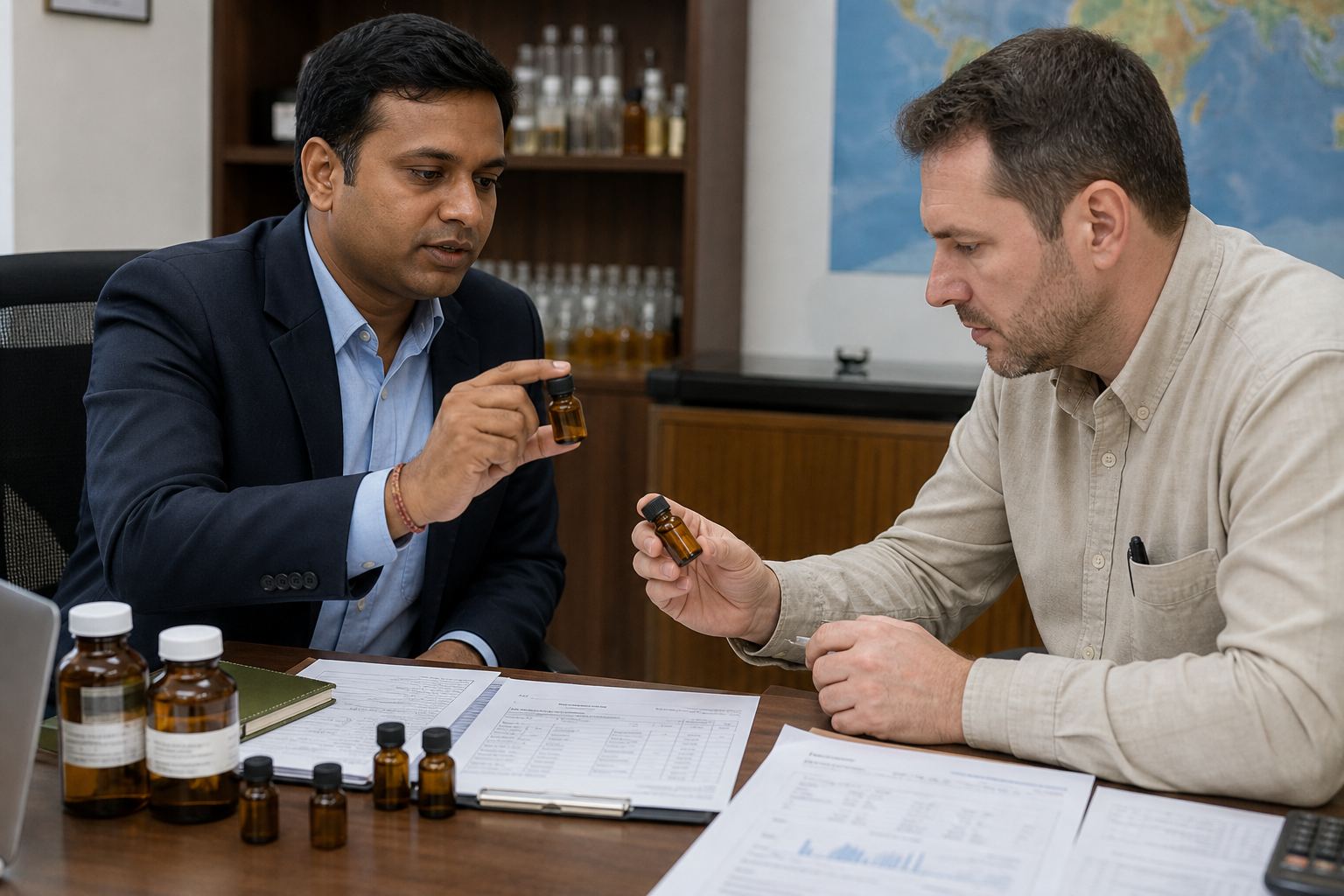
Finding international buyers for essential oils is not the same as finding buyers for generic commodities. HS 3301 trade is specification-led: fragrance houses, flavor manufacturers, aromatherapy brands, and cosmetics formulators evaluate suppliers on GC-MS chromatograms, IFRA alignment, and lot-to-lot consistency long before they discuss FOB pricing. Outreach that leads with price and volume without a credible quality story gets ignored — or worse, attracts fake buyers who waste months of distiller capacity.
This guide is a lead-generation and buyer-qualification playbook for Indian essential oil exporters, distillers, aggregators, and merchant exporters who already understand production but need a structured system to identify genuine importers, distributors, and procurement teams in the USA, EU, Middle East, Japan, and other destination markets. It covers Trade Map HS 3301 import intelligence, LinkedIn prospecting workflows, Chemexcil and trade-show channels including In-Cosmetics, Vitafoods, and World Perfumery Congress, and the verification steps that separate real purchase intent from broker noise and advance-fee traps.
Altus Exports operates as a merchant exporter and global sourcing partner for essential oils from India, connecting verified distillers with qualified international buyers while managing sample coordination, GC-MS documentation, and export logistics. The frameworks below reflect how we qualify buyers before committing distiller capacity — and how exporters can build the same discipline into their own outreach programs.
Key Takeaways
Summary Box
Executive Summary
Summary Box
International buyer discovery for essential oils rests on three pillars: market intelligence (who is already importing HS 3301 from India and competing origins), channel selection (trade data, LinkedIn, export promotion councils, and trade shows), and rigorous qualification (separating genuine procurement teams from brokers, speculators, and advance-fee fraud). Exporters who skip the intelligence and qualification layers — jumping straight to cold email with a price list — typically burn six to twelve months on non-converting leads before understanding why fragrance-lab buyers never replied.
This article does not repeat the full export process, documentation checklist, or oil-by-oil product ranking covered in companion guides. It focuses specifically on how to find buyers, where to find them, and how to verify they are real before you allocate distiller capacity. For operational export steps, see how to export essential oils from India. For destination-market selection, see best countries for Indian essential oil exports.

Market Size & Industry Overview
Key Statistics
The global essential oils market spans flavor and fragrance houses, cosmetics and personal care manufacturers, aromatherapy and wellness retail, food and beverage flavoring, and household product formulators. Published headline market-size figures vary widely depending on whether absolutes, oleoresins, and carrier oils are included — treat any single number as directional and always confirm scope before citing it in buyer outreach or investor conversations.
India occupies a structurally important position within HS 3301 trade: world-leading mentha (cornmint (Mentha arvensis)) production concentrated in the Uttar Pradesh belt, large-scale aromatic grass cultivation in Tamil Nadu and Andhra Pradesh, spice-derived oil distillation in Kerala and Karnataka, jasmine absolute production feeding fine fragrance supply chains, and Mysore-region sandalwood oil with heritage positioning (DGFT Restricted — export under licence; ITC-HS 3301 29 37). This diversity means Indian exporters can pitch both high-volume commodity oils and high-value specialty oils — but buyer discovery must be segmented by oil category, because a mentha buyer at a flavor house is not the same contact as a sandalwood buyer at a fine fragrance lab.
Lead generation succeeds when exporters understand which buyer segment maps to which oil. Flavor houses and confectionery manufacturers drive mentha and spice-oil demand. Fragrance houses and cosmetics brands drive lemongrass, citronella, palmarosa, jasmine, and sandalwood demand. Aromatherapy and wellness distributors drive eucalyptus, basil, and vetiver demand at smaller lot sizes but with retail-ready packaging expectations. Matching your outreach list to the correct segment before the first email is the single highest-leverage step in essential oil buyer discovery.
Essential Oil Buyer Segments and Lead-Generation Channels
Swipe →
Data table — swipe horizontally on small screens
| Buyer Segment | Primary Oil Demand | Decision Maker Titles | Best Discovery Channel |
|---|---|---|---|
| Flavor houses & FMCG | Mentha, peppermint, spearmint, spice oils | Procurement Manager, Flavor Chemist, Raw Materials Buyer | Trade Map HS 3301; Vitafoods; LinkedIn |
| Fragrance houses | Lemongrass, palmarosa, jasmine absolute, sandalwood | Senior Buyer, Fragrance Development, Raw Material Procurement | World Perfumery Congress; In-Cosmetics; LinkedIn |
| Cosmetics & personal care | Citronella, eucalyptus, basil, palmarosa | Formulation Manager, Sourcing Director, NPD Procurement | In-Cosmetics; LinkedIn; Trade Map |
| Aromatherapy & wellness retail | Eucalyptus, lemongrass, vetiver, basil | Brand Founder, Wholesale Buyer, Product Development | LinkedIn; trade shows; distributor directories |
| Household & industrial | Citronella, lemongrass | Raw Materials Procurement, Formulation Chemist | Trade Map; Chemexcil meets; LinkedIn |
| Re-export traders (UAE, Singapore) | Mixed HS 3301 basket | Trading Director, Commodity Trader | Trade Map; Gulf trade directories; LinkedIn |
Export Statistics
Key Statistics
India's essential oil export basket under HS 3301 is dominated by mint-type oils (HS 3301.24 and 3301.25), with mentha (cornmint) oil representing the largest single volume contribution — a position built on decades of cultivation and distillation scale in the Barabanki–Rampur–Badaun–Sambhal belt of Uttar Pradesh. HS 3301.29 captures India's exports of lemongrass, citronella, palmarosa, eucalyptus, basil, vetiver, sandalwood, and spice-derived oils, while HS 3301.30 covers concretes and absolutes including jasmine absolute.
DGCI&S and UN Comtrade data provide the backbone for buyer discovery: by analyzing which destination countries import the most from India under each HS 3301 subheading, exporters can prioritize outreach geographies that already have established supply relationships with Indian origin — reducing the education burden in first conversations. Trade Map (International Trade Centre) offers free visual access to bilateral trade flows by HS code, making it the most practical starting point for distillers who cannot afford paid import intelligence subscriptions.
Export value fluctuates with mentha crop yield, which is sensitive to monsoon timing and acreage decisions each season. Buyers sourcing mentha-type oils should expect price and availability variability tied to the UP harvest calendar — a fact that credible exporters mention proactively in outreach rather than hiding behind static price lists.
India Essential Oil Export Overview by HS 3301 Category (Indicative)
Swipe →
Data table — swipe horizontally on small screens
| HS Subheading | Key Oils | Primary Production Belt | Top Destination Markets |
|---|---|---|---|
| 3301.25 | Cornmint / other mint oils (Mentha arvensis) | Uttar Pradesh | China, USA, EU |
| 3301.25 | Mentha/cornmint, spearmint | Uttar Pradesh | USA, China, EU, Middle East |
| 3301.29 | Lemongrass, citronella, palmarosa, eucalyptus, basil, vetiver, sandalwood, spice oils | Tamil Nadu, Andhra Pradesh, Kerala, Karnataka | USA, EU, Japan, UAE |
| 3301.30 | Jasmine absolute, other concretes/absolutes | Karnataka, Tamil Nadu | France, USA, UAE, Japan |
Import Statistics
Key Statistics
Prospecting should prioritise destinations that already import Indian HS 3301 oils at scale. US flavor and oral-care buyers pull Mentha arvensis and peppermint derivatives; EU fragrance and cosmetics teams add REACH/IFRA filters on the same oil families; China remains a significant mentha-oil destination for menthol and related processing. Build account lists from those import patterns rather than spraying generic "essential oil buyer" outreach.
Trade Map analysis of HS 3301 imports by country reveals not just volume but competitive origin dynamics: Indian mentha competes primarily with synthetic menthol and other mint substitutes (China is also a major importer of Indian mint oils under HS 3301.25); lemongrass and citronella compete with Sri Lankan and Indonesian origins; sandalwood and jasmine absolute compete on quality documentation rather than price. Exporters who understand these origin comparisons can position Indian supply credibly in first outreach — acknowledging competition while highlighting India's structural advantages in mint volume, grass-oil acreage, and floral-absolute production infrastructure.
Middle East markets (UAE, Saudi Arabia) import essential oils for perfumery, personal care manufacturing, and re-export to neighboring markets. Japan is a smaller-volume but higher-price market for well-documented specialty oils, particularly sandalwood and jasmine absolute. China remains a major buyer of Indian mentha oil for menthol and pharmaceutical-adjacent processing industries.
Top Import Markets for Indian Essential Oils: Lead-Generation Priority
Swipe →
Data table — swipe horizontally on small screens
| Market | Import Volume Tier | Primary Oil Categories | Outreach Difficulty | Qualification Priority |
|---|---|---|---|---|
| USA | Very high | Mentha, lemongrass, eucalyptus, sandalwood | Moderate — crowded supplier market | GC-MS COA; FSSAI if food use; IFRA if fragrance use |
| Germany / EU | High | Mint oils, lemongrass, citronella, jasmine absolute | High — strictest documentation bar | REACH; IFRA; GC-MS COA |
| China | High (mentha-focused) | Mentha/cornmint oil | Moderate — price-sensitive | GC-MS COA; volume consistency |
| UAE / Gulf | Mid to high | Sandalwood, jasmine absolute, spice oils | Lower — relationship-driven | GC-MS COA; Halal-adjacent assurance |
| Japan | Mid (premium oils) | Sandalwood, jasmine absolute, eucalyptus | High — consistency expectations | GC-MS COA; precise lot documentation |
| UK | Mid to high | Mentha, lemongrass, aromatherapy oils | Moderate | GC-MS COA; UK REACH equivalent post-Brexit |
Product Categories / Variants
Summary Box
Essential oils exported from India fall into distinct functional categories, each attracting different buyer types and requiring different lead-generation approaches. Mint-type oils (mentha/cornmint, peppermint, spearmint) trade closest to a commodity, with buyers found primarily through flavor-industry channels and Trade Map analysis of HS 3301.24/25 import flows. Aromatic grass oils (lemongrass, citronella, palmarosa) serve fragrance, personal care, and household product formulators — buyers are discoverable through In-Cosmetics exhibitor lists and LinkedIn searches targeting cosmetics procurement.
Floral absolutes (jasmine) and heritage woods (sandalwood) occupy the premium tier, priced by the gram in some grades, with buyers found through World Perfumery Congress, fine fragrance industry networks, and specialist importer relationships in France, Japan, and the UAE. Spice-derived oils (black pepper, cardamom, ginger, turmeric, celery seed) serve flavor and pharmaceutical-adjacent buyers discoverable through Vitafoods and flavor-house procurement directories.
For detailed oil-by-oil specifications, GC-MS parameters, and FOB pricing by SKU, see top essential oil products exported from India. This section covers only what is needed to segment buyer discovery by product category.
Essential Oil Categories and Buyer Discovery Mapping
Swipe →
Data table — swipe horizontally on small screens
| Category | Representative Oils | Target Buyer Type | Lead-Gen Channel | HS Reference |
|---|---|---|---|---|
| Mint-type oils | Mentha arvensis, peppermint, spearmint | Flavor houses, oral care, confectionery | Vitafoods; Trade Map 3301.25/24; LinkedIn | 3301.25 (primary), 3301.24 |
| Aromatic grass oils | Lemongrass, citronella, palmarosa | Fragrance, personal care, household | In-Cosmetics; LinkedIn; Trade Map | 3301.29 |
| Herb & leaf oils | Basil, eucalyptus, davana | Wellness, personal care, pharma-adjacent | LinkedIn; aromatherapy trade media | 3301.29 |
| Floral absolutes | Jasmine absolute | Fine fragrance houses | World Perfumery Congress; specialist networks | 3301.30 |
| Heritage woods | Sandalwood oil | Fine fragrance, luxury cosmetics | World Perfumery Congress; Japan/UAE importers | 3301.29 |
| Spice-derived oils | Black pepper, cardamom, ginger, turmeric | Flavor, pharma-adjacent, food industry | Vitafoods; Trade Map; LinkedIn | 3301.29 |
Manufacturing Overview
Export Tip
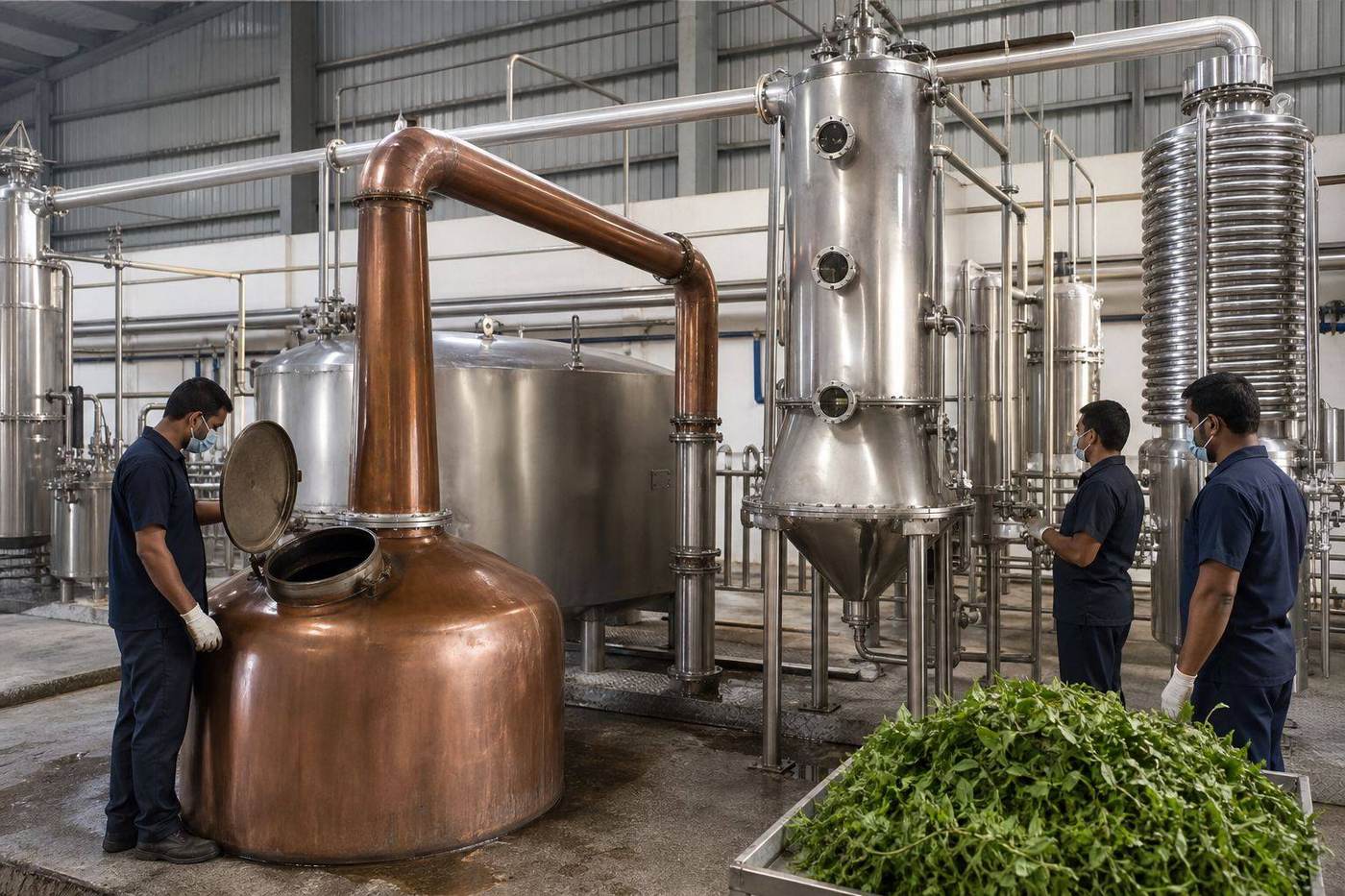
Understanding India's essential oil production clusters is essential for credible buyer outreach — international procurement teams ask about origin, distillation capability, and testing infrastructure within the first two conversations. Exporters who cannot articulate which cluster produces their target oil lose credibility before sample stage.
Uttar Pradesh Mentha Belt
The Barabanki, Rampur, Badaun, and Sambhal districts form the world's most concentrated mentha growing and distillation belt. Buyer outreach for mint-type oils should reference this cluster explicitly — flavor-house buyers already know it and expect Indian mentha suppliers to demonstrate UP-origin traceability and consistent menthol content by GC-MS.
Tamil Nadu and Andhra Pradesh: Aromatic Grasses
Large contiguous acreage under lemongrass, citronella, and palmarosa cultivation feeds distilleries supplying fragrance houses and personal care manufacturers globally. Outreach to cosmetics and fragrance buyers should highlight southern Indian grass-oil production capacity and citral/geraniol specification capability.
Kerala and Karnataka: Spice Oils and Jasmine
Kerala's spice-growing tradition supports steam distillation of black pepper, cardamom, ginger, and turmeric oils for flavor buyers. Karnataka contributes jasmine cultivation feeding solvent-extraction units producing jasmine absolute for fine fragrance — a category where buyer discovery happens through specialist trade shows rather than volume trade directories.
Mysore: Sandalwood Heritage
The Mysore region carries centuries-old sandalwood oil distillation heritage. Buyers for sandalwood oil are found through fine fragrance industry networks and premium cosmetics procurement — not through commodity trade directories. Outreach must lead with santalol % by GC-MS and sustainable sourcing documentation.
Pricing Analysis
Buyer Tip
Essential oil pricing is driven by botanical identity, marker compound concentration verified by GC-MS, extraction method, raw material yield in a given season, and packaging and certification stack. Mentha-type oils trade closest to a commodity; jasmine absolute and sandalwood command the highest per-kilogram prices in the Indian basket. Buyer outreach that leads with the lowest FOB price — without specification context — attracts price-shopping brokers rather than specification-driven procurement teams.
Credible outreach includes an indicative FOB range paired with the GC-MS marker that justifies it: menthol % for mentha, citral % for lemongrass, santalol % for sandalwood. Buyers who receive price-plus-specification in the first contact are more likely to engage than those who receive a generic price list covering twenty oils with no chromatographic context.
Indicative FOB Price Ranges for Indian Essential Oils (2025–2026)
Swipe →
Data table — swipe horizontally on small screens
| Oil | Specification Marker | Indicative FOB (USD/kg) | Buyer Segment |
|---|---|---|---|
| Mentha/Cornmint Oil | Menthol % by GC | USD 12–22/kg | Flavor houses, oral care |
| Peppermint Oil | Menthol, menthone ratios | USD 18–30/kg | Flavor houses, confectionery |
| Lemongrass Oil | Citral % by GC-MS | USD 10–20/kg | Fragrance, personal care, household |
| Citronella Oil | Citronellal/geraniol % | USD 8–16/kg | Household, personal care |
| Palmarosa Oil | Geraniol % by GC-MS | USD 30–55/kg | Fragrance, cosmetics |
| Jasmine Absolute | Olfactory profile; extraction grade | USD 3,000–6,000+/kg | Fine fragrance houses |
| Sandalwood Oil | Santalol % by GC-MS | USD 1,500–3,500+/kg | Fine fragrance, luxury cosmetics |
| Vetiver Oil | Vetiverol content | USD 120–250/kg | Fragrance, wellness |
| Black Pepper / Cardamom Oils | Marker compound % (varies) | USD 60–200/kg | Flavor, pharma-adjacent |
Expert Insight: Why Trade Data Beats Cold Email for Essential Oil Buyer Discovery
Expert Insight Box
Export Tip
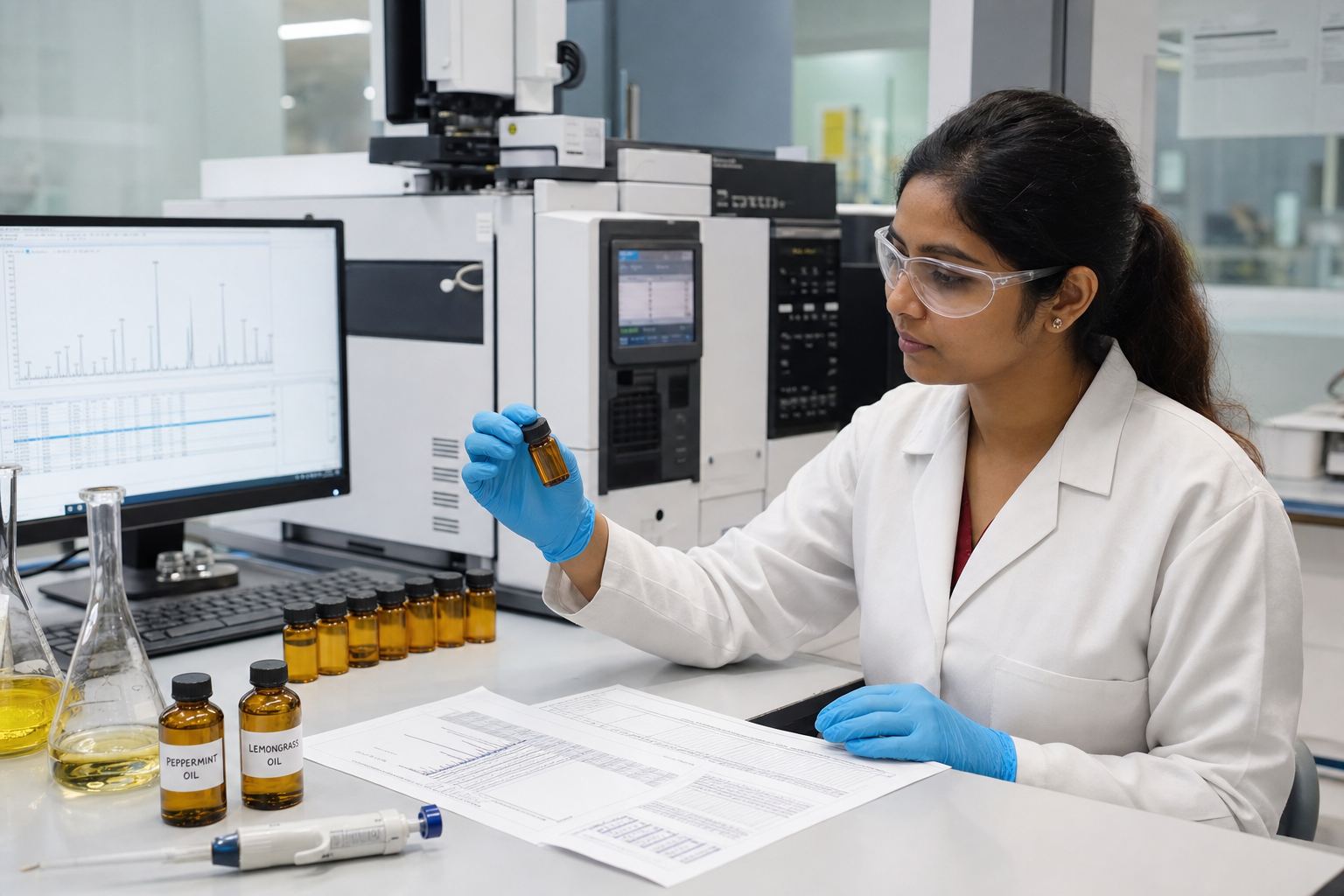
Saurabh Mittal, Founder of Altus Exports, advises distillers to spend their first two weeks on Trade Map HS 3301 analysis before sending a single cold email. The countries and companies already importing from India — or from competing origins for the same oil — represent buyers with proven demand, established customs classification experience, and procurement infrastructure. Cold outreach to companies with zero HS 3301 import history converts at a fraction of the rate.
He also warns against treating LinkedIn connection volume as a lead-generation metric. In essential oils, ten qualified conversations with fragrance-lab procurement managers outperform five hundred connection requests to generic "essential oil importer" profiles that have no verifiable company registration or import history.
MOQ Analysis
Buyer Tip
When qualifying a lead, translate interest into a realistic first lot. Commodity mentha programmes often start at a few hundred kilograms when distillation capacity is liquid; lemongrass and citronella trials commonly open in the tens to low hundreds of kilograms; jasmine absolute and sandalwood move in much smaller lab-to-kilo units. Use MOQ as a seriousness filter: buyers unwilling to state grams versus drums rarely convert after fair meetings.
Buyer qualification must include MOQ alignment: a buyer requesting 5 MT of jasmine absolute at commodity-oil pricing is a red flag, not a lead. Similarly, a buyer requesting 50 kg of sandalwood oil at mentha prices has not done basic market research. Exporters should confirm MOQ expectations in the first specification exchange rather than discovering misalignment after sample shipment.
MOQ Guidelines and Buyer Expectation Alignment
Swipe →
Data table — swipe horizontally on small screens
| Order Type | Typical MOQ | Applicable Oils | Buyer Red Flag |
|---|---|---|---|
| Evaluation sample | 100 g–1 kg | All categories | Refuses to pay sample courier cost |
| Trial lot — mid-tier | 25–180 kg | Lemongrass, citronella, palmarosa, basil | Demands trial at sample pricing |
| Trial lot — premium | 0.5–5 kg | Jasmine absolute, sandalwood, vetiver | Requests MT volumes at commodity price |
| Commercial — mint oils | 200 kg–1 MT+ | Mentha, peppermint, spearmint | No GC-MS specification discussion |
| Commercial — spice oils | 50–500 kg | Black pepper, cardamom, ginger, turmeric | No FSSAI/food-grade requirement stated |
| FCL program | 5–15 MT | Mentha and high-volume oils | Requests FCL before sample approval |
Packaging Standards
Export Tip
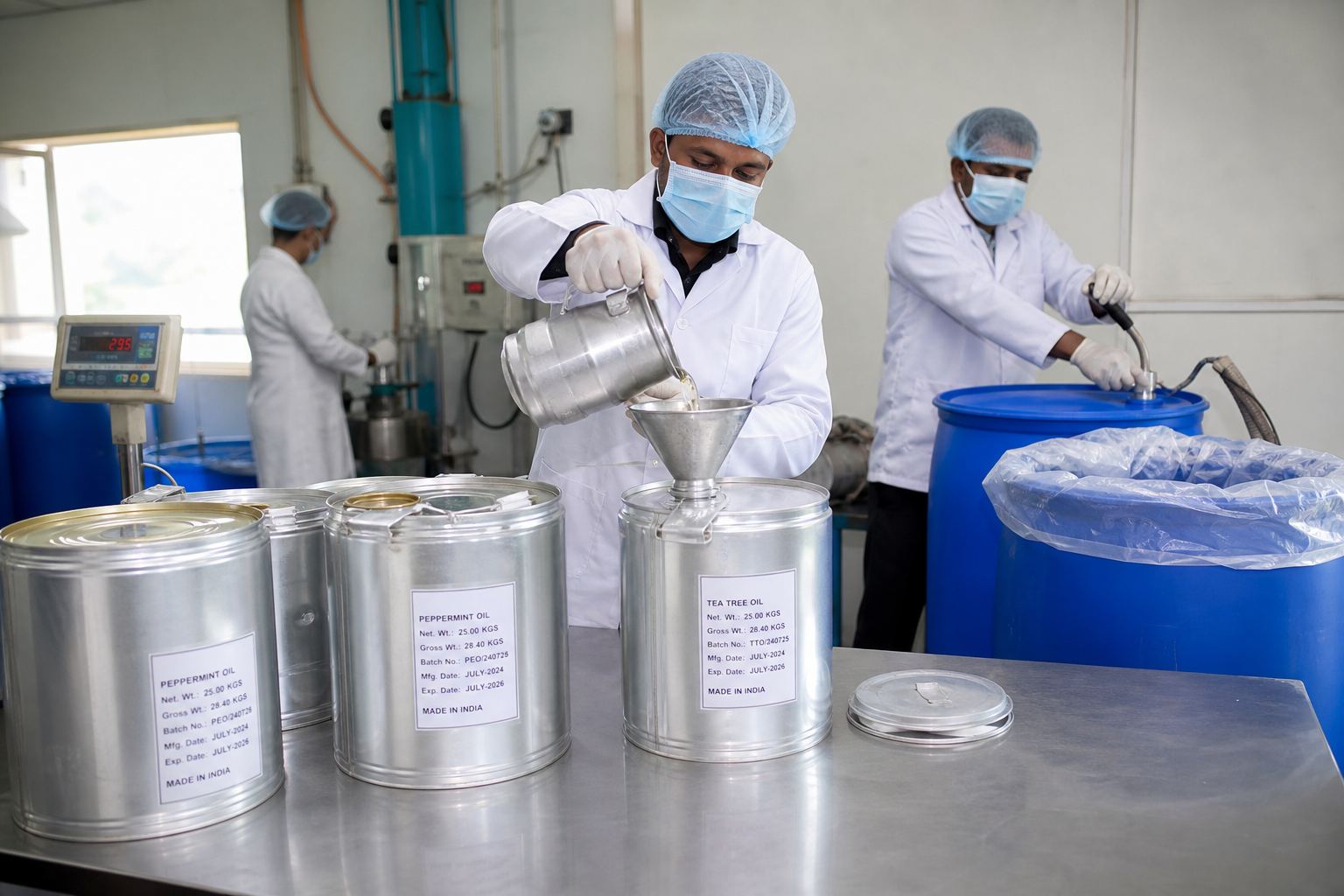
Packaging is a buyer-qualification signal as much as a logistics requirement. Serious international buyers ask about drum material, lining compatibility, and nitrogen blanketing in early conversations — because they have received shipments in incompatible containers that degraded oil quality in transit. Exporters who can articulate packaging standards credibly in outreach pass an implicit qualification test.
Commercial export standard is 25 kg, 50 kg, or 180 kg aluminium, GI, HDPE, or epoxy-lined mild-steel drums, with amber glass for samples. Nitrogen blanketing protects oxidation-sensitive oils. All drums must be labelled with product name, batch number, distillation date, net weight, and country of origin.
Packaging Formats Relevant to Buyer Conversations
Swipe →
Data table — swipe horizontally on small screens
| Format | Net Weight | Best For | Buyer Question to Expect |
|---|---|---|---|
| Aluminium drum | 25–180 kg | General-purpose oils | Corrosion resistance for specific oil? |
| GI drum | 25–180 kg | Bulk commodity oils | Chemical compatibility confirmation |
| HDPE drum | 25–50 kg | Compatible oils | Food-grade certification of plastic |
| Epoxy-lined mild-steel | 180 kg | High-terpene oils | Lining integrity verification |
| Amber glass bottle | 10 ml–1 kg | Samples | Courier customs paperwork competence |
| Nitrogen-blanketed drum | 25–180 kg | Oxidation-sensitive oils | Headspace purge protocol documentation |
Container Loading Details
Export Tip
Container loading details matter in buyer conversations when discussing commercial programs and FCL pricing. A buyer evaluating a recurring mentha supply program will ask about load port proximity to the UP distillation belt (Kolkata), pallet configuration, and approximate MT per 20-foot FCL — because these factors affect landed cost and supply reliability.
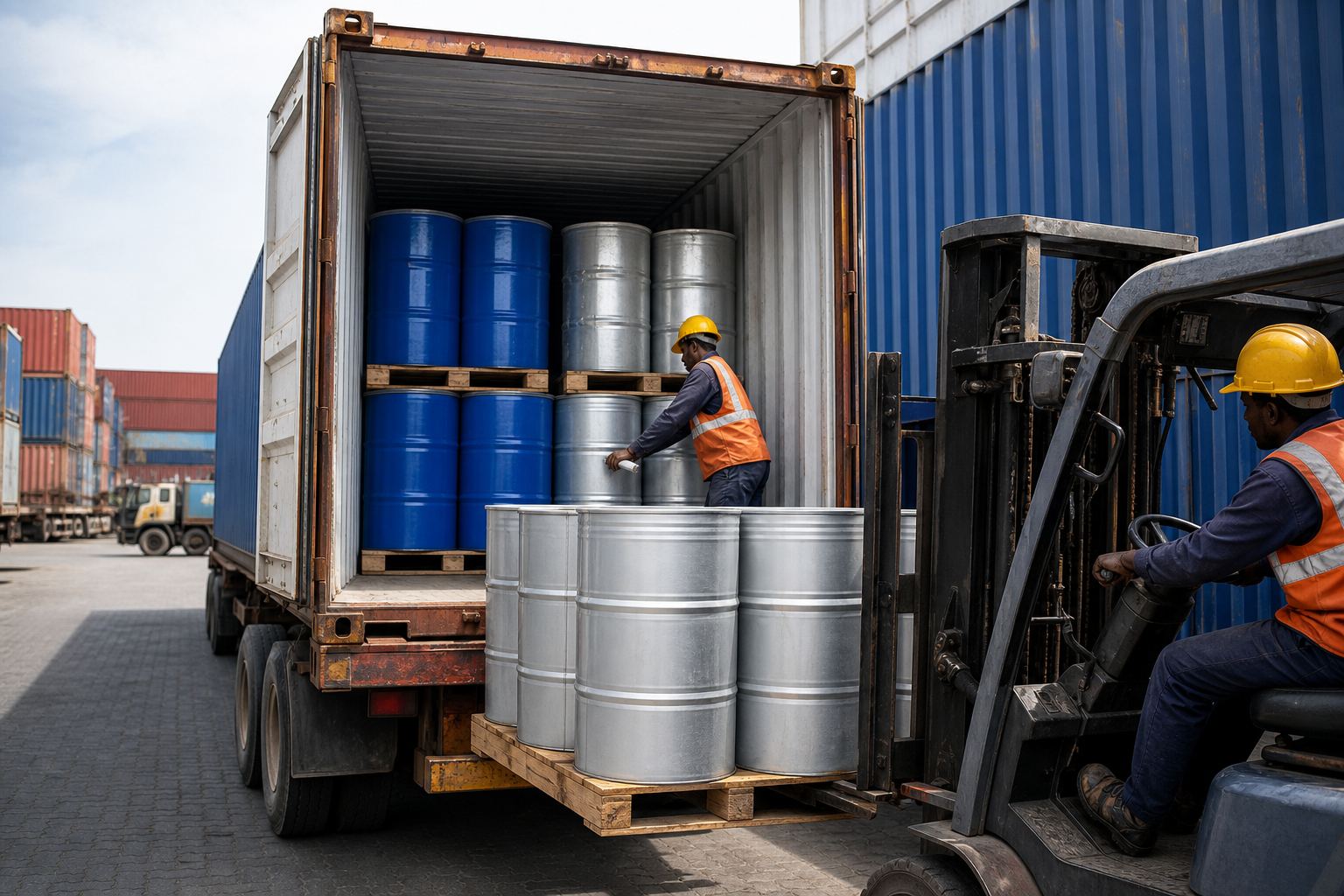
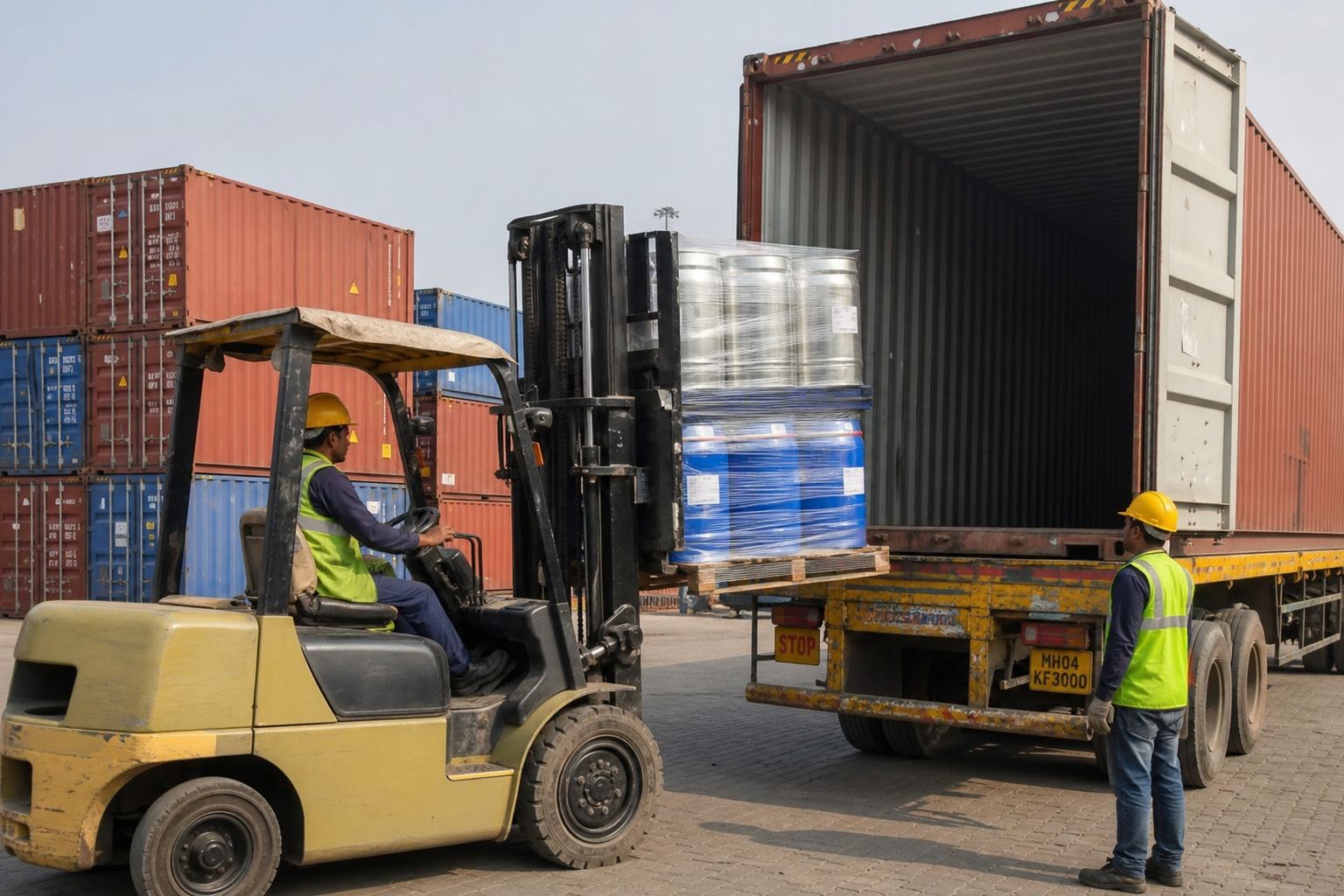
Drums are palletized upright with stretch-wrap securing. Essential oil drums should never be stacked on their side. Buyers and forwarders should confirm cool, dark storage during transit holds.
Container Loading Reference for Buyer Program Planning
Swipe →
Data table — swipe horizontally on small screens
| Container Type | Approx. Payload | Typical Oils | Buyer Planning Note |
|---|---|---|---|
| 20-foot FCL | About 12–16 MT drummed oil (indicative; confirm payload) | Mentha, citronella, lemongrass | Confirm weight limit with forwarder |
| 40-foot FCL | Weight-limited; ~1.6–2x 20ft | High-volume mint and grass oils | Engineer exact MT before quoting FCL price |
| LCL consolidation | 1 drum to part-pallet | Trial and small commercial lots | Cost-effective for first orders |
| Air freight | Premium and urgent lots | Jasmine absolute, sandalwood | Value density justifies cost premium |
Shipping Methods
Export Tip
Shipping method selection affects buyer lead conversion when discussing trial versus commercial programs. First-time buyers often prefer CIF quotes that include freight to their destination port; established buyers managing their own logistics prefer FOB at Indian load ports. Understanding the buyer's preferred Incoterm early in qualification prevents pricing mismatches late in negotiation.
Sea freight in FCL or LCL is standard for commercial volumes. Air freight serves samples, urgent orders, and premium oils. Key load ports: Kolkata (UP mentha belt), Nhava Sheva and Mundra (western routes), Chennai (southern producers).
Shipping Methods and Buyer Communication Points
Swipe →
Data table — swipe horizontally on small screens
| Mode | Typical Use | Transit Time | Buyer Expectation |
|---|---|---|---|
| Sea FCL | Commercial mint, grass, spice programs | 18–35 days | FOB or CIF quote; pre-alert documentation |
| Sea LCL | Trial and mid-size lots | Similar + consolidation | CFS storage condition confirmation |
| Air freight | Jasmine, sandalwood, urgent orders | 3–7 days | Secured crating; insurance for high-value |
| Courier (samples) | 100 g–1 kg evaluation | 2–5 business days | Amber glass; correct customs paperwork |
Certifications
Compliance Notes
Certifications are buyer-qualification checkpoints. A fragrance-house buyer will ask about IFRA compliance. An EU buyer will ask about REACH. A food-flavor buyer will ask about FSSAI. An exporter who cannot discuss these credentials in outreach will not pass first-stage qualification with specification-driven buyers — regardless of oil quality.
Chemexcil RCMC is the sector-specific registration that signals export-sector credibility. IEC from DGFT is mandatory for any exporter. GC-MS Certificate of Analysis functions as the de facto quality passport for every serious buyer.
Certifications Buyers Ask About During Qualification
Swipe →
Data table — swipe horizontally on small screens
| Certification | Issuing Body | Buyer Segment | Outreach Relevance |
|---|---|---|---|
| Chemexcil RCMC | Basic Chemicals, Cosmetics & Dyes EPC | All international buyers | Sector credibility signal in first contact |
| FSSAI Licence | FSSAI, Government of India | Food/flavor-grade buyers | Mandatory for food-chain procurement |
| GC-MS COA | NABL-accredited or equivalent lab | All serious buyers | Include spec sheet with outreach materials |
| IFRA Compliance | Self-declared against IFRA standards | Fragrance-industry buyers | Mention proactively for fragrance-use oils |
| REACH Registration / SDS | EU REACH framework | EU buyers | Confirm before EU-targeted outreach |
| Certificate of Origin | Chamber of Commerce / FIEO | Most international shipments | Standard commercial documentation |
Buyer Requirements
Buyer Requirements
Buyer requirements vary by market and application — and understanding them before outreach prevents wasted effort on buyers whose compliance needs exceed your current documentation capability.
Using Trade Map HS 3301 for Buyer Discovery
Trade Map (trademap.org) provides free access to bilateral trade flows by HS code. Search HS 3301 imports for your target destination country, filter by Indian origin, and identify the top importing partner countries and recent trend direction. Cross-reference importing company names (where available) with LinkedIn and corporate registries. For deeper company-level intelligence, complement Trade Map with ImportGenius, Panjiva, or Volza — but Trade Map alone is sufficient to prioritize which countries deserve outreach budget.
Analyze at subheading level: 3301.24/25 for mint buyers, 3301.29 for grass and specialty oil buyers, 3301.30 for absolute buyers. A country importing large volumes of 3301.25 from India is a mentha opportunity; a country importing 3301.30 is a jasmine or absolute opportunity — different contacts, different trade shows, different specification language.
LinkedIn Prospecting for Essential Oil Buyers
Effective LinkedIn prospecting targets specific titles at specific company types: "Procurement Manager" or "Raw Materials Buyer" at flavor houses; "Senior Buyer" or "Fragrance Development" at fragrance companies; "Sourcing Director" or "Formulation Manager" at cosmetics brands; "Wholesale Buyer" at aromatherapy distributors. Use LinkedIn Sales Navigator filters: industry (food production, cosmetics, chemicals), geography (target import country), title keywords (procurement, sourcing, raw materials, fragrance).
Connection requests should reference a specific oil and a specific capability — not a generic "we are a leading exporter of essential oils" template. Example: "We distill mentha oil in the UP belt with consistent 68–72% menthol by GC-MS — happy to share a spec sheet if your flavor team sources Indian mint." This filters for buyers who actually source mentha while repelling brokers who mass-connect with any supplier.
Chemexcil and Trade-Show Buyer Channels
Chemexcil (Basic Chemicals, Cosmetics & Dyes Export Promotion Council) organizes buyer-seller meets, trade delegations, and market development programs specifically for essential oils and allied aromatic chemicals. RCMC-registered exporters gain access to these programs — making Chemexcil registration a prerequisite for structured buyer discovery, not just a compliance checkbox. See Chemexcil and FSSAI registration benefits for essential oil exporters for credential details.
In-Cosmetics Global (rotating European cities) is the premier trade show for cosmetics and personal care raw material buyers — ideal for lemongrass, citronella, palmarosa, and eucalyptus outreach. Vitafoods Europe and Vitafoods Asia attract flavor-house and nutraceutical procurement teams — ideal for mentha and spice-oil outreach. World Perfumery Congress (WPC) is the specialist event for fine fragrance raw material buyers — essential for jasmine absolute and sandalwood positioning. For a full trade-show calendar and preparation guide, see trade shows for essential oil exporters.
Buyer Qualification Framework
Qualify every lead before allocating distiller capacity using a structured checklist: (1) Company registration verified through destination-country corporate registry. (2) Website and product portfolio confirm essential oil procurement is core business, not a side listing. (3) Import history corroborated through Trade Map or paid import data. (4) Written specification exchange completed — botanical name, marker compound range, intended application. (5) Sample request follows specification discussion, not precedes it. (6) Payment terms are reasonable — partial advance against proforma, balance against documents; never 100% advance to an unverified buyer. (7) Contact is reachable on corporate email domain, not only free webmail.
Fake-Buyer Traps and Advance-Fee Fraud
Essential oil exporters are targeted by several recurring fraud patterns. The advance-fee trap: a "buyer" agrees to a large order but requires the exporter to pay inspection fees, visa costs, or customs facilitation charges upfront — money that disappears after payment. The broker masquerading as end buyer: an intermediary claims to represent a major fragrance house but cannot provide a purchase order on the end buyer's letterhead or facilitate a direct specification call with the procurement team.
The specification-free bulk inquiry: a buyer requests 10 MT of sandalwood or jasmine absolute at mentha pricing without discussing GC-MS requirements — indicating no genuine market knowledge. The free-webmail-only contact: legitimate procurement teams at flavor and fragrance houses use corporate email; a gmail-only contact requesting urgent shipment at above-market prices is a red flag. The overpayment scam: buyer sends a fraudulent bank confirmation for more than the invoice amount and requests a refund of the difference.
Protect yourself: never pay any fee to a buyer; verify company registration independently; require corporate email communication; conduct a video call with the procurement team before production commitment; and use partial payment structures that protect the exporter until documents are presented.
Country-wise Opportunities
Market Snapshot
Each destination market rewards a different outreach strategy and qualification intensity. Use Trade Map to confirm current import volumes before allocating outreach budget to a country — a market that imported USD 50 million of HS 3301 from India last year deserves more effort than a market with negligible import history.
Country-wise Buyer Discovery Strategy for Indian Essential Oil Exporters
Swipe →
Data table — swipe horizontally on small screens
| Country/Region | Top Oils in Demand | Lead-Gen Channel | Qualification Intensity | Key Trade Event |
|---|---|---|---|---|
| USA | Mentha, lemongrass, eucalyptus, sandalwood | Trade Map; Vitafoods; LinkedIn | High — crowded market | Vitafoods USA; WPC |
| Germany / France (EU) | Mint, lemongrass, citronella, jasmine absolute | Trade Map; In-Cosmetics; LinkedIn | Very high — REACH/IFRA | In-Cosmetics Global; WPC |
| China | Mentha/cornmint oil | Trade Map; direct trade networks | Moderate — price-driven | Regional flavor industry events |
| UAE / Saudi Arabia | Sandalwood, jasmine absolute, spice oils | Trade Map; Gulf directories; LinkedIn | Moderate — relationship-driven | Beautyworld Middle East |
| Japan | Sandalwood, jasmine absolute, eucalyptus | Specialist importers; LinkedIn | High — consistency focus | In-Cosmetics Asia |
| UK | Mentha, lemongrass, aromatherapy oils | Trade Map; LinkedIn | Moderate — post-Brexit REACH | In-Cosmetics UK |
Sourcing Checklist
Checklist
Before committing distiller capacity to a new international buyer, confirm each of the following qualification checkpoints.
Buyer, Exporter, and Compliance Checklists
Checklist
Compliance Notes
Common Buyer Mistakes
Common Mistakes Box
Exporters make distinct mistakes in buyer discovery that cost months of distiller capacity. The most expensive is treating all inquiries equally — responding to fake buyers with the same urgency as qualified fragrance-lab procurement teams.
Common Exporter Mistakes in Essential Oil Buyer Discovery
Swipe →
Data table — swipe horizontally on small screens
| Mistake | Consequence | How to Avoid |
|---|---|---|
| Cold email with price list only, no GC-MS context | Attracts brokers and price shoppers, not procurement teams | Lead with specification capability and sample offer |
| No Trade Map analysis before outreach | Wasted effort on countries with no import demand for your oil | Analyze HS 3301 import flows first |
| Treating LinkedIn connection count as success metric | Hundreds of connections, zero purchase orders | Target procurement titles at verified companies |
| Skipping buyer qualification to close fast | Advance-fee fraud or unpaid shipments | Apply qualification framework before production |
| Same outreach message for all oil categories | Mentha pitch to sandalwood buyer destroys credibility | Segment outreach by oil category and buyer segment |
| Ignoring trade-show channels | Missing specification-driven buyers at In-Cosmetics, Vitafoods, WPC | Plan annual trade-show calendar with Chemexcil support |
| Committing distiller capacity before sample approval | Production locked for buyer who never converts | Sample-then-trial-then-commercial sequencing |
Future Market Trends
Key Statistics
Buyer discovery channels are shifting as essential oil procurement professionalizes. LinkedIn and trade-show exhibitor lists remain primary for fragrance and cosmetics buyers, but flavor-house procurement is increasingly centralized through approved-supplier portals that require pre-qualification before any outreach is possible — making Chemexcil-facilitated introductions and existing buyer referrals more valuable than cold email.
Sustainability and traceability documentation is becoming a buyer-qualification requirement for sandalwood and wildcrafted oils, not a premium add-on. Exporters who can provide farm-to-drum or plantation-to-drum traceability documentation will pass qualification faster with EU and USA wellness brands. GC-MS specification tightness is increasing across all segments — buyers who once accepted botanical-name-only purchasing now require marker compound ranges, pushing outreach toward specification-led positioning.
Future Trends in Essential Oil Buyer Discovery (2026–2030)
Swipe →
Data table — swipe horizontally on small screens
| Trend | Impact on Lead Generation | Preparation Strategy |
|---|---|---|
| Approved-supplier portal centralization | Cold email less effective for large flavor/FMCG buyers | Invest in Chemexcil introductions and referrals |
| Trade-show digital hybrid formats | Pre-show LinkedIn outreach + on-show meeting sequencing | Register early; book buyer meetings pre-event |
| Traceability as qualification gate | Sandalwood and niche oils need sourcing documentation in outreach | Build traceability docs before premium-oil outreach |
| Tighter GC-MS specification culture | Generic price lists increasingly ignored | Lead every outreach with marker compound capability |
| EU REACH and IFRA scrutiny intensifying | EU buyer qualification takes longer but rewards compliant suppliers | Pre-clear REACH/IFRA before EU outreach campaigns |
Expert Insight: What Separates Exporters Who Find Buyers from Those Who Wait
Expert Insight Box
Saurabh Mittal observes a consistent pattern: exporters who treat buyer discovery as a weekly discipline — Trade Map review, LinkedIn outreach, trade-show follow-up, qualification calls — build pipeline within one season. Exporters who send a burst of cold emails after harvest and then wait for replies rarely convert international buyers, because specification-driven procurement runs on relationship timelines measured in quarters, not weeks.
He advises distillers without international sales staff to partner with a merchant exporter who already holds buyer relationships and qualification infrastructure — rather than spending twelve months learning fake-buyer avoidance through expensive mistakes. The distiller's competitive advantage is oil quality and production consistency; the merchant exporter's advantage is buyer access and qualification speed.
Conclusion
- Operational export process: how to export essential oils from India.
- Destination market selection: best countries for Indian essential oil exports.
- Oil-by-oil product depth: top essential oil products exported from India.
- Buyer-side sourcing workflow: source essential oils directly from India.
- Country-specific demand map: most demanded Indian essential oils by country.
- Trade-show calendar: trade shows for essential oil exporters.
- Documentation readiness: essential oil export documentation checklist.
- Premium positioning: organic and therapeutic essential oil export opportunities.
- Contact Altus Exports merchant exporter services or export products from India to begin a qualified essential oil buyer conversation.
Finding international buyers for essential oils requires market intelligence, channel discipline, and rigorous qualification — not a generic price list sent to five hundred email addresses. Trade Map HS 3301 analysis identifies where demand already exists. LinkedIn prospecting with procurement-title targeting identifies who to contact. Chemexcil programs, In-Cosmetics, Vitafoods, and World Perfumery Congress provide access to specification-driven buyers who understand GC-MS requirements. And the qualification framework — company verification, specification exchange, sample approval, and payment structure — separates genuine procurement teams from fake-buyer traps.
India's structural advantages in mentha, aromatic grass oils, spice-derived oils, jasmine absolute, and sandalwood give exporters credible category stories for outreach — but only when the story matches the buyer's actual requirement and documentation expectations. Exporters who invest in qualification discipline convert fewer leads at higher value; those who skip qualification convert noise at a cost.
Altus Exports operates as a merchant exporter and global sourcing partner for essential oils from India, connecting verified distillers with qualified international buyers across flavor, fragrance, cosmetics, and wellness segments — managing buyer qualification, sample coordination, GC-MS documentation, and export logistics from Indian ports to destination markets.