
Organic & Ayurvedic Herbal Oil Export Opportunities from India
By Saurabh Mittal, Founder, Altus Exports
How Indian herbal oil exporters move beyond commodity castor and sesame pricing into premium value through NPOP, USDA NOP, and EU Organic certification, cold-pressed positioning, medicated Ayurvedic Taila differentiation, and disciplined segregation SOPs that buyers actually audit.
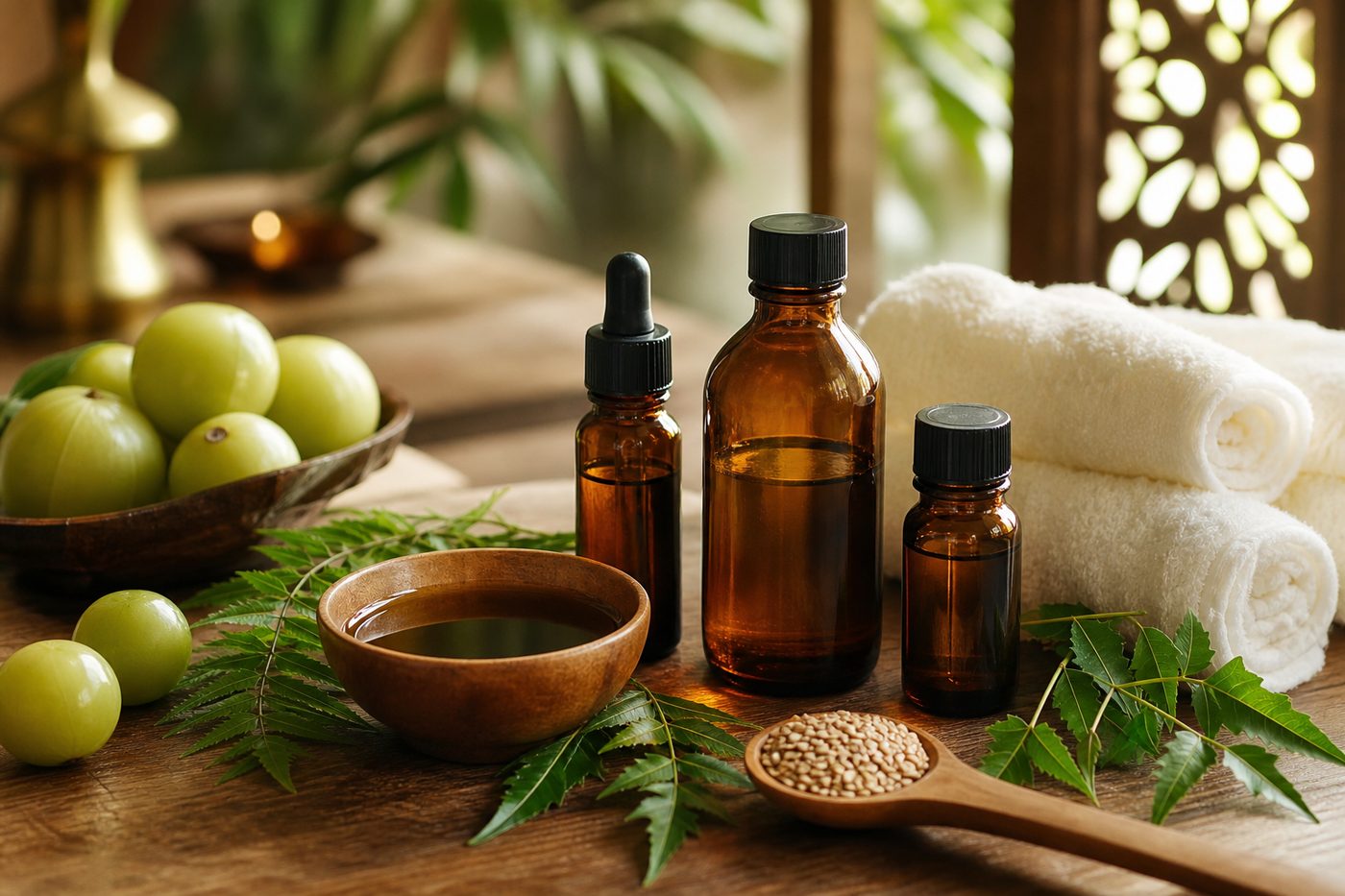
Commodity castor oil from Gujarat and solvent-extracted sesame oil from the northern belt compete on volume and industrial feedstock pricing — a market where India holds structural advantage but faces thin margins and price-sensitive industrial buyers. Premium export value in India's herbal oil basket sits elsewhere: NPOP-certified organic castor, sesame, coconut, flaxseed, and almond oil for clean-beauty and organic-food brands; cold-pressed grades for sesame, coconut, flaxseed, and almond that command a documented quality premium over solvent-extracted commodity oil; and AYUSH-licensed medicated Ayurvedic Taila — Bhringraj, Amla, Brahmi, Mahanarayan, and dozens of other classical formulations — that Western wellness retailers and GCC/ASEAN pharmacy chains will pay multiples of generic 'herbal hair oil' pricing for, provided the manufacturer can prove the licence and formulation behind the claim.
This guide covers the premium positioning layer of Indian herbal oil export: the NPOP organic certification pathway and its destination-market acceptance routes (US–India organic equivalence for USDA-labelled sales; EU Organic Regulation 2018/848 compliance for processed oils); cold-pressed premiums specifically for sesame, coconut, flaxseed, and almond oil; the operational difference between a medicated Ayurvedic Taila and a commodity herbal hair oil; and the segregation SOPs — farm-to-drum chain of custody — that separate credible premium suppliers from exporters who add an organic or Ayurvedic label without the certification infrastructure to back it.
Altus Exports operates as a merchant exporter and global sourcing partner for herbal oils from India, connecting international buyers seeking certified organic and AYUSH-licensed medicated oils with verified manufacturers who maintain legitimate NPOP/USDA/EU Organic certification chains and genuine AYUSH drug licences. This guide reflects the premium positioning frameworks we use with clean-beauty brands, organic-food buyers, and Ayurvedic wellness retailers — and how Indian exporters can move up the value chain beyond commodity castor and sesame.
Key Takeaways
Summary Box
Executive Summary
Summary Box
Indian herbal oil exporters face a strategic choice similar to producers in other Indian agri-export categories: compete in commodity castor and solvent-extracted sesame at volume-driven, feedstock-linked margins, or invest in NPOP/USDA/EU Organic certification, cold-pressed processing infrastructure, and AYUSH-licensed medicated Taila manufacturing to capture premium export value. The premium path requires higher upfront investment in certification, segregation, and formulation compliance — but delivers materially higher FOB pricing, stickier annual-contract buyer relationships, and access to clean-beauty, organic-food, and Ayurvedic wellness buyer segments that commodity suppliers cannot reach.
This article does not repeat the full export process or buyer-discovery playbook covered in companion guides. It focuses on premium positioning: which certifications matter and how NPOP connects to USDA-labelled and EU Organic-compliant oil sales in practice, what cold-pressed means in verifiable practice for sesame, coconut, flaxseed, and almond, how medicated Ayurvedic Taila differs operationally and commercially from a generic herbal hair oil, and what segregation SOPs credible premium suppliers must demonstrate. For export operations, see how to export herbal oils from India. For buyer discovery, see find international buyers for herbal oils.
Market Size & Industry Overview
Key Statistics
The global shift toward clean-label, organic, and traditional-medicine-informed wellness products is expanding demand for certified organic and AYUSH-licensed herbal oils well beyond the industrial and commodity food-oil channels that have historically dominated India's castor and sesame trade. This premium segment values documented organic chain-of-custody, verifiable cold-press processing, and — for Ayurvedic Taila — genuine formulation and licence compliance more than absolute lowest FOB price, creating a structurally different buyer relationship than commodity castor or coconut oil procurement.
India's organic herbal oil production base is growing but remains a small fraction of total fixed-oil export volume. NPOP-certified organic cultivation of castor, sesame, and select oilseeds exists in Gujarat, Rajasthan, and parts of Madhya Pradesh; organic coconut cultivation concentrates in Kerala and Tamil Nadu. Certified organic cold-press and packing capacity, however, is the binding constraint on premium supply, not organic farm acreage alone — a buyer sourcing certified organic oil needs chain-of-custody documentation from certified farm through certified cold-press to certified packing, a requirement that eliminates most conventional expeller units lacking segregation infrastructure.
Cold-pressed positioning occupies a related but distinct premium tier for sesame, coconut, flaxseed, and almond oil: extraction at low temperature without solvents, preserving nutrient and marker-compound profile, which does not require organic certification but demands verifiable process documentation and batch-consistency testing that conventional solvent-extraction units typically do not maintain. Medicated Ayurvedic Taila occupies a third, entirely separate premium tier grounded in regulatory licence rather than agricultural certification — the AYUSH drug manufacturing licence, not the organic seal, is the credential that legitimises a therapeutic claim.
Table 1 — Premium Herbal Oil Market Segments and Value Positioning
Swipe →
Data table — swipe horizontally on small screens
| Segment | Certification / Licence Demand | Price Premium vs Conventional | Primary Indian Oils | Key Buyer Type |
|---|---|---|---|---|
| Clean-beauty cosmetics | NPOP/USDA/EU Organic; cold-pressed | 25–50% | Castor, coconut, almond, sesame | Premium cosmetics brands, D2C skincare |
| Organic food & nutraceutical | NPOP/USDA/EU Organic + FSSAI | 20–40% | Sesame, flaxseed, kalonji-adjacent | Organic food and supplement brands |
| Ayurvedic wellness & pharmacy retail | AYUSH drug manufacturing licence | Multiples of generic 'herbal oil' | Medicated Taila (Bhringraj, Amla, Brahmi, Mahanarayan) | Ayurvedic wellness brands, pharmacy chains |
| Cold-pressed premium retail | Process documentation; batch consistency | 15–35% | Sesame, coconut, flaxseed, almond | Wellness retail, private-label brands |
| Commodity castor / solvent sesame | COA; standard export documentation | Baseline — thin margins | Castor oil, solvent-extracted sesame | Industrial distributors, flavour houses |
Export Statistics
Key Statistics
India's total HS 1515 fixed-oil exports are dominated by conventional castor oil volume from the Gujarat belt — a category where certified organic and cold-pressed supply remains a small but growing fraction. Official DGCIS trade data does not isolate organic-certified or cold-pressed herbal oil exports as separate line items, making precise premium-segment export volume difficult to cite with audited precision; industry estimates suggest certified organic and cold-pressed herbal oil exports from India represent well under 10% of total HS 1515/1513 export value, concentrated in sesame, coconut, flaxseed, and almond rather than castor.
Medicated Ayurvedic Taila contributes a distinct and disproportionately valuable slice of export revenue relative to volume once it reaches finished retail-ready form — a single carton of premium Mahanarayan or Brahmi Taila retail bottles can carry substantially more per-kilogram value than an equivalent weight of bulk conventional castor or coconut oil. Exporters pursuing premium positioning should measure success in export value per kilogram and buyer retention, not container volume alone.
Export growth in the premium segment is driven by clean-beauty brand launches in the USA and EU, expanding organic-food and nutraceutical retail distribution, and growing Ayurvedic wellness retail presence in Western markets alongside the established GCC and ASEAN diaspora demand for medicated Taila.
Table 2 — India Herbal Oil Export: Conventional vs Premium Value Contribution
Swipe →
Data table — swipe horizontally on small screens
| Category | Volume Share (Indicative) | Value Share (Indicative) | Premium Potential | Certification/Licence Path |
|---|---|---|---|---|
| Conventional castor oil | 55–65% of volume | 35–45% of value | Low — feedstock-linked pricing | COA; standard export documentation |
| Conventional coconut/sesame/almond | 20–25% of volume | 20–25% of value | Moderate — organic/cold-press upgrade path | NPOP/USDA/EU Organic; cold-press process docs |
| Certified organic herbal oils | Under 5% of volume | 5–10% of value | High — growing segment | NPOP + destination CB recognition (US equivalence / EU compliance for processed oils) |
| Cold-pressed premium (sesame, coconut, flax, almond) | 5–8% of volume | 8–14% of value | High — clean-label retail growth | Process documentation; batch consistency testing |
| Medicated Ayurvedic Taila (retail-ready) | Under 3% of volume | 10–18% of value | Very high — licence-scarcity driven | AYUSH drug manufacturing licence |
Import Statistics
Key Statistics
The United States is the largest import market for certified organic herbal oils globally, driven by USDA Organic labelling requirements for products sold as organic in the USA and by a large clean-beauty and organic-food retail sector that treats organic certification as a baseline expectation for premium shelf placement. EU markets — Germany, France, and the UK — follow closely, with EU Organic Regulation 2018/848 governing products sold as organic in the European Union.
GCC and ASEAN markets, by contrast, lead for medicated Ayurvedic Taila import demand, driven by South Asian diaspora populations and an expanding pharmacy and wellness retail channel that stocks classical Ayurvedic formulations alongside conventional personal care products. Buyers in these markets expect AYUSH licence documentation and, increasingly, local product registration support rather than organic certification as the primary qualification credential.
Import demand for certified organic and cold-pressed herbal oils is growing faster than conventional HS 1515/1513 import growth in North America and Western Europe — a trend that rewards Indian exporters who invest in certification and process-documentation infrastructure early rather than attempting to retrofit organic or cold-pressed claims onto conventional supply chains after buyer demand materialises.
Table 3 — Premium Herbal Oil Import Markets: Organic and Ayurvedic Demand
Swipe →
Data table — swipe horizontally on small screens
| Market | Organic Certification Required | Ayurvedic Taila Demand | Premium Oil Focus | Entry Barrier |
|---|---|---|---|---|
| USA | USDA Organic for organic-labelled products | Moderate — growing wellness retail | Organic castor, coconut, almond, sesame | USDA Organic chain-of-custody verification |
| Germany / EU | EU Organic Reg. 2018/848 compliance for processed oils (NPOP alone usually insufficient) | Low–moderate — niche wellness brands | Organic sesame, flaxseed, coconut | REACH + EU-recognised CB + process documentation |
| UK | UK-approved organic control body (no automatic EU–India equivalence carry-over) | Moderate — clean-beauty and diaspora demand | Organic castor, cold-pressed coconut | UK organic CB cert + COA documentation |
| GCC | Growing organic interest; secondary priority | Very high — pharmacy and wellness chains | Medicated Taila, coconut, sesame | AYUSH licence + HALAL + Arabic labelling |
| ASEAN (Malaysia, Singapore, Indonesia) | Moderate | High — diaspora and wellness retail | Medicated Taila, virgin coconut oil | AYUSH licence + local product registration |
| Australia | NASAA/USDA/EU Organic recognised | Low — niche wellness segment | Organic almond, cold-pressed sesame | Organic certification + COA consistency |
Product Categories / Variants
Summary Box
Not every herbal oil supports premium positioning equally, and the premium pathway differs by category. Commodity castor operates on volume and feedstock pricing — organic castor exists but competes in a market where conventional supply dominates pricing benchmarks. Cold-pressed positioning suits sesame, coconut, flaxseed, and almond, where extraction method itself is the differentiator. Medicated Ayurvedic Taila occupies its own regulatory-licence-driven premium tier entirely separate from organic or cold-pressed positioning. For oil-by-oil conventional specifications and pricing, see top herbal oil products exported from India. This section maps which categories support which premium pathway.
Table 4 — Herbal Oil Premium Positioning: Certification Fit by Category
Swipe →
Data table — swipe horizontally on small screens
| Category | Representative Oils | Organic Certification Fit | Cold-Pressed Fit | Premium Buyer Segment |
|---|---|---|---|---|
| Fixed carrier oils (industrial base) | Castor oil (conventional) | Moderate — organic castor plots exist | Low — feedstock/industrial market | Industrial distributors; clean-beauty (organic only) |
| Cold-press-suited seed oils | Sesame, flaxseed, almond | High — organic cultivation established | Very high — extraction method is the differentiator | Wellness retail, organic food, clean-beauty |
| Virgin tropical oils | Coconut | High — organic coconut cultivation in Kerala/TN | Very high — virgin/cold-pressed standard | Clean-beauty, Ayurvedic wellness brands |
| Niche fixed oils | Neem, kalonji, karanja | Moderate — organic cultivation developing | Moderate — cold-press common practice already | Nutraceutical, biopesticide, niche cosmetic buyers |
| Medicated Ayurvedic oils | Bhringraj, Amla, Brahmi, Mahanarayan Taila | Not the primary credential | Not applicable — regulated infusion process | Ayurvedic wellness brands, pharmacy chains |
Organic Castor Oil
NPOP-certified organic castor oil serves EU and USA cosmetic and pharmaceutical-adjacent buyers seeking organic carrier oils for skincare and hair-care formulation. The organic premium is narrower than for other oils because conventional castor oil pricing anchors the broader industrial market, but buyers in the clean-beauty channel will pay a meaningful premium for a documented organic chain of custody from Gujarat farm through certified crushing.
Cold-Pressed Sesame Oil
Cold-pressed (ghani/kolhu-method) sesame oil is increasingly requested by name over solvent-extracted grades for both culinary/nutraceutical and Ayurvedic massage-oil buyers seeking clean-label positioning and better retention of natural antioxidant compounds. Organic certification compounds the premium further for buyers building an organic wellness or organic-food product line.
Virgin / Cold-Pressed Coconut Oil
Virgin, cold-pressed coconut oil from Kerala with Ayurvedic heritage positioning is a distinct premium SKU from commodity RBD coconut oil, and organic certification adds a further tier above conventional virgin coconut oil. Buyers in this segment include clean-beauty brands, wellness retailers, and Ayurvedic product lines building on coconut's traditional Ayurvedic massage-oil use.
Cold-Pressed Flaxseed Oil
Cold-pressed flaxseed oil for nutraceutical buyers preserves omega-3 ALA content better than heat- or solvent-processed grades, and organic certification is increasingly expected in the premium nutraceutical channel. Technical-grade linseed oil for industrial coating applications sits in an entirely separate, non-premium market that exporters should not conflate with the food/wellness-grade product.
Cold-Pressed Almond Oil
Cold-pressed sweet almond oil is a premium cosmetic carrier oil for massage, hair, and skincare formulations, with organic certification adding a further premium tier for clean-beauty brands. Buyers will specifically ask for confirmation of sweet almond (not bitter almond) sourcing, and cold-press documentation distinguishes premium supply from lower-cost expeller-extracted grades.
Medicated Ayurvedic Taila (Bhringraj, Amla, Brahmi, Mahanarayan, and Others)
Medicated Taila are formulated under classical Ayurvedic pharmacopoeial texts, infusing a base oil (often sesame or coconut) with specific herbs and processed through prescribed heating and infusion cycles by an AYUSH-licensed manufacturer. Bhringraj Taila targets hair and scalp wellness; Amla Taila combines nourishment and antioxidant positioning; Brahmi Taila is positioned for cognitive and scalp wellness; Mahanarayan Taila is a classical formulation used for joint and muscular wellness applications. Buyers for this category are Ayurvedic wellness brands and GCC/ASEAN pharmacy chains, and the AYUSH licence — not an organic certificate — is the credential that legitimises the therapeutic positioning.
Manufacturing Overview
Export Tip
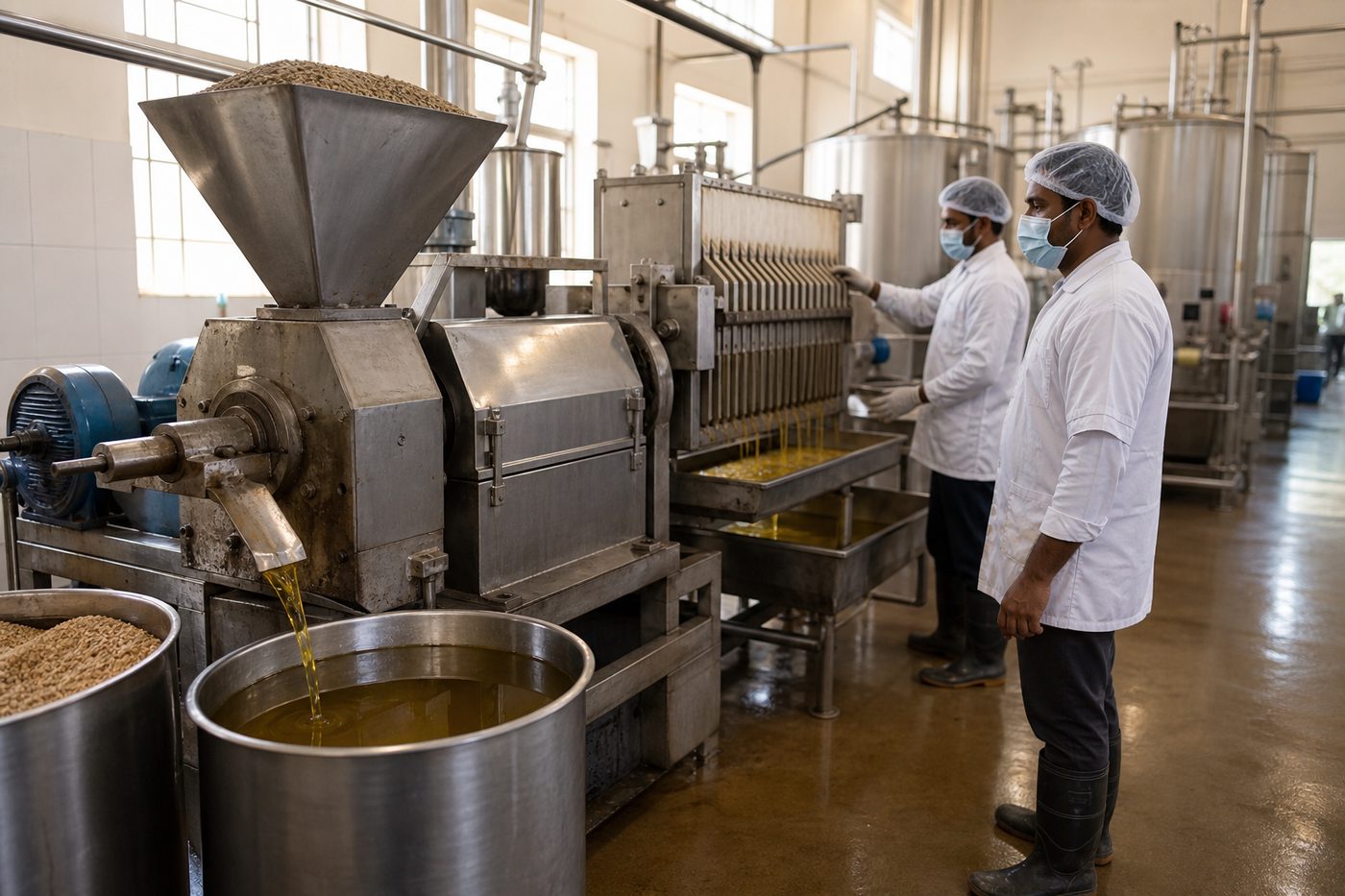
Premium herbal oil manufacturing requires more than conventional expeller pressing or solvent extraction — it requires certified organic infrastructure, dedicated or verified-clean cold-press lines, and, for medicated Taila, AYUSH-compliant infusion facilities that conventional oil mills in commodity clusters typically lack.
NPOP-Certified Organic Cold-Pressing
India's National Programme for Organic Production (NPOP), administered by APEDA, provides the domestic organic certification framework. NPOP-certified farms growing castor, sesame, flaxseed, and organic coconut plantations in Gujarat, Rajasthan, Kerala, and Tamil Nadu must feed cold-press units that maintain organic chain-of-custody: dedicated organic press runs or verified cleaning protocols between conventional and organic batches, NPOP-certified packing premises, and transaction certificates linking each export lot to certified organic origin.
USDA Organic acceptance of NPOP-certified product depends on the US–India organic equivalence arrangement and on whether the certifying body remains recognised for that pathway — exporters must reconfirm certifier recognition each shipment cycle. For the EU, India's third-country equivalence recognition (currently scheduled through end-2026 under the legacy framework, with possible extension under EU proposals) applies primarily to unprocessed plant products; processed plant products such as pressed and packed herbal oils generally require certification to EU Organic Regulation 2018/848 compliance by an EU-recognised control body, not NPOP alone. Do not assume an NPOP logo automatically authorises organic-labelled sale of oil in the EU or USA.
Cold-Press Process Infrastructure and Documentation
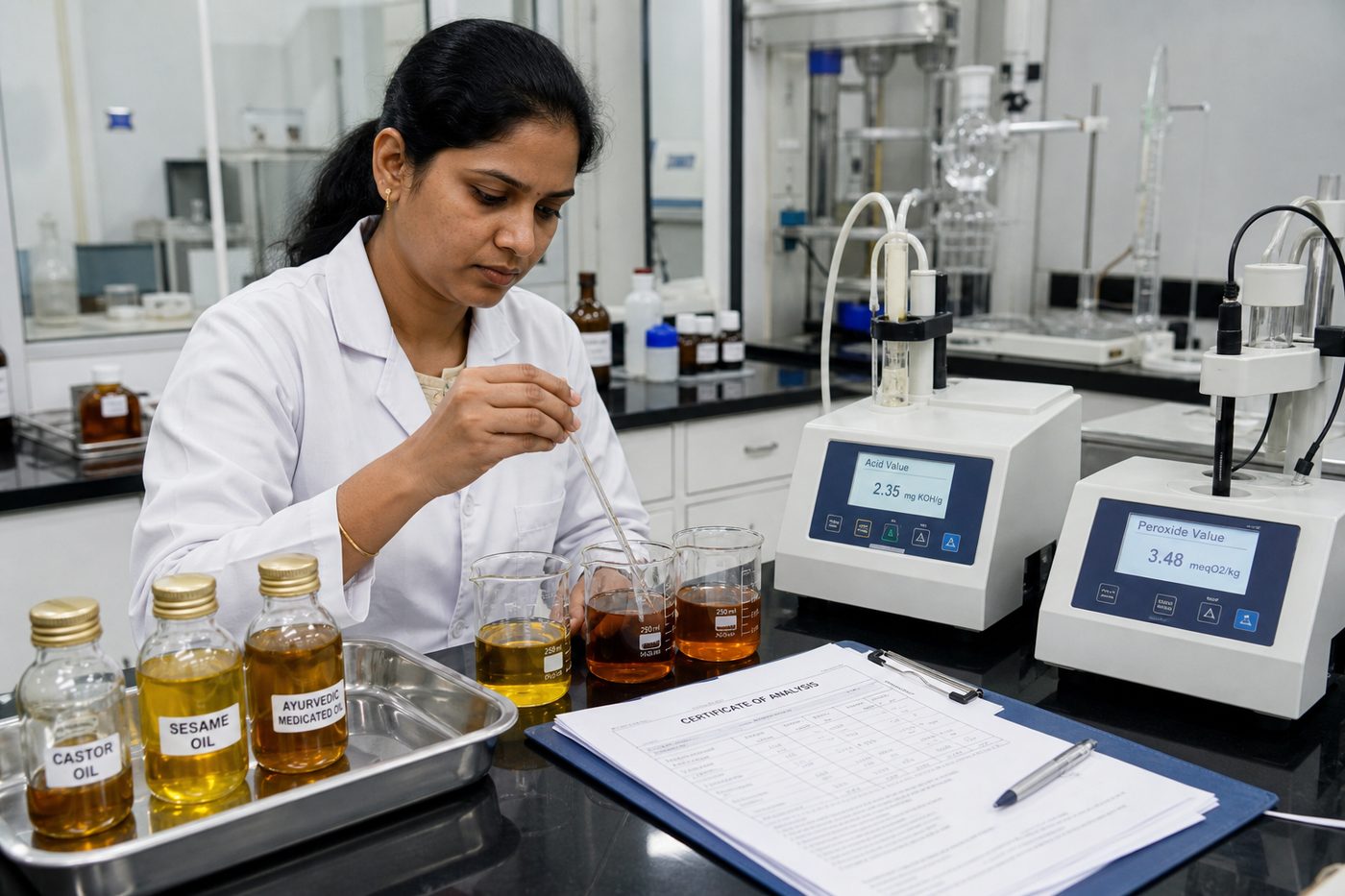
Cold-pressed positioning requires low-temperature extraction (typically below 50°C) without solvents, and credible suppliers maintain batch records documenting press temperature, yield, and analytical testing (free fatty acid, peroxide value, and — for flaxseed — ALA retention) demonstrating that a lot was genuinely cold-pressed and not blended with solvent-extracted oil to increase yield. Buyers increasingly request this batch documentation rather than accepting a cold-pressed claim on the label alone.
AYUSH-Compliant Medicated Taila Manufacturing
Medicated Taila manufacturing requires an AYUSH drug manufacturing licence covering the specific classical formulation, with production following the prescribed herb ratios, base-oil selection, and heating/infusion cycle documented in Ayurvedic pharmacopoeial texts. Batch records must demonstrate formulation compliance, and the manufacturing premises are subject to AYUSH GMP inspection — a materially different compliance bar than a general FSSAI-registered cosmetic-oil bottling unit.
Segregation and Chain-of-Custody
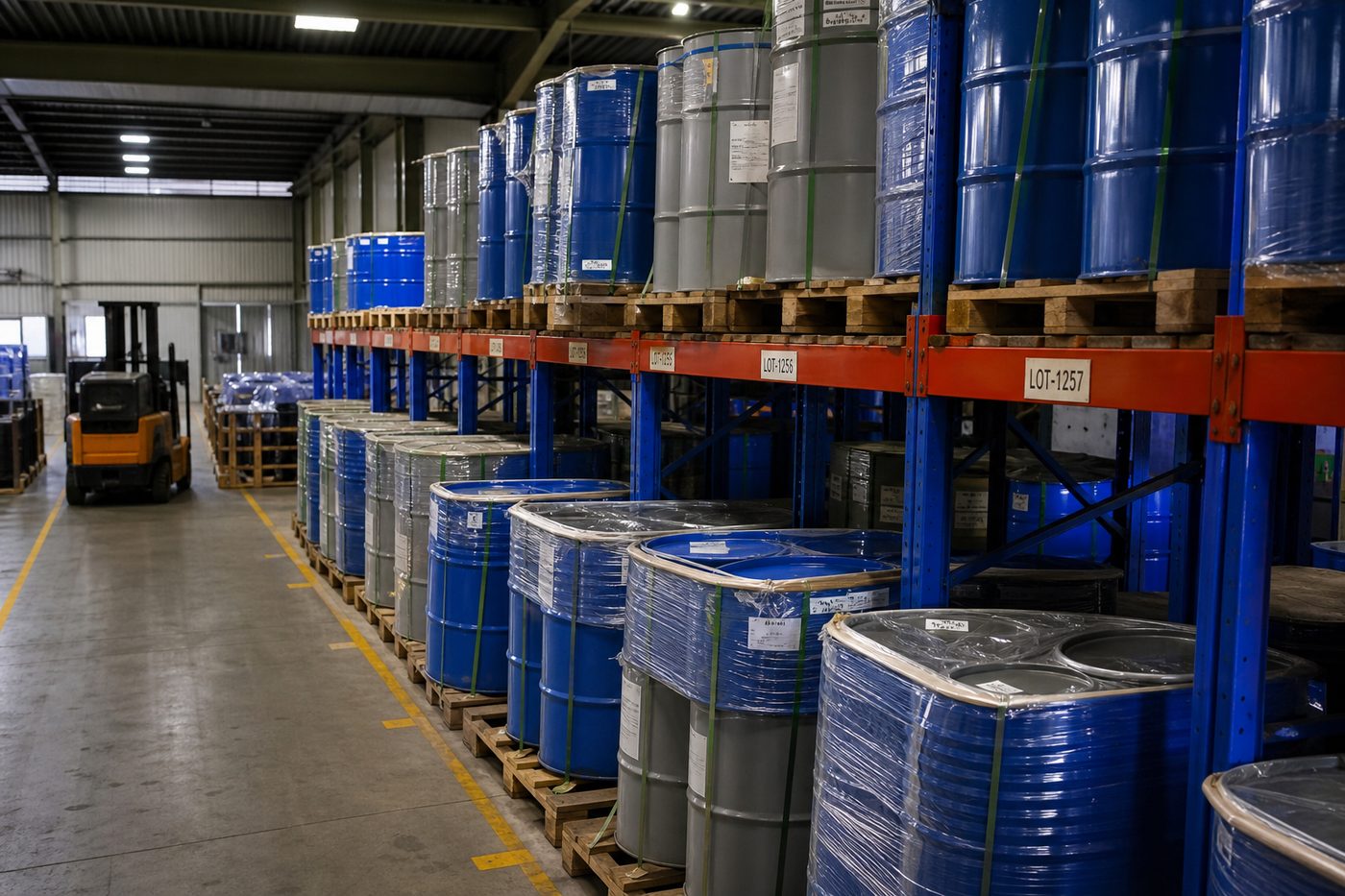
The most common failure in premium herbal oil positioning is claiming organic, cold-pressed, or medicated status without operational segregation to back it. Credible premium suppliers maintain documented separation between conventional and organic raw material storage, cold-press scheduling separated from solvent-extraction lines, and — for Taila — dedicated AYUSH-licensed infusion vessels distinct from generic cosmetic-oil bottling equipment. Chain-of-custody documentation from certified farm or licensed formulation record through to export drum or retail bottle label is what auditors and sophisticated buyers verify during supplier qualification.
Premium Oil Production Clusters
Organic castor cultivation and certified crushing concentrate in select Gujarat districts alongside the broader conventional castor belt. Organic sesame and flaxseed cultivation is expanding in Rajasthan and Madhya Pradesh. Organic and cold-pressed coconut production concentrates in Kerala and Tamil Nadu, the same region that hosts the majority of India's AYUSH-licensed medicated Taila manufacturing, particularly around Kottakkal, Coimbatore, and Kochi, where classical Ayurvedic manufacturing traditions and modern export-grade infrastructure increasingly coexist within the same clusters.
Pricing Analysis
Buyer Tip
Premium pricing in herbal oils is driven by certification stack, extraction method, formulation licence, and buyer segment — not merely by botanical identity. Conventional castor oil at USD 1.4–1.9/kg FOB becomes USD 2.4–3.2/kg with NPOP/USDA Organic certification in clean-beauty procurement. Conventional solvent-extracted sesame oil at USD 2.5–3.5/kg gains 40–80% with cold-pressed, organic-certified positioning for nutraceutical and Ayurvedic massage-oil buyers.
The comparison with commodity castor is instructive: conventional castor at USD 1.4–1.9/kg FOB operates on thin margins where a few cents per kilogram wins or loses container programmes. Premium organic cold-pressed sesame at USD 4.5–6.5/kg delivers a higher absolute margin per kilogram even at lower volume. Medicated Ayurvedic Taila sits in an entirely different pricing universe once it reaches retail-ready form — driven by formulation complexity, herb cost, and brand positioning rather than base-oil commodity pricing, with finished retail bottles often carrying multiples of the equivalent weight in bulk base oil.
Table 5 — Premium vs Conventional FOB Pricing: Indian Herbal Oils (2025–2026)
Swipe →
Data table — swipe horizontally on small screens
| Oil | Conventional FOB (USD/kg) | Organic Certified FOB (USD/kg) | Premium Driver | Typical Buyer |
|---|---|---|---|---|
| Castor Oil | USD 1.4–1.9/kg | USD 2.4–3.2/kg | NPOP/USDA/EU Organic; cosmetic-grade | Clean-beauty, cosmetic ingredient houses |
| Sesame Oil (cold-pressed) | USD 2.5–3.5/kg (solvent-extracted) | USD 4.5–6.5/kg (organic cold-pressed) | Extraction method; organic certification | Nutraceutical, Ayurvedic massage-oil brands |
| Coconut Oil (virgin, cold-pressed) | USD 1.6–2.2/kg (RBD) | USD 3.2–5.0/kg (organic virgin) | Virgin/cold-pressed grade; organic cert | Clean-beauty, Ayurvedic wellness brands |
| Flaxseed Oil (cold-pressed) | USD 3.0–4.5/kg (technical/solvent) | USD 6.0–8.5/kg (organic cold-pressed) | ALA retention; organic certification | Nutraceutical brands, organic food |
| Almond Oil (cold-pressed) | USD 9.0–12.0/kg (expeller) | USD 15.0–20.0/kg (organic cold-pressed) | Extraction method; organic certification | Premium cosmetics, massage-oil brands |
| Neem Oil | USD 2.5–3.5/kg | USD 5.0–7.0/kg (organic) | Organic certification; cosmetic grade | Cosmetic brands, agri-input distributors |
| Kalonji Oil (cold-pressed) | USD 8.0–12.0/kg | USD 16.0–22.0/kg (organic, high thymoquinone) | Marker compound; organic certification | Nutraceutical, Gulf wellness buyers |
| Medicated Ayurvedic Taila (retail-ready) | N/A — not a conventional/organic comparison | USD 6.0–25.0/kg equivalent (finished retail) | AYUSH licence; classical formulation complexity | Ayurvedic wellness brands, pharmacy chains |
MOQ Analysis
Buyer Tip
Premium herbal oil MOQs differ from commodity patterns. Clean-beauty brands and organic-food buyers often start with 5–25 kg trial lots of certified organic or cold-pressed oil — smaller than commodity castor trial volumes but at significantly higher per-kilogram pricing. Established premium programmes scale to 50–500 kg per lot for organic sesame, coconut, and flaxseed, while medicated Taila trials often run in retail-unit counts (50–200 bottles) rather than bulk kilogram terms, given the added formulation and label lead time.
Organic certification costs (annual inspection, transaction certificates per lot) create a minimum viable volume threshold: exporting 10 kg of certified organic sesame oil may not cover certification overhead, while a 100 kg programme to a clean-beauty brand with annual renewal justifies the investment. Exporters should model premium MOQ economics including certification cost per kilogram before entering the segment.
Table 6 — MOQ Guidelines for Premium Herbal Oil Programmes
Swipe →
Data table — swipe horizontally on small screens
| Order Type | Typical MOQ | Applicable Oils | Premium Pricing Note |
|---|---|---|---|
| Organic evaluation sample | 50–200 g | All certified organic oils | Sample cost higher; include organic transaction certificate |
| Cold-pressed sample | 50–200 g | Sesame, coconut, flaxseed, almond | Include batch record with press temperature and yield data |
| Medicated Taila sample | 5–20 retail units | Bhringraj, Amla, Brahmi, Mahanarayan Taila | Include AYUSH licence copy and formulation compliance note |
| Trial lot — organic/cold-pressed bulk | 5–25 kg | Sesame, coconut, flaxseed, almond, castor | 25–60% premium over conventional trial pricing |
| Commercial — organic programme | 50–500 kg | Certified organic bulk oils | Annual renewal contracts common in clean-beauty |
| Commercial — medicated Taila retail | 500–2,000 retail units | Multi-formulation Taila range | Custom labelling; AYUSH licence per formulation |
Packaging Standards
Export Tip
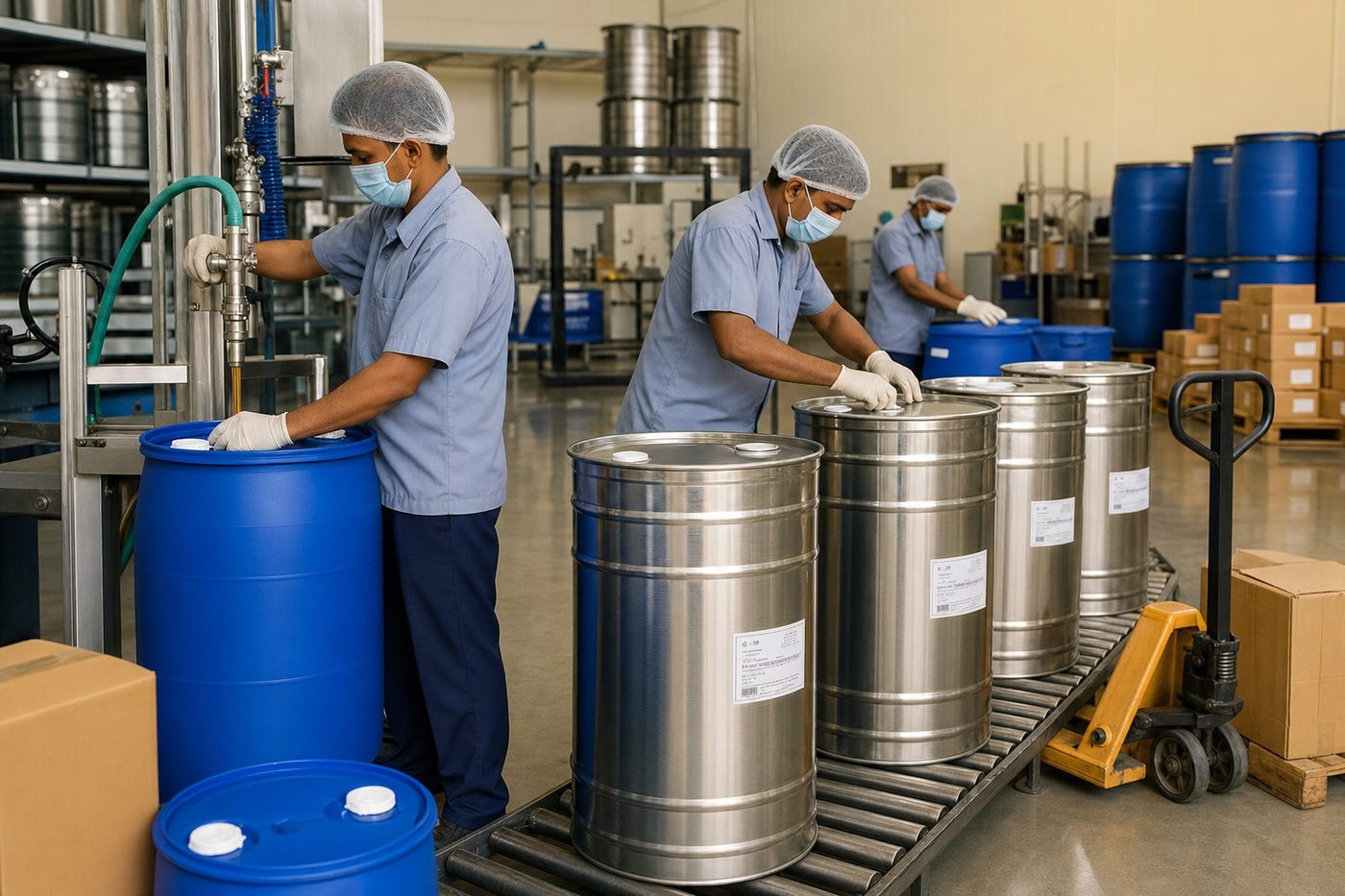
Premium herbal oil packaging must protect organic, cold-pressed, and medicated integrity through transit — and must itself comply with organic and AYUSH handling requirements where applicable. Organic-certified oils should be packed on NPOP-certified packing premises using food-grade or epoxy-lined drums that have been cleaned and verified free of conventional-oil residue when shared lines are used.
Amber glass or PET bottles remain standard for medicated Taila retail units and for premium cold-pressed samples to protect against light-driven oxidation. Labels for organic-certified export must include the certification body's name and logo per NPOP/USDA/EU Organic labelling rules; labels for medicated Taila must reflect the AYUSH-licensed formulation name and manufacturing licence number exactly as registered — not merely the word 'Ayurvedic' without licence reference.
Table 7 — Packaging Standards for Premium Herbal Oil Export
Swipe →
Data table — swipe horizontally on small screens
| Format | Net Weight | Premium Requirement | Compliance Note |
|---|---|---|---|
| HDPE drum (organic line) | 25–50 kg | NPOP-certified packing premises | Transaction certificate per lot |
| Cold-pressed retail bottle | 100–500 ml | Light protection; batch record referenced | Cold-press method stated on label |
| Amber glass bottle (medicated Taila) | 50–200 ml | AYUSH-compliant labelling | Licence number and formulation name on label |
| Nitrogen-blanketed drum | 25–50 kg | Oxidation-sensitive organic oils (flaxseed) | Preserves certified organic integrity in transit |
| Epoxy-lined drum | 180 kg | Large organic commercial programmes (castor) | Lining integrity verified for organic compliance |
| Retail-ready cartons | Per SKU pack size | Private-label clean-beauty and Ayurvedic programmes | Organic/AYUSH cert reference on carton and bottle |
Container Loading Details
Export Tip
Premium herbal oil shipments are more often LCL or, for organic and medicated Taila trial programmes, air-freighted rather than the multi-MT FCL flexitank shipments typical of conventional castor oil. A 100 kg organic sesame programme to a USA clean-beauty brand typically ships LCL rather than waiting for FCL consolidation, because the value per kilogram justifies freight cost and because buyers want shorter lead times for premium retail launches.
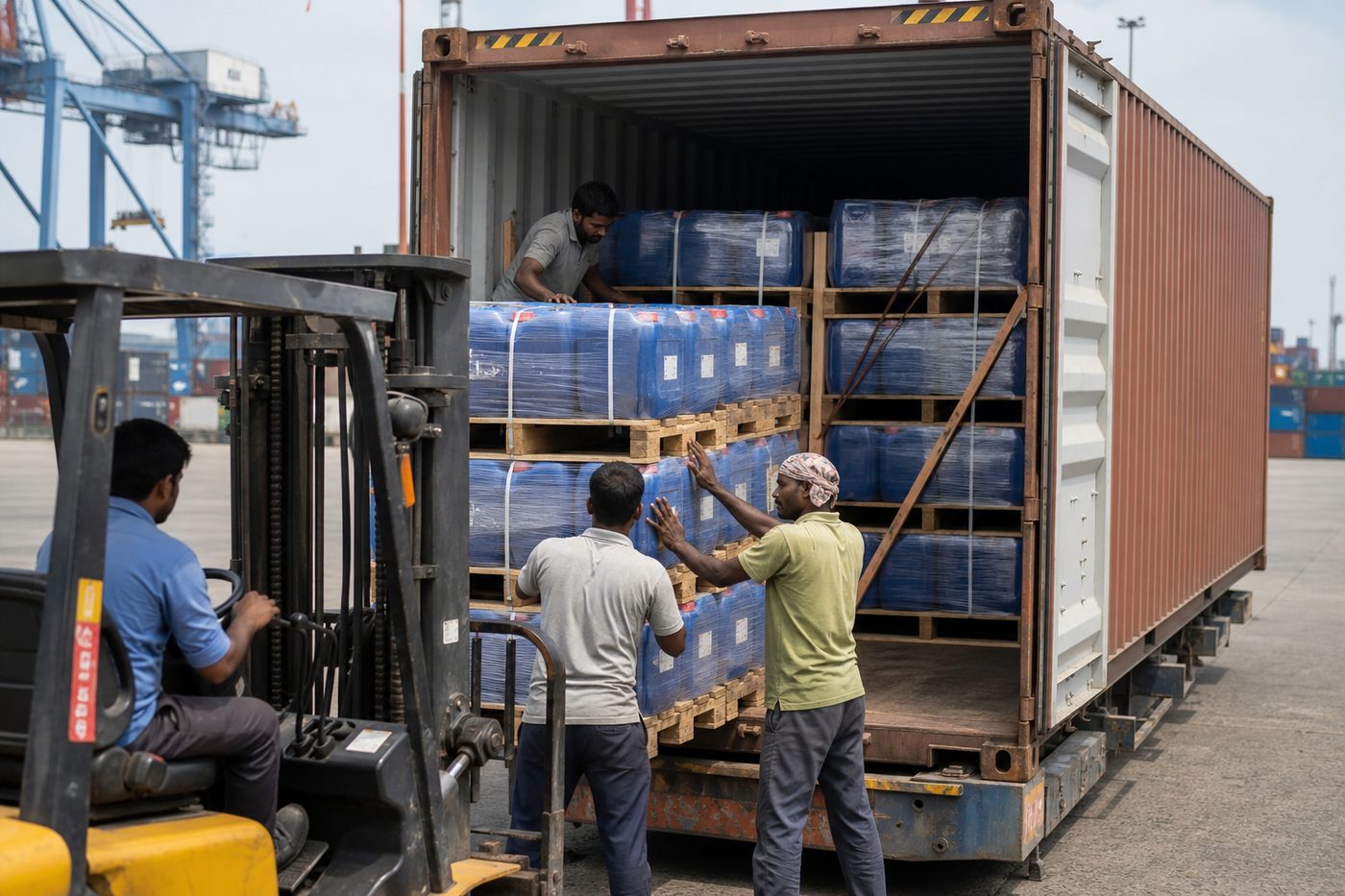
When premium oils do move FCL — established organic coconut or sesame programmes at scale, for instance — segregation requirements continue: organic-certified drums must not be loaded alongside conventional oil drums in the same container unless the buyer explicitly accepts mixed loading, which clean-beauty and organic-food buyers typically do not.
Table 8 — Container and Shipment Configuration for Premium Herbal Oils
Swipe →
Data table — swipe horizontally on small screens
| Shipment Type | Typical Volume | Premium Oils | Handling Note |
|---|---|---|---|
| Air freight (organic/Taila trial) | 5–25 kg or 50–200 retail units | Organic sesame, coconut; medicated Taila | Secured; temperature-stable routing |
| LCL (organic commercial) | 50–500 kg | Certified organic bulk oils | No conventional oil co-loading |
| FCL (large organic programme) | 2–8 MT | Established organic coconut/sesame programmes | Dedicated organic container preferred |
| Courier (premium sample) | 50–200 g / 5–20 retail units | Cold-pressed and medicated Taila samples | Amber glass or PET; documentation enclosed |
Shipping Methods
Export Tip
Premium herbal oil shipping prioritises integrity over lowest freight cost. Organic, cold-pressed, and medicated oils degrade with heat and light exposure — routing that minimises transit time and avoids prolonged port holds matters more than for commodity castor moving in bulk flexitank FCL.
Chennai and Cochin serve Kerala/Tamil Nadu organic coconut and medicated Taila producers shipping to USA, EU, GCC, and ASEAN buyers. Mundra and Kandla serve Gujarat organic castor and sesame programmes. Air freight is standard for premium samples and first commercial lots under 50 kg; established organic programmes may shift to LCL or FCL sea freight once buyer relationship and volume justify longer transit.
Table 9 — Shipping Methods for Premium Herbal Oil Export
Swipe →
Data table — swipe horizontally on small screens
| Mode | Typical Premium Use | Transit Time | Integrity Requirement |
|---|---|---|---|
| Air freight | Organic and Taila trial/commercial lots under 50 kg | 3–7 days | Cool, dark, upright; minimal handling |
| Sea LCL | Organic commercial 50–500 kg | 18–35 days | No co-loading with conventional oils |
| Sea FCL (dedicated organic) | Large organic sesame/coconut programmes | 18–35 days | Organic chain-of-custody maintained through port |
| Courier | Premium samples with certification/licence docs | 2–5 business days | Amber glass or PET; transaction certificate or licence copy included |
Certifications
Compliance Notes
Premium herbal oil export requires a layered certification stack that differs sharply by oil category: organic certification (NPOP, USDA Organic, EU Organic) for clean-beauty and organic-food buyers; cold-press batch documentation for sesame, coconut, flaxseed, and almond; and an AYUSH drug manufacturing licence covering the specific formulation for medicated Ayurvedic Taila. FSSAI licensing applies to edible-grade oils, and HALAL certification matters for GCC and ASEAN buyers across most premium categories.
Buyers paying organic premiums verify the certification chain, not just the COA. Transaction certificates issued by the NPOP-accredited certification body for each export lot are the document that links a specific drum to certified organic origin. For medicated Taila, buyers verify the AYUSH licence number against the specific formulation being ordered — a general Ayurvedic manufacturing licence does not automatically cover every classical formulation a manufacturer claims to produce.
Table 10 — Certification and Licence Stack for Premium Herbal Oil Export
Swipe →
Data table — swipe horizontally on small screens
| Certification / Licence | Issuing Body | Premium Segment | Buyer Verification Method |
|---|---|---|---|
| NPOP Organic | APEDA-accredited certification body | All organic-labelled export | Transaction certificate per lot; annual audit |
| USDA Organic (NOP) | USDA-recognised certifier (often same body as NPOP) | USA organic-labelled products | USDA Organic seal; certifier name on label |
| EU Organic (Reg. 2018/848) | EU-recognised certifier | EU organic-labelled products | EU Organic logo; certifier code on label |
| AYUSH Drug Manufacturing Licence | AYUSH Ministry / State Drug Authority | Medicated Ayurvedic Taila | Licence number matched to specific formulation |
| Cold-press batch documentation | Internal QA / NABL-accredited lab (if tested) | Sesame, coconut, flaxseed, almond | Press temperature, yield, and analytical panel per lot |
| FSSAI Licence + Health Certificate | FSSAI, Government of India | Edible-grade oils | Export health certificate per shipment |
| HALAL | HALAL certification body (India) | GCC, ASEAN Muslim-majority markets | Certificate matched to specific product lot |
| REACH SDS | EU REACH framework | EU market entry for industrial/cosmetic-grade oils (≥1 t/yr) | SDS + confirm who holds registration |
Buyer Requirements
Buyer Requirements
Premium herbal oil buyers impose qualification requirements beyond conventional COA — and understanding these before market entry prevents costly certification or licence misinvestment.
Clean-Beauty and Organic Brand Requirements
Clean-beauty and organic-food brands sourcing organic herbal oils require: valid NPOP/USDA/EU Organic certification with transaction certificates per lot; COA with relevant analytical parameters; and, increasingly, cold-press process documentation where the buyer's marketing positions the product as both organic and cold-pressed. Supplier audit capability (remote or on-site) confirming organic segregation and cold-press-line compliance is standard for larger programmes.
Ayurvedic Wellness and Pharmacy Chain Requirements
Premium Taila programmes stall when exporters treat AYUSH as a logo rather than formulation coverage. Clean-beauty and Gulf pharmacy buyers usually ask for the licence page that names the exact classical product, then check whether destination registration and claim language allow that positioning — a verbal 'we are AYUSH certified' assurance is not enough.
Organic Food and Nutraceutical Requirements
Organic food and nutraceutical brands sourcing organic sesame or flaxseed oil for flavouring or supplement use require NPOP/USDA/EU Organic certification, FSSAI export health certification, and food-grade documentation. The organic certification must cover the entire chain from farm through cold-press to packing — not farm-only certification paired with conventional solvent extraction.
Distributor and Private-Label Requirements
Distributors purchasing certified organic or medicated Taila for re-sale prioritise consistent supply, transaction-certificate or licence-copy availability per shipment, and a single accountable exporter relationship. Private-label clean-beauty and Ayurvedic wellness brands add artwork approval, retail-ready packaging, and shelf-life validation to the standard documentation stack.
Country-wise Opportunities
Market Snapshot
Premium herbal oil export opportunities concentrate in markets with strong clean-beauty and organic-food retail infrastructure for organic-certified oils, and in markets with Ayurvedic wellness or pharmacy-chain retail penetration for medicated Taila — not necessarily in markets with the highest total HS 1515/1513 import volume.
Table 11 — Country-wise Premium Herbal Oil Export Opportunities
Swipe →
Data table — swipe horizontally on small screens
| Country/Region | Premium Demand | Certification/Licence Required | Price Opportunity | Entry Strategy |
|---|---|---|---|---|
| USA | Organic castor, coconut, sesame, almond; growing Ayurvedic wellness | USDA Organic; COA; cold-press documentation | Highest organic premium globally | Clean-beauty trade shows; Vitafoods; distributor partnerships |
| Germany / EU | Organic sesame, flaxseed, coconut for cosmetics/food | EU Organic; REACH; process documentation | High; strictest documentation | In-Cosmetics; organic certifier introductions |
| UK | Organic castor and coconut; diaspora Ayurvedic demand | UK Organic; COA | High; growing clean-beauty and diaspora market | UK beauty trade events; diaspora wellness retailers |
| GCC | Medicated Taila, coconut, sesame for pharmacy/wellness chains | AYUSH licence; HALAL; Arabic labelling | High for licensed Taila; mid for organic bulk | Gulfood Manufacturing; pharmacy-chain distributor outreach |
| ASEAN (Malaysia, Singapore, Indonesia) | Medicated Taila, virgin coconut oil | AYUSH licence; local product registration support | High for licensed formulations | Regional Ayurvedic wellness distributor partnerships |
| Australia | Organic almond, cold-pressed sesame | NASAA/USDA/EU Organic recognised | Growing premium segment | Wellness retail distributor networks |
The NPOP Certification and Organic Chain-of-Custody Pathway
NPOP certification begins at the farm level, where cultivation must follow organic standards for a minimum conversion period before the land is eligible for certification. For herbal oils, the certification chain must then extend through cold-pressing or crushing on certified or verifiably segregated equipment, and through packing on NPOP-certified premises — a farm-only organic certificate does not entitle an exporter to sell the finished oil as organic if the pressing and packing stages are not equally covered.
Each export lot requires a transaction certificate issued by the NPOP-accredited certification body, confirming that the specific quantity being shipped was produced in compliance with organic standards across the full chain. This document — not the general company-level organic certificate — is what sophisticated buyers request and verify before releasing payment for an organic-premium shipment.
The USDA NOP Equivalence Path for Indian Herbal Oil Exporters
The United States does not require Indian exporters to obtain a separate USDA Organic certification from scratch. Under the US-India organic equivalence arrangement, oils certified under NPOP by a certification body that is also USDA-accredited (or that operates under a recognised equivalence arrangement) can be sold as organic in the United States without duplicating the entire certification process. The critical step is confirming that the specific certification body used for your NPOP certificate holds current USDA accreditation or equivalence recognition — this status can change, and exporters should verify it for every shipment cycle rather than assuming a prior year's equivalence still applies.
Buyers importing into the USA will ask for the USDA Organic label authorisation tied to the certifier, and for the transaction certificate referencing the specific shipment. Exporters who cannot produce both documents on request should expect the shipment to be rejected for organic-labelled sale, even if the underlying farming and pressing practices were genuinely organic.
EU Organic Certification for Herbal Oils
EU Organic labelling for Indian herbal oils should be planned under Regulation 2018/848 compliance rules for processed plant products. India's third-country equivalence recognition is primarily scoped to unprocessed plant products; pressed, refined, or packed oils therefore typically need an EU-recognised control body certifying the processing and packing steps to EU organic production rules — NPOP farm certification alone is not a complete EU organic pathway for oil. Confirm the live status of India's equivalence recognition, any extension beyond the current end-2026 horizon, and your control body's EU recognition before promising organic-labelled EU sales.
EU buyers, particularly in the cosmetics and organic-food channels, tend to apply the most rigorous documentation review among the major premium markets — expect requests for the full certification chain, farm-level organic conversion records where relevant, control-body certificates covering processing, and REACH-aligned safety data sheets for cosmetic-grade oils. The UK does not automatically inherit EU–India organic equivalence after Brexit; UK organic-labelled sales generally require a UK-approved control body unless a separate India–UK equivalence arrangement is later concluded.

Medicated Ayurvedic Taila: Differentiating from Commodity Carrier Oils
The single most important distinction for buyers new to this category is that medicated Ayurvedic Taila is not simply a herbal-oil-infused cosmetic product — it is a licensed medicinal preparation manufactured under classical pharmacopoeial standards, and this distinction carries real commercial and regulatory weight. A generic 'Bhringraj hair oil' sold as a cosmetic product and a genuine Bhringraj Taila manufactured under AYUSH licence to classical formulation standards can look similar on a shelf but occupy entirely different regulatory categories, price points, and buyer trust levels.
Buyers building a credible Ayurvedic wellness brand — as opposed to a generically 'herbal-inspired' personal care line — increasingly insist on sourcing from AYUSH-licensed manufacturers specifically because the licence, formulation compliance, and classical-text traceability are what justify the premium price and therapeutic positioning to their own end customers. Exporters who can supply this documentation clearly and confidently differentiate immediately from the much larger pool of suppliers offering generic herbal-labelled cosmetic oils.
Table 12 — Medicated Ayurvedic Taila vs Commodity Herbal Hair Oil
Swipe →
Data table — swipe horizontally on small screens
| Attribute | Medicated Ayurvedic Taila | Commodity 'Herbal' Hair Oil |
|---|---|---|
| Governing standard | Classical Ayurvedic pharmacopoeial formulation | No standardised formulation; brand-specific recipe |
| Manufacturing licence | AYUSH drug manufacturing licence required | General cosmetic manufacturing registration (FSSAI/BIS as applicable) |
| Label claims permitted | Therapeutic/medicinal claims per licensed indication | Cosmetic claims only; no medicinal claim permitted |
| Typical buyer | Ayurvedic wellness brands, pharmacy chains | General personal care retail, private label |
| Price positioning | Premium — multiples of generic herbal oil pricing | Mid-to-low; competes on fragrance and packaging |
| Verification buyers request | AYUSH licence number matched to formulation | General export documentation; COA if requested |
Segregation SOPs: Farm to Drum Organic Chain of Custody
A written segregation standard operating procedure is what turns an organic or cold-pressed claim from a marketing statement into an auditable fact. At minimum, credible SOPs document: separate receiving and storage areas (or clearly labelled and physically separated zones) for organic versus conventional raw material; a documented cleaning and changeover protocol when the same cold-press or crushing equipment processes both organic and conventional batches; batch-numbering that ties raw material lot, press run, and packing run together; and a retained-sample policy that allows any buyer dispute to be checked against the actual production batch rather than a generic reference sample.
Exporters preparing for buyer audit — whether a formal on-site visit or a remote documentation review — should be able to produce this SOP on request, along with the specific batch records for the lot being purchased, not just a general company policy statement. Buyers who pay organic or cold-pressed premiums increasingly treat the absence of a written segregation SOP as a disqualifying signal on its own, independent of whether the product itself tests clean.
Sourcing Checklist
Checklist
International buyers sourcing certified organic, cold-pressed, or AYUSH-licensed medicated herbal oils from India should verify each of the following before placing a premium-priced order.
Common Buyer Mistakes
Common Mistakes Box
Both buyers and exporters make recurring mistakes in premium herbal oil sourcing that destroy trust and waste certification investment.
Table 13 — Common Mistakes in Premium Herbal Oil Sourcing
Swipe →
Data table — swipe horizontally on small screens
| Mistake | Consequence | How to Avoid |
|---|---|---|
| Paying organic premium without transaction certificate | Receiving conventional oil with an organic label — brand reputation damage | Require lot-specific transaction certificate before payment |
| Accepting farm-only organic certificate without press/packing certification | Oil pressed on conventional equipment — organic claim invalid | Verify the entire chain: farm, pressing, packing |
| Treating 'cold-pressed' as a marketing label only | Oil fails buyer audit or shows solvent-extraction markers on independent testing | Request batch records with temperature and analytical data |
| Assuming any Ayurvedic-labelled oil is AYUSH-licensed | Product cannot legally carry therapeutic claims; import or retail rejection | Request the AYUSH licence number matched to the specific formulation |
| Comparing organic premium pricing to commodity castor pricing | Unrealistic price expectations kill premium negotiations | Benchmark against international organic carrier-oil pricing, not castor |
| Assuming NPOP certification alone authorises USDA or EU organic-labelled oil sales | Organic claim rejected when US certifier recognition lapses or EU processed-oil compliance is missing | Verify USDA pathway recognition and EU-recognised CB coverage for processed oils each cycle |
| Skipping segregation SOP review during supplier qualification | Cross-contamination risk invalidates organic or cold-pressed claims | Request the written SOP and batch-numbering system before ordering |
Future Market Trends
Key Statistics
Clean-label and clean-beauty regulation is tightening globally, expanding the addressable market for certified organic and cold-pressed herbal oils from India. EU Organic Regulation 2018/848 and USDA Organic enforcement both increase audit scrutiny on imported organic ingredients — favouring Indian exporters with robust chain-of-custody documentation over those with paper-only certification.
Ayurvedic wellness demand is expanding from South Asian diaspora markets into mainstream Western wellness retail, and this expansion is increasingly accompanied by more rigorous buyer diligence on AYUSH licence authenticity as Western retailers become more sophisticated about the difference between a genuinely medicated Taila and a marketing-only 'Ayurvedic-inspired' oil. Exporters who invest in licence transparency now will be well positioned as this scrutiny increases.
Traceability expectations that have already reshaped premium essential oil and herbal extract trade are extending into fixed carrier oils as well — buyers increasingly want farm-to-drum documentation for castor, coconut, and sesame, not just for scarcer botanicals. Cold-press process documentation is moving from a differentiator to a baseline expectation in premium wellness retail, mirroring the trajectory that organic certification followed a decade earlier.
Table 14 — Future Trends in Premium Herbal Oil Export (2026–2034)
Swipe →
Data table — swipe horizontally on small screens
| Trend | Impact on Indian Premium Exporters | Preparation Strategy |
|---|---|---|
| Clean-beauty regulation tightening (EU, USA) | Organic certification verification intensifies at import | Invest in audit-ready chain-of-custody documentation |
| Rising Western scrutiny of Ayurvedic claims | Buyers increasingly verify AYUSH licence authenticity directly | Maintain licence documentation transparency and formulation records |
| Cold-press as baseline expectation in premium retail | Process documentation becomes mandatory, not optional | Standardise cold-press batch record templates per oil |
| Traceability extending to fixed carrier oils | Castor and coconut buyers expect farm-to-drum documentation | Build traceability systems beyond scarce/premium botanicals alone |
| Premium segment growth outpacing commodity castor | Margin opportunity shifts to certified organic and licensed medicated oils | Diversify production capability beyond conventional castor/sesame |
Conclusion
Organic and Ayurvedic herbal oil export from India represents the highest-margin, most defensible positioning in the HS 1515/1513/3004 trade — but only for exporters who invest in genuine NPOP/USDA/EU Organic certification infrastructure, verifiable cold-press process documentation for sesame, coconut, flaxseed, and almond, and legitimate AYUSH drug manufacturing licences for medicated Ayurvedic Taila such as Bhringraj, Amla, Brahmi, and Mahanarayan formulations. Commodity castor and solvent-extracted sesame will continue to dominate export volume, but premium value concentrates in certified organic bulk oils for clean-beauty and organic-food brands, cold-pressed grades for wellness retail, and licensed medicated Taila for Ayurvedic wellness brands and pharmacy chains.
International buyers paying organic or Ayurvedic premiums have sophisticated verification capability — transaction certificates, cold-press batch records, and AYUSH licence checks are standard qualification steps, not exceptional requests. Exporters who treat premium positioning as a marketing layer over conventional production will fail buyer audit and damage Indian supplier reputation in premium segments.
Altus Exports operates as a merchant exporter and global sourcing partner for herbal oils from India, connecting clean-beauty brands, organic-food buyers, and Ayurvedic wellness retailers with verified manufacturers maintaining legitimate organic certification, cold-press documentation, and AYUSH licence infrastructure — managing certification and licence verification, sample coordination, and export logistics for premium herbal oil programmes.
For the complementary lead-generation angle — trade data, LinkedIn, Vitafoods/In-Cosmetics, and buyer verification — see our dedicated guide: How to Find International Buyers for Herbal Oils. For product-level depth, see top herbal oil products exported from India, and for the export process itself, see how to export herbal oils from India. Contact Altus Exports to discuss your organic or Ayurvedic herbal oil sourcing requirements.