
Top Herbal Oil Products Exported from India
By Saurabh Mittal, Founder, Altus Exports
A product-by-product catalog of the herbal oils India exports in commercial volume — fixed vegetable oils (neem, castor, sesame, coconut, sweet almond, kalonji, flaxseed/linseed, karanja) and Ayurvedic medicated oils (Bhringraj, Amla, Brahmi, Mahanarayan, Dhanwantharam, Ksheerabala, Ashwagandha, and herbal massage oil blends) — with quality parameters, HS classification, FOB price tiers, MOQ guidance, packaging formats, and the buyer profile each SKU serves best. Includes country-wise demand patterns and expert insight from Altus Exports.

India exports two distinct families of herbal oils under one broad commercial umbrella: fixed vegetable oils pressed or extracted directly from seed — neem, castor, sesame, coconut, sweet almond, kalonji (black seed), flaxseed/linseed, and karanja — and Ayurvedic medicated or infused oils known as Taila, formulated by simmering herbs in a carrier-oil base under classical ratios. Bhringraj, Amla, Brahmi, Mahanarayan, Dhanwantharam, and Ksheerabala oil sit alongside Ashwagandha oil and a broad category of herbal massage oil blends as the most commercially exported medicated SKUs. Each of these products carries its own specification sheet, HS classification, price tier, and buyer profile, and treating them as one undifferentiated "herbal oil" category is one of the fastest ways for a first-time importer to misprice a program.
This guide takes a SKU catalog approach: oil by oil, it covers the specification a buyer should request, the HS code a shipment should carry, the indicative FOB price band, typical MOQ, and the buyer type each product serves best. For the operational sequence — registration, sourcing, testing, packaging, and shipment — see our companion process guide, how to export herbal oils from India. For country-specific demand ranking, see best countries for Indian herbal oil exports and most demanded Indian herbal oils by country, both linked again in the conclusion.
Altus Exports operates as a merchant exporter and global sourcing partner for herbal and Ayurvedic oils from India, matching international buyers to the specific SKU, cluster, and grade that fits their formulation or retail program — whether that is bulk industrial castor oil for a chemical processor or a small drum program of Ksheerabala oil for an Ayurvedic wellness brand. This guide draws on the specification conversations we have with buyers across both fixed-oil and medicated-oil programs.
Key Takeaways
Summary Box
Executive Summary
Summary Box
This guide catalogs the herbal oil products India exports in meaningful commercial volume, organized by the two families that matter most for sourcing decisions: fixed vegetable oils extracted directly from seed, and Ayurvedic medicated Taila oils formulated by infusing herbs into a carrier-oil base. For each product, it covers the specification a serious buyer should request, the applicable HS classification, indicative FOB pricing, typical MOQ, packaging norms, and the buyer type the SKU serves best — flavor of information a generic supplier directory rarely organizes clearly.
This guide serves international buyers building a herbal oil sourcing program — whether a single-SKU trial order or a multi-category catalog spanning fixed oils and medicated Taila — as well as Indian producers deciding where their product sits in the broader export landscape. For the export process itself, see our companion guide how to export herbal oils from India, and for full documentation requirements, see herbal oil export documentation checklist.
Market Size & Industry Overview
Key Statistics
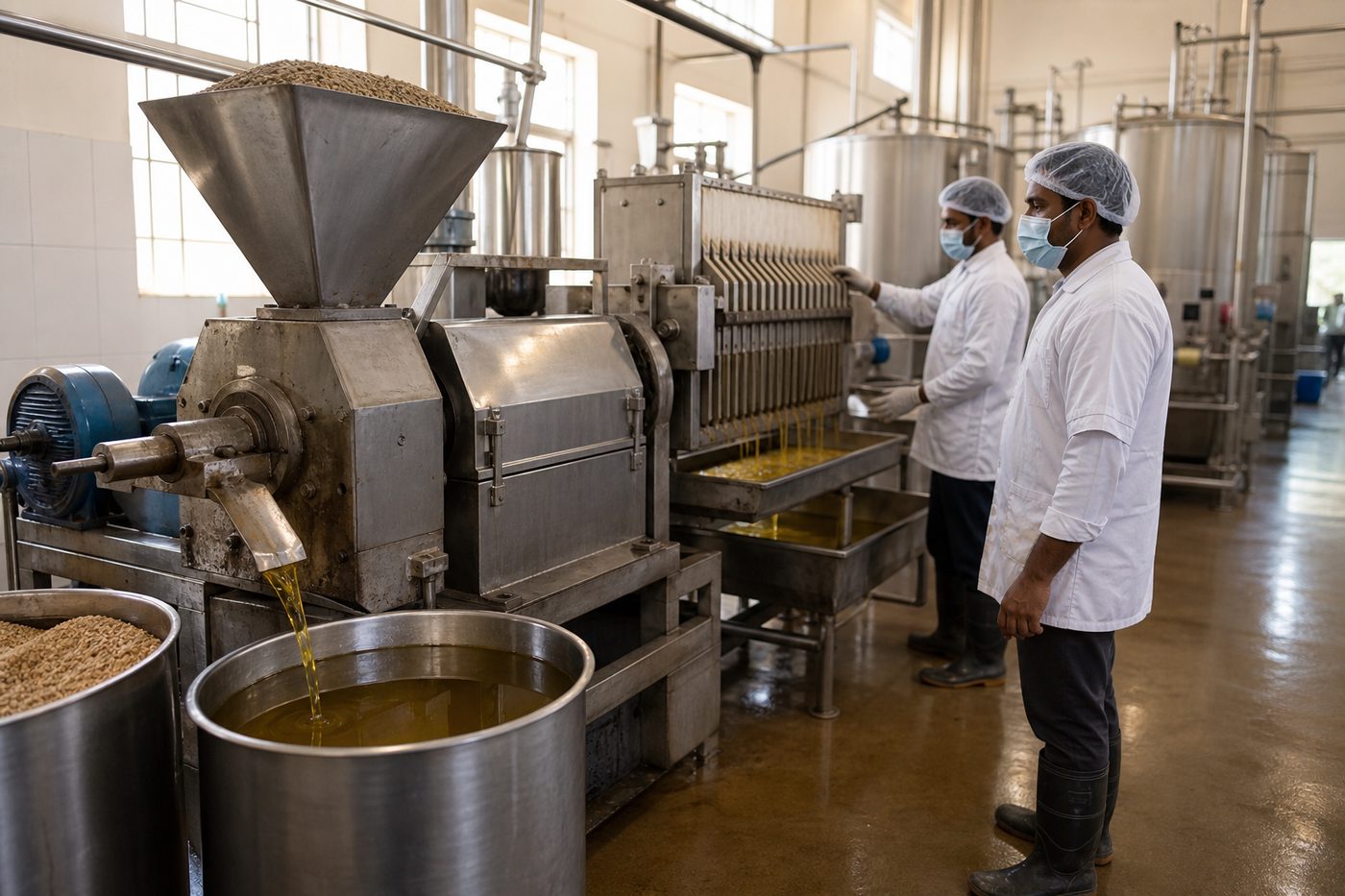
The herbal oils India exports serve genuinely different end markets depending on the SKU: personal-care and cosmetics manufacturers buy sesame, sweet almond, coconut, and cosmetic-grade castor oil as carrier and functional ingredients; agrochemical formulators buy neem and karanja oil for botanical biopesticide production; nutraceutical and functional-food brands buy flaxseed and kalonji oil for omega-3 and black-seed supplementation; and Ayurvedic distributors and wellness retail chains buy medicated Taila oils for hair care, massage, and traditional therapeutic positioning. Any single market-size figure that bundles all of these end uses together should be treated as directional only.
India's product depth in this space comes from regional specialization rather than one dominant hub: Gujarat effectively owns the global castor oil supply chain, the Rajasthan-Madhya Pradesh-Uttar Pradesh belt anchors sesame, Kerala combines coconut oil milling with a living Ayurvedic Taila manufacturing tradition, Andhra Pradesh and Telangana supply the bulk of India's neem oil, and Haridwar has become a large-scale modern manufacturing base for AYUSH-licensed medicated oils. That regional depth is what lets Altus Exports source eight fixed-oil SKUs and seven-plus medicated Taila formulations from a single country.
Herbal Oil Product Families: Market Overview (directional)
Swipe →
Data table — swipe horizontally on small screens
| Product Family | Representative SKUs | Primary End Market | Relative Export Volume |
|---|---|---|---|
| Industrial/cosmetic fixed oils | Castor, karanja | Chemical processing, cosmetics manufacturing | High |
| Edible/cosmetic fixed oils | Sesame, coconut | Food, personal care | High |
| Specialty fixed oils | Neem, sweet almond, kalonji, flaxseed | Agri-input, nutraceutical, cosmetics | Mid |
| Ayurvedic medicated Taila oils | Bhringraj, Amla, Brahmi, Mahanarayan, Dhanwantharam, Ksheerabala, Ashwagandha | Ayurvedic and wellness retail | Mid, growing |
| Herbal massage oil blends | Custom multi-herb formulations | Spa, wellness, private-label retail | Mid |
Export Statistics
Key Statistics
Among fixed oils, castor oil (HS 1515.30) is India's standout specialty export by value, underpinned by Gujarat's position as the source of the large majority of the world's traded castor seed, moving through both industrial-grade channels (lubricants, coatings, chemical feedstock) and cosmetic/pharma-grade channels. Sesame oil (HS 1515.50) exports split between edible-grade demand from Middle Eastern and Asian food buyers and cosmetic-grade demand from personal-care manufacturers who value its stability and traditional Ayurvedic positioning. Coconut oil (HS 1513) exports from Kerala and neighboring coastal states serve both food and cosmetic buyers at meaningful volume.
Neem, kalonji, and karanja oils — typically under HS 1515.90 — and flaxseed/linseed oil under HS 1515.11/1515.19 move in smaller but steady volumes to agri-input formulators, nutraceutical brands, and specialty cosmetics buyers respectively. Medicated Ayurvedic Taila oils under HS 3004.90 represent the smallest tonnage but the highest average unit value in this product set, and the category is expanding as Ayurvedic wellness brands build international retail distribution beyond South Asian diaspora communities.
Reconfirm the exact eight-digit ITC-HS line for each SKU with a licensed CHA before filing a shipping bill — packaging format and marketed use (bulk industrial oil versus finished cosmetic bottle) can shift the same botanical oil between HS 1515, HS 3004.90, and HS 3304/3305.
India Herbal Oil Export Overview by Product (Indicative, 2025–2026)
Swipe →
Data table — swipe horizontally on small screens
| Product | HS Code | Primary Cluster | Primary Port | Key Destination Markets |
|---|---|---|---|---|
| Castor Oil | 1515.30 | Gujarat (Kalol, Mehsana, Deesa) | Mundra, Kandla | USA, EU, China, Southeast Asia |
| Sesame Oil | 1515.50 | Rajasthan, Madhya Pradesh, Uttar Pradesh | Mundra, Nhava Sheva | Middle East, EU, Japan |
| Coconut Oil | 1513 | Kerala, Tamil Nadu | Kochi, Chennai | Middle East, USA, EU |
| Neem Oil | 1515.90 | Andhra Pradesh, Telangana | Chennai, Nhava Sheva | USA, EU, agri-input buyers |
| Sweet Almond, Kalonji, Karanja Oil | 1515.90 (neem/karanj often Indian ITC-HS 15159020) | MP, Rajasthan, multi-state | Mundra, Nhava Sheva | USA, EU |
| Flaxseed / Linseed Oil | 1515.11 / 1515.19 | Rajasthan, MP, multi-state | Mundra, Nhava Sheva | USA, EU |
| Ayurvedic Medicated Taila Oils | 3004.90 | Kerala, Haridwar | Kochi, Nhava Sheva | USA, EU, Gulf, Southeast Asia |
Import Statistics
Key Statistics
US buyers import cosmetic/pharma-grade castor oil, sesame oil, sweet almond oil, and a growing volume of medicated Taila oils for natural-products retail, generally requiring a fatty acid profile Certificate of Analysis and, for medicated oils, AYUSH-linked documentation even though the primary US hooks are FDA cosmetic and supplement labeling rules. German and French buyers import castor, sesame, coconut, and neem oil for cosmetics manufacturing, with pesticide residue data and detailed physicochemical documentation as standard entry conditions under EU cosmetics regulation.
Gulf markets import sesame and coconut oil for edible use at meaningful volume, alongside a substantial and growing basket of Ayurvedic medicated oils for wellness retail, typically with lighter documentation friction than the EU but rising interest in halal-adjacent assurance for cosmetic-use products. Southeast Asian markets are large-volume, price-sensitive buyers of coconut and sesame oil, while Japan represents a smaller but premium-priced opportunity for well-documented medicated Taila and specialty fixed oils.
Top Import Markets by Herbal Oil Product
Swipe →
Data table — swipe horizontally on small screens
| Market | Top Products Imported | Certification Priority | Price Tier |
|---|---|---|---|
| USA | Castor, sesame, sweet almond, medicated Taila | Fatty acid profile COA; AYUSH documentation for medicated oils | Mid to high |
| Germany / EU | Castor, sesame, coconut, neem | Pesticide residue data; fatty acid profile COA | High |
| UAE / Gulf | Sesame, coconut, medicated Taila | Fatty acid profile COA; halal-adjacent assurance | Mid to high |
| Southeast Asia | Coconut, sesame | Fatty acid profile COA; aflatoxin data | Mid, volume-driven |
| Japan | Medicated Taila, sesame, castor | Precise lot documentation | Premium |

Product Categories / Variants
Summary Box
This is the core catalog of this guide: every commercially exported herbal oil SKU from India, organized into fixed vegetable oils and Ayurvedic medicated Taila oils, with the specification, use case, and price tier that defines each one. Buyers evaluating a multi-SKU program should read this section alongside the Pricing Analysis and MOQ Analysis sections below, since the two together determine whether a first order should start as a sample, a trial drum, or a full FCL commitment.
Herbal Oil Product Catalog: SKU Overview
Swipe →
Data table — swipe horizontally on small screens
| Product | Category | Key Quality Parameter | FOB Price Tier | Primary Buyer |
|---|---|---|---|---|
| Castor Oil (industrial grade) | Fixed oil | Acid value, viscosity, color | Low | Chemical processors, lubricant/coatings manufacturers |
| Castor Oil (cosmetic/pharma grade) | Fixed oil | Fatty acid profile, refractive index | Mid | Cosmetics and pharma-adjacent formulators |
| Sesame Oil (cold-pressed) | Fixed oil | Fatty acid profile, unrefined grade | Mid | Edible-oil importers, Ayurvedic and natural-cosmetics brands |
| Coconut Oil (virgin) | Fixed oil | Fatty acid profile, moisture content | Mid | Food importers, personal-care brands |
| Neem Oil (cold-pressed) | Fixed oil | Fatty acid profile, bitter-principle retention | Mid | Agri-input formulators, personal-care brands |
| Sweet Almond Oil | Fixed oil | Fatty acid profile, refined grade | High | Premium cosmetics and skincare brands |
| Kalonji (Black Seed) Oil | Fixed oil | Fatty acid profile, cold-pressed grade | Mid to high | Nutraceutical and functional-food brands |
| Flaxseed / Linseed Oil | Fixed oil | Fatty acid profile, oxidation stability | Mid | Nutraceutical brands, omega-3 supplement formulators |
| Karanja Oil | Fixed oil | Fatty acid profile, industrial/cosmetic grade | Low to mid | Agri-input and biodiesel-adjacent buyers |
| Ayurvedic Medicated Taila (Bhringraj, Amla, Brahmi, and similar) | Medicated oil | Formulation ratio, herb sourcing, AYUSH documentation | High | Ayurvedic distributors, wellness retail brands |
Fixed Vegetable Oils: Specifications and Use Cases
Castor oil is India's flagship specialty fixed oil, produced in two commercially distinct grades: industrial-grade castor oil for lubricants, coatings, and chemical feedstock use, and higher-purity cosmetic/pharma-grade castor oil for personal-care formulation and Ayurvedic carrier-oil use. Sesame (til) oil is exported both cold-pressed and refined, with cold-pressed, unrefined sesame oil commanding a premium in Ayurvedic and natural-cosmetics channels where buyers specifically request ghani-extracted product. Coconut oil moves as virgin or refined grade, serving food buyers on one side and personal-care formulators on the other, with virgin grade commanding the higher price.
Neem oil is prized for its traditional skin, scalp, and agri-input applications, but its active bitter principles are light- and heat-sensitive, so buyers should confirm dark, cool storage commitments from any supplier. Sweet almond oil is a premium carrier oil for skincare, typically priced above the other fixed oils in this catalog given India's dependence on imported raw almonds for processing. Kalonji (black seed) oil and flaxseed/linseed oil serve nutraceutical and functional-food buyers focused on fatty acid composition — flaxseed oil in particular requires nitrogen-flush packaging given its high polyunsaturated fatty acid content and correspondingly fast oxidation rate. Karanja oil, a close relative of neem in the same botanical family, serves agri-input and biodiesel-adjacent industrial buyers at the lower end of the price spectrum.
Ayurvedic Medicated Oils (Taila): Formulations and Use Cases
Bhringraj oil and Amla oil are the two most widely exported hair-care Taila formulations, positioned for scalp health and traditional hair-strengthening claims, typically built on a sesame or coconut oil base infused with the respective herb. Brahmi oil is formulated for scalp and cognitive-wellness-adjacent positioning in international retail, while Ashwagandha oil is marketed for general wellness and stress-adjacent massage use, distinct from ashwagandha extract powder products that fall into a different export category entirely.
Mahanarayan oil and Dhanwantharam oil are classical multi-herb formulations used in Panchakarma and therapeutic massage protocols, generally exported to Ayurvedic clinics, distributors, and specialist wellness retailers rather than generalist cosmetics buyers. Ksheerabala oil, a milk-and-herb-infused formulation with Kerala origins, carries particular heritage credibility for buyers targeting authentic Ayurvedic positioning. Beyond these named classical formulations, Indian manufacturers also produce custom herbal massage oil blends to a buyer's own specification — a useful option for private-label wellness and spa brands that want a differentiated SKU without commissioning an entirely new classical formulation.
Manufacturing Overview
Export Tip
Each herbal oil SKU in this catalog traces back to a specific Indian production cluster, and matching a target SKU to its correct cluster is the fastest way to shortlist credible suppliers rather than relying on a generic nationwide directory search.
Gujarat: Castor and Karanja Oil
Gujarat's castor-growing districts around Kalol, Mehsana, and Deesa feed a dense crushing and refining infrastructure producing both industrial-grade and cosmetic/pharma-grade castor oil, giving this cluster unmatched depth for that single SKU. Karanja oil production also runs through parts of Gujarat and neighboring states, typically through smaller-scale cold-pressing operations serving agri-input and biodiesel-adjacent buyers.
Rajasthan, Madhya Pradesh, and Uttar Pradesh: Sesame, Kalonji, and Flaxseed
This belt supplies the bulk of India's sesame oil, both cold-pressed (ghani) and expeller/refined grades, and overlaps with kalonji and flaxseed cultivation and pressing in parts of Madhya Pradesh and Rajasthan. Buyers sourcing any of these three SKUs should expect to work with mid-sized pressing units rather than large integrated mills, and should confirm nitrogen-flush packaging capability specifically for flaxseed given its oxidation sensitivity.
Kerala: Coconut Oil and Ayurvedic Taila
Kerala's coconut oil milling sector supplies both edible and cosmetic-grade coconut oil, and the same region's classical Ayurveda hospitals and pharmacies produce Ksheerabala, Dhanwantharam, and various herbal massage oil blends with genuine heritage credibility. Kerala-produced coconut oil frequently serves as the carrier-oil base for Taila manufactured in the same cluster, giving buyers who source both products from one region a simpler supply chain to manage.
Andhra Pradesh and Telangana: Neem Oil
Andhra Pradesh and Telangana anchor neem seed collection and cold-pressing, supplying both agri-input formulators building botanical biopesticides and personal-care manufacturers using neem oil for traditional skin and scalp applications. This cluster's output is genuinely seasonal, tied to neem seed collection windows, so buyers should plan procurement calendars accordingly rather than assuming year-round flat availability.
Haridwar and Kerala: Ashwagandha, Bhringraj, Amla, Brahmi, and Mahanarayan Oil
Haridwar in Uttarakhand hosts large-scale, modern AYUSH-licensed manufacturing facilities producing Bhringraj, Amla, Brahmi, Mahanarayan, and Ashwagandha oil at commercial export scale, working alongside Kerala's classical Ayurveda manufacturing houses that produce the same formulations under a more traditional operating model. Buyers should confirm which specific manufacturer's AYUSH licence and product-level formulation approval covers the exact SKU being quoted, since formulation names can be shared across manufacturers with materially different herb sourcing and infusion ratios.
Pricing Analysis
Buyer Tip
Pricing across this SKU catalog spans roughly a fifteen-fold range from the lowest-cost industrial fixed oil to the highest-value medicated Taila formulation, driven by raw-material cost, extraction or infusion method, purity grade, and formulation complexity. Buyers new to this category should never compare a per-kilogram quote for industrial castor oil against a quote for Ashwagandha oil without accounting for the fact that one is a bulk commodity chemical feedstock and the other is a licensed, formulation-driven Ayurvedic product.
Use the SKU price bands below as planning ranges, not locked offers. Unit FOB shifts with refining grade, cold-press vs solvent extraction, AYUSH formulation complexity, and order size — then add freight, insurance, destination duty, and any re-testing before comparing suppliers on landed cost.
Indicative FOB Price Ranges by Herbal Oil SKU (2025–2026)
Swipe →
Data table — swipe horizontally on small screens
| Product | Grade/Specification Marker | Indicative FOB Range (USD/kg) | Key Price Driver |
|---|---|---|---|
| Castor Oil (industrial grade) | Acid value, viscosity, color | USD 1.4–2.2/kg | Global castor seed harvest; chemical-industry demand |
| Castor Oil (cosmetic/pharma grade) | Fatty acid profile, refractive index, color | USD 2.5–4.5/kg | Purity grade; cosmetic/pharma buyer demand |
| Karanja Oil | Fatty acid profile; industrial/cosmetic grade | USD 1.8–3/kg | Biodiesel/agri-input demand; seed availability |
| Sesame Oil (cold-pressed) | Fatty acid profile; unrefined vs. refined | USD 3.5–7/kg | Extraction method; edible vs. cosmetic grade |
| Coconut Oil (virgin) | Fatty acid profile; moisture content | USD 2.5–5/kg | Coconut harvest cycle; virgin vs. refined grade |
| Neem Oil (cold-pressed) | Fatty acid profile; bitter-principle retention | USD 3–6/kg | Seed yield; agri-input vs. cosmetic demand |
| Flaxseed / Linseed Oil | Fatty acid profile; oxidation stability | USD 4–9/kg | Freshness; nitrogen-flush packaging premium |
| Kalonji (Black Seed) Oil | Fatty acid profile; cold-pressed grade | USD 8–16/kg | Seed sourcing; extraction consistency |
| Sweet Almond Oil | Fatty acid profile; refined vs. unrefined | USD 12–22/kg | Import-dependent raw almond cost; purity grade |
| Ayurvedic Medicated Taila (Bhringraj, Amla, Brahmi, Mahanarayan, Dhanwantharam, Ksheerabala, Ashwagandha) | Formulation ratio; herb sourcing; AYUSH batch documentation | USD 6–20+/kg | Formulation complexity; brand-adjacent positioning |
Expert Insight: Why Two Ashwagandha Oil Quotes Rarely Mean the Same Product
Expert Insight Box
Saurabh Mittal, Founder of Altus Exports, has repeatedly seen buyers request quotes for "Ashwagandha oil" from multiple Indian suppliers and receive prices that vary by two or three times — not because one supplier is overcharging, but because the formulation ratio, herb sourcing, and carrier-oil base behind each quote are genuinely different products sharing one product name. He advises buyers to request the formulation ratio and AYUSH product registration details behind any medicated Taila quote before comparing price, the same discipline that serious buyers already apply to fixed-oil fatty acid profiles.
He also flags that a fixed oil and a medicated oil sharing a similar retail price point at destination can come from suppliers with completely different production economics at origin — a bulk fixed oil supplier optimizing for volume and a Taila manufacturer optimizing for formulation fidelity are not interchangeable, and buyers who ask a fixed-oil trader to also supply medicated Taila without checking for an AYUSH licence are taking on real compliance risk.
MOQ Analysis
Buyer Tip
MOQs across this catalog track closely with the price tiers above: the highest-volume, lowest-price fixed oils move in multi-tonne lots, while the highest-price medicated Taila formulations are typically transacted in smaller drum quantities per SKU. Buyers building a multi-SKU program should expect to negotiate MOQ separately for each product rather than assuming one blanket minimum across an entire order.
Sample evaluation of 1–5 kg per SKU is standard practice regardless of eventual order size, and buyers combining several SKUs into one program — for example, a hair-care brand ordering both coconut oil and Bhringraj oil — should expect to run parallel sample and specification-approval cycles for each product rather than a single combined evaluation.
MOQ Guidelines by Herbal Oil Product
Swipe →
Data table — swipe horizontally on small screens
| Product | Sample MOQ | Trial Lot MOQ | Commercial Order MOQ |
|---|---|---|---|
| Castor Oil | 1–5 kg | 100–200 kg | 1–5 MT+ |
| Sesame Oil | 1–5 kg | 100–200 kg | 500 kg–5 MT |
| Coconut Oil | 1–5 kg | 100–200 kg | 500 kg–5 MT |
| Neem Oil | 1–5 kg | 100–200 kg | 500 kg–2 MT |
| Sweet Almond, Kalonji, Flaxseed, Karanja Oil | 1–5 kg | 100–200 kg | 200 kg–1 MT |
| Ayurvedic Medicated Taila (per SKU) | 1–2 kg | 25–100 kg | 200–500 kg |
Packaging Standards
Export Tip
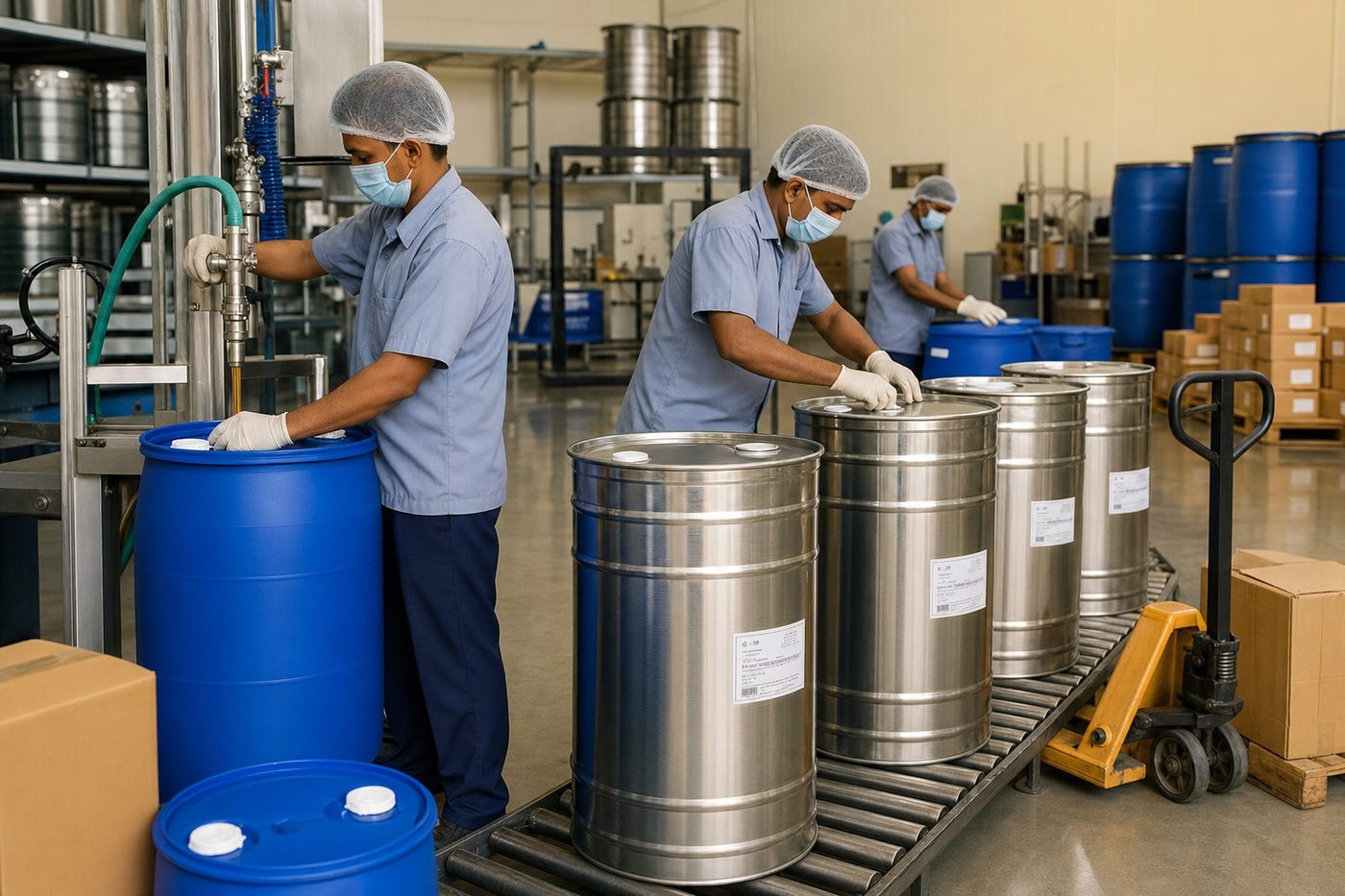
Packaging format should match each SKU's chemical sensitivity rather than following one blanket standard across the catalog. Oxidation-prone products — flaxseed oil in particular, and neem oil to a lesser extent — should move in nitrogen-flushed drums, while more chemically stable products like castor and coconut oil can move in standard HDPE, GI, or epoxy-lined drums without additional inert-gas treatment.
Medicated Taila oils, given their therapeutic-adjacent positioning, warrant closer attention to microbial control during filling and typically move in smaller, tightly sealed containers rather than large industrial drums, reflecting both their smaller order sizes and their higher unit value.
Packaging Formats by Herbal Oil Product Type
Swipe →
Data table — swipe horizontally on small screens
| Product Type | Standard Format | Sample Format | Special Requirement |
|---|---|---|---|
| Castor, Coconut Oil | HDPE or GI drums, 25–200 kg | Amber glass, 50 ml–1 kg | Standard filling; no inert-gas requirement |
| Sesame, Neem Oil | HDPE or epoxy-lined drums, 25–200 kg | Amber glass, 50 ml–1 kg | Dark storage recommended for neem |
| Flaxseed/Linseed Oil | Nitrogen-flushed HDPE drums, 25–200 kg | Amber glass, 50 ml–500 g | Nitrogen flush mandatory for shelf-life protection |
| Kalonji, Sweet Almond, Karanja Oil | HDPE drums, 25–200 kg | Amber glass, 50 ml–1 kg | Standard filling; verify chemical compatibility |
| Medicated Taila Oils | Sealed HDPE or glass, 5–25 kg | Amber glass, 50–200 ml | Microbial-controlled filling environment |
Container Loading Details
Export Tip
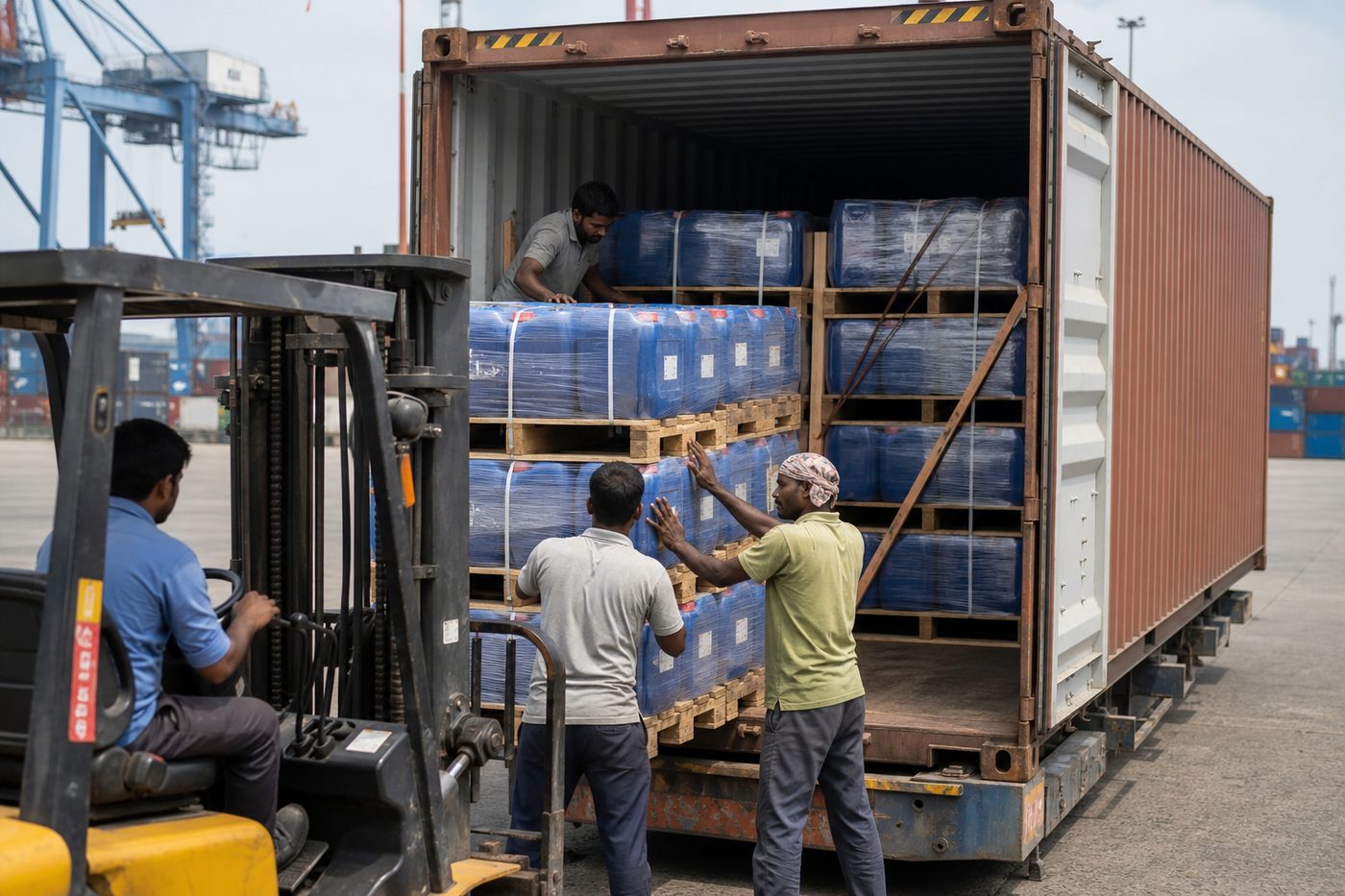
Container loading economics vary meaningfully by SKU density and drum format. High-density fixed oils like castor and coconut oil pack efficiently by weight in a standard 20-foot or 40-foot dry container, while lighter medicated Taila programs, given their smaller per-SKU order sizes, more often move as LCL consolidation across several formulations in one shipment.
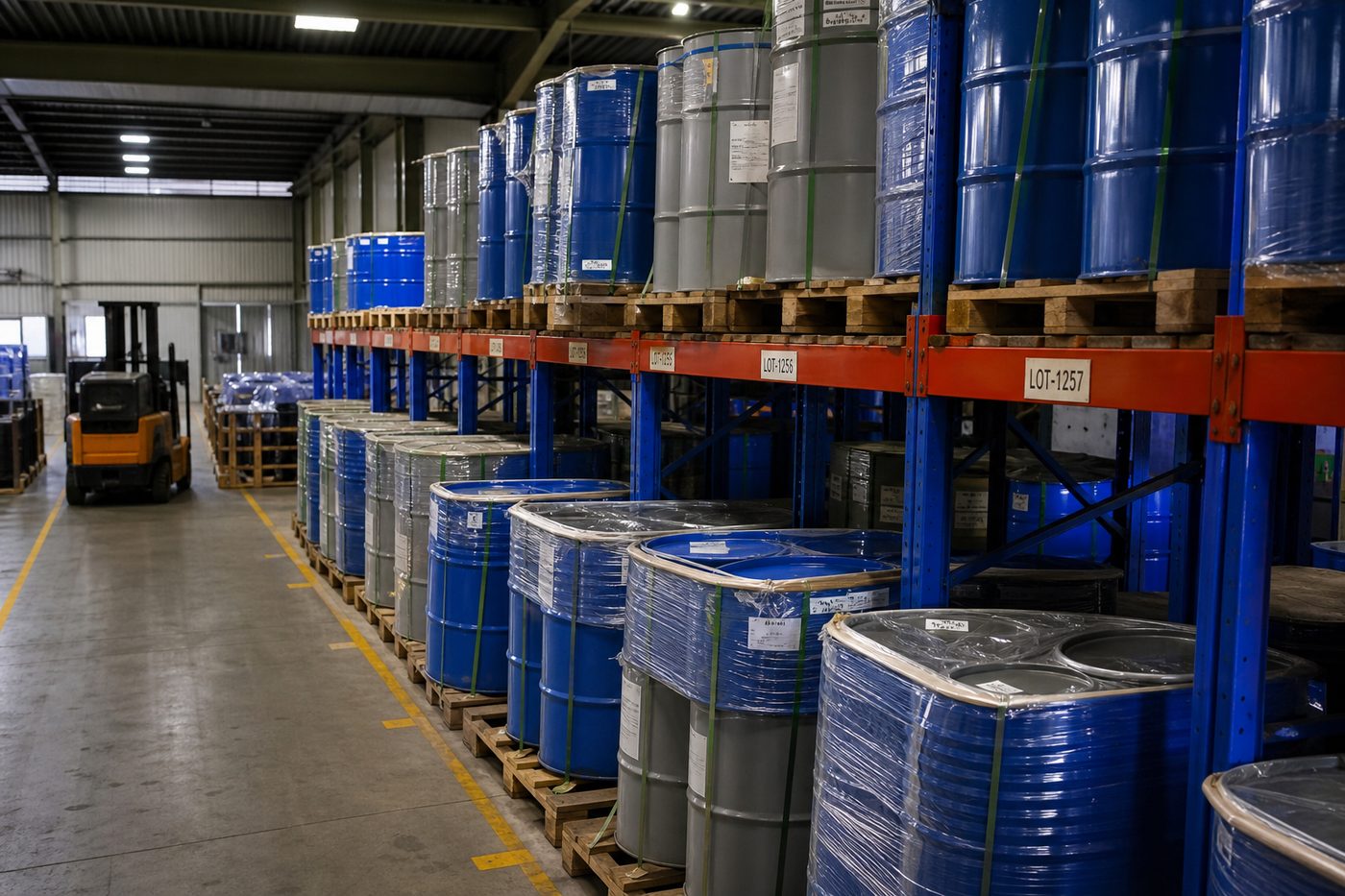
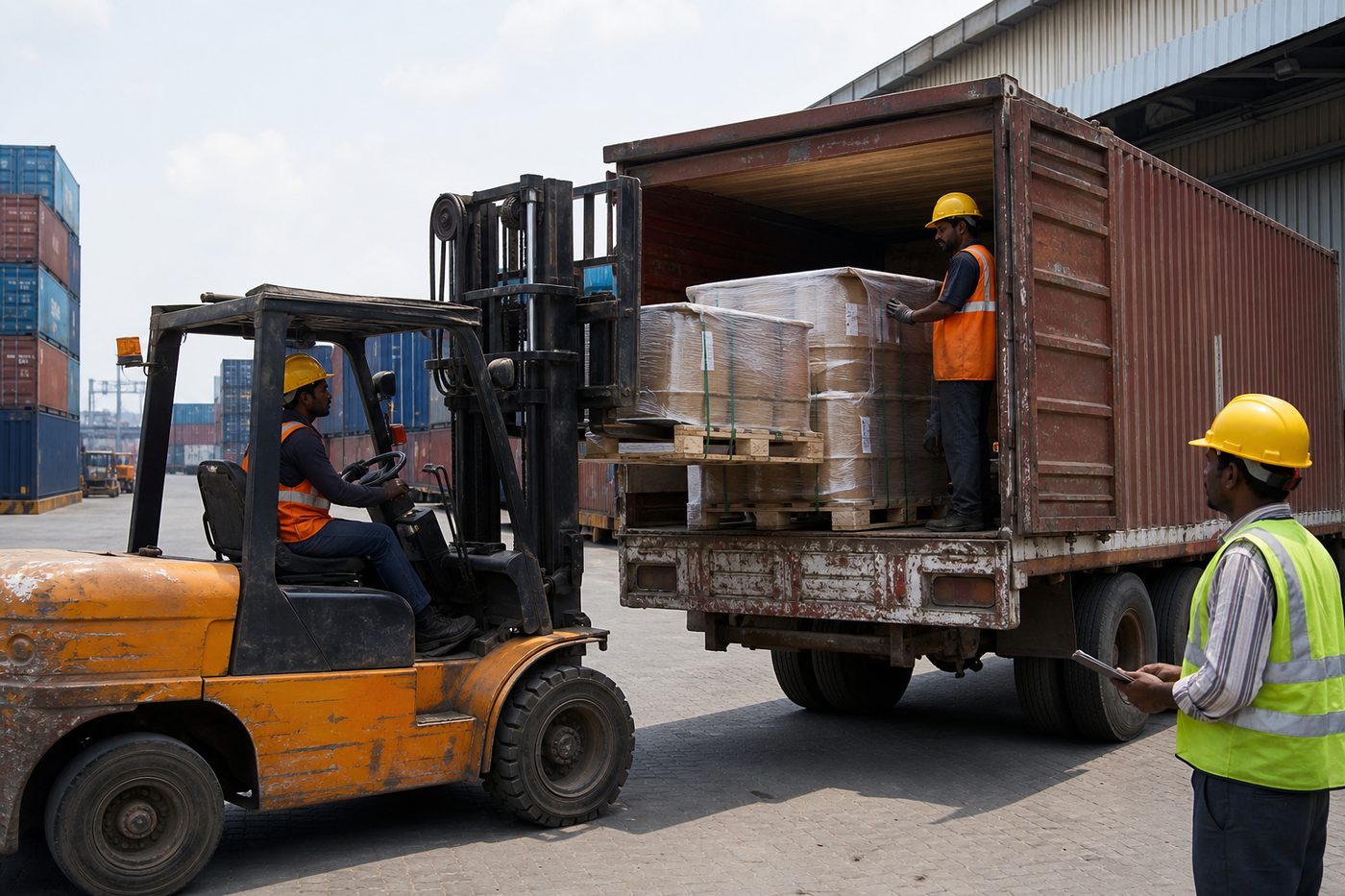
Regardless of product, drums must be palletized, stretch-wrapped, and kept upright throughout — never stacked on their side — and buyers combining multiple SKUs in one container should confirm with the forwarder that mixed-product stow plans still respect each product's individual weight and orientation requirements.
Container Loading Reference by Herbal Oil Product Group
Swipe →
Data table — swipe horizontally on small screens
| Product Group | Typical Loading Mode | Approx. Payload (20ft equivalent) | Key Note |
|---|---|---|---|
| Castor, coconut, sesame (bulk fixed oils) | FCL | 10–16 MT drummed | Weight-limited; confirm exact MT with forwarder |
| Neem, kalonji, flaxseed, karanja, almond | FCL or LCL | 6–14 MT drummed or part-load | LCL common for trial and mid-size orders |
| Medicated Taila (multi-SKU programs) | LCL | Part-pallet to full-pallet quantities | Consolidate multiple SKUs into one shipment |
Shipping Methods
Export Tip
Sea freight in FCL or LCL format is the default mode for nearly every SKU in this catalog given the density and shelf-stability of most herbal oils. Air freight is reserved for samples across all products and for occasional urgent or launch-timed medicated Taila orders where a retail launch date outweighs the cost premium over sea freight.
Port selection should follow the SKU's home cluster: Mundra and Kandla for Gujarat-origin castor and karanja, Nhava Sheva for broadly sourced west-coast programs, and Kochi or Chennai for Kerala-origin coconut oil and Taila alongside the southern neem cluster.
Certifications
Compliance Notes
Certification requirements differ by product family in this catalog rather than applying uniformly. Every fixed oil needs, at minimum, a lot-specific fatty acid profile Certificate of Analysis covering acid value, peroxide value, iodine value, saponification value, and refractive index; edible-grade fixed oils additionally need FSSAI licensing and, for EU/USA-bound lots, pesticide residue and aflatoxin testing. Every medicated Taila SKU needs an AYUSH drug manufacturing licence with product-specific formulation approval, plus microbial limit testing on each commercial lot.
Certification Requirements by Herbal Oil Product Type
Swipe →
Data table — swipe horizontally on small screens
| Product Type | Baseline Registration | Lot-Level Testing | Additional Requirement |
|---|---|---|---|
| Industrial fixed oils (castor, karanja) | IEC | Fatty acid profile COA | Chemexcil RCMC optional for castor-specific programs |
| Edible-grade fixed oils (sesame, coconut) | IEC, FSSAI | Fatty acid profile COA; aflatoxin for EU/USA | Pesticide residue report for regulated markets |
| Cosmetic-grade specialty oils (neem, almond, kalonji, flaxseed) | IEC | Fatty acid profile COA | Pesticide residue report for regulated markets |
| Medicated Ayurvedic Taila | IEC, AYUSH drug manufacturing licence | Formulation-specific COA; microbial limit test | Product-level AYUSH formulation approval |
Buyer Requirements
Buyer Requirements
Buyer expectations for each SKU track closely with the product family it belongs to, and matching your documentation investment to the specific product avoids both under-preparation and unnecessary certification spend.
Cosmetics and Personal-Care Buyers
Cosmetics buyers sourcing castor, sesame, coconut, neem, or sweet almond oil expect a fatty acid profile COA and, for EU-bound lots, pesticide residue documentation, with less emphasis on AYUSH-style licensing since these are typically sold as generic cosmetic ingredients rather than branded Ayurvedic products.
Nutraceutical and Functional-Food Buyers
Buyers of kalonji and flaxseed oil for supplement and functional-food use focus heavily on fatty acid profile, oxidative stability, and — for edible-grade claims — food-safety documentation including aflatoxin testing, since these products enter ingestible supply chains.
Agri-Input Buyers
Neem and karanja oil buyers formulating biopesticides prioritize bitter-principle or active-compound retention and consistent supply continuity over cosmetic-grade purity, and typically require less certification overhead than food or cosmetics buyers of the same botanical oil.
Ayurvedic and Wellness Retail Buyers
Buyers of medicated Taila oils expect AYUSH-linked documentation, formulation transparency, and microbial limit test results, and increasingly want traceability on herb sourcing behind formulations like Bhringraj, Amla, and Ashwagandha oil to support authentic Ayurvedic marketing claims at destination.
Country-wise Opportunities
Market Snapshot
Product demand varies meaningfully by destination country, and the SKU mix that performs best in the USA looks different from the mix that performs best in the Gulf or Southeast Asia. This section summarizes which products lead in which markets; for a deeper country-specific breakdown, see most demanded Indian herbal oils by country and best countries for Indian herbal oil exports.
Leading Herbal Oil Products by Destination Market
Swipe →
Data table — swipe horizontally on small screens
| Country/Region | Leading Products | Notable Growth SKU | Entry Note |
|---|---|---|---|
| USA | Castor (cosmetic grade), sesame, sweet almond | Medicated Taila (Bhringraj, Ashwagandha) | Natural-products retail and DTC wellness channels |
| Germany / France (EU) | Castor, sesame, coconut, neem | Kalonji, flaxseed oil | Cosmetics-industry buyer relationships |
| UAE / Saudi Arabia | Sesame, coconut | Medicated Taila for wellness retail | Edible-oil and wellness distributor partnerships |
| Southeast Asia | Coconut, sesame | Cosmetic-grade coconut oil | Volume-driven edible-oil trade relationships |
| Japan | Medicated Taila, castor | Ksheerabala, Dhanwantharam oil | Specialist importer relationships |
Sourcing Checklist
Checklist
Before placing a first order for any SKU in this catalog, confirm each of the following with your supplier or merchant exporter.
Buyer, Exporter, and Compliance Checklists
Checklist
Compliance Notes
Common Buyer Mistakes
Common Mistakes Box
Buyers building a multi-SKU herbal oil program run into a distinct set of mistakes tied specifically to treating different products as interchangeable or under-specifying which grade or formulation they actually need.
Common Buyer Mistakes When Sourcing Herbal Oil Products from India
Swipe →
Data table — swipe horizontally on small screens
| Mistake | Consequence | How to Avoid |
|---|---|---|
| Quoting "castor oil" without specifying industrial vs. cosmetic/pharma grade | Receiving a grade mismatched to the intended cosmetic or pharma use | Always specify grade and required physicochemical parameters upfront |
| Assuming all Ashwagandha or Bhringraj oil quotes reference the same formulation | Price and quality confusion across suppliers offering the same product name | Request formulation ratio and AYUSH registration behind every medicated-oil quote |
| Skipping nitrogen-flush packaging for flaxseed oil | Oxidized product arriving with a degraded fatty acid profile | Confirm nitrogen-flush packaging specifically for oxidation-prone SKUs |
| Ordering neem oil without confirming dark, cool storage | Reduced active-compound retention affecting agri-input or cosmetic efficacy | Specify storage and transit conditions in the purchase agreement |
| Bundling fixed oils and medicated Taila under one blanket MOQ | Unrealistic MOQ expectations for lower-volume, higher-value Taila SKUs | Negotiate MOQ separately per SKU family |
| Sourcing medicated Taila from a fixed-oil trader without AYUSH verification | Compliance risk from an unlicensed medicated-product supplier | Verify AYUSH licence and product-level formulation approval independently |
| Comparing per-kilogram price across fixed oils and medicated oils directly | Misleading cost comparisons that ignore formulation complexity | Compare within product families, not across fixed-oil and medicated-oil tiers |
Future Market Trends
Key Statistics
Demand for natural personal-care ingredients continues to lift castor, sesame, coconut, and sweet almond oil exports as cosmetics brands substitute away from synthetic ingredients. Mainstream wellness retail expansion in the USA and EU is pulling medicated Taila oils — particularly Bhringraj, Amla, and Ashwagandha oil — beyond traditional Ayurvedic-community buyers into broader natural-products retail distribution.
Nutraceutical demand for kalonji and flaxseed oil is growing alongside broader omega-3 and functional-ingredient interest, while sustainability and traceability expectations are rising fastest for neem oil among agri-input and cosmetics buyers who want documented seed-sourcing evidence. Across every SKU in this catalog, buyers are moving toward tighter physicochemical or formulation specification and away from generic botanical-name purchasing.
Future Trends by Herbal Oil Product Group (2026–2034)
Swipe →
Data table — swipe horizontally on small screens
| Trend | Products Most Affected | Preparation Strategy |
|---|---|---|
| Natural cosmetics ingredient substitution | Castor, sesame, coconut, sweet almond oil | Invest in consistent fatty acid profile documentation |
| Mainstream Ayurvedic wellness retail growth | Bhringraj, Amla, Ashwagandha, Brahmi oil | Develop retail-ready packaging and formulation transparency |
| Nutraceutical/functional-ingredient demand growth | Kalonji, flaxseed oil | Strengthen oxidative-stability and nitrogen-flush packaging capability |
| Rising traceability scrutiny for agri-input oils | Neem, karanja oil | Build seed-sourcing traceability documentation |
| Tighter specification-led sourcing across all SKUs | All fixed and medicated oils | Move buyers from botanical-name to COA-led purchasing |
Expert Insight: The SKU-Mix Question We Ask Every New Buyer
Expert Insight Box
Saurabh Mittal starts every new multi-SKU herbal oil conversation with one question: is the buyer building a bulk ingredient supply chain, a branded Ayurvedic retail line, or both? He has seen buyers waste months trying to source coconut oil and Ksheerabala oil from the same generalist trader, when the two products come from entirely different supplier categories — a coconut oil mill optimized for volume and consistency, and an AYUSH-licensed Ayurvedic manufacturer optimized for formulation fidelity and regulatory compliance.
His advice for buyers assembling a catalog across several SKUs: sequence sourcing by product family rather than by launch date. Lock fixed-oil suppliers first since sampling and testing cycles are shorter and more standardized, then run the longer AYUSH-verification and formulation-approval cycle for medicated Taila SKUs in parallel, so neither workstream blocks the other closer to a retail launch date.

Conclusion
- Read the full process guide at how to export herbal oils from India for registration through shipment.
- Find the right destination for your SKU mix with best countries for Indian herbal oil exports and most demanded Indian herbal oils by country.
- Source directly with how to source herbal oils directly from India.
- Understand the registration path in AYUSH and FSSAI registration benefits for herbal oil exporters.
- Find buyers for your catalog with find international buyers for herbal oils and explore premium positioning in organic and Ayurvedic herbal oil export opportunities.
- Get the full documentation checklist at herbal oil export documentation checklist and plan buyer outreach with trade shows for herbal oil exporters.
- For adjacent botanicals beyond this oil SKU set, see the herbal and Ayurvedic products industry page.
- Contact Altus Exports merchant exporter services or global sourcing partner services — or reach our team directly at Contact Altus Exports — to start building your herbal oil SKU catalog.
The top herbal oil products exported from India span a genuinely wide range — from bulk industrial castor oil priced by the tonne to formulation-specific Ashwagandha or Ksheerabala oil priced by the kilogram — and treating this catalog as one undifferentiated category is the single biggest sourcing mistake a new buyer can make. Each SKU carries its own specification, HS classification, certification path, and buyer profile, and the clusters behind them — Gujarat for castor, the Rajasthan-MP-UP belt for sesame, Kerala for coconut and Ayurvedic Taila, Andhra Pradesh and Telangana for neem, and Haridwar for AYUSH-licensed medicated manufacturing — are each genuinely specialized rather than interchangeable.
Buyers who match their sourcing approach to the specific product family — fixed-oil COA discipline for castor, sesame, coconut, neem, almond, kalonji, flaxseed, and karanja; AYUSH-verified formulation discipline for Bhringraj, Amla, Brahmi, Mahanarayan, Dhanwantharam, Ksheerabala, and Ashwagandha oil — build sourcing programs that scale cleanly from sample to full container. International buyers benefit most from working with verified producers or through a merchant exporter who has already mapped which cluster and which supplier produces which SKU at export quality.
Altus Exports operates as a merchant exporter and global sourcing partner for the full herbal oils catalog from India — fixed oils from Gujarat, the Rajasthan-MP-UP sesame belt, Kerala, and the Andhra-Telangana neem cluster, and medicated Taila oils from Haridwar and Kerala's Ayurvedic manufacturers — managing specification alignment, COA and AYUSH documentation verification, sample coordination, and end-to-end export logistics for single-SKU trial orders and multi-SKU retail catalogs alike.