
How to Find International Buyers for Herbal Oils
By Saurabh Mittal, Founder, Altus Exports
A lead-generation playbook for Indian herbal oil exporters — mining ITC Trade Map and UN Comtrade under HS 1515/3004, building a LinkedIn ICP, working Vitafoods and In-Cosmetics as channels, and filtering out time-wasting inquiries before you ship a single sample.

Indian herbal oil exporters — whether pressing castor and sesame in Gujarat, distilling neem and karanja in the Deccan, or infusing medicated Ayurvedic Taila in Kerala — routinely sit on capacity that outstrips their pipeline of qualified international buyers. The product is not the bottleneck. The bottleneck is a repeatable way to find companies that are actually importing neem, castor, sesame, coconut, almond, kalonji, flaxseed, or karanja oil, or sourcing Bhringraj, Amla, Brahmi, or Mahanarayan Taila for a real formulation programme — and to separate those companies from the much larger pool of one-time inquiries, price shoppers, and brokers who never place a purchase order.
This guide is a lead-generation playbook, not a general buyer-sourcing tutorial. It walks through how to mine ITC Trade Map and UN Comtrade under HS 1515 (fixed vegetable oils, including castor and sesame) and HS 3004 (Ayurvedic medicaments, which covers licensed medicated Taila) to identify active importers by country and volume; how to build a LinkedIn ideal customer profile (ICP) that reaches the right procurement and R&D titles at natural personal care, Ayurvedic wellness, and nutraceutical companies; how to use Vitafoods Europe and In-Cosmetics Global as face-to-face lead channels rather than passive exhibition space; and how to run an email-and-WhatsApp outreach cadence and a red-flag filter that protects your sample budget from buyers who were never going to convert.
Herbal oils sit apart from essential oils and herbal extracts in both trade classification and buyer type — a distinction this guide holds throughout. For product-level specifications once a lead is qualified, see our companion guide on the top herbal oil products exported from India. For the export process itself, see how to export herbal oils from India. Altus Exports operates as a merchant exporter and global sourcing partner for neem, castor, sesame, coconut, almond, kalonji, flaxseed, karanja, and Ayurvedic Taila programmes, and the frameworks below reflect buyer conversations and shipment patterns we see across the USA, EU, GCC, and ASEAN.
Key Takeaways
Summary Box
Executive Summary
Summary Box
India's herbal (fixed/carrier and Ayurvedic medicated) oil basket is dominated by castor oil, where India supplies an estimated 85–90% of world traded volume, alongside sesame, coconut, neem, kalonji, flaxseed, almond, and karanja oils and licensed medicated Taila. Verified WITS/UN Comtrade anchors for calendar year 2024 put Indian castor oil alone (HS 151530) at about USD 1,041.6 million; sesame oil (HS 151550) at about USD 39.0 million; and the aggregate HS 151590 "other fixed vegetable fats and oils" line at about USD 108.9 million (mixed herbal and non-herbal specialties — not a pure herbal-oil total). Official statistics do not isolate a single "herbal oil" basket once coconut (HS 1513) and Ayurvedic medicaments (HS 3004.90) are added, so avoid citing one unaudited mega-total for the whole category.
Buyer acquisition in this category rewards a systematic approach over opportunistic inbound inquiries. Exporters who combine HS-code trade intelligence, a defined LinkedIn ICP, disciplined trade-show follow-up at Vitafoods and In-Cosmetics, and a red-flag verification filter before sample dispatch consistently convert a higher share of leads to purchase orders than exporters relying on marketplace listings alone. This guide sequences that process end to end — market context first, then the specific lead-generation mechanics, then qualification and outreach cadence.

Market Size & Industry Overview
Key Statistics
India's herbal oil export base spans three distinct manufacturing traditions that buyers should understand before sourcing: cold-pressed and solvent-extracted fixed oils (castor, sesame, groundnut-adjacent neem, kalonji, flaxseed, karanja, almond) sold largely as industrial, cosmetic, or nutraceutical raw material; virgin and edible-grade coconut oil sold into food, cosmetic, and Ayurvedic channels; and licensed Ayurvedic medicated Taila — oils infused with herbs such as Bhringraj, Amla, Brahmi, and Mahanarayan under classical formulations — manufactured by AYUSH-licensed units and sold as medicinal or therapeutic products, not generic cosmetic oils.
Gujarat anchors castor oil production and refining, with Kandla and Mundra serving as the primary load ports for bulk castor shipments to China, the USA, and the EU. Rajasthan and parts of Uttar Pradesh and Madhya Pradesh contribute sesame, kalonji, flaxseed, and karanja oil pressing, feeding both edible-oil and cosmetic-oil channels. Kerala and Tamil Nadu are the centre of gravity for coconut oil and for AYUSH-licensed Ayurvedic Taila manufacturing, with clusters around Kottakkal, Coimbatore, and Kochi producing medicated formulations under classical Ayurvedic texts alongside cold-pressed virgin coconut and sesame oil for both domestic and export wellness channels.
Buyers should also understand the certification split up front: fixed carrier oils sold as cosmetic or industrial raw material generally require FSSAI (for edible-grade) or general export documentation only, while medicated Ayurvedic Taila sold on a therapeutic claim requires the manufacturer to hold an AYUSH drug manufacturing licence — a materially different regulatory bar that shapes which buyers can even legally import a given SKU into their market.
Table 1 — India Herbal Oils Industry at a Glance (2025–2026, Directional)
Swipe →
Data table — swipe horizontally on small screens
| Parameter | Estimated Figure | Source / Note |
|---|---|---|
| Global carrier/wellness herbal oil market | Scope-dependent; no single audited total | Analyst estimates vary widely by definition |
| India castor oil exports (HS 151530, CY2024) | ~USD 1,041.6M / 701,614 MT | WITS/UN Comtrade — largest verified anchor |
| India sesame oil exports (HS 151550, CY2024) | ~USD 39.0M / 11,255 MT | WITS/UN Comtrade; USA ~USD 10.1M top destination |
| India's global share of traded castor oil | ~85–90% | Industry / trade body estimates (directional) |
| Primary HS codes | 1515.30 (castor), 1515.50 (sesame), 1515.90 (neem/sweet almond/kalonji/karanja); 1515.11/1515.19 (flaxseed), 1513 (coconut), 3004 (medicated Taila) | ITC Trade Map / DGCIS |
| Top export clusters | Gujarat (castor), Rajasthan/UP/MP (sesame, flax, kalonji, karanja), Kerala/Tamil Nadu (coconut, Ayurvedic Taila) | Manufacturing density |
| Primary load ports | Kandla, Mundra, Nhava Sheva, Chennai, Cochin | Volume-weighted |
| Licensed AYUSH herbal oil manufacturing units | Several thousand across India | AYUSH Ministry / State Drug Authorities |
| Typical export packaging | 25 kg / 50 kg / 180–200 kg HDPE or GI drums; retail bottles for Taila | Industry practice |
Export Statistics
Key Statistics
Castor oil (HS 1515.30) is the single largest value driver in India's herbal oil export basket. In CY2024, China's offtake alone was about USD 504 million (~48% of India's HS 151530 exports), followed by the Netherlands (~USD 118 million), the United States (~USD 105 million), and France (~USD 77 million) — driven by castor's use as an industrial feedstock as well as a cosmetic and pharmaceutical carrier oil. Sesame oil (HS 1515.50) exports are much smaller by value (~USD 39 million in CY2024), with the USA the top destination (~USD 10.1 million), followed by the UAE, Mexico, and other Asian/Gulf markets; Japan and South Korea remain quality-sensitive specialty channels rather than top volume destinations for Indian sesame oil. Fixed oils grouped under HS 1515.90 — which in practice covers neem, sweet almond, kalonji, and karanja oil (India often uses ITC-HS 15159020 for neem seed oil and karanj oil) — form a smaller, more fragmented export category, while flaxseed/linseed oil is separately classified under 1515.11/1515.19. India holds a near-monopoly position for neem and kalonji given the specificity of the source botanicals.
Do not treat SKU-level export values for neem, kalonji, or karanja individually as audited government statistics — India's customs classification groups them together under HS 1515.90 alongside other unlisted fixed vegetable oils, so official trade data reports the aggregate line, not each botanical separately. Exporters and buyers relying on trade intelligence platforms should filter by product description text within shipment records, not by HS code alone, to isolate neem-specific or kalonji-specific buyer activity.
Table 2 — Verified Indian Castor Oil Export Destinations (HS 151530, CY2024, WITS/UN Comtrade)
Swipe →
Data table — swipe horizontally on small screens
| Destination | Export Value (USD M) | Share of India's HS 151530 | Primary Oil Focus |
|---|---|---|---|
| China | 503.7 | ~48% | Castor oil (industrial / derivative feedstock) |
| Netherlands | 118.4 | ~11% | Castor oil (EU industrial / trading hub) |
| United States | 104.9 | ~10% | Castor oil (industrial + cosmetic/pharma grades) |
| France | 77.0 | ~7% | Castor oil (EU industrial / chemical) |
| Thailand | 29.9 | ~3% | Castor oil |
| World total (HS 151530) | 1,041.6 | 100% | Castor oil and fractions (~701,614 MT) |
| Memo: Sesame oil HS 151550 world total | 39.0 | n/a (separate HS line) | Sesame oil (~11,255 MT); USA ~USD 10.1M top destination |
| Memo: Other fixed oils HS 151590 world total | 108.9 | n/a (aggregate basket) | Mixed specialty oils — not a pure herbal-oil total |
Import Statistics
Key Statistics
US Customs and Border Protection filings, EU Eurostat trade flows, and Japan's Ministry of Finance data consistently show herbal-oil buyers importing in lot sizes ranging from 200 kg trial drums to multi-tonne FCL programmes, with frequency skewing quarterly for cosmetic and personal-care buyers and semi-annual for pharmaceutical and nutraceutical buyers who run longer internal qualification cycles. Buyers increasingly consolidate: a US natural personal care brand that once bought castor oil, coconut oil, and almond oil from three separate Indian suppliers is now a common target for consolidation into a single verified exporter relationship.
GCC buyers for Ayurvedic Taila and coconut oil are frequently distributors re-exporting into Gulf pharmacy and wellness retail chains rather than end-brand formulators, which changes the qualification questions an exporter should ask — volume commitment and re-order cadence matter more than formulation detail for this buyer type. Japanese and South Korean buyers for sesame and castor oil apply tighter analytical scrutiny (acid value, peroxide value, fatty acid profile) before confirming even a trial order, which lengthens the sample-to-PO cycle relative to US or GCC buyers.
Table 3 — Key Buyer Profile by Market: Import Behaviour and Requirements
Swipe →
Data table — swipe horizontally on small screens
| Market | Typical Buyer Type | Order Frequency | Preferred Lot Size | Key Certification Demand |
|---|---|---|---|---|
| USA | Natural personal care brands, contract manufacturers | Quarterly | 500–2,000 kg | COA (fatty acid, acid/peroxide value), Non-GMO declaration |
| EU | Cosmetics formulators, wellness brands | Quarterly | 500–5,000 kg | REACH, EU Organic (where applicable), COA |
| Japan | Cosmetics and food-grade sesame buyers | Semi-annual–quarterly | 200–1,000 kg | Tight COA specs; consistency across lots |
| GCC | Distributors, pharmacy/wellness retail chains | Semi-annual | 500–2,000 kg | HALAL, AYUSH licence for Taila, Arabic labelling |
| ASEAN | Ayurvedic wellness retailers, distributors | Quarterly | 200–1,000 kg | AYUSH GMP, product registration support |
| UK | Cosmetics and natural personal care brands | Quarterly | 200–1,000 kg | COA, Organic (where positioned) |
| Canada | Natural health product manufacturers | Quarterly | 200–800 kg | NPN-ready documentation |
Product Categories / Variants
Summary Box
Buyer fit varies sharply by oil. Leading outreach with the right SKU for a given buyer type is the difference between a five-minute disqualification and a genuine sample request. The overview below maps the herbal oil portfolio to its primary international buyer segments.
Table 4 — Herbal Oil Product Lines: Grade Markers & Primary Buyer Segments
Swipe →
Data table — swipe horizontally on small screens
| Oil | Key Quality Marker | Typical Grade | Primary Buyer Segment | Price Band (USD/kg, FOB) |
|---|---|---|---|---|
| Castor Oil | Acid value, colour, viscosity | Cosmetic / industrial / pharma | Chemical distributors, cosmetic houses | 1.4–2.6 |
| Sesame Oil | Free fatty acid, peroxide value | Cold-pressed / refined | Food, cosmetic, Ayurvedic massage-oil buyers | 2.5–5.5 |
| Coconut Oil (Virgin) | Lauric acid %, moisture, colour | Virgin cold-pressed | Cosmetic, wellness, Ayurvedic brands | 2.2–4.0 |
| Neem Oil | Azadirachtin content, odour | Cosmetic / biopesticide | Cosmetic brands, agri-input distributors | 3.0–6.5 |
| Kalonji Oil | Thymoquinone content | Cold-pressed nutraceutical | Nutraceutical, wellness, Gulf buyers | 8.0–18.0 |
| Flaxseed Oil | ALA (omega-3) content, peroxide value | Cold-pressed / technical | Nutraceutical brands / industrial coatings | 3.5–7.0 |
| Almond Oil | Free fatty acid, colour | Sweet almond, cosmetic-grade | Personal care and massage-oil brands | 9.0–16.0 |
| Karanja Oil | Karanjin content | Cosmetic / biopesticide / biodiesel | Agri-input, biodiesel, Ayurvedic skincare | 2.0–4.5 |
| Ayurvedic Medicated Taila | Formulation compliance, herb ratio | AYUSH-licensed medicated | Ayurvedic wellness brands, pharmacy chains | 6.0–25.0 (finished retail-ready varies widely) |
Castor Oil
Castor oil (HS 1515.30) is India's highest-volume herbal oil export, used as an industrial feedstock (biodiesel, lubricants, polymers), a pharmaceutical excipient, and a cosmetic carrier oil for hair and skin formulations. Buyers range from large industrial chemical distributors to cosmetic ingredient houses. Cold-pressed, first-grade castor oil for cosmetic use commands a premium over industrial-grade, and buyers frequently request separate COAs for each grade.
Sesame Oil
Sesame oil (HS 1515.50) serves both edible/culinary buyers and cosmetic/Ayurvedic massage-oil buyers, with the two channels requiring different certification: FSSAI and food-grade documentation for edible use, cosmetic-grade COA for personal care and Ayurvedic massage-oil buyers. Cold-pressed (ghani/kolhu) sesame oil is increasingly requested by name for its clean-label positioning versus solvent-extracted grades.
Coconut Oil
Coconut oil (HS 1513) for the herbal-oil channel is typically virgin or cold-pressed grade rather than commodity RBD coconut oil, aimed at cosmetic, hair-care, and Ayurvedic wellness buyers rather than the food-oil bulk trade dominated by the Philippines and Indonesia. Kerala-origin virgin coconut oil with Ayurvedic heritage positioning is a distinct SKU from commodity coconut oil and should be marketed as such.
Neem Oil
Neem oil (grouped under HS 1515.90) serves cosmetic, agricultural biopesticide, and traditional wellness buyers, with India holding a near-monopoly on supply given the specificity of the neem tree to the subcontinent. Buyers differ sharply by end use — biopesticide buyers require different documentation (agricultural registration compliance in the destination market) than cosmetic buyers, who want cosmetic-grade COA and fragrance/odour specification.
Kalonji (Black Seed) Oil
Kalonji oil (HS 1515.90) targets nutraceutical, wellness, and Middle Eastern/halal-market buyers drawn to its traditional and religious significance in Islamic wellness culture. Cold-pressed kalonji oil with documented thymoquinone content is increasingly requested by nutraceutical brands seeking a differentiated marker beyond generic 'black seed oil' claims.
Flaxseed (Linseed) Oil
Flaxseed oil (HS 1515.11/1515.19) splits between nutraceutical/wellness buyers (omega-3 ALA positioning, cold-pressed, food-grade) and industrial buyers (paint, varnish, and coating applications using technical-grade linseed oil). Exporters should clarify grade early — a nutraceutical buyer has no use for technical-grade linseed oil and vice versa.
Almond Oil
Almond oil (HS 1515.90) is predominantly a cosmetic and personal-care carrier oil for international buyers, used in massage oils, hair oils, and skincare formulations. Sweet almond oil (edible/cosmetic) should not be confused with bitter almond oil (restricted in many markets due to amygdalin content) — buyers will ask for this clarification and exporters should have it ready before the question arises.
Karanja Oil
Karanja (Pongamia) oil (HS 1515.90) is a niche export serving biopesticide, traditional skincare, and biodiesel feedstock buyers. It is a smaller-volume, specialist category — buyers tend to be technically sophisticated (agricultural input companies, biodiesel blenders, or Ayurvedic skincare formulators) rather than generalist cosmetic buyers.
Ayurvedic Medicated Taila
Medicated Taila — Bhringraj, Amla, Brahmi, Mahanarayan, and dozens of other classical formulations — are herb-infused oils manufactured under Ayurvedic pharmacopoeial standards by AYUSH-licensed units, sold with therapeutic positioning rather than generic cosmetic claims. Buyers are Ayurvedic wellness brands, pharmacy chains in GCC and ASEAN markets with South Asian diaspora demand, and increasingly Western wellness retailers building an Ayurvedic product line. This category requires the exporter to hold or source from an AYUSH drug licence holder — a buyer question that should be answered before any pricing discussion.
Manufacturing Overview
Export Tip
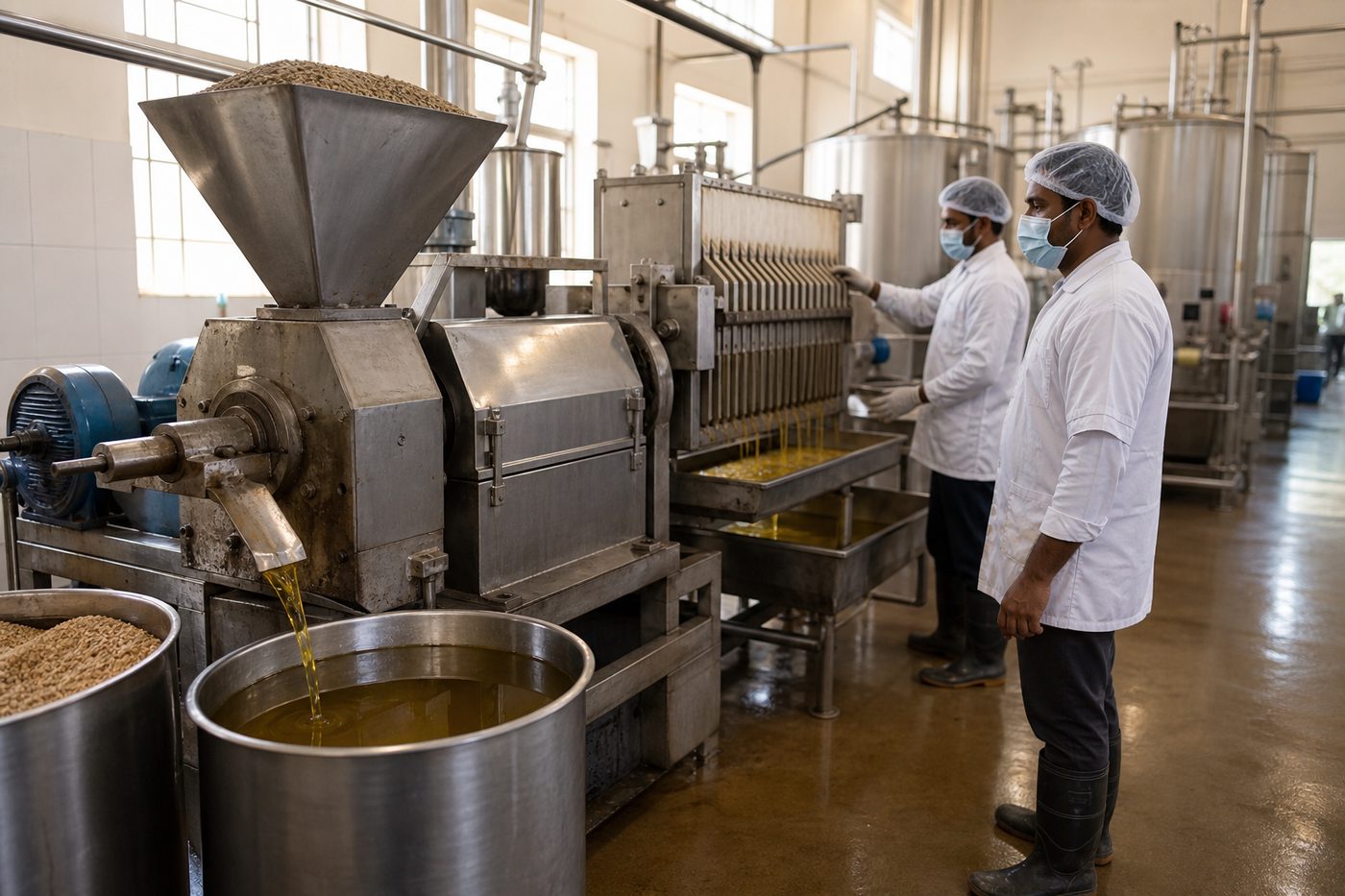
India's herbal oil manufacturing base clusters by raw material geography rather than a single national hub, which matters for lead generation because a buyer's preferred SKU often determines which region — and which exporter network — to prospect. Gujarat's castor belt (Saurashtra and Kutch regions) hosts the largest integrated castor crushing and refining capacity in the world, feeding both Kandla/Mundra export and the domestic castor derivatives industry. Rajasthan, Uttar Pradesh, and Madhya Pradesh host sesame, kalonji, flaxseed, and karanja pressing, much of it on smaller-scale ghani (traditional cold-press) or expeller lines feeding both domestic edible-oil demand and export-grade cosmetic and nutraceutical channels.
Kerala and Tamil Nadu form the centre of gravity for coconut oil and Ayurvedic Taila manufacturing. Kottakkal in Kerala is historically significant for classical Ayurvedic medicine manufacturing, including medicated Taila, and the region hosts several AYUSH-licensed units capable of producing Bhringraj, Amla, Brahmi, and Mahanarayan Taila to pharmacopoeial standard alongside cold-pressed virgin coconut and sesame oil for wellness export. Almond oil processing is more geographically dispersed, often produced by specialty cold-press units in northern and western India rather than a single dominant cluster.
Exporters should note for lead-generation purposes that buyers researching Indian suppliers increasingly ask which cluster and which specific licence (FSSAI vs AYUSH) backs a given SKU — a question that separates serious procurement research from generic marketplace browsing. Being able to answer this precisely in a first outreach message is itself a qualification signal to the buyer.
Pricing Analysis
Buyer Tip
Herbal oil pricing is a function of raw material cost (heavily influenced by seasonal harvest for castor, sesame, and flaxseed), extraction method (cold-pressed commands a premium over solvent-extracted for cosmetic and nutraceutical buyers), grade (cosmetic/pharma grade over industrial/technical grade), and — for Ayurvedic Taila — the complexity and herb cost of the classical formulation. Buyers evaluating quotes should always confirm grade and extraction method before comparing price per kilogram, since a solvent-extracted sesame oil quote and a cold-pressed sesame oil quote can differ by 40% or more for what a buyer might otherwise assume is the same product.
Castor and karanja oil, at the lower end of the pricing spectrum, operate closer to commodity dynamics where FOB Kandla/Mundra pricing moves with international feedstock and industrial demand. Kalonji, almond, and Ayurvedic Taila sit at the premium end, where botanical scarcity, extraction complexity, and brand positioning (nutraceutical or Ayurvedic heritage) support materially higher margins than the fixed-oil commodity segment.
Table 5 — Herbal Oil Pricing Structure by Grade (FOB Indian Port, 2025–26)
Swipe →
Data table — swipe horizontally on small screens
| Oil & Grade | Industrial/Standard (USD/kg) | Cosmetic/Food Grade (USD/kg) | Organic/Premium Grade (USD/kg) |
|---|---|---|---|
| Castor Oil (industrial vs cosmetic) | 1.4–1.9 | 2.0–2.6 | 2.4–3.2 (organic-certified) |
| Sesame Oil (solvent vs cold-pressed) | 2.5–3.5 | 3.5–4.5 | 4.5–6.5 (organic cold-pressed) |
| Coconut Oil (RBD vs virgin) | 1.6–2.2 | 2.2–3.2 | 3.2–5.0 (organic virgin) |
| Neem Oil | 2.5–3.5 | 3.5–5.0 | 5.0–7.0 (organic) |
| Kalonji Oil | 8.0–12.0 | 12.0–16.0 | 16.0–22.0 (organic, high thymoquinone) |
| Flaxseed Oil | 3.0–4.5 | 4.5–6.0 | 6.0–8.5 (organic cold-pressed) |
| Almond Oil | 9.0–12.0 | 12.0–15.0 | 15.0–20.0 (organic) |
| Karanja Oil | 2.0–3.0 | 3.0–4.0 | 4.0–5.5 (organic/traceable) |
MOQ Analysis
Buyer Tip
Minimum order quantities for herbal oils vary by product, grade, and supplier structure. Large integrated castor and coconut oil manufacturers typically set higher MOQs suited to bulk industrial or FMCG buyers, while smaller cold-press units and AYUSH-licensed Ayurvedic Taila manufacturers offer more flexible trial quantities suited to cosmetic brands and wellness retailers testing a new SKU.
Working through a merchant exporter allows a buyer building a multi-oil programme — say, castor, coconut, and almond oil for a single personal-care brand — to consolidate trial quantities across several manufacturers into one shipment, avoiding the complexity of separate MOQ negotiations, COA formats, and shipping schedules with three unrelated Indian suppliers.
Table 6 — MOQ Guide by Supplier Type and Herbal Oil Category
Swipe →
Data table — swipe horizontally on small screens
| Supplier Type | Typical MOQ (standard grade) | Trial Order MOQ | Notes |
|---|---|---|---|
| Large integrated castor/coconut manufacturer | 1,000–5,000 kg | 200–500 kg at premium | Higher minimum, lower unit price |
| Mid-size cold-press unit (sesame, flax, kalonji) | 100–500 kg | 25–100 kg | More flexible on trial sizes |
| AYUSH-licensed Ayurvedic Taila manufacturer | 50–200 kg / 500–2,000 retail units | 10–25 kg / 50–100 units | Formulation and label lead time adds to timeline |
| Merchant exporter (Altus model) | 25–100 kg per SKU | 25 kg per product | Consolidates multiple oils into one shipment |
| Trading company / broker | 50–200 kg | Limited trial flexibility | Adds markup, less quality control visibility |
| Organic-certified grade (any oil) | +30–50% on standard MOQ | +30–50% on standard trial | Certified batch segregation adds cost |
Packaging Standards
Export Tip
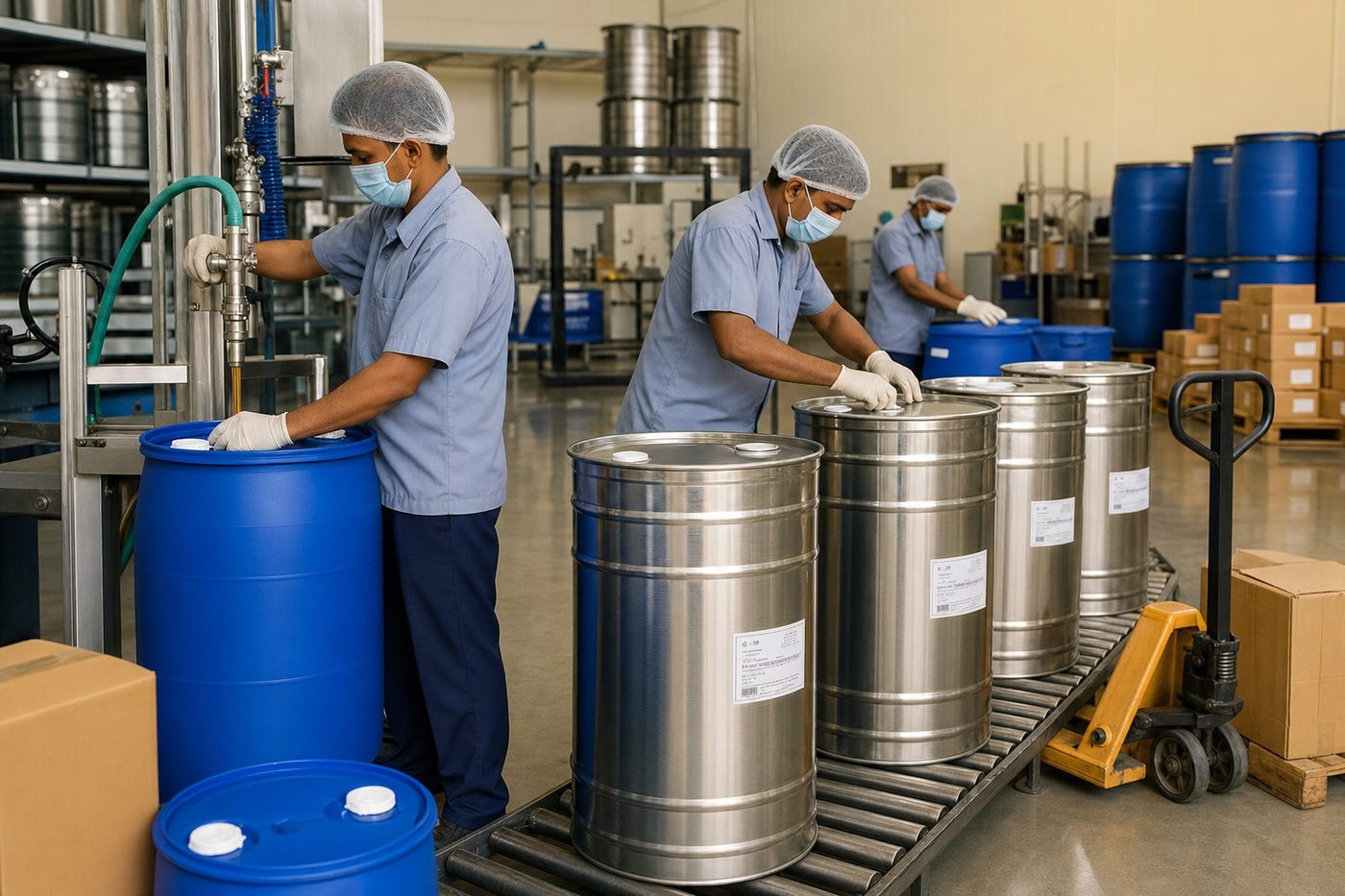
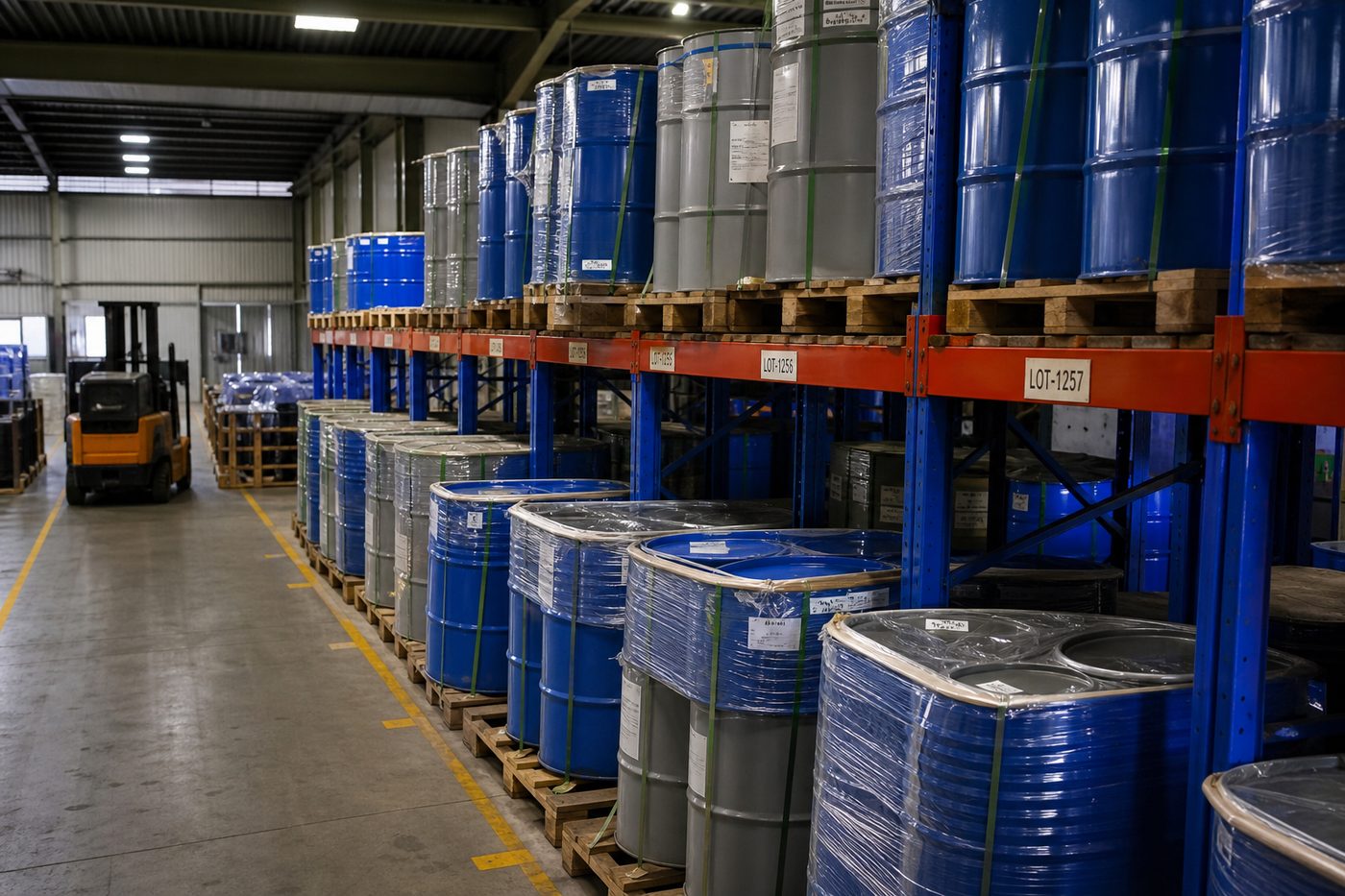
Fixed herbal oils generally follow bulk drum packaging standards similar to other export vegetable oils, while medicated Ayurvedic Taila frequently ships retail-ready in bottles given its therapeutic positioning and shelf presentation requirements. Each unit — drum or bottle — must carry a label compliant with the destination market's import rules: product name, botanical source, extraction method, lot number, manufacturing and best-before dates, net and gross weight, country of origin, and any relevant certification mark.
For medicated Taila specifically, the label must reflect the AYUSH-licensed formulation name and manufacturing licence details exactly as registered — a mismatch between label claims and licence scope is one of the most common causes of customs and import-registration delays for this category.
Table 7 — Standard Packaging Configurations for Herbal Oil Exports
Swipe →
Data table — swipe horizontally on small screens
| Oil Type | Inner/Bulk Packaging | Outer Packaging | Net Weight per Unit | Special Requirements |
|---|---|---|---|---|
| Castor oil (bulk) | N/A — direct fill | HDPE or GI drum, or flexi-tank for FCL | 180–200 kg drum; 18–20 MT flexitank | Seal integrity, batch coding |
| Sesame / almond / flaxseed oil | Food-grade PE liner (if drummed) | HDPE drum or tin | 15–25 kg | Light-protection for cold-pressed grades |
| Virgin coconut oil | PE liner or direct fill | HDPE drum or retail glass jar | 5–25 kg (bulk); 100–500 ml (retail) | Temperature-stable storage (solidifies below ~24°C) |
| Neem / kalonji / karanja oil | PE liner | HDPE drum | 20–25 kg | Odour-sealed packaging for neem |
| Ayurvedic medicated Taila (retail) | Amber glass or PET bottle | Corrugated master carton | 50–200 ml per bottle | AYUSH-compliant label, batch and licence number |
| Ayurvedic medicated Taila (bulk) | PE-lined drum | HDPE drum | 20–50 kg | Formulation-matched COA per batch |

Container Loading Details
Export Tip
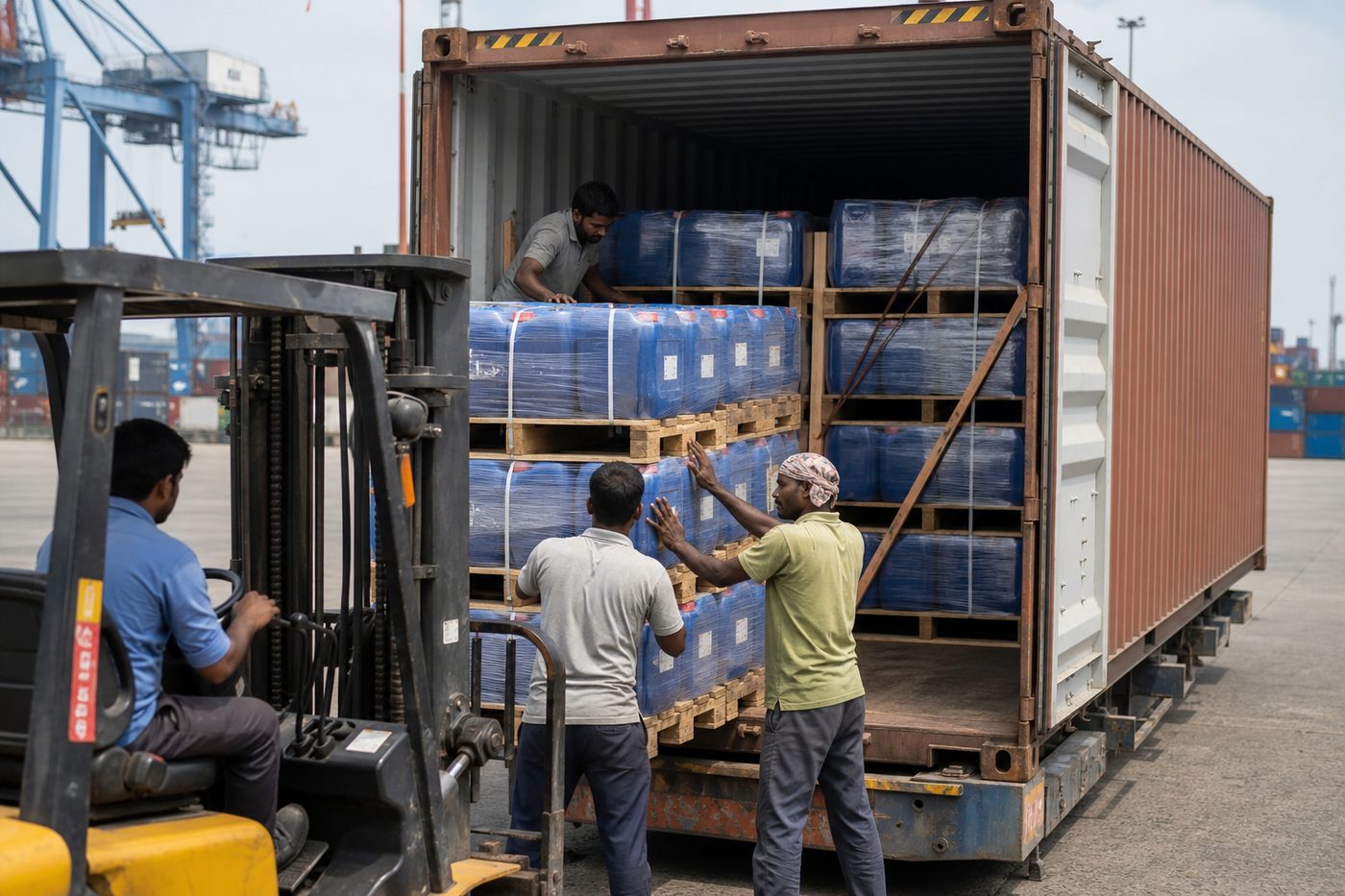
Most bulk fixed herbal oils — castor, sesame, coconut, neem, flaxseed, karanja — ship as FCL either in drums or, for larger castor programmes, in flexitanks that carry significantly more volume per container than drummed cargo. Ayurvedic medicated Taila, given its retail-ready packaging and typically smaller order volumes, more often ships LCL or in mixed-SKU FCL alongside other Ayurvedic wellness products.
Buyers consolidating a multi-oil programme should confirm with their exporter whether different oils in the same container require separated stowage — some oils with strong odour profiles (neem in particular) are best palletised away from more neutral oils like refined coconut or almond oil to avoid any risk of scent transfer during a long transit.
Table 8 — Container Loading Reference for Herbal Oils
Swipe →
Data table — swipe horizontally on small screens
| Format | 20-ft FCL Capacity | 40-ft FCL Capacity | Typical Use Case |
|---|---|---|---|
| 200 kg HDPE drums | ~90–100 drums (18–20 MT) | ~180–200 drums (36–40 MT) | Castor, sesame, coconut, neem, karanja bulk |
| Flexitank (castor oil) | ~18–20 MT | Not standard (20-ft flexitank only) | Large castor oil FCL programmes |
| 25 kg drums (specialty oils) | ~700–750 drums (17.5–18.75 MT) | ~1,400–1,500 drums (35–37.5 MT) | Kalonji, flaxseed, almond bulk |
| Retail bottles (Ayurvedic Taila) | Varies by carton size and pallet plan | Varies by carton size and pallet plan | Mixed-SKU LCL or consolidated FCL |
Shipping Methods
Export Tip
Sea freight FCL dominates bulk herbal oil shipping given the cost sensitivity of castor, sesame, coconut, and neem oil at industrial and cosmetic-ingredient pricing. Kandla and Mundra serve castor and western-cluster oils moving to China, the USA, and the EU; Chennai and Cochin serve southern-cluster coconut oil and Ayurvedic Taila moving to the GCC, ASEAN, and diaspora markets in the UK and North America.
Air freight is reserved for urgent regulatory submission samples, first commercial lots of Ayurvedic Taila under 25 kg, or high-value kalonji and almond oil trial shipments where transit-time risk outweighs the freight cost differential. LCL consolidation through Nhava Sheva or Mundra suits buyers trialling multiple oils below FCL volume before committing to a dedicated container.
Table 9 — Shipping Methods for Herbal Oil Export
Swipe →
Data table — swipe horizontally on small screens
| Mode | Typical Use | Transit Time | Notes |
|---|---|---|---|
| Sea FCL (drums or flexitank) | Bulk castor, sesame, coconut, neem, flax, karanja programmes | 18–35 days depending on lane | Cost-efficient for commodity-adjacent grades |
| Sea LCL | Trial or mixed-SKU shipments under FCL volume | 18–35 days | Consolidation through Nhava Sheva/Mundra |
| Air freight | Ayurvedic Taila trial lots, kalonji/almond samples | 3–7 days | 8–12× sea freight cost; used for urgency |
| Courier (samples) | 50–500 g/ml qualification samples | 2–5 business days | COA and product data sheet enclosed |
Certifications
Compliance Notes
Certification requirements split sharply by oil category and end use. Fixed carrier oils sold as cosmetic or industrial raw material need FSSAI (for edible-grade lines) and standard export documentation; oils positioned as organic require NPOP certification with USDA/EU equivalence; medicated Ayurvedic Taila requires the manufacturer to hold a valid AYUSH drug manufacturing licence, without which the product cannot legally be labelled or sold as a medicinal Taila in most markets.
Buyers should verify certification at the specific-lot level, not the company level — a manufacturer's general AYUSH licence does not automatically cover every formulation they produce, and a general FSSAI registration does not substitute for organic certification if the buyer intends to market the oil as organic.
Table 10 — Certification Map for Herbal Oil Exports
Swipe →
Data table — swipe horizontally on small screens
| Certification | Required By | Issuing Authority (India) | Market Access It Unlocks |
|---|---|---|---|
| AYUSH GMP / Drug Manufacturing Licence | Medicated Ayurvedic Taila | AYUSH Ministry / State Drug Authority | Legal basis for medicinal Taila claims worldwide |
| FSSAI | Edible-grade sesame, coconut, flaxseed, kalonji oil | FSSAI | Food-channel buyers in USA, EU, GCC |
| NPOP | Organic-positioned fixed oils and Taila | APEDA / accredited certification body | Base for USDA/EU organic equivalence |
| USDA Organic (NOP) | USA organic-labelled products | USDA-accredited certifier | US premium organic wellness market |
| EU Organic (Reg. 2018/848) | EU organic-labelled products | EU-accredited certifier | EU organic market |
| HALAL | GCC, ASEAN Muslim-majority markets | HALAL certification body (India) | GCC, Malaysia, Indonesia markets |
| REACH SDS | EU chemical/cosmetic buyers (≥1 t/yr) | EU REACH framework | EU market entry for industrial-grade oils |
| ISO 22000 / GMP | Cosmetic and nutraceutical buyers | Certification body | Retail and brand buyer qualification |
Buyer Requirements
Buyer Requirements
Buyer requirements diverge by segment more sharply in herbal oils than in many other export categories, because a single botanical (coconut, for instance) can serve a food buyer, a cosmetic buyer, and an Ayurvedic wellness buyer with three entirely different documentation stacks.
Cosmetic and Personal Care Brand Requirements
Cosmetic buyers for castor, coconut, almond, and neem oil require a cosmetic-grade COA (colour, odour, free fatty acid, peroxide value), INCI-compliant naming, and increasingly a Non-GMO or organic declaration for clean-beauty positioning. IFRA statements are not typically required for fixed carrier oils unless the buyer's finished formulation triggers fragrance-adjacent compliance review.
Nutraceutical and Wellness Brand Requirements
Kalonji, flaxseed, and sesame oil buyers in the nutraceutical channel require food-grade COA, marker compound data (thymoquinone for kalonji, ALA content for flaxseed), and — for the US market — evidence of manufacturing facility registration where the product is imported as a dietary ingredient.
Ayurvedic Wellness and Pharmacy Chain Requirements
When prospecting medicated Taila buyers, lead with formulation-specific AYUSH evidence in the outreach pack. Western wellness retailers and GCC/ASEAN pharmacy chains rarely advance a sample request until they see licence coverage for the exact SKU, plus a clear stance on destination registration and claim/label language for their market.
Distributor and Private-Label Requirements
Distributors purchasing across multiple herbal oils for re-sale prioritise consistent supply, competitive volume pricing, and a single accountable exporter relationship over deep formulation detail. Private-label cosmetic and wellness brands add artwork approval, retail-ready packaging, and shelf-life validation to the standard documentation stack.
Country-wise Opportunities
Market Snapshot
Herbal oil demand concentrates differently by country than commodity vegetable oil demand — clean-beauty and Ayurvedic wellness positioning drive USA and EU opportunity, diaspora and pharmacy-channel demand drive GCC and ASEAN opportunity, and industrial feedstock demand drives China's castor oil import volume.
Table 11 — Country-wise Herbal Oil Export Opportunities
Swipe →
Data table — swipe horizontally on small screens
| Country/Region | Demand Driver | Leading Oils | Certification Priority | Entry Strategy |
|---|---|---|---|---|
| USA | Clean-beauty and natural wellness retail | Castor, coconut, almond, kalonji | COA, Non-GMO, Organic (premium tier) | Vitafoods/SupplySide follow-up; LinkedIn ICP outreach |
| European Union | Cosmetics formulation, organic wellness | Castor, sesame, flaxseed, coconut | REACH, EU Organic, COA | In-Cosmetics Global; distributor partnerships |
| China | Industrial feedstock (castor derivatives) | Castor oil | Standard trade documentation, COA | Direct trade/distributor relationships |
| GCC | Diaspora Ayurvedic and pharmacy retail | Ayurvedic Taila, coconut, sesame | HALAL, AYUSH licence, Arabic labelling | Gulfood Manufacturing; pharmacy-chain distributor outreach |
| ASEAN (Malaysia, Singapore, Indonesia) | Ayurvedic wellness retail, diaspora demand | Coconut, Ayurvedic Taila | AYUSH GMP, local product registration support | Regional wellness distributor partnerships |
| Japan / South Korea | Cosmetic-grade sesame and castor demand | Sesame, castor | Tight COA consistency | In-Cosmetics Korea; direct technical outreach |
Using ITC Trade Map and UN Comtrade (HS 1515/3004) to Identify Buyers
Trade data is the most underused prospecting tool for Indian herbal oil exporters. ITC Trade Map, built on UN Comtrade data, publishes country-level import and export values by HS code, letting an exporter see which countries are increasing imports of HS 1515 fixed vegetable oils or HS 3004 Ayurvedic-adjacent medicaments year over year — a macro signal that should shape which markets receive prospecting effort first. UN Comtrade's own database allows the same query with longer historical series, useful for spotting multi-year growth trends before committing to a new-market push.
Trade Map and Comtrade report country-level aggregates, not individual company names — for company-level shipment records, exporters need a subscription trade intelligence platform such as Volza, Seair Exim Solutions, Import Genius, or Panjiva, which parse customs bills of entry to reveal consignee name, shipment value, weight, and frequency. A search filtered to HS 1515.30 (castor) imports into the USA over 12 months, for example, will surface both large industrial chemical importers and smaller cosmetic ingredient distributors, each with a visible import history an exporter can use to open a targeted conversation.
Qualification filtering is essential before outreach. Filter shipment records by declared value (eliminate sub-USD 3,000 spot purchases that indicate trial or hobby buying), frequency (three or more shipments in 12 months signals a programmatic buyer), product description match (confirm the specific oil, not just the HS heading, since HS 1515.90 groups several unrelated botanicals), and current origin country (buyers currently importing from lower-cost or less-consistent origins are prime targets for a quality-differentiated pitch).
Building a Prospect List from Trade Intelligence
Table 12 — Trade Data Prospect Qualification Framework
Swipe →
Data table — swipe horizontally on small screens
| Filter Criterion | Target Parameter | What It Signals |
|---|---|---|
| Annual import value | USD 30,000–1,500,000+ | Programmatic buyer with budget |
| Shipment frequency | 3+ shipments per year | Ongoing procurement need, not one-off |
| Product description match | Specific oil, not generic HS heading | Relevant demand for your SKU |
| Current origin country | Lower-consistency or higher-cost origin | Diversification opportunity for India |
| Company size (employees) | 10–500 | Reachable without enterprise gatekeeping |
| Regulatory registration visible | FDA facility reg., FSSAI-equivalent, AYUSH import registration | Compliance-capable, serious buyer |
Once trade records are filtered, enrich each prospect with public information: company website, LinkedIn company page, and — for cosmetic or nutraceutical buyers — any visible ingredient sourcing statements or supplier announcements. This enrichment clarifies whether a prospect is a contract manufacturer (fast-moving, active production mandates), a branded wellness company (slower cycle, stickier once converted), a distributor (volume-focused, margin-sensitive), or a pharmacy chain (for Ayurvedic Taila, longest qualification cycle but highest retained-relationship value).
LinkedIn ICP and Digital Prospecting for Herbal Oil Buyers
A defined ideal customer profile (ICP) turns LinkedIn from a broadcast channel into a targeted prospecting tool. For herbal oils, the ICP centres on job titles such as Sourcing Manager, Procurement Lead, Formulation Scientist, R&D Manager, and — for Ayurvedic Taila specifically — Ayurvedic Product Manager or Regulatory Affairs Lead, at companies tagged under Cosmetics, Personal Care, Dietary Supplements, or Traditional/Complementary Medicine on LinkedIn's industry taxonomy.
Defining the ICP by Oil Category
Castor and neem oil ICPs skew toward cosmetic ingredient houses and, for castor, industrial chemical distributors — titles here include Ingredient Sourcing Manager and Raw Material Procurement Lead. Kalonji and flaxseed oil ICPs skew toward nutraceutical and dietary supplement companies — titles include VP Sourcing, Formulation Scientist, and Quality Director. Ayurvedic Taila ICPs skew toward wellness brand founders, Ayurvedic Product Managers, and pharmacy-chain category buyers in GCC and ASEAN markets, where the buying decision often sits closer to a business owner than a corporate procurement department.
LinkedIn Outreach Sequencing
Send a connection request with a note referencing the prospect's specific product line or a recent company announcement — a new hair-care launch, an Ayurvedic product line expansion, or a trade show appearance. Avoid leading with a product pitch in the connection note itself. Once connected, the first message should offer something of clear value: a COA comparison, a note on India's castor or kalonji supply outlook, or a relevant regulatory update — before any pricing conversation begins.
B2B Portals and Content Marketing
Alibaba, IndiaMART, and TradeIndia generate inbound inquiries but reward listings that clearly differentiate on certification and grade rather than price alone — a listing for cold-pressed, AYUSH-compliant Bhringraj Taila with visible licence numbers will convert better than a generic 'Ayurvedic hair oil' listing competing purely on unit price. Publishing technically credible content on castor oil grades, cold-pressed extraction quality, or the Ayurvedic pharmacopoeial basis for a Taila formulation builds search visibility and pre-sells buyers before first contact, though this is a medium-term channel measured in months, not weeks.
Trade Shows: Vitafoods and In-Cosmetics as Lead Channels
Trade shows compress the trust-building timeline for herbal oils, which are often positioned on ingredient-story credibility as much as on price. Vitafoods Europe (Geneva, May) and In-Cosmetics Global (rotating European city, April) are the two highest-value shows for Indian herbal oil exporters, reaching nutraceutical, wellness, and cosmetic ingredient buyers respectively, with In-Cosmetics Korea a valuable secondary event for Japanese and South Korean cosmetic-grade sesame and castor oil buyer relationships.
Vitafoods Europe
Vitafoods draws nutraceutical and wellness brand procurement teams, making it the strongest channel for kalonji, flaxseed, and Ayurvedic Taila-adjacent wellness positioning. Book meetings four to six weeks ahead through the exhibitor portal, prepare packaged 50–100 g/ml trial quantities with a two-page technical data sheet and COA for each lead oil, and target eight to twelve scheduled meetings per exhibition day rather than relying on walk-in booth traffic alone.
In-Cosmetics Global
In-Cosmetics reaches formulation scientists and ingredient sourcing managers at cosmetic brands and contract manufacturers — the direct buyer for castor, coconut, neem, and almond oil as cosmetic carrier oils. Preparation should emphasise INCI-compliant documentation, COA parameters relevant to formulation (viscosity, colour, odour, free fatty acid), and — where applicable — organic or Non-GMO positioning documents, since In-Cosmetics attendees are typically more technically literate on ingredient specification than general wellness-retail buyers.
Secondary Events Worth Evaluating
Gulfood Manufacturing (Dubai, November) is a strong secondary channel for GCC coconut oil and Ayurvedic Taila distributor relationships. Arogya World Ayurveda Expo and related AYUSH Ministry-supported events connect Indian Ayurvedic Taila manufacturers directly with international distributors seeking classical formulations. Natural Products Expo West provides US natural-retail brand intelligence relevant to castor, coconut, and kalonji oil positioning.
Buyer Verification: Red-Flag Filters Before You Sample
Every sample dispatched to an unqualified inquiry costs real money — packaging, courier, and the internal time to prepare a COA and technical data sheet — and, more importantly, consumes the attention that should go to genuinely qualified prospects. A short red-flag filter run before sample commitment protects both budget and pipeline clarity.
Outreach Cadence: Email and WhatsApp Sequencing
Export Tip
Herbal oil buyers — particularly GCC and ASEAN distributors — respond well to a structured email-and-WhatsApp cadence that avoids both under-following-up and over-messaging. A first email should introduce the company, certifications, and one or two lead SKUs with a clear, specific call to action (request a sample, confirm interest in a call). WhatsApp is appropriate as a second-channel follow-up for GCC, ASEAN, and South Asian diaspora buyers where it is a standard business communication tool, but should generally not be the first point of contact for US or EU buyers, where email and LinkedIn remain the professional norm.
A workable cadence is: Day 0 email introduction; Day 4 LinkedIn connection request referencing the email; Day 9 follow-up email with a specific technical asset (COA sample, capability profile); Day 16 WhatsApp follow-up where appropriate, or a second LinkedIn message; Day 25 final follow-up before moving the prospect to a quarterly nurture list rather than continued weekly contact. This cadence respects buyer attention without disappearing after a single unanswered email.
The Sample-to-Purchase-Order Workflow
Once a lead clears verification, the sample-to-PO sequence determines how quickly interest converts to revenue. Dispatch samples within five business days of a qualified request, each with a correctly labelled sample unit, a COA covering the relevant parameters for that oil, a one-page technical data sheet, and a clear pricing indication for both trial and annual volume.
Allow two to five weeks for buyer evaluation depending on segment — cosmetic and wellness brands typically move faster than pharmaceutical-adjacent or Ayurvedic Taila buyers running formal formulation compatibility testing. Stay accessible during this window with one professional check-in at the two-week mark rather than repeated messages. When technical questions arise, respond within 24 hours with documented answers — responsiveness at this stage is itself a quality signal that shapes the buyer's confidence in the ongoing relationship.
Sourcing Checklist
Checklist
Before committing to a trial order, both buyers and exporters benefit from running through a structured checklist — and compliance should be verified independently of either party's own assurances.
Common Buyer Mistakes
Common Mistakes Box
Expert Insight: Why Qualification Beats Volume of Leads
Expert Insight Box
Saurabh Mittal, Founder of Altus Exports, has repeatedly observed that the exporters who convert leads to purchase orders fastest are not the ones sending the most samples — they are the ones sending the fewest samples to the most qualified prospects. A trial kit of castor, coconut, and kalonji oil sent to a distributor with no verifiable import history and no stated volume plan wastes the same courier and preparation cost as a kit sent to a genuine, trade-data-verified buyer, but the second one converts at a materially higher rate.
Future Market Trends
Key Statistics
Clean-beauty and traceability expectations are moving from the essential oil and herbal extract categories into fixed carrier oils as well — buyers increasingly want farm-to-drum traceability for castor, coconut, and neem oil, not just for premium botanicals. Exporters who build this documentation habit now, before it becomes a buyer expectation industry-wide, will have a meaningful head start over competitors relying on generic COAs.
Ayurvedic wellness demand is expanding beyond South Asian diaspora markets into mainstream Western wellness retail, creating a growing addressable market for medicated Taila brands willing to invest in destination-market product registration and English-language formulation storytelling rather than relying solely on heritage positioning. Kalonji and flaxseed oil demand is rising with the broader omega-3 and functional-nutrition wellness trend, a category where India's cold-press capacity is well positioned but under-marketed relative to Middle Eastern and Central Asian competing origins.
Buyer consolidation — cosmetic and wellness brands reducing their supplier count to two or three trusted Indian partners across multiple oils — rewards exporters and merchant partners who can supply a consistent, multi-oil portfolio with unified documentation rather than a single SKU relationship.
Expert Insight: Building a Repeatable Buyer Discovery Engine
Expert Insight Box
Export Tip
Looking beyond individual trade shows and single outreach campaigns, Saurabh Mittal advises exporters to treat buyer discovery as an ongoing engine rather than a seasonal push tied to a single Vitafoods or In-Cosmetics appearance. Trade data should be refreshed quarterly, LinkedIn outreach should run continuously in the background of production cycles, and every trade show should feed a documented follow-up list rather than a stack of unlogged business cards.
Conclusion
Finding international buyers for herbal oils is a discipline, not a single campaign. Exporters who combine HS 1515/3004 trade-data intelligence, a defined LinkedIn ICP, disciplined follow-up from Vitafoods and In-Cosmetics, a red-flag verification filter, and a structured email-and-WhatsApp outreach cadence build a pipeline that consistently outperforms one built on inbound marketplace inquiries alone.
Altus Exports operates as a merchant exporter and global sourcing partner for Indian herbal oils — neem, castor, sesame, coconut, almond, kalonji, flaxseed, karanja, and AYUSH-licensed Ayurvedic Taila including Bhringraj, Amla, Brahmi, and Mahanarayan formulations. Whether you are a wellness brand building a new Indian sourcing programme or an Indian manufacturer seeking to accelerate international buyer acquisition, we provide the qualification, documentation, and commercial infrastructure to move faster with lower first-order risk.
For the complementary premium positioning angle — NPOP, USDA, and EU Organic certification, cold-pressed premiums, and medicated Taila differentiation — see our dedicated guide: Organic & Ayurvedic Herbal Oil Export Opportunities from India. For product-level depth, see top herbal oil products exported from India, and for the export process itself, see how to export herbal oils from India.
Contact Altus Exports to discuss your herbal oil buyer discovery requirements, request a qualified supplier introduction, or explore how our merchant exporter model reduces risk and accelerates your first Indian shipment.