
Herbal Oil Export Documentation Checklist
By Saurabh Mittal, Founder, Altus Exports
A document-by-document operational checklist for exporting herbal oils from India — commercial invoice, packing list, ICEGATE shipping bill, bill of lading, certificate of origin, fatty acid profile Certificate of Analysis, Safety Data Sheet, and AYUSH- or FSSAI-linked certification — with what each document must contain, when to prepare it, and the single most common error that delays neem, castor, sesame, coconut, or Ayurvedic medicated Taila shipments at customs.

A herbal oil shipment rarely gets held at customs because the oil itself is wrong. It gets held because the commercial invoice describes 25 kg drums, the packing list shows 24, and the bill of lading was cut before anyone reconciled the two — or because a buyer's import broker in Rotterdam or New Jersey is waiting on a fatty acid profile Certificate of Analysis that nobody scheduled until sailing week. Herbal oils exported from India split into two regulatory families with different document stacks: fixed vegetable oils — neem, castor, sesame, coconut, sweet almond, kalonji, flaxseed, and karanja — pressed or solvent-extracted from seed, and Ayurvedic medicated Taila — Bhringraj, Amla, Brahmi, Mahanarayan, Dhanwantharam, Ksheerabala, and Ashwagandha oil among others — infused under classical formulation and manufactured by AYUSH-licensed units. Every document in this checklist exists to prove either the commercial transaction or compliance with an Indian or destination-market rule, and knowing which function a given document serves is what lets an exporter prioritize preparation time correctly.
This is a documentation reference, not a step-by-step export-process guide and not a buyer-prospecting playbook. For the full ten-step registration-to-shipment sequence, see How to Export Herbal Oils from India; for finding and qualifying buyers, see Find International Buyers for Herbal Oils; for the credential deep-dive behind AYUSH and FSSAI, see AYUSH & FSSAI Registration Benefits for Herbal Oil Exporters. This guide assumes those foundations are already in place and works through the document pack itself — document by document, in the order a customs officer or an import broker actually reviews it.
The organizing principle repeated throughout is simple: every document in a herbal oil shipment's pack must agree with every other document, and with what an inspector sees when a drum is opened. Quantities, weights, botanical names, HS codes, and lot numbers that match across the invoice, packing list, bill of lading, certificate of origin, and Certificate of Analysis clear customs faster than paperwork prepared in isolation and reconciled only under sailing-week pressure.
Altus Exports prepares export documentation alongside production for herbal oil clients as a merchant exporter in India and global sourcing partner, coordinating invoices, packing lists, fatty acid profile COAs, and AYUSH- or FSSAI-linked certificates with pressing units, Ayurvedic manufacturers, freight forwarders, and CHA partners so that paperwork and physical cargo move in parallel rather than in sequence after drums are already sealed.
Key Takeaways
Summary Box
Executive Summary
Summary Box
This checklist is organized the way a customs officer, CHA, or destination import broker actually reviews a herbal oil shipment: core commercial and transport documents first, then the fatty acid profile and safety documentation that substitutes for a buyer's inability to physically inspect the oil before it ships, then registration-linked certificates — AYUSH for medicated Taila, FSSAI for edible-grade fixed oils — that establish the exporter's and manufacturer's legal standing.
Each document section below states what the document must contain, when in the production and shipping cycle to prepare it, its typical validity window, and the single most common error that causes delay for herbal oil cargo specifically. The underlying discipline is the same one that governs every export category: treat the document pack as one coherent set, cross-checked before the container is sealed, not a stack of files each person prepared independently and reconciled only when a customs query arrives.

Market Size & Industry Overview
Key Statistics
Herbal oil documentation splits along the same line as the product category itself. Fixed vegetable oils — castor, sesame, coconut, neem, sweet almond, kalonji, flaxseed, and karanja — move through a commercial-and-quality document stack built around the fatty acid profile Certificate of Analysis and, for edible-grade lines, FSSAI certification. Ayurvedic medicated Taila — Bhringraj, Amla, Brahmi, Mahanarayan, Dhanwantharam, Ksheerabala, and Ashwagandha oil — moves through an additional AYUSH-linked document layer because these products are, in Indian regulatory terms, licensed Ayurvedic medicaments rather than generic cosmetic oils, even when marketed abroad under a wellness or personal-care label.
Every document in a herbal oil export pack ultimately exists to serve one of two functions: proving the commercial transaction (invoice, packing list, bill of lading) or proving compliance with an Indian or destination-market rule (Certificate of Analysis, AYUSH or FSSAI certificates, Safety Data Sheet). Compliance documents typically need the longest lead time, since laboratory testing and licence-linked paperwork rarely complete same-day on request — a reality that should shape how far in advance an exporter starts the documentation clock relative to the vessel cutoff date.
Table 1 — Herbal Oil Documentation Landscape at a Glance
Swipe →
Data table — swipe horizontally on small screens
| Dimension | Detail | Relevance to Documentation |
|---|---|---|
| HS classification | 1515.30 castor, 1515.50 sesame, 1515.90 neem/almond/kalonji/karanja, 1513 coconut, 3004.90 medicated Taila, 3304/3305 cosmetic-packed | Determines correct heading on invoice and shipping bill |
| Filing system | Export shipping bill filed through ICEGATE | Filed by exporter or CHA before vessel departure |
| Core quality document | Fatty acid profile Certificate of Analysis (acid, peroxide, iodine, saponification value, refractive index) | De facto industry-standard quality passport for fixed oils |
| Medicated-oil regulatory anchor | AYUSH drug manufacturing licence, product-specific formulation approval | Required documentation layer for Bhringraj, Amla, Brahmi, Mahanarayan, and similar Taila |
| Edible-oil regulatory anchor | FSSAI licence and export health certificate | Required for sesame, coconut, and other food-grade fixed oils |
| Major load ports | Mundra, Kandla, Nhava Sheva, Chennai, Kochi | Port of loading appears on bill of lading and shipping bill |
Export Statistics
Key Statistics
Documentation volume scales with both export volume and destination mix — a shipment split across the EU, the USA, and the Gulf under one buyer relationship generates more certificate cross-referencing work than a single-market shipment of the same total value. Castor oil (1515.30) generates the highest documentation throughput in this cluster by shipment count given Gujarat's production scale, followed by sesame (1515.50) and coconut (1513); medicated Taila shipments are lower in volume but carry the heaviest per-shipment documentation load because of the AYUSH-linked layer.
Each leading destination for Indian herbal oils carries a distinct documentation emphasis that should shape how much lead time an exporter builds into its shipping calendar — EU and UK buyers weight the fatty acid profile COA and pesticide residue data most heavily, USA buyers weight FSSAI and AYUSH documentation alongside the COA, and Gulf buyers generally move with lighter documentation friction but increasing interest in halal-adjacent assurance for cosmetic-use oils.
Table 2 — Documentation Emphasis by Leading Destination
Swipe →
Data table — swipe horizontally on small screens
| Destination | Core Documents | Category-Specific Additions |
|---|---|---|
| USA | Invoice, packing list, B/L, certificate of origin | FSSAI health certificate; AYUSH-linked documentation for medicated Taila |
| Germany / wider EU | Invoice, packing list, B/L, certificate of origin | Fatty acid profile COA; pesticide residue report; Safety Data Sheet |
| UK | Invoice, packing list, B/L, certificate of origin | Fatty acid profile COA; UK-equivalent chemical compliance documentation |
| UAE / GCC | Invoice, packing list, B/L, certificate of origin | Fatty acid profile COA; AYUSH/FSSAI documentation; halal-adjacent assurance increasingly requested |
| Southeast Asia / Japan | Invoice, packing list, B/L, certificate of origin | Fatty acid profile COA; aflatoxin data for edible-grade oils; tight lot documentation for Japan |
Import Statistics
Key Statistics
Reading destination-side import documentation rules matters as much as reading Indian export requirements, because a document pack that satisfies Indian customs does not automatically satisfy a destination country's import broker. Import compliance for herbal oils varies meaningfully: the EU expects pesticide residue evidence and a detailed physicochemical Certificate of Analysis before a cosmetics manufacturer will commit to a purchase order, the USA leans on FDA cosmetic and dietary-supplement labelling rules that make the fatty acid profile COA and FSSAI documentation the practical trust signals buyers ask for, and Gulf markets increasingly request halal-adjacent assurance for cosmetic-use fixed oils alongside standard commercial paperwork.
Buyers relying on trade intelligence or prior shipment records to pre-qualify a supplier should still request a lot-specific document pack for the actual shipment in hand — a supplier's general export history does not substitute for a fatty acid profile COA and AYUSH or FSSAI documentation tied to the exact batch being purchased.
Table 3 — Destination Import Documentation Requirements
Swipe →
Data table — swipe horizontally on small screens
| Destination | Additional Import Requirement | Typical Processing Lead Time |
|---|---|---|
| EU / Germany / France | Pesticide residue report; fatty acid profile COA | Laboratory testing: 5–10 working days |
| UK | Fatty acid profile COA; UK chemical compliance documentation | Laboratory testing: 5–10 working days |
| USA | FSSAI health certificate; AYUSH documentation for medicated Taila | Certificate issuance: 3–7 working days once licence is current |
| UAE / GCC | Halal-adjacent assurance for cosmetic-use oils; AYUSH/FSSAI documentation | 3–10 working days depending on certifying body |
| Japan / Southeast Asia | Aflatoxin data for edible-grade oils; precise lot documentation | Laboratory testing: 5–10 working days |

Product Categories / Variants
Summary Box
Documentation requirements differ by category more than by destination. Fixed oils sold purely for cosmetic or industrial use need only the core commercial set plus a fatty acid profile COA. Fixed oils sold as edible-grade need FSSAI documentation added to that same set. Medicated Ayurvedic Taila needs the full core set plus AYUSH manufacturing licence reference, product-specific formulation approval, and microbial limit test results — the heaviest documentation category in this cluster. For full product-level specifications rather than documentation depth, see Top Herbal Oil Products Exported from India.
Table 4 — Category-Specific Documentation Additions
Swipe →
Data table — swipe horizontally on small screens
| Category | HS Reference | Documentation Addition Beyond Core Commercial Set |
|---|---|---|
| Castor oil (industrial grade) | 1515.30 | Fatty acid profile COA; no FSSAI/AYUSH requirement |
| Castor oil (cosmetic/pharma grade) | 1515.30 | Fatty acid profile COA; SDS often requested by cosmetic buyers |
| Sesame oil (edible-grade) | 1515.50 | Fatty acid profile COA; FSSAI export health certificate |
| Coconut oil (edible/cosmetic) | 1513 | Fatty acid profile COA; FSSAI for edible-grade lots |
| Neem, kalonji, karanja, sweet almond | 1515.90 (neem/karanj often 15159020) | Fatty acid profile COA; FSSAI only if marketed food-grade |
| Flaxseed / linseed oil | 1515.11 / 1515.19 | Fatty acid profile COA; food-grade FSSAI when edible |
| Ayurvedic medicated Taila (Bhringraj, Amla, Brahmi, Mahanarayan, Dhanwantharam, Ksheerabala, Ashwagandha) | 3004.90 (3304/3305 if cosmetic-packed) | AYUSH licence reference; product-level formulation approval; microbial limit test report |
Manufacturing Overview
Export Tip
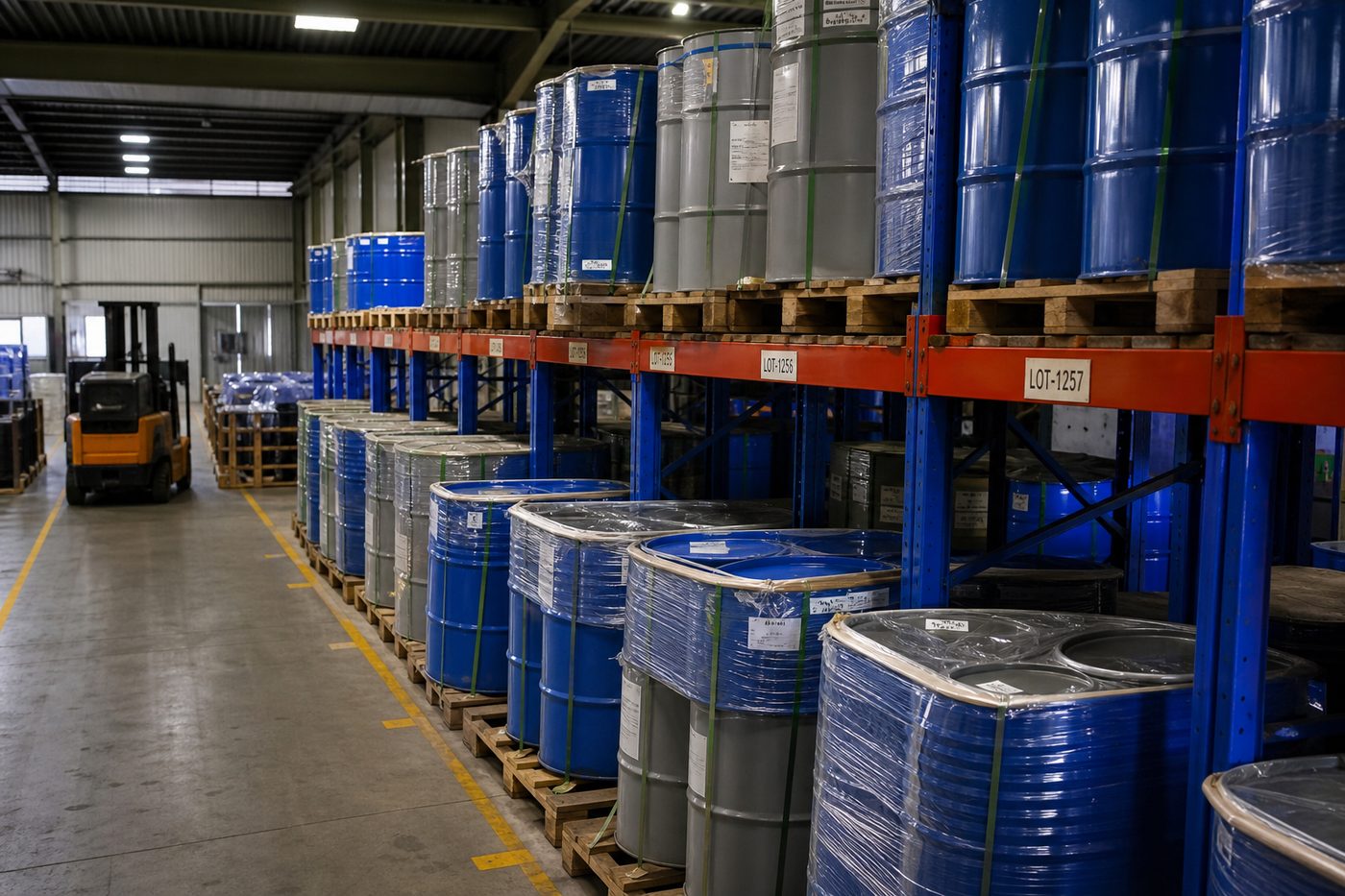
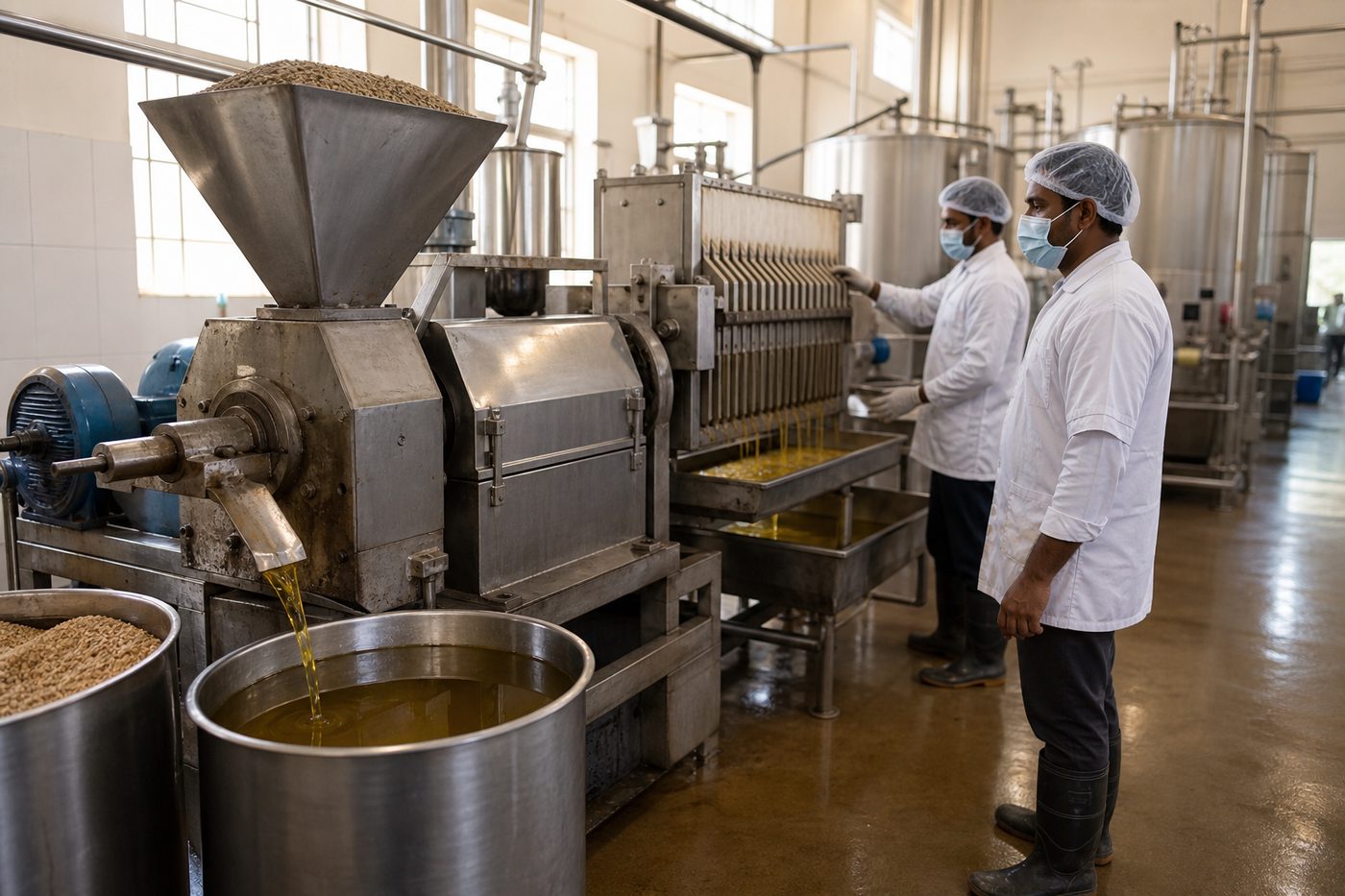
Documentation preparation should track the manufacturing sequence, not lag behind it. Lot discipline — assigning a traceable lot number at the pressing or infusion stage and carrying it through filtration, filling, and drum sealing — is what allows a Certificate of Analysis, an invoice line, and a packing list drum mark to all reference the same lot number later. Exporters who skip lot discipline during pressing or Ayurvedic infusion create documentation gaps that are expensive to close retroactively once drums are already sealed and staged for container loading.
For fixed oils, sample the finished lot for fatty acid profile, acid value, peroxide value, iodine value, saponification value, and refractive index testing at the point the oil is filtered and ready for filling — not after it is already drummed and palletized, when correcting a specification mismatch means reopening sealed containers. For medicated Taila, microbial limit testing should follow the same rule: sample at the finished-batch stage, before packing into retail bottles or bulk drums, so any result requiring reformulation or reprocessing does not surface after packaging labour is already spent.
The cluster a producer sits in also shapes which documents move fastest. Gujarat's castor crushing units, with decades of export documentation experience, typically turn around a commercial invoice and packing list within a day of a confirmed order. Kerala's Ayurvedic manufacturing houses, by contrast, often need longer lead time on AYUSH-linked paperwork because product-specific formulation approval sits with the State Licensing Authority rather than with the manufacturer directly, and that approval reference must be quoted accurately on every export document for the specific Taila SKU being shipped. Exporters coordinating across multiple clusters — say, a castor consignment from Gujarat alongside a Bhringraj Taila consignment from Kerala in the same buyer relationship — should build separate documentation timelines for each rather than assuming a single production and paperwork calendar covers both.
Pricing Analysis
Buyer Tip
Documentation cost is a real, budgetable line item for herbal oil exports, not a rounding error absorbed into general overhead. Laboratory fees for fatty acid profile and physicochemical testing, AYUSH-linked certification costs for medicated Taila, FSSAI certificate fees for edible-grade oils, chamber-of-commerce fees for certificates of origin, and CHA filing fees for the shipping bill should be quoted into FOB pricing explicitly rather than discovered as a surprise cost once a buyer relationship is confirmed.
Table 5 — Indicative Documentation and Compliance Cost Components
Swipe →
Data table — swipe horizontally on small screens
| Document / Service | Typical Cost Driver | Who Typically Arranges It |
|---|---|---|
| Fatty acid profile Certificate of Analysis | Per-lot laboratory testing fee | Exporter, via an in-house or NABL-accredited laboratory |
| Microbial limit test (medicated Taila) | Per-batch laboratory testing fee | Exporter, via an accredited laboratory |
| AYUSH-linked documentation | Licence renewal and per-formulation approval cost, amortized per shipment | Manufacturer holding the AYUSH drug manufacturing licence |
| FSSAI export health certificate | Per-shipment certification fee | Exporter or manufacturer holding the FSSAI licence |
| Certificate of origin | Chamber of commerce processing fee | Exporter, via local chamber of commerce or FIEO |
| CHA / shipping bill filing | Per-shipment CHA service fee | Exporter, via a Customs House Agent |
MOQ Analysis
Buyer Tip
Documentation cost does not scale linearly with order size, which matters directly for MOQ planning. A fatty acid profile COA or a microbial limit test costs roughly the same whether the lot is a 25 kg trial drum or a five-tonne commercial order, so exporters quoting very small trial quantities should factor documentation cost into per-kilogram pricing more heavily than they would for a standard commercial-lot programme.
Table 6 — Documentation Cost Sensitivity by Order Size (Indicative)
Swipe →
Data table — swipe horizontally on small screens
| Order Size | Documentation Cost per Kilogram (Relative) | Notes |
|---|---|---|
| 1–5 kg evaluation sample | Highest — fixed test fees spread across a tiny quantity | Some exporters absorb this cost to win the relationship |
| 25–200 kg trial lot | High — fixed certificate and test fees spread across a small lot | Typical first-order documentation cost tier |
| 500 kg–2 MT commercial lot | Moderate — costs spread across a meaningful volume | Standard programme documentation cost tier |
| FCL programme (8–18 MT) | Lowest per-kilogram documentation cost | Fixed fees spread across the largest lot size |
Packaging Standards
Export Tip
Packaging-related documentation is easy to overlook until a destination customs officer or import broker asks for it directly. Drum markings — botanical and common product name, batch number, pressing or manufacturing date, net weight, and country of origin — must match the packing list exactly, and any wood-based pallet material used for a shipment needs fumigation-marking evidence for markets that enforce biosecurity rules on wood packaging.
Table 7 — Packaging-Related Documentation Requirements
Swipe →
Data table — swipe horizontally on small screens
| Packaging Element | Documentation Requirement | Common Error |
|---|---|---|
| HDPE / GI / epoxy-lined drum | Botanical name, batch number, manufacturing date, net weight matching packing list exactly | Drum label date does not match the Certificate of Analysis lot date |
| Amber glass sample bottle | Product name, lot number, and destination-market labelling where applicable | Sample bottle lacks a lot number, breaking traceability to the COA |
| Wood pallets (where used) | Fumigation marking evidence for biosecurity-strict destinations | Missing or illegible fumigation mark rejected on arrival |
| Retail-ready bottle (medicated Taila) | AYUSH-licensed formulation name and licence details exactly as registered | Label wording drifts from the exact AYUSH-registered formulation name |
Container Loading Details
Export Tip
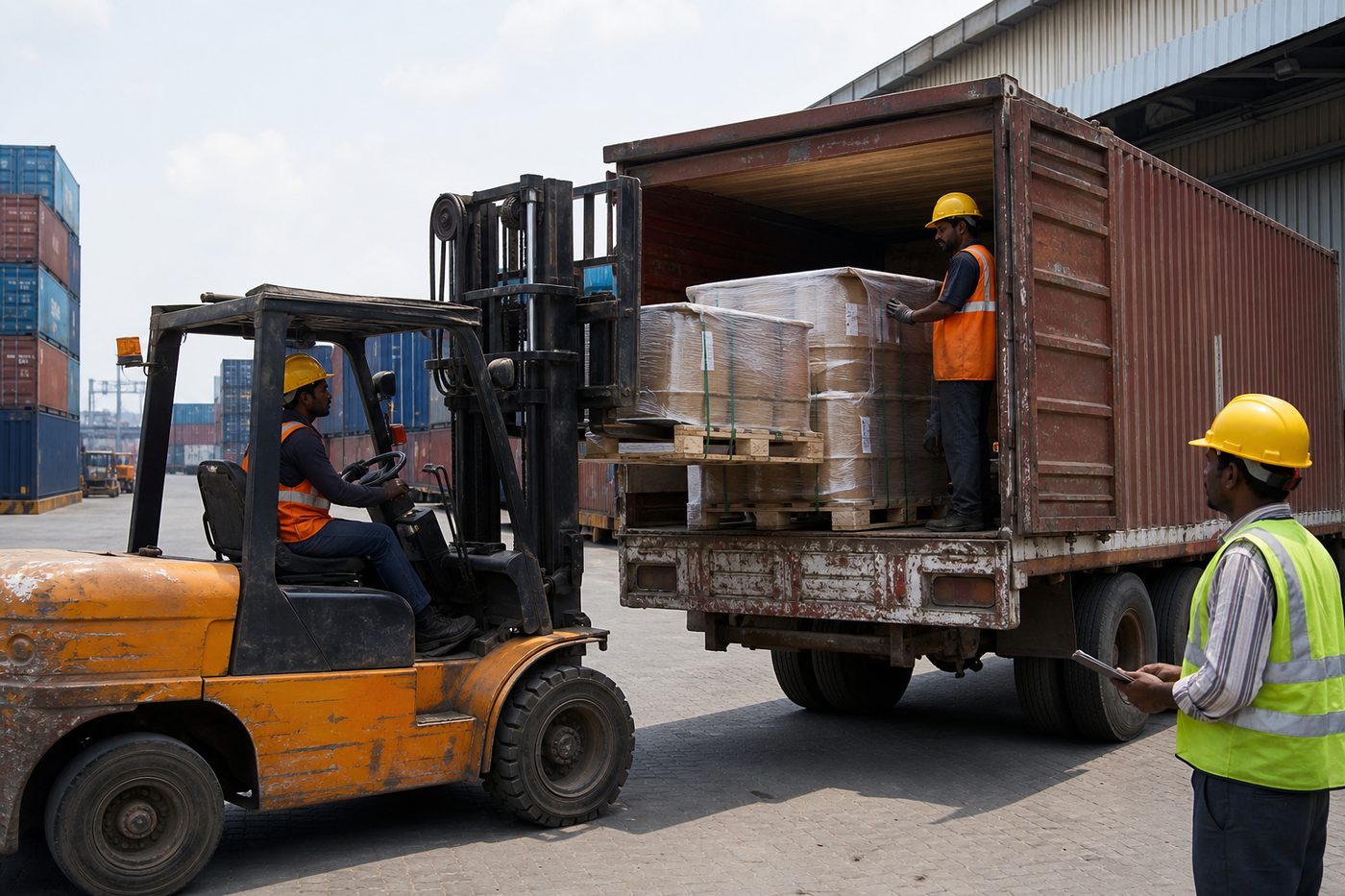
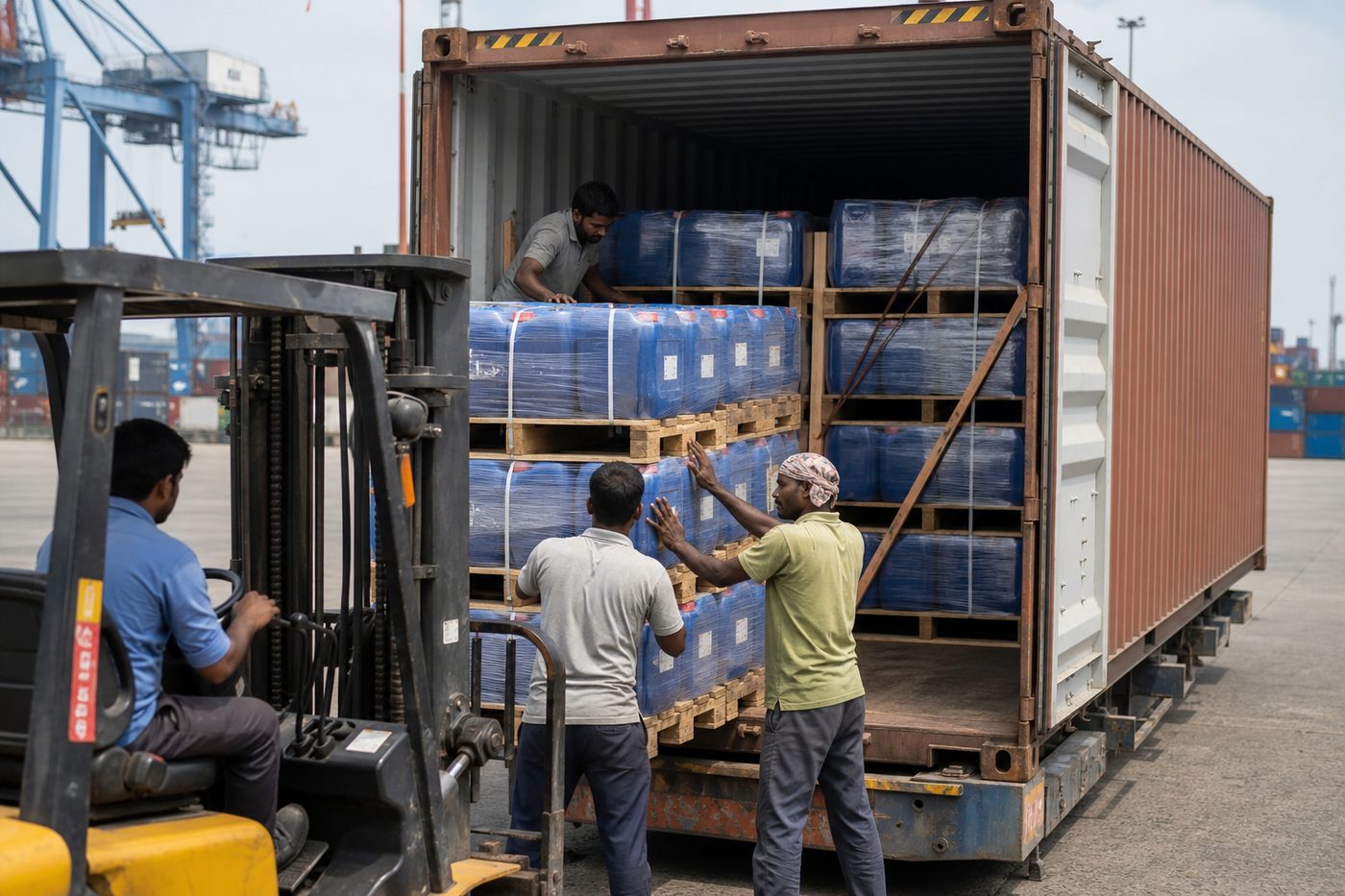
Container-level documentation ties the physical loading plan to the paperwork: the bill of lading and shipping bill must reference the correct container and seal numbers, and any discrepancy between the declared drum count and the actual stuffed count discovered at the port terminal creates a documentation amendment that delays vessel departure.
Table 8 — Container-Level Documentation Cross-Checks
Swipe →
Data table — swipe horizontally on small screens
| Document | Must Match | Common Error |
|---|---|---|
| Bill of lading | Container and seal number as physically loaded, upright drum orientation noted where relevant | Container number transcribed incorrectly from the terminal receipt |
| Shipping bill (ICEGATE) | Total drum count and gross weight matching packing list | Drum count discrepancy discovered only at port terminal weighing |
| Packing list | Drum-by-drum contents matching invoice line items and lot numbers | Mixed-lot drums summarized at pallet level instead of drum level |
Shipping Methods
Export Tip
The transport document required depends on shipping method: a bill of lading for sea freight, or an air waybill for air-freighted samples and urgent medicated-oil replenishment orders. FOB is the most common Incoterm on Indian herbal oil shipments from Mundra, Kandla, Nhava Sheva, Chennai, or Kochi, meaning freight prepaid or collect terms shown on the transport document must align with the agreed Incoterm — a CIF shipment carrying collect freight terms on the bill of lading creates confusion at destination that email explanation alone rarely resolves quickly. Confirm freight terms on the draft transport document before final issuance, not after the vessel has sailed.
The Herbal Oil Export Document Pack, Document by Document
This is the operational core of this guide: each document a herbal oil shipment typically requires, what it must contain, when to prepare it in the production and shipping cycle, its typical validity window, and the single most common error that triggers a delay for herbal oil cargo specifically.
Table 9 — Herbal Oil Document Pack: Quick Reference
Swipe →
Data table — swipe horizontally on small screens
| Document | Prepared By | Typical Timing | Validity Window |
|---|---|---|---|
| Commercial invoice | Exporter | On PO confirmation | Per shipment |
| Packing list | Exporter | After bulk filling and sealing | Per shipment |
| Shipping bill (ICEGATE) | Exporter or CHA | Before vessel cutoff | Per shipment |
| Bill of lading / airway bill | Shipping line / airline via forwarder | On booking confirmation | Per shipment |
| Certificate of origin | Chamber of commerce / FIEO | After invoice finalization | Per shipment only |
| Fatty acid profile COA | In-house or NABL-accredited laboratory | Once finished lot is filtered | Per lot; buyers expect recent testing |
| Safety Data Sheet | Exporter, using lab-verified parameters | Prepared once per oil grade, updated per lot | Reviewed per lot |
| AYUSH-linked documentation | AYUSH-licensed manufacturer | Confirmed before quoting delivery | Licence annual; formulation approval product-specific |
| FSSAI export health certificate | Exporter or FSSAI-licensed manufacturer | On confirmed edible-grade production run | Per shipment; licence annual |
Commercial Invoice
The commercial invoice must list exporter and buyer details, invoice number and date, Incoterm, currency, payment terms, line-item description with botanical and common name, quantity, unit price, total value, and the correct HS code (1515.30/1515.50/1515.90/1513 for fixed oils, 3004.90 for medicated preparations, 3304/3305 for cosmetic-packed finished oils). Prepare a draft as soon as the purchase order is confirmed, not after drums are packed. Common error: a generic description such as 'herbal oil' instead of the specific botanical name and grade, which invites classification queries at destination customs.
Packing List
The packing list itemizes every drum or carton with lot number, net and gross weight, drum count, and dimensions, and must reconcile exactly with the commercial invoice line items and the bill of lading. Prepare it once bulk filling is complete and drums are sealed, cross-checking drum-by-drum against the invoice before the container is loaded. Common error: summarizing mixed-lot drums at pallet level instead of drum level, which breaks traceability back to a specific Certificate of Analysis if a buyer raises a quality query later.
Shipping Bill (ICEGATE)
The shipping bill is filed electronically through Indian Customs' ICEGATE portal, either directly by the exporter or through a Customs House Agent, and must reflect the same HS code, quantity, and description as the commercial invoice and packing list. File it after the invoice and packing list are finalized and drums are ready for container loading, allowing time for any customs query before the vessel cutoff. Common error: HS code inconsistent with the actual oil and processing stage — for example, filing a cosmetic-packed hair oil under a fixed-oil heading instead of 3304/3305.
Bill of Lading or Airway Bill
The bill of lading (sea freight) or airway bill (air freight) records the shipper, consignee, port or airport of loading and discharge, container and seal number, and freight terms consistent with the agreed Incoterm. Confirm the draft before final issuance — amendments after a bill of lading is issued and the vessel has sailed are costly and slow. Common error: freight terms on the transport document that do not match the agreed Incoterm, creating a mismatch the buyer's bank or broker flags at destination.
Certificate of Origin
The certificate of origin, issued by a chamber of commerce or FIEO, confirms India as the country of origin for duty and customs purposes and typically carries validity only for the specific shipment it was issued against, not as a reusable annual document. Apply for it once the shipment's invoice and HS classification are finalized. Common error: requesting the certificate well in advance and letting it age past the point where its description still matches the final shipped quantity or invoice value.
Fatty Acid Profile Certificate of Analysis
This is the document that functions as the de facto quality passport for fixed oils: acid value, peroxide value, iodine value, saponification value, and refractive index, tied to a specific lot number that matches the packing list and invoice. Commission this testing once the finished lot is filtered and ready for filling — not after drums are already sealed — since serious buyers will not proceed to bulk order without a lot-specific report in hand. Common error: sharing a generic historical specification sheet instead of a lot-matched Certificate of Analysis for the actual batch being shipped.
Safety Data Sheet (SDS)
An SDS summarizing the oil's physicochemical properties, handling, and storage guidance is increasingly requested by EU and USA cosmetic-ingredient buyers, even for non-hazardous fixed oils, as part of their own internal ingredient-safety documentation. Prepare a standard SDS template per oil category in advance rather than drafting one from scratch under buyer pressure. Common error: sending an SDS with physicochemical values that do not match the shipment's own Certificate of Analysis, since buyers cross-check the two.
AYUSH-Linked Documentation (Medicated Taila)
Any medicated Ayurvedic Taila shipment — Bhringraj, Amla, Brahmi, Mahanarayan, Dhanwantharam, Ksheerabala, Ashwagandha, and comparable formulations — needs documentation referencing the manufacturer's AYUSH drug manufacturing licence and product-specific formulation approval, plus a microbial limit test report for the specific batch. Confirm this documentation set with the manufacturer before quoting a delivery date, since licence-linked paperwork cannot be rushed the way a commercial invoice can. Common error: assuming a manufacturer's general AYUSH licence automatically covers every formulation they produce — verify product-level approval for the exact Taila SKU being shipped.
FSSAI Export Health Certificate (Edible-Grade Oils)
Fixed oils destined for edible use — most commonly sesame and coconut oil, and in some cases sweet almond or flaxseed marketed as food-grade — need an FSSAI export health certificate confirming the manufacturing or packing premises holds a current FSSAI licence. Apply for this once the specific shipment's production run is confirmed. Common error: treating FSSAI licensing as optional for an oil that is, in fact, being marketed for edible use in the destination market, only to discover the gap when a buyer's customs broker requests it.
Certifications
Compliance Notes
Beyond the shipment-level documents above, two registration-level credentials establish an exporter's or manufacturer's legal standing to trade in herbal oils at all: an Import Export Code (IEC) from DGFT, mandatory for filing any shipping bill, and — depending on the specific oil — an AYUSH drug manufacturing licence or an FSSAI licence. Buyers verifying an Indian herbal oil supplier should check the credential relevant to their specific product, not a generic export registration.
A lot-specific fatty acid profile Certificate of Analysis functions as the practical quality passport that every serious fixed-oil buyer requires before committing to a purchase order, while medicated Taila additionally needs microbial limit testing and AYUSH product-level formulation approval. Edible-grade oils bound for the EU or USA typically also need pesticide residue or aflatoxin documentation alongside the standard set.
Table 10 — Certification and Registration Reference for Herbal Oil Export
Swipe →
Data table — swipe horizontally on small screens
| Certification / Registration | Issuing Body | Required For | Key Value |
|---|---|---|---|
| IEC (Import Export Code) | DGFT, Government of India | All exporters — mandatory for shipping bill | Enables legal export filing |
| AYUSH Drug Manufacturing Licence | State Licensing Authority under Ministry of AYUSH | Medicated Ayurvedic Taila (Bhringraj, Amla, Brahmi, Mahanarayan, etc.) | Legal authority to manufacture and export medicated formulations |
| FSSAI Licence | Food Safety and Standards Authority of India | Edible-grade fixed oils (sesame, coconut, and similar) | Mandatory for food-chain export; enables health certificate |
| Fatty Acid Profile Certificate of Analysis | In-house or NABL-accredited laboratory | Every commercial lot of fixed oils | Verifies acid, peroxide, iodine, saponification value, refractive index |
| Microbial Limit Test Report | NABL-accredited or equivalent laboratory | Medicated Taila oils | Confirms product safety for topical/therapeutic use claims |
| Certificate of Origin | Chamber of Commerce or FIEO | Most international shipments | Confirms India origin for duty and customs purposes |
Buyer Requirements
Buyer Requirements
- Current IEC, and AYUSH or FSSAI licence as applicable to the specific oil, verifiable on request before a formal quotation is issued.
- A lot-specific fatty acid profile Certificate of Analysis dated close to the shipment date, not a generic capability statement.
- Draft invoice and packing list shared before drums are sealed, so descriptions and HS codes can be corrected while amendments remain feasible.
- Certificate of origin confirmed as in-process before the buyer commits to a firm delivery date.
- Drum marking and labelling specification confirmed in writing, matching the buyer's destination-market requirements exactly.
Buyers should insist on seeing the actual document pack — not a verbal assurance that documentation is handled — before confirming a trial order. A buyer who reviews a draft invoice, packing list, and Certificate of Analysis before production is complete can catch classification or specification errors while correction is still cheap and fast.
Documentation expectations differ meaningfully by buyer type even within the same market. A US personal-care brand buying castor or coconut oil for a cosmetic formulation cares most about a lot-matched fatty acid profile COA and, increasingly, an SDS that matches the same lot's physicochemical values. A US wellness retailer buying Bhringraj or Amla Taila cares just as much about AYUSH licence transparency and formulation-approval reference as it does about the oil's physical quality. Confusing the two — sending a cosmetic-oil buyer a heavy AYUSH-style document pack, or sending an Ayurvedic wellness buyer only a generic fixed-oil COA without formulation approval — signals to the buyer that the exporter has not fully understood which regulatory family their specific product belongs to.
Country-wise Opportunities
Market Snapshot
Documentation depth scales with destination-market compliance rigour more than with order size. For market-by-market entry strategy beyond documentation, see Best Countries for Indian Herbal Oil Exports and Most Demanded Indian Herbal Oils by Country.
Table 11 — Country-wise Documentation Priorities for Herbal Oil Exports
Swipe →
Data table — swipe horizontally on small screens
| Country/Region | Documentation Priority | Entry Consideration |
|---|---|---|
| USA | Fatty acid profile COA; FSSAI; AYUSH documentation for medicated oils | FDA cosmetic/dietary-supplement labelling rules apply at destination |
| Germany / France (EU) | Pesticide residue report; fatty acid profile COA; SDS | Strictest documentation bar; longest buyer qualification cycle |
| UK | Fatty acid profile COA; UK chemical compliance documentation | Confirm current post-Brexit rules separately from EU |
| UAE / GCC | Fatty acid profile COA; AYUSH/FSSAI; halal-adjacent assurance | Lighter documentation friction than EU, rising halal interest |
| Southeast Asia / Japan | Fatty acid profile COA; aflatoxin data; precise lot documentation | Japan expects tight lot-to-lot consistency in paperwork |
Sourcing Checklist
Checklist
Before committing to a first herbal oil shipment, buyers, exporters, and compliance teams should each confirm their side of the document pack using the checklists below.
Common Buyer Mistakes
Common Mistakes Box
Buyers new to sourcing herbal oils from India make a predictable set of documentation mistakes, most of which a structured pre-shipment review process prevents entirely.
Common Buyer Mistakes in Herbal Oil Export Documentation
Swipe →
Data table — swipe horizontally on small screens
| Mistake | Consequence | How to Avoid |
|---|---|---|
| Confirming a delivery date before checking the document timeline | Preventable delay when lab testing or AYUSH/FSSAI paperwork cannot finish in time | Ask for the full documentation timeline before agreeing to a firm date |
| Assuming a prior Certificate of Analysis covers a new production lot | Receiving cargo that was never tested against the specific batch shipped | Require a lot-matched COA for the exact batch, every time |
| Treating AYUSH and FSSAI as interchangeable | Sourcing a medicated Taila from a supplier without AYUSH licensing, or vice versa | Confirm which registration applies to the specific oil and its intended claim |
| Ignoring drum-marking and labelling rules until cargo arrives | Rejected or delayed shipment at destination customs | Confirm labelling specification in writing before drums are sealed |
| Skipping cross-checks between invoice, packing list, and bill of lading | Quantity or weight mismatches discovered only at destination customs | Review the full document set together before the container is sealed |
| Paying entirely upfront to an unverified supplier | No recourse if documentation or quality fails | Use partial advance and balance against documents; verify the supplier independently |
Expert Insight: Documentation Is Assembled, Not Rescued
Expert Insight Box
Saurabh Mittal, Founder of Altus Exports, has seen the same pattern across years of herbal oil shipments: exporters who never face a customs hold are not lucky — they treat every document as part of one coherent pack, checked against every other document, from the day production starts. Exporters who scramble are the ones who treat documentation as a task for sailing week that can be rescued with a phone call to the CHA on the day of departure.
He advises buyers and exporters alike to confirm the full document timeline against the production and shipping calendar before accepting a delivery commitment, not after — particularly for medicated Taila, where AYUSH-linked paperwork genuinely cannot be compressed the way a commercial invoice can.
Future Market Trends
Key Statistics
Digital documentation and traceability platforms are gradually replacing paper-based certificate exchange for herbal oils, particularly for fatty acid profile and physicochemical evidence, where buyers increasingly want a verifiable digital record rather than a scanned PDF with no audit trail. Rising sustainability and traceability expectations, especially for neem and castor oil, are pushing buyers toward farm-to-drum documentation that goes beyond the standard commercial and quality pack described in this checklist.
Growing mainstream interest in Ayurvedic wellness products outside traditional South Asian diaspora markets is also raising documentation expectations for medicated Taila — buyers increasingly want formulation transparency and AYUSH product-registration detail presented clearly, not assumed as background credibility.
Expert Insight: One Document Set, Reviewed Together
Expert Insight Box
Looking beyond individual document types, Saurabh Mittal advises exporters to build a fixed pre-shipment review habit: before a container is sealed, one person reviews the commercial invoice, packing list, bill of lading, certificate of origin, and any Certificate of Analysis or AYUSH/FSSAI documentation side by side, checking that botanical names, quantities, weights, and lot numbers agree exactly across every file.
This review takes under an hour per shipment and routinely prevents the demurrage, rework, and buyer trust erosion that follow a preventable customs hold — a discipline that scales the same way whether the shipment is a 200 kg trial lot of neem oil or a full container of castor oil bound for the EU.

Conclusion
- Pair this checklist with the process guide How to Export Herbal Oils from India and the credential deep-dive AYUSH & FSSAI Registration Benefits for Herbal Oil Exporters.
- Finding the right buyer: Find International Buyers for Herbal Oils and meeting them in person via Trade Shows and B2B Marketplaces for Herbal Oil Exporters.
- Product-level depth: Top Herbal Oil Products Exported from India.
- Align document packs to destination rules with Best Countries for Indian Herbal Oil Exports and Most Demanded Indian Herbal Oils by Country.
- Sourcing and premium positioning: Source Herbal Oils Directly from India and Organic & Ayurvedic Herbal Oil Export Opportunities.
- Contact Altus Exports or explore merchant exporter, global sourcing partner, and product sourcing company services to begin a documentation-ready herbal oil sourcing conversation.
A complete herbal oil export document pack — commercial invoice, packing list, ICEGATE shipping bill, bill of lading, certificate of origin, fatty acid profile Certificate of Analysis, Safety Data Sheet, and AYUSH- or FSSAI-linked certification as applicable — prepared alongside production rather than assembled under sailing-week pressure is the single most reliable predictor of a smooth customs clearance for neem, castor, sesame, coconut, or Ayurvedic medicated Taila shipments. Every document must agree with every other document, and with what an inspector sees when a drum is opened.
Altus Exports prepares documentation alongside production for herbal oil clients as a merchant exporter in India and global sourcing partner, coordinating Certificates of Analysis, AYUSH- and FSSAI-linked certificates, and shipping documents under one accountable relationship. Explore export products from India and find manufacturers in India for verified, documentation-ready herbal oil supply, or browse the herbal-ayurvedic-products industry overview for adjacent botanical export context.