
Most Demanded Indian Herbal Oils by Country
By Saurabh Mittal, Founder, Altus Exports
A SKU-level demand matrix mapping the most demanded Indian herbal oils by destination country — castor, sesame, coconut, neem, almond, flaxseed, kalonji, and medicated Ayurvedic Taila. Covers USA (neem, castor, sesame), Germany/EU (organic sesame, flax, almond, cold-pressed), UAE/GCC (Amla, Bhringraj, massage oils), Japan (premium sesame, cold-pressed), and Southeast Asia (coconut, neem), plus pricing, MOQ, packaging, container loading, and expert insights from Altus Exports.

Not every herbal oil buyer wants the same product from India. A US agricultural-input distributor sourcing neem oil for biopesticide formulation, a German clean-label food brand seeking organic cold-pressed sesame oil, a Dubai wellness retailer stocking Amla and Bhringraj hair oil, a Japanese cosmetics house sourcing ultra-premium cold-pressed sesame for a skincare line, and an Indonesian coconut-oil food manufacturer are all buying 'Indian herbal oils' — but each wants a specific botanical, grade, and certification stack that has almost nothing in common with the others. India's herbal oil export strength — spanning castor, sesame, coconut, neem, sweet almond, flaxseed, kalonji, and medicated Ayurvedic Taila such as Amla and Bhringraj oil — is most commercially valuable when exporters match SKU, grade, and certification precisely to what each destination market's buyers actually order.
This guide maps the most demanded Indian herbal oils by country, translating destination buyer behaviour into a practical SKU-level demand matrix. It deliberately does not repeat a general market-selection ranking or a step-by-step export process guide — those are covered in Best Countries for Indian Herbal Oil Exports and How to Export Herbal Oils from India respectively. This guide instead answers a narrower and more operational question: once a market is on your target list, which specific oil, grade, and certification stack does that market's buyers actually order?
Use this guide alongside AYUSH & FSSAI Registration Benefits for Herbal Oil Exporters for the credentialing layer that underpins every destination market covered here, and Top Herbal Oil Products Exported from India for full product and grade detail. Validate demand signals against DGFT/DGCI&S trade data, ITC Trade Map, and direct buyer conversations before committing production or certification investment.
Key Takeaways
Summary Box
Executive Summary
Summary Box
India's herbal oil export catalog spans two structurally different product families — fixed vegetable oils (castor, sesame, coconut, neem, almond, flaxseed, kalonji) and medicated Ayurvedic Taila (Amla, Bhringraj, Mahanarayan, Ksheerabala, and comparable herb-infused formulations) — and each destination market draws from that catalog very differently depending on its own food, cosmetic, agricultural-input, and wellness-retail demand structure. Treating 'herbal oils' as one undifferentiated export product causes exporters to miss the SKU-level signal that actually drives buyer decisions in each market.
This guide organizes buyer demand by country and region, covering the USA, Germany and the wider EU, the UAE and GCC, Japan, and Southeast Asia (Indonesia and Malaysia), with a further note on the UK and Australia. Each section identifies the dominant oil SKUs, end-use channel, and certification expectations that drive demand in that market, supported by comparison tables covering pricing, MOQ, packaging, and shipping relevant to each market's typical order profile. Unlike a market-selection ranking guide, the focus here is a demand-fit matrix: which oil and grade to produce and document, not merely where to sell.

Market Size & Industry Overview
Key Statistics
India's herbal oil supply base is anchored by Gujarat's Kutch–Mehsana–Deesa castor belt — the world's dominant castor-growing and crushing cluster — alongside Kerala's coconut oil processing base and dense Ayurvedic medicated-oil manufacturing capacity in Kollam, Alappuzha, and Thrissur. Rajasthan and Madhya Pradesh contribute sesame, flaxseed, and kalonji oil, while Tamil Nadu and Andhra Pradesh add neem oil and secondary sesame capacity.
Global demand for these oils spans four distinct channels that do not overlap operationally: industrial and pharmaceutical feedstock (castor oil derivatives), food ingredient and culinary use (sesame, coconut, flaxseed), cosmetic-carrier and personal-care base oils (almond, neem, coconut), and Ayurvedic wellness retail (Amla, Bhringraj, and massage Taila). Each destination market sits at a different point across these four channels, which is the single biggest driver of which specific SKU a given country's buyers actually order.
Comparison table
Swipe →
Data table — swipe horizontally on small screens
| Production Cluster | State | Primary Oils | Export Role |
|---|---|---|---|
| Kutch–Mehsana–Deesa | Gujarat | Castor oil (crude/refined) | World's dominant castor processing and export hub |
| Saurashtra / Nagaur–Merta | Gujarat / Rajasthan | Sesame (til), flaxseed, kalonji oil | Primary edible-oil processing belt |
| Kollam–Alappuzha–Thrissur | Kerala | Coconut oil, Ayurvedic Taila | Coconut oil hub and Ayurvedic medicated-oil manufacturing center |
| Erode–Salem belt | Tamil Nadu | Neem oil, secondary sesame | Agri-input and cosmetic-carrier oil processing cluster |
| Malwa region | Madhya Pradesh | Flaxseed (linseed), sesame oil | Secondary edible-oil processing belt |
Export Statistics
Key Statistics
The table below summarizes directional export intensity by destination for India's herbal oil catalog — validate against current DGFT/DGCI&S export data and ITC Trade Map before allocation or investment decisions.
Comparison table
Swipe →
Data table — swipe horizontally on small screens
| Destination | Export Intensity | Dominant SKU / Channel |
|---|---|---|
| USA | Very High | Castor (industrial/pharma), neem (agri-input/cosmetic-carrier), sesame (food/cosmetic) |
| Germany / EU | Very High | Organic sesame, flaxseed, almond oil; cold-pressed positioning across categories |
| UAE / GCC | High | Amla, Bhringraj, massage Taila blends; coconut oil |
| Japan | Medium–High | Premium cold-pressed sesame; cosmetic-carrier oils |
| Indonesia / Malaysia (ASEAN) | Medium–High | Coconut oil; neem oil |
| UK | Medium | Bhringraj/Amla diaspora retail; coconut and almond cosmetic-carrier |
| Australia / New Zealand | Medium | Coconut and almond cosmetic-carrier; Ayurvedic wellness retail |
Import Statistics
Key Statistics
Import intensity reflects each market's industrial base, food-ingredient demand, cosmetic manufacturing sector, and Ayurvedic or herbal wellness retail maturity. The table below is directional; confirm current-year figures against destination customs statistics or ITC Trade Map before capacity planning.
Comparison table
Swipe →
Data table — swipe horizontally on small screens
| Country / Region | Import Driver | Buyer Type |
|---|---|---|
| USA | Industrial castor-derivative manufacturing; growing natural personal-care and biopesticide demand | Industrial/pharma buyers, cosmetic-carrier formulators, agri-input distributors |
| Germany | Food-ingredient sourcing; organic and clean-label cosmetic-carrier demand | Food manufacturers, cosmetic formulators, organic distributors |
| UAE / GCC | Ayurvedic wellness retail; spa and massage-oil demand | Wellness distributors, pharmacy chains, spa and personal-care retailers |
| Japan | Premium cosmetic and gourmet food ingredient sourcing | Cosmetics houses, specialty food importers |
| Indonesia / Malaysia | Food-ingredient coconut oil demand; growing herbal wellness retail | Food manufacturers, cosmetic-carrier formulators, wellness distributors |
| UK | Diaspora Ayurvedic retail; cosmetic-carrier demand | Wellness retailers, cosmetic formulators |
| Australia / NZ | Natural personal-care and wellness retail growth | Cosmetic formulators, wellness distributors |
Product Categories / Variants
Summary Box
Matching supply capability to country-specific demand starts with understanding which oil and positioning combination each market actually orders. The table below consolidates India's herbal oil catalog against the strongest destination demand for each product.
Comparison table
Swipe →
Data table — swipe horizontally on small screens
| Product | Botanical Source | Primary Positioning | Strongest Country Demand |
|---|---|---|---|
| Castor oil | Ricinus communis | Industrial/pharma feedstock, cosmetic-carrier | USA, EU, China (industrial); global cosmetic-carrier demand |
| Sesame (til) oil | Sesamum indicum | Food-grade cooking oil, cosmetic-carrier | Japan (premium), Germany/EU (organic), USA (health-food retail) |
| Coconut oil | Cocos nucifera | Food, cosmetic-carrier, hair-care base oil | Indonesia/Malaysia, UAE/GCC, UK/Australia diaspora retail |
| Neem oil | Azadirachta indica | Agri-input (biopesticide), cosmetic-carrier | USA, Indonesia/Malaysia |
| Sweet almond oil | Prunus dulcis | Cosmetic-carrier, premium food | Germany/EU, UK, Australia |
| Flaxseed (linseed) oil | Linum usitatissimum | Food/wellness, cold-pressed | Germany/EU (organic), USA (health-food) |
| Kalonji (black seed) oil | Nigella sativa | Wellness, food-adjacent retail | UAE/GCC, Germany/EU |
| Amla oil (medicated Taila) | Phyllanthus emblica infusion | Ayurvedic hair-care wellness retail | UAE/GCC, UK/Australia diaspora retail |
| Bhringraj oil (medicated Taila) | Eclipta prostrata infusion | Ayurvedic hair-care wellness retail | UAE/GCC, UK/Australia diaspora retail |
| Massage Taila blends (Mahanarayan, Ksheerabala, etc.) | Multi-herb infusion | Ayurvedic spa and wellness retail | UAE/GCC |
Manufacturing Overview
Export Tip
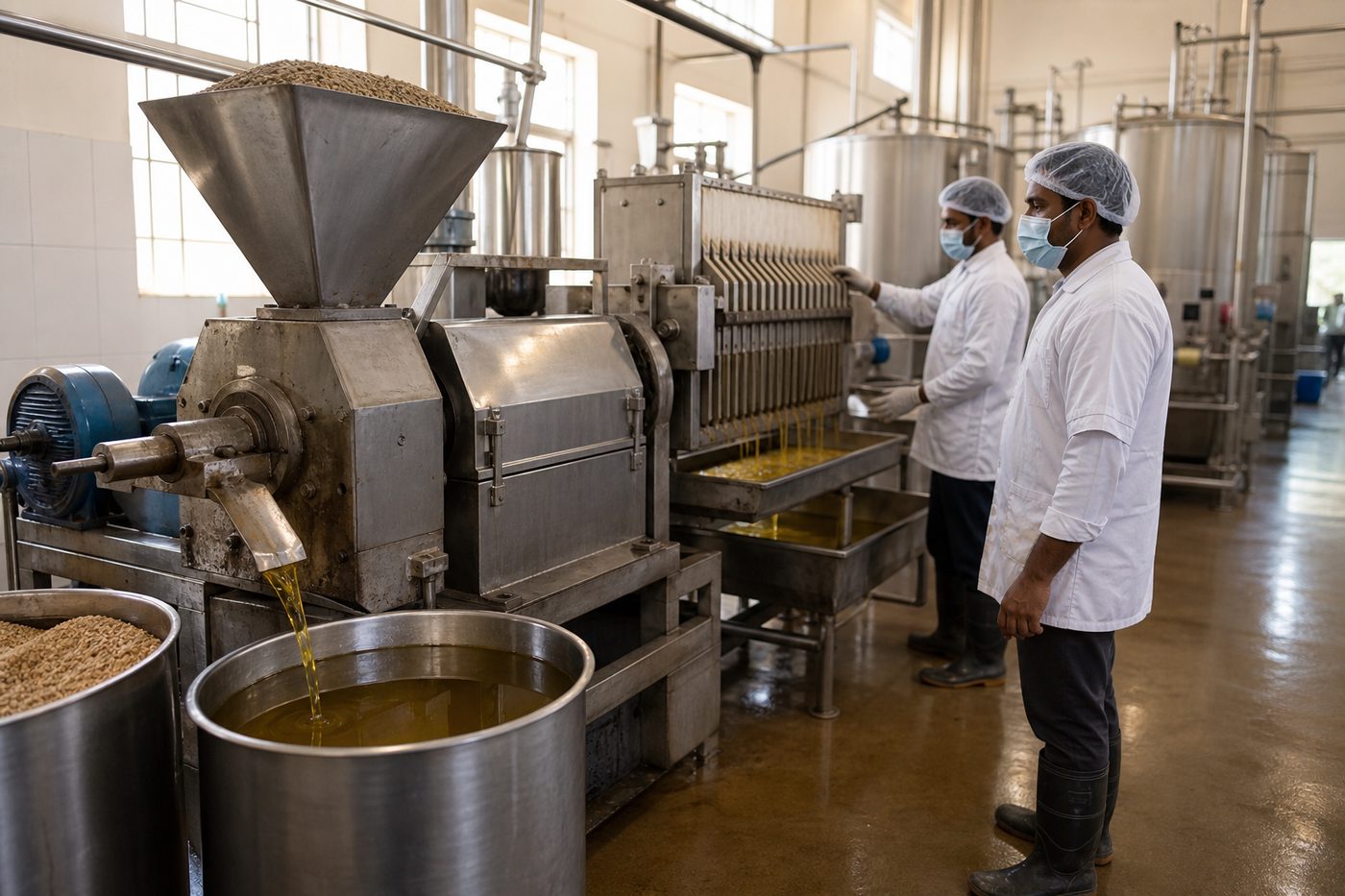
Country-specific demand shapes processing decisions at the plant level. A US or EU cosmetic-carrier programme for almond or neem oil requires tight peroxide-value and color/odor consistency control, since carrier-oil buyers are sensitive to oxidation. A Japan-bound premium cold-pressed sesame programme prioritizes low-temperature extraction and minimal processing to preserve flavor and aroma profile for gourmet food and premium cosmetic use. A UAE-bound Amla or Bhringraj Taila programme requires Schedule T-compliant Sneha Kalpana infusion process discipline and consistent herb-to-base-oil ratios batch to batch.
Exporters serving multiple country demand profiles from one production base typically dedicate specific processing runs and lot tracking to each market's requirements — a food-grade sesame lot for Japan's premium retail channel is processed and tested differently from a bulk sesame lot destined for a US commodity food-ingredient buyer, even though both originate from the same raw seed supply. This segmentation avoids the costly error of releasing a bulk commodity-grade lot into a premium retail buyer's programme where documentation and consistency expectations are materially higher.
Expert Insight: Demand Signals Live at the SKU Level, Not the Category Level
Expert Insight Box
Exporters who quote 'herbal oil' as a single undifferentiated category consistently underperform exporters who present a country-specific SKU and certification match on the first response to an inquiry.
Pricing Analysis
Buyer Tip
Herbal oil FOB pricing responds to extraction method, organic or wild-harvest sourcing, and — for medicated Taila — the destination market's certification and documentation expectations. The ranges below are indicative planning benchmarks; always request a live FOB quotation for your specific grade, certification, and packaging requirement.
Comparison table
Swipe →
Data table — swipe horizontally on small screens
| Oil / Product | Indicative FOB Range (USD/kg) | Key Country/Channel Driver |
|---|---|---|
| Castor oil (industrial grade) | 1.20 – 1.70 | USA, EU, China industrial/pharma feedstock demand |
| Sesame oil (refined, food-grade) | 2.50 – 4.00 | USA health-food and general food-ingredient demand |
| Sesame oil (organic, cold-pressed) | 4.50 – 7.50 | Germany/EU organic retail; Japan premium retail commands the upper band |
| Coconut oil (RBD, edible) | 1.60 – 2.30 | Indonesia/Malaysia and general food-ingredient demand |
| Coconut oil (virgin/cold-pressed) | 2.60 – 4.20 | UAE/GCC and UK/Australia premium retail demand |
| Neem oil (cosmetic/agri grade) | 2.00 – 3.50 | USA agri-input and cosmetic-carrier demand |
| Sweet almond oil | 8.00 – 14.00 | Germany/EU and UK cosmetic-carrier demand |
| Flaxseed / kalonji oil (cold-pressed) | 3.50 – 8.50 | Germany/EU organic and UAE/GCC wellness demand |
| Amla / Bhringraj Taila (bulk) | 4.00 – 9.00 | UAE/GCC wellness-retail bulk supply |
| Amla / Bhringraj Taila (branded retail bottle equivalent) | +40–90% over bulk equivalent | UAE/GCC and UK/Australia diaspora branded retail |
MOQ Analysis
Buyer Tip
MOQ expectations vary by market and channel type. US and EU industrial and food-ingredient buyers often scale to full container volumes quickly once documentation is confirmed; UAE/GCC and diaspora retail buyers for medicated Taila typically start smaller to validate formulation, aroma, and packaging before committing to programme volume.
Comparison table
Swipe →
Data table — swipe horizontally on small screens
| Market / Channel | Typical Starting MOQ | Scale-Up Pattern |
|---|---|---|
| USA industrial castor / neem | 1–5 metric tonnes | Scales quickly to 20ft/40ft FCL once documentation is confirmed |
| Germany/EU organic sesame/flax/almond | 500 kg – 2 metric tonnes | Gradual scale-up after organic certification and lab verification |
| Japan premium cold-pressed sesame | 500 kg – 1 metric tonne | Slow, trust-building scale-up; multi-season consistency valued |
| UAE/GCC Amla/Bhringraj/massage Taila | 25 – 100 kg (bulk) or 500–2,000 units (retail-ready) | Relatively fast conversion once AYUSH/COPP documentation is confirmed |
| Indonesia/Malaysia coconut/neem | 1–5 metric tonnes | Scales to FCL programme quickly for volume food/cosmetic accounts |
| UK/Australia diaspora retail Taila | 500–1,000 units | Modest, relationship-driven scale-up |

Packaging Standards
Export Tip
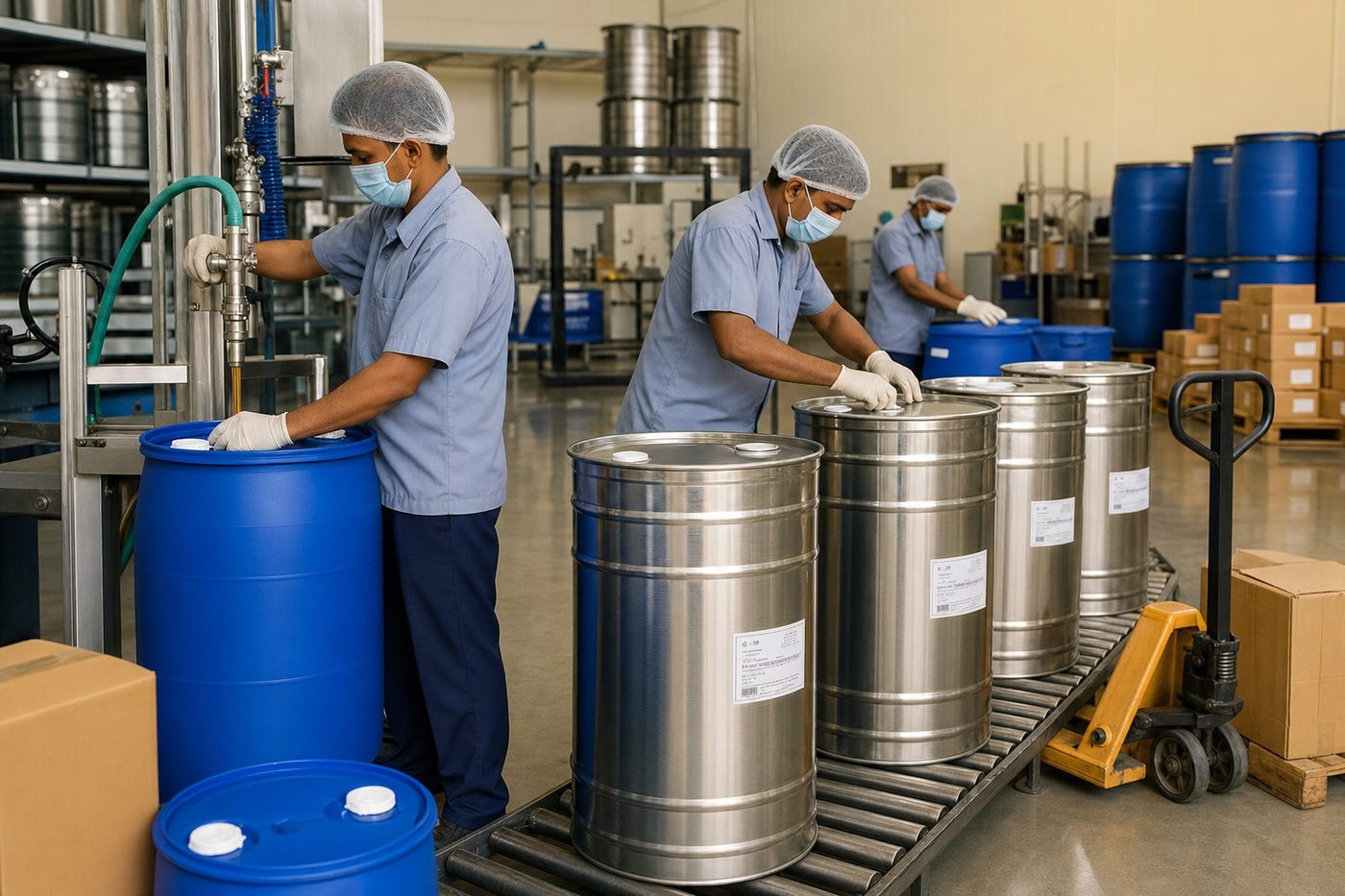
Bulk industrial and food-ingredient oils move in HDPE drums or flexitanks; medicated Taila and premium retail-positioned oils move in far smaller, branded formats matched to each market's retail expectations.
Comparison table
Swipe →
Data table — swipe horizontally on small screens
| Packaging Format | Typical Market Fit | Specification Note |
|---|---|---|
| HDPE drum (180–200 kg) | USA/EU industrial castor, bulk sesame, coconut, neem | Standard bulk export format across all fixed oils |
| Flexitank (per 20ft container) | High-volume USA/EU/China castor programmes (sesame rarely reaches flexitank scale) | Reduces drum handling for large industrial buyers |
| Glass bottle (retail, 50 ml–1 L) | UAE/GCC and UK/Australia branded Ayurvedic Taila retail | Premium positioning for Amla, Bhringraj, and massage oil retail |
| PET bottle (retail) | Indonesia/Malaysia and general food/cosmetic retail | Cost-efficient retail format for coconut and sesame oil |
| Small jerry can (25–50 kg) | UAE/GCC private-label bulk Taila supply | Bulk supply to a wellness brand's own bottling line |
| Amber glass / tin (cosmetic-carrier) | Germany/EU and Japan premium cosmetic-carrier almond/neem/sesame | Oxidation protection for premium cosmetic-carrier positioning |
Container Loading Details
Export Tip
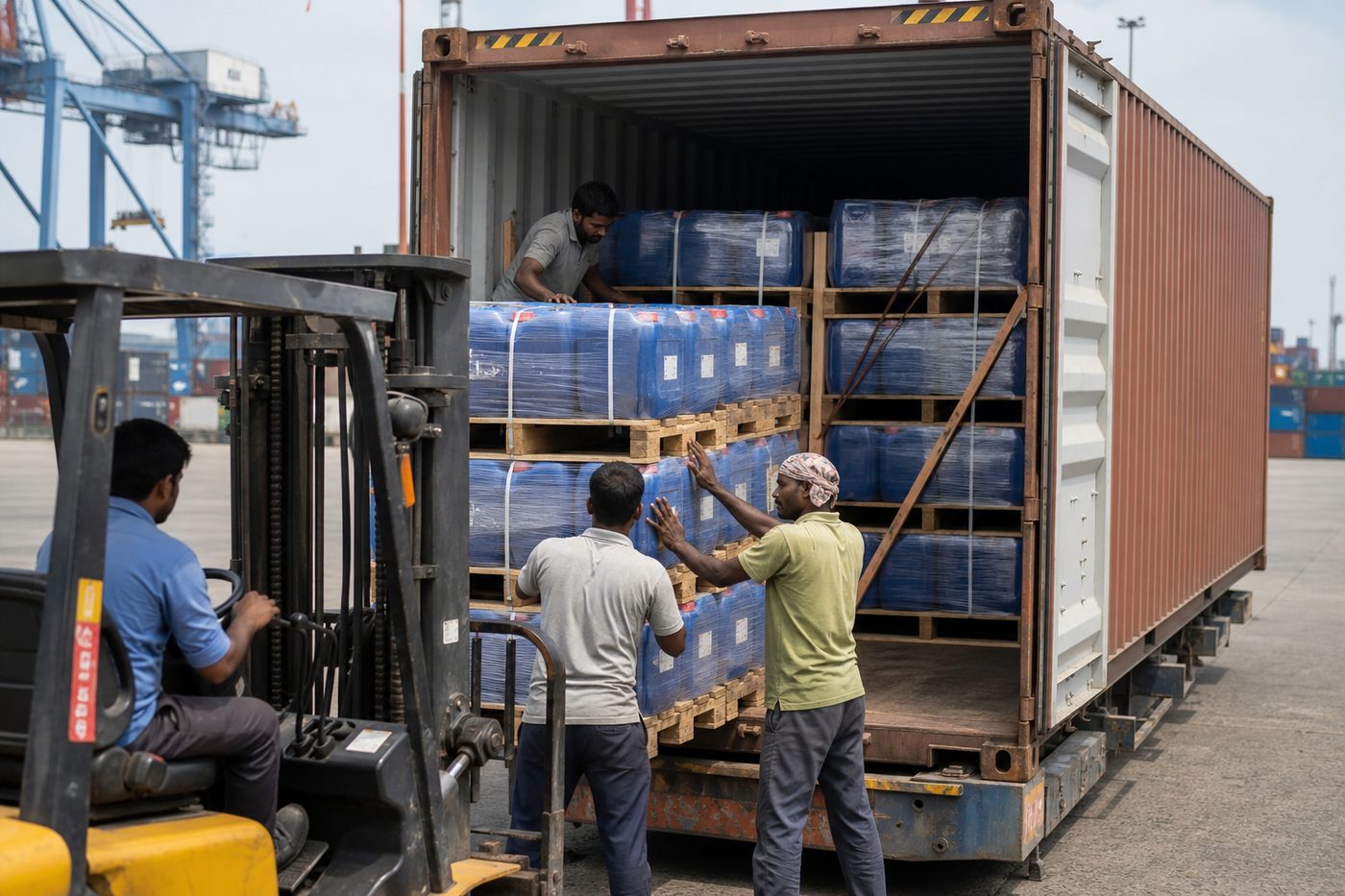
Container loading is broadly consistent across destination markets for standard drum formats, though flexitanks are more common on high-volume USA, EU, and China-bound castor and sesame lanes than on GCC or ASEAN lanes, where mixed-SKU or retail-ready shipments are more typical.
Comparison table
Swipe →
Data table — swipe horizontally on small screens
| Container Type | Indicative Payload | Demand-Fit Note |
|---|---|---|
| 20ft standard (HDPE drums) | Approximately 16–18 metric tonnes | Standard for GCC and ASEAN mixed-SKU or retail-ready shipments |
| 20ft flexitank | Approximately 18–21 metric tonnes (indicative; confirm with forwarder) | Common for high-volume castor; uncommon for sesame given smaller lot sizes |
| 40ft standard (HDPE drums) | Approximately 32–36 metric tonnes | High-volume food-ingredient and industrial programmes |
| LCL / part-container | By pallet or drum count | Trial shipments and mixed-SKU orders combining fixed oils with Taila retail stock |
Shipping Methods
Export Tip
Route and transit time shape how exporters sequence production against each market's delivery expectations. Long-transit US and EU industrial programmes justify flexitank and bulk-drum economics; short-transit GCC lanes support faster, smaller, retail-ready replenishment cycles for medicated Taila.
Comparison table
Swipe →
Data table — swipe horizontally on small screens
| Destination | Load Port | Approx. Transit Time |
|---|---|---|
| Germany / Netherlands (Rotterdam/Hamburg) | Mundra / Kandla | 18–24 days |
| USA East Coast (New York/Baltimore) | Mundra / Nhava Sheva | 28–36 days |
| USA West Coast (Los Angeles) | Mundra / Nhava Sheva | 22–30 days |
| UAE (Jebel Ali) / GCC | Mundra / Kandla / Cochin | 6–10 days |
| Japan (Yokohama/Kobe) | Mundra / Nhava Sheva / Cochin | 20–28 days |
| Indonesia / Malaysia (Port Klang/Tanjung Priok) | Cochin / Tuticorin / Nhava Sheva | 10–16 days |
| UK (Felixstowe/Southampton) | Mundra / Nhava Sheva | 20–27 days |
| Australia (Sydney/Melbourne) | Mundra / Nhava Sheva / Cochin | 18–26 days |
Certifications
Compliance Notes
Certification expectations scale with channel and destination market. Industrial and food-ingredient buyers in the USA and EU expect FSSAI and organic documentation; GCC wellness-retail buyers expect AYUSH and COPP documentation for medicated Taila; Halal certification recurs across GCC and ASEAN regardless of whether the oil is food, cosmetic, or wellness-positioned.
Comparison table
Swipe →
Data table — swipe horizontally on small screens
| Certification | Primary Relevant Markets | Typical Trigger |
|---|---|---|
| FSSAI licence | All markets (edible/industrial fixed oils) | Mandatory baseline for food and cosmetic-carrier oil export |
| AYUSH manufacturing licence (Schedule T) | UAE/GCC, UK/Australia diaspora retail | Mandatory for medicated Ayurvedic Taila (Amla, Bhringraj, massage oils) |
| Certificate of Pharmaceutical Product (COPP) | UAE/GCC | Requested during Ayurvedic product registration |
| NPOP / USDA NOP / EU Organic | USA, Germany/EU, UK | Required for organic-labelled sesame, flaxseed, almond, or coconut oil |
| Halal | UAE/GCC, Indonesia, Malaysia | Required for wellness, food, and cosmetic-carrier retail entry |
| WHO-GMP (voluntary) | UAE/GCC, Germany/EU | Requested by premium wellness and pharmacy-channel buyers for medicated Taila |
| Chemexcil RCMC (Panel IV) | USA, EU, China (castor oil specifically) | Relevant for castor oil and derivative exporters seeking FTP incentive access |
| ISO 22000 / HACCP | Germany/EU, Japan, USA | Requested by larger food-ingredient buyers for edible fixed-oil programmes |
Buyer Requirements
Buyer Requirements
- Product specification confirming extraction method (cold-pressed, expeller, RBD), botanical source, and packaging format
- FSSAI licence copy and batch-specific Certificate of Analysis for fixed oils positioned as food or cosmetic-carrier products
- AYUSH manufacturing licence and Schedule T evidence for medicated Ayurvedic Taila, plus a Certificate of Pharmaceutical Product where the destination market's registration process requires it
- Organic transaction certificate for any organic-labelled sesame, flaxseed, coconut, or almond oil shipment
- Halal certificate from a market-recognised body for GCC- and ASEAN-bound shipments
- Prior export shipment references to the buyer's specific destination market and channel
Regardless of destination, most serious herbal oil buyers converge on a core specification and document request before confirming a trial order. The specific certification layered on top of that baseline is what differs by country and SKU, as mapped throughout this guide.
Most Demanded Herbal Oils in the USA
Market Snapshot
- Dominant SKUs: neem oil (agri-input/cosmetic-carrier), castor oil (industrial/pharma), sesame oil (food/cosmetic)
- Certifications: FSSAI baseline; USDA NOP/NPOP organic for premium sesame and neem programmes; Chemexcil RCMC for castor
- Packaging: HDPE drums and flexitanks for bulk industrial programmes; retail bottles for premium sesame and cosmetic-carrier lines
- Channel tip: US agri-input buyers for neem oil request different documentation (biopesticide-adjacent specification) than US cosmetic buyers for the same botanical
The USA is one of India's most valuable herbal oil destinations, but demand concentrates in three specific SKUs rather than spreading evenly across the catalog. Castor oil leads on volume and value, feeding industrial and pharmaceutical feedstock manufacturing where US buyers specify refined or first-pressing grades with tight acid-value and color specifications. Neem oil serves a distinct dual channel — agricultural-input distributors sourcing neem for biopesticide formulation, and natural personal-care formulators sourcing cosmetic-grade neem as a carrier and active ingredient. Sesame oil serves food-ingredient and health-food retail buyers, with a growing organic and cold-pressed sub-segment commanding retail premiums.
US buyers across all three SKUs expect FSSAI documentation as a baseline and increasingly request organic certification (USDA NOP via NPOP equivalency) for sesame and, to a lesser extent, neem oil positioned for premium natural personal-care brands. Coconut and almond oil see secondary but steady demand in the cosmetic-carrier and wellness-retail segments.
Most Demanded Herbal Oils in Germany and the Wider EU
Market Snapshot
- Dominant SKUs: organic sesame oil, organic flaxseed oil, sweet almond oil; cold-pressed positioning valued across all three
- Certifications: FSSAI baseline; EU Organic/NPOP for organic-labelled programmes; EU Cosmetics Regulation compliance for cosmetic-carrier positioning
- Packaging: retail glass bottles for premium food and cosmetic-carrier lines; HDPE drums for bulk industrial and food-ingredient supply
- Watch-out: a generic 'organic' claim without a lot-specific EU Organic or NPOP transaction certificate will not clear premium retail buyer qualification
Germany anchors EU demand for Indian herbal oils, with organic and clean-label positioning driving the strongest commercial premiums across the catalog. Organic sesame oil, organic flaxseed (linseed) oil, and sweet almond oil are the three SKUs EU buyers request most consistently — sesame and flaxseed primarily for food-ingredient and health-food retail use, almond primarily for cosmetic-carrier applications in the region's large personal-care manufacturing base. Cold-pressed extraction is a near-universal EU buyer preference across all three, valued for retaining nutritional and sensory profile versus refined or solvent-extracted equivalents.
EU Organic certification under Regulation 2018/848 — generally via an EU-recognised control body covering processed plant products such as pressed oils, rather than NPOP farm equivalence alone — is close to a market-access requirement for the premium segment of this trade, not an optional upgrade. Coconut oil sees moderate demand for both food and cosmetic-carrier use, and castor oil moves steadily into the region's industrial and pharmaceutical feedstock manufacturing base.
Most Demanded Herbal Oils in the UAE and GCC
Market Snapshot
- Dominant SKUs: Amla oil, Bhringraj oil, massage Taila blends; coconut oil (food and cosmetic-carrier)
- Certifications: AYUSH manufacturing licence and Schedule T evidence; Certificate of Pharmaceutical Product for registration; Halal certification
- Packaging: branded glass retail bottles for wellness retail; bulk jerry cans for private-label supply to regional wellness brands
- Channel tip: complete AYUSH, COPP, and Halal documentation in the first inquiry pack — GCC wellness distributors move quickly once documentation is confirmed
The UAE and broader GCC represent India's strongest market for medicated Ayurvedic wellness oils. Amla oil and Bhringraj oil — both herb-infused hair-care Taila — lead demand, supplying a well-established regional Ayurvedic and natural wellness retail sector. Massage Taila blends (Mahanarayan, Ksheerabala, and comparable multi-herb formulations) serve the region's spa and personal-care wellness channel. Coconut oil, both edible and cosmetic-carrier grade, adds a steady secondary demand stream.
GCC buyers for medicated Taila routinely request AYUSH manufacturing licence documentation and, for several markets, a Certificate of Pharmaceutical Product as part of product registration with local health or municipal authorities. Halal certification is expected across the wellness and food-adjacent retail channel even for plant-based, non-ingested products, since downstream retail and pharmacy placement in the region frequently requires it.
Most Demanded Herbal Oils in Japan
Market Snapshot
- Dominant SKUs: premium cold-pressed sesame oil; cold-pressed coconut and almond oil for cosmetics
- Certifications: FSSAI baseline; batch-specific lab verification prioritized over broad certification stacking
- Packaging: small-format retail glass or tin for premium gourmet and cosmetic-carrier positioning
- Watch-out: inconsistent aroma or color between sample and commercial lot is a common cause of stalled Japan-bound programmes — multi-lot consistency matters more than a single strong sample
Japan is a smaller-volume but premium-value market for Indian herbal oils, anchored by cold-pressed sesame oil destined for gourmet food and premium cosmetic applications. Japanese buyers are highly attentive to extraction method, aroma profile, and consistency across lots, often requesting multi-season sample history before committing to a commercial programme. Cold-pressed coconut and almond oil see smaller but growing demand in the country's premium natural cosmetics segment.
Documentation expectations in Japan emphasize consistency and quality evidence — batch-specific specification sheets and laboratory verification of key parameters (moisture, free fatty acid, peroxide value) — over certification volume. Japanese buyers rarely request AYUSH documentation, since medicated Ayurvedic Taila has limited retail penetration in Japan compared to GCC or diaspora-retail markets.
Most Demanded Herbal Oils in Southeast Asia (Indonesia and Malaysia)
Market Snapshot
- Dominant SKUs: coconut oil (food/cosmetic-carrier), neem oil (agri-input/cosmetic-carrier)
- Certifications: FSSAI baseline; Halal from MUI (Indonesia) or JAKIM (Malaysia)
- Packaging: bulk HDPE drums for food-manufacturer and cosmetic-formulator volume buyers; PET retail for smaller wellness brands
- Channel tip: Halal certification from the country-specific recognised body is commercially critical — a general 'plant origin' claim is not sufficient
Indonesia and Malaysia represent the primary ASEAN markets for Indian herbal oils, with coconut oil and neem oil as the two dominant SKUs. Coconut oil serves both food-ingredient and cosmetic-carrier applications for the region's large personal-care and food-manufacturing base, competing alongside significant domestic and regional coconut oil supply — Indian coconut oil competes here primarily on quality consistency and documentation rather than price alone. Neem oil serves agricultural-input and cosmetic-carrier demand, with regional interest in natural, plant-based pesticide alternatives supporting steady growth.
Halal certification is commercially essential across both SKUs in both countries, from a market-recognised body — MUI for Indonesia, JAKIM for Malaysia — since downstream finished products in both food and cosmetic categories are frequently Halal-certified and trace ingredient supply chains accordingly.
Most Demanded Herbal Oils in the UK and Australia
Market Snapshot
- Dominant SKUs: Bhringraj and Amla oil (diaspora wellness retail); coconut and almond oil (cosmetic-carrier)
- Certifications: AYUSH for medicated Taila; FSSAI for fixed oils; UK Organic (post-Brexit) or Australian organic labelling standards as applicable
- Packaging: branded retail bottles for wellness and diaspora retail; bulk drums for cosmetic-carrier formulator supply
- Watch-out: EU Organic certification does not automatically satisfy UK organic labelling requirements post-Brexit
The UK and Australia share a broadly similar demand profile for Indian herbal oils, driven substantially by South Asian diaspora retail alongside a growing natural personal-care and wellness consumer base. Bhringraj and Amla oil see steady diaspora-retail demand in both markets, while coconut and sweet almond oil serve the broader natural cosmetics and wellness-retail segment beyond the diaspora consumer base specifically.
UK organic certification operates as a separate post-Brexit pathway from EU Organic certification, which exporters targeting both the UK and EU should plan for as distinct certification tracks rather than assuming one covers the other. Australian buyers for cosmetic-carrier oils increasingly request documentation consistent with the country's broader natural and organic personal-care labelling expectations.
Country-wise Opportunities
Market Snapshot
The consolidated table below brings together dominant SKU, certification priority, and market entry characteristics across all covered destinations, for exporters and buyers prioritizing effort across a multi-country herbal oil programme. Gulf markets typically convert from first inquiry to first commercial shipment fastest once AYUSH, COPP, and Halal documentation are confirmed; US and EU programmes for organic-certified fixed oils generally require a longer qualification cycle given certification and lab-verification lead times; Southeast Asian coconut and neem programmes sit between the two in conversion speed.
Country-wise Herbal Oil Demand and Entry Characteristics
Swipe →
Data table — swipe horizontally on small screens
| Market | Dominant SKU(s) | Primary Channel | Documentation Intensity | Typical Entry Speed |
|---|---|---|---|---|
| USA | Neem, castor, sesame | Agri-input, industrial/pharma, food/cosmetic | High (FSSAI, organic, Chemexcil for castor) | 60–120 days |
| Germany / EU | Organic sesame, flaxseed, almond | Food ingredient, cosmetic-carrier | Very High (EU Organic/NPOP, EU Cosmetics Reg) | 90–150 days |
| UAE / GCC | Amla, Bhringraj, massage Taila, coconut | Ayurvedic wellness retail, spa/personal care | Medium (AYUSH, COPP, Halal) | 30–60 days |
| Japan | Premium cold-pressed sesame, cold-pressed coconut/almond | Gourmet food, premium cosmetics | High (lab consistency, multi-lot history) | 90–150 days |
| Indonesia / Malaysia | Coconut, neem | Food, cosmetic-carrier, agri-input | Medium (FSSAI, Halal) | 30–60 days |
| UK | Bhringraj, Amla, coconut, almond | Diaspora wellness retail, cosmetic-carrier | Medium–High (AYUSH, UK Organic) | 45–90 days |
| Australia / NZ | Coconut, almond, Ayurvedic wellness oils | Cosmetic-carrier, wellness retail | Medium (organic labelling standards) | 60–120 days |
Sourcing Checklist
Checklist
Use the three checklists below to align buyer, exporter, and compliance expectations to the specific country and SKU combination being sourced.
Common Buyer Mistakes
Common Mistakes Box
Future Market Trends
Key Statistics
Through 2030, country-level demand for Indian herbal oils is likely to shift along several lines: continued organic and clean-label premium growth for sesame, flaxseed, and almond oil in the USA, EU, and UK; formalizing Ayurvedic product registration requirements in GCC markets that will make AYUSH and COPP documentation increasingly load-bearing rather than optional; steady expansion of neem oil demand in natural-input and cosmetic-carrier channels across the USA and ASEAN as synthetic-alternative scrutiny grows; and gradual diversification of Japan's premium cold-pressed oil sourcing as buyers seek supply resilience alongside existing origins.
Exporters who build country-specific SKU, grade, and certification capability now — rather than treating herbal oils as one undifferentiated export category — will be positioned to capture premium demand growth disproportionately as buyers in every covered market continue to consolidate around suppliers who can match the exact product each destination actually orders.
Expert Insights from Saurabh Mittal, Founder of Altus Exports
Expert Insight Box
A second perspective from Altus Exports on how country-specific SKU demand shapes practical sourcing and export decisions for herbal oil programmes.
Country-Fit Beats Catalog Breadth
A large product catalog is far less valuable than a precise country-fit answer to the first inquiry. Buyers in every market covered in this guide — from a GCC wellness distributor to a US neem oil agri-input buyer — respond fastest to exporters who can state, without hesitation, which specific SKU, grade, and certification matches their market, rather than exporters who send a broad catalog and ask the buyer to figure out the fit themselves.
How Altus Exports Supports Country-Specific Herbal Oil Sourcing
Altus Exports is a merchant exporter and global sourcing partner based in New Delhi. We match Indian herbal oil supply — fixed oils and medicated Ayurvedic Taila alike — to the specific SKU, grade, and certification demand profile of each destination market covered in this guide, and appear as exporter of record on shipping documentation for every programme we support.
Our sourcing network spans Gujarat castor and sesame processors, Kerala coconut and Ayurvedic Taila manufacturers, and Rajasthan, Madhya Pradesh, and Tamil Nadu-linked flaxseed, kalonji, and neem oil suppliers, each pre-verified for the licensing and certification track their SKUs require.
Conclusion
- Action: Share your target country, required oil SKU, and current certifications with Altus Exports for a country-fit sourcing review.
- Read How to Export Herbal Oils from India, Top Herbal Oil Products Exported from India, Best Countries for Indian Herbal Oil Exports, Source Herbal Oils Directly from India, AYUSH & FSSAI Registration Benefits for Herbal Oil Exporters, Find International Buyers for Herbal Oils, Organic & Ayurvedic Herbal Oil Export Opportunities, Herbal Oil Export Documentation Checklist, and Trade Shows for Herbal Oil Exporters.
- Explore Herbal & Ayurvedic Products, Agriculture & Food Products, Merchant Exporter India, and Global Sourcing Partner India for multi-market herbal oil export support.
The most demanded Indian herbal oil by country depends on SKU, end-use channel, and certification stack far more than on any single 'best-selling herbal oil' narrative: the USA concentrates on neem, castor, and sesame across agri-input, industrial, and food channels; Germany and the wider EU set the organic sesame, flaxseed, and almond benchmark; the UAE and GCC lead in medicated Ayurvedic wellness oils — Amla, Bhringraj, and massage Taila; Japan rewards premium cold-pressed sesame and cosmetic-carrier consistency; and Southeast Asia drives coconut and neem oil volume with Halal certification as a recurring requirement.
Exporters should prioritize three actions: map current processing and certification capability to the one or two country-SKU combinations with the strongest near-term demand fit; build the specific compliance stack — FSSAI, AYUSH/Schedule T, organic, or Halal — each target market requires before outreach; and segment production and documentation by destination SKU rather than treating herbal oils as one undifferentiated export category. Altus Exports can help both international buyers sourcing Indian herbal oils to a specific country-fit specification and Indian exporters aligning SKU, grade, and certification with destination demand.