
How International Buyers Can Source Honey Directly from India
By Saurabh Mittal, Founder, Altus Exports
A practical buyer guide on how to source honey directly from India — from defining specifications and finding Indian honey suppliers to sampling, lab verification, pricing, certification checks, and shipping. Written for importers, retailers, food manufacturers, organic brands, and e-commerce sellers in the USA, UK, EU, UAE, Canada, and Australia who want reliable honey with lower sourcing risk. Includes supplier checklists, lab testing norms, authenticity verification, merchant-exporter guidance, and a UK organic retailer case study from Altus Exports.
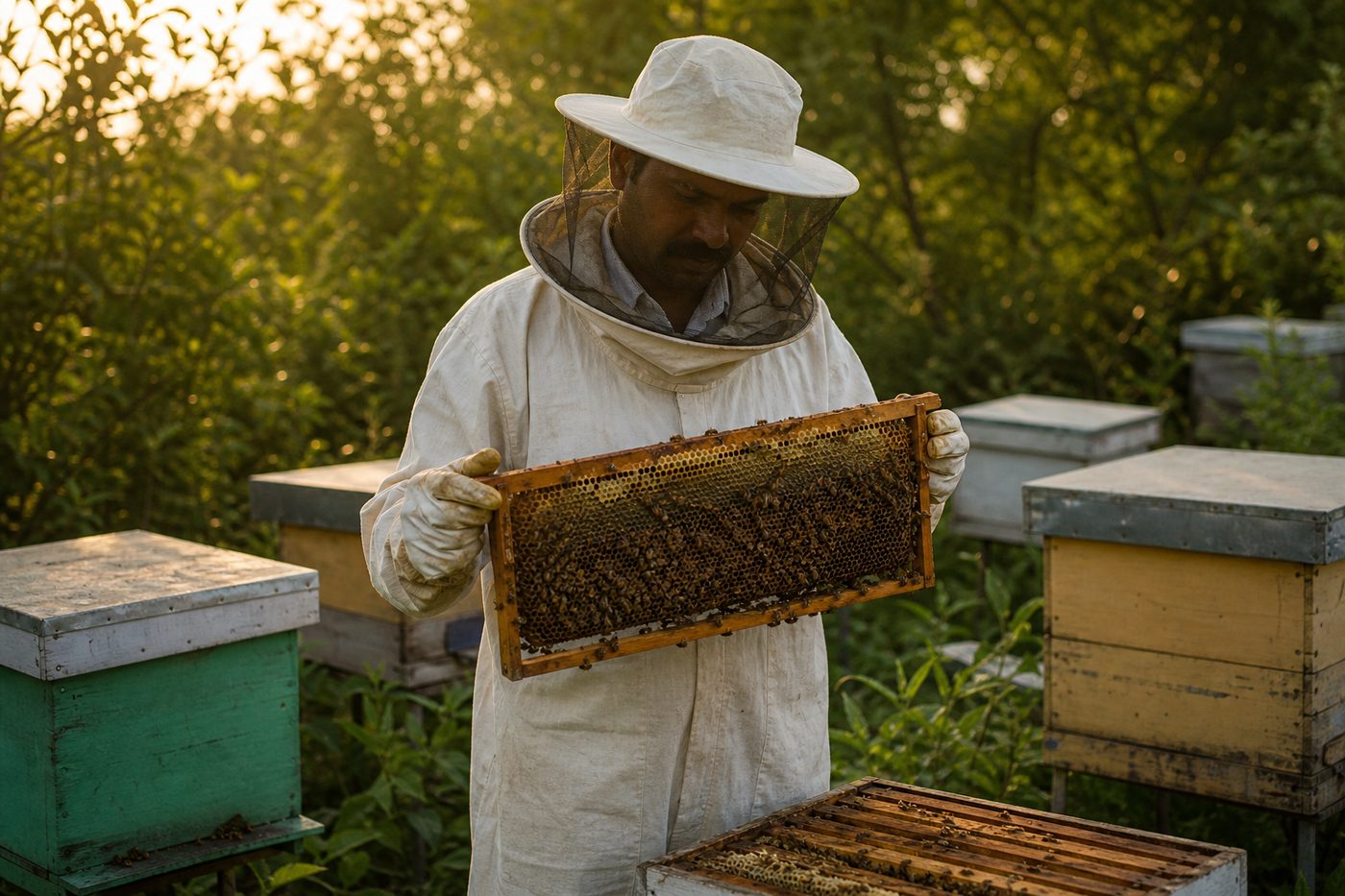
International buyers source honey from India for three converging reasons: extraordinary floral biodiversity that produces varieties unavailable from most other origins, competitive pricing across both conventional and certified organic grades, and a large export-organised sector capable of delivering consistent bulk and retail programmes. Litchi honey from Bihar, Ajwain from Rajasthan, Sidr from Jammu & Kashmir, Jamun from Maharashtra, and certified organic multi-floral from NPOP-registered apiaries across multiple states give buyers assortment depth that few countries can replicate under one sourcing geography.
Yet buyers who try to source honey directly from India without a structured process encounter the same recurring failures: beautiful sample jars, inconsistent lot quality, missing antibiotic test certificates, HMF violations, mislabelled origin claims, or processing units that cannot file export paperwork. India's honey export sector has a documented history of quality compliance challenges — including antibiotic residues and C4 sugar adulteration — that makes due diligence non-negotiable, not optional. Buyers who treat India as a low-risk commodity origin because of price are usually the ones with the highest first-shipment failure rates.
This guide is written for food importers, retail buyers, organic food brands, food manufacturers, e-commerce sellers, and wholesale distributors in the USA, UK, EU, UAE, Canada, and Australia. It explains how the Indian honey supply chain works, how to find and verify reliable suppliers, how to manage quality through lab testing and certification checks, and when a merchant exporter reduces risk better than managing multiple processing units alone. For market context, see Best Countries for Indian Honey Exports and Top Honey Products Exported from India.
Key Takeaways
Summary Box
- To source honey directly from India, define specifications fully — variety, grade, moisture, HMF, residue requirements, certification, and pack format — before shortlisting suppliers.
- India wins on variety depth, organic production capacity, and competitive pricing when quality documentation matches destination market standards.
- Verify APEDA registration, FSSAI licence, IEC, lot-level lab test records, and export history before any payment.
- Lab testing — C4 isotope, HMF, moisture, antibiotics — is the buyer's most important due diligence tool for every lot, every shipment.
- Multi-variety programmes sourced from different production regions are often safer through a merchant exporter than through fragmented direct-processing-unit management.
- Altus Exports supports honey & natural products sourcing programmes with supplier verification, lab alignment, certification coordination, and export documentation.
Why India Is One of the Best Origins for Honey Sourcing
- Example: A USA natural food importer sources USDA NOP-certified Ajwain honey from Rajasthan for health-food retail — positioned as a premium varietal alternative to generic clover.
- Example: A UK organic brand builds a co-branded range of NPOP-certified Indian multi-floral and Litchi honeys as origin-specific retail SKUs.
- Example: A German health-food distributor sources EU-organic-certified multi-floral bulk from a Maharashtra producer company for repacking into its own private-label range.
- Example: A UAE premium grocery buyer sources J&K Sidr honey for gift-format retail, competing with Yemeni Sidr on provenance documentation and price accessibility.
India's apiculture ecosystem spans over 3.5 million registered bee colonies across ecologically diverse zones: the sub-Himalayan foothills of Himachal Pradesh for mountain multi-floral honey, the Terai and Gangetic plains of Bihar and Uttar Pradesh for Litchi, Mustard, and Ajwain honey, the arid Rajasthan desert for multi-floral varieties, the coastal and Western Ghats zones of Maharashtra and Karnataka for Jamun and Tulsi honey, and the high-altitude Himalayan valleys of J&K for premium Sidr honey. This geographic range produces natural variety diversity that mass-production origins like Argentina or major Brazilian states cannot replicate with comparable heritage.
India's NPOP organic certification framework is internationally recognised and forms the production basis for USDA NOP and EU organic overlay certifications. APEDA tracks the export sector and operates mandatory registration, while EIC (Export Inspection Council) provides health and quality certification frameworks. FSSAI sets food-safety standards that align with Codex Alimentarius benchmarks. The institutional infrastructure supporting quality honey export from India is credible — the challenge is that individual operators within the ecosystem vary enormously in compliance discipline, which is exactly why buyer-side verification matters.
Pricing competitiveness is real. Indian organic multi-floral honey is priced competitively versus New Zealand Manuka or European Acacia for buyers who do not require those specific floral designations. Conventional bulk Indian honey competes on price with South American origins for food-manufacturing applications. The combination of variety, organic capacity, pricing, and an English-language export infrastructure makes India a rational primary or secondary honey sourcing origin for global buyers who invest appropriately in supplier verification.

Understanding the Indian Honey Supply Chain
Buyers who conflate beekeepers, processors, exporters, and agents create false expectations and mismatched contracts. Understanding the supply chain structure is the first step to identifying the right counterparty for your programme.
Comparison table
Swipe →
Data table — swipe horizontally on small screens
| Supply Chain Node | Role | Buyer Implication |
|---|---|---|
| Beekeepers / apiarists | Honey collection and primary extraction | Quality starts here; NPOP certification covers this level |
| Producer companies / FPOs | Aggregation from multiple beekeepers; first processing | Check APEDA registration and in-house lab testing capability |
| Honey processing units | Filtration, heating (careful control needed), bottling/drumming | Critical node for HMF control and contamination risk |
| Export houses | Category exporters with own export lines | Useful for established grades; verify quality documentation depth |
| Merchant exporters | Buy, coordinate, and export under their accountability | Strong for multi-variety consolidation and documentation management |
| Buying agents | Introduction and local coordination | Clarify whether they take quality and document accountability |
| Certified organic operators | NPOP/NOP/EU organic-certified production and export | Essential for organic claims; verify certification body accreditation |
| APEDA-registered exporters | Legally authorised honey exporters | Baseline requirement; absence is disqualifying |
Benefits of Sourcing Honey Directly from India
Direct sourcing from India reduces landed cost versus buying Indian honey through overseas intermediaries or commodity traders. It enables variety-specific procurement — you can specify Litchi, Ajwain, or Sidr rather than generic 'Indian multi-floral'. It enables organic certification alignment to your retail programme requirements. Direct relationships with organised processors allow customised pack formats — from 200kg drums for industrial use to branded glass jars for specialty retail. Long-term direct partnerships also compound: suppliers learn your moisture threshold, HMF tolerance, and packaging specifications, which reduces revision cycles on each repeat order.
'Direct' does not always mean 'single beekeeper.' For most international buyers, sourcing directly from India works best with one accountable Indian export partner — a merchant exporter or organised processor — who consolidates verified apiary-level supply, manages quality controls, and handles export compliance under one relationship. That model preserves India-origin pricing while adding the documentation discipline and export expertise that individual beekeepers or small cooperatives often cannot provide.
Compare models carefully: merchant exporters provide full-service accountability; manufacturer-exporters offer more direct factory access but less multi-variety flexibility; buying agents provide introductions but may not own quality outcomes. See the full model comparison for context on what works best for your programme type, and read How to Export Honey from India for the export-side process.
How to Source Honey Directly from India: Step-by-Step Buyer Playbook
Export Tip
Use this ten-step sequence whether you buy from a processing unit directly or through a merchant exporter. Each step exists to prevent a specific class of failure — skipping steps to save time typically costs more on the first failed container than the time saved.
Step 1: Define Specifications Completely
Document: honey variety (multi-floral, Litchi, Ajwain, Sidr, Organic multi-floral, etc.), grade (food grade, retail, premium), moisture threshold (e.g., ≤18.5%), HMF limit (e.g., ≤20mg/kg for premium, ≤40mg/kg for standard), antibiotic residue requirements (ND for chloramphenicol, streptomycin, OTC), C4 isotope requirement, certifications required (NPOP, NOP, EU Organic, Halal, FSSAI), pack format (200kg MS/SS drums, retail glass jars, custom retail packs), labelling requirements (destination market compliance), target FOB or CIF price, MOQ, and delivery window. Vague specifications produce incomparable quotations and invite suppliers to fill gaps with assumptions you will reject at the lab stage.
Step 2: Identify Potential Suppliers
Use APEDA's registered exporter directory, FSSAI-licensed processor lists, EIC-approved establishments, NPOP-certified operator databases for organic lots, trade fair exhibitor lists (Anuga, Gulfood, Natural Products Expo), ITC Trade Map HS 0409 shipment data to identify active Indian honey exporters by destination market, and referrals from APEDA or FIEO networks. Prefer suppliers with documented export history to your target market — a processor shipping regularly to Germany likely understands EU residue requirements better than one with no EU experience.
Step 3: Shortlist and Initial Qualification
Score candidates on: APEDA registration (verified on APEDA portal), FSSAI licence (verified on FoSCoS portal), IEC (verified on DGFT portal), export history (request redacted prior shipment documents), lab testing infrastructure (in-house vs. APEDA-approved external lab), certification status (check certifier validity independently), communication responsiveness, and willingness to provide references. Keep three suppliers maximum per category for a focused evaluation. Immediately disqualify any supplier who cannot provide APEDA registration proof or whose quoted price is significantly below market — both are red flags.
Step 4: Request Samples with Lab Reports
Request physical samples along with the lot-level lab reports that accompany them. Samples without lab documentation are marketing props, not quality evidence. Require: C4 IRMS test report, full antibiotic residue panel, HMF, moisture, diastase activity, ash content, and electrical conductivity from the same lot as the sample. Use an accredited third-party lab in your destination country to independently retest the sample against the Indian lab results. Discrepancies between supplier lab reports and independent retests are important signals before any commercial commitment.
Step 5: Evaluate Product and Documentation Quality
Evaluate the honey physically: colour, aroma, viscosity, crystallisation behaviour (natural crystallisation is fine; unusual texture is not), taste profile for the declared variety. Evaluate documentation: are lab reports from an APEDA-approved or NABL-accredited laboratory? Are certifications current and from accredited certification bodies? Does the variety name match the pollen analysis results? Do the apiary addresses in organic certificates correspond to the production region? Commercial taste and laboratory compliance together define a usable sample — one without the other is insufficient.
Step 6: Negotiate Pricing on Landed-Cost Basis
Compare landed cost, not only FOB. Include: FOB price, freight (bulk drum sea freight rates from JNPT or Mundra to your destination port), insurance, destination import duty, and destination lab testing cost for your own QC check. A lower FOB from a supplier with poor residue track record creates higher risk cost — failed containers cost far more than the price premium you saved. For organic lots, confirm whether organic certification transaction certificates are included in the quoted price or charged separately. Negotiate MOQ breaks for programme volume once you have validated quality on the trial order.
Step 7: Verify Export Compliance Capability
Confirm: APEDA registration is active and covers honey exports; FSSAI licence covers the processing facility; IEC is current and matches company name on quotation; supplier can provide EIC health certificate where required for your destination (EIC mandatory for many food exports to EU, USA); commercial invoice format meets your destination customs requirements; supplier has successfully exported to your target market before or has clear documentation knowledge of it. A processing unit without active APEDA registration and EIC capability cannot legally export honey from India — beautiful product does not override this.
Step 8: Place a Trial Order with Written Terms
Start with a limited trial quantity — one LCL lot for bulk, or a sample commercial order for retail. Lock in writing: approved lot specification and reference sample, Incoterms, payment milestones (typically 30% advance at order confirmation, 70% against shipping documents — avoid 100% advance with new suppliers), production tied to approved sample references and lab parameters, pre-shipment inspection requirement, what happens if lot fails inspection (rework, replacement, or refund pathway), and Incoterms-appropriate document checklist. All of this in writing before money moves.
Step 9: Conduct Pre-Shipment Inspection and Lab Testing
For every commercial lot: obtain and review the supplier's APEDA-lab test certificate for the specific lot; arrange your own independent third-party lot sample for retest at a destination-country-accredited lab if the order value or regulatory risk warrants it; verify drum condition (food-grade lining, no damage, correct sealing); verify labelling accuracy against your specification; review packing list matches before sealing. Do not allow cargo cutoff pressure to skip inspection on a first order — that urgency is exactly when problems are introduced.
Step 10: Manage Logistics, Documentation, and Arrival
Confirm document set before vessel departure: commercial invoice (with correct HS code 0409 and country of origin), packing list, bill of lading, APEDA certificate, EIC health certificate, phytosanitary certificate if required, organic transaction certificates for certified lots, certificate of origin, and cargo insurance certificate under CIF/CIP. Pre-alert your import broker with draft documents. Ensure HS code descriptions are consistent across all documents. Any mismatch triggers customs examination, which adds days and storage costs even when product quality is perfect. Read Honey Export Documentation Checklist for the complete document framework.
Where to Find Reliable Indian Honey Suppliers
No single discovery channel is sufficient. Combine multiple sources and verify every lead — honey export is a regulated food category where unverified claims carry significant commercial and compliance risk.
Comparison table
Swipe →
Data table — swipe horizontally on small screens
| Discovery Channel | Advantage | Limitation |
|---|---|---|
| APEDA registered exporter directory | Legally required for export; credibility baseline | Directory access; still requires your own due diligence |
| EIC-approved establishment list | Health certificate capability confirmed | Must cross-reference with APEDA and FSSAI |
| NPOP-certified operator databases | Organic capability verified by accredited certifier | Covers only certified organic operations |
| Trade shows (Anuga, Gulfood, NP Expo) | Face-to-face evaluation; sample acquisition | Annual; travel cost; follow-up discipline required |
| APEDA / FIEO referrals | Sector credibility; council accountability | Still requires independent quality verification |
| ITC Trade Map HS 0409 data | Identifies active exporters by destination market | Data cost; requires further supplier qualification |
| LinkedIn outreach | Direct access to export directors and managers | Slower nurture cycle; precision targeting needed |
| Merchant exporters / sourcing partners | Consolidated accountability + quality coordination | Includes coordination margin; less direct factory access |
| B2B platforms | Fast discovery | Very high noise; weak proof of export readiness or compliance |
How to Verify an Indian Honey Supplier: Due Diligence Checklist
Checklist
- APEDA registration — verify active status on APEDA portal; RCMC (Registration Cum Membership Certificate) for honey category
- FSSAI licence — verify on FoSCoS portal; must cover processing and export operations
- IEC (Import Export Code) — verify on DGFT portal; name must match quotation and invoice letterhead
- EIC-approved establishment — confirm for markets requiring health certificates (EU, USA, others)
- NPOP certification (for organic claims) — verify certifier name, accreditation status, and certificate validity; cross-check apiary addresses
- USDA NOP certification (for USA organic) — verify NOP certificate from accredited certifier
- Prior export document samples — request redacted copies of prior commercial invoices, bills of lading, and APEDA certificates from similar shipments
- Lab test track record — ask for six months of prior lot-level test records for C4, HMF, moisture, antibiotic panel from APEDA-approved lab
- Processing facility audit — video or in-person audit of processing unit: hygiene standards, drum storage, filtration process, temperature control, lab equipment
- Antibiotic-free beekeeping documentation — supply chain records demonstrating antibiotic-free protocols at apiary level
- Traceability system — from specific apiary lot number to processed lot to export drum — can they trace a drum back to a specific apiary cluster?
- Customer references in your target market — request contact details of current buyers in similar markets
- Subcontracting and aggregation disclosure — if they source from multiple beekeepers, how is quality controlled at aggregation points?
Use this checklist before any deposit. For organic programmes, add organic-specific verification steps. A supplier who passes product quality checks but fails documentation checks is not export-ready.
Understanding Honey Authenticity and Adulteration Risks
Honey adulteration — the addition of sugar syrups (typically C4 sugars from corn, rice, or cane) to increase volume and reduce cost — has been a persistent challenge in Indian honey exports. High-profile international studies and investigative reports have documented the practice at various points, creating lasting buyer caution. Understanding the analytical methods used to detect adulteration empowers buyers to demand and interpret the right test certificates.
C4 IRMS (Isotope Ratio Mass Spectrometry) is the primary screening method for detecting C4 sugar syrups. Natural honey is a C3 plant product; its carbon isotope signature (δ13C value) must match the protein fraction signature within a defined tolerance. Adulterated honey shows a C4 signature deviation. This test is required by premium buyers in the USA, EU, UK, Japan, and beyond. Some sophisticated adulterants now use C3 sugar syrups (like beet sugar) that pass C4 IRMS — Nuclear Magnetic Resonance (NMR) testing is used by premium EU buyers to detect these. Buyers purchasing from India at significantly below-market prices for the claimed variety should treat that pricing itself as an adulteration risk signal.
Comparison table
Swipe →
Data table — swipe horizontally on small screens
| Adulteration / Quality Risk | Detection Method | Markets Where Tested | Buyer Action |
|---|---|---|---|
| C4 sugar syrup (corn/rice/cane) | C4 IRMS isotope test | USA, EU, UK, Japan, Canada, Australia | Require IRMS certificate every lot |
| C3 sugar syrup (beet/invert) | NMR (Nuclear Magnetic Resonance) | Germany, Netherlands, premium EU buyers | Request NMR for premium EU programmes |
| Antibiotic residues (CAP, streptomycin) | ELISA + LC-MS/MS confirmation | All premium markets | Full residue panel every lot |
| Excess HMF (heat damage / old stock) | Photometric / HPLC analysis | All markets; critical EU/Japan | HMF test every lot; reject >40mg/kg |
| High moisture (fermentation risk) | Refractometer measurement | All markets | Moisture test before sealing; reject >20% |
| Mislabelled variety / origin | Pollen analysis (melissopalynology) | Germany, France, UK premium buyers | Request pollen report for varietal claims |
| False organic certification | Certifier accreditation cross-check | EU, USA, UK organic buyers | Verify certifier independently on accreditation body database |
Honey Sourcing Specifications and Quality Parameters: Reference Table
Use this reference table when building your RFQ specification. Parameters marked as 'premium buyer target' represent specifications that access the best prices in certified organic and specialty channels, even though some published standards may permit wider tolerances.
Comparison table
Swipe →
Data table — swipe horizontally on small screens
| Parameter | Codex Alimentarius Standard | EU / Premium Buyer Target | Japan MRL Guidance | FSSAI (India) Standard |
|---|---|---|---|---|
| Moisture content | ≤20% w/w | ≤20% (buyer pref ≤18.5%) | ≤20% | ≤20% |
| HMF | ≤40mg/kg (blossom honey) | ≤40mg/kg; premium ≤15–20 | ≤40mg/kg | ≤40mg/kg |
| Diastase activity | ≥8 (Schade scale) | ≥8 (≥3 for declared low-enzyme) | ≥8 | ≥8 |
| Sucrose content | ≤5g/100g | ≤5g/100g | ≤5g/100g | ≤5g/100g |
| Electrical conductivity | ≤0.8 mS/cm (blossom) | ≤0.8 mS/cm | Per Codex | Per Codex |
| Chloramphenicol (CAP) | Not applicable (banned) | Non-detectable (<0.1 ppb) | ≤0.3 ppb (or ND) | ND (banned) |
| Streptomycin | Not applicable (banned in food) | ND or EU MRL | Strict MRL | ND |
| Oxytetracycline (OTC) | Not applicable | EU MRL | Strict MRL | ND |
| C4 sugar content | ≤7% C4 sugars by IRMS | <7% (most buyers: must pass ND) | Must pass | Pass required |
MOQ, Pricing, and Payment Terms for Honey Sourcing from India
Minimum order quantities for Indian honey depend on buyer type and variety. Industrial food-grade bulk buyers typically purchase in FCL quantities of 18–21MT (one standard 20ft container of 200kg MS or SS drums, approximately 90–100 drums). Organic bulk programmes often start at smaller FCL or LCL trial quantities of 2–5MT as quality-verification lots before committing full containers. Retail and specialty honey import programmes can start smaller depending on the pack format — glass jar retail programmes may have MOQs defined by carton minimums rather than container economics.
Pricing benchmarks for Indian honey export (indicative for 2026, subject to seasonal and market variation): conventional multi-floral bulk (food grade) typically ranges USD 1.20–1.80/kg FOB; organic multi-floral certified bulk typically USD 2.80–4.50/kg FOB depending on certification depth and variety; premium varietal (Litchi, Ajwain) in the USD 2.00–3.50/kg FOB range; Sidr honey from J&K in premium retail formats can achieve substantially higher prices per kg depending on certification and provenance documentation quality.
Payment terms for new relationships typically involve 30–50% advance against purchase order and the balance of 50–70% against shipping documents (bill of lading or airway bill). Letter of Credit (LC) is used for larger first orders or when buyers prefer bank-intermediated payment security. Open account terms (net-30, net-60) are available only after an established track record of repeat orders, not on first transactions. Never pay 100% advance to unverified suppliers. Align payment milestones explicitly with sample approval, production start, pre-shipment inspection completion, and document release.
Comparison table
Swipe →
Data table — swipe horizontally on small screens
| Honey Grade | Typical MOQ | Indicative FOB Range (2026) | Certification Requirement |
|---|---|---|---|
| Conventional multi-floral, food grade bulk | 1 FCL (18–21MT) | USD 1.20–1.80/kg | APEDA, FSSAI, EIC |
| Organic multi-floral, NPOP certified bulk | 1–5MT LCL trial, then FCL | USD 2.80–4.50/kg | NPOP + USDA NOP / EU Organic |
| Litchi honey, food grade bulk | 1–2MT trial, FCL on repeat | USD 1.80–2.80/kg | APEDA, EIC, pollen cert |
| Ajwain honey, food grade bulk | 1–2MT trial, FCL on repeat | USD 1.80–2.60/kg | APEDA, EIC, pollen cert |
| Sidr honey (J&K), premium retail | Negotiated; 200–500kg trial | USD 8–20+/kg (retail equivalent) | APEDA, FSSAI, provenance docs |
| Organic retail jar programme | By carton / pallet minimum | Negotiated against FOB bulk + packaging | NPOP + destination organic cert |
Logistics and Shipping for Honey from India
Bulk honey (200kg drums) ships most cost-effectively by sea freight in 20ft FCL containers. Key Indian load ports for honey shipments include JNPT (Nhava Sheva, Mumbai) serving Maharashtra, UP, and Rajasthan production zones; Mundra (Gujarat) as an alternative for western production; and Chennai for southern India production. Transit times to Rotterdam/Hamburg are approximately 20–28 days; to UAE/Dubai 5–8 days; to US East Coast 20–25 days; to the USA West Coast 25–30 days.
Drum specification matters: food-grade mild-steel lacquer-lined drums or stainless-steel drums are standard for bulk honey export. Drum condition (no dents, intact liner, proper seal) must be verified before loading. Mislabelled or damaged drums can fail customs inspection even when honey quality is correct. Retail jar programmes ship as general cargo; glass jars require adequate cushioning and carton engineering to survive ocean transit vibration.
Documentation alignment before departure prevents the majority of customs complications: commercial invoice and packing list must use identical HS code (0409), identical lot references, identical weights, and consistent country-of-origin statements. APEDA certificate, EIC health certificate, organic transaction certificates, and phytosanitary certificate (where required) must all be presented to the destination broker before vessel arrival. Cargo insurance is strongly recommended for all honey shipments — insure based on CIF value at the destination.
Why International Buyers Work with Merchant Exporters Instead of Multiple Processing Units
Managing three honey processing units across different states — one for multi-floral, one for Litchi, one for NPOP-certified organic — sounds efficient on paper and creates significant operational complexity in practice. Each unit has different APEDA registration numbers, different EIC-approved establishment references, different lab testing relationships, different shipping bill filing practices, and different communication quality. One problematic lot from any one unit can delay your entire seasonal programme.
A merchant exporter provides a single point of quality accountability, consolidated lab documentation, unified export documentation, and multi-variety programme management under one commercial relationship. You approve specifications and review samples; the merchant exporter manages the India-side operating system. For buyers building diverse honey programmes — bulk multi-floral for food manufacturing, certified organic retail jars, and specialty varietal for premium channels — this consolidated model typically delivers lower total risk cost even accounting for the coordination margin embedded in merchant-export pricing.
This is why buyers from USA, UK, EU, UAE, and Canada operating honey import programmes above 5MT/year frequency increasingly prefer working with one accountable India export partner rather than direct-managing multiple processing units simultaneously. Learn more at the honey & natural products industry page and organic honey product page.
India vs Argentina vs Ukraine vs New Zealand for Honey Sourcing
Honey buyers increasingly multi-source across origins — India for variety and organic capacity, Argentina for high-volume commodity clover, Ukraine for European sunflower and rapeseed varieties (subject to supply chain risk), and New Zealand for premium Manuka. Understanding India's competitive position relative to these origins helps buyers make rational sourcing allocation decisions.
Comparison table
Swipe →
Data table — swipe horizontally on small screens
| Factor | India | Argentina | Ukraine | New Zealand |
|---|---|---|---|---|
| Variety depth | Excellent — multi-floral, Sidr, Litchi, Ajwain, Jamun, Mustard | Good — clover, citrus, sunflower | Moderate — sunflower, rapeseed, acacia | Limited — primarily Manuka and clover |
| Organic capacity | Strong NPOP framework; growing NOP/EU-certified volume | Good; established organic sector | Moderate (recovery phase) | Strong for Manuka; limited organic depth |
| Conventional bulk pricing | Competitive; USD 1.20–1.80/kg range | Often cheapest for EU clover grades | Competitive (when available) | Premium — not for commodity use |
| Residue risk profile | Antibiotic risk; requires lot-by-lot verification | Lower antibiotic risk profile historically | Variable; supply chain complexity | Very low residue risk; strict NZ standards |
| Adulteration risk | Documented history; C4 testing mandatory | Lower historical risk | Moderate | Very low |
| EU access | Complex; anti-dumping history; strict testing | Good EU access for approved exporters | Complicated by geopolitical supply risk | Good; NZ standards respected |
| Specialty / premium potential | Very high — Sidr, varietal, organic | Moderate for specialty | Lower specialty differentiation | Very high — Manuka UMF ratings |
| Buyer fit | Best for variety, organic, and provenance-led programmes | Best for high-volume commodity clover EU | Variable risk; review supply chain | Best for Manuka premium positioning |
Case Study: UK Organic Food Retailer Sourcing Indian Multi-Floral and Litchi Honey
Objective: A UK organic food retailer wanted to add two Indian-origin honey SKUs to its natural and organic grocery range: an organic multi-floral as a mainstream organic honey option and a Litchi honey as a premium specialty SKU, both with clear provenance stories for retail labelling.
Supplier identification: Used NPOP-certified operator database and APEDA-registered exporter referrals to identify three candidate suppliers in Bihar (Litchi honey region) and Maharashtra/UP (organic multi-floral). Shortlisted two after initial document check.
Documentation verification: Confirmed APEDA registration, FSSAI licence, NPOP certificate validity with the certifying body, and prior UK export experience. Requested six months of lot-level test records for both C4 IRMS and antibiotic panels.
Sample and lab evaluation: Received samples with APEDA-lab C4 and antibiotic certificates. Independently retested samples at a UK UKAS-accredited laboratory. Results: multi-floral samples passed all parameters; first Litchi sample had marginal HMF at 38mg/kg (still within Codex limit but above buyer's internal target of 30mg/kg); revised processing temperature protocol and resubmitted sample passed at 22mg/kg.
UK organic certification: NPOP-certified production; engaged a UK Organic certification body for UK Organic market approval — required a documentary review of NPOP certification evidence and UK-specific labelling compliance.
Retail packaging: Designed 250g and 500g glass jar formats with UK mandatory labelling elements (country of origin 'India', best before, storage, net weight in metric, UK responsible importer address). Production managed through the supplier with artwork approval process.
Trial shipment: First commercial order: LCL sea shipment from JNPT, 500kg each variety, with full document set including APEDA certificate, FSSAI certificate of analysis, UK organic transaction certificate, commercial invoice, packing list, bill of lading, insurance certificate.
Results: Both SKUs listed in the natural food category; Litchi honey sold through faster than forecast, triggering a repeat order within 10 weeks; multi-floral organic positioned as an everyday organic alternative to dominant EU origins.
Lessons learned: HMF testing discipline at the processing unit level — not just at the lab reporting stage — was the key quality management upgrade. UK organic certification documentation was more straightforward than anticipated when NPOP records were already in good order. The trial LCL approach correctly sized the first commitment.
Future of Global Honey Sourcing from India Through 2030
Through 2030, Indian honey sourcing will be shaped by three forces: technology-enabled traceability, premiumisation of specialty and organic segments, and tighter regulatory scrutiny worldwide. Blockchain-based apiary-to-export traceability systems are being piloted by progressive Indian exporters and producer companies — buyers who require this level of transparency will find a growing group of Indian suppliers able to deliver it. AI-powered quality prediction tools trained on historical HMF, moisture, and residue data from specific apiary clusters will begin to inform procurement sourcing decisions.
NMR-based honey authentication — the gold standard for detecting sophisticated adulteration beyond C4 IRMS — is becoming a routine screening tool among German, Dutch, and UK organic honey buyers. Indian exporters who prepare for NMR authenticity testing now will access the highest-value tier of EU honey buyers faster than competitors. India's Sidr, Litchi, and Ajwain varieties have significant underexplored premium positioning in EU and UAE specialty channels where provenance storytelling backed by pollen analysis and geographic documentation can justify 2–4x conventional pricing.
Regulatory changes — EU's farm-to-fork strategy, UK REUL evolution, and USA FDA food-safety modernisation — will continue to tighten documentation and traceability requirements. Buyers who establish clean, documented India honey sourcing programmes now will face less disruption as regulations evolve. For a full outlook on organic and sustainable positioning, read Sustainable & Organic Honey Export Opportunities.
Conclusion
- Next step: Send variety requirements, certification needs, target MOQ, destination market, and price band to Altus Exports for a verified supplier shortlist.
- Review Best Countries for Indian Honey Exports to align your sourcing programme to the right destination market.
- Read Top Honey Products Exported from India for variety and category depth.
- Understand the export side with How to Export Honey from India.
- Complete your compliance foundation: APEDA Registration Benefits for Honey Exporters and Honey Export Documentation Checklist.
- Build your buyer or seller pipeline with Find International Buyers for Honey and Trade Shows for Honey Exporters.
- Explore Most Demanded Indian Honey by Country for granular product-market matching.
- For sustainability positioning, read Sustainable & Organic Honey Export Opportunities.
- Browse organic honey product details and the honey & natural products industry page.
- Explore product sourcing company in India and global sourcing partner service models.
International buyers who source honey directly from India access extraordinary variety depth, organic production capacity, and competitive pricing — when they approach it as a quality-controlled process, not a commodity purchase. Define specifications precisely. Verify APEDA, FSSAI, and organic certifications independently. Test every lot for C4, antibiotics, HMF, and moisture at an accredited laboratory. Start with a trial LCL quantity before committing full container programmes. Engineer retail packaging for destination market compliance. Use a merchant exporter or accountable sourcing partner for multi-variety programmes.
The buyers who build the most successful India honey supply chains are not the ones who find the lowest FOB — they are the ones who find the most verifiable quality at competitive pricing. If you are ready to build a documented India honey sourcing programme with fewer first-order surprises, share your honey specifications with Altus Exports for a supplier shortlist and market-readiness assessment.