
Top 15 Honey Products Exported from India (2026 Guide)
By Saurabh Mittal, Founder, Altus Exports
Discover the top honey products and varieties exported from India and where global demand is strongest. This guide maps multifloral, acacia, mustard, lychee, eucalyptus, Himalayan wild honey, wild forest honey, jamun, neem, ajwain, sunflower, organic certified, raw unprocessed, beeswax, and creamed honey — with production regions, importing country demand, quality parameters, organic certification paths, and buyer trends for USA, Germany, UK, Japan, UAE, France, Netherlands, Canada, and Australia. Includes regional production tables, India vs China/Argentina/New Zealand sourcing comparison, a Japanese importer case study, and practical sourcing steps for international buyers and Indian exporters working with Altus Exports.
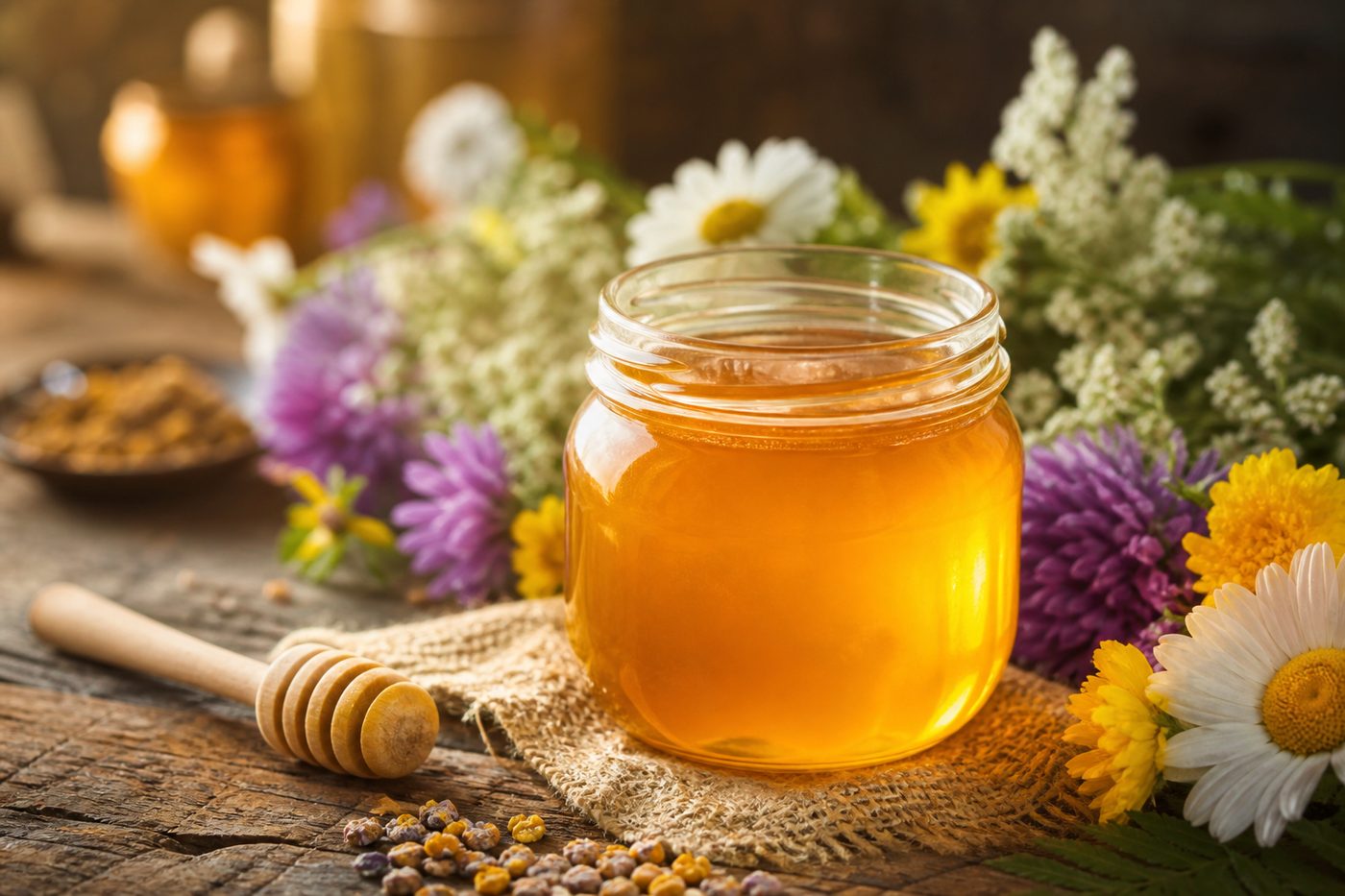
India's extraordinary floral diversity — stretching from the mustard fields of Punjab and the litchi orchards of Bihar to the Himalayan forests of Uttarakhand and the wildflower ecosystems of the Northeast — produces a range of honey varieties that no other major honey-exporting nation can replicate. For international buyers seeking authentic, traceable, and competitively priced honey beyond the commodity monocultures of Argentina or the antibiotic-scrutinised volumes of China, India offers a portfolio of distinct honey products exported from India that span commodity, premium, organic, medicinal-positioning, and ultra-specialty tiers. Understanding which variety matches which buyer channel is the foundation of any successful Indian honey import programme.
Global honey demand is bifurcating. Industrial food manufacturers and large retail packers continue to purchase commodity multifloral honey by the container load, prioritising consistent food safety documentation, competitive FOB pricing, and reliable supply. At the same time, a rapidly growing segment of premium retail buyers in Germany, Japan, USA health-food channels, UK organic retail, and Australian specialty stores actively seek authenticated monofloral and organic honey with verifiable provenance, NPOP or EU Organic equivalence certification, NABL laboratory test reports, and meaningful origin stories. India serves both segments — and the premium opportunity is growing faster than the commodity market.
Whether you are an international buyer designing a 2026 honey assortment for specialty retail or a foodservice programme, or an Indian honey processor deciding which varieties to develop for export, this guide covers the fifteen most commercially relevant honey products and varieties exported from India — with production regions, quality parameters, certification paths, and buyer-market fit. For the complete export process including APEDA, FSSAI, lab testing, documentation, and logistics, pair this article with How to Export Honey from India.
Key Takeaways
Summary Box
- India exports at least fifteen commercially distinct honey products — ranging from commodity multifloral to ultra-premium Himalayan wild honey — each with different buyer appeal, quality parameters, and certification paths.
- The top export varieties by volume are multifloral, mustard, and lychee honey; by value premium, acacia, Himalayan wild honey, and organic-certified varieties lead.
- NABL laboratory testing for HMF, moisture, antibiotic residues (especially chloramphenicol and nitrofurans), and C4 sugar adulteration is mandatory for every commercial export consignment from India.
- NPOP (National Programme for Organic Production) certification gives Indian honey EU Organic equivalence under the bilateral agreement — a significant competitive advantage over Argentine or Chinese honey in European premium markets.
- USA, Germany, UK, Japan, UAE, France, Netherlands, Canada, and Australia are the core import markets; Japan and Germany apply the world's strictest quality and residue standards.
- India's honey export advantage over China is documented quality transparency; over Argentina is varietal diversity and organic certification availability; over New Zealand Manuka is competitive pricing across premium non-Manuka varieties.
- Altus Exports supports international buyers sourcing organic honey from India and other natural food products through honey-natural-products industry channels.
Why India's Honey Diversity Drives Global Buyer Interest
Most of the world's major honey-exporting nations produce one or two dominant varieties at scale — Argentina exports primarily eucalyptus and sunflower honey; China produces vast quantities of undifferentiated multifloral at industrial scale; New Zealand built a global brand on Manuka (Leptospermum scoparium) bioactivity. India is structurally different. Its climatic and geographic range — from subtropical Punjab to alpine Uttarakhand, from the litchi groves of Bihar to the biodiversity hotspots of the Northeast — produces at least eight to twelve commercially distinct floral honey profiles, multiple of which are unavailable from any other origin at comparable quality and price.
This variety depth matters increasingly as premium honey retail matures. Specialty food buyers in Germany — the world's most sophisticated honey import market — routinely seek different monofloral origins for different retail price tiers. Japanese honey importers, who pay some of the highest global prices for clean, traceable honey, actively search for authentic Asian floral profiles that European or South American origins cannot provide. US health-food retail, which expanded natural and organic grocery dramatically over the last decade, looks for honey that carries both a quality story and a certification pathway. India checks those boxes with greater breadth than any competing origin.
The challenge has historically been quality documentation — specifically, the incidence of antibiotic residues and C4 sugar adulteration in unverified supply chains damaged India's reputation in EU markets in the early 2000s. APEDA, EIC, and the honey processing industry's investment in NABL-accredited testing infrastructure, stricter beekeeper sourcing protocols, and transparent supply chain documentation have substantially addressed that legacy. Buyers who dismissed Indian honey a decade ago are re-evaluating origin-certified, NABL-tested Indian varieties — particularly for premium organic and monofloral positions.
Overview of India's Honey Export Industry
India's beekeeping industry encompasses over ten million managed honey bee colonies operated by smallholder beekeepers, cooperatives, and commercial apiaries. Processing infrastructure ranges from small-scale village processors to large integrated export-grade processing plants with controlled-temperature dehumidification, multi-stage filtration, automated drum filling, and in-house or contracted NABL-linked laboratory testing. Export facilitation runs through APEDA, with inspection services provided by EIC (Export Inspection Council) and related authorised bodies.
Government support for honey export includes APEDA's promotional activities, NHB (National Bee Board) beekeeping development schemes, and the broader Ministry of Commerce export promotion framework. NPOP certification infrastructure under APEDA supports organic honey producers in achieving EU Organic equivalence, which is increasingly important as European buyers shift purchasing toward certified origins under EU Farm-to-Fork strategy targets for organic production.
Comparison table
Swipe →
Data table — swipe horizontally on small screens
| Indicator | Directional Snapshot | Buyer Implication |
|---|---|---|
| Colony base | 10+ million managed colonies | Scalable supply across variety and season |
| Primary export format | 280–300 kg bulk food-grade drums | Source by lot; retail format increasingly available for premium varieties |
| Key export body | APEDA + EIC | APEDA RCMC mandatory for all honey HS code shipping bills |
| Quality gatekeeper | NABL-accredited labs + EIC inspection | Demand lot-specific test reports before purchase |
| Organic certification | NPOP → EU Organic equivalence; NOP for USA | Significant premium unlock for European and US health-food channels |
| Risk factors | Antibiotic residues, C4 adulteration, HMF from improper processing | Require verified supply chain documentation; lot-level NABL reports |
| Key production regions | Punjab, Haryana, Bihar, UP, Uttarakhand, Himachal, NE India, Rajasthan, MP | Match variety to region; regional authentication strengthens buyer confidence |
| Growth opportunity 2026–2030 | Organic, monofloral specialty, retail jar formats | Prioritise quality-differentiated varieties over pure commodity volume competition |
Top 15 Honey Products Exported from India
The following fifteen categories represent the most commercially relevant honey products exported from India for international buyers and Indian exporters planning product development or export assortments. Quality parameters and approximate FOB price bands are directional — they vary with season, certifications, processing, and order volume.
1. Multifloral (Wildflower) Honey
- Quality parameters
- Moisture < 20%, HMF < 40 mg/kg, antibiotic-free per destination requirements.
- Top markets
- USA (industrial and retail packing), UAE (wholesale), UK (food service and retail), Middle East.
- Certification
- NPOP organic possible for some production zones; otherwise standard food-grade.
- Approx. FOB
- USD 1.20–2.00/kg for commodity bulk.
- Buyer profile
- Industrial food manufacturers, large retail packers, wholesale distributors.
- Growth
- Stable volume; margin pressure from Argentina and domestic supply from competing origins.
The highest-volume export category. Produced from multiple floral sources, primarily from Apis mellifera colonies managed across the agricultural plains of Punjab, Haryana, UP, and Rajasthan. Colour ranges from light amber to dark amber depending on season and region.
2. Mustard (Sarson) Honey
- Quality parameters
- Moisture < 18% critical to prevent fermentation in crystals; HMF very low when fresh.
- Top markets
- UK (creamed honey products), Germany (specialty spreads), Middle East (industrial).
- Certification
- Organic possible for select zones.
- Approx. FOB
- USD 1.30–2.20/kg depending on moisture and lot quality.
- Buyer profile
- European honey processors, UK artisan honey brands.
- Growth
- Moderate; creamed/set format is a growing premium category in UK and Germany.
Seasonal honey produced primarily during the mustard flowering season (January–March) in Punjab, Haryana, and western UP. Characterised by rapid crystallisation to a creamy white or pale yellow solid form — a natural property that buyers must be aware of for packaging and reliquefaction at destination.
3. Lychee (Litchi) Honey
- Quality parameters
- Moisture < 18%, HMF < 20 mg/kg for premium buyers, antibiotic-free.
- Top markets
- Germany (specialty retail), Japan (highest premium per kg), Netherlands (EU distribution), France (gourmet).
- Certification
- Organic possible for Bihar litchi zone apiaries meeting NPOP buffer requirements.
- Approx. FOB
- USD 2.50–4.50/kg certified organic; USD 1.80–3.00/kg premium non-organic.
- Buyer profile
- Specialty importers, premium supermarkets, gourmet food distributors.
- Growth
- High — monofloral market growing rapidly in Germany, Japan, and France.
One of India's most distinctive and premium monofloral export varieties, produced from Apis mellifera colonies placed in the litchi orchards of Bihar (Muzaffarpur district primarily), UP, and West Bengal during the lychee flowering season (April–June). Colour is light amber with delicate floral-fruity aroma; flavour profile is distinctively reminiscent of the lychee fruit. Pollen analysis confirms Litchi chinensis as dominant.
4. Acacia (Robinia) Honey
- Quality parameters
- Moisture < 17% for best quality; naturally very low HMF if properly processed; antibiotic-free.
- Top markets
- Germany (top buyer), Japan, France, UK, Netherlands.
- Certification
- NPOP organic frequently achievable given mountain-forest production environment.
- Approx. FOB
- USD 3.00–6.00/kg organic certified.
- Buyer profile
- Premium importers, organic stores, high-end supermarkets.
- Growth
- Very strong — German buyers in particular prefer acacia over commodity varieties.
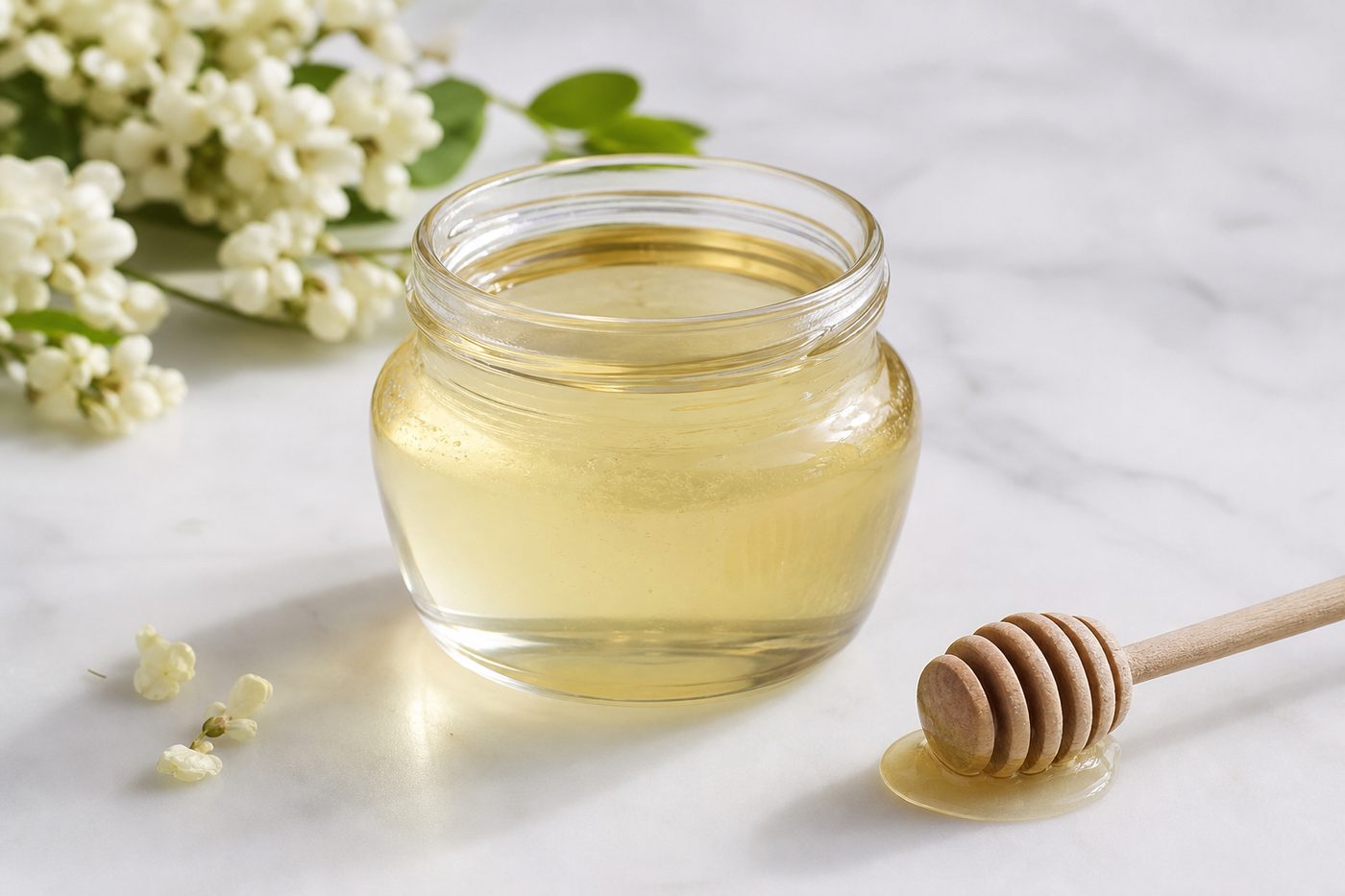
Produced from Robinia pseudoacacia (black locust) flowers in the foothills and valleys of Uttarakhand and Himachal Pradesh, typically May–June. Among India's cleanest and most prized export honeys — naturally slow to crystallise, light golden colour, delicate mild flavour with subtle vanilla notes. Considered a premium variety globally and aligns well with the high-value European and Japanese specialty honey market.
5. Eucalyptus Honey
- Quality parameters
- Moisture < 20%, HMF < 40 mg/kg, antibiotic-free.
- Top markets
- Middle East, UK, Germany, parts of EU.
- Certification
- Standard food-grade; organic less commonly available due to plantation sourcing zones.
- Approx. FOB
- USD 1.40–2.20/kg.
- Buyer profile
- Industrial food manufacturers, herbal product companies, food service distributors.
- Growth
- Steady; herbal-note positioning appeals to specific European and Middle East buyers.
Produced from Eucalyptus species planted across UP, MP, and parts of South India. Typically medium-amber in colour with a distinctive herbal and slightly medicinal aroma. One of the more commercially robust export varieties for Middle East industrial buyers and UK food-service channels.
6. Himalayan Wild Honey
- Quality parameters
- Moisture may be higher in wild harvest — dehumidification and careful processing essential; antibiotic-free by nature (wild colonies); HMF must be controlled during processing.
- Top markets
- Japan (highest premium buyer), Germany, Australia, USA (premium specialty).
- Certification
- NPOP organic straightforwardly achievable; wild-harvest certification through appropriate certifying body.
- Approx. FOB
- USD 5.00–12.00/kg for verified organic wild honey.
- Buyer profile
- Japanese specialty importers, luxury food retailers, wellness brand buyers.
- Growth
- Strong — unique terroir story commands premium positioning unavailable from other origins.
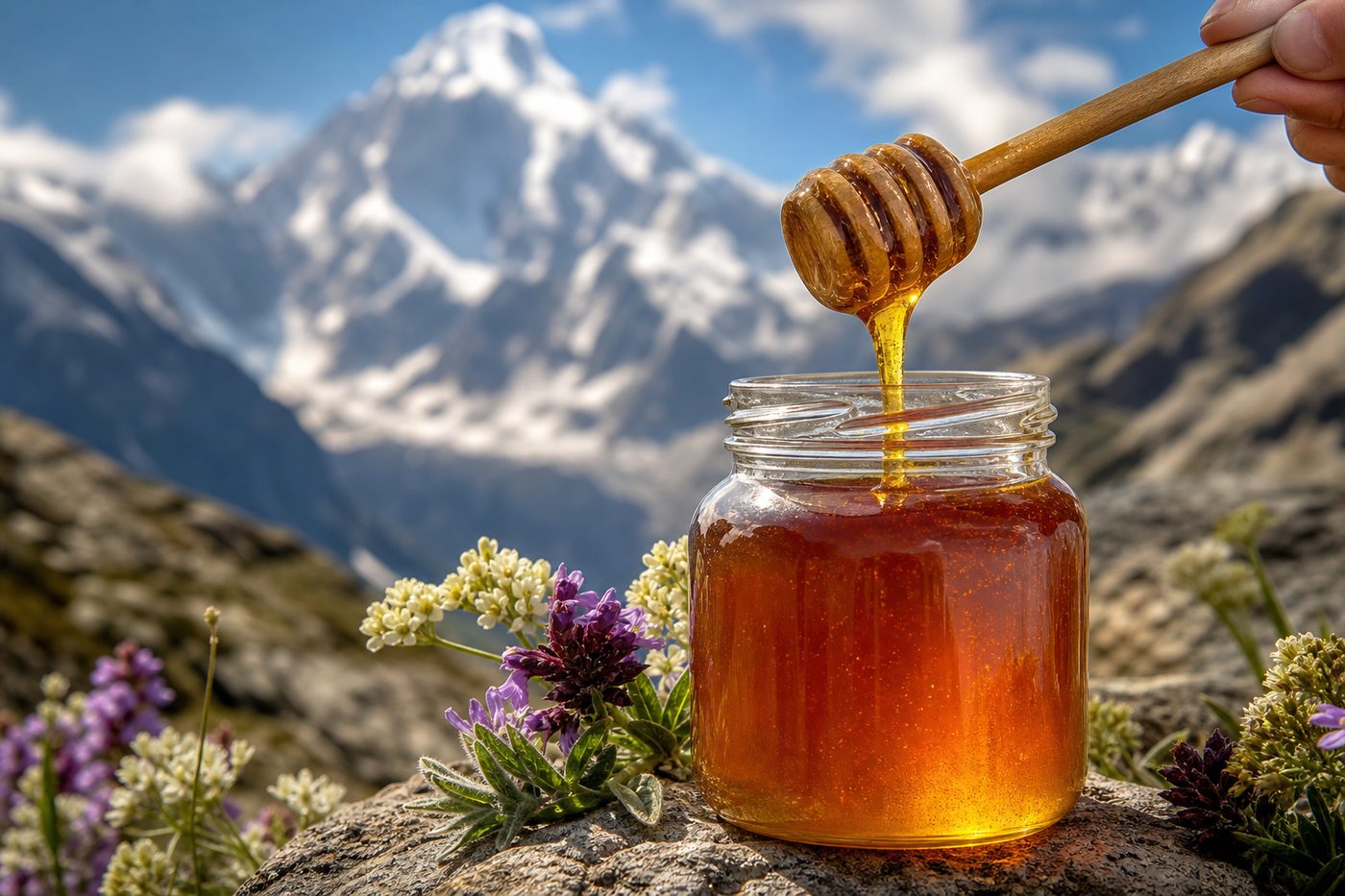
Harvested from wild rock bee (Apis dorsata laboriosa) colonies in cliff faces and forest trees of the high Himalayas — Uttarakhand, Himachal Pradesh, and Sikkim. Some productions involve Apis cerana or mixed wild species in accessible zones. Flavour complexity reflects the extraordinary Himalayan biodiversity including rhododendron, buckwheat, and numerous alpine flora. Colour ranges from dark amber to reddish-brown depending on floral season. This is India's most distinct ultra-premium honey category.
7. Wild Forest Honey
- Quality parameters
- Variable moisture (wild harvest) — requires careful processing; low HMF when freshly processed; antibiotic-free by nature.
- Top markets
- Germany, Netherlands, Japan, USA organic specialty.
- Certification
- Forest wild-harvest NPOP certification achievable; forest-certified honey (FSC-aligned supply chains) emerging interest from European buyers.
- Approx. FOB
- USD 3.00–7.00/kg organic wild forest.
- Buyer profile
- Specialty importers, artisan food retailers, organic distribution chains.
- Growth
- Strong in European and Japanese specialty segments.
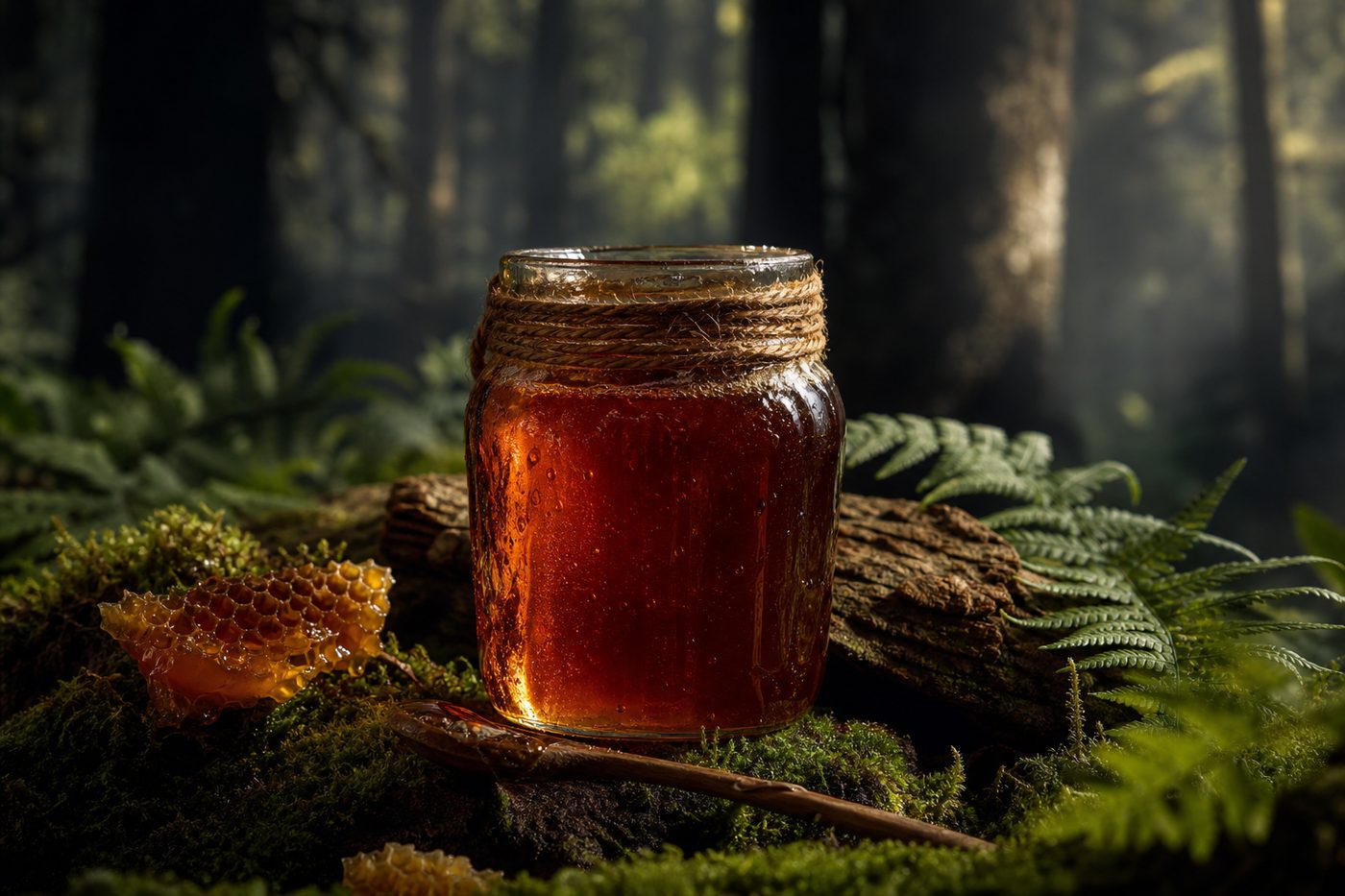
Dark, rich honey produced from wild and semi-wild bee colonies in the forest ecosystems of Northeast India (Assam, Meghalaya, Manipur), Madhya Pradesh, and Odisha. Produced primarily by Apis dorsata (rock bee) or Apis florea from diverse forest floral sources including sal, teak, mahua, and numerous endemic flowering species. Complex, bold flavour — often darker and more robust than managed apiary honeys.
8. Jamun (Indian Black Plum) Honey
- Quality parameters
- Moisture < 20%, antibiotic-free, HMF < 40 mg/kg.
- Top markets
- USA (health-food retail), UK, Germany, UAE (gifting and wellness).
- Certification
- Organic possible for managed apiary zones; medicinal-position marketing must comply with destination labelling law.
- Approx. FOB
- USD 2.20–4.50/kg premium.
- Buyer profile
- Health-food distributors, wellness product brands, premium gift assortments.
- Growth
- Rising interest as buyers seek honey with Ayurvedic heritage stories.
Produced from Syzygium cumini (jamun/java plum) flowering in Bihar, UP, MP, and parts of Maharashtra and South India. Medium to dark amber colour with a distinctively fruity-tart aroma unique to jamun blossom. Jamun honey has gained medicinal-positioning interest in health-food markets because jamun itself is traditionally associated with glycaemic management in Ayurvedic practice — though formal health claims on honey labels are strictly regulated and vary by market.
9. Neem Honey
- Quality parameters
- Moisture < 20%, antibiotic-free. The slightly bitter flavour is characteristic and must be communicated to buyers to avoid perception of quality defect.
- Top markets
- Germany (herbal specialty), USA (health-food), UK, UAE.
- Certification
- NPOP organic achievable for managed zones.
- Approx. FOB
- USD 2.00–3.50/kg.
- Buyer profile
- Health-food and herbal product buyers, Ayurvedic brand procurement.
- Growth
- Niche but consistent; grows with Ayurveda interest in Western wellness markets.
Produced from neem (Azadirachta indica) blossom in UP, MP, Rajasthan, and parts of Maharashtra. Neem honey is typically medium-amber to dark amber, with a slightly bitter and herbal finish that distinguishes it sharply from other Indian honey varieties. Like jamun honey, neem honey carries an Ayurvedic medicinal-positioning interest, but health claims on commercial honey labels must comply with destination food labelling regulations.
10. Ajwain (Carom Seed) Honey
- Quality parameters
- Moisture < 20%, antibiotic-free; the characteristic flavour should be documented for buyer education.
- Top markets
- Germany (specialty and gourmet), France, Japan, USA artisan retail.
- Certification
- NPOP organic in suitable zones.
- Approx. FOB
- USD 2.50–4.50/kg premium.
- Buyer profile
- Gourmet food importers, artisan honey retailers, specialty condiment brands.
- Growth
- Niche; stable growth with increasing global interest in botanical-flavour honeys.
Produced in Rajasthan, MP, and parts of UP during ajwain (Trachyspermum ammi) flowering. Ajwain honey has a distinctive spicy, herbal aroma reflecting the carom seed blossom. One of India's more unusual specialty honey exports, targeted at buyers seeking unique flavour profiles for gourmet, health-food, and specialty condiment channels.
11. Sunflower Honey
- Quality parameters
- Moisture < 18% (rapid crystallisation risk above this), HMF < 40 mg/kg, antibiotic-free.
- Top markets
- Middle East (industrial), UK, Germany (industrial packing), USA.
- Certification
- Standard food-grade; organic possible for select Rajasthan zones.
- Approx. FOB
- USD 1.20–2.00/kg commodity.
- Buyer profile
- Industrial honey processors, food manufacturers, large retail packers.
- Growth
- Stable volume; faces price competition from other commodity origins.
Produced from Helianthus annuus (sunflower) crops in Rajasthan, Haryana, and parts of MP. Sunflower honey is light to medium amber, with rapid crystallisation similar to mustard honey, and a mild, clean, slightly sweet flavour. It is a good commodity export variety for industrial buyers requiring a reliably neutral-flavour base honey for food manufacturing.
12. Organic Certified Honey (NPOP / EU Organic / USDA Organic)
- Quality parameters
- All standard honey parameters apply; sourcing zone documentation and annual third-party inspection are ongoing requirements.
- Top markets
- Germany, Netherlands, France, UK, USA, Japan.
- Approx. FOB premium
- 30–80% over non-certified equivalents depending on variety.
- Buyer profile
- Organic retail chains, health-food distributors, D2C wellness brands.
- Growth
- Among the fastest-growing segments in honey globally.
This is a cross-cutting certification category rather than a single variety — organic certified honey may be multifloral, lychee, acacia, wild forest, or Himalayan depending on the certified production zone. The organic certification (NPOP for EU equivalence; USDA NOP for US claims) is the primary product attribute that unlocks premium pricing and premium retail access. NPOP-certified Indian honey benefits from the bilateral EU-India organic equivalence agreement, meaning it can be marketed as EU Organic in European markets without separate EU certification.
13. Raw Unprocessed Honey
- Quality note
- Raw honey must still pass NABL testing for safety parameters — 'raw' does not mean 'unanalysed'; antibiotic residues, C4 adulteration, and moisture standards still apply.
- Top markets
- USA (natural grocery and D2C), Germany, UK, Australia, Japan.
- Certification
- Raw claim combined with organic certification is the highest value positioning.
- Approx. FOB
- USD 3.00–8.00/kg for premium certified raw varieties.
- Buyer profile
- Natural food retailers, D2C health brands, premium organic distributors.
- Growth
- Strong — consumer demand for minimally processed foods continues to grow.
Raw honey is minimally processed — extracted, coarsely strained to remove wax and debris, but not heated above approximately 35–40°C, not ultra-filtered, and not blended. Raw honey retains natural pollen, enzymes, propolis traces, and beeswax microparticles that standard commercial honey processing removes. These characteristics are valued by health-conscious consumers and natural food buyers.
14. Beeswax and Honey By-products
- Quality parameters
- Beeswax should be clean, free from pesticide contamination, and food-grade where required; purity testing by melting point and hydrocarbon analysis.
- Top markets
- Germany, Japan, Netherlands, USA (cosmetics and food industry).
- Approx. FOB
- USD 2.50–5.00/kg for standard yellow beeswax.
- Buyer profile
- Cosmetics manufacturers, pharmaceutical ingredient buyers, candle makers, food-grade wax users.
- Growth
- Steady to strong; specialty pollen and propolis show higher growth rates in nutraceutical channels.
Indian beeswax extracted during honey processing is a significant export product in its own right. Yellow beeswax from managed and wild colonies is exported in blocks for use in cosmetics, pharmaceuticals, food-grade coating, and artisan candle-making. Pollen, propolis, and royal jelly are additional high-value hive by-products with growing export demand in Japan and Europe.
15. Creamed and Value-Added Honey Formats
- Quality parameters
- All base honey parameters apply; infusion ingredients require separate food safety compliance at destination.
- Top markets
- UK (creamed honey retail), Germany, USA (gift and wellness), UAE (premium gifting).
- Approx. FOB
- USD 3.00–8.00/kg value-added formats depending on ingredients and packaging.
- Buyer profile
- Premium retail buyers, gifting importers, health-food specialty distributors.
- Growth
- High — value-added and artisan formats outperform commodity growth globally.
Creamed (set) honey is produced by controlled crystallisation of liquid honey to create a smooth, spreadable texture — particularly suited to mustard and sunflower honey varieties which crystallise naturally. Value-added formats include honey infused with spices (ginger, turmeric, cinnamon), honey-based wellness syrups, and honey in branded gift packaging. These represent an emerging premium segment for Indian exporters who can add value beyond bulk drum commodity supply.
Top Indian States for Honey Production and Export
India's honey production geography determines variety availability, seasonal windows, organic certification feasibility, and inland logistics to load ports. Use this regional map before specifying varieties in purchase orders — the right sourcing region is as important as the variety name.
Comparison table
Swipe →
Data table — swipe horizontally on small screens
| State / Region | Primary Honey Varieties | Key Floral Sources | Export Markets | Competitive Advantage |
|---|---|---|---|---|
| Punjab / Haryana | Mustard, multifloral, sunflower | Mustard (sarson), sunflower, mixed agricultural | UAE, UK, USA, Germany | Highest managed colony density; consistent volume; Nhava Sheva/Mundra access |
| Bihar / UP (east) | Lychee, jamun, multifloral | Litchi, jamun, mustard, mixed orchards | Germany, Japan, Netherlands, France | Bihar lychee is globally unique; premium monofloral potential |
| Uttarakhand / Himachal Pradesh | Acacia, Himalayan wild honey, multifloral | Robinia, apple blossom, alpine wildflowers | Germany, Japan, UK, France, Australia | NPOP organic readily achievable; mountain terroir story |
| Rajasthan | Ajwain, sunflower, multifloral | Ajwain, coriander, mustard, desert flora | Germany, France, UAE, UK | Unique ajwain and desert wildflower profiles; specialty market |
| MP / Chhattisgarh | Jamun, wild forest, neem, multifloral | Jamun, neem, teak, mahua, forest flora | Germany, USA, Japan | Forest and tribal honey with wild-harvest stories |
| Northeast India (Assam, Meghalaya, etc.) | Wild forest honey, multifloral | Diverse tropical and subtropical forest flora | Germany, Netherlands, Japan, USA organic | Biodiversity richness; NPOP organic achievable; unique provenance |
| Karnataka / South India (eucalyptus zones) | Eucalyptus, multifloral | Eucalyptus plantations, mixed agricultural | Middle East, UK, EU industrial | Eucalyptus supply reliability; herbal positioning |
| West Bengal / Odisha | Wild forest, multifloral, lychee (border zones) | Mixed forest and agricultural | UK, Germany, Japan | Access to both managed and wild colony supply |
Which Countries Import the Most Indian Honey?
Demand patterns differ significantly by variety and buyer channel. Match honey type and certification level to destination market requirements before locking export strategy.
USA
The United States is among the world's largest honey importers by value and volume. Indian honey enters both the industrial food manufacturing stream and the growing health-food retail channel. USDA Organic certification opens natural grocery and D2C channels at substantially higher price points. US buyers are particularly attentive to antibiotic residues and C4 adulteration testing given a history of honey fraud in global supply chains. FDA food facility registration and prior notice for food imports are procedural requirements for all US-bound honey shipments.
Germany
Germany is India's most important European export destination for premium honey varieties. German buyers are among the world's most sophisticated honey importers — they demand pollen analysis for varietal authentication, strict HMF and moisture control, full antibiotic residue panels, and C4 adulteration certification. German specialty and organic retail actively seeks Indian lychee, acacia, Himalayan wild, and organic certified honey as differentiated alternatives to domestic and Eastern European varieties. EU food law compliance including honey labelling Regulation 2001/110/EC applies to all EU-destined shipments.
UK
Post-Brexit, the UK operates its own food safety and labelling regulations broadly aligned with but separate from EU frameworks. Strong demand exists for organic honey in UK natural food retail, for creamed mustard honey in specialty channels, and for premium monofloral varieties in gifting programmes. UK buyers appreciate Indian honey's diversity but require clean documentation and NABL test reports from lot-specific shipments.
Japan
Japan applies the world's most stringent residue standards to imported honey — including effectively zero-tolerance requirements for a wide range of veterinary drug residues that other markets permit at low MRL levels. Japanese buyers pay premium prices for verified clean honey and are among the highest-value destinations for Indian Himalayan wild honey, lychee honey, and acacia honey. JAS Organic certification is required for organic claims in Japan. Japanese importers typically conduct their own laboratory verification on arrival; supply chain documentation must be impeccable.
UAE and Gulf
The UAE is a distribution hub for Gulf region wholesale and retail honey demand. Indian multifloral, eucalyptus, and mustard honey supply industrial food manufacturing and retail packing programmes throughout the Gulf. Halal certification is commercially beneficial and in some cases required for retail channel access. Premium gifting honey — including Himalayan and jamun varieties — is a growing segment in UAE premium retail.
France, Netherlands, and Canada
France is a gourmet food culture market that values terroir and varietal authenticity — Indian acacia, lychee, and ajwain honey can access premium French specialty retail channels. The Netherlands operates as a major EU distribution hub for honey importing and redistribution. Canada mirrors US market dynamics at smaller scale, with strong health-food retail demand for USDA Organic or equivalent certified Indian honey. Canadian CFIA compliance and bilingual labelling requirements apply.
Australia
Australia has strict biosecurity requirements for imported honey, including potential irradiation requirements to control American Foulbrood disease (Paenibacillus larvae). Australian biosecurity law requires importers to ensure incoming honey consignments meet FSANZ standards and DAFF import requirements. The market is smaller in volume than USA or Germany but offers high average order values for premium and organic Indian honey with clean NABL documentation.
Quality Parameters Buyers Check for Each Honey Type
Different honey varieties have characteristic quality signatures that experienced buyers verify. Monofloral authentication is one of the most important differentiators between commodity and premium Indian honey — and it requires pollen analysis, not just a label claim.
Comparison table
Swipe →
Data table — swipe horizontally on small screens
| Honey Variety | Key Quality Parameter | Monofloral Authentication | Premium Buyer Test Focus |
|---|---|---|---|
| Lychee / Litchi | HMF < 20 mg/kg; moisture < 18% | Litchi chinensis pollen > 35–45% | Germany, Japan: pollen + antibiotic full panel |
| Acacia (Robinia) | Naturally low HMF; very slow crystallisation | Robinia pseudoacacia pollen dominant | Germany: pollen analysis + SCIRA adulteration |
| Himalayan Wild | Moisture stability; processing temperature control | Mixed alpine pollen; wild-harvest documentation | Japan: ultra-low residue; wild harvest certification |
| Mustard (Sarson) | Moisture < 18% critical; rapid crystallisation normal | Brassica pollen dominant | UK: creamed texture stability; set honey format |
| Wild Forest | HMF control during processing; stable fermentation-free moisture | Mixed forest pollen; origin documentation | Germany, Japan: NPOP organic certificate + antibiotic |
| Jamun | Moisture < 20%; flavour character documented | Syzygium cumini pollen | USA, UK: health-positioning claim compliance |
| Multifloral | Moisture < 20%; HMF < 40 mg/kg | Multiple pollen types (not monofloral) | All markets: SCIRA mandatory; antibiotic panel |
| Organic Certified (any variety) | All standard + organic supply chain documentation | Variety-dependent | All premium markets: organic TC per lot + SCIRA |
Why International Buyers Source Honey from India
Cost competitiveness matters — India's honey FOB prices are broadly competitive with major competing origins for comparable quality grades. But for premium and specialty buyers, cost is secondary to four structural advantages: varietal diversity unmatched by other major origins; organic certification availability through NPOP-EU Organic equivalence; an increasingly transparent and verifiable supply chain supported by NABL-accredited testing; and the ability to source multiple honey varieties, beeswax, and related natural products through a single accountable merchant exporter in India.
Supply reliability is improving with commercial apiary modernisation. Traceability from specific beekeeping zones to individual shipment lots is achievable for well-organised exporters — and is increasingly demanded by German, Japanese, and Australian buyers as a baseline expectation rather than a premium offering. Buyers who experienced China-origin adulteration issues in previous years specifically seek Indian alternatives with documented NABL testing histories.
Buyers sourcing multiple natural products from India also benefit from consolidating honey alongside other agricultural and natural food products — spices, herbs, dried foods — through a global sourcing partner in India who manages quality, documentation, and logistics across categories. This consolidated model reduces the coordination overhead of managing separate supplier threads for each product line.
India vs China vs Argentina vs New Zealand for Honey Sourcing
No single origin is optimal for every honey programme. Use this comparison as a decision framework based on buyer channel, quality requirements, and variety availability.
Comparison table
Swipe →
Data table — swipe horizontally on small screens
| Factor | India | China | Argentina | New Zealand (Manuka) |
|---|---|---|---|---|
| Varietal diversity | Exceptional — 8–12 distinct monofloral profiles | Broad but less differentiated varietally | Strong in eucalyptus, sunflower, citrus; less diverse | Manuka dominant; limited other variety exports |
| Organic certification | NPOP → EU Organic equivalence; NOP achievable | Scrutinised; buyer hesitancy on organic claims | Available; increasingly credible | JAS/USDA/EU achievable but expensive |
| Antibiotic residue record | Improving significantly; NABL testing standard | Persistent buyer scrutiny; significant rejection history | Generally clean; well-regarded residue record | Clean; very high standards enforced |
| Price range | Commodity: competitive; premium/organic: mid-tier | Typically lowest commodity price | Competitive commodity pricing | Premium to ultra-premium (Manuka MGO 100–1000+) |
| C4 adulteration concern | Tested and controlled in verified supply chains | High buyer scrutiny; SCIRA testing mandatory | Generally cleaner market record | Essentially absent — premium category, well-policed |
| Regulatory framework | APEDA + EIC + FSSAI + NABL — structured | CNCA; buyer verification required | SENASA; structured export system | MPI; world-class traceability for Manuka |
| Best buyer fit | Commodity industrial + premium monofloral + organic specialty | Industrial bulk at lowest FOB when residue track record verified | Commodity and monofloral European buyers | Ultra-premium MGO-activity honey buyers globally |
| UK/EU market access | NPOP → EU Organic equivalence; strong and growing | Persistent quality scrutiny; requires NABL-equivalent evidence | Standard market access; competitive | Standard market access; premium positioning |
How International Buyers Can Source Honey from India Successfully
- Define variety, certifications required (organic, Halal, etc.), destination market, and volume before approaching any supplier or merchant exporter
- Request NABL test reports from the current season — not reports from previous years — and verify they cover the specific parameters required by your destination market
- Request pollen analysis for any monofloral honey claim — this is the industry standard for varietal authentication and mandatory for Japanese and German specialty buyers
- Commission a sample shipment with 2–5 honey varieties for destination-lab verification before placing a full container order
- Verify APEDA RCMC status, FSSAI licence number, and IEC of your supply partner — these can be checked online and provide baseline export credibility
- For organic claims, request the current NPOP organic certificate and the specific transaction certificate covering your purchase lot before payment
- Use a merchant exporter in India or product sourcing company in India for multi-variety programmes or when you need consolidated documentation and single-point accountability
- For additional supplier verification guidance, see how to find reliable suppliers in India
Successful honey sourcing from India follows a disciplined sequence that controls quality, certification, and documentation risk from the first enquiry through to repeat programme scale. Buyers who skip any of these steps typically encounter problems that are far more expensive to resolve after cargo is at sea than before.
Case Study: Japanese Importer Sourcing Himalayan Wild Honey from Uttarakhand
Business objective: A Japanese specialty food importer sought authenticated Himalayan wild honey from India for premium retail placement at a major Tokyo natural food retailer. The buyer's specification required: NPOP organic certification, HMF below 15 mg/kg, moisture below 18%, full antibiotic residue panel at near-zero levels, pollen analysis confirming alpine Himalayan species mix, and wild-harvest traceability documentation from specific collection zones.
Challenges: The buyer had previously sourced 'Himalayan honey' from generic Indian directories without pollen verification — and destination laboratory testing showed conventional managed-apiary multifloral honey, not genuine wild Himalayan product. Authenticity documentation was the primary challenge, not price.
Supplier selection: A merchant-export partner identified a Uttarakhand-based wild honey collection cooperative with NPOP organic certification, georeferenced apiary zone maps, documented wild-harvest protocols, and an established relationship with an NABL-accredited laboratory for lot-specific testing.
Quality verification process: The cooperative provided pollen analysis reports showing dominant Rhododendron, buckwheat, and mixed alpine pollen confirming high-altitude wild provenance. HMF at processing was 7 mg/kg; moisture 16.8%. Full NABL antibiotic residue panel returned non-detectable for chloramphenicol, nitrofurans, and all tested veterinary drugs. SCIRA/NPOP organic test confirmed authentic and organically certified.
Logistics and documentation: The consignment — 800 kg in food-grade drums — moved via Nhava Sheva to Yokohama. Complete documentation included APEDA RCMC, NPOP organic certificate and transaction certificate, NABL lot-specific test reports for all parameters, pollen analysis report, EIC health certificate, and certificate of origin. The Japanese importer's broker received the full document pack ten days before vessel departure.
Results: Japanese destination laboratory confirmed all parameters within specification. The honey was listed at ¥3,800 per 250g jar — a significant premium tier. The buyer placed a repeat order for three tonnes the following season with two additional Himalayan zone cooperatives introduced through the same merchant-export relationship.
Lessons learned: In the Japanese specialty honey market, authentic provenance documentation — pollen analysis, georeferenced zone maps, and third-party organic certification — is the product that converts buyers and justifies premium pricing. Price is almost irrelevant when documentation and quality are flawless. For process context, see How to Export Honey from India and the honey export documentation checklist.
Emerging Trends in the Global Honey Export Market
Through 2030, three major forces will reshape which Indian honey varieties capture the most market value. First, sustainability and traceability will shift from marketing language to purchase criteria in EU retail — buyers will require geo-referenced supply chain documentation, beekeeper registration databases, and evidence-based organic or wild-harvest certification rather than accepting descriptive label claims. Exporters who build these systems now will win more RFQs as the decade progresses.
Second, the premium monofloral and wild-honey segments will outpace commodity growth globally as consumer education about honey variety matures — driven by the New Zealand Manuka success story demonstrating that consumers will pay premium prices for authenticated, bioactive, and traceable honey. India has the raw material advantage to capture significant share of the premium monofloral tier that New Zealand Manuka currently monopolises — particularly in Japan, Germany, and Australia. The challenge is supply chain authentication and consistent NABL testing discipline.
Third, value-added honey formats — creamed honey, spice-infused honey, honey wellness syrups, and retail-ready branded jars — represent an upgrade path for Indian exporters seeking to move beyond commodity bulk drum pricing toward branded margin. Premium retailers in UK, Germany, and Japan are already stocking Indian-origin specialty honey under both private label and branded format. Indian exporters who invest in retail-grade packaging, consistent flavour profiles, and destination-compliant labelling in 2026 will have a substantial head start as this segment matures.
Conclusion
- Buyers: Share your target variety, certification requirements, destination market, and volume for a sourcing shortlist from verified Indian honey exporters.
- Exporters: Identify which of the fifteen varieties aligns with your production region and existing or achievable certification before investing in buyer outreach.
- Explore honey-natural-products industry overview and export products from India for broader agricultural and natural product context.
- Complete the full export process with How to Export Honey from India — covering APEDA, FSSAI, NABL testing, packaging, documentation, and buyer finding.
- Compare destination markets in Best Countries for Indian Honey Exports before finalising market entry strategy.
- Match variety demand to country with Most Demanded Indian Honey by Country for buyer-market fit.
- Build the organic premium with Sustainable Organic Honey Export Opportunities.
- Prepare complete paperwork with Honey Export Documentation Checklist.
- Generate buyer pipeline with How to Find International Buyers for Honey and Trade Shows for Honey Exporters.
- Complete APEDA readiness with APEDA Registration Benefits for Honey Exporters.
- International buyers should follow How to Source Honey Directly from India for structured procurement steps.
- Browse global sourcing partner services and find manufacturers in India for multi-category natural food export support.
The most commercially relevant honey products exported from India in 2026 are not a single variety — they span commodity multifloral and mustard at scale, premium lychee and acacia for specialist European and Japanese buyers, ultra-premium Himalayan wild and wild forest honey for high-value speciality retail, organic certified honey across varieties for health-food and natural grocery channels, raw unprocessed honey for D2C wellness brands, beeswax for industrial and cosmetics buyers, and value-added creamed and infused formats for premium retail programmes. India's floral diversity is the foundational advantage; quality documentation and certification are what convert that diversity into international buyer confidence and premium prices.
Most promising near-term opportunities for Indian exporters: lychee honey with pollen authentication for German and Japanese specialty; acacia honey from Himalayan foothills for premium EU organic programmes; NPOP-certified wild forest honey from Northeast India for D2C wellness and specialty retail globally; and retail-jar formats with destination-compliant labelling for any variety targeting health-food retail. For international buyers, India represents a unique origin where commodity and ultra-premium honey can be sourced from one relationship — with Altus Exports managing quality, certification, documentation, and logistics under one accountable platform. Visit our honey-natural-products industry page or browse organic honey from India to begin a sourcing conversation.