
Source Incense Sticks (Agarbatti) Directly from India: Importer Playbook
By Saurabh Mittal, Founder, Altus Exports
International importer playbook for sourcing incense sticks (agarbatti) directly from India — RFQ writing, Mysuru–Bengaluru and Tamil Nadu supplier audits, burn-test sampling, QC gates, landed-cost decision flow, and private-label art approval without unnecessary intermediary layers.
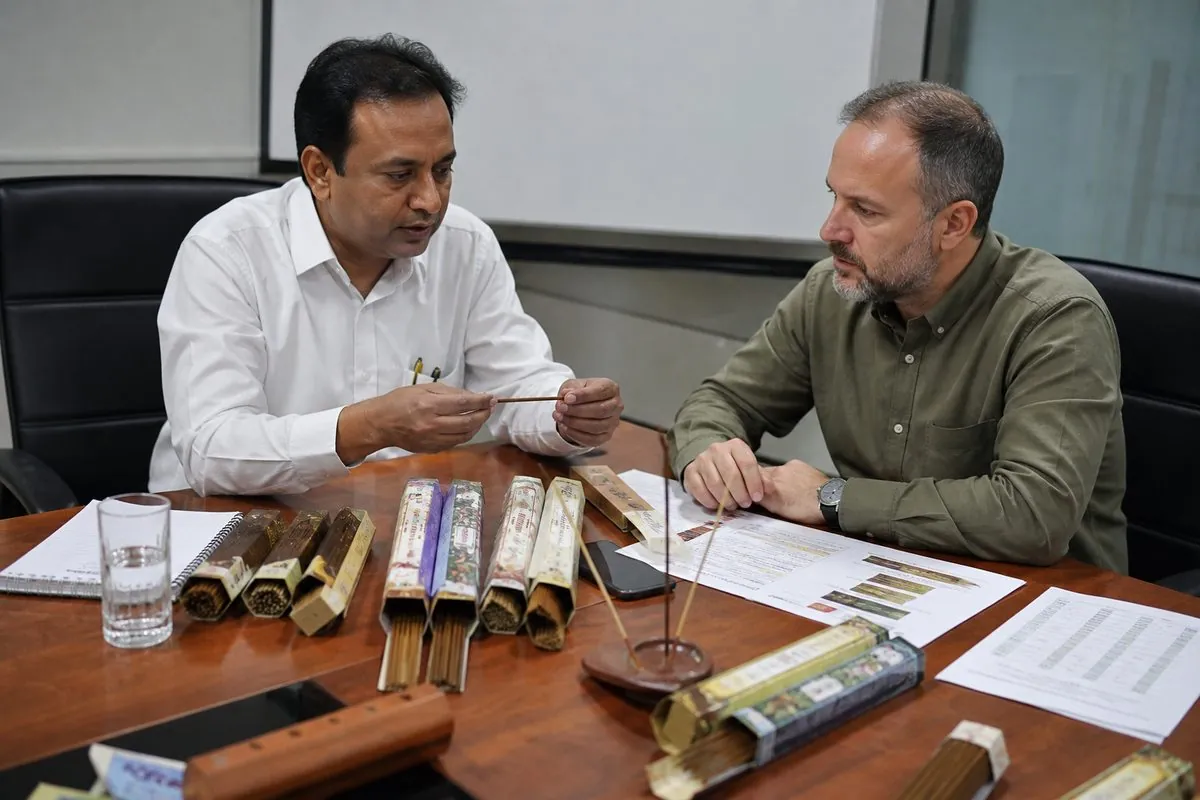
Sourcing incense sticks (agarbatti) directly from India rewards importers who treat supplier verification as a structured process rather than a price-comparison exercise. India's burning-preparation corridor — Mysuru–Bengaluru for masala and branded stick depth, Tamil Nadu–Puducherry for volume dipped and export packing, Gujarat–Mumbai for private-label consolidation, and Delhi-NCR for ethnic wholesale — sits across dozens of independent rolling units, fragrance finishers, and merchant exporters rather than one vertically integrated factory. Buyers who understand that structure, and who know how to write a clear RFQ, run burn-test sampling, and model landed cost before deposit, extract significantly better value than those who rely on marketplace listings alone.
This importer playbook walks through the complete direct-sourcing sequence: writing an RFQ that locks stick type, fragrance family, burn-time target, pack format, and HS intent; auditing Mysuru–Bengaluru and Tamil Nadu suppliers; approving burn-test samples against a written QC gate; deciding landed cost under HS 33074100; and clearing private-label art before production. For exporter-side process depth, see How to Export Incense Sticks (Agarbatti) from India; for SKU selection, see Top Incense Stick (Agarbatti) Products Exported from India.
WITS 2024 directional figures place India HS 330741 exports at roughly US$147.6M and 40,884 MT, with the United States, UAE, Nigeria, Iraq, Spain, Malaysia, Chile, and the United Kingdom among leading partners by value. Whether you engage a product sourcing company in India or work directly with verified factories, the verification checkpoints in this guide apply equally — because the product risks are fragrance- and pack-specific, not origin-specific.
Key Takeaways
Summary Box
Executive Summary
Summary Box
- Write stick type + fragrance + burn-time + pack + HS before requesting Indian FOB quotes.
- Audit Mysuru–Bengaluru masala capacity separately from Tamil Nadu volume dipped lines.
- Approve burn-test kits, then run 200–1,000 kg before first commercial FCL.
- Convert every offer to dated FOB + freight + duty before shortlisting ends.
- Reject brochure-only 'natural' or 'premium sandalwood' claims without burn-test evidence.
Sourcing incense sticks directly from India succeeds when importers run structured verification — seller credential check, Mysuru–Bengaluru or Tamil Nadu capability audit, burn-test samples against a written fragrance and stick-type specification, 200–1,000 kg trial, then FCL scale.
India's fragmented rolling and fragrance-finishing ecosystem rewards buyers who share channel requirements upfront rather than negotiating undefined 'agarbatti' on price alone.
This importer playbook compresses direct-sourcing risk for international distributors, wellness retailers, ethnic wholesale buyers, and private-label programmes evaluating Indian supply without unnecessary intermediaries.
Market Size & Industry Overview
Key Statistics
- Map factories by cluster before RFQs: masala corridor vs dipped volume vs private-label packer.
- Mysuru–Bengaluru for branded masala depth; Tamil Nadu for volume dipped and export cartons.
- Ask which stick types and fragrance families the plant can support on a 200–1,000 kg trial.
- Do not treat every Indian incense listing as interchangeable fragrance feedstock.
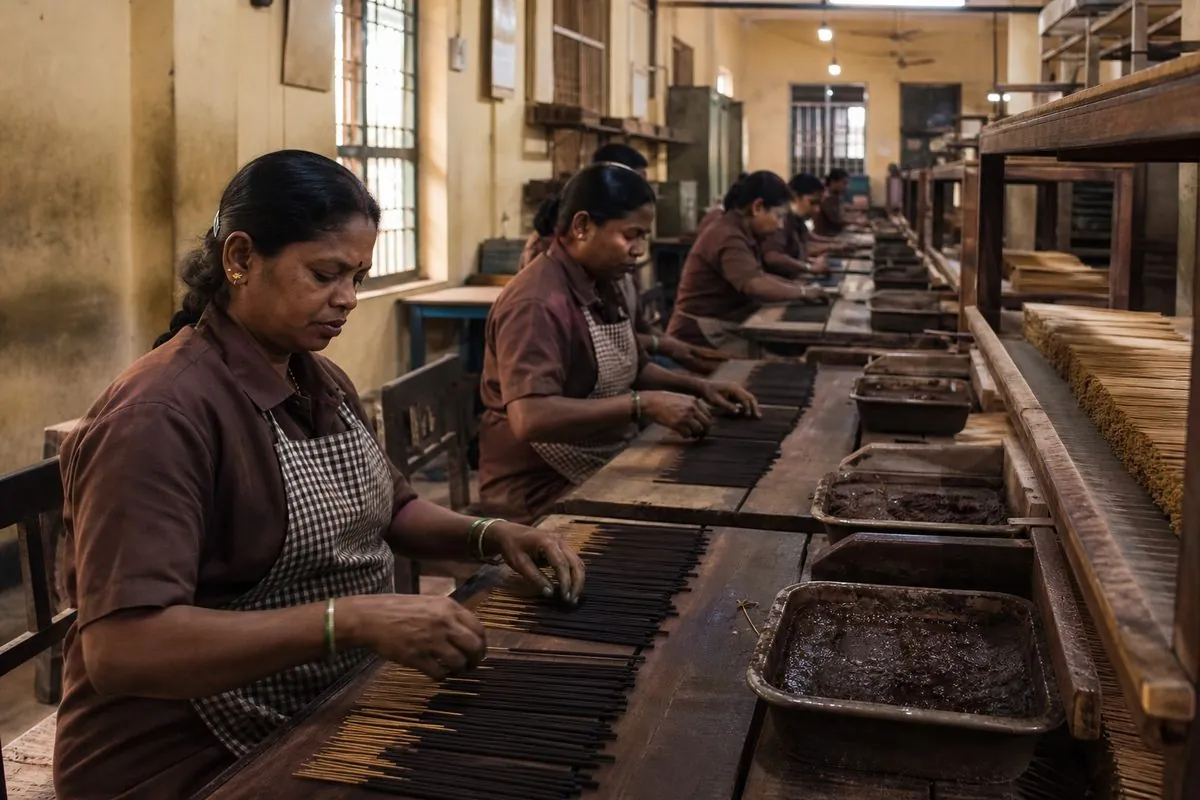
Direct sourcing from India's agarbatti ecosystem is a cluster-mapping problem: identify capable rolling and fragrance units in Mysuru–Bengaluru; audit Tamil Nadu–Puducherry volume dipped and packing lines; validate Gujarat–Mumbai private-label consolidation; then trial before FCL scale.
The most common importer error is assuming a single 'best supplier' when different stick types map to different factory capabilities — masala hand-rolling, perfume-dipped charcoal lines, herbal/natural programmes, bamboo-less dhoop, and cones often sit in different plants even when marketed under one brand name.
Merchant exporters compress this mapping when importers need single-interface consolidation across multiple fragrance lots and pack formats. India HS 330741 exports reached roughly US$147.6M / 40,884 MT in 2024 (WITS directional), which is large enough to support serious wholesale programmes when fragrance and pack discipline is in place.
Why direct sourcing beats catalogue shopping
Marketplace listings compress fragrance complexity into a few photos and a headline FOB. Direct sourcing forces a written RFQ, retained burn-test samples, and packing photos that survive ocean transit — the three artefacts that protect retail margin when a hex box arrives scent-weak or crushed.
Importers who skip that discipline often rediscover it after a failed trial: either through a refund fight or through a quiet decision never to reorder. Structure the verification once and reuse it on every new fragrance SKU.
Who this playbook is for
This guide is written for international buyers and importers — distributors, ethnic retail chains, wellness brands, and private-label programmes — not for exporters seeking Chemexcil registration steps or fair calendars. For exporter registration context (buyer credibility only), see Chemexcil Registration Benefits for Incense Stick Exporters. For shipment paperwork fields, see the documentation checklist.
Export Statistics
Key Statistics
- Ask suppliers for India 33074100 shipping-bill evidence, not parent Chapter 33 brochures.
- Directional WITS anchors help shortlist corridors — not vanity export claims.
- Verify whether a supplier's history is burning sticks versus non-burning room fragrance.
- Re-check partner ranks before locking a multi-month sourcing programme.
When verifying suppliers, confirm they file exports under India HS 33074100 — agarbatti and other odoriferous preparations which operate by burning. Misclassification onto 33074900 (non-burning odoriferous preparations) or 33079090 is a common red flag during importer due diligence.
India exported roughly US$147.6M / 40,884 MT on HS 330741 in 2024 (WITS / UN Comtrade directional). Leading partners by value include the United States (~US$21.2M), UAE (~US$7.7M), Nigeria (~US$7.0M), Iraq (~US$5.7M), Spain (~US$5.6M), Malaysia (~US$5.5M), Chile (~US$5.4M), and the United Kingdom (~US$5.4M). Treat figures as planning context; re-verify via DGCI&S / ITC Trade Map before citing in contracts.
Directional profile of Indian incense stick (agarbatti) trade (HS 330741 / India 33074100)
Swipe →
Data table — swipe horizontally on small screens
| Metric | Directional Estimate | Notes |
|---|---|---|
| Primary manufacturing clusters | Mysuru–Bengaluru (Karnataka); Tamil Nadu–Puducherry | Masala rolling / branded finishing and volume dipped + export packing belts |
| Supporting clusters | Gujarat–Mumbai; Delhi-NCR; Kannauj attar inputs | Private-label consolidation, ethnic wholesale, premium fragrance inputs |
| Applicable HS headings | 3307.41 / India 33074100 (primary); 33074900 (non-burning contrast only) | Confirm eight-digit line with CHA before shipping-bill filing |
| Governing trade council | Chemexcil (Basic Chemicals, Cosmetics & Dyes EPC) | RCMC alongside IEC for Chapter 33 agarbatti export credibility |
| WITS 2024 export value (HS 330741) | ~US$147.6M / ~40,884 MT | Directional UN Comtrade figure — re-verify annually |
| Leading destination partners (value) | USA, UAE, Nigeria, Iraq, Spain, Malaysia, Chile, UK | Followed by Argentina, Brazil, Netherlands, Mexico, South Africa, France, Australia |
| Dominant export grades | Perfume-dipped charcoal + mid masala + herbal/premium retail packs | Private-label hex boxes and pouches for wellness and ethnic retail |
Trade statistics analysis for importers
Scale alone does not qualify a supplier. An importer should ask which partner markets the factory already serves and whether those shipments used the same stick type and pack format as the RFQ. A supplier strong in Nigeria volume dipped sticks may still fail a US herbal hex-box programme on fragrance load and labelling discipline.
Use trade ranks to prioritise corridor experience — then replace ranks with burn-test evidence before deposit.
Import Statistics
Key Statistics
- Benchmark Indian offers against your home-market import alternatives on the same stick type.
- Use destination demand rows to write the RFQ fragrance and pack window.
- Do not issue a generic 'incense sticks' RFQ when the demand cell is sandalwood hex boxes.
- Reject non-burning fragrance offers when your import need is HS 330741 burning sticks.
Importers comparing Indian direct supply to third-country CIF offers should note that destination markets absorb Indian agarbatti alongside local and regional brands. India competes on fragrance range, pack flexibility, and private-label agility rather than replacing every incumbent SKU overnight.
Import-side landed-cost models must include duty, freight, inland delivery, inspection, and any destination labelling or fragrance compliance work — FOB alone is not a decision metric.
Directional import demand profile for Indian agarbatti by destination market
Swipe →
Data table — swipe horizontally on small screens
| Market | Directional Demand Profile | Primary Buyer Type |
|---|---|---|
| United States | Sandalwood, floral, and herbal retail packs; wellness and ethnic channels | Distributors, specialty retail, private-label wellness brands |
| United Arab Emirates | Masala and oud-leaning fragrances; Halal-aware labelling for ethnic and modern trade | Wholesale distributors, Gulf retail chains, re-export traders |
| Nigeria | High-volume charcoal dipped and economy masala sticks | Wholesale importers, ethnic retail networks, volume distributors |
| Spain / United Kingdom | Natural and premium retail hex boxes; IFRA-aware fragrance notes | Lifestyle retailers, wellness distributors, specialty importers |
| Malaysia | Ritual and retail incense with ASEAN labelling expectations | Distributors, temple and home-fragrance wholesalers |
| Chile / Brazil / Mexico | Volume masala and dipped sticks with Spanish/Portuguese pack copy | Importers, ethnic wholesale, modern-trade private label |
| South Africa / Australia | Herbal and mid masala programmes with cleaner-burn positioning | Wellness retailers, specialty distributors |
Import data analysis for RFQ design
Import demand profiles should shape the RFQ before the first supplier call. A Nigeria volume RFQ that asks for herbal IFRA packs wastes factory time; a US wellness RFQ that asks only for 'cheap incense' invites scent-weak dipped sticks that fail retail burn tests.
Write the destination channel into the RFQ header — ethnic wholesale, modern trade, temple/ritual, or wellness private label — so factories quote the correct pack density and fragrance load.
Product Categories / Variants
Summary Box
- Ask factories which of masala / dipped / herbal / dhoop / cones they actually produce this month.
- Mysuru masala plants and TN dipped lines belong on different shortlists.
- Request a recent burn-test photo set per fragrance card before RFQ scoring.
- Reject 'we make all incense' without retained-sample and packing evidence.
Direct importers should shortlist stick types before factory calls — the product catalogue defines fragrance families and pack formats. This playbook table focuses on how each variant changes the importer RFQ, audit, and burn-test gate.
Importer RFQ and burn-test focus by incense stick (agarbatti) variant
Swipe →
Data table — swipe horizontally on small screens
| Variant | RFQ Must Lock | Burn-Test Focus | Typical Importer Channel |
|---|---|---|---|
| Masala (hand-rolled) sticks | Paste composition cues, fragrance family, stick length/count, hex-box art | Even burn, ash colour, fragrance throw vs dipped controls | Ethnic retail, branded wholesale, mid-premium lifestyle |
| Perfume-dipped charcoal sticks | Fragrance oil family, dip load band, economy vs mid pack | Smoke density, scent longevity, stick breakage in transit | Volume wholesale, Africa/LatAm economy programmes |
| Herbal / natural sticks | Botanical claims substantiation, charcoal-free notes if claimed | Cleaner ash, milder throw, claim vs burn reality | US/EU wellness retail, natural private label |
| Bamboo-less dhoop sticks | Extrusion diameter, burn time, pack moisture barrier | Self-supporting burn, ash integrity, moisture damage | Ritual and specialty home fragrance |
| Incense cones | Cone size, fragrance load, tray/inner pack crush resistance | Cone stability, ash collapse, scent intensity | Gift, ritual, and specialty retail assortments |
| Premium sandalwood / oud / floral | Fragrance exclusivity, retail hex dieline, IFRA notes if required | Premium throw, ash finesse, pack scent retention | Private-label wellness and gift channels |
| Private-label retail programmes | Art approval cycle, barcode, multilingual copy, MOQ per fragrance | Sample-to-bulk match on scent and print colour | Retail chains and branded importer programmes |
Manufacturing Overview
Export Tip
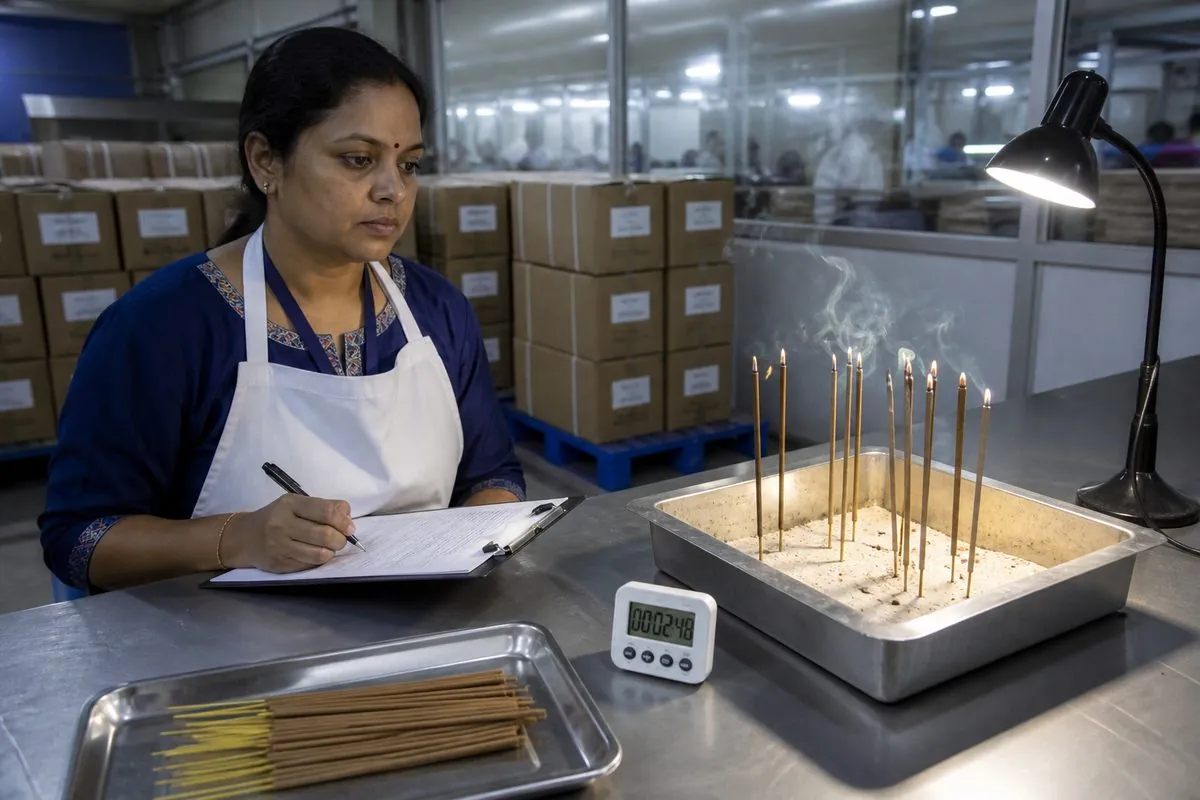
Direct sourcing audits should confirm bamboo stick supply, paste or charcoal coating lines, fragrance dipping or masala rolling, drying capacity, and export packing — capabilities vary by plant within Mysuru–Bengaluru and Tamil Nadu. Do not assume one generic factory tour covers the full catalogue.
Retain reference hex boxes from approved trial lots; bulk production must match approved fragrance throw, burn time, ash behaviour, and pack print. Merchant exporters consolidate multiple factory lines when importers need single-interface FCL programmes across fragrances.
Saurabh Mittal, Founder of Altus Exports, has said many times that an importer's biggest sourcing mistake is treating every Indian incense factory as the same. A Mysuru masala unit and a Tamil Nadu dipped-charcoal line are two different operations with two different QC disciplines. When you audit them the same way, you get the wrong picture, and the trial order is where the truth shows up.
Mysuru–Bengaluru audit focus
- Confirm rolling capacity vs claimed monthly MT.
- Inspect drying and moisture control before fragrance finishing.
- Verify hex-box packing and barcode application if private label.
- Ask how retained samples are stored by fragrance.
In the Mysuru–Bengaluru corridor, importers should prioritise masala paste consistency, drying hygiene, fragrance finishing controls, and hex-box packing stations. Ask for batch IDs on sample kits and for photos of fragrance-segregated storage — scent cross-contamination is a leading cause of retail complaints.
Tamil Nadu–Puducherry audit focus
- Confirm dipped vs masala lines are physically segregated.
- Review stick breakage QC after packing trials.
- Verify master-carton crush resistance for FCL stow.
- Ask which load ports the plant regularly stuffs toward.
In Tamil Nadu–Puducherry (including the Cuddalore belt), importers often audit volume dipped lines and export carton discipline. Confirm dip-load consistency, stick breakage rates after packing vibration, and master-carton moisture barriers for long ocean lanes.
Pricing Analysis
Buyer Tip
- Convert every Indian offer to dated FOB + pack + inspection fees.
- Compare factories on landed cost, not the lowest FOB headline.
- Ask whether sample courier and burn-test kits are inside or outside the quote.
- Reject undated 'today's price' messages without stick type and pack format.
Direct sourcing comparisons must use the same stick type, fragrance tier, and pack format — lowest FOB on mismatched dipped sticks is not a valid benchmark against mid masala hex boxes.
Importer-side planning bands (confirm on quote date against identical stick count and pack): economy dipped roughly ~US$0.8–2.5/kg, mid masala ~US$2.5–6/kg, herbal/natural ~US$4–10/kg, with premium sandalwood/oud or private-label retail packs usually quoted per hex box or carton rather than a single kg rate.
Directional FOB pricing bands by incense stick programme (importer comparison view)
Swipe →
Data table — swipe horizontally on small screens
| Programme | Directional FOB | Importer Pricing Note |
|---|---|---|
| Economy perfume-dipped sticks | ~US$0.8–2.5/kg | Compare only against same stick count and poly/hex pack |
| Mid masala sticks | ~US$2.5–6/kg | Fragrance load and burn time drive most of the spread |
| Herbal / natural sticks | ~US$4–10/kg | Claim substantiation and cleaner-burn positioning add premium |
| Premium sandalwood / oud retail packs | Higher; often USD/hex or USD/carton | Do not force per-kg comparison against bulk dipped bundles |
| Private-label hex programmes | FOB + art/setup + exclusivity premium | Include plate/setup and MOQ per fragrance in landed model |
Landed-cost decision flow
Importers should run a simple five-step landed-cost gate before awarding a first PO: (1) lock stick type and pack in the RFQ; (2) collect FOB at a named Indian port; (3) add ocean or air freight plus insurance; (4) add estimated destination duty and brokerage for HS 330741; (5) add inland delivery, inspection, and private-label setup if any. Award only after two or more offers clear the same model.
If a quote cannot be named as FOB Nhava Sheva, Mundra, Chennai, or Tuticorin, treat it as incomplete. EXW factory quotes need explicit inland haulage before they enter the comparison sheet.
Decision gate outcomes
- Proceed to burn-test sampling when landed cost clears target margin.
- Re-negotiate pack density or fragrance tier when FOB wins but landed cost fails.
- Walk away when a supplier refuses named-port FOB or burn-test retention.
- Escalate to merchant exporter consolidation when mixed fragrances break single-factory MOQ.
MOQ Analysis
Buyer Tip
- Write sample kit and trial MT into the RFQ before requesting Indian quotes.
- Approve burn-test kits, then release deposit for the 200–1,000 kg trial.
- Do not let a broker compress trial MOQ below factory economic reality.
- Scale to FCL only after sample-to-bulk fragrance match is proven.
Direct sourcing trials typically start at 1–5 kg or 50–200 hex boxes for burn-test kits, then 200–1,000 kg or 1–5 cartons per SKU for commercial trials — confirm trial MOQ before factory audit travel.
Wholesale programmes commonly move to 1–5 MT; FCL is planned by pack density (hex boxes vs bulk poly bundles). Private-label art programmes may require higher unit MOQs per fragrance.
Directional MOQ tiers for incense stick sourcing by stage
Swipe →
Data table — swipe horizontally on small screens
| Stage | Typical MOQ | Purpose |
|---|---|---|
| Burn-test sample kit | 1–5 kg or 50–200 hex boxes | Fragrance, burn time, ash, and pack print approval |
| Trial order | 200–1,000 kg or 1–5 cartons/SKU | Ocean-transit pack integrity and scent retention check |
| Wholesale programme | 1–5 MT | First commercial rhythm after trial clearance |
| FCL programme | By pack density (confirm with forwarder) | Established distributor and private-label repeat orders |
Packaging Standards
Export Tip
- RFQ must state inner pack, stick count, and master-carton marks before award.
- Approve packing photos from the factory before first commercial stuffing.
- Reject lots whose marks omit fragrance name or batch/lot ID.
- Merchant consolidators must prove they will not commingle fragrances in one carton.
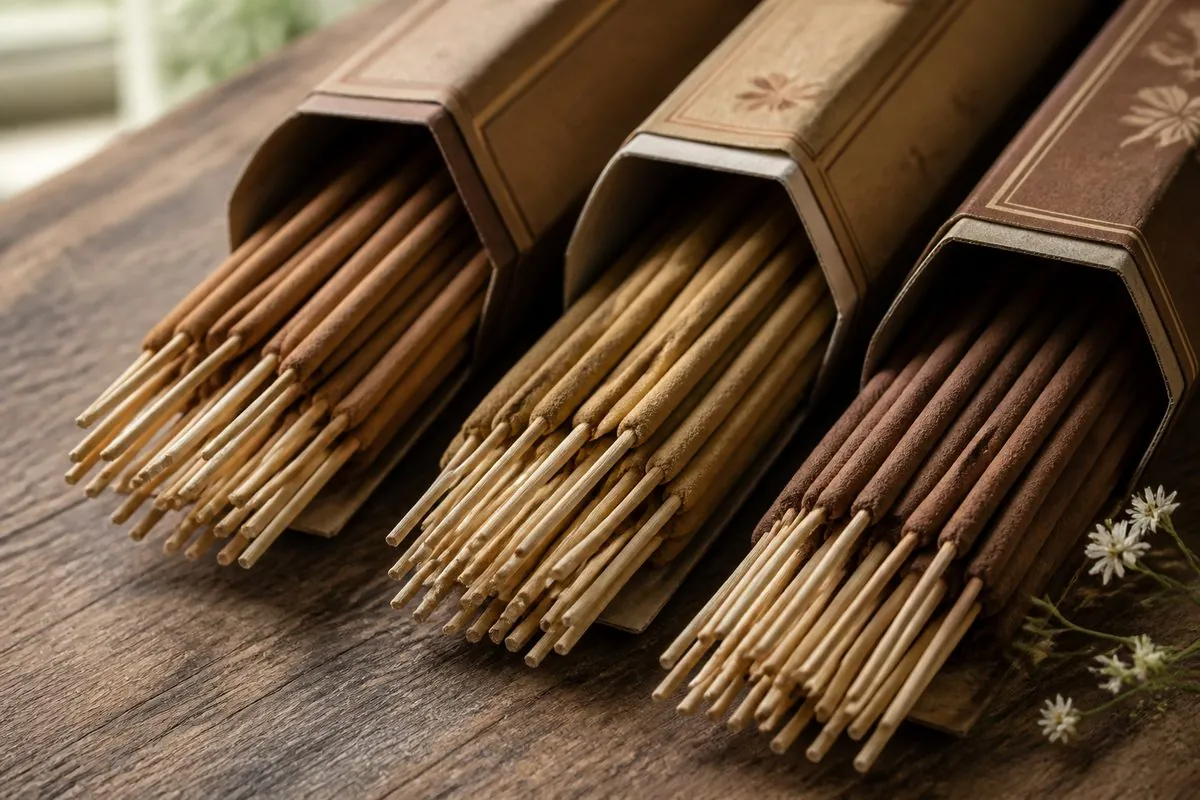
Direct sourcing checks should confirm inner pack format before trial PO — switching from hex boxes to pouches after sample approval invalidates stow plans and retail planograms.
Fragrance segregation, crush resistance, moisture barrier, and pallet stretch-wrap belong in the written purchase spec alongside stick type and burn-time bands.
Packaging formats and importer QC checkpoints for agarbatti export
Swipe →
Data table — swipe horizontally on small screens
| Format | Typical Configuration | Use Case | Key Importer Check |
|---|---|---|---|
| Hex / rectangle retail boxes | Stick count marked; fragrance name; barcode if PL | Wellness and ethnic retail programmes | Dieline approval, scent seal, print colour match |
| Pouches / cellophane sleeves | Inner fragrance barrier; master carton outer | Volume wholesale and economy channels | Seal integrity and scent cross-contamination risk |
| Master cartons | Corrugated with moisture barrier | All ocean shipments | Crush test photos; fragrance segregation marks |
| Pallet stretch-wrap | Fragrance-segregated stacks | FCL programmes with forklift discharge | No mixed-fragrance layers on one pallet face |
Container Loading Details
Export Tip
- Require stow photos and seal numbers in the trial SOP.
- Confirm forwarder payload math against pack format before deposit.
- Reject stuffing plans that mix incompatible fragrance strengths without barriers.
- Keep air freight for samples — not for commercial margin programmes.
Trial importers should agree stow assumptions before first FCL — hex-box stacking density differs from bulk poly bundles and affects whether target payload is achievable.
Fragrance segregation in the container matters as much as payload math. Strong oud or spice lines can migrate into mild herbal SKUs if cartons share open air without barriers.
Directional container loading guidance for incense sticks
Swipe →
Data table — swipe horizontally on small screens
| Container Type | Loading Consideration | Typical Use |
|---|---|---|
| 20-foot FCL | Payload driven by hex-box vs bulk density; confirm stow with forwarder | Trial and standard commercial shipments |
| 40-foot FCL / 40-foot HC | Higher cube for retail hex programmes; watch crush on lower tiers | Established distributor and private-label programmes |
| LCL | Suitable for trial cartons below FCL threshold; higher scent-risk from co-load | New buyer relationships and multi-SKU sampling |
| Air / express | Burn-test kits and urgent art samples only | Pre-PO approval and private-label proof packs |
Shipping Methods
Export Tip
- Write sample, trial, and FCL lead-time expectations into the RFQ.
- Approve Incoterm before comparing Indian offers on price alone.
- Express burn-test kits first; commercial FCL only after fragrance acceptance.
- Incoterms in practice: EXW, FOB named port, CFR/CIF; DDP selective for mature retail programmes.
- DDP only when your landed-cost and compliance team can own destination risk.
Direct-sourcing programmes align port choice to factory geography — Mysuru–Bengaluru flows often consolidate via Chennai, Tuticorin, or ICD routes; Tamil Nadu packing lines feed Chennai and Tuticorin; Gujarat–Mumbai consolidation feeds Nhava Sheva and Mundra.
Typical lead times: samples 7–14 days; stock fragrances 2–4 weeks after PO confirmation; custom/private-label 4–8+ weeks. Festive calendars (Navratri, Diwali, Christmas, Ramadan) can extend production — book early for seasonal programmes.
Certifications
Compliance Notes
- Request IEC, RCMC, and sample burn-test report before deposit.
- Verify IFRA/REACH/Halal scope in writing if the RFQ requires it.
- Treat ISO logos as secondary to lot identity and fragrance QC.
- Private-label art approval is not a certification — but it is a hard production gate.
Direct-sourcing buyers should collect seller IEC evidence, Chemexcil RCMC where used, SDS/MSDS for fragrance compounds when required, and burn-test/QC reports before deposit — IFRA, REACH/SVHC, Halal, and vegan claims are secondary until the factory clears fragrance and pack basics.
Ask for certificate scope tied to the exact fragrance programme under offer, not generic marketing PDFs. For how Chemexcil membership signals exporter credibility to importers, see Chemexcil registration benefits — this playbook does not cover exporter application steps.
Certifications and documents relevant to incense stick import programmes
Swipe →
Data table — swipe horizontally on small screens
| Certification / Document | Purpose | Relevant For |
|---|---|---|
| Burn-test / QC report | Burn time, ash, fragrance throw on retained samples | All commercial agarbatti programmes — baseline importer gate |
| Seller IEC + Chemexcil RCMC | Baseline export registration credibility for Chapter 33 | All commercial shipments from India |
| SDS / MSDS | Fragrance compound safety information when required | EU/US retail and premium fragrance programmes |
| IFRA conformity notes | Fragrance guidance alignment for premium retail | EU/US lifestyle and wellness private label |
| REACH / SVHC statements | Buyer-mandated substance declarations | EU importers with formal chemical compliance files |
| Halal certificate | Religious compliance where programme-specific | Selected Middle East / Africa programmes |
| Certificate of Origin | Country of manufacture; FTA claims where applicable | Destination customs programmes |
| Commercial invoice + packing list + B/L or AWB | Shipment identity and customs clearance | All ocean and air consignments |
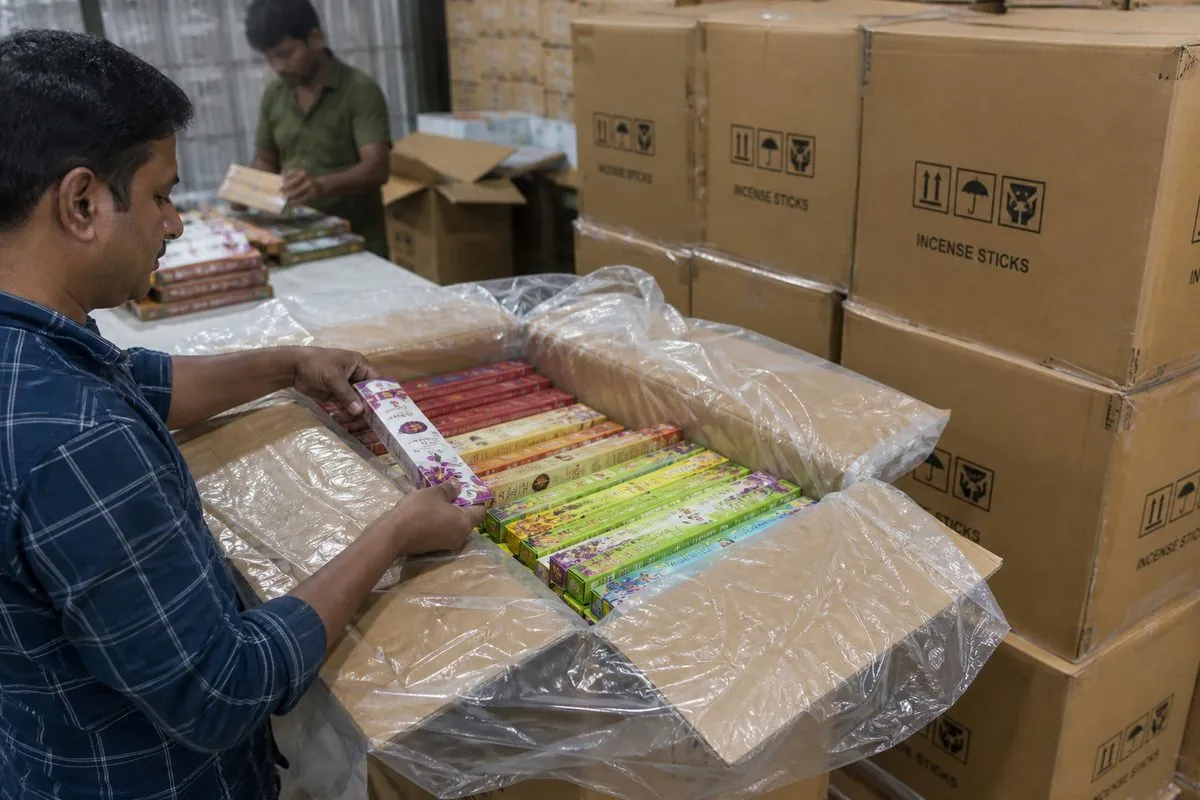
Buyer Requirements
Buyer Requirements
- Importer RFQ must state stick type, fragrance family, burn-time target, pack, HS intent, and Incoterm.
- Approve burn-test kits from the mapped factory before deposit for trial MT.
- Verify merchant vs factory flow independently.
- Stage 200–1,000 kg after written acceptance criteria.
- Model FOB + freight + duty before factory shortlisting ends.
- Lock private-label dielines and copy before production start.
Importers in direct-sourcing programmes typically request a written RFQ response, burn-test sample kits, packing photos, lot QC report, named-port FOB, and seller credential copies. Retail and private-label buyers add art approval cycles, barcode proofs, and fragrance exclusivity clauses.
RFQ writing template (importer)
- Company, destination market, and channel (ethnic / wellness / modern trade).
- Stick type and fragrance family shortlist (max 3–5 SKUs for first trial).
- Burn-time target range and ash/throw acceptance notes.
- Inner pack format, stick count, master-carton marks, moisture barrier.
- Sample kit quantity, trial MOQ, and first-year volume estimate.
- Incoterm and preferred Indian load port.
- Required docs: burn-test report, SDS if needed, COO, Chemexcil RCMC copy.
- Private-label: dieline, languages, barcode, exclusivity yes/no.
A strong RFQ prevents three failure modes: wrong stick type, scent drift after ocean transit, and private-label art reprints. Keep the RFQ short enough that factories answer every field, but complete enough that two quotes can be compared on the same sheet.
Private-label art approval flow
Private-label importers should treat art approval as a gated workflow: brief → dieline → print proof → physical hex sample → written sign-off → production. Do not allow bulk printing on verbal approval. Store signed PDFs with date, fragrance name, and batch intent in the vendor file.
Colour drift between proof and bulk is a common dispute — require a physical printed hex before FCL deposit when the brand is retail-facing.
Country-wise Opportunities
Market Snapshot
Direct-sourcing programmes should align factory stick type to the corridors below — Mysuru–Bengaluru for branded masala and premium packs, Tamil Nadu for volume dipped programmes, Gujarat–Mumbai for private-label consolidation. Reference best countries for Indian incense stick exports for corridor ranking depth; this table focuses on importer sourcing decisions per market.
Importer sourcing focus by destination for Indian agarbatti programmes
Swipe →
Data table — swipe horizontally on small screens
| Country | Sourcing Focus | Key Importer Requirement | Opportunity Note |
|---|---|---|---|
| United States | Herbal / sandalwood hex and pouch programmes | Burn-test + SDS/IFRA notes where retail claims apply | Top WITS 2024 partner (~US$21.2M) — quality-led RFQs win |
| United Arab Emirates | Masala and oud-leaning packs; Halal-aware labelling | Arabic/English pack copy + Halal docs when claimed | ~US$7.7M directional — re-export and local retail |
| Nigeria | Volume dipped and economy masala | Pack crush resistance + MOQ realism | ~US$7.0M directional — landed cost and volume discipline |
| Spain / United Kingdom | Natural and premium retail hex boxes | IFRA/REACH-aware fragrance files | ~US$5.6M / ~US$5.4M — premium private label fit |
| Malaysia | Ritual and retail incense | ASEAN labelling + consistent fragrance lots | ~US$5.5M directional — repeat wholesale rhythm |
| Chile | Volume masala/dipped with Spanish pack copy | Multilingual art + moisture barrier for long lane | ~US$5.4M directional — LatAm pack adaptation |
| Iraq / South Africa / Australia | Ritual volume or herbal mid-premium | Destination labelling + burn-test retention | Corridor-specific fragrance shortlists required |
Americas importer lens
US, Chile, Brazil, and Mexico importers should shortlist Indian factories that already document burn-tested retail packs and can support Spanish/Portuguese or English private-label art. Write fragrance and pack into the RFQ before comparing FOB. Approve sample kits, then release the 200–1,000 kg trial deposit.
Middle East and Africa importer lens
UAE and Nigeria programmes often diverge — UAE rewards fragrance prestige and labelling; Nigeria rewards volume pack integrity and landed-cost discipline. Do not force one factory shortlist for both without separate burn-test gates.
Europe and Asia-Pacific importer lens
Spain, UK, Malaysia, and Australia importers should prioritise fragrance documentation and sample-to-bulk match. A factory that fits Nigerian volume may fail a UK natural hex programme — discover that on burn-test kits, not on a sealed FCL.
Export Process
Export Tip
From the importer's seat, 'export process' means the sequence you force before cargo moves — not the exporter's IEC filing tutorial. Use this post-specific process angle: RFQ → credential check → cluster audit → burn-test → landed-cost gate → trial PO → QC release → FCL scale.
For end-to-end exporter process, Incoterms depth, and port playbooks, see the pillar How to Export Incense Sticks (Agarbatti) from India. For document field reconciliation at shipment time, see the documentation checklist.
Phase 1 — RFQ and credential screen
Issue the written RFQ. Collect seller IEC, Chemexcil RCMC where claimed, prior HS 33074100 evidence, and factory address in Mysuru–Bengaluru, Tamil Nadu, Gujarat, or Delhi-NCR. Reject listings that cannot name a plant or packer.
Phase 2 — Cluster audit and burn-test sampling
Run a remote video audit or on-site visit focused on rolling/dipping, drying, fragrance storage, and packing. Courier 1–5 kg or 50–200 hex boxes. Burn-test against written criteria: burn time, ash, throw, stick breakage, pack scent retention after 48–72 hours sealed.
Phase 3 — Landed-cost gate and trial PO
Complete the FOB + freight + duty model. Award a 200–1,000 kg trial with retention samples at origin and destination. Tie payment milestones to burn-test sign-off and BL scan where appropriate.
Phase 4 — QC release and scale
Compare trial bulk to approved retained hex. Only then scale to 1–5 MT or FCL. Re-run burn-test when fragrance oil lots or private-label art change mid-programme.
Sourcing Checklist
Checklist
Use this sourcing checklist as the master gate before any advance leaves your account. It compresses RFQ, audit, burn-test, and landed-cost discipline into one importer-facing list.
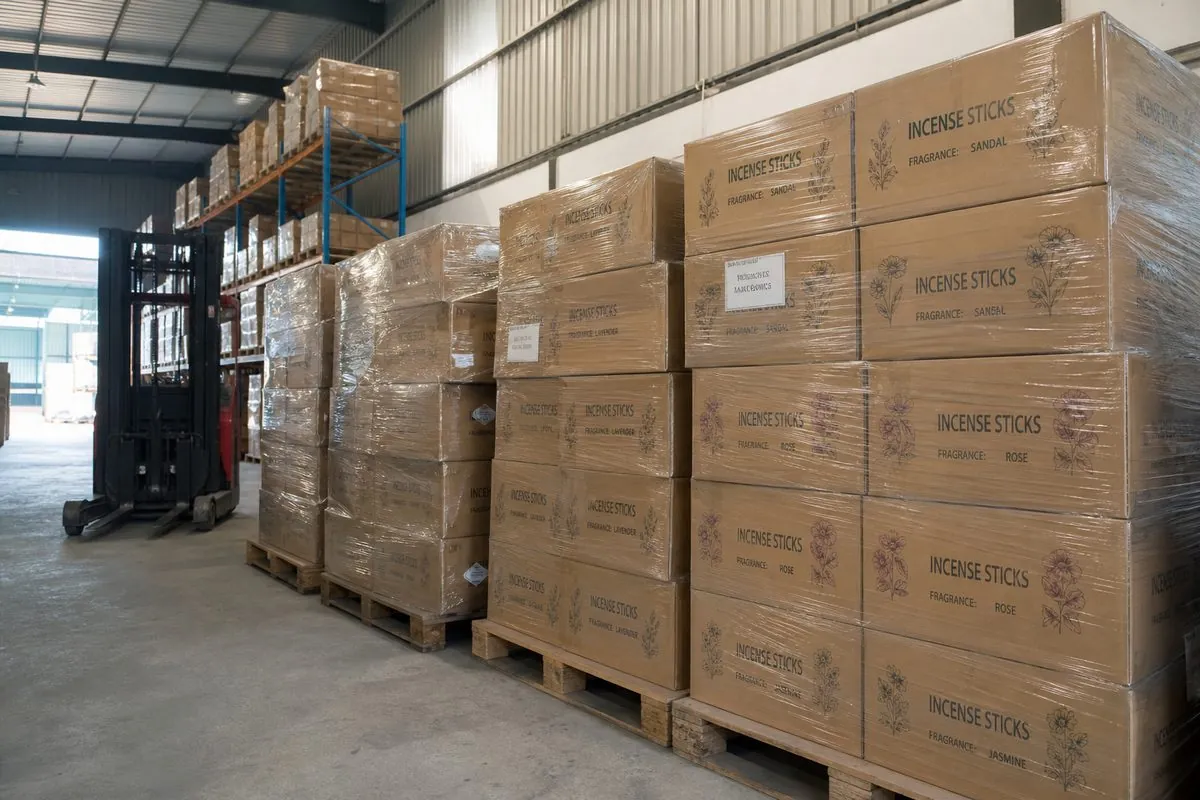
Buyer Checklist
Checklist
Exporter Checklist
Checklist
Importers should expect professional sellers to clear the following operational checklist. This is a buyer-facing readiness list — not an exporter registration how-to.
Common Buyer Mistakes
Common Mistakes Box
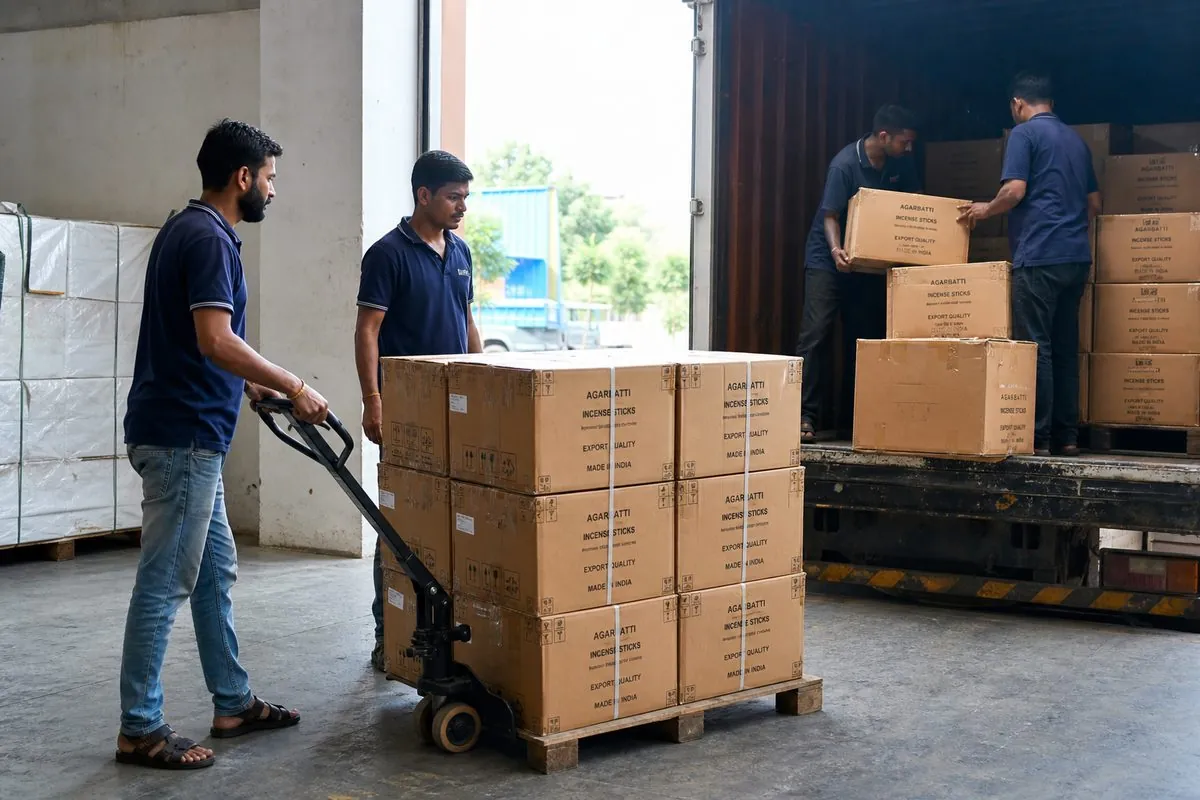
Future Market Trends
Key Statistics
- Importers will keep demanding burn-test evidence earlier in the RFQ cycle.
- Factory dual-sourcing grows as retail programmes refuse single-plant fragrance risk.
- Trial gates stay — trends toward FCL do not erase the 200–1,000 kg proof step.
- Private-label art cycles get shorter; factories that cannot proof quickly lose shortlists.
Importers shorten supplier lists after one failed fragrance trial — direct sourcing trends reward factories with sample-to-bulk burn-test match rates, not lowest first quote.
Private-label and cleaner-burn herbal programmes continue to pull premium margins in US and EU retail, while Africa and LatAm corridors still absorb volume dipped and economy masala when pack integrity holds.
Third-party inspection and SDS requests rise for programmes above wholesale MT thresholds — plan documentation readiness before scaling beyond trial cartons.
Challenges & Solutions
Direct sourcing challenges cluster around fragrance drift, pack crush, HS misfiling, and private-label art lag. Each has a practical importer-side solution if you design the gate before deposit.
Fragrance drift between sample and bulk
Challenge: approved burn-test kits smell stronger than bulk cartons after ocean transit. Solution: require retained samples from the same production batch as the trial, store sealed hexes at origin and destination, and write acceptance bands for throw and burn time into the PO annex.
Pack crush and scent cross-contamination
Challenge: hex boxes arrive crushed or scented by a stronger neighbour SKU. Solution: approve master-carton specs, forbid mixed-fragrance open stow without barriers, prefer FCL over LCL for premium programmes, and request stuffing photos before seal.
HS and document mismatches
Challenge: brokers file burning sticks on non-burning lines or omit SDS when the buyer channel needs it. Solution: state HS 33074100 in the RFQ and PO, and reconcile documents against the export documentation checklist before vessel cut-off.
Private-label art delays
Challenge: production waits while art revisions loop. Solution: freeze dielines early, require one physical print proof, and tie production start to written sign-off with a dated revision number.
Compliance Checklist
Checklist
Compliance Notes
Sources
- WITS / UN Comtrade — India exports HS 330741 by partner, 2024
- WITS / UN Comtrade — India imports HS 330741 by partner, 2024
- UN Comtrade Database (Comtrade Plus)
- ITC Trade Map
- DGFT (India) — IEC / Foreign Trade Policy portal
- ICEGATE — Indian Customs EDI
- India CBIC — Customs Tariff / notifications
- Exim Guru — ITC-HS 33074100 Agarbatti (policy Free)
- Chemexcil India — Basic Chemicals, Cosmetics & Dyes EPC (Panel III Cosmetics, Soaps, Toiletries & Essential Oils)
- IFRA — International Fragrance Association
- USITC Harmonized Tariff Schedule — search 3307.41
- USITC HTS Chapter 33 PDF archive (historical reference)
- European Commission TARIC consultation
- ECHA — REACH / SVHC guidance
- ICC Incoterms® rules
- Altus Exports — Contact
All sources accessed for factual audit 2026-08-01. Prefer primary government, council, and multilateral trade databases when citing figures in contracts or buyer presentations. Trade totals below are WITS/UN Comtrade directional figures — re-verify via DGCI&S / ITC Trade Map before contracts.
Supplier verification and burn-test protocols should reference the same HS 33074100 line the exporter files on the shipping bill.
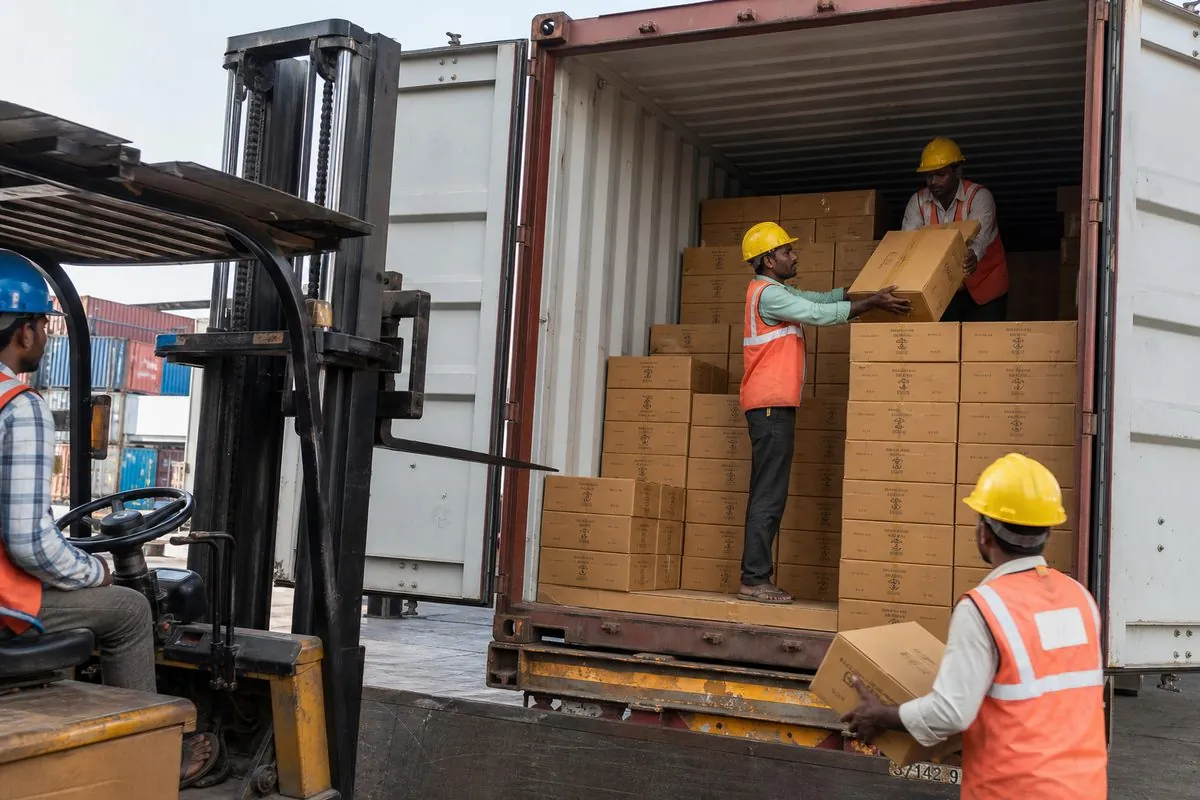
Conclusion
Sourcing incense sticks (agarbatti) directly from India works when RFQ clarity, Mysuru–Bengaluru or Tamil Nadu supplier audit, burn-test approval, and trial MOQ precede volume commitment — price without fragrance and pack discipline fails at retail.
Altus Exports compresses factory verification, burn-test logistics, private-label art coordination, and export execution for international importers — product sourcing company in India and global sourcing partner programmes available. Contact Altus Exports to map your first burn-tested trial.
See How to Export Incense Sticks (Agarbatti) from India for exporter-side process, Top Incense Stick Products Exported from India for SKU depth, Chemexcil registration benefits for seller credibility context, and the documentation checklist for shipment paperwork.