
Top Incense Stick (Agarbatti) Products Exported from India
By Saurabh Mittal, Founder, Altus Exports
A product-level catalogue of incense stick (agarbatti) types exported from India — masala, perfume-dipped charcoal, herbal/natural, bamboo-less dhoop, cones, premium sandalwood/oud/floral/spice lines, and private-label hex boxes — with fragrance families, MOQ ladders by SKU, packaging by product type, and channel fit for importers and distributors.
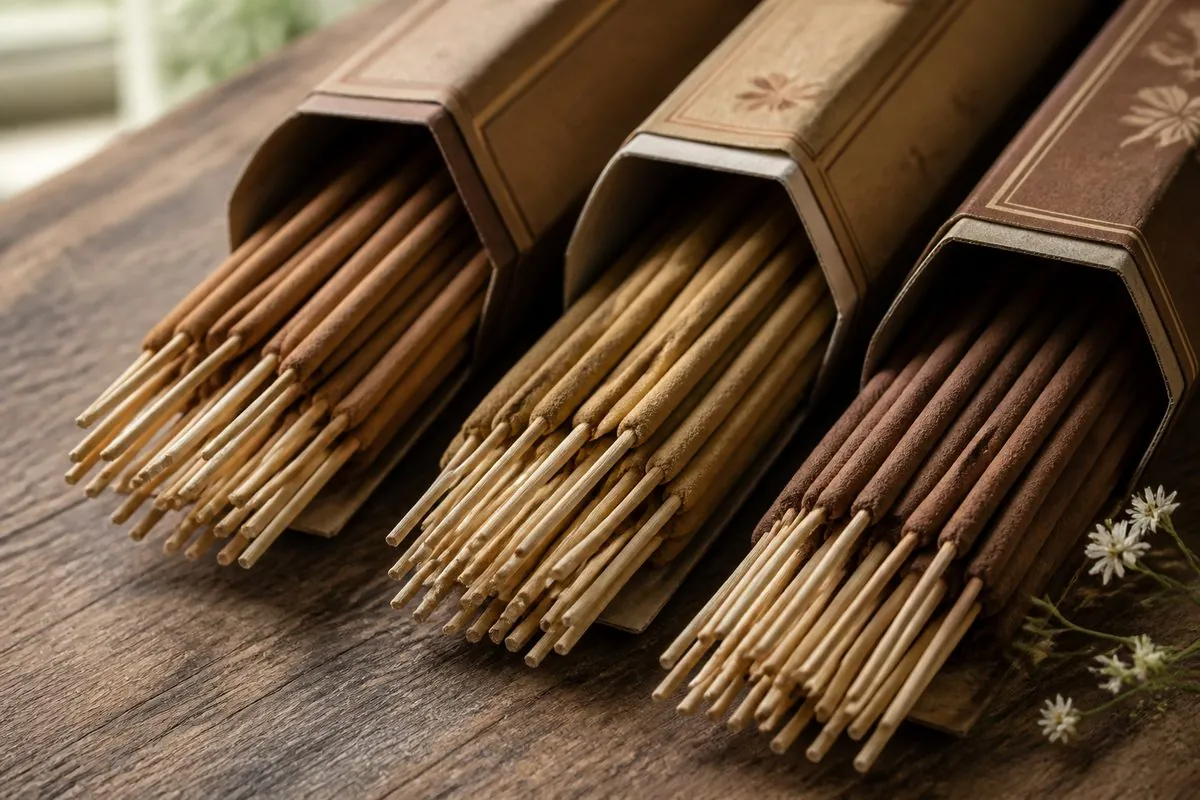
International buyers evaluating India as an incense stick sourcing origin rarely fail because India lacks agarbatti capacity — they fail because they treat 'incense sticks' as a single commodity rather than a matrix of stick constructions, fragrance families, and pack formats. Masala sticks, perfume-dipped charcoal sticks, herbal and natural lines, bamboo-less dhoop, cones, and premium sandalwood or oud programmes share a burning form under HS 33074100 but not the same manufacturing discipline, MOQ ladder, or retail presentation. Quoting or ordering the wrong SKU is the fastest route to a rejected lot at destination QC. This guide maps the top incense stick products exported from India with enough specificity to structure RFQs, compare directional FOB bands honestly, and match each product type to the buyer channel it serves. For the end-to-end export process, see How to Export Incense Sticks (Agarbatti) from India.
India's agarbatti export catalogue spans hand-rolled masala sticks, economy perfume-dipped charcoal sticks, herbal and botanical cleaner-burn lines, extruded bamboo-less dhoop sticks, incense cones, premium sandalwood / oud / floral / spice fragrance families, and private-label retail hex-box programmes. Quality parameters — burn time, ash quality, fragrance throw, stick length and count, moisture control, and pack integrity — must be declared lot-by-lot against approved burn-test samples. Mysuru–Bengaluru remains the dominant masala corridor; Tamil Nadu–Puducherry supplies volume dipped and masala programmes; Gujarat–Mumbai and Delhi-NCR support private-label packing and ethnic wholesale consolidation; Kannauj supplies attar inputs for premium stick lines. WITS / UN Comtrade 2024 directional figures for India HS 330741 show roughly US$147.6M and 40,884 MT, with the United States, UAE, Nigeria, Iraq, Spain, Malaysia, Chile, and the United Kingdom among the leading value partners.
Whether you are a wellness retailer building a private-label hex-box programme, a volume distributor stocking charcoal dipped sticks, or a specialty buyer evaluating herbal and sandalwood SKUs, this product catalogue gives you the vocabulary and specification framework to evaluate Indian suppliers without conflating economy dipped sticks with premium masala or natural lines. For country-level demand by stick type, see Most Demanded Indian Incense Sticks (Agarbatti) by Country; for natural and eco specialty depth, see Natural, Herbal & Eco-Friendly Incense Stick Export Opportunities.
Key Takeaways
Summary Box
Executive Summary
Summary Box
- Catalogue SKUs separately: masala · dipped · herbal · dhoop · cones · premium · private-label.
- Map every burning SKU to HS 33074100 — not 33074900 non-burning contrast lines.
- Price each SKU with fragrance grade, stick count, and pack format on the quote card.
- Trial 1–5 cartons per fragrance before promising wholesale MT programmes.
- Keep fragrance segregation and moisture control on every packaging card.
Evaluating Indian incense stick products means separating stick construction (masala vs perfume-dipped vs herbal vs dhoop vs cones), fragrance family, and pack format before comparing FOB. These are distinct manufacturing disciplines with distinct buyer channels, not interchangeable SKUs on a single price sheet.
Mysuru–Bengaluru, Tamil Nadu–Puducherry, Gujarat–Mumbai, Delhi-NCR, and Kannauj-linked premium lines supply the bulk of India's export catalogue; every commercial lot should clear against an approved burn-test sample covering burn time, ash, fragrance throw, and pack presentation.
This product catalogue helps importers, distributors, wellness retailers, ethnic grocery chains, and private-label buyers structure RFQs and acceptance criteria without conflating economy charcoal dipped sticks with premium sandalwood or herbal programmes.
Market Size & Industry Overview
Key Statistics
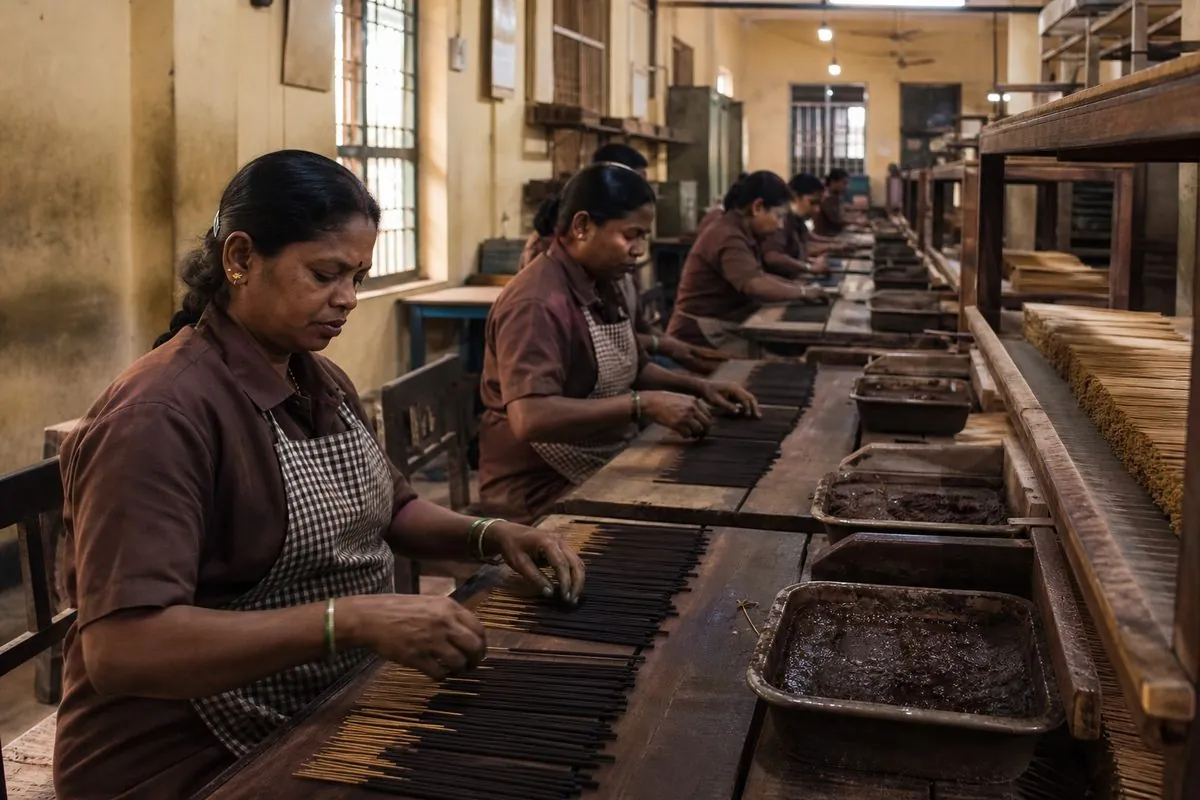
From a product perspective, the Indian incense stick ecosystem produces masala (hand-rolled paste), perfume-dipped charcoal sticks, herbal and natural botanical lines, bamboo-less extruded dhoop, cones, and premium sandalwood / oud / floral / spice programmes under HS 330741. Each construction sits inside the same burning-preparations heading but carries a different fragrance load, ash profile, MOQ, and retail pack story.
Manufacturing capacity concentrates in Mysuru–Bengaluru for branded and masala rolling depth; Tamil Nadu–Puducherry (including the Cuddalore belt) for volume dipped and masala export packing; Ahmedabad / Gujarat and Mumbai–Nashik for private-label consolidation; Delhi-NCR for ethnic wholesale; and Kannauj for attar inputs that feed premium stick fragrance programmes. Chemexcil (Basic Chemicals, Cosmetics & Dyes Export Promotion Council) is the relevant export promotion council for Chapter 33 agarbatti programmes.
Buyers pick stick type and fragrance family first, factory cluster second — never the reverse. Catalogue entries should name which corridor can actually produce and pack each SKU at the stated MOQ.
Why product taxonomy beats a single agarbatti price
A single FOB-per-kilogram number collapses retail hex-box sandalwood programmes into the same band as bulk poly-bundle charcoal sticks. Importers who publish structured SKU cards — construction, fragrance family, stick length and count, pack format, MOQ tier, and honest FOB band — convert faster and face fewer burn-test disputes.
Directional industry scale for India HS 330741 exports in 2024 is about US$147.6M and 40,884 MT per WITS / UN Comtrade. That total mixes SKU types; your catalogue win-rate depends on matching construction and fragrance to channel, not on claiming a share of the headline tonnage.
Supply clusters mapped to product types
- Mysuru / Bengaluru — masala rolling and branded stick corridor
- Tamil Nadu / Puducherry — volume dipped and masala export packing
- Gujarat / Mumbai–Nashik — private-label packing and merchant consolidation
- Delhi-NCR — ethnic wholesale and attar-linked premium lines
- Kannauj — attar / traditional perfume inputs for premium stick programmes
Masala and branded stick depth concentrates in Mysuru–Bengaluru. Volume perfume-dipped programmes often pull from Tamil Nadu–Puducherry. Private-label art, hex-box packing, and merchant consolidation sit strongly in Gujarat–Mumbai. Ethnic retail assortments and attar-linked premium lines consolidate through Delhi-NCR with Kannauj fragrance inputs where the programme requires traditional perfume character.
Export Statistics
Key Statistics
- Catalogue SKUs sit inside HS 330741 totals — do not publish one stick type as equal to full heading tonnage.
- Burning sticks and cones map to 33074100; non-burning room fragrance forms map to 33074900 (contrast only).
- Use partner ranks as demand signals for which fragrance and pack cards to lead with — not as a substitute for buyer RFQs.
- Refresh product export notes when DGCI&S or paid customs extracts update.
Product catalogues for incense stick products exported from India map to India HS 33074100 — agarbatti and other odoriferous preparations which operate by burning. Stick construction and fragrance grade drive commercial differentiation; the eight-digit burning line drives customs filing. Confirm the exact heading with your CHA before shipping-bill submission.
Directional export scale (WITS / UN Comtrade 2024): India HS 330741 totalled about US$147.6M and 40,884 MT. Leading partners by value include the United States (~US$21.2M), UAE (~US$7.7M), Nigeria (~US$7.0M), Iraq (~US$5.7M), Spain (~US$5.6M), Malaysia (~US$5.5M), Chile (~US$5.4M), and the United Kingdom (~US$5.4M), followed by Argentina, Brazil, Netherlands, Mexico, South Africa, France, Australia, and others. Treat all figures as directional planning context; re-verify via DGCI&S / ITC Trade Map before citing in contracts.
India incense stick (agarbatti) trade profile — WITS / UN Comtrade HS 330741, 2024 (directional)
Swipe →
Data table — swipe horizontally on small screens
| Metric | Directional Estimate | Notes |
|---|---|---|
| Primary manufacturing corridors | Mysuru–Bengaluru; Tamil Nadu–Puducherry; Gujarat–Mumbai; Delhi-NCR; Kannauj inputs | Cluster choice should match stick type and pack programme |
| Applicable HS line (India) | 33074100 — burning odoriferous preparations (agarbatti, dhoop, cones) | Confirm eight-digit with CHA; contrast 33074900 for non-burning forms only |
| WITS / HS6 reference | 330741 | Multilateral trade databases report at six-digit level |
| Governing trade council | Chemexcil | RCMC for Chapter 33 cosmetics / toiletries / odoriferous preparations including agarbatti |
| 2024 India HS 330741 exports | ~US$147.6M / ~40,884 MT | US$147,604.26K / 40,883,600 kg — WITS / UN Comtrade 2024; mixed SKU basket |
| Top value partners (2024) | USA, UAE, Nigeria, Iraq, Spain, Malaysia, Chile, UK | Directional — followed by Argentina, Brazil, Netherlands, Mexico, South Africa, France, Australia |
| Dominant export product families | Masala, perfume-dipped charcoal, herbal/natural, dhoop, cones, premium sandalwood/oud, private-label hex boxes | Fragrance family and pack format determine channel fit |
| Primary export ports | Nhava Sheva, Mundra, Chennai, Tuticorin (+ ICD consolidation as applicable) | Select port by factory cluster and sailing schedule |
Trade statistics notes for catalogue planners
HS 330741 aggregates burning preparations. Masala hex-box retail programmes and bulk charcoal dipped bundles both sit inside the same heading, so headline value per kilogram should not be read as a single SKU price. Build catalogue cards with construction-specific FOB bands and refresh them when fragrance oil and bamboo stick costs move.
For corridor-level market selection methodology, see Best Countries for Indian Incense Stick (Agarbatti) Exports. This products post stays on SKU taxonomy and pack/MOQ fit.
Import Statistics
Key Statistics
- Import-side demand informs which stick-type cards to lead with per corridor.
- Volume charcoal dipped demand and premium sandalwood demand rarely share the same buyer brief — keep quote cards separate.
- Use destination labelling (Arabic/English, Spanish/Portuguese, IFRA notes) as part of the SKU pack story.
- Keep non-burning room sprays and burning agarbatti stories separated in every catalogue note.
Destination import demand profiles show US and European wellness and lifestyle buyers pulling sandalwood, floral, and herbal retail packs; UAE and GCC ethnic and modern-trade channels pulling masala and Halal-documented assortments; Nigeria and broader African wholesale pulling volume charcoal dipped sticks; Spain, UK, Malaysia, and Chile absorbing mixed masala and retail-ready lines. Each product type in the catalogue has its own demand geography.
Directional import demand profile for Indian incense sticks by destination market (product-fit focus)
Swipe →
Data table — swipe horizontally on small screens
| Market | Directional Product Demand | Primary Buyer Type |
|---|---|---|
| United States | Sandalwood, floral, herbal, and private-label hex boxes; Prop 65 / fragrance disclosure awareness on retail packs | Wellness retailers, lifestyle distributors, e-commerce brands |
| United Arab Emirates | Masala assortments, oud-adjacent premium lines, Halal documentation for selected programmes | Ethnic retail, modern trade, regional distributors |
| Nigeria | Volume perfume-dipped charcoal sticks and economy masala; cost-led wholesale packs | Wholesalers, ethnic retail consolidators |
| Spain / United Kingdom | Masala and natural/herbal retail packs; REACH / IFRA-aware fragrance notes for premium lines | Lifestyle retailers, specialty importers |
| Malaysia | Ritual and retail masala; floral and sandalwood families with bilingual labelling expectations | Distributors, ethnic and modern-trade buyers |
| Chile / Latin America | Mixed masala and dipped programmes; Spanish-language retail packs for chain retail | Importers, supermarket and specialty distributors |
| Iraq / Middle East volume corridors | Economy and mid masala; fragrance-forward assortments for wholesale | Wholesalers and regional traders |
| Australia / Canada / Germany | Herbal, natural, and premium retail packs with cleaner-burn positioning | Specialty wellness and lifestyle importers |
Import data analysis for SKU selection
Import patterns help prioritise which fragrance families and pack formats to sample first. A US private-label buyer evaluating hex-box sandalwood has a different acceptance stack than a West African wholesaler evaluating bulk dipped sticks. Align sample kits to the destination's dominant product pull before expanding the fragrance matrix.
For a deeper country × stick type × fragrance matrix, use Most Demanded Indian Incense Sticks (Agarbatti) by Country. Duty and freight corridor ranking belongs in the best-countries guide, not in this SKU catalogue.
Product Categories / Variants
Summary Box
- Catalogue: masala · dipped · herbal · dhoop · cones · premium · private-label as separate cards.
- Masala is not a nickname for dipped charcoal — write the construction on the PO.
- Herbal/natural sells on botanical story and cleaner-burn claims — substantiate declarations.
- Private-label hex boxes are a pack + fragrance programme, not a leftover economy SKU.
Indian export catalogues span masala (hand-rolled) sticks, perfume-dipped charcoal sticks, herbal and natural sticks, bamboo-less dhoop sticks, incense cones, premium sandalwood / oud / floral / spice lines, and private-label retail hex boxes and pouches — each SKU maps to a different fragrance load, burn profile, MOQ, and buyer channel.
Use the taxonomy below as the primary RFQ vocabulary. Do not collapse constructions into one 'incense sticks' line item when fragrance oil cost, bamboo core, and pack art differ materially.
Primary incense stick (agarbatti) product types exported from India
Swipe →
Data table — swipe horizontally on small screens
| Product Type | Typical Spec / Construction | Fragrance Positioning | Primary Channel |
|---|---|---|---|
| Masala incense sticks | Hand-rolled paste of wood powder, gums, and fragrance on bamboo core | Rich, layered throw; mid to premium | Branded retail, ethnic grocery, specialty distributors |
| Perfume-dipped charcoal sticks | Bamboo core with charcoal paste, dipped in fragrance oil | Economy to mid; high volume scent families | Wholesale, cash-and-carry, value retail |
| Herbal / natural sticks | Botanical powders and essential-oil blends; cleaner-burn positioning | Natural, herbal, wellness retail | Wellness chains, eco-minded e-commerce, specialty importers |
| Bamboo-less dhoop sticks | Extruded sticks without bamboo core | Dense smoke / ritual positioning | Ritual, temple-adjacent, specialty ethnic retail |
| Incense cones | Cone-form burning preparations | Home fragrance and ritual short-burn formats | Gift, lifestyle, and home fragrance assortments |
| Premium sandalwood / oud / floral / spice | Higher fragrance load; often retail-packed hex boxes | Premium gift and lifestyle | Department, boutique, and private-label retail |
| Private-label retail programmes | Custom art hex boxes / pouches; fragrance exclusives | Buyer-brand exclusive SKUs | Retail chains, e-commerce brands, distributor brands |
Fragrance families exported from India
Common fragrance families for Indian incense stick export programmes
Swipe →
Data table — swipe horizontally on small screens
| Fragrance Family | Typical Stick Fit | Buyer Notes |
|---|---|---|
| Sandalwood | Masala, premium retail hex boxes | Core US / EU / AU wellness and gift demand |
| Floral (rose, jasmine, lavender) | Masala and dipped mid-retail | Broad lifestyle and ethnic retail appeal |
| Nag champa / temple floral blends | Masala and dipped | Strong ethnic grocery and specialty demand |
| Spice (cinnamon, clove, mixed) | Masala and dipped | Seasonal and gift assortments |
| Oud / attar-linked premium | Premium masala / private-label | GCC and premium lifestyle programmes; higher FOB |
| Herbal / botanical blends | Herbal/natural sticks | Cleaner-burn and wellness positioning |
| Citrus / fresh | Dipped and mid masala | Home fragrance and everyday-use assortments |
| Frankincense / resinous | Masala, cones, dhoop | Ritual and specialty spiritual retail |
Fragrance family selection is as important as stick construction. Indian exporters commonly offer sandalwood, rose, jasmine, lavender, frankincense, patchouli, nag champa / floral blends, spice (cinnamon, clove), citrus, oud-adjacent premium blends, and herbal/botanical mixes. Each family carries different oil cost, shelf-life sensitivity, and destination preference.
Stick length, count, and burn-time parameters
Commercial RFQs should state stick length (commonly ~8–9 inch / ~20–23 cm for many export sticks, with shorter and longer variants), sticks per hex box or pouch, and target burn time. Burn-test acceptance should reference the approved sample lot — not a verbal 'long burn' claim. Ash colour, unbroken burn, and fragrance throw at room scale belong on the QC sheet.
Manufacturing Overview
Export Tip
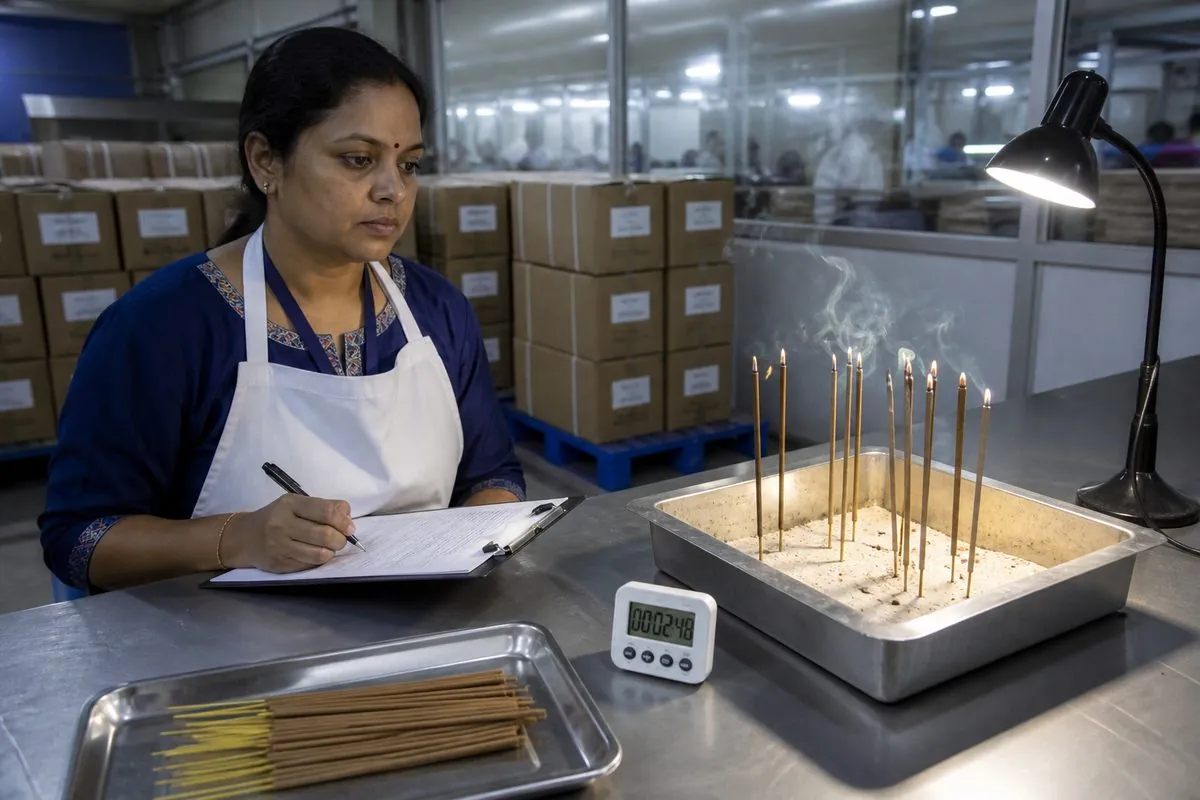
From a product perspective, manufacturing differentiation is construction-specific. Masala lines hand-roll or machine-assist a paste of wood powder, binding gums, and fragrance onto bamboo. Perfume-dipped lines apply charcoal paste to bamboo, dry, then dip in fragrance oil. Herbal and natural lines emphasise botanical powders and essential-oil blends with cleaner-burn positioning. Bamboo-less dhoop is extruded without a bamboo core. Cones are formed and dried as short-burn units. Premium and private-label programmes add higher fragrance loads and retail art packing.
Lot sampling covers burn time, ash quality, fragrance throw, stick integrity, moisture, and pack presentation before release — SKU integrity depends on not commingling fragrance families in the same open staging area or master carton without barrier segregation.
See the export process guide for operational steps from factory to port. This section stays on how construction choices create catalogue SKUs.
Construction controls that define export SKUs
- Never bag dipped charcoal leftovers as 'masala' to fill a short shipment.
- Retain burn-test samples from the approved lot for dispute resolution.
- Segregate strong fragrance families (oud, spice, floral) in storage and stuffing.
- Document bamboo length and stick count on the packing list for every SKU.
Masala programmes control paste moisture, rolling uniformity, and fragrance incorporation before drying. Dipped programmes control charcoal paste thickness, drying, and oil pickup. Herbal programmes control botanical powder ratios and oil blend consistency. Dhoop extrusion controls diameter and density. Cone lines control mould density and drying to avoid cracking. Private-label lines add print QC and fragrance exclusivity agreements.
Pricing Analysis
Buyer Tip
Product-level FOB bands below reflect stick construction, fragrance grade, and pack format — refresh quotes on quote date; fragrance oil costs and bamboo stick prices move. Premium retail packs are often quoted per hex box or master carton rather than only per kilogram.
Economy perfume-dipped sticks sit at the low end of the FOB curve. Mid masala occupies the centre. Herbal/natural and sandalwood/oud private-label retail packs command premiums. Do not publish one blended FOB for all constructions.
Directional FOB pricing bands by incense stick product type (confirm on quote date)
Swipe →
Data table — swipe horizontally on small screens
| Product Type | Directional FOB | Notes |
|---|---|---|
| Economy perfume-dipped charcoal sticks | ~US$0.8–2.5/kg | Volume wholesale; fragrance oil grade drives spread |
| Mid masala sticks | ~US$2.5–6/kg | Hand-rolled or assisted masala; brand and fragrance load matter |
| Herbal / natural sticks | ~US$4–10/kg | Botanical positioning; cleaner-burn claims need substantiation |
| Bamboo-less dhoop sticks | Mid to premium vs dipped (programme-specific) | Often quoted per kg or per carton by density |
| Incense cones | Programme-specific per carton / pack | Gift and lifestyle assortments; pack count drives unit economics |
| Premium sandalwood / oud / floral retail packs | Higher; often USD/hex box or USD/carton | Private-label art and fragrance exclusivity add cost |
| Private-label custom programmes | Premium over equivalent stock SKU | Artwork, tooling, and exclusivity extend lead time and MOQ |
How to structure honest multi-SKU quotes
List each construction and fragrance as a separate line with pack format, stick count, MOQ, lead time, and Incoterm. Bundle freight estimates separately under FOB, CFR, or CIF so buyers can compare product value without confusing ocean cost with fragrance premium. For landed-cost corridor context, cross-check Best Countries for Indian Incense Stick (Agarbatti) Exports.
MOQ Analysis
Buyer Tip
MOQ varies by SKU. Stock fragrance dipped sticks can trial at lower carton counts than custom private-label art programmes. Herbal and premium sandalwood lines may require higher minimum runs when fragrance oils are blended to order. Always state MOQ per fragrance SKU, not only per total order kilograms.
Directional MOQ tiers by incense stick transaction stage and SKU type
Swipe →
Data table — swipe horizontally on small screens
| Stage / SKU Context | Typical MOQ | Purpose |
|---|---|---|
| Burn-test samples (any construction) | 1–5 kg or 50–200 hex boxes | Fragrance throw, burn time, ash, and pack presentation approval |
| Trial order — stock fragrance | 200–1,000 kg or 1–5 cartons per SKU | Channel test before wholesale commitment |
| Trial order — private-label / custom art | Higher unit MOQ per fragrance (programme-specific) | Covers print run and exclusive fragrance blend economics |
| Wholesale programme | 1–5 MT | Distributor and ethnic wholesale repeat supply |
| FCL programme | Planned by pack density (hex boxes vs bulk poly bundles) | Confirm stow with forwarder; fragrance segregation required |
| Multi-fragrance assortment trial | 1–3 cartons per fragrance × assortment | Retail planogram testing without over-buying one scent |
MOQ by product type — practical notes
Perfume-dipped charcoal sticks usually offer the most flexible volume ladders. Masala mid-grades accept trial cartons readily when fragrance is in stock. Herbal/natural and oud-premium lines often need longer oil procurement and higher per-SKU floors. Cones and dhoop may share factory capacity with stick lines but still need separate carton MOQs because packing density differs.
Packaging Standards
Export Tip
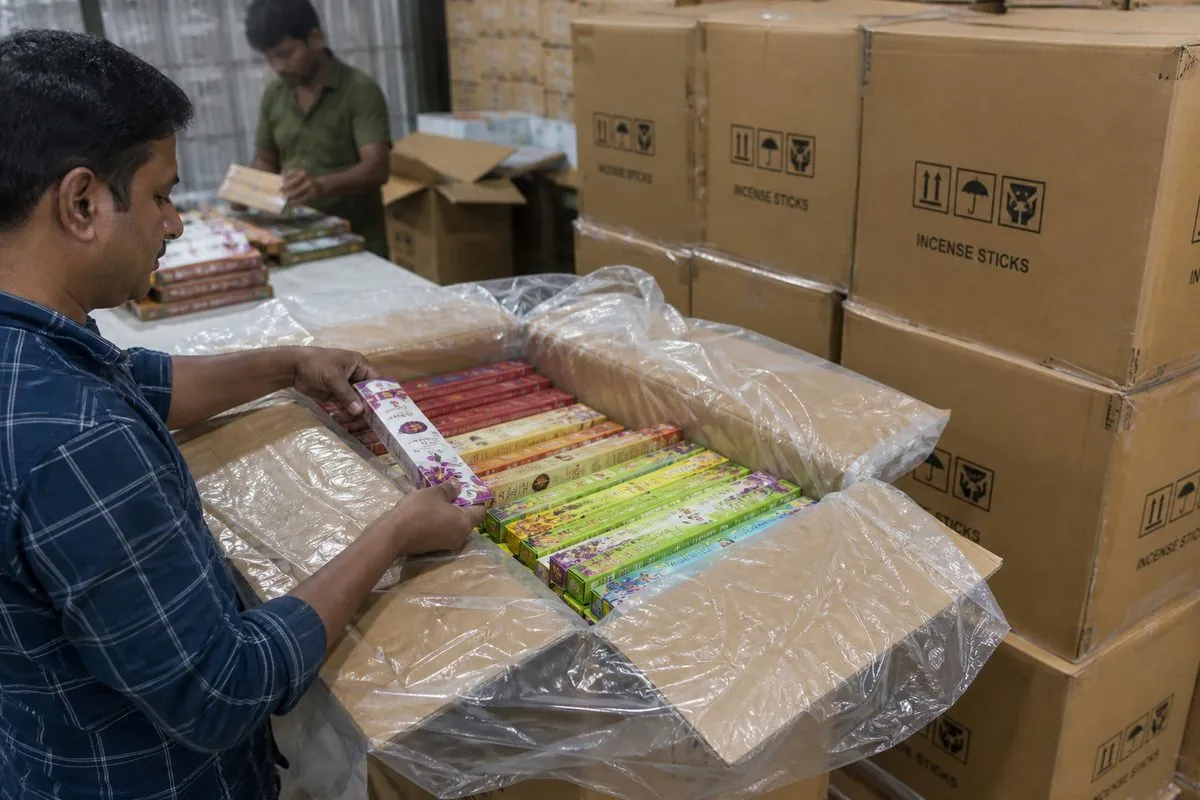
Packaging format is part of SKU definition. Hex boxes and rectangle boxes dominate retail-ready exports. Pouches and cellophane sleeves serve value and refill formats. Master cartons need moisture barrier and crush resistance. Fragrance segregation prevents scent cross-contamination — a common cause of destination complaints even when burn performance is acceptable.
Bag marks should state fragrance name, stick count, net weight, batch/lot ID, country of origin, and handling icons. Marks must match invoice and packing list lines.
Packaging formats and specifications by incense stick product type
Swipe →
Data table — swipe horizontally on small screens
| Format | Typical Configuration | Best Fit Product Types | Key Requirement |
|---|---|---|---|
| Hex retail boxes | Printed hex with sleeve or tray; fixed stick count | Masala, premium sandalwood/oud, private-label | Art colour match, crush resistance, fragrance seal |
| Rectangle retail boxes | Folding carton with inner wrap | Masala, herbal, lifestyle assortments | Moisture barrier and clear fragrance labelling |
| Pouches / sleeves | Poly or paper pouch; value stick counts | Dipped charcoal, economy masala | Seal integrity; avoid scent bleed into mixed cartons |
| Cone blister / small cartons | Count-specific retail packs | Incense cones | Protect cone tips from crush; moisture control |
| Master cartons | Corrugated with moisture barrier | All export SKUs | Lot ID, fragrance name, stick count totals, handling icons |
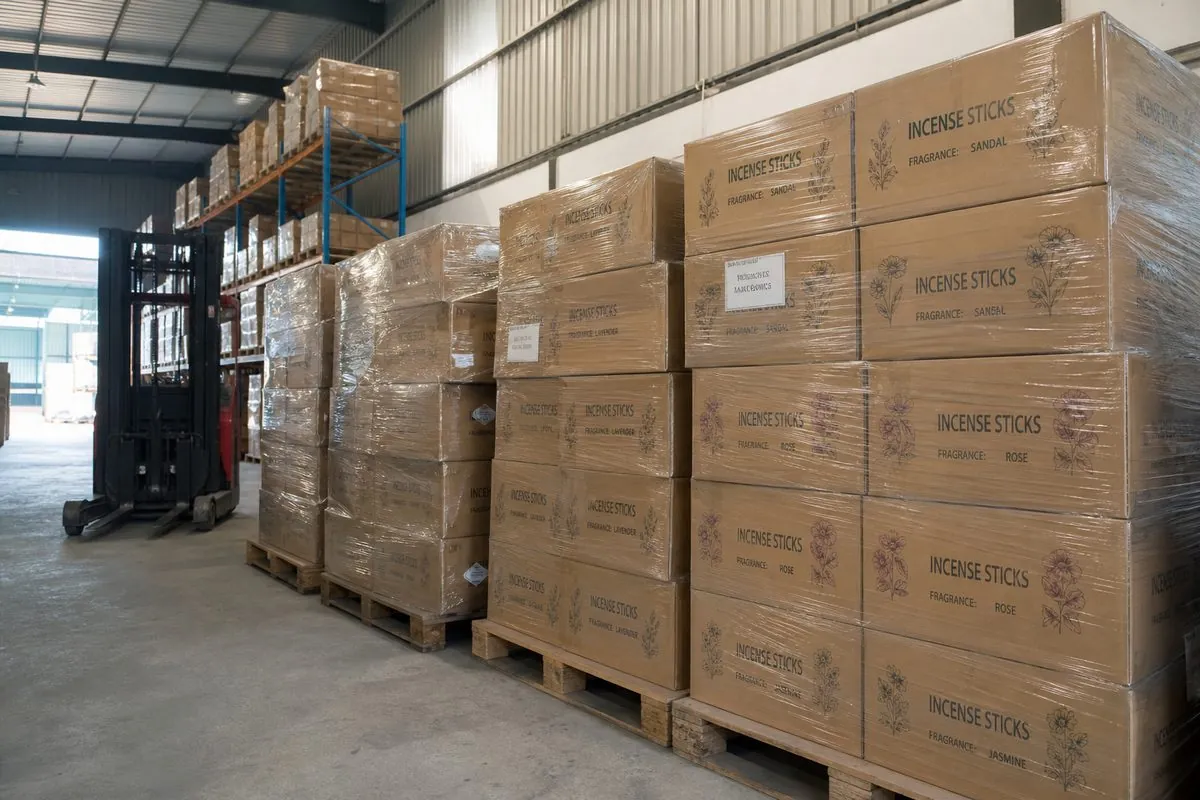
| Pallet stretch-wrap | Fragrance-segregated pallet layers | FCL and LCL programmes | No open mixing of strong scent families on one pallet face |
Packaging by product type — decision rules
Private-label programmes live or die on hex-box art and barcode accuracy. Volume dipped sticks can ship in simpler pouches if the buyer channel is wholesale. Herbal lines often need cleaner on-pack claims and sometimes IFRA or vegan callouts — only when substantiated. Dhoop and cones need extra crush protection relative to long sticks in rigid hex boxes.
Container Loading Details
Export Tip
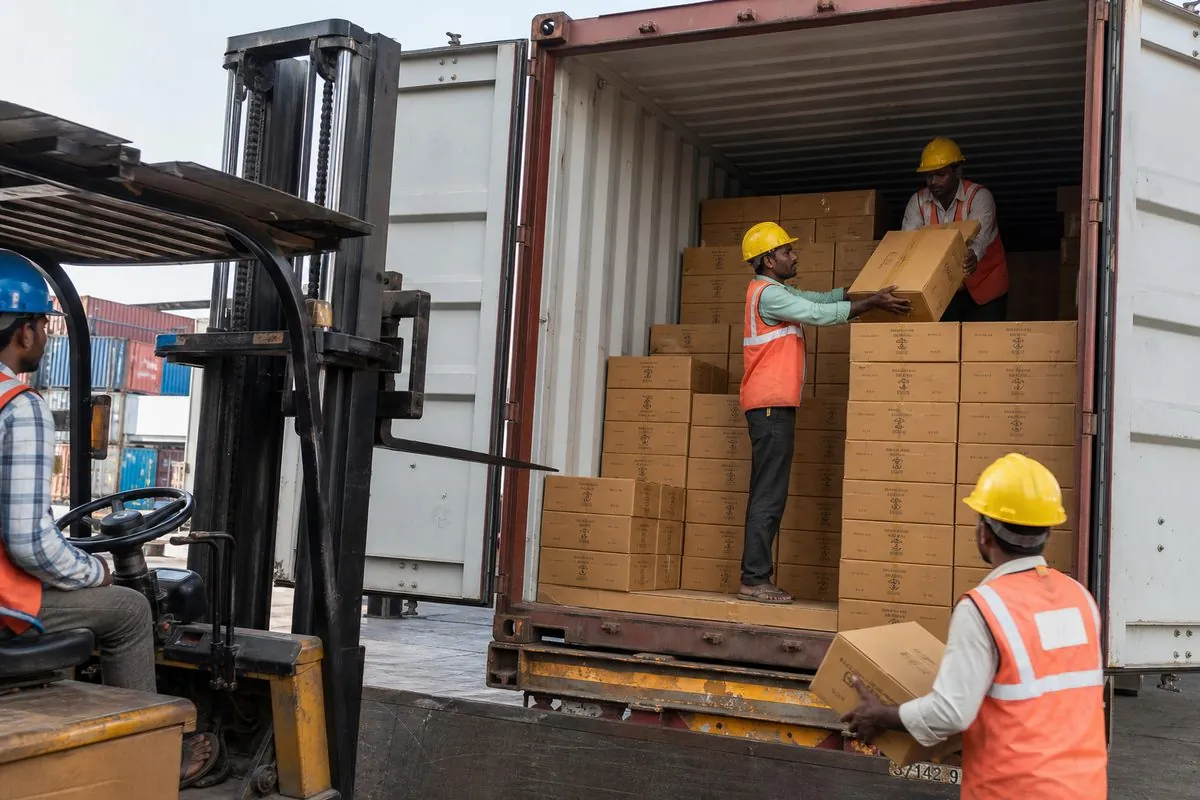
Container planning varies by pack density. Retail hex-box programmes cube out differently from bulk poly-bundle dipped sticks. Confirm payload and stow with the forwarder per SKU mix. Fragrance segregation inside the container reduces cross-contamination claims after multi-week ocean transit.
Directional container loading guidance for incense stick exports
Swipe →
Data table — swipe horizontally on small screens
| Container Type | Loading Consideration | Typical Use |
|---|---|---|
| 20-foot FCL | Payload driven by hex-box vs bulk density; verify carton crush limits | Trial assortments and mid-volume wholesale |
| 40-foot FCL / 40-foot HC | Higher cube for retail hex programmes; maintain fragrance segregation | Established distributor and private-label programmes |
| LCL | Suitable for multi-SKU sample expansions and small trial cartons | New buyer relationships; fragrance testing |
| Air freight | Samples and urgent retail launches; higher cost per kg | Burn-test kits and first planogram fills |
| Palletised stow | Recommended for hex-box retail to speed discharge and reduce crush | Buyers with forklift handling at destination warehouse |
| Mixed-SKU FCL | Separate fragrance families by pallet or carton block with barrier wrap | Assortment programmes for retailers |
Shipping Methods
Export Tip
Most commercial incense stick programmes move as ocean FCL or LCL from Nhava Sheva, Mundra, Chennai, or Tuticorin, with Bengaluru ICD consolidation when the factory cluster warrants it. Air freight suits burn-test kits and urgent private-label launches. Incoterms commonly used are EXW, FOB named Indian port, CFR/CIF destination ports, and selective DDP for mature retail distributor programmes.
Lead times by product type
- EXW — buyer controls pickup from Mysuru, Bengaluru, TN, or Gujarat warehouse
- FOB — exporter delivers to Nhava Sheva / Mundra / Chennai / Tuticorin
- CFR / CIF — ocean freight (and insurance under CIF) to destination port
- DDP — selective mature retail programmes only; confirm duty and last-mile capability
Samples typically ship in 7–14 days. Stock fragrance programmes often clear in 2–4 weeks after PO confirmation. Custom fragrance, private-label art, and herbal/eco programmes commonly need 4–8+ weeks. Navratri, Diwali, Christmas, and Ramadan calendars can extend lead times — book early for seasonal assortments.
Fragrance and moisture risk in transit
Ocean transit exposes sticks to humidity and temperature cycles. Moisture barrier cartons, desiccant where appropriate, and sealed inner packs protect burn quality. Strong fragrance SKUs should not share unsealed carton space with mild floral SKUs. Photograph stuffed container door views when multi-fragrance assortments ship together.
Certifications
Compliance Notes
IEC and Chemexcil RCMC support exporter credibility for Chapter 33 agarbatti. Lot-level burn-test or QC reports, SDS/MSDS for fragrance compounds when required, and destination-specific documents complete the pack. Premium EU/US retail may request IFRA alignment notes; EU buyers may request REACH/SVHC statements; selected Middle East and Africa programmes request Halal certificates; vegan or charcoal-free claims must be programme-specific and substantiated.
Certifications and documents relevant to incense stick product programmes
Swipe →
Data table — swipe horizontally on small screens
| Certification / Document | Purpose | Relevant For |
|---|---|---|
| Burn-test / QC report | Burn time, ash, fragrance throw on retained samples | All commercial shipments — baseline buyer requirement |
| Chemexcil RCMC + IEC | Export registration and council membership credibility | All commercial agarbatti export shipments from India |
| SDS / MSDS | Fragrance compound handling and importer compliance | Shipments where fragrance substances require SDS |
| IFRA conformity notes | Fragrance compliance for premium retail claims | EU/US lifestyle and wellness retail programmes |
| REACH / SVHC statements | EU substance disclosure when buyer-mandated | EU importers and private-label retailers |
| Halal certificate | Religious compliance documentation | Selected Middle East / Africa programmes |
| Vegan / charcoal-free declarations | Programme-specific marketing claims | Herbal/natural and eco retail lines — only if substantiated |
| Certificate of Origin | Preferential or standard origin evidence | Buyer or customs-required consignments |
| ISO 9001 / GMP (producer) | Quality-system credibility at manufacturing site | Retail chain and multinational private-label audits |

Buyer Requirements
Buyer Requirements
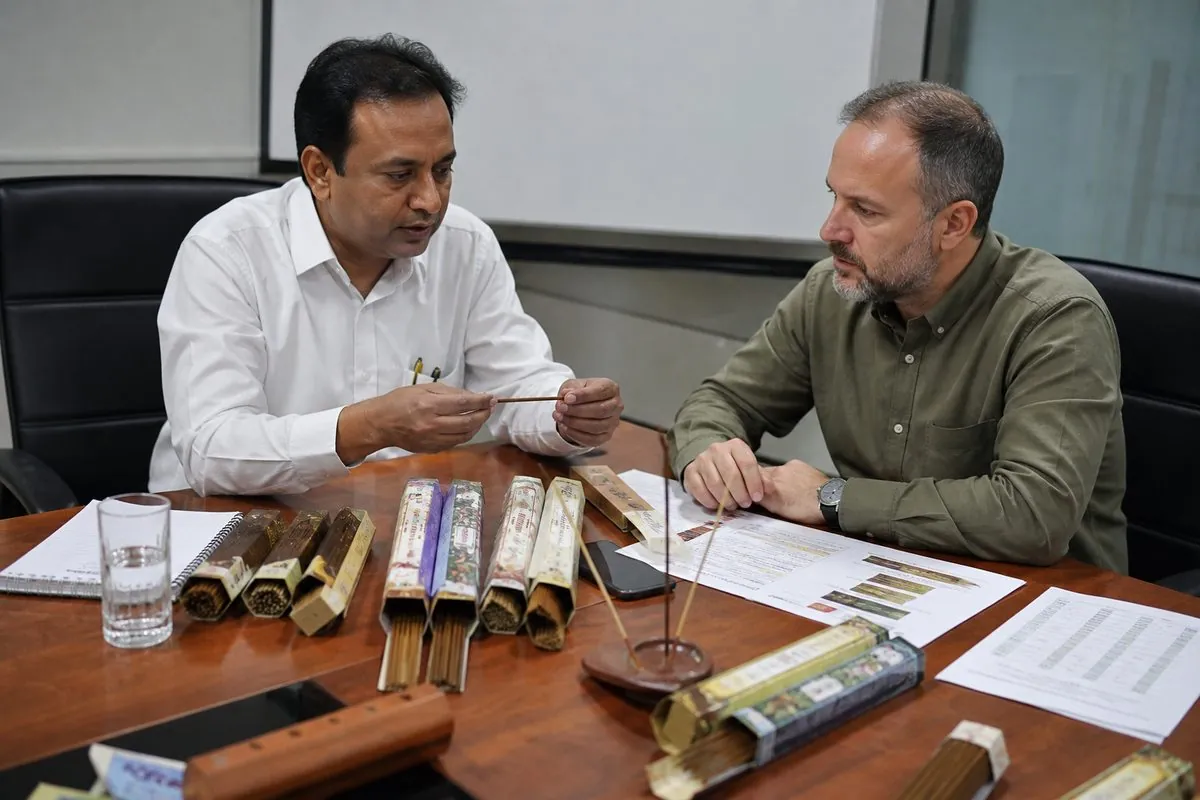
Buyers in product-catalogue programmes typically request construction-specific samples, written specs for stick length and count, fragrance family list, burn-time targets, packaging dielines, FOB pricing by SKU, MOQ by fragrance, lead times, and Chemexcil/IEC proof. Retail private-label buyers add artwork approval cycles, barcode allocation, and sometimes IFRA or Halal documentation. Wholesale volume buyers emphasise carton economics and sailing frequency over premium art.
RFQ fields that prevent SKU confusion
- State masala vs dipped vs herbal vs dhoop vs cones explicitly
- List fragrance families in priority order for sampling
- Attach or request hex-box dielines for private-label
- Declare destination labelling and certification needs up front
A complete RFQ names stick construction, fragrance names, sticks per pack, packs per carton, target burn time, pack format, labelling language, Incoterm, monthly volume estimate, and required certificates. Vague requests for 'Indian incense sticks' produce mismatched samples and wasted freight on the wrong construction.
Country-wise Opportunities
Market Snapshot
Country opportunity from a products angle means matching stick types and fragrance families to destination channels — not ranking markets by duty methodology. Use the matrix below to decide which catalogue cards to lead with when a buyer names a destination. For market-entry ranking and freight corridors, see the best-countries guide; for SKU preference depth by country, see the demand-by-country post.
Product-fit opportunities by destination (SKU emphasis — not duty ranking)
Swipe →
Data table — swipe horizontally on small screens
| Destination | Lead Product Types | Fragrance Emphasis | Pack Format Cue |
|---|---|---|---|
| United States | Premium masala, herbal/natural, private-label | Sandalwood, floral, herbal | Hex boxes; English retail claims |
| UAE / GCC | Masala, premium oud-adjacent, selected Halal programmes | Oud, sandalwood, floral | Retail hex + bilingual labelling where required |
| Nigeria / West Africa | Perfume-dipped charcoal, economy masala | Strong floral and popular blends | Value pouches and wholesale cartons |
| Spain / UK / EU | Masala, herbal/natural, cones | Sandalwood, lavender, herbal | Retail packs; IFRA/REACH-aware docs |
| Malaysia / ASEAN | Masala, ritual and retail mixes | Floral, sandalwood, spice | Retail and ethnic wholesale packs |
| Chile / LatAm | Masala and dipped mix | Floral, sandalwood, popular blends | Spanish-language retail packs |
| Australia / Canada | Herbal/natural and premium masala | Sandalwood, herbal, light florals | Cleaner-burn retail presentation |
| Iraq / volume Middle East | Economy and mid masala | Fragrance-forward popular blends | Wholesale carton economics |
How to use country product-fit without overclaiming
These rows are commercial pattern cues for catalogue sequencing. They are not a substitute for a live buyer brief. A Nigerian private-label retailer can still request premium hex boxes; a US dollar-store programme can still request economy dipped sticks. Lead with the most common fit, then expand the fragrance matrix after the first burn-test clears.
Export Process
Export Tip
From a products-catalogue angle, the export process is a SKU confirmation workflow: lock construction and fragrance, approve burn-test samples, freeze pack art, confirm MOQ and FOB by SKU, produce and segregate fragrances, stuff with moisture and crush controls, and file under HS 33074100 with matching invoice descriptions. Full registration sequencing, Incoterms teaching, and port operations depth belong in the pillar process guide — this section focuses on product-identity controls that keep catalogues honest through shipment.
SKU confirmation workflow (products lens)
- Approve burn-test before bulk production — not after stuffing
- Freeze private-label artwork before fragrance blending slots are booked
- Match invoice SKU names to carton marks exactly
- Book festive-season capacity early for Diwali, Christmas, and Ramadan calendars
Step one is a written SKU sheet per fragrance. Step two is sample approval with retained references. Step three is PO language that repeats construction, fragrance, stick count, and pack format. Step four is production with fragrance segregation. Step five is pre-shipment QC against the retained sample. Step six is documentation that names each SKU consistently across invoice, packing list, and shipping bill.
Where to go for process depth
For IEC-to-FCL process detail, Incoterms choice, and lead-time planning, use How to Export Incense Sticks (Agarbatti) from India. For document field checklists, use Incense Stick (Agarbatti) Export Documentation Checklist.
Sourcing Checklist
Checklist
Buyer Checklist
Checklist
Exporter Checklist
Checklist
Common Buyer Mistakes
Common Mistakes Box
Future Market Trends
Key Statistics
Private-label hex-box programmes and herbal/natural cleaner-burn lines are gaining share in US, EU, Australian, and Canadian lifestyle retail, while perfume-dipped charcoal sticks remain the volume engine for price-sensitive African and wholesale corridors. Catalogue breadth — not a single economy SKU — is becoming the exporter's competitive moat.
Fragrance transparency expectations are rising: buyers ask for IFRA notes, SDS packs, and clearer on-pack ingredient stories even when the legal bar varies by destination. Oud-adjacent and attar-linked premium lines continue to differentiate GCC and premium gift assortments. Cones and bamboo-less dhoop remain smaller but useful assortment extenders for gift and ritual sets.
Exporters who digitise SKU cards with construction, fragrance, pack dielines, MOQ, and burn-test videos will outpace sellers who still quote 'agarbatti per kg' on marketplaces without taxonomy.
Challenges & Solutions
Product-level challenges in Indian incense stick exports cluster around fragrance inconsistency, construction substitution, moisture damage, scent cross-contamination, private-label art delays, and festive capacity crunches. Each challenge has a catalogue-side control if you treat SKUs as distinct products.
Challenge: fragrance drift between sample and bulk
Solution: lock oil supplier and dosage on the approved sample; retain sealed reference sticks; require bulk burn-test against the retained lot before dispatch; write fragrance name and oil reference on the COA-style QC sheet.
Challenge: construction substitution under price pressure
Solution: put masala vs dipped language in the PO; reject silent substitution; if price must fall, requote an honest dipped SKU rather than relabelling charcoal sticks as masala.
Challenge: moisture and crush in hex-box FCLs
Solution: specify moisture-barrier master cartons, pallet patterns, and crush tests; avoid over-stacking soft pouches under heavy hex layers; photograph stow for mixed assortments.
Challenge: private-label lead times colliding with retail launches
Solution: freeze artwork early; separate print MOQ from fragrance MOQ; air-freight first fill cartons while ocean FCL follows; communicate festive calendar blackout dates at quote stage.
Challenge: over-assortment on first orders
Solution: start with three to five fragrance families in one construction; expand after sell-through data; use the demand-by-country guide to prioritise scent families by destination.
Compliance Checklist
Checklist
Compliance Notes
Sources
- WITS / UN Comtrade — India exports HS 330741 by partner, 2024
- WITS / UN Comtrade — India imports HS 330741 by partner, 2024
- UN Comtrade Database (Comtrade Plus)
- ITC Trade Map
- DGFT (India) — IEC / Foreign Trade Policy portal
- ICEGATE — Indian Customs EDI
- India CBIC — Customs Tariff / notifications
- Exim Guru — ITC-HS 33074100 Agarbatti (policy Free)
- Chemexcil India — Basic Chemicals, Cosmetics & Dyes EPC (Panel III Cosmetics, Soaps, Toiletries & Essential Oils)
- IFRA — International Fragrance Association
- USITC Harmonized Tariff Schedule — search 3307.41
- USITC HTS Chapter 33 PDF archive (historical reference)
- European Commission TARIC consultation
- ECHA — REACH / SVHC guidance
- ICC Incoterms® rules
- Altus Exports — Contact
All sources accessed for factual audit 2026-08-01. Prefer primary government, council, and multilateral trade databases when citing figures in contracts or buyer presentations. Trade totals below are WITS/UN Comtrade directional figures — re-verify via DGCI&S / ITC Trade Map before contracts.
Fragrance grades and stick-type bands cited here are planning ranges — confirm burn-test and fragrance load on every lot before invoicing or buyer approval.
Conclusion
Product-level honesty on stick construction, fragrance family, and pack format converts faster than collapsing every agarbatti SKU into one FOB band. Catalogue clarity is sales infrastructure for incense stick products exported from India.
Altus Exports matches masala, perfume-dipped, herbal, dhoop, cone, and premium private-label programmes to importer and retailer channel needs — with burn-tested samples, Chemexcil-aligned documentation, and FCL booking support. Contact Altus Exports to brief your fragrance assortment, or explore export products from India for multi-category programmes.
Continue with How to Export Incense Sticks (Agarbatti) from India, Most Demanded Indian Incense Sticks (Agarbatti) by Country, and Natural, Herbal & Eco-Friendly Incense Stick Export Opportunities.