
How to Export Incense Sticks (Agarbatti) from India: Complete Process Guide
By Saurabh Mittal, Founder, Altus Exports
A complete operational guide on how to export incense sticks (agarbatti) from India — IEC and Chemexcil registration, HS 33074100 classification, cluster sourcing, Incoterms, lead times, moisture and fragility controls, container loading, ports, and buyer development, with expert insight from Altus Exports.
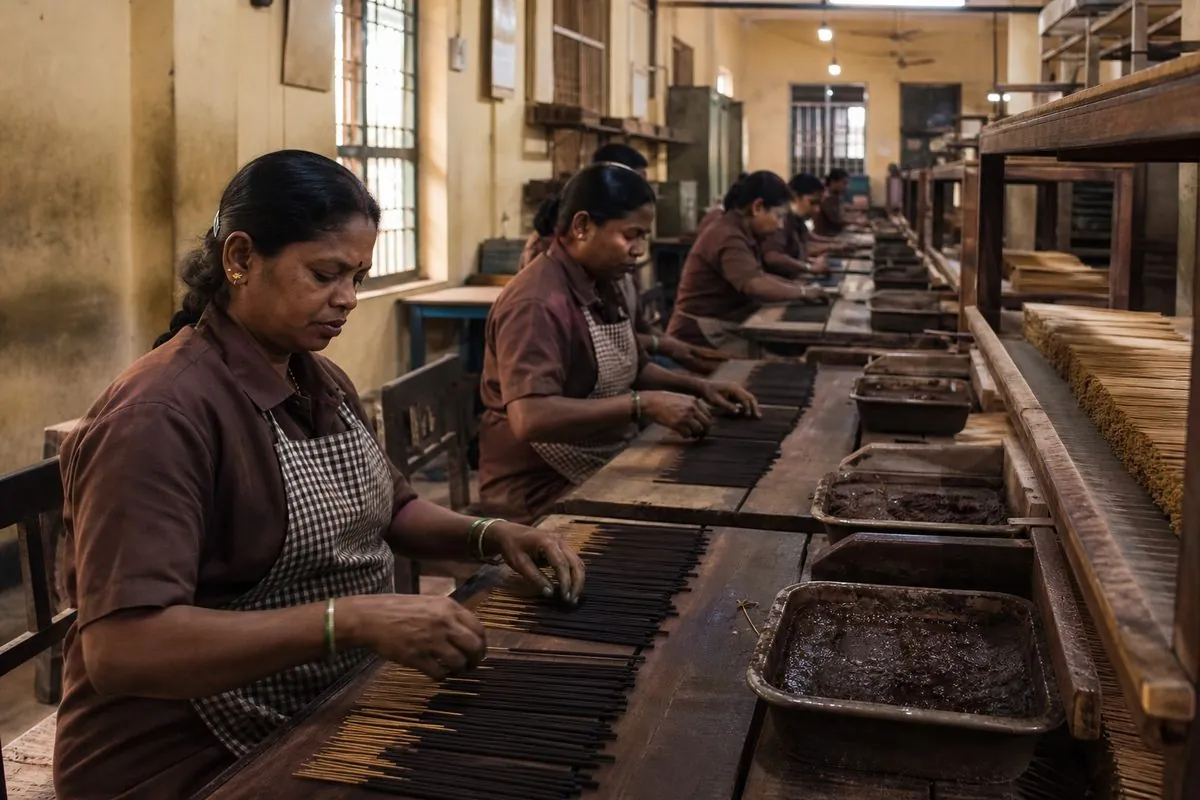
India is a global origin for incense sticks — agarbatti, dhoop, and burnable odoriferous preparations that move under Harmonized System heading 3307.41. Buyers searching for how to export incense sticks from India, or how to import them reliably, are really asking a process question: how do you connect verified rolling and dipping capacity in Mysuru–Bengaluru, Tamil Nadu–Puducherry, Gujarat–Mumbai, and Delhi-NCR to a Chemexcil-documented, moisture-protected, competitively priced FCL that clears customs and arrives with fragrance throw intact? This pillar guide answers that question end to end. For stick types and pack formats, see Top Incense Stick (Agarbatti) Products Exported from India; for destination selection, see Best Countries for Indian Incense Stick (Agarbatti) Exports.
Agarbatti exporting sits under India's Chapter 33 odoriferous-preparations trade. The primary filing line is India tariff 33074100 (WITS/HS6 330741) — agarbatti and other odoriferous preparations which operate by burning — with 33074900 reserved for non-burning room-fragrance contrast only. Chemexcil — the Basic Chemicals, Cosmetics & Dyes Export Promotion Council — is the relevant government-recognised trade body, and its RCMC sits alongside the Import Export Code (IEC) as the credential buyers expect before committing volume. Beyond registrations, the real operational work is process-specific: fragrance segregation, crush and moisture control, burn-test sample approval, Incoterm selection, and port stuffing discipline. If you would rather work through a verified supplier network than build these relationships from scratch, see Source Incense Sticks (Agarbatti) Directly from India and consider a merchant exporter in India to compress the learning curve.
This guide walks through the complete operational sequence — IEC and Chemexcil registration, cluster sourcing, HS classification, FOB pricing logic, hex-box and master-carton packaging, FCL loading from Nhava Sheva, Mundra, Chennai, or Tuticorin, Incoterms, lead times, documentation handoff, and buyer development — that Indian incense exporters and international importers should follow. WITS/UN Comtrade directional data for 2024 shows India HS 330741 exports at approximately US$147.6M and ~40,884 MT, with leading partners including the United States, UAE, Nigeria, Iraq, Spain, Malaysia, Chile, and the United Kingdom. For registration depth, see Chemexcil Registration Benefits for Incense Stick (Agarbatti) Exporters; for the pre-shipment paperwork gate, see Incense Stick (Agarbatti) Export Documentation Checklist.
Key Takeaways
Summary Box
Executive Summary
Summary Box
Exporting incense sticks from India is a five-part operating system: IEC and Chemexcil RCMC registration, cluster factory sourcing, fragrance-and-pack matched production (masala, dipped, herbal, dhoop, cones, or private-label retail), burn-test QC with moisture and crush controls, and FCL logistics from west- and south-coast ports under clear Incoterms.
WITS 2024 shows India HS 330741 exports at ~US$147.6M / ~40,884 MT — a material global corridor where process discipline on classification, packing, and lead-time honesty determines repeat orders more than headline FOB alone.
This pillar guide walks registrations through buyer development — the operational sequence Indian export houses and international distributors should follow before first FCL. It does not replace the SKU catalogue, country ranking deep-dive, or document field checklist; those sibling posts own those angles.
Market Size & Industry Overview
Key Statistics
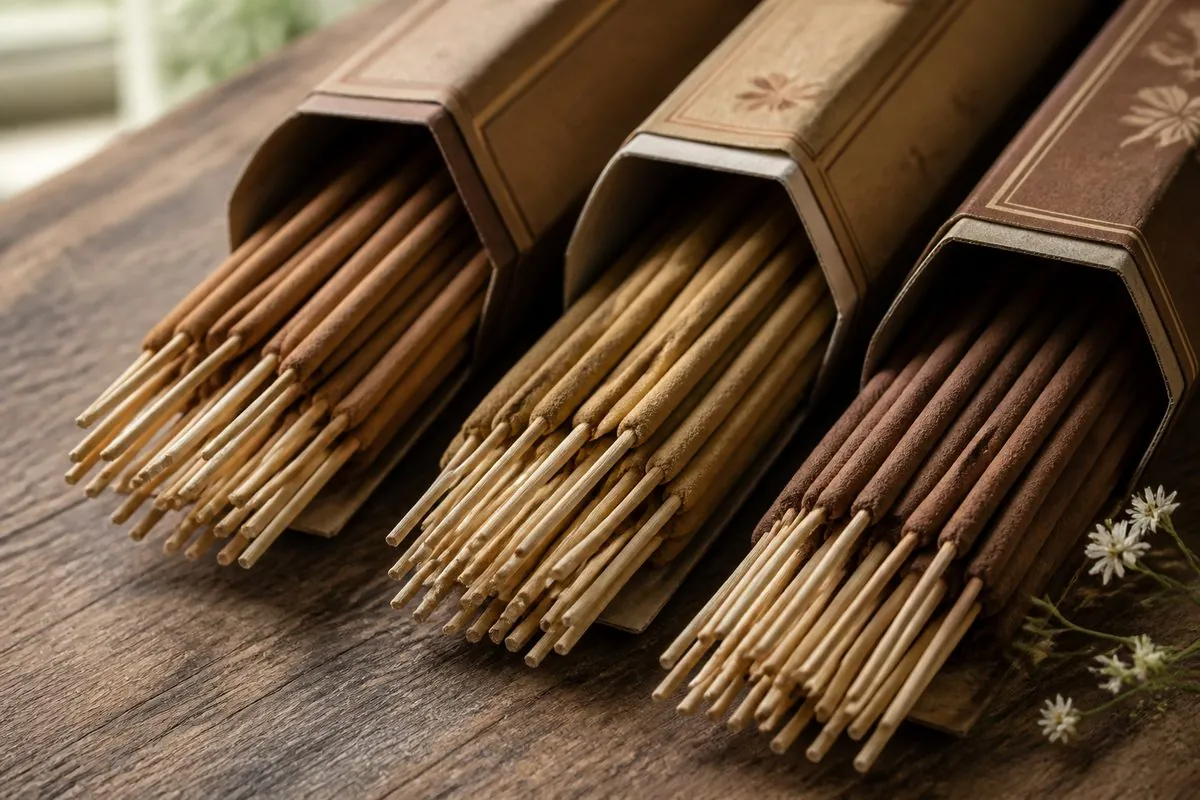
India's agarbatti export spine sits in Karnataka's Mysuru–Bengaluru corridor and the Tamil Nadu–Puducherry dipping and packing belt, with Gujarat–Mumbai and Delhi-NCR supporting private-label art, merchant consolidation, and ethnic wholesale programmes. Kannauj supplies traditional attar inputs for premium fragrance finishes when buyers specify heritage perfume profiles.
International buyers purchase burn performance, fragrance throw, ash behaviour, pack integrity, and delivery reliability under Chemexcil's Chapter 33 export lens — not commodity weight alone.
Most new exporters enter on stock fragrance FOB west- or south-coast cartons, then add custom private-label art and herbal programmes once sample-to-bulk burn-test rhythm is proven. Peak festive calendars — Navratri, Diwali, Christmas, and Ramadan retail builds — can tighten factory slots and extend lead times, so process calendars must book capacity early.
Process exporters who treat moisture control, fragrance segregation, and HS 33074100 discipline as core operations — not afterthoughts — win the repeat distributor and retail programmes that define this category.
Export Statistics
Key Statistics
Start export planning with HS-line discipline: India 33074100 covers agarbatti and other odoriferous preparations which operate by burning; 33074900 is non-burning odoriferous-preparation contrast only — confirm with your CHA before the first shipping bill.
WITS/UN Comtrade 2024 reports India HS 330741 exports at US$147,604.26K and 40,883,600 kg (~US$147.6M / ~40,884 MT). Leading partners by value include the United States (~US$21.2M), UAE (~US$7.7M), Nigeria (~US$7.0M), Iraq (~US$5.7M), Spain (~US$5.6M), Malaysia (~US$5.5M), Chile (~US$5.4M), and the United Kingdom (~US$5.4M).
Treat these figures as directional planning context. Re-verify Comtrade, DGCI&S, and ITC Trade Map annually before citing numbers in buyer presentations or contracts. The table below summarises directional cluster metrics for board and RFQ packs.
Directional profile of Indian incense stick (agarbatti) trade (HS 330741 / India 33074100)
Swipe →
Data table — swipe horizontally on small screens
| Metric | Directional Estimate | Notes |
|---|---|---|
| Primary manufacturing clusters | Mysuru–Bengaluru; Tamil Nadu–Puducherry | Masala rolling, dipped sticks, branded and export packing corridors |
| Supporting clusters | Gujarat–Mumbai; Delhi-NCR; Kannauj (attar inputs) | Private-label packing, merchant consolidation, premium fragrance inputs |
| Applicable HS headings | 3307.41 / India 33074100 (primary); 3307.49 / India 33074900 (non-burning contrast) | Confirm eight-digit line with CHA before shipping-bill filing |
| Governing trade council | Chemexcil (Basic Chemicals, Cosmetics & Dyes EPC) | RCMC alongside IEC for export credibility in Chapter 33 agarbatti |
| WITS 2024 export value (HS 330741) | ~US$147.6M / ~40,884 MT | Directional UN Comtrade figure for burning odoriferous preparations — re-verify annually |
| WITS 2024 India imports (HS 330741) | ~US$0.63M / ~726 MT (chiefly Vietnam) | Net-exporter context — India exports far exceed India imports on this line |
| US HTS planning cue (verify live) | 3307.41.00.00 — USITC general (MFN) field 2.4% | Confirm live USITC HTS / preferential overlays before landed-cost quotes |
| Leading destination regions | North America, Middle East, Africa, EU, ASEAN, LatAm | Top partners: USA, UAE, Nigeria, Iraq, Spain, Malaysia, Chile, UK |
| Dominant export formats | Hex/rectangle retail packs; wholesale pouches; master cartons | Moisture barrier and fragrance segregation required for ocean transit |
Trade Statistics Analysis for Process Planning
For process exporters, the trade data answer a sequencing question: which corridors justify FCL frequency, and which start as LCL or mixed-SKU trials? High-value partners such as the USA and EU retail programmes often demand tighter IFRA notes, SDS packs, and private-label art lead times. Volume corridors such as Nigeria and parts of West Africa often prioritise charcoal-dipped and masala economy packs with competitive FOB and reliable sailings.
Average unit value implied by ~US$147.6M on ~40,884 MT sits near the mid-commodity band — but private-label hex programmes and premium sandalwood lines pull realised FOB well above that average. Never quote a buyer the Comtrade average as a contract price; build lot-specific FOB from fragrance grade, stick type, and pack format.
Import Statistics
Key Statistics
India itself imports little finished agarbatti on HS 330741: WITS/UN Comtrade 2024 records India imports at US$629.40K and 725,986 kg (~US$0.63M / ~726 MT), chiefly from Vietnam (~US$624K). Against ~US$147.6M of India exports on the same line, India is a large net exporter of burning odoriferous preparations — process planning should focus on destination-side import demand, not Indian import substitution.
Destination import demand for HS 330741 spreads across ethnic retail, wellness and home-fragrance chains, mosque and temple wholesale, and modern-trade private label. Import data analysis for process planning focuses on buyer type, compliance burden, and freight corridor — not SKU preference matrices (owned by the demand-by-country sibling post).
USA and EU importers typically request SDS, IFRA conformity notes for premium fragrance programmes, and clear country-of-origin marking. For US landed-cost models, USITC HTS 3307.41.00.00 publishes a general (MFN) duty field of 2.4% — verify live before quoting, including any preferential or Chapter 99 overlays. UAE and GCC buyers often add Halal documentation and bilingual labelling. African and Latin American volume buyers emphasise packing strength, lead-time honesty, and payment-term discipline. Confirm live duty schedules on USITC HTS, TARIC, and destination customs portals before locking landed-cost models; do not invent destination duty percentages.
Directional import demand profile by destination market (process planning view)
Swipe →
Data table — swipe horizontally on small screens
| Market | Directional Demand Profile | Primary Buyer Type |
|---|---|---|
| United States | Highest India HS 330741 partner by value; ethnic, wellness, and retail private label | Distributors, lifestyle retailers, ethnic wholesalers |
| United Arab Emirates | Gulf retail and re-export hub for Middle East and Africa assortments | Wholesale traders, modern-trade importers, re-exporters |
| Nigeria | High-volume charcoal and masala stick programmes | Importers, regional wholesalers, ethnic retail networks |
| Spain / United Kingdom | EU/UK lifestyle and ritual fragrance retail | Specialty distributors, gift and home retailers |
| Malaysia | ASEAN ritual and retail incense demand | Wholesale importers, religious goods distributors |
| Chile / Brazil / Mexico | LatAm volume absorption of Indian agarbatti | Importers, supermarket private label, ethnic channels |
| Iraq / Saudi Arabia | Middle East ritual and household fragrance programmes | Wholesale traders; Halal and labelling focus |
Import Data Analysis Notes for Exporters
When you read partner rankings, separate value leaders from volume-led corridors. A USA private-label hex programme may ship fewer kilograms than a Nigeria wholesale pouch programme yet generate higher invoice value and heavier compliance work. Process calendars should allocate sample, SDS, and art-approval days accordingly.
Preferential duty under bilateral or regional FTAs can change landed cost materially. Confirm origin criteria and certificate-of-origin form with your CHA before promising a duty rate on an RFQ reply. For market-entry ranking methodology, see Best Countries for Indian Incense Stick (Agarbatti) Exports.
Product Categories & Variants Overview
Summary Box
- Quote stick family, fragrance code, stick count, and pack format on every proforma.
- Confirm HS 33074100 with CHA for burning sticks — do not force 33074900.
- Route full SKU and fragrance-family selection to the products catalogue post.
- Route natural/eco specialty depth to the natural herbal export opportunities post.
Process exporters do not need a full SKU catalogue here — that angle belongs to the products sibling post — but every shipping bill, proforma, and stuffing plan must name the stick family clearly. Misnaming a dipped charcoal programme as masala, or filing burning sticks under a non-burning heading, creates customs and buyer disputes.
Use the overview table below as a process-side map: which family you are manufacturing, packing, and classifying under HS 33074100 before you quote Incoterms or book a container.
Process-side map of incense stick families commonly exported from India
Swipe →
Data table — swipe horizontally on small screens
| Product Family | Process Note | Typical Pack Cue | Primary Channel Cue |
|---|---|---|---|
| Masala incense sticks | Hand-rolled paste; fragrance in paste matrix | Hex or rectangle retail boxes | Ethnic retail, ritual, mid-premium wholesale |
| Perfume-dipped charcoal sticks | Bamboo core + charcoal paste, oil dipped | Pouches and economy hex packs | Volume wholesale, Africa and value retail |
| Herbal / natural sticks | Botanical powders; cleaner-burn positioning | Retail hex with claim panels | Wellness and specialty retail |
| Bamboo-less dhoop sticks | Extruded sticks without bamboo core | Pouches or short boxes | Ritual and regional wholesale |
| Incense cones | Cone-form burning preparations | Tins, trays, or retail cartons | Home fragrance and gift assortments |
| Premium sandalwood / oud / floral | Higher fragrance load; tighter QC | Private-label hex / gift packs | Lifestyle retail and gift programmes |
| Private-label retail programmes | Custom art, exclusive fragrance codes | Buyer-branded hex boxes | Modern trade and brand owners |
Manufacturing Overview
Export Tip
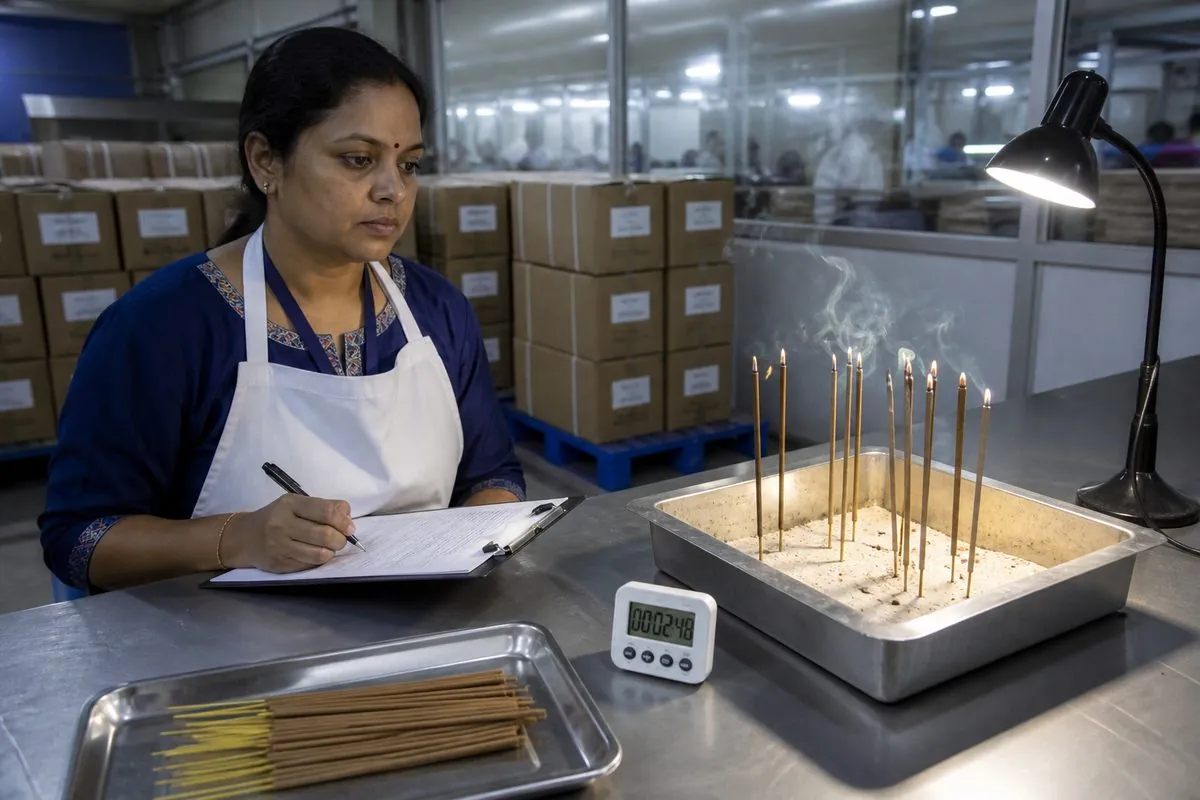
Agarbatti manufacturing for export typically flows from bamboo stick preparation (where used), paste mixing or charcoal coating, fragrance application (masala paste or perfume dip), drying, stick sorting, and packing into retail or wholesale formats. Masala lines emphasise hand-rolling discipline and paste consistency; dipped lines emphasise charcoal paste uniformity and controlled oil uptake.
Mysuru–Bengaluru concentrates deep masala and branded finishing capacity. Tamil Nadu–Puducherry (including the Cuddalore belt) supports volume dipped and masala programmes with strong export packing. Gujarat–Mumbai houses private-label art and merchant consolidation. Delhi-NCR supports ethnic wholesale programmes. Kannauj attar houses feed premium fragrance finishes when specified.
From a process standpoint, the exporter's job is to lock factory allocation to a written burn-test specification, retain approved samples, and prevent fragrance cross-contamination and moisture pickup between drying rooms and stuffing yards.
Process Controls That Protect Export Quality
Retain sealed burn-test samples from every approved fragrance code. Photograph stuffing layers for crush and segregation proof. Stage cartons in dry warehouses away from open fragrance oil drums that can cross-contaminate neighbouring SKUs. Align lot IDs on hex boxes, master cartons, packing lists, and invoices before CHA filing.
Export Process: Step-by-Step
Export Tip
The following sequence is the complete operational path from a standing start to a shipped, documented incense stick consignment. Follow the steps in order — registrations, sample burn-test approval, moisture-safe packing, and quality gates exist precisely because skipping them creates customs holds, fragrance complaints, or damaged buyer trust.
Export process timeline overview for Indian incense stick programmes
Swipe →
Data table — swipe horizontally on small screens
| Stage | Typical Duration | Process Gate |
|---|---|---|
| IEC + Chemexcil RCMC setup | 1–3 weeks (clean filings) | Credentials active before buyer outreach |
| Sample kit burn-test cycle | 7–14 days production + transit | Written buyer approval on retained lot ID |
| Stock fragrance commercial order | 2–4 weeks after PO | Pack art and carton marks locked |
| Custom / private-label programme | 4–8+ weeks after art approval | Fragrance exclusivity and IFRA notes as required |
| Port stuffing and sailing | 3–10 days post-packing (corridor-dependent) | Moisture and crush inspection photos filed |
Step 1: Obtain an Import Export Code (IEC) from DGFT
An IEC is the baseline legal requirement for any commercial export from India, including incense sticks. Apply online through the DGFT portal with PAN, current bank account details, and address proof consistent with your GST registration. Clean applications are typically processed within a few working days. Without an IEC you cannot file a shipping bill for HS 33074100 consignments.
Step 2: Register with Chemexcil and secure your RCMC
Agarbatti and related Chapter 33 odoriferous preparations fall under Chemexcil's notified product scope. Registration with an active RCMC is a practical necessity for trade-fair access, buyer KYC packs, and council directory credibility. Confirm product-list fit with Chemexcil and your CHA before locking the RCMC route. See Chemexcil Registration Benefits for Incense Stick (Agarbatti) Exporters for application and renewal detail.
Step 3: Source from verified Indian manufacturing clusters
Map supply to specific factories in Mysuru–Bengaluru for masala depth, Tamil Nadu–Puducherry for volume dipped and packing programmes, and Gujarat–Mumbai or Delhi-NCR for private-label consolidation. Verify IEC, prior export packing experience, burn-test capability, and moisture-control warehouse practice before allocating volume. See Source Incense Sticks (Agarbatti) Directly from India for importer-side verification checkpoints.
Step 4: Lock stick family, fragrance code, and pack format in writing
Align masala, dipped, herbal, dhoop, cones, or premium private-label format to the buyer's channel and price point before production. Quote stick count per box, net weight, fragrance name or code, and art status on the proforma. Do not leave fragrance exclusivity or private-label ownership ambiguous — document both in the purchase order annex.
Step 5: Approve burn-test samples before bulk production
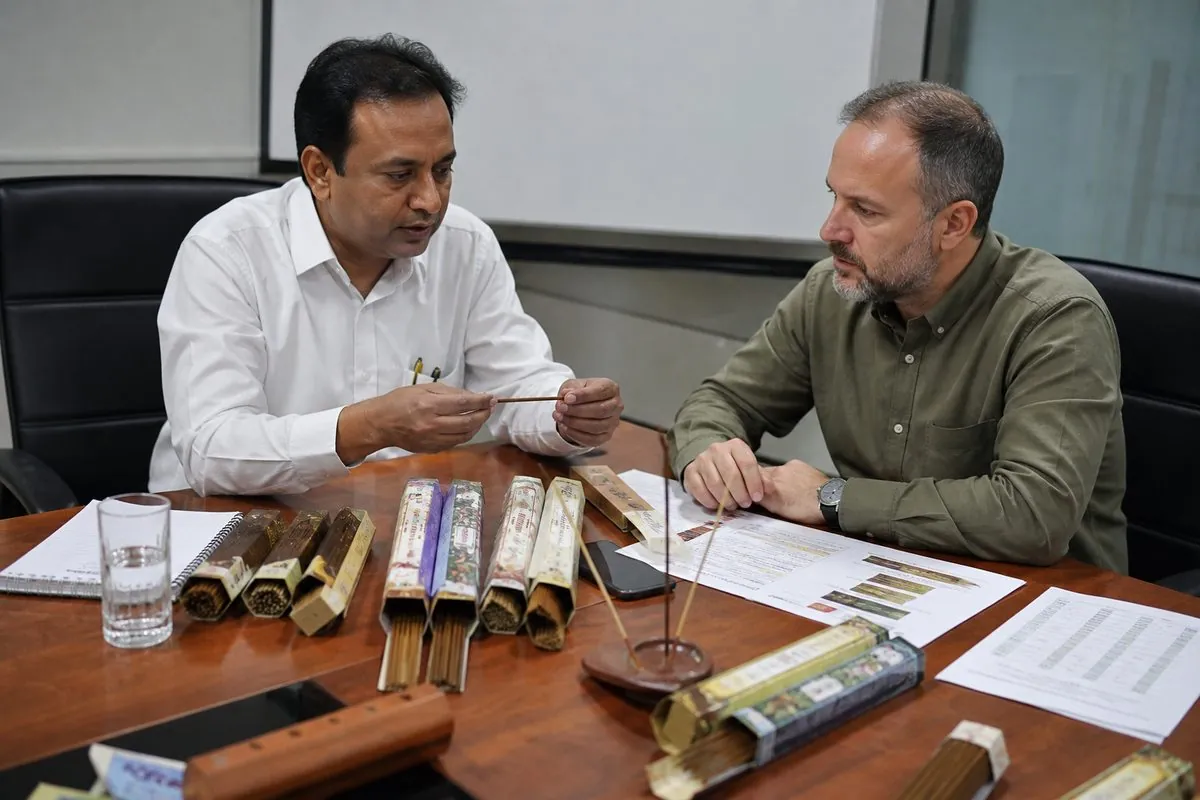
Ship sample kits (typically 1–5 kg or 50–200 hex boxes) with burn-time, ash, fragrance throw, and stick integrity notes. Buyer sign-off must reference the retained sample lot ID. Bulk production must match the approved sample on fragrance load, stick length, and pack art — never let bulk drift from the signed kit.
Step 6: Commission compliance documents appropriate to destination
Commodity wholesale programmes need commercial docs, COO where required, and SDS/MSDS when fragrance compounds trigger buyer or customs requests. Premium EU/US retail may add IFRA conformity notes and REACH/SVHC statements. Middle East and selected Africa programmes may require Halal certificates. Route field-by-field document assembly to the documentation checklist.
Step 7: Select packaging and plan moisture-safe FCL loading
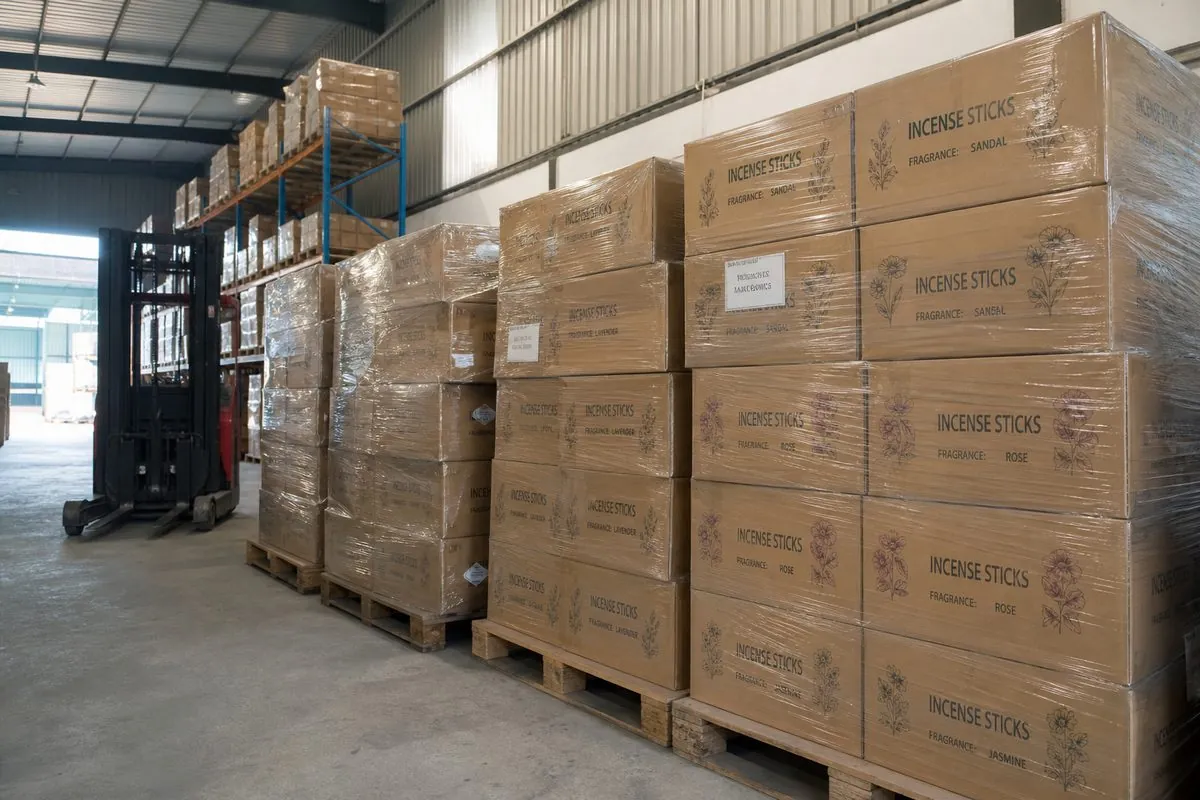
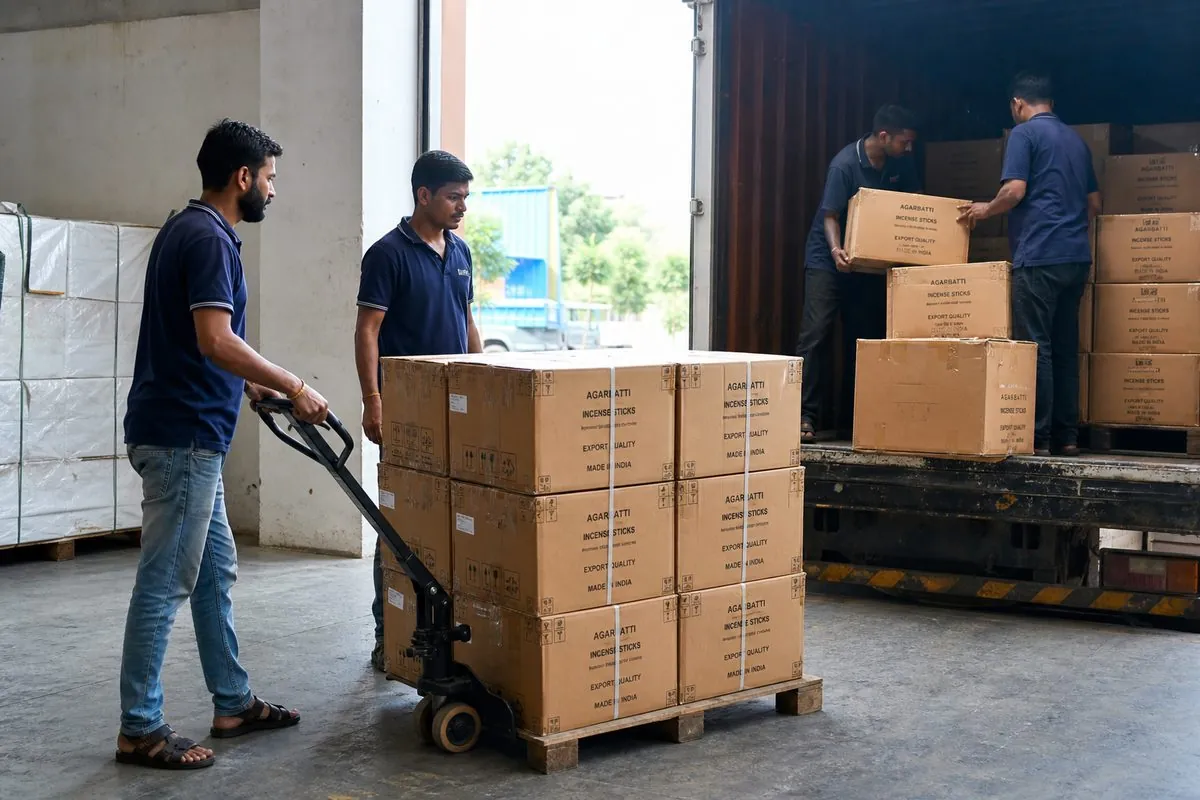
Pack inner hex/rectangle boxes or pouches into corrugated master cartons with moisture barrier. Segregate strong fragrances. Plan pallet stretch-wrap and crush-resistant stacking. Confirm carton counts and net/gross weights with your forwarder before booking — hex density differs sharply from bulk poly bundles.
Step 8: Build export pricing and confirm Incoterms
Construct FOB named-port USD/kg or USD/carton from fragrance grade, stick type, testing, packaging, inland haulage to Nhava Sheva, Mundra, Chennai, or Tuticorin, and margin. Quote EXW factory/warehouse, FOB named Indian port, or CFR/CIF destination based on buyer capability. Reserve DDP for mature retail distributor programmes only.
Step 9: Prepare documentation and coordinate with your CHA
Core docs: commercial invoice, packing list, shipping bill, bill of lading or AWR, certificate of origin, Chemexcil RCMC copy where used, SDS/MSDS when required, and burn-test or QC notes on retained samples. Confirm India HS 33074100 with your CHA. Reconcile fragrance codes, carton counts, and lot IDs across every page before vessel cutoff.
Step 10: Book shipping via Nhava Sheva, Mundra, Chennai, or Tuticorin
Ocean FCL/LCL is standard for commercial volumes. Nhava Sheva and Mundra serve west-coast consolidation; Chennai and Tuticorin serve South India factory corridors; Bengaluru ICD consolidation applies when inland rail or ICD routing is economical. Air freight is for urgent burn-test samples only — not for routine FCL economics.
Step 11: Develop and maintain international buyers
Combine HS 330741 trade-data prospecting, Chemexcil trade shows, B2B marketplaces, and distributor outreach. See How to Find International Buyers for Incense Sticks (Agarbatti) and Trade Shows and B2B Marketplaces for Incense Stick (Agarbatti) Exporters. Convert trial cartons into repeat FCL only after destination burn feedback and packing integrity are confirmed.
Pricing Analysis
Buyer Tip
Process exporters should model FOB as grade-plus-pack economics — fragrance oil cost, bamboo stick cost, labour intensity (masala vs dipped), retail art, testing, inland haulage, and margin. Static price lists fail when oil costs move between quote acceptance and vessel cutoff.
Economy dipped sticks typically quote in the lower USD/kg band; mid masala and herbal/natural grades step up; premium sandalwood, oud, and private-label retail packs are often quoted per hex box or per master carton rather than only per kilogram. Always state the Incoterm and named port on the quote.
Directional FOB pricing bands for Indian incense stick exports
Swipe →
Data table — swipe horizontally on small screens
| Grade / Format | Directional FOB | Notes |
|---|---|---|
| Economy perfume-dipped sticks | ~US$0.8–2.5/kg | Volume charcoal-dipped programmes; pack format drives realised unit price |
| Mid masala sticks | ~US$2.5–6/kg | Hand-rolled paste programmes; fragrance load and stick length affect band |
| Herbal / natural sticks | ~US$4–10/kg | Botanical positioning; cert and claim substantiation may add cost |
| Premium sandalwood / oud / PL retail | Higher; often USD/hex or USD/carton | Private-label art, gift packs, tighter QC — confirm quote date |
MOQ Analysis
Buyer Tip
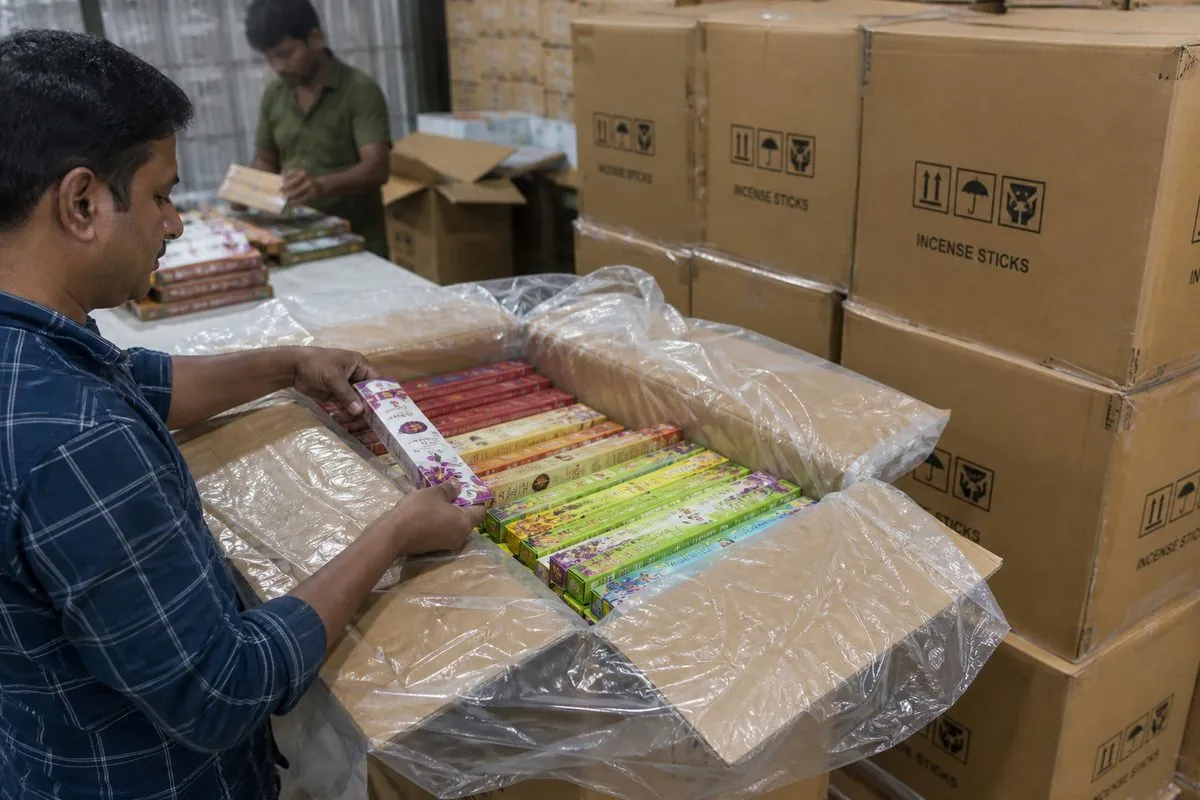
MOQ tiers for process programmes scale from burn-test samples to wholesale MT and density-planned FCL. Private-label art programmes may require higher unit MOQs per fragrance even when kilogram totals look modest. Confirm pack density with your forwarder before promising container fill to a buyer.
Directional MOQ tiers by incense stick transaction stage
Swipe →
Data table — swipe horizontally on small screens
| Stage | Typical MOQ | Purpose |
|---|---|---|
| Burn-test samples | 1–5 kg or 50–200 hex boxes | Fragrance throw, burn time, ash, and pack art evaluation |
| Trial order | 200–1,000 kg or 1–5 cartons per SKU | Destination QC, retail sell-through test, logistics proof |
| Wholesale programme | 1–5 MT | Distributor restock and multi-SKU assortment builds |
| FCL programme | Planned by pack density (hex vs bulk poly) | Established retail or wholesale repeat sailings — confirm stow with forwarder |
Packaging Standards
Export Tip
Incense packaging must protect fragrance, prevent stick breakage, and block moisture. Inner formats include hex boxes, rectangle boxes, pouches, and cellophane sleeves. Master cartons need corrugated strength and moisture barrier. Mark fragrance name, stick count, net weight, batch/lot ID, country of origin, and handling icons. Segregate strong fragrances in the container plan.
Packaging formats and specifications for incense stick export
Swipe →
Data table — swipe horizontally on small screens
| Format | Typical Configuration | Use Case | Key Requirement |
|---|---|---|---|
| Hex / rectangle retail boxes | Printed inner packs, stick count marked | Lifestyle retail and ethnic wholesale | Crush resistance; accurate stick count; art approval |
| Pouches / sleeves | Poly or laminated pouches, bulk-friendly | Volume wholesale and economy channels | Seal integrity; fragrance retention |
| Master cartons | Corrugated with moisture barrier | All ocean shipments | Lot marks match packing list; stacking strength |
| Pallet stretch-wrap | Unitised cartons, corner boards as needed | Forklift discharge destinations | Avoid crush; keep dry staging until stuffing |
| Fragrance segregation | Separate stacks / liners by scent family | Multi-SKU FCL and LCL | Prevent scent cross-contamination in transit |
Container Loading Details
Export Tip
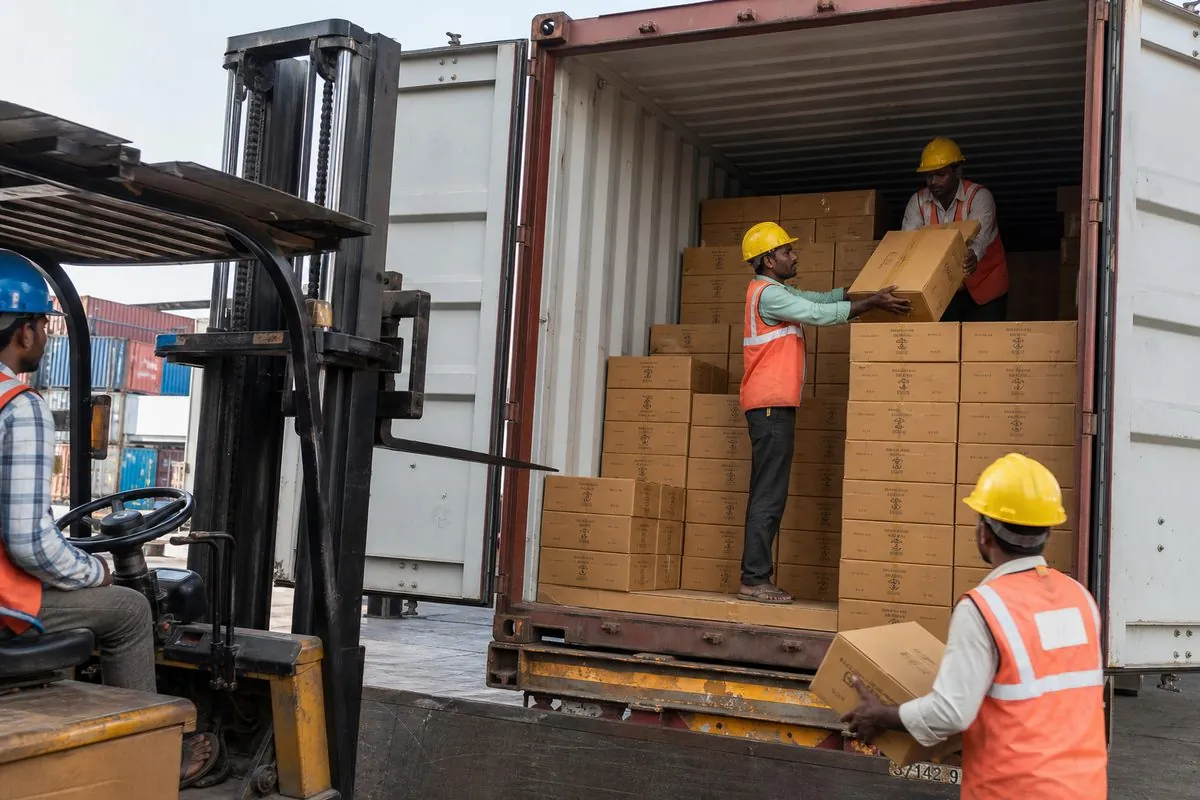
Incense FCL stuffing is volume-and-fragility constrained more than dense bulk cargo. Hex-box programmes fill cubic capacity before weight limits; bulk poly bundles can change payload. Always verify stow plans with the forwarder. Photograph layers showing carton orientation, dunnage, and segregation. Reject wet or soft cartons at the stuffing yard.
Directional container loading guidance for incense sticks (agarbatti)
Swipe →
Data table — swipe horizontally on small screens
| Container Type | Loading Consideration | Typical Use |
|---|---|---|
| 20-foot FCL | Plan by carton cube and crush limits; confirm payload with forwarder | Trial and mid-volume commercial shipments |
| 40-foot FCL / 40-foot HC | Higher cube for hex retail programmes; watch stacking height | Established distributor and private-label programmes |
| LCL | Suitable for trial cartons below FCL economics | New buyer relationships and multi-supplier consolidations |
| Palletised loads | Speeds discharge where destination has forklifts | Modern-trade and warehouse importers |
| Moisture / fragility controls | Dry cartons, no floor wetting, fragrance segregation | All ocean incense consignments |
Shipping Methods
Export Tip
- Samples: air/express — typically 7–14 days for burn-test kits when stocked
- Stock fragrance orders: ocean after 2–4 weeks production
- Custom / private-label: 4–8+ weeks including art and fragrance approval
- Incoterms: EXW, FOB named port, CFR/CIF; DDP selective for mature retail
- Ports: Nhava Sheva, Mundra, Chennai, Tuticorin (+ ICD consolidation as applicable)
Ocean FCL and LCL from Nhava Sheva (JNPT), Mundra, Chennai, Tuticorin, and Bengaluru ICD consolidation routes cover commercial incense volumes. Air or express courier handles urgent burn-test sample kits — typically within the 7–14 day sample window when production is ready. Inland trucking from Mysuru, Tamil Nadu, or Gujarat factories must protect cartons from rain and road crush before port gate-in.
Lead-time planning should separate factory production from ocean transit. Stock fragrances often ship 2–4 weeks after PO confirmation; custom private-label art commonly needs 4–8 weeks. Festive demand spikes can extend both factory and liner availability — book early for Diwali, Christmas, and Ramadan retail builds.
Incoterms Selection for Incense Programmes
Incoterms quick reference for Indian incense stick exports
Swipe →
Data table — swipe horizontally on small screens
| Incoterm | Seller Focus | Buyer Focus | Best Fit |
|---|---|---|---|
| EXW | Factory/warehouse handover | India pickup, export formalities if agreed | Buyers with local freight forwarders |
| FOB (named port) | On-board delivery at Indian port | Ocean freight + destination risk | Most first commercial orders |
| CFR / CIF | Freight (and insurance under CIF) to destination port | Import clearance and inland delivery | Buyers wanting bundled ocean cost |
| DDP | Delivered duty paid to named place | Receive goods with duties handled | Mature retail programmes only |
FOB named Indian port is the most common first-order Incoterm — seller delivers on board; buyer controls ocean freight and destination insurance. EXW suits buyers with strong India logistics partners. CFR/CIF helps buyers who want freight bundled. DDP should remain selective because destination duty, labelling, and last-mile compliance vary widely across USA, EU, GCC, and African markets.
Certifications
Compliance Notes
IEC and Chemexcil RCMC are the baseline exporter credentials. Lot-level commercial documents are universal. Destination and channel then add SDS/MSDS, IFRA notes, REACH/SVHC statements, Halal certificates, vegan or charcoal-free declarations (only when substantiated), and ISO/GMP plant claims where verified.
Certifications and documents relevant to incense stick export
Swipe →
Data table — swipe horizontally on small screens
| Certification / Document | Purpose | Relevant For |
|---|---|---|
| IEC + Chemexcil RCMC | Baseline export registration and council membership | All commercial agarbatti export shipments from India |
| Certificate of Origin | Preferential or non-preferential origin proof | FTA corridors and buyer customs clearance |
| SDS / MSDS | Fragrance compound handling and importer compliance | Shipments where buyer or destination requires chemical docs |
| IFRA conformity notes | Fragrance compliance for retail programmes | Premium EU/US lifestyle and private-label buyers |
| REACH / SVHC statements | EU substance communication | Buyer-mandated EU retail programmes |
| Halal certificate | Faith and retail compliance | Selected Middle East and Africa programmes |
| Burn-test / QC report | Burn time, ash, fragrance throw on retained samples | All serious commercial programmes |
Buyer Requirements
Buyer Requirements
International incense buyers typically request fragrance and stick-family samples, written pack specifications, FOB or CFR pricing, Chemexcil/IEC proof, lead-time commitment, and moisture-safe packing assurances. Retail chains add private-label art guidelines, barcode rules, and claim substantiation for natural, vegan, or IFRA-aligned programmes.
Wholesale African and Middle Eastern buyers often prioritise carton strength, fragrance intensity consistency, and sailing reliability. US and EU buyers add SDS/IFRA layers and clearer labelling. Align your RFQ reply to the buyer's channel — do not send a private-label EU retail packet to a volume pouch wholesaler, or vice versa.
Payment terms for first orders commonly run advance or LC at sight; open account appears after successful trial clearance. Document Incoterm, named port, fragrance codes, and carton marks on the purchase order so process responsibility stays clear if a claim arises after discharge.
Country-wise Opportunities
Market Snapshot
This pillar view ranks process opportunity — compliance load, freight corridor fit, and Incoterm practicality — not a full destination ranking or per-country SKU matrix. Those deeper angles live in Best Countries for Indian Incense Stick (Agarbatti) Exports and Most Demanded Indian Incense Sticks (Agarbatti) by Country.
Use the table below to decide where your first process investment (sample kits, SDS packs, Halal files, private-label art) should go.
Directional country opportunity profile for process-led incense exporters
Swipe →
Data table — swipe horizontally on small screens
| Country | Process Opportunity Cue | Key Requirement Focus | Opportunity Note |
|---|---|---|---|
| United States | Highest WITS partner value; strong private-label potential | SDS/IFRA for premium lines; retail packing discipline | Invest in sample burn-test and art lead times early |
| United Arab Emirates | Gulf hub with re-export reach | Halal and bilingual labelling where required | Good FOB/CFR programmes via west-coast sailings |
| Nigeria | Volume charcoal and masala wholesale | Carton strength, lead-time honesty, payment discipline | Strong for economy dipped and masala pouch programmes |
| Spain / United Kingdom | EU/UK lifestyle retail corridors | REACH/IFRA notes; retail claim accuracy | Fit for mid-premium hex and herbal lines |
| Malaysia | ASEAN ritual and retail demand | Labelling and FTA origin paperwork | Stable wholesale and religious-goods channels |
| Chile | LatAm volume partner on WITS ranks | Spanish labelling; moisture-safe ocean packing | Good cube-planned FCL once trial clears |
| Iraq | Middle East household and ritual demand | Documentation clarity; robust packing | Volume potential with disciplined Incoterms |
| Australia / Canada | Lifestyle and ethnic retail niches | Clear COO and fragrance compliance packs | Selective premium and private-label entry |
Sourcing Checklist
Checklist
Buyer Checklist
Checklist
Exporter Checklist
Checklist
Common Buyer Mistakes
Common Mistakes Box
Future Market Trends
Key Statistics
Wellness retail, ethnic modern trade, and private-label home fragrance continue to support Indian agarbatti export demand across North America, Europe, GCC, Africa, ASEAN, and LatAm. Cleaner-burn and herbal positioning grows in specialty channels, while volume dipped and masala programmes remain the volume spine in many African and Middle Eastern corridors.
Process winners will invest in digital sample tracking, SDS readiness, and festive capacity planning — not only in fragrance catalogues. Buyers increasingly expect photo evidence of stuffing discipline and lot-level traceability from hex box to bill of lading.
Fragrance oil and bamboo stick cost volatility will keep serious exporters on dated FOB quotes with clear validity windows. Transparent Incoterms and honest lead times outperform aggressive promises that miss vessel cutoffs.
Challenges & Solutions
- Challenge: fragrance cross-contamination in multi-SKU FCL — Solution: segregation liners, separate stacks, and stuffing photos
- Challenge: moisture dulling throw on arrival — Solution: moisture-barrier cartons, dry staging, reject wet cartons at yard
- Challenge: HS misfiling under 33074900 — Solution: CHA-confirmed 33074100 for burning sticks
- Challenge: sample-to-bulk drift — Solution: retained burn-test lots and written fragrance codes on PO
- Challenge: festive lead-time slips — Solution: early capacity booking and dated production calendars
- Challenge: buyer claim on broken sticks — Solution: crush-resistant packing and stack-height limits in stuffing SOP
Scaling incense stick export involves registration discipline, fragrance and moisture control, classification accuracy, and corridor-specific compliance. The challenges below are process problems with process solutions.
Compliance Checklist
Checklist
Compliance Notes
Sources
- WITS / UN Comtrade — India exports HS 330741 by partner, 2024
- WITS / UN Comtrade — India imports HS 330741 by partner, 2024
- UN Comtrade Database (Comtrade Plus)
- ITC Trade Map
- DGFT (India) — IEC / Foreign Trade Policy portal
- ICEGATE — Indian Customs EDI
- India CBIC — Customs Tariff / notifications
- Exim Guru — ITC-HS 33074100 Agarbatti (policy Free)
- Chemexcil India — Basic Chemicals, Cosmetics & Dyes EPC (Panel III Cosmetics, Soaps, Toiletries & Essential Oils)
- IFRA — International Fragrance Association
- USITC Harmonized Tariff Schedule — search 3307.41
- USITC HTS Chapter 33 PDF archive (historical reference)
- European Commission TARIC consultation
- ECHA — REACH / SVHC guidance
- ICC Incoterms® rules
- Altus Exports — Contact
All sources accessed for factual audit 2026-08-01. Prefer primary government, council, and multilateral trade databases when citing figures in contracts or buyer presentations. Trade totals below are WITS/UN Comtrade directional figures — re-verify via DGCI&S / ITC Trade Map before contracts.
Process and registration steps in this guide should be cross-checked against current DGFT, Chemexcil, and CBIC Chapter 33 tariff entries before first agarbatti shipment.
Conclusion
Exporting incense sticks (agarbatti) from India succeeds when IEC, Chemexcil RCMC, HS 33074100 discipline, burn-test sample control, moisture-safe packing, clear Incoterms, and port stuffing operate as one system — not as disconnected tasks. India's ~US$147.6M HS 330741 corridor rewards process reliability as much as fragrance variety.
Work with Altus Exports as your merchant exporter and global sourcing partner for incense sticks (agarbatti) — verified Indian factory lots, burn-tested fragrance specs, Chemexcil-aligned documentation, and FCL booking from inquiry to shipment.
Altus Exports helps Indian factories and overseas buyers launch agarbatti programmes as a merchant exporter in India, export products from India partner, and global sourcing partner — contact us for your first burn-test kit or next named-port FCL.
Next reads: Top Incense Stick (Agarbatti) Products Exported from India, Incense Stick (Agarbatti) Export Documentation Checklist, Best Countries for Indian Incense Stick (Agarbatti) Exports, and Source Incense Sticks (Agarbatti) Directly from India.