
How to Source Leather Bags Directly from India: Buyer Playbook
By Saurabh Mittal, Founder, Altus Exports
A procurement playbook for international buyers sourcing leather bags directly from India — RFQ discipline, supplier verification, sealed sample approval, pre-shipment inspection, trial versus FCL sequencing, and buyer-side QC gates written for importers, distributors, wholesalers, and retail chains.
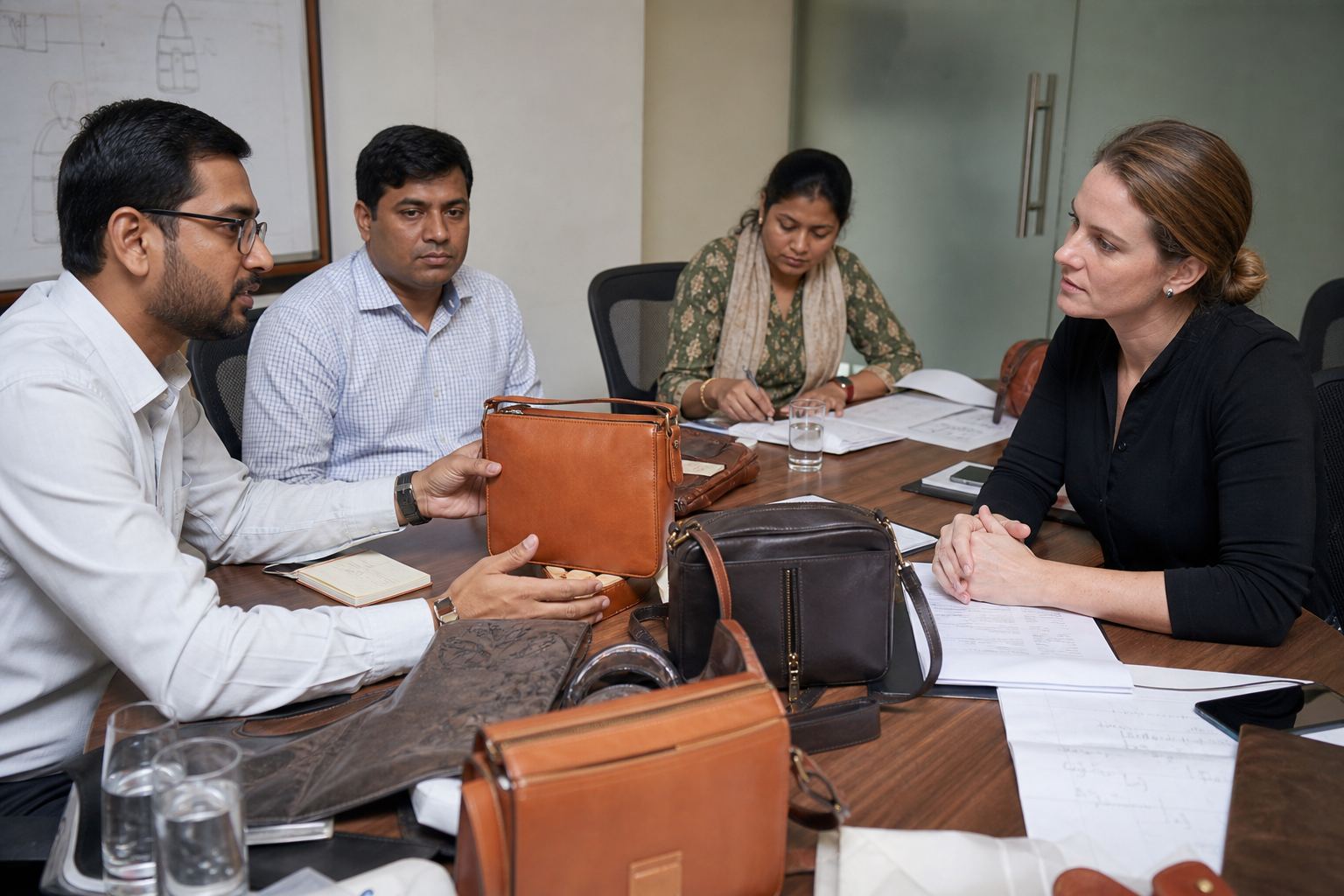
Buyer procurement playbook — not a market overview and not an exporter registration guide. Goal: RFQ → first bill of lading without colour drift, weak hardware, or compliance gaps on HS 4202 cargo.
Skipping verification causes predictable failures: beautiful prototypes then shade drift; no current CLE RCMC; vague “genuine leather”; payment before credentials. India's capacity is not the problem — process is.
Gates: written RFQ → paid sealed samples → PSI → trial → FCL. CLE depth: CLE Benefits. Markets: Best Countries.
Key Takeaways
Summary Box
Executive Summary
Summary Box
- RFQ gate — comparable quotes (dimensions, leather, hardware, SPI, Incoterm).
- Verification gate — CLE RCMC / IEC / GST checked independently.
- Sealed sample gate — production-grade construction before bulk cutting.
- PSI gate — defects caught on the shipping lot, not a showroom piece.
- Trial → FCL gate — scale capital only after clean colourway cycles.
- Depth centerpieces: Manufacturing Overview + Sourcing/Buyer checklists.
India offers deep tanning, skilled bag labour, and HS 4202 coverage from handbags to wallets. Multi-year supply comes from process gates, not luck after one bad container.
Market Size & Industry Overview
Key Statistics
India is among the world's largest producers of leather goods, with leather bags representing one of the most commercially significant product groups within the HS 4202 export basket. The industry sits under the regulatory and promotional umbrella of the Council for Leather Exports (CLE), which registers exporters, issues the RCMC, and coordinates India's presence at international leather and accessories fairs.
The supply chain a buyer sources through has distinct layers, and confusing them is one of the most common sourcing mistakes. Tanneries convert raw or wet-blue hides into finished leather — where chrome tanning, chromium VI control, and Leather Working Group (LWG) environmental certification live. Hardware suppliers provide zippers, buckles, D-rings, magnetic snaps, and logo plates. Bag manufacturing units cut patterns, skive edges, stitch panels, attach linings, set hardware, and finish edges. Merchant exporters buy finished bags from one or several factories and export under their own accountability.
India's leather bag export base concentrates around regional clusters, each with distinct specialisation. Kanpur carries deep tanning heritage alongside high-volume handbag and briefcase production. Kolkata supplies leather bags with strong export orientation. Delhi-NCR hosts design-forward handbag and fashion-accessories units. The Ambur–Ranipet–Chennai belt combines export-experienced tanning with structured handbag and laptop-bag production for EU and USA buyers. Agra contributes volume leather goods manufacturing. Jaipur specialises in artisanal embossing and fashion-forward handbag lines. Hyderabad serves corporate gifting, laptop bags, and mid-volume export programmes.
India Leather Bag Supply Chain Structure for Buyers
Swipe →
Data table — swipe horizontally on small screens
| Supply Chain Node | Role | What a Buyer Should Verify |
|---|---|---|
| Tanneries | Convert hides into finished leather; chrome or vegetable tanning | LWG certification tier, chromium VI test reports, batch traceability |
| Hardware suppliers | Zippers, buckles, snaps, rings, logo plates, rivets | Nickel-free claims, pull strength, brand specification (YKK, etc.) |
| Bag manufacturing units | Cutting, skiving, stitching, lining, hardware, edge finishing | CLE RCMC, IEC, factory capacity versus your MOQ |
| Merchant exporters | Consolidate, export under own accountability | Track record, buyer references, prior document sample sets |
| Buying agents | Introduction and local coordination | Whether they accept QC and documentation accountability |
Export Statistics
Key Statistics
India's leather goods sector, including bags under HS 4202, has consistently ranked among the country's significant export categories. Export destinations concentrate in the USA, UK, Germany, and other EU states, with the UAE, France, Netherlands, Australia, and Japan forming an important secondary tier.
For a buyer, aggregate export data confirms the sector is real and export-capable at volume; it does not confirm that the specific factory you are negotiating with can produce your exact pattern, hardware spec, and colour consistently. Treat export statistics as market-sizing context, not a substitute for factory-level verification.
Indicative India Leather Bag Export Composition Relevant to Buyers
Swipe →
Data table — swipe horizontally on small screens
| Bag Category | Indicative Planning Mix | Typical HS Sub-Heading | Buyer Sourcing Note |
|---|---|---|---|
| Women's handbags / totes | Usually highest RFQ volume | 4202.21 | Lock pattern, hardware brand, lining in RFQ |
| Messenger / crossbody bags | Strong corporate and casual retail demand | 4202.91 | Specify strap pull strength and buckle material |
| Laptop / briefcase bags | Institutional and corporate gifting | 4202.91 | Confirm padding spec and zipper brand before sampling |
| Backpacks | Growing D2C and travel retail demand | 4202.99 | Verify back-panel construction and strap reinforcement |
| Wallets / SLG | High unit count, lower average FOB | 4202.21 | Edge paint and card-slot stitching are primary QC points |
Import Statistics
Key Statistics
Reading import-side data from your destination market is one of the fastest ways to sanity-check a supplier's claims before spending money on a sample. HS 4202 import statistics from ITC Trade Map or your national customs data show whether India's presence in your market is growing relative to China, Vietnam, Italy, and Turkey, and what unit values per bag are typical for the category you intend to buy.
If a quoted FOB price sits significantly below the average unit value reported for that HS code from India, treat it as a quality-risk signal that needs extra diligence — thinner leather, substituted hardware, or skipped compliance testing — not a negotiating win.
Using Destination Import Data to Validate a Sourcing Decision
Swipe →
Data table — swipe horizontally on small screens
| Data Signal | What It Tells a Buyer | Action |
|---|---|---|
| Rising Indian share of your HS 4202 imports | Growing acceptance among buyers similar to you | Proceed with standard verification checklist |
| Falling Indian share versus China/Vietnam | Possible price, quality, or lead-time disadvantage | Benchmark FOB against trend; ask factory directly |
| Unit value far below category average | Possible grade mismatch or quality risk | Request construction testing before committing |
| No pattern matching factory's claimed history | Claim may be exaggerated | Request redacted prior shipment documents and references |
Product Categories / Variants
Summary Box
Buyers who ask for 'leather bags from India' without specifying bag type, leather grade, lining material, hardware specification, and construction method receive quotations that cannot be compared. Learn this taxonomy before sending your first RFQ — it is the language factories use in tech packs.
For customs purposes, most genuine leather bags fall under HS 4202, with sub-headings distinguishing handbags (4202.21 with outer surface of leather), travel bags (4202.91), and other articles (4202.99). Confirm the correct sub-heading with your customs broker since misclassification causes duty disputes at destination.
RFQ Category Reference — Bag Types India Exports at Scale
Swipe →
Data table — swipe horizontally on small screens
| Category | Typical Dimensions to Specify | Indicative FOB | Primary Cluster |
|---|---|---|---|
| Women's handbags | L×W×H + strap drop | $8–$35 | Kanpur / TN belt |
| Tote bags | L×W×H + strap drop | $10–$40 | Delhi-NCR |
| Crossbody / shoulder bags | L×W×H + strap drop | $12–$38 | Delhi-NCR |
| Messenger bags | L×W×H + strap drop | $12–$45 | Delhi-NCR / TN |
| Backpacks | L×W×H + strap drop | $15–$55 | Kanpur / TN |
| Briefcases / document cases | L×W×H + strap drop | $18–$70 | Kanpur |
| Travel bags / duffels | L×W×H + strap drop | $12–$42 | Hyderabad / Delhi-NCR |
| Laptop bags | L×W×H + strap drop | $2–$8 | Kanpur / Kolkata |
Structured Handbags and Totes
Top-handle bags, shoulder bags, and open totes with full-grain or corrected-grain leather outers, typically reinforced with internal structuring depending on price tier. Delhi-NCR and the Tamil Nadu belt serve department stores and fashion accessories distributors across the EU, USA, and UK.
Construction Types Buyers Must Specify
Turned-edge construction is cost-efficient for mid-market price points; bound-edge and piped-edge construction command a premium. Specify construction type in writing — factories substitute turned-edge for bound-edge to protect margin unless the specification explicitly forbids it.
Messenger and Crossbody Bags
Flap-front messenger bags, crossbody satchels, and sling bags for men's and women's casual and corporate channels. Specify strap pull strength, buckle material, and adjustable hardware torque in the RFQ.
Laptop Bags and Briefcases
Structured briefcases, laptop sleeves, and executive bags combining leather outers with padded compartments. Padding specification, zipper brand, and handle attachment method should be verified separately from outer leather grade.
Backpacks and Travel Bags
Leather-trim or full-leather backpacks, duffels, and weekender bags. Back-panel construction, strap reinforcement stitching, and zipper pull strength are primary QC points distinct from handbag inspection criteria.
Wallets and Small Leather Goods
Bi-fold and tri-fold wallets, card holders, passport covers, and key cases serving high-unit-count wholesale programmes. Lowest per-unit FOB in the leather bag range; highest units-per-container yield.
Leather Grades — Specify Beyond 'Genuine Leather'
'Genuine leather' is a marketing term, not a grade. Full-grain leather retains the natural surface and grain. Corrected-grain (top-grain) leather has the surface sanded and refinished with an embossed grain. Split leather is thinner and less durable. Specify full-grain, corrected-grain, or split explicitly in the RFQ and request a leather swatch alongside the finished bag sample.
Manufacturing Overview
Export Tip
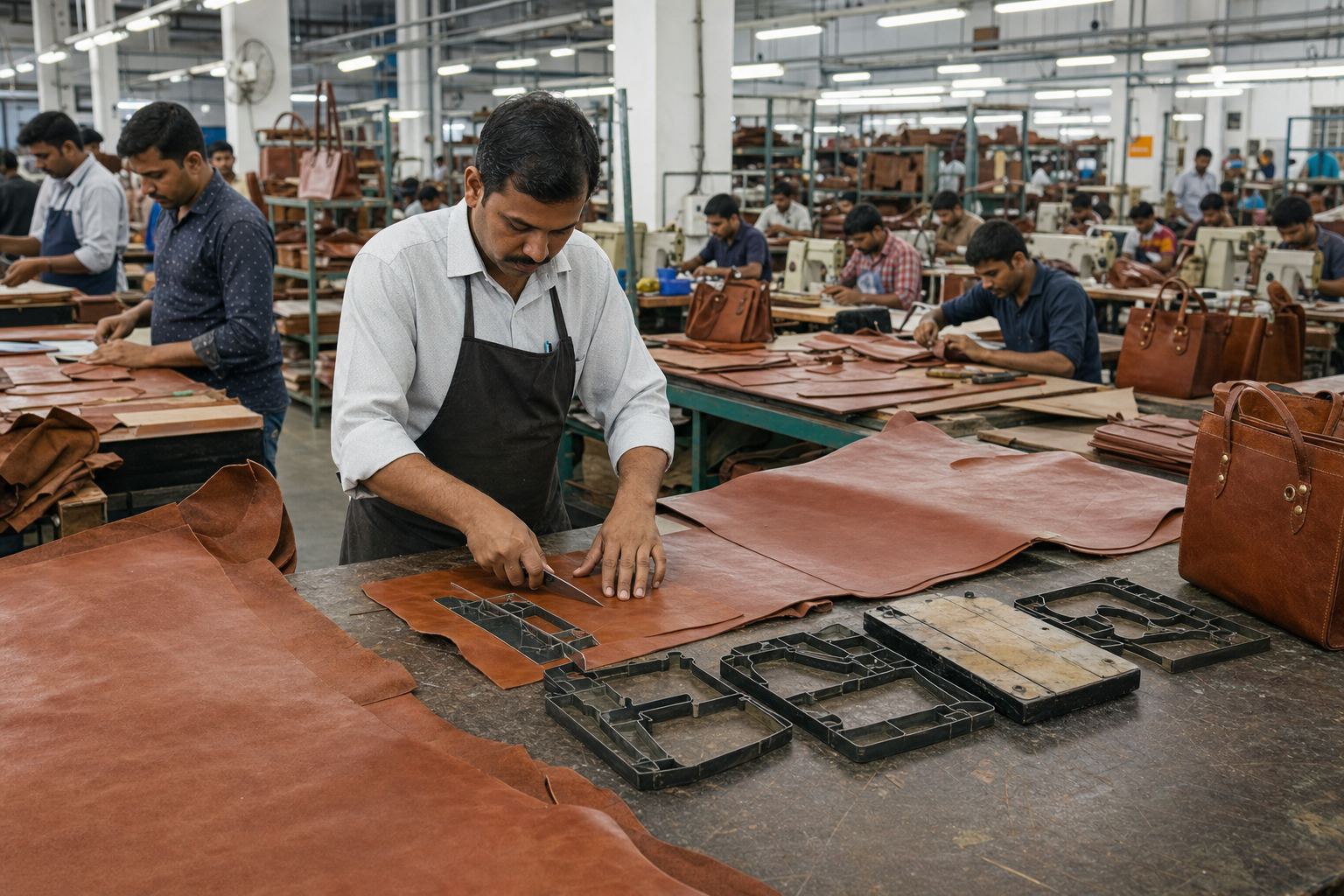
Understanding how a factory converts leather into a finished bag helps buyers ask sharper questions during verification and set QC gates that block bulk cutting until each stage passes. The core stages — pattern development, cutting, skiving, stitching, lining attachment, hardware setting, and edge finishing — are consistent across clusters, but quality-control discipline varies widely between an MSME workshop and an export-oriented mid-size factory.
This section maps buyer-side QC gates to each production stage. Treat each gate as a hold point — bulk production does not proceed past a gate until the buyer or their nominated inspector signs off against the sealed sample and written specification.
Buyer QC Gate Summary by Production Stage
Swipe →
Data table — swipe horizontally on small screens
| Stage | QC Gate | Pass Criteria | Fail Action |
|---|---|---|---|
| Raw material intake | Leather lot vs swatch | Grade, thickness, colour match | Hold cutting |
| Cutting | Pattern vs sealed sample | Dimensions within tolerance | Halt bulk run |
| Stitching | SPI measurement | 8–10 SPI on main seams (typical) | Rework or reject line |
| Hardware | Function test | Zipper, snap, buckle pass cycles | Replace hardware lot |
| Edge / colour | Shade comparison | Within agreed tolerance | Hold shipment |
| Pre-shipment | PSI on packed lot | AQL pass; qty matches invoice | Block dispatch |
Gate 1 — Raw Material Intake
- Hold bulk cutting until leather lot identity is confirmed against sealed sample swatch
- Reject substituted split leather when RFQ specified full-grain or corrected-grain
- Confirm hardware brand and finish match RFQ — unbranded zippers are a common margin-protection substitution
Before cutting begins, verify that the incoming leather lot matches the approved swatch: grade (full-grain, corrected-grain, or split), thickness in millimeters, finish, and colour reference against Pantone or signed swatch. Request a photo of the hide lot stamp and tannery batch number aligned to any chromium VI test report for EU/UK-bound programmes.
Gate 2 — Pattern and Cutting
- Confirm cutting pattern matches sealed pre-production sample — not an earlier prototype
- Request mid-cut photos on first bulk run for remote buyers without on-site QC staff
- Verify panel count and grain direction consistency across front and back panels
Leather panels are cut using dies or computer-guided systems against the approved pattern. Verify graded dimensions against RFQ L×W×H tolerances (typically ±3–5 mm on export lines). Skilled cutting minimises waste and ensures grain consistency — panels cut from weak hide sections fail after weeks of retail use.
Gate 3 — Skiving, Stitching, and SPI
- Measure SPI on pre-production sample and first bulk unit — hold line if SPI drops below spec
- Check lining attachment method: fully bagged-out versus half-lined as specified
- Verify reinforcement stitching at strap attachment points and handle bases
Skiving thins leather edges before folding and stitching. Specify stitches per inch (SPI) in the RFQ — export-grade handbags typically require 8–10 SPI on main seams. Inconsistent skiving produces lumpy edges and weak stitch lines. Confirm thread type (polyester core-spun, bonded nylon) matches specification; factories sometimes substitute cheaper thread unless forbidden in writing.
Gate 4 — Hardware Setting and Function Testing
- Cycle-test zippers 50 times on sample and first bulk units
- Confirm logo plates, rivets, and feet match approved hardware sample
- Reject bulk run if hardware finish differs from sealed sample — common on mixed hardware lots
Hardware is riveted or screwed into place. Test zipper smoothness, magnetic snap closure force, buckle torque, and D-ring pull strength on the pre-production sample and on the first units off the bulk line. Nickel-free hardware claims for EU-bound orders require supplier documentation or independent testing.
Gate 5 — Edge Finishing and Colour Matching
- Compare bulk units to sealed sample under consistent lighting — not factory fluorescent alone
- Check edge paint for colour bleed and cracking on flex points
- Hold shipment if shade drift exceeds agreed Delta E or visual tolerance standard
Edge finishing covers edge paint, burnishing, binding, or piping — the stage most visible to inspectors and retail customers. Colour matching across panels from different hide lots is the critical checkpoint unique to leather bags. Agree a colour tolerance standard and require mid-production colour QC photos before all panels are stitched.
Gate 6 — Pre-Shipment Inspection (PSI)
- Book PSI after 100% packing complete, before vessel cutoff
- Include sealed sample and spec sheet in PSI briefing documents
- Block bill of lading release if PSI fails — negotiate rework or credit before dispatch
Independent pre-shipment inspection by SGS, Bureau Veritas, Intertek, or equivalent should occur on the actual colourway lot packed in master cartons — not a prior lot or unpacked showroom pieces. PSI verifies AQL defect rates, carton marks, quantity against invoice, and spot-checks construction against the sealed sample.
Expert Insight: RFQ and Sample Discipline
Expert Insight Box
Export Tip
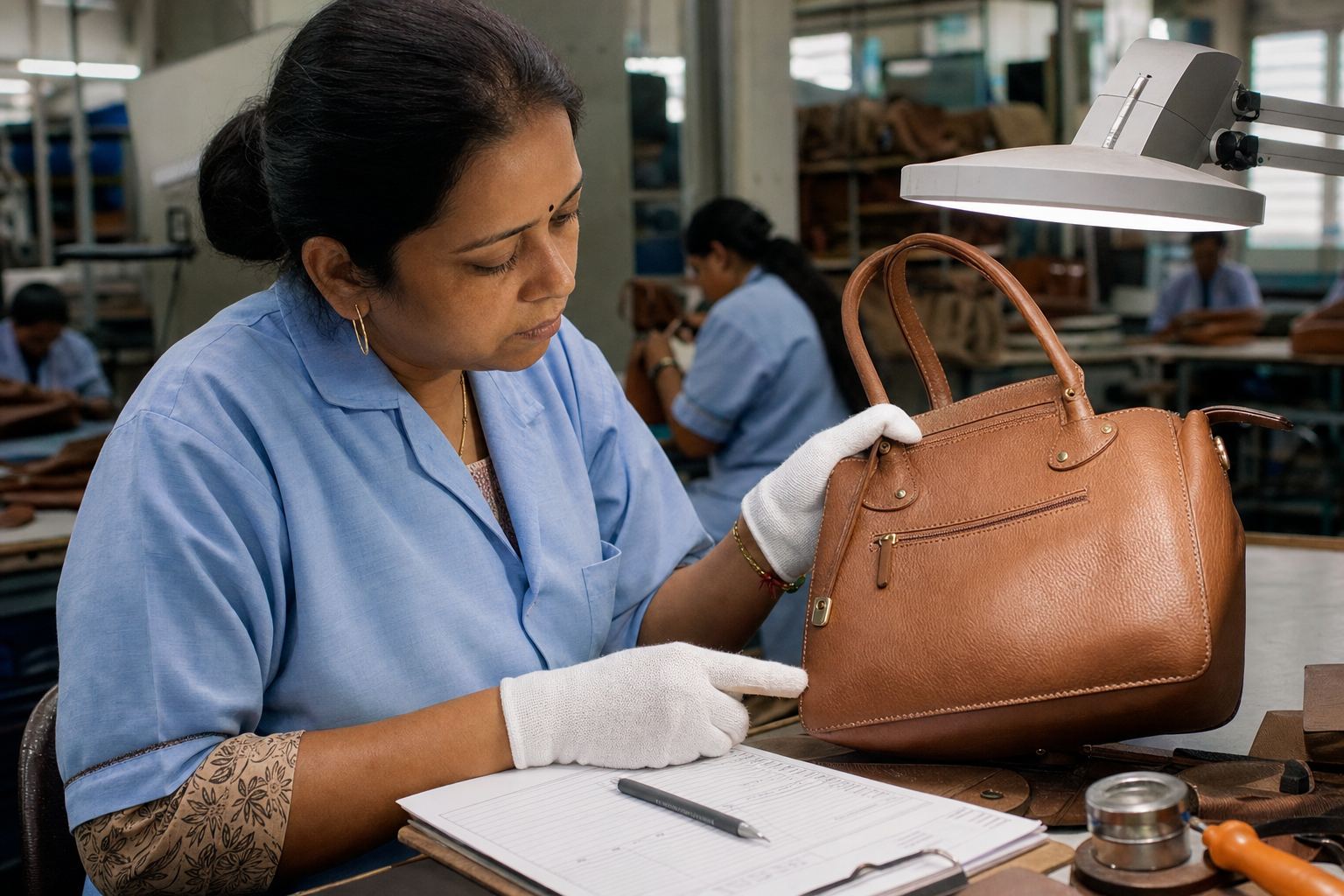
Lead with a complete RFQ, not with price. A buyer who opens with 'best price for 500 handbags' signals that price is the deciding factor, which invites factories to quote aggressively and quietly cut corners on leather grade, hardware brand, or colour-matching discipline. A buyer who opens with dimensions, leather grade, SPI, hardware spec, and colour reference signals a serious counterparty worth quoting honestly.
Pricing Analysis
Buyer Tip
Use indicative ranges below for RFQ framing only — leather bag pricing swings with leather grade, construction type, hardware brand, lining quality, and raw hide prices. Compare landed cost per unit (FOB, freight, insurance, duty at verify current rates, PSI, destination tax) rather than FOB alone.
For REACH-sensitive EU-bound orders, confirm upfront whether certification testing costs are included in quoted FOB or billed separately.
Indicative FOB Pricing Reference by Category (2026, per unit — Planning Only)
Swipe →
Data table — swipe horizontally on small screens
| Bag Category | Indicative FOB Range | Primary Cost Driver |
|---|---|---|
| Women's handbags | $8–$35 | Leather grade + hardware brand |
| Totes | $10–$40 | Size + lining + structure |
| Messenger bags | $12–$38 | Hardware + strap construction |
| Backpacks | $12–$45 | Panel count + strap reinforcement |
| Briefcases | $15–$55 | Structure + padding + hardware |
| Travel bags / duffels | $18–$70 | Leather area + zipper length |
| Laptop bags | $12–$42 | Padding spec + handle attachment |
| Wallets / SLG | $2–$8 | Edge paint + slot stitching |
MOQ Analysis
Buyer Tip
MOQ in leather bags is quoted in units per style per colourway and interacts with hardware lot sizes and leather dye-lot minimums. A factory quoting 'MOQ 500 units' typically means 500 units of a single style in a single approved colour, not 500 spread across five colourways unless explicitly agreed.
Indicative planning: MSME trial orders 100–300 pieces; standard programmes 300–1,000 pieces; retail chain programmes 1,000–3,000+ pieces.
Indicative MOQ Reference by Category and Order Stage
Swipe →
Data table — swipe horizontally on small screens
| Category | Sample Stage | Trial Order | Standard Programme MOQ |
|---|---|---|---|
| Structured handbags | 1 prototype + 1 sealed PP sample | 200–500 units/colourway | 800–2,000 units/style/colour |
| Messenger / crossbody | 1 prototype + 1 sealed PP sample | 300–600 units/colourway | 1,000–2,500 units/style/colour |
| Laptop / briefcase | 1 prototype + 1 sealed PP sample | 200–400 units/colourway | 500–1,500 units/style/colour |
| Backpacks | 1 prototype + 1 sealed PP sample | 200–500 units/colourway | 800–2,000 units/style/colour |
| Wallets / SLG | 1 prototype + 1 sealed PP sample | 500–1,500 units/colourway | 2,000–5,000 units/style/colour |
Packaging Standards
Export Tip
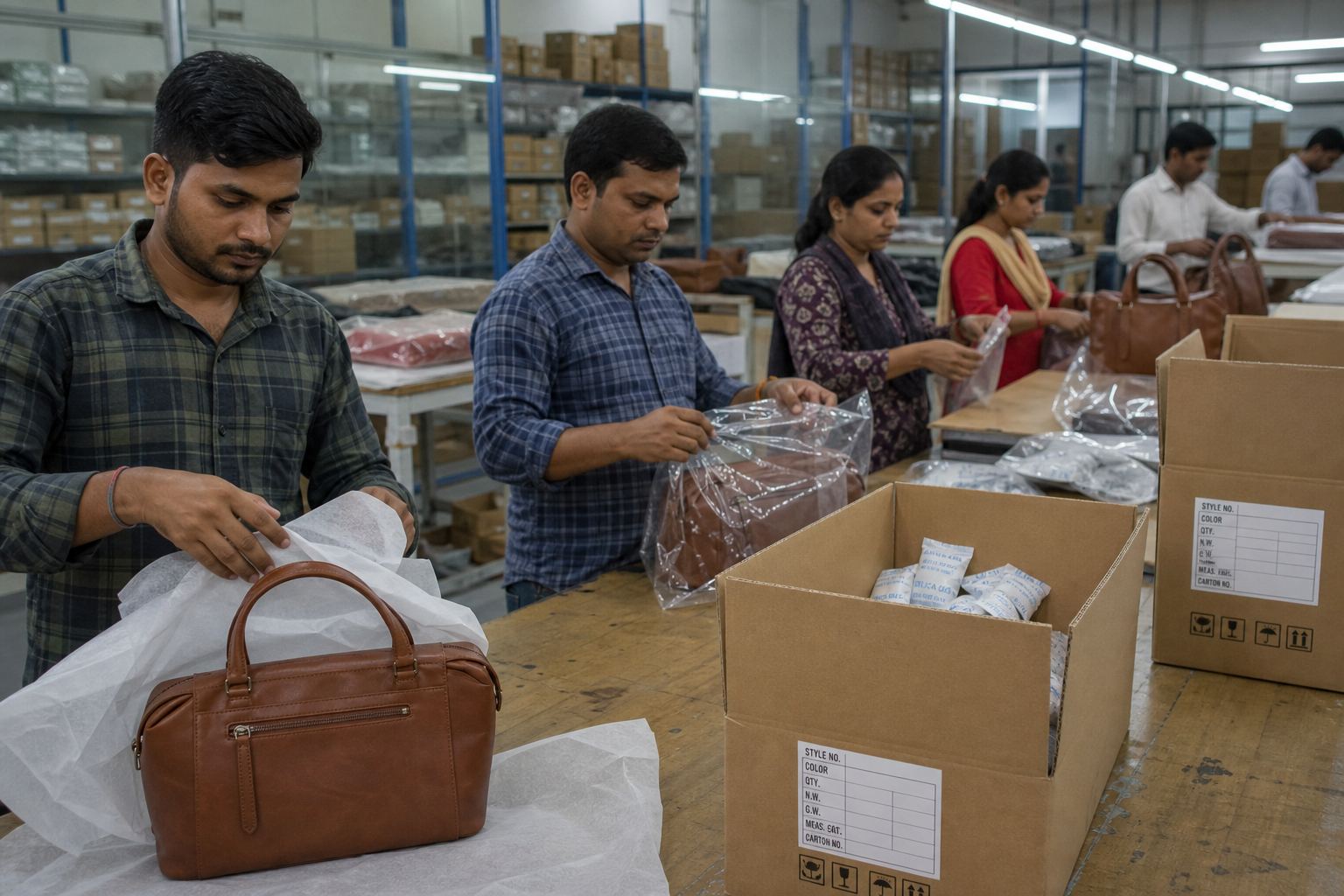
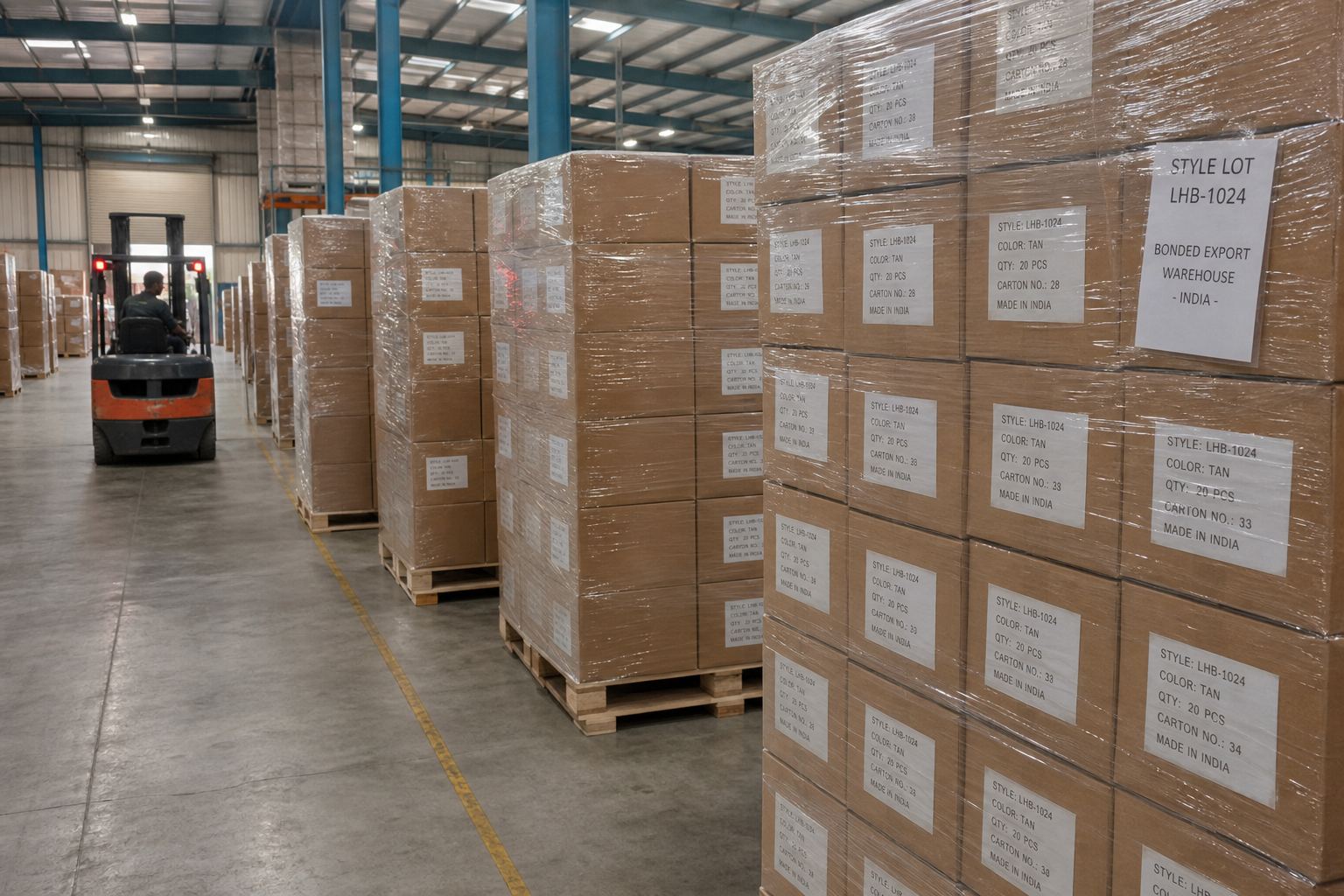
Packaging protects finish and shape. Standard export format is one bag per dust bag or polybag inside a rigid or semi-rigid box, with boxes packed into master cartons of 10, 20, or 30 units depending on bag size. Master cartons must carry style code, colourway, quantity, and PO number matching the packing list.
Standard Export Packaging Formats for Leather Bags
Swipe →
Data table — swipe horizontally on small screens
| Packaging Format | Typical Unit | Common Use Case | Key Requirement |
|---|---|---|---|
| Individual dust bag + box | 1 bag per box | All finished-bag categories | Box survives stacking; label matches carton manifest |
| Master carton (10 units) | 10 bags per carton | Bulky styles — backpacks, weekender bags | Style, colourway, PO number, weight marked |
| Master carton (20–30 units) | 20–30 bags per carton | Smaller styles — wallets, crossbody bags | Confirm stacking limit for bottom-layer cartons |
| Silica gel sachets | Inside box or carton | All categories on ocean lanes | Manages moisture during transit |
| Retail-ready barcoded packaging | Per buyer brand spec | Private-label retail chain programmes | Print-ready artwork confirmed early |
Container Loading Details
Export Tip
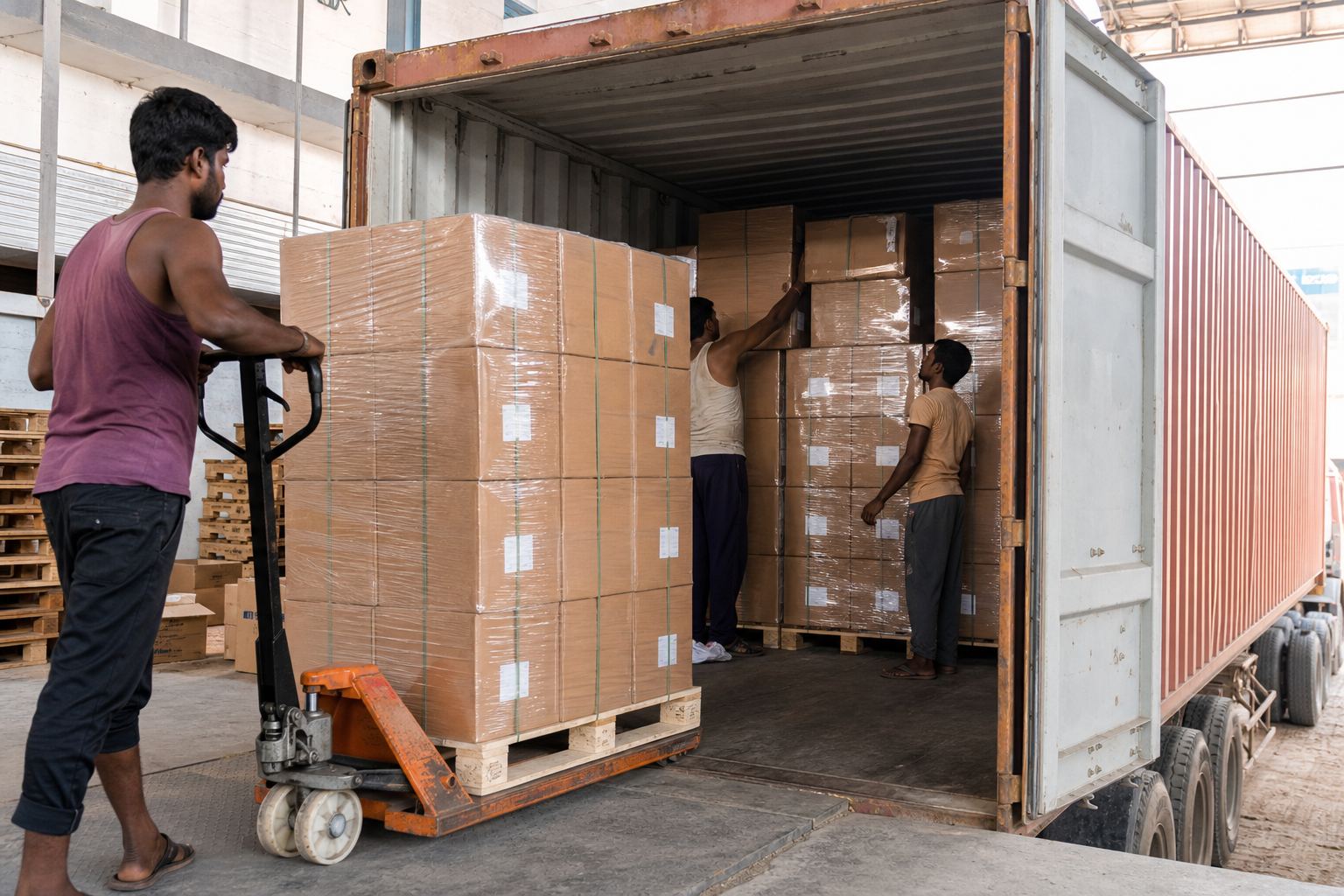
Container payload varies by bag size more than almost any other accessories category. Indicative planning: 20ft FCL 1,200–3,500 pieces; 40ft HC 3,000–8,000 pieces. Varies by silhouette bulk, carton size, and nesting; confirm against actual carton specs.
Indicative Container Loading Benchmarks by Category
Swipe →
Data table — swipe horizontally on small screens
| Category | Indicative 20ft FCL | Indicative 40ft HC | Notes |
|---|---|---|---|
| Structured handbags | 1,500–3,500 pcs | 3,000–8,000 pcs | Varies with box rigidity |
| Messenger / crossbody | 2,000–4,500 pcs | 4,500–9,000 pcs | Moderate yield |
| Laptop / briefcase | 1,200–2,500 pcs | 2,500–5,500 pcs | Lower yield due to rigid structure |
| Wallets / SLG | 8,000–15,000 pcs | 15,000–30,000 pcs | Highest yield; strongest landed-cost economics |
| Backpacks / travel | 1,000–2,500 pcs | 2,500–6,000 pcs | Confirm test-certificate lot matches shipped batch |
Shipping Methods
Export Tip
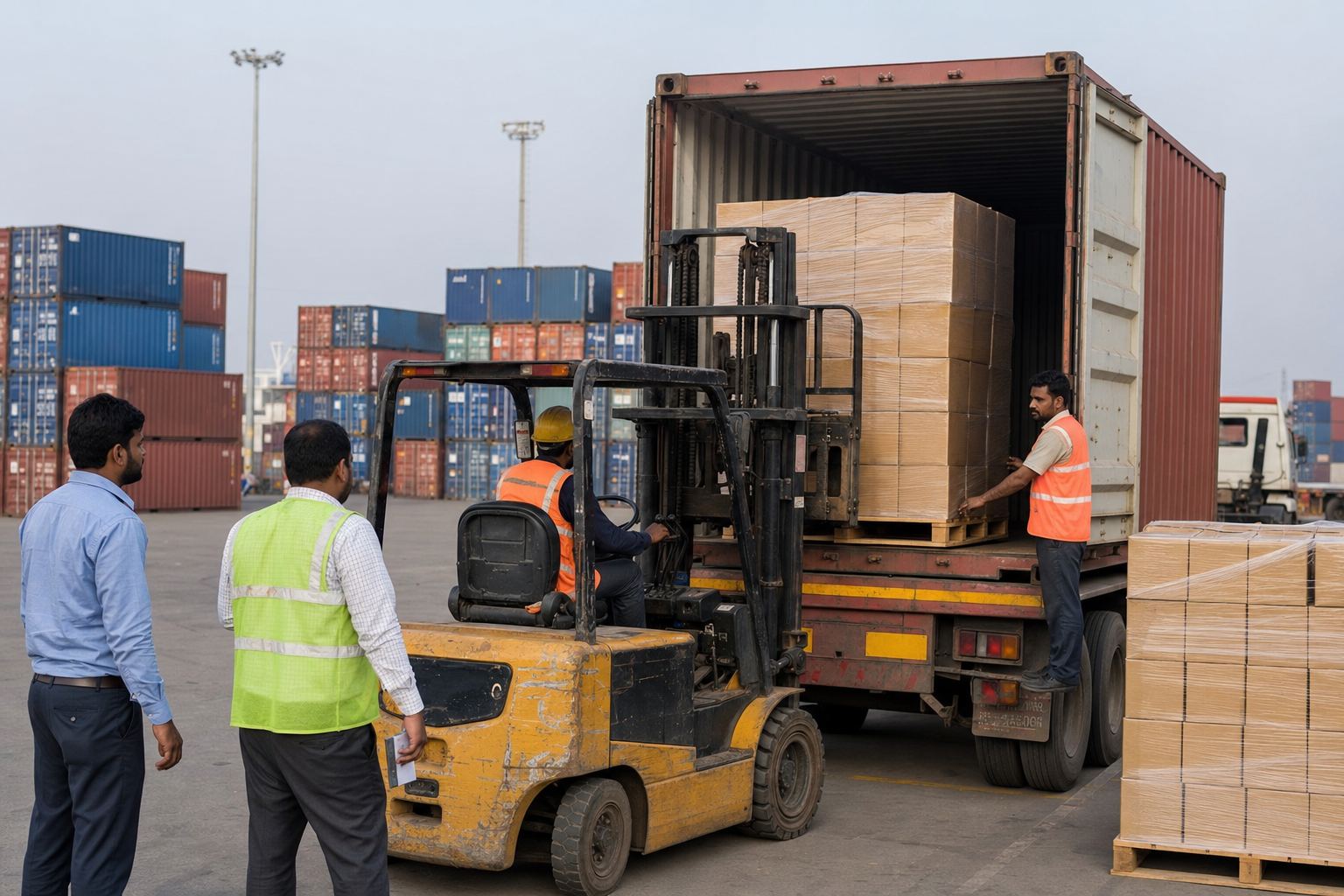
Trial orders should ship LCL or as a shared FCL slot after sealed pre-production sample sign-off — this validates logistics, carton integrity, and supplier communication under deadline pressure without committing a full container. Move to dedicated FCL once weekly or monthly replenishment makes carton velocity predictable and per-piece freight cost justifies container minimums.
FOB at a named Indian port — Mundra, Nhava Sheva (JNPT), Chennai, Tuticorin, Kolkata — is the most common Incoterm. Match port to factory cluster: Chennai for Tamil Nadu belt units; Mundra or Nhava Sheva for Kanpur, Delhi-NCR, and Agra; Kolkata for East India programmes. Air freight is for sealed samples and emergency top-ups only.
Trial LCL vs Dedicated FCL — Buyer Decision Matrix
Swipe →
Data table — swipe horizontally on small screens
| Factor | Trial LCL / Shared FCL | Dedicated FCL Programme |
|---|---|---|
| Order size | 200–800 units per colourway typical | 1,000+ units per style/colour |
| Financial exposure | Lower capital at risk | Higher inventory commitment |
| Per-piece freight | Higher per unit | Lower per unit at scale |
| Validation purpose | Tests consistency + logistics | Assumes proven supplier relationship |
| When to use | First 1–2 commercial shipments | After 2–3 clean trial cycles |
| PSI requirement | Mandatory on trial shipment | Mandatory until supplier scorecard matures |
Certifications
Compliance Notes
Treat certifications as evidence to request, not boxes to tick blindly. Ask for test reports referencing the specific style and batch you are ordering, not a generic annual certificate for the factory as a whole.
Certifications Relevant to Sourcing Leather Bags from India
Swipe →
Data table — swipe horizontally on small screens
| Certification / Registration | Who Should Hold It | What It Protects the Buyer From |
|---|---|---|
| CLE RCMC and IEC | Every exporting factory or merchant exporter | Confirms legal export eligibility |
| LWG tannery certification | The tannery supplying the leather | Traceability and environmental standards |
| REACH chromium VI test report | Batch-specific, EU/UK-bound orders | CrVI ≤ 3 mg/kg under REACH Annex XVII |
| CPSIA compliance testing | Children's bag lines entering USA | Lead, phthalates, child-product safety |
| Nickel-free hardware testing | Hardware lots for EU-bound orders | EU nickel directive compliance |
| Independent PSI (SGS, BV, Intertek) | Arranged before dispatch | Colour, construction, AQL defects on packed lot |
Buyer Requirements
Buyer Requirements
- Valid IEC and current CLE RCMC, verifiable directly — not a screenshot
- Sealed pre-production sample built from approved pattern with production-grade hardware and lining
- Written confirmation of leather type with swatch sample alongside finished bag
- RFQ response quoting leather grade, hardware brand, lining spec, SPI, and construction type precisely
- Clear packaging specification matching your downstream use
- Realistic MOQ, colourway flexibility, and lead-time commitments aligned to capacity
- Prior export document samples and buyer references from markets similar to yours
- PSI acceptance clause in purchase order before first bulk run
A well-prepared Indian leather bag exporter should produce the following on request before you advance past a first conversation. Hesitation or delay is a signal to slow down, not a paperwork inconvenience to overlook.
Country-wise Opportunities
Market Snapshot
Your sourcing diligence depth should flex to reflect what your destination market actually enforces. Over-verifying a commodity wallet purchase wastes time; under-verifying a REACH documentation claim for a German handbag programme invites a costly compliance dispute. For deeper destination-specific style mapping, see Most Demanded Indian Leather Bags by Country and Best Countries for Indian Leather Bag Exports.
Buyer-Side Country Fit for Leather Bag Sourcing
Swipe →
Data table — swipe horizontally on small screens
| Destination | Prioritise in RFQ / Verification | PSI Emphasis |
|---|---|---|
| USA | CPSIA for children's lines; UPC on retail programmes | Colour + construction on trial shipment |
| UK / EU | REACH CrVI batch reports; LWG if claimed | Mandatory until supplier proven |
| UAE | Hardware finish; competitive FOB | Standard on first two shipments |
| France | Finish precision; colour tolerance standard | High — fashion quality audits |
| Germany | REACH + LWG before deposit | Mandatory — no exceptions |
| Australia | Biosecurity packing declaration | Standard on trial |
| Japan | Packaging presentation; process documentation | High — multiple checkpoints |
United States
Confirm CPSIA-relevant testing for any children's bag line. Verify factory export history to US buyers. Trial MOQs of 200–300 units per style are common on e-commerce private-label programmes.
United Kingdom and European Union
Require batch-specific REACH chromium VI test reports before deposit. Refuse to authorize bulk cutting until tannery batch on the report matches the leather lot for your order. UK post-Brexit documentation must be verified separately from EU certificates.
United Arab Emirates
Prioritize hardware finish consistency and FOB competitiveness over EU-depth chemical packs unless cargo is destined for onward EU stock. Clarify whether goods stay in local retail or re-export — carton marks change accordingly.
Australia and Japan
Australia: declare wood packing / ISPM-15 status on RFQ. Japan: plan extended sample and document loops; do not skip PSI to accelerate PO — presentation packaging is part of quality evaluation.
Sourcing Checklist
Checklist
Use this checklist on every new factory relationship. Each item is a gate — do not advance to the next stage until the current item is documented in writing.
Stage 1 — RFQ Preparation (Before Any Outreach)
- Bag type and reference image or tech pack with L×W×H dimensions and tolerances
- Leather grade: full-grain, corrected-grain, or split — thickness in mm
- Lining material and colour; pocket configuration
- Hardware: brand (e.g., YKK), finish, buckle type, magnetic snap spec
- Stitching SPI target (e.g., 8–10 SPI on main seams); thread type
- Colour reference: Pantone code or physical swatch to be matched
- Packaging format: dust bag, box, master carton count, retail-ready requirements
- Certifications required: REACH, CPSIA, LWG, nickel-free hardware
- Target FOB, trial MOQ, delivery window, destination market, preferred Incoterm
Stage 2 — Supplier Verification (Before Paid Sample)
- Verify CLE RCMC independently through leatherindia.org or direct CLE inquiry
- Confirm IEC on DGFT portal against quotation letterhead
- Check GST registration status
- Request prior export document samples (redacted) from similar markets
- Shortlist maximum three factories per category; score on credentials and RFQ response quality
- Video or in-person facility walkthrough before first deposit
Stage 3 — Sample Sequence (Before Bulk PO)
- Pay for prototype sample; evaluate against RFQ — do not negotiate bulk price yet
- Request sealed pre-production sample with production hardware and lining
- Colour-match PP sample against signed swatch under consistent lighting
- Sign and seal approved sample; assign reference number tied to PO
- Retain duplicate sealed sample at origin for PSI reference
Stage 4 — Trial Order and PSI (Before FCL Programme)
- Issue PO referencing sealed sample number and spec sheet version
- Agree payment milestones: 30–50% advance, balance against docs or PSI pass
- Monitor mid-production colour QC photos on first bulk run
- Book PSI on packed lot — include sealed sample in inspector briefing
- Validate trial shipment logistics, carton integrity, and document pack before FCL commitment
Buyer Checklist
Checklist
This checklist covers the buyer-side actions that protect capital and retail reputation from first PO through repeat programme scale-up.
Before Issuing Purchase Order
- Lock sealed pre-production sample and spec sheet version as binding reference — in writing on PO
- Agree Incoterms, payment milestones, PSI criteria, and rejection pathway
- Structure payment: 30–50% advance at confirmation; balance against shipping documents or PSI sign-off
- Never 100% advance to an unverified factory
- Confirm HS 4202 sub-heading with customs broker matches product construction
During Bulk Production
- Request raw material lot confirmation photos before cutting starts
- Review mid-production colour QC photos — not only end-of-line inspection
- Measure SPI on first units off the line against specification
- Escalate deviations immediately; do not wait until cargo is at port
Before Shipment Release
- PSI completed on actual colourway lot in master cartons
- Commercial invoice, packing list, and test reports reference same lot/batch identity
- Certificate validity covers expected arrival date, not only shipment date
- Carton marks match packing list entries exactly
- Share draft document pack with destination broker before vessel sailing
After Trial — FCL Scale-Up Decision
- Require two to three clean trial cycles before dedicated FCL commitment
- Build supplier scorecard: quality, delivery, documentation, communication
- Reuse signed spec sheets and sealed sample references on repeat POs
- Renegotiate pricing only after consistency is proven — not after first trial
Exporter Checklist
Checklist
Compliance Checklist
Checklist
Compliance Notes
Common Buyer Mistakes
Common Mistakes Box
Most preventable disputes in leather bag sourcing trace to a short, recurring list of avoidable mistakes.
Future Market Trends
Key Statistics
Three trends are shaping buyer-side sourcing relationships through 2027. First, digital verification of CLE registration and batch-specific test reports will replace paper certificate acceptance — buyers will expect portal-verifiable credentials and lab report IDs traceable to the shipped lot. Second, EU sustainability and deforestation-linked sourcing rules will extend LWG and traceability requirements into mid-tier handbag programmes. Third, PSI is becoming standard practice even for mid-volume buyers who previously skipped inspection to save cost — the cost of skipping has become visible in chargeback data.
Buyers who invest early in RFQ discipline, sealed sample verification, documented QC gates, and PSI on trial shipments will scale confidently into FCL programmes. Buyers who source on FOB price alone will remain confined to reactive firefighting.
Expert Insight: Trial Order Discipline
Expert Insight Box
Size your trial to test consistency — a few hundred units per colourway depending on category — not to match your eventual programme volume. When a trial reveals a colour-matching error or hardware inconsistency, that is the system working as intended. Better to find it on 300 bags than on a full FCL container.
Altus Exports supports international buyers through trial order coordination, PSI scheduling, and FCL scale-up planning as part of our global sourcing partner service.
Conclusion
- Next step: send your RFQ specification to Altus Exports for a factory shortlist and market-readiness assessment.
- Review Most Demanded Indian Leather Bags by Country to align sourcing with destination demand.
- Read Top Leather Bag Products Exported from India for category and construction depth.
- Understand the export side with How to Export Leather Bags from India and CLE Registration Benefits for Leather Bag Exporters.
- Complete compliance with Leather Bag Export Documentation Checklist.
- Explore Best Countries for Indian Leather Bag Exports, Sustainable & Premium Leather Bag Export Opportunities, Find International Buyers for Leather Bags, and Trade Shows for Leather Bag Exporters.
- Explore product sourcing company in India, find manufacturers in India, and global sourcing partner service models.
Sourcing leather bags directly from India rewards buyers who treat it as a quality-controlled process rather than a one-time purchase decision. Write your RFQ before you contact a factory. Verify CLE RCMC, IEC, and GST independently. Seal and sign a pre-production sample before bulk cutting. Book PSI on the packed lot. Stage trial LCL before dedicated FCL. Use a merchant exporter or accountable sourcing partner if you are managing multiple factories or categories at once.
Share your bag type, dimensions, leather grade, hardware spec, certification needs, target MOQ, and destination market with Altus Exports for a verified factory shortlist and procurement pathway recommendation.