
Trade Shows and B2B Marketplaces for Leather Bag Exporters
By Saurabh Mittal, Founder, Altus Exports
A fair-by-fair and marketplace playbook for Indian leather bag exporters under HS 4202 — IILF Chennai, Lineapelle, Premiere Classe Paris, CLE-organized buyer-seller meets, and Alibaba/GlobalSources for bags and leather goods, plus booth and sample strategy, 72-hour post-fair CRM follow-up, and year-round lead conversion — not a LinkedIn prospecting guide.
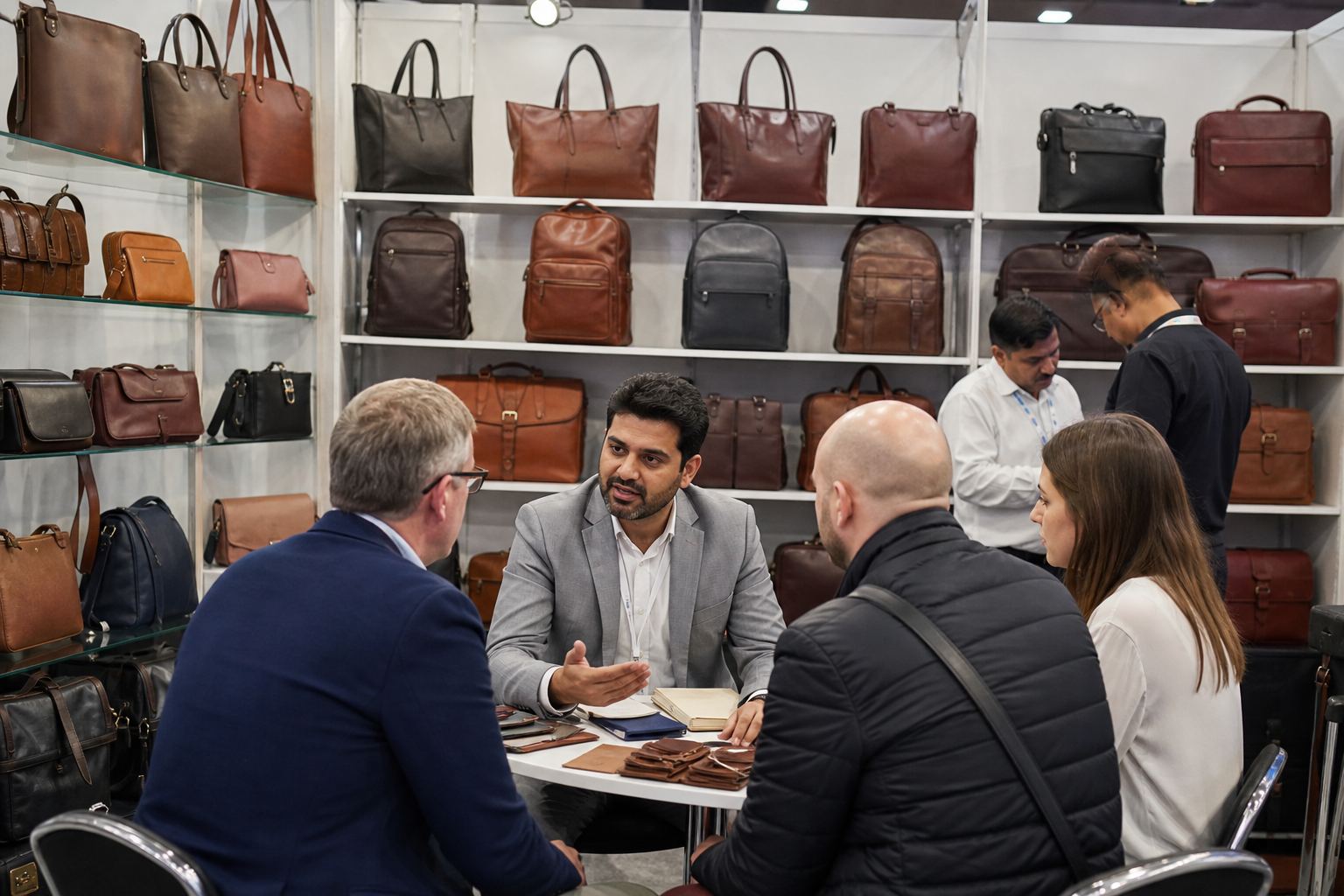
Fairs are the fastest route to spec-level buyer conversations — if you arrive prepared and treat them as one channel in a year-round pipeline, not the whole sales plan.
Channels covered: IILF Chennai · Lineapelle · Premiere Classe Paris · CLE buyer-seller meets · Alibaba/GlobalSources — plus a booth-to-order playbook with 72-hour CRM follow-up.
Not LinkedIn prospecting (Find Buyers). Readiness still required: CLE RCMC, IEC, REACH for EU lines (CLE Benefits, Documentation Checklist).
Altus Exports converts fair leads into shipped orders as merchant exporter and global sourcing partner.
Key Takeaways
Summary Box
Executive Summary
Summary Box
- Pre-fair: production-ready samples · one-page product sheet · CLE credential visible.
- On-floor: qualify serious buyers vs browsers before promising samples.
- 72-hour CRM: most fair ROI dies in week one without a cadence.
- Benchmark: dozens of real conversations; ~5–15% → sample request in 30 days with disciplined follow-up.
- Year-round: one CRM pipeline across fairs and marketplaces.
Convert attendance into shipped orders with one repeatable sequence — preparation beats booth size.
Market Size & Industry Overview
Key Statistics
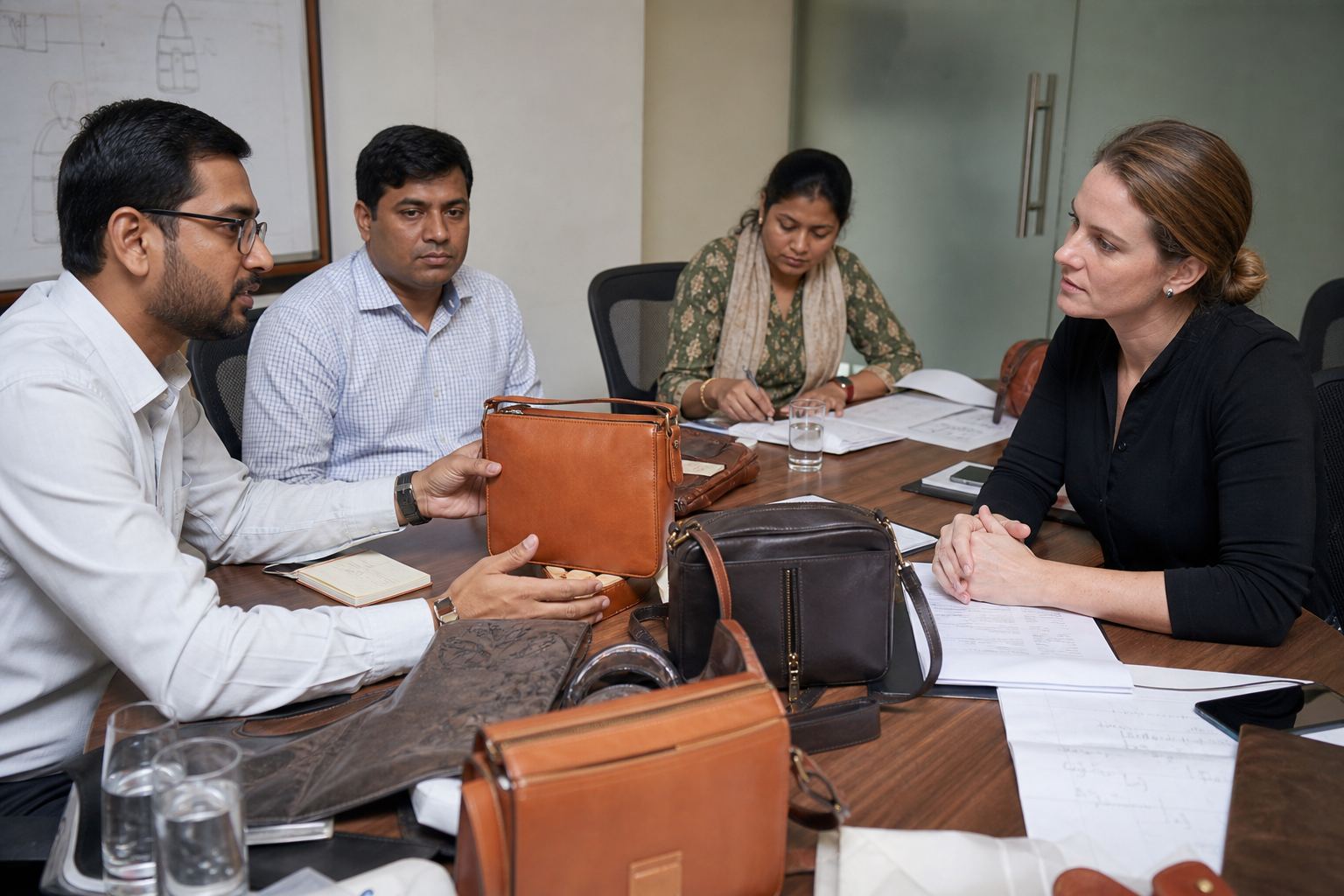
India's leather bag export industry, anchored by Council for Leather Exports (CLE) registration and manufacturing clusters in Kanpur, Kolkata, Delhi-NCR, Ambur–Ranipet–Chennai (Tamil Nadu), Agra, Jaipur, Hyderabad, relies on domestic and international fairs, CLE buyer-seller meets, and B2B marketplaces to connect with global demand. Chennai's proximity to the Tamil Nadu export cluster makes IILF a natural anchor fair.
Leather bags ship primarily under HS heading 4202 — handbags under 4202.21 (leather outer) or 4202.29 (other materials), travel bags under 4202.91/4202.99, and wallets under 4202.31/4202.32. Buyers at every fair in this guide ask about HS classification early.
Leather Bag Fair and Marketplace Landscape (Indicative)
Swipe →
Data table — swipe horizontally on small screens
| Channel | Location / Type | Primary Value to Bag Exporters |
|---|---|---|
| India International Leather Fair (IILF) | Chennai, India — CLE-supported | Domestic anchor; international buyer delegations |
| Lineapelle | Bologna, Italy | Premium leather sourcing; fashion and accessories buyer access |
| Premiere Classe Paris | Paris, France | Accessories-focused fashion buyers; design-led handbags and SLG |
| CLE buyer-seller meets | Various, organized by CLE | Pre-qualified one-on-one buyer meetings |
| Alibaba / GlobalSources | Online B2B marketplaces | Year-round inbound RFQs for bags and leather goods |
Export Statistics
Key Statistics
CLE and DGCIS export statistics show the USA, Germany, the UK, Italy, France, and the Netherlands among India's leading leather goods destinations — buyer nationalities concentrated at IILF international delegations, Lineapelle, and Premiere Classe. Fair selection should follow export destination priority.
Fair Relevance by Target Export Destination
Swipe →
Data table — swipe horizontally on small screens
| Target Destination | Most Relevant Fair(s) | Buyer Profile at That Fair |
|---|---|---|
| Italy / France / fashion EU | Lineapelle, Premiere Classe Paris | Fashion importers, design-led private label, accessories buyers |
| Germany / DACH | Lineapelle, IILF delegations | Wholesale distributors, retail chain buyers, SLG importers |
| USA | IILF Chennai delegations, Alibaba / GlobalSources | Department store, wholesale, D2C private-label buyers |
| Domestic + all destinations | IILF Chennai, CLE buyer-seller meets | Mixed international delegation; efficient single-location coverage |
Import Statistics
Key Statistics
Fair organizers publish attendee profiles revealing buyer company type and country mix. Reviewing this data before committing booth budget is better than assuming a fair's general reputation guarantees relevant bag buyer traffic.
Cross-checking attendee lists against HS 4202 import data through ITC Trade Map helps confirm whether listed buyers have documented handbag, tote, or travel-goods import history. This is attendee validation, not a substitute for the prospecting workflow in Find International Buyers for Leather Bags.
Pre-Fair Attendee Research Checklist
Swipe →
Data table — swipe horizontally on small screens
| Research Step | What It Reveals | When to Do This |
|---|---|---|
| Review published exhibitor/attendee list | Buyer company type and country mix | 6–8 weeks before the fair |
| Cross-check list against HS 4202 import data | Documented leather bag import history | 4–6 weeks before the fair |
| Pre-book meetings where the fair allows | Scheduled, higher-intent conversations | 2–4 weeks before the fair |
| Segment booth samples to fair buyer profile | Whether hero styles match dominant buyer type | 4–6 weeks before the fair |
Product Categories / Variants
Summary Box
Booth sample selection should mirror the fair's dominant buyer profile, not an exporter's full catalogue. Premiere Classe rewards design-led handbags and clutches; Lineapelle rewards leather-grade narratives alongside finished bag samples; IILF spans a wider mix and rewards clear category segmentation on the booth.
For full category depth, see Top Leather Bag Products Exported from India.
Matching Booth Samples to Fair Buyer Profile
Swipe →
Data table — swipe horizontally on small screens
| Fair / Channel | Recommended Hero Categories | Buyer Priority |
|---|---|---|
| Premiere Classe Paris | Design-led handbags, clutches, SLG | Trend alignment, finish quality, brand positioning |
| Lineapelle | Material-led swatches plus 2–3 hero bags | Leather grade, tannage, colour consistency, LWG traceability |
| IILF Chennai | Broad mix, segmented by category on booth | Efficient discovery across mixed international delegation |
| CLE buyer-seller meets | Category matching pre-scheduled buyer interest | Specification-precise conversation |
| Alibaba / GlobalSources | 8–12 hero listings with accurate MOQ and HS code | Specification clarity before price discussion |
Manufacturing Overview
Export Tip
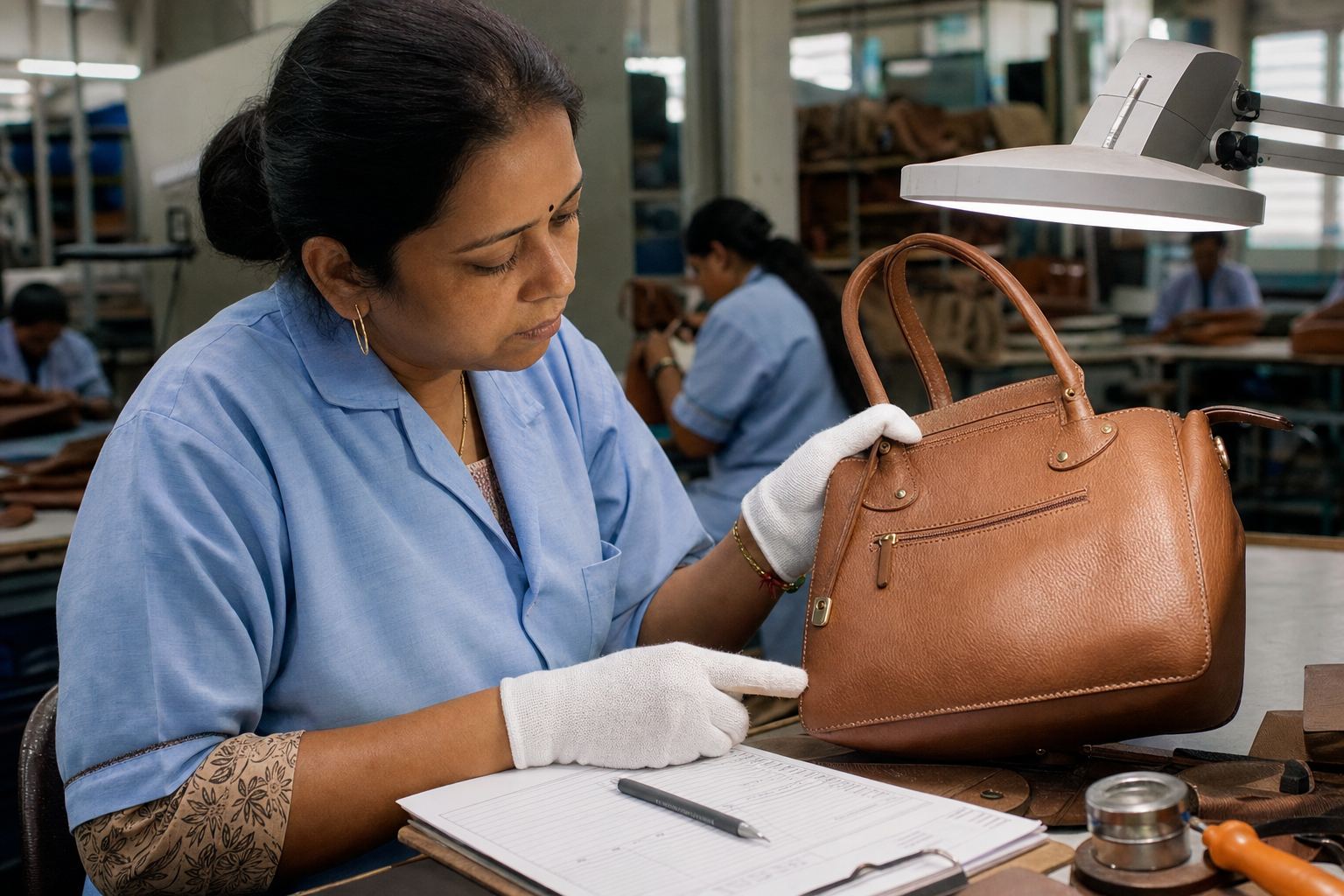
Fair samples must reflect real bulk-production capability — a hand-finished booth sample that cannot be replicated at the factory's actual construction method is a credibility risk once a buyer requests a bulk-matching pre-production sample after the fair.
Confirm with your factory, before committing a style to the booth, that the leather grade, lining, hardware, edge finish, and stitching shown on the fair floor is exactly what bulk production can deliver at the MOQ you intend to quote.
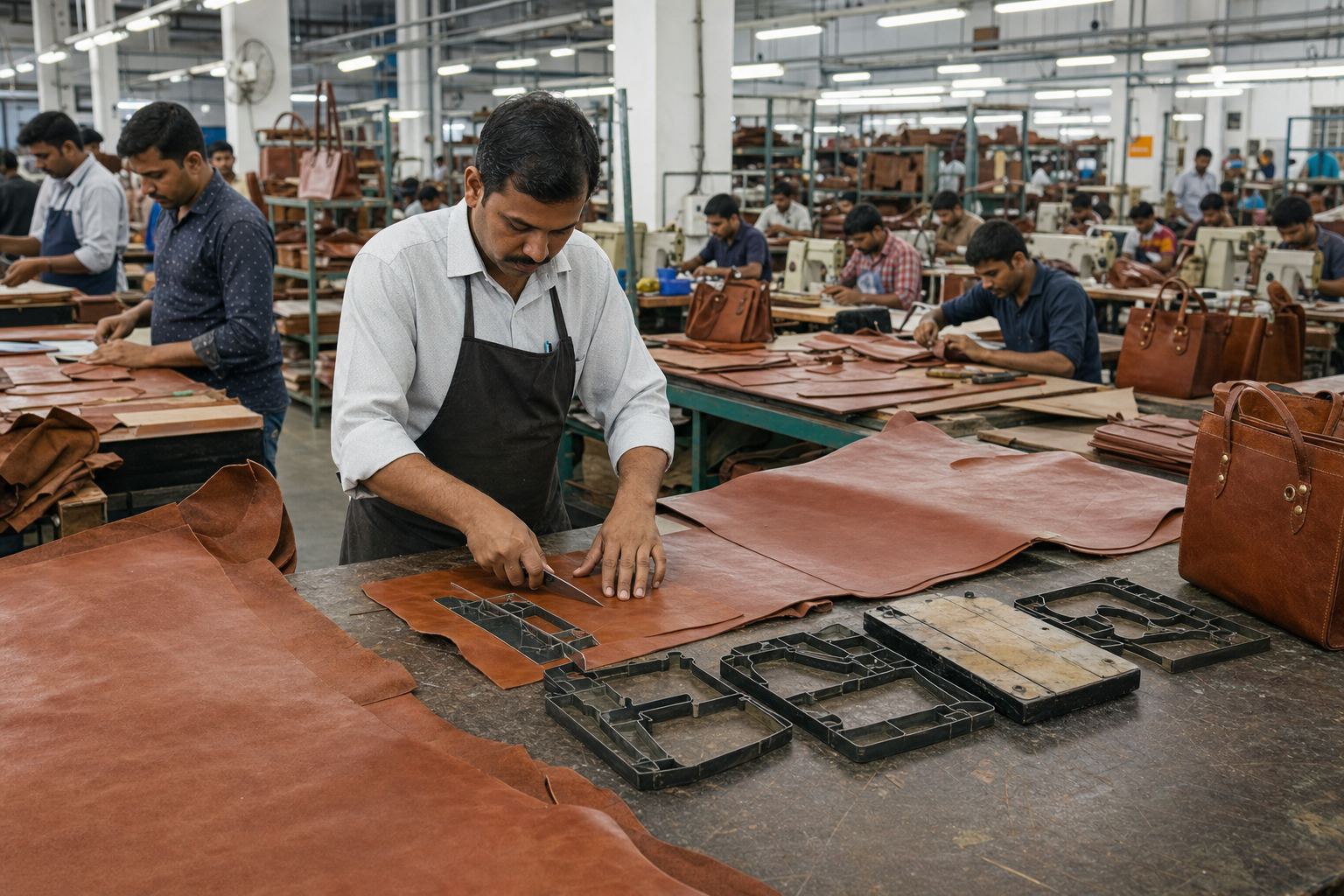
Indian leather bag manufacturing runs cutting, skiving, stitching, edge painting, lining insertion, and hardware attachment in sequence. Exporters who can answer confidently about which steps are in-house versus subcontracted convert at a higher rate.
Pricing Analysis
Buyer Tip
Fair budgets should be planned as a full campaign cost — booth space, travel, sample development, and follow-up staff time — set against a realistic conversion estimate, not just the headline booth rental fee.
Indicative Fair Campaign Cost Components
Swipe →
Data table — swipe horizontally on small screens
| Cost Component | Typical Share of Budget | Notes |
|---|---|---|
| Booth space and construction | 30–45% | Varies by fair and booth size |
| Travel and accommodation | 20–30% | Multiply by staff count attending |
| Sample development and freight | 10–20% | Underbudgeted by many first-time exhibitors |
| 72-hour follow-up and sample dispatch | 10–15% | Often skipped — erases value of other spend |
MOQ Analysis
Buyer Tip
MOQ conversations at a fair should be handled honestly and specifically. State realistic MOQ per style on the product sheet — trial orders at 100–300 pieces, standard programmes at 300–1,000 pieces — so post-fair internal buyer discussions anchor to accurate numbers.
Typical MOQ Expectations to Communicate at a Fair (Pieces, per Style)
Swipe →
Data table — swipe horizontally on small screens
| Manufacturer / Buyer Type | Trial Order MOQ | Standard Programme MOQ | Fair Conversation Note |
|---|---|---|---|
| MSME manufacturer | 100–300 pieces | 300–800 pieces | State on product sheet, not only verbally |
| Export-oriented mid-size factory | 300–500 pieces | 800–2,000 pieces | Confirm leather batch before quoting fast lead time |
| Retail chain / private-label | 500–1,500 pieces | 2,000–5,000+ pieces | Expect forecast conversation, not single-order pitch |
Packaging Standards
Export Tip
Packaging samples at a booth should match what a real bulk shipment carries — individually packed bag in dust bag or polybag with silica gel, plus a master carton mock-up if space allows.
Fair Booth Packaging Display Checklist
Swipe →
Data table — swipe horizontally on small screens
| Element | Recommended Booth Display | Why It Matters |
|---|---|---|
| Individual dust bag / polybag | One fully packed unit per hero style | Signals retail-ready packaging capability |
| Master carton mock-up | Style/colour markings if space allows | Demonstrates bulk-shipment discipline |
| Product sheet with packaging spec | Hand out with every qualified conversation | Buyers reference this after the fair |
| Silica gel and humidity note | Mention on product sheet | Leather bag buyers expect moisture protection |
Container Loading Details
Export Tip
Serious buyers at wholesale-focused fairs ask about container loading economics early. Be ready with indicative figures — 1,200–3,500 pieces in a 20ft FCL and 3,000–8,000 pieces in a 40ft HC — rather than a vague answer that signals underpreparation.
Shipping Methods
Export Tip
Buyers at international fairs ask about lead time from PO to shipment and which Incoterm the exporter quotes. FOB remains standard from Mundra, Nhava Sheva (JNPT), Chennai, Tuticorin, Kolkata. Sample shipments after a fair typically move by air so the buyer evaluates physical construction while the fair conversation is still fresh.
Certifications
Compliance Notes
CLE registration should be visible on the booth — on the product sheet, signage, and pitch. REACH chromium VI compliance status should be stated clearly on request; European buyers at Lineapelle and Premiere Classe expect this without multi-day delay.
Certifications to Have Visible or Ready at a Fair Booth
Swipe →
Data table — swipe horizontally on small screens
| Certification / Credential | Where to Display | Buyer Expectation |
|---|---|---|
| CLE RCMC reference | Product sheet, booth signage | First-level legitimacy check |
| Valid IEC | Available on request in outreach materials | Confirms legal export eligibility |
| REACH chromium VI status | Stated on request with recent test summary | Non-negotiable for EU/UK conversations |
| LWG tannery certification (where applicable) | Product sheet with named tannery | Relevant at Lineapelle for material-traceability buyers |
Buyer Requirements
Buyer Requirements
- One-page product sheet with leather grade, lining, hardware, dimensions, HS 4202 sub-heading, and MOQ per style.
- CLE RCMC and IEC visible in signage and outreach materials.
- Confident, specific answers on lead time, MOQ, and Incoterm.
- Sample dispatch policy stated at the booth — paid vs. free, courier cost owner, turnaround time.
- Defined 72-hour follow-up commitment: "we will send a formal quotation within three business days."
Buyers approaching a booth screen quickly for legitimacy: clear product sheet, visible CLE registration, confident MOQ and lead-time answers, and samples that look production-ready rather than rough prototypes.
Fair-by-Fair Playbook
Each fair and channel below reaches a distinct buyer profile. Treat this section as an operational playbook — buyer profile, prep checklist, booth strategy, and ROI guidance — not a calendar listing.
India International Leather Fair (IILF) — Chennai
- Buyer profile: mixed international delegation including US, UK, EU, and Gulf wholesale distributors, retail chain sourcing offices, and domestic brand buyers familiar with Indian leather goods under HS 4202.
- Prep checklist (6–8 weeks out): confirm CLE RCMC is current; select 4–6 hero styles segmented by category (handbags, totes, travel, SLG); prepare one-page product sheets with MOQ and HS sub-heading; review attendee list and pre-book meetings; bring production-ready signed samples.
- Booth strategy: qualify destination market, buyer type, and volume tier within two minutes; hand product sheet with every serious conversation; display packaging mock-up for at least one hero style.
- ROI benchmark: well-prepared IILF exhibitors generate 40–80 genuine conversations over three to four days; with 72-hour follow-up, expect 5–15% to progress to sample request within thirty days.
IILF is India's primary domestic leather and leather-goods trade fair, held in Chennai with CLE support. It brings Indian manufacturers and exporters together with domestic and international buyer delegations — the most cost-efficient starting point for leather bag exporters building international exposure before committing budget to a European fair.
Lineapelle — Bologna, Italy
- Buyer profile: Italian and broader European fashion brands, accessories designers, premium private-label sourcing offices; buyers prioritize leather grade consistency, colour matching, and LWG traceability.
- Prep checklist: bring leather swatch books alongside 2–3 finished hero bags; name tannery and tannage on every product sheet; confirm REACH chromium VI status; prepare a material specification sheet separate from the finished-goods sheet.
- Booth strategy: lead with material story — leather origin, tannage, thickness, grain — then transition to finished bag construction.
- ROI benchmark: 15–30 serious discussions over two to three days; sample-request conversion often 10–20% with 72-hour follow-up. Best for Italian, French, and premium EU fashion buyers.
Lineapelle is the world's leading leather materials fair. Fashion brands, accessories designers, and sourcing offices evaluate leather grades, colours, and tannage innovations — making it strategic for Indian leather bag exporters who want to lead with material credibility and connect with premium European buyers.
Premiere Classe Paris
- Buyer profile: French and broader European fashion accessories buyers, boutique importers, emerging brand founders; buyers prioritize trend alignment, finish quality, and brand positioning over volume.
- Prep checklist: trend-aligned hero styles with strong visual merchandising; lookbook-style product sheets with lifestyle imagery; confirm MOQ is realistic for boutique buyers (often 100–500 pieces per style initially).
- Booth strategy: lead with design narrative and finish quality; boutique buyers decide quickly on visual appeal and construction-to-price alignment.
- ROI benchmark: 20–40 conversations over two to three days; sample-request conversion 10–18% for trend-aligned ranges. Best for French fashion retail and boutique importers.
Premiere Classe Paris is a fashion accessories trade show during Paris Fashion Week, reaching accessories-focused fashion buyers, boutique importers, and design-led private-label brands. It is a higher-intent fair for Indian exporters whose range is design-led handbags, clutches, and small leather goods.
CLE Buyer-Seller Meets
- Buyer profile: pre-qualified international buyers with stated product interest — retail chain sourcing offices, wholesale distributors, brand supply chains familiar with Indian leather bags.
- Prep checklist: confirm CLE RCMC (required for access); review buyer profile CLE provides; prepare category-specific samples matched to each buyer's stated interest; bring current REACH test summaries for EU-bound buyers.
- Booth strategy: treat each meeting as a specification conversation — lead with exact styles and MOQs relevant to the buyer's stated requirement.
- ROI benchmark: 8–20 one-on-one meetings per exporter per event; sample-request conversion often 15–25%. Highest conversion rate in this guide.
CLE buyer-seller meets are organized, pre-qualified one-on-one programmes run by the Council for Leather Exports — distinct from open exhibition-floor fairs. Because meetings are pre-scheduled and buyers pre-qualified, conversion rates typically exceed general fair floor traffic.
Alibaba and GlobalSources — B2B Marketplaces for Bags and Leather Goods
- Buyer profile: mixed — genuine retail and wholesale buyers, sourcing agents, trading companies, and price shoppers; Alibaba skews US and Asia-Pacific; GlobalSources skews US and EU.
- Prep checklist: verified supplier profile with CLE RCMC, factory photos, and 8–12 hero product listings with accurate MOQ and HS 4202 classification; respond to RFQs within 24 hours with qualification questions before quoting price.
- Platform strategy: treat every RFQ as qualification — ask destination, volume, and whether buyer has imported HS 4202 goods before; price-only responses attract price-only buyers.
- ROI benchmark: 20–100+ inquiries per month for active exporters; sample-request conversion 1–3% from raw inquiries without qualification, versus 5–8% with structured verification. Best as year-round top-of-funnel feeding the same CRM pipeline as fair leads.
Alibaba and GlobalSources are the two most relevant international B2B marketplaces for Indian leather bag exporters seeking inbound inquiry volume from US, EU, and Asia-Pacific buyers. These platforms generate more inbound leads than any single fair, but average lead quality is lower and requires the same qualification discipline.
Fashion Accessories Side Events (Supplementary)
Selected European fashion accessories side events attract handbag and small-leather-goods buyers from Italy and the broader EU. Treat these as supplementary channels — not a primary fair strategy — and only attend with design-led handbag and SLG samples when IILF, Lineapelle, and Premiere Classe calendars are already locked. For most Indian bag exporters, those three channels deliver more consistent HS 4202 buyer density.
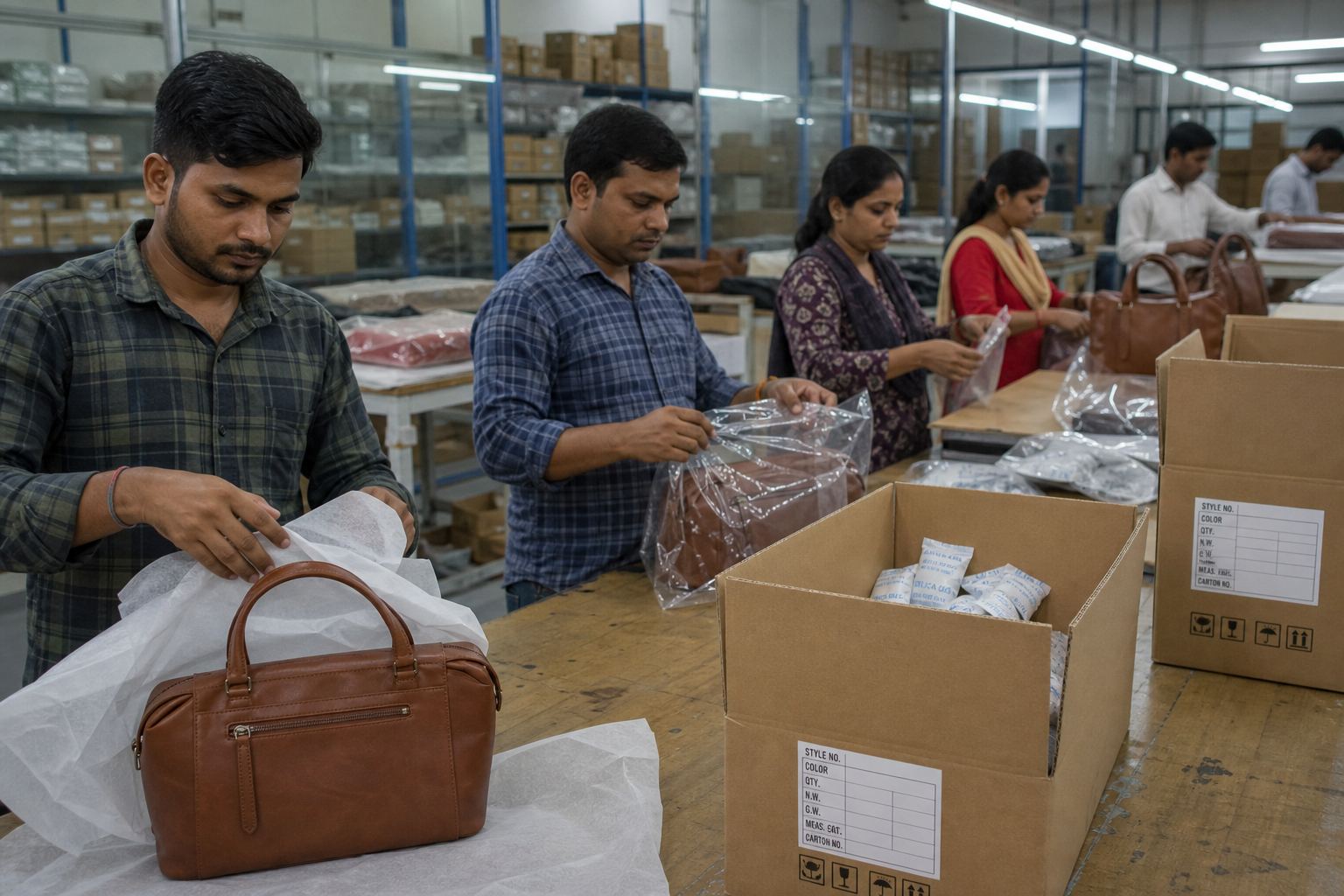
Comparing Fairs and B2B Channels
Use this comparison to decide which channel to prioritize with a limited budget. The right answer is usually a combination — IILF or CLE meets as domestic anchor, one European fair matched to target destination, and marketplace listings running year-round.
Fair and Marketplace Comparison for Leather Bag Exporters
Swipe →
Data table — swipe horizontally on small screens
| Channel | Typical Campaign Cost | Buyer Volume | Avg. Lead Quality | Best For | Sample Conversion (with 72hr follow-up) |
|---|---|---|---|---|---|
| IILF Chennai | Low–medium | High (40–80 conversations) | Medium–high | First fair; mixed delegation | 5–15% |
| Lineapelle | Medium–high | Medium (15–30 conversations) | High | Premium EU material and fashion buyers | 10–20% |
| Premiere Classe Paris | Medium–high | Medium (20–40 conversations) | Very high | Design-led French/EU boutique buyers | 10–18% |
| CLE buyer-seller meets | Low | Low–medium (8–20 meetings) | Very high | Pre-qualified specification-ready buyers | 15–25% |
| Alibaba / GlobalSources | Low (subscription) | Very high (20–100+ RFQs/month) | Low–medium | Year-round top-of-funnel | 1–8% (depends on qualification) |
72-Hour Post-Fair CRM Follow-Up
Export Tip
- Set up CRM pipeline stages before the fair opens: Lead → Qualified → Sample Requested → Quoted → Trial Order.
- Assign one person accountable for 72-hour follow-up — not "the sales team will handle it when back at the factory."
- Never send a generic thank-you email; reference the specific style, leather grade, and MOQ discussed at the booth.
- Dispatch samples within the turnaround promised at the booth, with tracking communicated proactively.
Post-fair follow-up is where most exporters lose their fair investment. The first 72 hours after an event closes are the highest-intent window — buyers are still comparing suppliers they met on the floor, and the exporter who follows up first with an accurate quotation and sample dispatch plan wins disproportionate share of mind.
This is a CRM discipline, not a networking habit. Every qualified conversation should enter a pipeline the same day with buyer name, company, destination, styles discussed, MOQ discussed, and a scheduled follow-up date.
72-Hour Post-Fair CRM Cadence
Swipe →
Data table — swipe horizontally on small screens
| Timing | Action | CRM Stage | Purpose |
|---|---|---|---|
| Same day (hour 0–8) | Log conversation in CRM with styles, MOQ, buyer details | Lead captured | Capture details while fresh |
| Hour 8–24 | Personalized follow-up email referencing booth conversation | Lead contacted | Re-establish contact while fair is top of mind |
| Hour 24–48 | Send formal quotation to qualified leads | Quoted | Anchor discussion to written terms |
| Hour 48–72 | Confirm sample dispatch plan or schedule call | Sample requested / dispatched | Move to physical evaluation |
| Day 4–14 | 4–6 follow-up touches per qualified lead | Active pipeline | Maintain momentum through buyer decision cycle |
| Day 60–90 | Fair ROI review — leads, samples, orders | Closed / inactive | Inform next fair budget decision |
Year-Round Lead Conversion Between Fairs
Fair attendance without year-round pipeline management is an expensive networking exercise. Between IILF, Lineapelle, Premiere Classe, and CLE meets, exporters should run the same conversion sequence on marketplace RFQs and inbound referrals: qualify → sample → quote → document → ship.
Alibaba and GlobalSources listings should stay active and current between fair cycles, feeding the same CRM pipeline rather than operating as a separate, unmanaged inquiry inbox.
Pre-Fair Preparation (6–8 Weeks Out)
- Review attendee list and cross-check against HS 4202 import data.
- Pre-book one-on-one meetings where the fair or CLE platform allows.
- Confirm every booth sample matches bulk-production capability at stated MOQ.
- Brief booth staff on MOQ, lead time, Incoterm, and REACH answers.
Pre-fair work determines conversation quality more than booth size. Confirm CLE RCMC and IEC are current, finalize booth samples matched to the fair's buyer profile, and prepare one-page product sheets for every hero style.
On-Floor Qualification
- Ask: destination market, buyer type, intended volume tier, prior HS 4202 import experience.
- Hand product sheet with every qualified conversation.
- State specific 72-hour follow-up commitment at the booth.
- Log qualified conversations in CRM the same day.
- Do not quote bulk pricing to unqualified leads; offer sample-first pathway.
Score every booth conversation within two minutes. Serious buyers ask about leather grade, MOQ, lead time, and test reports; casual browsers ask only for a price list.
Country-wise Opportunities
Market Snapshot
Fair selection should follow country priority. See Best Countries for Indian Leather Bag Exports and Most Demanded Indian Leather Bags by Country.
USA
US buyers are less concentrated at a single leather-goods fair; IILF international delegations and targeted Alibaba/GlobalSources outreach are typically more efficient than a US-specific show for most Indian bag exporters.
Italy and France
Lineapelle and Premiere Classe Paris reach Italian, French, and Southern European fashion and accessories buyers; bring design-led samples with finish-quality storytelling.
Germany and DACH
German, Austrian, and Swiss wholesale distributors attend Lineapelle and IILF delegations with appetite for reliable handbags and travel goods with documented REACH compliance.
India
IILF Chennai and CLE buyer-seller meets are the most cost-efficient channel, combining domestic networking with international delegation access.
UAE/Gulf and Australia/Japan
These markets are often better served through targeted B2B marketplace outreach and direct relationship-building than through a dedicated regional leather-goods fair.
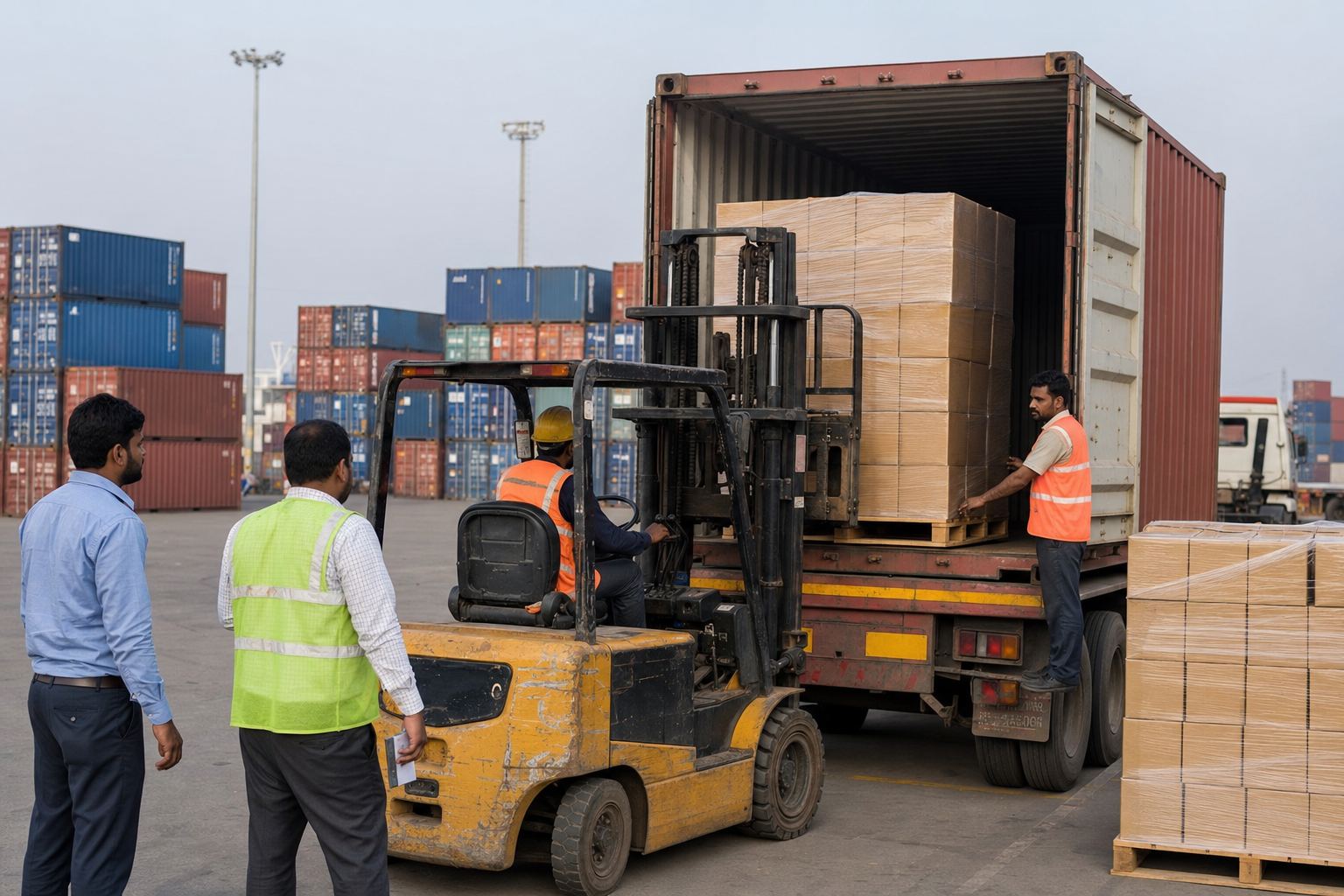
Expert Insight: The Booth Is Only Half the Investment
Expert Insight Box
Match the booth pitch to production reality before the fair opens. A buyer who receives a confident, accurate answer at the booth and then a matching written quotation within 72 hours converts at a far higher rate than one who receives an optimistic verbal promise followed by silence.
Sourcing Checklist
Checklist
Buyer Checklist
Checklist
Exporter Checklist
Checklist
Compliance Checklist
Checklist
Compliance Notes
Common Buyer Mistakes
Common Mistakes Box
Expert Insight: Marketplaces Feed the Same Pipeline
Expert Insight Box
Alibaba and GlobalSources are useful precisely because they generate volume, but that volume includes price shoppers and unverified accounts. The channel a lead comes from should not change the qualification bar or the 72-hour response standard it needs to clear.
Future Market Trends
Key Statistics
Hybrid fair formats — combining in-person booths with digital buyer-matching platforms run by CLE and European organizers — are reducing the cost of pre-fair buyer research and making qualified one-on-one meetings easier to schedule before events open.
Premiere Classe and similar fashion-week-adjacent accessories shows are growing in relevance as D2C and boutique brand buyers seek direct factory relationships — a trend favoring Indian exporters who present design capability and consistent finish quality at a fair booth.
B2B marketplaces are investing in supplier verification tools, gradually reducing low-quality inquiry volume, but structured 72-hour follow-up and sample-first qualification remain the exporter's responsibility regardless of platform improvements.
Conclusion
- Between fairs: Find International Buyers for Leather Bags.
- Show CLE status at the booth — see CLE Registration Benefits for Leather Bag Exporters for what buyers verify on day one.
- Post-fair documentation: Leather Bag Export Documentation Checklist.
- Premium positioning: Sustainable and Premium Leather Bag Export Opportunities.
- Shortlist fair-target markets via Best Countries for Indian Leather Bag Exports and bring the right silhouettes using Most Demanded Indian Leather Bags by Country.
- Convert fair meetings into shipments with Altus Exports — merchant exporter, global sourcing partner, and export products from India under one accountable workflow.
Trade fairs and B2B marketplaces are effective lead-generation channels for Indian leather bag exporters when paired with real preparation and disciplined 72-hour CRM follow-up — IILF Chennai, Lineapelle, Premiere Classe Paris, and CLE buyer-seller meets each reach a distinct buyer profile worth targeting deliberately, while Alibaba and GlobalSources extend reach year-round with their own qualification requirements.
Altus Exports helps leather bag exporters convert fair and marketplace leads into documented, shipped orders as a merchant exporter in India and global sourcing partner. Explore export products from India and find manufacturers in India for verified leather goods supply.