
Trade Shows and B2B Marketplaces for Coffee Exporters from India
By Saurabh Mittal, Founder, Altus Exports
A fair-by-fair ROI playbook for Indian coffee exporters — World of Coffee, the SCA Expo, Gulfood, Anuga, SIAL, and Coffee Board buyer-seller meets/IICF compared against Alibaba, Tridge, Europages, and LinkedIn outreach. Covers booth and marketplace-profile preparation, buyer requirements at the booth, break-even and cost-per-lead economics by fair tier, country-by-country fair strategy, four readiness checklists, common mistakes at fairs, and a structured post-event follow-up system for measuring ROI — from Altus Exports.
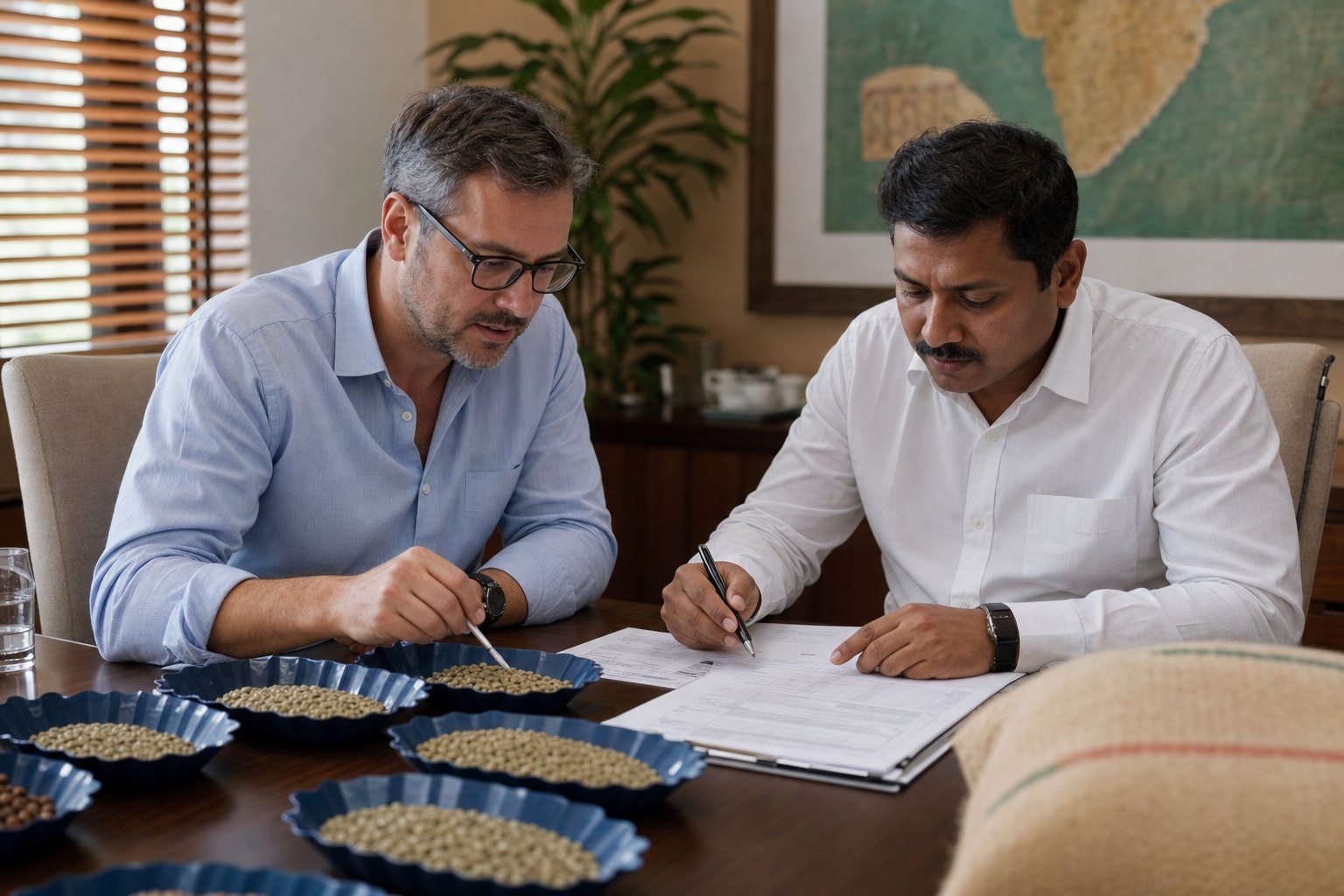
Most Indian coffee estates and curing works can supply consistent, export-grade green coffee. Far fewer reliably reach international buyers who pay at premium, reorder consistently, and grow into long-term programmes. Visibility — not quality alone — decides who builds export revenue and who waits for inquiries that never arrive. India produces more than 340,000 MT of coffee annually, yet a meaningful share moves through commodity channels at compressed margins because producers lack the buyer relationships that premium pricing requires. This guide is an ROI playbook for trade shows and B2B marketplaces specifically — not a restatement of the export process itself, which is covered in how to export coffee from India.
Trade fairs and digital marketplaces remain the two highest-leverage buyer-discovery channels available to Indian coffee estates, curing works, co-operatives, and merchant exporters. World of Coffee, the SCA Expo, Gulfood, Anuga, and SIAL create face-to-face trust with buyers who handle large annual volumes and demand documentation compliance. Coffee Board buyer-seller meets and the India International Coffee Festival (IICF) offer a structured, India-origin-focused entry point that lowers first-time-exhibitor risk. Digital B2B platforms create continuous discovery between exhibition seasons. Used together — with disciplined post-event follow-up and honest ROI measurement — they form a sustainable export growth engine rather than a one-off marketing expense.
This guide covers which fairs and marketplaces best suit Indian coffee exporters, the fully loaded cost and break-even economics for each fair tier, what buyers expect to see at the stand, country-by-country fair strategy, four readiness checklists, common mistakes exhibitors make, and — the part most exporters skip — a structured system for converting fair leads into programme orders and measuring the return on every rupee spent. Pair it with find international buyers for coffee, Coffee Board registration benefits for exporters, and the coffee export documentation checklist. Always verify current fair dates, fees, and Coffee Board participation routes — schedules and programmes evolve.
Key Takeaways
Summary Box
Executive Summary
Summary Box
This guide treats trade shows and B2B marketplaces as a combined lead-generation system, not competing options for the same budget line. The operating theme is simple: face-to-face fairs build trust and let buyers cup your coffee in person; digital marketplaces provide continuous discovery between fair seasons; and a structured post-event pipeline with honest ROI tracking is what actually converts either channel into a signed programme rather than a pile of business cards.
India's coffee export promotion infrastructure centres on the Coffee Board of India, which organises buyer-seller meets, the India International Coffee Festival, supports pavilion participation at select international fairs, and provides market intelligence. Exhibitors who lead with Coffee Board credentials at the booth build faster buyer trust than exhibitors who lead only on price. Fair and marketplace selection should follow bean-type segmentation: volume Robusta buyers concentrate at Gulfood and Coffee Board meets; specialty Arabica buyers at the SCA Expo and Anuga; organic and Monsooned Malabar buyers concentrate at World of Coffee and Biofach.
Comparison table
Swipe →
Data table — swipe horizontally on small screens
| Channel type | Primary buyer segment | Best Indian coffee fit | Typical ROI timeline |
|---|---|---|---|
| Gulfood | Gulf importers, ME retail, hospitality | Robusta, blends, bulk | 30–90 days to first order |
| SCA Expo (Specialty Coffee Expo) | US specialty roasters, retail | Arabica, Monsooned Malabar, organic | 60–180 days |
| Coffee Board meets / IICF | India-origin focused buyers | All grades; first-time exporters | 30–120 days |
| B2B marketplaces | Continuous RFQ discovery | All grades; needs qualification | Variable; 24-hour response SLA |
Market Size & Industry Overview
Key Statistics
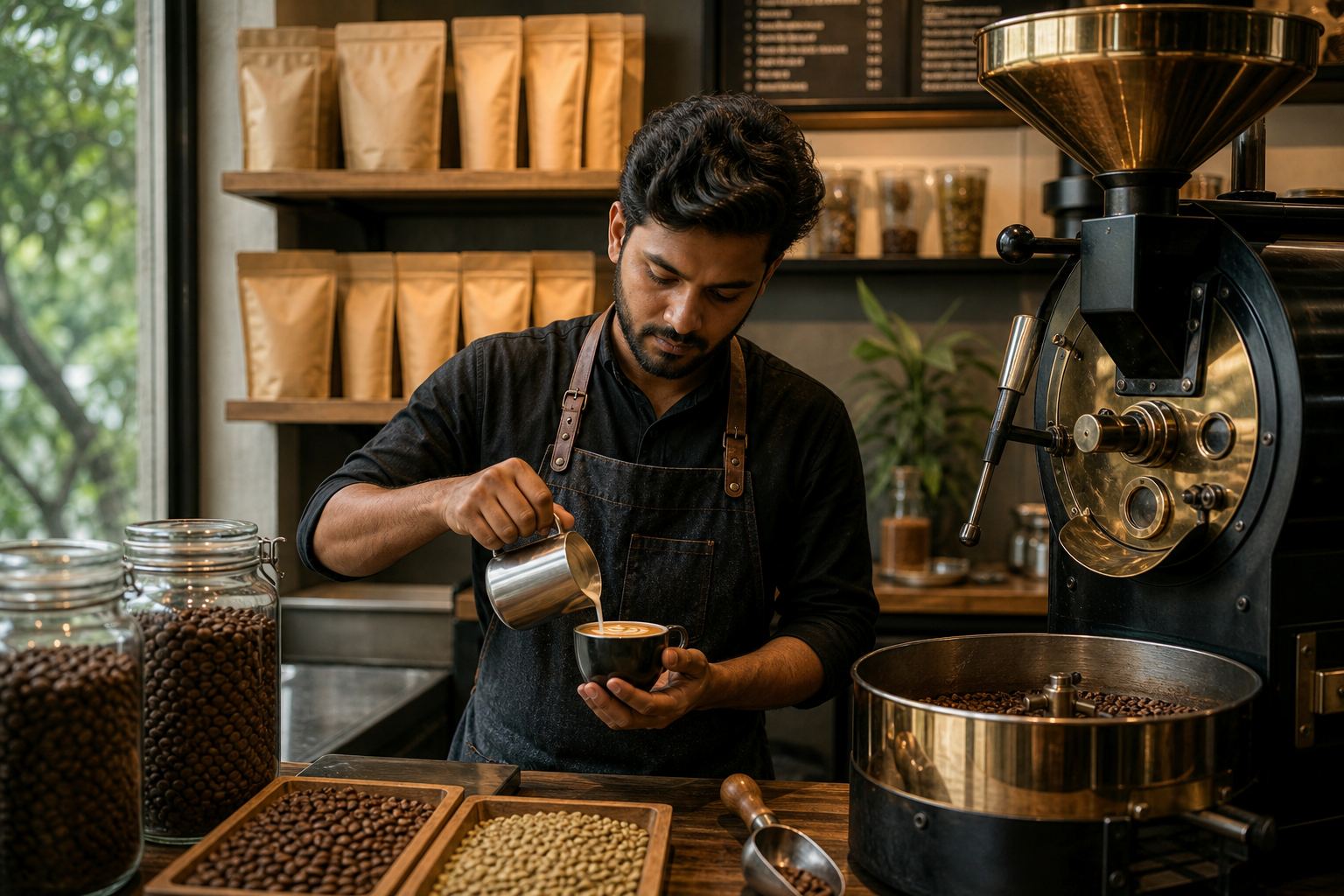
India's structural position in global coffee trade — a top-ten producer with dual capability in high-volume shade-grown Robusta and premium single-estate Arabica plus a genuinely unique Monsooned Malabar category — is the story that should anchor every booth conversation. No competing origin matches this combination under one sovereign supply base: Vietnam dominates Robusta volume, Brazil and Colombia command Arabica scale, and Ethiopia leads on heirloom specialty narrative, but none supply commodity Robusta and a rare, monsoon-processed specialty category at scale the way India does.
Fair and marketplace selection should mirror this dual identity rather than force a single pitch. A Gulfood booth should lead with Robusta strength, competitive FOB pricing, and Coffee Board registration credibility. A World of Coffee or Anuga booth should lead with Monsooned Malabar story, single-estate grade nomenclature, and organic transaction-certificate readiness. Exhibitors who run the same generic pitch at both fairs under-perform exhibitors who tailor the story to the buyer segment each event actually attracts.
The post-pandemic exhibition landscape has hybridised: physical booths are now supplemented by digital buyer matchmaking, pre-registered video meetings, and year-round marketplace presence. Exporters who treat a fair as a three-day event without a 90-day post-fair pipeline consistently lose ROI to competitors who follow up within 48 hours with documentation packs and sample offers.
Comparison table
Swipe →
Data table — swipe horizontally on small screens
| Competing origin | Primary fair strength | India's comparative fair positioning |
|---|---|---|
| Vietnam | Volume Robusta at price-led events | Matches Robusta scale with a shade-grown/Monsooned story Vietnam cannot tell |
| Brazil | Volume Arabica; established brand equity | Single-estate Coorg/Chikmagalur competes at SCA Expo and Anuga |
| Colombia | Washed Arabica premium positioning | Nilgiri and Wayanad estate coffee competes on cup character |
| Ethiopia | Heirloom specialty narrative | Monsooned Malabar offers a comparably unique, non-replicable process story |
Export Statistics
Key Statistics
India exported approximately 300,000–400,000 MT of coffee in recent crop years (Coffee Board provisional), with Italy, Germany, Belgium, Russia, the USA, the UAE, and Japan among the leading destinations — a footprint that maps directly onto the major fair circuit. Italy and Gulf volume exporters should concentrate on Gulfood and regional Italian events; EU specialty exporters on Anuga and Biofach; North American specialty exporters on the SCA Expo. Robusta formats dominate export volume; Arabica, Monsooned Malabar, and specialty represent a smaller share of volume but a materially higher share of export value per kilogram.
Export statistics should inform fair-budget allocation, not just marketing copy. An exporter whose volume is 90% Robusta gains more from a Gulfood pavilion slot than from an SCA Expo booth built for specialty buyers who will not place large Robusta orders. Conversely, an exporter with a genuine Monsooned Malabar or organic single-estate line under-monetises that asset by only attending volume-focused Gulf fairs.
Comparison table
Swipe →
Data table — swipe horizontally on small screens
| Metric | Scale | Fair-strategy implication |
|---|---|---|
| India annual coffee exports | ~300,000–400,000 MT (recent crop years) | Volume producers should prioritise Gulfood and Coffee Board meets |
| Top volume destinations | Italy, Germany, Russia | Proximity fairs and Coffee Board meets fit best |
| Top value destinations | Germany, USA, Japan | SCA Expo, Anuga, Biofach fit best |
| Robusta export share | Majority by kg | Bulk specs and FOB pricing should anchor the Gulfood pitch |
| Organic/specialty growth | Accelerating in EU/US/Japan | Biofach and SCA Expo become essential once certification is active |
Import Statistics
Key Statistics
Before booking any fair, analyse HS 0901/2101 import data for the target market. Identify importers who increased Indian-origin coffee purchases in the last 12–24 months — they are more likely to attend fairs actively seeking origin diversification or grade upgrades, and pre-fair outreach to this list converts far better than cold booth traffic. Compare Indian market share against Vietnam, Brazil, and Colombia in the same market to understand competitive positioning before pitching.
Import data also reveals grade and format preferences by market: buyers importing primarily Robusta bulk grades are a different audience than buyers importing single-estate Arabica and specialty lots, even within the same country. Tailor booth samples and price sheets to the grade profile your target market actually imports, not the grades sitting in your current warehouse inventory.
Comparison table
Swipe →
Data table — swipe horizontally on small screens
| Import market | Demand profile | Pre-fair outreach priority |
|---|---|---|
| Italy | Largest Robusta value destination | Invite existing Indian-coffee importers to regional Italian coffee fairs |
| USA | Commodity + fast-growing specialty segment | Target specialty buyers via SCA Expo pre-registration |
| Germany | Premium and organic gateway | Target organic-focused buyers via Biofach and Anuga |
| UAE | Distribution hub + direct consumption | Invite Gulf wholesalers to the Gulfood booth |
Product Categories / Variants
Summary Box
Trade fair product presentation must match the buyer audience each fair attracts. Gulf-focused fairs favour Robusta samples with strong crema, bright colour, and competitive FOB pricing — presented with bulk bag specifications, MOQ, and Incoterm clarity on a single price sheet. The SCA Expo and European specialty fairs favour grade nomenclature (Plantation A/B, estate lots), estate stories, cupping notes, and COA summaries the buyer can photograph. Organic and Monsooned Malabar fairs require certification and process proof — NPOP, EU equivalence, USDA NOP, curing-works batch records — and a clear explanation of lot-specific organic transaction certificate workflow, since many buyers have been burned by suppliers offering only an annual certificate.
Packaging on display matters as much as the coffee itself: show both bulk export formats (jute bags with GrainPro liners) and retail-ready formats (foil pouches, vacuum packs, private-label cartons) if you genuinely serve both channels — do not display formats you cannot actually supply at the MOQ shown.
Comparison table
Swipe →
Data table — swipe horizontally on small screens
| Product | Fair audience fit | Sample format | Key booth message |
|---|---|---|---|
| Robusta green coffee | Gulfood, Coffee Board meets | Bulk sample + cupping demo | Strength, FOB price, MOQ, Coffee Board registered |
| Single-estate Arabica | Anuga, SCA Expo | Grade-labelled small bags | Grade nomenclature, estate, COA |
| Monsooned Malabar | SCA Expo, SIAL, World of Coffee | Origin-labelled specialty packs | Curing authenticity, low-acid character, warehouse traceability |
| Organic certified | Biofach, Natural Products Expo | Certified retail samples | Certifier name, lot-specific TC workflow |
| Private-label retail | PLMA, Anuga | Mock-up packs | MOQ, lead time, FSSAI, label compliance |
Manufacturing Overview
Export Tip
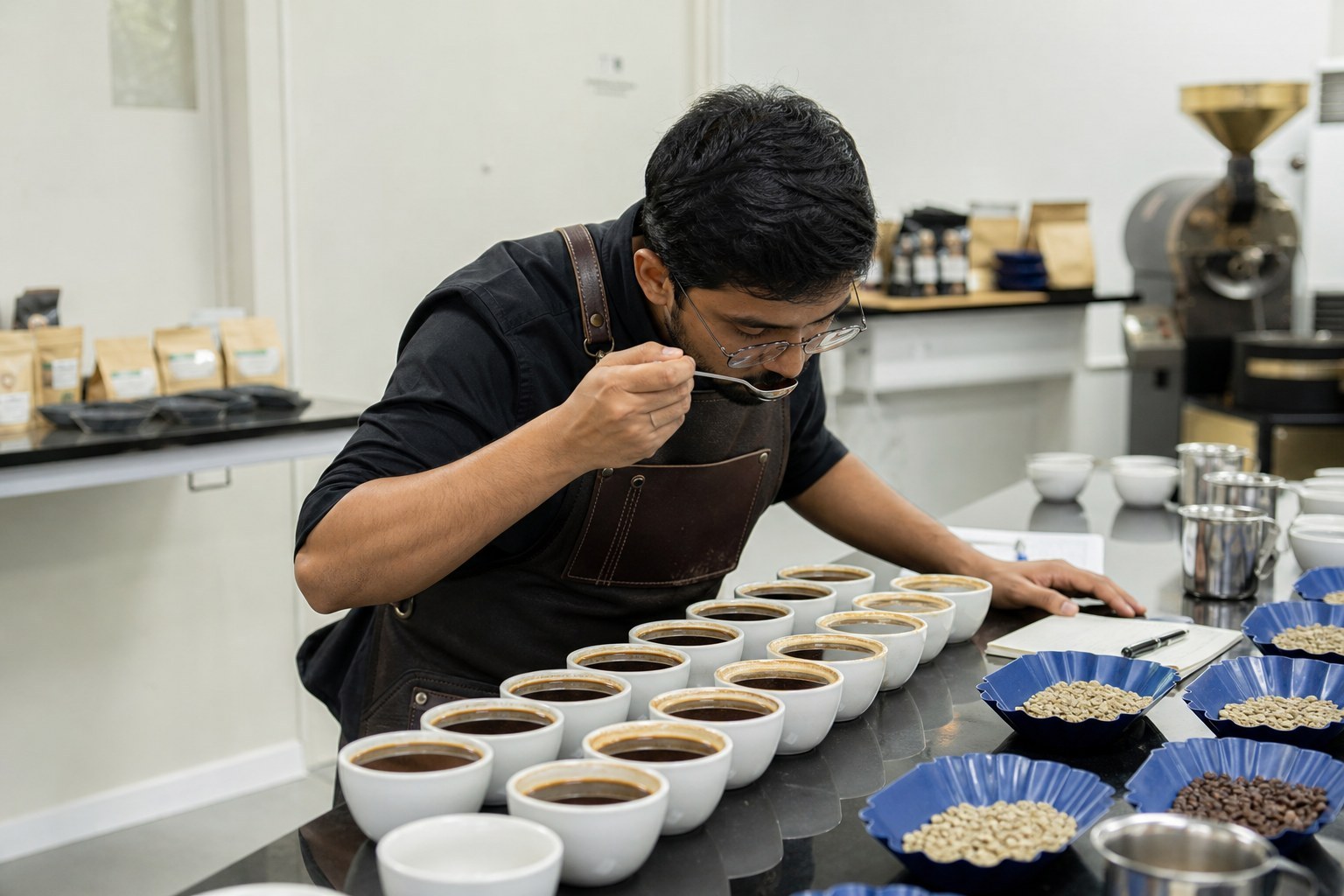
Before booking any fair, confirm production readiness matches what will be pitched at the booth — a common and costly mismatch is presenting samples and price sheets for volumes or grades the curing works cannot actually deliver on the timeline promised. Buyers who cup a strong sample and place a trial order expect the bulk lot to match; a curing works that cannot reproduce the exhibited grade consistently damages the relationship faster than never having exhibited at all.
Confirm before the fair: current cupping and grading capacity, moisture and COA turnaround time, Coffee Board documentation processing capability, and — for organic or Monsooned Malabar lines — certifier and curing-works lot-tracking systems that can issue a transaction certificate or batch traceability document on the timeline a buyer will expect after a fast-moving fair conversation.
Comparison table
Swipe →
Data table — swipe horizontally on small screens
| Readiness item | Confirm before the fair | Why it matters at the booth |
|---|---|---|
| Cupping/grading capacity | Consistent grade across recent lots | Buyers compare bulk sample against booth sample immediately |
| Lab/COA turnaround | 7–15 business day capability | Fast follow-up samples need lab support behind them |
| Coffee Board documentation capability | Processing timeline confirmed | First order needs paperwork fast to hit buyer's timeline |
| Organic/Monsooned lot tracking | Certifier or curing works can issue lot-specific docs quickly | Organic and Monsooned Malabar buyers ask about this at the booth |
Pricing Analysis
Buyer Tip
Trade fair ROI must account for fully loaded costs: booth rental, travel, accommodation, sample preparation, documentation-pack printing, Coffee Board or pavilion participation fees, and staff time. A Gulfood pavilion slot for a small exporter typically runs ₹3–8 lakhs all-in; an SCA Expo or Anuga overseas presence runs ₹8–20 lakhs depending on booth size and team size. Coffee Board buyer-seller meets and the IICF are materially cheaper, typically ₹1–3 lakhs, making them the right first step for exporters without a fair budget history.
Break-even analysis should be run before booking: if fully loaded fair cost is ₹10 lakhs and target gross margin per MT is ₹40,000, roughly 25 MT of programme volume from fair-sourced leads is needed to break even — typically achievable from one to two converted programme buyers over 12–18 months. Track cost per qualified lead (roughly ₹15,000–40,000 for specialty fairs; ₹5,000–15,000 for Coffee Board meets) and cost per first order as the real ROI metrics, not booth footfall.
Comparison table
Swipe →
Data table — swipe horizontally on small screens
| Fair tier | Typical all-in cost (INR) | Break-even volume (₹40K/MT margin) | Typical first-order timeline |
|---|---|---|---|
| Coffee Board meet / IICF | ₹1–3 lakhs | 3–8 MT | 30–90 days |
| Gulfood (shared pavilion) | ₹3–8 lakhs | 8–20 MT | 30–90 days |
| SCA Expo | ₹8–15 lakhs | 20–38 MT | 60–180 days |
| Anuga (India pavilion) | ₹8–18 lakhs | 20–45 MT | 90–180 days |
| Biofach | ₹6–12 lakhs | 15–30 MT | 90–180 days |
MOQ Analysis
Buyer Tip
MOQ communicated at the booth should be pre-approved and identical across every conversation — buyers compare notes with other exhibitors at the same fair, and an inconsistent MOQ across two conversations at the same event damages credibility fast. Bulk Robusta programmes typically publish 10–20 MT MOQ at Gulf-focused fairs; specialty Arabica and Monsooned Malabar trials at the SCA Expo or Anuga can start at 500 kg–2 MT; organic programme MOQ varies by certifier and should be confirmed before the fair, not improvised at the booth.
For first-time exhibitors, offering a smaller trial MOQ specifically for fair-sourced leads — even below the standard published tier — can convert a hesitant buyer into a first shipment faster, provided the documentation and lead-time commitments made at the booth are still fully honoured.
Comparison table
Swipe →
Data table — swipe horizontally on small screens
| Fair type | Typical published MOQ | Trial-order flexibility |
|---|---|---|
| Gulfood / Coffee Board meets | 10–20 MT bulk Robusta | Some exhibitors offer 5 MT trial for new buyers |
| SCA Expo / Anuga | 500 kg–2 MT specialty/Arabica | 250–500 kg premium Monsooned Malabar trials common |
| Biofach (organic) | Certifier-dependent minimum | Rarely flexible due to certification audit cost |
Packaging Standards
Export Tip
Booth packaging display should mirror what will actually ship — a beautifully staged retail jar that does not match the exporter's real production packaging sets up a documentation and expectation mismatch at the first order. Bulk formats (jute bags with GrainPro liners) should be shown alongside retail-ready formats (foil pouches, vacuum packs, private-label cartons) only if both are genuinely available at the MOQ quoted.
For private-label and retail-focused fairs (PLMA, Anuga retail zones), bring finished mock-up packs with label compliance already reviewed — buyers at these fairs evaluate shelf-readiness as much as coffee quality, and an unfinished label or missing barcode signals a programme that is not actually ready to launch.
Comparison table
Swipe →
Data table — swipe horizontally on small screens
| Pack format shown at booth | Fair type | Readiness check before exhibiting |
|---|---|---|
| 60kg jute bags with GrainPro liner | Gulfood, Coffee Board meets | Match bag weight and MOQ to what is actually quoted |
| Grade-labelled small bags | SCA Expo, Anuga | Grade on bag must match COA nomenclature |
| Retail pouch / vacuum pack mock-ups | PLMA, Anuga retail zones | Label compliance and barcode already reviewed |
| Certified organic retail pack | Biofach | Certifier logo and lot-TC workflow ready to explain |
Container Loading Details
Export Tip
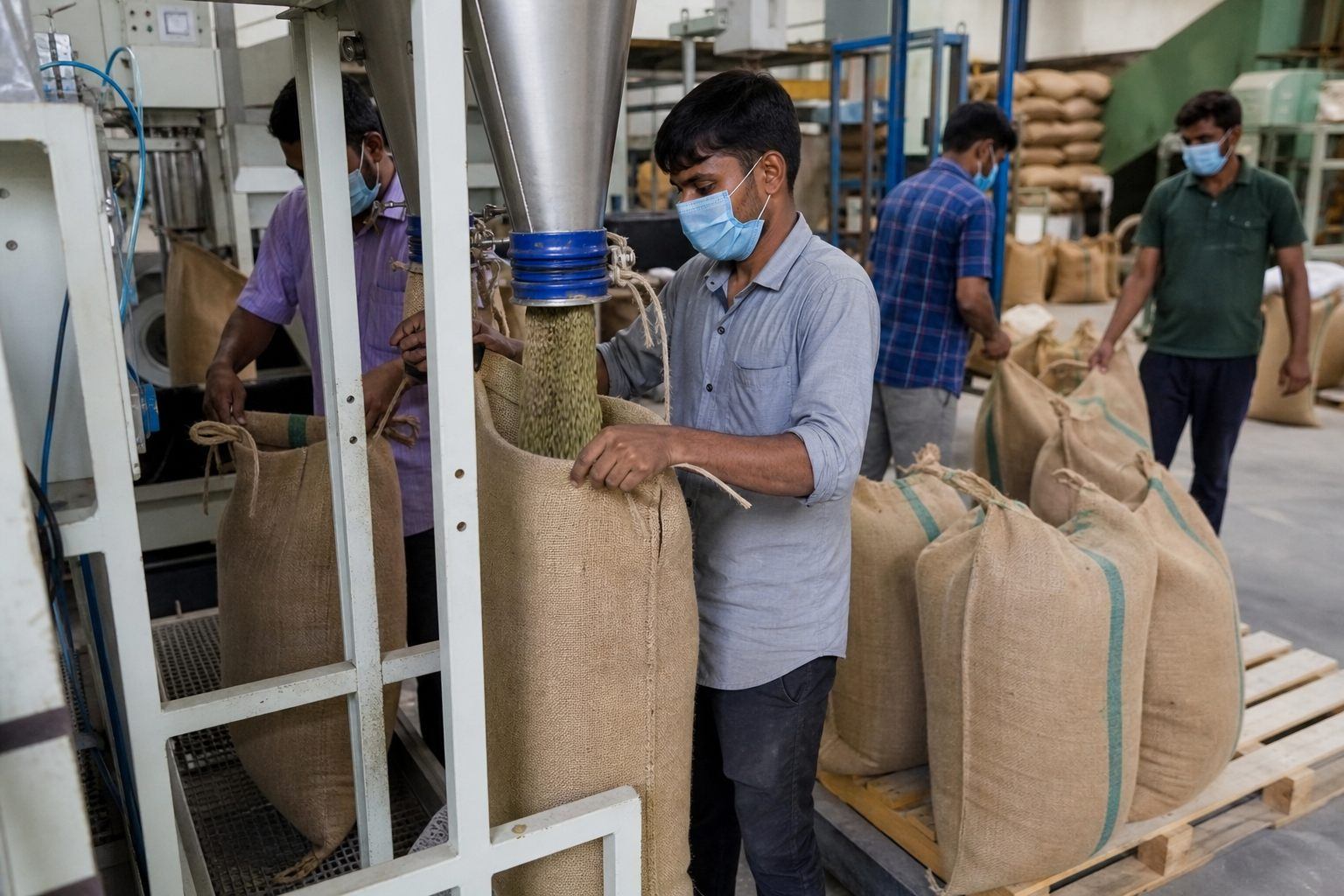
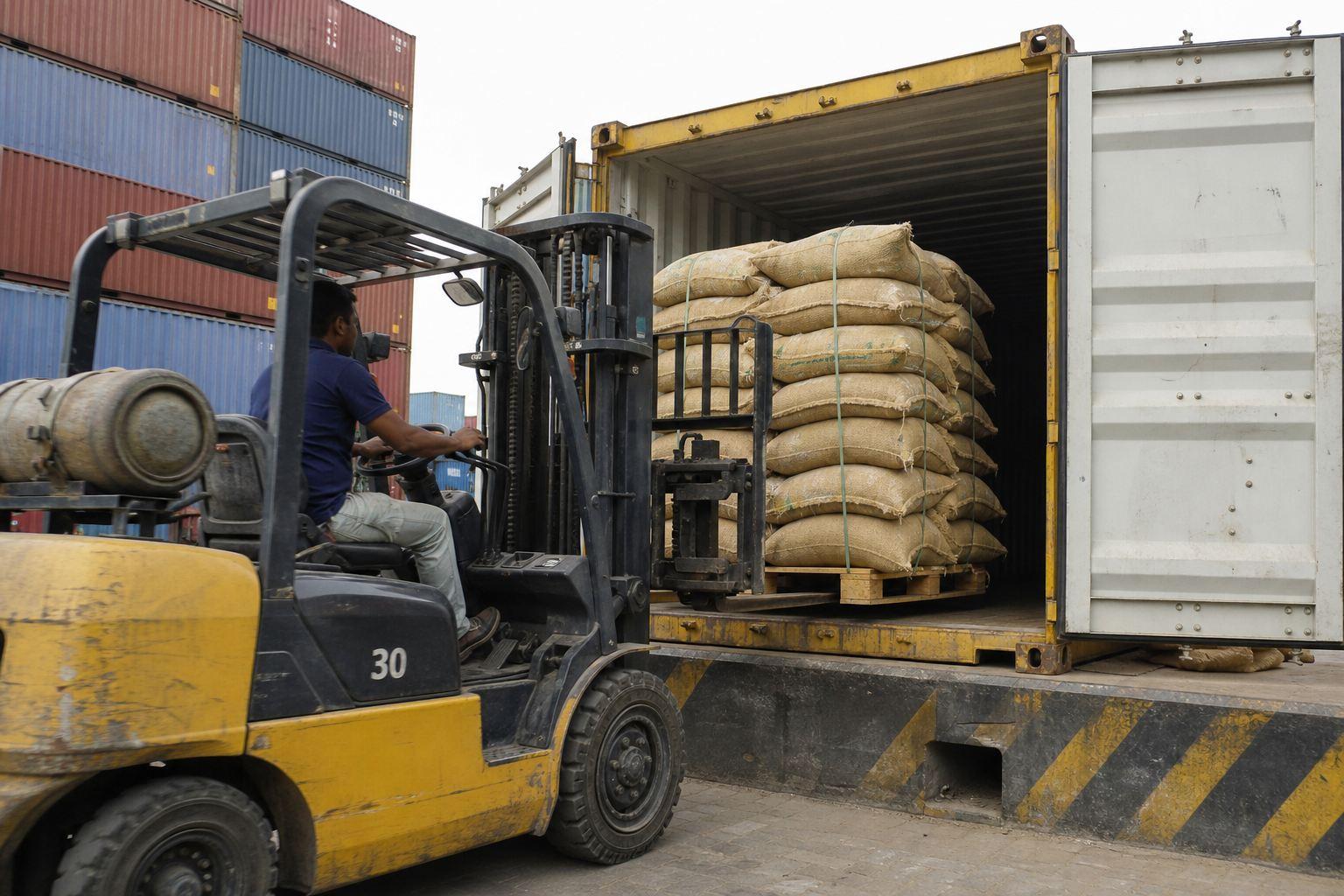
Container loading capacity should be communicated at the booth in terms buyers actually use for planning: a 20-foot container typically carries about 17–19 MT of bagged green coffee (often ~300 × 60 kg bags); a 40-foot container is usually volume-limited at about 24–26 MT for bagged green coffee — not double a 20ft load. Buyers evaluating a new supplier at a fair often ask how quickly a first FCL can be loaded and sailed after a trial order is confirmed — have a realistic answer ready rather than an optimistic one that later slips.
For buyers requesting LCL trial shipments of 2–5 MT after a fair conversation, confirm in advance that your packaging and moisture-control practices protect cargo adequately in mixed-cargo LCL handling — this is a common follow-up question from cautious first-time buyers.
Comparison table
Swipe →
Data table — swipe horizontally on small screens
| Container | Typical loading | Fair-conversation talking point |
|---|---|---|
| 20ft FCL, bagged | ~17–19 MT | Standard first-order size for confirmed Gulf/EU buyers |
| 40ft FCL, bagged | ~24–26 MT (volume-limited) | Large programmes — clarify it is not double 20ft |
| LCL | 2–5 MT | Common ask from cautious first-time fair leads |
Shipping Methods
Export Tip
Confirm Incoterm options before the fair so price-sheet quotes at the booth are consistent: FOB Chennai/Cochin is standard for experienced buyers who manage their own freight; CIF suits buyers who prefer single-point pricing and is common for newer relationships originating from a fair. Never quote an Incoterm-specific price under aisle pressure without pre-approved authority — this is one of the most common booth-level pricing mistakes.
For buyers who convert quickly at a fair and want to move fast, having freight-forwarder relationships already in place for the relevant load port shortens the gap between trial-order confirmation and vessel booking — a gap that, left too long, cools buyer enthusiasm generated at the fair.
Comparison table
Swipe →
Data table — swipe horizontally on small screens
| Incoterm | Best fit for fair-sourced buyer | Booth conversation note |
|---|---|---|
| FOB | Experienced buyers managing own freight | Most common for Gulf/Italy fair leads |
| CIF | Newer buyers wanting simpler budgeting | Common for first-time SCA Expo/Anuga leads |
| CFR | Buyers who self-insure | Seen in Gulf and CIS conversations |
Certifications
Compliance Notes
Certification proof at the booth is as important as the sample cup. Bring physical or digital copies of Coffee Board exporter registration, current FSSAI licence, and a recent COA — buyers increasingly ask to see these during the conversation, not after. For organic and Biofach-specific participation, bring the certifier's name and a sample transaction certificate structure so buyers can confirm your lot-specific workflow rather than taking a verbal assurance.
Monsooned Malabar documentation deserves specific booth preparation: bring curing-works batch traceability proof for any Monsooned Malabar-labelled sample on display, since EU, US, and Japan buyers at premium fairs increasingly ask this question directly before discussing price.
Comparison table
Swipe →
Data table — swipe horizontally on small screens
| Certification to bring | Fair relevance | Format to carry |
|---|---|---|
| Coffee Board exporter registration | All fairs | Digital + one printed copy |
| FSSAI licence | All fairs | Digital + one printed copy |
| Recent COA | All fairs, especially EU/Japan-focused | Printed summary, digital full report on request |
| Organic transaction certificate sample | Biofach, organic-focused zones | Digital, explained verbally with example |
| Monsooned Malabar curing-works traceability | SCA Expo, SIAL, EU/Japan buyers | Digital + printed for Monsooned-labelled samples |
Buyer Requirements
Buyer Requirements
Buyers walking a major coffee fair evaluate exhibitors on more than the sample cup. They check whether the exhibitor can quote a locked MOQ and price without hesitation, whether Coffee Board and FSSAI credentials are readily available, and whether the follow-up promised at the booth actually arrives within days rather than weeks. A polished booth with a slow follow-up loses more deals than a modest booth with a fast, documentation-ready response.
For EU, US, and Japanese buyers specifically, expect questions about pesticide MRL panel coverage and organic transaction certificate workflow before any commercial discussion — these buyers have often been burned by suppliers who could not produce this proof after the fair, and they now ask before, not after.
Country-wise Opportunities
Market Snapshot
Fair selection should be matched to destination market, not chosen by prestige alone.
Comparison table
Swipe →
Data table — swipe horizontally on small screens
| Fair / Platform | Location / Reach | Frequency | Indian coffee fit |
|---|---|---|---|
| World of Coffee | Rotating EU city (SCA Europe) | Annual | Strong — specialty Arabica, Monsooned Malabar, organic |
| SCA Expo (Specialty Coffee Expo) | USA | Annual | Strong — Arabica, Monsooned Malabar, organic |
| Gulfood | UAE | Annual | Very strong — Robusta, proximity |
| Anuga | Germany | Biennial | Strong — Arabica, organic, all grades |
| SIAL | France | Biennial | Strong — specialty positioning, Monsooned Malabar |
| Coffee Board buyer-seller meets / IICF | India (Bengaluru and other cities) | Multiple p.a. | Very strong — supported framework for first-timers |
| Biofach | Germany | Annual | Essential for organic coffee exporters |
| Alibaba / Tridge / Europages (marketplaces) | Global / global food / EU | Continuous | Supplementary discovery between fair seasons |
Italy and wider EU — regional Italian coffee events, Anuga, SIAL
Primary focus: Robusta for espresso blending and broader Italian/EU distribution. Product focus: Robusta, blended Arabica, competitive FOB. Post-fair pipeline: fast sample dispatch since Italian buyers evaluate quickly on crema and cup character. Typical first order lands 30–90 days after the fair for volume buyers.
USA — SCA Expo and organic/natural events
Primary fair: Specialty Coffee Expo (SCA), USA. Product focus: single-estate Arabica, Monsooned Malabar, organic certified. Post-fair pipeline runs longer — 60 to 180 days — with FDA Prior Notice coordination and NOP organic transaction certificates for certified lines. Specialty roasters cup extensively before committing.
EU and UK — World of Coffee, Anuga, Biofach, SIAL
Primary fairs: World of Coffee (SCA Europe, rotating EU city), Anuga (biennial), Biofach (organic-only), SIAL (premium/innovation). Product focus: single-estate Arabica, Monsooned Malabar, organic certified. Post-fair pipeline is documentation-heavy — share EU MRL COA proactively and explain organic transaction certificate and curing-works workflow before the buyer asks.
Russia and CIS — regional food fairs
Primary fair: World Food Moscow and regional events. Product focus: Robusta, instant-coffee inputs. Verify current market access and banking requirements before committing fair budget to this region.
UAE/Gulf and Japan
UAE and Gulf: Gulfood is the flagship prospecting event for Robusta and instant coffee, with fast-moving buyers who decide quickly once documentation is confirmed. Japan: relationship-intensive market best approached through SCA Expo networking and direct outreach with strict MRL compliance evidence ready before the first meeting.
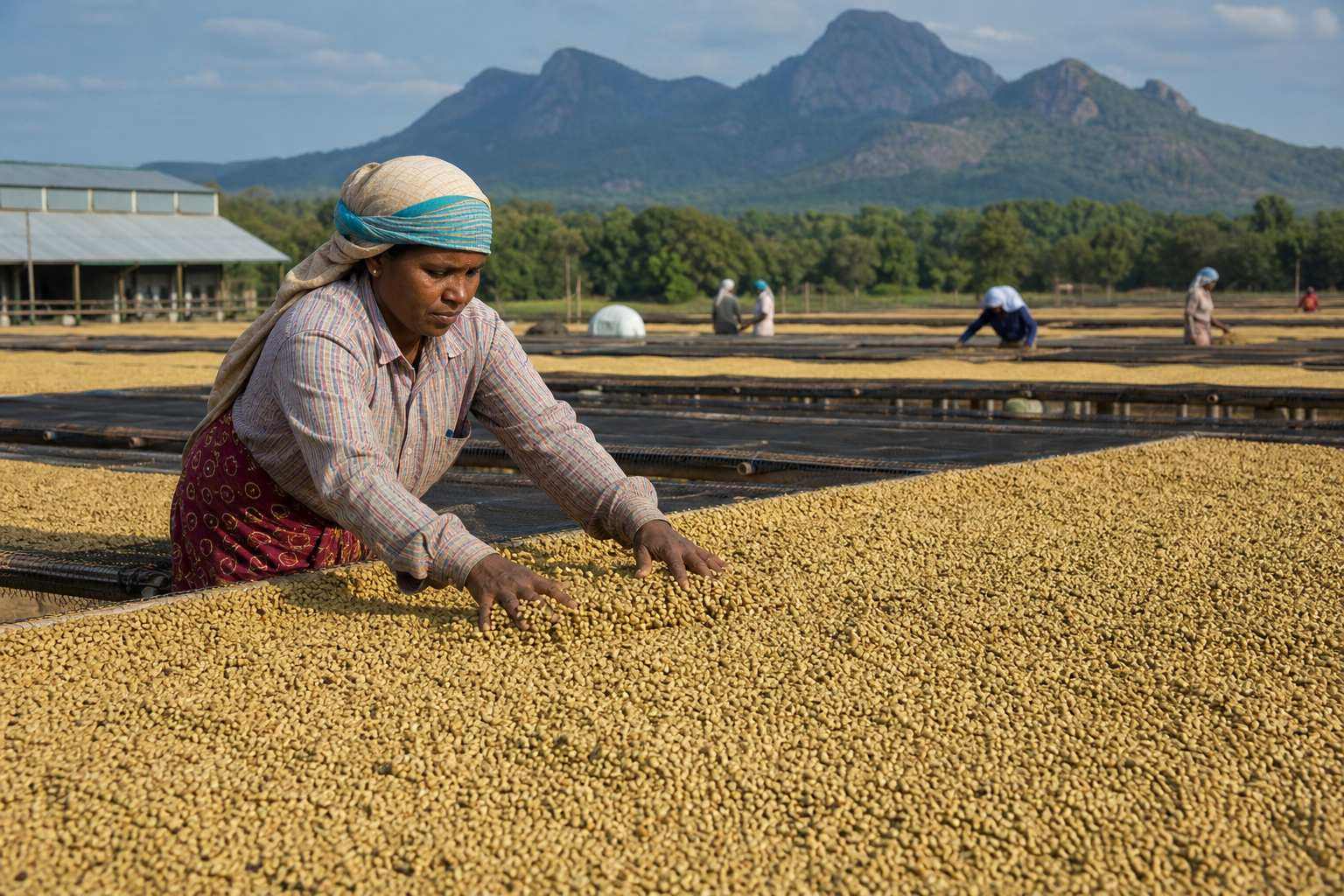
Expert Insight #1 — Saurabh Mittal, Founder, Altus Exports
Expert Insight Box
Saurabh Mittal, Founder of Altus Exports, treats trade fairs as relationship accelerators rather than substitutes for export process readiness. He recommends a practical first-year fair path for coffee exporters: confirm Coffee Board exporter registration and FSSAI first, prepare a documentation summary pack and grade photography, attend one Coffee Board buyer-seller meet, the IICF, or Gulfood before anything larger, build a 90-day post-fair CRM workflow, and only add the SCA Expo or Anuga once two to three successful export shipments confirm process readiness.
For organic and Monsooned Malabar specialty programmes, Mittal advises prioritising Biofach and the SCA Expo early once EU-equivalent certification or curing-works traceability is genuinely active — but only with a lot-specific transaction certificate workflow and MRL COA capability demonstrated proactively to buyers, not promised in the moment.
Sourcing Checklist
Checklist
- Confirm Coffee Board exporter registration, FSSAI licence, and IEC status at least 30 days before any fair or marketplace listing.
- Pre-book meetings with import-data-identified buyers 30 days before the fair rather than relying on walk-up traffic.
- Source and set aside production-lot samples labelled with grade, origin, estate, and certifications — never a curated sample that differs from what is actually shippable.
- Confirm curing works or estate partners can reproduce the exhibited grade at the MOQ and lead time promised at the booth.
- Book a NABL-accredited lab slot for pesticide-residue panels ahead of peak fair season so testing never delays a sample dispatch.
Complete this sourcing and pre-fair preparation checklist before booking booth space or a marketplace profile upgrade.
Buyer Checklist
Checklist
- Confirm the exhibitor can produce Coffee Board exporter registration and current FSSAI licence on request at the booth.
- Ask for a recent COA and compare its grade parameters against the sample being cupped.
- Request a documentation summary pack — invoice format, packing list, certificate examples — before confirming even a trial order.
- For organic or Monsooned Malabar claims, ask specifically about lot-specific transaction certificate or curing-works workflow, not just certifier or estate name.
- Set a follow-up expectation with the exhibitor at the booth — sample dispatch within 7–10 days is a reasonable standard.
For buyers meeting Indian coffee exporters at fairs or on marketplaces, this checklist helps separate genuinely export-ready suppliers from those who are not yet ready for a first commercial order.
Exporter Checklist
Checklist
- Prepare a one-page documentation summary buyers can photograph, plus a digital PDF version to email during the meeting.
- Enter every lead into CRM the same evening with source code, next step, and a same-day or next-day thank-you scheduled.
- Dispatch sample kits with COA within 7–10 days for high-intent leads; share a full documentation summary pack by day 14.
- Schedule a video call for remote cupping or spec walkthrough within 14–21 days, then send a trial-order proforma by day 21–45.
- Track cost per qualified lead and cost per first order by channel monthly, not booth footfall.
This checklist converts fair and marketplace preparation, and post-fair follow-up, into a repeatable pre- and post-event routine for Indian coffee exporters.
Compliance Checklist
Checklist
Compliance Notes
- Confirm Coffee Board exporter registration is current before listing on any marketplace or booking any fair.
- Do not exhibit organic-labelled samples without an active certifier relationship capable of issuing lot-specific transaction certificates.
- Do not market Monsooned Malabar-labelled samples without verifiable curing-works batch traceability documentation on hand.
- Confirm FSSAI licence scope covers coffee processing and export before printing it on any booth material.
- Review every marketplace profile claim (organic, Monsooned Malabar, certifications) against actual current certification status before publishing.
This checklist ensures fair and marketplace activity stays aligned with statutory coffee export compliance rather than treating exhibitions as a marketing-only exercise disconnected from documentation readiness.
Common Buyer Mistakes
Common Mistakes Box
Expert Insight #2 — Saurabh Mittal, Founder, Altus Exports
Expert Insight Box
The post-fair pipeline is where trade show ROI is actually won or lost — and it deserves as much planning as the booth itself. Exporters who follow up within 48 hours convert several times more fair leads than those who wait until returning fully to the office. Segment leads by intent at CRM entry: A-grade accounts with stated buying authority, volume mandate, and timeline get a sample plus documentation pack within seven days. B-grade accounts with interest but no volume clarity get a thank-you and spec sheet, re-engaged at 30 days. C-grade general inquiries enter a nurture sequence — do not dispatch expensive samples on unqualified interest.
Measure ROI honestly by channel: lead volume, lead quality, cost per qualified lead, conversion rate to first orders, documentation clearance rate on first presentation, and pipeline velocity from fair close to first shipment. A fair that generates fifty business cards and zero qualified conversations is not a cheaper channel than a marketplace that generates five verified RFQs — it is a more expensive one once true cost per qualified lead is calculated.
Future Market Trends
Key Statistics
Coffee fairs and marketplaces are shifting toward hybrid formats — pre-registered video meetings ahead of physical attendance, digital certificate verification at the booth, and marketplace profiles that increasingly surface certification status directly rather than as a downloadable PDF. Exporters who digitise their documentation proof now will look more credible to buyers who are increasingly used to instant verification from other origins.
Organic and process-authenticated coffee — including Monsooned Malabar — will continue gaining fair floor space relative to undifferentiated commodity Robusta, particularly at Biofach, Anuga, and SIAL, as EU and US buyers deepen scrutiny of transaction-certificate and traceability workflows. Coffee Board buyer-seller meets and the IICF are also likely to expand their matchmaking sophistication, giving first-time exporters better pre-fair buyer targeting than in previous years.
Conclusion
- Read find international buyers for coffee, Coffee Board registration benefits for exporters, and coffee export documentation checklist.
- Continue with how to export coffee from India, most demanded Indian coffee by country, and organic and specialty coffee export opportunities from India.
- Explore merchant exporter support for end-to-end coffee export programmes.
Trade shows and B2B marketplaces for coffee exporters from India work best as an integrated system: World of Coffee, the SCA Expo, Gulfood, Anuga, SIAL, Biofach, and Coffee Board buyer-seller meets/IICF for face-to-face trust and cupping; Tridge, Alibaba, and Europages for continuous discovery; and a disciplined 90-day post-fair pipeline with honest ROI tracking for revenue conversion. Documentation readiness — Coffee Board registration, FSSAI compliance, COA capability, and organic transaction certificate workflows — is as important at the booth as product quality.
Shortlist one fair from the comparison tables above that matches your coffee type and target buyer geography, confirm Coffee Board and FSSAI readiness, build your post-fair follow-up templates before the event opens, and measure ROI by source code rather than booth footfall. Altus Exports supports coffee exporters and international buyers connecting buyer discovery with documentation-compliant export execution across agriculture and food products programmes.