
Best Countries for Indian Leather Wallet and Belt Exports in 2026
By Saurabh Mittal, Founder, Altus Exports
A destination-ranking and market-selection guide for Indian leather wallet and belt exporters — comparing the USA, UK, Germany, UAE, France, Netherlands, Australia, Japan, Canada, and Saudi Arabia on duties, compliance intensity, payment culture, and wallet-versus-belt demand.
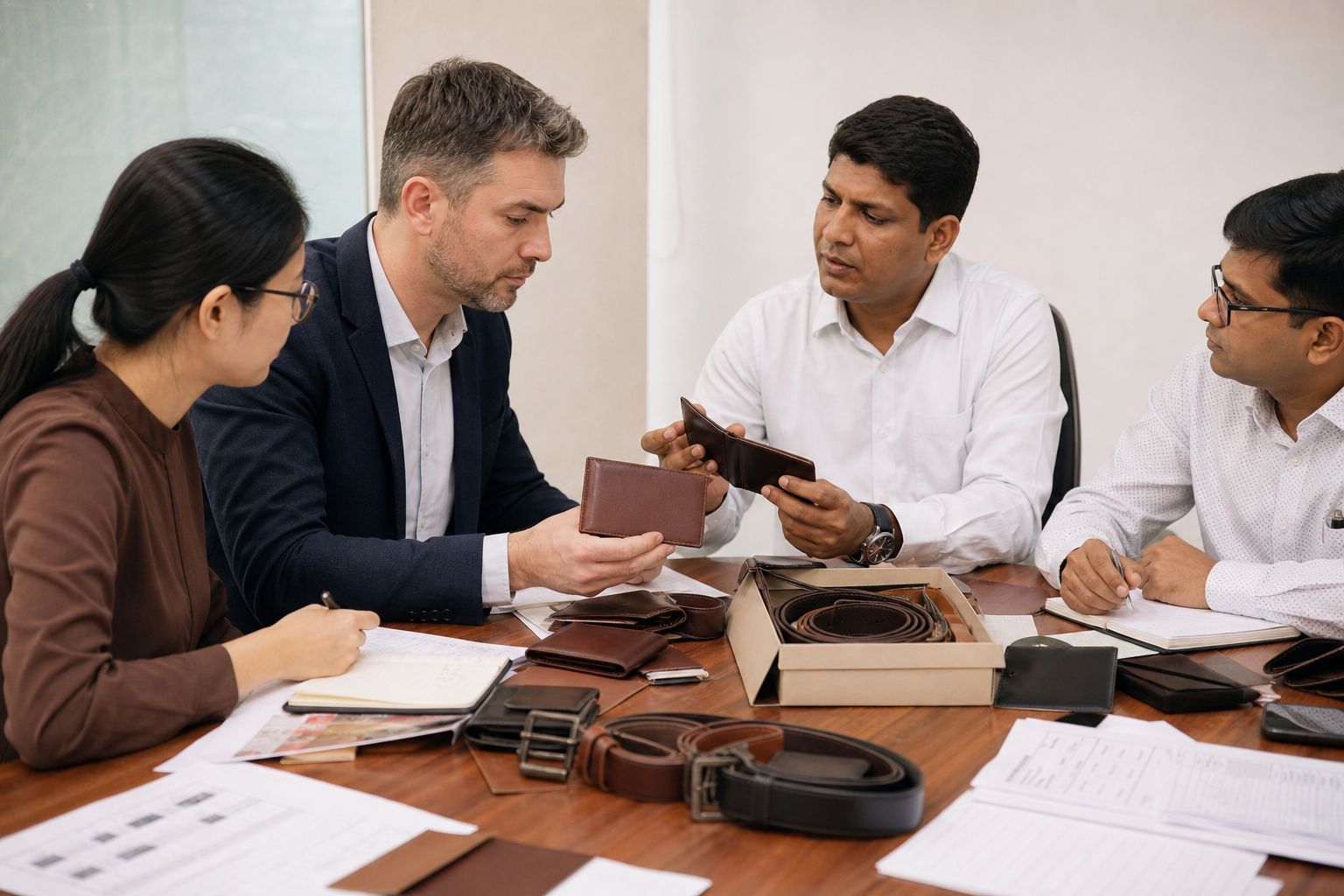
Choosing where to sell Indian leather wallets and belts is a market-selection decision — not a product catalogue exercise. Bifolds, RFID card holders, formal dress belts, and reversible casual belts travel under different HS lines, attract different duty treatments, and meet buyers who pay, audit, and reorder in sharply different ways.
United States, United Kingdom, Germany, United Arab Emirates, France, Netherlands, Australia, Japan, Canada, Saudi Arabia each import Indian small leather goods (SLG) and belts at meaningful volume, yet they diverge on preferred constructions, channel structure, compliance intensity, and payment culture. Ranking those differences before you allocate sample budget or certification spend is the highest-leverage step an exporter or sourcing partner can take in 2026.
This guide is a destination-ranking and market-selection framework. It is not a how-to-export walkthrough and not a style catalogue. For the operational registration-to-shipment sequence, see How to Export Leather Wallets and Belts from India. For SKU depth, see Top Leather Wallet and Belt Products Exported from India. For country-level product demand, see Most Demanded Indian Leather Wallets and Belts by Country. For buyer-side procurement, see Source Leather Wallets and Belts Directly from India.
Altus Exports works as a merchant exporter in India and global sourcing partner coordinating wallet and belt programmes into the markets ranked below — this article distills that market-level experience into a practical comparison for exporters choosing where to focus and for importers deciding whether India fits their accessory assortment.
Key Takeaways
Summary Box
Executive Summary
Summary Box
Not every destination rewards the same wallet construction, belt width, price point, or compliance investment. Exporters who quote the same bifold and 35 mm formal belt package into every market consistently underperform those who build a market-specific entry plan around duty exposure, audit intensity, and reorder behaviour.
This guide ranks ten destinations that matter for Indian leather wallets and belts in 2026 — the United States, United Kingdom, Germany, UAE, France, Netherlands, Australia, Japan, Canada, and Saudi Arabia — on demand strength, compliance burden, price sensitivity, payment culture, and the preferred constructions each market actually reorders.
The comparison covers market size context, export and import statistics relevant to HS 4202.31 and 4203.30, indicative pricing and MOQ by destination tier, packaging and container economics for dense SLG versus buckle-heavy belts, certification emphasis, and a country-by-country opportunity section that forms the practical core of the article.
Two Expert Insight sections capture patterns we see when exporters choose a first market and when they expand into a second without diluting edge-paint, RFID liner, or buckle-finish consistency. Jump to the destination relevant to your decision, then use the comparison tables to validate that choice against alternatives.
Market Size & Industry Overview
Key Statistics
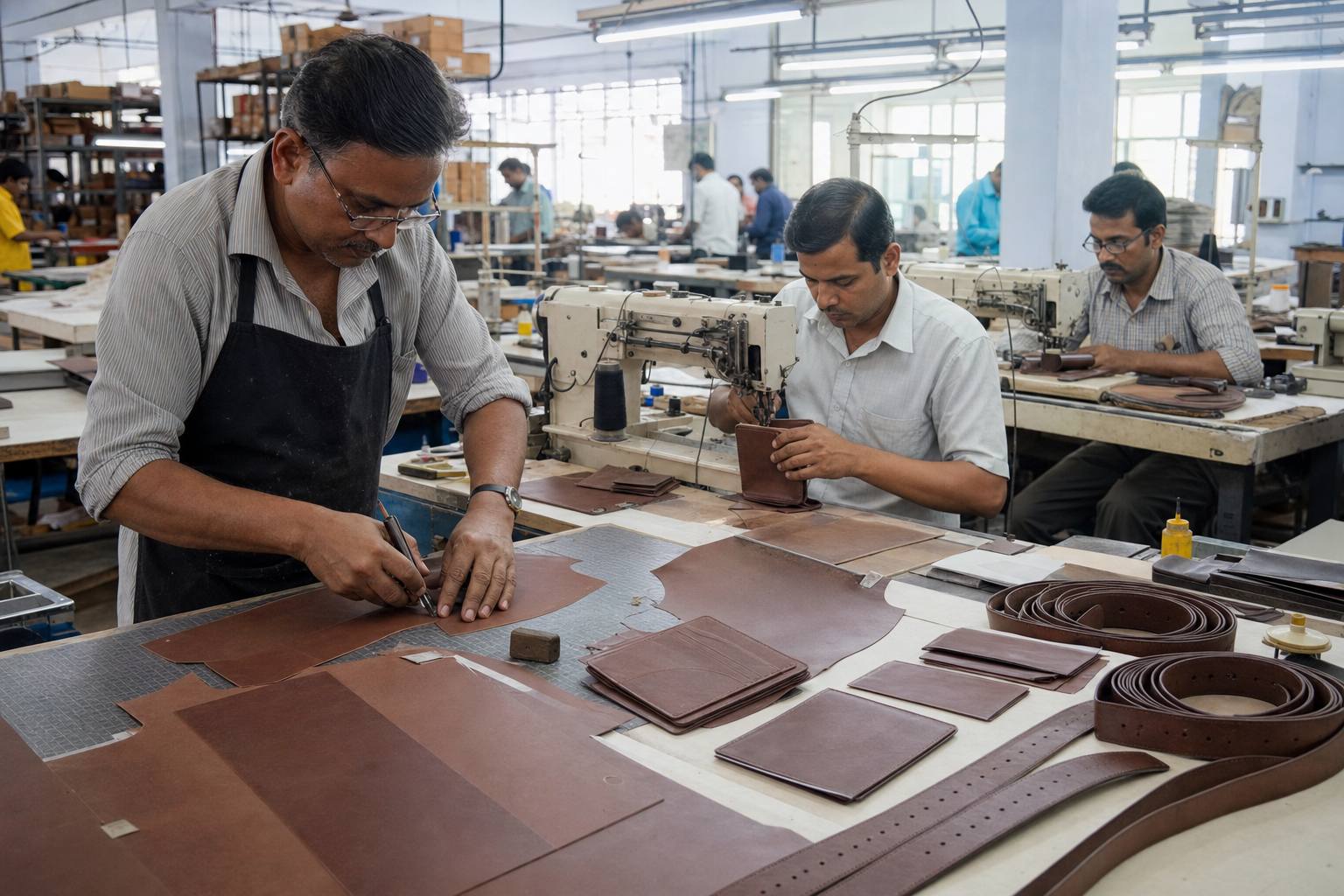
India's leather wallet and belt exports sit inside the broader finished leather goods and apparel accessories trade. Demand concentrates in mature accessory markets with dense wholesale, retail-chain, and e-commerce private-label channels: North America, the EU, the United Kingdom, the Gulf, and a quality-led Asia-Pacific tier. Clusters that actually produce these articles — Kanpur, Kolkata (Bantala), Delhi-NCR, Ambur–Ranipet–Chennai, Agra, Jaipur — differ in tannery relationships, edge-paint skill, buckle sourcing, and EU documentation maturity.
Market selection should follow construction capability and compliance readiness, not sector headline size. A market with large overall leather-goods imports may still be a poor fit if your factory cannot hold RFID liner consistency or REACH chromium VI evidence for belt leather. A smaller but well-matched market can deliver faster, cleaner repeat POs on bifolds and formal belts.
The Council for Leather Exports (CLE) and DGCI&S publish periodic leather-sector destination shares. Treat those shares as directional for market selection, then confirm HS-specific wallet and belt flows in Trade Map or customs data before setting volume targets.
Market Comparison Snapshot — Wallets & Belts (Indicative)
Swipe →
Data table — swipe horizontally on small screens
| Market | Demand Strength | Compliance Intensity | Payment Culture | Wallet vs Belt Emphasis |
|---|---|---|---|---|
| USA | Very high | Moderate | Net terms after trial; LC less common at mid-tier | Wallets + casual belts lead; RFID rising |
| UK | High | Moderate–high | Wholesale net terms; retail chargebacks real | Bifold + formal belt balanced |
| Germany | High | High (REACH / LWG) | Longer onboarding; LC or insured terms early | Formal belts + premium SLG |
| UAE | Moderate–high | Low–moderate | Faster TT / short terms common | Gift sets + formal belts |
| France | Moderate | High (finish audits) | Relationship-led; slower first PO | Fashion SLG + dress belts |
| Netherlands | Moderate | High (EU REACH) | Trading-hub TT/LC mix | Assorted SLG for EU redistribution |
| Australia | Moderate | Moderate (biosecurity pack) | Importer net terms after trial | Casual belts + travel wallets |
| Japan | Moderate | High (QC docs) | Conservative; long sample cycles | Slim wallets + precise formal belts |
| Canada | Moderate | Moderate | Wholesale net; bilingual labels | Bifold + RFID; winter gift belts |
| Saudi Arabia | Moderate | Low–moderate (GSO rising) | TT common via regional distributors | Formal belts + gift wallet sets |
Export Statistics
Key Statistics
CLE / DGCI&S Overview of Indian Leather Industry 2026 reports India's leather & leather products exports at US$ 4.75 billion in FY 2025-26, with leather goods at US$ 1,253.6 million (26.39%). Destination shares of the TOTAL sector include USA 20.54%, Germany 10.97%, UK 8.84%, Netherlands 6.11%, France 4.65%, and UAE 2.99%.
CLE destination shares are for the TOTAL leather & leather products basket (footwear, garments, goods, saddlery, etc.), not wallet-only (HS 4202.31) or belt-only (HS 4203.30) volumes. Use those shares for market prioritisation, then confirm HS 4202.31 and 4203.30 import flows in Trade Map or customs data before setting volume targets.
CLE FY 2025-26 Sector Destination Shares (Total Leather Basket — Not Wallet/Belt-Only)
Swipe →
Data table — swipe horizontally on small screens
| Market / Region | CLE Sector Share FY 2025-26 | Typical Wallet/Belt Programme Strength | HS Focus |
|---|---|---|---|
| United States | 20.54% | Private-label bifold, RFID, casual belts | 4202.31 / 4203.30 |
| Germany | 10.97% | REACH-ready formal belts, premium SLG | 4203.30 / 4202.31 |
| United Kingdom | 8.84% | Chain bifold + dress belt programmes | 42023120 / 42033000 |
| Netherlands | 6.11% | Assorted SLG for EU hubs | 4202.31 / 4203.30 |
| France | 4.65% | Fashion SLG, colourway dress belts | 4202.31 / 4203.30 |
| UAE | 2.99% | Gift sets, formal belts, travel wallets | 4202.31 / 4203.30 |
| Australia / Japan / Canada / Saudi | 1.56% / 1.66% / 1.15% / 0.79% | Secondary but sticky programmes | Mixed SLG + belts |
Import Statistics
Key Statistics
Reading each market's import behaviour for wallets and belts — average unit value, origin mix, and channel structure — reveals how India competes against other SLG origins. A market where Indian bifolds capture rising share through e-commerce private label is a different opportunity than a market where formal belts enter through department-store compliance gates.
Use import statistics to score entry difficulty and first-year focus. Low duty does not equal easy entry if REACH retesting or bilingual labelling costs erase the FOB advantage on a US$6–12 wallet.
Market Entry Scoring Matrix — Indian Leather Wallets & Belts
Swipe →
Data table — swipe horizontally on small screens
| Market | Entry Difficulty | First-Year Focus | Scale Signal | De-prioritise If… |
|---|---|---|---|---|
| USA | Medium | Bifold / RFID with clear card-slot map | Repeat PO + chargeback-free DC receiving | You lack UPC / carton label discipline |
| Germany | High | Formal belts + Cr(VI) evidence on leather lots | Buyer asks for LWG tannery ID early | You cannot fund lab tests before trial |
| UK | Medium–high | Bifold + dress belt with UK chemical evidence | Wholesale reorder within one season | Edge paint drifts between sample and bulk |
| UAE | Medium | Gift sets + 30–35 mm formal belts | Orders timed to Ramadan / gifting windows | You only quote EU premium packs with no value tier |
| France | High | Colourway SLG + finish-led dress belts | Brand QC feedback loops, not one-off trucks | Factory cannot hold Pantone / edge tone refs |
| Netherlands | Medium | Assorted SLG FCL for EU redistribution | Hub buyers booking repeat FCL slots | You chase boutique MOQs that break cube economics |
| Australia | Medium–high | Casual belts + travel wallets, biosecurity pack | Importer listing after first clean entry | Wood packing / fumigation rules unfamiliar |
| Japan | High | Slim wallets + precise hole-punch belts | Multi-season supplier retention | You need fast PO velocity over premium retention |
| Canada | Medium | Bilingual-ready bifold / RFID programmes | National wholesale reorder | You ignore French labelling on retail packs |
| Saudi Arabia | Medium | Formal belts + wallet–belt gift sets | Distributor reorder via Gulf hub | You lack GSO/SASO awareness for regulated claims |
Product Categories / Variants
Summary Box
Product-market fit for wallets and belts varies by destination more than many exporters admit. See Top Leather Wallet and Belt Products Exported from India for full SKU depth. In brief: USA and Canada favour bifolds, slim RFID wallets, and casual/jeans belts; UK balances bifold volume with formal dress belts; Germany and France reward formal belts, vegetable-tanned or LWG-linked leather, and finish-disciplined SLG; UAE and Saudi Arabia pull gift wallet–belt sets and formal belts; Japan prefers slim card holders and precise length assortments; Australia mixes travel wallets with casual belts.
Do not force a single assortment into every market. A reversible 35 mm belt that clears Gulf gifting may fail Japanese hole-spacing tolerances; an RFID bifold that wins US e-commerce may be over-specified for a price-led UAE wholesale line.
Preferred Constructions by Destination (Indicative)
Swipe →
Data table — swipe horizontally on small screens
| Market | Preferred Wallet Constructions | Preferred Belt Constructions | Channel Types |
|---|---|---|---|
| USA | Bifold, trifold, RFID slim, card holder | Casual / jeans 35–38 mm; some formal | Wholesale, e-comm private label, department |
| UK | Bifold, zip coin, RFID rising | Formal 30–35 mm; reversible casual | High-street chains, distributors |
| Germany | Full-grain bifold, premium card holder | Formal dress 30–35 mm; LWG leather | Specialty retail, premium wholesale |
| UAE | Passport / travel, gift bifold | Formal 30–35 mm; statement buckle | Mall retail, re-export distributors |
| France | Fashion SLG, zip-around, colourways | Dress belts, fashion buckle | Department, fashion wholesale |
| Netherlands | Assorted bifold / card holder mix | Assorted formal + casual for EU | Trading houses, EU redistribution |
| Australia | Travel wallet, bifold | Casual belts; some workwear widths | Importer-distributors, retail chains |
| Japan | Slim bifold, card holder, precision stitch | Formal belts, exact hole punch & length | Specialty retail, department |
| Canada | Bifold, RFID, gift sets | Casual + formal winter gift mix | National wholesale, bilingual retail |
| Saudi Arabia | Gift bifold sets, passport holders | Formal belts; corporate gift widths | Distributors, modern trade |
Manufacturing Overview
Export Tip
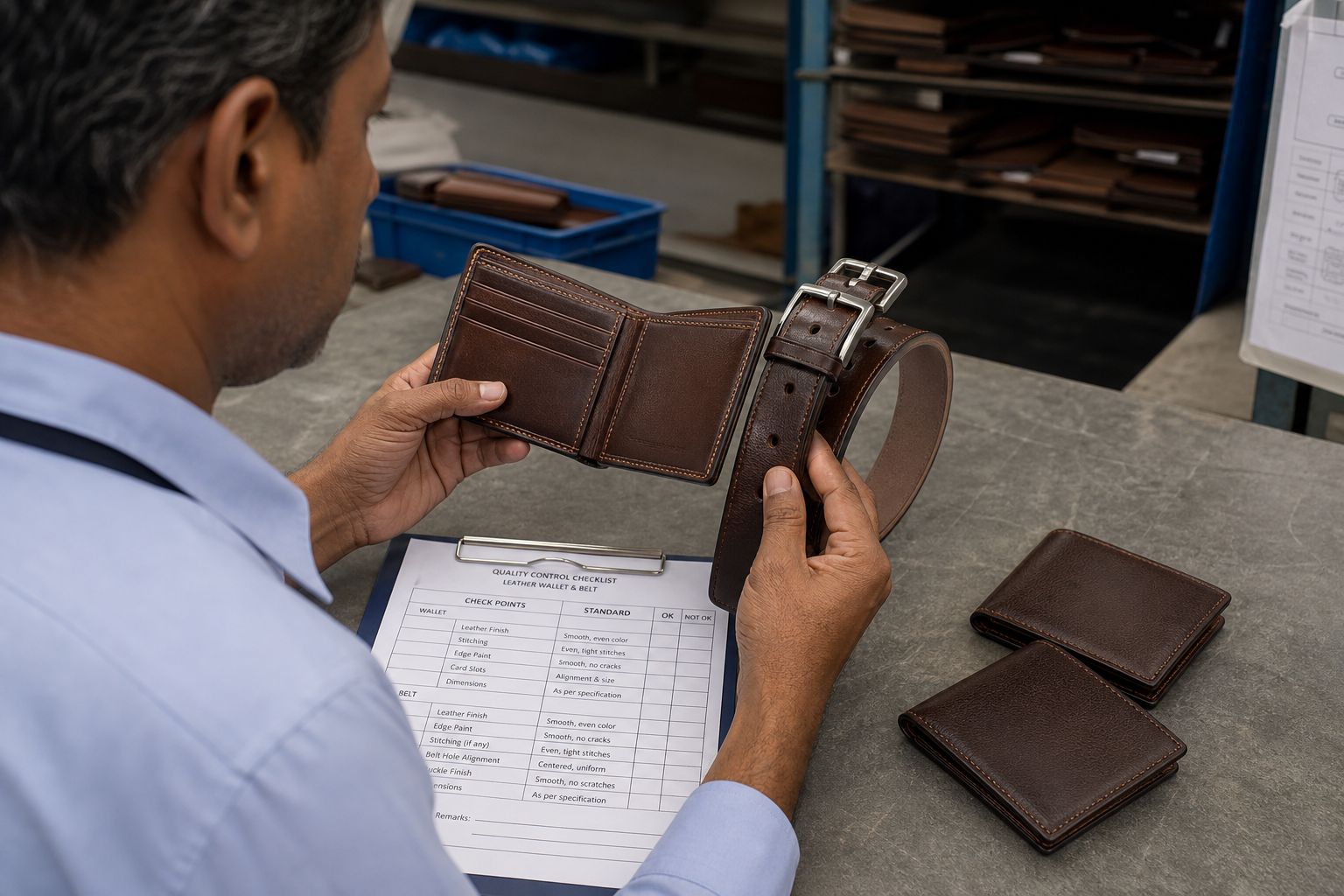
Manufacturing stages for wallets and belts — leather selection, cutting/skiving, stitching or cementing, edge paint, RFID liner insertion where specified, buckle and hole finishing for belts, final QC — are similar across destinations. What changes is which cluster and which process controls a buyer will audit. Kanpur, Kolkata (Bantala), Delhi-NCR, Ambur–Ranipet–Chennai, Agra, Jaipur each carry different strengths for SLG density, buckle sourcing, and EU documentation.
Exporters targeting Germany, France, or Japan should confirm tannery relationships, chromium VI testing discipline, and edge-paint batch control before committing capacity. Exporters targeting USA and Canada should confirm barcode, carton mark, and RFID claim substantiation. Gulf-bound programmes should confirm gift-set packing and buckle alloy consistency for formal belts.
Ports commonly used for wallet and belt FCL include Mundra, Nhava Sheva, Chennai, Tuticorin, Kolkata — choose routing from cluster geography, not habit.
Cluster Fit for Wallet & Belt Export Markets
Swipe →
Data table — swipe horizontally on small screens
| Cluster | Strength | Best-Matched Markets |
|---|---|---|
| Kanpur | SLG volume, bifold / card holder depth | USA, UK, Canada, Netherlands assortments |
| Kolkata (Bantala) | Leather goods + belt lines, East India logistics | UK, Middle East, Australia |
| Delhi-NCR | Fashion SLG, private label coordination | USA e-comm, France colourways |
| Ambur–Ranipet–Chennai | Export compliance culture, EU programmes | Germany, France, Netherlands, UK |
| Agra | Volume accessories, gift assortments | UAE, Saudi, USA value tiers |
| Jaipur | Artisanal finish, fashion belts / emboss | France, UAE gift, specialty retail |
Pricing Analysis
Buyer Tip
Price expectations differ by market as much as by SKU. A bifold FOB that clears easily in the USA or UAE may be uncompetitive in Germany once REACH and audit costs are loaded; a Japan-positioned slim wallet may leave margin on the table in a Gulf value programme. Ranges below are indicative FOB planning figures — not quotes.
Indicative anchors from current planning tables: bifold US$4–12 / pc FOB; RFID US$6–18 / pc FOB; formal belt US$3.50–12 / pc FOB; casual belt US$3–10 / pc FOB; premium full-grain set US$18–45 / set FOB.
Indicative FOB Positioning by Market (USD / pc, Wallet–Belt Blend)
Swipe →
Data table — swipe horizontally on small screens
| Market | Indicative Wallet FOB Band | Indicative Belt FOB Band | Price Sensitivity | Compliance Cost Add-On |
|---|---|---|---|---|
| USA | $4–14 | $3–12 | Moderate–high | Low–moderate (RFID claim proof) |
| Germany | $6–18 | $5–14 | Moderate (premium-rewarding) | High (REACH / LWG) |
| UK | $5–14 | $3.50–12 | Moderate–high | Moderate (UK REACH-equivalent) |
| UAE | $3.50–12 | $3–11 | High | Low |
| France | $6–16 | $5–15 | Low (quality-rewarding) | High (finish audits) |
| Netherlands | $4–13 | $3.50–12 | High (trading hub) | Moderate–high (EU REACH) |
| Australia | $5–14 | $3.50–12 | Moderate | Low–moderate (biosecurity pack) |
| Japan | $7–18 | $6–15 | Low (premium-rewarding) | High (QC documentation) |
| Canada | $4–14 | $3.50–12 | Moderate | Moderate (bilingual packs) |
| Saudi Arabia | $3.50–12 | $3–11 | High | Low–moderate |
MOQ Analysis
Buyer Tip
Trial order size and lead time vary by market maturity and buyer type. Indicative India-side planning MOQs: 100–300 pcs / style (wallets); 150–400 pcs / style (belts); standard programmes 300–1,000 pcs / style; retail chains 1,000–5,000+ pcs / style / colourway; gift sets 200–800 sets / assortment. Lead times typically run samples 7–18 days after locked tech pack, trial 25–45 days ex-factory after sample sign-off, bulk 45–75 days to vessel (hardware/buckle lead time parallel).
Relationship-led markets (Germany, France, Japan) often accept smaller style trials but longer sample cycles. Trading hubs and Gulf distributors often prefer larger first assortments once samples clear.
Indicative Trial MOQ and Lead Time by Market
Swipe →
Data table — swipe horizontally on small screens
| Market | Typical Trial MOQ / Style | Sample Lead | Bulk to Vessel |
|---|---|---|---|
| USA | 200–600 wallets or 250–500 belts | 7–14 days | 45–70 days |
| Germany | 150–400 wallets or 200–450 belts | 14–21 days (+ tests) | 55–75 days |
| UK | 200–500 pcs | 10–18 days | 45–70 days |
| UAE | 300–800 pcs / gift assortment | 7–14 days | 40–60 days |
| France | 150–400 pcs | 14–21 days | 55–75 days |
| Netherlands | 400–1,000 pcs assortment | 10–18 days | 45–70 days |
| Australia | 200–500 pcs | 10–18 days | 50–75 days |
| Japan | 100–300 wallets or 150–350 belts | 18–28 days | 60–75 days |
| Canada | 200–500 pcs | 10–18 days | 45–70 days |
| Saudi Arabia | 300–800 pcs / sets | 7–14 days | 40–60 days |
Packaging Standards
Export Tip
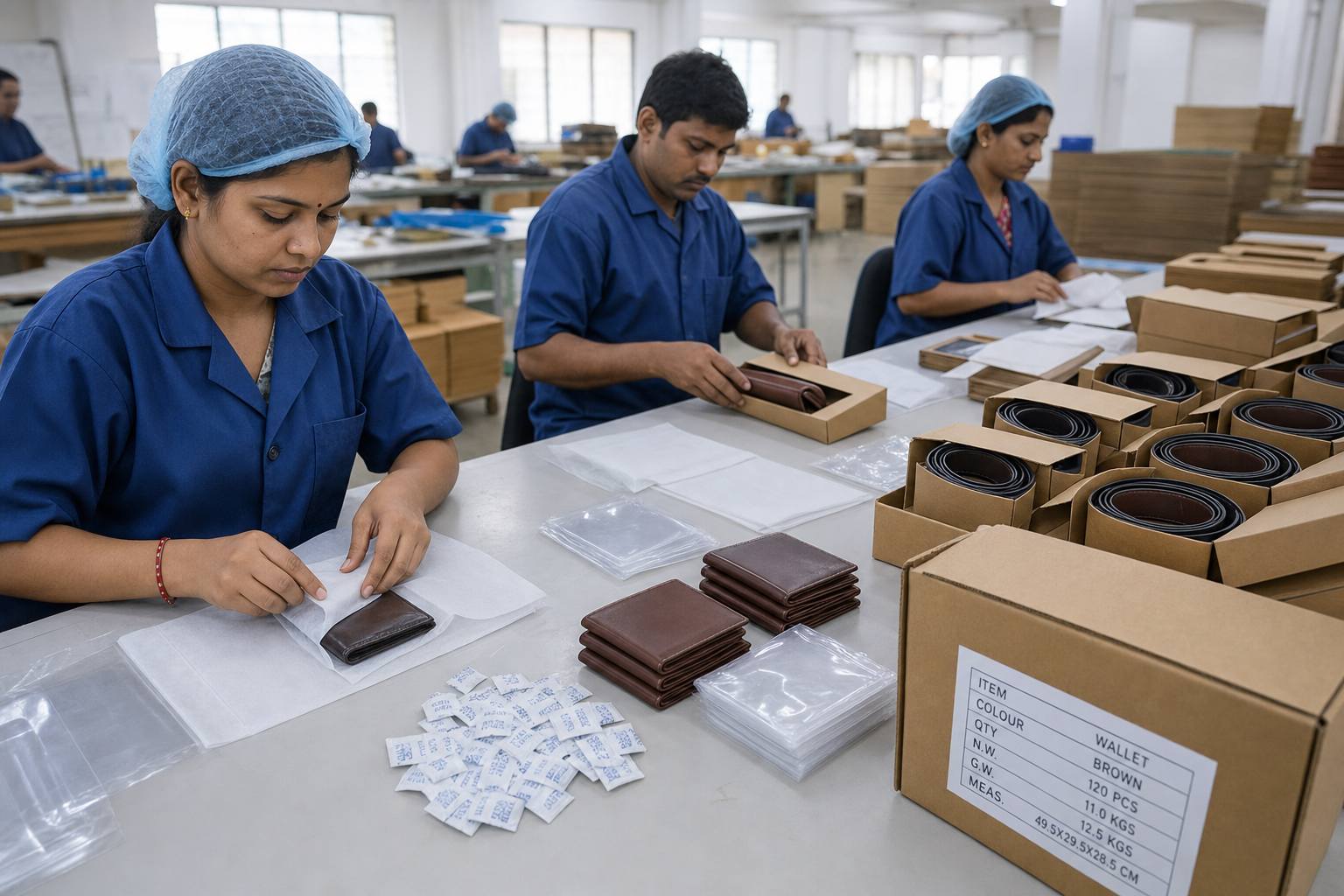
Packaging for wallets and belts is denser and more claim-sensitive than many leather articles. EU and UK retail buyers expect retail-ready wallets with care labels and origin marks; US private-label programmes specify polybag or gift-box formats plus UPC; Gulf buyers often want gift-box sets for wallet–belt combinations; Japan expects meticulous presentation and consistent carton counts; Australia requires biosecurity-aware packing materials.
Packaging and Labelling Emphasis by Market
Swipe →
Data table — swipe horizontally on small screens
| Market | Packaging Expectation | Labelling / Pack Note |
|---|---|---|
| USA | Polybag or gift box by channel; master carton UPC | RFID claim language must match liner test evidence |
| Germany / EU | Retail-ready wallet box; belt loop cards common | Multilingual care; Cr(VI) lot refs where required |
| UK | Retail-ready similar to EU | Confirm UK labelling separately post-Brexit |
| UAE / Saudi | Gift boxes for sets; wholesale cartons for volume | Simpler labels; rising modern-trade QC |
| France | Presentation-led retail packs | Colourway and edge-tone consistency across cartons |
| Netherlands | Export cartons for hub redistribution | Assortment marks must match packing list exactly |
| Australia | Standard export cartons | Biosecurity-compliant materials mandatory |
| Japan | High presentation standard | Precise material and size/length labelling |
| Canada | Retail or wholesale packs | Bilingual English/French where retail-bound |
Container Loading Details
Export Tip
Container economics favour wallets over buckle-heavy belts on cube. Indicative stuffing: 20ft 8,000–18,000 wallets or 6,000–14,000 belts (carton-dependent); 40ft HC 18,000–40,000 wallets or 14,000–32,000 belts (carton-dependent). Belt cartons with buckles weigh more per cube; wallet SLG nests denser. Always stuff from actual carton dims.
Destination mix changes the average: a USA e-commerce wallet-heavy FCL stuffs denser than a Germany formal-belt programme with larger gift boxes; Gulf gift-set cartons sit between the two.
Indicative 40ft HC Loading by Market Category Mix
Swipe →
Data table — swipe horizontally on small screens
| Market | Typical Mix | Approx. Units / 40ft HC | Notes |
|---|---|---|---|
| USA / Canada | Wallet-heavy bifold + RFID + casual belts | 22,000–38,000 wallets or mixed lower with belts | Dense SLG raises piece count |
| UK / Netherlands | Balanced bifold + dress/casual belts | 18,000–32,000 mixed pcs | Assortment cartons reduce density |
| Germany / France | Formal belts + premium SLG boxes | 14,000–28,000 mixed pcs | Gift/retail boxes cut cube efficiency |
| UAE / Saudi | Gift sets + formal belts | 16,000–30,000 sets/pcs | Set cartons heavier per cube |
| Australia / Japan | Travel wallets + precise belts | 18,000–30,000 mixed pcs | Japan carton counts must match docs exactly |
Shipping Methods
Export Tip
Sea freight FCL is the standard method for wallet and belt programmes into every market in this guide. Routing follows cluster and port choice among Mundra, Nhava Sheva, Chennai, Tuticorin, Kolkata. Mundra and Nhava Sheva serve USA, UK, Canada, and Europe efficiently from North and Central Indian clusters; Chennai and Tuticorin serve Ambur–Ranipet–Chennai EU programmes and Gulf lanes; Kolkata serves Bantala-origin cargo.
FOB remains the dominant Incoterm. CIF appears more often with UAE, Saudi, and Netherlands hub buyers. Air freight covers sealed samples and urgent RFID or belt replenishment — Japan, Germany, and France typically burn the longest sample cycles because of QC and chemical testing.
Certifications
Compliance Notes
Certification intensity is the largest market-to-market variable for wallets and belts. Confirm the certificate set for the destination before cutting bulk leather — not after a buyer requests Cr(VI) mid-production.
Certification and Compliance Emphasis by Market
Swipe →
Data table — swipe horizontally on small screens
| Market | Mandatory / Strongly Expected | Commonly Requested |
|---|---|---|
| USA | Customs entry docs; truthful RFID / material claims | PSI for large retail; CPSIA if children's SLG |
| Germany | REACH Cr(VI) on leather lots | LWG tannery ID; sustainability pack |
| UK | UK REACH-equivalent chemical evidence | LWG for premium chains |
| UAE / Saudi | Commercial docs; rising modern-trade QC | Gift-set presentation standards; GSO awareness |
| France | Chemical compliance + finish audits | Brand QC protocols before scale |
| Netherlands | EU REACH for redistribution | Assortment and document consistency |
| Australia | Biosecurity-compliant packing | Importer QC packs |
| Japan | Strict QC / consistency documentation | Defect-rate reports by lot |
| Canada | Customs docs; bilingual retail labels where applicable | Wholesale receiving compliance |
Buyer Requirements
Buyer Requirements
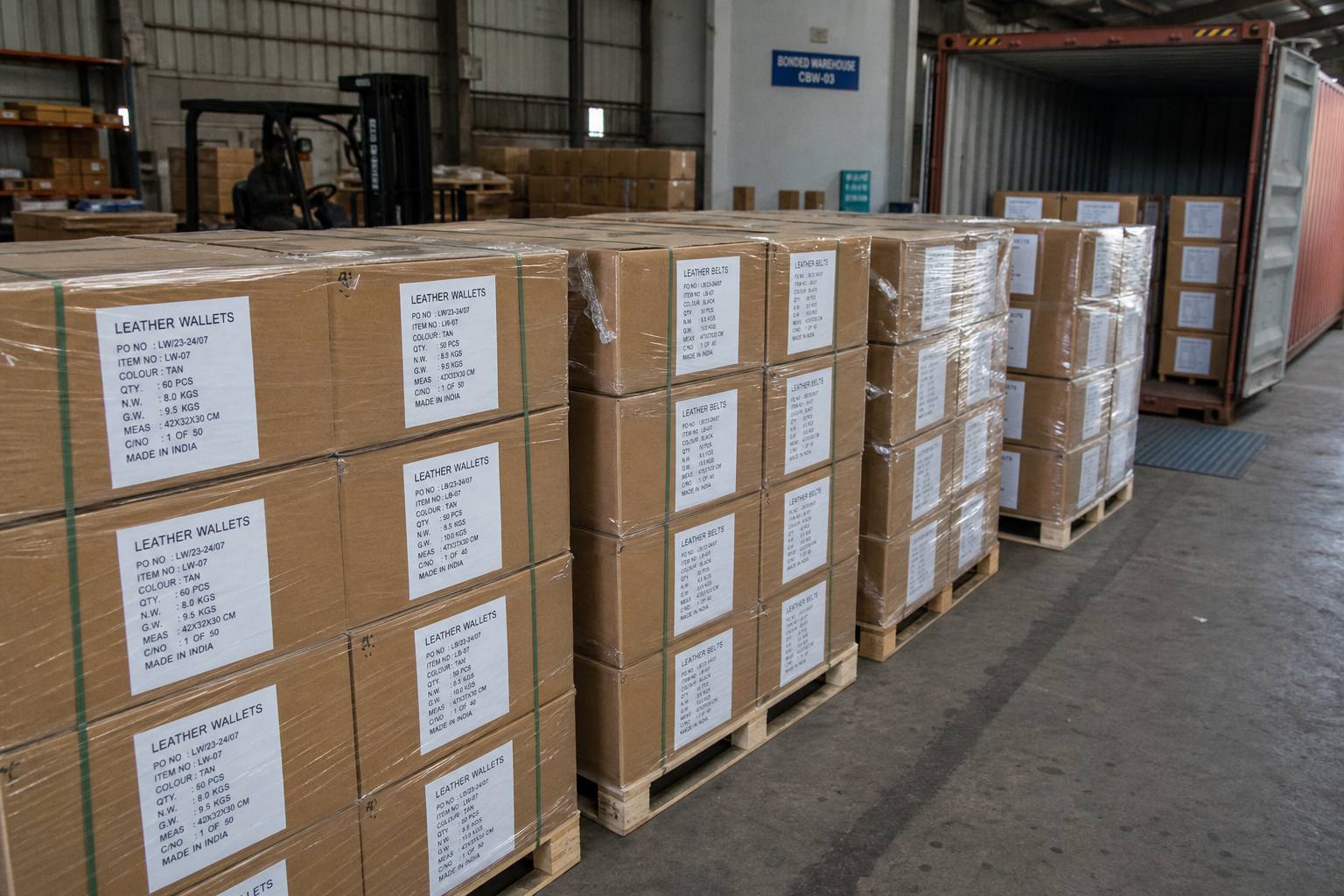
- Ask for shipment records to your destination for wallets (HS 4202.31) and/or belts (HS 4203.30), not only mixed leather goods.
- Confirm Cr(VI) / REACH readiness for EU/UK, RFID claim evidence for US private label, and bilingual packs for Canadian retail.
- For Germany, France, and Japan, request prior audit outcomes on edge paint, stitching SPI, buckle finish, and hole-punch accuracy.
- Clarify gift-box, polybag, and master-carton marks for your channel before locking FOB.
- Size the trial to validate your market's compliance and finish bar — not only unit aesthetics.
Importers and retail buyers evaluating an Indian wallet/belt supplier for a specific market want proof of market-specific experience — not only general leather-goods capability.
Country-wise Opportunities
Market Snapshot
This section is the core ranking: ten destinations with duty notes, preferred constructions, channel types, and payment culture signals. Treat it as a starting framework; refine against your exact leather grade, RFID liner, belt width, and buckle alloy.
Deep Country Scorecard — Duties, Demand & Channels (Indicative Planning)
Swipe →
Data table — swipe horizontally on small screens
| Country | Duty / Tariff Notes (verify current) | Preferred Constructions | Channel Types | Payment Culture Signal |
|---|---|---|---|---|
| USA | MFN rates apply by HTS line for 4202.31 / 4203.30; confirm column 1 and any preferential claims before quoting landed | Bifold, RFID slim, card holder; casual 35–38 mm belts | Wholesale, e-comm private label, department | Net terms after clean trial; deposits on first PO common |
| UK | UKGT / preferential status by origin — confirm wallet vs belt lines separately post-Brexit | Bifold + formal 30–35 mm; RFID rising | High-street chains, distributors | Wholesale net; retail chargebacks on label errors |
| Germany | EU Common Customs Tariff on 4202.31 / 4203.30; preferential origin docs if claimed | Full-grain SLG; formal dress belts; LWG leather preferred | Specialty retail, premium wholesale | Longer onboarding; LC or credit insurance early |
| UAE | Generally low duty environment for many finished leather accessories — confirm HS line and Free Zone vs mainland entry | Gift bifold sets; formal belts; travel wallets | Mall retail, GCC re-export distributors | TT / short terms after verification |
| France | EU CCT same basket as Germany; origin and invoice accuracy audited closely | Fashion SLG colourways; dress / fashion buckle belts | Department stores, fashion wholesale | Relationship-led; slower first PO, sticky reorders |
| Netherlands | EU CCT; hub clearances often re-export within EU — document discipline critical | Assorted bifold / card holder; mixed belts for redistribution | Trading houses, EU hub importers | TT/LC mix; volume consistency rewarded |
| Australia | Confirm current duty on 4202.31 / 4203.30 and FTA eligibility; biosecurity packing costs are real | Travel wallets; casual belts | Importer-distributors, retail chains | Net after trial; clean first entry matters |
| Japan | Verify Japan tariff schedule by HS; preferential claims need exact origin evidence | Slim wallets; precise formal belts (width, holes, length) | Specialty and department retail | Conservative; long sample cycles; low price sensitivity |
| Canada | Confirm MFN / CPTPP or other preferential eligibility by line; bilingual retail packs add cost | Bifold, RFID; casual + formal gift belts | National wholesale, bilingual retail | Wholesale net terms after trial |
| Saudi Arabia | Confirm customs duty by HS and any SASO/GSO conformity for regulated claims; often served via UAE hub | Formal belts; corporate gift wallet–belt sets | Distributors, modern trade | TT common; festival-timed orders |
United States
The USA is the primary volume destination for Indian leather wallets and a strong casual-belt market. Private-label e-commerce and wholesale distributors reorder bifolds, trifolds, card holders, and RFID-blocking constructions when card-slot maps, stitching SPI, and carton UPCs stay stable across lots.
Duty treatment must be verified on the exact HTS line for leather-outer wallets versus belts. Planning references commonly used by importers (verify live HTS before quoting): leather-outer pocket articles such as wallets often fall under HTS 4202.31.60 at MFN ~8%; leather belts under HTS 4203.30.00 at MFN ~2.7%. Payment culture typically moves from deposit-plus-balance on first trial to net terms after chargeback-free receiving. RFID claims require liner evidence — marketing language alone fails retail compliance reviews.
United Kingdom
UK chains and distributors sustain balanced demand for bifolds and formal dress belts, with RFID and slim constructions rising in urban retail. Post-Brexit chemical rules should be confirmed separately from EU REACH even when they look similar.
Payment culture is wholesale-led with real chargeback risk on labelling and barcode errors. Exporters who hold edge-paint colour between sealed sample and bulk earn priority allocation in peak gifting seasons.
Germany
Germany is the compliance and premium gate for EU wallet and belt programmes. Formal belts and full-grain SLG with Cr(VI) reports and increasingly LWG tannery IDs move further than commodity bifolds without documentation.
Payment and onboarding are slower; relationship depth is high. Once approved, German buyers scale steadily rather than through opportunistic one-off containers.
United Arab Emirates
UAE combines direct mall and modern-trade demand with a GCC re-export role. Gift wallet–belt sets and formal 30–35 mm belts perform strongly around festival calendars. Duty and Free Zone entry mechanics should be confirmed per shipment path.
Payment culture is among the fastest in this ranking once the supplier is verified — TT and short terms are common. QC expectations from regional chains are rising year on year.
France
French fashion wholesale and department channels reward colourway discipline, edge finish, and buckle aesthetics on dress belts more than the lowest FOB. Fashion SLG and statement belts outperform plain commodity bifolds.
Expect brand-level QC feedback loops before scale. Payment follows relationship trust; first POs are smaller and slower, reorders stick when finish holds.
Netherlands
Rotterdam hub importers often buy assorted wallets and belts for EU redistribution. Volume consistency, packing-list accuracy, and REACH-ready leather evidence matter more than brand storytelling.
Payment is a TT/LC mix typical of trading houses. Boutique MOQs that break FCL economics are usually a poor fit for this channel.
Australia
Australian importer-distributors and retail chains pull travel wallets and casual belts with moderate price sensitivity. Biosecurity-compliant packaging is mandatory and should be designed before cartons are sealed.
A clean first entry builds listing confidence; documentation mistakes are costly given distance and lead time.
Japan
Japan is a premium, low price-sensitivity market for slim wallets and precisely finished formal belts. Hole punch spacing, length assortment accuracy, and stitching consistency are audited closely.
Sample cycles are long; defect-rate transparency across lots is expected. Exporters who need fast PO velocity should treat Japan as a second-market expansion, not a first speculative push.
Canada
Canada mirrors US bifold and RFID demand with additional bilingual retail labelling where packs go direct to store. Winter gifting lifts belt and wallet–belt set volume.
Confirm preferential duty eligibility carefully by HS line. Wholesale net terms after a clean trial is the common payment path.
Saudi Arabia
Saudi Arabia sustains formal belt and corporate gift-set demand, often fulfilled through UAE-based distributors before direct programmes mature. Confirm duty and any SASO/GSO expectations for regulated claims on the specific articles.
Payment is frequently TT-led; orders cluster around gifting and corporate calendar peaks. Formal belt width and buckle alloy consistency matter more than RFID features in most programmes.
Expert Insight: Match the Market to Your Compliance and Construction Bar
Expert Insight Box
We consistently see SLG exporters over-index on total leather-goods import size and under-index on construction fit. A mid-size market where your edge paint, hole punch, and Cr(VI) paperwork already clear will outperform a larger market where every RFID claim or buckle lot becomes a scramble.
Sourcing Checklist
Checklist
Common Buyer Mistakes
Common Mistakes Box
Market-selection errors for wallets and belts are expensive because piece counts are high and chargebacks multiply quickly across retail DCs.
Future Market Trends
Key Statistics
Three market-level trends shape Indian wallet and belt exports through 2026 and beyond: EU and UK buyers continuing to raise traceability and LWG expectations on belt leather and SLG linings; US and Canadian e-commerce private label rewarding fast sample turns on RFID and slim wallets with stable card-slot maps; and Gulf modern trade professionalising gift-set QC while retaining festival-timed demand spikes.
Exporters who reallocate certification and cluster capacity market by market — rather than freezing a one-time ranking — will capture the destinations growing fastest for their specific constructions.
Buyer Checklist
Checklist
Exporter Checklist
Checklist
Compliance Checklist
Checklist
Compliance Notes
Expert Insight: Expand Only After One Market Runs Clean
Expert Insight Box
Spreading certification budget and sample capacity across USA, Germany, UAE, and Japan simultaneously routinely disappoints buyers in all four. Prove one market's preferred constructions and payment rhythm, then expand deliberately — that discipline protects both margin and reputation in high-piece-count SLG trade.
Conclusion
- Operational process: How to Export Leather Wallets and Belts from India.
- Product depth: Top Leather Wallet and Belt Products Exported from India.
- Country demand: Most Demanded Indian Leather Wallets and Belts by Country.
- Buyer playbook: Source Leather Wallets and Belts Directly from India.
- Buyer outreach: Find International Buyers for Leather Wallets and Belts.
- Premium / sustainable: Sustainable Premium Leather Wallet and Belt Export Opportunities.
- Trade shows: Trade Shows & B2B Marketplaces for Leather Wallet and Belt Exporters.
Market selection for Indian leather wallets and belts is a strategic ranking exercise across duties, compliance intensity, payment culture, and wallet-versus-belt demand — not a race to the largest leather-import headline. The United States offers scale in bifolds, RFID, and casual belts; Germany and France reward REACH-ready formal belts and finish discipline; the UK balances chain volume with chemical care; UAE and Saudi Arabia accelerate gift-set and formal-belt programmes with faster payment culture; Netherlands and Canada favour assortment and labelling discipline; Australia and Japan pay for packaging and QC consistency.
Altus Exports supports Indian wallet and belt exporters and international buyers as a merchant exporter in India and global sourcing partner, coordinating market-specific compliance, documentation, and shipment under one accountable relationship. Explore export products from India, product sourcing company in India, and find manufacturers in India to plan your next destination.