
CLE Registration Benefits for Leather Wallet and Belt Exporters in India
By Saurabh Mittal, Founder, Altus Exports
A deep Council for Leather Exports (CLE) and RCMC guide for Indian small leather goods and belt exporters — application steps, product scope under HS 420231 and 420330, fair access, buyer credibility filters, and how Altus Exports helps MSMEs turn membership into shippable programmes.
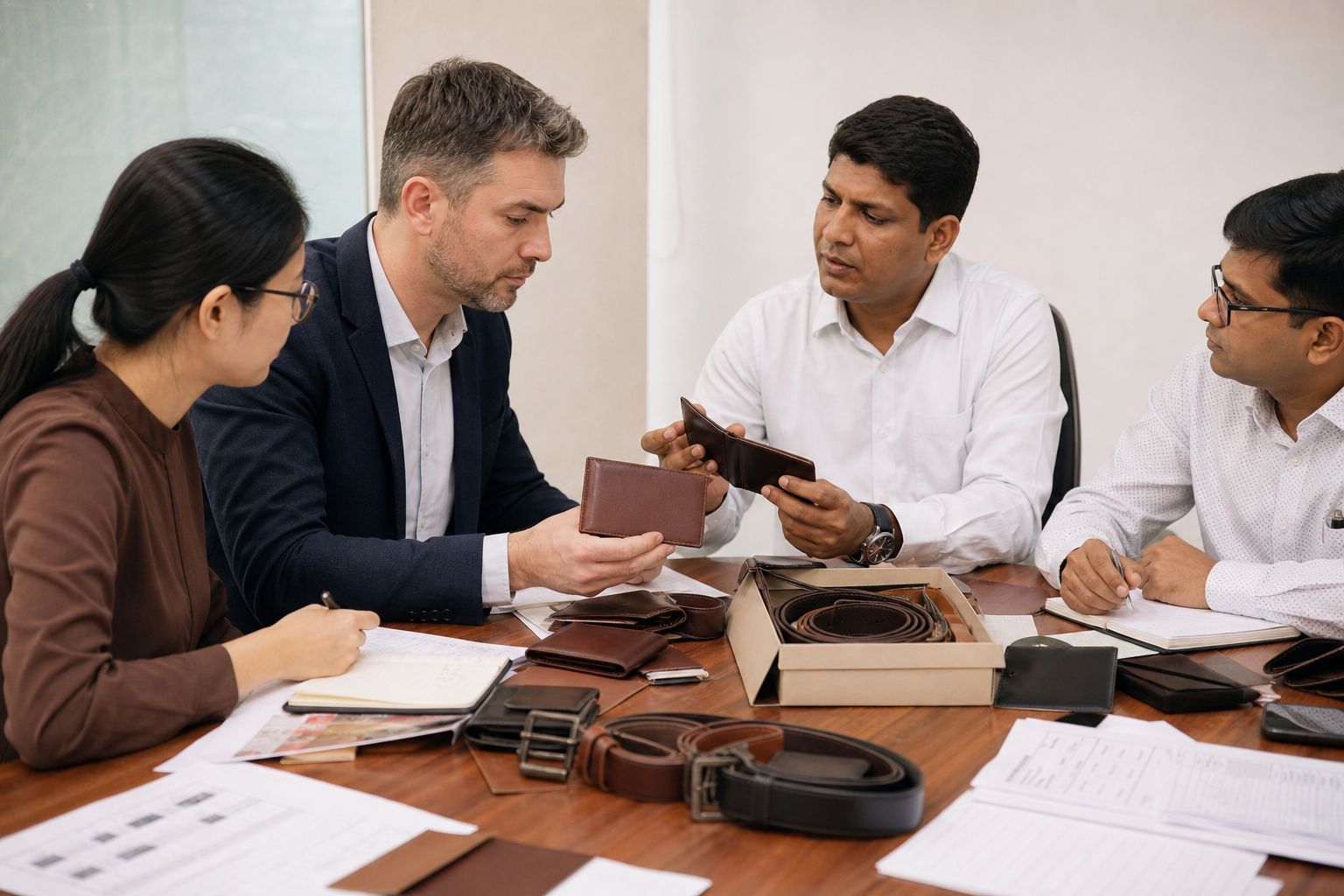
CLE registration is the institutional bridge between an Indian wallet or belt workshop and serious international buyers — and DGFT scheme pathways — for finished small leather goods under HS 4202.31 and leather belts under HS 4203.30.
This article is a registration deep dive (RCMC categories, application sequence, product scope, fair access, renewal, buyer due diligence) — not a general export how-to. For process steps from sampling to shipment, use How to Export Leather Wallets and Belts from India. For destination ranking, see Best Countries for Indian Leather Wallet and Belt Exports.
Scope here is wallets with leather outer surface (4202.31 / 42023120) and leather belts (4203.30 / 42033000). Confirm live fees, forms, and portal steps on leatherindia.org and DGFT/NSWS before filing.
Key Takeaways
Summary Box
Executive Summary
Summary Box
Leather wallets and belts sit inside India's organised leather goods export ecosystem. Buyers in the United States, United Kingdom, Germany, UAE, France, Netherlands, Australia, Japan, Canada, and Saudi Arabia increasingly filter suppliers through Council for Leather Exports (CLE) membership and Registration Cum Membership Certificate (RCMC) evidence before they release sample deposits or open FOB negotiations.
CLE registration does not manufacture quality. It signals that your entity is visible inside the leather council network, eligible for council exhibitions and buyer-seller platforms, and positioned for DGFT-linked scheme workflows that reference RCMC. For wallet and belt exporters — manufacturer exporters, merchant exporters consolidating Kanpur or Kolkata capacity, and MSMEs building their first private-label programmes — registration is early infrastructure, not a certificate collected after the first inquiry.
This guide walks through who should register, how product scope maps to HS 420231 and 420330, the application sequence, what buyers actually check, fair access economics, renewal discipline, and how a merchant exporter such as Altus Exports pairs CLE credentials with factory verification, sampling, and container-ready documentation. Pair it with Leather Wallet and Belt Export Documentation Checklist and Source Leather Wallets and Belts from India.
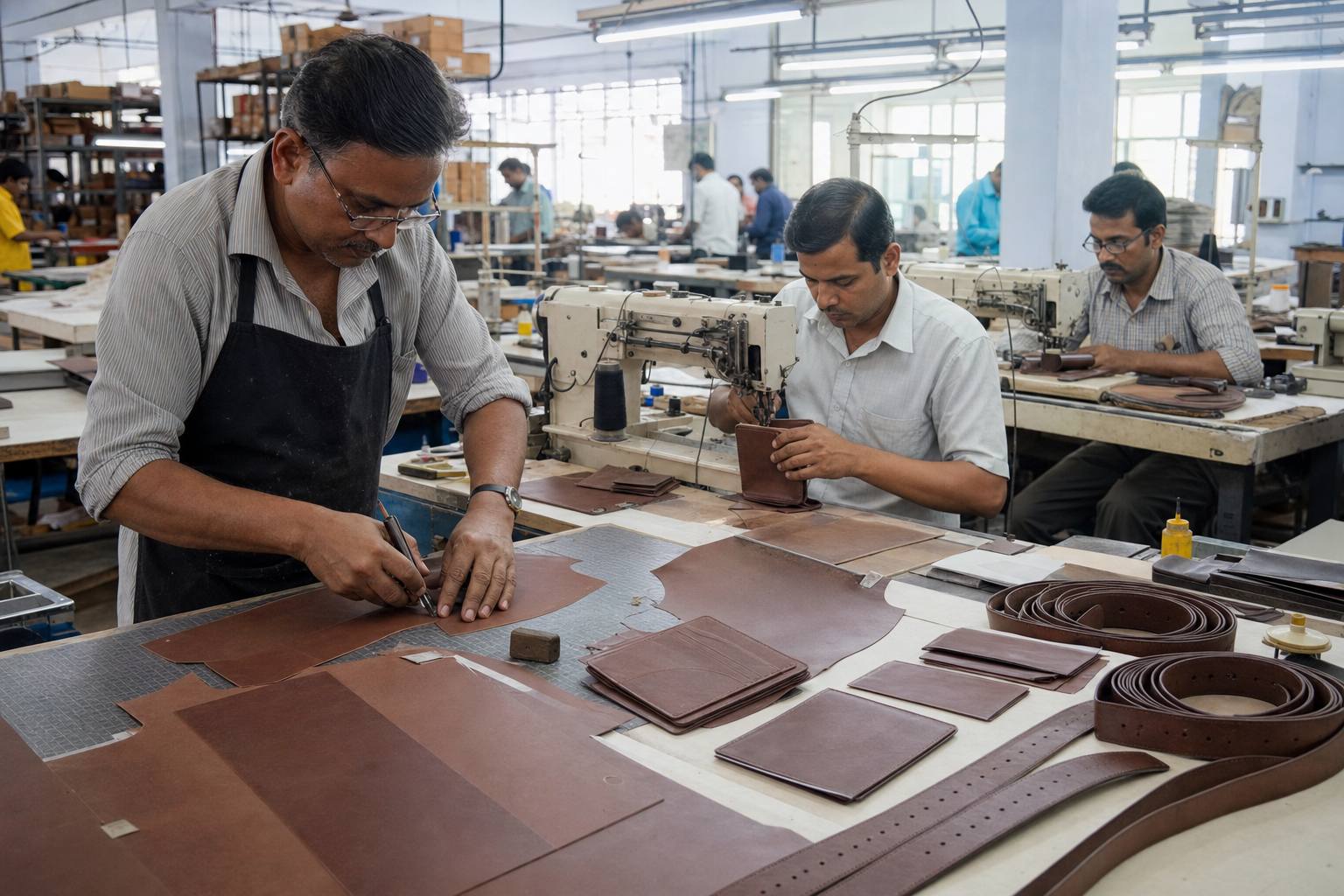
Market Size & Industry Overview
Key Statistics
India's leather goods export base includes finished small leather goods (SLG) — wallets, card holders, passport holders, coin pouches — and leather belts for formal, casual, and reversible programmes. Demand is driven by fashion retail private label, department-store accessories, corporate gifting, e-commerce assortment refresh, and promotional gift sets combining a wallet and belt under one assortment code.
Production depth concentrates in Kanpur, Kolkata (Bantala), Delhi-NCR, Ambur–Ranipet–Chennai, with Agra and Jaipur contributing specialised finishing and accessory capacity. Tanneries and cutting rooms feeding SLG lines often share supply chains with broader leather goods, but wallet construction (edge paint, RFID laminate, card-slot tolerance) and belt construction (width consistency, hole pitch, buckle torque) are distinct technical programmes — CLE membership should list the lines you actually ship.
Institutionally, CLE (leatherindia.org) anchors trade promotion for India's leather and finished leather goods sector. Wallet and belt exporters use the same council pathway as other leather goods houses, but buyer questionnaires increasingly ask for HS-specific product cards, LWG tannery status on hide lots, and buckle/hardware REACH statements — registration alone is insufficient without that product stack.
Wallet and belt export ecosystem — institutional map
Swipe →
Data table — swipe horizontally on small screens
| Layer | What it covers | Why CLE members care |
|---|---|---|
| CLE / RCMC | Council membership and registration credential | Buyer onboarding filter; fair and scheme access |
| IEC + GST | Legal export identity and tax compliance | Prerequisite for CLE filing and shipping |
| HS 420231 / 420330 | Tariff classification for wallets and belts | Accurate invoices, COO, and buyer customs clearance |
| Cluster capacity | Kanpur, Kolkata, Delhi-NCR, Ambur–Ranipet–Chennai | Sampling speed and bulk fill reliability |
| Ports | Mundra, Nhava Sheva, Chennai, Tuticorin, Kolkata | CFS cutoffs and freight planning |
| Product QC stack | Stitch, edge, RFID, buckle, chemical tests | Converts RCMC into repeatable POs |
Export Statistics
Key Statistics
Official trade publications group leather goods broadly; wallet and belt exporters should treat national aggregates as directional and build their own SKU-level dashboards from shipping bills, buyer forecasts, and CLE market notes. Indicative planning still helps MSMEs size programmes before they book IILF booths or commit buckle tooling.
Private-label wallet programmes commonly move in the low thousands of pieces per style after a trial lot; belt programmes often mirror that scale once width and buckle finish are locked. Container economics favour dense SLG nesting more than bulky structured goods — see Container Loading Details below.
Indicative wallet and belt export planning anchors (validate annually)
Swipe →
Data table — swipe horizontally on small screens
| Metric | Indicative range | Planning note |
|---|---|---|
| Bifold wallet FOB | US$4–12 / pc FOB | Leather grade and edge finish drive spread |
| Card holder FOB | US$2.50–8 / pc FOB | Slim RFID variants price higher |
| Formal belt FOB | US$3.50–12 / pc FOB | Buckle metal and plating matter |
| Reversible belt FOB | US$5–15 / pc FOB | Dual-face leather + hardware cost |
| Trial MOQ / style | 100–300 pcs / style (wallets); 150–400 pcs / style (belts) | Common first PO band |
| Sample lead time | 7–18 days after locked tech pack | After locked tech pack |
| Bulk to vessel | 45–75 days to vessel (hardware/buckle lead time parallel) | Buckle lead time often critical path |
Import Statistics
Key Statistics
Import markets for Indian leather wallets and belts overlap with broader leather accessories demand but filter differently: SLG buyers scrutinise card-slot durability and RFID claims; belt buyers scrutinise width tolerance, hole reinforcement, and buckle chemical compliance. Top destination interest for Indian programmes typically includes the United States, United Kingdom, Germany, UAE, France, Netherlands, Australia, Japan, Canada, and Saudi Arabia.
Importers increasingly request CLE RCMC as a baseline vendor document alongside factory audit summaries. That does not mean registration replaces product tests — EU REACH and US CPSIA/lead-cadmium expectations on hardware still sit on the critical path for belts with metal buckles.
Import-market filters that interact with CLE credentials
Swipe →
Data table — swipe horizontally on small screens
| Market | Typical buyer filter | CLE role |
|---|---|---|
| United States | Vendor pack + CPSIA hardware awareness | RCMC as onboarding baseline |
| United Kingdom | Post-Brexit UKCA/REACH continuity questions | Council membership + chemical evidence |
| Germany / EU | REACH SVHC, nickel release on buckles | Credibility + fair sourcing channel |
| UAE / GCC | Assortment depth and gift-set readiness | Fair meetings and RCMC trust signal |
| Japan | Precision QC and packaging neatness | Serious-supplier filter before sampling |
| Australia | Labelling and chemical statements | Vendor diligence pack item |
Product Categories / Variants
Summary Box
CLE product declarations for wallet and belt exporters should name the constructions you can actually sample and ship. Vague “leather goods” language weakens both council records and buyer RFQs. Use the category map below when filing and when building onboarding packs.
HS scope checklist for CLE product declarations
Swipe →
Data table — swipe horizontally on small screens
| Product family | HS anchor | Declaration tip |
|---|---|---|
| Leather-outer wallets / SLG | 4202.31 | State constructions: bifold, RFID, passport |
| India tariff line (wallets) | 42023120 | Align commercial invoice with shipping bill |
| Leather belts | 4203.30 | Note widths and buckle types in annex |
| India tariff line (belts) | 42033000 | Keep buckle metal notes for buyer QC |
| Plastic/textile outer wallets | 4202.32 | Do not mix into leather-outer declarations |
Men's bifold and trifold wallets
Core SLG volume under HS 4202.31. Buyers specify leather type (full grain, corrected grain, split), lining, stitch density, and card capacity. Declare bifold vs trifold separately if your capacity differs.
Card holders, slim wallets, and RFID lines
High inquiry density from e-commerce and travel retail. RFID claims require laminate specification and test language — CLE membership does not validate marketing claims.
Passport holders and travel wallets
Often bundled with gift and travel assortments. Document dimensions against passport booklet standards for the destination region.
Women's zip-around wallets and coin pouches
Zip quality and puller finish drive returns. List zipper brand/spec in tech packs attached to CLE-backed buyer packs.
Formal, casual, and reversible leather belts
Belts classify under HS 4203.30. Width (commonly 30–38 mm programmes), leather face, backing, hole pitch, and buckle finish define SKUs. Reversible belts need dual-face leather discipline and secure buckle mechanisms.
Corporate gift wallet–belt sets
Assortment MOQs and matched colourways matter more than single-SKU optimisation. CLE fair booths convert better when set photography and price architecture are ready.
Manufacturing Overview
Export Tip
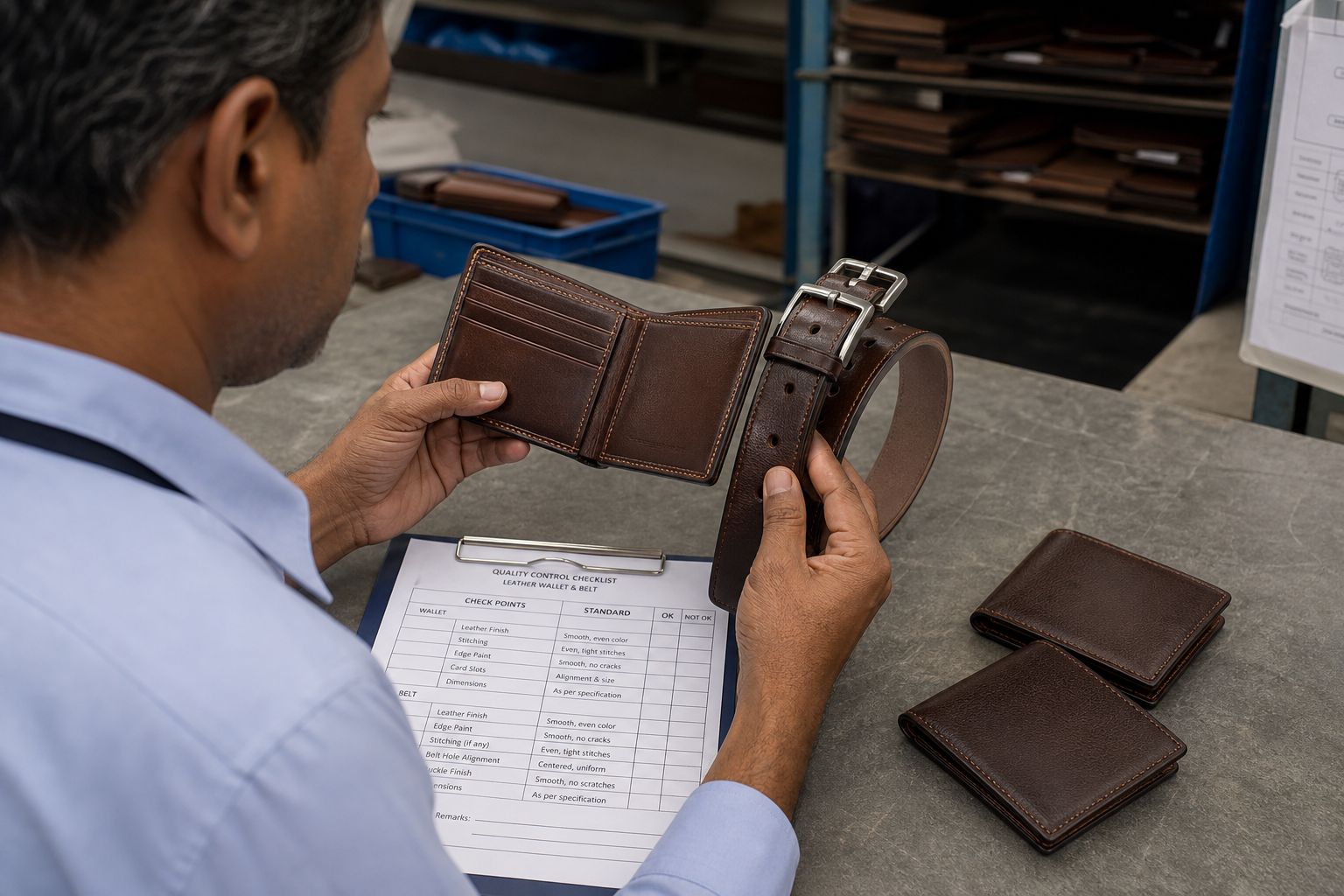
Wallet and belt manufacturing for export typically sequences hide selection, cutting, skiving, stitching or edge construction, hardware attachment, finishing, and final QC. Cluster strengths differ: Kanpur and Kolkata (Bantala) for volume leather goods capacity; Delhi-NCR for design-led SLG and buyer meetings; Ambur–Ranipet–Chennai corridor for southern leather networks; Agra and Jaipur for specialised finishing and accessory programmes.
CLE registration should match how you fulfill: manufacturer exporter with in-house stitching lines; merchant exporter consolidating verified workshops; or merchant-cum-manufacturer with documented subcontract maps. Buyers increasingly ask for subcontract transparency on edge painting, RFID insertion, and buckle sourcing — council category choice that contradicts reality creates diligence failures later.
Cluster focus for wallet and belt CLE members
Swipe →
Data table — swipe horizontally on small screens
| Cluster | Typical SLG / belt strength | CLE usage tip |
|---|---|---|
| Kanpur | Volume wallets and formal belts | Bring construction cards to CLE meets |
| Kolkata (Bantala) | Leather goods depth and tannery links | Map LWG tannery lots to SKUs |
| Delhi-NCR | Design sampling and buyer access | Use for first meetings + sample loops |
| Ambur–Ranipet–Chennai | Southern leather supply networks | Port timing via Chennai / Tuticorin |
| Agra / Jaipur | Finishing and accessory specialisation | Clarify role in subcontract map |
Pricing Analysis
Buyer Tip
CLE membership does not set FOB prices. It improves the probability that buyers will open a priced conversation. Indicative FOB bands for planning — always validate against leather lot, hardware, and edge finish — include bifolds at US$4–12 / pc FOB, trifolds at US$5–14 / pc FOB, card holders at US$2.50–8 / pc FOB, RFID wallets at US$6–18 / pc FOB, formal belts at US$3.50–12 / pc FOB, and premium full-grain sets at US$18–45 / set FOB.
Fair-sourced leads convert when price sheets show construction differentials (edge paint vs raw edge, solid brass vs zinc alloy buckle, RFID laminate grade). Altus Exports, as a merchant exporter, builds destination-aware price architectures so CLE-backed introductions do not stall on incomplete quotations.
Indicative FOB bands for CLE-ready wallet and belt sheets
Swipe →
Data table — swipe horizontally on small screens
| SKU type | Indicative FOB | What moves price |
|---|---|---|
| Bifold wallet | US$4–12 / pc FOB | Leather grade, lining, stitch |
| Trifold wallet | US$5–14 / pc FOB | Panel count, edge finish |
| Card holder | US$2.50–8 / pc FOB | Slim profile, RFID option |
| Passport holder | US$6–16 / pc FOB | Size, compartments |
| RFID wallet | US$6–18 / pc FOB | Laminate + claim support |
| Formal belt | US$3.50–12 / pc FOB | Width, buckle plating |
| Casual belt | US$3–10 / pc FOB | Leather face, stitching |
| Reversible belt | US$5–15 / pc FOB | Dual face + mechanism |
| Premium set | US$18–45 / set FOB | Matched colourways |
MOQ Analysis
Buyer Tip
Registration does not lower MOQ by itself. It helps you reach buyers whose MOQ culture matches organised export programmes. Indicative bands: 100–300 pcs / style (wallets); 150–400 pcs / style (belts) for MSME trials; 300–1,000 pcs / style for standard programmes; 1,000–5,000+ pcs / style / colourway for retail chains; 200–800 sets / assortment for gift-set assortments.
At CLE buyer-seller meets, state MOQ by construction and colourway — not a single factory-wide number. Belt buckle tooling often forces higher effective MOQs than wallet stitching capacity alone would suggest.
Packaging Standards
Export Tip
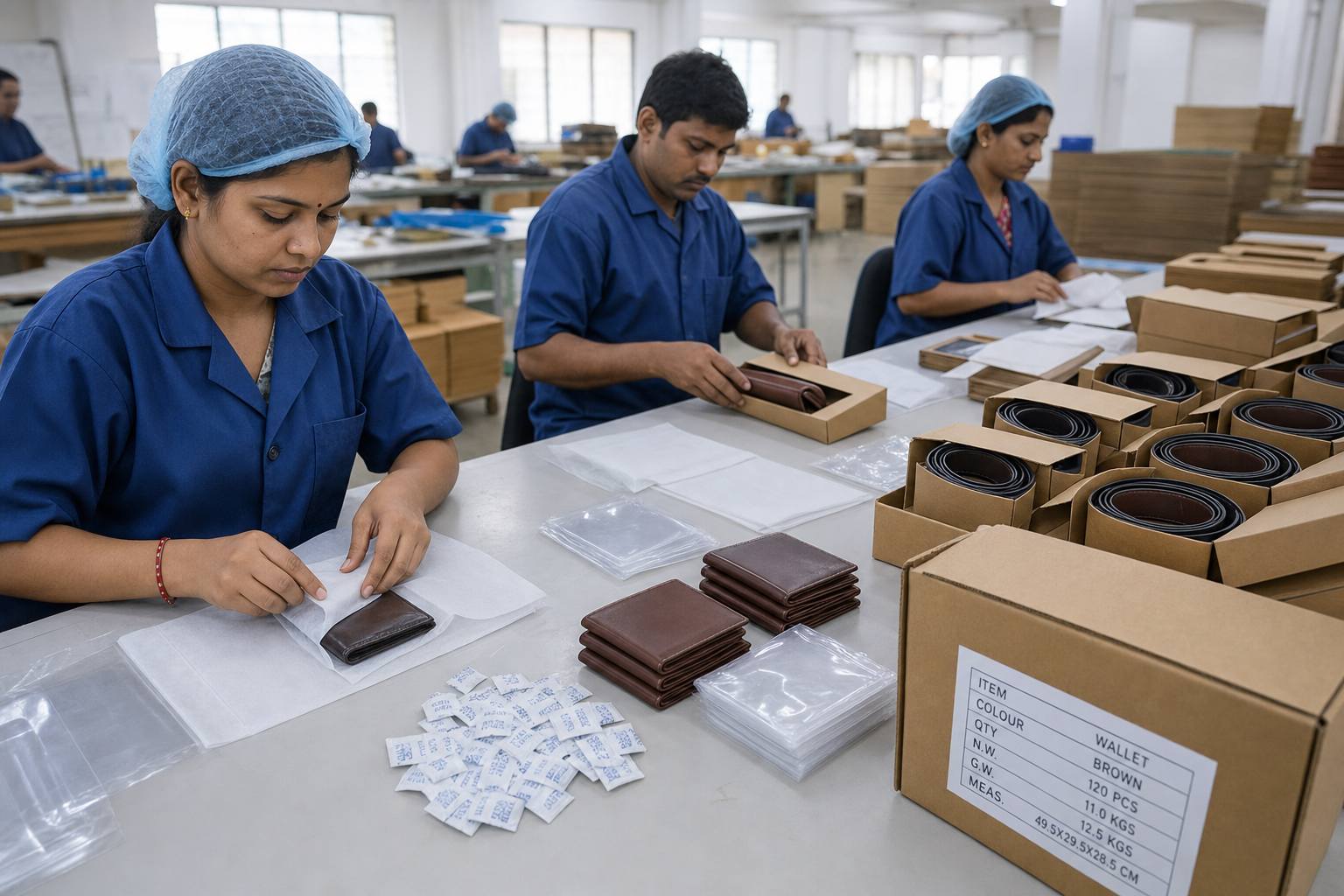
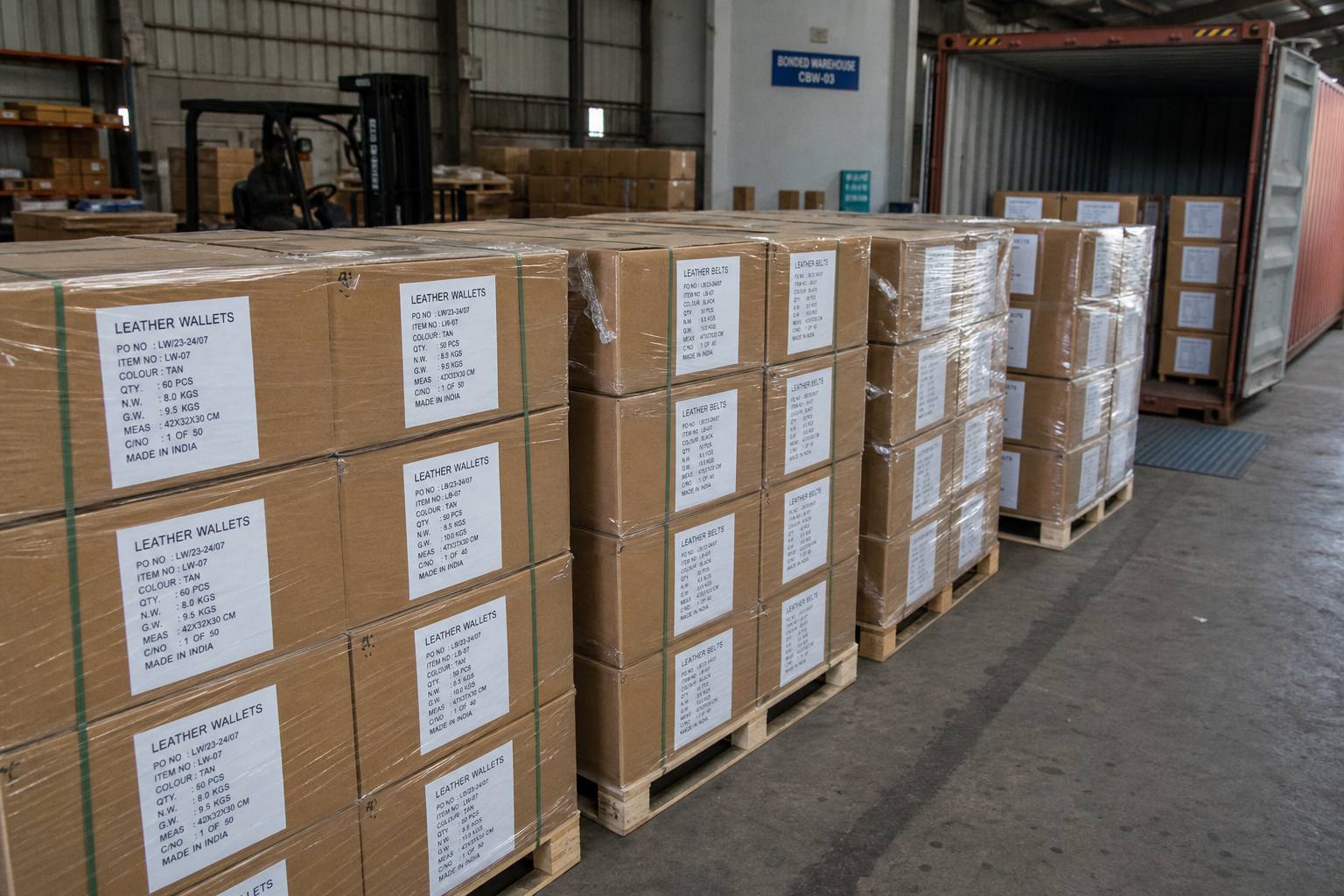
Buyer packaging standards for wallets and belts are part of the commercial offer CLE introductions expect to see. Typical export packing: individual poly or cloth pouch, silica gel where climate risk is high, barcode/hangtag per retail brief, inner carton separators for buckles to prevent scratch transfer, and master cartons with style/colour/quantity labels matching the packing list.
Gift sets need assortment cards and matched packaging SKUs. CLE fair samples should travel in the same packaging system you intend for bulk — packaging surprises after RCMC-based introductions destroy trust faster than price variance.
Packaging elements buyers expect from CLE-listed exporters
Swipe →
Data table — swipe horizontally on small screens
| Element | Wallet programmes | Belt programmes |
|---|---|---|
| Unit wrap | Pouch + card insert | Loop wrap / box per brief |
| Scratch control | Tissue between panels | Buckle guards mandatory |
| Moisture | Silica as specified | Silica + dry carton store |
| Labelling | Care + origin + size | Width + origin + care |
| Master carton | Dense nesting OK | Weight and cube trade-off |
| Set packaging | Matched wallet box | Wallet + belt gift carton |
Container Loading Details
Export Tip
Wallet SLG nests denser than belts with buckles. Indicative planning: 20ft — 8,000–18,000 wallets or 6,000–14,000 belts (carton-dependent); 40ft HC — 18,000–40,000 wallets or 14,000–32,000 belts (carton-dependent). Belt cartons with buckles weigh more per cube; wallet SLG nests denser. Always stuff from actual carton dims.
CLE-backed programmes still fail commercially when freight quotes assume wallet density for belt-heavy loads. Stuff from actual carton dimensions after first production lot.
Shipping Methods
Export Tip
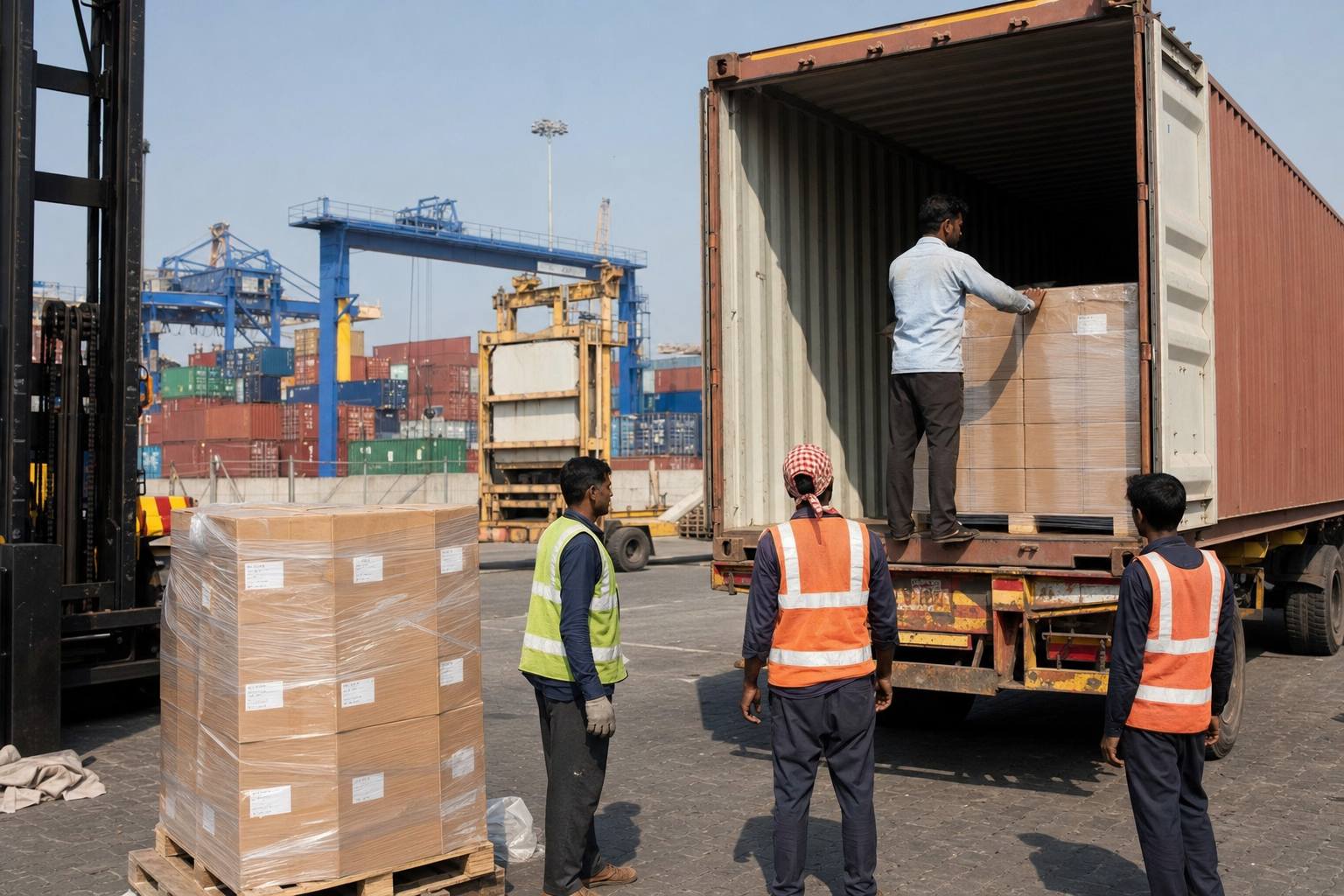
Samples and urgent RFID launch lots often move air freight; trial and bulk programmes usually move LCL or FCL through Mundra, Nhava Sheva, Chennai, Tuticorin, Kolkata. Document packs for CLE-credible exporters include commercial invoice, packing list, bill of lading/AWB, certificate of origin as required, and test reports referenced on the invoice remarks where buyers demand them.
Lead-time planning anchors: samples 7–18 days after locked tech pack; trial orders 25–45 days ex-factory after sample sign-off; bulk programmes 45–75 days to vessel (hardware/buckle lead time parallel). Buckle import or plating queues frequently dominate belt schedules — declare that risk in fair meetings rather than after PO signature.
Certifications
Compliance Notes
CLE RCMC is a trade registration credential — not a substitute for product or tannery certifications. Wallet and belt programmes commonly layer: LWG tannery status on hide supply, REACH / SVHC statements for coated leather and metal hardware, nickel-release awareness for belt buckles sold into the EU, CPSIA-oriented heavy-metal awareness for US children's-adjacent gift channels, and factory social audits when retail codes demand them.
Present CLE membership in the same onboarding PDF as IEC, GST, and test summaries. Buyers score completeness, not certificate count alone. See also Sustainable Premium Leather Wallet and Belt Export Opportunities.
Credential stack beside CLE for wallets and belts
Swipe →
Data table — swipe horizontally on small screens
| Credential | What it proves | Does not prove |
|---|---|---|
| CLE RCMC | Council membership / export registration | Stitch quality or RFID efficacy |
| IEC / GST | Legal export identity | Product compliance |
| LWG tannery evidence | Responsible hide supply pathway | Finished wallet durability |
| REACH / chemical reports | Substance limits on materials/hardware | On-time delivery |
| Social audit (as required) | Workplace standards for retail codes | Design capability |
Buyer Requirements
Buyer Requirements
International buyers evaluating Indian wallet and belt exporters typically request: CLE RCMC (current), IEC, GST, factory profile with capacity by construction, sealed samples with tech packs, FOB price sheet by SKU, MOQ by colourway, lead times including buckle procurement, packaging standards, and chemical/test commitments for destination markets.
Merchant exporters must show how CLE registration maps to verified workshops — buyers reject opaque multi-factory fulfilment without QC ownership. Altus Exports positions CLE-backed vendor packs with construction photos, HS cards for 420231 / 420330, and inspection plans before price negotiation accelerates.
Country-wise Opportunities
Market Snapshot
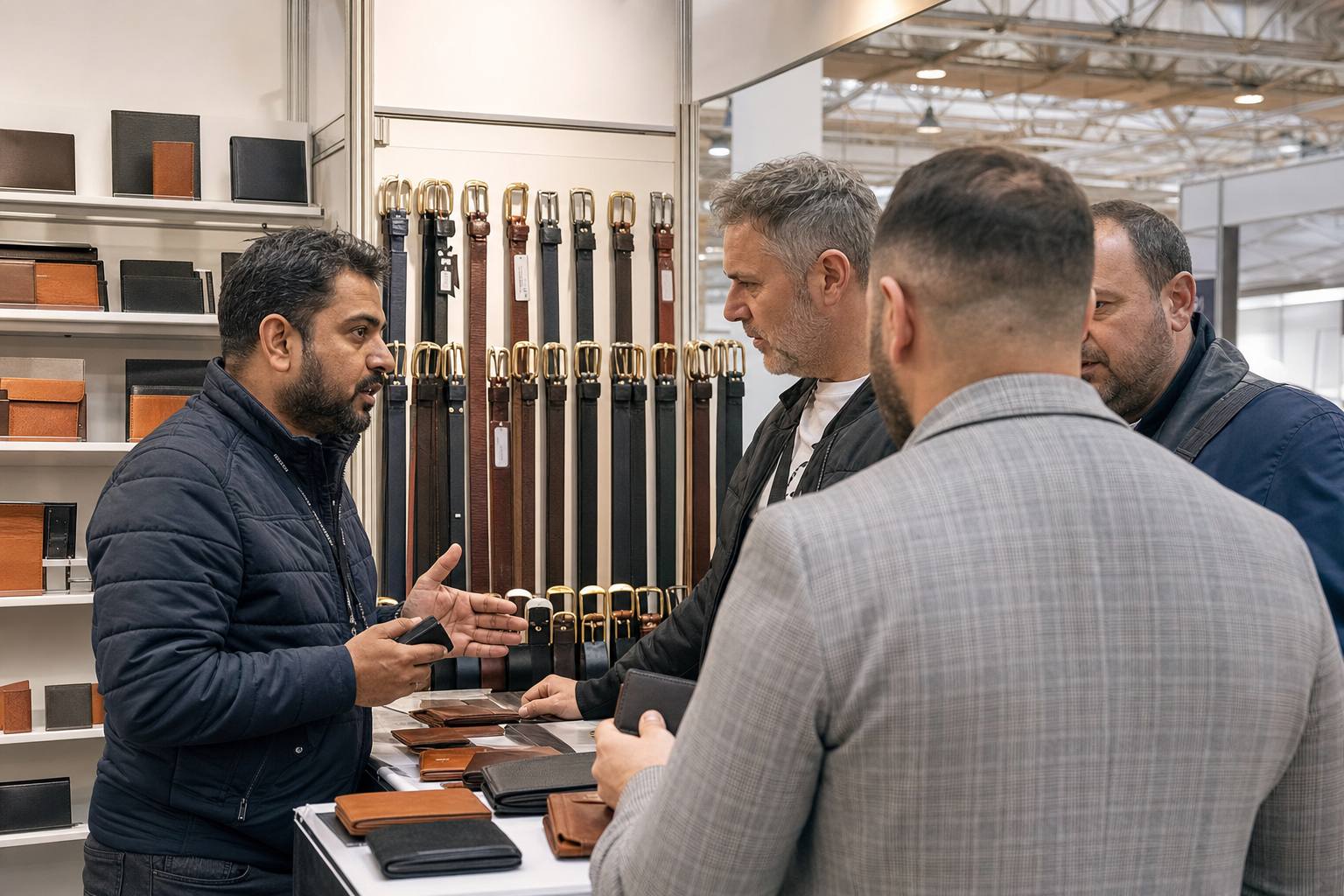
CLE fair access and buyer-seller meets are most valuable when you pre-select constructions by market rather than displaying an undifferentiated catalogue. Use the matrix below as a registration-era targeting guide — for deeper construction demand detail, read Most Demanded Indian Leather Wallets and Belts by Country.
CLE fair targeting by market focus
Swipe →
Data table — swipe horizontally on small screens
| Market | Lead constructions | CLE meeting prep |
|---|---|---|
| USA | Bifold, RFID slim, casual belt | CPSIA note + barcode brief |
| UK / EU | Formal belt, refined bifold | REACH / nickel pack |
| UAE | Gift sets, premium wallets | Assortment boards |
| Japan | Slim card holder, precise stitch | Tolerance cards |
| Australia | Casual belt, travel wallet | Care + chemical statements |
United States
Strong demand for bifolds, slim RFID wallets, and casual belts. CLE membership helps clear importer vendor portals; pair with CPSIA-aware hardware language and clear origin labelling.
United Kingdom and European Union
Formal belts, refined bifolds, and chrome-aware or vegetable-tanned stories perform when REACH documentation is ready. CLE credibility accelerates first meetings; chemical packs close them.
UAE and Gulf
Gift sets, premium full-grain wallets, and polished formal belts. CLE fair introductions convert when assortment photography and Arabic/English care cards are prepared.
Japan, Australia, and Canada
Precision QC, neat packaging, and conservative colourways. RCMC signals seriousness; sample discipline wins the programme.
Expert Insight: RCMC First, Then RFID Samples
Expert Insight Box
Compliance Notes
Wallet and belt MSMEs often reverse the sequence: chase LinkedIn leads first, then scramble for CLE paperwork when a buyer requests RCMC. That delay kills momentum and signals operational immaturity.
Sourcing Checklist
Checklist
- Confirm CLE RCMC validity and category (manufacturer / merchant / merchant-cum-manufacturer).
- Match declared products to wallets HS 420231 and belts HS 420330 on invoices.
- Map factories in Kanpur, Kolkata, Delhi-NCR, or Ambur–Ranipet–Chennai with subcontract transparency.
- Request sealed samples with tech packs for each construction you will buy.
- Align MOQ and FOB to colourway — not only to style code.
- Collect chemical/test commitments for buckle and coated leather before PO.
- Verify packaging and carton labels against retail destination brief.
- Schedule inspection plan and AQL before bulk cutting.
Use this CLE-oriented sourcing checklist whether you are a buyer evaluating Indian wallet/belt capacity or an exporter preparing to meet one. Cross-link with Find International Buyers for Leather Wallets and Belts and Trade Shows and B2B Marketplaces for Leather Wallet and Belt Exporters.
Common Buyer Mistakes
Common Mistakes Box
Accepting RCMC photocopies without independent verification
Always verify membership status through council channels or documented originals — emailed scans alone are a common fraud vector in SLG sourcing.
Treating RCMC as proof of wallet stitch quality or belt width tolerance
Council registration proves institutional presence. Construction quality is proven only by sealed samples, in-line QC, and final inspection.
Assuming merchant-exporter RCMC covers every subcontract workshop's standards
Demand a factory map and QC ownership statement — especially for edge paint and buckle attachment subcontractors.
Using a generic trade registration in place of CLE leather goods scope
Non-leather council memberships do not substitute for CLE when buyers diligence leather wallets and belts.
Skipping registration re-verification on repeat seasons
Renewal lapses happen. Re-check RCMC each programme year before releasing deposits.
Future Market Trends
Key Statistics
Expect tighter buyer filters around traceability (tannery lot to finished wallet or belt), RFID claim substantiation, chrome-free and vegetable-tanned stories for premium EU programmes, and digital vendor portals that list CLE membership as a mandatory field. Fair models will continue blending physical IILF presence with pre-booked video diligence.
Exporters who treat CLE as a living commercial channel — updated product declarations, renewal discipline, fair CRM follow-up — will outpace factories that treat membership as a one-time PDF. Pair registration with construction-led assortments from Top Leather Wallet and Belt Products Exported from India.
Buyer Checklist
Checklist
Exporter Checklist
Checklist
Compliance Checklist
Checklist
Compliance Notes
Expert Insight: IILF Access Needs Current Product Lists
Expert Insight Box
The commercial ROI of CLE for wallet and belt houses sits in fair access and repeated buyer meetings — but only if renewal and product updates stay current.
Conclusion
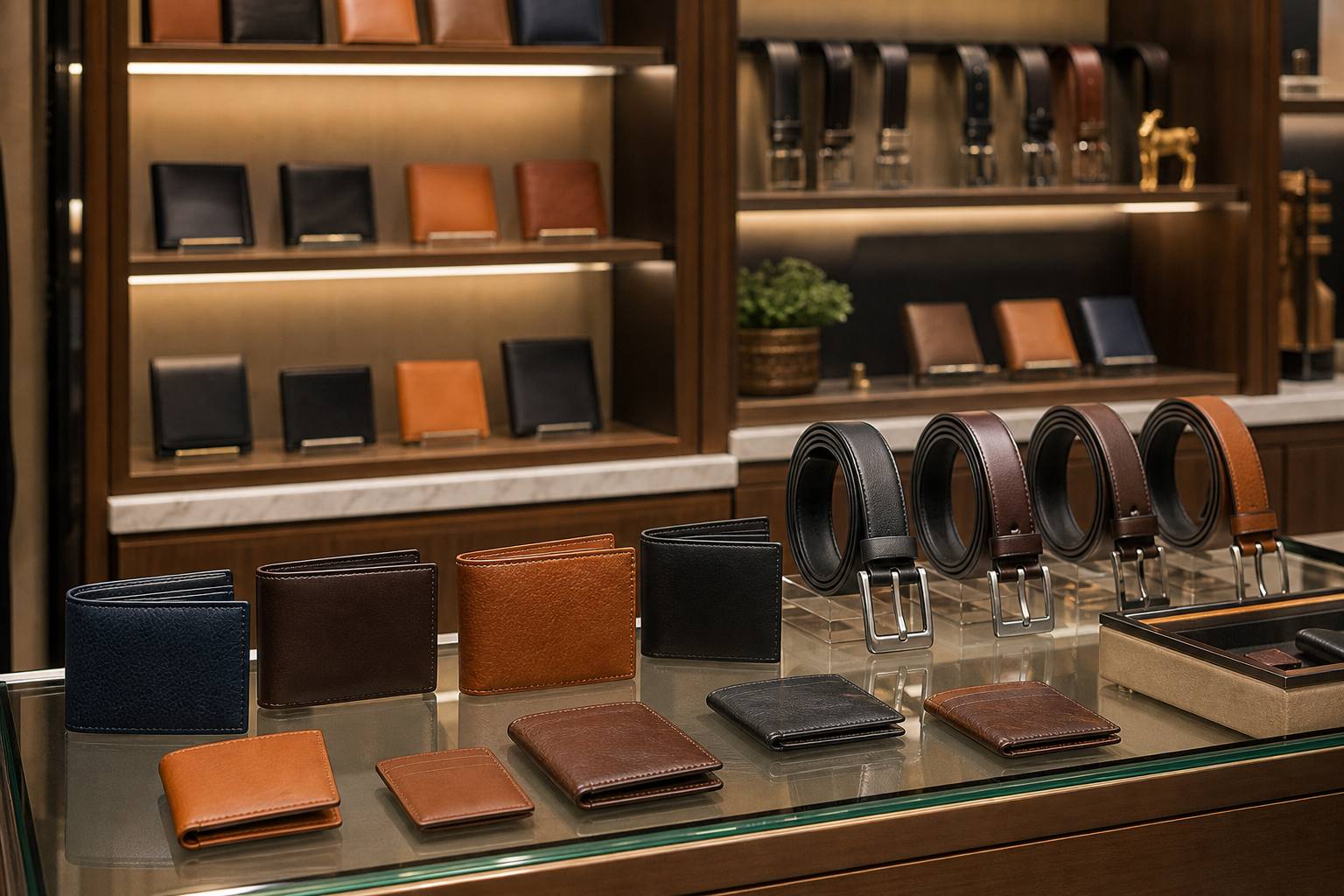
CLE registration and RCMC are foundational credentials for Indian leather wallet and belt exporters competing for organised retail and importer programmes under HS 420231 and 420330. Membership unlocks fair access, buyer credibility, and scheme pathways — while product quality, chemical compliance, packaging, and delivery discipline close the order.
If you are an MSME in Kanpur, Kolkata, Delhi-NCR, or the Ambur–Ranipet–Chennai corridor preparing your first SLG or belt export season, complete IEC, GST, and CLE early, then build construction-led samples. If you are an international buyer, insist on verifiable RCMC and construction evidence before deposits.
Altus Exports operates as a merchant exporter and sourcing partner — aligning CLE-ready Indian capacity with destination briefs, sampling, QC, and documentation. Explore How to Export Leather Wallets and Belts from India, Source Leather Wallets and Belts from India, and our merchant exporter in India service page to structure your next programme.