
How to Source Leather Wallets and Belts Directly from India: Buyer Playbook
By Saurabh Mittal, Founder, Altus Exports
A procurement playbook for importers, distributors, and retail chains sourcing leather wallets and belts directly from India — RFQ discipline, supplier verification, sealed samples, pre-shipment inspection, and trial-versus-FCL sequencing with lower first-order quality risk.
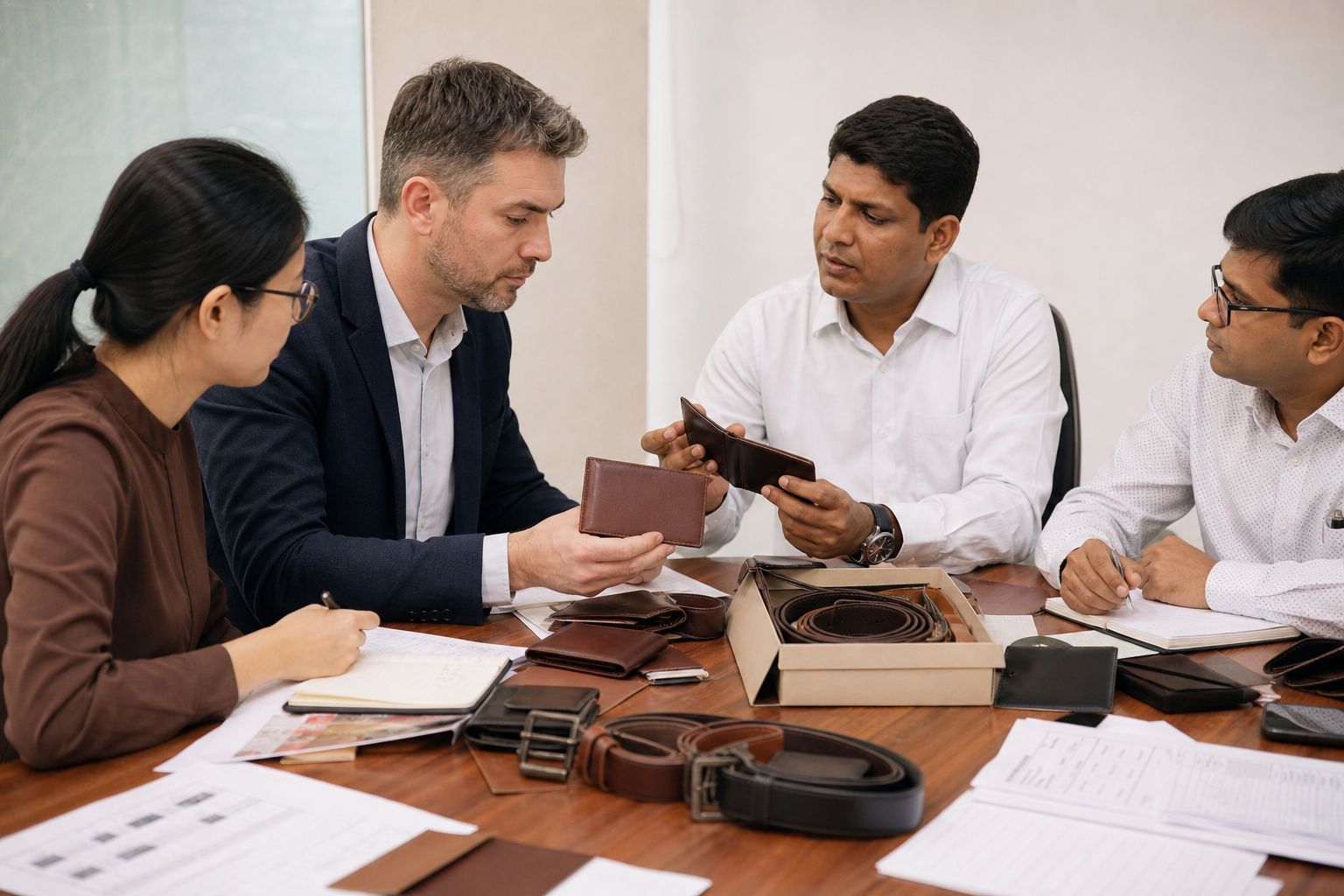
This is a buyer and procurement playbook — not an exporter registration guide and not a destination-ranking essay.
If you are an importer, distributor, wholesaler, or retail-chain buyer who has already decided to source Indian leather wallets and belts — bifolds for a private-label programme, RFID slim wallets for e-commerce, formal 35 mm dress belts for department stores, or wallet–belt gift sets for Gulf modern trade — the open question is no longer why India. It is how to run RFQ, verification, sealed samples, PSI, and trial-versus-FCL gates without burning capital on the first container.
Buyers who skip those gates meet the same failures repeatedly: a beautiful bifold sample followed by bulk with drifted edge paint; an RFID claim with no liner specification; a formal belt sample in one length followed by irregular hole punch across the assortment; a factory that cannot produce current CLE credentials; or 100% advance payment before any document was checked.
This playbook walks through writing a wallet- and belt-specific RFQ, verifying the supplier, approving sealed samples, negotiating MOQ and landed cost, running pre-shipment inspection, and sequencing trial orders before FCL programmes. For market selection context, see Best Countries for Indian Leather Wallet and Belt Exports. For SKU depth, see Top Leather Wallet and Belt Products Exported from India. For CLE credentials in depth, see CLE Registration Benefits for Wallet and Belt Exporters.
Altus Exports supports international buyers as a merchant exporter in India and global sourcing partner — coordinating factory verification, sealed sampling, PSI, and export documentation under one accountable relationship for wallet and belt programmes.
Key Takeaways
Summary Box
Executive Summary
Summary Box
International buyers source leather wallets and belts from India because the country combines tannery relationships, skilled edge finishing, buckle and hardware supply, and export clusters that can run private-label SLG and belt programmes at competitive FOB with meaningful MOQ flexibility.
The commercial opportunity is real. What separates buyers who build multi-year accessory supply from buyers who abandon India after one disputed container is gate discipline — not luck and not the lowest first quote.
This guide treats direct sourcing as a sequence of gates. The RFQ gate prevents incomparable quotes. The verification gate blocks entities that cannot legally export or cannot show CLE leather-goods scope. The sealed-sample gate prevents bulk that only vaguely resembles the photo you liked. The trial-order and PSI gates prove lot consistency before you fund a full container. The payment gate protects capital if any earlier gate was skipped.
None of these gates require you to be an expert in Indian tanning. They require you to demand evidence — card-slot maps, edge-paint references, RFID liner specs, belt width and hole charts — and to withhold the next payment until that evidence checks out.
Market Size & Industry Overview
Key Statistics
India's wallet and belt export base sits under the Council for Leather Exports (CLE) promotional umbrella and ships into United States, United Kingdom, Germany, United Arab Emirates, France, Netherlands, Australia, Japan, Canada, Saudi Arabia among other destinations. For buyers, national export scale confirms the category is real; it does not confirm that a specific factory can hold your RFID liner or 35 mm formal belt hole spacing across 5,000 pieces.
The supply chain has distinct nodes: tanneries (chrome or vegetable tanning, Cr(VI) control, LWG); component suppliers (buckles, rivets, RFID liners, zippers, edge paint); manufacturing units that cut, stitch, edge-finish wallets and punch/finish belts; merchant exporters who consolidate and export under their own accountability; and agents who may only introduce. Confusing those roles is a common procurement mistake.
Production concentrates in Kanpur, Kolkata (Bantala), Delhi-NCR, Ambur–Ranipet–Chennai, Agra, Jaipur. Match cluster to category before you shortlist factories — volume bifolds versus EU formal belts versus fashion embossed belts are not interchangeable capabilities.
India Wallet & Belt Supply Chain Nodes for Buyers
Swipe →
Data table — swipe horizontally on small screens
| Node | Role | What a Buyer Should Verify |
|---|---|---|
| Tanneries | Finished leather for SLG and belt straps | LWG tier, Cr(VI) reports, lot traceability |
| Component suppliers | Buckles, RFID liners, zippers, edge paint | Alloy/spec sheets; REACH-relevant chemistry for EU |
| Wallet/belt factories | Cutting, stitching, edge paint, hole punch, QC | CLE RCMC, IEC, capacity vs MOQ, sealed sample discipline |
| Merchant exporters | Consolidate, document, export under accountability | Shipment references, document packs, PSI cooperation |
| Buying agents | Introduction / coordination only | Whether they own QC and docs — or only introduce |
Export Statistics
Key Statistics
Finished leather goods exports from India include high piece-count wallets under HS 4202.31 and leather belts under HS 4203.30. For procurement planning, composition matters more than the sector headline: bifolds and card holders typically dominate piece counts; formal and casual belts add heavier carton weight per cube; RFID and passport holders sit at higher average unit values.
Read export statistics as market-sizing context. Your RFQ, sealed sample, and PSI results decide whether a named supplier can serve your assortment — CLE destination shares cannot substitute for factory-level verification.
Indicative Export Mix Relevant to Buyer RFQs (Planning)
Swipe →
Data table — swipe horizontally on small screens
| Category | Typical HS | Buyer RFQ Emphasis | Failure Mode If Vague |
|---|---|---|---|
| Men's bifold wallets | 4202.31 | Card slots, note compartments, SPI, edge paint | Bulk slot map drifts from sample |
| RFID / slim wallets | 42023120 | Liner type, claim language, thickness | Unsubstantiated blocking claims |
| Passport / travel wallets | 4202.31 | Pocket layout, zipper brand, lining | Fit failures on passport thickness |
| Formal dress belts | 4203.30 | Width mm, buckle alloy, hole punch, lengths | Length assortment chaos at retail |
| Casual / reversible belts | 42033000 | Reversible mechanism, stitch, tip finish | Hardware failure in returns |
| Wallet–belt gift sets | Mixed lines | Set BOM, gift box, colour match | Component mismatch across set |
Import Statistics
Key Statistics
Your destination's import pattern should shape the first trial — not a generic India MOQ. US and Canadian private-label programmes often trial denser wallet assortments; German and French buyers trial fewer styles with heavier documentation; Gulf buyers trial gift sets timed to calendars; Japanese buyers trial small quantities with long sample cycles.
Use import-channel reality to set PSI AQL, carton marks, and payment milestones before you negotiate FOB.
Buyer Trial Design by Import Channel (Indicative)
Swipe →
Data table — swipe horizontally on small screens
| Destination Tier | Typical First Trial | PSI Focus | Scale Trigger |
|---|---|---|---|
| USA / Canada private label | 2–4 wallet styles + 1 casual belt | UPC, edge paint, RFID liner | Chargeback-free DC receiving |
| UK chain wholesale | Bifold + formal belt paired | Barcode, care label, colour | Season reorder |
| Germany / France premium | 1–2 formal belts + 1 SLG | Cr(VI), finish, buckle | Audit clearance + reorder |
| UAE / Saudi gift | Wallet–belt set assortment | Gift box, colour match, buckle | Festival reorder window |
| Japan specialty | Slim wallet or precise belt | Hole punch, SPI, defect rate | Multi-season retention |
| Netherlands hub | Assorted SLG carton plan | Packing list vs carton marks | Repeat FCL slot |
Product Categories / Variants
Summary Box
Write RFQs against specific variants — not against leather accessories. Core export variants include men's bifolds, trifolds, card holders, RFID-blocking wallets, passport holders, women's zip-around wallets, coin pouches, formal dress belts, casual/jeans belts, reversible belts, fashion buckle belts, and corporate gift wallet–belt sets.
Each variant needs its own measurable fields. A bifold without a card-slot map is not an RFQ. A formal belt without width mm, buckle alloy, hole count/spacing, and length assortment is not an RFQ.
Variant-to-RFQ Field Map (Buyer Use)
Swipe →
Data table — swipe horizontally on small screens
| Variant | Must-Specify Fields | Indicative FOB Anchor |
|---|---|---|
| Bifold wallet | Leather grade, slots, note section, edge paint, lining | US$4–12 / pc FOB |
| Trifold wallet | Fold map, thickness, stitch SPI | US$5–14 / pc FOB |
| Card holder / slim | Slot count, RFID yes/no, dimensions | US$2.50–8 / pc FOB |
| RFID wallet | Liner spec, claim wording, test method | US$6–18 / pc FOB |
| Passport holder | Pocket layout, zipper, lining colour | US$6–16 / pc FOB |
| Formal belt | Width mm, buckle alloy, holes, lengths | US$3.50–12 / pc FOB |
| Casual / jeans belt | Width, tip, stitch, leather temper | US$3–10 / pc FOB |
| Reversible belt | Mechanism, both-side leather, buckle | US$5–15 / pc FOB |
| Gift set | BOM, box, colour match tolerance | US$18–45 / set FOB |
Manufacturing Overview
Export Tip
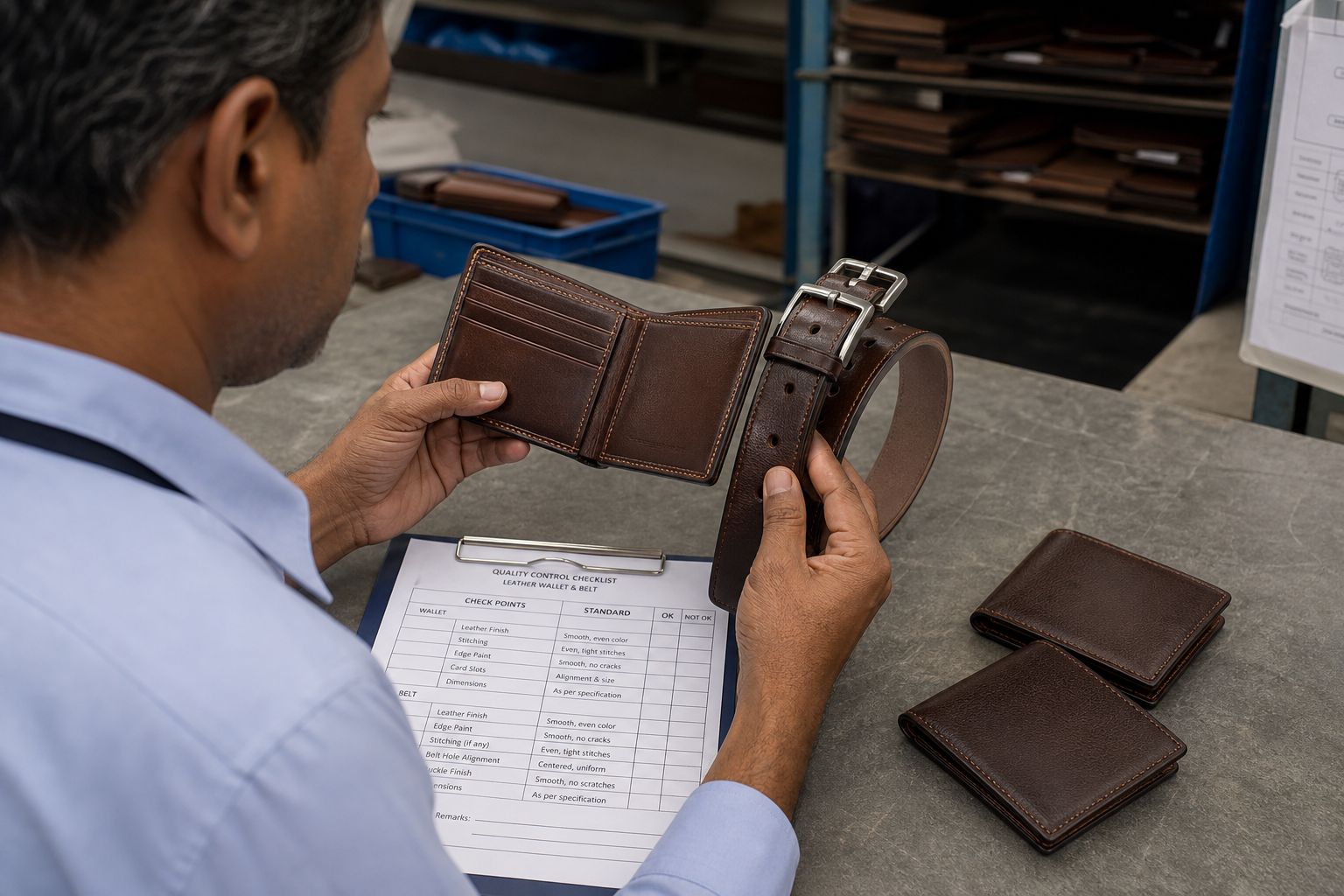
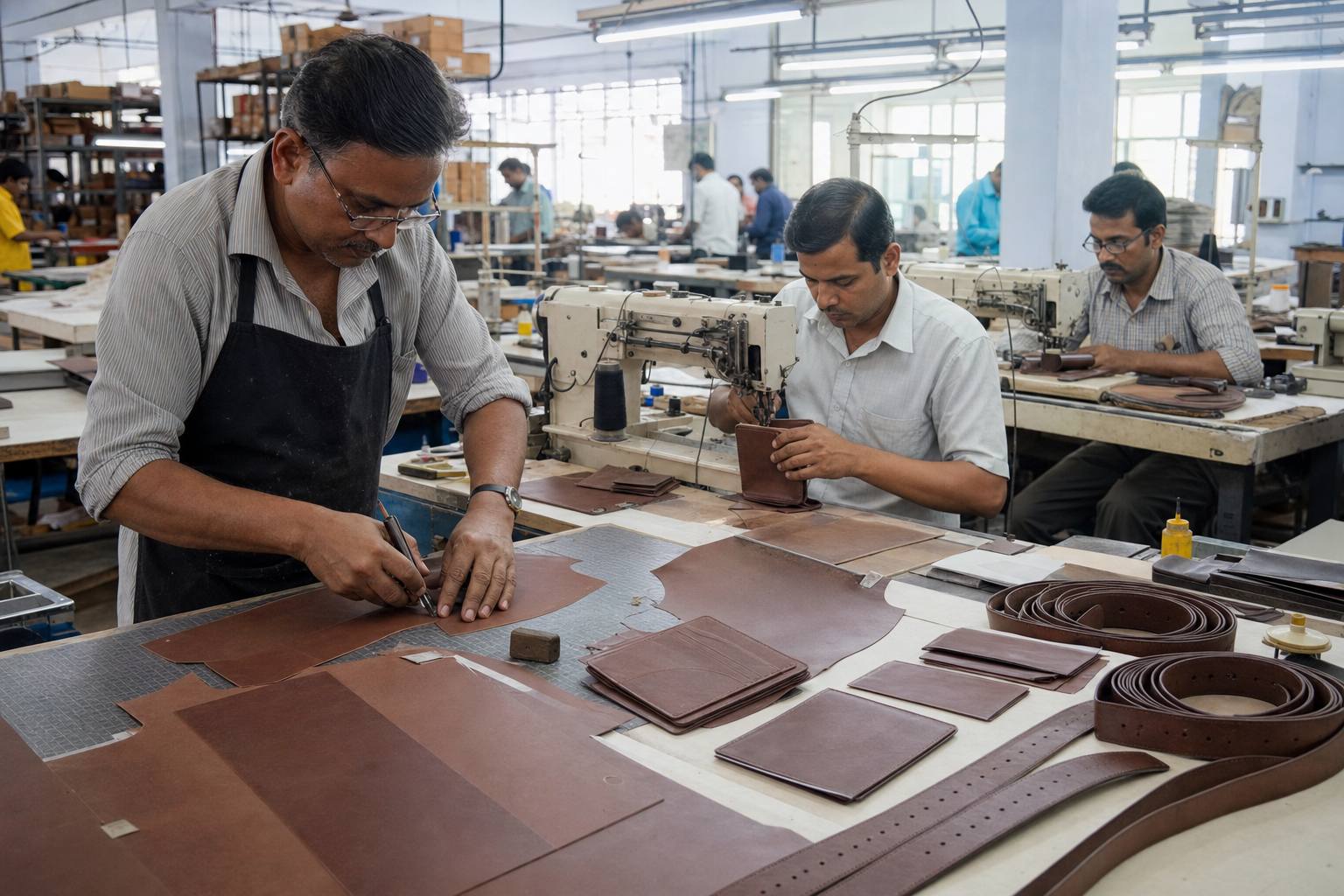
Understanding the factory sequence helps you place inspection points. Wallets typically move through leather issuance, cutting/skiving, pocket and card-slot construction, lining and optional RFID liner insertion, stitching, edge paint, branding, and final QC. Belts move through strap cutting, edge finishing, hole punching to a length chart, tip finishing, buckle attachment, and QC against width and hole tolerances.
Ask which stages are in-house versus subcontracted. Edge paint and hole punch consistency are frequent failure points when subcontracted without lot control. Confirm which Mundra, Nhava Sheva, Chennai, Tuticorin, Kolkata port the factory or merchant exporter actually uses for your lane.
Inspection Points Across Wallet & Belt Production
Swipe →
Data table — swipe horizontally on small screens
| Stage | Wallet Check | Belt Check |
|---|---|---|
| Incoming leather | Grade, thickness, Cr(VI) lot ID | Strap temper, thickness, lot ID |
| Cutting | Panel yield vs tech pack | Width mm within tolerance |
| Construction | Slot map, lining, RFID liner seat | Hole punch spacing vs chart |
| Finishing | Edge paint tone/opacity | Tip finish, buckle torque/fit |
| Final QC | SPI, branding, dimensions | Length assortment mix, buckle alloy mark |
| Packing | Polybag/gift box, silica, UPC | Belt card/loop, set box if applicable |
Pricing Analysis
Buyer Tip
Compare suppliers on landed cost per piece or per set — FOB plus freight, insurance, duty, PSI, and your internal QC — not on FOB alone. A US$0.40 cheaper bifold that fails edge-paint AQL is not cheaper.
Use indicative anchors only for RFQ sanity checks: bifold US$4–12 / pc FOB; RFID US$6–18 / pc FOB; formal belt US$3.50–12 / pc FOB; casual US$3–10 / pc FOB; premium set US$18–45 / set FOB. Demand itemised quotes separating leather, hardware, packaging, and testing.
Landed-Cost Comparison Template (Buyer Worksheet)
Swipe →
Data table — swipe horizontally on small screens
| Cost Element | Supplier A | Supplier B | Notes |
|---|---|---|---|
| FOB wallet / pc | — | — | Same RFQ, same leather grade |
| FOB belt / pc | — | — | Same width, buckle, lengths |
| Packaging / pc or set | — | — | Gift box vs polybag |
| Testing / PSI allocation | — | — | Cr(VI), RFID, third-party PSI |
| Ocean freight / pc | — | — | From actual carton dims |
| Duty / pc | — | — | By destination HS line |
| Total landed / pc | — | — | Decision metric |
MOQ Analysis
Buyer Tip
Indicative India-side MOQs: trial 100–300 pcs / style (wallets); 150–400 pcs / style (belts); standard 300–1,000 pcs / style; retail chain 1,000–5,000+ pcs / style / colourway; gift sets 200–800 sets / assortment. Lead times: samples 7–18 days after locked tech pack; trial 25–45 days ex-factory after sample sign-off; bulk 45–75 days to vessel (hardware/buckle lead time parallel).
Negotiate MOQ per style and per colourway separately. Belt length assortment ratios must be written into the PO — average length thinking causes retail stockouts in popular sizes.
Trial vs Programme MOQ Decision Guide
Swipe →
Data table — swipe horizontally on small screens
| Stage | Typical Size | Buyer Objective | Do Not… |
|---|---|---|---|
| Paid sealed sample | 5–20 pcs / style | Lock construction & finish | Approve bulk from photos |
| Trial order | 100–300 pcs / style (wallets); 150–400 pcs / style (belts) | Prove lot consistency + docs | Skip PSI to save fees |
| Programme PO | 300–1,000 pcs / style | Fill seasonal pipeline | Change buckle mid-run silently |
| Retail chain roll-out | 1,000–5,000+ pcs / style / colourway | DC-ready volume | Launch without barcode pilot |
| Gift set drop | 200–800 sets / assortment | Calendar windows | Mix unmatched leather lots in one set |
Packaging Standards
Export Tip
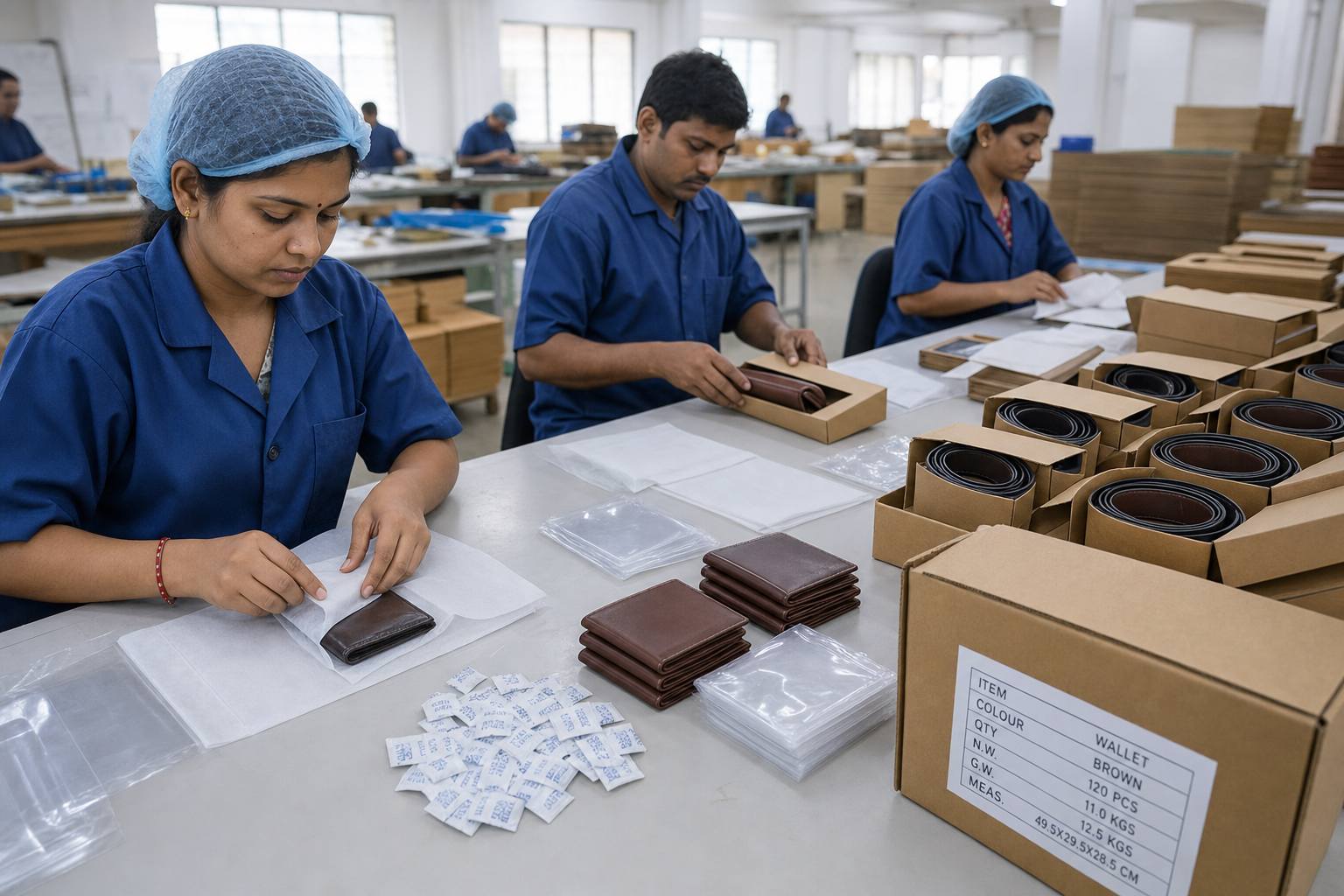
Specify packaging in the RFQ with the same seriousness as leather grade. Wallets need polybag or gift-box rules, silica gel, care labels, and barcode placement. Belts need cards or loops, tip protection, and assortment marks. Gift sets need BOM-matched boxes and colour-match tolerances across wallet and belt.
Destination rules — bilingual Canada packs, EU care language, Australia biosecurity materials, US UPC — belong in the RFQ, not in a post-production email.
Packaging Spec Checklist for Wallet & Belt POs
Swipe →
Data table — swipe horizontally on small screens
| Element | Wallet Spec | Belt Spec |
|---|---|---|
| Inner pack | Polybag or gift box; tissue; silica | Belt card/loop; tip guard |
| Label / hangtag | Material, origin, care, UPC/EAN | Width, length, origin, UPC/EAN |
| Master carton | Style, colour, qty, NW/GW, dims | Assortment ratio marks mandatory |
| Claim language | RFID only if liner evidenced | No unverified alloy claims |
| Set packaging | Shared gift box BOM | Wallet+belt colour match ΔE limit |
Container Loading Details
Export Tip
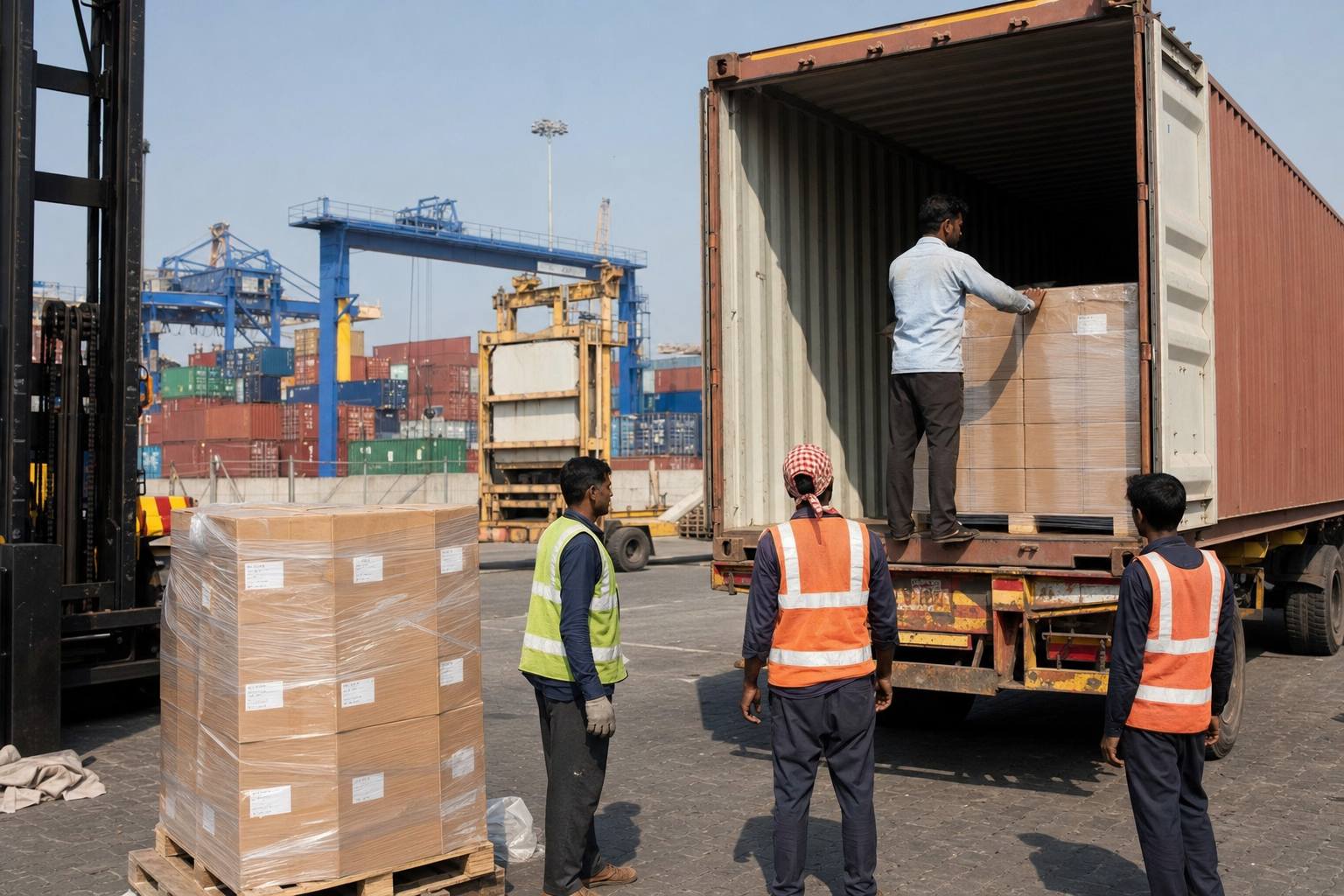
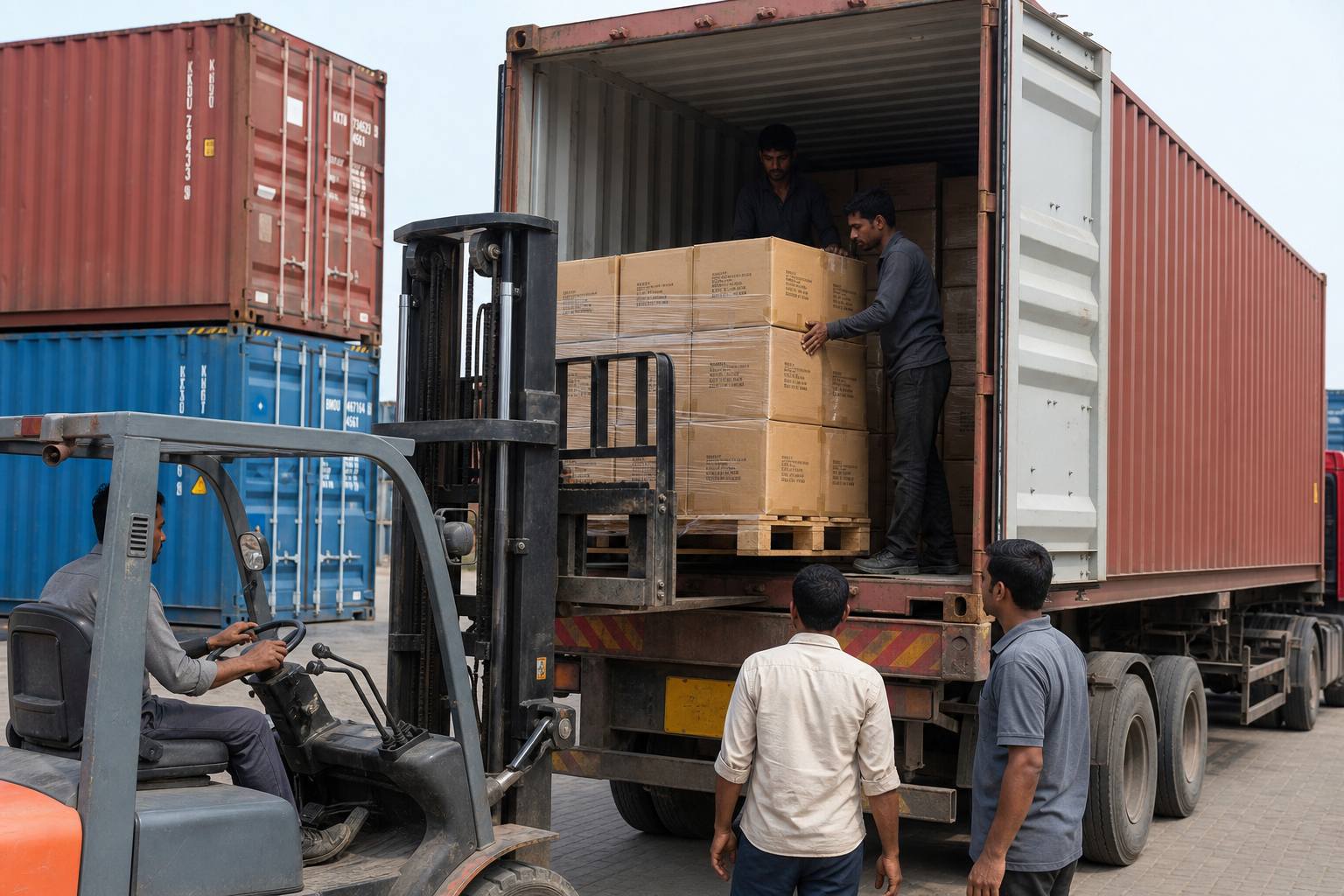
Plan stuffing from real carton dimensions. Indicative: 20ft 8,000–18,000 wallets or 6,000–14,000 belts (carton-dependent); 40ft HC 18,000–40,000 wallets or 14,000–32,000 belts (carton-dependent). Belt cartons with buckles weigh more per cube; wallet SLG nests denser. Always stuff from actual carton dims.
Ask the supplier for a cartonisation sheet before you compare freight quotes. Wallet-heavy trials and buckle-heavy belt trials produce very different cube and weight profiles.
Cartonisation Inputs Buyers Should Demand
Swipe →
Data table — swipe horizontally on small screens
| Input | Why It Matters | Owner |
|---|---|---|
| Inner pack dims & pcs/inner | Drives master carton yield | Factory / merchant exporter |
| Master carton L×W×H & GW | Freight and container plan | Factory |
| Assortment ratio (belts) | Prevents length stockouts | Buyer PO + factory |
| Stacking limit / crush | Damage claims in FCL | Factory + forwarder |
| HS split per carton marks | Customs and DC receiving | Exporter docs team |
Shipping Methods
Export Tip
Use air for sealed samples and urgent replenishment; use sea LCL for small trials when timing allows; use FCL once assortment and quality are proven. Common load ports include Mundra, Nhava Sheva, Chennai, Tuticorin, Kolkata.
Prefer FOB while you are still validating suppliers so you control forwarder and insurance choices. CIF can work with trusted merchant exporters on repeat programmes. Never confuse Incoterm convenience with QC ownership — PSI rights should be contractual regardless of Incoterm.
Certifications
Compliance Notes
Buyer-side certification requests should be proportionate to destination and claims. EU/UK programmes need Cr(VI) evidence on leather lots. RFID programmes need liner specifications and test methods. Premium German/French programmes may require LWG tannery IDs. Children's SLG into the USA may trigger CPSIA — adult wallets usually do not, but confirm if any kids assortment is in scope.
Ask for CLE RCMC product scope covering finished leather goods / wallets and belts, plus IEC and GST name match across documents.
Buyer Certification Request Matrix
Swipe →
Data table — swipe horizontally on small screens
| Document / Proof | When to Require | Red Flag |
|---|---|---|
| CLE RCMC | Before paid sample | Expired or wrong product scope |
| IEC + GST | Before any payment | Legal name mismatches |
| Cr(VI) test report | EU/UK leather programmes | Report not lot-linked |
| LWG tannery evidence | Premium EU programmes | Verbal LWG claim only |
| RFID liner spec + test | Any RFID claim | Marketing text without liner ID |
| PSI report | Every trial and first FCLs | Supplier refuses third-party access |
Buyer Requirements
Buyer Requirements
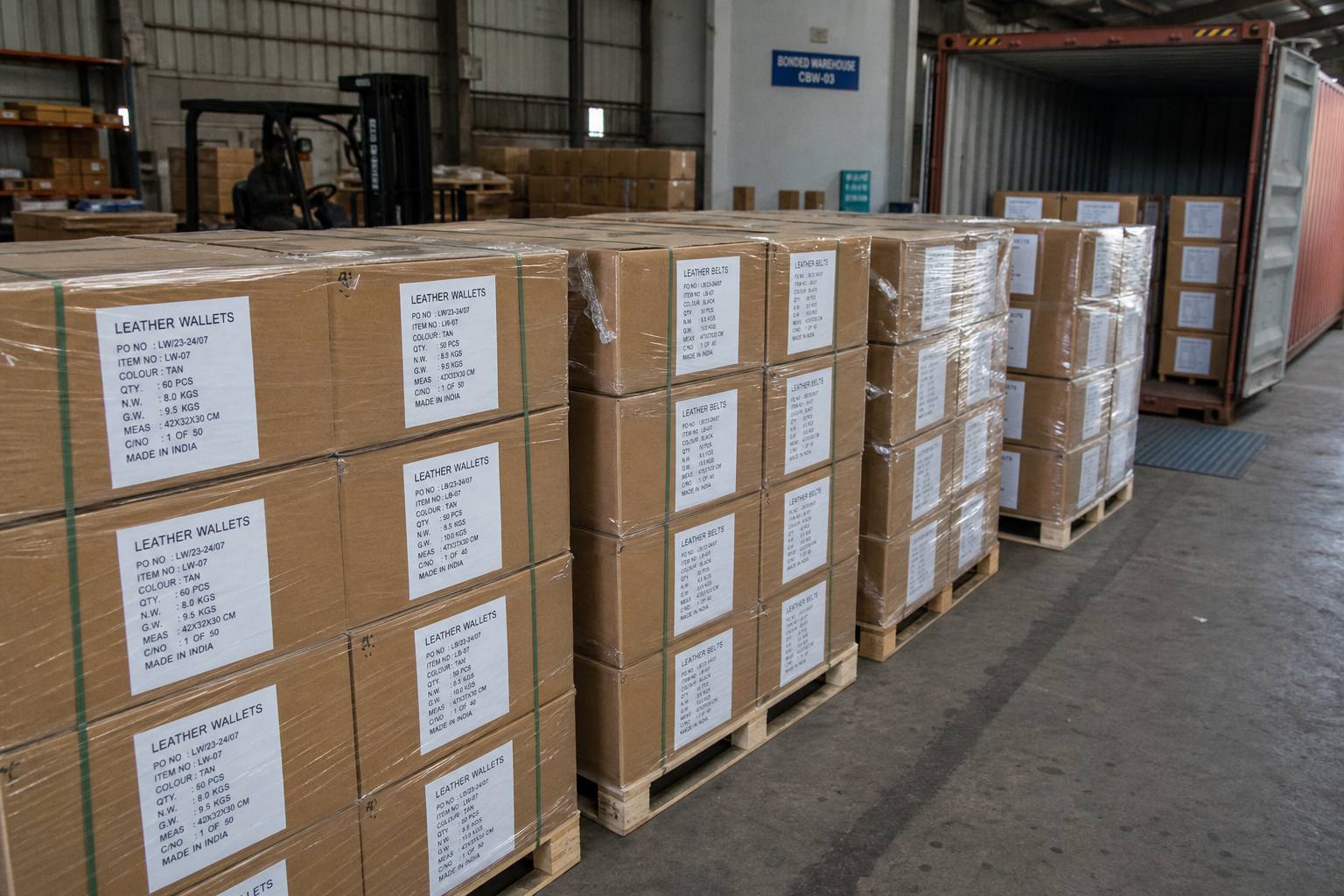
- Written RFQ with wallet card-slot map and/or belt width, buckle, holes, and length assortment.
- Independent verification of CLE, IEC, and GST — not WhatsApp photos alone.
- Sealed pre-production samples retained by both parties with revision IDs.
- Contractual PSI rights with AQL and defect classification for edge paint, SPI, buckle, and hole punch.
- Milestone payment terms — never 100% advance to an unverified factory.
- Lot-linked packing list and commercial invoice using correct HS lines for wallets and belts.
Successful importers and retail chains treat the following as minimum requirements before a wallet or belt trial leaves India.
Country-wise Opportunities
Market Snapshot
Procurement tactics shift by destination even when the factory stays the same. Use this table to tune RFQ emphasis and trial design; for full destination ranking see Best Countries for Indian Leather Wallet and Belt Exports and demand detail in Most Demanded Indian Leather Wallets and Belts by Country.
Buyer RFQ Emphasis by Destination
Swipe →
Data table — swipe horizontally on small screens
| Market | RFQ Emphasis | Trial Design Tip |
|---|---|---|
| USA | RFID liner, UPC, card slots, casual belt widths | Pilot DC labels on trial cartons |
| UK | Care labels, bifold + formal belt pair | Chargeback-aware barcode check |
| Germany | Cr(VI), LWG, formal belt tolerances | Fund lab tests before bulk cut |
| UAE | Gift set BOM, formal belts | Align to festival calendar |
| France | Colourways, edge paint, fashion buckles | Hold Pantone/edge refs on file |
| Netherlands | Assortment cartons for EU hub | Packing list exactness first |
| Australia | Biosecurity pack, travel wallets | Pack materials approved early |
| Japan | Slim wallets, hole punch precision | Longer sample cycle in plan |
| Canada | Bilingual packs, RFID bifolds | Label artwork before sampling |
| Saudi Arabia | Formal belts, corporate gift sets | Often via UAE distributor first |
Expert Insight: The RFQ Is the Product
Expert Insight Box
Export Tip
Buyers who invest one extra day in a measurable RFQ routinely save weeks of dispute after cargo sails. Treat the RFQ as the product definition — photos are illustrations, not specifications.
Sourcing Checklist
Checklist
Wallet RFQ template fields (copy into your brief)
- Style name / buyer style code; bifold, trifold, slim, zip-around, or passport.
- Leather type and grade; thickness mm; colour Pantone or physical swatch ID.
- Card slot count and layout map; note compartment; coin pocket yes/no.
- Lining material; RFID liner type, coverage area, and approved claim wording.
- Stitch SPI; thread type; edge paint colour and finish (matte/gloss); logo method.
- Dimensions (closed); packaging (polybag/gift box); barcode; target FOB and Incoterm.
- HS line intent (4202.31 / 42023120); destination compliance pack required.
- MOQ per colourway; sample due date; sealed sample retention rule.
Belt RFQ template fields (copy into your brief)
- Style name / buyer style code; formal, casual, reversible, or fashion buckle.
- Strap leather grade; thickness; colour; edge finish.
- Width in mm (e.g., 30 / 35 / 38); tip shape; stitch detail if any.
- Buckle alloy / material; finish (brushed nickel, gunmetal, etc.); logo on buckle yes/no.
- Hole punch count, spacing mm, and distance from tip; keeper design.
- Length assortment ratio (e.g., 80/85/90/95/100/105/110/115 cm) and pcs per size.
- Packaging (card/loop/gift box); barcode; target FOB and Incoterm.
- HS line intent (4203.30 / 42033000); Cr(VI) requirement if EU/UK.
- MOQ per colourway; sample due date; sealed sample retention rule.
Common Buyer Mistakes
Common Mistakes Box
These mistakes appear repeatedly in first-time wallet and belt sourcing programmes — each is avoidable with gate discipline.
Future Market Trends
Key Statistics
Buyer expectations through 2026 are tightening around three axes: lot-level chemical and tannery traceability for EU-bound belts and SLG; substantiated RFID and material claims for North American private label; and digital photo/PSI evidence packs attached to each shipment, not only paper certificates.
Procurement teams that institutionalise RFQ templates, sealed-sample libraries, and trial-before-FCL rules will onboard Indian wallet and belt capacity faster than teams still sourcing from PDF catalogues alone.
Buyer Checklist
Checklist
Exporter Checklist
Checklist
Compliance Checklist
Checklist
Compliance Notes
Expert Insight: Trial Gates Protect Both Sides
Expert Insight Box
Merchant exporters and factories that welcome sealed samples and PSI are signalling process maturity. Treat resistance to inspection access as a sourcing signal, not a negotiation tactic to ignore.
Conclusion
- Market selection: Best Countries for Indian Leather Wallet and Belt Exports.
- SKU depth: Top Leather Wallet and Belt Products Exported from India.
- Export operations (exporter view): How to Export Leather Wallets and Belts from India.
- Demand by country: Most Demanded Indian Leather Wallets and Belts by Country.
- CLE credentials: CLE Registration Benefits for Wallet and Belt Exporters.
- Docs: Leather Wallet and Belt Export Documentation Checklist.
- Fairs: Trade Shows & B2B Marketplaces for Leather Wallet and Belt Exporters.
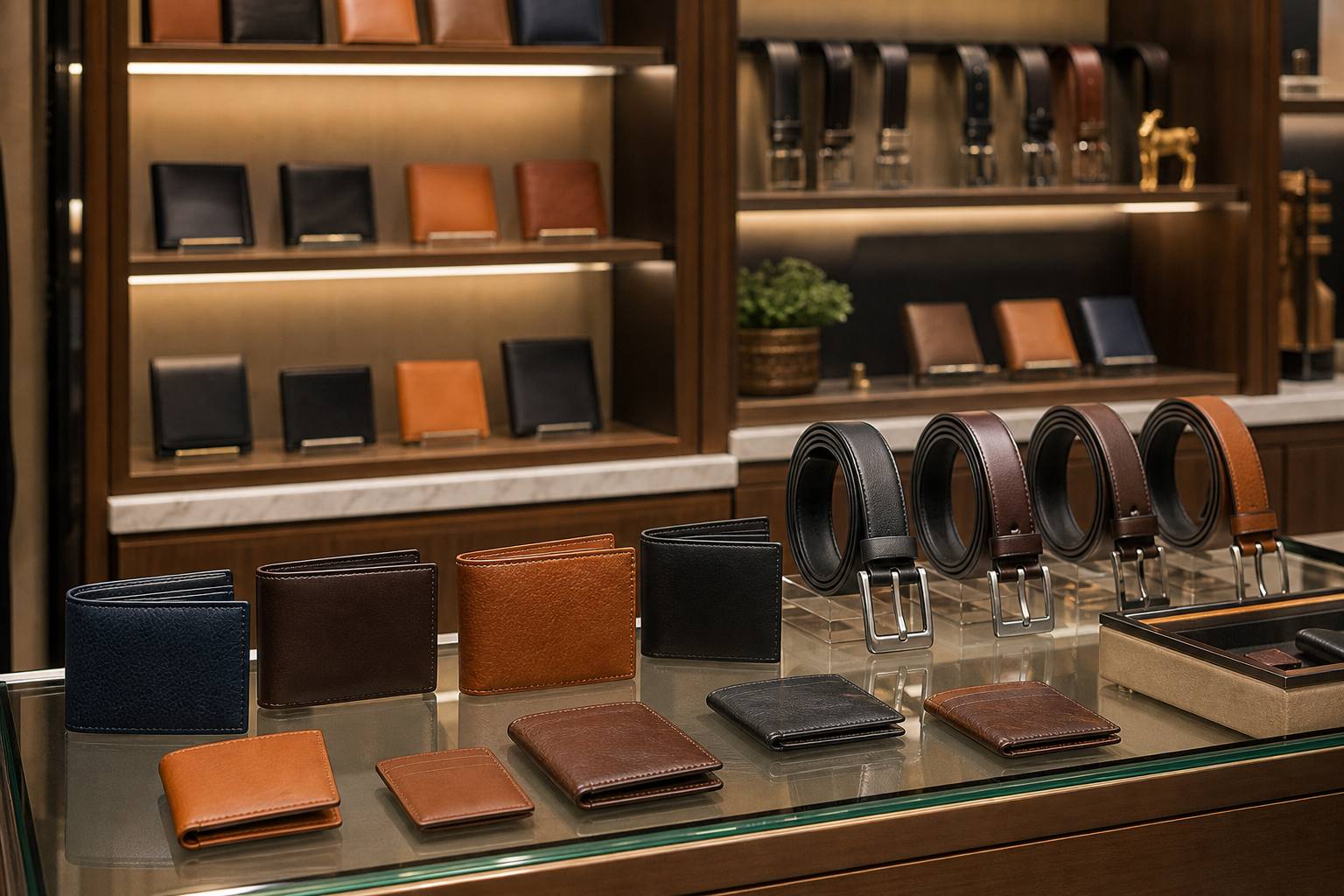
Sourcing leather wallets and belts directly from India rewards buyers who run a disciplined procurement sequence: measurable RFQs, independent verification, sealed samples, PSI-backed trials, and FCL scale only after lot consistency holds. Card slots, edge paint, RFID liners, belt widths, buckle alloys, hole punch charts, and length assortments are the fields that separate clean programmes from chargeback disasters.
Altus Exports works as a merchant exporter in India and global sourcing partner for importers, distributors, and retail chains — coordinating factory shortlists, sealed sampling, inspection, and export documentation for wallet and belt programmes. Explore product sourcing company in India, find manufacturers in India, and export products from India to structure your next trial.