
How to Export Leather Wallets and Belts from India: Complete Guide for Importers & Exporters
By Saurabh Mittal, Founder, Altus Exports
A factory-to-port operational guide to exporting leather wallets and belts from India — registration, CLE membership, HS 4202.31 / 4203.30 classification, sampling, bulk production, packing, documentation, customs, and freight — with indicative FOB, MOQ, and container benchmarks for importers and exporters.
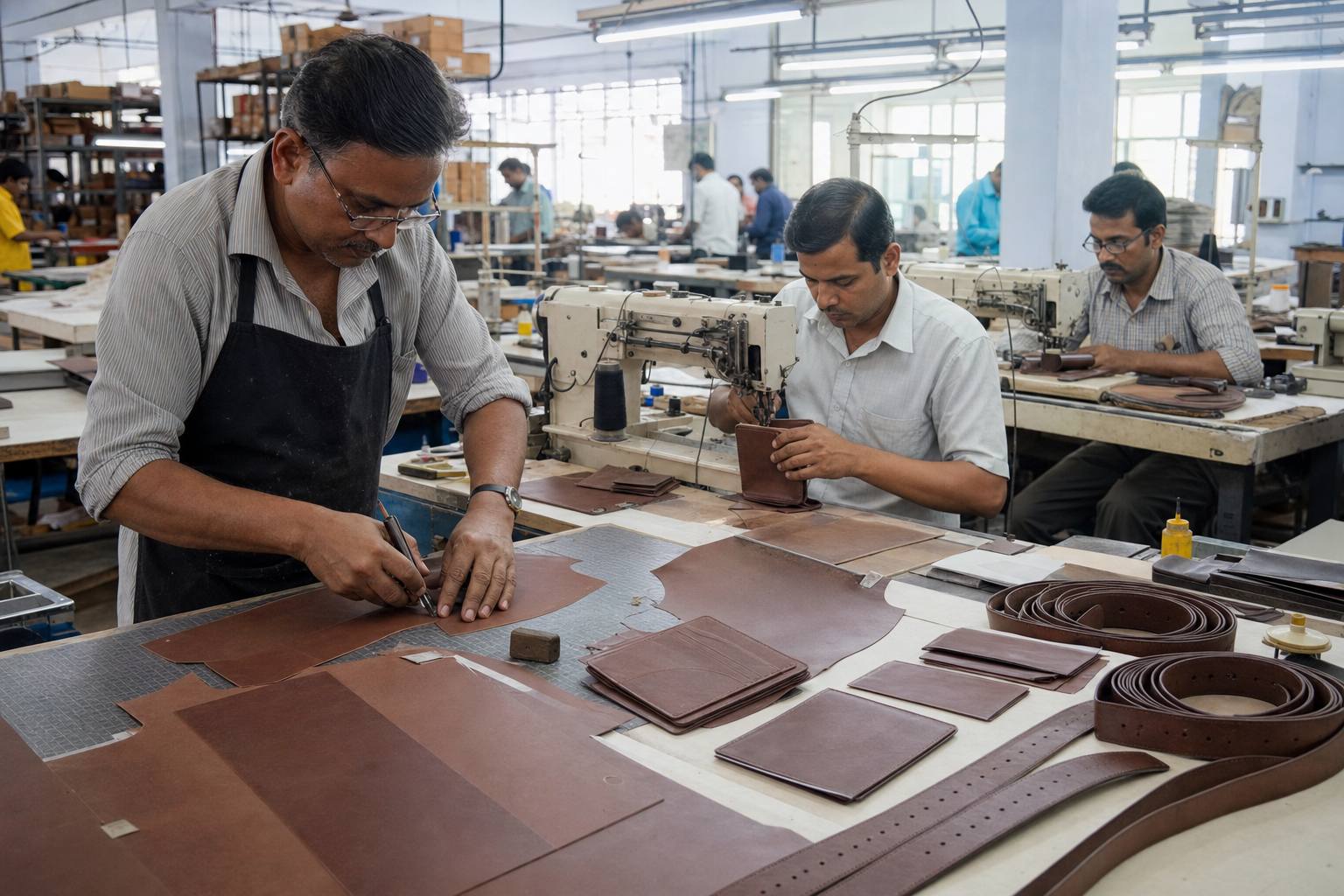
Exporting leather wallets and leather belts from India follows a defined factory-to-port sequence: business and IEC registration, Council for Leather Exports (CLE) membership with RCMC, GST and factory compliance, sourcing or manufacturing export-grade small leather goods (SLG) and belts, sample and hardware approval, bulk cutting and stitching, quality inspection and packing, documentation prepared in parallel with production, customs clearance, and freight booking. Wallets ship primarily under HS 4202.31 (Indian ITC-HS 42023120); leather belts ship under HS 4203.30 (Indian ITC-HS 42033000).
India's SLG and belt capacity is concentrated in Kanpur, Kolkata (Bantala), Delhi-NCR, Ambur–Ranipet–Chennai, Agra, Jaipur — each cluster with different scale, hardware supply, and buyer experience. Primary load ports are Mundra, Nhava Sheva, Chennai, Tuticorin, Kolkata, chosen by cluster proximity and the buyer's preferred routing.
This guide is the operational pillar for wallets and belts — registration → sample → bulk → pack → docs → freight — not a product catalogue and not a country-ranking guide. For SKU depth across bifolds, trifolds, card holders, RFID wallets, passport holders, formal/casual/reversible belts, and gift sets, see Top Leather Wallet and Belt Products Exported from India.
Market selection: Best Countries for Indian Leather Wallet and Belt Exports and Most Demanded Indian Leather Wallets and Belts by Country. Buying side: Source Leather Wallets and Belts from India. CLE detail: CLE Registration Benefits for Wallet and Belt Exporters. Docs: Leather Wallet and Belt Export Documentation Checklist.
Altus Exports works as a merchant exporter in India and global sourcing partner coordinating wallet and belt programmes end to end — from first registration through repeat shipment. This guide distills that operational experience for international buyers, importers, distributors, wholesalers, retail chains, and procurement teams.
Key Takeaways
Summary Box
Executive Summary
Summary Box
Exporting leather wallets and belts from India is a regulated, multi-step process built around four pillars: legal export eligibility (IEC and GST), category credibility (CLE membership and RCMC), physical product readiness (sourcing or manufacturing, sample approval, bulk production, and quality control), and documentation that satisfies both Indian customs and the destination country's import rules.
New exporters who treat these as sequential milestones — rather than a checklist to complete the week before sailing — consistently ship faster and face fewer customs holds. Wallets and belts share leather compliance (REACH Cr(VI), origin labelling) but diverge on construction: wallets emphasise pocket layout, RFID liners, and edge paint; belts emphasise strap width consistency, buckle alloy, and hole punch accuracy.
This guide walks through each operational step in order: registration and CLE membership, sourcing or manufacturing export-grade SLG and belts, sample and hardware approval, bulk cutting and quality control, packing and container preparation, documentation, customs clearance, freight booking, and post-shipment compliance.
Along the way, it covers market size, export and import trade statistics, product categories, indicative pricing and MOQ from planning benchmarks, packaging standards, container loading, shipping methods, certifications, buyer requirements, and country-wise opportunities.
Whether you are an established leather-goods manufacturer adding an export channel, a merchant exporter consolidating bifolds and dress belts from multiple factories, or a first-time entrepreneur entering SLG, the sequence below applies. Destination depth scales documentation — a container to Germany and a pallet to the UAE carry different certificate burdens — but the underlying factory-to-port sequence is the same.
Market Size & Industry Overview
Key Statistics
India's leather goods sector includes a deep small leather goods and belt manufacturing base that sits alongside larger leather articles. For wallets and belts specifically, the practical implication for a first-time exporter is this: India has genuine depth in tanned leather access, skilled cutting and stitching labour, buckle and hardware supply, and RFID liner sourcing that few competing origins match at comparable cost — but export-grade wallets and belts must clear a distinct bar on stitch consistency, colour matching, hardware finish, and compliance documentation that domestic-market accessory trade does not always meet.
The Council for Leather Exports (CLE), the export promotion body sponsored by India's Ministry of Commerce and Industry and tracked through leatherindia.org, is the sector's regulatory and promotional anchor. CLE membership is the reference point international buyers most often check before extending trust to a new Indian wallet or belt supplier, alongside a valid IEC and GST registration.
India Leather Wallet & Belt Industry Snapshot (Indicative)
Swipe →
Data table — swipe horizontally on small screens
| Dimension | Approximate Figure | Relevance to New Exporters |
|---|---|---|
| Primary HS — wallets | 4202.31 / 42023120 | Correct sub-heading required on every shipping bill and invoice |
| Primary HS — belts | 4203.30 / 42033000 | Belts are articles of apparel/clothing accessories of leather — not HS 4202 |
| Primary manufacturing clusters | Kanpur; Kolkata (Bantala); Delhi-NCR; Ambur–Ranipet–Chennai; Agra; Jaipur | Cluster affects specialisation, MOQ flexibility, and export experience |
| Regulatory body | Council for Leather Exports (CLE) — leatherindia.org | CLE membership and RCMC are the sector's baseline credibility check |
| Major export ports | Mundra, Nhava Sheva, Chennai, Tuticorin, Kolkata | Port choice depends on manufacturing cluster location and destination lane |
| Segment mix | Bifolds, trifolds, card holders, RFID, passport holders, formal/casual/reversible belts, gift sets | Segment choice determines hardware, lining, and target buyer profile |
Manufacturing Clusters at a Glance
Kanpur combines tanning with finished wallet and belt production in one of India's oldest industrial leather corridors — buyers gain access to integrated raw-material-to-finished-product supply for volume bifolds and dress belts. Kolkata (Bantala) anchors eastern leather goods capacity with strong wallet stitching and finishing experience for both domestic and export programmes.
Delhi-NCR specialises in fashion SLG, corporate gift sets, and private-label programmes with faster sampling cycles. The Ambur–Ranipet–Chennai belt in Tamil Nadu carries deep experience serving European and North American accessory buyers, including compliance-heavy programmes preferring LWG-certified tanneries. Agra and Jaipur round out the map with pockets of belt making, casual SLG, and artisanal finishing that suit lifestyle and gift channels.
Export Statistics
Key Statistics
Per CLE / DGCI&S Overview of Indian Leather Industry 2026, India's footwear, leather and leather products exports totalled US$ 4.75 billion in FY 2025-26 (Apr–Mar), after US$ 4.83 billion in FY 2024-25. The leather goods segment — which includes bags, wallets, belts and related finished articles — was US$ 1,253.6 million (26.39%) in FY 2025-26, versus US$ 1,319.6 million (27.33%) in FY 2024-25. India is the 5th largest global exporter of leather goods & accessories.
CLE destination shares are for the TOTAL leather & leather products basket (footwear, garments, goods, saddlery, etc.), not wallet-only (HS 4202.31) or belt-only (HS 4203.30) volumes. Wallets under HS 4202.31 and belts under HS 4203.30 typically move as high-piece-count, dense carton cargo compared with larger leather articles. Category mix rows below are indicative commercial planning only — CLE does not publish official bifold-versus-belt share percentages.
CLE Sector Anchors + Indicative Wallet/Belt Planning Mix (Not Official CLE SKU Shares)
Swipe →
Data table — swipe horizontally on small screens
| Category | Indicative Planning Mix (not CLE-published) | Typical HS | Primary Destinations (sector-led) |
|---|---|---|---|
| Men's bifold wallets | Planning only — confirm with your order book | 4202.31 | USA, UK, UAE, Germany |
| Card holders / slim wallets | Planning only — confirm with your order book | 4202.31 | USA, UK, Japan, Australia |
| RFID and travel / passport wallets | Planning only — confirm with your order book | 4202.31 | USA, Germany, UK, Netherlands |
| Trifolds and women's zip-around | Planning only — confirm with your order book | 4202.31 | USA, UAE, UK, France |
| Formal dress belts | Planning only — confirm with your order book | 4203.30 | USA, Germany, UK, UAE, Saudi Arabia |
| Casual / jeans and reversible belts | Planning only — confirm with your order book | 4203.30 | USA, UK, Australia, Canada |
Import Statistics
Key Statistics
New exporters often study only India's export data. Reading the destination side — what each country imports under HS 4202.31 and 4203.30, from which origins, and at what average unit value — reveals whether a market is a commodity volume opportunity or a value-added niche before you commit cutting capacity to it. For landed-cost modelling, import duty treatment for wallets and belts varies by market and trade-agreement status; buyers must verify current duty rates and preferential tariff eligibility before quoting a retail price.
Top Importing Countries for Indian Leather Wallets & Belts (Indicative Demand Signals)
Swipe →
Data table — swipe horizontally on small screens
| Importing Country | Import Role | Typical Category Demand | Documentation Emphasis |
|---|---|---|---|
| United States | Retail, wholesale, e-commerce private label | Bifolds, RFID wallets, casual belts | Standard commercial docs; CPSIA if children's SLG |
| United Kingdom | Retail chains and wholesale distributors | Bifolds, card holders, formal belts | REACH-equivalent UK chemical compliance |
| Germany | Specialty accessory importers and retail | RFID, full-grain bifolds, formal belts | REACH Cr(VI) reports; LWG tannery preference |
| United Arab Emirates | Re-export hub and regional retail | Gift sets, formal belts, bifolds | Standard commercial docs; quality documentation rising |
| France | Fashion retail and department stores | Slim wallets, fashion belts | Chemical compliance; brand quality audits |
| Netherlands | Trading and re-export hub (Rotterdam) | Mixed SLG and belts for EU redistribution | Standard commercial docs; volume consistency |
| Australia | Retail chains and importer-distributors | Casual belts, bifolds, RFID | Biosecurity and standard customs documentation |
Product Categories / Variants
Summary Box
This guide focuses on process, not product depth — see Top Leather Wallet and Belt Products Exported from India for full SKU differentiation. In brief, new exporters should understand that segment choice determines which sampling, hardware, and sourcing steps carry the most weight in the sequence below.
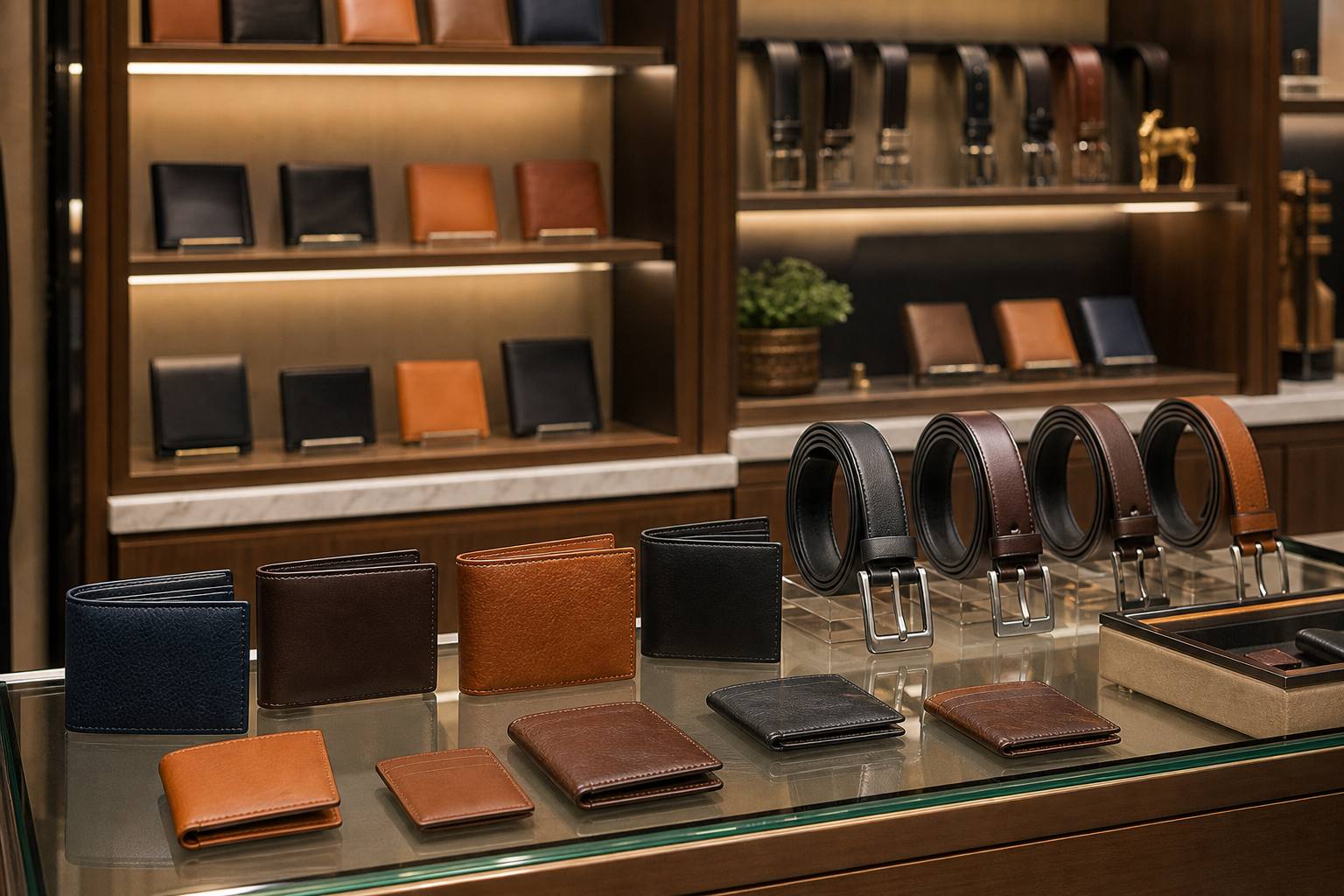
India's export wallet range spans men's bifolds, trifolds, card holders and slim wallets, RFID-blocking wallets, passport and travel wallets, women's zip-around styles, and coin pouches or money clips. Belt exports span formal dress belts, casual and jeans belts, reversible belts, and fashion statement-buckle styles, plus corporate gift wallet–belt sets. Leather types range from full-grain and corrected-grain through nubuck and suede, with chrome-tanned leather remaining the industry default and chrome-free leather gaining preference among EU buyers with sustainability sourcing policies.
Wallet & Belt Categories and Typical HS Codes (Indicative)
Swipe →
Data table — swipe horizontally on small screens
| Category | Typical Construction | Common HS | Primary Buyer Type |
|---|---|---|---|
| Men's bifold wallets | Leather outer, card slots, billfold, optional RFID liner | 4202.31 | Wholesale distributors, men's accessory retail |
| Card holders / slim wallets | Minimal pockets, thin profile, often RFID | 4202.31 | Lifestyle retail, e-commerce private label |
| Passport / travel wallets | Passport sleeve, ticket/card pockets, zip coin | 4202.31 | Travel retail, gift programmes |
| Formal dress belts | Leather strap, dress buckle, size-graded holes | 4203.30 | Formalwear retail, corporate gift buyers |
| Casual / jeans belts | Thicker strap, casual buckle, often pull-up leather | 4203.30 | Denim retail, lifestyle chains |
| Reversible belts | Two-face strap, reversible buckle mechanism | 4203.30 | Department stores, gift sets |
| Wallet–belt gift sets | Matched leather colour and grain, retail gift box | Mixed 4202.31 + 4203.30 lines | Corporate gifting, holiday retail |
Manufacturing Overview
Export Tip
The operational sequence below applies whether you are an established leather-goods manufacturer adding an export channel for wallets and belts, a merchant exporter consolidating supply from multiple factories, or a first-time entrepreneur entering SLG. It covers the complete factory-to-packing journey — registration, sourcing, sampling, bulk production, quality control, and packing — as clear steps. Documentation depth scales with destination market, but the underlying sequence is the same.
Step 1: Register Your Business and Obtain an IEC
Before sourcing a single export-grade wallet or belt, complete the registrations that make your business legally eligible to export from India. Register as a sole proprietorship, partnership, LLP, or private limited company, and obtain a Permanent Account Number (PAN) if you do not already have one.
Apply for an Import Export Code (IEC) through the DGFT online portal using your PAN and bank account details. The IEC is a mandatory ten-digit code that appears on every shipping bill and customs record — no legal export shipment can be filed without one, and approval typically takes only a few working days online.
Step 2: GST Registration and CLE Membership
GST registration is required for domestic input procurement (leather, linings, buckles, RFID film, packaging) and for claiming input tax credit or export refunds where applicable. With IEC and GST in hand, complete Council for Leather Exports (CLE) membership and obtain a Registration-cum-Membership Certificate (RCMC). See CLE Registration Benefits for Wallet and Belt Exporters for application process, buyer-facing credibility benefits, and access to CLE-organised buyer-seller meets and fairs.
CLE membership is frequently the first credential international buyers ask to verify before releasing even a trial-order deposit, particularly buyers in Germany, the UK, and the United States accustomed to working through established export councils.
Step 3: Source or Manufacture Export-Grade Wallets and Belts
Export-grade wallet and belt sourcing differs from domestic accessory sourcing in one critical respect: buyers expect colour and grain matching across a production batch, stitch uniformity, accurate pocket layout or strap width, and hardware finish that casual domestic trade does not always demand at the same rigour.
You can manufacture in-house or source through job-work arrangements with manufacturers in Kanpur, Kolkata Bantala, Delhi-NCR, Ambur–Ranipet–Chennai, Agra, or Jaipur while managing quality and export documentation as a merchant exporter. Confirm tannery sourcing — chrome-tanned versus chrome-free, and whether tanneries are Leather Working Group (LWG) certified — matches what your target buyer expects, particularly for EU-bound programmes.
Step 4: Sampling, Hardware Approval, and Buyer Sign-Off
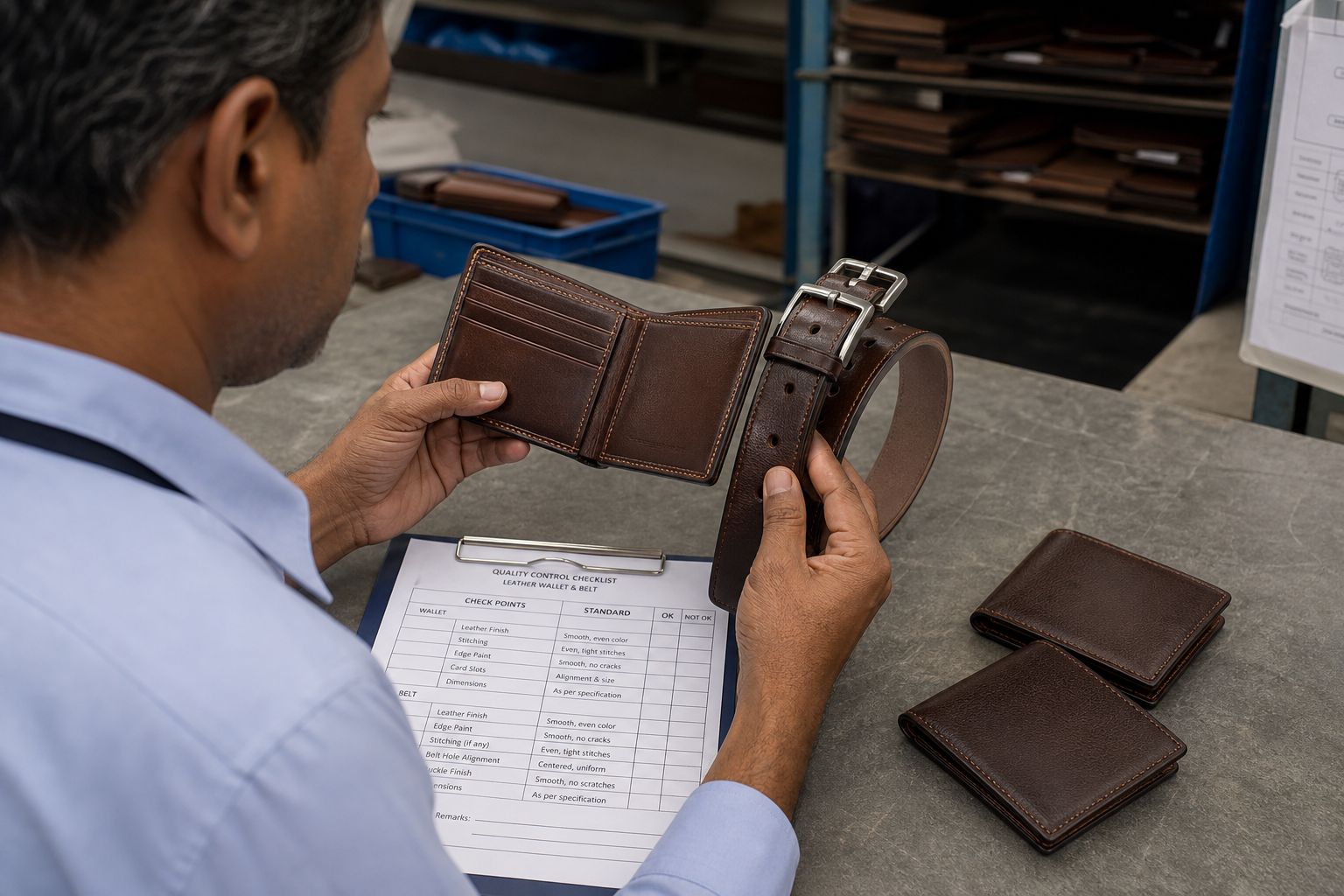
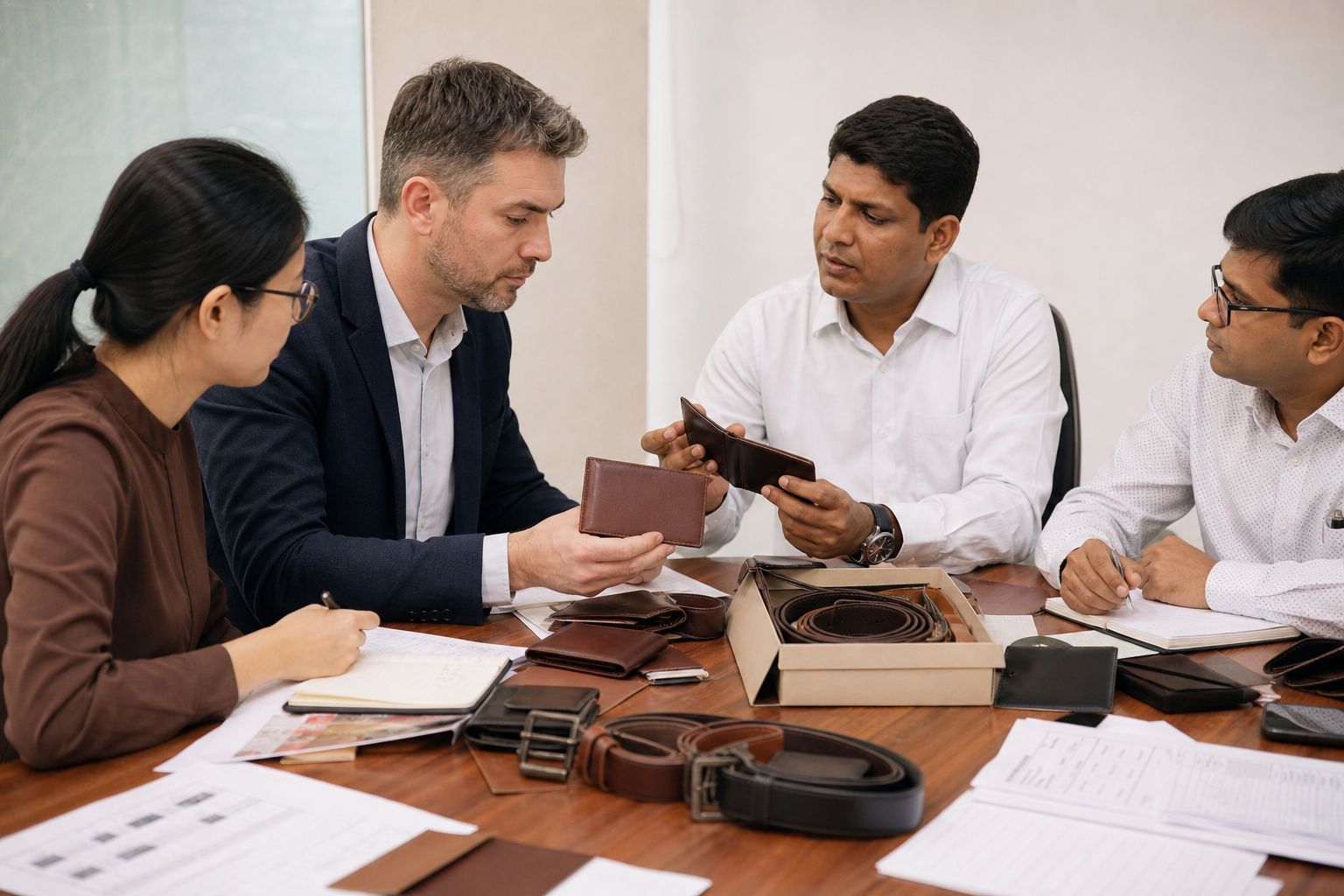
Send physical samples before committing to bulk cutting. For wallets, approval criteria should cover leather grade, stitch pattern, edge paint, lining, RFID liner function (if specified), card-slot count, and dimensions. For belts, cover strap width and thickness, buckle alloy and plating, hole punch spacing, tip finish, and size grading. Typical sample lead time: 7–18 days after locked tech pack.
Never proceed to bulk cutting without a signed sample approval and retained reference samples at both origin and, where practical, destination. A sample that looks perfect in black tells you little about how the same grain and edge paint will run across brown and tan colourways without a colourway check.
Step 5: Bulk Cutting, Production, and Quality Control
Once samples are approved, place bulk production. Track cutting, skiving, stitching, edge finishing, and hardware assembly against the signed specification, with checkpoints at raw material intake, mid-production, and pre-pack. Typical trial lead time: 25–45 days ex-factory after sample sign-off; bulk programmes often run 45–75 days to vessel (hardware/buckle lead time parallel).
Critical orders benefit from in-line or pre-shipment inspection by an independent agency such as SGS, Bureau Veritas, or Intertek — particularly for stitch consistency, RFID function spot-checks, buckle plating adhesion, and colour matching. Agree defect-rate thresholds in writing before production begins, and link QC sign-off to document preparation so paperwork and cargo move in parallel.
Step 6: Packing and Container Preparation
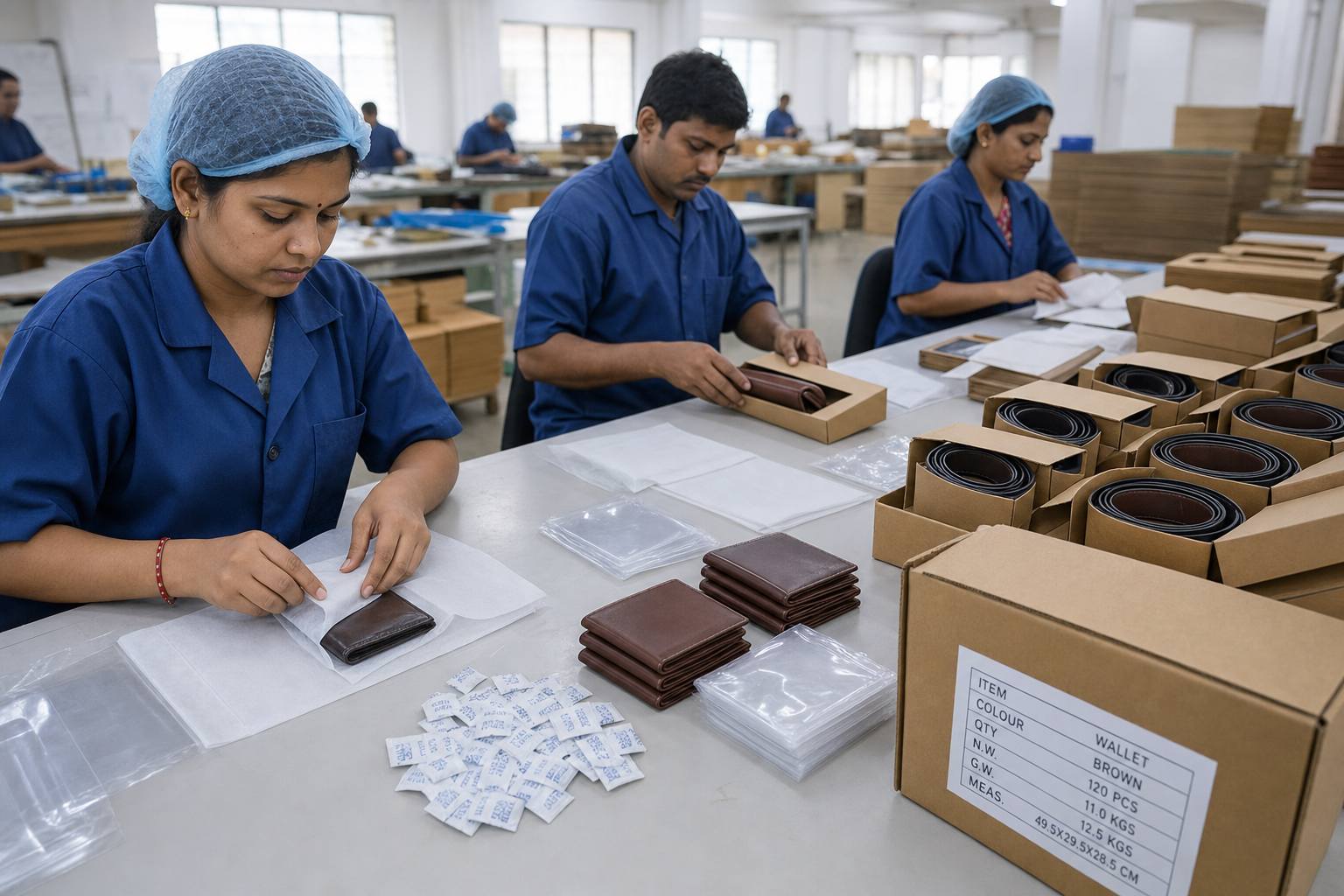
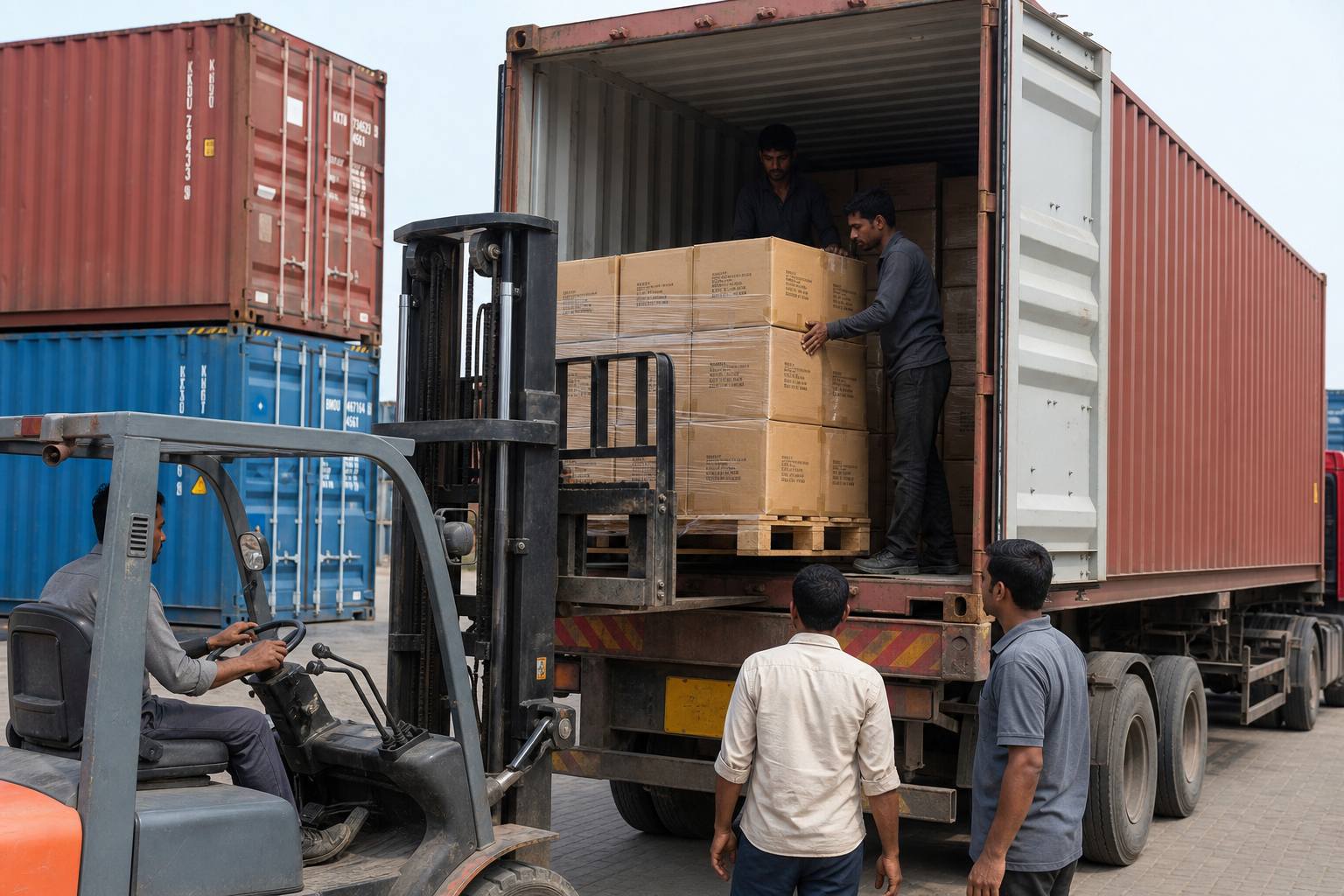
Packaging format should be agreed with your buyer before production, not decided at the factory on loading day. Standard export packing places each wallet in a polybag or gift box with tissue, then consolidates into master cartons by style and colourway. Belts typically ship coiled or flat in individual sleeves or boxes, with buckle protectors to prevent plating scratches, then into master cartons by size run.
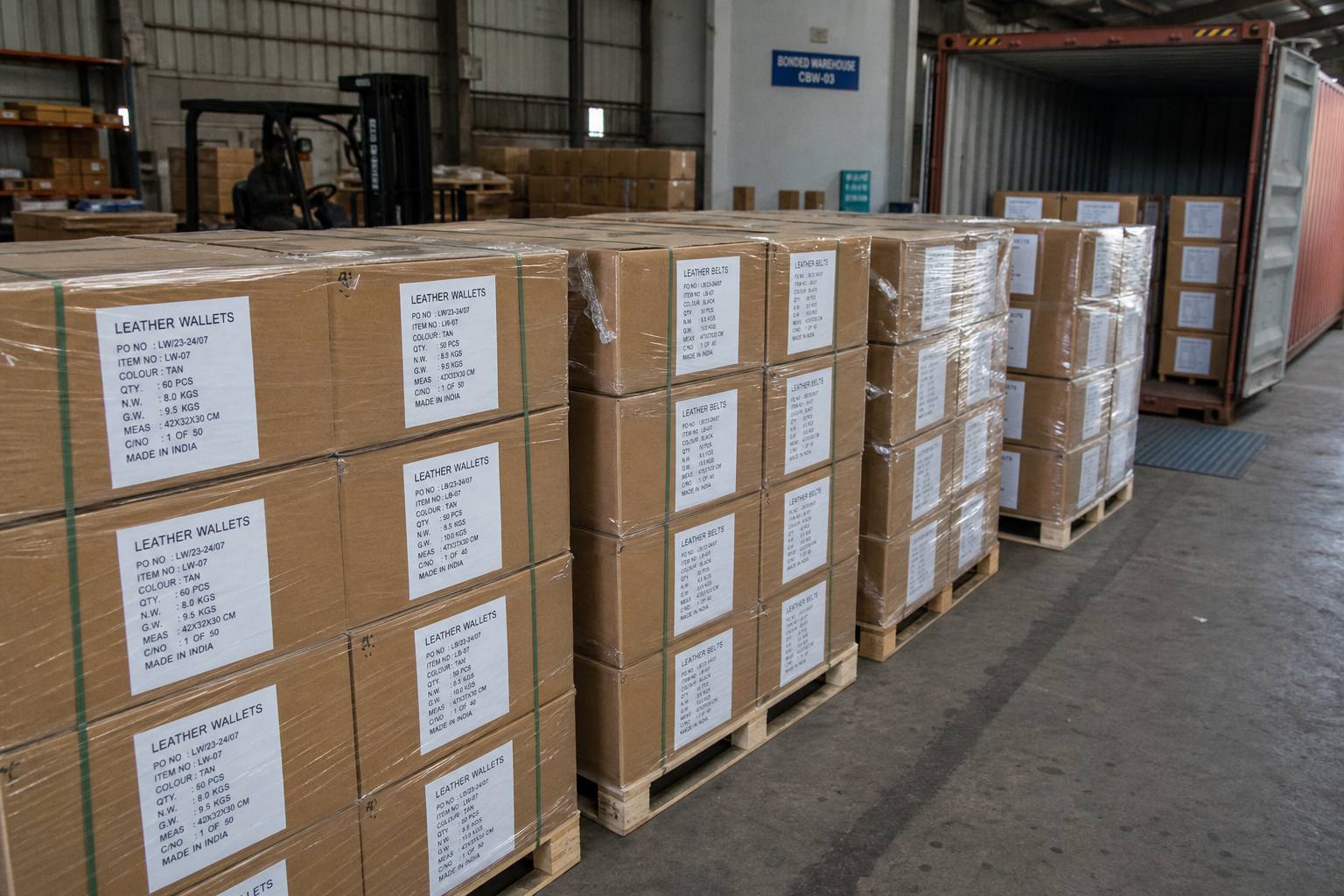
Master cartons should carry clear markings — style number, colour, size breakdown (belts), carton weight, and destination port — matching the packing list exactly. Silica gel sachets help manage moisture on ocean transit. Confirm weight distribution complies with container and destination handling limits before the container is sealed.
Step 7: Export Documentation
Documentation should be prepared in parallel with packing, not after. Every document must agree with every other — quantity, weight, and description mismatches between the invoice, packing list, and bill of lading are a leading cause of customs delays worldwide. Prepare a commercial invoice, packing list, bill of lading (or air waybill for sample air shipments), test reports where required, and export shipping bill filed through ICEGATE. See the Leather Wallet and Belt Export Documentation Checklist for a line-by-line breakdown.
Obtain a certificate of origin from your local chamber of commerce, and prepare any REACH chromium VI test reports or LWG tannery certificates the buyer has requested. Apply for certificates as soon as bulk production is confirmed — issuance rarely happens same-day on request. When a shipment mixes wallets and belts, invoice lines must carry the correct HS codes for each article type.
Step 8: Customs Clearance and Freight Booking
File your export shipping bill through ICEGATE, either directly or through a Customs House Agent (CHA). Book freight through a forwarder aligned with your chosen Incoterm — FOB is standard for most Indian wallet and belt exports, with the buyer arranging main carriage from the load port, though CIF and CFR are common with buyers who prefer a single landed-cost quote.
Step 9: Payment Realisation and Post-Shipment Compliance
After shipment, submit export documents to your bank for payment realisation under the agreed terms. Retain copies of all shipping documents for RBI/FEMA compliance and for duty drawback or export incentive claims where applicable, and reconcile invoice value against actual foreign exchange realised within the required reporting timeline.
Expert Insight: Sample Discipline Before Bulk
Expert Insight Box
A recurring pattern we see with first-time wallet and belt exporters is approving a single black bifold and a single 34-inch dress belt, then releasing bulk across five colourways and a full size run. Buyers in Germany and the UK increasingly ask for mid-production colour and size spot-checks before releasing balance payment — build that discipline into the purchase agreement from day one.
Pricing Analysis
Buyer Tip
Wallet and belt pricing follows leather cost cycles, construction complexity, hardware quality, and destination willingness to pay — the figures below are indicative FOB planning ranges from shared trade anchors, not fixed quotes. Always validate current pricing against recent factory quotations and tannery leather rates before committing to a buyer price.
Indicative FOB Price Ranges by Wallet & Belt Category
Swipe →
Data table — swipe horizontally on small screens
| Category | Indicative FOB Range | Primary Destinations | Key Price Driver |
|---|---|---|---|
| Bifold wallets | US$4–12 / pc FOB | USA, UK, UAE, Germany | Leather grade; RFID liner; edge finish |
| Trifold wallets | US$5–14 / pc FOB | USA, UAE, UK | Pocket count; lining; stitch density |
| Card holders | US$2.50–8 / pc FOB | USA, UK, Japan, Australia | Slim profile; RFID; branding hardware |
| Passport holders | US$6–16 / pc FOB | USA, UK, Germany, UAE | Travel features; zip quality; leather grade |
| RFID wallets | US$6–18 / pc FOB | USA, Germany, UK, Netherlands | Shielding film quality; construction complexity |
| Formal dress belts | US$3.50–12 / pc FOB | USA, Germany, UK, UAE, Saudi Arabia | Buckle alloy/plating; strap consistency |
| Casual / jeans belts | US$3–10 / pc FOB | USA, UK, Australia, Canada | Strap thickness; buckle style; leather finish |
| Reversible belts | US$5–15 / pc FOB | USA, UK, department stores | Reversible buckle mechanism; dual-face leather |
| Premium full-grain gift sets | US$18–45 / set FOB | UAE, USA, UK, corporate gifting | Matched grain; gift packaging; leather grade |
MOQ Analysis
Buyer Tip
Minimum order quantity expectations vary by manufacturer scale and buyer type. New exporters should quote realistic MOQs rather than accepting unrealistically small trial orders that make cutting and hardware setup uneconomical, or unrealistically large first orders that overextend an unproven relationship.
Typical MOQ by Order Stage (Wallets & Belts)
Swipe →
Data table — swipe horizontally on small screens
| Order Stage | Indicative MOQ | Notes |
|---|---|---|
| MSME trial per style | 100–300 pcs / style (wallets); 150–400 pcs / style (belts) | MOQ scales with colourway count and hardware SKUs |
| Standard programme per style | 300–1,000 pcs / style | Often requires forward leather booking for colour match |
| Retail chain per style / colourway | 1,000–5,000+ pcs / style / colourway | Volume forecasts and seasonal calendars agreed in advance |
| Gift set assortment | 200–800 sets / assortment | Matched wallet–belt sets; packaging lead time parallel |
Packaging Standards
Export Tip
Packaging protects wallets and belts from crush, moisture, scuffing, and buckle plating damage during transit, and must match the buyer's downstream use — a retail chain expects retail-ready gift boxes and barcodes, while a wholesale distributor may accept simpler export cartons. Agree packaging before production, not at stuffing.
Standard Export Packaging Formats for Wallets & Belts
Swipe →
Data table — swipe horizontally on small screens
| Packaging Format | Typical Contents | Common Use Case | Key Requirement |
|---|---|---|---|
| Polybag + tissue (wallets) | 1 wallet, tissue, optional hangtag | Wholesale and e-commerce private label | Consistent bag grade; no ink transfer to leather |
| Retail gift box (wallets / sets) | 1 wallet or set, foam/tissue, brand insert | Department stores, corporate gifting | Barcode and artwork locked before bulk print |
| Belt sleeve / coil pack | 1 belt, buckle protector, size label | All belt programmes | Prevent plating scratches and strap crease marks |
| Silica gel sachets | Moisture absorber per carton or box | All ocean-freight programmes | Reduces mould and finish damage in transit humidity |
| Master carton (style consolidated) | Multiple units by style/colour/size | All export programmes | Markings must match packing list exactly |
Container Loading Details
Export Tip
Belt cartons with buckles weigh more per cube; wallet SLG nests denser. Always stuff from actual carton dims. Plan on indicative ranges rather than a theoretical weight-max fill — wallet cartons nest denser than belt cartons with metal buckles. Confirm against actual carton dimensions before quoting freight cost per piece.
Indicative Container Loading Benchmarks (Wallets & Belts)
Swipe →
Data table — swipe horizontally on small screens
| Container Type | Approx. Load | Notes |
|---|---|---|
| 20-foot FCL | 8,000–18,000 wallets or 6,000–14,000 belts (carton-dependent) | Standard for smaller trial and mid-size programmes |
| 40-foot High Cube (HC) | 18,000–40,000 wallets or 14,000–32,000 belts (carton-dependent) | Preferred for established retail chain programmes |
| LCL consolidation | Palletised master cartons (mixed styles) | Common for trial orders and multi-style sample consolidation |
| Air freight (samples / urgent) | Carton or small pallet lots | Used for sample approval and urgent replenishment |
Shipping Methods
Export Tip
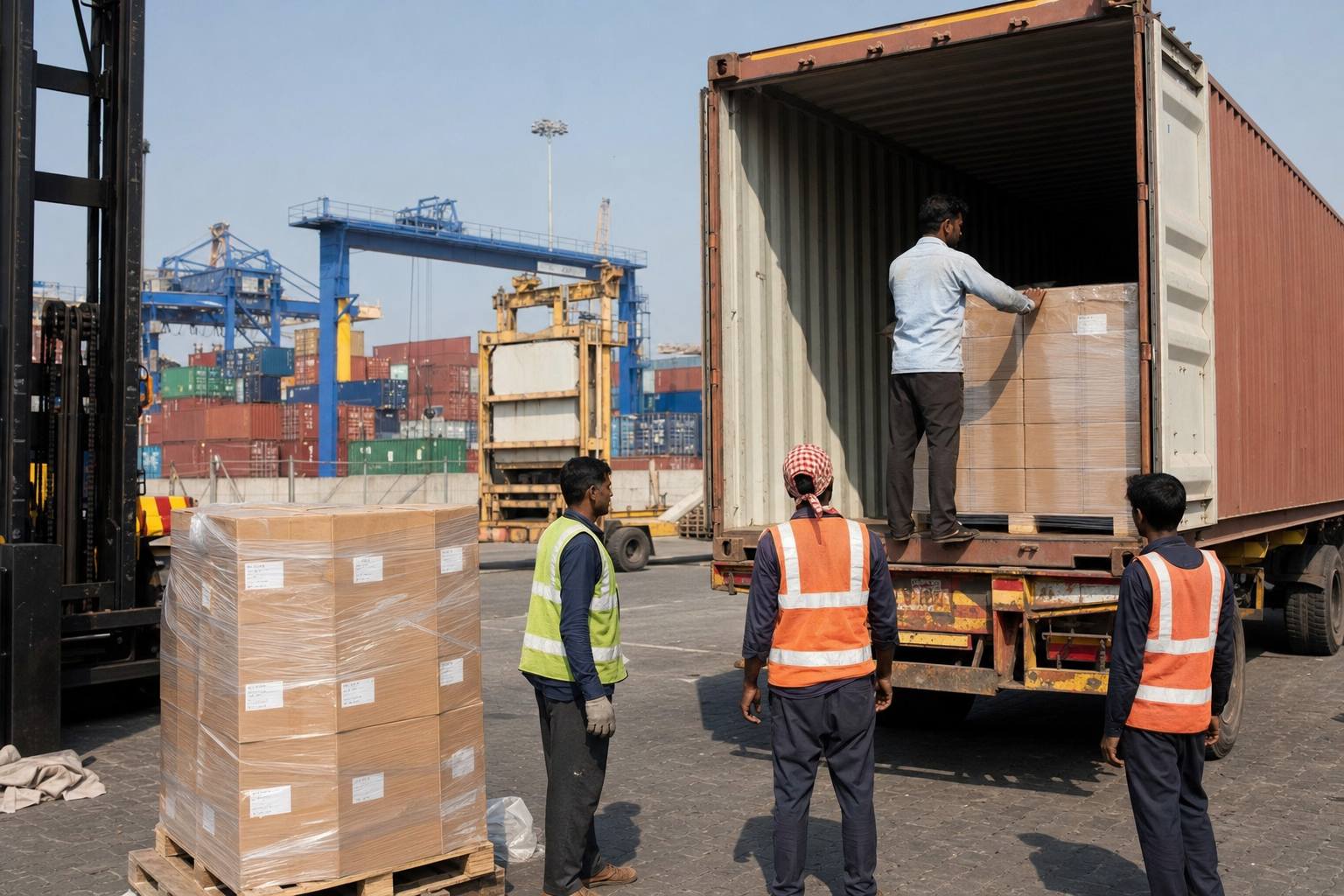
Sea freight is the dominant shipping method for wallet and belt export from India, chosen for cost efficiency on the piece counts that retail and wholesale programmes require. Full container load (FCL, typically 40ft HC) is standard for established buyers; less-than-container-load (LCL) consolidation suits smaller trial orders. Air freight is used selectively — most often for sample shipments, urgent replenishment, or small trial lots where speed outweighs per-piece freight cost.
FOB is the Incoterm used on the large majority of Indian wallet and belt shipments. CIF and CFR are used by buyers who prefer a single landed-cost quote; EXW appears when the buyer's forwarder manages logistics from factory gate. Mundra and Nhava Sheva serve northern and western clusters most directly; Chennai and Tuticorin serve the Ambur–Ranipet–Chennai belt; Kolkata serves eastern Bantala-origin cargo.
Sample lead times typically run 7–18 days after locked tech pack. Trial orders often land 25–45 days ex-factory after sample sign-off. Bulk programmes commonly require 45–75 days to vessel (hardware/buckle lead time parallel) — buyers should build this into launch calendars rather than assuming retail-shelf-ready delivery within weeks of a first inquiry.
Certifications
Compliance Notes
Beyond mandatory IEC, GST, and CLE registration, additional certifications unlock specific market segments and buyer trust. Compliance requirements are typically driven by destination market rules rather than Indian regulation alone, so exporters should confirm requirements against the buyer's stated market before production begins.
Certifications and Compliance Relevant to Wallet & Belt Export
Swipe →
Data table — swipe horizontally on small screens
| Certification / Standard | Mandatory or Optional | Relevance |
|---|---|---|
| CLE membership and RCMC | Effectively mandatory for credible export | Legal and reputational prerequisite for leather goods export from India |
| REACH chromium VI compliance (EU/UK) | Mandatory for EU and UK-bound shipments | Cr(VI) must remain ≤3 mg/kg in leather components of wallets and belts |
| Leather Working Group (LWG) tannery certification | Optional (increasingly expected by EU/US brands) | Confirms tannery environmental and traceability standards for premium programmes |
| Chrome-free / metal-free leather certification | Optional | Relevant for EU buyers with sustainability sourcing policies |
| RFID performance spot-check reports | Optional but common on RFID wallet programmes | Confirms shielding film function on sampled units |
| Third-party pre-shipment inspection | Optional but common on critical orders | Independent verification of construction, colour match, and packing |
Sequencing Certifications for a First Shipment
Complete mandatory registrations first, ship successfully to a mid-tier or commodity accessory market, then add LWG tannery sourcing or chrome-free certification once a specific buyer justifies the additional cost and audit burden. Chasing every certification before a first wallet or belt shipment delays market entry without adding buyer value on that first order.
Buyer Requirements
Buyer Requirements
- Valid IEC and current CLE RCMC, verifiable on request through leatherindia.org
- Signed samples covering leather grade, stitch, edge paint, RFID (if any), and belt buckle finish
- Clear leather grade and tannery sourcing documentation, with chromium VI test reports available for EU/UK
- Defined packaging options matching wholesale, retail-ready, or private-label use
- Realistic MOQ and lead-time commitments aligned to actual cutting and hardware capacity
International buyers evaluating a new Indian leather wallet or belt exporter typically look for verifiable registration, colour-consistent samples, clear packaging specifications, and a documented sample-to-bulk sign-off process. First-time exporters should be ready to answer these questions before outreach, not after a buyer asks.
Country-wise Opportunities
Market Snapshot
This process guide covers only a brief country overview — for detailed market-by-market entry strategy, see Best Countries for Indian Leather Wallet and Belt Exports and Most Demanded Indian Leather Wallets and Belts by Country.
United States
A leading destination for bifolds, RFID wallets, and casual belts through wholesale distribution and growing e-commerce private-label channels; consistent colour matching and barcode-ready packing matter as much as unit price.
Germany
Compliance-heavy but premium-rewarding for full-grain bifolds, RFID travel wallets, and formal dress belts; REACH Cr(VI) documentation and LWG tannery sourcing are checked closely before outreach succeeds.
United Kingdom
Retail chains and wholesale distributors sustain steady demand across bifolds, card holders, and formal belts; repeat-order consistency matters more than headline FOB.
United Arab Emirates
A re-export hub for the wider Gulf and a strong direct market for gift sets, formal belts, and bifolds; relationships with established regional distributors accelerate entry.
France
Fashion retail and department store demand for slim wallets and fashion belts rewards finish quality and colour-matching precision over commodity pricing.
Sourcing Checklist
Checklist
Common Buyer Mistakes
Common Mistakes Box
First-time buyers and first-time exporters make predictable mistakes that a structured wallet and belt process is designed to prevent.
Future Market Trends
Key Statistics
Three trends are shaping the operational side of Indian leather wallet and belt export: growing buyer demand for RFID and slim card-holder formats alongside classic bifolds; increased preference for LWG-certified and chrome-free leather on EU and premium US programmes; and steady growth in corporate gift sets and e-commerce private-label demand that rewards fast sample turnaround and colour-consistent bulk more than commodity pricing alone.
Exporters who invest early in documentation discipline, hardware QC, and sample-to-bulk colour matching will be positioned to serve both stable commodity bifold and dress-belt markets and the growing RFID, reversible, and gift-set segments — rather than being confined to whichever programme happens to be easiest to enter first. For sustainability-oriented programmes, see Sustainable Premium Leather Wallet and Belt Export Opportunities.
Buyer Checklist
Checklist
Exporter Checklist
Checklist
Compliance Checklist
Checklist
Compliance Notes
Expert Insight: Documentation as a Trust Asset
Expert Insight Box
Wallet and belt export succeeds or fails on discipline applied long before a container reaches Mundra or Nhava Sheva — leather grading at intake, honest sample approval against a signed reference, and documentation drafted alongside production rather than assembled under sailing-week pressure. Exporters who move fastest into repeat business are rarely those with the lowest FOB quote; they are the ones whose second shipment matches their first exactly, piece after piece.
Conclusion
- Product depth: Top Leather Wallet and Belt Products Exported from India.
- Markets: Best Countries for Indian Leather Wallet and Belt Exports · Most Demanded by Country.
- Buying: Source Leather Wallets and Belts from India · Find International Buyers.
- Compliance & CLE: CLE Registration Benefits · Documentation Checklist.
- Growth angles: Sustainable Premium Opportunities · Trade Shows & B2B Marketplaces.
Exporting leather wallets and belts from India follows a defined, learnable sequence: register your business and obtain an IEC, secure GST registration and CLE membership, source or manufacture export-grade SLG and belts, complete sample and hardware approval, cut and produce to specification, pack to standard, prepare documentation in parallel with production (with correct HS codes for wallets and belts), clear customs, book freight, and manage post-shipment compliance. Each step reduces risk for the next.
Altus Exports supports Indian wallet and belt exporters and international buyers as a merchant exporter in India and global sourcing partner, coordinating supplier verification, documentation, and shipment under one accountable relationship. Explore export products from India and product sourcing company services, or connect through find manufacturers in India. Visit https://altusexports.com/ to start a sourcing conversation.