
How to Find International Buyers for Fox Nuts (Makhana)
By Saurabh Mittal, Founder, Altus Exports
A practical playbook for Indian fox nut (makhana) processors and merchant exporters on how to find international buyers: inbound leads from a conversion-ready website and consistent LinkedIn/Instagram/Facebook/YouTube activity, plus outbound email outreach, website-form introductions, sample email templates, and named prospect companies across the USA, Canada, UK, UAE, and Australia.
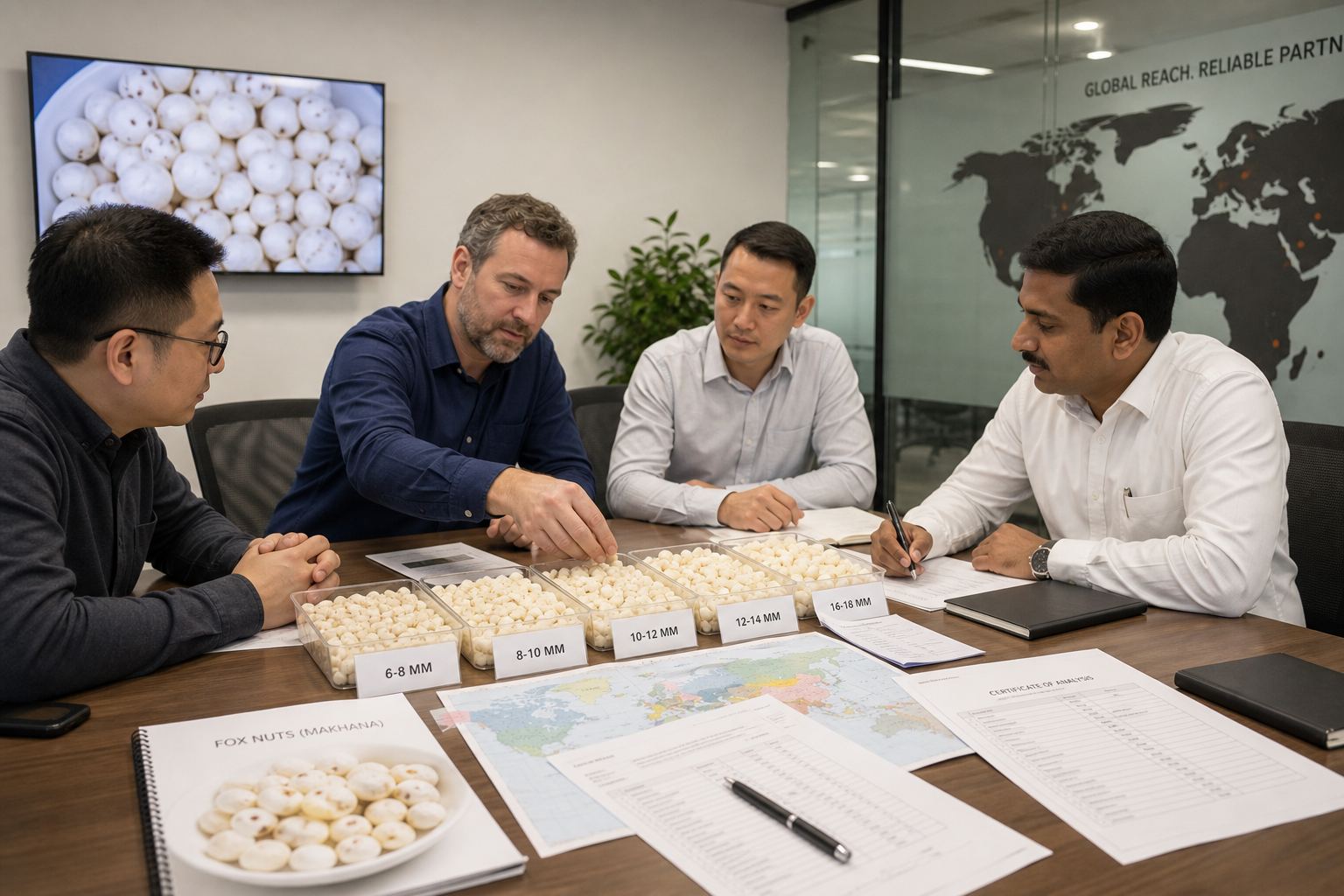
Fox nuts — makhana, the popped seed of the aquatic plant Euryale ferox — have moved from a regional Bihar snack and religious-fasting food into a global better-for-you snacking category almost entirely on the strength of Indian supply. India dominates global fox nut supply, with Bihar alone accounting for roughly 80–85% of world output and about 90% of India's production (APEDA directional), concentrated in the Mithila belt of Bihar (Darbhanga, Madhubani, Purnea, Katihar, Saharsa, and Supaul districts), which now carries a Geographical Indication (GI) tag recognising Mithila Makhana as a distinct, traceable origin product. Global demand has followed the same trajectory as quinoa, chia, and other "ancient superfood" categories a decade earlier — but demand on Google Trends and retail shelf listings does not automatically translate into a purchase order in a processor's inbox.
Most Bihar-based processors, cooperatives, FPOs (Farmer Producer Organisations), and merchant exporters who want to sell makhana internationally struggle with exactly one problem: finding genuine, verifiable buyers who will actually place and pay for orders, rather than price-shopping brokers, sample-collecting "importers," or unqualified directory contacts. This guide is a lead-generation playbook organised around two complementary engines — inbound leads (website, social media) and outbound leads (email, website forms, named prospect lists) — plus HS 20081921/22/29 trade data, LinkedIn prospecting, buyer verification, and a repeatable outreach-to-order process for fox nut (makhana) export from India.
This is deliberately not a product catalogue or a grading and processing manual — for that depth, see our companion guides on how to export fox nuts (makhana) from India, top fox nut (makhana) products exported from India, and most demanded Indian fox nuts (makhana) by country. For the premium and certified-organic layer of the market, see organic & premium fox nut (makhana) export opportunities. Altus Exports works as a merchant exporter and global sourcing partner connecting Bihar-region makhana processors with verified international buyers — this guide reflects the buyer-discovery process we run for those clients.
Key Takeaways
Summary Box
Executive Summary
Summary Box
Finding international buyers for Indian fox nuts is fundamentally a prospecting and verification problem, not a production problem. Bihar's makhana processing capacity has expanded substantially over the past decade — mechanised popping units, size-grading lines, and roasting/flavouring facilities now exist well beyond the traditional cottage-scale operation — yet most processors still rely on inbound inquiries from generic B2B listings, which produce a high volume of unqualified contacts and a low rate of real orders.
This guide sets out a repeatable system: define your product range and buyer profile, mine HS 2008.19 trade data for named importer companies by destination country, prospect distributors and snack brands on LinkedIn, use APEDA-linked food fairs and buyer-seller meets for high-intent meetings, verify every lead before committing lab-tested samples, and run a disciplined follow-up cadence that converts inquiries into trial containers and trial containers into repeat programmes.
It does not repeat the processing, grading, or documentation detail covered in our export-process and documentation guides — see how to export fox nuts (makhana) from India and fox nut (makhana) export documentation checklist for that layer.
Market Size & Industry Overview
Key Statistics
Global demand for makhana has grown from a niche South Asian and religious-fasting food into a recognised "better-for-you" snack ingredient — low-fat, gluten-free, plant-protein-bearing, and positioned alongside popcorn and puffed-grain snacks in natural and specialty grocery aisles across North America, Western Europe, and the Gulf. India dominates global fox nut supply, with Bihar's Mithila belt (Darbhanga, Madhubani, Purnea, Katihar, Saharsa, Supaul) accounting for roughly 80–85% of world output and about 90% of India's production (APEDA directional), supplemented by smaller cultivation pockets in eastern Uttar Pradesh, West Bengal, Assam, Manipur, and Jammu & Kashmir's Wular Lake area.
The 2022 Geographical Indication (GI) tag for Mithila Makhana formalised what buyers already understood informally: origin and provenance matter in this category, and Bihar-grown, Bihar-processed makhana carries a traceability and quality signal that buyers increasingly ask about by name. This is a meaningful discovery lever — buyers researching "Mithila makhana" or "GI makhana" specifically are further along the buying journey than generic "fox nuts supplier India" searchers.
Structurally, the buyer landscape splits into four groups that behave very differently in prospecting and negotiation: bulk ingredient buyers and food manufacturers who use makhana as an input (trail mixes, granola, protein bars); snack brands who private-label roasted and flavoured makhana as a finished retail SKU; wholesale distributors and importers who redistribute bulk or repacked product to smaller retailers and food-service; and retail-chain procurement teams sourcing directly for house-brand programmes. Each requires a different message, grade, and pack format — a single generic pitch converts poorly across all four.
Global Fox Nut (Makhana) Buyer Landscape by Segment
Swipe →
Data table — swipe horizontally on small screens
| Buyer Segment | Typical Volume | Primary Grade Interest | Key Decision Factor |
|---|---|---|---|
| Bulk ingredient buyers / food manufacturers | 5–20 MT/quarter | Broken/small grade, raw or lightly roasted | Consistent input cost, functional specification |
| Snack brands (private label) | 1–10 MT/quarter (scaling) | 12–18mm roasted/flavoured retail grade | Flavour consistency, packaging compliance, MOQ flexibility |
| Wholesale distributors / importers | 5–30 MT/quarter | Mixed grades, bulk bags for repacking | Landed price, reliability, repeat lead time |
| Retail-chain procurement (house brand) | 10–50+ MT/annum | 16mm+ premium roasted grade | Compliance documentation, audit access, price stability |
| Nepal cross-border trade / re-export | High volume, price sensitive | All grades including commercial/broken | Landed cost, proximity logistics, credit terms |
Export Statistics
Key Statistics
India's fox nut export volumes have grown steadily over the past several years as processing capacity in Bihar has modernised and international better-for-you snacking demand has expanded. Per APEDA's MIC Makhana dashboard, exports grew directionally from roughly 6,700 MT in 2020 to roughly 25,130 MT in 2024 (~39% CAGR), with Jan–Oct 2025 volumes around 18,150 MT — tracking slightly below the 2024 full-year pace amid US tariff and price pressure. Export statistics for makhana are captured under HS codes 20081921 (foxnuts/makhana), 20081922, and 20081929, effective from July 2025, within Chapter 20 (preparations of vegetables, fruit, nuts, or other parts of plants) of India's customs classification — these are the exact codes to search when pulling DGCI&S or ITC Trade Map export data for the category.
Export value growth has outpaced volume growth in recent seasons as a larger share of exported makhana shifts from raw/semi-processed lots toward roasted, flavoured, and retail-ready formats that command materially higher per-kilogram pricing than commodity raw grade. This is the same value-migration pattern seen in cashews and other tree-nut categories a decade earlier, and it is a direct signal to processors: buyers who want flavoured retail SKUs, not raw commodity, are where the fastest-growing export value concentrates.
Bihar-origin supply dominates export volumes, though consignments are frequently containerised and shipped from Kolkata given Bihar's landlocked geography and Kolkata's rail/road proximity — a logistics reality that shapes which international buyers get fastest transit times and should inform your market-priority sequencing.
India Fox Nut (Makhana) Export Profile — Indicative Structure
Swipe →
Data table — swipe horizontally on small screens
| Metric | Indicative Position | Trend (2023–2026) | Notes |
|---|---|---|---|
| Global market share (volume) | Bihar ~80–85% of world output; ~90% of India's production (APEDA directional) | Stable to growing | India remains structurally dominant supplier |
| Export volume, 2020 → 2024 | ~6,700 MT → ~25,130 MT (~39% CAGR, APEDA directional) | Growing | Jan–Oct 2025 ~18,150 MT, slightly below 2024 pace |
| Primary export form | Roasted/flavoured retail + raw bulk | Shifting toward retail-ready | Retail-ready commands higher FOB value |
| Top export value driver | Snack-brand and retail private-label programmes | Growing fastest | Outpaces bulk ingredient segment growth |
| Primary export gateway | Kolkata (rail/road from Bihar) | Consistent | Air freight used for samples and premium retail lots |
| HS classification | 20081921 / 20081922 / 20081929 | Stable | Use for DGCI&S and ITC Trade Map data pulls |
Import Statistics
Key Statistics
On the import side, the United States leads global demand growth for makhana as a snack and better-for-you ingredient, driven by natural-grocery retail expansion and direct-to-consumer snack-brand launches. Germany and the wider EU follow, with demand concentrated in organic and clean-label retail channels and growing interest from plant-based protein formulators. The UK shows similar clean-label retail dynamics with a somewhat smaller but fast-growing specialty-snack segment.
Canada and Australia track USA and UK patterns respectively — natural grocery, health-food retail, and a growing base of ethnic-grocery distribution that predates the mainstream snacking trend and continues to grow alongside it. The UAE combines two demand pools: a South Asian expatriate population with long-standing makhana familiarity, and a premium gifting/health-food retail segment adopting it as a wellness snack.
Nepal is structurally different from the other six markets: proximity to Bihar, shared culinary use, and lower per-unit price sensitivity make it a high-volume, lower-margin market often served through overland trade rather than containerised ocean freight — worth including in a buyer portfolio for volume stability even though it will rarely deliver premium retail pricing.
Key Import Markets for Indian Fox Nuts (Makhana)
Swipe →
Data table — swipe horizontally on small screens
| Country | Demand Driver | Typical Buyer Type | Growth Signal |
|---|---|---|---|
| USA | Better-for-you snacking, natural grocery, DTC brands | Snack brands, distributors, ingredient buyers | Fastest-growing retail category demand |
| Germany / EU | Clean-label, organic retail, plant-protein formulators | Organic distributors, snack brands | Strong organic-certified pull |
| UK | Specialty and health-food retail | Snack brands, wholesale distributors | Growing specialty-snack listings |
| Canada | Natural grocery, ethnic-grocery distribution | Distributors, snack brands | Steady growth alongside USA trend |
| Australia | Health-food retail, wellness snacking | Distributors, retail-chain buyers | Growing wellness-snack shelf space |
| UAE | South Asian expat demand + premium wellness retail | Distributors, gifting/retail buyers | Dual-channel steady demand |
| Nepal | Proximity trade, culinary/religious use | Cross-border traders, wholesalers | High volume, price-led, stable |
Product Categories & Variants Buyers Ask For
Summary Box
Buyer outreach converts poorly when it is generic — "we export makhana" tells a buyer nothing they can act on. Effective prospecting starts with knowing which of your product variants matches which buyer type, so your first message can reference a specific grade, format, and use case.
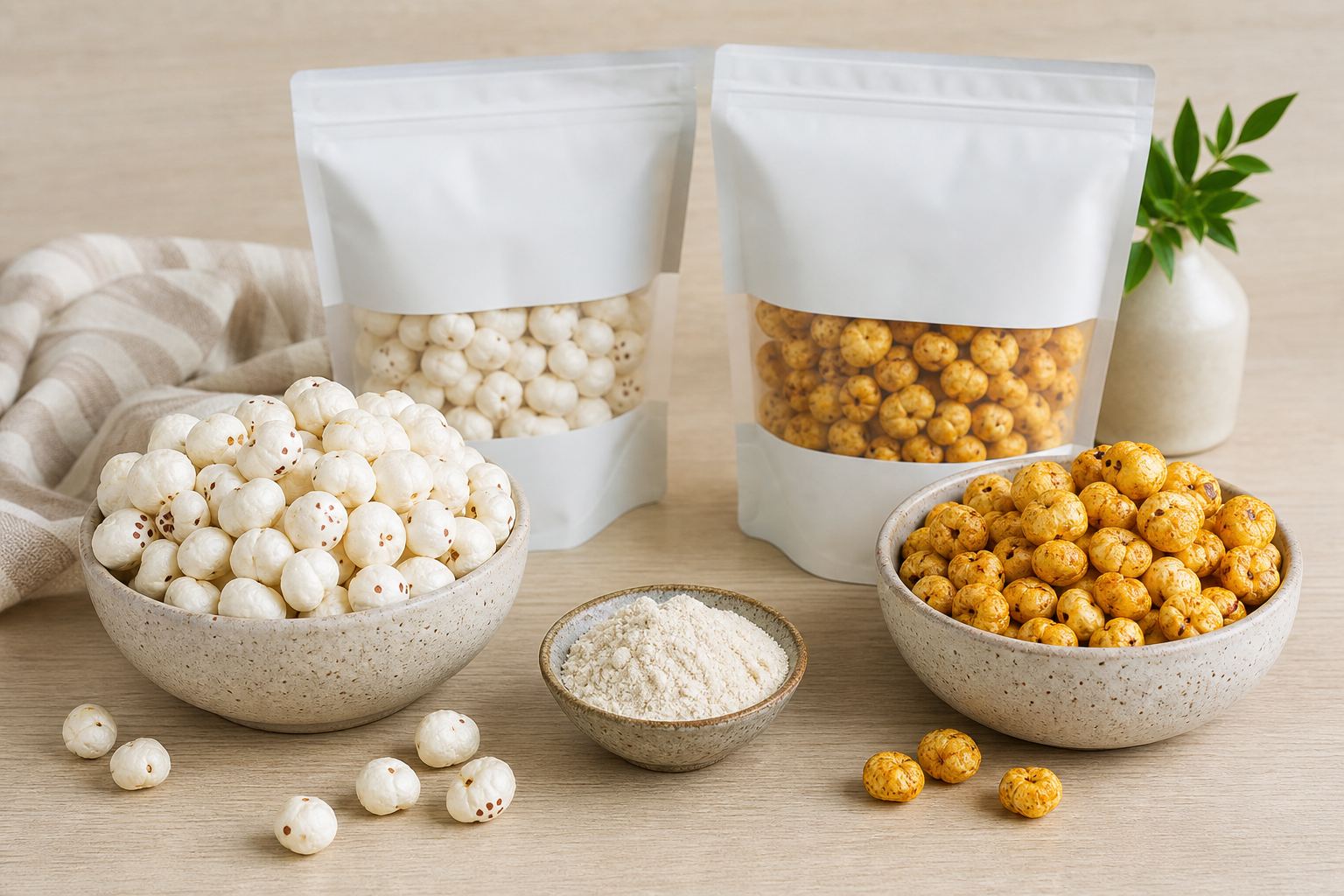
Fox nuts are traded across a small number of well-understood variant categories: raw/unroasted popped seed for further processing; roasted plain for direct retail or repacking; roasted and flavoured (salted, peri-peri, cheese, chocolate-coated, and other retail flavour lines) for branded snack SKUs; makhana flour and broken/commercial grade for bakery, batter, and ingredient use; and size-graded whole makhana (commonly bracketed under 12mm, 12–14mm, 14–16mm, 16–18mm, and 18mm+/"jumbo") where larger, more intact seeds command premium retail pricing. For full specification and pricing depth by variant, see top fox nut (makhana) products exported from India — this section maps variant to buyer type for prospecting purposes only.
Makhana Variant-to-Buyer Mapping for Outreach Targeting
Swipe →
Data table — swipe horizontally on small screens
| Variant | HS Reference | Primary Buyer Type | Outreach Angle |
|---|---|---|---|
| Raw/unroasted popped grade | 20081929 (typical) | Ingredient buyers, further processors | Consistent input spec, moisture/broken % data |
| Roasted plain (unflavoured) | 20081921 | Distributors, health-food retail | Clean-label positioning, shelf-stable packaging |
| Roasted & flavoured retail SKU | 20081922 (typical, format-dependent) | Snack brands, private-label programmes | Flavour range, MOQ flexibility, packaging artwork support |
| Makhana flour / broken grade | 20081929 (typical) | Bakery, batter, ingredient manufacturers | Functional specification, bulk pricing consistency |
| 18mm+ jumbo/premium whole grade | 20081921 | Retail-chain house brands, gifting | Size consistency, premium visual grade, GI origin story |
Manufacturing Overview: What Buyers Check Before They Reply
Export Tip
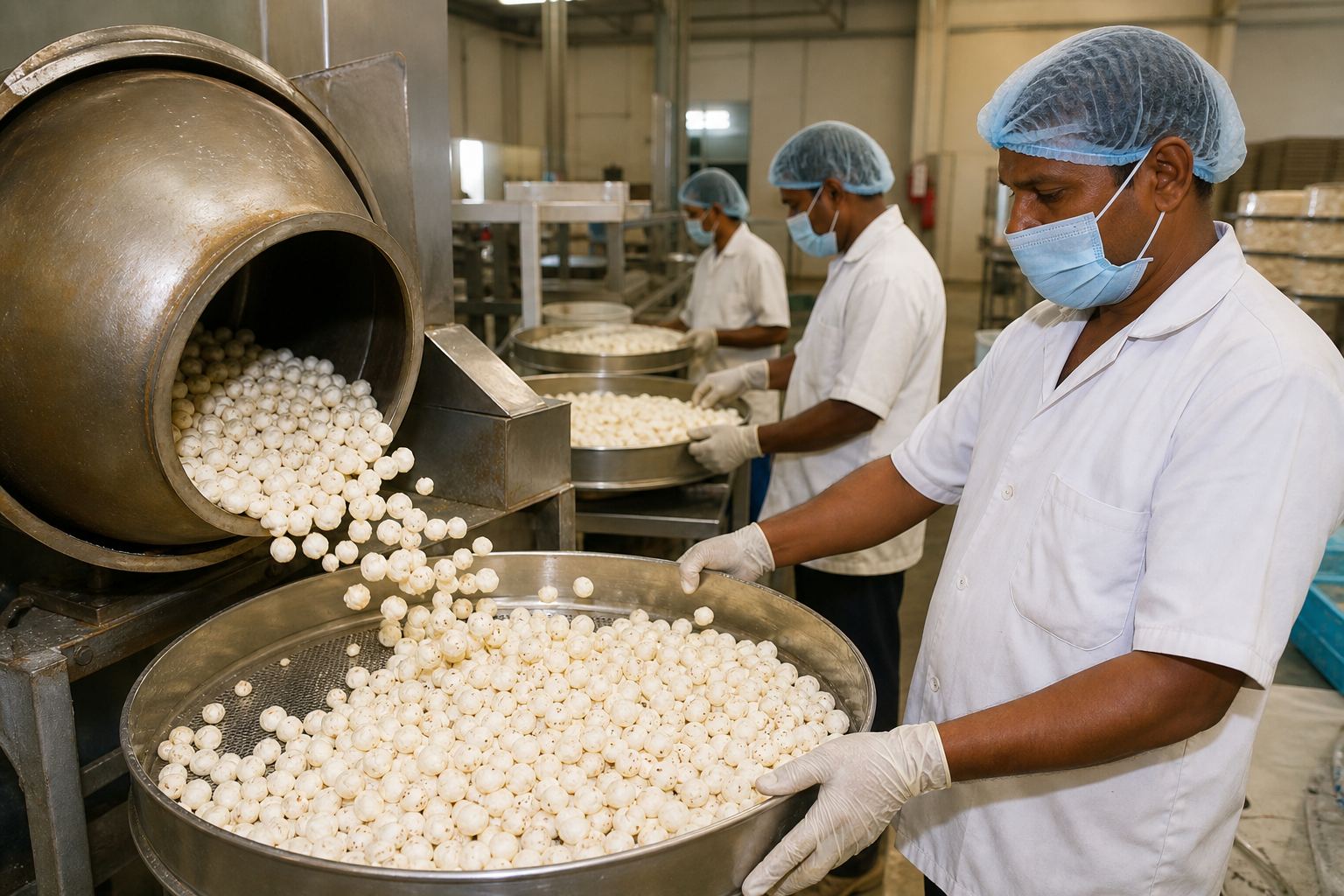
You do not need to explain your full processing line in a first outreach message, but buyers who research your company before replying will look for evidence of a modern, food-safe operation — and its absence is one of the fastest ways a promising inquiry goes cold. Makhana processing runs from pond harvest of the Euryale ferox seed through sun-drying, controlled-heat roasting/popping (traditionally in earthen pots over sand, increasingly in mechanised rotary roasters), decortication to separate the popped white kernel, and size-grading by millimetre bracket before packing.
Buyers evaluating a new supplier commonly ask, directly or through their sourcing checklist, whether roasting and grading happen in a facility with basic food-safety infrastructure (covered, pest-controlled, metal-detection or sieving for foreign matter) rather than an open cottage setup — not because cottage-scale production is inferior in taste or quality, but because international retail and snack-brand buyers need documentable process control to satisfy their own compliance teams.
Size Grade Reference Buyers Use When Qualifying Suppliers
Swipe →
Data table — swipe horizontally on small screens
| Grade Bracket | Common Trade Name | Typical Use Case | Relative FOB Position |
|---|---|---|---|
| Below 12mm / broken | Commercial / broken grade | Flour, batter, bulk ingredient | Lowest |
| 12–14mm | Small/medium retail grade | Value retail packs, bulk repacking | Entry-mid |
| 14–16mm | Standard retail grade | Mainstream retail SKUs | Mid |
| 16–18mm | Large/premium grade | Premium retail, gifting | Mid-high |
| 18mm and above | Jumbo / super / king size | Premium retail-chain house brands, gifting | Highest |
Export Process: An 8-Step System to Find and Convert Makhana Buyers
Export Tip
Treat buyer discovery as a repeatable quarterly process, not a one-time push. This sequence converts random outreach into a pipeline that compounds season over season.
Step 1: Pick a primary and backup export market
Choose one lead market and one backup based on your grade mix and certification status — USA or Germany for retail-ready and organic-leaning buyers, UAE for South Asian-community and gifting demand, Nepal for volume stability. Do not spread first-quarter effort across all seven markets simultaneously.
Step 2: Lock 3–5 sellable variants with real specifications
Commit to variants you can reproduce consistently: size grade in mm, moisture %, broken %, roast profile, and flavour lines if applicable. Vague "we can supply any grade" listings get ignored by buyers who need to compare suppliers on paper.
Step 3: Write a one-page buyer profile
Define target country, channel type (distributor/snack brand/retail/ingredient buyer), volume band, certification requirement, and likely decision-maker title (category buyer, procurement manager, import operations manager, R&D/formulation lead for private-label snack brands).
Step 4: Mine HS 20081921/22/29 trade data for named importers
Pull shipment-level import records under HS 2008.19 sub-headings for your target country from ITC Trade Map or a commercial customs-data provider. This surfaces the actual companies already importing makhana or closely adjacent snack-nut products — a fundamentally warmer list than any general trading directory.
Step 5: Verify before you commit a sample
Run each lead through the verification checklist in this guide before dispatching lab-tested product. Confirm business registration, a coherent food/snack website, and — where available — HS 2008.19 or related snack-import history.
Step 6: Prospect distributors and snack brands on LinkedIn
Search titles such as "Category Buyer – Snacks," "Procurement Manager – Natural Foods," "Founder/R&D – [snack brand]," and "Import Operations Manager." Send short, grade-specific connection notes referencing your GI-origin Mithila supply and one concrete spec — not a generic "we are exporters of makhana" line.
Step 7: Follow up with new value, not just reminders
Plan 4–6 touches over three to four weeks. Use harvest-season updates, a new lab report, a fair meeting invitation, or a flavour-line sample offer as the reason for each follow-up rather than a plain "checking in" message.
Step 8: Convert with a fast, specific quotation
Reply within 24 hours with grade, moisture/broken %, MOQ, packaging options, Incoterm, lead time, and a paid lab-tested sample offer. Lock terms in a proforma invoice before production, and treat the first container as a relationship-building trial, not a one-off transaction.
Inbound Leads: Attract Buyers Who Find You
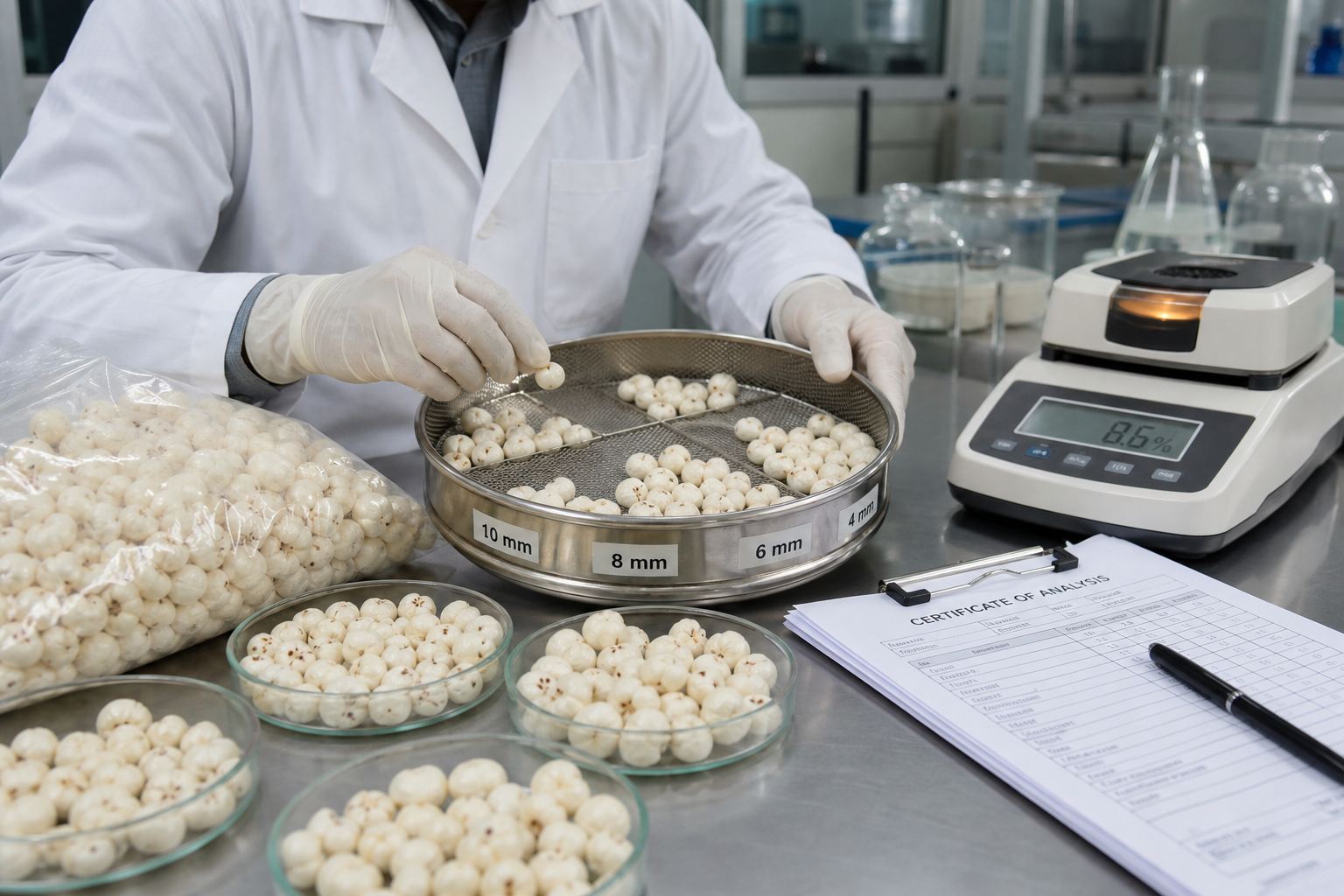
Inbound leads are international buyers who discover you — through search, social content, or a referral — and then choose to enquire. For fox nuts (makhana), inbound works when your digital presence answers the same questions a Category Buyer or Import Manager would ask on a first call: grade range (mm / suta), moisture and broken %, roast/flavour capability, certifications, MOQ, packaging, lead time, and evidence that a real processing facility exists behind the website.
Treat inbound as a system, not a brochure. Weak inbound looks like a one-page "we export makhana" site with a generic Gmail address. Strong inbound looks like a product-specific export site that converts cold search traffic into qualified RFQs, supported by consistent social posting that earns trust before the first email.
From Your Website: What Must Be There to Attract and Convert Buyers
Your website is the primary inbound asset. A serious snack-brand or distributor buyer will open it before replying to LinkedIn or email. Build pages that are informative for B2B export buyers — not only lifestyle shoppers — and make enquiry frictionless on mobile.
Homepage / hero: Clear product naming in buyer language — "Fox Nuts (Makhana / Popped Lotus Seeds) Exporter from Bihar, India" — plus one sentence on GI Mithila origin, grade range, and export markets served. A primary CTA ("Request specs & sample") and secondary CTA ("Download grade sheet") should sit above the fold.
Product & specifications page: Separate SKUs for raw popped, roasted plain, roasted & flavoured, flour/broken, and size grades (12–14mm, 14–16mm, 16–18mm, 18mm+). For each SKU list moisture %, broken %, foreign matter, shelf life, pack sizes, indicative MOQ, and HS references 20081921 / 20081922 / 20081929. Buyers compare suppliers on paper — if your site lacks numbers, they bounce.
Certifications & quality page: Show FSSAI licence number, APEDA RCMC status, HACCP/ISO if held, organic (NPOP/USDA/EU) if applicable, Mithila GI claim accuracy, and sample COA layout (moisture, microbiology, heavy metals). Link PDF certificates where possible; blur serials if needed but prove documents exist.
Factory & process proof: Photos and short video of roasting/popping lines, size-grading, metal detection/sieving, packing, and moisture-barrier/nitrogen packing. Include leadership photos and a short "who we are" note (years in processing, districts sourced, monthly capacity in MT). Buyers use this to decide whether you are a cottage trader or an export-capable processor.
Buyer resources: One-page technical datasheets, packaging options (5/10/20/25 kg bulk; 50–500 g retail), Incoterms you can quote (FOB Kolkata / CIF), sample policy (paid lab-tested sample preferred), and a clear contact form with fields for country, company type (brand / distributor / retailer / ingredient buyer), grade interest, and monthly volume. Publish a professional company email domain — not only WhatsApp.
Trust & SEO basics: Case-style notes (anonymised if needed), export markets served, blog posts that answer buyer questions, schema-friendly titles, fast mobile load, and HTTPS. Internal links to your full process guide help both buyers and search engines — for example how to export fox nuts (makhana) from India.
Social Media Activities: Five Example Posts You Can Publish
Social content for makhana export should educate buyers and prove capability — not only post product photos with "DM for price." Rotate process, specs, origin story, buyer education, and soft CTAs. Here are five ready-to-adapt examples:
Post 1 — Grade education (LinkedIn / Instagram carousel): "Not all fox nuts (makhana) are the same. 12–14mm suits value retail and bulk repack; 16–18mm and 18mm+ command premium snack-brand pricing. We size-grade every lot and report broken % on the COA. Comment GRADE for our one-page spec sheet."
Post 2 — Factory process reel (Instagram / YouTube Shorts / Facebook): 30–60 seconds of controlled roasting/popping → grading → packing into moisture-barrier bags. Caption: "From Mithila ponds to export-ready bags — hygienic popping, mm grading, and barrier packing for long ocean transit. Importers: ask for our sample kit with lot COA."
Post 3 — Certification & compliance (LinkedIn): "What US/UK/UAE buyers ask before the first PO: FSSAI, APEDA RCMC, lot COA (moisture + micro), phytosanitary/health cert per shipment, and clear HS coding (20081921/22/29). We keep this pack ready so vendor approval does not stall." Attach a blurred sample COA image.
Post 4 — Flavour / private-label offer (Instagram + Facebook): Flat-lay of plain roasted vs peri-peri / cheese / Himalayan salt pouches. Caption: "Private-label fox nut programmes for snack brands — MOQ from trial bags to multi-MT quarters. Share your target market and we will suggest grade + flavour + pack format."
Post 5 — Origin / GI story (YouTube long-form or LinkedIn article clip): Short film on Mithila Makhana GI geography (Darbhanga, Madhubani, Purnea belt), farmer cooperatives, and why provenance matters for premium retail. End with CTA to the enquiry form — not a hard sell on price.
Be Active on Social Media: Post Consistently Across Channels
Consistency beats burst posting. Aim for a simple weekly rhythm exporters can sustain: LinkedIn 3×/week (buyer-facing, longer captions), Instagram 4–5×/week (reels + carousels of product and factory), Facebook 2–3×/week (repurpose Instagram with a distributor-friendly caption), YouTube 1×/week or biweekly (factory tours, grade explainers, FAQ answers). Cross-post the same core idea — do not invent five unrelated campaigns.
LinkedIn: Target titles such as Category Buyer – Snacks, Procurement – Natural Foods, Import Manager, and snack-brand founders. Comment usefully on their posts before pitching. Keep your company page complete with product keywords "fox nuts," "makhana," "popped lotus seeds," and export markets.
Instagram & Facebook: Use Reels for process proof; Stories for harvest/packing updates and "sample kit available" stickers; carousels for grade and certification education. Use location tags for Bihar/Mithila when showing origin footage.
YouTube: Host longer assets that sales can send in outbound emails — "How we grade 16–18mm makhana," "Moisture control for ocean freight," "Private-label packaging options." These videos become reusable proof in every sales thread.
Measurement: Track profile visits, link clicks to the enquiry form, and inbound RFQ source ("saw your LinkedIn post"). Double down on formats that produce enquiries, not vanity likes.
Outbound Leads: Reach Prospects Directly
Outbound leads are companies you identify and contact first — snack brands already selling fox nuts / popped lotus seeds, ethnic and natural-food distributors, retail chains expanding better-for-you snacks, and ingredient buyers. Outbound converts when your first touch feels like a vendor introduction, not a spam blast: share specifications, certifications, test reports, technical details, experience, leadership context, and factory photos so the buyer can start internal qualification immediately.
Primary outbound channels: personalised email to procurement / founder / category buyer addresses; LinkedIn connection + short note; and filling the "Become a supplier," "Contact," or "Private label" forms on the prospect's own website. Attach or link a one-page grade sheet, a sample COA, and 3–5 factory photos. Offer a paid lab-tested sample with clear MOQ for trial orders.
What to Share in Every Outbound Introduction
Product specs: size grade (mm), moisture %, broken %, roast profile, flavour SKUs, shelf life, and pack formats.
Certifications: FSSAI, APEDA RCMC, HACCP/ISO if held, organic if claimed, Mithila GI accuracy, and destination-ready document list (phytosanitary, health cert, FDA Prior Notice support for USA).
Test reports: recent NABL (or equivalent) COA for moisture and microbiology; heavy metals if the buyer market expects it.
Company proof: years in makhana processing, monthly capacity (MT), districts sourced, leadership names/photos, and factory line photos or a 60-second video link.
Commercial clarity: indicative MOQ by channel, sample policy, Incoterms, and typical lead time including Bihar-to-Kolkata inland leg.
Five Example Outreach Emails
Use these five emails as a sequence, not five unrelated pitches: (1) introduction, (2) specifications and certifications, (3) technical specs with test certificate and experience, (4) follow-up with sampling offer, (5) final follow-up. Space them a few days apart. Replace placeholders, keep subjects specific, and point buyers to your own pages on yourwebsite.com (swap the domain for your live site). Each box is copy-ready at roughly 150–250 words with three scannable bullets.
10 Prospective Companies Across 5 Countries
Use the stacked profiles below as an illustrative starting pipeline — end-consumer snack brands, distributors/importers, and retail channels active in fox nuts / popped lotus seeds or adjacent South Asian and better-for-you snack categories. Each profile lists country, buyer type, website, a public email (where the company publishes one), and the contact / supplier form link so you can outreach without horizontal scrolling.
Always re-verify contacts, import history (HS 2008.19 where available), and current assortment before outreach — companies add and drop SKUs. Enrich this list with customs-data consignees for the highest-intent importers. Coverage: USA and Canada, UK, UAE/Gulf retail, and Australia (with one India-based snack brand useful for Gulf programmes).
1. Lotus Pops (USA)
- Country
- USA
- Buyer type
- End-consumer snack brand
- Website
- https://www.lotuspops.com
- Not published on the website — use the contact form
- Contact form
- https://www.lotuspops.com/pages/contact-us
Sells roasted lotus-seed (fox nut) snacks — a natural buyer of graded, export-ready makhana supply or co-pack capacity. Lead with size grade, roast profile, and a paid sample offer.
2. AshaPops (USA)
- Country
- USA
- Buyer type
- End-consumer snack brand
- Website
- https://ashapops.com
- info@ashapops.com
- Contact form
- https://ashapops.com/pages/contact
US better-for-you popped / lotus-seed style snack brand — fit for roasted and flavoured programme discussions. Email and form both appear on the public contact page; prefer company-domain mail plus a short spec sheet.
3. HOS Global Foods — House of Spices (Canada / North America)
- Country
- Canada (also USA warehouses)
- Buyer type
- Distributor / importer
- Website
- https://hosindia.com
- Contact form
- https://hosindia.com/contactus/
Major North American importer-distributor of South Asian foods — channel for ethnic grocery and foodservice makhana placement. Use the contact page for new-vendor introductions; orders@ is listed for online/order traffic, so lead with a clear “new supplier / snack category” subject.
4. Arz Fine Foods (Canada)
- Country
- Canada
- Buyer type
- Specialty grocery / importer-retailer
- Website
- https://arzfinefoods.com
- Contact form
- https://arzfinefoods.com/contact-us/ (select Vendor Relations)
Toronto-area specialty / ethnic grocery and prepared-foods group with a public Vendor Relations path on the contact form — useful Canadian specialty-grocery outreach for roasted or retail-ready fox nut SKUs. Qualify current dry-snack assortment before pitching.
5. Karma Bites (UK)
- Country
- UK
- Buyer type
- End-consumer snack brand
- Website
- https://karmabites.co.uk
- goodness@karmabites.co.uk (listed on public company profiles)
- Contact form
- https://karmabites.co.uk/ (site contact / enquiry — confirm path after load; email is the reliable channel)
UK popped lotus-seed snack brand listed in mainstream and health retail — high-fit for premium graded supply and private label. Prefer email with grade sheet + COA; follow up via the website enquiry if the form is available.
6. Surya Foods (UK)
- Country
- UK
- Buyer type
- Distributor / world foods
- Website
- https://suryafoodsonline.com
UK world-foods distributor (Flying Trade Group) with broad supermarket and independent retail reach — gateway to broader distribution conversations for ethnic and better-for-you snacks. Sales emails and a contact form are published on the group contact pages.
7. Popmak (India — Gulf / export snack brand)
- Country
- India (Gulf retail / gifting fit)
- Buyer type
- End-consumer snack brand
- Website
- https://popmak.in
- stkfoodprocessing@gmail.com (listed on contact page)
- Contact form
- https://popmak.in/contact/
Roasted makhana snack brand (STK Food Processing) — useful for Gulf retail and gifting-oriented roasted programmes and co-pack / supply discussions. Prefer the contact form plus a short intro email referencing your grade matrix.
8. LuLu Hypermarket — LuLu Retail (UAE / GCC)
- Country
- UAE (GCC retail)
- Buyer type
- Retail chain (end consumer)
- contact@ae.lulumea.com (corporate / Business Enquiry) · headoffice@ae.lulumea.com
- Contact form
- https://www.luluretail.com/contact-us/ (choose Business Enquiry)
Large GCC retail chain with strong South Asian assortment — approach via the corporate Business Enquiry form or local import partners for listing. Do not use customer-care inboxes for supplier pitches.
9. Oriental Merchant (Australia)
- Country
- Australia
- Buyer type
- Importer / distributor
- Not published on the website — use the contact form
- Contact form
- https://au.orientalmerchant.com/contact-us/ (select Potential Supplier Enquiries)
Established Australian specialty & Asian foods importer-distributor — channel for health/ethnic snack category introductions. The public form explicitly includes a Potential Supplier Enquiries option.
10. BAS Foods / Basfoods (Australia)
- Country
- Australia
- Buyer type
- Importer / wholesaler
- Website
- https://www.basfoods.com.au
- admin@basfoods.com.au (wholesale / general) · info@basfoods.com.au (customer support)
- Contact form
- https://www.basfoods.com.au/pages/contact-us · wholesale: https://www.basfoods.com.au/pages/wholesale
Australian food importer-wholesaler serving retail and foodservice — prospect for bulk roasted or raw popped makhana lines. Prefer admin@ and the wholesale form for B2B supply conversations.
Pricing Analysis
Buyer Tip
Makhana FOB pricing is driven primarily by size grade, roast/flavour treatment, and certification — not by broad market conditions alone. Broken and small-grade commodity material sits at the lower end of the range, while large, intact, flavoured retail-ready grades command materially higher pricing per kilogram, and certified-organic or GI-linked premium lots sit at the top of the band. Use APEDA's own Oct-2025 dashboard as a negotiating anchor: it puts overall export FOB at roughly USD 15.5–20.3/kg, while buyers in Germany, Nepal, and Australia are actually paying closer to ~USD 26, ~USD 21.6, and ~USD 21/kg respectively despite ordering less volume — worth raising when a low-volume premium buyer tries to negotiate you down to big-market pricing.
Quote structure should always separate product price from packaging, testing, and documentation costs — buyers comparing quotes across suppliers need to see these line items distinctly, and bundling them into a single opaque per-kilogram figure invites unproductive price renegotiation later in the deal.
Indicative FOB Pricing by Grade and Treatment (USD/kg)
Swipe →
Data table — swipe horizontally on small screens
| Grade / Treatment | Indicative FOB (USD/kg) | Key Price Driver | Typical Buyer |
|---|---|---|---|
| Broken/commercial grade, raw | USD 12–15/kg | Volume input use, minimal processing | Ingredient buyers, flour manufacturers |
| 12–14mm roasted plain | USD 14–17/kg | Standard retail-grade roast | Distributors, entry retail |
| 14–16mm roasted plain | USD 16–19/kg | Mainstream retail grade | Retail distributors, snack brands |
| 16–18mm roasted & flavoured | USD 18–22/kg | Flavour treatment + larger grade | Snack brands, private label |
| 18mm+ jumbo, roasted/flavoured | USD 20–26+/kg | Premium size grade, visual quality | Retail-chain house brands, gifting |
| Certified organic / GI-linked premium | USD 22–26+/kg | NPOP/organic certification + Mithila GI origin | Organic retail, premium snack brands |
MOQ Analysis
Buyer Tip
MOQ expectations vary sharply by buyer type, and quoting the wrong MOQ structure — either too high for a snack-brand pilot or too low to be commercially efficient for a bulk distributor — kills conversations before specification discussion even begins.
MOQ Guidance by Buyer Type and Order Stage
Swipe →
Data table — swipe horizontally on small screens
| Buyer Type | First Sample | Trial Order | Commercial Programme |
|---|---|---|---|
| Snack brand (private label) | 500g–2kg lab sample | 100–500 kg | 1–5 MT/quarter, scaling |
| Wholesale distributor | 1–5 kg sample | 1–3 MT | 5–30 MT/quarter |
| Retail-chain house brand | 2–5 kg sample + audit | 3–5 MT pilot | 10–50+ MT/annum |
| Ingredient/bulk buyer | 1–2 kg sample | 1–5 MT | 5–20 MT/quarter |
| Nepal cross-border trade | Minimal formal sample | 1–2 MT | Ongoing volume, lower per-order minimum |
Packaging Standards
Export Tip
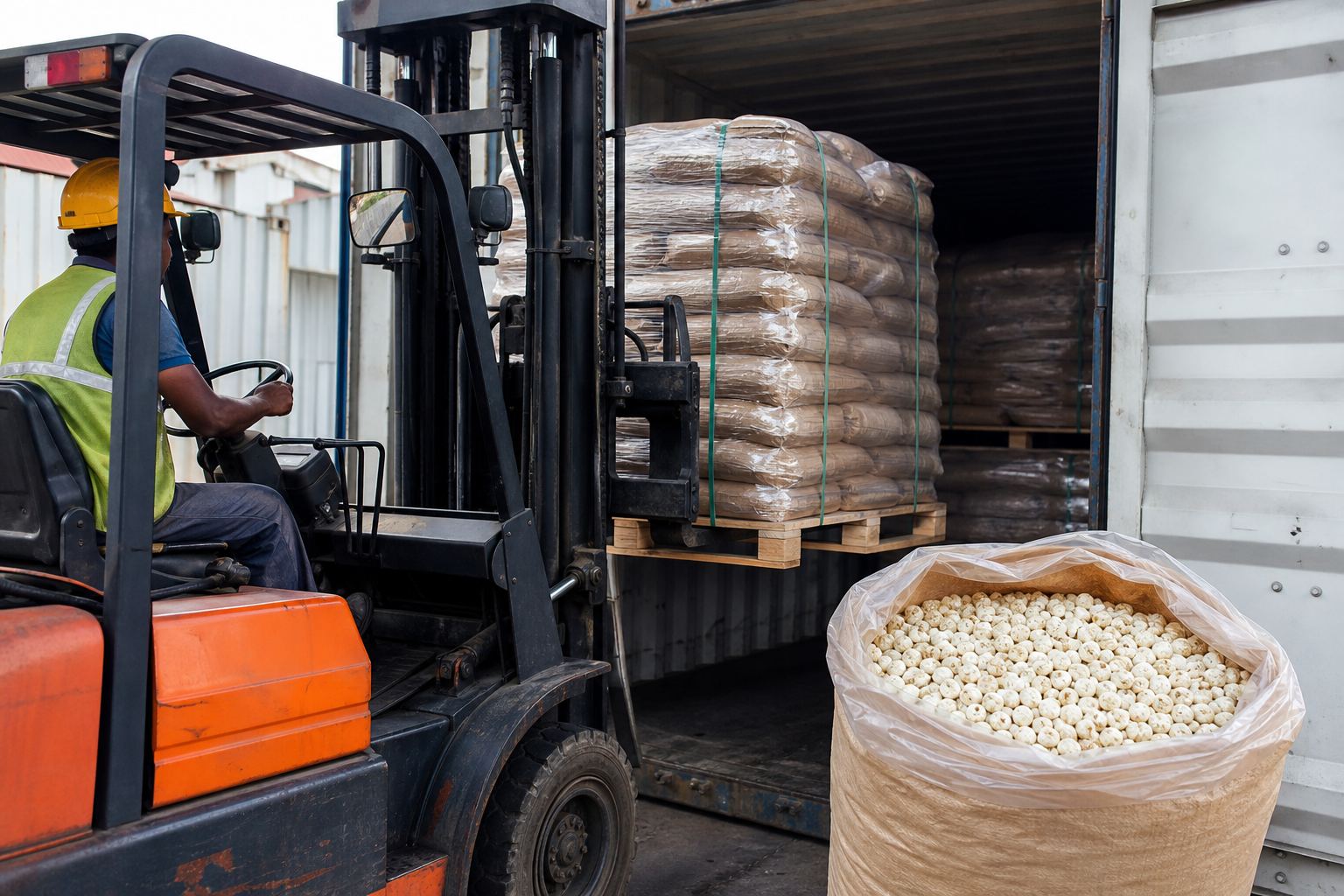
Bulk shipments to distributors and ingredient buyers typically move in food-grade multi-layer bags or cartons at 5, 10, 20, or 25 kg net weight, often with an inner moisture-barrier liner given makhana's sensitivity to humidity pickup during transit. Premium and organic lots increasingly use nitrogen-flushed packaging to protect crispness and shelf life across longer ocean transit times.
Retail-ready and private-label pouches typically run 50–500g for direct shelf placement, with buyers requiring artwork proofing, barcode verification, and — for USA/EU/UK/Australia destinations — nutrition panel and allergen-statement compliance before print approval.
Packaging Formats for Makhana Export
Swipe →
Data table — swipe horizontally on small screens
| Format | Net Weight | Typical Buyer | Key Requirement |
|---|---|---|---|
| Food-grade bulk bag (moisture-barrier lined) | 5 / 10 / 20 / 25 kg | Distributors, ingredient buyers | Moisture protection, food-grade certification |
| Nitrogen-flushed bulk pack | 5–25 kg | Premium/organic programmes | Preserves crispness across long transit |
| Retail pouch (flat/stand-up) | 50–200 g | Snack brands, retail-chain house brands | Artwork proof, nutrition/allergen panel |
| Bulk retail/value pouch | 250–500 g | Value retail, distributor repacking | Barcode scan test, seal integrity |
| Gifting carton/tin | 100–500 g | UAE gifting, premium retail | Presentation quality, GI-origin labelling |
Container Loading Details
Export Tip
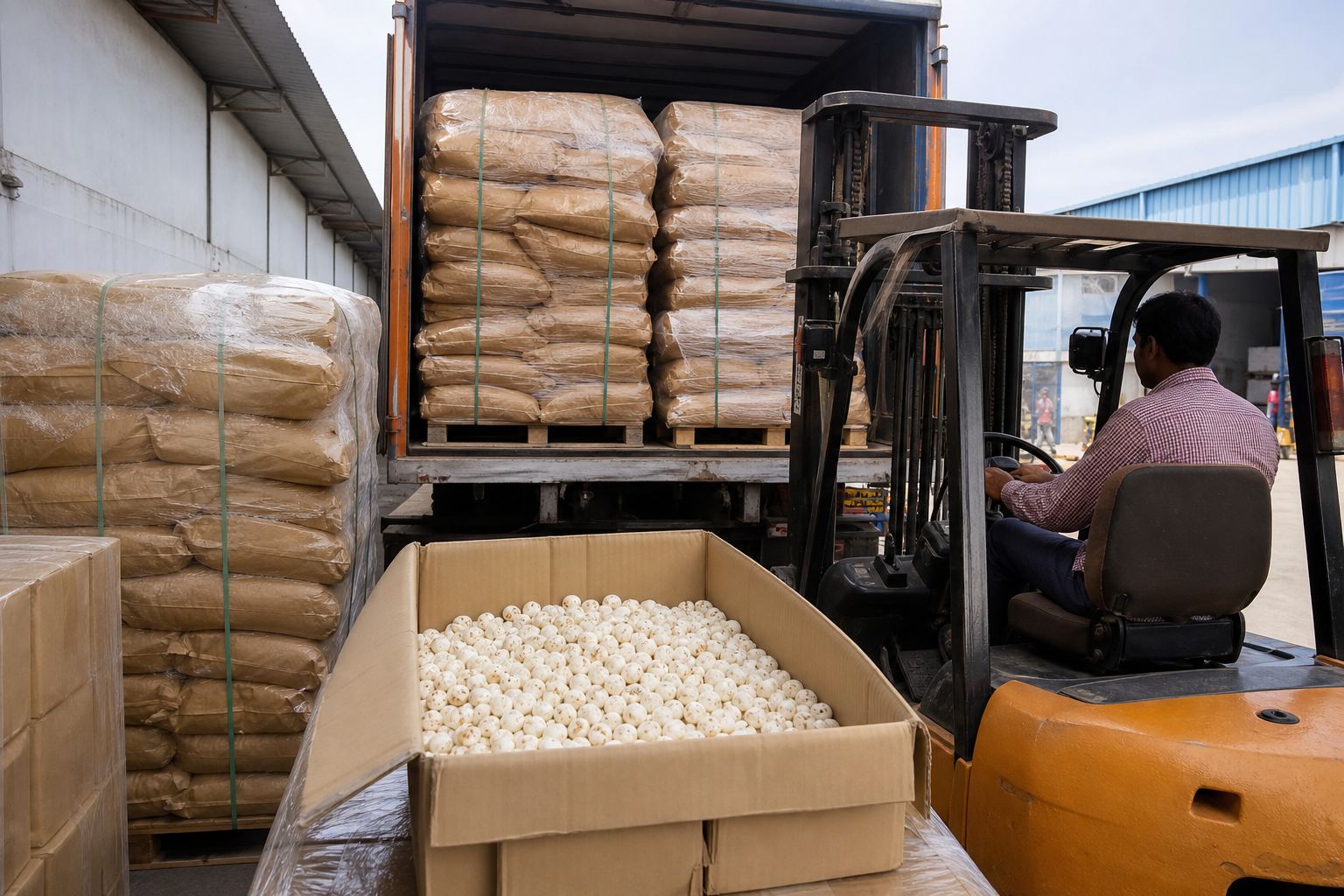
Because Bihar is landlocked, makhana consignments are typically railed or trucked to Kolkata (or occasionally other eastern/inland container depots) for FCL stuffing before onward ocean movement — a logistics step buyers rarely think about but which affects your realistic lead time quoting. Given makhana's low bulk density relative to weight, containers commonly reach volumetric capacity before reaching weight limits, so cube utilisation planning matters as much as tonnage planning.
Mixed-grade or mixed-SKU container loads are common for distributor orders; retail-chain and organic programmes generally require single-grade, non-mixed loading with clear segregation from any other cargo to avoid contamination or grade-mixing disputes on arrival.
Container Loading Reference for Makhana Export
Swipe →
Data table — swipe horizontally on small screens
| Container Type | Typical Load | Common Buyer | Loading Note |
|---|---|---|---|
| 20ft FCL | ~5–10 MT (cube-limited, not weight-limited) | Distributors, mixed-SKU orders | Verify cube utilisation before quoting fill % |
| 40ft FCL | ~10–18 MT (cube-limited) | Larger distributor/retail programmes | Palletisation improves handling at destination |
| LCL | 1–5 MT consolidated | Snack brands, first commercial orders | Longer transit; useful for MOQ-flexible buyers |
| Air freight (samples/small retail lots) | Under 200 kg | New buyer samples, urgent retail restocks | Higher cost, fastest lead time |
Shipping Methods
Export Tip
Sea freight FCL and LCL from Kolkata (with some volume also routing via Visakhapatnam, Nhava Sheva, or Mundra depending on buyer destination and freight-forwarder routing) remains the standard mode for commercial-volume makhana export. Air freight is reserved for samples, urgent retail restocks, and small premium/gifting lots where transit speed outweighs the materially higher freight cost per kilogram.
Moisture control matters throughout transit regardless of mode — makhana readily reabsorbs humidity, and buyers in humid destination climates (UAE, parts of Australia) specifically ask about barrier packaging and container desiccant use during supplier qualification.
Shipping Methods for Fox Nut (Makhana) Export
Swipe →
Data table — swipe horizontally on small screens
| Mode | Typical Use | Transit Time (Indicative) | Key Consideration |
|---|---|---|---|
| Sea FCL | Bulk commercial and distributor orders | 20–35 days depending on destination | Cube-limited loading; desiccant recommended |
| Sea LCL | Trial orders, smaller snack-brand programmes | 22–38 days depending on consolidation | Slightly longer due to consolidation scheduling |
| Air freight | Samples, urgent restocks, premium small lots | 3–7 days | High cost; use for speed-critical situations only |
| Rail/road to port (Bihar to Kolkata) | Pre-shipment inland leg | 2–5 days | Factor into total lead-time quoting |
Certifications
Compliance Notes
Certification is often the first credibility filter international buyers apply before even discussing price. At minimum, exporters need an active FSSAI licence (mandatory for any Indian food business operator) and, for most structured export relationships, APEDA registration (RCMC), which also opens access to APEDA-linked buyer-seller meets and export promotion programmes relevant to processed food products.
Phytosanitary and health certification requirements vary by destination — USA, EU, UK, Canada, and Australia buyers typically expect an export health certificate and phytosanitary certificate per shipment, while Nepal-bound overland trade often has lighter formal documentation expectations. Buyers targeting organic or GI-linked premium positioning should also review our companion guide on organic & premium fox nut (makhana) export opportunities for the NPOP/USDA/EU Organic and Mithila GI layer.
Core Certification Stack for Makhana Export
Swipe →
Data table — swipe horizontally on small screens
| Certification | Purpose | Relevant Markets | Buyer Verification Point |
|---|---|---|---|
| FSSAI Licence | Mandatory Indian food business registration | All export destinations | Licence number on invoice/COA |
| APEDA Registration (RCMC) | Processed food export registration; fair/BSM access | All destinations; especially useful for buyer discovery | RCMC number, APEDA directory listing |
| Phytosanitary Certificate | Plant-origin product entry clearance | USA, EU, UK, Canada, Australia | Issued per shipment by plant quarantine authority |
| Export Health Certificate | Food-safety clearance for destination customs | USA, EU, UK, Canada, Australia, UAE | Issued by competent authority per consignment |
| Mithila Makhana GI Tag | Origin/provenance certification | Premium retail, provenance-driven buyers | GI registration reference; traceability to Mithila belt |
| Lab COA (moisture, broken %, microbiology) | Lot-specific quality verification | All buyers, especially retail-chain and snack brands | NABL-accredited lab report per lot |
Buyer Requirements by Channel
Buyer Requirements
Requirements differ meaningfully by buyer channel — matching your documentation and sample readiness to the specific buyer type in front of you speeds up qualification significantly.
Snack Brands (Private Label)
Snack brands typically require flavour and grade consistency across repeat lots, packaging artwork and nutrition-panel support, flexible MOQ for pilot SKUs, and a fast sample-to-decision cycle — many are venture-backed or founder-led brands operating on tight product-launch timelines.
Wholesale Distributors and Importers
Distributors prioritise landed-cost competitiveness, reliable repeat lead times, mixed-grade order flexibility, and straightforward payment/credit terms once trust is established — they are typically less interested in origin storytelling than in operational reliability.
Retail-Chain Procurement (House Brand)
Retail-chain buyers require full compliance documentation, remote or on-site audit access, price stability commitments across a contract period, and often a formal vendor-approval process before the first purchase order — plan for a longer qualification cycle with this channel.
Ingredient and Bulk Buyers
Ingredient buyers care most about functional specification consistency (moisture %, broken %, particle size for flour), competitive bulk pricing, and dependable supply continuity across seasons rather than retail packaging or flavour range.
Country-wise Opportunities
Market Snapshot
Each of the seven core markets rewards a different prospecting and positioning approach — treating them identically wastes outreach effort on the wrong buyer type or channel.
Country-wise Buyer-Discovery Strategy for Makhana Exporters
Swipe →
Data table — swipe horizontally on small screens
| Country | Best Entry Channel | Prospecting Priority | Positioning Angle |
|---|---|---|---|
| USA | Snack-brand LinkedIn outreach; natural-grocery distributors | HS 2008.19 import data + LinkedIn category buyers | Better-for-you snacking, clean-label, retail-ready formats |
| Germany / EU | Organic distributors, clean-label retail buyers | Organic-certified importer lists, trade fairs | NPOP/EU Organic certification, provenance |
| UK | Specialty snack distributors, health-food retail | LinkedIn procurement titles, import data | Clean-label, GI-origin story |
| Canada | Natural grocery and ethnic-grocery distributors | Import data + referral networks | Consistency, reliable repeat supply |
| Australia | Health-food retail distributors | LinkedIn + wellness retail buyer lists | Wellness-snack positioning |
| UAE | South Asian trading houses + premium retail buyers | Trade fairs, distributor referrals | Dual pitch: community demand + premium gifting |
| Nepal | Cross-border traders, overland wholesalers | Direct trade relationships, referrals | Price competitiveness, proximity logistics |
Sourcing Checklist for Buyers and Exporters
Checklist
Compliance Checklist
Checklist
Compliance Notes
Common Buyer Mistakes
Common Mistakes Box
Both first-time buyers and first-time exporters repeat a predictable set of mistakes in makhana sourcing — most are avoidable with a short verification and specification-discipline habit.
Common Mistakes in Makhana Buyer-Supplier Engagement
Swipe →
Data table — swipe horizontally on small screens
| Mistake | Who Makes It | Consequence | Fix |
|---|---|---|---|
| Requesting price before specifying grade/format | Buyers | Quotes are impossible to compare across suppliers | Always specify size grade, roast/flavour, and volume first |
| Accepting free unlimited samples without earnest interest | Suppliers | Wastes lab-testing and sample cost on unqualified leads | Offer paid, lab-tested samples with a clear sample policy |
| Mass-emailing generic "makhana exporter" pitches | Suppliers | Low response rate, perceived as spam | Send grade-specific, buyer-type-specific outreach |
| Assuming GI tag equals organic certification | Buyers | Wrong compliance expectation set with regulators | Clarify GI (origin) versus NPOP/organic (production method) separately |
| Skipping moisture/packaging discussion before ordering | Buyers | Product degrades or loses crispness in transit | Confirm barrier packaging and desiccant use before shipment |
| No follow-up after the first quotation | Suppliers | Loses buyers who needed 2–3 more touches to decide | Plan a structured 4–6 touch follow-up cadence |
Challenges & Solutions
Beyond buyer discovery itself, a handful of recurring operational challenges shape how smoothly inquiries convert into repeat export programmes.
Common Challenges in Makhana Export and Practical Solutions
Swipe →
Data table — swipe horizontally on small screens
| Challenge | Why It Happens | Solution |
|---|---|---|
| Landlocked Bihar origin adds inland logistics time | All export cargo must reach Kolkata or another port by rail/road first | Build inland transit time into every lead-time quotation |
| Moisture pickup degrading crispness in transit | Makhana is hygroscopic; humid ports and long transit compound this | Use moisture-barrier and nitrogen-flushed packaging for longer routes |
| Fake or unqualified buyer inquiries | High interest in a trending snack category attracts price-shopping and unverified contacts | Verify business registration and import history before sample dispatch |
| Inconsistent size grading across lots | Manual grading variance between batches or suppliers | Standardise mm-grade sieving and include grade % in every COA |
| Retail-chain vendor approval taking longer than expected | Formal compliance and audit processes at larger retailers | Prepare full documentation pack upfront; do not wait for the buyer to ask |
Future Market Trends
Key Statistics
The better-for-you snacking trend that has driven makhana's international growth over the past several years shows no sign of reversing — if anything, flavour innovation (beyond salted and peri-peri into globally recognised snack flavours) and protein/plant-based ingredient positioning are widening the addressable buyer base beyond South Asian-focused retail into mainstream natural grocery and even mainstream mass retail in some markets.
Buyer-discovery tools are also evolving: AI-assisted trade-data platforms, more granular HS-code-linked shipment tracking, and digital buyer-intent signals from e-commerce and retail-listing platforms will make it easier to identify named prospective buyers earlier in their sourcing cycle — rewarding exporters who maintain clean digital presence, current certification status, and responsive outreach infrastructure over those relying purely on inbound directory inquiries.
The Mithila GI tag is also likely to gain more commercial weight as awareness grows among premium retail and organic buyers specifically seeking provenance-verified makhana — exporters who build genuine traceability to the certified geography now will be positioned to capture that premium as buyer sophistication increases.
Trends Shaping Makhana Buyer Discovery (2026–2030)
Swipe →
Data table — swipe horizontally on small screens
| Trend | Impact on Buyer Discovery | Exporter Response |
|---|---|---|
| Mainstream snacking category expansion | Broader buyer base beyond South Asian-focused retail | Diversify flavour range and target mainstream natural-grocery buyers |
| AI-assisted trade-data and buyer-intent tools | Faster identification of named prospective importers | Adopt trade-data tools; maintain clean digital company presence |
| Growing provenance/GI awareness among premium buyers | Higher-value buyers actively search for Mithila-origin supply | Build and document genuine traceability to the GI geography |
| Plant-protein and clean-label ingredient demand | New ingredient-buyer segment beyond traditional snack retail | Develop flour/ingredient-grade specification sheets |
Conclusion
- Do this week: upgrade your website product/spec and certification pages (yourwebsite.com style URLs); schedule five social posts; and send Email 1 (introduction) to three companies from the prospect list.
- Read how to export fox nuts (makhana) from India, top fox nut (makhana) products exported from India, and fox nut (makhana) export documentation checklist.
- Also see best countries for Indian fox nut (makhana) exports, most demanded Indian fox nuts (makhana) by country, and source fox nuts (makhana) directly from India.
- For premium and certified-organic positioning, see organic & premium fox nut (makhana) export opportunities and APEDA registration benefits for fox nut (makhana) exporters.
- Explore merchant exporter, export products from India, global sourcing partner, and product sourcing company in India services, plus the agriculture & food products industry page.
Finding international buyers for Indian fox nuts is a solvable, repeatable process — but only when inbound and outbound run together. Build a website that answers grade, certification, and factory questions; post consistently on LinkedIn, Instagram, Facebook, and YouTube; then run outbound email and supplier-form introductions with specs, COAs, and factory proof to named brands, distributors, and retailers — verified against HS 2008.19 trade data before you fund samples.
Altus Exports works as a merchant exporter and global sourcing partner connecting Bihar-region makhana processors, cooperatives, and FPOs with verified international buyers across snack-brand, distributor, retail-chain, and ingredient-buyer channels — managing buyer verification, sample coordination, documentation, and shipment execution under one accountable relationship.