
A Guide to APEDA Registration and Benefits for Fox Nut (Makhana) Exporters
By Saurabh Mittal, Founder, Altus Exports
A complete guide to APEDA registration for fox nut (makhana) exporters from India — what APEDA is, why registration matters for Euryale ferox exports from Bihar's Mithila belt, who should register, the step-by-step application process, documents, fees, RCMC continuity, and how membership builds buyer confidence in the USA, Canada, UAE, UK, Australia, Germany, and Nepal. Includes market size, export/import statistics, pricing, MOQ, packaging, container loading, certifications, and country-wise opportunity tables.

Fox nuts — known globally as makhana and botanically as Euryale ferox — have moved from a regional Indian snack into an international clean-label ingredient category within a few short years. India dominates global fox nut supply, and Bihar alone accounts for roughly 80–85% of world output and about 90% of India's production (APEDA directional), concentrated in the Mithila belt (Darbhanga, Madhubani, Saharsa, Katihar, and neighbouring districts) — a region that earned the Geographical Indication (GI) tag for 'Mithila Makhana' in 2022. As international buyers in the USA, Canada, UAE, UK, Australia, and Germany add popped fox nuts to keto, gluten-free, and better-for-you snacking ranges, the institutional credentials behind an Indian exporter matter as much as the product itself.
For fox nut and makhana exporters, APEDA registration is the foundational credential. APEDA — the Agricultural and Processed Food Products Export Development Authority — is the government body mandated to promote and regulate export of scheduled agricultural and processed food products, and makhana falls squarely within that scope under HS heading 2008 (subheadings 20081921, 20081922, and 20081929, with older shipments historically recorded under HS 19041090). Registration unlocks RCMC issuance, market development support, quality infrastructure access, and — most importantly for a fast-growing category — the institutional identity that buyers use to separate serious exporters from opportunistic traders during vendor onboarding.
This guide explains what APEDA is, why registration matters specifically for makhana exporters, who should register, the step-by-step application process, documents and fees, and how membership translates into buyer trust and market access. It is not a full shipment documentation walkthrough or an organic-certification deep dive — for those, see the fox nut (makhana) export documentation checklist and organic and premium fox nut (makhana) export opportunities. Pair this guide with how to export fox nuts (makhana) from India for the full operational picture, and always verify current fees and portal workflows on apeda.gov.in and dgft.gov.in, as administrative processes are updated periodically.
Key Takeaways
Summary Box
- APEDA registration is the primary institutional credential for exporting scheduled fox nut (makhana) products from India under HS heading 2008 (20081921/22/29; legacy 19041090).
- Obtain IEC first; APEDA membership and RCMC applications flow through the DGFT-linked portal, and incomplete IEC, GST, or FSSAI details are the most common cause of processing delays.
- First-year enrolment fees are commonly benchmarked around ₹8,000 + 18% GST — always confirm the live fee schedule on the official APEDA portal before remitting.
- RCMC validity typically spans multiple years subject to annual fee renewal; lapsed membership disrupts export documentation continuity mid-programme.
- Buyers in the USA, Canada, UAE, UK, Australia, and Germany increasingly treat APEDA RCMC as a baseline vendor-qualification credential alongside FSSAI, IEC, and lab test reports.
- Altus Exports helps makhana processors, Mithila-belt aggregators, and merchant exporters align institutional registrations with product readiness for agriculture & food products and honey & natural products export programmes.
Executive Summary
Summary Box
Fox nut (makhana) is one of India's fastest-growing agri-export categories, moving from a devotional and regional-snack product to an internationally recognised better-for-you ingredient in under a decade. India's near-monopoly on global supply — anchored in Bihar's Mithila wetlands — gives Indian exporters a structural advantage that few other agri-commodities enjoy, but that advantage only converts into export revenue when institutional credentials, quality documentation, and buyer-facing packaging are in place.
APEDA registration sits at the centre of that institutional layer. It is the gateway to RCMC issuance, market development assistance for overseas fairs, quality infrastructure linkages, and — commercially most important — the credibility signal that shortens buyer due diligence. This guide combines the APEDA registration playbook with the market context an exporter needs: size and industry overview, export and import statistics, product categories, manufacturing overview, export process, pricing, MOQ, packaging, container loading, shipping, certifications, buyer requirements, and country-wise opportunity across the USA, Canada, UAE, UK, Australia, Germany, and Nepal.

Market Size & Industry Overview
Key Statistics
Global demand for fox nuts has expanded rapidly as popped makhana positions itself alongside popcorn and puffed snacks in the clean-label, low-calorie, gluten-free snacking category, while also serving as a traditional ingredient in South Asian festive cooking and an Ayurvedic-adjacent wellness food. India dominates global fox nut supply and export volume, with Bihar accounting for roughly 80–85% of world output and about 90% of India's production (APEDA directional) — concentrated in the Mithila region's Darbhanga, Madhubani, Saharsa, Katihar, Purnia, and adjoining districts where the Euryale ferox plant grows in ponds (ahar-pyne wetlands) suited to its cultivation.
The Government of Bihar's Makhana Mission and the 2022 GI tag for 'Mithila Makhana' have accelerated formalisation of the sector — bringing more farmer-processor clusters into organised supply chains, improving popping and grading infrastructure, and giving exporters an authenticity marker that resonates with international buyers seeking traceable, origin-linked ingredients. Growth is further supported by rising retail demand in the USA and UK for keto and paleo-aligned snacks, Gulf demand for premium roasted formats, and steady institutional demand from Nepal via overland trade given cultural and culinary familiarity with the product.
What Is APEDA and Why It Matters for Makhana Exporters
APEDA stands for the Agricultural and Processed Food Products Export Development Authority, a statutory body under the APEDA Act, 1985, operating under India's Ministry of Commerce and Industry. It promotes and regulates export of scheduled agricultural and processed food products — including fox nuts and other prepared cereal-adjacent snack foods — through registration services, market development assistance (MDA), quality infrastructure facilitation, trade fair participation support, and market intelligence.
For makhana exporters, APEDA plays a dual role: regulatory registration authority issuing the Registration-cum-Membership Certificate (RCMC), and commercial facilitator connecting exporters to overseas buyer-seller meets, international food exhibitions, and government export incentive schemes. Because makhana is a scheduled product under APEDA's mandate, registration is a genuine regulatory requirement for commercial export — not a discretionary credential. Buyers in developed markets increasingly request RCMC evidence during vendor onboarding precisely because the category has attracted a wave of new, sometimes undocumented, entrants as global demand has grown.
Export Statistics
Key Statistics
India's makhana exports were historically difficult to track precisely because shipments were often recorded under the broad HS code 19041090 (prepared cereal foods), which clubbed fox nuts with other puffed and prepared grain products. Dedicated HS subheadings under 2008.19 (20081921, 20081922, 20081929) became effective from July 2025 per APEDA, materially improving trade-data granularity, and exporters should reference these current codes on shipping bills going forward while keeping the legacy code for historical trend comparison.
Per APEDA's MIC Makhana dashboard, India's makhana exports grew directionally from roughly 6,700 MT in 2020 to roughly 25,130 MT in 2024 — a CAGR of approximately 39% — as the USA, Canada, UAE, UK, and Australia added the product to health-food and ethnic-grocery ranges and GI-tagged Mithila Makhana gained recognition as a premium origin marker. Jan–Oct 2025 volumes ran around 18,150 MT, tracking slightly below the 2024 full-year pace amid US tariff pressure and price adjustment. Exporters should treat these as APEDA-sourced directional figures and verify current data via APEDA's trade statistics portal, DGFT's export data dashboards, and ITC Trade Map under the HS 2008.19 subheadings before making sourcing or capacity commitments.
Comparison table
Swipe →
Data table — swipe horizontally on small screens
| Metric | Directional Trend | Where to Verify |
|---|---|---|
| India's share of global makhana supply | Bihar ~80–85% of world output, ~90% of India's production (APEDA directional), concentrated in the Mithila belt | APEDA / State Bihar Makhana Mission data |
| HS code used for exports | 20081921 / 20081922 / 20081929 (current); 19041090 (legacy) | DGFT export data, ICEGATE |
| Top destination markets by value | USA, UAE, UK, Canada, Germany, Australia, Nepal | APEDA trade statistics, ITC Trade Map |
| Export growth trajectory (5-year) | Strong upward trend as snacking and health-food demand rises | DGFT / APEDA year-on-year comparisons |
| Primary export format | Popped (phool) makhana, bulk and retail-ready | Shipping bill / commercial invoice records |
Import Statistics
Key Statistics
On the import side, the USA leads demand for Indian makhana driven by natural and specialty grocery, keto-snack brands, and e-commerce private label. The UAE and broader Gulf import both bulk food-service packs and premium roasted/flavoured retail formats, partly for the resident South Asian diaspora and partly for the growing regional interest in better-for-you snacking. The UK and Australia show strong growth from ethnic grocery and natural-food retail channels, Germany's natural and organic food sector is an emerging premium buyer of GI-linked and certified-organic makhana, and Canada mirrors US demand patterns closely. Nepal is a distinct case — proximity and shared culinary use drive consistent overland import demand via the Raxaul–Birgunj and related border points, often in bulk raw or lightly processed form rather than retail-ready packs.
Comparison table
Swipe →
Data table — swipe horizontally on small screens
| Country | Import Driver | Typical Format Imported |
|---|---|---|
| USA | Keto/health-food snacking, natural grocery, private label | Retail pouches (50–150g), bulk 10–25kg |
| Canada | Natural food retail, South Asian diaspora grocery | Retail pouches, 10–20kg bulk |
| UAE | Food service, gifting, diaspora and Gulf retail | Bulk 10–25kg, premium gift packs |
| UK | Ethnic grocery, natural/health food retail | Retail pouches (50–100g), 5–20kg bulk |
| Australia | Health-food retail, growing snacking category | Retail pouches, 10–20kg bulk |
| Germany | Organic/natural food, GI-linked premium positioning | Certified-organic retail packs, small bulk |
| Nepal | Culinary use, cultural familiarity, overland trade | Bulk raw/semi-processed, 25kg+ sacks |
Product Categories
Summary Box
- Raw/unpopped fox nut seeds (Gorgon nut) — lower processing, used by re-processors and some Nepal-bound bulk buyers
- Popped (phool) makhana — graded by size in mm (commonly 14mm+ through 20mm+/king grade), the dominant retail and snacking export format
- Roasted and flavoured makhana — peri-peri, cheese, chocolate-coated, and salted variants for retail snacking brands
- Makhana flour and broken/powder grade — used in bakery, infant food, and gluten-free formulations
- Organic and GI-certified Mithila Makhana — premium positioning for EU, UK, and North American organic/specialty channels
Makhana exports span a range of processing levels, and exporters should understand where APEDA registration and buyer expectations differ across categories, even though a full product breakdown belongs in top fox nut (makhana) products exported from India.
Manufacturing Overview
Export Tip
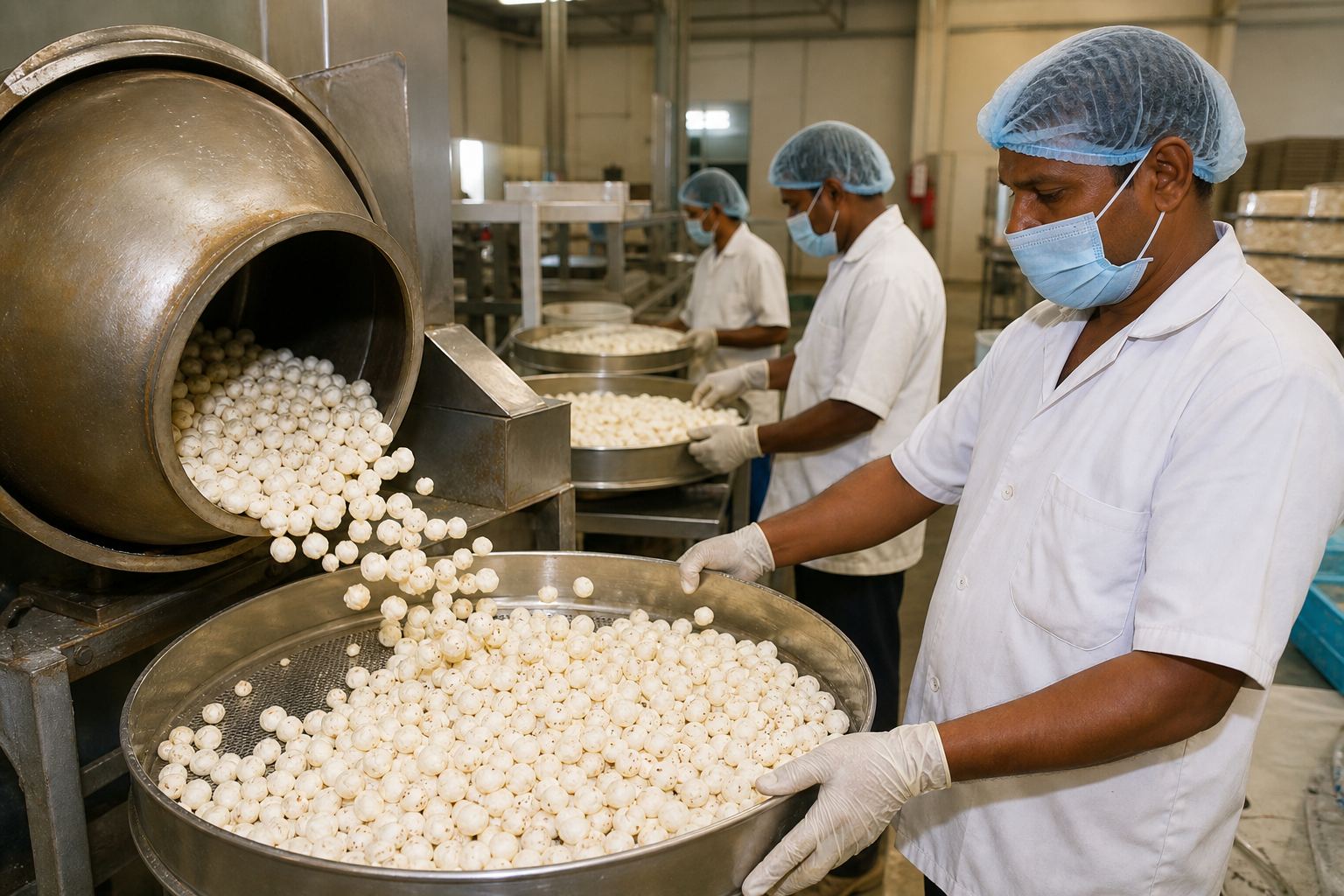
Makhana production follows a distinct agricultural-to-processing cycle. Euryale ferox is cultivated in shallow ponds and wetlands across the Mithila belt, with harvesting typically running from June through September. Seeds are collected, sun-dried, and then sorted before the defining step — roasting and popping, traditionally done by hand over heated sand in small batches, increasingly supplemented by semi-mechanised roasting units as processors scale for export volumes.
After popping, lots are graded by size (mm), whiteness, and breakage percentage, then sorted to remove foreign matter and under-popped or discoloured pieces. Export-oriented processing units increasingly invest in moisture-controlled storage, mechanised grading, and food-grade packing lines to meet the consistency that international retail and private-label buyers require. Processing capacity is concentrated in and around Bihar's producing districts, with a growing number of FSSAI-licensed units capable of servicing export specifications directly.
Why APEDA Registration Matters for Makhana Exporters
Beyond the regulatory requirement, APEDA membership delivers practical commercial value for fox nut exporters: RCMC issuance for export documentation, market development fund eligibility for participating in overseas food fairs, quality infrastructure linkages including EIC and NABL-accredited labs for moisture, broken-percentage, and microbiology testing, and visibility in APEDA's exporter directory used by international sourcing teams.
Buyer trust is the immediate commercial payoff. When a buyer onboarding pack includes IEC, GSTIN, FSSAI, and APEDA membership/RCMC together, the perceived risk for a US natural-food buyer or a UK ethnic-grocery importer drops sharply. Missing APEDA documentation causes serious buyers to pause, request workarounds, or move to an already-registered competitor — a meaningful risk in a category where new, sometimes undocumented, processors and traders have entered rapidly as global demand has grown.
Who Should Register with APEDA for Fox Nut (Makhana) Exports
- Makhana processing and popping units in Bihar's Mithila belt
- Farmer producer organisations (FPOs) and cooperatives aggregating pond-grown Euryale ferox
- Merchant exporters consolidating multi-processor or multi-district lots
- Private-label and flavoured-snack brands exporting retail-packed makhana
- MSMEs and startups with IEC and GST readiness entering the makhana export category
APEDA registration is relevant to any entity engaged in commercial export of fox nuts and related products, including makhana processing units in Bihar, farmer producer organisations (FPOs) and cooperatives in the Mithila belt, merchant exporters consolidating multi-processor lots, private-label snack brands exporting retail-packed makhana, and MSMEs or startups entering the category with a valid IEC.
Eligibility generally requires a valid IEC, GST registration, appropriate FSSAI licence, and entity constitution documents matching the applicant's business structure — proprietorship, partnership, company, cooperative, or producer company. Manufacturer-exporter classification typically requires production or processing-unit evidence; merchant-exporter classification requires procurement-and-export documentation. If your role is unclear, state it explicitly during application, since default classification affects RCMC scope.
Benefits of APEDA Membership for Makhana Exporters
Treat APEDA membership as a commercial toolkit rather than a certificate to file away — the RCMC opens institutional doors, but grading discipline, packaging, and responsiveness close orders.
Comparison table
Swipe →
Data table — swipe horizontally on small screens
| Benefit | What You Gain | How to Use It for Makhana |
|---|---|---|
| RCMC issuance | Mandatory export documentation credential for scheduled products | Include in every buyer onboarding pack alongside IEC and FSSAI |
| Market development assistance (MDA) | Partial reimbursement for fair participation, travel, and promotion | Apply before booking booths at Gulfood, Anuga, or SIAL |
| Quality infrastructure access | Linkage to EIC and NABL-accredited labs | Use for moisture, broken %, and microbiology testing before shipment |
| Buyer-seller meets | Structured introductions to vetted international importers | Bring graded samples, spec sheets, and pricing tiers to every meet |
| Exporter directory listing | Visibility to buyers searching for registered Indian suppliers | Keep product categories and certification status current |
| Market intelligence | Destination-specific demand and compliance updates | Prioritise 1–2 markets based on current APEDA intelligence |
| Organic export facilitation (NPOP linkage) | Institutional pathway toward organic certification for premium buyers | Use selectively for GI/organic Mithila Makhana lines, not the full range |
| Buyer credibility | Institutional signal reducing onboarding friction | Attach RCMC to every inquiry response and fair presentation |
APEDA Registration for Makhana Exporters: Step-by-Step Process
Export Tip
The sequence below reflects the current organised application pathway through the APEDA portal, which is linked to DGFT login infrastructure for IEC-holding exporters. Confirm live screen flows and document checklists on apeda.gov.in before filing, as workflows are periodically updated.
Step 1: Obtain IEC
Apply for an Import Export Code on the DGFT portal if you do not already hold one. IEC is the foundation of all commercial export from India, and APEDA registration cannot proceed without it. Keep PAN, bank details, and address consistent with your GST registration to avoid mismatches later.
Step 2: Ensure FSSAI Registration/Licence
Because makhana is a food product, FSSAI registration or licence is required alongside APEDA membership. Export-oriented processing units typically require a Central FSSAI licence. Confirm current turnover and export-status thresholds on the FSSAI portal — both APEDA and FSSAI credentials are usually requested together during buyer onboarding.
Step 3: Prepare Documentation
Assemble IEC copy, GST certificate, PAN, FSSAI registration/licence, cancelled cheque, bank financial soundness certificate where required, and entity constitution proofs (partnership deed, incorporation certificate, MoA/AoA, cooperative registration as applicable). Manufacturer-exporter classification may require MSME Udyam and production-unit evidence. Incomplete document packs are the leading cause of processing delays.
Step 4: Register on the APEDA Portal
Create an applicant account on the APEDA online registration portal using your IEC and business email. This is the primary interface for new registration; DGFT portal linkages may form part of the workflow depending on the application type.
Step 5: Complete the Application and Select Product Categories
Fill in entity details, IEC, and product categories — select fox nuts/makhana and related prepared food categories as applicable, and declare export destination interests and exporter type (manufacturer or merchant). Accurate category selection matters because RCMC scope and scheme eligibility often tie back to declared products.
Step 6: Pay Registration Fees
Pay the prescribed fee online via the portal's payment gateway. First-year fees typically comprise a one-time registration fee plus annual subscription plus GST. Retain receipts and acknowledgement numbers in your compliance file, and always verify live amounts before remitting since fee schedules are revised periodically.
Step 7: Upload Documents and Submit
Upload clear, self-attested scans of all required documents. Names, addresses, and signatory details must match precisely across IEC, GST, FSSAI, and the application form — even minor spelling discrepancies generate deficiency notices. Submit only once every required field and upload is confirmed complete.
Step 8: Verification and RCMC Issuance
APEDA officials verify completeness and document authenticity. Respond to any deficiency communication within 24–48 hours to avoid application dormancy. On approval, APEDA issues the RCMC — download and store it alongside IEC, GSTIN, and FSSAI, and diary the annual renewal date so continuity is never broken.
Documents and Fees for APEDA Registration
Use this snapshot as a preparation gate. Exact requirements vary slightly by entity type and by manufacturer- versus merchant-exporter category.
Comparison table
Swipe →
Data table — swipe horizontally on small screens
| Item | Requirement / Typical Cost | Practical Note |
|---|---|---|
| IEC certificate | Mandatory prerequisite | Self-attest; ensure name matches all other documents |
| GST registration certificate | Mandatory | Legal name and address must align with IEC |
| FSSAI registration/licence | Mandatory for food products | Central FSSAI licence typically required for export |
| Entity constitution proof | Deed / incorporation / MoA-AoA / cooperative registration | Ensure notarisation where required |
| Bank financial soundness certificate | Often required | Use the bank account reflected in your IEC |
| First-year registration + membership + GST | ≈ ₹8,000 + 18% GST as a common benchmark | Verify live fee schedule on the APEDA portal |
| Annual renewal fee | Lower than first-year enrolment | Diary renewal before the financial-year deadline |
RCMC for Makhana Exporters: What It Means and How to Use It
Compliance Notes
The Registration-cum-Membership Certificate (RCMC) confirms an exporter's registration and membership under APEDA's institutional framework. For makhana exporters, RCMC is referenced during buyer vendor onboarding, in applications for government export incentives, and in documentary credit transactions where institutional membership proof is a documentary condition. Validity is typically multi-year but subject to annual fee payment — lapsing disrupts continuity even within the nominal validity window. Keep RCMC alongside IEC and FSSAI in a master compliance file accessible to your export desk and shipping agent.
Export Process
Export Tip
APEDA registration is one step in a broader export sequence. A typical makhana export process runs: IEC and APEDA/FSSAI registration; buyer discovery and inquiry response; sample dispatch with grade specifications and COA; price negotiation and purchase order; procurement or production scheduling with Mithila-belt processors; pre-shipment quality control (moisture, broken %, size grade, foreign matter); export packing; customs documentation and clearance; booking and loading at the chosen port; shipment tracking; and final documentation handover against payment terms (advance, LC, or DP/DA as agreed).
For the complete operational walkthrough — including documentation specifics — see how to export fox nuts (makhana) from India and the fox nut (makhana) export documentation checklist.
Pricing Analysis
Buyer Tip
Makhana pricing is driven primarily by size grade, popping quality (whiteness, breakage percentage), and whether the lot is conventional or certified organic/GI-linked. FOB pricing for standard popped grades commonly runs USD 12–18/kg, while premium large-grade, low-breakage, or organic-certified lots command USD 18–26+/kg. Roasted and flavoured retail-ready formats typically price at a premium over plain popped bulk due to added processing and packaging cost. None of that pricing power matters if a buyer stalls at vendor qualification — for the full country-by-country unit-price breakdown, see how to export fox nuts (makhana) from India.
Comparison table
Swipe →
Data table — swipe horizontally on small screens
| Grade / Format | Typical FOB Price (USD/kg) | Price Driver |
|---|---|---|
| Standard popped, mixed grade | 12–15 | Baseline snacking-grade supply |
| Large-grade popped (16mm+) | 15–18 | Size consistency, low breakage |
| Premium/king-grade popped (18–20mm+) | 18–22 | Size, whiteness, minimal breakage |
| Organic-certified / GI Mithila Makhana | 20–26+ | Certification and origin premium |
| Roasted/flavoured retail-ready | Add 15–30% over base popped price | Processing, flavouring, packaging cost |
MOQ Analysis
Buyer Tip
MOQ for makhana scales from sample quantities to full container loads depending on buyer type. Retail and private-label buyers typically start with 1–5kg samples for taste and quality evaluation, move to LCL trial orders of 100–500kg, and scale to FCL commitments once specification and packaging are finalised. Institutional and food-service buyers in the UAE and Nepal may start closer to LCL or part-container volumes given regular reorder cycles.
Comparison table
Swipe →
Data table — swipe horizontally on small screens
| Buyer Stage | Typical MOQ | Shipment Mode |
|---|---|---|
| Sample evaluation | 1–5 kg | Courier/air parcel |
| Trial order | 100–500 kg | LCL sea freight |
| Standing reorder (mid-size buyer) | 1–5 MT | LCL or part-container |
| FCL programme | 1 x 20ft or 1 x 40ft container | FCL sea freight |
Packaging Standards
Export Tip
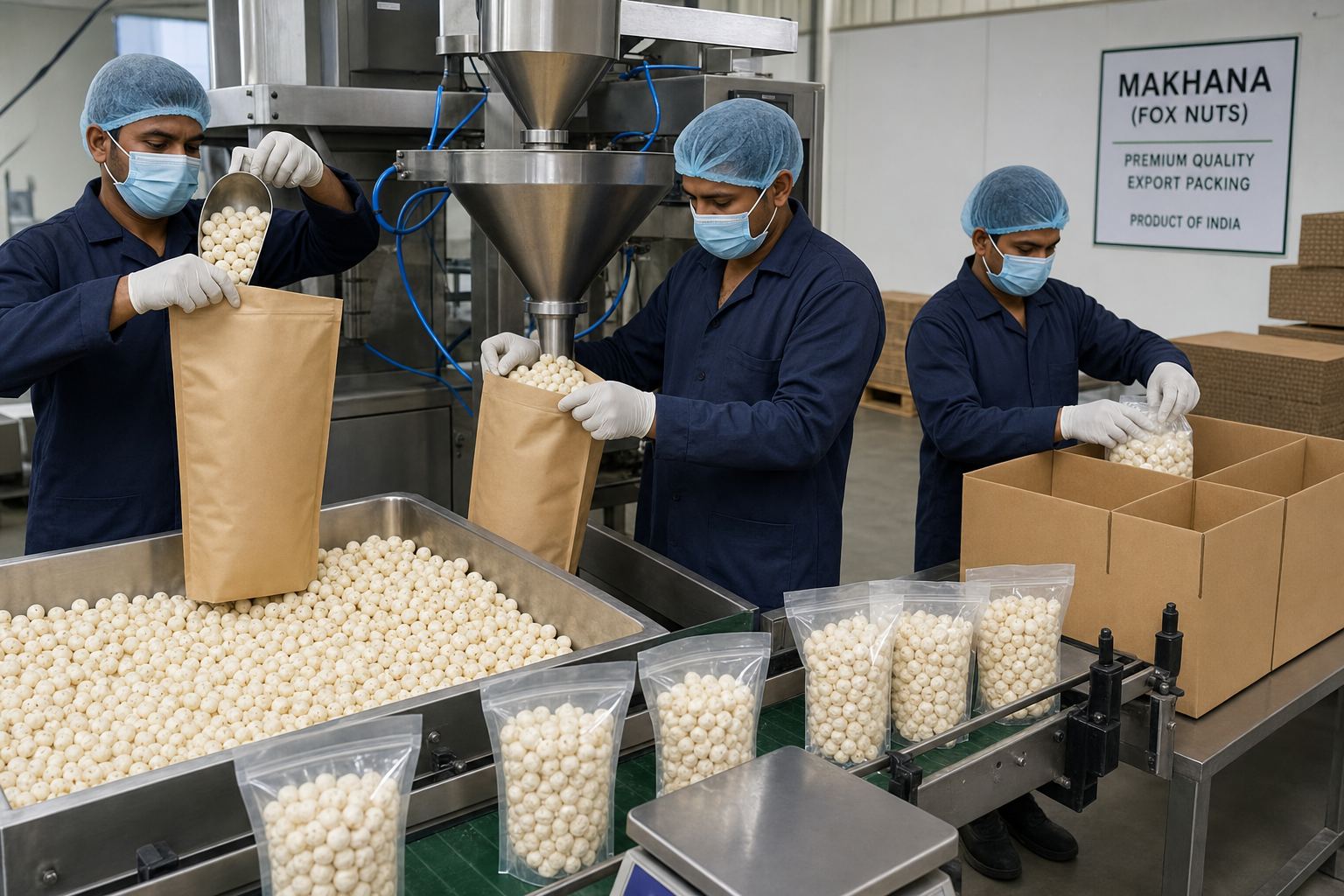
Bulk export packaging for makhana typically uses food-grade 5/10/20/25kg bags or cartons with inner moisture-barrier liners; premium and organic lots increasingly use nitrogen-flush packaging to protect crispness and shelf life over long transit times. Retail formats run 50–500g flexible laminate pouches, often with resealable zippers for the US and UK snacking channel. Labelling must reflect destination-market requirements (allergen statements, net weight in appropriate units, country of origin, and best-before date).
Comparison table
Swipe →
Data table — swipe horizontally on small screens
| Format | Typical Pack Size | Notes |
|---|---|---|
| Bulk export bags/cartons | 5kg / 10kg / 20kg / 25kg | Food-grade inner liner; nitrogen flush for premium lots |
| Retail pouches | 50g / 100g / 150g / 250g / 500g | Resealable laminate; destination-specific labelling |
| Gifting/premium packs | 200g–1kg | Popular for UAE and Gulf gifting channel |
Container Loading Details
Export Tip
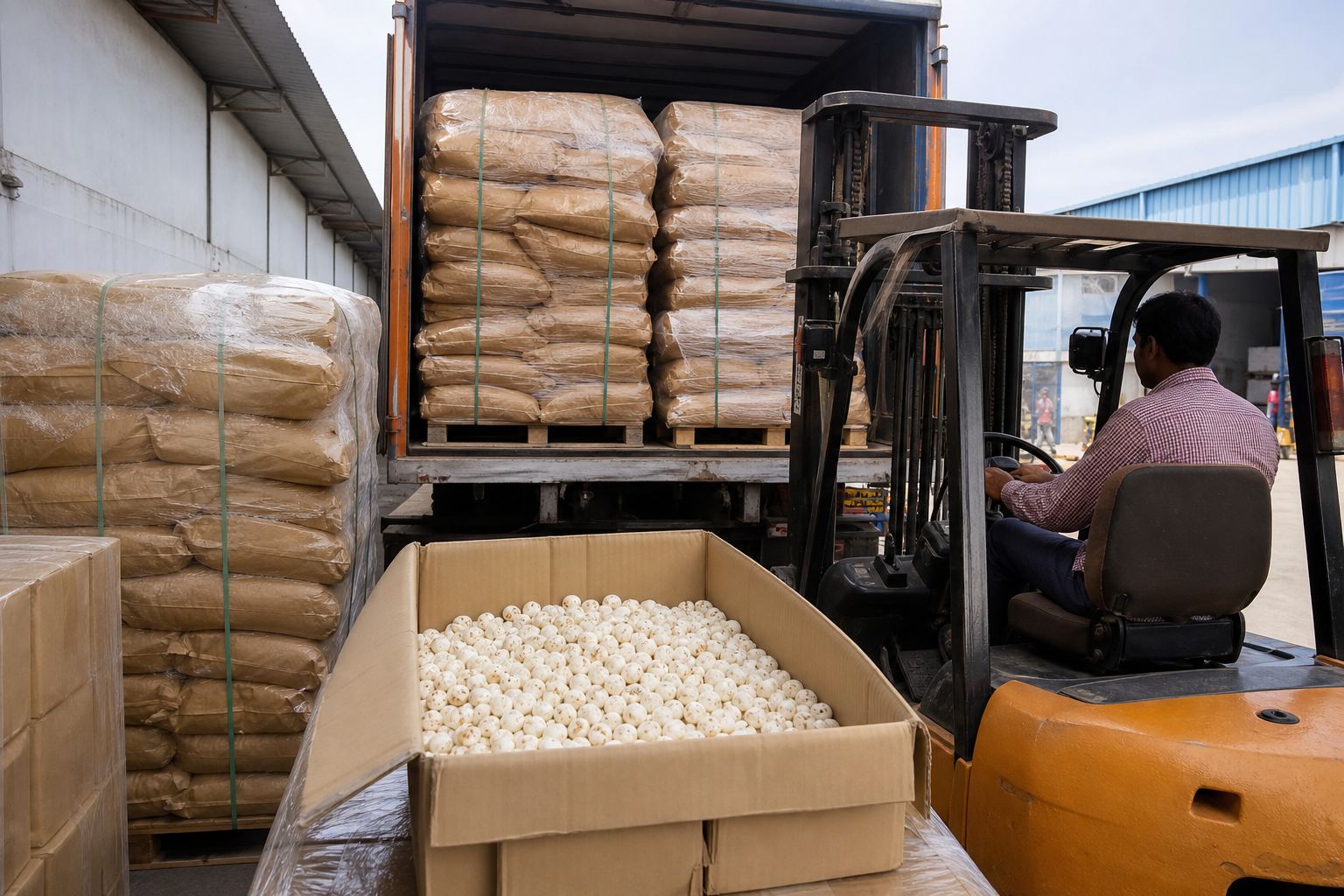
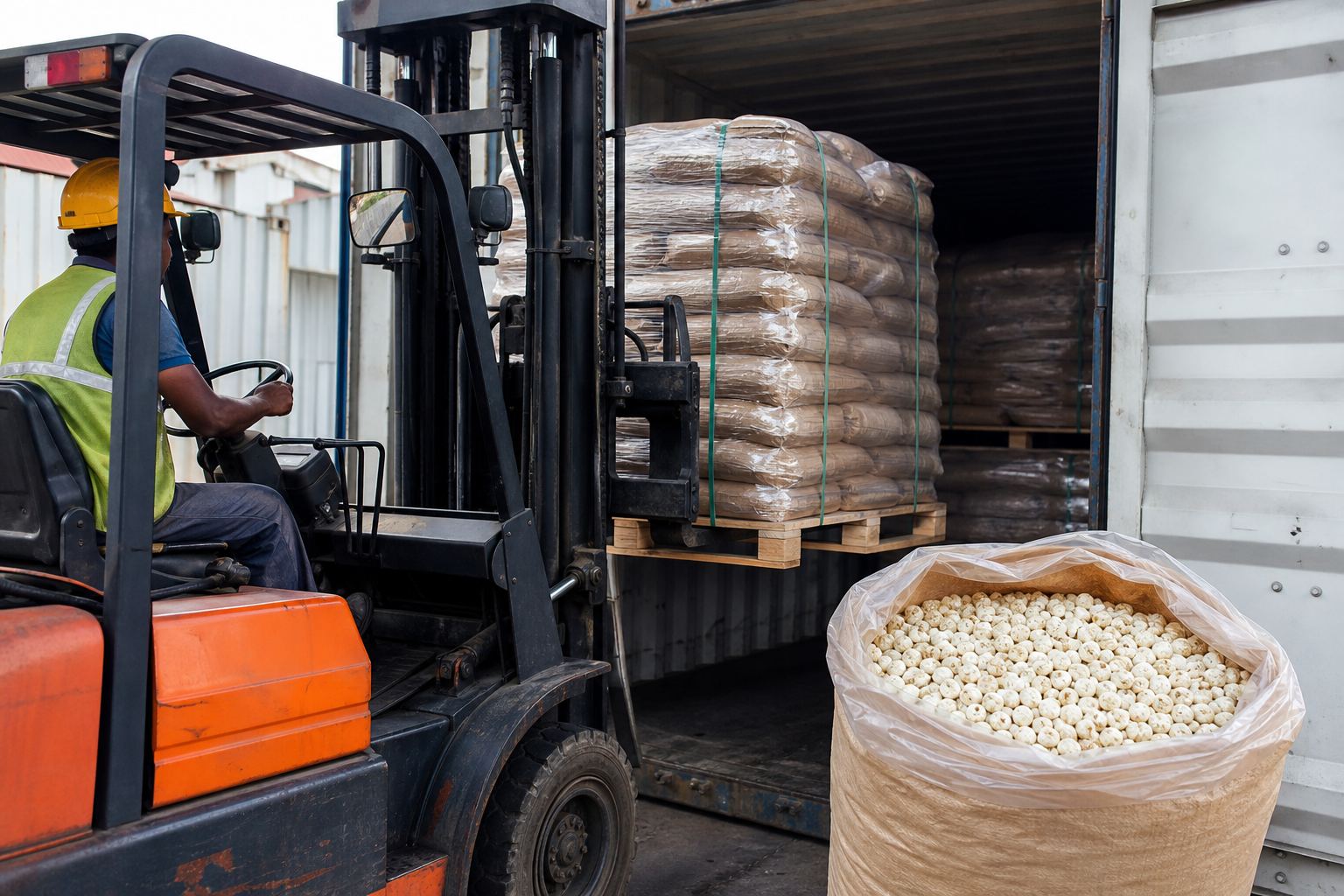
Container loading itself is a freight-forwarder decision, not an APEDA one — but the certificate of origin, RCMC reference, and FSSAI details on your paperwork must match the specific container and lot being stuffed, not a template carried over from a previous shipment. As a quick benchmark, popped makhana is volume- rather than weight-constrained, so pack format drives the achievable net weight per container more than the credentials paperwork does — see the table below.
Comparison table
Swipe →
Data table — swipe horizontally on small screens
| Container | Typical Load (Popped Makhana) | Typical Load (Raw Seed) |
|---|---|---|
| 20ft FCL | ~5–10 MT (volume-constrained) | ~12–16 MT |
| 40ft FCL | ~10–18 MT (volume-constrained) | ~24–28 MT |
Shipping Methods
Export Tip
Shipping mode doesn't change because of APEDA registration, but RCMC and FSSAI reference numbers do need to appear correctly on the shipping bill and certificate of origin regardless of whether cargo moves by sea FCL/LCL through Kolkata, Nhava Sheva, or Mundra, by air for urgent samples, or overland through Raxaul–Birgunj for Nepal-bound trade. Keep both credentials current so a shipment is never held up by paperwork rather than product. For full port, lead-time, and Incoterm guidance, see how to export fox nuts (makhana) from India.
Certifications
Compliance Notes
Baseline certifications for makhana export are IEC, GST registration, APEDA RCMC, and an FSSAI licence — together these form the credibility floor that international buyers expect during vendor onboarding. Depending on destination and channel, exporters may also need a phytosanitary or health certificate, and GI-tag documentation to substantiate 'Mithila Makhana' origin claims. Organic certification (NPOP, USDA NOP, or EU Organic) is relevant for premium buyers but is a separate, deliberate investment rather than a default requirement — see organic and premium fox nut (makhana) export opportunities for that pathway in depth.
Comparison table
Swipe →
Data table — swipe horizontally on small screens
| Certification/Registration | Purpose | Who Needs It |
|---|---|---|
| IEC | Mandatory for any commercial export from India | All exporters |
| GST registration | Tax identity and commercial entity confirmation | All exporters |
| APEDA RCMC | Scheduled-product registration and buyer credibility | All exporters |
| FSSAI licence | Food safety compliance for makhana as a food product | All exporters |
| Phytosanitary/health certificate | Destination-specific import clearance | As required by buyer/destination |
| GI Mithila Makhana documentation | Substantiates origin-linked premium claims | Exporters marketing GI-tagged product |
| Organic (NPOP/NOP/EU Organic) | Premium organic channel access | Exporters targeting certified-organic buyers |
Buyer Requirements
Buyer Requirements
International makhana buyers typically request: graded samples with a Certificate of Analysis covering moisture, broken percentage, size grade, and foreign matter; consistent lot-to-lot quality; flexible MOQ for first orders; customisable retail packaging (private label, allergen statements, language localisation); and a clean institutional credential set (IEC, APEDA RCMC, FSSAI) presented upfront rather than after multiple follow-up requests. Buyers who have previously received inconsistent grading or under-documented shipments apply stricter scrutiny to new Indian suppliers regardless of quoted price.
Country-wise Opportunities
Market Snapshot
APEDA registration is a universal prerequisite, but the commercial opportunity differs meaningfully by destination. For the full grade, pack, and certification demand matrix by country, see most demanded Indian fox nuts (makhana) by country; the snapshot below focuses on how APEDA credentials interact with each market's buyer expectations.
Comparison table
Swipe →
Data table — swipe horizontally on small screens
| Country | Opportunity Driver | APEDA-Linked Buyer Expectation |
|---|---|---|
| USA | Keto/health snacking, private label growth | RCMC + FSSAI + clean COA expected at first inquiry |
| Canada | Natural food retail, diaspora grocery | Similar to USA; bilingual labelling awareness helps |
| UAE | Food service, gifting, diaspora retail | RCMC + halal-readiness for retail entry |
| UK | Ethnic grocery, natural/health food retail | RCMC + FSSAI; post-Brexit import documentation care |
| Australia | Growing snacking category, health retail | RCMC + biosecurity/import compliance awareness |
| Germany | Organic/natural food, GI-linked premium | RCMC + organic certification for premium channel |
| Nepal | Overland cultural/culinary demand | RCMC + FSSAI; simpler documentation given land trade |
APEDA vs Other Export Bodies for Makhana Exporters
Makhana exporters sometimes ask whether other councils are more relevant. For fox nuts as the primary export product, APEDA is the correct and mandatory primary registration body. FIEO offers broader cross-sector federation benefits; EIC handles compulsory inspection/certification where destination markets require it; FSSAI governs food safety independent of product category. These bodies complement APEDA rather than compete with it.
Comparison table
Swipe →
Data table — swipe horizontally on small screens
| Body | Primary Role for Makhana Exporters | When to Engage |
|---|---|---|
| APEDA | Scheduled product registration, RCMC, MDA, market development | Primary and mandatory for all commercial exporters |
| FSSAI | Food safety licence for makhana as a regulated food product | Mandatory before APEDA and buyer onboarding |
| EIC | Inspection/certification for select regulated destinations | When the destination country requires a government quality certificate |
| FIEO | Broad exporter federation, cross-sector networking | Supplementary for wider export community benefits |
| DGFT | IEC issuance, RCMC portal infrastructure, export policy | IEC first; portal credentials used throughout |
Sourcing Checklist for Buyers and Exporters
Checklist
Use this two-sided checklist to align expectations before the first purchase order.
For Buyers
- Request IEC, APEDA RCMC, FSSAI, and GST evidence upfront
- Ask for a sample with size grade, moisture %, and broken % on the COA
- Confirm packaging format and labelling compatibility with your destination market
- Clarify MOQ, lead time, and payment terms before quoting retail pricing to your own customers
- Ask about GI Mithila Makhana or organic certification if premium positioning is planned
For Exporters
- Complete IEC, FSSAI, and APEDA registration before active buyer outreach
- Standardise size grading and maintain a consistent COA template
- Invest in moisture-controlled storage and food-grade packing to protect quality in transit
- Prepare tiered pricing across grades so buyers can select against their target price point
- Respond to specification questions and sample requests within 24–48 hours
Compliance Checklist
Checklist
Compliance Notes
Comparison table
Swipe →
Data table — swipe horizontally on small screens
| Compliance Item | Status Check | Owner |
|---|---|---|
| IEC | Valid and matches GST/PAN details | Export desk |
| GST registration | Active and address-consistent | Accounts/compliance |
| FSSAI licence | Central licence for export-oriented unit | Quality/compliance |
| APEDA RCMC | Current and renewed annually | Export desk |
| Pre-shipment COA | Moisture, broken %, size grade, foreign matter documented | QC team |
| Labelling compliance | Destination-specific allergen/COO/date requirements met | Packaging team |
| GI/organic documentation (if applicable) | Certificates current and matched to the specific lot | Quality/compliance |
Common Buyer Mistakes
Common Mistakes Box
- Assuming all makhana is the same grade — size, whiteness, and breakage vary widely and drive both price and product performance.
- Skipping sample evaluation before a bulk order, then discovering moisture or breakage issues on arrival.
- Not verifying APEDA/FSSAI credentials before wiring an advance payment to an unregistered trader.
- Choosing the lowest FOB quote without checking whether it reflects a lower size grade or higher broken percentage.
- Overlooking seasonal harvest timing, then facing availability or price volatility close to a promotional launch date.
- Assuming GI 'Mithila Makhana' claims are self-certifying without requesting supporting documentation.
Challenges & Solutions
Comparison table
Swipe →
Data table — swipe horizontally on small screens
| Challenge | Impact | Solution |
|---|---|---|
| Seasonal harvest concentration (June–Sept) | Price and availability volatility off-season | Lock in supplier agreements and forward-book inventory ahead of peak demand |
| Moisture sensitivity in transit | Quality degradation, loss of crispness | Moisture-controlled packing, nitrogen flush for premium/long-transit lots |
| Bulky, low-density product | Container space, not weight, becomes the binding constraint | Optimise carton dimensions and palletisation with freight forwarder input |
| Grading inconsistency across small processors | Buyer dissatisfaction, repeat-order risk | Standardise size-grade sorting and a consistent COA template |
| New, undocumented entrants in the category | Buyer scepticism during vendor diligence | Lead with APEDA RCMC, FSSAI, and IEC in every first response |
Future Market Trends
Key Statistics
Through 2030, three trends will shape the makhana export category: continued formalisation of Bihar's supply base through the state Makhana Mission and expanded GI-tag adoption; growth of flavoured and roasted retail formats as private-label brands in the USA and UK differentiate beyond plain popped snacks; and rising organic and traceability expectations from EU and North American buyers as the category matures beyond its early high-growth phase. APEDA's digital registration and MDA processes are also expected to streamline further, reducing administrative friction for smaller processors entering export for the first time.
Exporters who treat APEDA registration as living infrastructure — renewed annually, paired with consistent grading discipline, and used actively for MDA-supported fair participation — will be best positioned to capture disproportionate share as international demand keeps expanding across the USA, Canada, UAE, UK, Australia, Germany, and Nepal.
Conclusion
- Do next: Verify live APEDA registration fees and process on apeda.gov.in, then file with a complete document pack before buyer outreach begins.
- Read how to export fox nuts (makhana) from India, most demanded Indian fox nuts (makhana) by country, top fox nut (makhana) products exported from India, best countries for Indian fox nut (makhana) exports, find international buyers for fox nuts (makhana), source fox nuts (makhana) directly from India, the fox nut (makhana) export documentation checklist, organic and premium fox nut (makhana) export opportunities, and trade shows and B2B marketplaces for fox nut (makhana) exporters.
- Explore agriculture & food products, honey & natural products, merchant exporter, export products from India, global sourcing partner, and product sourcing company partnership models.
APEDA registration for fox nut (makhana) exporters is the foundational institutional credential behind India's near-monopoly makhana supply: RCMC continuity, market development support, quality infrastructure linkage, and the buyer credibility that shortens the path from first inquiry to first container. The steps are clear — obtain IEC and FSSAI first, complete APEDA registration with a clean document pack, diary annual renewals, and pair the credential with disciplined size grading and packaging.
Actionable next steps: verify IEC, GST, and FSSAI consistency this week; assemble the documents from this guide; complete APEDA registration; and plan a buyer-outreach cycle with graded samples and a complete credential pack. Altus Exports supports Mithila-belt processors, aggregators, and merchant exporters who need registration frameworks, product readiness, and buyer connectivity aligned to real export execution.