
How to Export Fox Nuts (Makhana) from India: Complete Process Guide
By Saurabh Mittal, Founder, Altus Exports
A step-by-step operational guide on how to export fox nuts (makhana / phool makhana) from India — registrations, sourcing from Bihar's GI-tagged Mithila belt, popping and size-grading, laboratory COA testing, food-grade packaging, container loading, shipping lanes, pricing, and buyer development, with expert insight from Altus Exports.
Fox nuts — known across India as makhana or phool makhana, and botanically as the seed of the aquatic plant Euryale ferox — have moved from a regional Bihari snack and religious-fasting food into a global health-food category in barely a decade. Popped makhana is naturally gluten-free, low in fat, and marketed internationally as a clean-label alternative to potato chips and conventional nuts, which has pulled in buyers across North America, the Gulf, Europe, and Australia. India dominates global fox nut supply, and Bihar alone accounts for roughly 80–85% of world output and about 90% of India's production (APEDA directional) — almost entirely rooted in the wetlands and ponds of the Mithila and Kosi belt, spanning districts such as Madhubani, Darbhanga, Sitamarhi, Saharsa, Katihar, and Purnia, with supporting production from West Bengal and eastern Uttar Pradesh. If you are trying to work out how to export fox nuts from India for the first time, that geographic concentration is both the opportunity and the operational challenge you need to plan around.
Unlike many commodity food exports, makhana carries a genuine origin story that buyers can be sold on: the crop is GI-tagged as Mithila Makhana, harvested from ponds by hand, dried, roasted in earthen or mechanized kilns, and hand- or machine-popped into the familiar puffed white kernel. That process — plus size grading in millimetres, moisture control, and increasingly popular flavoured and roasted retail formats — means export success depends on far more than finding a supplier willing to sell in bulk. Exporters must navigate DGFT's Import Export Code, APEDA's RCMC registration, FSSAI food-safety compliance, HS classification that changed materially from July 2025, laboratory testing for moisture and broken percentage, and packaging that protects a genuinely fragile, hygroscopic product across a multi-week ocean voyage.
This guide walks through the complete operational sequence — from registrations and sourcing through popping, grading, laboratory certificates of analysis, packaging, container loading, shipping, and documentation, to pricing strategy and buyer development — that Indian makhana exporters and the international buyers who work with them should follow. Trade figures, pricing bands, and country-share estimates in this guide are directional planning inputs; always confirm current HS classification with your customs house agent (CHA) and validate landed pricing against fresh quotations before committing to a shipment. For the companion catalogue of specific export-ready products and grades, see Top Fox Nut / Makhana Products Exported from India.
Key Takeaways
Summary Box
Executive Summary
Summary Box
Exporting fox nuts from India is fundamentally a five-part operating system: legal registration (IEC, APEDA, FSSAI), reliable sourcing from Bihar's Mithila-Kosi production belt or supporting regions, disciplined processing (roasting, popping, size grading), laboratory-verified quality control, and export logistics that protects a lightweight, moisture-sensitive product through to destination. Each part has a specific compliance or operational gate, and skipping any one of them is the most common reason first-time exporters lose buyer trust or face customs friction.
The category is genuinely growing: makhana has shifted from a niche religious-fasting food inside India to an internationally recognised roasted-snack and better-for-you ingredient, with flavoured retail pouches, private-label programmes, and makhana flour/powder for bakery and coating applications adding demand beyond plain popped kernels. That growth has attracted both experienced agricultural exporters and newer entrants — which raises the bar on documentation, size-grade consistency, and certification for anyone trying to win and retain international buyers.
This guide assumes you are either (a) an Indian manufacturer, processor, or aggregator planning your first or next export shipment, or (b) an international importer, retailer, or brand evaluating India as a makhana sourcing origin. Both audiences need the same underlying information — registrations, grading standards, pricing logic, packaging formats, and documentation — viewed from opposite sides of the same transaction. Altus Exports operates as a merchant exporter and global sourcing partner that sits at the centre of that transaction, coordinating supplier verification, quality testing, and shipment execution on both sides.
Market Size & Industry Overview
Key Statistics
India's fox nut cultivation is concentrated on shallow ponds and wetlands (locally called mauns or chaurs) across Bihar's Mithila and Kosi region — a geography, climate, and centuries of cultivation knowledge that no other country has replicated at scale. Bihar alone is estimated to account for the large majority of India's makhana acreage and output, which is why the crop received Geographical Indication (GI) recognition as Mithila Makhana, protecting the name for genuine Mithila-region production and giving exporters a differentiated, story-driven claim that competitors outside the region cannot legally use. Supporting production exists in parts of West Bengal and eastern Uttar Pradesh, but volumes there remain smaller relative to Bihar's core Mithila-Kosi districts.
The industry structure below the farm level is layered: pond cultivators and harvesters, primary driers, small-scale roasting-and-popping units (traditionally family-run with earthen kilns, increasingly mechanized), size-grading and sorting operations, and finally packers and exporters who consolidate lots, run laboratory testing, and manage documentation. Because so much of the processing base is fragmented and semi-organised, consistency of size grade, moisture, and broken percentage across a season — and across multiple small suppliers — is the single biggest operational variable exporters must manage, more so than raw material availability itself.
Government and institutional support has scaled up meaningfully: APEDA has actively promoted makhana as an export category, Bihar's state government has invested in cluster development and processing infrastructure around Madhubani and Darbhanga, and GI registration has created a marketing and compliance framework that did not exist a decade ago. For exporters and buyers alike, this means the category is professionalising quickly — but is not yet uniformly standardised, which is exactly why size-grade specification, verified lab testing, and clear packaging standards matter so much in this particular product.
Export Statistics
Key Statistics
Precise, universally agreed export volume and value figures for makhana are difficult to pin down publicly because HS classification for the category has itself been in transition — treat the figures below as directional planning inputs rather than audited totals, and validate current-year numbers against APEDA and DGCI&S data or your CHA before making sourcing or investment decisions. Per APEDA's MIC Makhana dashboard, total India makhana exports grew directionally from roughly 6,700 MT in 2020 to roughly 25,130 MT in 2024 (~39% CAGR), with Jan–Oct 2025 volumes around 18,150 MT — tracking slightly below the 2024 full-year pace amid US tariff and price pressure.
Directional profile of Indian fox nut (makhana) exports
Swipe →
Data table — swipe horizontally on small screens
| Metric | Directional Estimate | Notes |
|---|---|---|
| Bihar's share of global fox nut supply | ~80–85% of world output; ~90% of India's production (APEDA directional) | Concentrated almost entirely in Bihar's Mithila-Kosi belt |
| Export volume, 2020 → 2024 | ~6,700 MT → ~25,130 MT (~39% CAGR, APEDA directional) | Jan–Oct 2025 ~18,150 MT, slightly below 2024 pace |
| Primary export form | Popped (roasted) makhana | Highest export volume share vs. flour/powder or raw seed |
| Growth trajectory | Rising year-on-year | Driven by health-snack positioning and private-label demand |
| Leading destination region | North America (USA + Canada) | Combined largest directional share of exports |
| Secondary destination region | Middle East (UAE and Gulf) | Strong wholesale and retail demand |
| Emerging destinations | UK, Australia, Germany, Nepal | Smaller but growing volumes |
| Applicable HS headings (from July 2025) | 20081921 / 20081922 / 20081929 | Popped / flour-powder / other; legacy 19041090 on transitional filings |
Import Statistics
Key Statistics
From the buyer side, makhana enters most destination markets as a packaged snack food or as a bulk ingredient input, which means import statistics are often buried inside broader 'processed seeds/nuts' or 'snack food' trade categories rather than tracked as a standalone line in every country's public trade data. Buyers and analysts should treat the country-level breakdown below as a working model for planning shipment volumes and market entry sequencing, not as a substitute for market-specific import research.
Directional import demand profile by destination market
Swipe →
Data table — swipe horizontally on small screens
| Market | Directional Share of Indian Makhana Exports | Primary Buyer Type |
|---|---|---|
| USA | ~40% | Health-food retail, private label, e-commerce brands, distributors |
| Canada | ~20% | Retail distributors, South Asian grocery chains, health-food channels |
| UAE | ~17% | Wholesale distributors, retail chains, re-export hub for the Gulf |
| UK | ~10% | Retail, ethnic grocery, health-food distributors |
| Australia | ~1–5% (higher unit price, ~USD 21/kg directional) | Health-food retail and specialty importers |
| Germany | ~1–5% (higher unit price, ~USD 26/kg directional) | Organic and health-food specialty channels |
| Nepal | Established regional | Cross-border retail and food-service demand |
Product Categories & Grades
Summary Box
- Plain popped (roasted) makhana — the core export SKU, sold bulk and retail-packed
- Roasted & flavoured makhana — peri-peri, cheese, cream & onion, turmeric, herb, and other retail-facing profiles
- Makhana flour / powder — from broken kernels, used in bakery, health formulations, and coatings
- Raw / unpopped seed (limited export volume) — mainly for buyers running their own popping operations
- Organic-certified makhana — NPOP/USDA/EU Organic certified lots for premium retail and specialty channels
- GI-tagged Mithila Makhana — origin-authenticated lots for buyers targeting a verified Bihar provenance claim
Fox nuts move through export channels in several distinct product forms, and matching the right form to the right buyer is a core part of pricing and positioning strategy. Plain popped (roasted) makhana is the largest-volume export form and the base product from which every flavoured or private-label variant is built. Roasted and flavoured makhana — peri-peri, cream & onion, cheese, turmeric-pepper, and other regionally popular profiles — target retail snacking channels directly and typically command a packaging and margin premium over plain popped kernels. Makhana flour or powder, made from broken kernels or seed that does not meet popping-grade standards, serves bakery, health-food formulation, and coating applications and is priced on a different curve from popped retail grades.
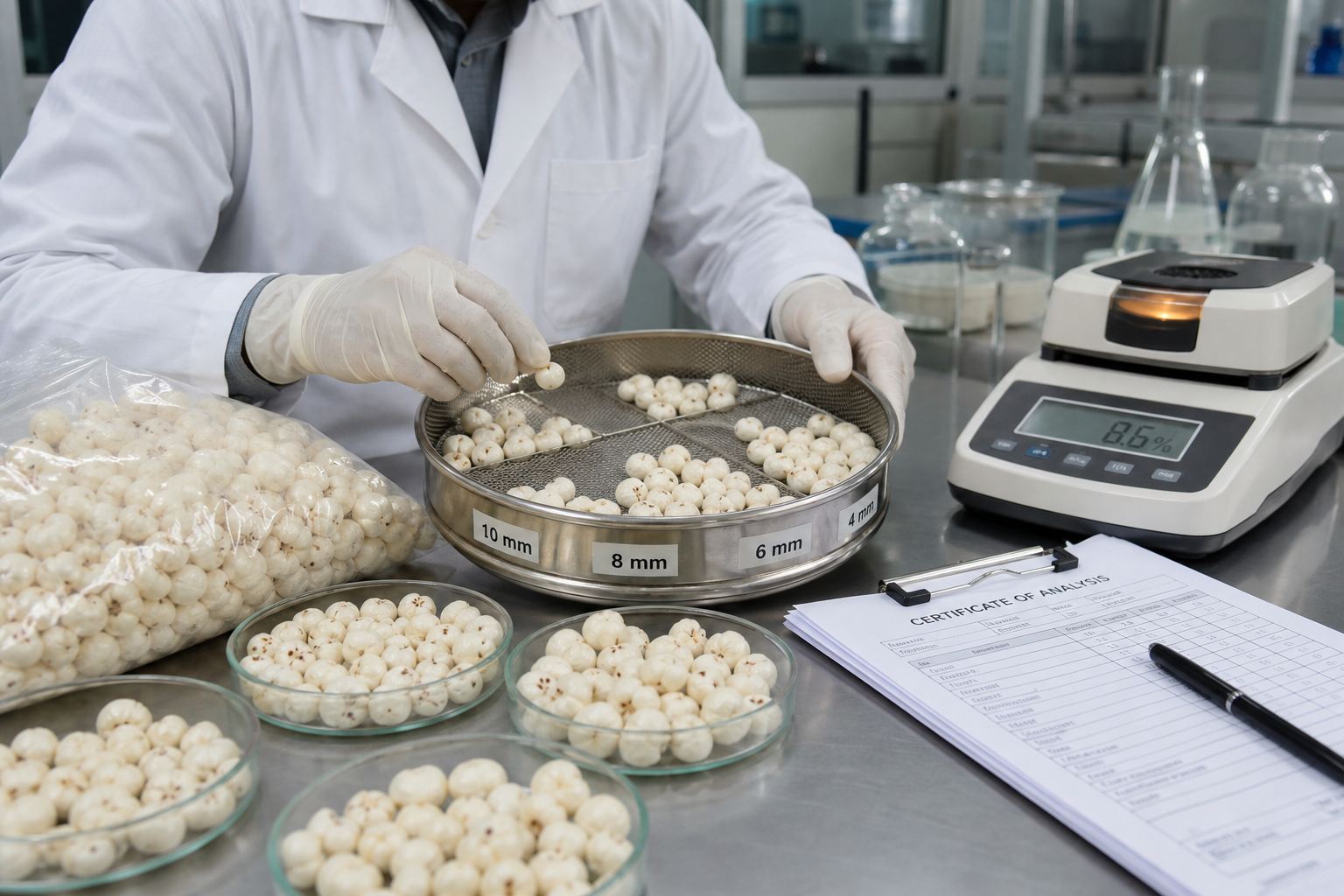
Size grading in millimetres is the primary quality and pricing lever within the popped category: larger, whiter, more uniformly puffed kernels (commonly graded above 16–18mm) command premium pricing, while smaller and more broken kernels move at commodity pricing or get diverted to flour production. GI-tagged Mithila Makhana claims require supporting documentation tying the lot back to the recognised production region — a claim that carries real commercial value with buyers who specifically search for authenticated Bihar-origin product. For a full breakdown of specific SKUs, grade specifications, and how to position organic and premium lines, see Top Fox Nut / Makhana Products Exported from India and Organic & Premium Fox Nut Makhana Export Opportunities.
Manufacturing Overview
Export Tip
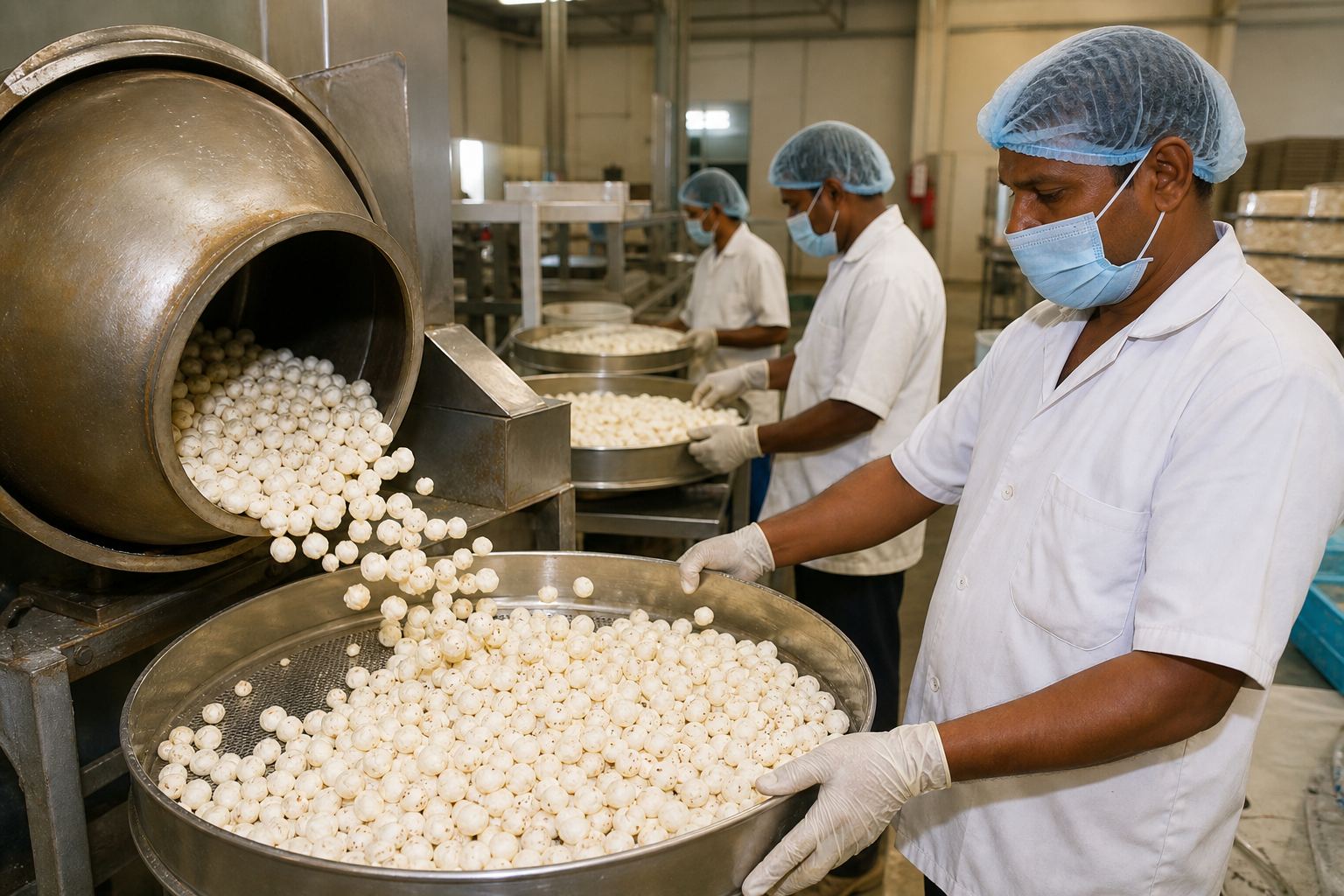
Makhana processing begins at harvest, when seeds are collected from pond beds — traditionally by hand, often by diving harvesters working in the Mithila wetlands — and sun-dried before storage. The defining transformation step is roasting and popping: dried seeds are heated (traditionally in earthen kilns over controlled fires, increasingly in mechanized rotary roasters at larger processing units) until the hard seed coat cracks and the interior puffs into the familiar light, crunchy white kernel. This step requires real skill — under-roasting leaves dense, poorly popped kernels that buyers reject on inspection, while over-roasting scorches flavour and darkens colour, both of which reduce grade and price.
After popping, kernels pass through size-grading — typically sieved or optically sorted into millimetre bands — with larger, more uniformly white, less broken kernels moving into premium export lots and smaller or broken material either sold at commodity pricing or diverted to flour production. Roasted plain makhana destined for flavoured retail SKUs then goes through a coating and seasoning line — oil or seasoning application, tumbling, and a secondary light roast or drying pass — before moving to packaging.
Because a large share of India's makhana processing capacity remains small-scale and semi-mechanized around the Mithila-Kosi belt, exporters typically work with a network of processing units rather than a single integrated factory, aggregating and re-grading lots to hit a consistent export specification. This is precisely where an experienced merchant exporter earns its margin: coordinating quality-consistent aggregation across multiple small processors is materially harder than sourcing from one large factory, and buyers should expect their Indian partner to explain exactly how lot consistency is achieved across a season.
Export Process: Step-by-Step
Export Tip
The following sequence is the complete operational path from a standing start to a shipped, documented makhana consignment. Follow the steps in order — registrations and testing gates exist precisely because skipping them creates customs holds, rejected lots, or damaged buyer trust that costs far more than the time saved.
Step 1: Obtain an Import Export Code (IEC) from DGFT
An IEC is the baseline legal requirement for any commercial export from India, including makhana. Apply online through the DGFT portal with PAN, current bank account details, and address proof consistent with your GST registration. Clean applications are typically processed within a few working days. Keep the IEC active and details current — a lapsed or mismatched IEC blocks shipping bill filing entirely, regardless of how ready your product is.
Step 2: Register with APEDA and secure your RCMC
Fox nuts fall under APEDA's (Agricultural and Processed Food Products Export Development Authority) notified product scope, making APEDA registration and an active RCMC (Registration Cum Membership Certificate) a practical necessity for shipping bill filing under the relevant HS headings and for accessing APEDA's market development support, buyer-seller meet programmes, and trade intelligence. Registration is completed online via the APEDA portal and requires your IEC, FSSAI licence, GST details, and bank information. For a deeper look at what RCMC unlocks specifically for this category, see APEDA Registration Benefits for Fox Nut Makhana Exporters.
Step 3: Secure an FSSAI licence and align processing to food-safety standards
Every processing and exporting entity handling makhana as a food product needs a valid FSSAI licence — central licensing typically applies once turnover or export activity crosses the relevant threshold. FSSAI's food safety standards govern hygiene, contamination control, and labelling declarations. Processing units should run documented hygiene practices around roasting, popping, grading, and packing areas, and be prepared to demonstrate HACCP-aligned controls, particularly for buyers in the USA, UK, and EU who increasingly ask for evidence of a functioning food-safety management system, not just a licence number.
Step 4: Source from verified Mithila-belt processors and aggregators
Sourcing quality begins with mapping your supply to specific pond-cultivation zones and processing partners in Madhubani, Darbhanga, Sitamarhi, Saharsa, Katihar, Purnia, or the broader Mithila/Kosi region, with West Bengal and eastern UP as supporting sources if your volume or specification allows it. Written supplier agreements should specify roasting method, expected size-grade distribution, moisture targets, and — where a GI Mithila Makhana claim will be made — documentation tying the lot to the recognised geography. For buyers evaluating direct sourcing relationships rather than working through an intermediary trader, see Source Fox Nuts Makhana Directly from India.
Step 5: Manage roasting, popping, and size grading to export specification
Align expected size-grade distribution, colour, and broken-percentage tolerances with your buyer's specification before committing to a production run — premium buyers above 18mm size grade will not accept a lot skewed toward smaller kernels, even at a discount, if their retail packaging or brand positioning depends on a specific kernel size. Maintain lot-level records of roasting batch, popping date, and grading results so any quality question downstream can be traced back to a specific production run.
Step 6: Commission laboratory testing and a lot-specific certificate of analysis (COA)
Before booking freight, commission a laboratory COA covering moisture content, size-grade distribution in millimetres, broken percentage, foreign matter, microbiological parameters, and — where the buyer's market or an organic/EU claim requires it — aflatoxin and pesticide residue screening. Do not ship on the strength of a prior season's or a different lot's report; buyers and destination inspectors increasingly expect lot-matched documentation, and mismatches are a common cause of customs or buyer-side holds.
Step 7: Select export packaging matched to buyer channel
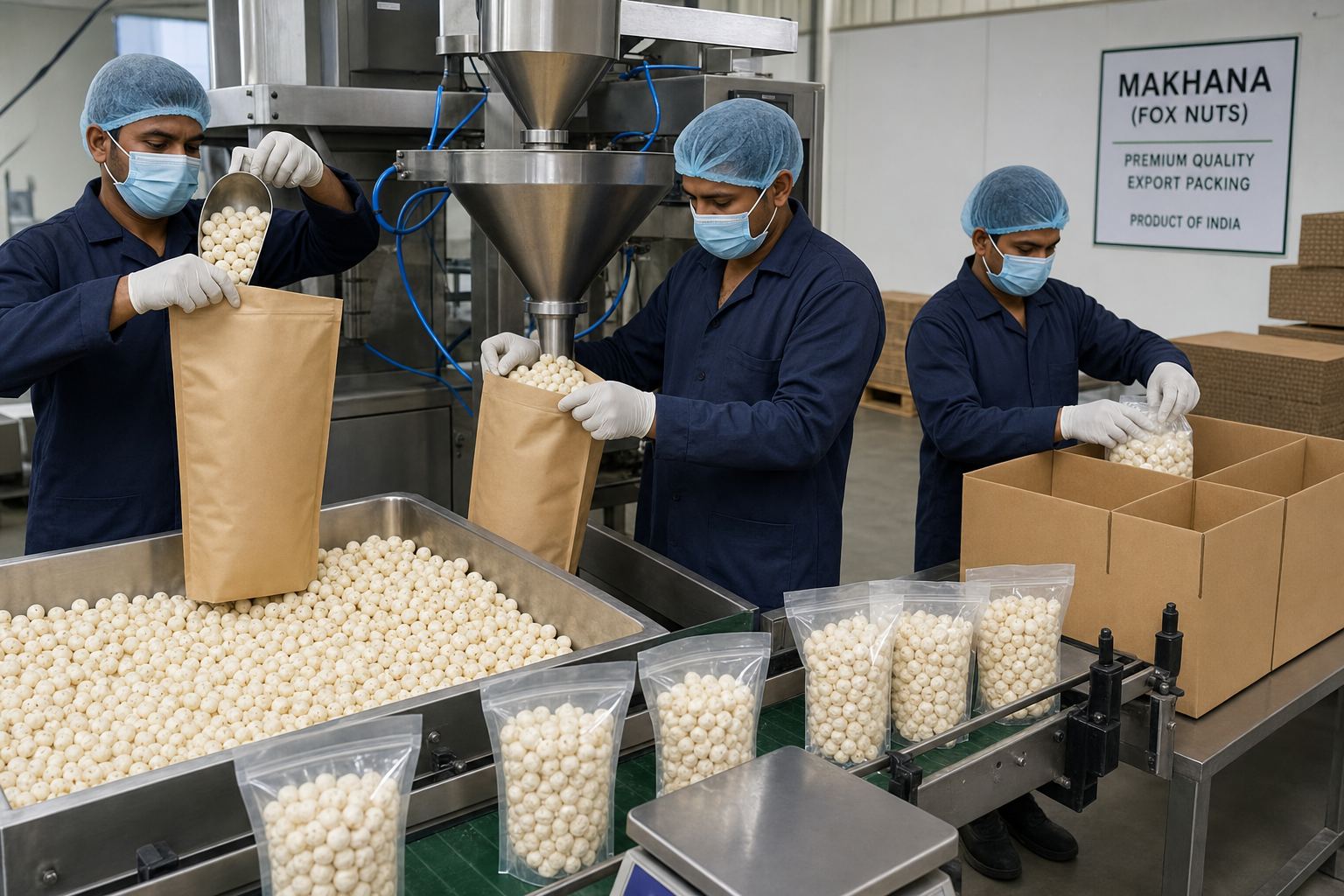
Bulk export lots typically move in food-grade LDPE or HDPE bags or cartons at 5, 10, 20, or 25 kg, with nitrogen-flush or moisture-barrier packaging commanding a premium for buyers who need extended shelf stability or are shipping through humid transit lanes. Retail-format lots for private-label or branded programmes run 50–500 g pouches with destination-compliant labelling. Because popped makhana is fragile and hygroscopic, packaging integrity is as much a quality control step as a logistics one — see the Packaging Standards section below for full specification detail.
Step 8: Build your export pricing and confirm Incoterms
Construct your FOB price from raw seed procurement, roasting/popping and grading costs, laboratory testing, APEDA-related compliance costs, export-grade packaging, inland haulage to your chosen port, and an appropriate margin — then quote buyers under EXW, FOB, or CFR/CIF depending on their logistics preference, with DDP available selectively for buyers who want fully landed pricing. See the Pricing Analysis section for directional FOB bands by grade.
Step 9: Prepare export documentation and coordinate with your CHA
Core documentation includes the commercial invoice, packing list, shipping bill, bill of lading or airway bill, certificate of origin, the lot-specific COA, an APEDA-related certificate where applicable, and an FSSAI or health certificate for the food category. Confirm your current HS heading — 20081921 for popped, 20081922 for flour/powder, 20081929 for other preparations, noting some transitional filings may still reference legacy heading 19041090 — with your CHA before filing, since classification changes from July 2025 have created a period of mixed practice across shipping bills. For a full pre-shipment checklist, see Fox Nut Makhana Export Documentation Checklist.
Step 10: Book shipping and manage container loading
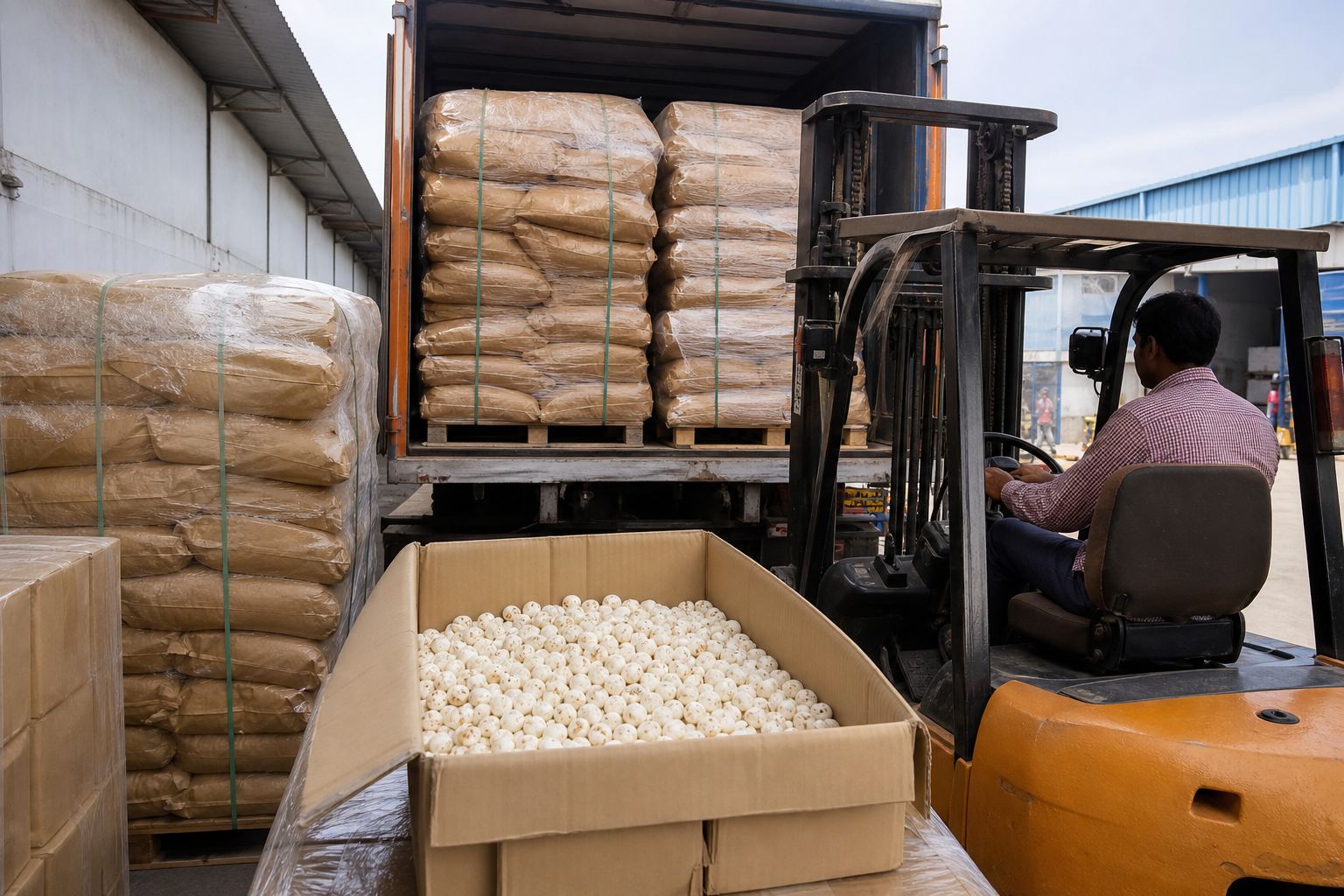
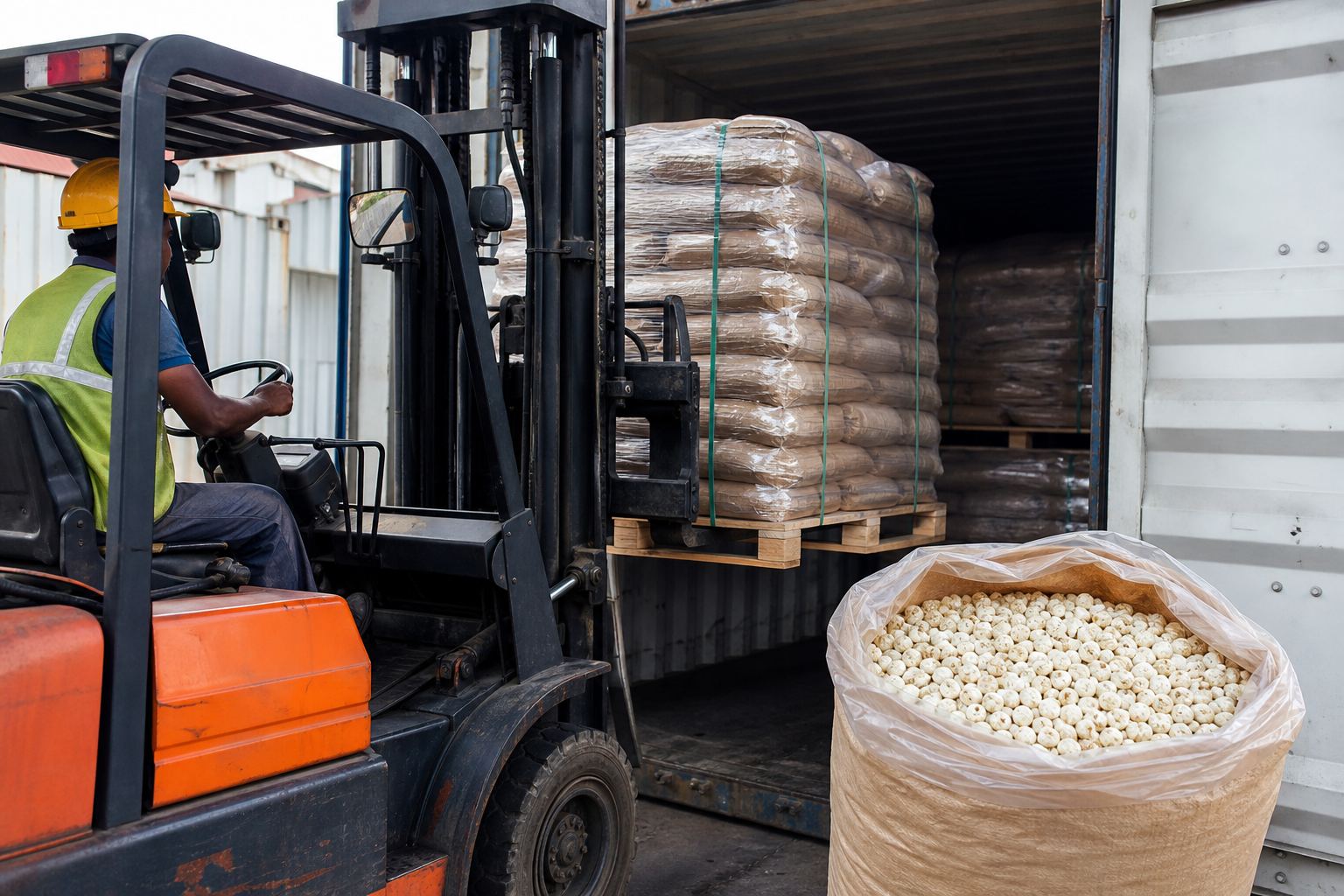
Makhana is a low-density, moisture-sensitive food product, so container loading plans should account for both weight and volume constraints, plus adequate dunnage and moisture control. Kolkata is the natural gateway given its proximity to Bihar, with Nhava Sheva and Mundra serving as alternative or consolidation ports depending on buyer routing and carrier availability. See the Container Loading Details and Shipping Methods sections below for full planning guidance.
Step 11: Develop and maintain international buyers
Buyer development for makhana works best through a combination of trade-data prospecting, food and health-product trade shows, B2B marketplace listings, and direct outreach to retail and private-label procurement teams — supported at every stage by clean lab documentation and a consistent grade story. See How to Find International Buyers for Fox Nuts Makhana and Trade Shows & B2B Marketplaces for Fox Nut Makhana Exporters for a structured approach.
Pricing Analysis
Buyer Tip
Makhana pricing is driven primarily by size grade, roast quality, and whether the lot carries organic or GI Mithila documentation — far more than by simple bulk-volume discounting, which is common in less differentiated commodities. Treat the figures below as directional FOB bands for planning purposes; always confirm current pricing against a fresh quotation, since raw seed availability and seasonal harvest outcomes in Bihar can move pricing meaningfully year to year. APEDA's Oct-2025 unit-price data shows overall export FOB fluctuating roughly USD 15.5–20.3/kg, with destination unit prices directionally highest in Germany (~USD 26/kg), Nepal (~USD 21.6/kg), and Australia (~USD 21/kg) despite their smaller volume shares.
Directional FOB USD/kg pricing bands by product grade
Swipe →
Data table — swipe horizontally on small screens
| Product / Grade | Directional FOB USD/kg | Notes |
|---|---|---|
| Commodity popped makhana (standard grade) | ~12–18 | Mixed size distribution, standard roast |
| Premium popped makhana (>18mm) | ~18–26+ | Large, uniform, whiter kernels; retail-grade appearance |
| Organic-certified popped makhana | Premium over conventional | NPOP/USDA/EU Organic certified; price varies by certifying scheme and volume |
| Private-label / branded retail packs | Premium over bulk FOB | Includes packaging, labelling, and compliance costs |
| Roasted & flavoured makhana | Premium over plain popped | Seasoning, coating, and secondary processing add cost |
| Makhana flour / powder | Typically below popped retail grades | Made from broken kernels; priced as an ingredient input |
MOQ Analysis
Buyer Tip
Minimum order quantities for makhana scale from sample-size lots through to full-container wholesale, and matching your MOQ expectations to where you are in the buyer relationship avoids wasted negotiation cycles on both sides.
Directional MOQ tiers by transaction stage
Swipe →
Data table — swipe horizontally on small screens
| Stage | Typical MOQ | Purpose |
|---|---|---|
| Sample | 1–5 kg | Buyer product and quality evaluation |
| Trial order | 100–500 kg | Market and channel testing, small retail runs |
| Wholesale / bulk | 1–5 MT | Established buyer repeat programmes |
| FCL container | Varies by pack density | Full-container economics for larger distributors and importers |
Packaging Standards
Export Tip
Popped makhana is genuinely fragile — kernels crush under compression and reabsorb moisture quickly if packaging is compromised, which makes packaging as much a quality-control decision as a logistics one. Bulk export packaging should be food-grade, sealed, and specified against the buyer's shelf-life and transit-humidity requirements; retail packaging must additionally meet destination labelling rules.
Packaging formats and specifications for makhana export
Swipe →
Data table — swipe horizontally on small screens
| Format | Typical Size | Use Case | Key Requirement |
|---|---|---|---|
| Food-grade LDPE/HDPE bags | 5 / 10 / 20 / 25 kg | Bulk wholesale, industrial repacking | Heat-sealed, food-grade, moisture-resistant |
| Cartons with liner | 5 / 10 / 20 / 25 kg | Bulk wholesale with added crush protection | Corrugated outer with food-grade inner liner |
| Nitrogen-flush / moisture-barrier bags | 5–25 kg | Premium bulk, long transit lanes, extended shelf life | Barrier film, nitrogen flush, heat-sealed |
| Retail pouches | 50–500 g | Private-label and branded retail, e-commerce | Destination-compliant labelling, tamper-evident seal |
| Retail cartons / display boxes | 50–500 g units, multi-packed | Retail shelf and foodservice channels | Shelf-ready design, barcode/label compliance |
Container Loading Details
Export Tip
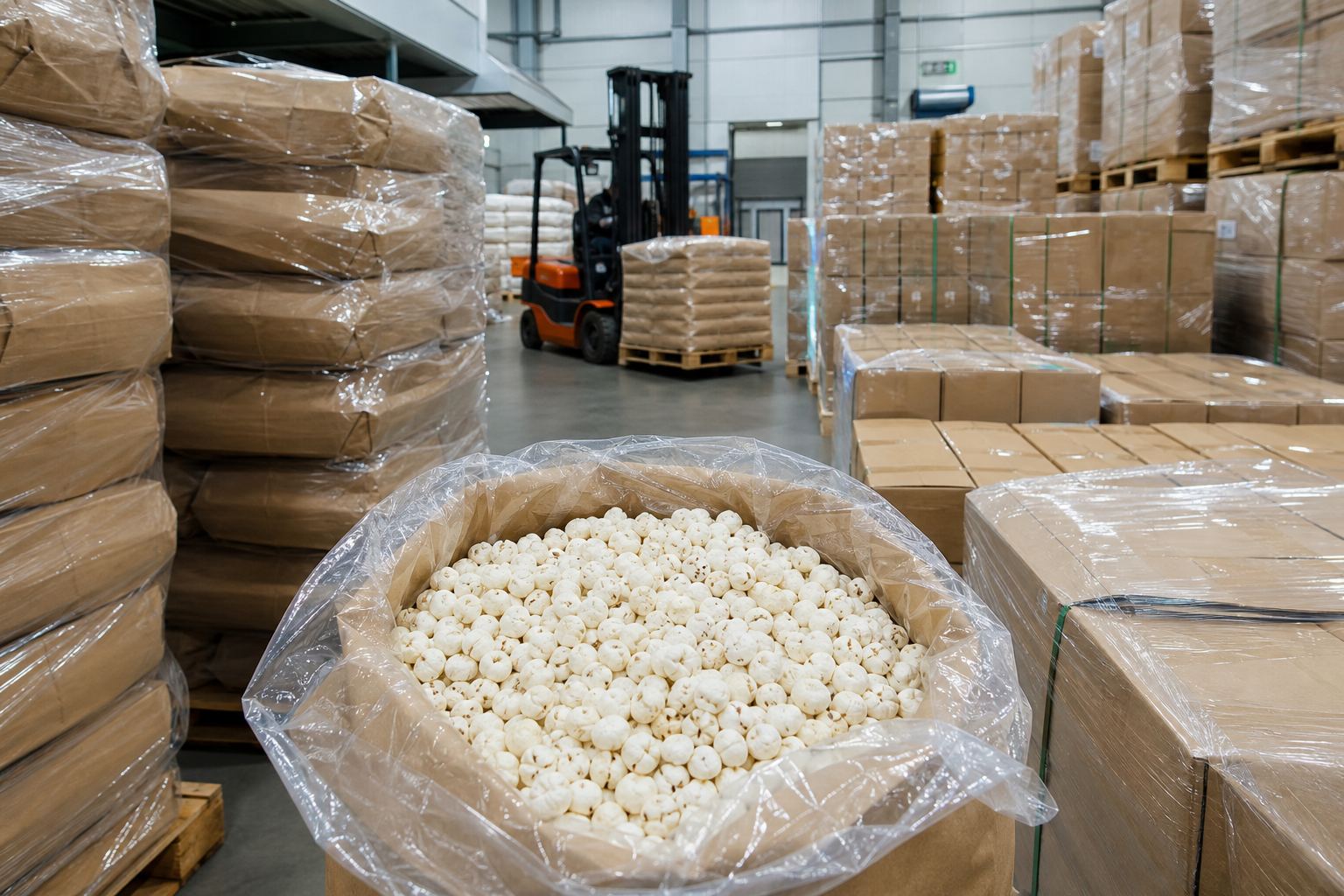
Because popped makhana is low-density, container loading plans for this category are usually volume-constrained before they are weight-constrained — meaning exporters and buyers should plan pallet stacking and dunnage carefully rather than assuming a container will simply load to its weight limit. Pack density (bag size, whether product is compressed or loose-filled, and whether cartons or bags are used) determines the realistic net weight achievable per container.
Directional container loading guidance for makhana
Swipe →
Data table — swipe horizontally on small screens
| Container Type | Loading Consideration | Typical Use |
|---|---|---|
| 20-foot FCL | Volume-constrained; ~5–10 MT for popped grades, ~12–16 MT for denser raw seed | Trial and mid-size wholesale shipments |
| 40-foot FCL / 40-foot HC | Volume-constrained; ~10–18 MT for popped grades; better economics per kg for larger orders | Established wholesale and distributor programmes |
| LCL (less than container load) | Suitable for sample and small trial shipments | New buyer relationships, market testing |
| Palletisation | Recommended for retail cartons to reduce crush risk | Retail and private-label shipments |
Shipping Methods
Export Tip
- Samples and small trial kits: air freight or express courier, 7–14 days typical lead time
- Standard bulk/wholesale orders: ocean FCL/LCL from Kolkata, Nhava Sheva, or Mundra, 2–4 weeks typical lead time
- Flavoured or private-label programmes: ocean freight with 4–8 weeks typical lead time to allow for formulation and label approval
- Incoterms commonly used: EXW, FOB, CFR/CIF, with DDP offered selectively for buyers who want fully landed pricing
Ocean freight under FCL or LCL is the standard shipping method for commercial makhana volumes, given the product's shelf stability relative to fresh agricultural goods — there is no cold-chain requirement for properly dried, roasted, and sealed makhana. Kolkata is the natural port of choice given its proximity to Bihar's Mithila-Kosi production belt, minimising inland haulage distance and time; Nhava Sheva and Mundra serve as alternative gateways depending on carrier routing, consolidation options, or buyer-side preference for a specific arrival port.
Air freight is occasionally used for urgent sample shipments, trade-show product kits, or very high-value premium/organic lots destined for launch orders, but it is not economical for standard bulk or wholesale volumes given the product's low per-kg value relative to freight cost. Lead times typically run 7–14 days for samples, 2–4 weeks for standard stock orders, and 4–8 weeks for flavoured or private-label programmes that require formulation, packaging development, and label approval before production.
Certifications
Compliance Notes
Certification requirements for makhana scale with the buyer's market and the specific claims made on the label. Baseline compliance (FSSAI, APEDA RCMC) is non-negotiable for legal export; the remaining certifications are commercially valuable for accessing specific premium buyer segments and should be pursued deliberately rather than opportunistically.
Certifications relevant to fox nut / makhana export
Swipe →
Data table — swipe horizontally on small screens
| Certification | Purpose | Relevant For |
|---|---|---|
| FSSAI licence | Baseline Indian food-safety compliance | All exporters and processors |
| APEDA RCMC | Mandatory registration for notified agricultural export categories | All exporters |
| ISO 22000 / HACCP | Food safety management system certification | Buyers requiring documented food-safety systems (USA, UK, EU) |
| Halal certification | Religious dietary compliance | UAE, Gulf, and other Muslim-majority markets |
| Kosher certification | Religious dietary compliance | Select USA and other Jewish-community retail channels |
| NPOP / USDA Organic / EU Organic | Organic certification for premium claims | Organic retail and specialty buyers in the USA, EU, UK |
| GI documentation (Mithila Makhana) | Origin authentication for Bihar-region claims | Buyers and marketing programmes making a verified Mithila-origin claim |
Buyer Requirements
Buyer Requirements
International buyers evaluating an Indian makhana supplier typically ask for a consistent set of proof points before issuing a purchase order, and exporters who prepare these proactively convert faster than those who wait to be asked. At minimum, expect buyers to request: a lot-specific COA covering moisture, size grade, broken percentage, and microbiology; sample kits across the size grades or flavour SKUs under consideration; clear FOB or landed pricing by grade and volume tier; packaging specification sheets, including any nitrogen-flush or moisture-barrier options; and evidence of FSSAI and APEDA registration status.
Retail and private-label buyers in the USA, UK, and EU commonly add label-compliance review, allergen statements, nutritional panel verification, and — for organic or GI Mithila claims — certificate copies that can be independently verified. Gulf-region wholesale buyers frequently prioritise Halal certification and competitive bulk pricing over retail-format sophistication. Buyers new to the category should also expect to discuss shelf-life claims and moisture-related storage guidance, since makhana's hygroscopic nature makes this a genuine technical question, not a formality.
Country-wise Opportunities
Market Snapshot
Each of India's primary makhana destination markets has a distinct buyer profile and compliance emphasis, and matching your product form, certification investment, and packaging format to the right market sequence materially improves conversion speed for new exporters. For a country-by-country deep dive, see Most Demanded Indian Fox Nuts Makhana by Country and Best Countries for Indian Fox Nut Makhana Exports.
Directional country opportunity profile for Indian makhana exporters
Swipe →
Data table — swipe horizontally on small screens
| Country | Demand Profile | Key Requirement Focus | Opportunity Note |
|---|---|---|---|
| USA | Largest directional destination; retail, private label, e-commerce | FDA food facility registration, Prior Notice, FSVP compliance, label compliance, organic certification value; MFN duty on prepared fox nuts (HTS 2008.19.xx) is typically ~17.9% ad valorem — confirm with a US broker | Strong for both commodity bulk and premium/organic retail lines |
| Canada | Second-largest directional destination | CFIA-aligned labelling, bilingual packaging for retail | Good fit for retail and South Asian grocery-channel distribution |
| UAE | Major wholesale and re-export hub | Halal certification, food-safety documentation | Strong bulk volume; gateway to broader Gulf demand |
| UK | Retail and health-food specialty demand | FSA-aligned compliance, clear labelling | Good fit for organic and premium retail-format lots |
| Australia | Health-food retail niche | DAFF biosecurity import conditions, FSANZ food-safety compliance | Premium positioning opportunity at smaller volumes |
| Germany | Emerging organic/health-food channel | EU labelling and organic certification rigor | Long-term premium opportunity as category awareness grows |
| Nepal | Established cross-border demand | Simpler logistics given proximity to Bihar | Good fit for commodity bulk volumes |
Sourcing Checklist
Checklist
Buyer Checklist
Exporter Checklist
Compliance Checklist
Checklist
Compliance Notes
Common Buyer Mistakes
Common Mistakes Box
- Buying purely on lowest price without checking size-grade consistency — Solution: request a lot-specific COA and physical samples before committing volume.
- Assuming all 'Bihar makhana' carries GI Mithila status — Solution: request the specific GI documentation rather than accepting the claim at face value.
- Underestimating packaging needs for humid transit lanes — Solution: specify nitrogen-flush or moisture-barrier packaging for longer or high-humidity routes.
- Ordering a large first shipment before a trial order — Solution: start with a 100–500 kg trial to validate grade consistency and packaging integrity.
- Not confirming current HS classification post-July 2025 — Solution: confirm 20081921/20081922/20081929 with your CHA before filing.
- Treating flour/powder pricing expectations the same as popped retail grades — Solution: price and negotiate flour/powder as a distinct ingredient category.
- Skipping label-compliance review for retail-format imports — Solution: run destination labelling review before printing final retail packaging.
- Assuming organic claims are self-certifying — Solution: verify NPOP/USDA/EU Organic certificates independently before marketing a lot as organic.
Buyers new to sourcing makhana from India — and exporters new to serving them — repeat a predictable set of avoidable errors. The patterns below account for the majority of failed first orders and damaged buyer relationships in this category.
Challenges & Solutions
- Challenge: fragmented small-processor supply base creates lot-to-lot grade variation — Solution: work with an aggregator or merchant exporter who actively manages multi-supplier grading consistency across a season.
- Challenge: product fragility during transit — Solution: invest in moisture-barrier packaging and careful container loading/palletisation rather than treating packaging as a cost to minimise.
- Challenge: seasonal raw-seed availability affecting pricing and supply consistency — Solution: plan procurement contracts and pricing reviews around the Bihar harvest calendar rather than assuming flat year-round pricing.
- Challenge: HS classification transition creating documentation confusion — Solution: maintain an active relationship with a CHA experienced in the current makhana HS headings.
- Challenge: verifying GI Mithila and organic claims from a distance — Solution: request underlying certificates and, where volume justifies it, commission independent verification or a supplier audit.
- Challenge: differentiating in an increasingly crowded flavoured-snack retail category — Solution: lean on authenticated origin story (GI Mithila), verified organic certification, and consistent size grading as differentiators buyers can market against.
Exporting makhana at scale involves a specific set of operational challenges that differ from more industrially standardised food exports, largely because of the crop's fragmented, semi-artisanal processing base and its physical fragility.
Future Market Trends
Key Statistics
The makhana export category is likely to keep professionalising over the next several years as buyer expectations around certification, traceability, and packaging sophistication rise alongside overall category growth. Flavoured and roasted retail formats will likely continue gaining share relative to plain popped kernels as international consumers become more familiar with the product as a snack rather than purely a health ingredient, which favours exporters who invest in seasoning and retail-packaging capability rather than staying purely in bulk commodity supply.
Organic certification and GI Mithila documentation are likely to become stronger differentiators as more buyers in the USA, UK, and EU specifically search for verified, premium-origin makhana rather than treating the category as an undifferentiated commodity. At the same time, increasing buyer sophistication means exporters who cannot produce lot-specific COAs, consistent size grading, and verifiable certification will find it progressively harder to compete purely on price as the category matures and more organised players enter.
Processing infrastructure investment in Bihar — including state-supported cluster development around Madhubani and Darbhanga — should gradually reduce the fragmentation that currently makes grade consistency the industry's central operational challenge, though this is a multi-year structural shift rather than something that resolves in a single season. Exporters and buyers who build relationships now with well-organised aggregators and merchant exporters are positioning themselves ahead of that consolidation curve rather than behind it.
Expert Insights
Expert Insight Box
Altus Exports works with international buyers and Indian makhana processors as a merchant exporter, global sourcing partner, and export consultant — coordinating supplier verification, laboratory testing, packaging specification, and shipment execution so that both sides of the transaction are protected by documentation, not just goodwill.
Conclusion
- Next step for processors and exporters: complete IEC, APEDA RCMC, and FSSAI licensing, then audit grading consistency across your supplier network before your next production season.
- Next step for buyers: share your target size grade, flavour requirements, certification needs, and volume — Altus Exports will match verified Mithila-belt suppliers and coordinate testing and shipment.
- Explore export products from India and global sourcing partner services for broader multi-category sourcing support alongside makhana.
- Consider product sourcing company India services if you are evaluating makhana alongside other agricultural or food categories for a diversified import programme.
Learning how to export fox nuts from India comes down to building a disciplined operating system around a genuinely artisanal agricultural product: legal registration through IEC, APEDA RCMC, and FSSAI; sourcing that is mapped to specific Mithila-belt processors rather than an anonymous commodity pool; roasting, popping, and size-grading managed to a written specification; lot-specific laboratory COAs before every shipment; packaging that respects the product's fragility and hygroscopic nature; and documentation that stays consistent, lot by lot, from invoice to bill of lading. India's structural advantage — Bihar alone supplying roughly 80–85% of global output, rooted in a GI-protected origin (APEDA directional) — is real, but it only converts into buyer trust and repeat orders when the operational and compliance system behind it is equally strong.
If you are an Indian makhana processor, aggregator, or MSME ready to formalise your export programme, complete your registrations, audit your grading consistency across suppliers, and commission your first lot-specific COA before approaching international buyers. If you are an international buyer or retailer evaluating India as a sourcing origin, use the checklists in this guide to structure your supplier due diligence from the first sample request. Altus Exports coordinates both sides of that relationship as a merchant exporter in India — reach out via our contact page to discuss your specific volume, grade, and certification requirements.
This guide is the process pillar for our fox nut / makhana content cluster. For the product-level catalogue of specific grades and SKUs, see Top Fox Nut / Makhana Products Exported from India. For market selection, see Best Countries for Indian Fox Nut Makhana Exports and Most Demanded Indian Fox Nuts Makhana by Country. For direct sourcing guidance, see Source Fox Nuts Makhana Directly from India. For registration depth, see APEDA Registration Benefits for Fox Nut Makhana Exporters. For buyer development, see How to Find International Buyers for Fox Nuts Makhana and Trade Shows & B2B Marketplaces for Fox Nut Makhana Exporters. For premium and organic strategy, see Organic & Premium Fox Nut Makhana Export Opportunities. For your documentation gate, see Fox Nut Makhana Export Documentation Checklist.