
Best Countries to Export Indian Fox Nuts (Makhana) in 2026
By Saurabh Mittal, Founder, Altus Exports
A practical destination-ranking guide to the best countries for Indian fox nut (makhana) exports in 2026. Compares USA, Canada, UAE, UK, Australia, Germany, and Nepal on import demand, duty structure, freight corridors, certification requirements, and market-entry difficulty — with pricing benchmarks, container-loading economics, a country scorecard, and a Bihar exporter case study from Altus Exports.
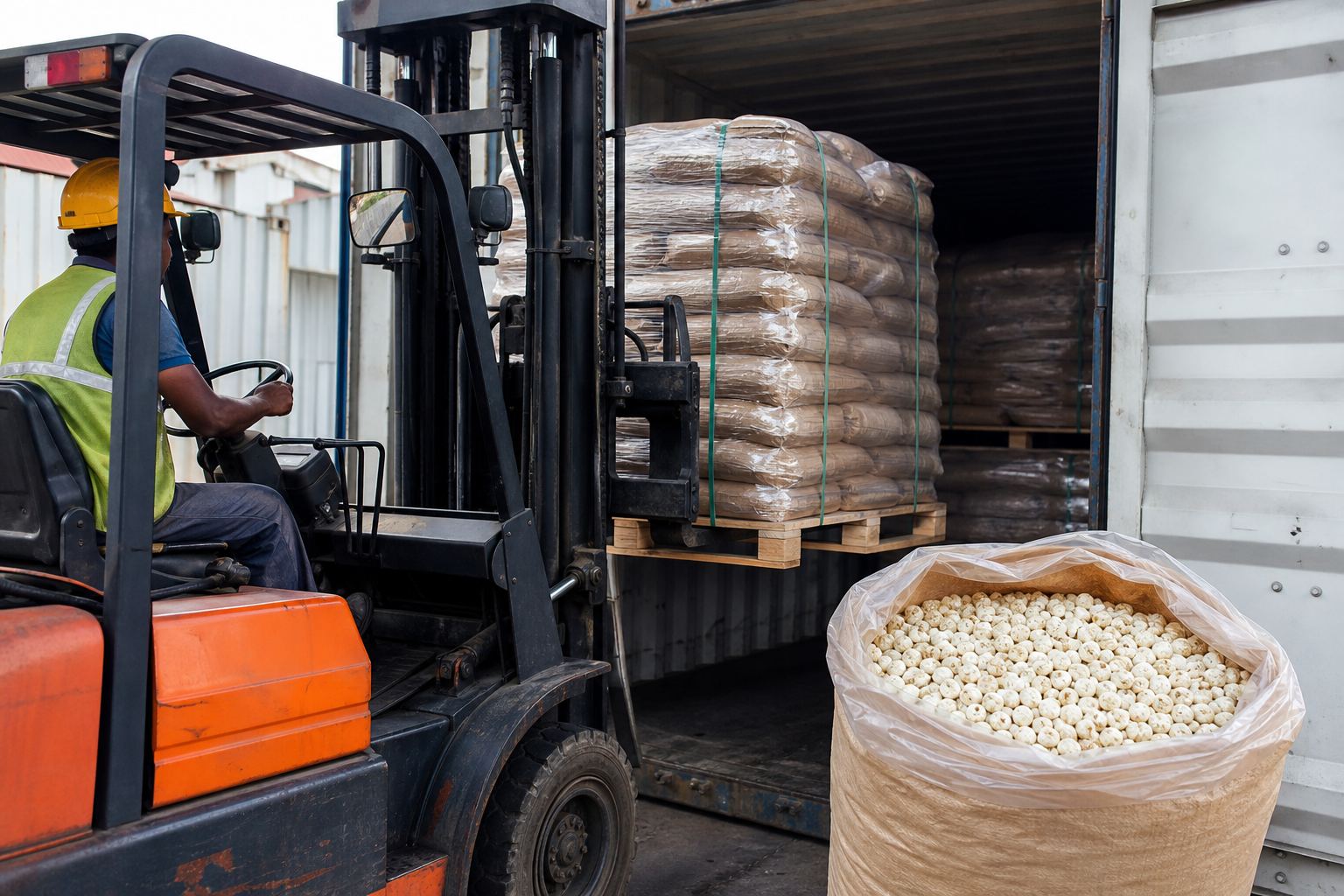
Fox nuts — known as makhana, phool makhana, or by their botanical name Euryale ferox — have moved from a regional Indian snack ingredient to a global better-for-you food category in under a decade. India dominates global fox nut supply, and Bihar alone accounts for roughly 80–85% of world output and about 90% of India's production (APEDA directional), almost entirely from the GI-tagged Mithila belt (Madhubani, Darbhanga, Sitamarhi, Saharsa, Katihar, and Purnia), with West Bengal and eastern Uttar Pradesh contributing supporting volumes. That production concentration gives Indian exporters genuine pricing power — but only in the markets where demand, duty structure, and logistics economics line up.
Choosing the wrong first destination is the single most common reason new makhana exporters stall after one or two shipments. A country with strong retail demand for roasted snack pouches is not automatically the easiest place to land a first container if duty exposure, cold-chain-free shelf-life rules, or labelling requirements are unclear. This guide ranks the best countries to export Indian fox nuts and makhana in 2026 using the filters that actually determine whether a market is commercially viable: import demand by HS code (20081921 popped, 20081922 flour/powder, 20081929 other, with some customs desks still referencing legacy heading 19041090), duty and preferential access, certification burden, buyer type, and freight corridor economics from Kolkata, Nhava Sheva, and Mundra.
This guide is built for Indian makhana exporters, Bihar-based producer groups, FPOs, and merchant exporters deciding where to invest certification and buyer-outreach budget first. Pair it with How to Export Fox Nuts (Makhana) from India for the full process pillar and Top Fox Nut Makhana Products Exported from India for category depth. If you are a buyer rather than an exporter, the companion guide How International Buyers Can Source Fox Nuts (Makhana) Directly from India covers the RFQ-to-landed-cost playbook from your side of the table.
Key Takeaways
Summary Box
- The best countries for Indian makhana exports in 2026 are not equally accessible — USA, Canada, and UAE together already account for roughly three-quarters of India's fox nut export value, and each has a distinct duty and certification profile.
- USA remains the largest single destination by value, driven by health-snack retail and e-commerce demand for roasted and flavoured popped makhana.
- Canada offers similar buyer behaviour to the USA with a smaller but growing organic and bulk ingredient channel.
- UAE is the fastest entry-cycle market for retail and gifting formats, but requires Halal-aligned processing documentation.
- UK, Australia, and Germany are mid-size premium niches where certified organic and large-grain (>18mm) makhana earn the strongest margins.
- Nepal is a high-frequency, low-friction land-border market that many exporters underrate as a volume stabiliser between seasonal export cycles.
- APEDA registration, FSSAI licensing, and destination-specific lab documentation (moisture, size grade, aflatoxin, pesticide residues) are the baseline that every market on this list requires before quotation.
- Altus Exports supports agriculture & food products exporters with market prioritisation, certification alignment, and export coordination for makhana programmes.
Executive Summary
Summary Box
Global demand for fox nuts and makhana has expanded well beyond South Asian diaspora retail into mainstream health-snack, keto, gluten-free, and plant-protein categories across North America, the Gulf, Europe, and Oceania. Because India dominates world supply — with Bihar alone accounting for roughly 80–85% of world output (APEDA directional) — the constraint on export growth is rarely raw material — it is market selection, certification readiness, and freight-corridor economics.
This guide scores seven priority destinations — USA, Canada, UAE, UK, Australia, Germany, and Nepal — against import demand, duty exposure, certification complexity, average order size, and ease of entry. USA and Canada offer the largest addressable retail and e-commerce channels; UAE offers the fastest buyer decision cycle; UK, Australia, and Germany reward certified organic and large-grain premium positioning; and Nepal offers a low-friction land corridor that many exporters overlook in favour of container-only planning.
The recommendation for most exporters entering export for the first time is to sequence markets rather than pursue all seven simultaneously: build documentation and freight discipline in one North American or Gulf market first, then extend to the EU/UK premium tier once certification depth (organic, HACCP/ISO 22000) is in place.
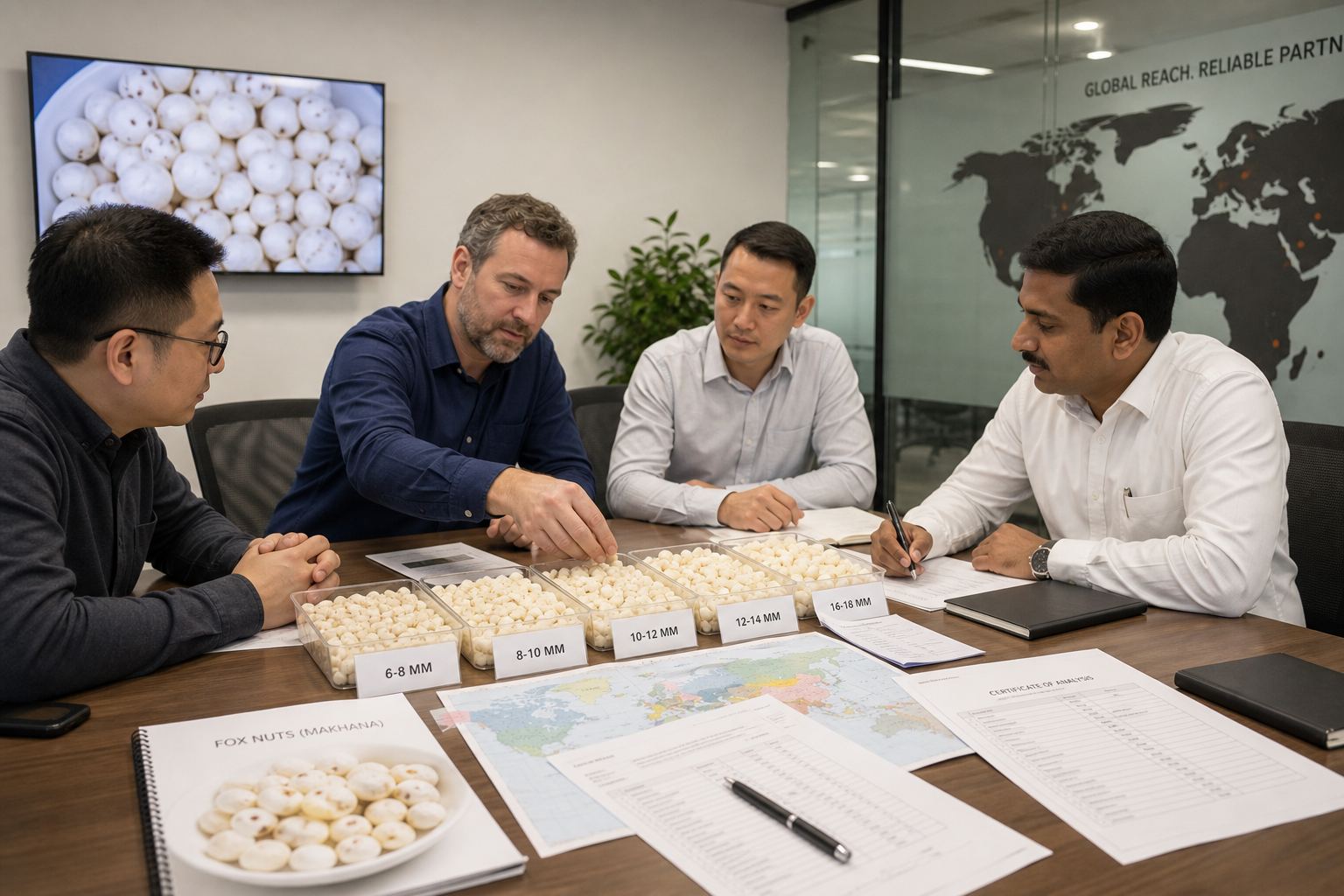
Market Size & Industry Overview
Key Statistics
India's makhana economy is anchored in the wetland aquaculture systems of the Mithila region of Bihar, where Euryale ferox is cultivated in ponds (mauns) and harvested seasonally before the seeds are sun-dried, roasted in sand-bed furnaces, and mechanically or manually popped into the familiar white, puffed kernel. The Mithila Makhana GI tag formally recognises this regional specialisation and is increasingly used as a provenance marker in export documentation and premium retail positioning. West Bengal and the eastern districts of Uttar Pradesh supplement Bihar's output but do not currently rival its scale or GI-backed brand recognition.
Export-oriented processing has consolidated around graded, roasted, and packed popped makhana (HS 20081921) as the dominant traded form, with makhana flour and powder (HS 20081922) growing fastest as a bakery, infant-nutrition, and health-food ingredient, and other preparations — flavoured, coated, or mixed-snack formats — filed under HS 20081929. Some customs desks, particularly for older shipment classifications or specific preparation types, still reference the legacy heading 19041090 for prepared cereal-based foods; exporters should confirm current classification with their customs broker per destination rather than assuming a single HS code applies universally.
APEDA oversight and FSSAI licensing form the regulatory backbone for Indian makhana exports, with quality benchmarked against moisture content, size grade (measured in millimetres of popped kernel diameter), broken percentage, foreign matter, microbiological limits, and — because Euryale ferox is a stored seed crop — aflatoxin and pesticide residue screening where destination markets require it.
Comparison table
Swipe →
Data table — swipe horizontally on small screens
| Dimension | 2026 Snapshot | Exporter Implication |
|---|---|---|
| HS Codes | 20081921 popped; 20081922 flour/powder; 20081929 other; legacy 19041090 | Confirm current classification per shipment with destination broker |
| Core producing belt | Mithila GI Bihar — Madhubani, Darbhanga, Sitamarhi, Saharsa, Katihar, Purnia | Tie provenance claims to GI-backed sourcing documentation |
| Supporting regions | West Bengal, Eastern Uttar Pradesh | Useful for volume flexibility during peak-demand windows |
| India's global supply share | Bihar ~80–85% of world output; ~90% of India's production (APEDA directional) | Pricing power exists, but only where certification and freight are in order |
| Regulatory bodies | APEDA, FSSAI | Registration and licensing are non-negotiable prerequisites |
| Quality benchmarks | Moisture %, size grade (mm), broken %, foreign matter, microbiology, aflatoxin, pesticides | Build a standard COA template before your first quotation |
| Top destinations by value | USA ~40%, Canada ~20%, UAE ~17%, plus UK/Australia/Germany/Nepal | Sequence market entry rather than pursuing all destinations at once |
Export Statistics
Key Statistics
India's fox nut and makhana export value has grown steadily as health-snack positioning gained traction in North America and the Gulf, with popped and roasted formats accounting for the large majority of shipped volume. Flavoured and private-label programmes are the fastest-growing sub-segment as overseas retail brands seek differentiated SKUs rather than plain roasted kernels. Per APEDA's MIC Makhana dashboard, total India makhana exports grew directionally from roughly 6,700 MT in 2020 to roughly 25,130 MT in 2024 (~39% CAGR), with Jan–Oct 2025 volumes around 18,150 MT — tracking slightly below the 2024 full-year pace amid US tariff and price pressure.
Comparison table
Swipe →
Data table — swipe horizontally on small screens
| Metric | 2026 Indicative Position | Trend |
|---|---|---|
| Dominant export form | Roasted/popped makhana (HS 20081921, effective July 2025) | Stable majority share |
| Fastest-growing form | Makhana flour/powder (HS 20081922) | Rising — bakery and infant-nutrition demand |
| Flavoured/coated variants (HS 20081929) | Growing private-label and retail-brand share | Rising, especially USA, UAE, UK |
| Export volume, 2020 → 2024 | ~6,700 MT → ~25,130 MT (~39% CAGR, APEDA directional) | Jan–Oct 2025 ~18,150 MT, slightly below 2024 pace |
| Top 3 destinations by export value | USA, Canada, UAE (~77% combined) | Concentration remains high; diversification opportunity in UK/Australia/Germany |
| Seasonal production cycle | Harvest concentrated post-monsoon; processing/export flow through the year from inventory | Plan buyer commitments around Bihar harvest and processing calendar |
| Primary exporter profile | FPOs, processing units, and merchant exporters consolidating multi-grower supply | Buyers increasingly prefer consolidated, documentation-ready suppliers |
Import Statistics
Key Statistics
Import demand for Indian makhana is concentrated in a small number of markets, but the buyer profile differs meaningfully between them — from mainstream health-snack retail in North America to gifting and hospitality channels in the Gulf, and from mid-size specialty-food importers in Europe to daily cross-border trade in Nepal.
Comparison table
Swipe →
Data table — swipe horizontally on small screens
| Country | Approx. Share of Indian Makhana Exports | Dominant Buyer Type | Preferred Format |
|---|---|---|---|
| USA | ~40% | Health-snack retail, e-commerce brands, natural-food distributors | Roasted/flavoured retail pouches, bulk for repacking |
| Canada | ~20% | Natural-food distributors, South Asian grocery chains, growing mainstream retail | Bulk and retail pouches |
| UAE | ~17% | Hypermarkets, gifting/hospitality procurement, health retail | Premium retail packs, gift-format tins |
| UK | ~10% | Specialty and organic food retailers, South Asian grocery | Retail pouches, organic bulk |
| Australia | ~1–5% (higher unit price, ~USD 21/kg directional) | Health-food and specialty retail importers | Retail pouches, bulk for repacking |
| Germany | ~1–5% (higher unit price, ~USD 26/kg directional) | Organic and natural-food distributors | Certified organic bulk |
| Nepal | ~1–5% (higher unit price, ~USD 21.6/kg directional), high shipment frequency | Cross-border wholesale and retail traders | Bulk sacks, unbranded and branded |
Product Categories & Variants (Brief Overview)
Summary Box
Destination markets differ in which makhana format they absorb fastest. Understanding the category split helps exporters match production planning to buyer demand rather than defaulting to plain roasted kernels for every market.
Comparison table
Swipe →
Data table — swipe horizontally on small screens
| Category | HS Reference | Typical Buyer | Best-Fit Markets |
|---|---|---|---|
| Plain roasted/popped (unflavoured) | 20081921 | Health-food retail, bulk repackers | USA, Canada, UK, Australia |
| Flavoured/roasted (masala, peri-peri, cheese, chocolate-coated) | 20081929 | Retail brands, private-label programmes | USA, UAE, UK |
| Makhana flour/powder | 20081922 | Bakery, infant-nutrition, health-ingredient manufacturers | USA, Germany, Canada |
| Raw/unpopped seed and broken grades | 20081929 / legacy 19041090 in some filings | Processors, ingredient blenders | Nepal, regional processors |
| Premium large-grain (>18mm) retail | 20081921 | Gifting, hospitality, premium grocery | UAE, UK, Australia |
| Certified organic / private-label | 20081921 / 20081922 | Organic retail chains, branded importers | Germany, UK, USA, Canada |
Manufacturing Overview (Brief)
Export Tip
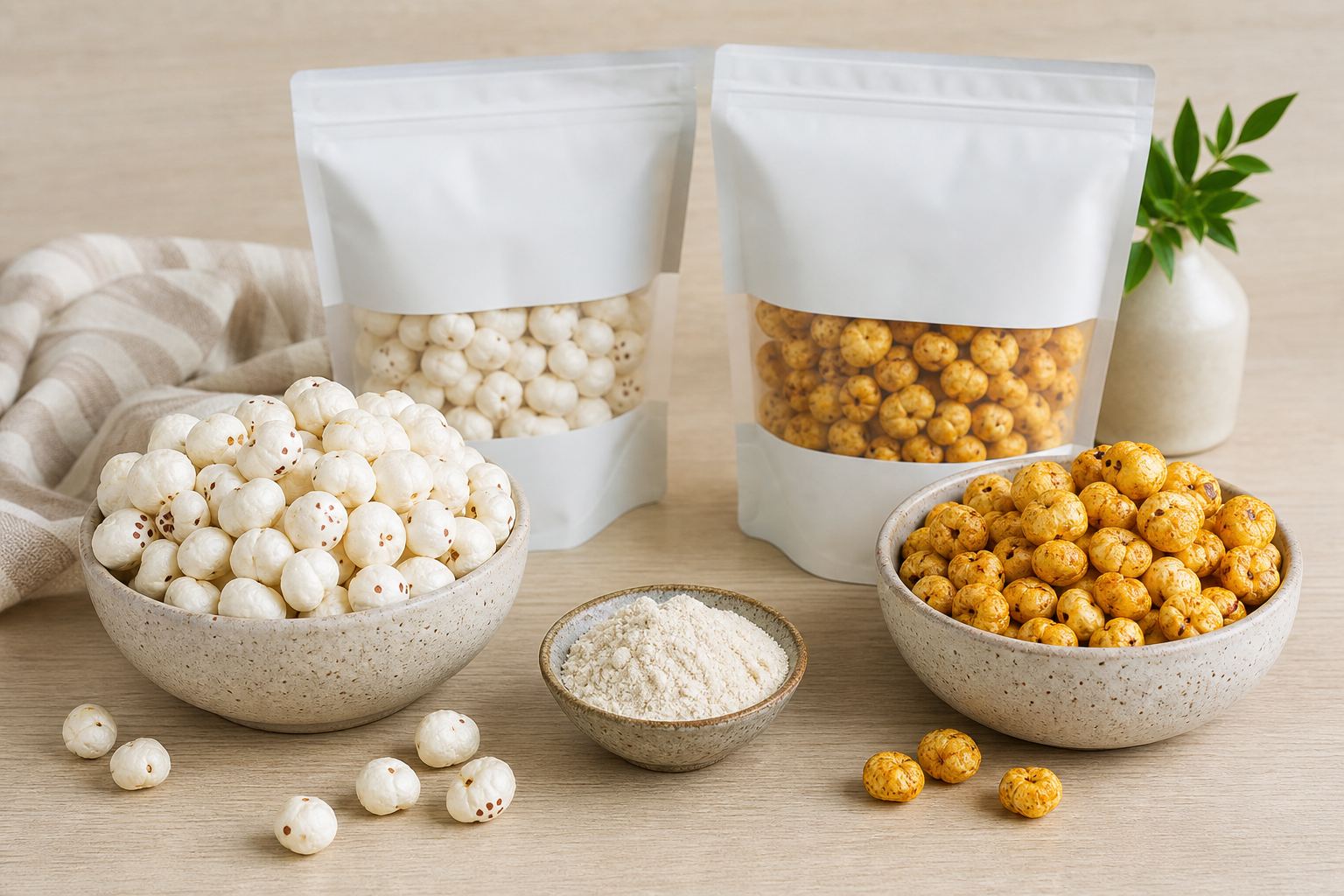
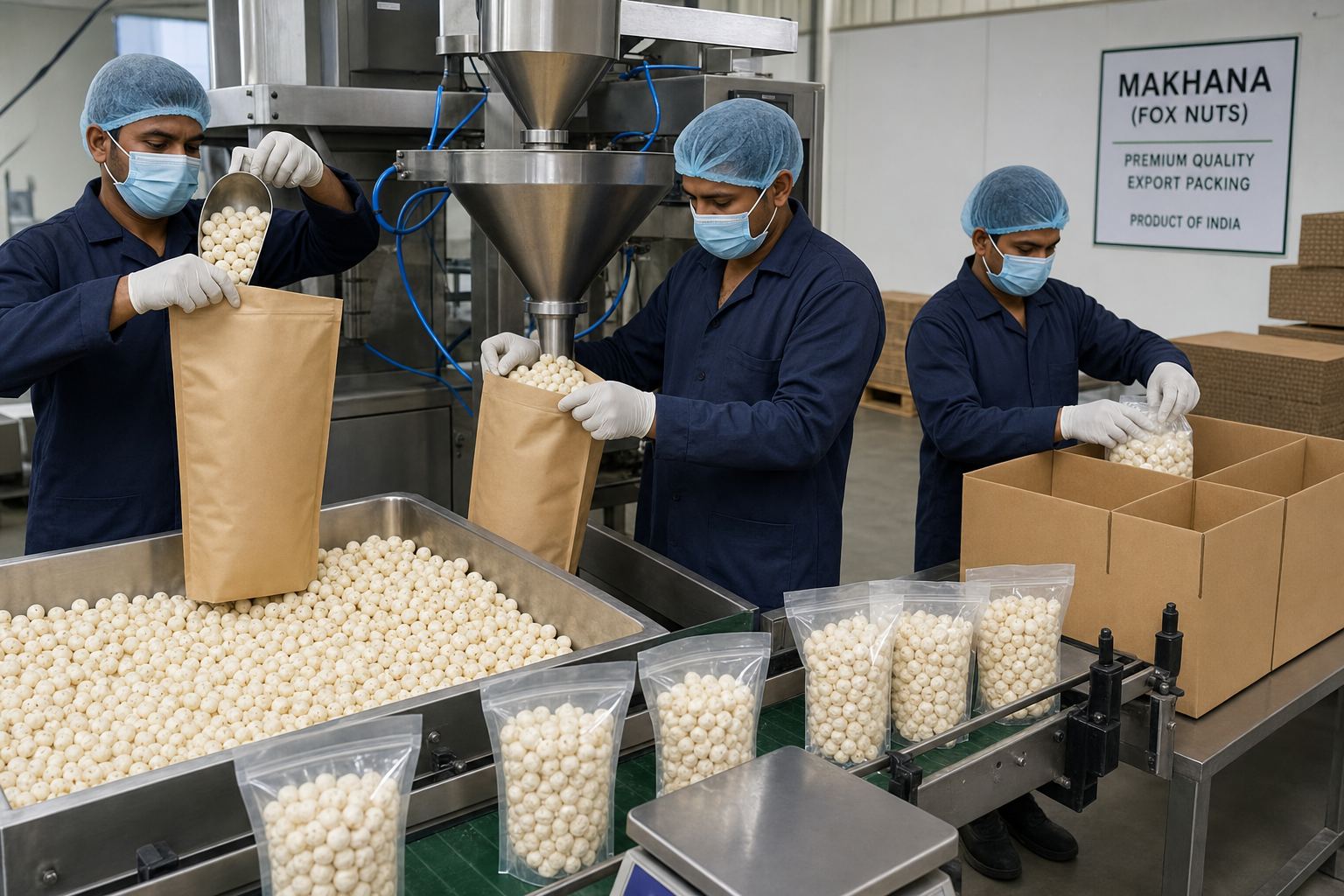
Makhana processing follows a defined sequence: pond-cultivated seeds are harvested, sun-dried, and stored before controlled roasting over sand beds or in mechanised roasters brings the seed to popping temperature. Popping — traditionally done by striking heated seeds, increasingly supported by semi-mechanised processing — separates the puffed white kernel from the shell. Kernels are then graded by size in millimetres, sorted for broken percentage and foreign matter, and either packed plain or processed further into flavoured, coated, or flour formats.
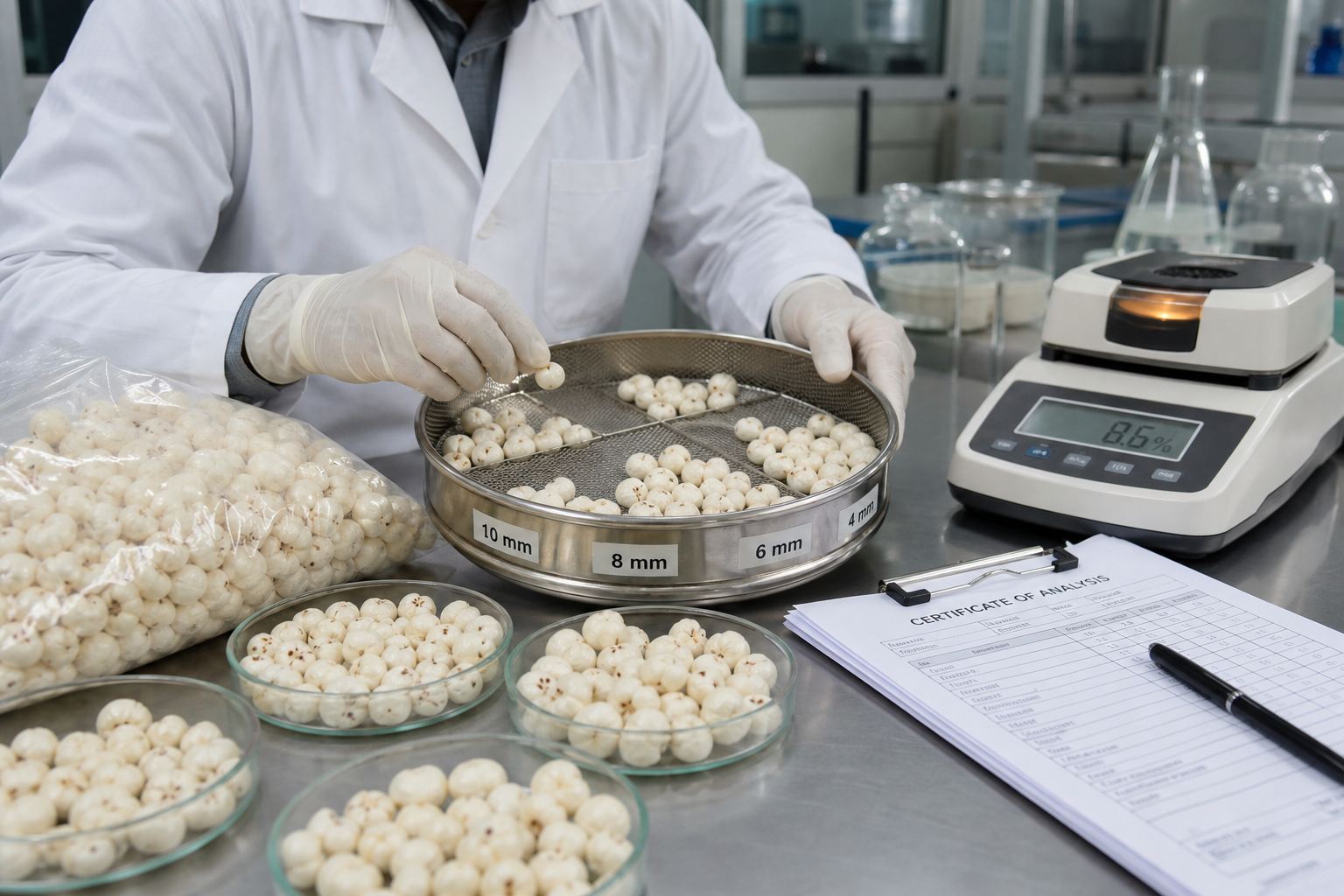
Export-ready processing units maintain moisture control through the roasting and packing stages, since elevated moisture is the primary driver of shelf-life failure and microbial risk in transit. Buyers evaluating suppliers should expect a documented process flow and a Certificate of Analysis referencing moisture, size grade, and broken percentage at minimum. Full manufacturing detail, equipment standards, and quality-control checkpoints are covered in How to Export Fox Nuts (Makhana) from India.
Export Process (Buyer-Relevant Overview)
Export Tip
- Registration: APEDA, FSSAI licence, IEC, and GST compliance before any export quotation.
- Specification agreement: size grade (mm), moisture ceiling, broken %, flavour/format, and packaging confirmed in writing.
- Lab testing: lot-level COA covering moisture, size grade, broken %, foreign matter, microbiology, and aflatoxin/pesticides where the destination requires it.
- Documentation: commercial invoice, packing list, certificate of origin, phytosanitary certificate (where applicable), health certificate (for certain food-safety-strict destinations).
- Shipment: FCL/LCL sea freight via Kolkata, Nhava Sheva, or Mundra, or land-border movement for Nepal.
- For the complete step-by-step export process with documentation depth, see How to Export Fox Nuts (Makhana) from India and Fox Nut Makhana Export Documentation Checklist.
For destination-market planning purposes, exporters need only the buyer-facing shape of the export process: registration and compliance (APEDA, FSSAI, IEC), sample and specification agreement, lot-level lab testing, production or ex-stock allocation, packaging to destination requirements, documentation (commercial invoice, packing list, certificate of origin, phytosanitary certificate where required, health certificate for certain markets), and shipment via the appropriate freight corridor and Incoterm.
Pricing Analysis
Buyer Tip
Makhana pricing is driven primarily by size grade — larger popped kernels (measured in millimetres) command a steep premium over standard and broken grades — followed by certification level (conventional vs. organic), format (plain vs. flavoured/private-label), and packaging specification (standard bag vs. nitrogen-flush premium pouch). That grade-and-certification logic plays out differently market by market: APEDA's Oct-2025 dashboard puts the overall export FOB band at roughly USD 15.5–20.3/kg, yet Germany, Nepal, and Australia post the highest average unit prices (directionally ~USD 26, ~USD 21.6, and ~USD 21/kg) on comparatively small volumes — a signal that these three markets reward certification and grade discipline rather than the volume play that defines the USA and Canada.
Comparison table
Swipe →
Data table — swipe horizontally on small screens
| Grade/Format | Indicative FOB Price (USD/kg) | Price Driver |
|---|---|---|
| Standard popped makhana (mixed size) | 12–18 | Baseline commodity grade; moisture and broken % discipline |
| Premium large-grain popped (>18mm) | 18–26+ | Kernel size, visual uniformity, low broken % |
| Certified organic popped | Premium above conventional equivalent grade | NPOP/USDA Organic/EU Organic certification |
| Private-label/flavoured retail | Premium above bulk-equivalent grade | Packaging, branding, flavour formulation, MOQ complexity |
| Makhana flour/powder | Varies by processing grade | Milling consistency, particle size, moisture control |
MOQ Analysis
Buyer Tip
Minimum order quantities scale predictably from evaluation samples through to container-scale wholesale commitments. Buyers in USA, Canada, UK, Australia, and Germany typically move through all three stages; UAE and Nepal buyers sometimes compress the sample-to-trial cycle given shorter freight transit and lower first-order risk perception.
Comparison table
Swipe →
Data table — swipe horizontally on small screens
| Order Stage | Typical MOQ | Purpose | Typical Lead Time |
|---|---|---|---|
| Evaluation sample | 1–5kg | Quality, taste, and size-grade evaluation | 7–14 days |
| Trial order | 100–500kg | Market/shelf test, buyer-side QC verification | 2–4 weeks |
| Wholesale/commercial order | 1–5MT | Programme-level retail or ingredient supply | 2–4 weeks ex-stock; 4–8 weeks for flavoured/private-label |
Packaging Standards
Export Tip
Packaging specification differs by channel: bulk buyers and repackers want food-grade bags or cartons in standard weight bands, while premium retail and gifting buyers in UAE, UK, and Australia expect nitrogen-flush barrier pouches that protect the delicate popped kernel from crushing and moisture pickup during transit.
Comparison table
Swipe →
Data table — swipe horizontally on small screens
| Pack Format | Typical Use | Notes |
|---|---|---|
| 5kg / 10kg food-grade bags or cartons | Bulk wholesale, food-service | Standard for USA, Canada, Nepal bulk trade |
| 20kg / 25kg bags or cartons | Large wholesale, ingredient manufacturing | Common for flour/powder and bulk popped grades |
| Nitrogen (N2) flush pouches | Premium and extended-shelf-life programmes | Preferred by UAE, UK, and premium USA retail brands |
| Retail pouches, 50–500g | Direct-to-consumer retail, e-commerce | Requires destination-compliant labelling and shelf-life declaration |
| Gift tins/boxes | UAE hospitality and gifting channel | High-margin format; premium large-grain preferred |
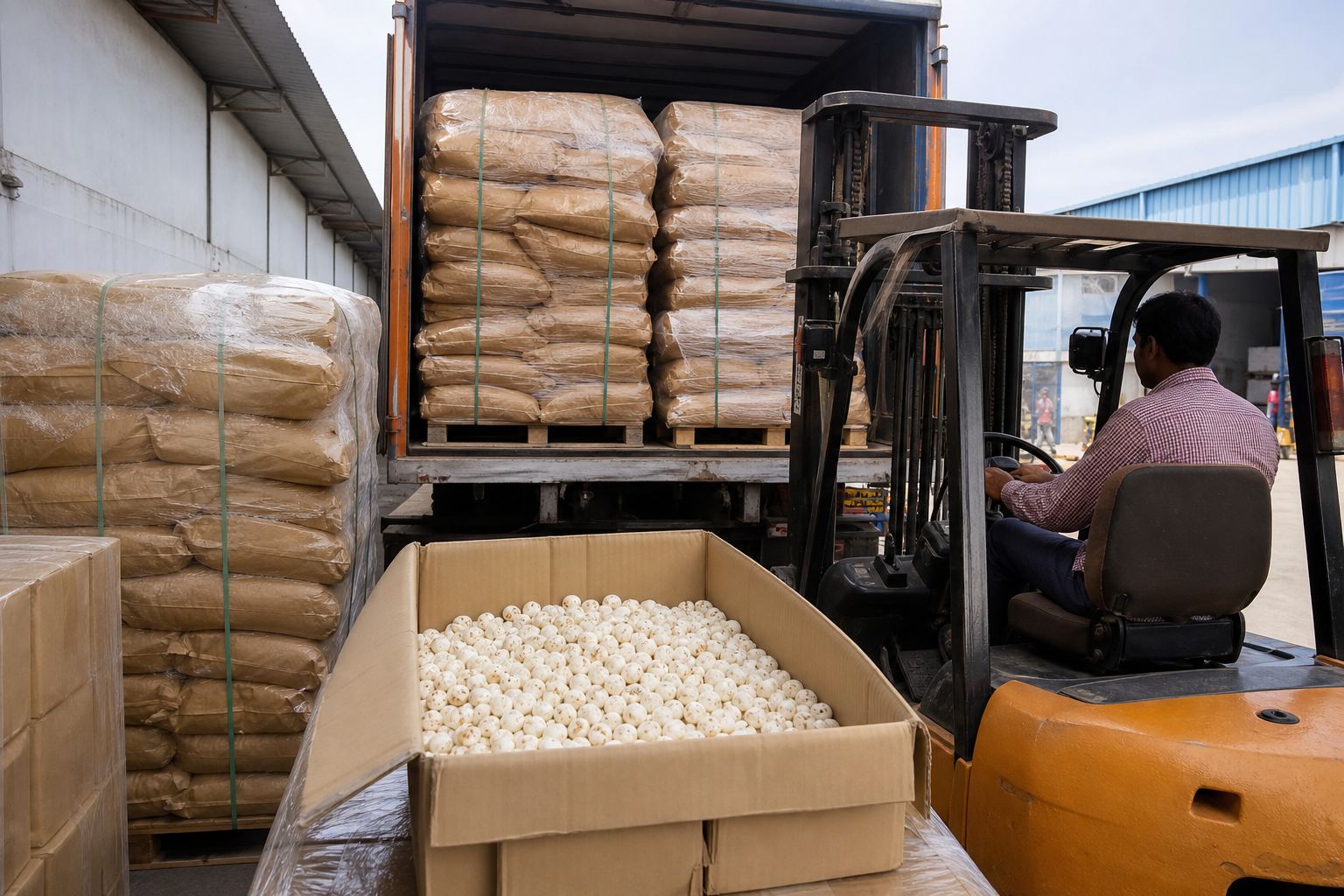
Container Loading Details
Export Tip
Popped makhana is light and bulky relative to its weight, which means container loading is frequently volume-constrained rather than weight-constrained — a planning detail that surprises exporters used to denser agricultural commodities. Crush resistance during stuffing and transit is a real quality risk that must be engineered into carton and pallet design, not addressed only at the packaging-material level.
Comparison table
Swipe →
Data table — swipe horizontally on small screens
| Container Type | Typical Loadability | Key Consideration |
|---|---|---|
| 20ft FCL | ~5–10 MT for popped grades (volume-constrained before weight limit); ~12–16 MT for denser raw seed | Carton stacking pattern must prevent crushing of kernels |
| 40ft FCL | ~10–18 MT for popped grades (volume-constrained); preferred for large bulk or mixed-SKU consolidated orders | Palletisation reduces handling damage versus loose carton stacking |
| LCL | Used for trial orders and smaller retail/gift-format shipments | Higher per-unit freight cost; acceptable for premium-margin formats |
| Flour/powder shipments | Denser than popped kernels; less volume-constrained | Standard bulk-bag or carton stuffing patterns apply |
Shipping Methods and Freight Corridors
Export Tip
Freight corridor choice is one of the most underused levers for improving makhana export economics, because the three relevant Indian load ports — Kolkata, Nhava Sheva (JNPT), and Mundra — sit at different distances from the Bihar production belt and offer different sailing frequencies to key destinations.
Kolkata offers the shortest inland haulage from Mithila-region processing units, which matters for a product where handling damage (crushed kernels) is a real cost. Nhava Sheva and Mundra offer higher sailing frequency and often more competitive freight rates to the USA West Coast, Europe, and the Gulf, at the cost of longer inland transit from Bihar. Exporters and merchant exporters routinely make destination-specific port decisions rather than defaulting to a single load port for every shipment.
Comparison table
Swipe →
Data table — swipe horizontally on small screens
| Corridor | Load Port | Approx. Transit Time | Best-Fit Incoterm |
|---|---|---|---|
| India → USA (East Coast) | Nhava Sheva / Kolkata | 25–35 days | FOB, CFR |
| India → USA (West Coast) | Nhava Sheva / Mundra | 20–28 days | FOB, CFR |
| India → Canada (East Coast) | Nhava Sheva / Kolkata | 28–35 days | FOB, CIF |
| India → UAE | Mundra / Nhava Sheva | 7–12 days | FOB, CIF |
| India → UK / Germany | Nhava Sheva / Mundra | 22–30 days | FOB, CIF |
| India → Australia | Nhava Sheva / Kolkata | 18–26 days | FOB, CFR |
| India → Nepal (land) | N/A — road/rail via Bihar-Nepal border | 2–5 days | EXW, FOB (border point) |
Certifications
Compliance Notes
Certification requirements scale with market premium expectations. Every destination requires the baseline of FSSAI licensing and APEDA registration; premium retail, organic, and Halal/Kosher-sensitive channels layer additional certification on top.
Comparison table
Swipe →
Data table — swipe horizontally on small screens
| Certification | Purpose | Primary Markets Requiring It |
|---|---|---|
| FSSAI licence | Domestic food-safety compliance baseline | All markets — mandatory |
| APEDA registration | Scheduled export product compliance | All markets — mandatory |
| HACCP / ISO 22000 | Food-safety management system verification | USA, Canada, UK, Germany, Australia |
| Halal certification | Religious dietary compliance | UAE and wider Gulf retail/hospitality |
| Kosher certification | Dietary compliance for niche USA/EU retail | USA specialty retail, select EU buyers |
| NPOP (India organic) | Domestic organic certification foundation | Basis for USDA/EU organic equivalence pathways |
| USDA Organic | US organic retail market access | USA organic and natural-food retail |
| EU Organic | EU organic retail market access | Germany, UK-adjacent EU distribution |
| GI tag (Mithila Makhana) | Provenance and premium positioning | All markets — brand/marketing value |
Buyer Requirements
Buyer Requirements
- Documentation expected before PO
- APEDA/FSSAI proof, sample COA, packaging specification sign-off
- Lab parameters buyers check
- Moisture %, size grade (mm), broken %, foreign matter, microbiology, aflatoxin, pesticide residues
- Packaging expectations
- Crush-resistant carton design, moisture-barrier packaging, accurate net-weight and shelf-life labelling
- Payment norms for new relationships
- Advance or LC-based terms; open account only after repeat-order track record
- Common differentiators sought
- Consistent size grading, low broken %, GI/provenance documentation, private-label flexibility
Country-wise Opportunities
Market Snapshot
The following profiles rank the seven strongest destinations for Indian fox nut and makhana exports in 2026. Each profile is a decision brief covering demand character, duty and certification burden, freight reality, and market-entry strategy — validate against current trade data before committing certification budget.
1. United States
- Why attractive
- Deep health-snack and keto/gluten-free retail channels; strong e-commerce and private-label opportunity; large South Asian diaspora grocery base as an anchor channel
- Duty and access
- For prepared/roasted fox nuts, US classification often falls under HTS 2008.19.xx (confirm the exact 10-digit line with a US broker); the MFN general rate for 2008.19.90 is typically 17.9% ad valorem, and India generally does not receive Free preferential treatment on this line. Additional reciprocal/special tariffs may apply — APEDA notes 2025 US tariff pressure on makhana exports. Always verify current HTSUS classification and any Chapter 99 measures with a licensed US customs broker before quoting landed cost.
- Certification expectations
- FDA food facility registration, Prior Notice of imported food shipments, FSVP (Foreign Supplier Verification Program) compliance, FSMA compliance, USDA Organic for organic claims, HACCP documentation valued by larger retail buyers
- Freight corridor
- Nhava Sheva or Kolkata to US East/West Coast; 20–35 days depending on port pairing
- Challenges
- Retail listing cycles are slow; private-label buyers demand consistent size grading and low broken % across repeat lots
- Strategy
- Lead with plain roasted and one flavoured SKU; provide full COA and FDA registration proof with every quotation; prioritise buyers with existing natural-food or South Asian grocery distribution before pursuing mainstream big-box retail.
The USA is the largest single destination for Indian makhana by export value, driven by mainstream health-snack retail, e-commerce brands, and natural-food distribution.
2. Canada
- Why attractive
- Established diaspora retail base plus emerging mainstream health-snack demand; bilingual labelling is manageable and well-understood by experienced exporters
- Duty and access
- Confirm current CBSA tariff treatment for the specific HS line; generally workable for prepared food preparations
- Certification expectations
- CFIA food-safety compliance, bilingual (English/French) labelling, organic certification recognised via NOP-equivalence pathways
- Freight corridor
- Nhava Sheva or Kolkata to Canadian East Coast ports; 28–35 days
- Challenges
- Smaller absolute volume than USA; bilingual packaging adds a production step
- Strategy
- Pair Canada with USA outreach using shared documentation; position Canada as a lower-risk North American entry point before scaling to full US retail complexity.
Canada mirrors USA buyer behaviour at a smaller scale, with a fast-growing mainstream retail interest layered on top of an established South Asian grocery channel.
3. United Arab Emirates
- Why attractive
- Short freight transit (7–12 days); strong gifting and hospitality demand for premium large-grain formats; growing health-retail interest
- Duty and access
- GCC common external tariff generally favourable for food preparations; confirm current rate and any GCC-wide documentation requirements
- Certification expectations
- Halal-compatible processing documentation, UAE Ministry of Economy food labelling compliance, FSSAI-backed origin documentation
- Freight corridor
- Mundra or Nhava Sheva to Jebel Ali; 7–12 days
- Challenges
- Retail price sensitivity in mainstream channels; premium gifting segment requires strong packaging investment
- Strategy
- Lead with premium large-grain (>18mm) in gift-tin formats for hospitality and gifting buyers; use UAE as a fast-cycle proof point before expanding into wider Gulf outreach.
UAE offers the fastest buyer decision cycle on this list, driven by hypermarket retail, gifting culture, and hospitality procurement for premium large-grain makhana.
4. United Kingdom
- Why attractive
- Established South Asian grocery and growing specialty/organic health-food retail demand; UK buyers can act independently of EU certification pathways
- Duty and access
- Confirm current UK Global Tariff treatment for the specific HS line post-Brexit
- Certification expectations
- UK food-safety compliance, organic certification (UK Organic or EU-equivalent recognised pathways), accurate labelling per UK rules
- Freight corridor
- Nhava Sheva or Mundra to UK ports; 22–30 days
- Challenges
- Post-Brexit documentation complexity; specialty retail buyers expect consistent quality documentation
- Strategy
- Lead with certified organic and premium large-grain SKUs; work with a UK-experienced import broker on labelling compliance before committing to retail listings.
The UK offers an accessible premium and organic retail culture with its own post-Brexit regulatory framework, distinct from the wider EU.
5. Australia
- Why attractive
- Strong consumer willingness to pay for natural and health-positioned snack foods; growing specialty retail interest in plant-based protein snacks
- Duty and access
- Confirm current DAFF biosecurity import conditions and tariff treatment before committing to any Australian quotation
- Certification expectations
- FSANZ food-standards compliance, biosecurity import permit where applicable, accurate labelling
- Freight corridor
- Nhava Sheva or Kolkata to Australian ports; 18–26 days
- Challenges
- Biosecurity requirements add complexity; not ideal as a first export market for inexperienced exporters
- Strategy
- Confirm current import conditions with an Australian food-import broker before investing in certification or packaging specific to this market.
Australia is a manageable premium niche for health-food and specialty retail, with strict biosecurity import conditions that must be mapped before quoting.
6. Germany
- Why attractive
- Large organic and natural-food retail market; strong buyer appetite for traceable, certified-organic snack and ingredient imports
- Duty and access
- EU common external tariff applies; confirm current rate and any preferential documentation requirements
- Certification expectations
- EU Organic certification (built on NPOP basis with EU-accredited certifier sign-off), EU food-safety and labelling compliance
- Freight corridor
- Nhava Sheva or Mundra to Hamburg/Rotterdam-adjacent EU ports; 22–30 days
- Challenges
- Highest compliance bar on this list; buyers conduct systematic documentation and quality checks
- Strategy
- Do not approach Germany without EU organic certification in place; use it as the EU distribution gateway once certified rather than as a first export market.
Germany represents the strongest EU entry point for certified organic makhana, rewarding provenance documentation and consistent quality over price competition.
7. Nepal
- Why attractive
- Direct road/rail movement from Bihar production clusters; 2–5 day transit; high shipment frequency supports steady cash flow between overseas container cycles
- Duty and access
- Cross-border trade arrangements are generally favourable for agricultural food products; confirm current documentation requirements at the specific border crossing
- Certification expectations
- FSSAI/APEDA documentation generally sufficient; less certification-intensive than overseas container markets
- Freight corridor
- Road/rail via Bihar-Nepal border crossings; 2–5 days
- Challenges
- Lower per-unit pricing than overseas premium markets; less suited to branded/private-label margin strategies
- Strategy
- Use Nepal as a volume and cash-flow stabiliser alongside overseas container programmes rather than as a standalone growth market.
Nepal is a land-border market that many exporters underweight in favour of container-only planning, despite offering the fastest, lowest-friction shipment cycle on this list.
Country Comparison Scorecard for Indian Makhana Exporters
Use this directional scorecard to prioritise outreach and certification investment. Scores are relative guidance for typical Indian makhana exporters in 2026 — validate against your specific grade mix, certification level, and freight economics.
Comparison table
Swipe →
Data table — swipe horizontally on small screens
| Country | Market Size | Duty/Access Complexity | Certification Burden | Freight Transit | Avg Order Size | Ease of Entry | Opportunity Score |
|---|---|---|---|---|---|---|---|
| USA | Very High | Low–Medium | Medium | 20–35 days | Medium–High | Medium | 9/10 |
| Canada | High | Low–Medium | Medium | 28–35 days | Medium | Medium–High | 8/10 |
| UAE | High | Low | Medium (Halal) | 7–12 days | Medium | High | 8.5/10 |
| UK | Medium–High | Medium | Medium–High | 22–30 days | Medium | Medium | 7.5/10 |
| Australia | Medium | High (biosecurity) | Medium–High | 18–26 days | Medium | Low–Medium | 6.5/10 |
| Germany | Medium | Medium | Very High (organic) | 22–30 days | Medium | Low–Medium | 7/10 |
| Nepal | Medium (frequent) | Low | Low | 2–5 days | Low–Medium | Very High | 7.5/10 |
Sourcing Checklist: Buyer and Exporter Readiness
Checklist
Whether you are the exporter preparing to enter a new market or the overseas buyer preparing to place a first order, both sides benefit from working off the same readiness checklist.
Buyer Checklist
- Confirm specification: grade/size (mm), moisture ceiling, broken %, flavour/format, organic requirement
- Verify supplier APEDA registration and FSSAI licence independently
- Request lot-level COA: moisture, size grade, broken %, foreign matter, microbiology, aflatoxin/pesticides
- Order samples (1–5kg) before committing to a trial order
- Confirm packaging specification, including moisture-barrier and crush-resistance requirements
- Align Incoterms, payment terms, and lead time in writing before production begins
Exporter Checklist
- Complete APEDA registration, FSSAI licence, IEC, and GST compliance
- Build a standard COA template covering all destination-relevant parameters
- Map certification gaps (organic, HACCP/ISO 22000, Halal, Kosher) against target markets before outreach
- Confirm freight corridor and Incoterm economics per destination before quoting FOB/CFR/CIF
- Prepare crush-resistant packaging design for popped-kernel formats before the first container
- Sequence market entry — build documentation depth in one market before expanding to the next
Compliance Checklist
Checklist
Compliance Notes
- APEDA registration current and covering the relevant scheduled product category
- FSSAI licence valid and covering processing and export operations
- IEC (Import Export Code) and GST registration in place
- Lot-level lab testing from an APEDA-approved or accredited laboratory for every commercial shipment
- Certificate of origin, phytosanitary certificate (where required), and health certificate (for markets that require it) prepared in advance
- Organic transaction certificates in place for any NPOP/USDA/EU Organic claims
- Halal or Kosher certification current where the destination channel requires it
- HS code classification confirmed with a licensed customs broker for the specific product form being shipped
Common Buyer Mistakes
Common Mistakes Box
Buyers new to sourcing Indian makhana repeat a predictable set of mistakes that exporters can proactively address in their sales process.
Comparison table
Swipe →
Data table — swipe horizontally on small screens
| Mistake | Consequence | How Exporters Should Address It |
|---|---|---|
| Buying on price alone without checking size grade | Inconsistent kernel size, high broken %, poor retail presentation | Provide grade-specific COA and sample kits upfront |
| Skipping independent lab verification | Undetected moisture or aflatoxin issues surfacing after shipment | Offer to co-fund destination-country retesting on first orders |
| Underestimating packaging needs for popped kernels | Crushed product on arrival, retail-unsellable stock | Recommend crush-resistant carton and pallet design proactively |
| Assuming one HS code applies to every format | Customs delays and reclassification disputes | Confirm HS code per product form before every shipment |
| Committing to large orders before a trial shipment | Quality mismatches discovered at full-container scale | Structure sample → trial → wholesale sequencing into every new relationship |
Challenges and Solutions
Makhana export challenges cluster around product fragility, quality consistency, certification gaps, and freight-corridor cost — each addressable with process discipline rather than guesswork.
Comparison table
Swipe →
Data table — swipe horizontally on small screens
| Challenge | Where It Bites Most | Mitigation Strategy |
|---|---|---|
| Kernel crushing in transit | All overseas container markets | Crush-resistant carton/pallet design; careful stuffing pattern; consider nitrogen-flush for premium lots |
| Moisture-driven quality decline | Long-transit markets (UK, Germany, Australia) | Strict moisture control at roasting/packing stage; barrier packaging |
| Aflatoxin/pesticide residue risk | USA, Canada, UK, Germany, Australia | Lot-level lab testing before every shipment; sourcing discipline at farm level |
| Organic certification gap | Germany, UK, USA premium channels | Invest in NPOP → USDA/EU organic pathway ahead of premium market outreach |
| Biosecurity import conditions | Australia | Confirm current DAFF conditions with an import broker before quoting |
| Freight cost for bulky, light product | Long-haul markets generally | Optimise carton/pallet density; evaluate port choice (Kolkata vs. Nhava Sheva/Mundra) per shipment |
| Buyer price-benchmarking against unverified suppliers | All markets | Differentiate on documented grade consistency and GI provenance, not price alone |
Future Market Trends
Key Statistics
Demand for makhana is expected to keep expanding within the global better-for-you snacking and plant-protein categories through 2030, with flavoured and private-label formats growing faster than plain roasted commodity trade. Makhana flour and powder are positioned for above-average growth as bakery, infant-nutrition, and functional-ingredient applications mature in North America and Europe.
Certification will become a bigger differentiator as more overseas retail buyers request organic, HACCP/ISO 22000, and traceable GI-backed provenance documentation rather than treating makhana as an undifferentiated commodity. Exporters who build multi-market certification depth now — rather than reacting market-by-market — will capture a disproportionate share of the premium retail and private-label growth. Diversification beyond the USA-Canada-UAE concentration into UK, Australia, Germany, and additional Gulf and Southeast Asian markets is the most likely structural shift over the next several years.
Case Study: Bihar Processor Sequencing USA, UAE, and UK Entry
Background: A Madhubani-district makhana processing unit with APEDA registration and FSSAI licensing wanted to move beyond domestic and Nepal trade into overseas container export within twelve months.
Market analysis: Scored USA (largest addressable retail channel, moderate certification burden), UAE (fastest freight cycle and lowest entry friction), and UK (premium organic opportunity, highest compliance bar).
Sequencing decision: Entered UAE first given the 7–12 day freight cycle and lower certification burden, using a premium large-grain retail-tin programme with a Dubai hospitality-sector buyer. Used the resulting export track record and documentation discipline to approach a USA natural-food distributor six months later.
Certification pathway: Built HACCP documentation during the UAE programme, then pursued NPOP organic certification in parallel with the USA relationship to prepare for a planned UK organic retail approach in year two.
Results: First UAE shipment (500kg trial, premium large-grain gift tins) converted to a repeat quarterly order within 90 days. USA trial order (1MT roasted retail pouches) led to a private-label discussion with a natural-food distributor.
Lessons learned: Starting with the fastest-cycle, lowest-certification-burden market (UAE) built the operational discipline and cash flow needed to invest in the certification depth required for USA private-label and eventual UK organic entry — a sequencing approach that outperformed attempting all three markets simultaneously from a standing start.
Conclusion
- Action: Confirm APEDA registration, FSSAI licensing, and lot-level lab testing capability before targeting any new destination market.
- Review How to Export Fox Nuts (Makhana) from India for the complete export process framework.
- Read Top Fox Nut Makhana Products Exported from India to align product form with destination demand.
- See Most Demanded Indian Fox Nuts Makhana by Country for granular product-market matching.
- Build buyer relationships with Find International Buyers for Fox Nuts Makhana and Trade Shows & B2B Marketplaces for Fox Nut Makhana Exporters.
- Prepare documentation with Fox Nut Makhana Export Documentation Checklist and APEDA Registration Benefits for Fox Nut Makhana Exporters.
- Explore organic positioning with Organic & Premium Fox Nut Makhana Export Opportunities.
- For the buyer-side playbook, read How International Buyers Can Source Fox Nuts (Makhana) Directly from India.
- Explore merchant exporter services from India and global sourcing partner models, or contact Altus Exports to discuss your target markets.
The best countries to export Indian fox nuts and makhana in 2026 depend on your certification readiness, freight economics, and grade mix — but the practical priority sequence is clear: USA and Canada for scale in health-snack and e-commerce retail; UAE for the fastest entry cycle and premium gifting positioning; UK and Germany as premium organic destinations once certification depth is built; Australia as an accessible niche once biosecurity conditions are confirmed; and Nepal as a low-friction volume stabiliser alongside overseas container programmes.
Every market on this list rewards the same underlying investment: consistent size grading, low broken percentage, moisture and aflatoxin discipline, and certification that matches the destination's expectations. Exporters who sequence market entry around their current documentation and freight readiness outperform those who chase every market inquiry simultaneously.