
How International Buyers Can Source Fox Nuts (Makhana) Directly from India
By Saurabh Mittal, Founder, Altus Exports
A practical buyer playbook for sourcing fox nuts and makhana directly from India — RFQ writing, supplier audit, sampling, lab QC, contracts, landed cost — plus a directory of 20 Indian makhana suppliers with company briefs, contact details, and product notes for importers in the USA, Canada, UAE, UK, Australia, and Germany.
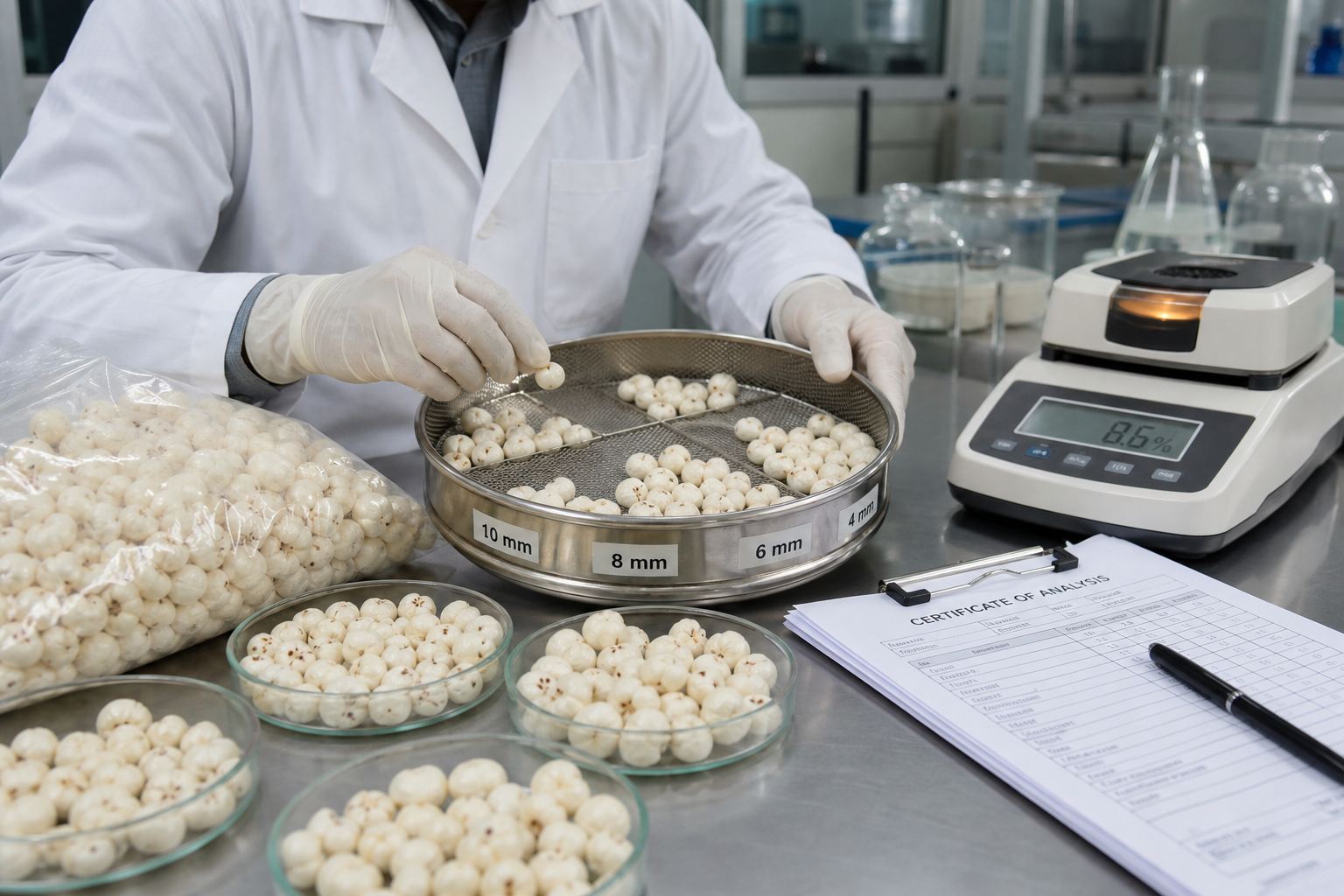
Fox nuts — makhana, phool makhana, Euryale ferox — have become one of the fastest-growing better-for-you snack ingredients in North American, Gulf, and European retail. Because Bihar accounts for roughly 80–85% of global makhana production and about 90% of India's production (APEDA directional), almost entirely from the GI-tagged Mithila belt (Madhubani, Darbhanga, Sitamarhi, Saharsa, Katihar, Purnia), there is effectively no alternative sourcing origin at scale. For buyers, that concentration is both an opportunity and a risk: pricing power sits with Indian suppliers, but supplier quality and documentation discipline vary enormously across a fragmented base of farmer cooperatives, small processors, and organised exporters.
Buyers who try to source makhana directly from India without a structured process run into the same recurring problems: beautiful sample pouches followed by inconsistent bulk-lot size grading, crushed kernels on arrival because packaging wasn't engineered for the product's fragility, missing or unverifiable APEDA and FSSAI documentation, and moisture or aflatoxin issues that surface only after the container has landed. None of these failures are inherent to Indian makhana — they are the predictable result of skipping verification steps under deadline pressure.
This guide is written for importers, retail buyers, health-snack brands, e-commerce sellers, and food manufacturers in the USA, Canada, UAE, UK, Australia, and Germany who want to source fox nuts directly from India with a repeatable, lower-risk process. It walks through RFQ specification, supplier discovery and audit, sampling and lab QC, contract terms, and landed-cost calculation — and explains when a merchant exporter reduces risk more effectively than managing multiple Bihar processing units independently. For destination-market context, see Best Countries for Indian Fox Nut Makhana Exports and Top Fox Nut Makhana Products Exported from India.
Key Takeaways
Summary Box
- To source fox nuts (makhana) directly from India, write a complete RFQ — size grade in mm, moisture ceiling, broken %, format, certification, and packaging — before contacting any supplier.
- Use the 20-supplier directory below as a research starting list (company, address, website, phone, email, products) — then verify APEDA, FSSAI, and IEC independently before sampling.
- India's near-total market share means supplier selection, not origin selection, is the real sourcing decision.
- Verify APEDA registration, FSSAI licence, and lot-level lab test history before any deposit — a good sample photo proves nothing about bulk-lot consistency.
- Popped makhana is fragile; packaging and container-loading engineering are as important to landed quality as the raw product itself.
- Use a phased commitment structure — sample (1–5kg), trial (100–500kg), wholesale (1–5MT) — and do not skip the trial stage on a new supplier relationship.
- A merchant exporter consolidating multiple Bihar-region suppliers under one accountable relationship typically reduces total sourcing risk for multi-SKU or multi-grade programmes.
- Altus Exports supports agriculture & food products buyers with supplier verification, sample coordination, and landed-cost-optimised export management for makhana programmes.
Executive Summary
Summary Box
This guide sets out a ten-step buyer playbook for sourcing fox nuts and makhana directly from India: define specifications, identify suppliers, shortlist and audit, request samples with lab reports, evaluate product and documentation, negotiate on landed-cost basis, verify export compliance, place a trial order with written terms, conduct pre-shipment inspection, and manage logistics through arrival.
Because India's makhana supply chain runs from thousands of individual pond growers through aggregators, processors, and export houses of highly variable formalisation, the single highest-leverage buyer action is independent verification — of APEDA/FSSAI status, of lot-level lab records, and of packaging engineering for a genuinely fragile product. Buyers who build this discipline into their first order convert faster into stable, repeat-programme relationships than buyers who source on sample photos and price alone.
Market Size & Industry Overview
Key Statistics
India's makhana economy is concentrated in the wetland pond systems of Bihar's Mithila region, supplemented by West Bengal and eastern Uttar Pradesh, and is regulated at the export level by APEDA (scheduled agricultural and processed food product oversight) and FSSAI (food-safety licensing). The Mithila Makhana GI tag formally protects the regional name and is increasingly used by buyers as a provenance-verification anchor when auditing supplier claims.
The supply chain is genuinely fragmented: pond-level growers sell to local aggregators, who supply processing units of widely varying scale and formalisation, some of which hold export registrations directly while others rely on export houses or merchant exporters to handle compliance and shipment. Buyers who understand this structure make better counterparty decisions — a processor with excellent product quality but no direct APEDA registration is not disqualifying, but it changes who is contractually and legally accountable for your shipment.
Export product forms fall into three HS categories that buyers should specify explicitly in every RFQ: popped/roasted makhana (HS 20081921), flour or powder (HS 20081922), and other preparations including flavoured or coated formats (HS 20081929) — with some customs filings still referencing legacy heading 19041090 for certain prepared cereal-based classifications.
Comparison table
Swipe →
Data table — swipe horizontally on small screens
| Supply Chain Node | Role | Buyer Implication |
|---|---|---|
| Pond growers (Mithila belt) | Euryale ferox cultivation and harvest | Origin/provenance starts here; GI tag applies at this level |
| Local aggregators | Collection from multiple growers | Quality and lot traceability can weaken here without discipline |
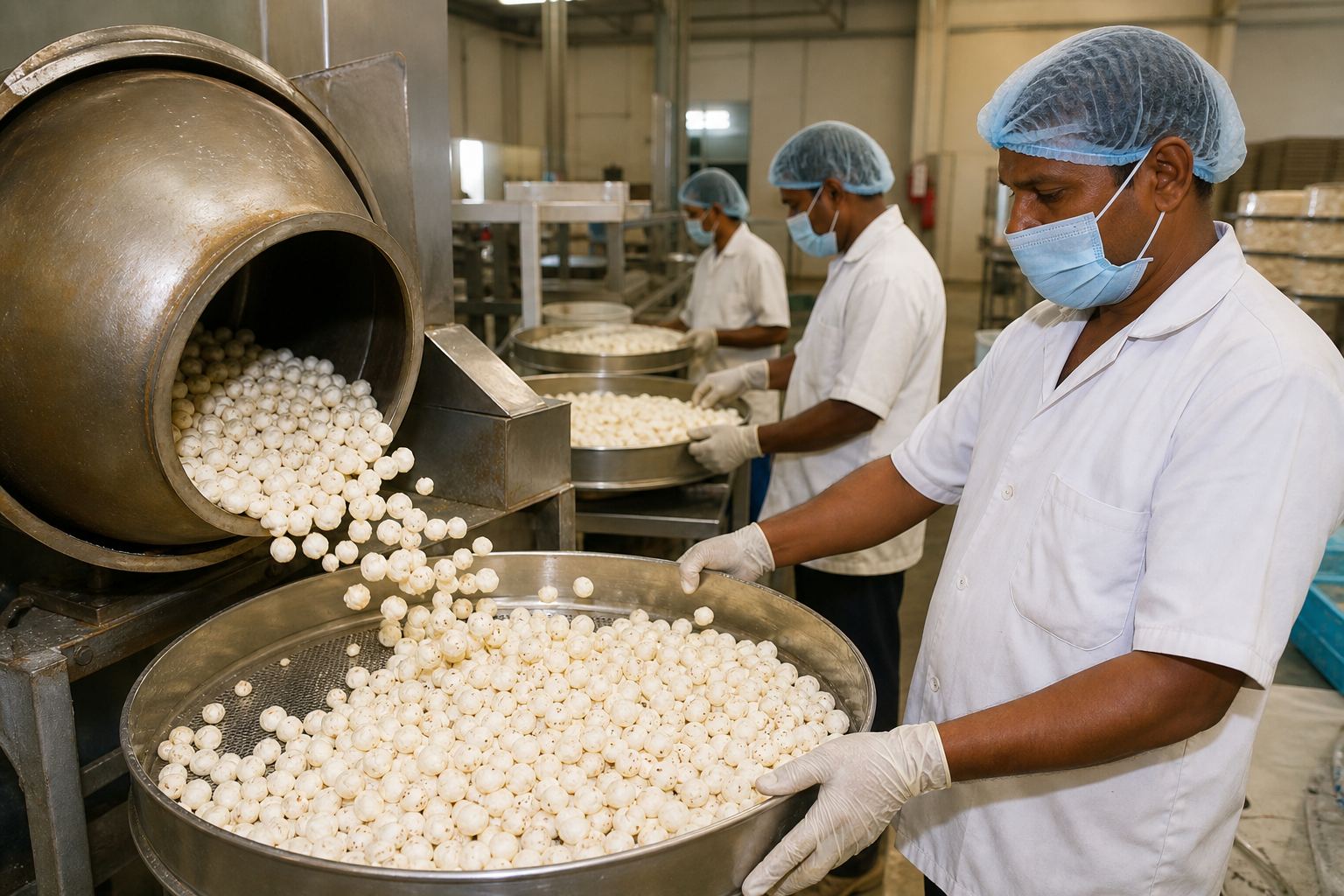
| Processing units | Roasting, popping, grading, packing | Critical node for size grading, moisture control, and packaging engineering |
| Export houses | Direct export under own registration | Verify APEDA/FSSAI status independently before contracting |
| Merchant exporters | Consolidate multi-supplier programmes under one accountable relationship | Strong fit for multi-grade, multi-SKU buyer programmes |
| APEDA-registered exporters | Legally authorised to export scheduled products | Baseline requirement; absence is disqualifying |
Export Statistics
Key Statistics
Indian makhana export volume has grown steadily as global health-snack retail adoption widened, with popped/roasted formats representing the majority of shipped volume and flavoured, private-label, and flour/powder formats growing fastest year over year. Per APEDA's MIC Makhana dashboard, exports grew directionally from roughly 6,700 MT in 2020 to roughly 25,130 MT in 2024 (~39% CAGR), with Jan–Oct 2025 volumes around 18,150 MT. Buyers entering the category for the first time typically start with plain roasted retail pouches or bulk-for-repacking before moving into private-label flavour development once a verified supplier relationship is established.
Comparison table
Swipe →
Data table — swipe horizontally on small screens
| Metric | 2026 Indicative Position | Buyer Relevance |
|---|---|---|
| Dominant export form | Roasted/popped makhana (HS 20081921, effective July 2025) | Safest starting SKU for a first order |
| Fastest-growing form | Flour/powder (HS 20081922) | Growing ingredient-manufacturer demand |
| Flavoured/private-label share | Rising, especially retail-brand programmes | Requires longer lead time (4–8 weeks) than plain bulk |
| Supply concentration | Bihar ~80–85% of world output; ~90% of India's production (APEDA directional) | Regional-provenance verification is a real due-diligence step, not a formality |
| Export volume, 2020 → 2024 | ~6,700 MT → ~25,130 MT (~39% CAGR, APEDA directional) | Signals fast-growing, still-fragmented supply base |
| Exporter formalisation | Highly variable across the supply base | Verification of APEDA/FSSAI status is essential, not optional |
Import Statistics
Key Statistics
Buyer concentration mirrors the destination-market data: the USA, Canada, and UAE together account for the large majority of Indian makhana import value, with the UK, Australia, Germany, and Nepal making up the remainder. Understanding where your buyer profile sits within this landscape helps calibrate supplier expectations — an established Indian export house is more likely to have USA or UAE shipment experience than experience with a smaller or newer destination market.
Comparison table
Swipe →
Data table — swipe horizontally on small screens
| Buyer Region | Approx. Share of Indian Makhana Imports | Typical Buyer Profile | Sourcing Consideration |
|---|---|---|---|
| USA | ~40% | Health-snack retail, e-commerce brands, natural-food distributors | Most suppliers have USA shipment experience; still verify FDA registration |
| Canada | ~20% | Natural-food distributors, grocery chains | Similar buyer profile to USA; confirm bilingual labelling capability |
| UAE | ~17% | Hypermarkets, hospitality, gifting procurement | Confirm Halal-aligned processing documentation |
| UK | ~10% | Specialty and organic food retailers | Confirm UK-specific labelling and organic-certification pathway experience |
| Australia | ~1–5% (higher unit price, ~USD 21/kg directional) | Health-food and specialty retail importers | Confirm supplier familiarity with biosecurity documentation |
| Germany | ~1–5% (higher unit price, ~USD 26/kg directional) | Organic and natural-food distributors | Confirm EU organic certification pathway and EU shipment experience |
Product Categories & Variants (Brief Overview)
Summary Box
Specify the exact product form in your RFQ rather than asking generically for 'makhana' — suppliers price, grade, and pack differently across these categories, and vague requests produce quotations that cannot be fairly compared.
Comparison table
Swipe →
Data table — swipe horizontally on small screens
| Category | Typical Use Case | Sourcing Note |
|---|---|---|
| Plain roasted/popped, mixed grade | Value retail, bulk repacking | Lowest-risk first order; verify moisture and broken % |
| Plain roasted/popped, premium large-grain (>18mm) | Premium retail, gifting, hospitality | Command a real price premium; confirm size-grade consistency lot to lot |
| Flavoured/coated (masala, sweet, peri-peri, chocolate) | Retail brand SKUs, private label | Longer lead time; confirm food-safe flavouring compliance for your market |
| Makhana flour/powder | Bakery, infant nutrition, functional-ingredient blends | Confirm milling consistency and particle-size specification |
| Certified organic | Organic retail programmes | Verify NPOP certificate and destination-organic equivalence pathway independently |
Manufacturing Overview (Brief)
Export Tip
Understanding the basic processing sequence helps buyers ask better audit questions. Pond-harvested seeds are sun-dried and stored before controlled roasting brings them to popping temperature; the popped kernel is separated from residual shell, then graded by size in millimetres, sorted for broken percentage and foreign matter, and packed plain or processed further into flavoured or flour formats. Moisture control through roasting and packing is the single most important process variable for shelf-life and microbial safety — ask any candidate supplier directly how they monitor and record moisture at each stage, not only in the final COA.
Export Process (Buyer's Ten-Step Playbook)
Export Tip
Use this ten-step sequence whether you are buying from a processing unit directly or through a merchant exporter. Each step exists to prevent a specific, predictable class of failure — skipping a step to save a week typically costs far more when a container fails inspection or arrives with crushed, unsellable stock.
Step 1: Write a Complete RFQ
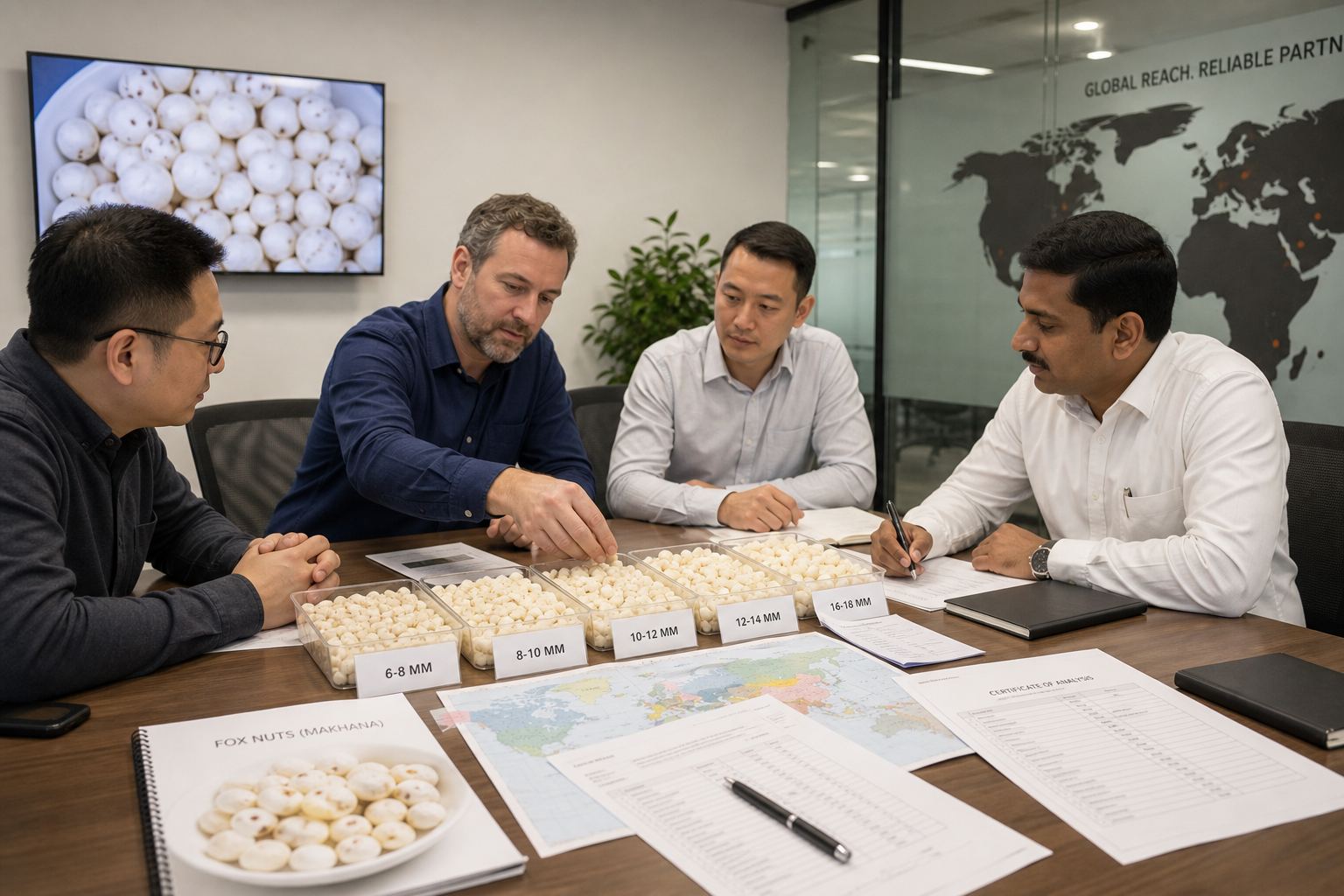
Document: product form (plain popped, flavoured, flour/powder), size grade in millimetres, moisture ceiling (typically specified below industry-standard limits for retail shelf stability), broken percentage tolerance, foreign-matter tolerance, certification requirements (FSSAI, APEDA, HACCP/ISO 22000, Halal, Kosher, organic as relevant), packaging format (bag/carton weight, nitrogen-flush requirement, retail pouch size), target FOB/CFR/CIF price, MOQ, and delivery window. A vague RFQ — 'good quality makhana, best price' — produces incomparable quotes and invites suppliers to fill gaps with assumptions you will reject at the sample stage.
Step 2: Identify Potential Suppliers
Use APEDA's registered exporter directory, FSSAI-licensed processor lists, GI-registered Mithila Makhana producer references, trade-fair exhibitor lists, and referrals from APEDA or FIEO networks. Prefer suppliers with documented export history to your target market — a processor already shipping to USA or UAE buyers likely understands the certification and packaging expectations those markets demand better than one with purely domestic or Nepal-border trade experience. For a curated research starting list with websites and contact details, see the 20 Indian supplier profiles later in this guide.
Step 3: Shortlist and Audit
Score candidates on APEDA registration (verify on the APEDA portal), FSSAI licence (verify on FoSCoS), IEC (verify on DGFT), export history (request redacted shipment documents), in-house or third-party lab testing capability, certification status (verify certifiers independently), and responsiveness. Immediately disqualify any supplier who cannot produce APEDA registration proof or whose price is dramatically below the market range — both are red flags, not bargains.
Step 4: Request Samples with Lab Reports
Require lot-level lab reports alongside physical samples: moisture content, size-grade breakdown, broken percentage, foreign matter, microbiological results, and aflatoxin/pesticide screening where relevant to your market. A sample without accompanying lab documentation is a marketing prop, not quality evidence. For higher-value or first-time orders, retest the sample independently at an accredited laboratory in your destination country.
Step 5: Evaluate Product and Documentation Quality
Physically inspect kernel size uniformity, colour, crunch/texture, and broken percentage against the claimed grade. Cross-check documentation: is the lab an APEDA-approved or accredited facility? Are certifications current and from accredited certifying bodies? Does the claimed size grade match your own measurement of the sample? Commercial acceptability requires both a satisfactory physical sample and satisfactory documentation — one without the other is insufficient grounds for a trial order.
Step 6: Negotiate on a Landed-Cost Basis
Compare landed cost, not FOB in isolation: FOB price, ocean freight (which is often volume-constrained rather than weight-constrained for bulky, light popped makhana), insurance, destination duty, and your own destination lab-retest cost. A lower FOB from a supplier with weak packaging engineering can produce a higher effective cost once crushed-kernel wastage and retail-unsellable stock are accounted for. Negotiate volume-based price breaks only after quality has been validated on a trial order, not before.
Step 7: Verify Export Compliance Capability
Confirm the supplier's APEDA registration is active and covers the relevant product category, FSSAI licence covers the processing facility, IEC is current and matches the quotation letterhead, and — where your market requires it — the supplier can provide a health certificate or phytosanitary certificate. A processing unit without active APEDA registration cannot legally export makhana from India, regardless of product quality.
Step 8: Place a Trial Order with Written Terms
Start with a limited trial quantity (100–500kg) rather than committing to a full container on an unproven relationship. Lock in writing: the approved specification and reference sample, Incoterms, payment milestones (typically 30–50% advance, balance against shipping documents — avoid 100% advance with new suppliers), production tied to the approved sample and lab parameters, a pre-shipment inspection requirement, and a defined resolution path (rework, replacement, or refund) if the lot fails inspection.
Step 9: Conduct Pre-Shipment Inspection and Lab Testing
For every commercial lot, review the supplier's lot-specific lab certificate, arrange independent retesting for higher-value or first-time orders, and physically verify packaging integrity — carton/bag condition, moisture-barrier seal quality, and crush-resistance of the stacking pattern. Do not allow vessel-cutoff pressure to compress or skip inspection on a first order; that is exactly when avoidable quality problems get shipped.
Step 10: Manage Logistics, Documentation, and Arrival
Confirm the full document set before vessel departure: commercial invoice (correct HS code and country of origin), packing list, bill of lading, APEDA certificate, health/phytosanitary certificate where required, organic transaction certificate for certified lots, certificate of origin, and cargo insurance certificate under CIF/CIP terms. Pre-alert your import broker with draft documents, and ensure HS code descriptions are consistent across every document — mismatches trigger customs holds even when the product itself is fine. Read Fox Nut Makhana Export Documentation Checklist for the complete document framework.
20 Indian Fox Nut (Makhana) Suppliers Directory
The profiles below are publicly listed Indian companies active in makhana / fox nut manufacturing, wholesale, or export. Each entry summarises company identity, address, website, phone, email, a short company brief, products, and diligence notes drawn from their websites at the time of research.
This directory is a buyer research aid — not a ranking, certification, or endorsement by Altus Exports. Contact details and claims change; always re-verify APEDA RCMC, FSSAI licence, IEC, and lab COAs on official portals and with the supplier before deposits or trial orders. Prefer paid, lot-linked samples over free marketing pouches.
1. MakhanaBazar (Krishipurna Organic Pvt. Ltd.)
- Company
- Krishipurna Organic Pvt. Ltd. (MakhanaBazar)
- Address
- Darbhanga, Bihar, India (Mithila makhana origin belt)
- Website
- https://www.makhanabazar.com
- Phone
- +91 92119 59766
- info@makhanabazar.com
Long-standing fox nut house presenting 80+ years of makhana supply heritage, focused on GI-linked Mithila origin lots for importers, distributors, and FMCG brands. Positions itself for FOB/CIF programmes into the USA, UK, UAE, Australia, Canada, and other markets with APEDA, FSSAI, ISO 22000, and HACCP claims on its export site.
Products: Raw / popped fox nuts (makhana), roasted and flavoured retail-ready formats, graded lots for wholesale and private label.
Also note: Strong GI Mithila provenance messaging; publishes Incoterm options (EXW Darbhanga, FOB Nhava Sheva/Mundra, CIF). Ask for current certificate PDFs and a lot COA with moisture and size-grade breakdown before sampling.
2. Darnif Exim Private Limited
- Company
- Darnif Exim Private Limited
- Address
- JP Chowk, Laxmisagar, Darbhanga, Bihar 846009, India
- Website
- https://darnifexim.com
- Phone
- +91 70291 48050 / +91 79864 15206
- contact@darnifexim.com
Darbhanga-based bulk makhana exporter working the Mithila supply belt for international wholesalers and snack brands. Website content emphasises farm-direct Bihar sourcing, suta/mm grading, and full export documentation packs (FSSAI, APEDA, HACCP/ISO pathways, COA, phytosanitary, certificate of origin).
Products: Bulk phool makhana / fox nuts across size grades (including 4+ to 7 suta style grading), raw, roasted, and flavoured options for wholesale and private label.
Also note: Transparent about optional premium certifications (organic, Halal, Kosher) as add-ons rather than blanket claims — useful diligence signal. Request redacted prior shipment docs to your destination market.
3. TirhutWala
- Company
- TirhutWala
- Address
- Bihar, India (Tirhut / Mithila region focus)
- Website
- https://www.tirhutwala.com
- Phone
- +91 70900 54650
- hello@tirhutwala.com
Bihar-origin makhana exporter-supplier brand highlighting FSSAI and APEDA-aligned international-grade food safety for fox nut shipments. Useful shortlist candidate for buyers specifically seeking Mithila-belt processors rather than multi-commodity trading houses.
Products: Export-oriented makhana / fox nuts from Bihar; confirm raw vs roasted vs flavoured SKUs and pack sizes on enquiry.
Also note: Lead with WhatsApp/phone for fast RFQ response; still insist on written APEDA RCMC and FSSAI licence numbers before any deposit. Verify email domain replies match the website domain.
4. Global Reach Trade
- Company
- Global Reach Trade
- Address
- Bihar & Bengaluru, India (dual base per company site)
- Website
- https://globalreachtrade.com
- Phone
- +91 96325 57927
- trade@globalreachtrade.com
Agri-export company specialising in premium GI-tagged Mithila fox nuts with farm-to-port messaging: farmer procurement, FSSAI processing claims, lab testing, APEDA documentation, and logistics for USA, UAE, UK, Europe, and other destinations. Offers FCL/LCL and private-label options.
Products: Premium GI Mithila makhana, organic-oriented lots (confirm certificate), Halal-oriented supply claims, bulk and private-label formats.
Also note: Good fit if you want a single desk handling docs plus freight. Ask for sample lead time, current organic transaction-certificate pathway, and cube-limited container loading guidance for popped stock.
5. Exofusion Ventures
- Company
- Exofusion Ventures
- Address
- Bihar & Maharashtra, India (operations footprint per site)
- Phone
- +91 99233 72992
- info@exofusionventures.com
Certified makhana export house sourcing from Bihar farming cooperatives and supplying importers, distributors, and brands in 20+ countries. Emphasises FSSAI, HACCP, and ISO 22000 claims with bulk, private-label, and retail-ready dry-roasted formats.
Products: Bulk fox nuts, dry-roasted oil-free pouches (stated ~12-month shelf life), private-label roasted snacks; indicative MOQ around 250 kg on retail-ready lines (confirm current MOQ).
Also note: Strong B2B sample/quote form workflow (states 24-hour response Mon–Sat). Request specification sheets with moisture %, broken %, and size grade before comparing FOB quotes.
6. FFG Global Foods
- Company
- FFG Global Foods
- Address
- Bihar, India (origin); ports via Kolkata / Mumbai
- Website
- https://foxnutfarm.com
- Phone
- +91 88825 43801
- ffgglobalfoods@gmail.com / export@ffgglobalfoods.com
Premium GI-tagged farm-direct fox nut exporter marketing multi-continent supply partnerships, FOB/CIF options, and phytosanitary / certificate-of-origin handling. Site cites multi-hundred-MT annual capacity and multi-grade programmes for importers and brands.
Products: GI-tagged Bihar makhana grades (premium and commercial), farm-direct fox nuts for wholesale and brand programmes.
Also note: Cross-check the HS code they print on quotations against your broker’s advice (buyers commonly use Chapter 20 headings 20081921/22/29 for prepared fox nuts). Prefer company-domain email threads for formal POs.
7. The Indian Makhana
- Company
- The Indian Makhana
- Address
- HQ: Harda Bazar, Near Harda High School, Purnea, Bihar 854303; Branch: Aavkar Complex, First Floor-09, Nr Gurukul Metro, Drive-In Road, Ahmedabad, Gujarat 380052
- Website
- https://theindianmakhana.com
- Phone
- +91 91049 35733 / +91 91067 85545
- info@theindianmakhana.com
Manufacturer-wholesaler-exporter headquartered in Purnea (core Bihar production district) with an Ahmedabad commercial branch — useful if you want both origin-side processing proximity and a west-India commercial contact point.
Products: Premium quality makhana / fox nuts / lotus seeds for domestic wholesale and export; confirm grading brackets and roasted/flavoured capability on RFQ.
Also note: Dual-city presence can help with sample dispatch and buyer meetings in Gujarat. Still verify processing-site FSSAI licence matches the exporting entity on the invoice.
8. Field to Feed Export
- Company
- Field to Feed Export
- Address
- 73, Deep Palace Colony, Nipania, Indore, Madhya Pradesh 452010, India
- Phone
- +91 91113 55591
- support@fieldtofeedexport.com
Multi-market fox nuts makhana exporter and bulk supplier serving importers, wholesalers, distributors, and retailers across the USA, UK, Canada, Australia, UAE, and other destinations. Positions as manufacturer-supplier with bulk logistics emphasis for Gulf and Western markets.
Products: Premium-grade fox nuts / makhana in bulk; uniform sizing claims; long shelf-life packing for wholesale channels.
Also note: Indore commercial base with Bihar-origin product claims — ask where roasting/grading physically occurs and who holds APEDA RCMC for the exporting legal entity.
9. The Foxnut Farm (JNA Global Ventures Pvt. Ltd.)
- Company
- JNA Global Ventures Pvt. Ltd. (The Foxnut Farm)
- Address
- Kundla Vasundra City, Ambikapur, Surguja, Chhattisgarh 497001, India
- Phone
- +91 62634 25645
- shubhiagrawal456@gmail.com
Chhattisgarh-based supplier emphasising farm-linked raw makhana, including 6-suta raw programmes, with a sustainability and farmer-sourcing narrative. Useful diversification candidate beyond the classic Bihar-only shortlist — still compare grade consistency carefully against Mithila lots.
Products: Raw makhana / fox nuts (including larger suta grades); confirm roasted and export documentation capability if you need finished snack SKUs.
Also note: Prefer migrating commercial correspondence to a company domain when available. Validate export registrations and whether origin claims are Surguja vs Bihar-sourced lots.
10. Makhana Supplier (makhanasupplier.in)
- Company
- Makhana Supplier (Darbhanga export desk)
- Address
- Darbhanga, Bihar, India
- Website
- https://makhanasupplier.in
- Phone
- +91 62025 00448 (WhatsApp)
- Via website contact / WhatsApp (confirm on reply letterhead)
Darbhanga-rooted exporter site targeting health-food brands, importers, and wholesale distributors with APEDA-certified export messaging, Madhubani–Darbhanga–Sitamarhi sourcing claims, and private-label/OEM packaging options from samples to container loads.
Products: Raw makhana, roasted fox nuts, flavoured snack makhana; vacuum, jar, and zipper-pouch packing options; barcode/nutrition-label assistance for retail packs.
Also note: Stated reach into 12+ countries including USA, UK, UAE, Canada, Australia, and Europe. Lock legal company name, GSTIN, and IEC on the first formal quotation.
11. MeraKisan
- Company
- MeraKisan
- Address
- Factory: Katihar, Bihar 854103; Office: Gandhinagar, Gujarat (per contact page)
- Website
- https://merakisan.com
- Phone
- +91 90237 31197
- info@merakisan.com
Bihar GI-tagged makhana B2B supplier with Katihar factory roots and multi-country export marketing (UK, UAE, Singapore, Australia, USA, and reported China shipments). Strong content depth on grades (4–7 suta), Halal, ISO/HACCP claims, and destination-specific buyer pages (USA/UAE/Australia).
Products: Raw, roasted, and flavoured GI Mithila makhana; bulk bags and private-label retail packs; custom Arabic labelling options noted for UAE programmes.
Also note: Good shortlist pick for Halal-aware Gulf retail and graded bulk. Re-verify every certification PDF and ask for recent destination-specific shipment references.
12. Nature to Home Agro Private Limited
- Company
- Nature to Home Agro Private Limited
- Address
- Durgabha ITI College, Village Dhakjari, Post Bharouli Dhakjari, Thana Sonbarsha, Kachahri Saharsa, Bihar 852202, India
- Phone
- +91 96618 23537
- help@naturetohomeagro.com / sameer@naturetohomeagro.com
Bihar bulk manufacturer-exporter of lotus seeds / makhana / fox nuts with organic-oriented positioning and Saharsa-region operations in the broader Mithila production geography. Useful for buyers seeking factory-side conversations rather than only trading desks.
Products: Bulk and export-grade makhana / lotus seeds; organic and conventional programmes (confirm active organic scope certificates).
Also note: Ask for processing capacity (MT/month), in-house vs third-party lab partners, and whether they export under their own APEDA RCMC or through a merchant partner.
13. Absolute Nuts
- Company
- Absolute Nuts
- Address
- Corporate Office: 3rd Floor, WH-113, Block B, Mayapuri Industrial Area Phase I, Mayapuri, New Delhi 110064, India
- Website
- https://absolutenuts.in
- Phone
- +91 99109 92106 / +91 99109 92107
- Via website contact form (confirm on letterhead reply)
Delhi-based nuts and makhana wholesaler with manufacturing footprint messaging, serving retail chains, distributors, online sellers, exporters, and private-label buyers. Convenient north-India commercial contact for sample coordination and packaging discussions.
Products: Raw makhana, roasted and flavoured makhana, bulk fox nuts, private-label jars/pouches, and related dry-fruit assortments.
Also note: Clarify whether makhana is processed in-house or aggregated from Bihar units, and who appears as exporter of record on shipping documents.
14. Om Exim Traders
- Company
- Om Exim Traders
- Address
- Shankar Cinema Rd, opposite Modi Collection Mall, Bazarapada, Angul, Odisha 759122, India
- Website
- https://omeximtraders.com
- Phone
- +91 90400 30306
- info@omeximtraders.com / omeximtraders@gmail.com
Multi-commodity Indian exporter listing makhana alongside cashew, onion, and agri lines — a trading-house profile that can work for buyers consolidating several SKUs, provided makhana grade control and Bihar-origin traceability are contractually clear.
Products: Makhana / fox nuts plus other agri exports (cashew, onion, and related lines per site).
Also note: For makhana-critical programmes, require named processing partners, lot COAs, and GI/origin statements in the PO — multi-commodity traders vary widely in category depth.
15. Zest n Zing Foods
- Company
- Zest n Zing Foods
- Address
- Plot No. 25, Gate 5, Muktidham Estate, Jiwan Wadi Road, Nikol, Ahmedabad 382350, Gujarat, India
- Website
- https://zestnzingfoods.com
- Phone
- +91 99985 57030 / +91 93160 07030
- export@zestnzingfoods.com / info@zestnzingfoods.com
Ahmedabad manufacturer-exporter of roasted makhana (plain and flavoured) under ISO 9001:2015, GMP, and Halal-certified conditions messaging, with COA coverage for moisture, purity, and microbiology. Strong private-label and retail-pack narrative for global buyers.
Products: Roasted plain and flavoured fox nuts; bulk and retail snack packs (multiple net weights); private-label OEM.
Also note: Good candidate for finished snack SKUs and Halal-sensitive markets. Confirm Bihar raw-material sourcing chain and APEDA registration of the exporting entity.
16. Alstoe India Exports
- Company
- Alstoe India Exports
- Address
- India (Bihar Mithila sourcing focus — confirm registered office on quotation)
- Phone
- +91 85955 02646
- alstoeindiaexports@gmail.com
APEDA-registered exporter site with FSSAI and ISO 9001:2015 claims, CIF/FOB pricing, and detailed educational content on Indian makhana grades, market shares, and documentation. Positions farm-linked GI Mithila supply for raw and flavoured programmes.
Products: Raw and flavoured makhana across suta grades (site discusses wide grade range); bulk export packs.
Also note: Ask for formal company letterhead with registered address, GSTIN, IEC, and APEDA RCMC number before sample payment. Prefer migrating from Gmail to a company domain for contracts.
17. MakhanaKing (Nutrivin Agro Private Limited)
- Company
- Nutrivin Agro Private Limited (MakhanaKing)
- Address
- Sankat Mochan Mandir area, Madhubani, Bihar, India
- Website
- https://www.makhanaking.com
- Phone
- +91 83830 78091 / +91 93153 13718
- info@makhanaking.com / export@makhanaking.com
Madhubani-based manufacturer and wholesale supplier brand in the heart of the Mithila production belt, marketing raw and processed makhana with export desk contacts. Strong geographic fit for buyers who want origin-proximate suppliers.
Products: Raw and processed makhana / fox nuts for wholesale and export; confirm flavouring and retail packing if needed.
Also note: Madhubani location is a positive provenance signal — still audit process hygiene, metal detection/sieving, and moisture-barrier packing for ocean freight.
18. House of Makhana (Shayra Foods Private Limited)
- Company
- Shayra Foods Private Limited (House of Makhana)
- Address
- Corporate Office & Flavoring Unit: Plot No. 174, Hansa Industrial Park, Vill. Haripur Hinduan, Barwala Road, Dera Bassi, Distt. SAS Nagar (Mohali), Punjab, India
- Website
- https://houseofmakhana.com
- Phone
- Via website / email (confirm current sales line on contact page)
- info@houseofmakhana.com / customercare@houseofmakhana.com
Branded makhana company with farm-to-fork positioning and a Punjab flavouring/industrial unit, sourcing narrative tied to Bihar Mallah farmer communities. Suitable for buyers evaluating finished flavoured retail SKUs and brand/private-label collaborations.
Products: Premium raw makhana and flavoured roasted lines (e.g. tangy tomato, pudina masala, cream & onion style SKUs per site catalogue).
Also note: Clarify exporter-of-record vs brand entity, and whether they support bulk unbranded supply or only branded/private-label programmes.
19. MN Legacy Exports
- Company
- MN Legacy Exports
- Address
- India (confirm registered office on formal quotation)
- Website
- https://mnlegacyexports.com
- Phone
- +91 87886 79794 / +91 90651 81292
- info@mnlegacyexports.com
Export-oriented trading company listing makhana among agri-food offerings for international buyers. Use as a supplementary shortlist name when expanding beyond Bihar-only processors — diligence on processing partners is essential.
Products: Makhana / fox nuts export programmes (confirm grades, roast, and pack formats in writing).
Also note: Request facility photos/video, APEDA RCMC, FSSAI licence of the processing site, and a paid sample with lot COA before any advance payment.
20. Nutrivelle Global
- Company
- Nutrivelle Global
- Address
- India (confirm registered office and warehouse on quotation)
- Phone
- +91 95997 62714
- sales@nutrivelleglobal.com
National export-network style supplier contact appearing in makhana sourcing research for buyers seeking a commercial desk that can coordinate Bihar-origin lots into export shipments. Treat as a trading/coordination counterparty until processing sites are named and verified.
Products: Makhana and related nutri-food export lines (scope to be confirmed per RFQ).
Also note: Before trial orders, obtain the exact processing unit address, certifications, and whether Nutrivelle or a partner appears as exporter on the bill of lading.
Pricing Analysis
Buyer Tip
Makhana pricing is driven primarily by kernel size grade, followed by certification level and packaging/format complexity. Buyers should request pricing broken out by grade rather than a single blended rate, since blended pricing often masks a supplier's inability to consistently deliver the premium grade at scale. APEDA's Oct-2025 unit-price data shows overall export FOB fluctuating roughly USD 15.5–20.3/kg, with destination unit prices directionally around USA ~USD 19.5/kg and Canada ~USD 15.8/kg — confirm against the current APEDA dashboard for your specific destination.
Comparison table
Swipe →
Data table — swipe horizontally on small screens
| Grade/Format | Indicative FOB Price (USD/kg) | Buyer Note |
|---|---|---|
| Standard popped (mixed size) | 12–18 | Baseline commodity grade; confirm moisture and broken % on every lot |
| Premium large-grain (>18mm) | 18–26+ | Verify size-grade consistency across repeat lots, not just the sample |
| Certified organic | Premium above conventional equivalent grade | Independently verify NPOP/USDA/EU Organic certificate validity |
| Private-label/flavoured | Premium above bulk-equivalent grade | Factor in flavour development and packaging cost separately from raw material cost |
| Flour/powder | Varies by milling grade | Confirm particle-size specification and moisture control |
MOQ Analysis
Buyer Tip
Structure every new supplier relationship through the same three-stage MOQ sequence, regardless of how confident the sample evaluation makes you feel. Skipping the trial stage to save time is the single most common cause of first-container quality disputes.
Comparison table
Swipe →
Data table — swipe horizontally on small screens
| Order Stage | Typical MOQ | Purpose | Typical Lead Time |
|---|---|---|---|
| Evaluation sample | 1–5kg | Taste, texture, and size-grade evaluation | 7–14 days |
| Trial order | 100–500kg | Bulk-lot consistency and packaging validation | 2–4 weeks |
| Wholesale/commercial order | 1–5MT | Programme-level supply | 2–4 weeks ex-stock; 4–8 weeks for flavoured/private-label |
Packaging Standards
Export Tip
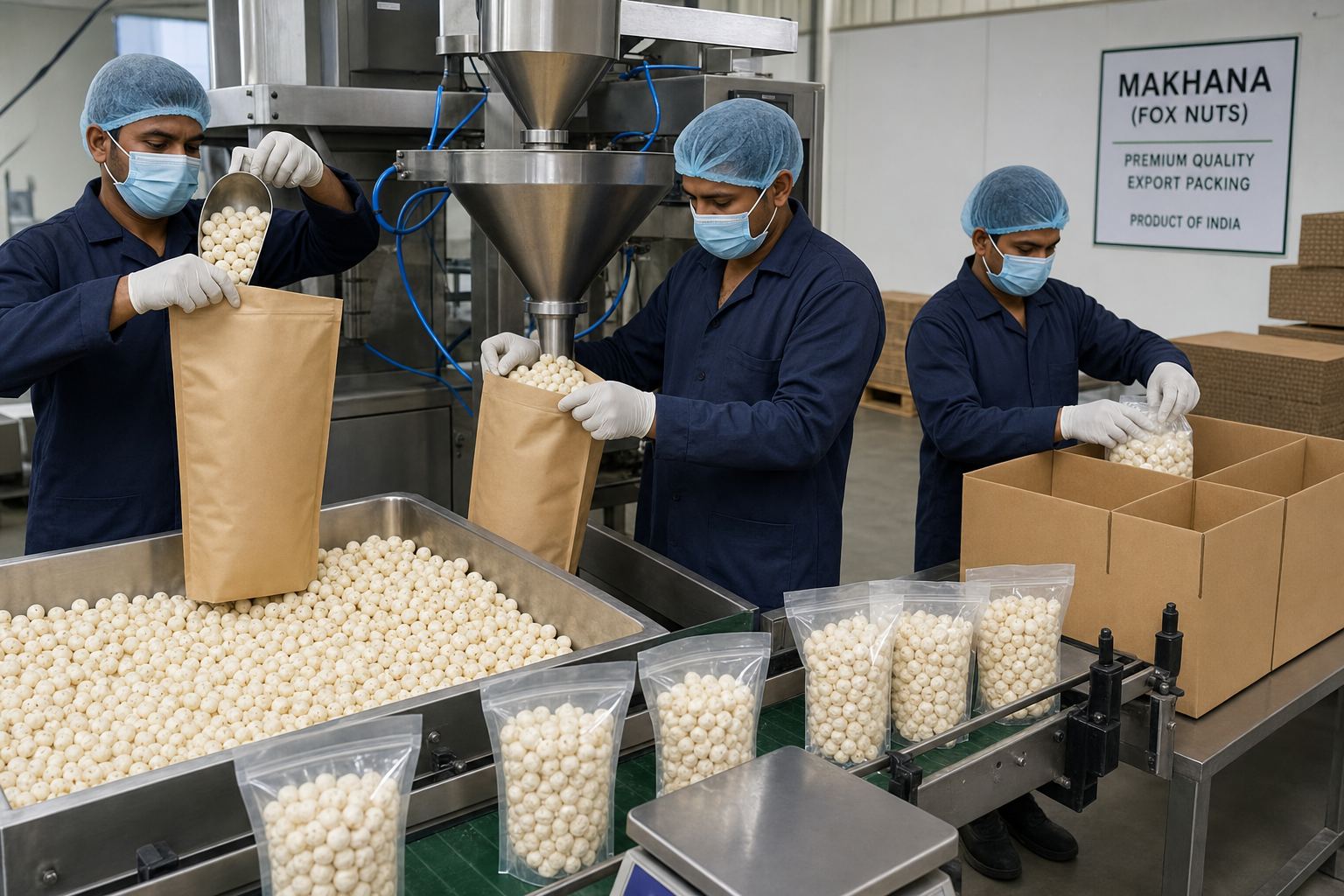
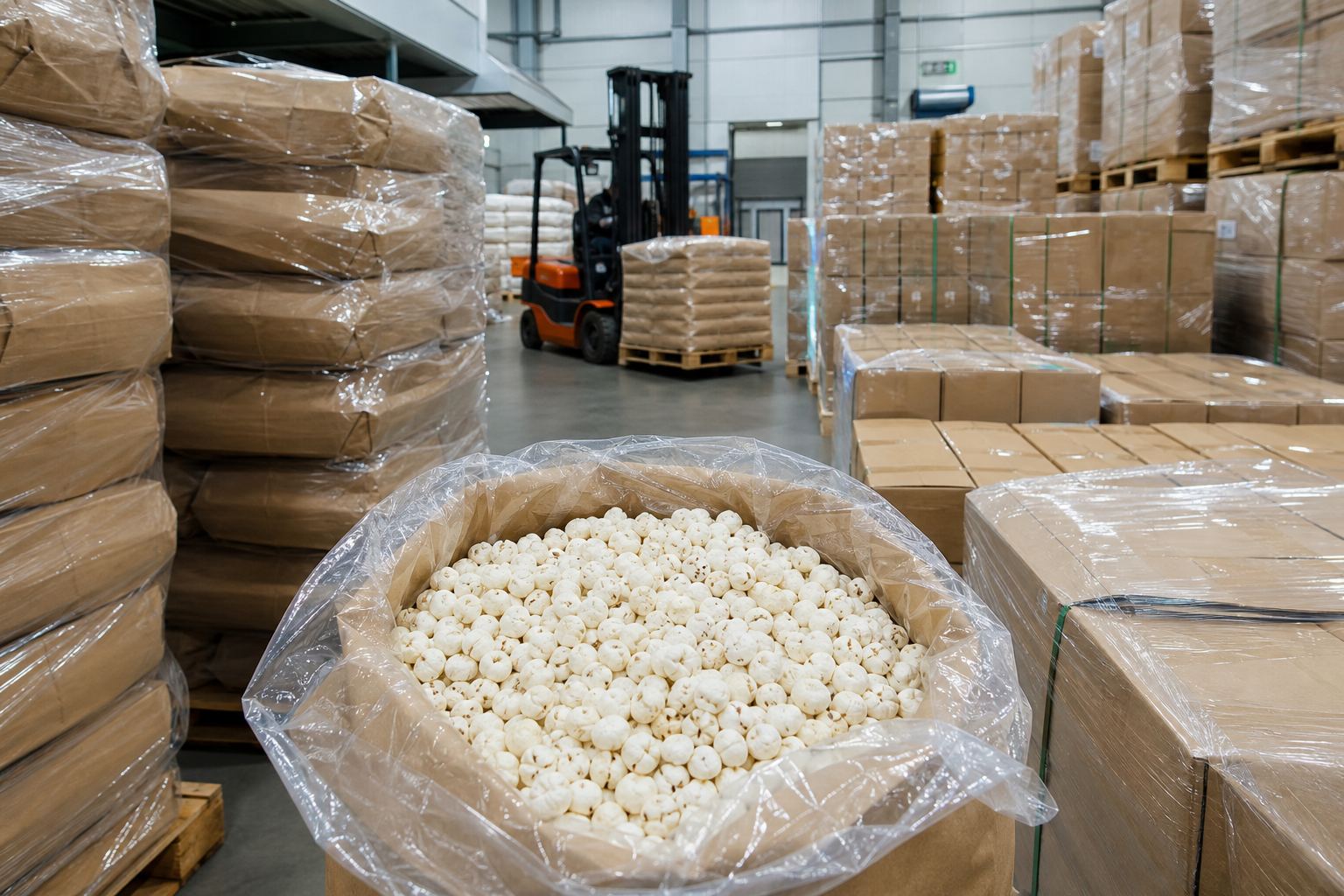
Because popped makhana is light, bulky, and physically fragile, packaging specification deserves more buyer attention than for most bulk agricultural commodities. Confirm carton or bag weight, moisture-barrier construction, and — for premium or long-transit programmes — nitrogen-flush pouching before approving any packaging design.
Comparison table
Swipe →
Data table — swipe horizontally on small screens
| Pack Format | Typical Use | Buyer Verification Point |
|---|---|---|
| 5kg / 10kg food-grade bags or cartons | Bulk wholesale, food-service | Confirm carton stacking pattern prevents crushing |
| 20kg / 25kg bags or cartons | Large wholesale, ingredient manufacturing | Standard for flour/powder and bulk popped grades |
| Nitrogen (N2) flush pouches | Premium and extended-shelf-life programmes | Verify seal integrity and barrier-film specification |
| Retail pouches, 50–500g | Direct-to-consumer retail, e-commerce | Confirm destination-compliant labelling and shelf-life declaration |
| Gift tins/boxes | Gulf hospitality and gifting channel | Confirm premium large-grain fill and transit-damage protection |
Container Loading Details
Export Tip
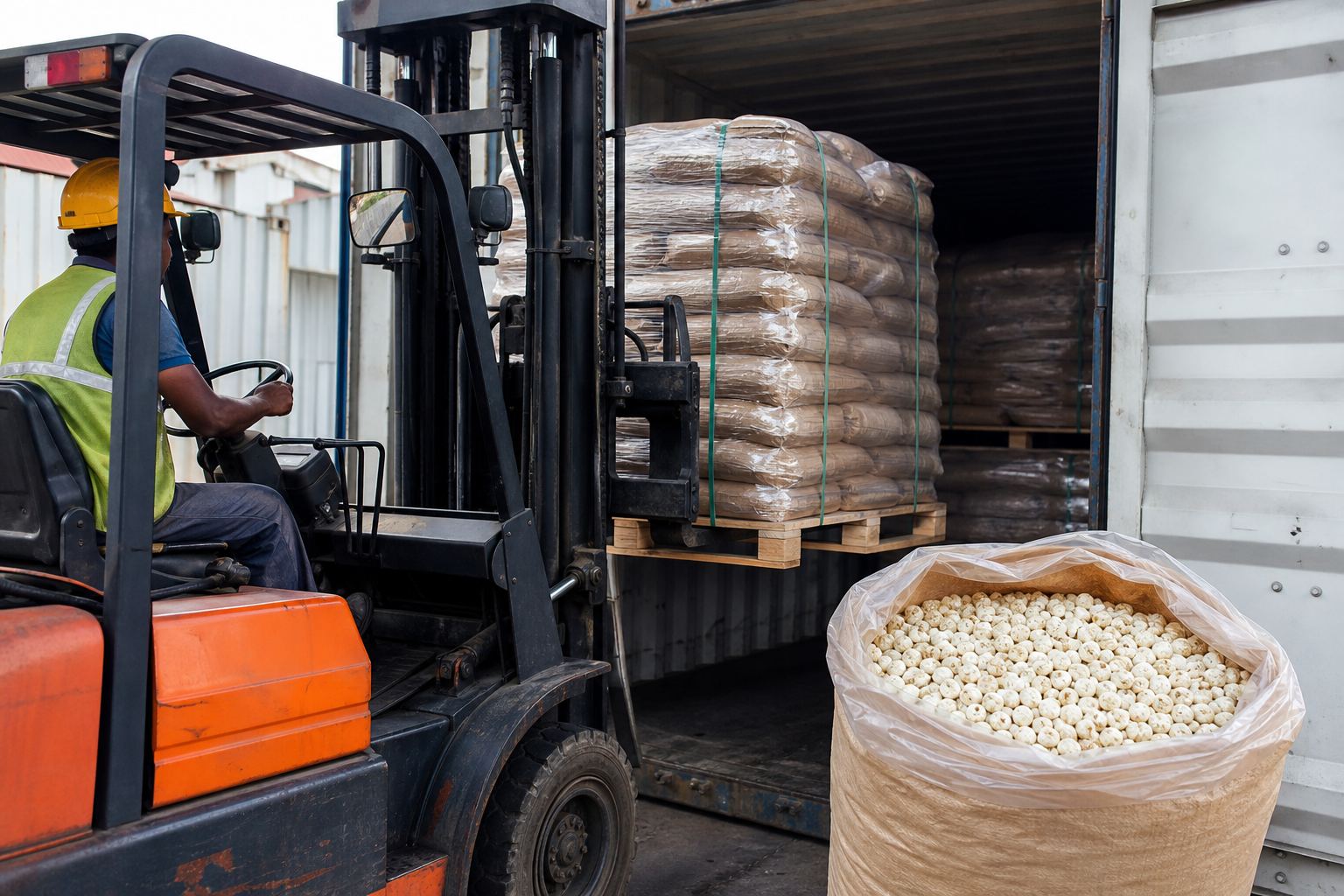
Buyers new to makhana are often surprised that a 20ft container reaches its volume limit well before its weight limit for popped grades, given the product's low bulk density. This changes cost-per-unit math versus denser commodities and makes carton/pallet design a genuine quality-control issue, not just a logistics detail.
Comparison table
Swipe →
Data table — swipe horizontally on small screens
| Container Type | Typical Loadability | Buyer Consideration |
|---|---|---|
| 20ft FCL | ~5–10 MT for popped grades (volume-constrained before weight limit); ~12–16 MT for denser raw seed | Confirm stuffing pattern is engineered against crushing, not just cost-optimised |
| 40ft FCL | ~10–18 MT for popped grades (volume-constrained); preferred for large bulk or multi-SKU consolidated orders | Request palletisation for handling-damage reduction |
| LCL | Suitable for trial orders and premium/gift-format shipments | Higher per-unit freight cost; acceptable given premium margin |
| Flour/powder shipments | Denser; less volume-constrained than popped kernels | Standard bulk-bag or carton stuffing applies |
Shipping Methods
Export Tip
Sea freight via FCL or LCL from Kolkata, Nhava Sheva, or Mundra is standard for overseas buyers; Kolkata offers the shortest inland haulage from Bihar's production belt, which matters for a fragile product, while Nhava Sheva and Mundra often provide higher sailing frequency and competitive rates to the USA, Europe, and the Gulf. Buyers sourcing at trial-order scale should ask their supplier or merchant exporter which port they intend to use and why, since inland handling distance directly affects crushed-kernel risk before the container is even loaded.
Comparison table
Swipe →
Data table — swipe horizontally on small screens
| Route | Typical Transit Time | Common Incoterms |
|---|---|---|
| India → USA | 20–35 days (coast-dependent) | FOB, CFR |
| India → Canada | 28–35 days | FOB, CIF |
| India → UAE | 7–12 days | FOB, CIF |
| India → UK / Germany | 22–30 days | FOB, CIF |
| India → Australia | 18–26 days | FOB, CFR |
Certifications
Compliance Notes
Verify certifications independently rather than accepting supplier-provided copies at face value — check registration numbers on the relevant government portal and confirm certifying bodies are currently accredited.
Comparison table
Swipe →
Data table — swipe horizontally on small screens
| Certification | What It Confirms | How to Verify |
|---|---|---|
| FSSAI licence | Food-safety compliance for processing/export | FoSCoS portal lookup |
| APEDA registration | Legal authority to export scheduled products | APEDA portal lookup |
| IEC | Legal export/import entity registration | DGFT portal lookup |
| HACCP / ISO 22000 | Food-safety management system | Certificate number verification with issuing body |
| Halal | Religious dietary compliance | Certifying body accreditation check |
| NPOP / USDA / EU Organic | Organic production/claims compliance | Certifier accreditation and certificate validity check |
Buyer Requirements
Buyer Requirements
- Minimum documentation before deposit
- APEDA/FSSAI verification, lot-level COA, packaging specification sign-off
- Independent verification recommended
- Destination-country lab retest for first orders above trial scale
- Payment structure for new suppliers
- 30–50% advance, balance against shipping documents; avoid 100% advance
- Packaging sign-off items
- Carton/bag weight, moisture-barrier spec, nitrogen-flush requirement, labelling compliance
- Escalation clause to include in contract
- Defined rework/replacement/refund path for lots failing inspection
Country-wise Opportunities for Direct Sourcing
Market Snapshot
Buyer experience sourcing directly from India differs by home market — mainly in certification burden, freight transit time, and how much competitive supplier experience already exists serving that destination.
USA and Canada
The largest pool of Indian makhana exporters already has USA and Canada shipment experience, which simplifies supplier discovery but also means more variability in supplier quality — competition for buyer attention is high. Prioritise FDA/CFIA-aware suppliers and verify USDA Organic pathway experience if organic positioning is part of your programme.
UAE and Gulf
Shorter freight transit (7–12 days) makes UAE an efficient market for buyers to run faster trial-order cycles. Prioritise suppliers with Halal-aligned processing documentation and premium large-grain packaging capability if targeting gifting or hospitality channels.
UK and Germany
Buyers targeting organic or premium specialty retail should prioritise suppliers with existing EU or UK organic certification experience — building this certification from scratch with an unproven supplier adds significant time to your first-order timeline. Germany in particular rewards documented, EU-organic-certified supply over price competition.
Australia
Confirm any candidate supplier's familiarity with Australian biosecurity import documentation before committing — this is a market-specific compliance layer that inexperienced suppliers may not have navigated before, regardless of their product quality.
Sourcing Checklist: Buyer and Exporter Readiness
Checklist
Buyer Checklist
- Write a complete RFQ: size grade (mm), moisture ceiling, broken %, format, certification, packaging
- Verify supplier APEDA registration, FSSAI licence, and IEC independently on government portals
- Request lot-level COA and independently retest samples for first or high-value orders
- Place a trial order (100–500kg) before committing to wholesale volume
- Confirm packaging engineering (crush-resistance, moisture barrier) before approving production
- Lock payment milestones and inspection rights in writing before any deposit
Exporter Checklist
- Maintain current APEDA registration, FSSAI licence, IEC, and GST compliance ready to share proactively
- Provide lot-level COA with every sample and commercial shipment, not only on request
- Invest in crush-resistant packaging engineering for popped-kernel formats
- Be transparent about certification gaps (organic, HACCP, Halal) rather than overstating readiness
- Offer a phased sample → trial → wholesale commitment path to new buyers
- Confirm freight corridor and Incoterm economics before quoting a landed price
Compliance Checklist
Checklist
Compliance Notes
- APEDA registration verified independently on the APEDA portal, not from a supplier-provided copy alone
- FSSAI licence verified on FoSCoS and confirmed to cover the specific processing facility
- IEC verified on DGFT and matched against quotation and invoice letterhead
- Lot-level lab testing from an APEDA-approved or accredited laboratory attached to every commercial shipment
- Organic transaction certificates in place and verified for any NPOP/USDA/EU Organic claims
- Halal or Kosher certification current and verified where your channel requires it
- HS code confirmed with your own customs broker for the specific product form before the shipment departs
- Full document set (invoice, packing list, bill of lading, certificate of origin, health/phytosanitary certificate) confirmed before vessel departure
Common Buyer Mistakes
Common Mistakes Box
These mistakes recur across nearly every buyer's first makhana sourcing attempt from India — anticipating them saves real time and money.
Comparison table
Swipe →
Data table — swipe horizontally on small screens
| Mistake | Consequence | How to Avoid It |
|---|---|---|
| Sourcing on price alone | Inconsistent size grade, high broken %, adulteration risk | Request grade-specific COA and compare on landed cost, not FOB alone |
| Skipping the trial-order stage | Quality mismatches discovered at full-container scale | Always insert a 100–500kg trial stage before wholesale commitment |
| Accepting certificates without independent verification | Fraudulent or lapsed certifications discovered too late | Verify every registration number on the relevant government portal |
| Underspecifying packaging | Crushed kernels, unsellable retail stock on arrival | Sign off on carton/pallet design and moisture-barrier spec before production |
| Paying 100% advance to a new supplier | No leverage if the lot fails inspection | Structure payment in milestones tied to inspection and document release |
| Assuming one HS code fits every product form | Customs delays and reclassification disputes | Confirm HS code per shipment with your own customs broker |
Challenges and Solutions
Direct sourcing challenges for makhana buyers cluster around supplier fragmentation, product fragility, and verification gaps — all addressable through the process discipline in this guide.
Comparison table
Swipe →
Data table — swipe horizontally on small screens
| Challenge | Root Cause | Solution |
|---|---|---|
| Fragmented, variably formalised supply base | Thousands of small growers and processors of uneven scale | Verify APEDA/FSSAI status independently; consider a merchant exporter for consolidation |
| Kernel crushing in transit | Under-engineered packaging for a fragile, bulky product | Sign off on crush-resistant carton/pallet design before production |
| Moisture-driven quality decline | Inadequate moisture control at roasting/packing stage | Require lot-level moisture testing; specify moisture-barrier packaging |
| Certification fraud or lapse risk | Unverified supplier-provided certificate copies | Independently verify every certificate on the issuing body's portal |
| Freight cost surprises for a bulky product | Volume-constrained container loading not anticipated | Get landed-cost quotes that reflect actual volume-based freight, not assumed weight-based freight |
| Managing multiple Bihar suppliers directly | Coordination overhead across inconsistent documentation practices | Consolidate multi-grade or multi-SKU programmes under one merchant exporter relationship |
Why International Buyers Work with Merchant Exporters Instead of Multiple Processing Units
Managing three or four Bihar processing units directly — one for plain roasted, one for premium large-grain, one for flavoured private-label — sounds efficient on paper and creates real operational complexity in practice. Each unit has different APEDA registration status, different lab testing discipline, different packaging engineering standards, and different communication reliability. A single problematic lot from any one unit can delay an entire seasonal retail programme.
A merchant exporter provides one point of quality accountability, consolidated lab documentation, unified export documentation, and multi-grade programme management under one commercial relationship. You define specifications and approve samples; the merchant exporter manages the India-side sourcing, verification, and export operating system. For buyers building multi-SKU makhana programmes — plain bulk for repacking, certified organic retail, and flavoured private-label for premium channels — this consolidated model typically produces lower total risk cost even accounting for the coordination margin built into merchant-export pricing.
Future Market Trends
Key Statistics
Buyer demand for traceable, GI-verified provenance is likely to grow as makhana matures from a novelty snack ingredient into a mainstream health-food category — buyers who can document a supply chain back to the Mithila belt with GI-tag verification will have a genuine marketing advantage over competitors selling undifferentiated 'Indian makhana.' Certified organic and private-label flavoured formats are expected to keep growing faster than plain commodity bulk trade as retail brands seek differentiation.
Digital traceability tools linking specific export lots back to processing units and, eventually, to grower clusters are beginning to appear among more sophisticated Indian exporters — buyers who prioritise suppliers investing in this infrastructure now will be better positioned as retail-market documentation expectations tighten over the next several years.
Conclusion
- Next step: Send your product form, grade, certification needs, target MOQ, and destination market to Altus Exports for a verified supplier shortlist.
- Review Best Countries for Indian Fox Nut Makhana Exports to align your sourcing programme with the right destination market.
- Read Top Fox Nut Makhana Products Exported from India for product and grade depth.
- Understand the export side with How to Export Fox Nuts (Makhana) from India.
- Complete your compliance picture with APEDA Registration Benefits for Fox Nut Makhana Exporters and Fox Nut Makhana Export Documentation Checklist.
- Build your supplier or buyer pipeline with Find International Buyers for Fox Nuts Makhana and Trade Shows & B2B Marketplaces for Fox Nut Makhana Exporters.
- Explore Most Demanded Indian Fox Nuts Makhana by Country for granular product-market matching.
- For sustainability and organic positioning, read Organic & Premium Fox Nut Makhana Export Opportunities.
- Explore merchant exporter services from India and product sourcing company in India models, or contact Altus Exports directly to discuss your programme.
International buyers who source fox nuts and makhana directly from India access a supply base with genuine scale and near-total global market share — but only when they treat sourcing as a verification-driven process rather than a price-driven purchase. Write a complete RFQ. Verify APEDA, FSSAI, and certification status independently. Test every lot for moisture, size grade, and safety parameters at an accredited laboratory. Insert a real trial-order stage before committing to wholesale volume. Engineer packaging for a genuinely fragile product. Use a merchant exporter for multi-grade or multi-SKU programmes.
The buyers who build the most durable India makhana supply chains are not the ones who found the lowest FOB quote — they are the ones who found the most verifiable, consistent quality at a competitive landed cost. If you are ready to build a documented makhana sourcing programme with fewer first-order surprises, share your specifications with Altus Exports for a supplier shortlist and market-readiness assessment.