
Most Demanded Indian Fox Nuts (Makhana) by Country (2026)
By Saurabh Mittal, Founder, Altus Exports
A market intelligence guide mapping the most demanded Indian fox nuts (makhana) by country — comparing size grade, roast/flavour format, pack size, and certification requirements across the USA, Canada, UAE, UK, Australia, Germany, and Nepal. Understand exactly what buyers in each market want from Bihar's Mithila-belt supply, and how to adapt grading, packaging, and documentation to win orders. Includes a full country × grade × pack × certification demand matrix, pricing, MOQ, container loading, and Altus Exports advisory context.

Not every international makhana buyer wants the same thing. A US keto-snack brand sourcing large-grade, low-breakage popped fox nuts for a resealable retail pouch has entirely different requirements from a UAE food-service distributor buying bulk mixed-grade makhana for institutional catering, or a German organic retailer seeking GI-tagged, NPOP-certified Mithila Makhana in small premium packs. India's structural advantage — Bihar alone accounts for roughly 80–85% of world fox nut (Euryale ferox) output and about 90% of India's production (APEDA directional), overwhelmingly from Bihar's GI-tagged Mithila belt — only converts into repeat export orders when exporters understand exactly which grade, pack format, and certification each market rewards.
India's makhana production is concentrated in Darbhanga, Madhubani, Saharsa, Katihar, and neighbouring Mithila districts, where seasonal pond harvests (roughly June to September) feed a popping and grading infrastructure that has scaled quickly alongside global demand. Export classification now sits under dedicated HS subheadings 20081921, 20081922, and 20081929 (with historical shipments recorded under legacy code 19041090), reflecting the category's maturation from a niche product to a tracked agri-export line.
This guide maps the most demanded Indian fox nuts (makhana) by country in 2026, translating grade, pack, and certification preferences into practical guidance for exporters and international buyers across the USA, Canada, UAE, UK, Australia, Germany, and Nepal. Use it alongside top fox nut (makhana) products exported from India, best countries for Indian fox nut (makhana) exports, and how to export fox nuts (makhana) from India. Validate demand signals with APEDA market intelligence, DGFT trade data under HS heading 2008.19, and direct buyer conversations before committing production or certification investment.
Key Takeaways
Summary Box
- Most demanded Indian makhana by country varies sharply by grade, pack format, and certification — not just by price.
- The USA and Canada lead demand for large-grade, low-breakage popped makhana in resealable retail pouches for keto and natural-food snacking.
- The UAE and broader Gulf prioritise bulk mixed-grade supply for food service alongside premium gifting packs, especially around Ramadan.
- The UK and Australia are fast-growing premium and ethnic-grocery markets valuing consistent grading and destination-compliant labelling.
- Germany represents the most certification-intensive market, rewarding GI-tagged, NPOP/EU Organic-certified Mithila Makhana at meaningful premiums.
- Nepal's overland trade absorbs significant bulk and semi-processed volume with simpler documentation given the shared land border.
- Altus Exports aligns agriculture & food products sourcing with per-country grade, pack, and certification intelligence for buyers and Indian exporters.
Executive Summary
Summary Box
Fox nuts (makhana), botanically Euryale ferox, have grown from a regional Bihar snack into an internationally traded better-for-you ingredient in under a decade, with Bihar accounting for roughly 80–85% of global volume and about 90% of India's production (APEDA directional) from its GI-tagged Mithila belt. But 'demand' for makhana is not a single number — it splits sharply by grade (size in mm, breakage percentage, whiteness), pack format (bulk 5–25kg versus retail 50–500g), and certification (APEDA/FSSAI baseline versus organic/GI premium), and each destination market weights these variables differently.
This guide builds a practical country × grade × pack × certification demand matrix across the USA, Canada, UAE, UK, Australia, Germany, and Nepal, alongside the market context exporters need to act on it: size and statistics overview, product categories, manufacturing, export process, pricing, MOQ, packaging, container loading, shipping, certifications, buyer requirements, sourcing and compliance checklists, common buyer mistakes, and future trends through 2030.

Market Size & Industry Overview
Key Statistics
Global demand for fox nuts has grown quickly as popped makhana carved out a position alongside popcorn and puffed snacks in the clean-label, gluten-free, low-calorie snacking category, while retaining its traditional role in South Asian festive cooking and wellness-food culture. Bihar's Mithila belt — Darbhanga, Madhubani, Saharsa, Katihar, Purnia and adjoining districts — supplies the overwhelming majority of this volume from Euryale ferox grown in shallow ponds and wetlands, a production geography formally recognised by the 2022 GI tag for 'Mithila Makhana.'
The Government of Bihar's Makhana Mission is actively expanding organised processing and grading infrastructure, which matters directly for export demand mapping: markets that reward consistent large-grade, low-breakage lots (USA, Canada, UK) benefit from mechanised grading investment, while markets absorbing bulk mixed-grade volume (UAE, Nepal) are more forgiving of grading variability but reward price competitiveness and supply reliability instead.
Why Demand Varies So Much by Country
Four variables explain almost all of the difference in what buyers want across markets: size grade (larger, whiter, less-broken makhana commands both a price premium and stronger retail-snacking fit); pack format (bulk drums/bags for food service and reprocessing versus retail-ready pouches for direct-to-shelf sale); certification depth (baseline APEDA/FSSAI versus organic/GI-linked premium positioning); and channel type (food service and institutional buyers behave very differently from natural-food retail and private-label brands).
Buyers who have received inconsistent grading or under-documented shipments in the past apply much stricter scrutiny to new Indian suppliers, regardless of quoted FOB price. Matching your current grading capability and certification status to the market that actually rewards it — rather than chasing every inquiry with the same price sheet — is the single highest-leverage decision a makhana exporter can make.
Export Statistics
Key Statistics
India's makhana export data has become materially easier to track since dedicated HS subheadings 20081921, 20081922, and 20081929 under HS heading 2008 became effective from July 2025 per APEDA, replacing reliance on the broad legacy code 19041090 that historically clubbed fox nuts with other prepared cereal products. Per APEDA's MIC Makhana dashboard, India's makhana exports grew directionally from roughly 6,700 MT in 2020 to roughly 25,130 MT in 2024 (a CAGR of approximately 39%), with Jan–Oct 2025 volumes around 18,150 MT — tracking slightly below the 2024 full-year pace amid US tariff and price pressure. Exporters should verify current figures via APEDA's trade statistics, DGFT export dashboards, and ITC Trade Map before committing capacity.
Comparison table
Swipe →
Data table — swipe horizontally on small screens
| Metric | Directional Trend | Where to Verify |
|---|---|---|
| Bihar's share of global supply | ~80–85% of world output; ~90% of India's production (APEDA directional) | APEDA / Bihar Makhana Mission |
| Export volume, 2020 → 2024 | ~6,700 MT → ~25,130 MT (~39% CAGR, APEDA directional) | APEDA MIC Makhana dashboard |
| Jan–Oct 2025 volume | ~18,150 MT (slightly below 2024 full-year pace) | APEDA MIC Makhana dashboard |
| Current HS classification | 20081921 / 20081922 / 20081929, effective July 2025 (legacy 19041090) | DGFT / ICEGATE |
| Fastest-growing export destinations | USA, UK, Canada, Australia (snacking category growth) | APEDA trade statistics, ITC Trade Map |
| Largest volume destination | UAE and broader Gulf (bulk + gifting) | DGFT shipping bill data |
| Steady overland volume | Nepal via land border trade | Land customs station records |
Import Statistics
Key Statistics
Import patterns diverge clearly by market maturity and channel. The USA and UK show the fastest growth in retail-ready, large-grade formats driven by keto, paleo, and gluten-free snacking trends. The UAE remains the largest volume destination when bulk food-service and gifting formats are combined. Germany's import volumes are smaller in absolute terms but carry meaningful certification-linked premiums. Canada and Australia track USA-style demand with smaller volumes, while Nepal's overland import pattern is distinct — driven by cultural and culinary familiarity rather than the snacking-category trend seen elsewhere.
Comparison table
Swipe →
Data table — swipe horizontally on small screens
| Country | Import Growth Driver | Typical Grade Imported |
|---|---|---|
| USA | Keto/health snacking, private label | Large-grade (16–20mm+), low breakage |
| Canada | Natural food retail, diaspora grocery | Large/medium-grade, mixed with organic lines |
| UAE | Food service, gifting, diaspora retail | Mixed-grade bulk + premium large-grade gifting |
| UK | Ethnic grocery, natural/health food retail | Medium/large-grade, growing organic interest |
| Australia | Health-food retail, emerging snacking category | Large-grade retail, smaller bulk volumes |
| Germany | Organic/natural food, GI-linked premium | Certified-organic, GI-documented large-grade |
| Nepal | Culinary use, overland cultural demand | Mixed-grade and raw/semi-processed bulk |
Product Categories
Summary Box
- Popped (phool) makhana graded by size — commonly 14mm+, 16mm+, 18mm+, and 20mm+/king grade — the dominant retail-snacking format
- Mixed-grade bulk popped makhana — cost-efficient for food service and institutional buyers less sensitive to uniform size
- Roasted and flavoured makhana (peri-peri, cheese, chocolate-coated, salted) — growing fastest in US and UK private label
- Makhana flour and broken/powder grade — used in bakery, infant food, and gluten-free formulations, mainly by reprocessors
- Organic and GI-certified Mithila Makhana — the premium tier that unlocks German and EU organic retail specifically
Grade and format are the two variables buyers care about most, and both differ meaningfully by market — a full product breakdown lives in top fox nut (makhana) products exported from India.
Manufacturing Overview
Export Tip
Makhana moves from pond harvest to export-ready product through seed collection, sun-drying, and roasting/popping — traditionally hand-done over heated sand, increasingly supplemented by semi-mechanised roasting for export-scale consistency. Post-popping, lots are graded by size (mm), whiteness, and breakage percentage before food-grade packing. Grading consistency is the single biggest manufacturing variable that determines which export markets a given processor can realistically serve: processors with mechanised, size-calibrated grading can competitively serve the USA, UK, and premium German channels, while processors with more variable manual grading are better matched to UAE bulk and Nepal overland trade.
Most Demanded Indian Fox Nuts (Makhana) in the USA
Market Snapshot
- Preferred grade: Large (16–20mm+), low breakage percentage, uniform whiteness
- Preferred pack: Retail pouches 50–150g (resealable); bulk 10–25kg for food-processing buyers
- Certifications expected: APEDA RCMC, FSSAI, clean COA; USDA Organic for the growing organic-snacking tier
- Watch-out: US buyers are quality-consistency sensitive — one under-graded lot can end a private-label relationship
- Channel tip: Organic-certified large-grade makhana commands a meaningful premium in US natural-food retail
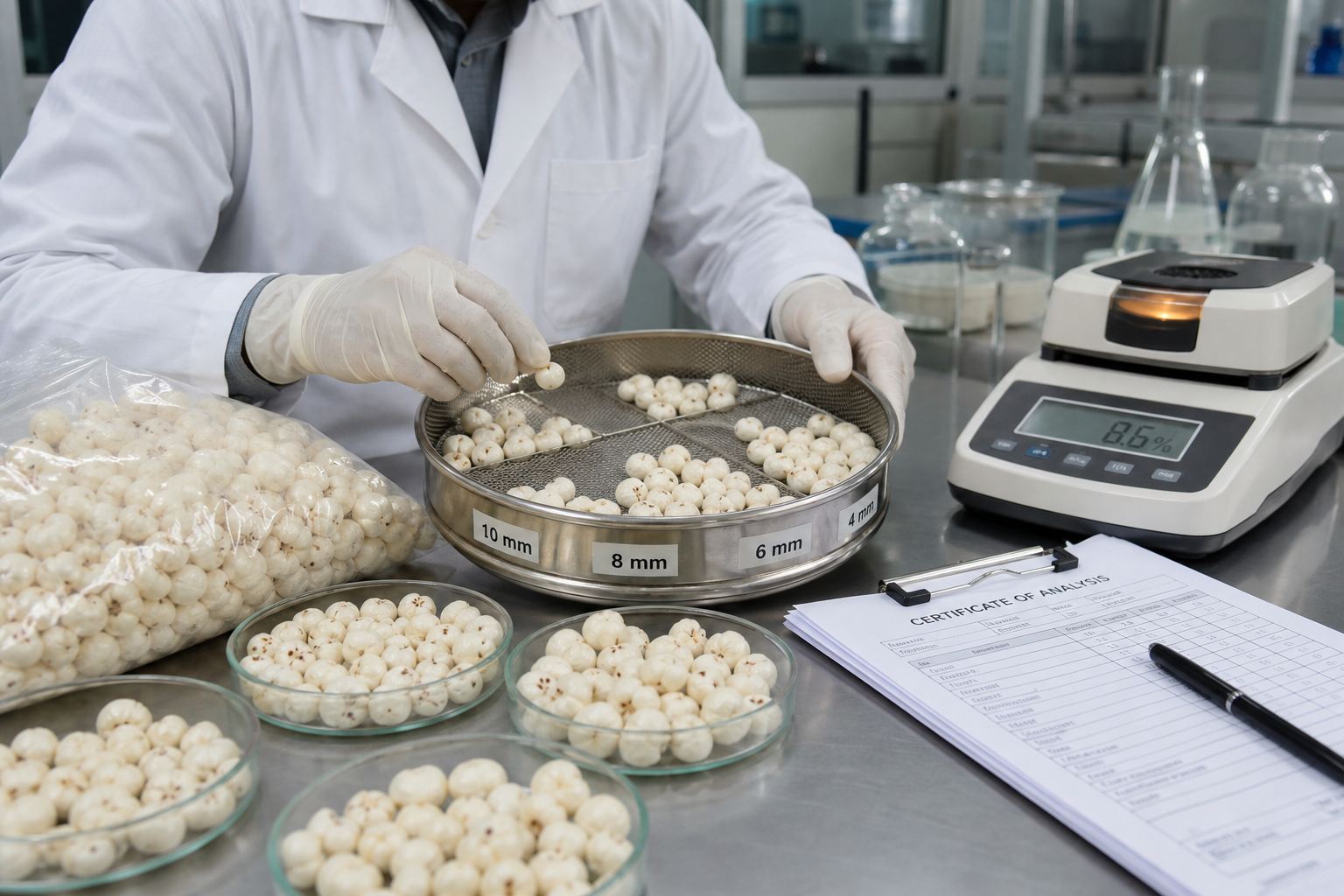
The USA is one of the fastest-growing destinations for Indian makhana, driven by keto, paleo, and gluten-free snacking trends across natural-food retail, e-commerce, and private-label brands. US buyers overwhelmingly prefer large-grade (16mm+), low-breakage popped makhana in resealable retail pouches (50–150g) for direct-to-shelf sale, alongside bulk 10–25kg packs for food-processing and repackaging operations. Flavoured formats — peri-peri, cheese, and lightly salted — are growing quickly in private-label ranges.
Most Demanded Indian Fox Nuts (Makhana) in Canada
Market Snapshot
- Preferred grade: Large/medium-grade, with growing organic-certified demand
- Preferred pack: Retail pouches (matching US format); 10–20kg bulk for diaspora grocery distributors
- Certifications expected: APEDA RCMC, FSSAI; CFIA-compliant documentation for direct Canadian import
- Channel tip: Diaspora grocery distributors are an accessible entry point before pursuing mainstream retail listings
Canadian demand closely mirrors the USA — natural food retail and South Asian diaspora grocery both drive steady import growth. Canadian buyers request large and medium-grade popped makhana in retail pouches similar to the US format, often sourcing through established US or direct-import channels. Bilingual (English/French) labelling awareness is a practical differentiator for exporters targeting Canadian retail directly rather than via US intermediaries.
Most Demanded Indian Fox Nuts (Makhana) in the UAE and Gulf
Market Snapshot
- Preferred grade: Mixed-grade bulk (food service); large-grade premium (gifting)
- Preferred pack: 10–25kg bulk bags; 200g–1kg gift boxes for Ramadan/Eid
- Certifications expected: APEDA RCMC, FSSAI, GSO compliance; halal-readiness supports retail entry
- Seasonal tip: Ramadan procurement begins 60–90 days ahead — confirm availability and pricing in the preceding quarter
The UAE is among the largest-volume destinations for Indian makhana when bulk food-service and premium gifting formats are combined. Gulf buyers split cleanly into two tiers: institutional food-service and catering distributors buying mixed-grade bulk (10–25kg) for cost efficiency, and premium/gifting buyers seeking large-grade, attractively packaged makhana (200g–1kg gift boxes) for Ramadan and Eid gifting cycles. Halal certification readiness and GSO (Gulf Standardisation Organisation) awareness matter for retail entry even though makhana itself is a plant-based product.
Most Demanded Indian Fox Nuts (Makhana) in the UK
Market Snapshot
- Preferred grade: Medium/large-grade, consistent whiteness
- Preferred pack: Retail pouches/jars 100–250g; 5–20kg bulk for ethnic grocery distributors
- Certifications expected: APEDA RCMC, FSSAI; UK Organic (via UKAS-approved CAB) for the organic tier
- Channel tip: UK online grocery and D2C snack brands are a fast-growing, accessible entry point for premium-graded makhana
UK demand is concentrated in ethnic grocery and the growing natural/health-food retail segment, with rising interest from online grocery and D2C snack brands. UK buyers generally want medium-to-large grade popped makhana in retail glass jars or pouches (100–250g), with post-Brexit import documentation requiring separate attention from EU-bound shipments. Organic-certified makhana is gaining traction as UK clean-label snacking grows, though the category is earlier-stage than in Germany.
Most Demanded Indian Fox Nuts (Makhana) in Australia
Market Snapshot
- Preferred grade: Large-grade retail; smaller bulk volumes than other markets
- Preferred pack: Retail pouches for health-food retail; limited bulk demand currently
- Certifications expected: APEDA RCMC, FSSAI, biosecurity/import compliance documentation
- Channel tip: Position as a novel, better-for-you snack category rather than competing purely on price against established local snacks
Australia is an earlier-stage but fast-growing market for Indian makhana, driven by expanding health-food retail interest in novel plant-based snacks. Import volumes remain smaller than the USA or UK, but buyers show strong preference for large-grade retail formats with credible quality documentation, given Australia's stringent biosecurity and import health-standards framework (Australian Border Force, FSANZ). Certified-organic and clearly graded product perform best in this compliance-conscious market.
Most Demanded Indian Fox Nuts (Makhana) in Germany
Market Snapshot
- Preferred grade: Large-grade, minimal breakage, GI-documented origin
- Preferred pack: Smaller premium retail packs (100–250g) for organic/specialty retail
- Certifications expected: NPOP/EU Organic certification, GI Mithila Makhana documentation, APEDA RCMC
- Watch-out: Incomplete or unsubstantiated organic/GI claims cause immediate buyer sourcing suspension
Germany is the most certification-intensive market in this comparison and rewards exporters who can substantiate both organic status and GI-linked origin claims. German organic and natural-food retailers seek certified-organic, GI-documented Mithila Makhana in smaller premium retail packs, with full traceability from pond cluster to export lot. The commercial reward is meaningful: certified, GI-linked makhana can command a substantial premium over conventional bulk in the German specialty retail channel, but greenwashed or undocumented organic/GI claims are penalised with immediate sourcing suspension.
Most Demanded Indian Fox Nuts (Makhana) in Nepal
Market Snapshot
- Preferred grade: Mixed-grade bulk; raw/semi-processed seed also finds buyers
- Preferred pack: Bulk sacks 25kg+; retail packaging is a smaller share of demand
- Certifications expected: APEDA RCMC, FSSAI; simplified overland customs documentation
- Channel tip: Land-route logistics via Raxaul–Birgunj reduce transit time and cost versus sea-freight markets
Nepal's demand pattern is distinct from every other market in this guide. Cultural and culinary familiarity with makhana drives consistent overland import demand via land border points such as Raxaul–Birgunj, typically in bulk raw or semi-processed form rather than retail-ready packs. Documentation requirements are comparatively simpler given the shared land border and established trade corridor, but exporters should not mistake simplicity for laxity — FSSAI and basic quality documentation remain expected.
Country × Grade × Pack × Certification Demand Matrix
Use this directional comparison to prioritise grading, packaging, and certification investment by target market. Validate with APEDA intelligence, DGFT HS 2008.19 trade data, and direct buyer conversations — demand levels reflect commercial intensity for typical Indian makhana exporters in 2026, not a guarantee that every grade will find buyers in every listed country.
Comparison table
Swipe →
Data table — swipe horizontally on small screens
| Country | Preferred Grade | Preferred Pack | Key Certifications | Demand | Price Sensitivity | Growth |
|---|---|---|---|---|---|---|
| USA | Large (16–20mm+), low breakage | Retail pouches 50–150g; bulk 10–25kg | APEDA, FSSAI, USDA Organic (premium tier) | Very High | Medium | High |
| Canada | Large/medium-grade | Retail pouches; 10–20kg bulk | APEDA, FSSAI, CFIA-compliant docs | High | Medium | High |
| UAE | Mixed-grade bulk + large-grade gifting | 10–25kg bulk; 200g–1kg gift boxes | APEDA, FSSAI, GSO, halal-readiness | Very High | Medium–High | High |
| UK | Medium/large-grade | Retail pouches/jars 100–250g; 5–20kg bulk | APEDA, FSSAI, UK Organic (CAB) | High | Medium | High |
| Australia | Large-grade retail | Retail pouches; limited bulk | APEDA, FSSAI, biosecurity compliance | Medium–High | Low–Medium | Medium–High |
| Germany | Large-grade, GI-documented | Premium retail 100–250g | NPOP/EU Organic, GI Mithila Makhana, APEDA | High | Low–Medium | High |
| Nepal | Mixed-grade bulk / raw | Bulk sacks 25kg+ | APEDA, FSSAI, overland customs docs | High | High | Medium–High |
Export Process
Export Tip
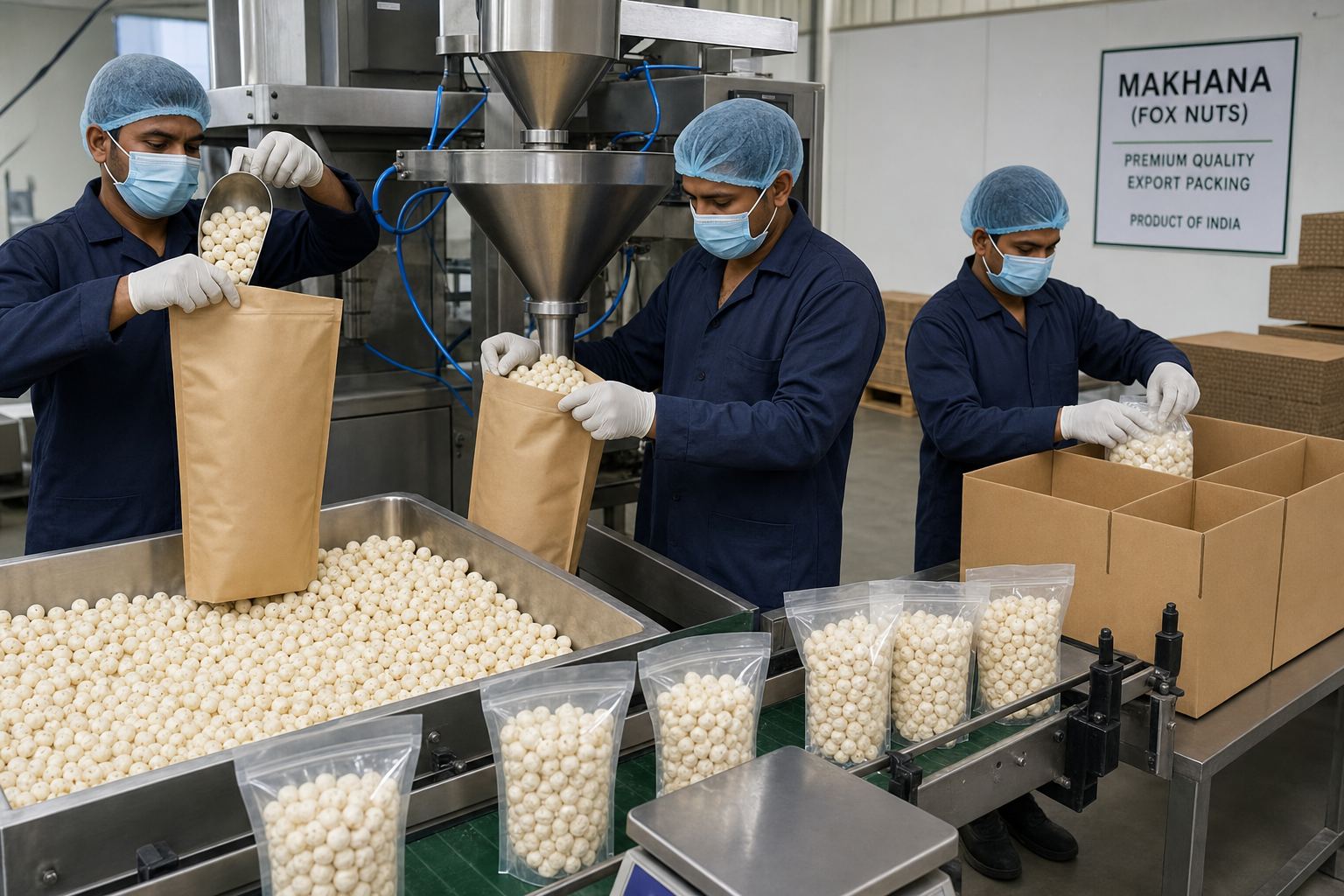
Regardless of destination, the export sequence stays consistent while the specification details change by market: IEC and APEDA/FSSAI registration; buyer discovery matched to your grading capability; sample dispatch with size grade and COA; price negotiation and purchase order; procurement/production scheduling with Mithila-belt processors; pre-shipment QC against the destination-specific grade and moisture requirement; export packing in the format that market expects; customs documentation; port booking and loading; and final documentation handover. See how to export fox nuts (makhana) from India for the full operational walkthrough.
Pricing Analysis
Buyer Tip
Pricing follows grade and certification closely across all markets, with country-specific packaging and compliance costs layered on top. Standard popped grades run USD 12–18/kg FOB, while premium large-grade, low-breakage, or certified-organic/GI lots reach USD 18–26+/kg — the premium tier is what unlocks Germany's specialty retail channel and the top end of US organic private label. APEDA's Oct-2025 unit-price data shows recent export FOB fluctuating roughly USD 15.5–20.3/kg overall, with destination unit prices directionally around Germany ~USD 26/kg, Nepal ~USD 21.6/kg, Australia ~USD 21/kg, UK ~USD 20/kg, USA ~USD 19.5/kg, Canada ~USD 15.8/kg, and UAE ~USD 13.3/kg — confirm against the current APEDA dashboard.
Comparison table
Swipe →
Data table — swipe horizontally on small screens
| Grade / Format | Typical FOB Price (USD/kg) | Markets Where This Wins |
|---|---|---|
| Standard popped, mixed grade | 12–15 | UAE bulk food service, Nepal overland trade |
| Large-grade popped (16mm+) | 15–18 | USA, Canada, UK retail-ready programmes |
| Premium/king-grade popped (18–20mm+) | 18–22 | US/UK premium private label, UAE gifting |
| Organic-certified / GI Mithila Makhana | 20–26+ | Germany specialty retail, US/UK organic tier |
MOQ Analysis
Buyer Tip
MOQ expectations differ by market maturity. US, UK, and Australian retail/private-label buyers typically start with small samples before committing to LCL trial orders; UAE and Nepal buyers with regular reorder cycles may move faster to part-container or FCL volumes given established bulk demand patterns.
Comparison table
Swipe →
Data table — swipe horizontally on small screens
| Buyer Stage | Typical MOQ | Common in Markets |
|---|---|---|
| Sample evaluation | 1–5 kg | USA, UK, Australia, Germany |
| Trial order | 100–500 kg | All markets before scaling |
| Standing reorder | 1–5 MT | UAE, Canada, Nepal |
| FCL programme | 1 x 20ft or 40ft container | UAE, USA (private label), Nepal (bulk) |
Packaging Standards
Export Tip
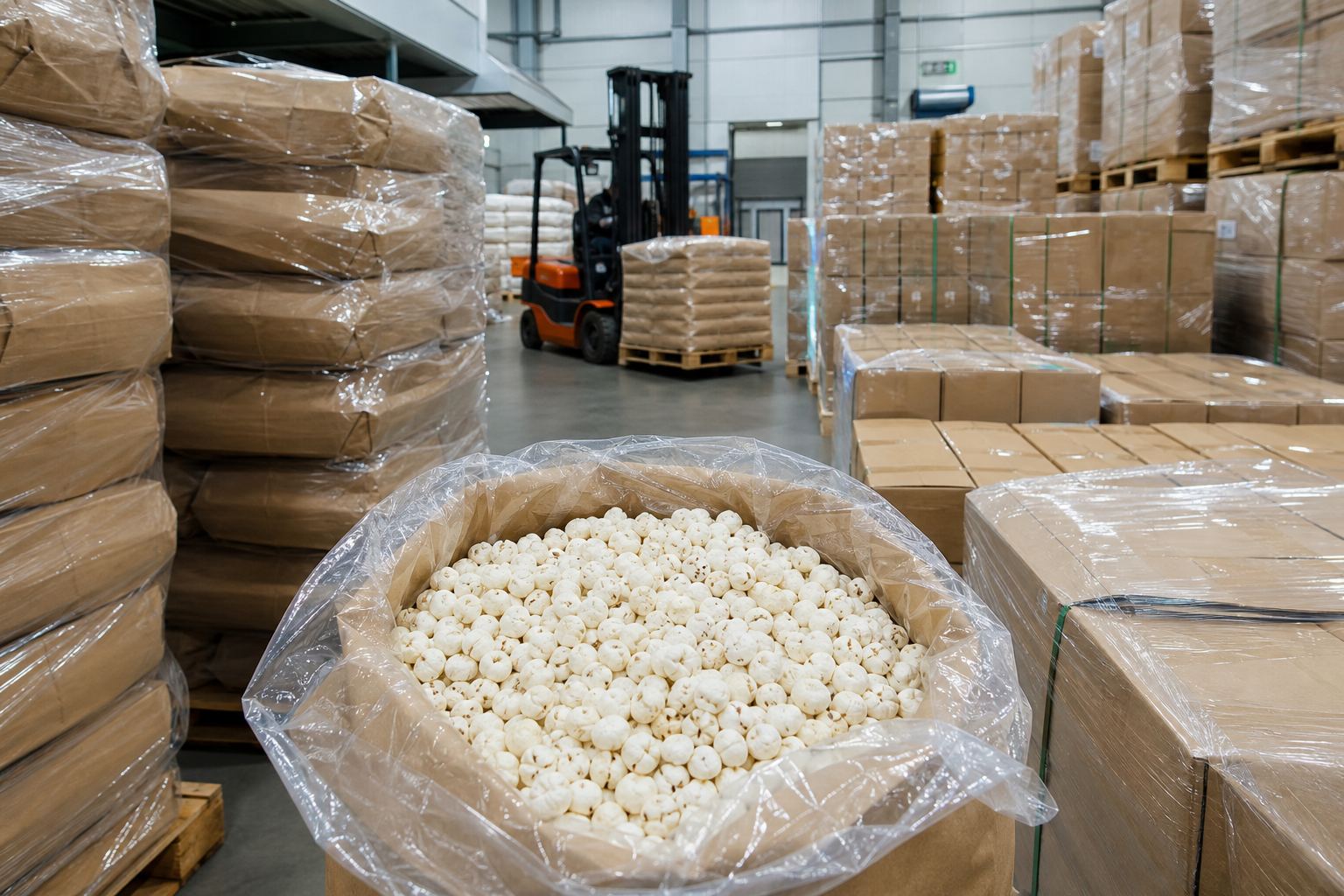
Packaging format is one of the clearest market differentiators in this guide. Bulk export packs (5/10/20/25kg food-grade bags/cartons with moisture-barrier liners) serve UAE food service, Nepal overland trade, and reprocessing buyers everywhere. Retail-ready pouches (50–500g, often resealable) dominate USA, UK, Canada, and Australia. Premium gifting formats (200g–1kg) matter specifically for UAE Ramadan/Eid cycles and German specialty retail presentation.
Comparison table
Swipe →
Data table — swipe horizontally on small screens
| Format | Typical Pack Size | Primary Markets |
|---|---|---|
| Bulk export bags/cartons | 5kg / 10kg / 20kg / 25kg | UAE food service, Nepal, reprocessors |
| Retail pouches (resealable) | 50g / 100g / 150g / 250g / 500g | USA, UK, Canada, Australia |
| Premium/gifting packs | 200g–1kg | UAE (Ramadan/Eid), Germany specialty retail |
Container Loading Details
Export Tip
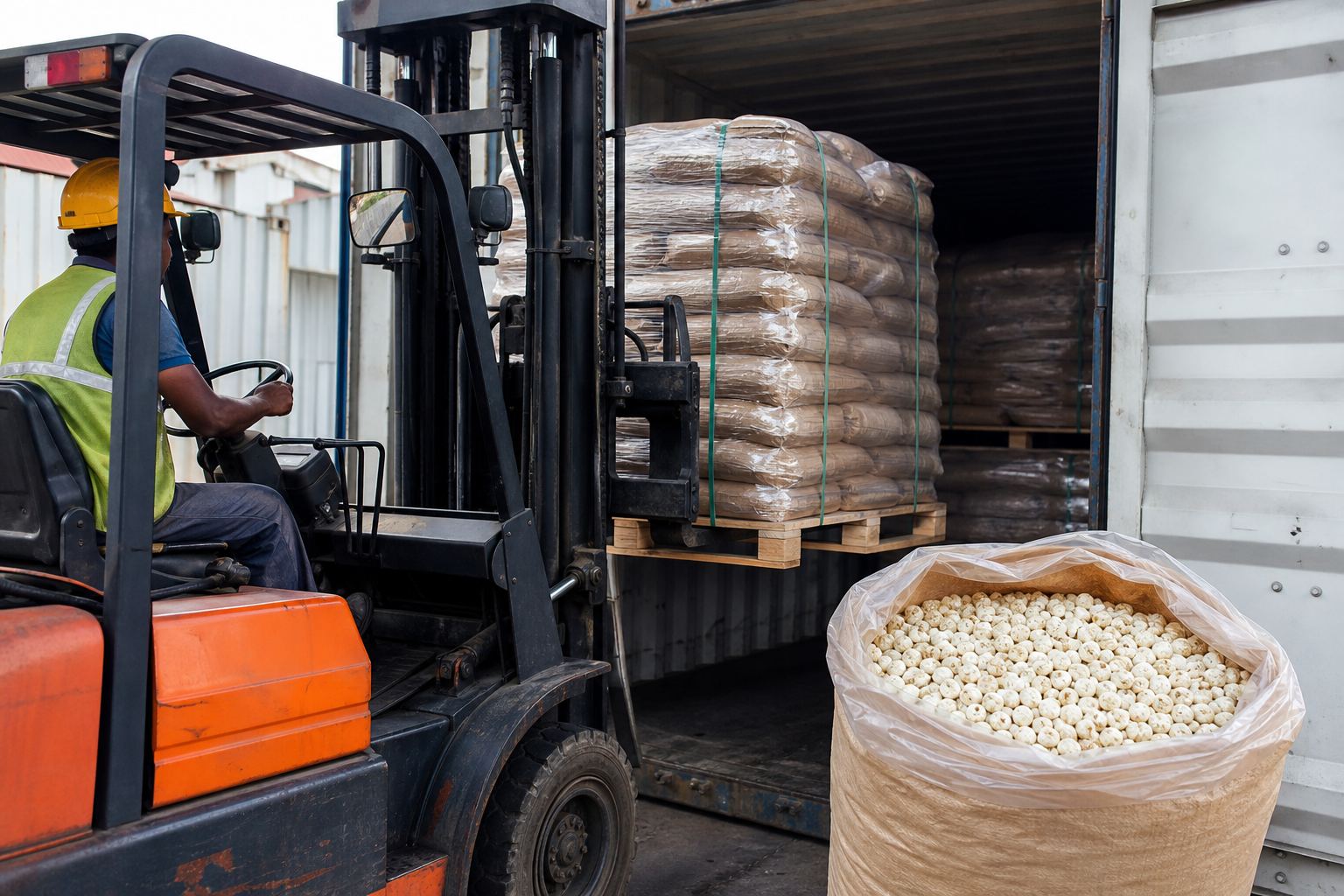
Popped makhana is light and bulky, so container loading is generally volume-constrained rather than weight-constrained — this holds across every market in this guide, though pack format (retail cartons versus bulk bags) shifts the exact figure. As a directional benchmark, a 20ft FCL commonly loads 5–10 MT of popped makhana in standard bulk packaging, with a 40ft FCL loading roughly 10–18 MT; denser raw/unpopped seed lots (more relevant to Nepal-bound bulk trade) load closer to 12–16 MT in a 20ft container. Confirm exact stuffing plans with your freight forwarder for each specific pack format.
Comparison table
Swipe →
Data table — swipe horizontally on small screens
| Container | Typical Load (Popped Makhana) | Typical Load (Raw Seed) |
|---|---|---|
| 20ft FCL | ~5–10 MT (volume-constrained) | ~12–16 MT |
| 40ft FCL | ~10–18 MT (volume-constrained) | ~24–28 MT |
Shipping Methods
Export Tip
Sea freight (FCL/LCL) via Kolkata, Nhava Sheva, or Mundra serves the USA, Canada, UAE, UK, Australia, and Germany under FOB, CFR, or CIF terms depending on buyer preference — Kolkata's proximity to Bihar makes it the natural first choice for many Mithila-belt exporters. Air freight covers urgent premium retail samples or small reorder top-ups. Nepal-bound trade moves predominantly overland/by rail through border points such as Raxaul–Birgunj, reflecting the established land trade corridor rather than sea logistics.
Certifications
Compliance Notes
Certification depth is the clearest signal of market sophistication in this comparison. APEDA RCMC, FSSAI, IEC, and GST form the baseline every market expects. Beyond that floor, requirements diverge sharply: Germany and the premium US/UK organic tier require NPOP/EU Organic or USDA NOP certification and GI Mithila Makhana documentation; the UAE benefits from halal-readiness and GSO compliance for retail entry; Australia requires biosecurity/import compliance documentation; and Nepal's overland trade is comparatively lighter on certification depth while still expecting FSSAI and basic quality documentation.
Comparison table
Swipe →
Data table — swipe horizontally on small screens
| Certification/Registration | Baseline or Premium | Markets Where It Matters Most |
|---|---|---|
| IEC + GST | Baseline | All markets |
| APEDA RCMC | Baseline | All markets |
| FSSAI licence | Baseline | All markets |
| GI Mithila Makhana documentation | Premium | Germany, US/UK specialty retail |
| Organic (NPOP/NOP/EU Organic) | Premium | Germany, US/UK organic tier |
| Halal-readiness / GSO compliance | Market-specific | UAE and broader Gulf |
| Biosecurity/import compliance documentation | Market-specific | Australia |
Buyer Requirements
Buyer Requirements
Across every market, buyers expect graded samples with a Certificate of Analysis (moisture, broken percentage, size grade, foreign matter), lot-to-lot consistency, and a clean institutional credential set presented upfront. What changes by market is the depth beyond that baseline: US/UK/Canadian retail buyers add private-label packaging customisation requests; UAE buyers add halal-readiness and gifting-format flexibility; German buyers add organic and GI documentation; and Nepal buyers add overland logistics reliability as a top priority alongside price.
Country-wise Opportunities
Market Snapshot
Beyond the grade/pack/certification matrix above, exporters should weigh entry difficulty against growth potential when choosing where to focus first. For the institutional-credential side of this decision — specifically APEDA registration — see APEDA registration benefits for fox nut (makhana) exporters.
Comparison table
Swipe →
Data table — swipe horizontally on small screens
| Country | Entry Difficulty | Growth Outlook | Best Fit For |
|---|---|---|---|
| USA | Medium (quality-consistency bar) | High | Processors with mechanised grading and private-label capability |
| Canada | Medium (similar to USA) | High | Exporters already serving the USA seeking channel diversification |
| UAE | Low–Medium (fast-moving buyers) | High | Exporters who can run both bulk and gifting-grade lines |
| UK | Medium (post-Brexit documentation) | High | Exporters targeting ethnic grocery and D2C snack brands |
| Australia | Medium–High (biosecurity compliance) | Medium–High | Exporters with strong documentation discipline and patience for slower entry |
| Germany | High (certification intensive) | High | Exporters with organic/GI certification investment capacity |
| Nepal | Low (established land trade) | Medium–High | New exporters building initial export experience and cash flow |
Sourcing Checklist for Buyers and Exporters
Checklist
For Buyers
- Specify size grade (mm), maximum breakage %, and moisture tolerance in every RFQ
- Confirm pack format (bulk vs retail) and labelling compatibility with your destination market
- Ask for APEDA RCMC, FSSAI, and IEC evidence before sending a sample-evaluation fee or deposit
- For organic/GI claims, request the certificate number and issuing body — do not accept unverified claims
- Align MOQ and lead time expectations with the exporter's actual grading and packing capacity
For Exporters
- Map your current grading capability honestly against the country matrix before quoting a new market
- Maintain separate documentation packs for baseline (APEDA/FSSAI) versus premium (organic/GI) buyers
- Invest in mechanised grading before targeting the USA, UK, or German premium tiers
- Prepare tiered pricing by grade so buyers can select against their specific price point
- Respond to specification and sample requests within 24–48 hours across every market
Compliance Checklist
Checklist
Compliance Notes
Comparison table
Swipe →
Data table — swipe horizontally on small screens
| Compliance Item | Status Check | Owner |
|---|---|---|
| IEC + GST | Valid and consistent across documents | Export desk |
| FSSAI licence | Central licence for export-oriented unit | Quality/compliance |
| APEDA RCMC | Current and renewed annually | Export desk |
| Pre-shipment COA | Size grade, moisture, broken %, foreign matter documented | QC team |
| Destination labelling | Allergen, COO, date, and language requirements met per market | Packaging team |
| Organic/GI documentation (where applicable) | Certificate current and matched to the specific lot | Quality/compliance |
| Halal/GSO documentation (UAE-bound) | Current certificate from recognised authority | Export desk |
Common Buyer Mistakes
Common Mistakes Box
- Assuming the grade that works in one market (e.g., UAE bulk) will satisfy a US or German premium buyer without adaptation.
- Requesting large-grade, low-breakage specifications while only budgeting for mixed-grade bulk pricing.
- Not confirming whether an 'organic' or 'GI Mithila Makhana' claim has a verifiable certificate behind it.
- Underestimating post-Brexit UK documentation differences from EU-bound shipments.
- Ignoring Ramadan/Eid seasonal procurement timing when sourcing for UAE gifting formats.
- Skipping sample evaluation before a bulk order and discovering grade inconsistency only on arrival.
Challenges & Solutions
Comparison table
Swipe →
Data table — swipe horizontally on small screens
| Challenge | Impact | Solution |
|---|---|---|
| Grade requirements differ sharply by market | Wasted quotes and mismatched inquiries | Map current grading capability to the country matrix before outreach |
| Certification-intensive markets (Germany) | Slower market entry, higher upfront cost | Sequence organic/GI certification deliberately, targeting Germany after baseline markets are stable |
| Bulky, low-density product | Container space becomes the binding constraint | Optimise carton/pallet dimensions per pack format with freight forwarder input |
| Seasonal demand spikes (UAE Ramadan) | Short procurement windows with high stakes | Confirm gifting-format availability and pricing 60–90 days ahead |
| Post-Brexit UK documentation differences | Customs delays if EU-style documents are reused | Prepare UK-specific documentation separate from EU-bound shipments |
Future Market Trends
Key Statistics
Through 2030, demand differentiation by country is likely to deepen rather than converge. US, UK, and Canadian retail will keep pushing toward larger grades, flavoured formats, and organic certification as the category matures beyond commodity snacking. Germany and broader EU organic retail will continue rewarding GI-linked traceability as a competitive prerequisite. The UAE will likely sustain its dual bulk-and-gifting demand pattern, Australia will grow steadily as biosecurity-compliant supply becomes more available, and Nepal's overland trade will remain a stable, lower-certification volume channel valuable for exporters building initial export experience.
Exporters who invest now in mechanised grading, organic/GI certification pathways, and destination-specific packaging will be positioned to serve the full spread of this matrix by 2030, rather than being confined to the lowest-certification, price-competitive segment of the global makhana trade.
Conclusion
- Action: Share your current grading capability, certifications, and target markets with Altus Exports for a demand-fit sourcing review.
- Explore agriculture & food products, honey & natural products, merchant exporter, export products from India, global sourcing partner, and product sourcing company partnership models.
- Continue with how to export fox nuts (makhana) from India, top fox nut (makhana) products exported from India, best countries for Indian fox nut (makhana) exports, APEDA registration benefits for fox nut (makhana) exporters, find international buyers for fox nuts (makhana), source fox nuts (makhana) directly from India, the fox nut (makhana) export documentation checklist, organic and premium fox nut (makhana) export opportunities, and trade shows and B2B marketplaces for fox nut (makhana) exporters.
The most demanded Indian fox nuts (makhana) by country in 2026 depends on grade, pack format, and certification depth as much as on price: the USA, Canada, and UK reward large-grade, retail-ready, increasingly organic-certified supply; the UAE rewards a dual bulk-and-gifting strategy; Germany rewards GI-linked organic certification at premium pricing; Australia rewards documentation discipline in a compliance-conscious market; and Nepal offers a lower-certification, high-volume overland channel well suited to exporters building initial export experience.
Exporters should prioritise three actions: (1) map current grading capability honestly against the country matrix in this guide; (2) choose one or two markets that match that capability rather than pursuing every destination simultaneously; (3) sequence certification investment (organic, GI documentation) toward the specific premium market it unlocks. Altus Exports can help both international buyers sourcing Indian makhana and Indian exporters aligning grade, certification, and documentation with destination demand.