Trade Shows & B2B Marketplaces for Fox Nut (Makhana) Exporters: Channel ROI Guide
By Saurabh Mittal, Founder, Altus Exports
A channel and events ROI guide for Indian fox nut (makhana) exporters — Gulfood, Anuga, SIAL, Biofach, Sweets & Snacks Expo, Natural Products Expo West, Fi Europe, and APEDA buyer-seller meets — with official websites, time of year, location, and tentative participation expense, plus Alibaba, IndiaMART, TradeIndia, and Tridge marketplace playbooks.
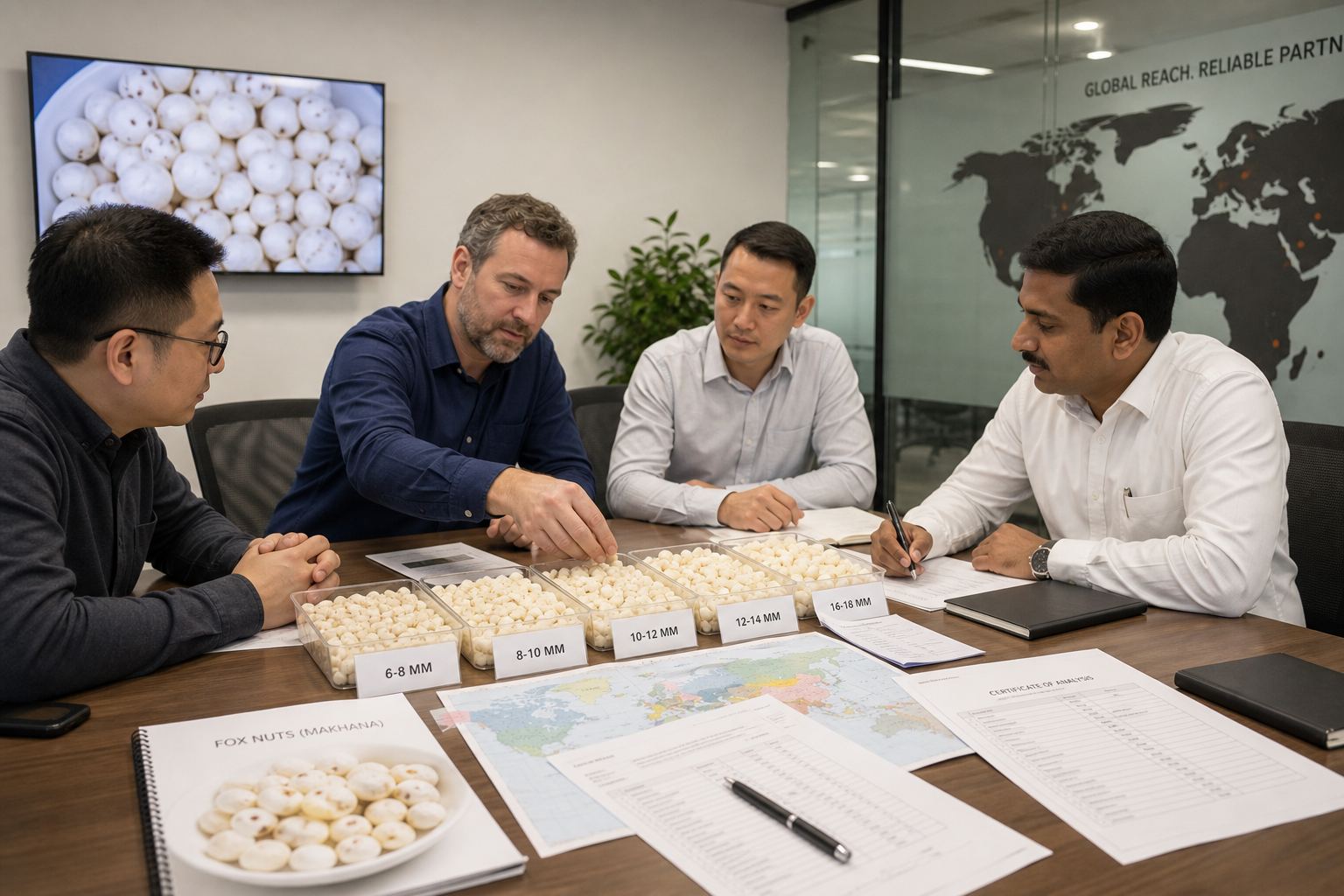
Trade shows and B2B marketplaces are the two highest-leverage channels for Indian **fox nut (makhana / *Euryale ferox*) exporters to reach international buyers outside their existing network. In three to four days at Gulfood, Anuga, SIAL, or Biofach, an exporter can meet more snack distributors, retail buyers, and organic-food brands than in a year of cold outreach. Between fair seasons, Alibaba, IndiaMART, TradeIndia, and Tridge** keep discovery running continuously — but only if booth strategy, listing quality, and follow-up discipline are in place.
This guide is a fair calendar + B2B marketplace ROI playbook for Indian makhana exporters and merchant exporters. It covers global fair selection, APEDA buyer-seller meet (BSM) and Reverse Buyer-Seller Meet (RBSM) participation, booth design essentials, marketplace listing optimisation, buyer conversation workflows, and structured follow-up. This is a channel and events guide — for operational export process and documentation, see the companion posts linked below.
For buyer discovery beyond trade shows, see Find International Buyers for Fox Nuts (Makhana). For APEDA council detail, see APEDA Registration Benefits for Fox Nut (Makhana) Exporters. For operational process, read How to Export Fox Nuts (Makhana) from India. For country ranking, read Best Countries for Indian Fox Nut (Makhana) Exports.
Altus Exports operates as a merchant exporter in India and global sourcing partner, participating in relevant fairs alongside APEDA delegations and supporting makhana exporters and international buyers with booth strategy, marketplace positioning, and post-fair commercial execution. Contact Altus Exports to plan your fair calendar or marketplace presence.
Key Takeaways
Summary Box
Executive Summary
Summary Box
Trade shows and B2B marketplaces for fox nut (makhana) exporters concentrate three activities that would otherwise take months: face-to-face buyer meetings, competitor benchmarking, and continuous digital lead flow. The flagship fair venues rotate between the Middle East (Gulfood), Europe (Anuga, SIAL, Biofach, Fi Europe), and North America (Sweets & Snacks Expo, Natural Products Expo West). APEDA-organised BSMs and RBSMs layer additional credibility and subsidised access for agri-food exporters. Digital marketplaces — Alibaba, IndiaMART, TradeIndia, Tridge — fill the gaps between physical events.
The return on booth or listing investment depends on preparation and follow-up more than on booth size or marketplace subscription tier. A modest booth with a well-designed exporter profile, sample COA copies, RCMC, and structured meeting workflow outperforms a larger booth staffed by unprepared teams handing out generic brochures. Follow-up cadence — 3 days, 10 days, 30 days — decides whether leads become first purchase orders.
This guide walks through fair calendar, booth strategy, APEDA delegation participation, marketplace positioning, and follow-up playbook. It deliberately stays on the channel and events side of makhana exporting — for step-by-step export process and documentation, see the companion posts referenced throughout.
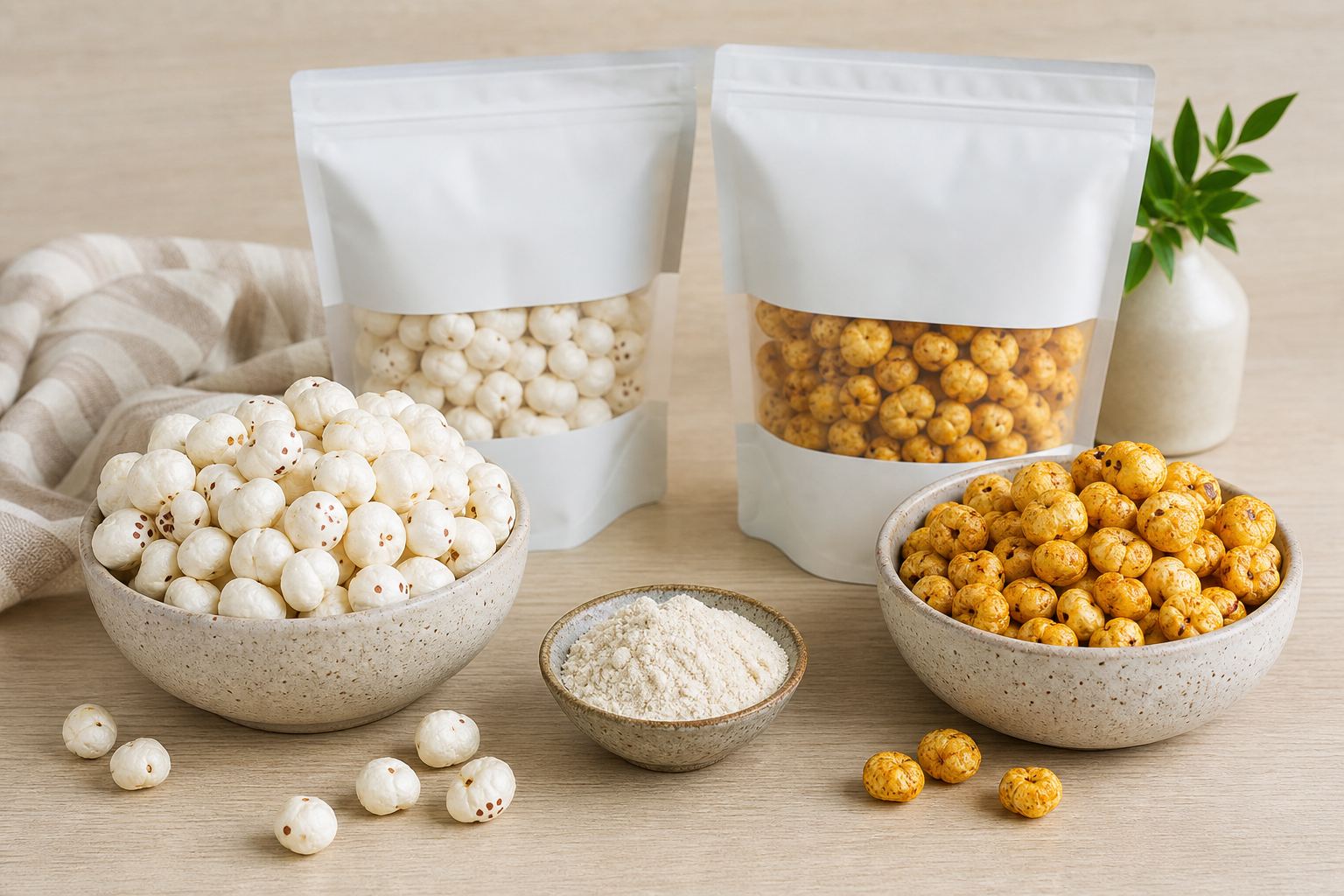
Market Size & Industry Overview
Key Statistics
Global food, snack, and natural-products trade shows collectively host tens of thousands of buyers each year across the Middle East, Europe, and North America. Gulfood attracts importers and distributors from across the Middle East, Africa, and South Asia. Anuga and SIAL host retail chains, private-label brands, and specialty importers from more than 100 countries between them. Biofach consolidates the world's organic-food buyer base into Nuremberg each February. Sweets & Snacks Expo and Natural Products Expo West bring together North American snack-category buyers, clean-label brands, and retail chain procurement teams.
B2B marketplaces complement fairs by keeping discovery active year-round. Alibaba and Tridge attract global bulk and ingredient buyers; IndiaMART and TradeIndia attract price-sensitive regional buyers and Indian-diaspora-linked distributors, useful for Nepal and Gulf redistribution leads. APEDA's BSM and RBSM programmes add council-organised buyer access at subsidised or facilitated rates, often timed around major fairs.
Fair schedules and marketplace fee structures shift year to year. Verify current-year dates, cities, and listing tiers on official fair and marketplace websites before committing budget.
Trade Show & Marketplace Snapshot (with Official Websites)
Swipe →
Data table — swipe horizontally on small screens
| Channel | Official Website | Typical Season | Location |
|---|---|---|---|
| Gulfood | gulfood.com | Jan–Mar (annual) | Dubai, UAE |
| Anuga | anuga.com | October (biennial) | Cologne, Germany |
| SIAL Paris | sialparis.com | October even years | Paris, France |
| BIOFACH | biofach.de/en | February (annual) | Nuremberg, Germany |
| Sweets & Snacks Expo | sweetsandsnacks.com | May (annual) | USA (often Chicago) |
| Natural Products Expo West | expowest.com | March (annual) | Anaheim, USA |
| Fi Europe | figlobal.com/europe | Nov–Dec (annual) | Rotating EU cities |
| APEDA fairs / BSM / RBSM | apeda.gov.in/TradeFairs | Year-round | India + overseas hosts |
| Alibaba / IndiaMART / TradeIndia / Tridge | alibaba.com · indiamart.com · tradeindia.com · tridge.com | Digital, continuous | Global online |
Trade Show Calendar: Websites, Timing, Location & Tentative Expense
Use the profiles below to budget your makhana fair calendar. Each entry links the official organizer website, states the usual time of year, city/venue, and a tentative participation expense band (space rental where published, plus directional all-in cost for a small Indian exhibitor team). Figures are indicative research anchors — organizers change rate cards every cycle.
As a planning rule of thumb: independent European/Gulf booths for 9–12 m² often total USD 12,000–45,000+ all-in; US snack/natural floors can run higher per square metre; APEDA pavilion / table space is usually the lowest-cost credible entry. Always request the live rate card and APEDA circular before locking budget.
Quick Expense Comparison (Indicative, Space + Directional All-In)
Swipe →
Data table — swipe horizontally on small screens
| Fair | Published Space Band (Indicative) | Directional All-In for Small Indian Team |
|---|---|---|
| Gulfood | ≈ AED 1,500–2,000/m² shell; APEDA EOI ≈ INR 2–5 lakh | USD 12,000–30,000+ |
| Anuga | EUR 358–423/m² + marketing packages | USD 18,000–45,000+ |
| SIAL Paris | ≈ EUR 346–376/m² | USD 15,000–40,000+ |
| BIOFACH | EUR 218–279/m² + obligatory fees | USD 12,000–35,000+ |
| Sweets & Snacks | ≈ USD 49–68/sq ft | USD 20,000–50,000+ |
| Expo West | ≈ USD 9,000+ per 10×10 (historical inline) | USD 18,000–45,000+ |
| Fi Europe | ≈ EUR 300–450/m² (request rate card) | USD 15,000–35,000+ |
| APEDA pavilion / BSM | Subsidised; EOI often INR 2–5 lakh | Typically lowest net cost for first-timers |
1. Gulfood (Dubai)
- Official website
- www.gulfood.com
- Time of year
- Typically late January–February; next major editions include 26–30 January 2026 and 15–19 March 2027 (confirm on the official site).
- Location
- Dubai, UAE — Dubai World Trade Centre and expanded Dubai Exhibition Centre / Expo City footprint for larger editions.
- Tentative expense
- Independent space often quoted around AED 1,500–2,000 per m² for shell-scheme bands (varies by hall/year). A 9–12 m² independent stand commonly lands near USD 8,000–18,000 for space alone before build, power, and freight. APEDA India Pavilion table/stall participation often requires an EOI deposit around INR 2–5 lakh (refundable if not allotted); final share is calculated after government approval. Add flights, hotel, visas, samples, and staff — all-in first-time budgets commonly USD 12,000–30,000+.
Best for makhana: Gulf distributors, ethnic retail, private-label snack buyers, and Middle East / Africa / South Asia redistribution partners. Strong Halal and gifting-season conversations.
Also note: Book 6–9 months ahead. Pavilion participation via APEDA Trade Fairs is usually the cheapest credible entry for first-time Indian exporters.
2. Anuga (Cologne)
- Official website
- www.anuga.com
- Time of year
- Biennial, early–mid October (next edition 9–13 October 2027).
- Location
- Cologne, Germany — Koelnmesse fairgrounds.
- Tentative expense
- Official floor rental (2027 published bands): EUR 358/m² Early Bird, EUR 380/m² regular, EUR 423/m² last call, plus obligatory marketing packages (main exhibitor package around EUR 1,399 and lighter options around EUR 350, plus small AUMA/energy fees). A 12 m² early-bird space alone is roughly EUR 4,300 before stand build. All-in with travel for a small Indian team commonly USD 18,000–45,000+.
Best for makhana: Global retail chains, private-label buyers, and specialty snack importers across Europe and beyond.
Also note: Use the Anuga stand-cost calculator on the organizer site and ask APEDA early about India Pavilion slots for Anuga years.
3. SIAL Paris
- Official website
- www.sialparis.com
- Time of year
- Biennial, mid–late October in even years (next edition 17–21 October 2026).
- Location
- Paris, France — Paris Nord Villepinte exhibition centre.
- Tentative expense
- Published exhibitor space bands around EUR 346/m² (early) to EUR 376/m² (standard) for recent cycles — confirm current rate card on the SIAL site. A 9–12 m² equipped stand often sits near EUR 3,500–6,000 for space before custom build. All-in Indian exhibitor budgets commonly USD 15,000–40,000+ including travel and samples.
Best for makhana: Innovation-focused retailers, European distributors, and private-label programmes seeking flavoured / retail-ready fox nuts.
Also note: Listed on APEDA’s 2026–27 fair calendar — check for pavilion EOI windows.
4. BIOFACH (Nuremberg)
- Official website
- www.biofach.de/en
- Time of year
- Annual, mid-February (next edition 16–19 February 2027).
- Location
- Nuremberg, Germany — Nuremberg Exhibition Centre.
- Tentative expense
- Hall rental (published): EUR 218/m² in-line (min 12 m²), EUR 254/m² corner, EUR 264/m² peninsula, EUR 279/m² island — stand construction not included. Obligatory extras include AUMA (~EUR 0.60/m²), disposal (~EUR 6.40/m²), and marketing services (~EUR 929 for direct exhibitors). A minimum 12 m² in-line space alone is about EUR 2,600 before build. All-in organic programmes commonly USD 12,000–35,000+.
Best for makhana: Organic and clean-label buyers — only bring NPOP / EU Organic / equivalent documentation if you claim organic. Non-organic commodity lots convert poorly here.
Also note: Book stand via BIOFACH exhibit page. Pair with certified organic COAs and chain-of-custody evidence.
5. Sweets & Snacks Expo (USA)
- Official website
- www.sweetsandsnacks.com
- Time of year
- Annual, typically mid-May (US confectionery and snack calendar — confirm exact dates on the site each year).
- Location
- United States — commonly Chicago (McCormick Place) for recent editions.
- Tentative expense
- Floor space is often priced per sq ft — directional published bands around USD 49–68 per sq ft depending on NCA membership and category. A standard 10×10 ft (≈9.3 m²) can run roughly USD 4,900–6,800 for space alone; total project cost (build, freight, labor, travel) is frequently 3–5× space, so budget USD 20,000–50,000+ for a serious first US snack-floor presence.
Best for makhana: North American snack-category buyers, flavoured retail SKUs, and private-label confectionery/snack distributors.
Also note: Application and category approval run through the National Confectioners Association process on the official site — start early.
6. Natural Products Expo West (USA)
- Official website
- www.expowest.com
- Time of year
- Annual, early March (APEDA calendar lists 2–5 March 2027 — confirm on Expo West).
- Location
- Anaheim, California, USA — Anaheim Convention Center.
- Tentative expense
- Historical rate cards show inline 10×10 packages around USD 9,000+ and island/peninsula rates around USD 116–119 per sq ft (confirm current contract). All-in with travel and clean-label sampling commonly USD 18,000–45,000+ for a first booth.
Best for makhana: Clean-label, natural, and wellness snack brands; US retail buyers seeking better-for-you fox nut SKUs.
Also note: Also listed on APEDA Trade Fairs — watch for India Pavilion or FAS support windows.
7. Fi Europe (Food Ingredients Europe)
- Official website
- www.figlobal.com/europe
- Time of year
- Annual, typically late November / early December (city rotates — check Fi Global each year).
- Location
- Rotating major EU cities (recent cycles have used Paris and other Informa Fi Global venues).
- Tentative expense
- Ingredient-fair space commonly falls in a broad EUR 300–450/m² band depending on package and year (request the live rate card from Fi Global). A 9–12 m² presence plus travel often totals USD 15,000–35,000+ all-in.
Best for makhana: Ingredient and R&D buyers — makhana flour, broken grade, and functional snack-base applications rather than retail pouch tasting alone.
Also note: Bring mesh/particle-size specs, moisture targets, and application sheets — Fi buyers buy on technical data more than origin storytelling.
8. APEDA Buyer-Seller Meets, RBSMs & India Pavilions
- Official website
- apeda.gov.in/TradeFairs
- Time of year
- Year-round calendar — domestic BSMs/RBSMs plus India Pavilions at Gulfood, SIAL, BIOFACH, Expo West, Fine Food Australia, and others (see APEDA’s current Events & Trade Fairs table).
- Location
- Multiple: India (domestic meets) and overseas host cities of partner fairs (Dubai, Paris, Nuremberg, Anaheim, Singapore, Jeddah, Moscow, etc.).
- Tentative expense
- Usually lower than independent booths. Recent Gulfood pavilion EOIs required about INR 2 lakh deposit for table-space interest (refundable if not allotted); stall packages for other fairs have used INR 2–5 lakh EOI bands depending on size. Final cost is set after GoI/APEDA approval; FAS (Financial Assistance Scheme) support may further reduce net cost for eligible RCMC holders. Always read the circular for that fair.
Best for makhana: First-time exporters and FPOs needing subsidised access, pre-scheduled buyer meetings, and India-brand credibility.
Also note: Apply via APEDA i-Track / trade-fair application links in each circular. Preference often goes to new participants, startups, women exporters, and FPOs when stated.
B2B Marketplaces (Year-Round Digital Channels)
- Alibaba
- www.alibaba.com — free storefronts to paid Gold Supplier tiers; directional annual spend often USD 1,000–several thousand depending on package and ads.
- IndiaMART
- www.indiamart.com — free basic listings; paid memberships for lead priority (commonly low–mid four figures INR/month depending on plan).
- TradeIndia
- www.tradeindia.com — free to paid exporter catalogues; useful for Nepal/Gulf diaspora-linked inquiries.
- Tridge
- www.tridge.com — agri/food sourcing marketplace; paid supplier visibility packages vary — request current rate card.
Marketplaces keep discovery running between fair seasons. Budget for photography, COA PDFs, and a person to qualify inquiries — subscription fees are only a fraction of true cost-per-qualified-lead.
Export Statistics
Key Statistics
Conversion rates for Indian makhana exporters across fairs and marketplaces vary widely by channel, booth or listing preparation, and follow-up discipline. Directionally, a well-prepared exporter can convert 5 to 15 percent of booth conversations into serious quote requests, and 10 to 25 percent of quote requests into first purchase orders — with significant variation by SKU family and destination. Marketplace conversion is typically lower per-lead but higher in volume, requiring rigorous qualification rather than uniform follow-up.
Fair & Marketplace Conversion Direction (Indicative)
Swipe →
Data table — swipe horizontally on small screens
| Stage | Fair Conversion Direction | Marketplace Conversion Direction |
|---|---|---|
| Interaction to contact exchange | 40–70% | 15–30% (inquiry to genuine contact) |
| Contact exchange to sample request | 10–25% | 5–15% |
| Sample requests to formal quotes | 40–60% | 30–50% |
| Formal quotes to first purchase order | 10–25% | 8–20% |
| First PO to repeat programme | 50–80% | 40–65% |
Import Statistics
Key Statistics
Import-side data cross-references with trade show and marketplace activity. Buyers from USA, Canada, UAE, UK, Australia, Germany, and Nepal appear across snack, organic-food, and B2B ingredient channels in different proportions. Distributors, retail chains, e-commerce brands, and ingredient formulators each favour different fair categories and marketplaces — build your channel calendar to match the buyer archetype you want to convert.
Buyer Archetype by Channel
Swipe →
Data table — swipe horizontally on small screens
| Buyer Archetype | Best-Fit Channel |
|---|---|
| Snack-category retail buyer (USA/Canada) | Sweets & Snacks Expo, Anuga |
| Clean-label / natural brand (USA) | Natural Products Expo West, Biofach |
| Organic retail chain (Germany/EU-adjacent) | Biofach, SIAL |
| Gulf distributor / redistribution (UAE) | Gulfood, APEDA BSM |
| Bakery / ingredient formulator (Germany/UK) | Fi Europe |
| Regional bulk buyer (Nepal) | IndiaMART, TradeIndia |
| Global bulk / private-label buyer | Alibaba, Tridge |
| Wellness retail buyer (Australia) | Natural Products Expo West, Biofach |
Product Categories
Summary Box
Channel selection should follow SKU family and destination. Flavoured, roasted, and retail private-label makhana convert best at snack and natural-products fairs. Bulk phool makhana and makhana flour convert best on B2B marketplaces and at ingredient-focused fairs like Fi Europe. Organic-certified lots convert best at Biofach and through organic-specific marketplace listings.
SKU-to-Channel Mapping
Swipe →
Data table — swipe horizontally on small screens
| SKU Family | Priority Channel |
|---|---|
| Flavoured / roasted retail packs | Sweets & Snacks Expo, Natural Products Expo West |
| Organic makhana (any format) | Biofach, organic-specific marketplace listings |
| Bulk phool makhana | Alibaba, Tridge, APEDA BSM |
| Makhana flour | Fi Europe, IndiaMART |
| Retail private label | Anuga, SIAL, Gulfood |
Manufacturing Overview
Export Tip
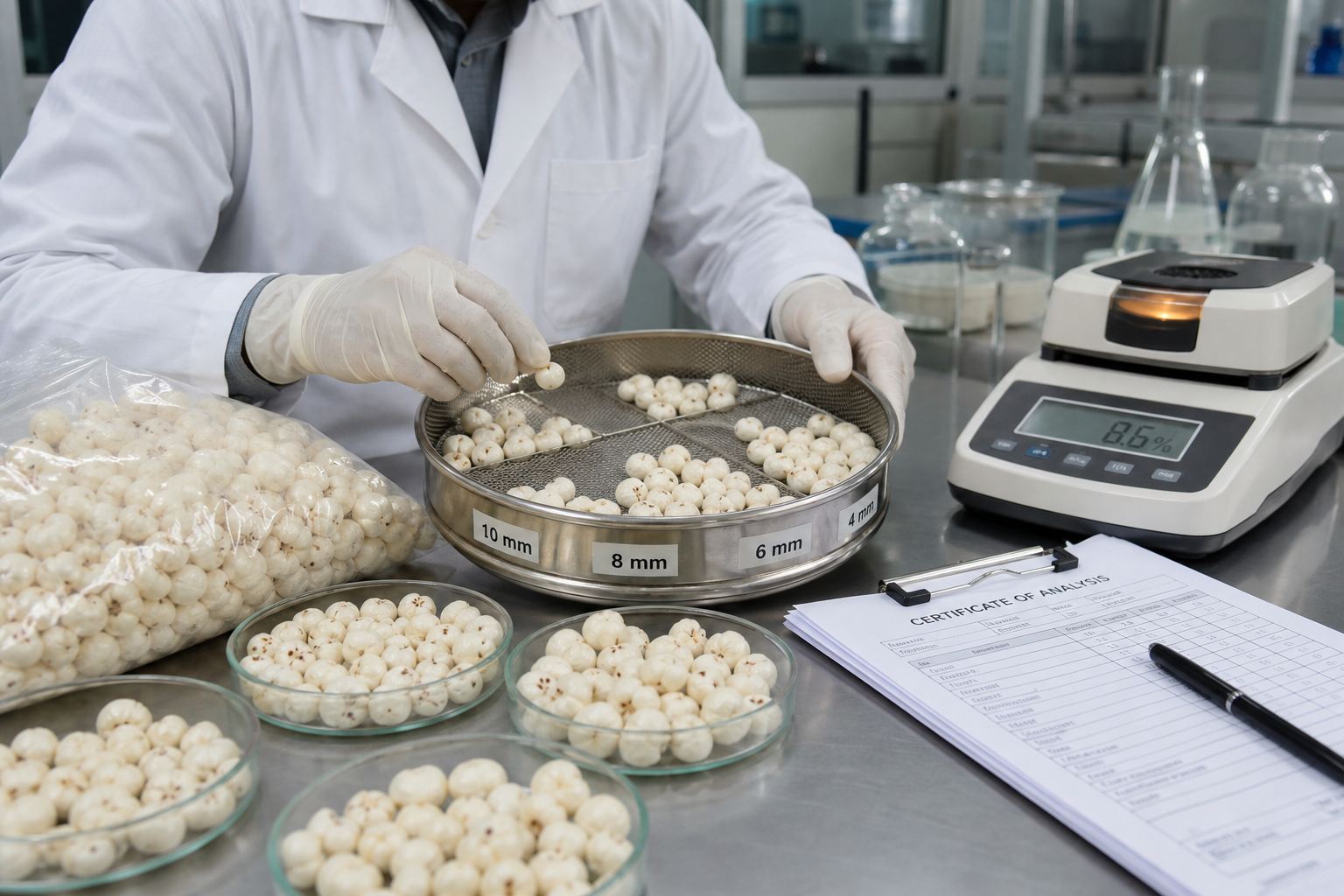
Channel readiness starts at production. Booth and listing conversations convert best when the exporter can quote FOB bands with confidence across the directional USD 12–26+/kg range depending on grade, size, roast, and organic status. Bring physical samples in labelled containers (both bulk and retail formats), size-grade visuals, packing bill of materials print-outs, and a QR-linked exporter profile page for both fair booths and marketplace listings.
Booth Preparation Checklist
- Exporter profile PDF (2 to 4 pages, well-designed)
- Product catalogue by SKU family with FOB bands
- Physical samples in labelled containers (bulk + retail formats)
- Size-grade visuals or reference gauges
- Packing bill of materials print-outs per SKU
- Registration and certification copies: IEC, FSSAI licence, APEDA RCMC, HACCP/ISO 22000, Halal/Kosher/organic
- Sample lot COA per SKU family
- QR code linked to exporter website and product catalogue
- Business cards with named lead contact
- CRM app or spreadsheet for on-booth lead capture
Delegation vs Independent Participation
APEDA-organised BSMs and RBSMs offer subsidised participation, pre-scheduled buyer meetings, and shared council credibility. Independent booth participation offers more branding control and larger footprint. First-time exporters typically benefit more from delegation participation; established exporters often mix delegation and independent booth participation across fairs.
Both approaches require the same preparation discipline. Delegation participation does not exempt an exporter from booth material readiness, COA sample discipline, or follow-up cadence.
Export Process
Export Tip
This section connects channel activity to the export process without duplicating full operational detail — the goal is to show where fairs and marketplaces feed the sales funnel. A booth conversation or marketplace inquiry is not an export process step by itself; it is the trigger that opens the sample-to-PO sequence covered in full in the operational guide.
Channel-to-Sale Funnel
Swipe →
Data table — swipe horizontally on small screens
| Stage | Channel Activity | Next Step |
|---|---|---|
| 1. Discovery | Booth conversation or marketplace inquiry | Qualify buyer (SKU fit, destination, volume) |
| 2. Sample request | Buyer requests 1–5 kg sample | Courier sample with informal spec sheet |
| 3. Sample evaluation | Buyer tests moisture, size grade, taste | Follow up at day 10 with formal quote |
| 4. Trial order | Buyer places 100–500 kg trial order | Confirm documentation pack and Incoterm |
| 5. Wholesale programme | Buyer commits to 1–5 MT FCL programme | Move to full documentation and repeat-shipment workflow |
Pricing Analysis
Buyer Tip
Booth investment ranges widely — see the detailed rate bands in Trade Show Calendar: Websites, Timing, Location & Tentative Expense above. An APEDA BSM/RBSM or India Pavilion slot may cost a fraction of an independent 12 m² booth. Published European floor rates often sit near EUR 218–423/m² depending on fair and booking window; Gulf shell schemes are often quoted near AED 1,500–2,000/m²; US snack floors can exceed USD 49/sq ft. Marketplace listings range from free basic tiers on IndiaMART to paid Alibaba Gold Supplier packages. Return on investment depends on lead conversion, and lead conversion depends on preparation and follow-up regardless of channel.
Booth & Listing Investment vs Return Framework
Swipe →
Data table — swipe horizontally on small screens
| Investment Layer | Return Consideration |
|---|---|
| Booth space rental | Match size to conversation bandwidth |
| Booth design + construction | Reuse elements across fairs to amortise |
| Travel + accommodation | Book early for cost efficiency |
| Marketplace premium listing fee | Track cost per qualified lead, not just impressions |
| Sample production for on-booth / marketplace use | Prepare per SKU family |
| Follow-up team cost | Budget dedicated post-fair and post-lead bandwidth |
MOQ Analysis
Buyer Tip
Booth and marketplace conversations should quote MOQ flexibly. Sample 1–5 kg; trial 100–500 kg; wholesale 1–5 MT. Buyers who ask for a sample or trial are exactly the buyers you want; buyers demanding FCL commitment from a first marketplace message are usually higher-risk conversions.
MOQ Positioning in Channel Conversations
Swipe →
Data table — swipe horizontally on small screens
| Programme | First-Contact Positioning |
|---|---|
| Sample courier | 1–5 kg |
| Trial order | 100–500 kg |
| Wholesale FCL | 1–5 MT |
Packaging Standards
Export Tip
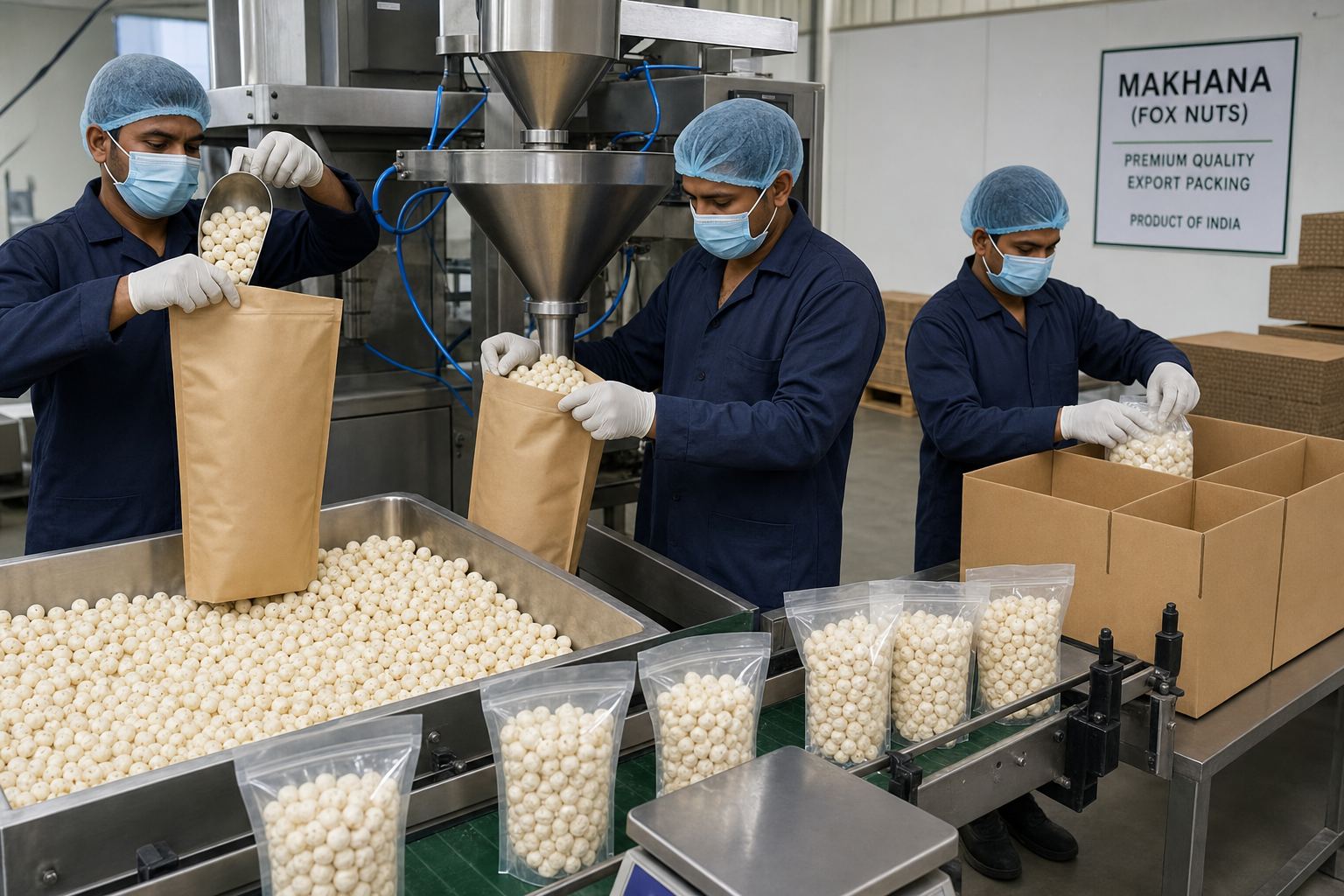
Bring physical packing samples to fairs and photograph them clearly for marketplace listings: 5/10/20/25 kg bulk food-grade bags, and retail 50–500 g nitrogen-flushed pouches. High-quality listing photography of retail pack formats materially improves marketplace click-through and buyer confidence versus generic stock imagery.
Packing Samples for Booth & Marketplace Listings
Swipe →
Data table — swipe horizontally on small screens
| Sample | Purpose |
|---|---|
| 25 kg bulk bag (mini sample) | Bulk buyer conversation and listing photo |
| Retail pouch mock-up (N2-flushed) | Retail buyer conversation and listing photo |
| Flavoured variant sample set | Snack fair tasting conversation |
| Flour sample pack | Ingredient buyer conversation at Fi Europe |
Container Loading Details
Export Tip
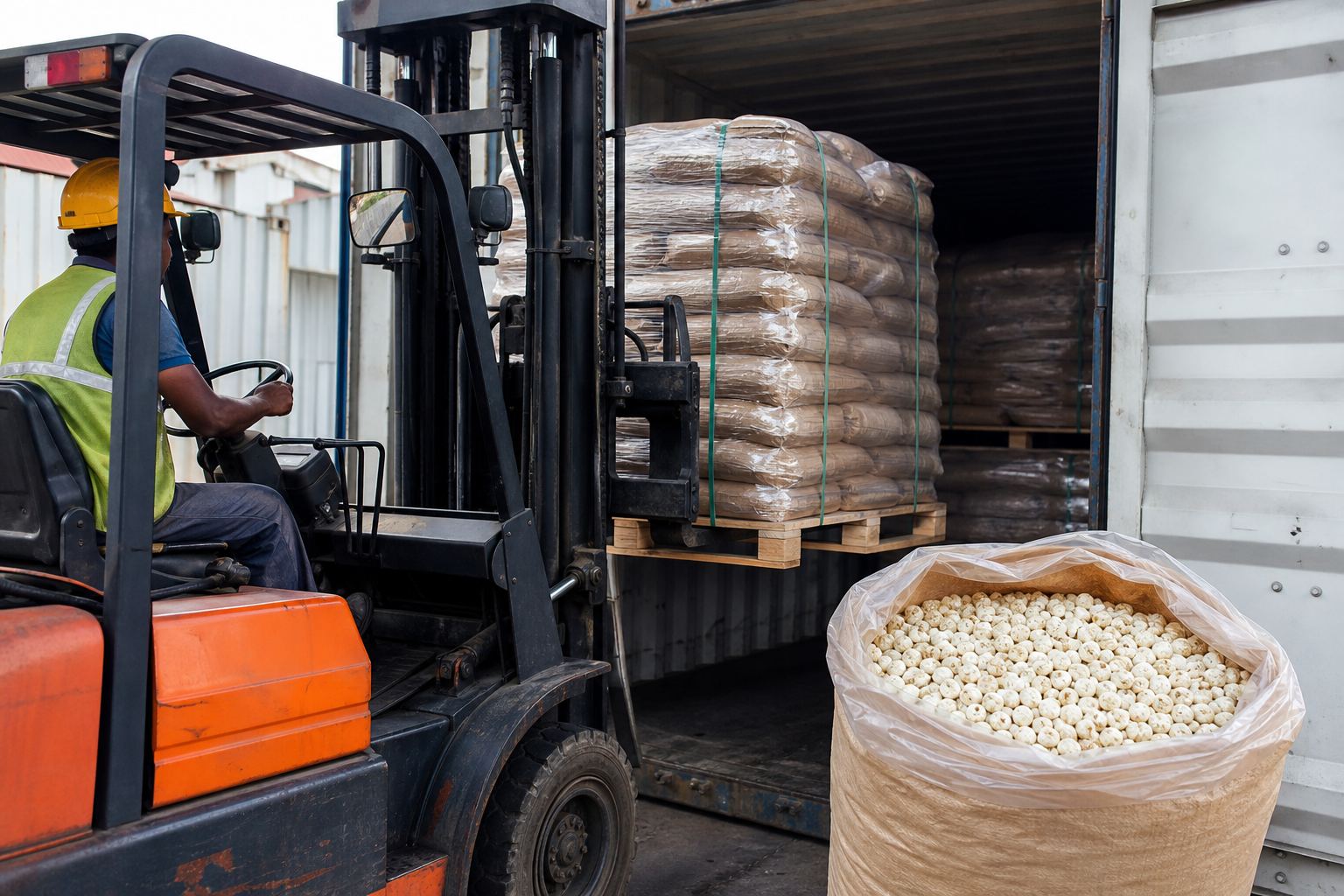
Reference FCL targets in booth and marketplace conversations when the buyer is likely to run repeat programmes. Wholesale programmes target 1–5 MT with stow verification. Load ports at Kolkata, Nhava Sheva, or Mundra. Buyers reading FCL capability at your booth or listing interpret it as supplier maturity.
FCL Signals in Channel Conversations
Swipe →
Data table — swipe horizontally on small screens
| Signal | Buyer Interpretation |
|---|---|
| Wholesale target 1–5 MT | Standard programme readiness |
| Multiple SKU capability in one FCL | Flexible, well-organised supplier |
| Pre-stow inspection SOP referenced | Documentation-mature supplier |
| Clear port and lead-time statement | Logistics-mature supplier |
Shipping Methods
Export Tip
Reference shipping capability confidently at booth and in listings: sea FCL from Kolkata, Nhava Sheva, or Mundra; LCL for trial launches; air for samples. Incoterms: EXW, FOB, CFR/CIF. Lead times run directionally 7–14 days for samples, 2–4 weeks for trial orders, and 4–8 weeks for wholesale FCL programmes. Buyers who ask about FOB Kolkata want freight control; CFR/CIF signals exporter-managed freight.
Shipping Method Talking Points at Booth / Listing
Swipe →
Data table — swipe horizontally on small screens
| Signal | Buyer Signal |
|---|---|
| FOB Kolkata / Nhava Sheva / Mundra | Buyer-controlled freight |
| CFR / CIF | Exporter-managed freight |
| LCL for trial launches | Small first orders welcome |
| Stated lead times (7–14d / 2–4w / 4–8w) | Logistics-mature, planning-ready supplier |
Certifications
Compliance Notes
Present credentials visibly at the booth and in marketplace listings: APEDA RCMC on the product sheet, FSSAI licence number, HACCP/ISO 22000 where held, and a one-page lot COA summary with moisture, size grade, and microbiology. Halal / Kosher marks help Gulf visitors and organic certification helps EU-adjacent and USA visitors. Buyers treat cert visibility as a supplier maturity signal on both fair booths and digital storefronts.
Cert Presentation at Booth / Listing
Swipe →
Data table — swipe horizontally on small screens
| Cert | Presentation Format |
|---|---|
| APEDA RCMC | Framed copy at booth; PDF attachment on listing |
| FSSAI licence | Framed copy at booth; number in listing description |
| HACCP / ISO 22000 | Framed copy for buyer-facing programmes |
| Halal / Kosher | Reference copy for Middle East / specialty buyers |
| Organic (NPOP/USDA/EU-equivalent) | Reference copy for USA / EU-adjacent buyers |
| Lot COA samples | Printed lot COA per SKU family; PDF for listings |
Buyer Requirements
Buyer Requirements
Buyer requirements in fair and marketplace conversations are less structured than in commercial negotiation. Buyers want to see that you exist, have registrations, can meet spec, and have credible references. Conversations that lead with credibility and end with a clear next step convert better than conversations that lead with price and end without an agreed follow-up.
Channel Conversation Buyer Expectations
Swipe →
Data table — swipe horizontally on small screens
| Buyer Signal | Expected Exporter Response |
|---|---|
| Casual booth walk-in | Brief pitch + brochure + business card exchange |
| Serious marketplace inquiry | SKU discussion + FOB indication + sample commitment |
| Buyer-scheduled BSM/RBSM meeting | Prepared exporter profile + samples + follow-up plan |
| Existing category buyer | Prior shipment reference + landed cost discussion |
| First-time India buyer | Merchant exporter service + APEDA RCMC + documentation walkthrough |
Country-wise Opportunities
Market Snapshot
Country-specific channel opportunities allow exporters to concentrate their fair and marketplace calendar on the destinations that fit their SKU capability.
Fair & Marketplace Priority by Destination
Swipe →
Data table — swipe horizontally on small screens
| Destination | Priority Channel |
|---|---|
| USA | Sweets & Snacks Expo, Natural Products Expo West |
| Canada | Sweets & Snacks Expo, Natural Products Expo West |
| UAE / Middle East | Gulfood, APEDA BSM |
| UK | Anuga, SIAL |
| Germany | Anuga, SIAL, Biofach, Fi Europe |
| Australia | Natural Products Expo West, Biofach, Alibaba/Tridge |
| Nepal | IndiaMART, TradeIndia |
United States
USA-focused makhana exporters should prioritise Sweets & Snacks Expo and Natural Products Expo West. Retail chains, e-commerce brands, and clean-label formulators attend. Booth conversation focus: flavoured retail packs and organic-certified lots.
Canada
Canadian buyers commonly attend the same North American fairs as US buyers. Distinguish Canadian conversations by preparing bilingual retail readiness references.
United Arab Emirates
UAE and Gulf-focused exporters should prioritise Gulfood and APEDA BSMs held in the region. Halal alignment, Arabic labelling references, and Gulf redistribution readiness are key conversation points.
United Kingdom
UK buyers attend Anuga and SIAL alongside wider EU buyers. Focus on allergen declarations, retail-ready packing, and consistent size grading.
Germany
Germany buyers attend Anuga, SIAL, Biofach (organic), and Fi Europe (ingredient/flour buyers). Focus on organic documentation, mesh/size consistency, and sustainability positioning.
Australia
Australian wellness retail buyers attend Natural Products Expo West and Biofach when travelling internationally, and are increasingly reachable through Alibaba and Tridge listings. Focus on labelling discipline and long-lane barrier packing.
Nepal
Nepal-focused buyers are most efficiently reached through IndiaMART, TradeIndia, and direct trade relationships rather than international fairs, given proximity and existing land-border trade channels.
Sourcing Checklist (Buyer + Exporter)
Checklist
A channel-focused sourcing checklist keeps both exporters and buyers organised across the fair calendar and marketplace year.
For Exporters
- Choose 2 to 4 priority fairs per year based on destination + SKU fit
- Register for APEDA BSM/RBSM 6 months in advance where relevant
- Book independent booth space 4 to 6 months in advance for premium fairs
- Optimise marketplace listings with clear photos, FOB bands, and cert copies
- Schedule high-value buyer meetings 4 to 8 weeks before fair
- Assign lead capture and follow-up owners for each channel
- Track conversion metrics — contacts, samples, quotes, POs — per channel to refine calendar
For Buyers
- Pre-book meetings with matched exporters via fair apps or APEDA coordinators
- Cross-check marketplace supplier claims against APEDA RCMC and FSSAI records
- Request a written spec sheet and lot COA before committing to a sample order
- Compare quotes from at least two to three exporters met across different channels
- Track which channel produced your most reliable supplier relationships for future sourcing
Compliance Checklist
Checklist
Compliance Notes
- IEC, GST, FSSAI licence, and APEDA RCMC current before listing or exhibiting
- Lot COA samples prepared per SKU family for on-demand sharing
- Halal / Kosher / organic certificates ready for relevant destination conversations
- Marketplace listings accurately describe HS-relevant product categories and specifications
- Booth materials include visible registration and certification references
- Sample courier processes comply with destination customs declaration rules
- Lead capture and follow-up process documented and assigned to a named owner
A compact compliance checklist for channel participation keeps fair and marketplace activity aligned with export readiness.
Common Buyer Mistakes
Common Mistakes Box
Channel-related mistakes are consistent: booking booth space or a marketplace premium tier without a follow-up plan; sending unprepared staff who cannot answer SKU-level questions; failing to bring physical samples to fairs; skipping the 72-hour follow-up window; and treating every buyer conversation or marketplace inquiry as equally valuable rather than qualifying leads on the spot.
Challenges & Solutions
Channel-specific challenges recur across seasons, and each has a repeatable fix once an exporter has run a full fair or marketplace cycle.
Channel Challenges and Solutions
Swipe →
Data table — swipe horizontally on small screens
| Challenge | Solution |
|---|---|
| Low marketplace response rate | Refresh listing photos, FOB bands, and certifications quarterly |
| Booth conversations that never convert | Qualify leads on the spot with three fixed questions before exchanging cards |
| Follow-up backlog after a fair | Assign a dedicated follow-up owner before the fair, not after |
| Duplicate leads across marketplaces and fairs | Maintain a single CRM tracking channel source per lead |
| High marketplace inquiry volume, low quality | Use standardised qualification templates to triage before sample commitment |
| Booth budget uncertainty | Start with an APEDA BSM/RBSM slot before committing to independent booth space |
Future Market Trends
Key Statistics
Channel trends over the next few years: hybrid fair models blending physical booths with digital buyer sessions; QR-linked exporter profiles replacing paper brochures; growing use of AI-powered lead-scoring tools on B2B marketplaces; and rising importance of sustainability and GI-provenance positioning as a booth and listing conversation theme. Digital augments physical presence — it does not replace it.
APEDA delegations will continue to modernise with pre-scheduled buyer meetings, virtual attendance options, and post-event follow-up support. Exporters who blend delegation participation, independent booth strategy, marketplace presence, and disciplined follow-up should outperform pure single-channel operators over multi-year cycles.
Channel Trend Signals
Swipe →
Data table — swipe horizontally on small screens
| Trend | Exporter Response |
|---|---|
| Hybrid fair models | Combine physical + digital attendance |
| QR-linked profiles | Prepare mobile-friendly exporter site |
| AI lead scoring on marketplaces | Integrate CRM with marketplace lead capture |
| Sustainability and GI-provenance positioning | Substantiate before printing brochures or listings |
| Digital delegation platforms | Register early and prepare digital pitch |
Conclusion
Trade shows and B2B marketplaces are the highest-density buyer discovery channels for Indian fox nut (makhana) exporters. Gulfood, Anuga, SIAL, Biofach, Sweets & Snacks Expo, Natural Products Expo West, and Fi Europe form the flagship fair calendar. APEDA BSMs and RBSMs layer credibility and pre-scheduled meetings. Alibaba, IndiaMART, TradeIndia, and Tridge keep discovery continuous between fairs. Booth and listing ROI depend on preparation and follow-up more than on size or spend.
Frame MOQ around 1–5 kg samples, 100–500 kg trials, and 1–5 MT wholesale FCL targets in every channel conversation. Bring APEDA RCMC, FSSAI licence, HACCP/ISO 22000, Halal/Kosher/organic, and lot COA samples to every fair and reference them in every listing.
Contact Altus Exports to structure your fox nut (makhana) fair calendar and marketplace presence with APEDA-backed delegation participation, booth strategy, and coordinated follow-up. Get in touch or continue with Find International Buyers for Fox Nuts (Makhana) for cross-channel buyer discovery, or Fox Nut (Makhana) Export Documentation Checklist for the operational documentation side of every conversion.