
Top Fox Nut (Makhana) Products Exported from India: Full Catalogue
By Saurabh Mittal, Founder, Altus Exports
A product-first catalogue of fox nut (makhana) exports from India — size grades in millimetres, plain popped and roasted SKUs, flavoured retail lines, makhana flour and powder, GI Mithila and organic premium tiers, bulk versus retail packaging formats, and directional pricing and MOQ by product category, with expert insight from Altus Exports.
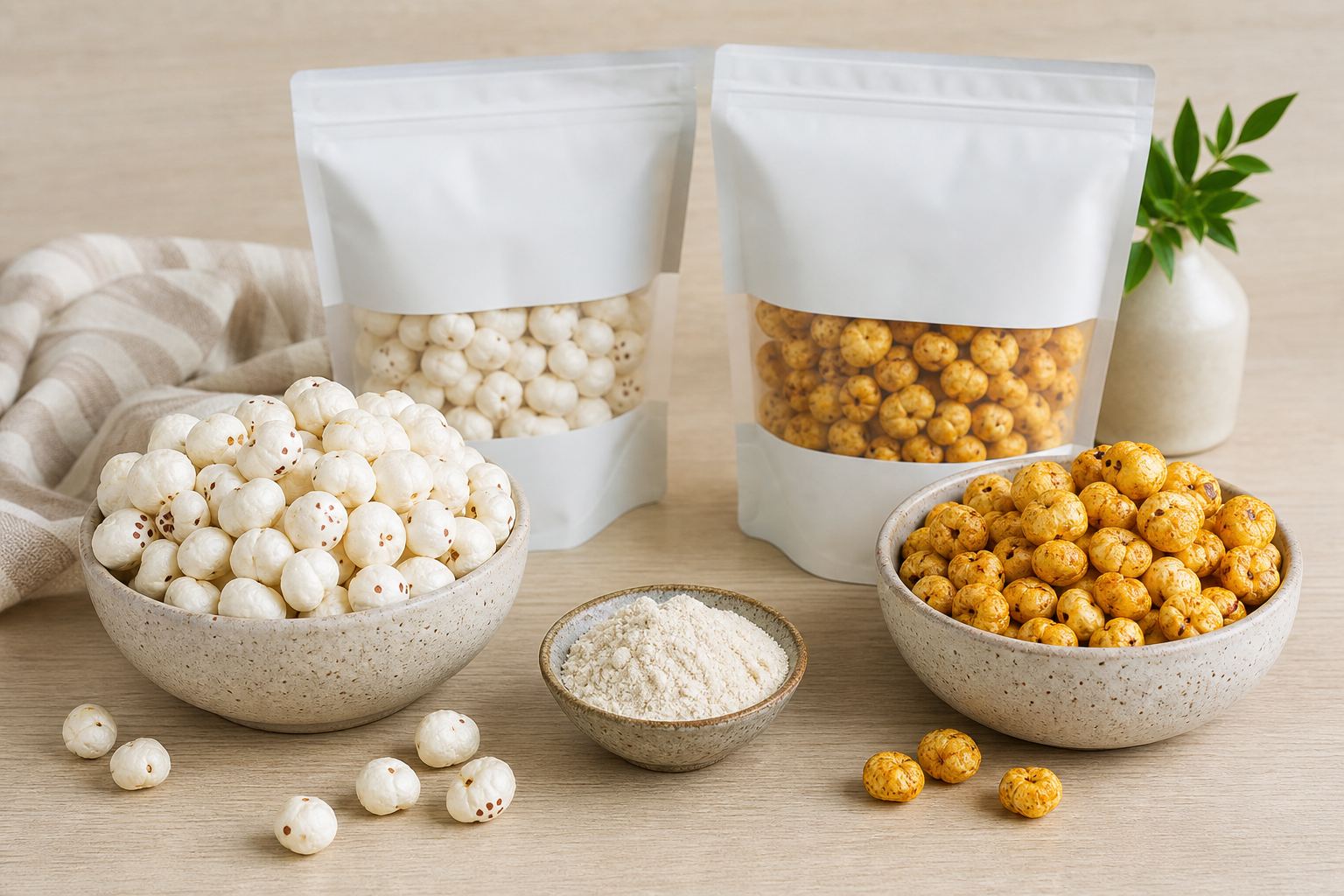
'Makhana' is not one export product — it is a small family of related products built from the same seed of Euryale ferox, each with a different buyer, a different price ceiling, and a different packaging expectation. Plain popped fox nuts sold in 10 kg bulk bags for a repacker in New Jersey have almost nothing in common commercially with a flavoured, private-label retail pouch destined for a UK supermarket shelf, even though both originate from the same Bihar ponds. This catalogue is built around that distinction: it maps the specific fox nut products exported from India, the size-grade and quality specifications that separate commodity from premium, and the packaging and pricing logic buyers should expect for each SKU category.
India's fox nut export base is rooted in Bihar's GI-tagged Mithila Makhana belt — Madhubani, Darbhanga, Sitamarhi, Saharsa, Katihar, Purnia, and the wider Mithila/Kosi districts — with West Bengal and eastern Uttar Pradesh contributing supporting volume. From that raw material base, exporters produce a genuinely wide product range: plain roasted/popped kernels graded by millimetre size, roasted and seasoned flavoured lines, makhana flour and powder for bakery and formulation use, raw unpopped seed for buyers running their own popping lines, and increasingly organic-certified and GI-authenticated premium tiers. Each of these moves through export channels differently, and treating them as one undifferentiated 'makhana' SKU is the most common mistake first-time buyers and inexperienced exporters make.
This guide catalogues each product category with its typical grade specification, directional pricing, MOQ, packaging format, and target buyer profile, so that both Indian exporters building a catalogue and international buyers evaluating India as a source can move quickly from category to a specific, quotable SKU. Trade and pricing figures here are directional planning inputs — always validate against current supplier quotations and your customs house agent (CHA) for HS classification. For the companion operational process guide covering registrations, sourcing, and shipping mechanics, see How to Export Fox Nuts Makhana from India.
Key Takeaways
Summary Box
Executive Summary
Summary Box
This catalogue organises Indian fox nut exports into product categories rather than treating 'makhana' as a single commodity line — because pricing, MOQ, packaging, and buyer profile diverge sharply between a bulk commodity-grade popped lot and a flavoured, organic, GI-authenticated retail pouch. Exporters building a product line and buyers building a purchase specification both benefit from working through the same category structure: plain popped and roasted kernels graded by size, flavoured and seasoned retail SKUs, makhana flour and powder as an ingredient category, raw unpopped seed for buyers with their own popping capability, and the organic/GI premium tier that sits above conventional grades across several of these categories.
The underlying raw material for every product in this catalogue is the same: seeds harvested from ponds in Bihar's GI-tagged Mithila belt, dried, and roasted/popped through either traditional earthen-kiln or increasingly mechanized processing. What differentiates the finished products that reach export buyers is size grading, secondary processing (seasoning, milling), certification, and packaging format — not the underlying crop itself. Understanding that structure helps buyers avoid comparing prices across products that are not actually comparable, and helps exporters build a coherent, multi-tier catalogue rather than a single flat price list.
Altus Exports works with international buyers across this full product range — from commodity bulk buyers sourcing plain popped kernels by the container to retail and private-label brands developing flavoured or organic-certified lines — coordinating supplier selection, grade verification, and packaging development as a merchant exporter and global sourcing partner.
Market Size & Industry Overview
Key Statistics
India dominates global fox nut supply, and Bihar alone accounts for roughly 80–85% of world output and about 90% of India's production (APEDA directional) — heavily concentrated in the Mithila-Kosi wetland belt across Madhubani, Darbhanga, Sitamarhi, Saharsa, Katihar, and Purnia, with West Bengal and eastern Uttar Pradesh as supporting regions. What has changed meaningfully over the past several years is not just export volume, but export product mix: plain popped kernels sold purely as bulk commodity have been joined by a genuinely diversified product range, as processors and exporters respond to international retail demand for flavoured snacking formats, ingredient-grade flour and powder, and certified premium tiers.
This diversification matters commercially because it lets Indian exporters serve multiple buyer segments from the same raw material base — a commodity bulk buyer in the Gulf, a private-label retail brand in the USA, and a bakery-ingredient buyer in Europe can all be served by the same processing cluster, just through different finishing, grading, and packaging pathways. For buyers, it means the right question is rarely 'what does makhana cost' but rather 'what does this specific grade, format, and certification cost' — a distinction this catalogue is built to answer category by category.
Export Statistics
Key Statistics
Product-level export statistics for makhana are not uniformly published as a standalone category in most public trade data sources, and the figures below should be read as directional planning inputs based on industry reporting and trade patterns, not as audited totals — confirm current-year detail with APEDA, DGCI&S, or your CHA before making investment decisions. At the total-category level, APEDA's MIC Makhana dashboard shows India's overall makhana exports growing directionally from roughly 6,700 MT in 2020 to roughly 25,130 MT in 2024 (~39% CAGR), with Jan–Oct 2025 volumes around 18,150 MT.
Directional export product-mix profile for Indian fox nuts
Swipe →
Data table — swipe horizontally on small screens
| Product Category | Directional Export Volume Share | Primary Destination Type |
|---|---|---|
| Plain popped / roasted makhana | Largest share | Bulk wholesale and repacking buyers |
| Flavoured / seasoned retail makhana | Growing share | Retail and private-label brands |
| Makhana flour / powder | Smaller, steady share | Bakery and food-formulation buyers |
| Raw / unpopped seed | Minor share | Buyers with their own popping capability |
| Organic-certified lots (across categories) | Growing premium share | Organic retail and specialty channels |
| GI Mithila-authenticated lots (across categories) | Growing differentiated share | Premium and origin-focused retail |
Import Statistics
Key Statistics
Destination-market import data for makhana is frequently absorbed into broader processed-snack or seed-product trade categories, so the country-level view below should be used as a working model for prioritising outreach and shipment planning rather than as a precise statistical benchmark.
Directional import demand by market and typical product-mix fit
Swipe →
Data table — swipe horizontally on small screens
| Market | Directional Share | Typical Product-Mix Fit |
|---|---|---|
| USA | ~40% | Mix of bulk commodity, private label, and organic retail |
| Canada | ~20% | Retail and ethnic-grocery distribution, growing private label |
| UAE | ~17% | Bulk wholesale and re-export; growing retail flavoured demand |
| UK | ~10% | Organic and premium retail-format demand |
| Australia | ~1–5% (higher unit price, ~USD 21/kg directional) | Health-food retail; premium positioning |
| Germany | ~1–5% (higher unit price, ~USD 26/kg directional) | Organic and specialty-channel demand |
| Nepal | ~1–5% (higher unit price, ~USD 21.6/kg directional) | Primarily bulk commodity |
Product Categories & Variants
Summary Box
This is the core catalogue: five product categories that account for the substantial majority of fox nut export value from India, each described with its typical grade specification, buyer profile, and how it is priced and packaged relative to the others.
1. Plain popped / roasted makhana (commodity and premium grades)
Indicative size-grade tiers for popped makhana (with APEDA Suta mapping)
Swipe →
Data table — swipe horizontally on small screens
| Grade Tier | Approximate Kernel Size (APEDA Suta) | Typical Positioning |
|---|---|---|
| Small / broken grade | Below ~12mm, higher broken % (below 4 Suta) | Commodity bulk, often diverted toward flour |
| Standard commodity grade | ~12–15mm, mixed distribution (4 Suta / Regular) | Bulk wholesale, industrial repacking |
| Premium grade | ~15–18mm, low broken % (5 Suta / Good) | Retail-ready bulk, better presentation |
| Super-premium grade | Above ~18mm, very low broken %, bright white (6–7 Suta / High to Premium, export-ready) | Top-tier retail and private-label programmes |
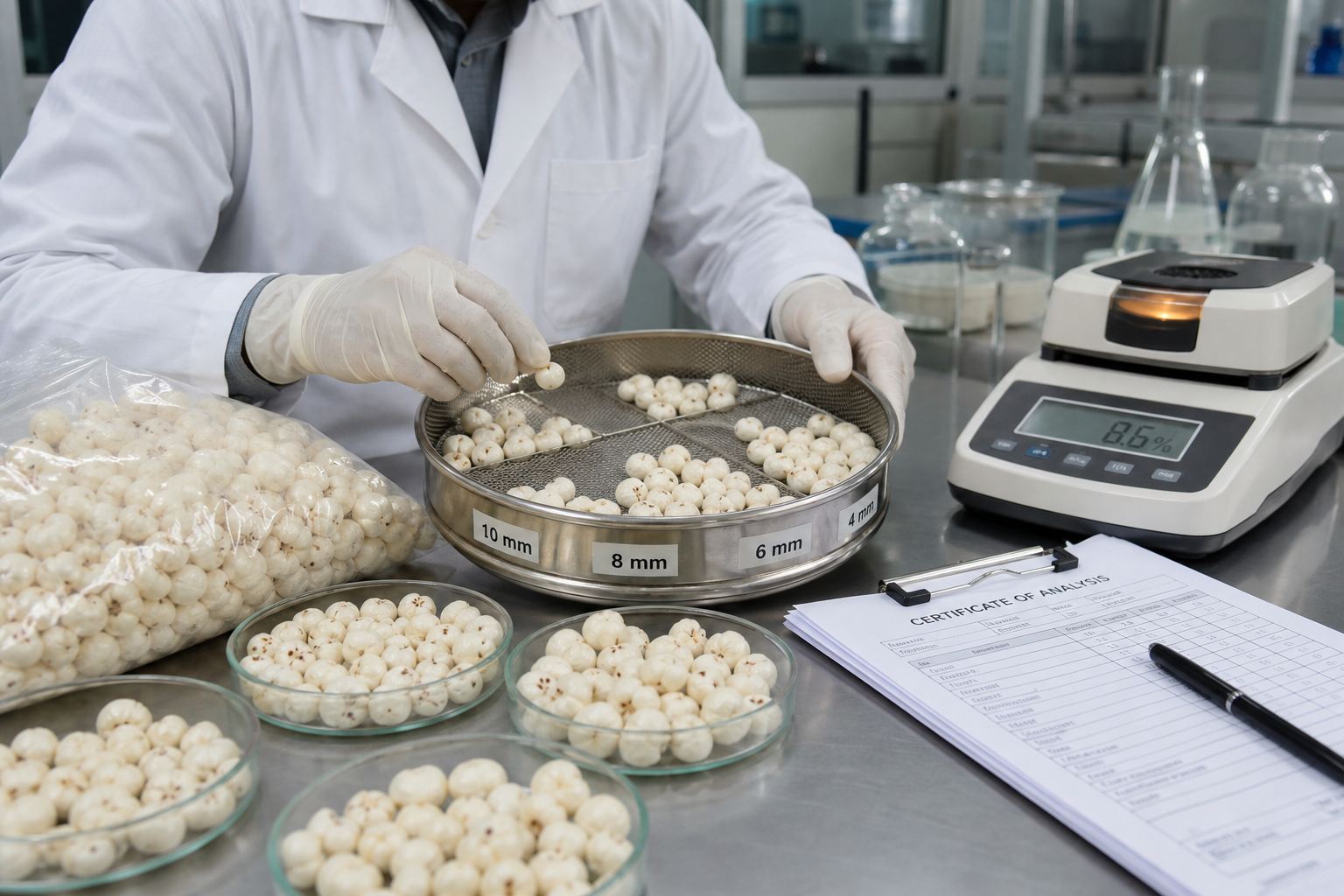
This is the base export product: dried Euryale ferox seed roasted until the seed coat cracks and the interior puffs into a light, crunchy white kernel, then size-graded. Within this single category, size grade in millimetres is the dominant price and quality variable — larger, more uniformly white, less broken kernels command premium pricing, while smaller and more broken material is sold at commodity pricing or diverted to flour production. Buyers evaluating this category should always request the size-grade distribution on the lot's certificate of analysis (COA) rather than accepting a supplier's stated average grade.
2. Flavoured and seasoned retail makhana
Built from plain popped kernels — typically premium or super-premium grade, since flavour coating highlights kernel appearance — flavoured makhana is roasted or lightly oil-tossed with seasoning blends and packed directly into retail-facing formats. Popular flavour profiles for export include peri-peri, cream & onion, cheese, turmeric-pepper, herb, and regionally inspired masala blends. This category commands a clear premium over plain popped pricing because it includes seasoning cost, a secondary processing step, and retail-ready packaging, and it is the fastest-growing category in the export mix as international consumers become more familiar with makhana as a snack rather than purely a health ingredient.
3. Makhana flour and powder
Made primarily from broken kernels and off-grade popped material that does not meet retail size or appearance standards, makhana flour and powder is positioned as an ingredient category rather than a finished snack — used in bakery formulations, health-food products, coatings, and infant/health-nutrition applications in some markets. Because it is made from material that would otherwise be a lower-value byproduct, flour and powder typically prices below popped retail grades, making it an efficient way for processors to monetise off-grade output rather than a waste stream, and an attractively priced ingredient input for formulation buyers.
4. Raw / unpopped seed
A smaller export category, raw or unpopped Euryale ferox seed is purchased by buyers who operate their own roasting and popping capability at destination, or who are developing alternative processed products from the raw seed. Volume in this category is limited relative to popped and flavoured makhana, since most international buyers prefer to import the finished, shelf-stable popped product rather than manage a popping process themselves — but it remains a relevant option for specific industrial or product-development buyers.
5. Organic-certified and GI Mithila premium tiers
Organic certification (NPOP, USDA Organic, or EU Organic) and GI Mithila Makhana authentication are not separate products so much as a premium overlay that can apply across the plain popped, flavoured, and flour categories above. A GI-authenticated, organic-certified, super-premium-grade flavoured pouch sits at the very top of the category's value chain, while the same underlying grade without certification sells at a meaningfully lower price. Buyers targeting premium retail, organic specialty, or origin-focused marketing should specifically request this documentation rather than assuming it. For a deeper look at building a premium organic/GI programme, see Organic & Premium Fox Nut Makhana Export Opportunities.
Manufacturing Overview
Export Tip
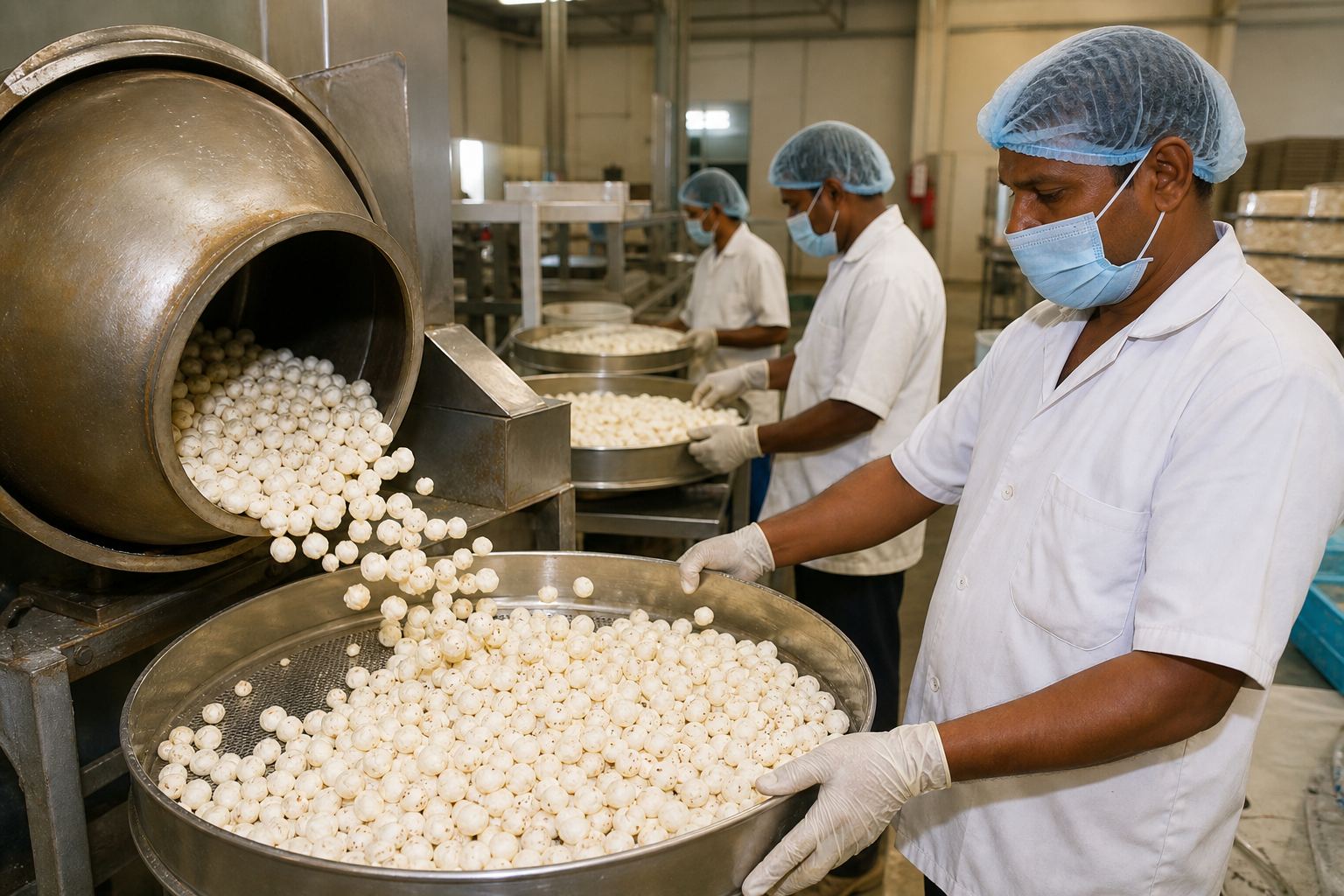
Every product in this catalogue traces back to the same processing sequence: pond harvest, sun-drying, roasting and popping (traditionally in earthen kilns, increasingly in mechanized rotary roasters at larger units), and size grading, typically by sieve or optical sorting. From that common base, the product tree branches: premium and super-premium graded kernels move toward plain retail-ready or flavoured lines; standard and commodity grades move toward bulk wholesale; and smaller, broken, or off-grade material is diverted to flour and powder milling.
Flavoured SKUs add a secondary processing stage — seasoning application, tumbling, and a light secondary roast or drying pass — before packaging. Organic-certified lines require the underlying pond cultivation and processing chain to meet NPOP (or equivalent) standards from seed sourcing through to packing, which is why organic certification is typically built into a specific supplier relationship rather than applied retroactively to an already-processed lot. Because most of Bihar's makhana processing capacity remains organised around small and mid-size units rather than a handful of large integrated factories, exporters building a multi-tier product catalogue typically coordinate across several processing partners rather than sourcing every SKU from one factory floor.
Export Process
Export Tip
The operational mechanics of exporting any of these product categories follow the same underlying path: IEC and APEDA RCMC registration, FSSAI-compliant processing, lot-specific laboratory testing and COA issuance, product-appropriate packaging, and documentation aligned to the correct HS heading before shipment. Flavoured, organic, and private-label SKUs add development steps — formulation and label approval, organic certification verification, and packaging artwork sign-off — that extend lead time relative to a straightforward commodity popped shipment. For the full step-by-step operational sequence covering registrations, sourcing, grading, and shipping mechanics in detail, see How to Export Fox Nuts Makhana from India.
Pricing Analysis
Buyer Tip
Pricing across the makhana product range is best understood as a ladder, with size grade, secondary processing, and certification each adding a distinct premium layer over the base commodity price. Treat the figures below as directional FOB bands for planning; always confirm against a current supplier quotation. The same ladder logic holds at the national level: APEDA's Oct-2025 dashboard shows overall export FOB averaging USD 15.5–20.3/kg, yet Germany, Nepal, and Australia post the highest per-kilogram averages (directionally ~USD 26, ~USD 21.6, and ~USD 21/kg) on a fraction of the volume — evidence that grade and format decide what a shipment earns more than destination size does.
Directional FOB USD/kg pricing by product category and grade
Swipe →
Data table — swipe horizontally on small screens
| Product Category | Directional FOB USD/kg | Key Price Driver |
|---|---|---|
| Commodity popped (standard grade) | ~12–18 | Mixed size distribution, standard roast quality |
| Premium popped (16–18mm) | ~15–20 | Larger, more uniform, whiter kernels |
| Super-premium popped (>18mm) | ~18–26+ | Top-tier size, appearance, and low broken % |
| Flavoured / seasoned retail | Premium over equivalent plain grade | Seasoning, secondary processing, retail packaging |
| Organic-certified (any grade) | Premium over conventional equivalent | NPOP/USDA/EU Organic certification and audit costs |
| GI Mithila-authenticated (any grade) | Premium over unauthenticated equivalent | Verified origin documentation |
| Makhana flour / powder | Typically below popped retail grades | Made from broken/off-grade material; ingredient positioning |
MOQ Analysis
Buyer Tip
MOQ expectations vary by product category as much as by transaction stage — flavoured and private-label SKUs generally require larger commitments than plain commodity grades because of formulation, packaging, and label development costs that need to be amortised over a meaningful run size.
Directional MOQ tiers by product category
Swipe →
Data table — swipe horizontally on small screens
| Product Category | Sample MOQ | Trial Order MOQ | Wholesale MOQ |
|---|---|---|---|
| Plain popped (commodity/premium) | 1–5 kg | 100–500 kg | 1–5 MT |
| Flavoured / seasoned retail | 1–5 kg | 200–500 kg | 1–5 MT (higher due to formulation setup) |
| Makhana flour / powder | 1–5 kg | 100–500 kg | 1–5 MT |
| Raw / unpopped seed | 1–5 kg | 100–500 kg | 1–5 MT |
| Organic-certified / GI-authenticated | 1–5 kg | 100–500 kg | 1–5 MT (certification lead time applies) |
Packaging Standards
Export Tip
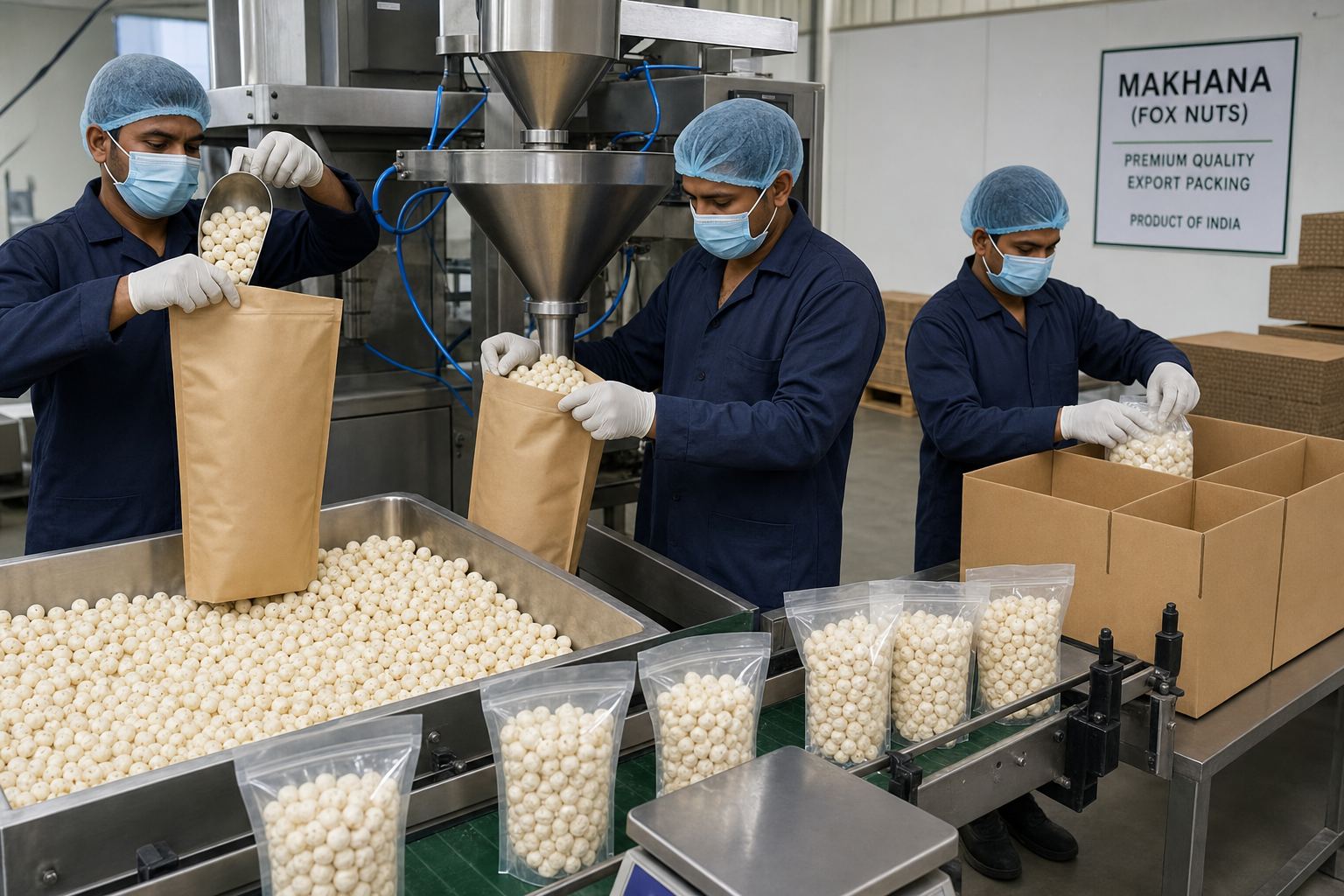
Packaging format tracks directly with product category and buyer channel: bulk commodity and premium grades typically move in food-grade bags or cartons, flavoured and organic/GI premium lines move increasingly into retail-ready formats, and flour/powder is packed to protect against moisture absorption and caking rather than to showcase kernel appearance.
Packaging formats by product category
Swipe →
Data table — swipe horizontally on small screens
| Product Category | Typical Packaging | Key Requirement |
|---|---|---|
| Plain popped bulk (commodity/premium) | Food-grade LDPE/HDPE bags or cartons, 5/10/20/25 kg | Heat-sealed, moisture-resistant; nitrogen-flush for premium/long transit |
| Flavoured / seasoned retail | Retail pouches, 50–500 g | Destination-compliant labelling, tamper-evident seal, barrier film for seasoning freshness |
| Makhana flour / powder | Food-grade bags or lined cartons, 5/10/20/25 kg bulk; retail pouches for finished formulations | Moisture-barrier critical to prevent caking |
| Organic-certified lots | Same formats as above with organic-compliant labelling | Certification mark and transaction certificate reference on documentation |
| GI Mithila-authenticated lots | Same formats as above with origin labelling | GI documentation reference on packaging/documentation where permitted |
Container Loading Details
Export Tip
Because popped makhana is low-density, container loading across every product category in this catalogue is generally volume-constrained before it is weight-constrained, with flour/powder being a partial exception since it packs more densely than whole popped kernels.
Directional container loading guidance by product category
Swipe →
Data table — swipe horizontally on small screens
| Product Category | Loading Consideration | Typical Container Choice |
|---|---|---|
| Plain popped (bulk bags/cartons) | Volume-constrained; ~5–10 MT/20ft, ~10–18 MT/40ft; careful stacking and dunnage needed | 20ft or 40ft FCL depending on order size |
| Flavoured retail (cartons of pouches) | Palletisation recommended to reduce crush risk | 40ft FCL for established retail programmes |
| Makhana flour / powder | Denser than whole kernels; better weight utilisation | 20ft or 40ft FCL depending on order size |
| Small trial or sample shipments (any category) | LCL suitable given limited volume | LCL consolidation |
Shipping Methods
Export Tip
- Plain popped (commodity/premium): 2–4 weeks typical lead time from confirmed order to shipment
- Flavoured / private-label: 4–8 weeks typical lead time, including formulation and label approval
- Makhana flour / powder: 2–4 weeks typical lead time
- Organic / GI-authenticated lots: allow additional lead time for certification and documentation verification
- Samples across any category: 7–14 days typical lead time via air freight or express courier
Ocean freight under FCL or LCL is the standard shipping method across all five product categories, since properly dried, roasted, and sealed makhana products are shelf-stable and do not require cold-chain logistics. Kolkata is the natural gateway given proximity to Bihar's production belt, with Nhava Sheva and Mundra as alternative or consolidation ports. Air freight is occasionally used for sample kits or urgent small quantities of any category but is not economical for standard bulk volumes.
Lead times differ meaningfully by product category: plain popped commodity or premium-grade orders typically ship within 2–4 weeks of confirmed order; flavoured, private-label, and organic/GI-certified programmes typically require 4–8 weeks to allow for formulation, certification verification, and label/packaging approval before production begins.
Certifications
Compliance Notes
Certification needs scale with product category and target market. Baseline FSSAI and APEDA credentials apply across every category in this catalogue; the remaining certifications are specifically relevant to unlocking premium retail, organic, or religious-compliance buyer segments.
Certifications relevant across the makhana product range
Swipe →
Data table — swipe horizontally on small screens
| Certification | Most Relevant Product Categories | Purpose |
|---|---|---|
| FSSAI licence | All categories | Baseline Indian food-safety compliance |
| APEDA RCMC | All categories | Mandatory registration for shipping bill filing under notified codes |
| ISO 22000 / HACCP | All categories, especially private label | Documented food-safety management system |
| Halal certification | Plain popped, flavoured retail | Gulf and Muslim-majority market compliance |
| Kosher certification | Plain popped, flavoured retail | Select USA and other retail channels |
| NPOP / USDA / EU Organic | Any category carrying an organic claim | Organic certification for premium retail and specialty buyers |
| GI documentation (Mithila Makhana) | Any category carrying a Mithila-origin claim | Origin authentication for Bihar-region provenance claims |
Buyer Requirements
Buyer Requirements
Buyers evaluating a specific makhana product category should tailor their diligence to that category's key risk points. Bulk commodity buyers primarily need a reliable size-grade distribution, moisture control, and consistent supply across the season. Flavoured retail and private-label buyers additionally need formulation samples, ingredient and allergen documentation, nutritional panel verification, and label-compliance review for their specific market. Flour and powder buyers should verify particle size specification, moisture, and microbiological parameters appropriate to their end-use formulation. Organic and GI-claim buyers should always request the underlying certificate or GI documentation rather than accepting the claim on a spec sheet alone.
Across every category, buyers should expect a lot-specific certificate of analysis and should request samples matched to the exact grade or SKU under consideration — a sample from a different lot or grade is not a reliable basis for a purchase decision, particularly for size-grade-sensitive categories like premium and super-premium popped makhana.
Country-wise Opportunities
Market Snapshot
Product-category fit varies meaningfully by destination market, and matching your catalogue investment to the right country sequence improves both conversion speed and margin capture. For a full country-by-country breakdown, see Most Demanded Indian Fox Nuts Makhana by Country.
Directional product-fit by destination market
Swipe →
Data table — swipe horizontally on small screens
| Country | Best-Fit Product Categories | Notes |
|---|---|---|
| USA | All categories; strong private-label and organic retail demand | Largest directional market; supports full product ladder |
| Canada | Plain popped and flavoured retail; growing private label | Bilingual retail labelling required |
| UAE | Bulk commodity and flavoured retail; Halal-certified priority | Also serves as a re-export hub to the wider Gulf |
| UK | Organic and premium flavoured retail | Strong fit for GI Mithila and organic-certified lines |
| Australia | Premium and organic retail niche | Smaller volume but strong price realisation |
| Germany | Organic and premium categories | Emerging specialty-channel opportunity |
| Nepal | Primarily plain popped commodity | Simplified logistics given proximity to Bihar |
Sourcing Checklist
Checklist
Buyer Checklist
Exporter Checklist
Compliance Checklist
Checklist
Compliance Notes
Common Buyer Mistakes
Common Mistakes Box
- Comparing prices across different size grades as if they were the same product — Solution: always compare quotes at the same stated size-grade distribution.
- Assuming flour/powder pricing should match popped retail-grade pricing — Solution: price and negotiate flour/powder separately as an ingredient category.
- Ordering a flavoured or private-label SKU on the same lead-time assumption as plain popped — Solution: budget 4–8 weeks for formulation and label approval.
- Accepting an organic or GI Mithila claim without requesting the certificate — Solution: request and independently verify the underlying documentation.
- Requesting a sample from a different grade than the one being quoted — Solution: insist on samples matched to the exact SKU and lot grade under negotiation.
- Assuming all suppliers offer the full product range — Solution: confirm which specific categories (flavoured, organic, GI, flour) a given supplier or exporter actually produces or sources.
- Under-specifying packaging for retail-format orders — Solution: provide a detailed label and packaging specification sheet before production, not after.
- Treating raw/unpopped seed sourcing the same as finished popped product sourcing — Solution: recognise this is a distinct, smaller category with different buyer logic and lead times.
Because the makhana product range is genuinely varied, buyers frequently make category-confusion mistakes that would not occur with a more standardised commodity. The patterns below are the most common and most costly.
Challenges & Solutions
- Challenge: maintaining consistent size-grade specification across seasons for premium/super-premium tiers — Solution: work with processors who actively grade and separate output rather than selling a single blended lot.
- Challenge: coordinating formulation and label approval timelines for flavoured/private-label SKUs — Solution: build a standing product-development calendar with buyers rather than reacting to each order individually.
- Challenge: verifying organic and GI claims at scale across multiple suppliers — Solution: centralise certificate verification with a merchant exporter who maintains ongoing supplier audit relationships.
- Challenge: balancing byproduct (flour/powder) monetisation without diluting focus from higher-margin popped categories — Solution: treat flour/powder as a distinct product line with its own buyer pipeline, not an afterthought.
- Challenge: packaging investment decisions across bulk vs. retail formats — Solution: sequence packaging investment to match confirmed buyer demand rather than speculatively building retail capacity before demand is proven.
Building and sourcing across a multi-category makhana catalogue introduces challenges beyond those of a single-SKU commodity export, largely around consistency and coordination across categories.
Future Market Trends
Key Statistics
The product mix within Indian makhana exports is likely to keep shifting toward higher-value categories — flavoured retail, organic-certified, and GI-authenticated lines — as international buyers become more sophisticated about the category and less willing to treat all makhana as an undifferentiated commodity. Exporters who build genuine grading discipline and certification depth now are positioning their catalogues ahead of that shift rather than reacting to it later.
Makhana flour and powder is likely to see steady growth as a specialty ingredient in gluten-free and better-for-you bakery and snack formulations internationally, giving processors a genuine second revenue stream from material that would otherwise be a lower-value byproduct. Meanwhile, growing buyer familiarity with GI Mithila Makhana as a verified origin claim — similar to how other GI-protected agricultural products have built premium positioning globally — should continue to widen the price gap between authenticated and unauthenticated lots over the coming years.
Expert Insights
Expert Insight Box
Altus Exports works with buyers across the full makhana product range — from bulk commodity importers to private-label retail brands and organic specialty buyers — matching the right supplier, grade, and certification combination to each buyer's specific channel and volume requirements.
Conclusion
- Next step for processors and exporters: audit your current output against the five product categories in this catalogue and identify your strongest grade tier and any untapped byproduct opportunity.
- Next step for buyers: define your exact SKU — grade, format, certification — before requesting quotes, then request samples matched precisely to that specification.
- Explore export products from India and global sourcing partner services for broader multi-category sourcing support alongside makhana.
- Consider product sourcing company India services if you are building a diversified food-import programme that includes makhana alongside other categories.
The fox nut products exported from India span a genuine range — commodity and premium popped grades, flavoured retail lines, makhana flour and powder, raw seed, and organic/GI-authenticated premium tiers — and treating that range as a single undifferentiated commodity is the fastest way for either an exporter or a buyer to misprice a transaction. Building or sourcing against this catalogue structure, with clear size-grade specification, lot-specific COAs, and verified certification for any premium claim, is what separates a durable, multi-season buyer relationship from a one-off trial order that never repeats.
If you are an Indian processor or exporter, use this catalogue to map your own product ladder and identify where your current supply base is strongest — and where a byproduct stream like flour/powder could become a genuine second revenue line. If you are an international buyer, use the checklists above to specify exactly which product category and grade you need before requesting quotes. Altus Exports coordinates sourcing, grading, and certification verification across this entire product range as a merchant exporter in India — reach out via our contact page with your specific SKU, grade, and volume requirements.
For the complete operational process behind these products — registrations, sourcing, grading, and shipping mechanics — see How to Export Fox Nuts Makhana from India. For market selection, see Best Countries for Indian Fox Nut Makhana Exports and Most Demanded Indian Fox Nuts Makhana by Country. For direct sourcing guidance, see Source Fox Nuts Makhana Directly from India. For registration depth, see APEDA Registration Benefits for Fox Nut Makhana Exporters. For buyer development, see How to Find International Buyers for Fox Nuts Makhana and Trade Shows & B2B Marketplaces for Fox Nut Makhana Exporters. For premium strategy, see Organic & Premium Fox Nut Makhana Export Opportunities. For your documentation gate, see Fox Nut Makhana Export Documentation Checklist.