
Organic & Premium Fox Nut (Makhana) Export Opportunities from India
By Saurabh Mittal, Founder, Altus Exports
How Indian fox nut (makhana) exporters capture premium export value through NPOP/USDA/EU Organic certification, Mithila GI provenance, high-grade (16mm+) programmes, and clean-label positioning — with segregation requirements, margin structure, and the buyer segments who pay well above commodity broken-grade pricing for certified, traceable Euryale ferox.
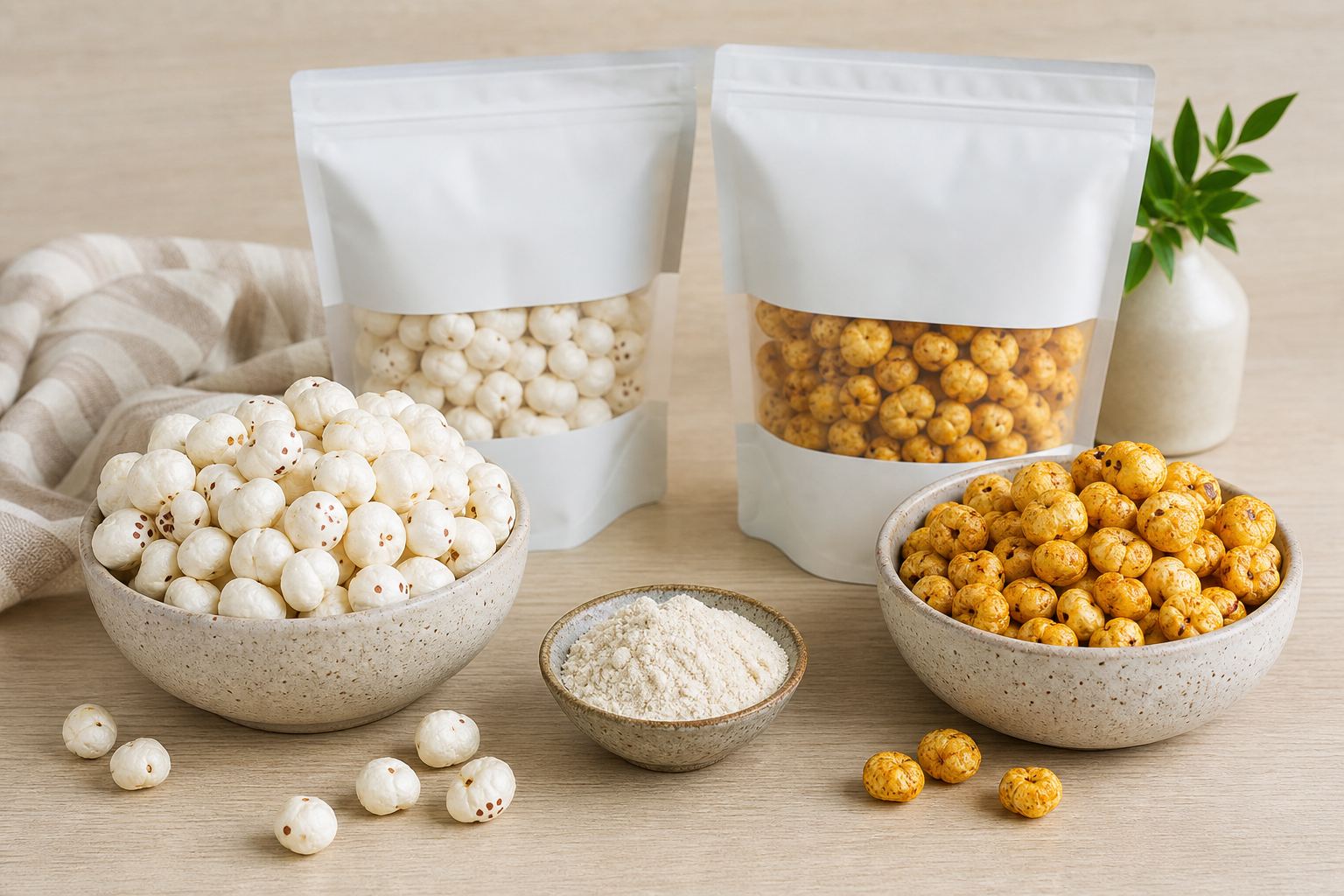
Commodity-grade fox nuts (makhana) — broken pieces and small, inconsistently roasted lots sold on price alone — compete in a crowded, thin-margin segment of India's Euryale ferox trade. A structurally different, higher-margin opportunity sits above it: certified-organic makhana grown under NPOP (with USDA Organic and EU Organic equivalence), traceable to the GI-protected Mithila belt of Bihar, size-graded to 16mm and above, and clean-label roasted without synthetic additives — the tier that clean-label snack brands, organic retail chains, and premium gifting buyers in the USA, Germany, UK, Canada, Australia, and UAE actively seek out and pay a documented premium for.
This guide covers that premium layer specifically: organic certification pathways (NPOP/USDA/EU Organic equivalence) for pond-based Euryale ferox cultivation, how the 2022 Mithila Makhana Geographical Indication (GI) tag functions as a provenance and marketing asset distinct from organic certification, high-grade (16–18mm and 18mm+ jumbo) programme economics, clean-label roasting and ingredient-list positioning, and the segregation and chain-of-custody infrastructure that separates credible premium suppliers from processors who apply an "organic" or "GI" label without the certification paperwork to support it.
This is not a general export-process or grading-and-processing pillar — for that foundational depth, see how to export fox nuts (makhana) from India and top fox nut (makhana) products exported from India. For buyer-discovery tactics across the full market including commodity grades, see find international buyers for fox nuts (makhana). Altus Exports works as a merchant exporter and global sourcing partner connecting Bihar-region certified-organic makhana processors with premium international buyers — this guide reflects the positioning frameworks we use with clean-label and organic retail clients.
Key Takeaways
Summary Box
Executive Summary
Summary Box
Indian makhana processors face a strategic choice similar to producers in other Indian agri-export categories: compete in commodity broken/small-grade trade on thin, price-driven margins, or invest in organic certification, size-grade discipline, and GI-linked provenance marketing to access premium buyer segments willing to pay materially more per kilogram for documented quality and origin. The premium path requires real upfront investment — certified organic pond conversion, segregated processing, lab testing infrastructure — but delivers durable margin advantage and buyer relationships that renew rather than re-tender every season on price alone.
This guide does not repeat general export mechanics or the full grading-and-processing pillar. It focuses specifically on what organic certification and GI provenance mean in practice for makhana, how premium pricing compares to commodity grade, and what operational infrastructure genuinely premium suppliers must maintain. For export operations, see how to export fox nuts (makhana) from India. For buyer discovery across the market, see find international buyers for fox nuts (makhana).
Market Size & Industry Overview
Key Statistics
The global shift toward clean-label, organic, and provenance-verified snacking is expanding demand for certified makhana beyond the traditional South Asian-community retail channel into mainstream natural grocery, direct-to-consumer better-for-you snack brands, and premium wellness retail. This buyer segment values documented organic certification, size-grade consistency, and traceable origin more than the lowest available FOB price — a structurally different relationship than commodity broken-grade procurement.
India's certified-organic makhana production base is growing but still represents a modest fraction of total Euryale ferox export volume. NPOP-certified pond cultivation exists across parts of the Mithila belt (Darbhanga, Madhubani, Purnea, Katihar, Saharsa, Supaul), but certified organic processing and packing capacity — not organic pond acreage alone — is the binding constraint on scaling the premium segment, since a genuinely organic claim requires the entire chain from pond through roasting to packing to carry certification, not just the raw seed.
The Mithila Makhana GI tag, granted in 2022, sits alongside organic certification as a second, distinct premium lever: it certifies geographic origin and traditional production method rather than organic farming practice. Buyers increasingly recognise both credentials, and processors who hold GI-linked traceability plus NPOP organic certification occupy the strongest positioning tier in the market.
Premium Makhana Market Segments and Value Positioning
Swipe →
Data table — swipe horizontally on small screens
| Segment | Certification Demand | Price Premium vs Commodity | Primary Format | Key Buyer Type |
|---|---|---|---|---|
| Clean-label snack brands | Organic preferred; GI provenance valued | 20–35% | 16–18mm roasted/flavoured retail | D2C snack brands, natural grocery |
| Organic retail chains | NPOP/USDA/EU Organic mandatory | 25–40% | Retail-ready pouches, house brand | Organic supermarket chains |
| Premium gifting | GI provenance valued; organic optional | 15–30% | 18mm+ jumbo, presentation packaging | UAE gifting, premium hampers |
| Wellness/ingredient formulators | Organic preferred; clean-label required | 15–25% | Raw/roasted plain, flour grade | Protein bar, trail mix formulators |
| Commodity broken/small grade | GC/FSSAI baseline only | Baseline — thin margins | Bulk bags, flour | Ingredient buyers, value distributors |
Export Statistics
Key Statistics
Total Indian makhana export volume is dominated by conventional (non-organic-certified) roasted and raw grades from the Bihar processing base, with certified-organic supply representing a modest but steadily growing share of overall export value. Per APEDA's MIC Makhana dashboard, total India makhana exports grew directionally from roughly 6,700 MT in 2020 to roughly 25,130 MT in 2024 (~39% CAGR), with Jan–Oct 2025 volumes around 18,150 MT. DGCI&S data captured under HS 20081921/22/29 (effective July 2025) does not separately break out organic-certified volume as its own line item, so precise organic export statistics are best approximated through industry estimates and processor-level certification records rather than cited as an exact published figure.
Premium categories — 18mm+ jumbo grade, certified-organic lots, and GI-traceable Mithila-origin product — contribute disproportionate export value relative to volume share. A container of 18mm+ certified-organic roasted makhana can generate meaningfully higher gross export value than an equivalent-weight container of broken/commercial grade, even though both occupy the same container space. Processors and exporters pursuing premium positioning should track export value per kilogram and buyer retention across seasons, not container count alone.
Growth in the premium segment is driven by clean-label snack-brand product launches in the USA and UK, organic retail-chain listing expansion in Germany and the wider EU, and growing GI-provenance awareness among specialty and gifting buyers in the UAE.
India Makhana Export: Commodity vs Premium Value Contribution (Indicative)
Swipe →
Data table — swipe horizontally on small screens
| Category | Volume Share (Indicative) | Value Share (Indicative) | Premium Potential | Certification Path |
|---|---|---|---|---|
| Broken/commercial grade | 35–45% of volume | 20–25% of value | Low — commodity pricing | FSSAI baseline; GC/lab COA |
| Standard roasted grade (12–16mm) | 35–45% of volume | 35–40% of value | Moderate — organic upgrade path | NPOP/USDA/EU Organic |
| High-grade roasted/flavoured (16–18mm) | 10–15% of volume | 20–25% of value | High — snack-brand demand | NPOP organic; clean-label positioning |
| Certified organic (all grades) | Under 10% of volume | 12–18% of value | High — fastest-growing segment | NPOP + USDA/EU equivalence |
| Jumbo/premium (18mm+, GI-traceable) | Under 5% of volume | 8–12% of value | Very high — scarcity and provenance driven | GI traceability + organic optional |
Import Statistics
Key Statistics
The United States is the largest and fastest-growing import market for certified-organic makhana, driven by USDA Organic labelling requirements for products sold as organic in the USA and a large natural-grocery and D2C better-for-you snack sector that treats organic and clean-label claims as a near-baseline shelf expectation in this category. Germany and the wider EU follow closely, governed by EU Organic Regulation 2018/848 for products marketed as organic within the European Union.
The UK shows strong clean-label retail demand with organic certification as a differentiator rather than a strict shelf requirement in all channels. Canada and Australia track broadly similar organic and wellness-retail demand patterns to the USA and UK respectively, with Australia's NASAA and USDA/EU Organic-recognition pathways relevant for certified imports.
The UAE combines organic-aware premium retail demand with a separate, larger conventional-makhana South Asian community market — exporters should treat these as two distinct buyer conversations even within the same country, since gifting and premium retail buyers there respond to GI provenance and presentation quality as much as to organic certification itself.
Premium Makhana Import Markets: Organic and Provenance Demand
Swipe →
Data table — swipe horizontally on small screens
| Market | Organic Certification Expectation | Provenance/GI Interest | Premium Focus | Entry Barrier |
|---|---|---|---|---|
| USA | USDA Organic for organic-labelled products | Growing — clean-label brands cite origin | Organic 14–18mm roasted, flavoured retail | USDA Organic chain-of-custody verification |
| Germany / EU | EU Organic (Reg. 2018/848) | Moderate — specialty retail | Organic clean-label retail pouches | EU Organic + food-safety documentation |
| UK | Preferred, not universally mandatory | Growing — specialty snack retail | Clean-label, provenance-marketed retail | GC/lab COA + organic where claimed |
| Canada | USDA/EU-equivalent recognition common | Moderate | Organic and high-grade retail | Organic certification + food-safety docs |
| Australia | NASAA/USDA/EU Organic recognised | Moderate — wellness retail | Organic and premium wellness-snack grade | Organic certification + import compliance |
| UAE | Increasing organic interest | High — gifting and premium retail | 18mm+ jumbo, GI-traceable, presentation pack | Presentation quality + provenance documentation |
Manufacturing Overview: Certified Organic and GI-Traceable Production
Export Tip
Premium makhana manufacturing requires infrastructure and documentation beyond conventional pond cultivation and roasting — it requires certified organic protocols, segregation discipline, and traceability systems that many conventional Bihar processors have not yet built.
NPOP-Certified Organic Pond Cultivation
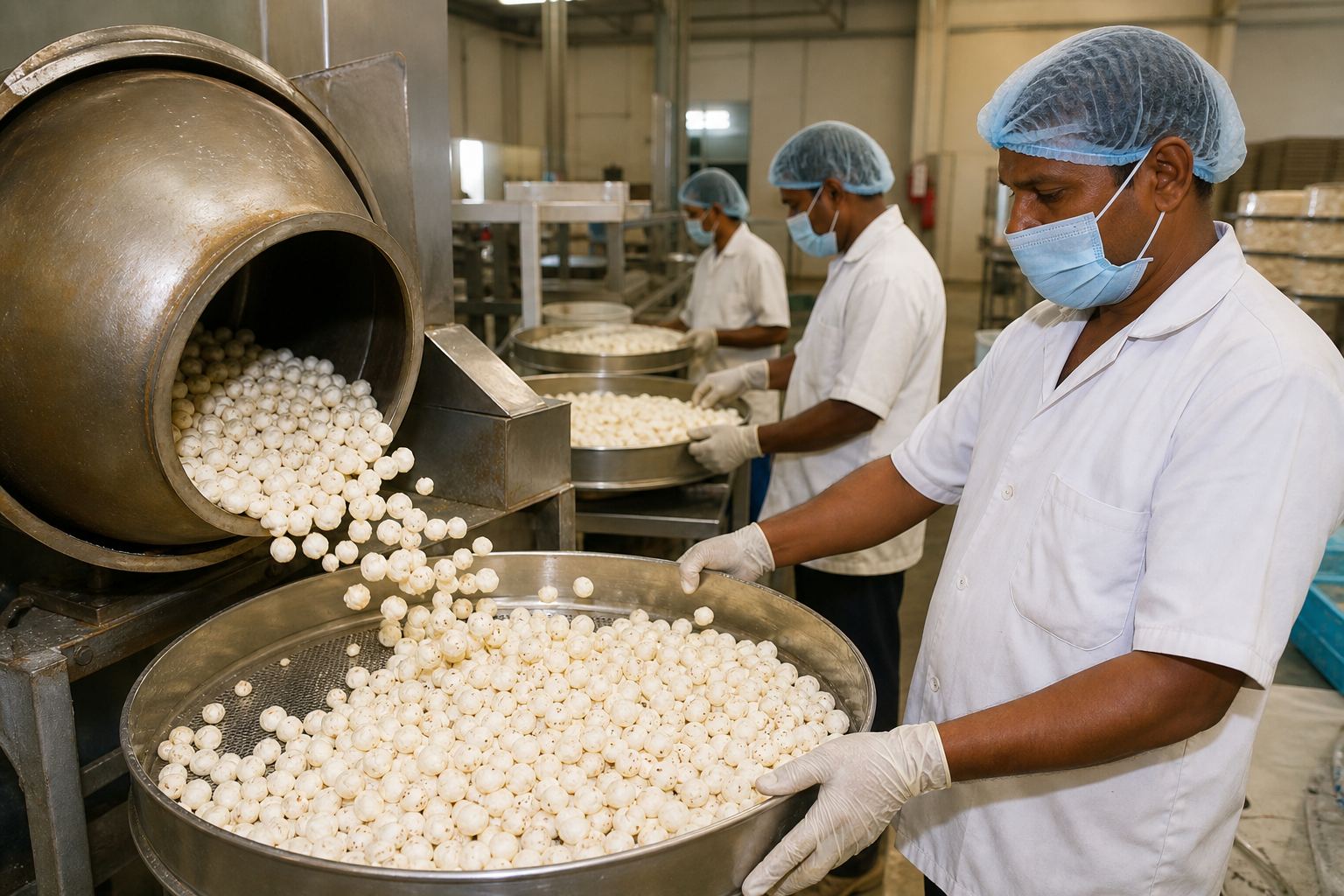
India's National Programme for Organic Production (NPOP), administered by APEDA, is the domestic organic certification framework applicable to makhana pond cultivation. NPOP-certified ponds must avoid synthetic fertiliser and pesticide inputs, maintain buffer-zone separation from conventional ponds, and feed a processing chain — sun-drying, roasting/popping, decortication, grading, packing — that itself maintains organic chain-of-custody through dedicated organic-only runs or verified equipment-cleaning protocols between conventional and organic batches.
USDA Organic equivalence allows NPOP-certified Indian organic makhana to be sold as organic in the United States when the certifying body is USDA-recognised. EU Organic equivalence under Regulation 2018/848 allows sale as organic within the European Union under similar mutual-recognition arrangements. Exporters must confirm their specific certification body's current international equivalence status before marketing product as organic in either destination.
Mithila Makhana GI Tag: Provenance, Not Organic Status
The Geographical Indication tag granted to Mithila Makhana in 2022 certifies that the product originates from the recognised Mithila geography (parts of Bihar's Darbhanga, Madhubani, and surrounding districts) and follows traditional cultivation and processing associated with that region. It is a provenance and quality-reputation credential — it does not certify organic farming practice, and processors should market the two credentials distinctly and accurately rather than implying GI status equals organic certification.
Buyers who value provenance — premium retail, gifting, and specialty snack brands building an origin-story narrative — respond strongly to documented GI traceability. Exporters should be able to demonstrate sourcing from the certified Mithila geography with supporting documentation, not merely reference "Bihar origin" generically.
Segregation and Chain-of-Custody
The most common failure in premium makhana positioning is claiming organic or GI-traceable status without operational segregation to support it. Credible premium suppliers maintain documented separation between conventional and organic pond sourcing, dedicated or logged-clean roasting and grading runs, and packing-line segregation. Chain-of-custody documentation — from NPOP-certified pond through roasting batch record to export pack label — is exactly what organic-certification auditors and sophisticated retail buyers verify during supplier qualification.
Clean-Label Roasting and Ingredient Positioning
Clean-label positioning for roasted and flavoured makhana means minimal-ingredient recipes — natural roasting without synthetic preservatives, recognisable flavour ingredients (himalayan salt, natural spice blends, real cheese powder rather than artificial flavour compounds), and ingredient-list transparency that clean-label snack brands and their retail buyers now expect as close to a baseline requirement rather than a marketing extra in the USA, Germany, and UK.
Pricing Analysis
Buyer Tip
Premium pricing in makhana is driven by the combination of size grade, organic certification, and GI-linked provenance — not by any single factor alone, and the premiums compound rather than substitute for one another. A 16–18mm (5–6 Suta) roasted grade at conventional pricing of USD 18–22/kg FOB can rise to USD 22–26+/kg with NPOP/USDA Organic certification for a clean-label snack brand, and jumbo 18mm+ (6–7 Suta) GI-traceable lots command the top of the pricing band even before organic certification is added.
The comparison with commodity broken grade is instructive: broken/commercial material at USD 12–15/kg FOB operates on thin margins where a small per-kilogram price difference can determine whether a bulk distributor order is won or lost. Premium organic high-grade makhana at USD 22–26+/kg delivers substantially higher absolute margin per kilogram even at meaningfully lower shipped volume — a margin structure that rewards grade and certification investment over volume racing. That margin structure isn't theoretical — it already shows up in APEDA's Oct-2025 dashboard, where the overall export average sits at just USD 15.5–20.3/kg FOB while Germany, Nepal, and Australia (directionally ~USD 26, ~USD 21.6, and ~USD 21/kg) out-earn that average per kilogram on a fraction of the volume.
Premium vs Commodity FOB Pricing: Indian Makhana (2025–2026, Indicative)
Swipe →
Data table — swipe horizontally on small screens
| Grade / Treatment | Conventional FOB (USD/kg) | Organic Certified FOB (USD/kg) | Premium Driver | Typical Buyer |
|---|---|---|---|---|
| Broken/commercial grade | USD 12–15/kg | USD 15–18/kg (organic ingredient) | Organic cert; functional specification | Ingredient buyers, flour manufacturers |
| 12–14mm roasted plain | USD 14–17/kg | USD 17–20/kg | Organic cert; consistency | Distributors, entry retail |
| 14–16mm roasted plain | USD 16–19/kg | USD 19–23/kg | Organic cert + grade | Retail distributors, snack brands |
| 16–18mm roasted & flavoured | USD 18–22/kg | USD 22–26+/kg | Organic + clean-label + grade | Clean-label snack brands, natural grocery |
| 18mm+ jumbo, GI-traceable | USD 20–26+/kg | USD 24–28+/kg | Grade + GI provenance + organic (if held) | Retail-chain house brands, premium gifting |
MOQ Analysis
Buyer Tip
Premium makhana MOQs differ from commodity patterns in a specific way: certification and grading overhead makes very small lots economically inefficient, while buyer-side trial caution keeps first orders smaller than typical bulk-distributor volumes. Clean-label snack brands and organic retail buyers often start with 100–300 kg trial lots of certified-organic, high-grade product before committing to a scaling programme.
Organic certification costs (annual inspection, transaction certificates per export lot) create a practical minimum viable volume: exporting a very small quantity of certified-organic makhana may not cover certification overhead per kilogram, while a 500 kg–1 MT programme with an annual renewal relationship justifies the investment comfortably. Exporters should model certification cost per kilogram into premium MOQ economics before entering the segment.
MOQ Guidelines for Premium Makhana Programmes
Swipe →
Data table — swipe horizontally on small screens
| Order Type | Typical MOQ | Applicable Grades | Premium Pricing Note |
|---|---|---|---|
| Organic/GI evaluation sample | 500g–2 kg | All certified organic and GI-traceable grades | Sample cost higher; include transaction certificate reference |
| Trial lot — clean-label snack brand | 100–300 kg | 16–18mm roasted/flavoured organic | 20–35% premium over conventional trial pricing |
| Trial lot — organic retail chain | 300–500 kg + audit | 14–18mm certified organic | Pilot before house-brand listing decision |
| Commercial — organic snack programme | 500 kg–2 MT, scaling | Certified organic high-grade | Annual renewal contracts common in clean-label retail |
| Commercial — jumbo/GI premium | 200–800 kg | 18mm+ GI-traceable | Scarcity and grade-driven; smaller volume, higher value |
| Certified organic ingredient/flour | 1–3 MT | Organic flour/broken grade | Lower per-kg premium than retail-ready grades |
Packaging Standards
Export Tip
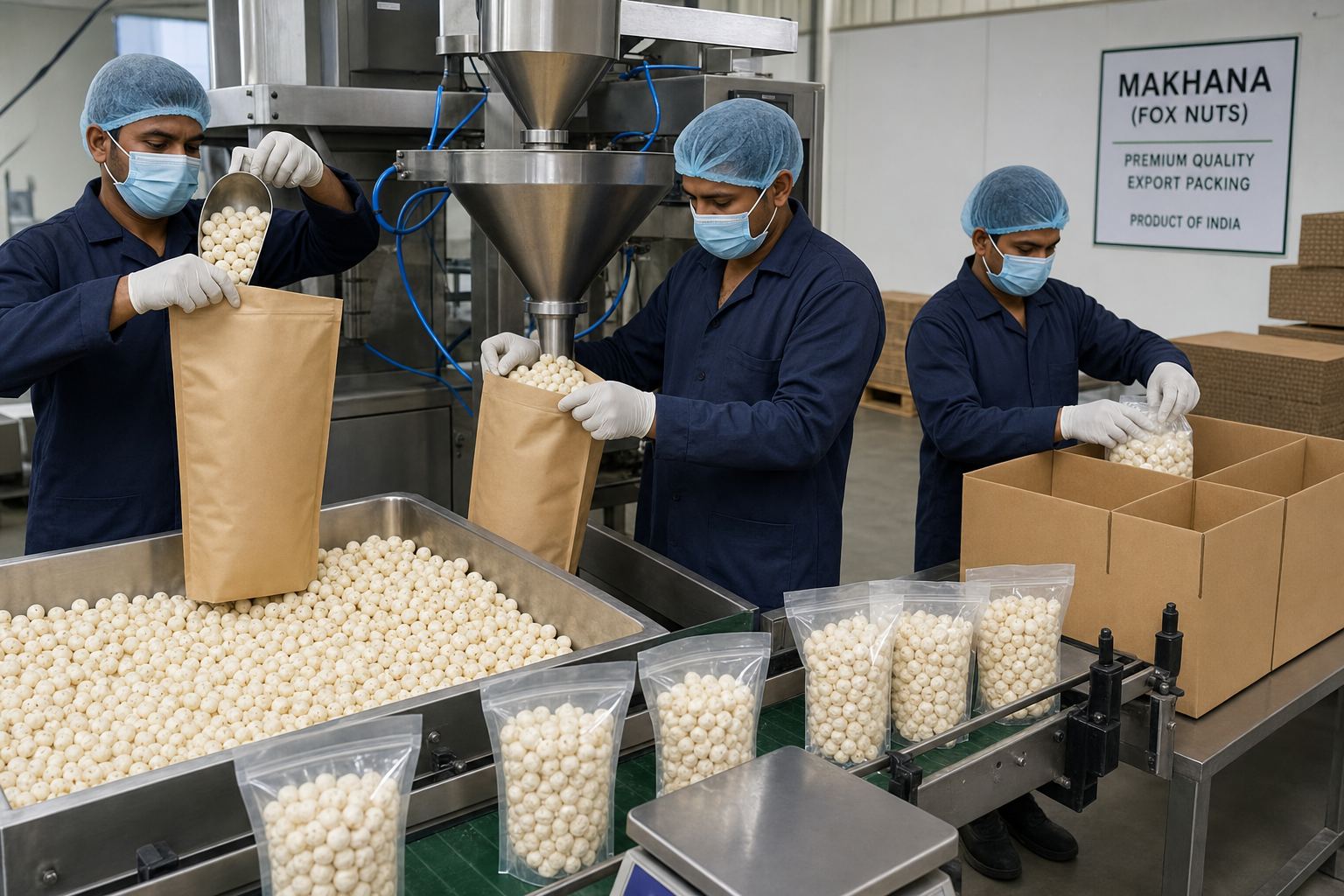
Premium makhana packaging must protect organic and clean-label integrity through transit while itself complying with organic-handling and GI-labelling requirements. Organic-certified lots should be packed on certified or verified-segregated packing lines using moisture-barrier bags or nitrogen-flushed packaging to preserve crispness across long ocean transit, particularly for humid destination climates such as the UAE.
Labels for organic-certified export must reference the certifying body's name per NPOP/USDA/EU Organic labelling rules — not merely the word "organic" without a supporting certification reference. GI-traceable premium retail and gifting packaging should carry accurate Mithila-origin labelling only where the specific lot can be substantiated back to the certified geography.
Packaging Standards for Premium Makhana Export
Swipe →
Data table — swipe horizontally on small screens
| Format | Net Weight | Premium Requirement | Certification Compliance Note |
|---|---|---|---|
| Nitrogen-flushed retail pouch | 50–200 g | Clean-label snack brand retail | Organic label with certifying body name where applicable |
| Moisture-barrier bulk bag | 5–25 kg | Organic commercial programmes | Verified cleaning between conventional/organic runs |
| Presentation carton/tin | 100–500 g | UAE gifting, premium retail | Accurate GI-origin labelling; provenance documentation |
| Retail-ready house-brand pouch | 100–300 g | Retail-chain organic programmes | Full nutrition/allergen panel + organic certification mark |
| Organic ingredient bulk pack | 20–25 kg | Organic flour/ingredient buyers | Transaction certificate per lot enclosed or referenced |
Container Loading Details
Export Tip
Premium and organic-certified makhana lots require stricter segregation during container loading than commodity shipments: certified-organic packs should not be loaded alongside conventional product in the same container unless the buyer explicitly accepts mixed loading, which organic retail and clean-label brand buyers typically do not. Because Bihar's origin is landlocked, this segregation discipline must extend through the inland rail/road leg to Kolkata as well as the ocean container itself.
Given makhana's low bulk density, cube utilisation planning matters as much for premium containers as for commodity ones — but premium programmes more frequently ship LCL or smaller consolidated loads given lower per-order volumes relative to bulk commodity distributor orders.
Container and Shipment Configuration for Premium Makhana
Swipe →
Data table — swipe horizontally on small screens
| Shipment Type | Typical Volume | Premium Grades | Handling Note |
|---|---|---|---|
| Air freight (organic/GI trial) | 5–50 kg | Organic 16mm+ roasted, jumbo samples | Secured; minimal handling; documentation enclosed |
| LCL (organic commercial) | 100–800 kg | Certified organic high-grade programmes | No conventional co-loading; segregation maintained |
| FCL (established organic programme) | 2–8 MT | Large certified-organic clean-label programmes | Dedicated organic container preferred |
| Courier (premium sample) | 500g–5 kg | Organic and GI-traceable evaluation samples | Moisture-barrier packaging; transaction certificate enclosed |
Shipping Methods
Export Tip
Premium makhana shipping prioritises integrity and speed-to-shelf over lowest freight cost. Organic and clean-label snack-brand buyers running product launches on tight timelines often prefer smaller, faster LCL or air-freighted lots over waiting for full FCL consolidation, particularly for first commercial orders.
Kolkata remains the primary sea-freight gateway given proximity to Bihar's processing base, with air freight ex Kolkata, Patna, or Delhi used for premium samples and urgent small retail restocks to distant markets such as Australia and the USA West Coast.
Shipping Methods for Premium Makhana Export
Swipe →
Data table — swipe horizontally on small screens
| Mode | Typical Premium Use | Transit Time (Indicative) | Integrity Requirement |
|---|---|---|---|
| Air freight | Organic/GI samples and urgent small retail lots | 3–7 days | Moisture-barrier packaging; minimal handling |
| Sea LCL | Organic commercial 100–800 kg | 22–38 days depending on consolidation | No co-loading with conventional product |
| Sea FCL (dedicated organic) | Large certified-organic clean-label programmes | 20–35 days depending on destination | Organic chain-of-custody maintained through inland and ocean legs |
| Rail/road to Kolkata (inland leg) | Pre-shipment for all export modes | 2–5 days | Segregation discipline maintained from processing site |
Certifications
Compliance Notes
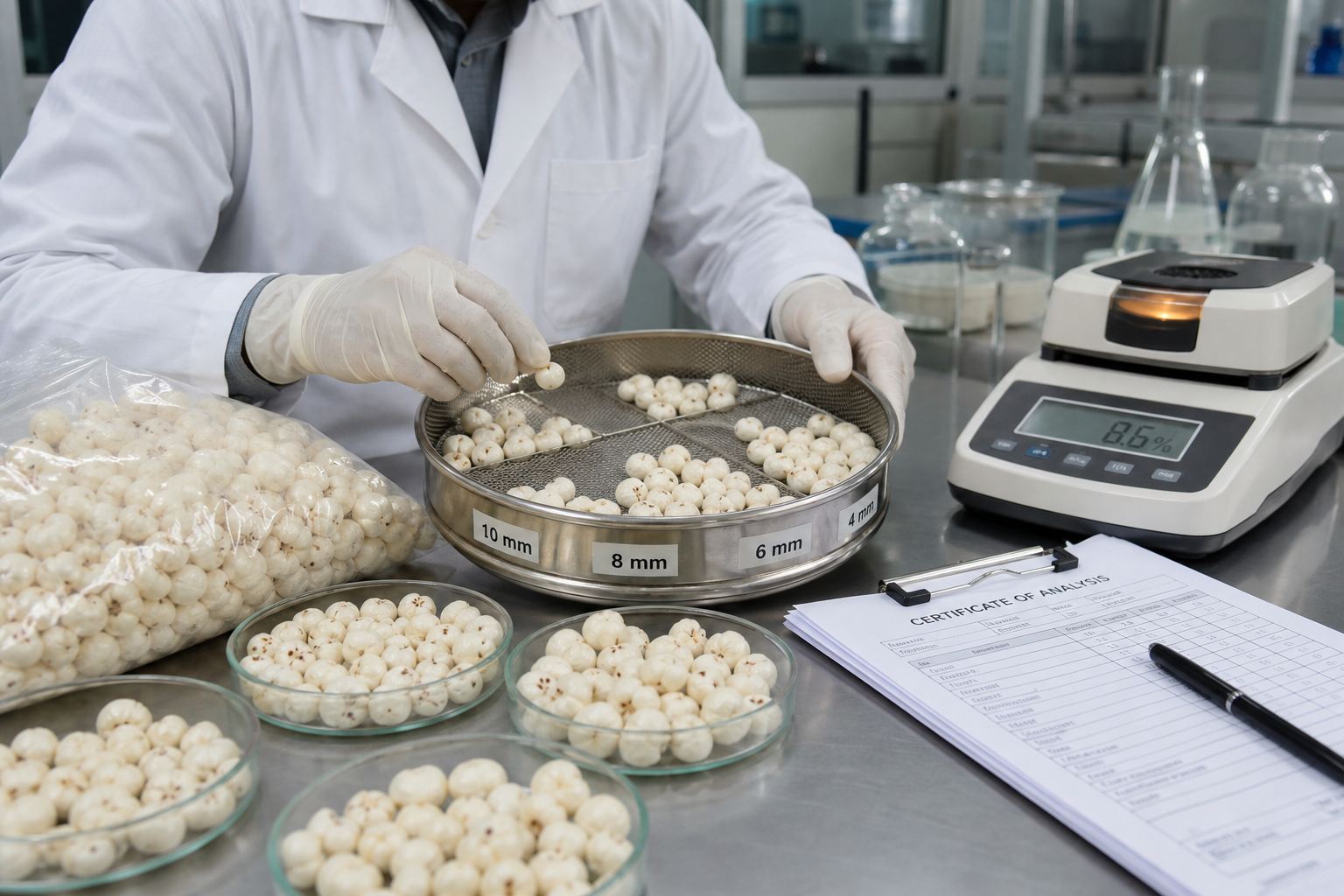
Premium makhana export requires a layered certification stack distinct from — and additive to — the baseline FSSAI and APEDA registration required for any export shipment: organic certification (NPOP, with USDA Organic and EU Organic equivalence) for organic-labelled buyers, the Mithila Makhana GI tag for provenance-driven positioning, and lot-specific lab COAs covering moisture, broken percentage, and microbiology for all premium and retail-ready programmes.
Buyers paying organic or GI-linked premiums verify the certification chain, not just a general company-level claim. NPOP transaction certificates issued per export lot are the document that links a specific pack or drum to certified organic origin; without one, an organic label claim will not withstand buyer audit.
Certification Stack for Premium Makhana Export
Swipe →
Data table — swipe horizontally on small screens
| Certification | Issuing Body | Premium Segment | Buyer Verification Method |
|---|---|---|---|
| FSSAI Licence | FSSAI, Government of India | All export shipments (baseline) | Licence number on invoice/COA |
| APEDA Registration (RCMC) | APEDA | All processed food export; fair/BSM access | RCMC number, APEDA directory listing |
| NPOP Organic | APEDA-accredited certification body | All organic-labelled export | Transaction certificate per lot; annual audit |
| USDA Organic | USDA-recognised certifier (often same body as NPOP) | USA organic-labelled products | USDA Organic seal; certifier name on label |
| EU Organic (Reg. 2018/848) | EU-recognised certifier | EU organic-labelled products | EU Organic logo; certifier code on label |
| Mithila Makhana GI Tag | Geographical Indications Registry | Provenance-driven premium and gifting buyers | GI registration reference; documented origin traceability |
| Lab COA (moisture, broken %, microbiology) | NABL-accredited laboratory | All retail-ready and organic programmes | Lot-specific report matched to shipment batch |
Buyer Requirements
Buyer Requirements
Premium makhana buyers impose qualification requirements beyond conventional lab COA review — understanding these before certification investment prevents costly missteps.
Clean-Label Snack Brand Requirements
Clean-label snack brands sourcing organic makhana for private-label formulation typically require: valid NPOP/USDA/EU Organic certification with transaction certificates per lot; lab COA with moisture, broken percentage, and microbiology data; minimal-ingredient flavour formulation with no synthetic preservatives; grade consistency (usually 16mm+) across repeat lots; and supplier audit capability confirming segregated processing and packing.
Organic Retail Chain Requirements
Organic retail chains prioritise certification completeness (organic status covering the entire pond-to-pack chain, not farm-only certification), consistent supply across a listing period, formal vendor-approval documentation, and price stability commitments — often requiring a longer qualification cycle than a smaller D2C snack brand before the first purchase order.
Premium Gifting and Provenance-Driven Requirements
UAE gifting and premium retail buyers weight GI-traceable Mithila provenance and presentation-quality jumbo grade heavily, often alongside but not strictly requiring organic certification. Documented origin traceability and consistent large-grain visual quality matter more to this segment than certification breadth.
Organic Ingredient and Formulator Requirements
Organic protein-bar and trail-mix formulators sourcing makhana as an input require organic certification covering the full chain, functional specification consistency (particle size for flour-grade use), and dependable supply continuity — packaging aesthetics and provenance storytelling matter less to this buyer type than functional and certification reliability.
Country-wise Opportunities
Market Snapshot
Premium makhana export opportunities concentrate in markets with strong clean-label and organic retail infrastructure, or with demonstrated provenance-driven premium retail demand — not necessarily in the markets with the highest total conventional import volume.
Country-wise Premium Makhana Export Opportunities
Swipe →
Data table — swipe horizontally on small screens
| Country/Region | Premium Demand Focus | Certification Required | Price Opportunity | Entry Strategy |
|---|---|---|---|---|
| USA | Organic clean-label snack retail, D2C brands | USDA Organic; lab COA | Highest organic premium; fastest-growing | Clean-label trade shows; LinkedIn snack-brand founders |
| Germany / EU | Organic retail chains, specialty grocery | EU Organic; food-safety documentation | High; strict documentation expectations | Organic distributor introductions; specialty trade fairs |
| UK | Clean-label specialty snack retail | Organic preferred; lab COA required | Growing premium segment | UK specialty snack buyer outreach |
| Canada | Organic and natural grocery retail | USDA/EU-equivalent recognition | Moderate to high | Distributor partnerships; organic retail introductions |
| Australia | Wellness retail, organic snacking | NASAA/USDA/EU Organic recognised | Growing premium segment | Wellness retail distributor networks |
| UAE | Premium gifting, GI-traceable jumbo grade | Provenance documentation; organic optional | High for jumbo/GI-traceable presentation lots | Gifting-sector buyer relationships; trade fairs |
Sourcing Checklist
Checklist
International buyers sourcing certified-organic or GI-traceable makhana from India should verify each of the following before paying a premium price.
Buyer, Exporter, and Compliance Checklists
Checklist
Compliance Notes
Common Buyer Mistakes
Common Mistakes Box
Both buyers and exporters make recurring mistakes in premium makhana sourcing that erode trust and waste certification investment.
Common Mistakes in Premium Makhana Sourcing
Swipe →
Data table — swipe horizontally on small screens
| Mistake | Consequence | How to Avoid |
|---|---|---|
| Paying organic premium without a transaction certificate | Receiving conventional product with an organic label — brand reputation damage | Require lot-specific transaction certificate before payment |
| Assuming Mithila GI status equals organic certification | Wrong compliance expectation set with retail or regulatory partners | Clarify GI (origin/provenance) versus NPOP/organic (production method) separately |
| Accepting pond-only organic certification without processing certification | Product roasted/packed on conventional lines — organic claim invalid | Verify entire chain: pond, roasting, and packing certification |
| Comparing organic/premium pricing to commodity broken-grade benchmarks | Unrealistic price expectations stall premium negotiations | Benchmark against comparable organic/high-grade international pricing, not commodity grade |
| Treating clean-label as a marketing label without ingredient-list review | Formulation contains excluded ingredients for target retail channel | Review full ingredient and additive list against destination clean-label standards |
| Skipping lot-specific lab COA for organic/premium shipments | Quality dispute at destination with no documentation to resolve it | Include lab COA matched to the specific shipment batch every time |
Challenges & Solutions
Premium makhana positioning introduces operational challenges beyond those in commodity trade — most solvable with upfront process discipline rather than reactive fixes.
Challenges in Premium Makhana Export and Practical Solutions
Swipe →
Data table — swipe horizontally on small screens
| Challenge | Why It Happens | Solution |
|---|---|---|
| Certification cost erodes thin-margin lots | Annual inspection and per-lot transaction certificates carry fixed cost regardless of volume | Model certification cost per kilogram; set minimum viable premium-lot volume before quoting |
| Segregation lapses invalidate organic claims | Shared roasting/packing equipment used for both conventional and organic batches without verified cleaning | Maintain dedicated organic runs or documented cleaning logs between batches |
| GI-origin claims made without supporting documentation | Processors conflate general "Bihar origin" with certified Mithila GI geography | Maintain pond-location records tying specific lots to the certified GI area |
| Buyer price expectations anchored to commodity grade | Buyers unfamiliar with makhana compare quotes to broken-grade benchmarks seen elsewhere | Lead conversations with grade, certification, and provenance value before discussing price |
| Moisture-related quality disputes on premium retail-ready lots | Retail-ready packaging held to a stricter shelf-life standard than bulk commodity packs | Use nitrogen-flushed, moisture-barrier packaging and confirm shelf-life data upfront |
Future Market Trends
Key Statistics
Clean-label and organic-labelling regulation is tightening globally, expanding the addressable market for genuinely certified-organic makhana from India while raising audit scrutiny on imported organic ingredients — favouring Indian exporters with robust chain-of-custody documentation over those relying on paper-only or partial certification.
Provenance and GI-linked marketing is becoming a mainstream premium-retail expectation rather than a niche specialty-buyer interest, particularly as more consumers in the USA, UK, and Germany become familiar with makhana as a category and begin differentiating suppliers on origin story rather than treating all Indian makhana as interchangeable.
Clean-label ingredient-list transparency is shifting from a premium differentiator to a near-baseline retail listing requirement in mainstream natural grocery, meaning processors who have not yet reformulated flavour lines away from synthetic additives will find it increasingly difficult to access growing retail channels regardless of organic certification status.
Future Trends in Premium Makhana Export (2026–2032)
Swipe →
Data table — swipe horizontally on small screens
| Trend | Impact on Indian Premium Exporters | Preparation Strategy |
|---|---|---|
| Organic-labelling regulation tightening (EU, USA) | Organic certification verification intensifies at import | Invest in audit-ready chain-of-custody documentation now |
| Growing GI/provenance awareness among premium buyers | Higher-value buyers actively differentiate by Mithila origin | Build and document genuine pond-to-pack traceability |
| Clean-label as baseline retail expectation | Synthetic-additive flavour lines lose access to mainstream retail | Reformulate flavour lines toward natural, minimal-ingredient recipes |
| Premium segment growth outpacing commodity grade | Margin opportunity shifts toward certified organic and high-grade product | Diversify capacity beyond broken/commercial grade production |
| Rising buyer sophistication in certification audit | Superficial organic or GI claims fail qualification more often | Standardise transaction-certificate and lab-COA documentation per lot |
Conclusion
- Export operations: how to export fox nuts (makhana) from India.
- Buyer discovery: find international buyers for fox nuts (makhana).
- Product depth: top fox nut (makhana) products exported from India.
- Destination markets: best countries for Indian fox nut (makhana) exports.
- Country demand map: most demanded Indian fox nuts (makhana) by country.
- Registration credentials: APEDA registration benefits for fox nut (makhana) exporters.
- Documentation: fox nut (makhana) export documentation checklist.
- Trade shows: trade shows & B2B marketplaces for fox nut (makhana) exporters.
- Contact Altus Exports global sourcing partner or product sourcing company in India services for certified organic makhana programmes.
Organic and GI-traceable makhana export from India represents the highest-margin, most defensible positioning available in the Euryale ferox trade — but only for processors who invest in genuine NPOP/USDA/EU Organic certification infrastructure, documented Mithila GI traceability, size-grade discipline, and clean-label reformulation. Commodity broken and standard grade will continue to dominate export volume, but premium value concentrates in certified-organic 16mm+ retail-ready product for clean-label snack brands, organic-certified ingredient grade for wellness formulators, and GI-traceable jumbo grade for premium gifting and provenance-driven retail.
International buyers paying organic or GI-linked premiums have real verification capability — transaction certificates, chain-of-custody audits, and traceability documentation reviews are standard qualification steps, not exceptional requests. Processors who treat premium positioning as a marketing layer over conventional production will fail buyer audit and damage the broader Indian makhana supplier reputation in premium segments.
Altus Exports operates as a merchant exporter and global sourcing partner for fox nuts (makhana) from India, connecting clean-label snack brands, organic retail chains, and premium gifting buyers with verified Bihar-region processors maintaining legitimate organic certification and GI-traceable supply chains — managing certification verification, sample coordination, and export logistics for premium programmes.