
Corrugated Box Container Loading and Shipping: Complete Buyer Guide
By Saurabh Mittal, Founder, Altus Exports
A calculation-led logistics guide for flat-packed bundles, palletized versus floor loading, container selection, moisture protection, freight economics, and receiving.
Corrugated boxes are lightweight but cube-intensive. International buyers therefore need to manage corrugated box container loading and shipping as an engineering and cost problem, not accept a generic promise that a certain number of boxes fits a 20GP, 40GP, or 40HC. Blank dimensions, fold pattern, bundle count, flute, wall construction, pallet footprint, stack height, compression allowance, humidity protection, and equipment supplied by the carrier all change the result.
This guide teaches a repeatable method for flat-packed bundles: measure the approved export pack, calculate gross CBM and weight, choose floor-loaded or palletized handling, model utilization and landed freight per usable box, protect board strength through the route, book against realistic cargo-ready and transit scenarios, and inspect at destination. It does not publish fixed container counts because those figures would be false precision. Buyers should replace every scenario input with measured package data and current carrier, forwarder, port, and customs information.
Executive Summary
Summary Box
A reliable corrugated-box shipment begins with the finished bundle or pallet, not nominal box dimensions. Record package length, width, height, gross weight, SKU quantity, orientation, and stack limits. Calculate package CBM, map the packages into the actual equipment dimensions, apply realistic stowage loss, and check payload and route constraints. Only then compare 20GP, 40GP, 40HC, LCL, and consolidation options.
Corrugated strength is sensitive to compression history and moisture. Flat packs should be bundled without strap damage, kept off wet floors, protected from condensation risk, and loaded so lower tiers are not crushed by dynamic transport forces. The importer should receive a pre-alert, unloading plan, tally map, and inspection protocol before arrival. Freight cost should be normalized per accepted box, not merely per container.
Introduction
An unerected corrugated box can look simple on a quotation but become difficult at export scale. Die-cut projections may prevent a tight rectangular bundle. Thick double- or triple-wall blanks may resist folding. Printed surfaces may scuff under straps. A small change in bundle quantity can change height, pallet pattern, container utilization, and manual handling weight. If logistics is estimated before the golden pack is approved, the landed-cost model rests on guesses.
Define the logistics unit at three levels: each saleable box blank, each handling bundle, and each shipping unit such as a pallet. Preserve conversions among them. A packing list may say 24 pallets, but the buyer needs to know exactly which bundles and SKUs sit on each pallet. The receiving team needs the same hierarchy to count without erecting every box.
Market Size & Industry Overview
Key Statistics
International trade in corrugated cartons, boxes, and cases is substantial but structurally regional because empty packaging consumes freight volume faster than payload. WITS/UN Comtrade reporter tables show large country flows under HS 481910, but summing reporters, partners or an EU aggregate with member states can double count trade. Customs trade is not the same as total corrugated production or consumption; much packaging is produced and used domestically.
India reported approximately US$55.790 million and 38.399 million kg of HS 481910 exports in 2024. This scale supports real export lanes, but it does not prove that long-distance shipment is economical for a standard brown RSC that a local converter can produce quickly. Export opportunities are stronger when the product carries specialized print, construction, certification, conversion value, India-linked product kitting, or a volume plan that uses ocean equipment efficiently.
The logistics decision belongs inside sourcing. Review corrugated box types and specifications, corrugated box wholesale pricing, and corrugated quality standards and certifications before accepting a freight model. A thinner or smaller bundle is not a saving if it reduces box performance or causes conversion damage.
Verified corrugated-box trade signals and their logistics meaning.
Swipe →
Data table — swipe horizontally on small screens
| Market signal | Verified period | Reported measure | Logistics interpretation |
|---|---|---|---|
| India HS 481910 exports | 2024 | US$55.790 million; 38.399 million kg | Established but selective export category |
| Netherlands HS 481910 imports | 2024 | US$856.101 million | Large cross-border and distribution flows |
| Mexico HS 481910 imports | 2024 | US$788.089 million | Strong regional manufacturing integration |
| United States HS 481910 imports | 2024 | US$747.204 million | Large demand with domestic/regional competition |
Market Overview
The market is large enough to support specialized trade, but empty-box freight makes each lane product-specific. Validate whether print, construction, certification, India-linked kitting, service resilience, or conversion economics create enough value to offset cube, transit inventory, and local competition.

Export Statistics
Key Statistics
WITS reports 2024 HS 481910 gross exports led by China at approximately US$1.553 billion, the United States at US$1.384 billion, and Germany at US$1.218 billion. India reported US$55.790 million. These figures capture declared cross-border value for corrugated cartons, boxes, and cases. They do not identify palletization, container type, box style, flute, print, performance, Incoterm, or freight spend.
India's reported quantity of 38.399 million kg implies an aggregate customs value near US$1.45 per kg when divided into reported value. That is an arithmetic trade indicator, not a product quote, freight rate, or landed price. Corrugated products differ greatly in board combination and conversion value, and customs valuation conventions differ. Logistics teams should never infer boxes per container from kilograms of national trade.
Leading 2024 HS 481910 exporters without unsupported loading inferences.
Swipe →
Data table — swipe horizontally on small screens
| 2024 exporter | Reported export value | Reported quantity | Data caution |
|---|---|---|---|
| China | US$1.553 billion | 689.417 million kg | Broad product and route mix |
| United States | US$1.384 billion | Not shown in cited summary | Large neighboring-market flows |
| Germany | US$1.218 billion | 807.331 million kg | European regional trade |
| India | US$55.790 million | 38.399 million kg | No container count can be derived |
Trade Statistics
Use trade data to screen countries and competitors, not to calculate loading. Customs kilograms and dollars contain unknown box mixes and routes; only measured package geometry, weight, and assigned equipment can support a load plan.
Import Statistics
Key Statistics
WITS 2024 data list the Netherlands at approximately US$856.101 million and 1.013 billion kg of HS 481910 imports, Mexico at US$788.089 million and 402.923 million kg, the United States at US$747.204 million and 344.218 million kg, and Canada at US$597.954 million. France reported US$578.183 million and 349.690 million kg. The European Union aggregate overlaps member-state reports, so it must not be added to national rows.
These markets are research signals, not automatic India lanes. High imports may represent short-haul truck movements, integrated border manufacturing, re-export, or specialized formats. Screen the actual origin-destination pair for ocean service, transshipment, port congestion, inland drayage, container availability, seasonal weather, destination labor, local box prices, and buyer inventory cost. Compare a delivered program against local conversion, not only against another overseas quote.
Major 2024 import reporters and the lane question each buyer should test.
Swipe →
Data table — swipe horizontally on small screens
| 2024 importer | Value | Quantity | Lane-screening question |
|---|---|---|---|
| Netherlands | US$856.101 million | 1,012.570 million kg | Can Indian ocean economics compete with European regional supply? |
| Mexico | US$788.089 million | 402.923 million kg | Is the use case differentiated from US–Mexico regional trade? |
| United States | US$747.204 million | 344.218 million kg | Does product value offset long-distance cube and inventory? |
| Canada | US$597.954 million | Not reproduced here | Can differentiated supply offset regional competition and cube? |
| France | US$578.183 million | 349.690 million kg | Are EU/French packaging and receiving requirements built in? |
Import Data Analysis
After identifying a high-import market, compare the proposed India lane with domestic and neighboring converters on delivered unit cost, minimums, lead-time variability, warehouse inventory, handling, sustainability requirements, and resilience. The result is a route-specific sourcing hypothesis, not a demand forecast.
Product Categories / Variants
Summary Box
Logistics behavior changes by box format. Regular slotted container blanks can often form stable rectangular bundles. Die-cut mailers and retail-ready designs may have projections, windows, perforations, pre-applied tapes, or print surfaces needing interleaving and lower strap pressure. Heavy-duty double- and triple-wall boxes increase bundle thickness and weight. Coated, waxed, water-resistant, or food-contact constructions may change friction, condensation behavior, recycling claims, and handling.
Freeze supplied condition. “Flat packed” can mean fully flat blanks, manufacturer's-joint boxes folded on one score, partially assembled trays, or nested components. Dividers, pads, and fittings may ship separately or kitted. These choices determine package geometry and receiving labor. The RFQ and custom-printed corrugated boxes guide should define print-protection and pack orientation before a freight quote.
How common corrugated-box variants behave in export handling.
Swipe →
Data table — swipe horizontally on small screens
| Corrugated variant | Typical shipping form | Main logistics control |
|---|---|---|
| RSC and slotted cases | Folded blanks in rectangular bundles | Score alignment, strap pressure, bundle count |
| Die-cut mailers | Flat or pre-folded bundles | Projection protection and bundle geometry |
| Retail-ready/display cases | Flat components or partial assembly | Print scuff, perforation, component matching |
| Heavy-duty cases | Thicker folded blanks | Bundle weight, rebound, stack pressure |
| Trays and telescope parts | Nested or flat components | Set counts and deformation |
| Partitions/pads supplied with boxes | Separate bundles or kits | SKU mapping and receiving sequence |
Product Overview
The logistics specification should identify finished blank dimensions, folded dimensions, bundle quantity, measured bundle dimensions, gross bundle weight, pallet pattern if used, maximum stack, and handling method. Do not calculate from the erected internal box dimensions; those dimensions describe the buyer's eventual pack, not the exported flat-pack cube.
Minimum golden-pack evidence
- Photographs with scale, measurement record, bundle count, gross weight, strap and edge-protector details.
- Pallet pattern or floor-load orientation, compression limit, SKU mark, and approved handling trial.
Export Process
Export Tip
Translate the approved corrugated-box specification into a production-equivalent golden bundle, then measure it and build the preliminary load model. Obtain current freight scenarios and align the selected mode, equipment, Incoterm, cargo-ready window, and destination receiving plan. During production, monitor board condition, bundle geometry, count, marks, and stack limits; do not wait until container positioning to discover that the pack changed.
At cargo readiness, freeze the final package list and confirm booking, cutoff, container inspection, loading labor, moisture controls, dunnage, load pattern, verified-gross-mass responsibilities, tally, seal, and photographs. After departure, send the invoice, packing list, transport information, package map, estimated arrival, unloading instructions, and claims contacts. At destination, inspect before breaking down or discarding evidence and feed measured results into the next order.
The six operational gates from pack approval through receiving.
Swipe →
Data table — swipe horizontally on small screens
| Export logistics gate | Output | Release condition |
|---|---|---|
| Pack design | Golden bundle/pallet and measurements | Production-equivalent pack approved |
| Freight planning | Mode/equipment scenarios and landed model | Buyer selects route and Incoterm |
| Cargo readiness | Final packages, weights, marks, load plan | No uncontrolled pack change |
| Loading | Container inspection, tally, seal, photographs | Exceptions documented and accepted |
| In transit | Pre-alert, milestone updates, receiving plan | Destination team ready before arrival |
| Receiving | Count, condition, damage evidence, feedback | Claims preserved and corrective action opened |
Manufacturing Overview
Export Tip
Corrugated logistics begins on the converting floor. Paper is corrugated and bonded into board, then slit, scored, printed, die-cut or slot-cut, folded, glued or stitched, and bundled. Board leaving the corrugator can contain process heat and moisture; converting, conditioning, and storage affect dimensional stability. Shipping freshly made bundles before moisture equilibrates can increase warp, condensation contribution, and compression variability.
The pack station should verify fold direction, bundle count, strap placement, edge protection, print condition, bundle squareness, measured dimensions, and gross weight. A production-equivalent packing trial is essential because hand samples may fold more carefully or compact differently than bulk goods. Record nonconforming or reworked bundles so they do not break pallet geometry or tally accuracy.
Manufacturing outputs that influence flat-pack shipping performance.
Swipe →
Data table — swipe horizontally on small screens
| Stage | Shipping-sensitive output | Control |
|---|---|---|
| Corrugation | Board moisture, flute integrity, warp | Condition and inspect before conversion |
| Printing/die-cutting | Surface and projection vulnerability | Approved stacking face and interleaving |
| Folding/jointing | Flat-pack geometry | Production-equivalent fold standard |
| Bundling | Package cube and compression history | Count, strap tension, edge protection |
| Storage/loading | Humidity and stack exposure | Dry floor, stack limits, FIFO by accepted lot |

Pricing Analysis
Buyer Tip
Compare total delivered logistics, not only ocean base freight. Include factory-to-container movement, export handling, documentation, terminal charges, ocean or air freight, fuel and security surcharges, insurance, destination terminal and handling, customs brokerage, duty and tax where applicable, chassis or vehicle, delivery appointment, unloading labor, pallet disposal, storage, detention/demurrage exposure, damage, and working-capital time. Obtain dated, route-specific quotes with inclusions and validity.
Normalize by accepted usable box. Suppose a buyer chooses purely illustrative inputs: 18,000 boxes, product cost US$0.62 each, and door-to-door logistics plus nonrecoverable import charges of US$6,300. The landed logistics allocation is US$0.35 per box and the pre-rejection landed amount is US$0.97. If 2% arrive unusable, divide total cost by 17,640 accepted boxes, not 18,000 shipped. These are invented teaching inputs, not market ranges or Altus offers.
Cube utilization can outweigh a lower factory price. A supplier that redesigns bundle orientation or reduces avoidable pallet overhang without damaging boxes may lower freight per unit. Conversely, excessive compression that creates score cracking or crushed flutes is false economy. Compare price scenarios against sustainable corrugated packaging and performance requirements before changing material or pack.
Door-to-door freight layers to normalize per accepted corrugated box.
Swipe →
Data table — swipe horizontally on small screens
| Freight-cost layer | Quote basis | Comparison rule |
|---|---|---|
| Origin inland/handling | Factory, load port, equipment, service date | Include positioning and loading labor |
| Main carriage | Route, equipment/mode, validity, free time | Separate base and surcharges |
| Destination charges | Port/CFS, handling, broker, delivery | Identify prepaid versus collect |
| Inventory/time | Production plus queue, transit, clearance, delivery | Apply buyer's carrying-cost method |
| Damage/rejection | Receiving evidence and claims history | Divide by accepted boxes |
| Contingency | Storage, detention, demurrage, examination | Model scenarios; do not hide in unit price |
MOQ Analysis
Buyer Tip
The economical shipping quantity is not necessarily the converter's manufacturing MOQ. Board run, print plate, die, and setup economics can permit a quantity that uses only part of a container. The buyer must compare inventory carrying cost and forecast risk against LCL handling, poor FCL utilization, or a consolidated multi-SKU order. Ask separately for manufacturing minimum, packing multiple, pallet minimum, and freight breakpoints.
A pilot may justify LCL or a shared consolidation even when the per-box freight is high because it limits product-performance and demand risk. A repeat program may move toward FCL after the bundle dimensions and receiving results are proven. Do not inflate a first order merely to “fill a 40HC” without testing the product, documentation, route, and downstream consumption rate.
Order-size scenarios and the logistics decision each should prioritize.
Swipe →
Data table — swipe horizontally on small screens
| Order scenario | Decision focus | Useful control |
|---|---|---|
| Prototype/sample | Design and handling validation | Courier/air with protected sample pack |
| Commercial pilot | Quality and lane proof | LCL or consolidation with handling safeguards |
| Mixed-SKU replenishment | Cube balance and demand | Common pallet/bundle logic and clear SKU map |
| Repeat FCL | Freight efficiency and cadence | Measured load plan and receiving feedback |
| Peak-season buffer | Service risk versus inventory | Earlier booking and scenario lead time |
Packaging Standards
Export Tip
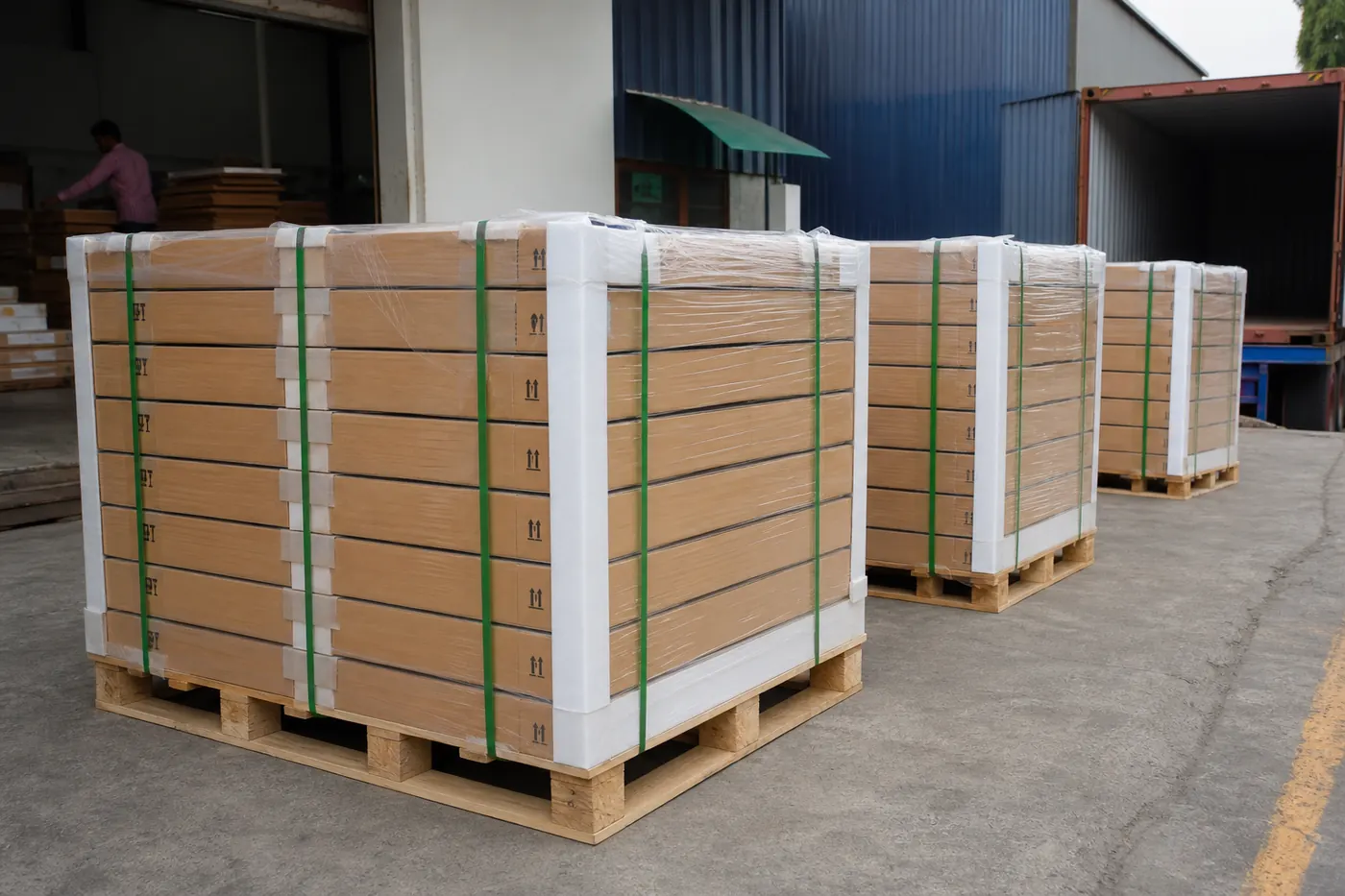
Export packaging must protect the corrugated boxes without becoming a moisture trap or crushing source. Define bundle count, approved fold, facing direction, interleaf where needed, strap type and placement, tension limit, edge boards, corner protection, wrap or shroud, pallet material, top cap, maximum height, stack limit, marks, and handling symbols. Test whether wrap blocks needed drying or creates condensation pockets during temperature change.
Regulated solid-wood pallets, blocking and dunnage used in international trade may require ISPM 15 treatment and marking, subject to the standard's exemptions. ISPM 15 does not apply to corrugated boxes or paper pallets merely because they cross a border. Verify the destination and material; do not assume a supplier statement is enough. Pallets should be dry, sound, and free from protruding nails or deck gaps that indent bundles.
The IMO/ILO/UNECE CTU Code, published in 2014, warns that insufficient humidity control can cause severe cargo damage and collapse. Its informative material explains that ordinary fiberboard loses substantial stability as humidity rises. Prevent rain loading, wet floors, damp timber and uncontrolled condensation rather than relying on desiccants as a universal cure. There is no fixed desiccant dosage for every container: sizing depends on route, duration, cargo and timber moisture, container condition, barrier system, ventilation and product compatibility.
Container Loading Details
Export Tip
Start with measured package CBM: length (m) × width (m) × height (m). Multiply by the number of identical packages, then sum all package types. That gross package CBM is not the same as container utilization. Door openings, internal posts, corrugations, pallet overhang, orientation limits, uneven package geometry, airflow or moisture measures, bracing, and inaccessible voids reduce usable space. Weight and axle limits can bind even when cube remains, although corrugated blanks are often cube-limited.
Use the actual equipment specification supplied by the carrier. Representative carrier examples list a 20GP at about 33.2 m³ nominal internal volume with roughly 28.1–28.3 t maximum payload, a 40GP at about 67.7 m³ with roughly 28.87 t, and a 40HC at about 76.3–76.4 m³ with roughly 28.6–28.7 t. These are equipment examples, not universal specifications or usable-cargo guarantees: internal and door dimensions, tare, payload and fittings vary, and road, axle, lifting, terminal and route limits may be lower. Never apply a universal utilization percentage.
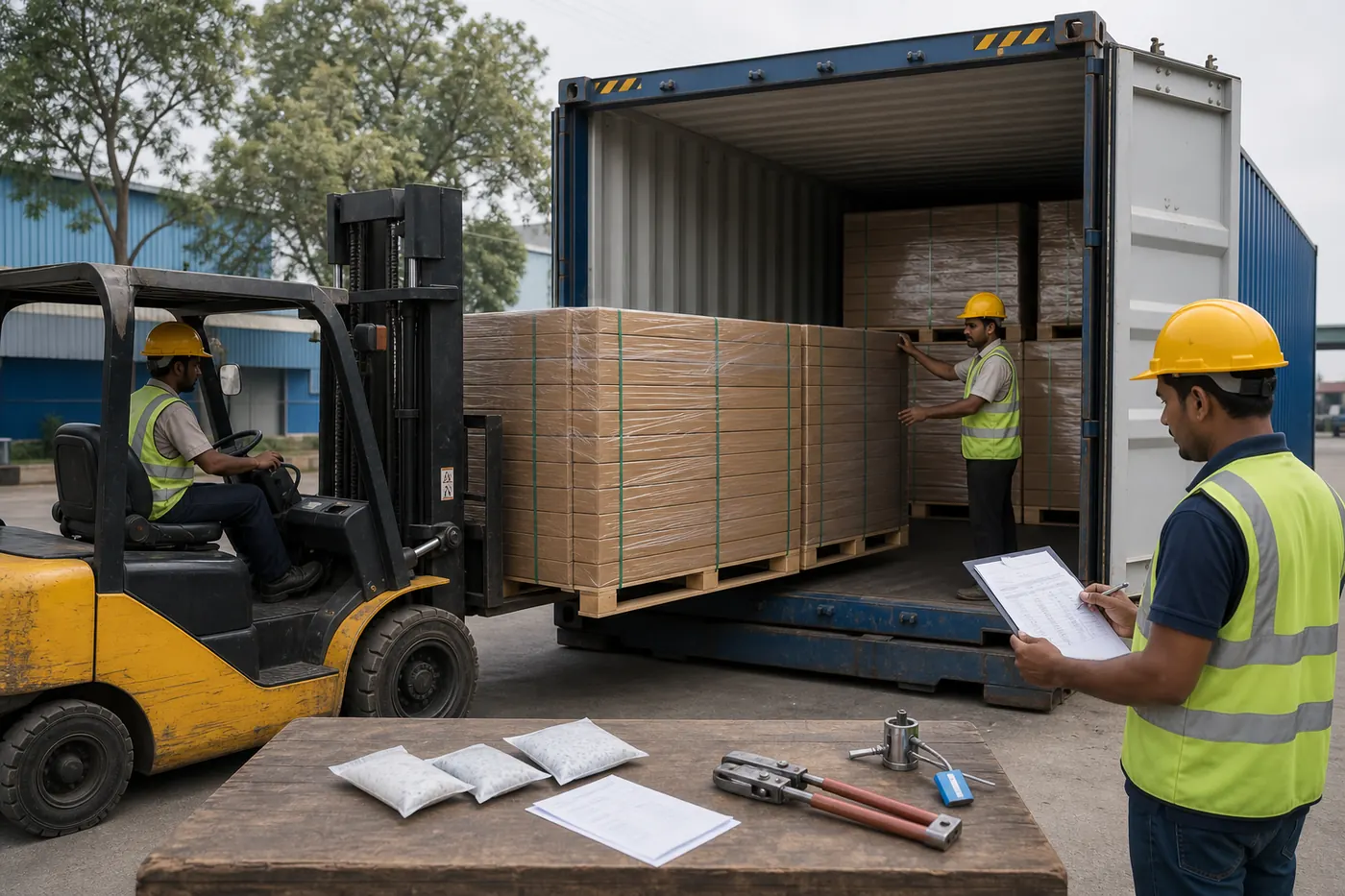
Calculate theoretical packages by geometry, not CBM division alone. Test orientations along length, width, and height; enforce door clearance, stack limits, pallet dimensions, and no-rotation rules. A three-dimensional loading tool or scaled layout helps, but conduct a physical trial for high-value repeat programs. Apply a stowage factor based on the actual pattern. Record loaded quantity by SKU, package sequence, container number, seal, and photographs.
Inputs and checks for a measured container-loading calculation.
Swipe →
Data table — swipe horizontally on small screens
| Planning field | Formula/source | What invalidates it |
|---|---|---|
| Package CBM | Measured L × W × H in meters | Bundle rebound, changed count, pallet overhang |
| Total gross CBM | Sum of package CBM × quantity | Mixed unmeasured package types |
| Geometric fit | Integer packages by tested orientation | Door, posts, voids, no-rotation limit |
| Weight check | Cargo + packing + dunnage | Payload, road, axle, lifting limits |
| Utilization | Loaded package CBM ÷ verified internal cube | Using nominal instead of assigned equipment |
| Boxes loaded | Loaded packages × verified boxes/package | Assumed rather than tallied bundle count |
20GP versus 40GP versus 40HC
A 20GP may suit pilots, dense mixed orders, constrained receiving sites, or lanes where larger equipment is unavailable. A 40GP increases floor area and cube but does not double every usable dimension. A 40HC adds height, valuable for stable lightweight stacks, but extra tiers increase compression at the bottom and can exceed safe unloading reach. Compare actual freight and destination handling, not container names.
Palletized versus floor-loaded
Palletized and floor-loaded options compared for buyer operations.
Swipe →
Data table — swipe horizontally on small screens
| Factor | Palletized | Floor-loaded |
|---|---|---|
| Cube | Lost to pallet and pattern gaps | Potentially higher geometric utilization |
| Handling | Faster where forklifts and docks fit | More touches and labor |
| Crush/scuff | Stable unit if designed well | Depends heavily on stack and unloading discipline |
| Compliance | Wood may trigger ISPM 15 | Dunnage still requires review |
| Receiving | Good for warehouse put-away | Needs sorting and labor capacity |
Palletization speeds forklift handling, supports package identity, and can reduce individual touches. It consumes cube and adds pallet weight, cost, overhang constraints, wood-compliance duties, and possible point loading. Floor loading can use cube better and avoid pallet cost, but requires more manual handling, careful boundary-to-boundary stow, and an unloading labor plan. Neither method is universally superior.
Humidity and crush-control plan
Before loading
- Condition board and bundles; keep cargo, pallets, and dunnage dry; reject containers with leaks, odor, contamination, holes, wet floors, or severe damage.
- Verify stack compression against board, bundle, humidity, duration, and dynamic transport exposure rather than dry-lab strength alone.
During and after loading
- Use a stable load pattern, protect door-end cargo, control voids, avoid concentrated pressure, document seal and tally, and preserve ventilation strategy.
- At receipt, record temperature/humidity observations where planned, container condition, visible condensation, stack lean, crushed tiers, wet marks, and count before disposal.
Shipping Methods
Export Tip
FCL gives one shipper greater control over loading pattern, seal, and container environment, with fewer consolidation touches. It can be economical before the container is visually “full” if LCL minimums, CFS handling, damage exposure, and destination fees are high. LCL can suit pilots and small replenishment but adds warehouse handling, co-loading uncertainty, and possible exposure to odor or moisture from other cargo. Specify that corrugated goods must not be co-loaded with wet, odorous, contaminating, or incompatible cargo.
Air freight and courier are usually reserved for samples, emergency quantities, or high-value specialized packs because volumetric weight penalizes flat-pack cube. Rail-road or sea-road combinations depend on lane. Obtain both chargeable-weight and actual-weight calculations. Ask forwarders to disclose service, transshipment, cutoffs, free time, CFS steps, exclusions, equipment assumptions, and current surcharges.
Lead time has four clocks: preproduction approvals and material availability; manufacturing and conditioning; booking, origin handling, and vessel/flight departure; and transit, clearance, appointment, and final delivery. For scenario planning, create optimistic, expected, and stressed dates using forwarder schedules and port intelligence. Do not market a generic “four-week shipping time” as a commitment when transshipment, customs examination, weather, blank sailings, or congestion can intervene.
Shipping modes compared for corrugated-box volume, handling, and quote scope.
Swipe →
Data table — swipe horizontally on small screens
| Mode | Best-fit hypothesis | Main corrugated risk | Quote requirement |
|---|---|---|---|
| FCL ocean | Repeat or larger measured loads | Condensation and long-duration compression | Equipment, route, free time, surcharges |
| LCL ocean | Pilot or small replenishment | Extra handling and co-load environment | CFS steps, minimum CBM, destination fees |
| Air freight | Urgent specialized quantity | Volumetric cost and handling | Chargeable-weight formula and routing |
| Courier | Samples and prototypes | Sample pack may not represent bulk | Dimensional weight and customs service |
| Multimodal | Inland origin/destination programs | Transfer points and schedule variance | End-to-end custody and exclusions |
Incoterms and Freight Economics
State Incoterms® 2020 plus the exact named place or port. FCA is usually the better fit where containerized cargo is delivered to the carrier or terminal before vessel loading. FOB, CFR and CIF are sea/inland-waterway rules. Under CFR and CIF, the seller pays ocean carriage to the named destination port, and under CIF specified insurance too, but risk transfers when the goods are on board at shipment—not when paid carriage ends. CPT and CIP can apply across modes.
Incoterms allocate specified tasks, costs and risk; they do not set title transfer or payment terms. DDP is operationally demanding because the seller must be able to manage destination import clearance, duties, taxes and regulatory responsibilities. It should not be offered casually through a freight quote. Whatever the term, create a cost-and-risk matrix covering positioning, loading, verified gross mass data, handling, freight, insurance, destination fees, customs, tax, delivery, unloading, delay and empty return.
Certifications
Compliance Notes
FSC or PEFC chain-of-custody certification can support responsible-fiber claims for eligible corrugated boxes, but it does not guarantee transport strength or moisture resistance. Verify certificate holder, status, scope, product group, transaction claim, and invoice continuity. ISO 9001 can indicate a quality-management-system scope; BRCGS Packaging Materials may be customer-required for certain packaging supply chains; neither substitutes for SKU-specific loading or receiving validation.
ISTA distribution-test procedures, ASTM methods, ISO paper/board tests, ECT, BCT, Cobb, moisture, and compression evidence should be chosen for the product and route. A test on an erected box containing the buyer's product answers a different question from compression of flat-packed export bundles. State sample configuration, conditioning, stacking, load, duration, vibration or shock sequence, method edition, and acceptance criteria.
What common certifications and tests can—and cannot—support.
Swipe →
Data table — swipe horizontally on small screens
| Evidence | What it can support | What it cannot prove |
|---|---|---|
| FSC/PEFC CoC claim | Defined fiber-chain transaction claim | Compression, moisture resistance, recyclability everywhere |
| ISO 9001 | Certified quality-system scope | Shipment conformity by itself |
| BRCGS Packaging Materials | Audited packaging-site protocol scope | Universal legal approval or container performance |
| ISTA report | Test outcome for defined pack and sequence | Every SKU, route, or later production lot |
| ECT/BCT/Cobb/moisture report | Named sample and method result | Long-route performance without representative conditions |

Buyer Requirements
Buyer Requirements
Buyers should issue a logistics annex with the PO. It should define flat-pack form, bundle count, dimensions and weight tolerances, straps, edge protection, wrap, pallet type, maximum package and stack weight, orientation, marks, moisture plan, prohibited co-loads, container inspection, loading photographs, seal control, shipping mode, Incoterm, route approval, pre-alert deadline, and receiving procedure.
Destination capability determines origin packing. Confirm dock height, forklift type and mast clearance, pallet dimensions, floor-loaded unloading crew, container parking time, appointment rules, weather shelter, count method, quarantine or wood-pallet controls, recycling/disposal, and empty-return timing. A 40HC that optimizes origin cube can be wrong if the receiving team cannot unload the top tiers safely.
Buyer logistics requirements, pre-shipment evidence, and receiving impact.
Swipe →
Data table — swipe horizontally on small screens
| Buyer requirement | Evidence before shipment | Receiving impact |
|---|---|---|
| Bundle/pallet specification | Golden pack and measured record | Count and handling method |
| Stack/crush limit | Engineering basis and load trial | Safe unloading and usable boxes |
| Moisture plan | Cargo/container/dunnage checks | Condensation inspection and claim evidence |
| Route/equipment | Forwarder confirmation and load plan | Dock, labor, appointment readiness |
| Tally/marks | Package map and photographs | Fast SKU reconciliation |
| Claims protocol | Insurance and discrepancy instructions | Evidence preserved before disposal |
Country-wise Opportunities
Market Snapshot
A country can be a major corrugated importer yet remain difficult for Indian flat-pack supply because regional converters offer shorter lead times. Opportunity screening should combine WITS data with differentiated product value, ocean and inland freight, destination labor, inventory cadence, duties, sustainability rules, and resilience needs. For U.S. entries, the Section 122 measure currently adds a temporary 10% ad valorem surcharge to covered imports through 12:01 a.m. EDT on July 24, 2026, subject to exclusions or change; brokers must verify entry-date and Chapter 99 treatment rather than treating it as a permanent HS 481910 rate. The table presents hypotheses, not forecasts.
Country opportunities screened through route-specific logistics priorities.
Swipe →
Data table — swipe horizontally on small screens
| Market | Opportunity hypothesis | Logistics priority |
|---|---|---|
| United States | Specialized printed, heavy-duty, or India-linked programs | Long-route moisture, port/inland cost, warehouse receiving |
| Netherlands/EU | Distribution and certified-fiber private label | EU packaging obligations, port/CFS economics, traceability |
| United Kingdom | E-commerce and specialty retail formats | Inventory cadence, destination fees, pallet standards |
| UAE/Gulf | Retail, food, industrial, and regional redistribution | Heat/humidity transitions and delivery windows |
| Africa | Selected industrial and consumer-goods packaging | Service frequency, transshipment, documentation, inland handling |
| Australia | Specialized and export-linked packaging | Long transit, biosecurity for wood, moisture and inventory |
Sourcing Checklist
Checklist
- [ ] Freeze finished corrugated-box and flat-pack specifications before logistics quoting.
- [ ] Approve a production-equivalent golden bundle and pallet where applicable.
- [ ] Measure every package type and record count, dimensions, gross weight, and orientation.
- [ ] Model geometric fit, CBM, payload, stack pressure, and assigned equipment.
- [ ] Compare palletized and floor-loaded plans with destination receiving capability.
- [ ] Obtain dated FCL, LCL, air, and consolidation quotes where commercially relevant.
- [ ] Define humidity, container-condition, void-control, tally, seal, and photograph checks.
- [ ] Contract Incoterm 2020 rule, named place, route approval, lead-time milestones, and claims process.
- [ ] Send package map and pre-alert before arrival; inspect before cargo evidence is discarded.
Buyer Checklist
Checklist
- [ ] Annual demand and replenishment cadence support the proposed shipment size
- [ ] Broker, forwarder, warehouse, and unloading team reviewed the plan
- [ ] Final package dimensions—not erected box dimensions—drive CBM
- [ ] Door-to-door cost is normalized per accepted usable box
- [ ] Destination dock, forklift, labor, stack height, and weather shelter are adequate
- [ ] Insurance, survey, notice, and claims deadlines are known
- [ ] Receiving inspection separates transit damage from manufacturing defects
- [ ] Repeat-order feedback updates pack and loading specifications
Exporter Checklist
Checklist
- [ ] Bulk bundles match the approved golden pack
- [ ] Cargo, pallets, dunnage, and storage area are dry and clean
- [ ] Package counts, dimensions, weights, marks, and SKU map are final
- [ ] Assigned container is structurally acceptable, dry, odor-free, and photographed
- [ ] Load pattern respects stack, crush, orientation, void, and door controls
- [ ] Container, seal, final tally, and exceptions are recorded
- [ ] Forwarder cutoffs, verified gross mass process, and pre-alert deadlines are met
- [ ] Receiving and emergency contacts have final route and document data
Compliance Checklist
Checklist
Compliance Notes
- [ ] Destination tariff, duty, import tax, and packaging obligations are confirmed
- [ ] Incoterms 2020 rule and named place match commercial and freight documents
- [ ] Carrier payload, internal dimensions, door opening, and road/axle limits are verified
- [ ] Container packing follows applicable CTU safety principles
- [ ] Wood pallets and dunnage meet ISPM 15 where applicable
- [ ] Verified gross mass responsibilities and data are assigned
- [ ] FSC/PEFC, recycled, recyclable, food-contact, and other claims are substantiated
- [ ] Dangerous-goods status of inks, coatings, adhesives, desiccants, or ancillary items is assessed where relevant
Challenges & Solutions
Frequent corrugated-box shipping failures and their operational fixes.
Swipe →
Data table — swipe horizontally on small screens
| Challenge | Root cause | Solution |
|---|---|---|
| Container count promise fails | Estimate used erected box or nominal cube | Measure final packages and test geometric fit |
| Bottom bundles crush | Stack load ignores humidity, duration, dynamics | Set evidence-based stack limit and load pattern |
| Boxes arrive damp | Wet cargo/dunnage, leaks, or condensation | Control moisture sources and inspect container |
| Pallets waste excessive cube | Footprint and bundle geometry mismatch | Optimize pack/pallet together or evaluate floor load |
| LCL damage/scuff | Extra touches and incompatible co-load | Strengthen unit pack and specify handling restrictions |
| Freight quote looks cheap | Destination and delay charges excluded | Compare door-to-door cost matrix |
| Receiving claim fails | Evidence discarded during unloading | Photograph, tally, segregate, and notify immediately |
Expert Insights from Saurabh Mittal
Expert Insight Box
The operational view associated with Saurabh Mittal's sourcing work is that freight optimization must preserve the purchased performance. The cheapest cube is not achieved by strapping harder, stacking higher, or removing moisture controls until the blanks deform. Altus Exports should connect converter data, loading trials, freight quotations, and warehouse feedback, then improve the next shipment using measured loss and handling time.
A robust review asks whether every assumption can be replaced by evidence: production bundle measurements, assigned-container dimensions, tested orientation, current route quote, documented stack limit, moisture inspection, and receiving tally. Where evidence is unavailable, label the number as a scenario and show sensitivity. This creates a useful decision even before final booking without pretending that a planning model is a guarantee.
Common Buyer Mistakes
Common Mistakes Box
- Asking how many boxes fit without supplying folded bundle dimensions.
- Dividing container nominal cube by package CBM and calling the result guaranteed.
- Using erected internal box dimensions to calculate export flat-pack volume.
- Choosing 40HC solely for extra cube without checking bottom-tier compression and unloading reach.
- Assuming palletization is always safer or floor loading is always cheaper.
- Loading recently produced or damp board into a container without conditioning.
- Treating desiccant quantity as a substitute for controlling moisture sources and leaks.
- Comparing FCL and LCL base rates while excluding CFS and destination handling.
- Quoting a generic transit time without production, cutoff, transshipment, clearance, and delivery clocks.
- Failing to photograph and segregate wet, crushed, or scuffed boxes before claim evidence disappears.
Future Market Trends
Key Statistics
Right-sizing will increasingly apply to both the buyer's eventual package and the export pack carrying flat blanks. Digital load-planning tools, package-level scans, humidity loggers, electronic pre-alerts, and repeat-lane damage analytics can improve utilization and traceability. Their value depends on accurate measurements and disciplined receiving data; software cannot correct a bundle that changes after the model is approved.
Packaging-waste policy, recycled-content expectations, certified-fiber demand, and carbon accounting may make cube, pallet choice, route, and damage rate more visible in procurement decisions. Buyers may compare local conversion with imported specialized boxes using total cost and emissions scenarios. Avoid unsupported environmental claims: calculate within a stated boundary, use current carrier and material data, and retain assumptions.
Resilience may favor smaller, more frequent replenishment or dual sourcing even when a full 40HC has lower freight per box. Teams should model service variability, forecast error, working capital, local backup capacity, and redesign lead time. The future program is not simply the fullest container; it is the cadence that meets demand with acceptable cost, quality, evidence, and risk.
FAQs
The answers below are decision frameworks. Final dimensions, capacities, freight, schedules, safety controls, and legal responsibilities must come from the actual approved packages, assigned equipment, providers, and destination.
Conclusion
Successful corrugated box container loading and shipping starts with measured flat-packed bundles and ends with accepted boxes at the buyer's warehouse. Calculate CBM from the final pack, test geometric fit against assigned equipment, compare palletized and floor-loaded handling, protect against humidity and compression, model door-to-door freight per usable unit, and plan receiving before cargo departs. Fixed container counts are unreliable because every box and pack architecture differs.
Build the program with our complete guide to importing corrugated boxes from India, evaluate Indian manufacturers, prepare corrugated box export documentation, and compare quality standards. Explore Altus Exports' India import coordination service and global sourcing support, or contact Altus Exports with drawings, folded pack dimensions, bundle count, weights, destination, receiving limits, annual demand, and required delivery date.
References
- World Bank WITS / UN Comtrade, HS 481910 exports by country, 2024
- World Bank WITS / UN Comtrade, HS 481910 imports by country, 2024
- IMO/ILO/UNECE, Code of Practice for Packing of Cargo Transport Units, 2014
- International Maritime Organization, verified gross mass requirements under SOLAS
- International Chamber of Commerce, Incoterms® 2020
- International Plant Protection Convention, ISPM 15
- International Safe Transit Association, test procedures and standards
- Forest Stewardship Council, Chain of Custody certification
- ISO 535, Paper and board — Cobb water absorptiveness
- World Customs Organization, Harmonized System overview
- White House, temporary Section 122 import surcharge proclamation, February 20, 2026
- Maersk, dry-container capacity and maximum-payload examples
Sources were accessed July 17, 2026. Trade data are gross reporter statistics, and equipment dimensions or route conditions must be verified with the current carrier and forwarder.