Custom Printed Corrugated Boxes in India: 2026 International Buyer Guide
By Saurabh Mittal, Founder, Altus Exports
A specification-led guide to print-process selection, artwork approval, proofs, retail-ready construction, MOQs, quality control and export delivery.
International buyers searching for custom printed corrugated boxes India suppliers are not purchasing print alone. They are purchasing a coordinated package in which board strength, dimensions, graphics, coating, converting, packing, transport and destination compliance must all work together. A color-perfect carton that crushes in distribution fails; a strong shipper with an unreadable barcode or inaccurate claim also fails.
This guide gives retail, e-commerce, electronics and private-label teams a commercial workflow for choosing flexographic, litho-laminated or digital print; preparing artwork; approving proofs; controlling ink and color; setting realistic minimums; inspecting production; and shipping flat boxes from India. All prices and lead times are indicative planning scenarios, not offers. Altus Exports can turn the final brief into a supplier-specific RFQ, samples and dated quotation.
Executive Summary
Summary Box
Custom corrugated boxes should be bought as one controlled structure-and-graphics system. Freeze internal dimensions, style, flute, board performance, packed load and distribution route before the converter releases the production dieline. Select flexography, litho-lamination or digital print by graphic requirement, substrate, version count, run length, schedule and total delivered cost—not by appearance in an online sample gallery.
Control four approvals separately: structural white sample, artwork/content proof, physical color standard and production-equivalent golden sample. State total and per-SKU MOQ, tooling, lead time, inspection, export pack and Incoterm. WITS/UN Comtrade records India's 2023 HS 481910 exports at US$57.641 million and 37.486 million kg, confirming an active export base without proving any supplier's capability or current price.
Introduction
A successful printed-box program begins before a designer opens the artwork file. The buyer must define what the box protects, how it is packed, the distribution hazards, the selling environment, the print standard, mandatory copy and the acceptable delivered cost. Those facts determine whether a simple one-color flexographic regular slotted container is appropriate or whether a litho-laminated retail-ready tray, digitally printed launch quantity or multi-part display is justified.
India offers paper mills, corrugators, sheet plants, printers, die makers and export coordinators across several industrial regions. Capability varies by plant. Buyers should verify the actual corrugator, printing press, laminator, die cutter and finishing route assigned to the order, including subcontractors. The complete import guide explains the broader sourcing sequence; this article owns design-to-print execution.
Market Size & Industry Overview
Key Statistics
Corrugated packaging is usually produced near the point of filling because empty boxes are bulky and freight-sensitive. Cross-border sourcing therefore works best when print value, unusual capability, regional consolidation or total program economics outweigh the logistics penalty. Export opportunities are strongest for premium printed packs, inserts and displays; boxes accompanying Indian-made goods; consolidated private-label programs; and destinations where Indian supply has a defensible route advantage.
The relevant customs category is substantial but highly regional. TrendEconomy, drawing on national trade statistics, reported 2023 world imports above US$9.18 billion for HS 481910 among 141 reporting countries. It listed the Netherlands, Mexico, United States, Germany and France as the largest importer reporters by value. These figures cover cartons, boxes and cases of corrugated paper or paperboard, not only custom-printed empty boxes, and intra-regional movements materially influence the ranking.
Product Categories / Variants
Summary Box
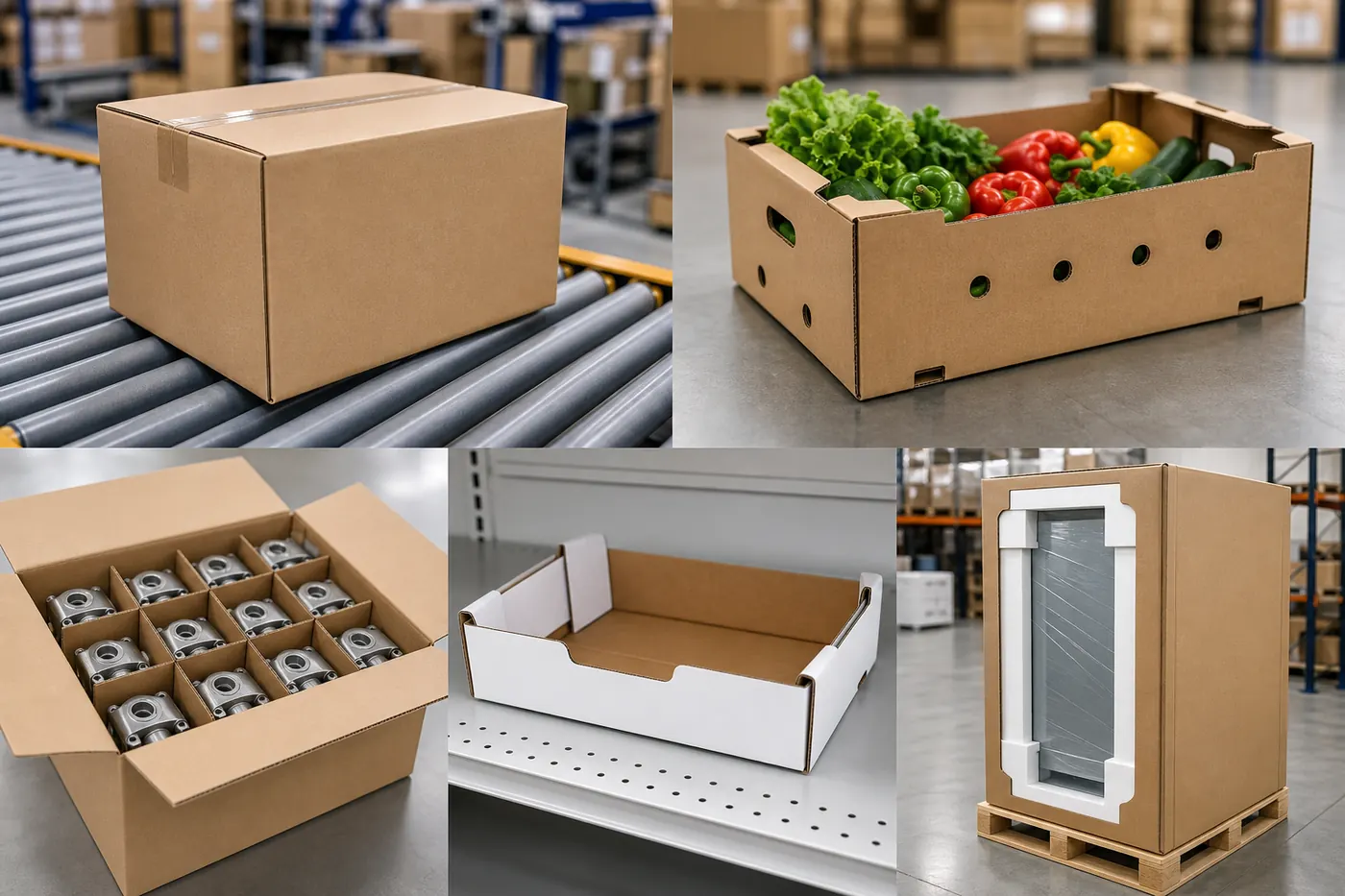
Specify the package as a system. Record internal dimensions in length × width × depth order; box style using an FEFCO or ECMA reference where appropriate; flute or flute combination; liner and medium grammages or verified board performance; joint type; score allowances; hand holes; perforations; tear strips; inserts; print faces; coating; and packing method. The corrugated box types and specifications guide covers ECT, burst, BCT, Cobb, flute and tolerances in detail.
Retail-ready packaging can combine a transit case with a perforated opening that converts into a shelf tray. Private-label cartons may carry brand identity, product claims, legal copy, barcodes, lot panels and handling symbols. A display may require a header, reinforced base and assembly instructions. Each added function should have an acceptance test: opening force, shelf stability, barcode verification, rub resistance, compression or packing-line trial.
Custom corrugated-box formats, applications and primary design controls.
Swipe →
Data table — swipe horizontally on small screens
| Format | Best-fit use | Key design control | Typical risk |
|---|---|---|---|
| Flexo RSC or die-cut shipper | E-commerce, industrial, master case | Board caliper, print registration, score quality | Graphics distorted at scores |
| Litho-laminated carton | Premium retail, electronics, beauty | Laminate bond, warp, color and die alignment | Cracking, warp or delamination |
| Digital corrugated pack | Launches, localization, versioning | Approved substrate profile and variable-data logic | Unit cost or color drift across runs |
| Shelf-ready tray/case | Retail replenishment | Perforation, opening and shelf footprint | Tear-out damages display |
| Display or multi-part kit | Promotion and point of sale | Assembly, load stability and component count | Missing parts or field assembly failure |
Manufacturing Overview
Export Tip
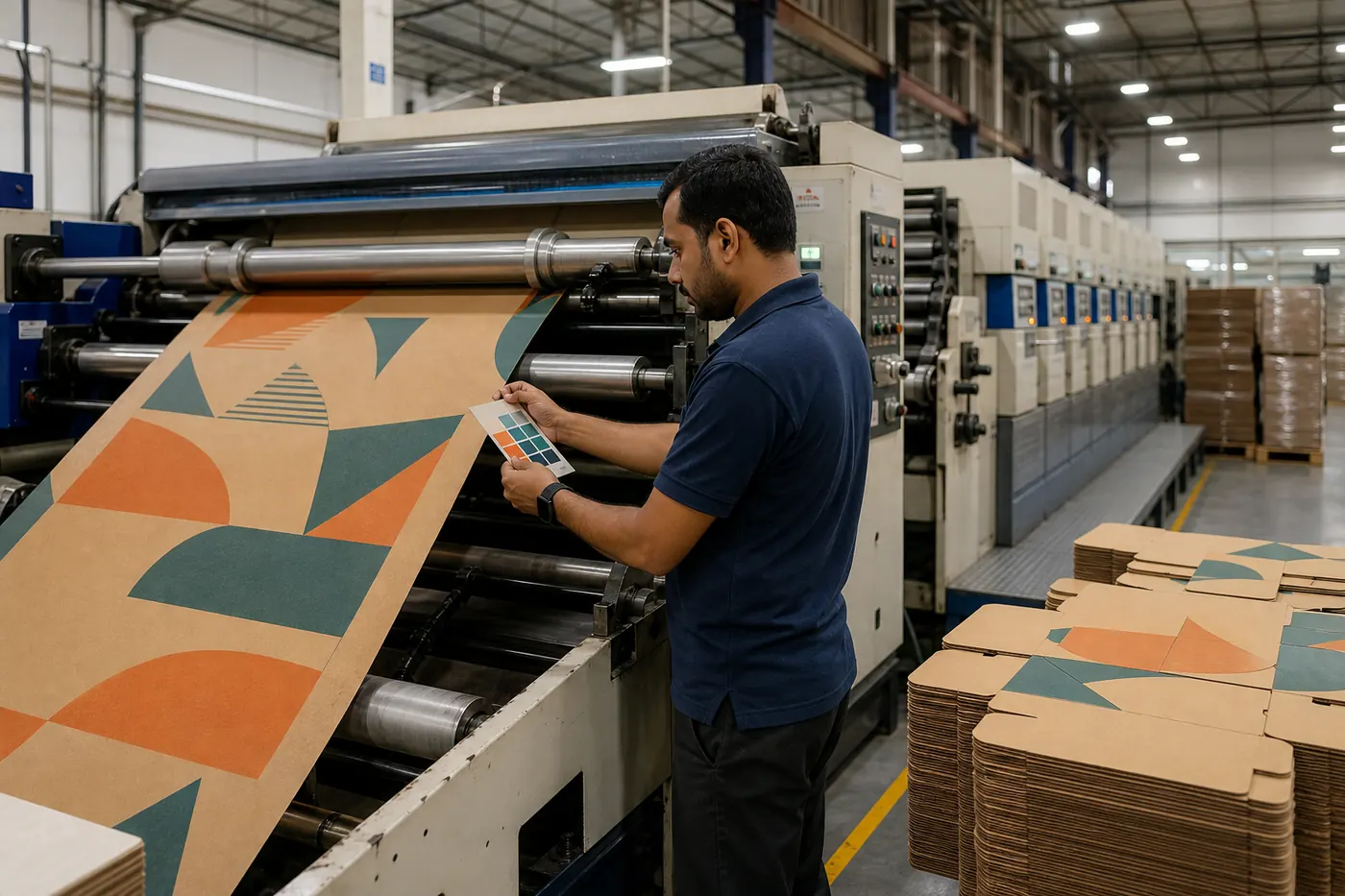
Flexography transfers ink through raised photopolymer plates, generally onto liner or combined board. It is fast and economical at repeat volume, handles broad spot colors and line work well, and can print inline with converting. Modern presses can deliver strong graphics, but corrugated flute profile, liner absorbency, anilox selection, plate mounting and pressure affect dots and registration. Do not evaluate a supplier's flexo capability from a PDF mockup.
Litho-lamination normally prints high-resolution offset graphics on a coated sheet that is then laminated to single-face or corrugated board before die cutting. It supports fine screens, photographic detail and premium retail presentation. More process steps mean more interfaces to control: paper grain, moisture, adhesive, laminate registration, curing, warp, die cutting and crease cracking. A beautiful top sheet cannot compensate for a weak or distorted finished board.
Digital printing eliminates conventional plates and enables short runs, multiple language versions, seasonal graphics and variable content. It can reduce setup waste and accelerate iteration, but the buyer must understand press format, ink system, white-ink capability, color gamut, overprint behavior, coating compatibility and economics at the required quantity. Digital is not automatically cheaper or more sustainable; compare actual waste, substrate, energy, run length and reprint risk.
Buyer comparison of flexographic, litho-laminated and digital corrugated printing.
Swipe →
Data table — swipe horizontally on small screens
| Decision factor | Flexographic | Litho-laminated | Digital |
|---|---|---|---|
| Graphic strength | Spot colors, type, logos, screens | Fine detail and photographic retail graphics | Versioning, short runs and variable graphics |
| Prepress | Plates, separations, trapping | Offset plates and top-sheet workflow | RIP, profiles and digital file control |
| Economic tendency | Improves with repeat volume | Setup justified by premium value/volume | Attractive for pilots and variants |
| Proof priority | Press drawdown/production proof | Contract color proof plus laminated sample | Device/substrate production proof |
| Main production risk | Dot gain, washboarding, registration | Warp, bond and crease cracking | Gamut, consistency and throughput |
Flexographic, litho-laminated and digital routes
How the process choice changes control
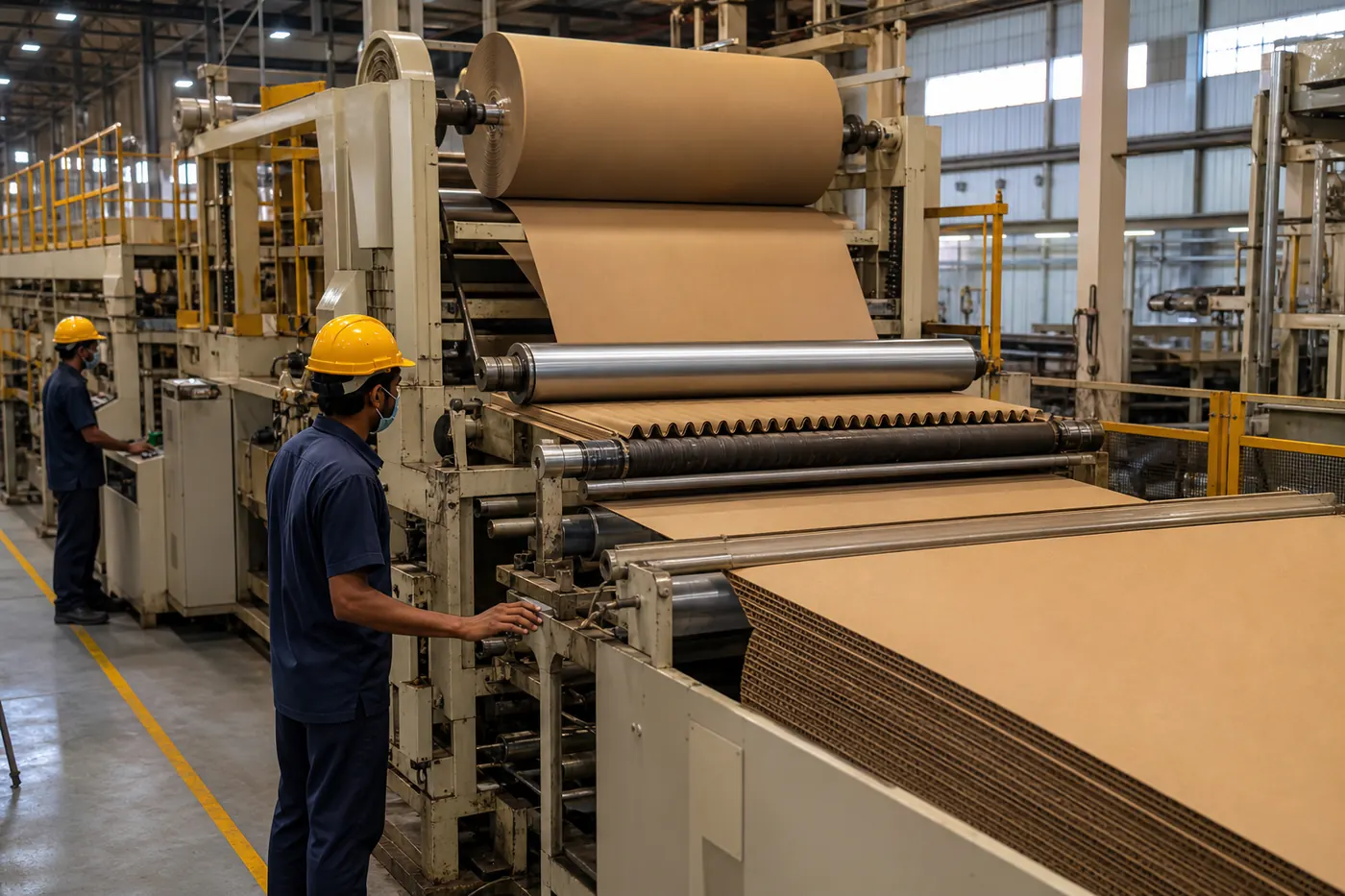
Each route combines prepress, substrate preparation, printing and conversion differently. Buyers should map every operation to the responsible site, machine and approval record, then verify any outsourced plate making, offset printing, lamination, die cutting or coating.
Artwork, Dielines and Version Control
The converter should issue the controlled structural dieline after dimensions and board caliper are agreed. Artwork built on an unapproved generic template can shift panels, barcodes or legal copy when engineering adjusts scores. Use a layered vector file, linked or embedded high-resolution images, outlined or supplied fonts, defined spot colors, bleed and safe zones. Mark varnish, white ink, glue, cuts, creases, perforations and non-print areas on separate named layers.
Assign one artwork owner and one approval register. The file name should include SKU, language, revision and date. The printer's preflight should flag missing fonts, low-resolution images, overprint settings, thin reverses, trapping, unsupported transparency, small text and barcode magnification. The importer owns final legal text and product claims; printer approval confirms manufacturability, not legal accuracy.
Proofs, Color Standards and Inks
Use proof stages for different questions. A PDF proof checks content and position but not physical color. A calibrated contract proof predicts separations within an agreed workflow but does not show flute effects.
An ink drawdown on the specified liner reveals substrate interaction. A wet or machine proof on production-equivalent board provides the strongest evidence but may require setup cost and scheduling. A white sample validates structure without claiming print approval.
Specify color by a physical standard and measurement conditions where critical. Pantone references are useful starting points, but coated-book color cannot be assumed on brown kraft liner. Agree whether acceptance is visual under a named light source, instrumental using a stated color-difference method and tolerance, or both. Retain signed master samples and control fading, contamination and replacement.
Water-based inks are common in corrugated flexo, while offset, UV and digital ink systems vary. Require the supplier to identify the actual ink and coating system, safety-data documentation where applicable, drying or curing controls, rub resistance and substrate compatibility. Marketing language such as “eco ink” is not an acceptance criterion; every environmental or recyclability claim needs defined scope and evidence for the destination.
Retail-Ready, Private-Label and Carton Design
Design retail-ready packaging backward from the shelf and forward from distribution. Confirm case count, shelf width, facing count, opening direction, maximum replenishment steps, consumer access, edge appearance and disposal communication. Then test whether perforations survive transport but open cleanly in store. Private-label teams should lock brand hierarchy, claim substantiation, importer identity, country-of-origin wording for the packed product, recycling marks and language requirements before print.
Carton optimization is not simply reducing board. Right-sizing can lower material and cube, but insufficient clearance may slow packing or transfer product loads directly to panels. Excessive void raises dimensional freight and product movement. Prototype with production product, inserts and tape; run a packing-line trial; condition samples if humidity matters; then perform distribution testing appropriate to the route.
Export Process
Export Tip
Begin with a complete RFQ: destination, annual demand, order quantity, SKU mix, internal dimensions, style, board performance, print process, colors, coverage, coating, artwork status, testing, retail pack, pallet policy, Incoterm and delivery window. Evaluate manufacturers in India against the required press and converting route, not a generic factory profile.
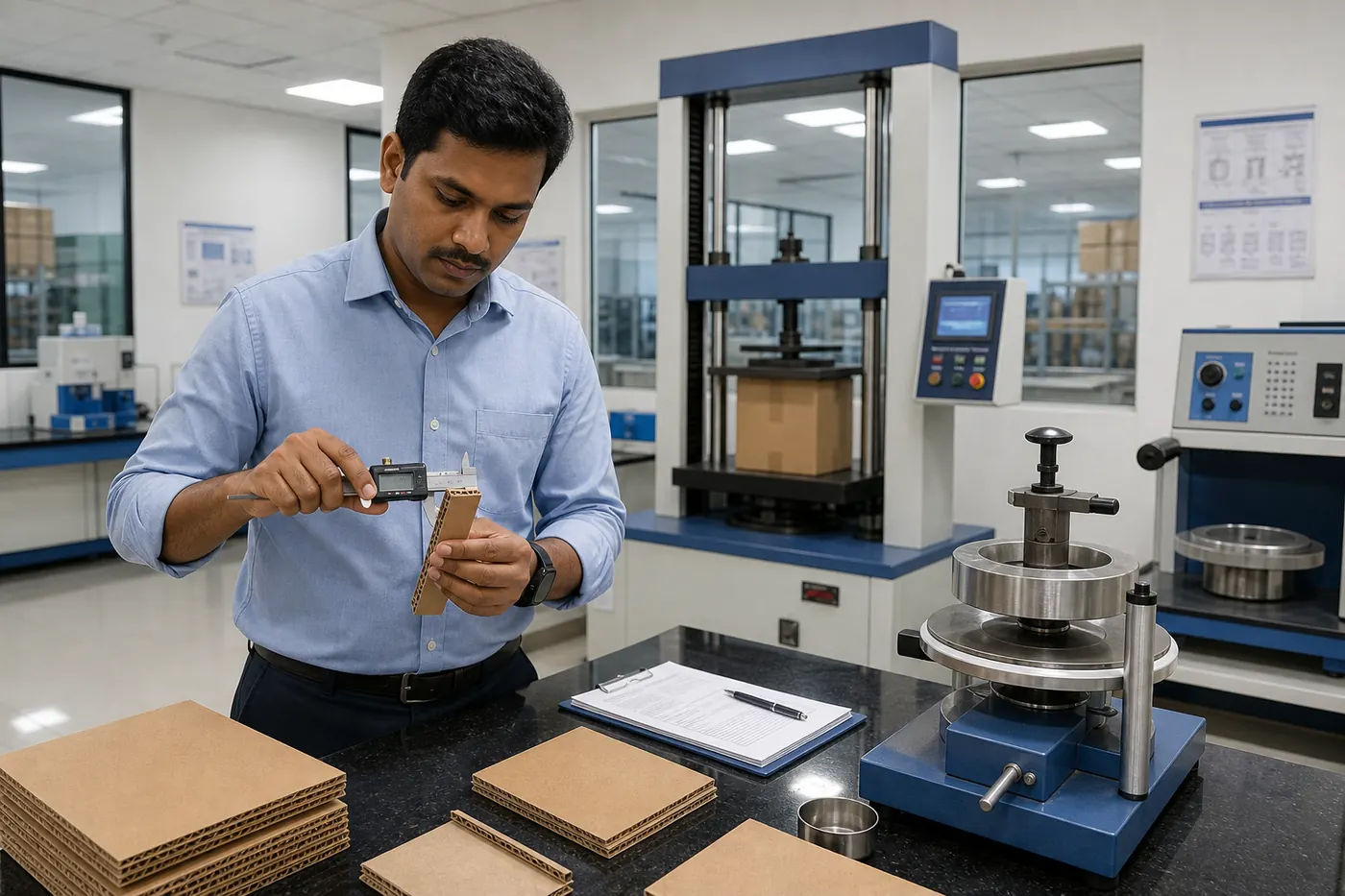
After technical clarification, obtain structural samples, print proofs and a production-equivalent preproduction sample. Freeze a bill of materials and quality plan. During production, verify incoming paper, corrugator records, print registration and color, die-cut dimensions, glue joint, warp and bundle count. Final inspection should sample finished packs against agreed AQL or another written plan, reconcile labels and versions, and document loading.
Approval gates and evidence required from normalized RFQ through shipment release.
Swipe →
Data table — swipe horizontally on small screens
| Gate | Evidence | Buyer decision |
|---|---|---|
| RFQ normalization | One controlled specification and quote matrix | Comparable suppliers and scope |
| Structure approval | White sample and product pack trial | Dimensions, assembly and protection |
| Print approval | Signed proof, drawdown and color standard | Content, color and finish |
| Preproduction | Production-equivalent golden sample | Authorize bulk run |
| Final release | Inspection, tests, pack list and loading record | Ship, rework or hold |
Export Statistics
Key Statistics
WITS/UN Comtrade's 2023 India reporter table records US$57.641 million and 37.486 million kg under HS 481910. India-reported exports to the United States were US$10.873 million and 5.240 million kg; UAE US$6.881 million and 5.231 million kg; United Kingdom US$3.092 million and 1.604 million kg; Netherlands US$2.616 million and 1.130 million kg; and Nepal US$2.443 million and 1.040 million kg. Values were reported in thousands of U.S. dollars and converted here to millions.
Dividing value by kilograms produces a customs-value-per-kilogram indicator, not a quote. The mix includes plain and printed boxes, different board grades, assembled or flat formats, specialized packs and related cases. Freight valuation conventions and reporting also differ. Use the data to identify established lanes and scale, then validate a specific SKU with supplier quotations.
India's leading reported HS 481910 export destinations in 2023.
Swipe →
Data table — swipe horizontally on small screens
| India destination, 2023 | Export value US$ million | Quantity million kg | Commercial reading |
|---|---|---|---|
| United States | 10.873 | 5.240 | Largest listed destination; demanding landed-cost test |
| United Arab Emirates | 6.881 | 5.231 | Regional proximity and re-export channels |
| United Kingdom | 3.092 | 1.604 | Retail/private-label compliance opportunity |
| Netherlands | 2.616 | 1.130 | EU distribution gateway; EU rules apply |
| Nepal | 2.443 | 1.040 | Near-market logistics advantage |
Import Statistics
Key Statistics
TrendEconomy's 2023 compilation reported over US$9.18 billion of HS 481910 imports among 141 countries: Netherlands US$838 million, Mexico US$775 million, United States US$686 million, Germany US$638 million and France US$583 million. The totals reflect gross trade and may include re-exports. Germany and France are within the EU customs area, while Netherlands volumes can reflect distribution activity. Do not add country and regional aggregates without checking overlap.
High import value does not guarantee India is competitive. Corrugated boxes have a high cube-to-value ratio, and Mexico's trade is heavily shaped by its North American manufacturing network. Screen bilateral flows, route cost, buyer concentration and print complexity. The dedicated corrugated box import markets analysis should be used before assigning sales resources.
Country-wise Opportunities
Market Snapshot
Country selection should combine verified trade demand with route economics and a product-level compliance review. The opportunities below are commercial hypotheses, not forecasts.
Country screening hypotheses for custom-printed corrugated-box programs.
Swipe →
Data table — swipe horizontally on small screens
| Market | Potential fit | Buyer control |
|---|---|---|
| United States | Premium private label, displays, boxes accompanying Indian goods | State packaging rules, retailer manuals and substantiated claims |
| UAE and Gulf | Luxury retail, electronics and regional distribution | Arabic copy, destination rules, heat and humidity |
| United Kingdom | Retail-ready and e-commerce programs | UK packaging EPR, claims, importer and recycling communication |
| European Union/Netherlands | Premium graphics and distribution programs | PPWR transition, EPR, REACH and claim review |
| Nepal and nearby markets | General commercial packaging and short routes | Local duties, tax, road handling and moisture |
| Australia | Niche private label and consolidated supply | Packaging claims, biosecurity for wood pallets and route economics |
Pricing Analysis
Buyer Tip
Printed carton price is driven by paper weight and yield, corrugation, print setup and coverage, plates or prepress, inks, lamination, die, conversion speed, coating, spoilage, bundle packing, testing and order allocation. Request separate one-time tooling and recurring unit cost. The companion wholesale pricing guide explains normalization and landed cost.
For a hypothetical quotation scenario only, assume a 400 × 300 × 250 mm internal-dimension RSC, single-wall kraft board, one- or two-color flexo print, glued joint, 5,000 identical pieces and flat bundles: US$0.35–$1.20 per box EXW India can be used solely as an invented sensitivity range. A different hypothetical 300 × 220 × 120 mm litho-laminated retail box at 5,000 pieces might be tested at US$0.90–$3.50 EXW, and a 300 × 200 × 100 mm digitally printed mailer at 500 pieces at US$1.20–$5.00 EXW. These are not observed prices, offers or market averages. Board construction and performance, print coverage, coatings and finish remain to be specified; tooling, proofs, tests, tax, pallets, inland transport, export charges and international freight are excluded. Obtain a dated, dimension- and specification-specific supplier quotation.
Quote layers that must be normalized before comparing printed-box prices.
Swipe →
Data table — swipe horizontally on small screens
| Quote layer | Must be stated | Frequent omission |
|---|---|---|
| Board | Composition/performance, dimensions and allowed variation | Supplier substitutes lighter board |
| Process, colors, coverage, coating and color control | Setup or wash charges | |
| Tooling | Plate, die, ownership, storage and remake terms | Tooling buried in unit price |
| Packing | Bundle count, strapping, pallet and moisture protection | Export pack differs from sample |
| Delivery | Incoterms 2020, named place and validity | FOB/local charges treated inconsistently |
MOQ Analysis
Buyer Tip
There is no universal Indian MOQ. Economical minimums arise from paper procurement, corrugator width and changeover, ink and plate setup, die making, lamination runs, SKU count and packing. For an invented RFQ sensitivity scenario—not a market fact—a buyer could ask one supplier to price 500, 1,000 and 2,000 pieces of one digital SKU; 2,000 and 5,000 of one simple flexo SKU; and 3,000 and 10,000 of one litho-laminated SKU. These figures are not expected minimums. Only a dated supplier quotation for the stated dimensions, board, print, tooling, pack and delivery terms establishes MOQ and price.
For a hypothetical schedule scenario, an RFQ could test 3–7 working days for structural engineering, 3–10 for artwork/prepress, 5–15 for tooling and proofing, and 15–35 for production after approval, excluding inspection and shipping. These invented allowances are not a typical or promised lead time. Paper availability, custom liner, press queue, laboratory tests and buyer approval delays can extend them. The selected supplier's dated critical path and purchase-order cargo-ready commitment control.
Packaging Standards
Export Tip
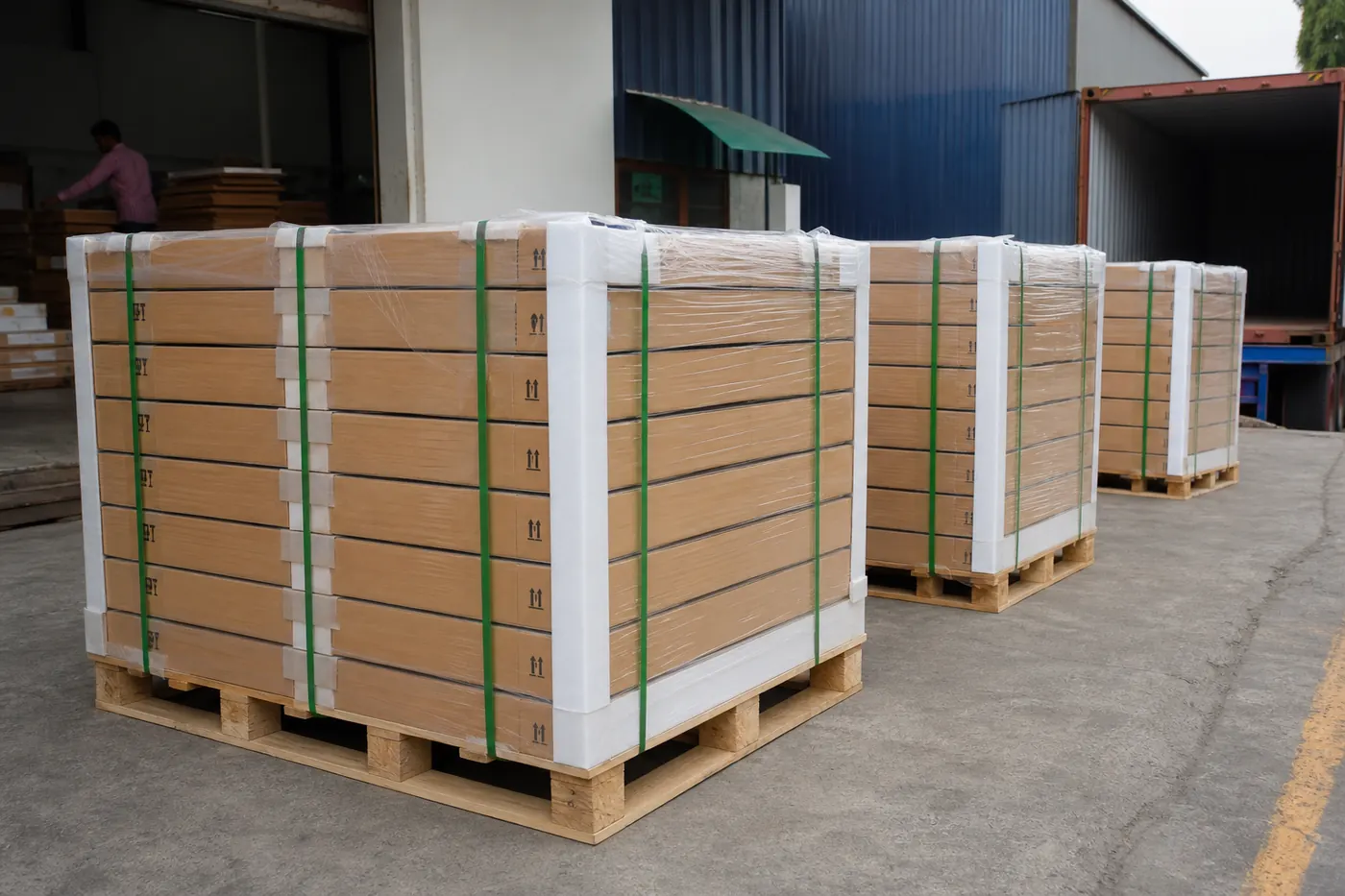
Boxes usually ship knocked down, counted in strapped bundles, master bales or pallet units. Specify bundle quantity, orientation, protective sheets, corner boards, strapping tension, pallet footprint, maximum height, moisture barrier and shipping marks. Excessive strap tension crushes flutes; loose bundles shift. ISPM 15 applies to regulated raw or solid-wood packaging such as many pallets and dunnage; corrugated board and qualifying processed-wood materials are outside its scope. Confirm destination implementation for any wood packaging actually used.
Container Loading Details
Export Tip
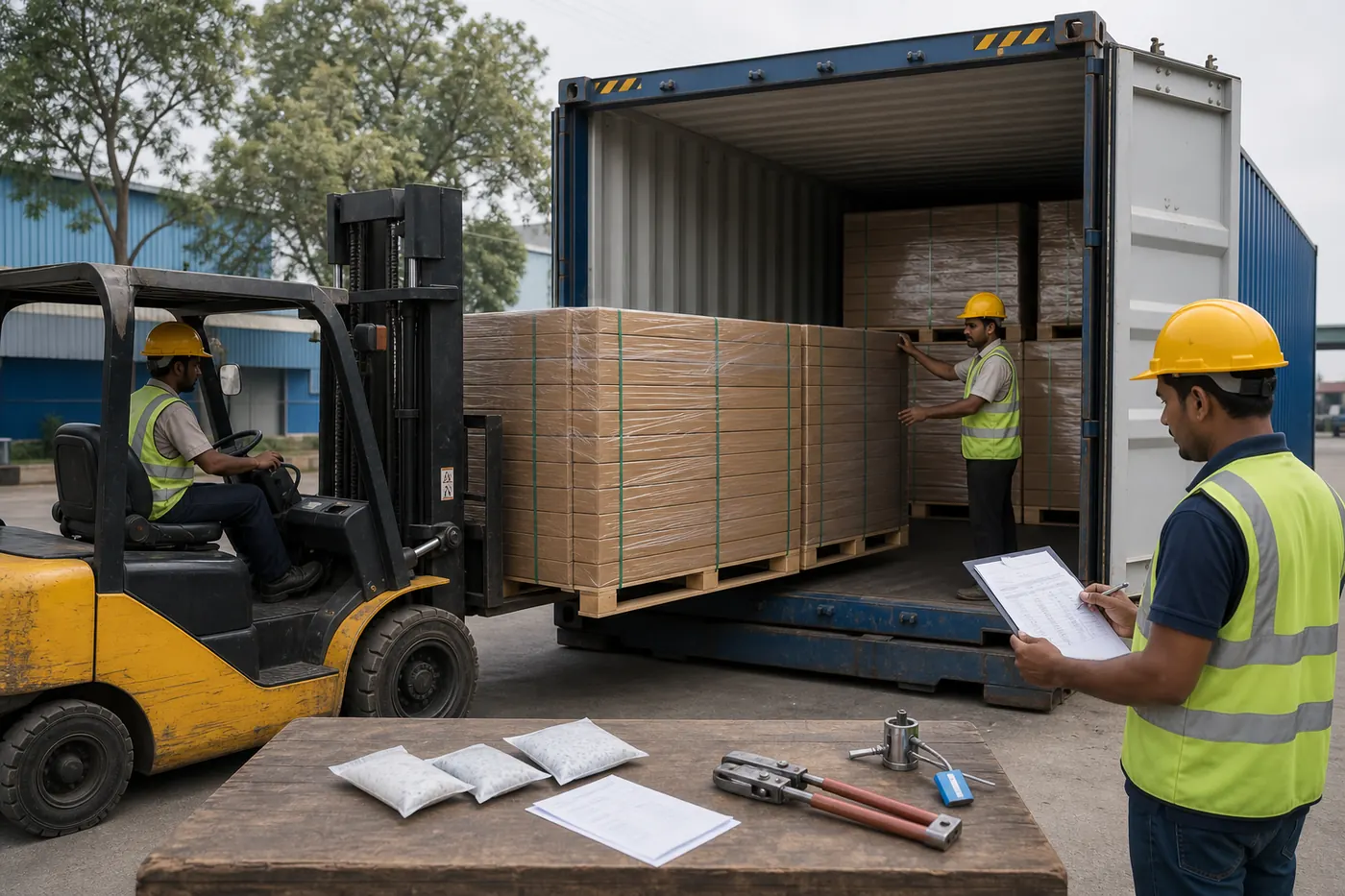
Container count must be calculated from final bundle or pallet dimensions. A hypothetical 0.10 m³ bundle and a 28 m³ planning allowance produce 280 bundles before stowage constraints; this is arithmetic, not a typical loading claim. Confirm container internal dimensions, payload, door opening, pallet pattern and usable cube with the carrier. The container loading and shipping guide covers moisture, floor loading, FCL and LCL.
Illustrative container-planning inputs that require production measurements.
Swipe →
Data table — swipe horizontally on small screens
| Planning input | Illustrative value | Required production evidence |
|---|---|---|
| Bundle cube | 0.10 m³ | Measured finished bundle |
| Planning allowance | 28 m³ | Assigned container and stow plan |
| Arithmetic output | 280 bundles | Final tally after constraints |
| Boxes per bundle | Buyer-defined | Approved packing specification |
Shipping Methods
Export Tip
Ocean freight suits replenishment when volume justifies FCL; LCL can expose cartons to extra handling and humidity; air freight is usually reserved for proofs or urgent, high-value shortages. Use Incoterms® 2020 with a named place. EXW leaves origin handling with the buyer; FOB transfers according to the rule at the named Indian port; CIF includes seller-arranged freight and minimum insurance to destination port but not all destination charges. DDP should be offered only where importer, duty and tax obligations are operationally lawful.
Certifications
Compliance Notes
HS 481910 generally covers cartons, boxes and cases of corrugated paper or paperboard. Non-corrugated folding cartons may fall under 481920; sacks, trays, displays, paperboard articles and packaging imported with goods can require different treatment. National tariff schedules add digits and legal notes. Classification depends on the article as presented, so the importer must obtain broker advice before contracting or declaring.
Duty depends on destination tariff line, origin, preference, valuation and trade measures. Do not promise “zero duty” from a six-digit code. Ask the customs broker for current duty, import VAT/GST, preference evidence and treatment of tooling or assists.
Indian export documents commonly include commercial invoice, packing list, shipping bill and bill of lading/air waybill. Origin, inspection, fumigation or other evidence may be required for the transaction. See the export documentation guide.
FEFCO is a structural code system and source of technical methods, not a product certification. FSC or PEFC claims require valid chain-of-custody scope and transaction evidence; an FSC logo cannot be copied merely because paper is described as certified. FSC Mix can include FSC-certified, recycled and controlled material and is not a claim of 100% certified fibre; FSC Recycled paper may include pre-consumer as well as post-consumer reclaimed fibre. ISO 9001 is voluntary certification of a management system for the stated entity, site and scope—not product certification. BRCGS Packaging Materials Issue 7 audits commenced on 28 April 2025; it is voluntary site/process certification and not food-contact approval.
There is no universal “food-grade corrugated box” certificate. For EU food contact, Regulation (EC) No 1935/2004 and GMP Regulation (EC) No 2023/2006 require an intended-use assessment, while paper, board and printing inks are not fully harmonized at EU level. U.S. FDA compliance depends on the components and conditions of use; avoid “FDA-approved box.” RoHS generally regulates electrical and electronic equipment, not packaging as such. REACH can apply conditionally to packaging as an article and to its inks, adhesives or coatings. Regulation (EU) 2025/40, the PPWR, entered into force on 11 February 2025 and generally applies from 12 August 2026, with provision-specific dates. Review quality standards and certifications before approving claims.
Buyer Requirements
Buyer Requirements
The buyer requirement package should identify the packed product's dimensions and weight, packing orientation, stacking, handling, humidity exposure, shelf or delivery use, box dimensions and style, board target, print faces, color standards, finish, opening features, annual demand, SKU split, destination and required delivery. The importer must approve legal copy, claims, barcode data and destination obligations.
Buyer approvals required for structure, graphics, performance and export logistics.
Swipe →
Data table — swipe horizontally on small screens
| Buyer control | Approval evidence |
|---|---|
| Structure | Drawing, white sample and packed-product trial |
| Artwork | Revision-controlled copy and signed PDF |
| Color/print | Physical standard and production proof |
| Performance | Methods, limits and lot-linked reports |
| Logistics | Approved bundle, pallet and loading plan |
Challenges & Solutions
Frequent custom-print execution failures and preventive controls.
Swipe →
Data table — swipe horizontally on small screens
| Challenge | Root cause | Control |
|---|---|---|
| Color differs from proof | Wrong proof type, liner variation, press conditions | Drawdown plus production-equivalent signed standard |
| Artwork shifted | Dieline changed after design | Converter-issued revision-controlled dieline |
| Warped litho-lam box | Moisture, grain, adhesive or curing imbalance | Conditioned sample, process records and flatness limit |
| Barcode fails | Scaling, contrast, distortion or coating | Grade verification on finished production pack |
| MOQ surprise | Per-SKU setup economics omitted | Total and per-version minimums in RFQ |
| Damage in transit | Weak bundle/pallet or container moisture | Approved export pack and loading/moisture plan |
Common Buyer Mistakes
Common Mistakes Box
- Designing on a generic dieline before board and structure are approved.
- Calling a screen image a color proof.
- Comparing flexo, litho-lam and digital quotes without equal print coverage and setup.
- Approving graphics but never packing and drop-testing the actual product.
- Using sustainability or recyclability claims without scoped evidence.
- Ignoring SKU-level MOQ when one order has many languages or designs.
- Allowing production at an undisclosed printer or laminator.
- Calculating a container from flat sheet area instead of packed bundle dimensions.
- Treating CIF as a fully landed destination price.
- Releasing shipment without version, barcode and bundle-count reconciliation.
Expert Insights from Saurabh Mittal
Expert Insight Box
For an international buyer, the Indian sourcing partner's value is not simply finding a press. It is coordinating designers, structural engineers, paper procurement, print production, conversion, testing and logistics while preserving one approved specification. Learn how Altus supports international buyers or submit a brief through contact Altus Exports.
Sourcing Checklist
Checklist
- Define packed load, internal dimensions, style, flute and board performance.
- Select print route by graphics, versions, run length and delivered cost.
- Use the converter-issued dieline and one artwork revision register.
- Approve structure, content, color and production sample separately.
- State total and per-SKU MOQ, tooling, lead time and quote validity.
- Verify the actual corrugator, printer, laminator and converter.
- Contract print, board, conversion, barcode and packing acceptance.
- Measure final bundles and approve container loading.
- Confirm HS classification, duty and destination rules with advisers.
- Contact Altus Exports for a controlled supplier RFQ.
Buyer Checklist
Checklist
- [ ] Dieline revision matches purchase order
- [ ] Mandatory copy and barcodes approved
- [ ] Physical color reference retained
- [ ] Production-equivalent sample signed
- [ ] Tests and defect limits contracted
- [ ] Tool ownership and MOQ recorded
- [ ] Bundle cube measured
- [ ] Receiving inspection window defined
Exporter Checklist
Checklist
- [ ] Indian registrations and IEC current
- [ ] Production and subcontract sites disclosed
- [ ] Paper, ink, plate and die revisions controlled
- [ ] Golden sample available to production and QC
- [ ] Version counts reconcile with packing list
- [ ] Shipping bill and invoice classification reviewed
- [ ] Container condition, tally and seal recorded
- [ ] Shipment evidence archived
Compliance Checklist
Checklist
Compliance Notes
- [ ] HS 481910 and national tariff line confirmed
- [ ] Duty, value, origin and preference checked
- [ ] Artwork legal copy approved by importer
- [ ] Environmental and fiber claims substantiated
- [ ] Destination EPR and marking duties mapped
- [ ] Certification logo authorization verified
- [ ] ISPM 15 checked for solid-wood packaging
- [ ] Records support traceability and recall
Future Market Trends
Key Statistics
Commercial teams are testing shorter graphic runs, more localized versions, right-sized structures, connected artwork approval and transaction-level fiber traceability. Digital printing may expand where versioning and speed offset unit cost, while improved flexo continues to serve repeat programs. These are procurement directions to validate against a buyer's own SKU economics, not forecasts.
Regulatory focus on packaging waste and environmental claims will make design evidence more important. Buyers should monitor destination EPR schemes, the EU Packaging and Packaging Waste Regulation transition and claim guidance, then preserve material, print and chain-of-custody records with each revision.
Explore the Complete Corrugated Box Buyer Series
- How to import corrugated boxes from India
- How to evaluate corrugated box manufacturers in India
- Corrugated box types and specifications
- Corrugated box import markets
- Custom-printed corrugated boxes from India
- Corrugated box wholesale pricing in India
- Corrugated box quality standards and certifications
- Sustainable corrugated packaging from India
- Corrugated box export documentation
- Corrugated box container loading and shipping
FAQs
The answers below summarize commercial planning points. Final specifications, prices, duties and compliance must be confirmed for the actual order and destination.
Conclusion
Custom-printed corrugated packaging succeeds when structure and graphics are engineered together. Select the print process by run length, design, substrate and channel; use a controlled dieline; distinguish content, contract-color and production proofs; define ink and claim requirements; and inspect against a signed production-equivalent standard.
Send Altus Exports your destination, box dimensions, packed-product weight, style, board target, artwork, print coverage, annual volume, SKU split, compliance needs and delivery window. We can normalize the requirement, identify an appropriate Indian production route, coordinate samples and proofs, and build an export-ready commercial plan. Request a custom corrugated box sourcing proposal.
References
- WITS/UN Comtrade — India HS 481910 exports by destination, 2023
- TrendEconomy — HS 481910 world imports and exports, 2023
- World Customs Organization — Harmonized System resources
- ICC — Incoterms rules
- FAO/IPPC — ISPM 15
- FSC — Chain of custody certification
- PEFC — Chain of custody
- BRCGS — Packaging Materials Issue 7 launch and audit transition
- EUR-Lex — Regulation (EU) 2025/40 on packaging and packaging waste
- European Commission — food-contact materials legislation
- ECHA — requirements for substances in articles
Sources accessed July 17, 2026. Customs figures are gross trade under HS 481910 and not market-size forecasts or supplier prices. Price, MOQ, lead-time and loading ranges in this guide are explicitly hypothetical quotation scenarios.