
How to Import Corrugated Boxes from India: Complete 2026 Buyer Guide
By Saurabh Mittal, Founder, Altus Exports
A practical international buyer guide to specifying, sourcing, approving, shipping, and receiving corrugated boxes from India.

To import corrugated boxes from India successfully, an international buyer must control more than dimensions and a price per piece. Paper grades, flute profile, board construction, strength targets, converting tolerances, print, joint method, moisture, bundle configuration, container utilization, destination rules, and the buyer's filling line all affect whether a carton performs. The correct sequence is specification, supplier qualification, production-equivalent sampling, normalized commercial comparison, compliance approval, bulk inspection, document reconciliation, and controlled loading.
Introduction
India has a real export base, but corrugated packaging is usually bulky relative to its value. WITS, using UN Comtrade data, reports that India exported US$55.790 million and 38.399 million kg under HS 481910 in calendar 2024. That figure covers cartons, boxes, and cases of corrugated paper or paperboard; it does not isolate every box style, prove an individual manufacturer's capability, or make international freight economical for every order.
This pillar guide explains the end-to-end buying decision. Altus Exports can act as an Indian merchant exporter, global sourcing partner, and export consulting expert, coordinating qualified production, samples, inspections, commercial documents, and shipment handoffs. Altus does not need to own a converting plant to add value; the role is to preserve one approved requirement across the selected manufacturing and export route.
Executive Summary
Summary Box
Corrugated cartons are engineered shipping systems, not generic brown boxes. Begin with the packed product, distribution hazards, destination, line speed, stacking period, pallet or floor-loading plan, graphics, and disposal requirements. Translate those conditions into a drawing and measurable board, strength, print, workmanship, packing, and inspection criteria. Only then request comparable quotations.
India can be attractive for custom dimensions, export cartons, printed retail shippers, heavy-duty cases, inserts, and coordinated product-plus-packaging programs. It is less attractive when freight on empty erected boxes overwhelms product value. Flat-packed regular slotted cartons, nested die-cuts, consolidated cargo, and sourcing close to the product-filling location can improve economics. Buyers should model landed cost per usable box, not merely EXW or FOB price.
Market Size & Industry Overview
Key Statistics
India's packaging supply base serves domestic manufacturing, agriculture, food, pharmaceuticals, consumer goods, e-commerce, engineering, and export industries. This broad local demand supports paper mills, corrugators, printers, die cutters, testing laboratories, and logistics providers. Capability is uneven, however. A plant that makes simple local transport cartons may not control high-graphics flexographic registration, heavy-duty multiwall board, food-contact declarations, moisture resistance, or retailer-specific testing.
Geography matters because corrugated board is sensitive to freight and humidity. Gujarat and Maharashtra offer large industrial ecosystems and access to western ports; Tamil Nadu and other southern clusters can suit Chennai-area production and exports; northern and eastern clusters serve their regional industries and land-border trade. These are screening observations, not endorsements. Select the actual site based on equipment, paper access, capacity, process control, distance to the filling point, and export route.
Global trade is substantial but often regional. WITS lists China, the United States, Germany, the European Union aggregate, and Poland among leading 2024 exporter reporters for HS 481910. The same data show strong importing activity in the Netherlands, Mexico, the United States, France, Canada, Germany, and the United Kingdom. Cross-border flows can include packaging moving with industrial supply chains; gross trade does not equal end-user consumption.
Product Categories / Variants
Summary Box
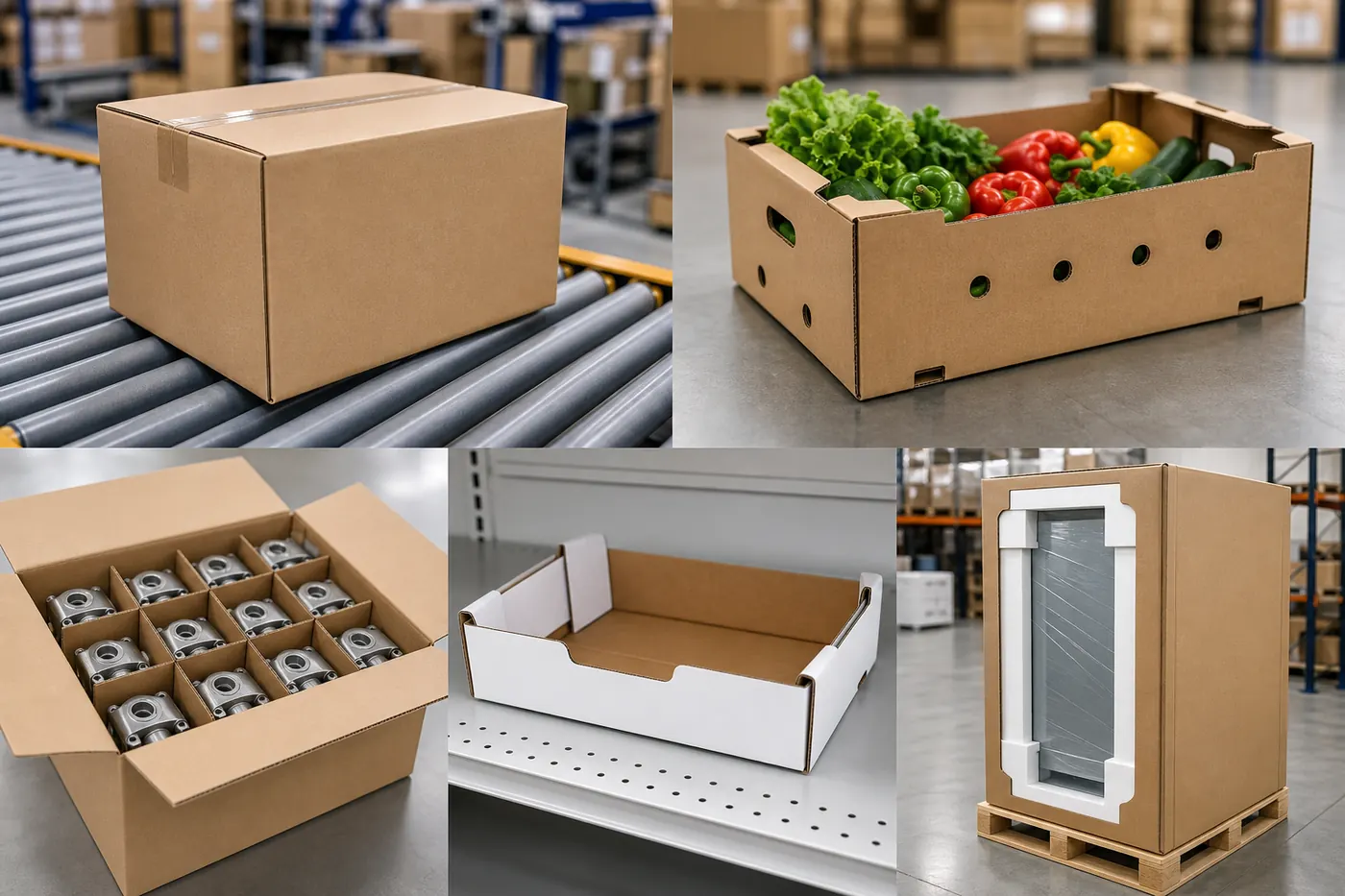
A corrugated sheet combines linerboards with a fluted medium. Single-face material has one liner and one medium; single-wall board usually has two liners around one flute; double-wall combines three liners and two fluted media; triple-wall adds another flute and liner for demanding applications. Flute labels such as A, B, C, E, and F suggest profile ranges, but actual caliper and take-up factor vary by plant and machine. Contract measured properties rather than relying on a letter alone.
Regular slotted containers are common because they convert and ship efficiently. Full-overlap cartons improve top and bottom coverage. Die-cut mailers, trays, telescopic cases, five-panel folders, produce boxes, partitions, pads, and retail-ready formats solve different packing and display problems. Use the corrugated box types and specifications guide to choose the style before asking for a manufacturer.
Paper furnish may include virgin kraft liner, recycled test liner, semi-chemical or recycled medium, coated white-top liner, and combinations. Recycled content does not independently predict performance, and a high nominal GSM does not guarantee compression strength. Moisture, fiber quality, bonding, flute formation, score quality, machine direction, and dimensions all matter. If a recycled, recyclable, FSC, PEFC, compostable, or food-safe claim will appear in marketing, define it precisely and obtain applicable evidence.
Core fields for a corrugated-box purchase specification
Swipe →
Data table — swipe horizontally on small screens
| Buying field | What to specify | Why it matters |
|---|---|---|
| Internal dimensions | Length × width × depth and measurement convention | Fit, void, closure, and line compatibility |
| Board construction | Liners, media, flute combination, nominal caliper | Protection and converting behavior |
| Strength | ECT, burst, compression, puncture, or buyer protocol | Stacking and distribution performance |
| Method, colors, coverage, artwork, registration, color tolerance | Brand and barcode acceptance | |
| Joint/closure | Glue, tape, stitch, overlap, score and slot details | Case integrity and packing speed |
| Packing | Flat bundles, count, strap, wrap, pallet, labels | Handling, moisture protection, and freight |
Manufacturing Overview
Export Tip
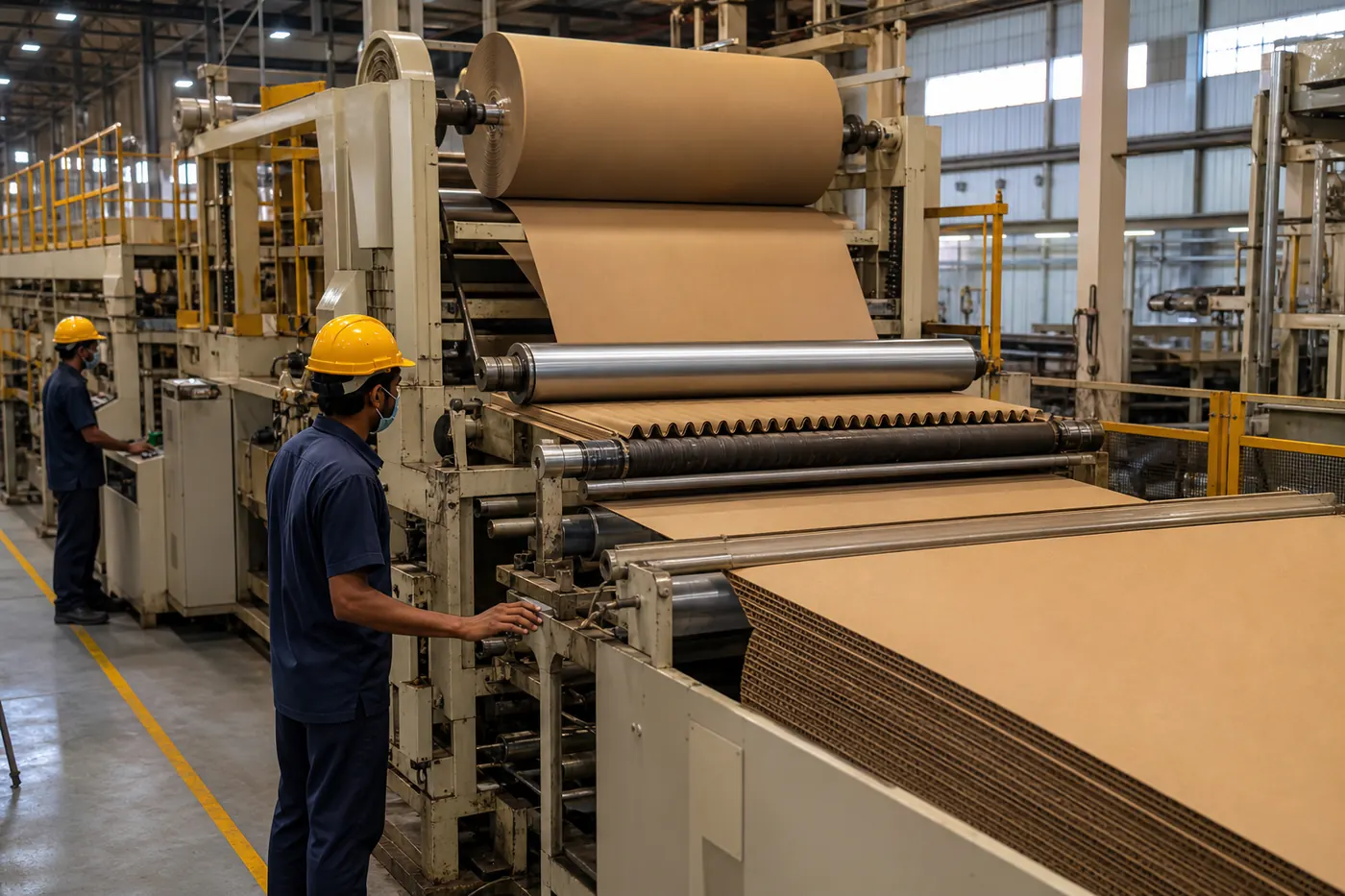
Corrugated-box manufacturing begins with conditioned liner and medium paper. A corrugator heats and forms the medium into flutes, applies starch adhesive, bonds liners, and slits and scores the continuous board. Converting equipment then prints, slots, die cuts, folds, glues, or stitches the blank. Finished boxes are counted, compressed only within approved limits, bundled, labeled, and staged in a dry area.
Process capability depends on paper storage, corrugator controls, flute formation, adhesive preparation, warp management, print registration, die maintenance, score geometry, joint formation, and inspection discipline. Buyers should map each operation to the actual site. Outsourced corrugation, lithographic printing, lamination, coating, die cutting, or testing is not automatically unacceptable, but it must be declared and controlled.
Create the production specification
Start with the product and route. Record packed weight, center of gravity, dimensions, fragility, abrasion sensitivity, temperature and humidity exposure, stacking pattern, stack height, warehouse duration, pallet overhang limit, transport modes, manual handling, and opening experience. A box engineered only around empty internal dimensions may fail once high humidity, vibration, dynamic loads, and long storage reduce compression performance.
Control drawings and performance methods
The drawing should identify internal or external dimensions, score-to-score geometry, panel order, manufacturer's joint, flaps, slots, hand holes, perforations, print-free areas, glue locations, and tolerances. Choose ECT, burst, box compression, Cobb, moisture, puncture, bond, drop, vibration, or climatic methods according to actual risk. State the method version, conditioning, sample count, acceptance threshold, and responsibility.
Control artwork and conversion
Artwork needs controlled version numbers and a locked dieline. Specify print method, color references, coverage, registration, trapping, varnish or coating, and permitted variation. Barcodes need symbology, size, quiet zones, contrast, orientation, verification grade, and application point. First-off production approval should check scores, slots, glue, stitch, folding, squareness, print, and packed-product fit.
HS Classification, Duties, and Compliance
Compliance Notes
HS 4819.10 generally covers cartons, boxes, and cases of corrugated paper or paperboard at the international six-digit level. Related paper packaging can fall elsewhere within heading 4819: non-corrugated folding cartons are generally associated with 4819.20, sacks and bags with 4819.30 or 4819.40 depending on construction, other packing containers with 4819.50, and certain office-type articles with 4819.60. Inserts, printed promotional items, composite packs, molded pulp, and goods imported with their contents can require additional analysis.
India and destination countries extend the HS code with national tariff digits. A familiar Indian HSN suffix must not be copied into a foreign entry without review. The importer of record should give the final product drawing, materials, intended use, and import presentation to a licensed customs broker. Confirm the current duty rate, trade remedies, taxes, preference rules, valuation basis, and origin documentation before accepting a landed-cost estimate.
Corrugated boxes may be subject to product-specific and destination-specific rules. Food, pharmaceutical, cosmetic, dangerous-goods, children's-product, and electronics packaging can trigger buyer protocols or legal requirements beyond general packaging law. Printing inks, adhesives, coatings, heavy metals, mineral oils, and intentionally added substances may need declarations or testing.
EU Regulation 2025/40 on packaging and packaging waste (PPWR) entered into force on 11 February 2025 and generally applies from 12 August 2026, with individual obligations taking effect on different dates. Buyers should map the provisions applicable on the placement-on-market date, plus national EPR rules. U.S. requirements can include state toxics-in-packaging and EPR rules in addition to federal customs and sector requirements.
As checked on 17 July 2026, the ordinary U.S. general/MFN rate for HTSUS 4819.10.00 is Free, but qualifying entries are temporarily subject to the additional 10% Section 122 surcharge under HTSUS chapter 99 from 24 February 2026 through 12:01 a.m. EDT on 24 July 2026 unless excluded; the broker must check the entry date and current chapter 99 treatment. The published base tariff is generally Free for EU CN 48191000, UK 4819100000, Canada 4819.10.00, and Australia 4819.10.00, while VAT/GST and other charges remain separate. These are dated schedule observations, not rulings.
Export Process
Export Tip
1. Define the sourcing brief
Issue one controlled request for quotation containing drawings, packed-product facts, forecast, order quantity by SKU, destination, Incoterm, testing, certifications, print files, pack-out, pallet restrictions, ship window, and quote validity. Separate mandatory requirements from negotiable targets. This prevents suppliers from solving different versions of the problem.
2. Qualify the production route
Verify the legal exporter and actual converting site. Review corrugator width and flute capability, printing and die-cutting equipment, stitching or gluing, paper storage, laboratory controls, traceability, maintenance, subcontracting, current capacity, and export experience. The companion guide explains how to evaluate corrugated box manufacturers in India.
3. Develop and approve samples
Use stages appropriate to risk: structural prototype, blank production sample, color drawdown or print proof, printed preproduction sample, packed-product trial, transit simulation, and sealed golden sample. Record deviations and approvals in writing. A plotter-cut prototype may verify fit but not corrugator bonding, print, scores, or production die behavior.
4. Contract production and quality controls
The purchase order should reference drawing and artwork revisions, approved materials, test methods, tolerances, inspection plan, packaging, ship window, Incoterms® 2020 rule, named place, payment milestones, change control, and remedies. Schedule incoming-paper checks, first-off approval, inline checks, final inspection, and loading release.
5. Prepare export documents and dispatch
The exporter typically coordinates commercial invoice, packing list, shipping bill, and bill of lading or air waybill, plus certificate of origin, insurance, inspection certificate, treatment evidence, or declarations when required. Follow the detailed corrugated box export documentation checklist and reconcile descriptions, quantities, weights, marks, HS references, and parties before filing.
Export Statistics
Key Statistics
WITS/UN Comtrade provides a defensible macro view when the year, reporter, flow, partner, nomenclature, units, and category are stated. For 2024, WITS reports China at US$1.553 billion, the United States at US$1.384 billion, Germany at US$1.218 billion, the EU aggregate at US$839.573 million, and Poland at US$657.824 million in gross HS 481910 exports. India reported US$55.790 million and 38.399 million kg.
Do not add the EU aggregate to all EU member reporters to construct a world total. Reporter data can include re-exports, and value conventions differ between exports and imports. Quantity quality can vary. These figures establish active trade, not market size, supplier revenue, margin, capacity, or a price benchmark.
Leading reported HS 481910 exporters in 2024
Swipe →
Data table — swipe horizontally on small screens
| 2024 exporter/reporting area | Reported value | Reported quantity | Interpretation |
|---|---|---|---|
| China | US$1.553 billion | 689.417 million kg | Largest listed exporter by value |
| United States | US$1.384 billion | Quantity not shown in cited WITS summary | Large regional cross-border supply |
| Germany | US$1.218 billion | 807.331 million kg | Major European production and trade |
| EU aggregate | US$839.573 million | 428.025 million kg | Do not add to member states |
| Poland | US$657.824 million | 406.654 million kg | Significant European converting base |
| India | US$55.790 million | 38.399 million kg | Established but smaller global export position |
Import Statistics
Key Statistics
WITS' 2024 importer table lists the Netherlands at US$856.101 million, Mexico at US$788.089 million, the United States at US$747.204 million, the EU aggregate at US$601.675 million, Canada at US$597.954 million, France at US$578.183 million, Germany at US$568.272 million, the United Kingdom at US$331.145 million, and Australia at US$91.782 million for HS 481910. The EU aggregate overlaps member reporters and must never be added to them. Logistics-hub and intra-regional flows mean customs imports are not automatically final consumption.
India's 2024 destination page reports US$11.2871 million to the United States, US$6.8296 million to the UAE, US$3.3456 million to the United Kingdom, US$2.6661 million to Nepal, US$2.2474 million to the Netherlands, and US$1.9146 million to Australia. India's world net weight of 38.399 million kg is identified by WITS as estimated; neither values nor weight reveal box count, style, buyer, or supplier.
For buyer planning, use trade data to shortlist lanes, then test actual economics. Empty cartons travel poorly over long distances unless customization, performance, consolidation, regional paper economics, or coordinated sourcing offsets freight. A large national import figure does not mean an Indian supplier can compete in every city or channel.
Leading reported HS 481910 importers in 2024
Swipe →
Data table — swipe horizontally on small screens
| 2024 importer/reporting area | Reported value | Reported quantity | Buyer caution |
|---|---|---|---|
| Netherlands | US$856.101 million | 1,012.570 million kg | Hub and re-export effects may be material |
| Mexico | US$788.089 million | 402.923 million kg | Regional supply chains shape flows |
| United States | US$747.204 million | 344.218 million kg | State and buyer packaging rules vary |
| EU aggregate | US$601.675 million | 281.048 million kg | Overlaps with member reporters |
| Canada | US$597.954 million | Quantity not reproduced here | Long-distance economics need lane-specific proof |
| France | US$578.183 million | 349.690 million kg | EU and French obligations both require review |
| Germany | US$568.272 million | Quantity not reproduced here | EU member; do not add EU aggregate |
| United Kingdom | US$331.145 million | Quantity not reproduced here | Separate UK tariff and packaging regime |
| Australia | US$91.782 million | Quantity not reproduced here | Long route; validate cube and local competition |
Country-wise Opportunities
Market Snapshot
Country selection should combine trade evidence with product-channel fit, freight, tariff treatment, regulations, and buyer access. The opportunities below are screening hypotheses, not demand forecasts. Review the dedicated corrugated box import markets analysis before committing inventory or sales resources.
Country screening priorities for Indian corrugated-box sourcing
Swipe →
Data table — swipe horizontally on small screens
| Market | Potential fit for India | Due-diligence priority |
|---|---|---|
| United States | Custom printed shippers, specialty formats, coordinated product packaging | Broker classification, state packaging/EPR rules, retailer protocols, dimensional freight |
| UAE and Gulf | Retail, food, industrial, and re-export packaging with shorter lanes | Food-contact scope, Arabic artwork where required, heat and humidity performance |
| United Kingdom | Private label, e-commerce, specialty retail and industrial cases | UK packaging EPR, material reporting, print and importer specifications |
| EU/Netherlands | Specialty and coordinated packaging entering distribution networks | PPWR transition, EPR, substances, recyclability, languages, hub effects |
| Nepal and nearby markets | Regional industrial and consumer-goods packaging | Land transport, border documentation, moisture and handling |
| Australia | Specialty, retail-ready, and product-plus-packaging programs | Long ocean lane, biosecurity for wood pallets, recycling labels and buyer standards |
| Africa | Industrial, agricultural, consumer, and institutional applications by country | Route reliability, humidity, payment risk, local converting competition |
Pricing Analysis
Buyer Tip
Corrugated pricing changes with kraft and recycled-paper markets, board area, flute take-up, paper grammages, trim waste, order run length, print colors and coverage, plates and dies, slots and perforations, glue or stitching, testing, bundle method, pallets, inland transport, payment terms, and Incoterm. Compare price per usable box, per square meter of specified board, and—where useful—per kilogram, while preserving the same performance requirement.
For early budgeting only, simple custom export cartons from India might be modeled in a very broad US$0.35–US$2.50 per box EXW range, while large, multiwall, heavily printed, die-cut, coated, or low-volume formats can fall below or well above it. This is not a market quote, typical price, offer, or guarantee. Dimensions alone can multiply board area several times; paper markets and currency move; tooling and testing may be separate. Replace the range with dated, specification-matched supplier quotations.
Build landed cost from the quoted product, tooling amortization, plates, tests, inspection, bundles or pallets, origin haulage, terminal and documentation charges, ocean or air freight, insurance, duty, brokerage, port fees, tax treatment, inland delivery, damage allowance, and disposal obligations. The corrugated box wholesale pricing guide provides a deeper normalization model.
Landed-cost layers to normalize before supplier comparison
Swipe →
Data table — swipe horizontally on small screens
| Cost layer | Required input | Common error |
|---|---|---|
| Board and conversion | Signed specification and quoted run quantity | Comparing different paper or strength assumptions |
| Tooling and artwork | Die, plate, proof, revision, and ownership terms | Treating one-time charges as recurring—or ignoring them |
| Packing | Bundle count, wrap, straps, pallets, labels | Pricing loose boxes while freight model assumes pallets |
| Origin logistics | Factory, port/ICD, vehicle, handling, documents | Using a national average |
| International freight | Measured shipment cube/weight and dated route quote | Assuming empty-box freight is negligible |
| Destination | Duty, tax, port, brokerage, EPR, delivery | Calling CIF a delivered landed price |
MOQ Analysis
Buyer Tip
There is no universal Indian MOQ. A converter may state a minimum number of boxes, square meters of board, paper consumption, machine run, or commercial order value. Print plates, rotary or flat dies, special paper, coatings, and each artwork version create additional minimums.
As a nonbinding planning scenario, buyers often test 1,000–5,000 pieces per custom SKU for conventional formats, but small digital or sample runs can be lower and efficient industrial runs can be much higher. Obtain written total, per-size, per-print, and per-delivery minimums.
Lead time begins only after required inputs are released. A simple repeat order using available paper might be produced in roughly two to four weeks; new structures, paper procurement, tooling, print approvals, testing, complex converting, or peak demand can extend the schedule to four to eight weeks or more. These are planning ranges, not commitments. Add sampling, buyer approval, inspection, port cutoffs, sailing schedules, transshipment, customs, and final delivery.
Use a critical path with dates for final drawing, artwork, paper reservation, tooling, prototype, preproduction sample, test report, bulk start, inline approval, final inspection, cargo-ready confirmation, booking, and document release. A generic “30-day lead time” is not operationally useful if its start point and exclusions are undefined.
Packaging Standards
Export Tip
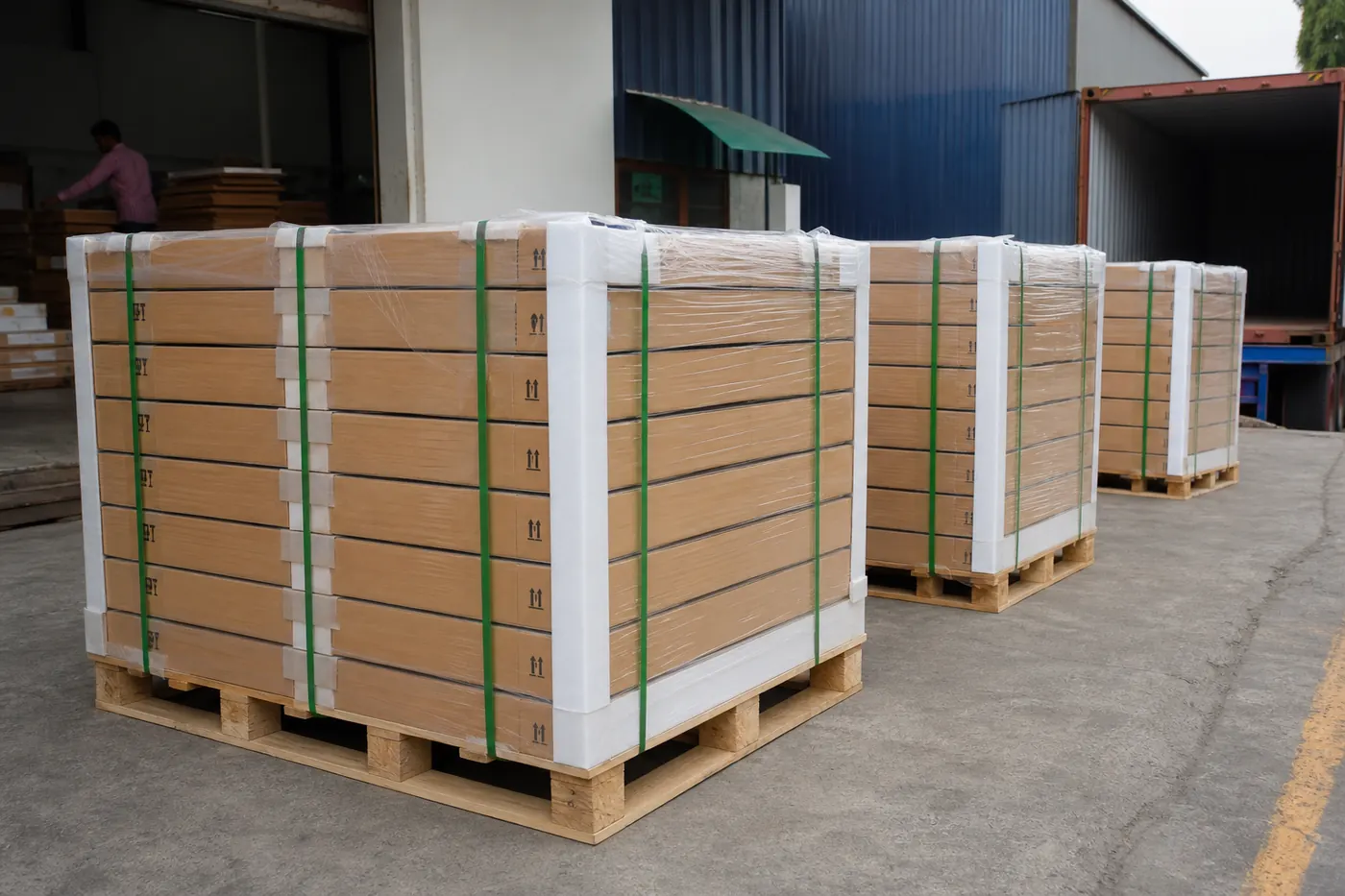
Most shippers are supplied flat and bundled to reduce cube. Specify bundle quantity, orientation, compression limit, edge protection, strap material and position, moisture barrier, labels, gross weight, manual-handling limit, and pallet pattern. Straps should secure bundles without crushing flutes or marking printed surfaces. Stretch wrap protects against dust and short exposure but can trap moisture if wet board is wrapped.
Palletization improves handling and count control but consumes cube and may require compliant wood packaging. Confirm ISPM 15 treatment and marks for regulated solid-wood packaging; engineered-wood pallets may be treated differently by destination rules. Floor-loaded bundles can improve utilization but increase handling, contamination, counting, and damage risks. Agree who unloads and what equipment is available.
Container Loading Details
Export Tip
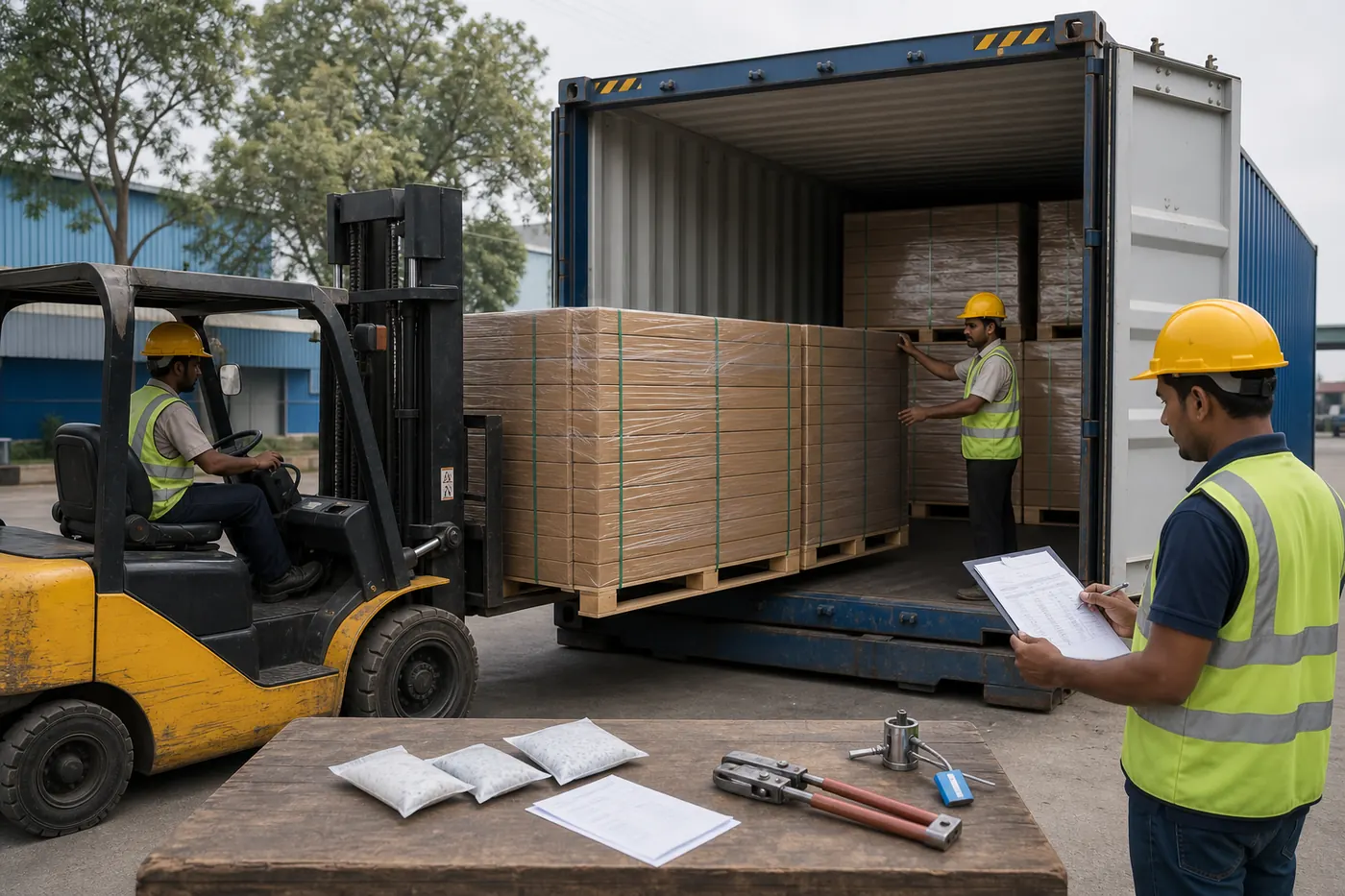
A 20-foot or 40-foot high-cube count cannot be stated responsibly without measured bundle dimensions, weight, pallet decision, container internal limits, carrier payload, stowage loss, and route restrictions. Corrugated boxes are commonly cube-limited. Create a row-by-row loading plan, inspect the container for holes, odor, moisture, protrusions, and floor condition, photograph loading, reconcile bundle count, apply the seal, and record the seal number. See the full container loading and shipping guide.
Loading approval should use production bundles, not prototype dimensions. Record bundle length, width, height, gross weight, count, compression state, pallet overhang, and any dunnage. Confirm that unloading equipment and receiving doors match the selected arrangement. Desiccants or liners are risk controls only when a competent logistics plan justifies them; they do not correct wet board or a leaking container.
Export packing and loading formats for flat corrugated boxes
Swipe →
Data table — swipe horizontally on small screens
| Loading choice | Advantage | Risk/control |
|---|---|---|
| Flat strapped bundles | Efficient cube and simple count | Prevent strap crush and moisture exposure |
| Wrapped bundles | Dust and splash protection | Avoid trapping moisture; substantiate plastic claims |
| Palletized bundles | Faster mechanical handling | Lower cube; verify pallet and ISPM 15 rules |
| Floor loading | Potentially higher container utilization | More handling; use clean container and disciplined tally |
| Nested die-cuts | Reduces void for some styles | Protect tabs, print, and score geometry |
Shipping Methods
Export Tip
Ocean FCL is often the main option for commercial volumes; LCL can serve pilots but adds handling and moisture exposure; air freight usually suits urgent samples or very high-value specialized packaging. Consolidating boxes with the Indian product they will pack can be more rational than shipping empty packaging independently, provided food-contact, contamination, sequencing, and customs issues are controlled.
Under EXW, the buyer assumes a demanding origin pickup role; FCA can be cleaner when the seller clears export at a named place. FOB is used for port shipments but should follow Incoterms® 2020 scope and a named Indian port. CFR and CIF include seller-arranged ocean carriage, with CIF including minimum prescribed insurance, yet destination handling, duty, and delivery remain outside unless stated. DAP and DDP require careful destination capability; DDP can create importer, registration, tax, and compliance obligations that the seller may not be able to perform lawfully.
Create a responsibility matrix for booking, verified gross mass, export clearance, terminal charges, insurance, origin detention, destination demurrage, customs entry, examinations, duties, EPR fees, delivery, unloading, and empty-container return. Incoterm labels do not replace this operational detail.
Certifications
Compliance Notes
ISO 9001 can indicate a quality-management system at a defined site and scope, but it does not certify a box's compression strength. FSC or PEFC chain-of-custody certification can support eligible responsible-fiber claims only when the organizations, products, invoices, certificate status, and trademark use fit the scheme. A supplier saying it “uses FSC paper” is not equivalent to a valid certified sale.
Food-contact packaging may require migration or composition evidence based on the box's direct or indirect contact, coatings, inks, adhesives, barriers, and destination law. Supplier declarations should name the actual materials and conditions of use. Heavy-metal or chemicals testing, retailer protocols, social audits, recycled-content evidence, and laboratory accreditation may also be relevant. Read the quality standards and certifications guide and the sustainable corrugated packaging guide before approving claims.
Corrugated-box certification and quality evidence matrix
Swipe →
Data table — swipe horizontally on small screens
| Evidence | What it supports | Verification |
|---|---|---|
| Box test report | Measured samples against listed methods | Match SKU, lot, conditioning, method, date, and lab |
| ISO 9001 | Site quality-management scope | Check issuer, site, scope, validity, and exclusions |
| FSC/PEFC chain of custody | Eligible certified sourcing/claims | Validate code, transaction scope, invoice claim, and logo approval |
| Food-contact declaration/test | Defined material and use conditions | Match inks, adhesive, coating, food type, temperature, and destination |
| Social audit | Conditions observed under a named protocol/date | Review site identity, findings, and corrective actions |
| Recycled-content evidence | Defined pre/post-consumer claim | Confirm method, period, product scope, and marketing wording |
Expert Insight — Saurabh Mittal, Founder, Altus Exports

Challenges & Solutions
Common corrugated-box import problems and corrective controls
Swipe →
Data table — swipe horizontally on small screens
| Challenge | Why it happens | Practical solution |
|---|---|---|
| Boxes collapse in storage | Humidity, weak board, poor stacking, overhang, long dwell | Test conditioned compression; redesign board and pallet pattern |
| Product does not fit | Dimension convention or score allowance misunderstood | Approve packed-product trial and signed drawing |
| Print is rejected | Uncontrolled artwork, substrate variation, weak tolerances | Version-control files; approve production proof and color method |
| Bundles arrive warped or wet | High board moisture, poor wrapping, container condensation | Measure moisture; season board; use dry loading and route-appropriate protection |
| Landed cost exceeds plan | Cube, tooling, destination, or LCL charges omitted | Model measured load and complete charge matrix before PO |
| Certificate claim fails review | Facility certificate assumed to cover product/transaction | Verify scope, validity, transaction evidence, and claim wording |
| Late shipment | Paper, die, artwork, test, and booking dependencies hidden | Manage dated critical path with approval deadlines and escalation |
| Customs dispute | Wrong national code, origin, value, or description | Obtain broker ruling/advice and reconcile documents before filing |
Buyer Requirements
Buyer Requirements
The buyer requirement package should function as the single commercial and technical baseline. It must identify legal entities, importer of record, destination, intended use, packed product, annual forecast, launch quantity, approved drawing, board construction, performance, artwork, tolerances, tests, claims, bundle and pallet configuration, Incoterm, schedule, document set, inspection, and remedies. Requirements that remain in email threads are easy to omit from the purchase order.
Destination obligations belong in the brief before material is ordered. The importer should provide current retailer manuals, barcode rules, recycling labels, EPR data fields, food-contact conditions, restricted-substance lists, pallet requirements, and language text. Supplier acceptance should be written, with exceptions listed line by line rather than hidden in a general quotation.
Buyer approval package required before corrugated-box production
Swipe →
Data table — swipe horizontally on small screens
| Buyer requirement | Evidence before bulk production | Release owner |
|---|---|---|
| Structure and fit | Signed drawing and packed-product trial | Packaging engineer/buyer |
| Board and performance | Paper declaration and production-sample tests | Quality team |
| Artwork and barcode | Controlled proof and verification plan | Brand/retailer team |
| Compliance and claims | Destination review and scoped evidence | Importer/compliance team |
| Commercial and logistics | Normalized quote, Incoterm matrix, measured pack plan | Procurement/logistics |
Expert Insight — Saurabh Mittal, Founder, Altus Exports
Sourcing Checklist
Checklist
- Define the packed product, distribution cycle, destination, storage duration, and stacking conditions.
- Freeze internal dimensions, box style, joint, drawing revision, board construction, and test criteria.
- Map the actual corrugating, printing, die-cutting, gluing or stitching, testing, and packing sites.
- Approve structural, print, production-equivalent, packed-product, and golden samples as appropriate.
- Normalize supplier quotes for board, quantity, tooling, testing, packing, Incoterm, and payment.
- Verify certificate, food-contact, recycled-content, and fiber claims against product and transaction scope.
- Contract incoming, first-off, inline, final, and loading controls with objective remedies.
- Confirm destination HS line, duties, EPR, labeling, and document requirements with qualified advisers.
- Measure production bundles and approve the pallet or floor-loading plan before freight booking.
- Reconcile invoice, packing list, shipping bill, origin evidence, transport document, tally, and seal.
Buyer Checklist
Checklist
- [ ] Importer of record and customs broker confirmed
- [ ] Packed-product and distribution hazards documented
- [ ] Drawing, artwork, tolerances, and test methods approved
- [ ] Destination packaging and sector rules reviewed
- [ ] Supplier exceptions and subcontractors disclosed
- [ ] Golden sample and defect catalogue controlled
- [ ] Landed-cost model uses measured bundles
- [ ] Inspection, claims window, and remedies contracted
- [ ] Cargo insurance and Incoterm responsibilities confirmed
- [ ] Receiving inspection and lot traceability planned
Exporter Checklist
Checklist
- [ ] Indian IEC and applicable tax/banking registrations active
- [ ] Actual manufacturing and outsourced sites identified
- [ ] Paper, adhesive, ink, coating, and lot records retained
- [ ] Approved drawings and artwork match production versions
- [ ] Final test, inspection, and quantity evidence compiled
- [ ] Bundles, pallets, marks, weights, and measurements reconciled
- [ ] Invoice, packing list, shipping bill, and transport instructions aligned
- [ ] Origin or preference evidence checked where requested
- [ ] Container condition, loading tally, and seal documented
- [ ] Post-shipment document and record-retention duties assigned
Compliance Checklist
Checklist
Compliance Notes
- [ ] HS 4819.10 wording and destination national line reviewed
- [ ] Duty, tax, valuation, origin, and preference treatment confirmed
- [ ] Packaging EPR, reporting, labeling, and recyclability obligations mapped
- [ ] Food-contact or sector-specific use conditions assessed
- [ ] Inks, adhesives, coatings, and restricted substances addressed
- [ ] FSC, PEFC, recycled, recyclable, and environmental claims substantiated
- [ ] Solid-wood packaging checked for ISPM 15 applicability
- [ ] Dangerous-goods packaging approval assessed if contents require it
- [ ] Required languages, barcodes, marks, and responsible-party data approved
- [ ] Records support traceability, complaints, and corrective action
Common Buyer Mistakes
Common Mistakes Box
- Asking only for “3-ply” or “5-ply” without paper, flute, dimensions, performance, and tolerances.
- Comparing price per piece across different internal/external dimensions and board constructions.
- Treating a hand-cut prototype as proof of production print, scores, bonding, and die accuracy.
- Selecting a supplier without identifying outsourced corrugation, printing, die cutting, or testing.
- Assuming HS 4819.10 and one duty rate apply to every packaging article and country.
- Ignoring humidity conditioning and real pallet-stack duration in compression decisions.
- Approving sustainability or food-contact claims without product- and transaction-specific evidence.
- Calculating containers from theoretical internal cube instead of measured bundles and stowage.
- Using CIF as if it includes destination duty, port charges, customs, and final delivery.
- Releasing shipment without final inspection, quantity reconciliation, and document review.
Future Market Trends
Key Statistics
Corrugated-box development is moving toward right-sized structures, lower material use per delivered product, verifiable fiber sourcing, recycled-content transparency, water-based or lower-impact converting systems, and designs that remain recyclable in the destination stream. Regulation and EPR programs are also increasing demand for material composition and packaging-volume data. These directions do not prove that every lighter box is better; protection failure and product damage can erase material savings.
Digital printing and automated cutting can improve prototypes, versioned graphics, and smaller launches, while high-volume flexography remains important for efficient repeat work. Buyers are likely to ask for better lot records, machine-readable specifications, barcode verification, measured carbon inputs, and evidence tied to the actual transaction. Treat all forecasts as hypotheses and validate them with destination law, customer manuals, converters, recyclers, and controlled trials.
Commercial implications
International programs may increasingly compare total delivered system performance: product damage, board mass, cube, line efficiency, returns, recyclability, and reporting burden. Indian suppliers that can document rather than merely claim these variables will be easier to qualify. Buyers should preserve repeat-order data so design changes are judged against a stable baseline.
How Altus Exports Supports International Buyers
Altus Exports can translate the buyer's use case into a structured sourcing brief, identify suitable Indian converters, normalize quotations, coordinate structural and printed samples, organize applicable tests and inspections, manage change communication, and assemble export documentation. As a product sourcing company in India and manufacturer-finding partner, Altus can coordinate the chain without making unsupported claims about factory ownership or automatic certification.
Explore the packaging materials industry page, import products from India service, and global sourcing partner service. Buyers planning print-intensive programs can also review custom printed corrugated boxes from India.
Conclusion
India is an established source of corrugated cartons, with US$55.790 million in reported HS 481910 exports during 2024, but reliable importing depends on order-level engineering and control. Define the packed product and route, freeze measurable specifications, qualify the actual site, approve production-equivalent samples, verify claims, normalize landed cost, inspect bulk goods, and load from measured packs.
To discuss a sourcing program, contact Altus Exports with destination, product, packed weight, internal dimensions, box style, expected strength, print files, annual demand, first-order quantity, pack method, certifications, and delivery window. Altus can structure a merchant-export, sourcing, and export-consulting workflow around those facts.
References
- WITS/UN Comtrade — HS 481910 exporters, 2024
- WITS/UN Comtrade — HS 481910 importers, 2024
- WITS/UN Comtrade — India HS 481910 exports by destination, 2024
- World Customs Organization — Harmonized System resources
- International Chamber of Commerce — Incoterms® rules
- European Commission — Packaging waste and PPWR
- U.S. EPA — Extended producer responsibility
- IPPC — ISPM 15 wood-packaging standard
- Forest Stewardship Council — certificate search
- USITC — Harmonized Tariff Schedule, HTSUS 4819.10
- White House — temporary Section 122 import surcharge proclamation
- UK Integrated Online Tariff — heading 4819
- Canada 2026 Customs Tariff — chapter 48
- Australian Border Force — chapter 48 tariff
- EUR-Lex — Regulation (EU) 2025/40
- India Directorate General of Foreign Trade
All online sources were accessed 2026-07-17. WITS values are gross trade reported in thousands of U.S. dollars and converted here to millions or billions.
Quantities and implied values are customs indicators, not supplier quotations. Commercial ranges in this guide are expressly illustrative and require current order-specific validation.