
Corrugated Box Quality Standards and Certifications: 2026 Buyer Guide
By Saurabh Mittal, Founder, Altus Exports
A compliance-led guide to specifying, testing and verifying export corrugated boxes and supplier certificates.
## Introduction
Buyers searching for corrugated box quality standards and certifications often receive a certificate bundle before anyone has defined the package. That reverses the correct sequence. A reliable program starts with the packed product, distribution hazards, destination law and buyer requirements; converts them into board, box, print and performance criteria; chooses methods with stated editions and conditioning; and verifies both production lots and certificate scope. No single logo proves that a shipping case will survive a humid warehouse, parcel network or stacked ocean container.
This guide is written for importers, retailers, industrial users and packaging teams evaluating Indian supply. Altus Exports operates as a merchant exporter, global sourcing partner and export consulting coordinator. We can align buyer specifications, qualified converters, laboratories, inspections, export documents and shipping—not replace the importer, customs broker, certification body or legal adviser.
Executive Summary
Summary Box
A compliant corrugated-box program begins with the packed product and distribution route, then defines measurable board, box, print and pack requirements. FEFCO style language, TAPPI and ISO material methods, ISTA distribution procedures, management-system certificates and fiber chain-of-custody evidence answer different questions. Name methods and acceptance rules, verify certificates independently, inspect production lots and retain destination-specific evidence.
Market Size & Industry Overview
Key Statistics
Corrugated packaging demand follows manufacturing, agriculture, processed food, appliances, pharmaceuticals, e-commerce and organized retail. India offers integrated paper mills, sheet plants and independent converters, but capability varies by flute equipment, printing process, laboratory discipline, paper sourcing and control of subcontracted operations. A large machine does not automatically mean disciplined moisture, adhesive, score, slot and print control.
For trade screening, the central six-digit heading is usually HS 481910: cartons, boxes and cases, of corrugated paper or paperboard. Flat sheets, trays, partitions, retail displays, non-corrugated cartons and molded-fiber items may classify elsewhere. UN Comtrade and the World Bank WITS database publish reporter-level trade under HS 481910.
The latest complete year can differ by reporter and revision date, so this guide does not turn a changing database extraction into a fixed market-size claim. Download current data on the day of analysis and preserve reporter, partner, flow, year, unit and revision metadata.
Corrugated boxes are bulky relative to value, so trade data understates local conversion activity and often reflects cross-border lanes, specialty formats or geographic imbalances. Import value is not the same as end-user consumption, and value divided by kilograms is not a box quotation. Freight inclusion, board grade, dimensions, printing, product mix and customs valuation all distort that ratio.
Product Categories / Variants
Summary Box
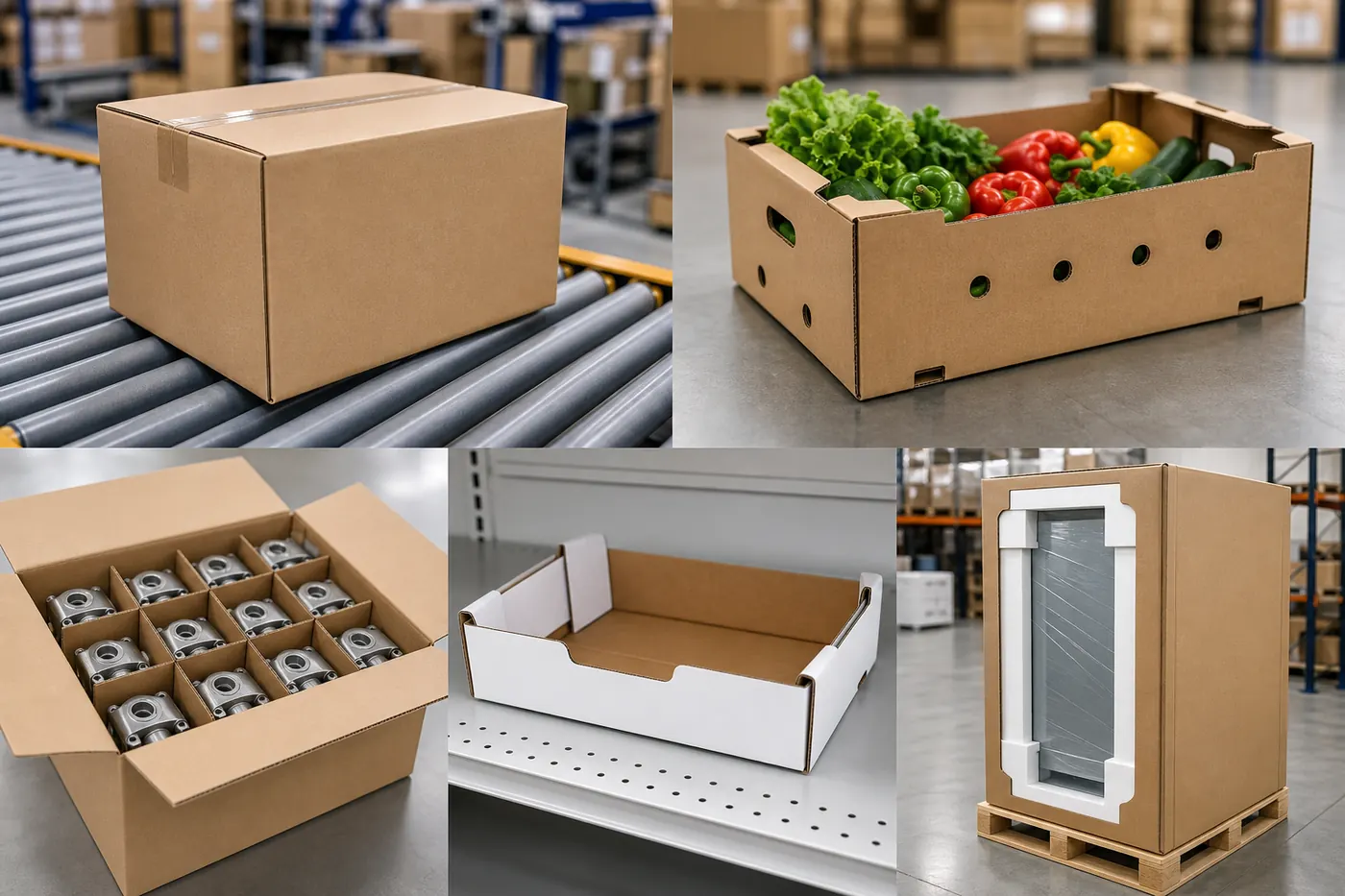
A corrugated board combines one or more fluted mediums with liners. Single-wall board commonly uses three papers; double-wall combines two flutes and three liners. Flute profile influences caliper, cushioning, print surface and stacking behavior, but flute letters are not strength grades. Paper grammage, fiber mix, ring crush or SCT properties, moisture, adhesive bond and converting damage collectively determine performance.
Common styles are described through the FEFCO–ESBO code system, including regular slotted cases, die-cut folders, telescope packs and trays. A code is a structural vocabulary, not a performance approval. The drawing must still state internal dimensions in an agreed order, flute direction, manufacturer's joint, slot and score positions, tolerances, closure, hand holes, ventilation, print artwork and pallet pattern.
The package specification should identify the packed product's mass, dimensions, fragility, load distribution, humidity sensitivity, center of gravity and any dangerous-goods status. It should also record unit count, inner packs, dividers, bags, edge protectors, tape, straps, pallet, stretch film and maximum stack. Testing an empty box or a substitute product answers a different question from testing the final packed system.
Corrugated-box specification fields for buyer approval
Swipe →
Data table — swipe horizontally on small screens
| Attribute | What to specify | Why it matters |
|---|---|---|
| Board construction | Single/double wall, liners, mediums, flute combination | Controls caliper, conversion and performance |
| Dimensions | Internal L × W × H, tolerance, measurement condition | Determines fit, cube and compression |
| Strength | ECT and/or BCT target with named method | Connects material and packed-case needs |
| Water response | Cobb target and test side/time | Supports humidity and surface sizing control |
| Workmanship | Joint, scores, slots, warp, glue, print and defects | Prevents assembly and line failures |
| Pack system | Contents, inserts, closure, pallet and stack | Makes distribution testing representative |
Manufacturing Overview
Export Tip
Liners and medium are conditioned, fluted with heat and starch adhesive, combined, slit, scored, printed, die-cut or slotted, folded, joined and bundled. Paper moisture and strength affect corrugation; poor adhesive control creates loose flute; excessive printing pressure crushes caliper; inaccurate scores, slots or joints reduce assembly and compression reliability.
Map outsourced sheet making, printing, lamination and die cutting. Incoming paper identity, moisture, adhesive records, settings, warp, caliper, dimensions, print, barcode, joint and finished-box tests should remain traceable to a lot. A certificate covering one site cannot silently cover another.
Manufacturing stages, corrugated risks and control records
Swipe →
Data table — swipe horizontally on small screens
| Stage | Corrugated-specific risk | Control |
|---|---|---|
| Paper receipt | Wrong grade or moisture | Mill record and incoming test |
| Corrugation | Crushed flute or poor bond | Settings, bond and caliper |
| Converting | Misregister or score damage | First-off and patrol checks |
| Joining | Weak glue or stitch | Joint destructive check |
| Bundling | Warp, count or rain exposure | Final tally and dry storage |

Quality Methods: FEFCO, ISTA, TAPPI and ISO
FEFCO provides box-style codes and technical methods used in the European corrugated sector; it is not a certification body and a FEFCO code is not a certificate. ISTA procedures evaluate packaged-product systems against defined distribution sequences. TAPPI methods are widely used for paper and corrugated material tests. ISO publishes international methods for paper, board, conditioning and packaging. ASTM methods may also be specified in North American programs. These families overlap but are not interchangeable by name alone.
Record the exact method identifier, edition or contract date, specimen orientation, preconditioning, conditioning atmosphere, number of specimens, equipment settings and acceptance rule. Current ISO references cited here are ISO 3037:2022 for ECT, ISO 535:2023 for Cobb water absorptiveness, ISO 2759:2014 for corrugated-board burst, ISO 12048:1994 for compression and stacking tests using a compression tester on complete, filled transport packages, and ISO 187:2022 for conditioning atmospheres. Paper and board are moisture-responsive; production-floor results cannot be compared casually with laboratory-conditioned results.
ISTA testing is not a generic “ISTA certification” for every box a factory makes. A report applies to the tested packaged-product configuration, sequence and laboratory conditions. Changing gross weight, dimensions, inserts, closure, palletization or product fragility can invalidate the practical relevance. Select a procedure based on the actual distribution system—for example parcel versus unitized load—then have a qualified packaging professional confirm the current procedure and test level.

ECT, BCT, Cobb and Burst Testing
Edge crush test (ECT) measures edgewise compression resistance of a corrugated-board specimen. TAPPI T 811 and current ISO 3037:2022 are recognized references, but specimen preparation and edge quality materially affect results. ECT characterizes board and can inform compression design; it does not directly guarantee a packed box's stacking life.
Box or package compression loads an erected case or complete package between platens. TAPPI T 804 addresses fiberboard shipping containers; ISO 12048:1994 addresses complete, filled transport packages and compression/stacking tests using a compression tester. Results are sensitive to specimen configuration, dimensions, flute direction, scores, joint, humidity, closure and platen conditions. Warehouse performance also depends on time, pallet support, vibration and climate. Formula estimates such as McKee are design screens, not substitutes for package validation where failure matters.
Cobb testing measures water absorptiveness over a specified time; current ISO 535:2023 and TAPPI T 441 are established references. State the exposed side and duration. Cobb is useful for monitoring sizing and surface response, but it is not proof of waterproofing, barrier safety or survival through prolonged condensation.
Burst strength measures pressure required to rupture board under specified conditions; current ISO 2759:2014 and TAPPI T 810 are common corrugated-board references. Burst remains embedded in some carrier and legacy purchasing rules, while performance specifications may emphasize ECT. ECT, burst, Cobb and BCT measure different properties and are not substitutes. Avoid converting ECT to burst through an unsupported universal formula.
Comparison of principal corrugated-box quality tests
Swipe →
Data table — swipe horizontally on small screens
| Test | Useful question | Does not prove | Verification focus |
|---|---|---|---|
| ECT | How does board resist edge compression? | Finished-case survival by itself | Specimen cut, orientation, conditioning |
| BCT | How does the erected case resist compression? | Long-term stack life in every climate | Final dimensions, closure, platen, atmosphere |
| Cobb | How much water is absorbed in stated time? | Waterproof or food-safe status | Test side, time, conditioned mass |
| Burst | What pressure ruptures the board? | Stacking or puncture performance alone | Method, diaphragm, board condition |
| ISTA sequence | How does the packed system respond to modeled hazards? | All real-world routes or altered packs | Representative contents and procedure |
Certifications
Compliance Notes
FSC and PEFC chain-of-custody systems support eligible claims through certified organizations under defined controls; the converter or trader making the sale must have the necessary chain-of-custody coverage and transaction evidence. FSC Mix may combine FSC-certified virgin fibre, recycled material and controlled wood, so it is not a claim of 100% FSC-certified fibre. FSC Recycled paper uses reclaimed material but is not necessarily all post-consumer because eligible pre-consumer reclaimed fibre can be included. Verify legal entity, site, product scope, validity, invoice claim and trademark authorization.
An ISO 9001 certificate is voluntary third-party certification of a quality-management system within the named legal entity's, site's and activity's stated scope. ISO itself does not certify organizations, and the certificate does not certify ECT, food contact or a particular SKU. Confirm the certification body's identity, accreditation where claimed, certificate status and covered manufacturing site. Review operating records such as incoming checks, calibration, process controls, nonconformance, traceability and corrective action.
BRCGS Global Standard Packaging Materials Issue 7 was published on 28 October 2024, and Issue 7 audits commenced on 28 April 2025. It is voluntary site/process certification, although a buyer can require it contractually. It is not statutory approval, food-contact approval or certification that every SKU meets its specification. Verify directory status, production address, product category, scope, exclusions, certificate expiry and corrective actions where available.
Certification evidence and its verification limits
Swipe →
Data table — swipe horizontally on small screens
| Evidence | Supports | Does not replace | Buyer verification |
|---|---|---|---|
| FSC/PEFC CoC | Controlled chain and eligible transaction claims | Physical quality or legal food-contact review | Official database plus invoice claim |
| ISO 9001 | Scoped quality-management system | Lot test report | Site, scope, body, status and records |
| BRCGS Packaging | Audited site controls under named standard | SKU performance or every buyer protocol | Directory, scope, audit and actions |
| Accredited lab report | Named sample tested by stated methods | Factory-wide certification | Sample identity, date, method, results |
| Supplier declaration | Defined representation by accountable entity | Independent proof where required | Authority, basis, lot and traceability |
Certification evidence hierarchy
Separate scheme certificates, transaction claims, laboratory reports and supplier declarations. Each document has its own issuer, scope, period and evidentiary limit.
Order-level verification record
Record the official-directory result, site and scope match, report-to-lot match, transaction wording, reviewer, date and any exception before shipment release.
Food Contact, Mineral Oil and Printing-Ink Rules
There is no universal food-grade corrugated-box certificate. Corrugated packaging for food needs a market- and use-specific assessment: direct or indirect contact, functional barrier, food type, temperature, storage time and recycled fibre change the analysis. In the United States, evaluate each paper, coating, ink, adhesive and other food-contact component under the FDA framework and relevant conditions of use. Avoid “FDA-approved box”; FDA does not issue a blanket approval for a finished corrugated box merely because a component has a regulatory basis.
In the European Union, Regulation (EC) No 1935/2004 provides the general food-contact framework and Regulation (EC) No 2023/2006 addresses good manufacturing practice. Paper and board, printing inks and some other non-plastic components are not fully harmonized through one EU-specific material measure, so national measures and recognized guidance may matter. A declaration must identify the construction, intended use, supporting basis and any barrier or migration assumptions.
Mineral-oil hydrocarbons can arise from recycled paper, inks, processing aids and the environment. Requirements are evolving and differ by country. France's restrictions concerning mineral oils in packaging and printing inks illustrate why a broad “EU compliant” declaration is insufficient. Obtain current legal advice and a risk assessment covering paper source, inks, adhesives, barrier effectiveness, migration or analytical work and the exact destination.
Printing inks should be specified for intended use, including low-migration systems where justified, and managed under good manufacturing practice. EuPIA guidance is influential industry guidance, not an EU law. A “food-grade ink” statement without formulation controls, intended-use conditions and migration reasoning is weak evidence. Control set-off, curing, ink batch traceability and use of substances excluded by the buyer.
Other EU chemical and packaging rules need separate scoping. RoHS restricts substances in electrical and electronic equipment and does not generally regulate corrugated packaging as packaging; do not request a generic “RoHS box certificate.” Under REACH, packaging is a separate article and duties can arise from Candidate List substances, restrictions, inks, adhesives, coatings or other constituents, depending on concentration, tonnage, actor and use. A supplier declaration should identify the substances, article/component scope, threshold basis and date rather than state only “REACH compliant.”
Regulation (EU) 2025/40 on packaging and packaging waste, the PPWR, entered into force on 11 February 2025 and generally applies from 12 August 2026, although individual provisions and implementing measures have their own dates. It applies broadly to packaging placed on the EU market and packaging waste; it is not a voluntary certificate. Map the actual role, packaging category, recyclability, substance, labelling, documentation and EPR obligations with EU counsel instead of treating PPWR as one supplier test.
Supplier Certificate Verification
- [ ] Verify legal name, address and manufacturing activity
- [ ] Search the official certificate directory
- [ ] Match scope, site, product category and validity
- [ ] Confirm issuer recognition or accreditation
- [ ] Reconcile order and transaction claim wording
- [ ] Match test sample to production lot and construction
- [ ] Review audit findings and corrective actions where available
- [ ] Save dated evidence and define lapse remedies
Begin with the legal entity and actual production address. Search the issuer or scheme database independently; do not follow only a link embedded in the supplier's PDF. Match certificate number, status, standard version, scope, sites and product categories. Confirm that the certification body is recognized for that scheme and, where accreditation is claimed, inspect the accreditation body's directory.
Check dates against production and shipment, not merely quotation. Look for altered fonts, cropped pages, inconsistent addresses and scopes that describe trading rather than converting. Ask how multisite or outsourced operations are covered. For FSC or PEFC claims, reconcile purchase inputs, sales documents and label approval. For laboratory reports, match board construction, paper grades, dimensions, print, sample date, lot and test method.
Write verification into the contract: which evidence is due before artwork, before production, before shipment and after corrective action. Define the remedy if a certificate lapses or a claim becomes unavailable. A supplier can be technically capable without a voluntary certificate; equally, a certified supplier can ship a nonconforming lot. The commercial decision should separate legal need, buyer policy, claim value and physical performance.
Export Process
Export Tip
A controlled export begins with a packaging brief: product, destination, filling line, annual volume, order pattern, storage, distribution route, pallet and sustainability or certification claims. Altus Exports can issue that brief to screened Indian converters under one comparison format, disclose the proposed production route and normalize quotations.
Development should proceed through structural drawing, plain sample, printed or production-equivalent sample, packed-system trial and signed golden sample. Laboratory and distribution tests follow the agreed risk plan. Before bulk release, approve artwork, tolerances, defect catalogue, certificate wording, inspection plan, Incoterm, payment milestones and required documents.
Production monitoring covers incoming paper identity, moisture, adhesive preparation, corrugator settings, warp, caliper, dimensions, joint, slots, scores, print registration, barcode verification and bundle count. Final inspection should use a defined sampling plan and separately verify critical requirements. Shipment records commonly include commercial invoice, packing list, shipping bill, bill of lading or air waybill and certificate of origin when required, plus test, inspection or chain-of-custody evidence specified by contract.

MOQ Analysis
Buyer Tip
There is no responsible universal MOQ. Minimums depend on board combination, paper procurement, corrugator width, print plates or dies, ink changes, style, dimensions and run-combination opportunities. In an invented RFQ sensitivity—not an expected minimum—a buyer could ask a supplier to price 500, 1,000 and 3,000 identical existing-tool cases and 2,000, 5,000 and 10,000 identical custom printed cases. Only a dated quotation tied to dimensions, board, print, tooling, packing, tax and delivery establishes MOQ and price.
For a hypothetical quotation schedule, a buyer could ask whether a repeat 400 × 300 × 250 mm one-color RSC can be cargo-ready two to four weeks after approval, and whether a new-tooling version requires four to eight weeks or more. These are invented checkpoints, not typical lead times or promises. The selected supplier must provide a dated critical path covering drawings, artwork, samples, paper, testing, inspection, inland transport and port cutoff; transit is separate.
Boxes are commonly shipped knocked down, strapped or wrapped in counted bundles, often palletized when handling and destination requirements justify it. Protect edges, print surfaces and paper from rain and condensation. ISPM 15 applies to regulated raw or solid-wood packaging such as many pallets and dunnage, not to corrugated board; qualifying processed-wood packaging is exempt. Confirm destination implementation, pallet dimensions, stack height, gross weight and container condition. Whether an assigned container reaches cube or payload first must be calculated from approved bundles and a verified load plan.
Shipping modes for samples and commercial corrugated-box orders
Swipe →
Data table — swipe horizontally on small screens
| Mode | Best fit | Main control |
|---|---|---|
| Courier/air | Samples and urgent small quantities | Volumetric weight and corner protection |
| LCL ocean | Pilot orders without container volume | Extra handling, moisture and consolidation |
| FCL ocean | Stable, high-volume programs | Cube, load pattern and condensation |
| Road/rail regional | Cross-border or inland lanes | Weather protection and legal dimensions |
Packaging Standards
Export Tip
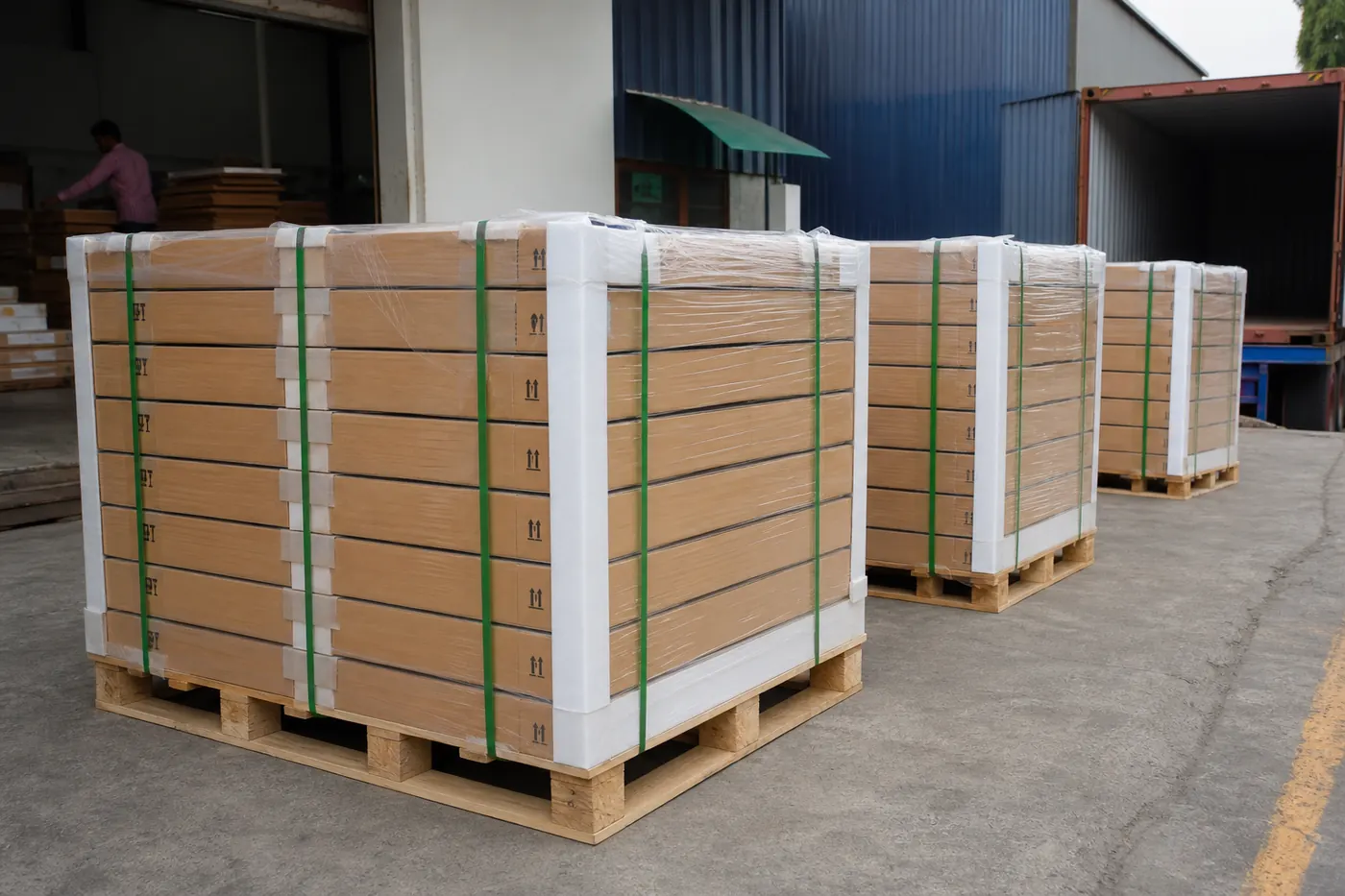
Approve the knocked-down bundle as carefully as the box: count, dimensions, mass, strap or wrap, pallet, edge protection, labels and moisture protection. Specify ISPM 15 evidence where regulated wood packaging is used. Packaging for boxes should prevent rain, abrasion, crushed edges and warp without creating unsupported environmental claims.
Container Loading Details
Export Tip
Calculate loading from measured approved bundle dimensions, pallet pattern, carrier equipment and legal payload. Record boxes per bundle, bundles per pallet or floor load, stowage loss and door clearance. Flat corrugated boxes may reach usable cube before payload, but that outcome is not universal; generic internet counts are unreliable. Inspect the container for dryness, odor and damage, document loading and seal, and assess condensation risk for the actual route.

Shipping Methods
Export Tip
Courier or air fits samples; LCL can support pilots but adds handling; FCL improves control at scale; road or rail can suit regional lanes. Use current route quotations. State Incoterms® 2020 and named place: FOB, CIF and DDP allocate responsibilities differently, and CIF does not include every destination cost.
Pricing Analysis
Buyer Tip
Corrugated box pricing is driven by paper mass and grade, flute combination, dimensions, converting waste, print colors and coverage, plate and die charges, coatings, adhesives, order quantity, packing, testing, certification claim and delivery basis. Paper indexes and recycled-fiber availability move over time. Compare price per box only after all bidders quote the same drawing, board construction, tolerances, pack and Incoterm.
For one hypothetical quotation sensitivity only, assume a 400 × 300 × 250 mm internal-dimension RSC, single-wall kraft board, one-color print, glued joint, 5,000 identical pieces and flat EXW India supply: US$0.20–$2.50 per box is an intentionally wide invented band for testing a landed-cost model, not an Altus offer, observed price or market average. Paper construction, ECT/BCT target, tolerances and print coverage still require definition; tooling, samples, laboratory work, certification claims, tax, pallets, inland/export charges, freight and duty are excluded. Obtain dated supplier and forwarder quotations.
Build landed cost from unit price, one-time tooling, sampling, laboratory work, inspection, bundling or pallets, inland haulage, export clearance, freight, insurance, destination handling, duty, tax, brokerage, storage and damage allowance. No general duty rate can be inferred from HS 481910: rates, preferences, valuation and trade measures depend on the destination's national tariff line, origin, transaction and date. The importer must have its broker confirm classification, customs value, duty and tax before contracting.
Landed-cost layers for corrugated-box quotations
Swipe →
Data table — swipe horizontally on small screens
| Cost layer | Quote requirement | Frequent error |
|---|---|---|
| Material/conversion | Same drawing and board | Comparing unlike grammages |
| Tooling | Plate, die ownership and life | Ignoring repeat replacement |
| Quality | Tests, sample count, inspection | Assuming certificates include testing |
| Logistics | Bundle cube, pallet and Incoterm | Optimizing piece price, not landed cube |
| Import | Current tariff and taxes | Using another country's duty rate |
Export Statistics
Key Statistics
Use UN Comtrade or WITS HS 481910 exports from India to identify recorded destination lanes, then use destination imports from world to understand importer scale. Record the extraction date, nomenclature version and whether the reporter has complete quantity data. Compare at least three years because a single year may reflect freight disruption, reporting revisions or exceptional orders.
Do not add the EU aggregate to EU member reporters, and do not call gross imports a market size. Re-exports can appear in hub economies. Country trade values also cannot reveal flute, recycled content, food-contact status, box dimensions or profitability. Their proper role is market screening and lane validation.
Correct interpretation of HS 481910 export indicators
Swipe →
Data table — swipe horizontally on small screens
| Screen | Source field | Limit |
|---|---|---|
| India exports | HS 481910 value | Not production or box count |
| Destination rank | Partner value/weight | No specification detail |
| Three-year direction | Annual extracts | Not a forecast |
| Value/kg | Calculated indicator | Not a quotation |
Import Statistics
Key Statistics
A useful dashboard separates value, net weight, supplementary quantity where available, partner concentration and year-over-year direction. Apparent value per kilogram should be labeled an arithmetic customs indicator. Investigate anomalies against source metadata rather than inventing a commercial explanation.
Shortlist markets where recorded imports, buyer channels and freight economics align, then validate actual prospects through retailer requirements, industrial clusters, tenders and distributor interviews. Because empty corrugated packaging is freight-intensive, nearby and regional trade may be more commercially meaningful than a large distant import total.
Country-wise Opportunities
Market Snapshot
The opportunities below are screening hypotheses, not forecasts. Current law, buyer manuals, tariffs and freight must be checked for each shipment. For EU supply, PPWR generally applies from 12 August 2026, subject to provision-specific dates; REACH applies conditionally to articles and constituents, while RoHS is not a general packaging law.
Country screening opportunities for Indian corrugated boxes
Swipe →
Data table — swipe horizontally on small screens
| Market | Commercial angle | Compliance emphasis |
|---|---|---|
| United States | Industrial, e-commerce and specialty printed cases | FDA food-contact basis where relevant; state packaging and claims rules |
| European Union | Traceable fiber and optimized transport packaging | Framework food-contact rules, PPWR transition, EUDR applicability review |
| United Kingdom | Retail-ready and e-commerce packaging | UK food-contact, producer-responsibility and claims review |
| Gulf markets | Food, appliance and distribution cartons | Country-specific conformity, Arabic marking and heat/humidity |
| East Africa | Agriculture, consumer goods and industrial cases | Destination standards, moisture and inland handling |
| South Asia | Regional manufacturing and produce lanes | Tariff preference, origin and border logistics |
Buyer Requirements
Buyer Requirements
The buyer should provide the packed product, route, line constraints, drawing, pallet plan, legal market, buyer protocols, test methods, defect limits, evidence list, label data and remedies. The importer and its advisers must approve national tariff classification, duty, food-contact basis and mandatory declarations before production.
Sourcing Checklist
Checklist
- Define packed product, route, annual demand and failure consequences.
- Issue controlled drawing, board construction and acceptance methods.
- Screen the actual converter, printer and subcontractors.
- Approve representative samples and packed-system testing.
- Normalize price, tooling, inspection, Incoterm and bundle cube.
- Verify certificates in official directories and against the order.
- Inspect production and reconcile lot, documents, loading and seal.
Buyer Checklist
Checklist
- [ ] Packed route documented
- [ ] HS and duty broker-confirmed
- [ ] Drawing and methods approved
- [ ] Destination rules assessed
- [ ] Certificates linked to requirements
- [ ] Inspection and remedies agreed
- [ ] Landed cost approved
- [ ] Receiving checks assigned
Exporter Checklist
Checklist
- [ ] IEC current
- [ ] All production sites disclosed
- [ ] Certificate status verified
- [ ] Lot tests complete
- [ ] Invoice and packing list reconciled
- [ ] Export and origin documents aligned
- [ ] Tally and seal recorded
- [ ] Records retained
Compliance Checklist
Checklist
Compliance Notes
- [ ] Classification and duty documented
- [ ] Legal and buyer rules separated
- [ ] Food-contact use assessed
- [ ] Ink and mineral-oil controls market-specific
- [ ] FSC/PEFC wording matched
- [ ] ISO/BRCGS scope not overstated
- [ ] Method editions recorded
- [ ] Claims approved
Challenges & Solutions
Common corrugated-box failures and practical controls
Swipe →
Data table — swipe horizontally on small screens
| Challenge | Why it occurs | Control |
|---|---|---|
| Compression loss | Humidity, overhang, score damage | Climate-conditioned BCT and verified pallet plan |
| Warp and poor feeding | Moisture imbalance or conversion settings | Flatness limits and line trial |
| Weak joints | Glue application or contaminated surfaces | Joint test and destructive checks |
| Print/barcode failure | Substrate variation and gain | Approved target, verifier grade and sampling |
| False certificate comfort | Scope or transaction mismatch | Independent database and order-level checks |
| Food-contact gaps | Generic declarations | Intended-use assessment and documented basis |
| Transit moisture | Rain or container condensation | Dry loading, liner strategy and records |
Common Buyer Mistakes
Common Mistakes Box
- Buying a board grade without validating the final packed case.
- Treating flute letter or paper grammage as a strength guarantee.
- Accepting “ISTA tested” without procedure, sample identity and report.
- Comparing unconditioned mill results with conditioned laboratory results.
- Assuming FSC, PEFC, ISO 9001 or BRCGS certifies every shipment property.
- Using a generic food-grade or low-migration declaration.
- Ignoring bundle cube, pallet overhang and humidity in landed cost.
- Printing environmental claims before legal and scheme approval.
- Failing to disclose outsourced printing, lamination or converting.
- Releasing shipment without reconciling lot tests and certificate validity.
Future Market Trends
Key Statistics
Buyers are likely to request better lot traceability, digital test records, validated right-sizing, clearer fiber claims and package-system evidence. Parcel networks and automated packing will increase attention to dimensional accuracy, barcode performance and machine compatibility. Regulatory and retailer scrutiny of food-contact and environmental claims will also favor precise, qualified statements over broad badges.
Expert Insights from Saurabh Mittal
Expert Insight Box
The commercial insight is that specification discipline improves negotiation. When every converter quotes the same box drawing, packed weight, test method, defect limits and shipment basis, the buyer can distinguish genuine process efficiency from exclusions. Altus can coordinate that normalization, supplier communication, production evidence and export execution while keeping certification and legal decisions with qualified parties.
Conclusion
Corrugated compliance is a layered decision: identify the package, model its route, define measurable performance, verify material and management claims, evaluate destination rules, inspect the lot and preserve evidence. FEFCO, ISTA, TAPPI and ISO provide valuable tools, but none substitutes for a package-specific risk assessment.
Use this standards guide with the corrugated box specifications guide, manufacturer evaluation framework, import process, sustainable packaging guide, export documentation checklist and container-loading guide so test evidence remains connected to sourcing, claims, documents and physical delivery.
For a controlled India sourcing program, contact Altus Exports with product dimensions and weight, destination, annual demand, current drawing, packing line, pallet plan, required tests and claim policy. Explore our merchant exporter service, global sourcing support and India import process. We can build a supplier, testing, quality and shipment plan around the actual requirement.
References
- FEFCO, FEFCO Code and testing resources: https://www.fefco.org/technical-information/fefco-code
- ISTA, test procedures and certification context: https://ista.org/
- TAPPI, standards search: https://www.tappi.org/
- ISO, standards catalogue including ISO 3037, ISO 535 and ISO 12048: https://www.iso.org/standards.html
- ISO 3037:2022, edgewise crush resistance: https://www.iso.org/standard/80310.html
- ISO 535:2023, Cobb water absorptiveness: https://www.iso.org/standard/80320.html
- ISO 12048:1994, complete filled transport-package compression and stacking: https://www.iso.org/standard/20810.html
- ISO 2759:2014, board bursting strength: https://www.iso.org/standard/61488.html
- ISO 187:2022, conditioning atmospheres: https://www.iso.org/standard/80311.html
- FSC, certificate search and chain of custody: https://search.fsc.org/
- PEFC, Find Certified: https://www.pefc.org/find-certified
- ISO, ISO 9001 quality management: https://www.iso.org/iso-9001-quality-management.html
- BRCGS, Packaging Materials standard and directory: https://www.brcgs.com/our-standards/packaging-materials/
- U.S. FDA, food-contact substances: https://www.fda.gov/food/food-ingredients-packaging/food-contact-substances-fcs
- EUR-Lex, Regulation (EC) No 1935/2004: https://eur-lex.europa.eu/eli/reg/2004/1935/oj
- EUR-Lex, Regulation (EC) No 2023/2006: https://eur-lex.europa.eu/eli/reg/2006/2023/oj
- EUR-Lex, Regulation (EU) 2025/40 on packaging and packaging waste: https://eur-lex.europa.eu/eli/reg/2025/40/oj
- European Commission, RoHS scope: https://environment.ec.europa.eu/topics/waste-and-recycling/rohs-directive_en
- ECHA, Candidate List substances in articles: https://echa.europa.eu/regulations/reach/candidate-list-substances-in-articles
- IPPC, ISPM 15: https://www.ippc.int/en/publications/640/
- EuPIA, printing-ink guidance: https://www.eupia.org/
- UN Comtrade, HS 481910 trade data: https://comtradeplus.un.org/
- World Bank WITS, trade data methodology: https://wits.worldbank.org/
- ICC, Incoterms rules: https://iccwbo.org/business-solutions/incoterms-rules/
Sources were reviewed for this guide on July 17, 2026. Standards are copyrighted and revised; purchase or consult the current official edition before writing a contract. This article is commercial information, not legal, certification or customs advice.