
Sustainable Corrugated Packaging India: 2026 Commercial Buyer Guide
By Saurabh Mittal, Founder, Altus Exports
A commercial framework for sourcing lower-impact corrugated boxes from India without weak claims or avoidable performance risk.
## Introduction
Sustainable corrugated packaging India programs succeed when environmental goals become purchasing controls. “Eco-friendly box” is not a specification. A defensible brief states box dimensions, packed weight, distribution route, performance limits, fiber and chain-of-custody claim, substances, printing, recyclability design, evidence, destination EPR data and an improvement baseline. It also protects the product: a lighter box that causes damage can increase total waste and emissions.
This guide focuses only on corrugated boxes. Altus Exports supports overseas buyers as an Indian merchant exporter, global sourcing partner and export consulting coordinator. We can structure requirements, screen converters, normalize bids, coordinate samples and inspections, and assemble export evidence. Brand owners and importers remain responsible for destination law, EPR registration, claims and customs decisions.
Executive Summary
Summary Box
A credible program combines five decisions: use only the material needed to protect the product; choose recycled and responsibly sourced fiber with evidence; design the complete printed and glued box for collection and recycling; collect packaging data for destination EPR; and approve claims only after legal and documentary review. Cost, carbon, weight and damage must be evaluated together.
Market Size & Industry Overview
Key Statistics
India's corrugated conversion base serves food, consumer goods, appliances, pharmaceuticals, agriculture, industrial parts and e-commerce. Supply ranges from integrated paper-and-box groups to regional sheet plants and specialist printers. Commercial sustainability therefore varies: some sites can provide traceable paper inputs and measured energy data; others can only make unsupported general statements. Qualify the actual converting and printing sites.
Trade in corrugated cartons, boxes and cases is generally screened under HS 481910. UN Comtrade and World Bank WITS provide country-reported values and quantities, but empty boxes are cube-intensive and largely produced near filling locations. Customs trade is not total Indian production or global market size. Published consultancy forecasts often use incompatible scopes; this guide avoids presenting a paywalled estimate as verified fact.
Commercial demand drivers for Indian corrugated boxes
Swipe →
Data table — swipe horizontally on small screens
| Commercial driver | Box implication | Evidence to request |
|---|---|---|
| E-commerce | Right-sized, damage-resistant shipper | Pack-out and distribution trial |
| Retail/FMCG | Print, shelf and pallet efficiency | Artwork, cube and pallet plan |
| Food/agriculture | Moisture and intended-use controls | Material declarations and risk review |
| Industrial | High load and part protection | Compression and field-damage data |
| Export packing | Humidity and long dwell time | Route assessment and container plan |
Export Statistics
Key Statistics
For current export statistics, extract India's HS 481910 exports from UN Comtrade by calendar year and partner, preserving retrieval date, HS revision, value, net weight and reporter notes. Compare three or more complete years. Do not infer recycled content, certification, box count or margin from customs value. Value per kilogram is only an arithmetic trade indicator, not an Indian ex-factory price.
Export lanes may favor neighboring markets, specialty printed boxes and locations where filling and conversion capacity differ. Rank destinations only after checking completeness and revisions. Altus uses trade data to form a prospecting hypothesis, then validates buyer channels, freight cube, local competition and the exact sustainability evidence requested.
How to interpret HS 481910 export fields
Swipe →
Data table — swipe horizontally on small screens
| Export-data field | Use | Caution |
|---|---|---|
| Value | Lane scale screen | Valuation and product mix differ |
| Net weight | Mass-flow context | Frequently missing or inconsistent |
| Partner | Route shortlist | Hubs may re-export |
| Three-year direction | Stability screen | Not a demand forecast |
Import Statistics
Key Statistics
Destination imports from world under HS 481910 can identify recorded import intensity. Never add an EU aggregate to member-state values. Gross imports are not consumption because re-exports and local production are excluded. Supplement customs data with producer-responsibility registers, retailer packaging manuals, tender notices and interviews.
Import Data Analysis should separate value, weight, partners and reporting completeness. Test whether freight and handling erase an apparent unit-cost advantage. For an empty corrugated box, reducing shipped cube or sourcing closer to the buyer may produce a better environmental and commercial result than buying from a distant low-price source.
Import-data decision gates for corrugated-box lanes
Swipe →
Data table — swipe horizontally on small screens
| Analysis question | Required input | Decision |
|---|---|---|
| Is the lane established? | Three-year partner imports | Proceed to channel research |
| Is freight viable? | Approved bundle cube and current quote | Landed-cost gate |
| Is data complete? | Reporter metadata and quantity coverage | Confidence rating |
| Can claims travel? | Destination law and buyer policy | Approved evidence list |
Product Categories / Variants
Summary Box
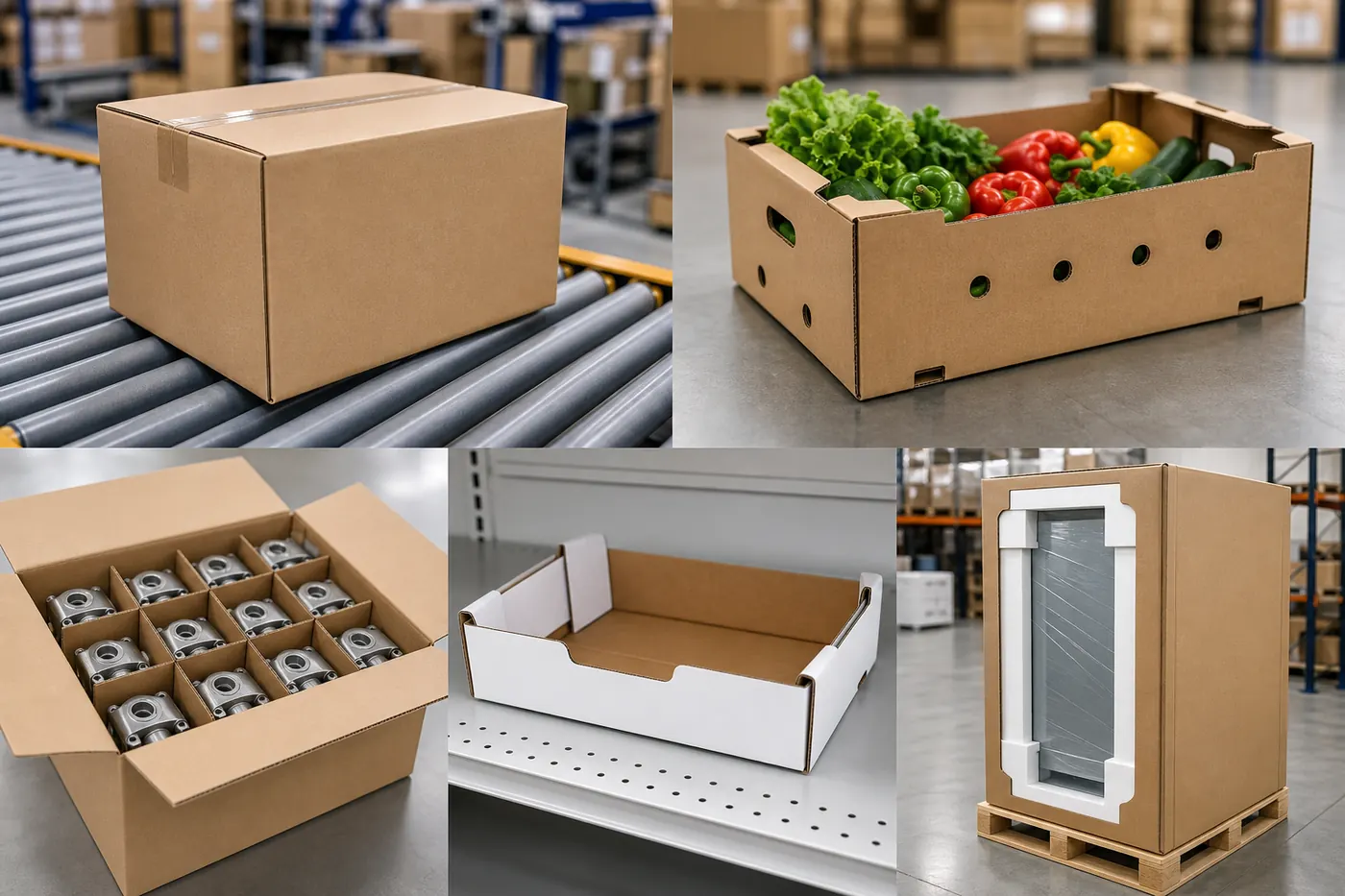
The sustainable choice is application-specific. Single-wall regular slotted cases can minimize material for stable products; die-cut mailers may reduce void fill; trays and wraparounds can improve shelf or pallet utilization; double-wall cases may prevent damage in demanding routes. A heavier construction can be lower impact if it prevents product loss or enables greater stacking.
Corrugated-box variants and sustainability design opportunities
Swipe →
Data table — swipe horizontally on small screens
| Corrugated-box variant | Sustainability opportunity | Risk to validate |
|---|---|---|
| Regular slotted case | Efficient converting and closure | Void space and tape use |
| Die-cut mailer | Right-sized e-commerce presentation | Tooling and trim waste |
| Wraparound case | Close product fit | Packing-line compatibility |
| Tray/display case | Transport-to-shelf function | Coatings and mixed components |
| Double-wall case | Damage prevention and stacking | Unnecessary fiber weight |
| Returnable corrugated format | Potential multiple uses | Actual return rate and condition |
Manufacturing Overview
Export Tip
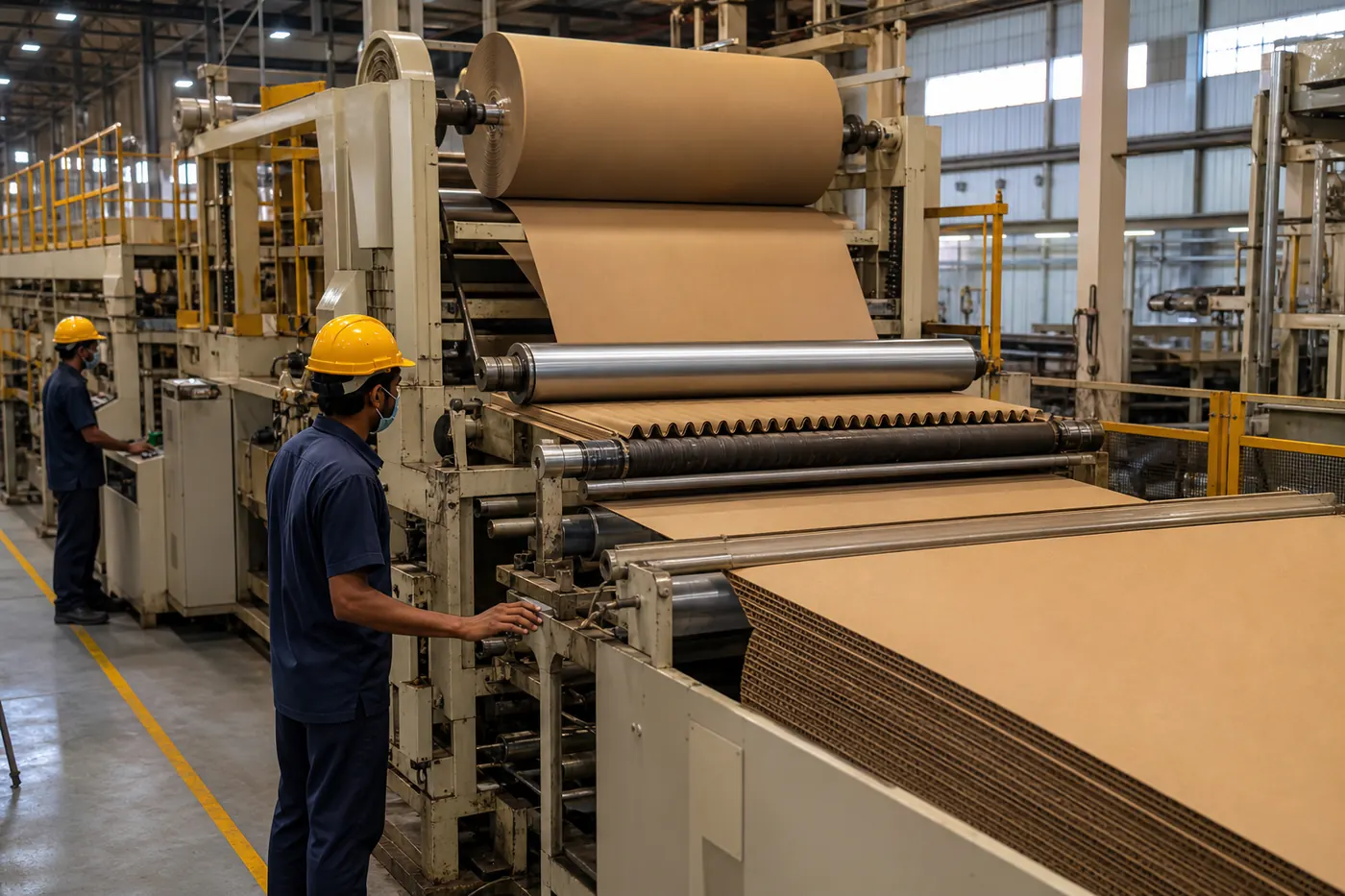
Paper liners and fluting medium are conditioned, corrugated with heat and adhesive, combined into board, slit and scored, printed, die-cut or slotted, folded, joined and bundled. Sustainability controls begin with paper purchase and mass balance, but converting yield, trim segregation, starch adhesive, ink, wash-up, energy, water, rejected board and transport also matter.
Map every site and subcontractor. A certified sheet plant may outsource printing or die cutting to an uncovered facility. Ask for bill-of-material mass, paper grade and claim, production yield, waste destination, energy boundary and calculation method. Site averages can guide improvement but should not be represented as product-specific footprints without an accepted allocation method.
Fiber and board design
Recycled fiber reduces demand for virgin material but repeated recycling shortens fibers, and recovered-paper quality varies. Virgin fiber can provide strength efficiently and, when responsibly sourced, support renewable forest supply. Optimize the blend against box performance rather than using an absolute rule that one input is always superior.
Functional-unit decision gate
Compare candidate constructions by board mass per safely delivered product, external cube, damage performance and documented fiber claim. Reject changes that save paper only by shifting waste or emissions elsewhere.
Printing, adhesive and finishing
Minimize unnecessary ink coverage, metallic effects, plastic films and hard-to-separate components. Water-based ink is not automatically harmless or universally recyclable. Obtain formulation and recycling evidence appropriate to the market. Design tear strips, labels and coatings so they do not defeat collection, sorting or repulping.
Recycled Content, Responsible Fiber and Chain of Custody
Define recycled content using an identified methodology and distinguish pre-consumer from post-consumer material. ISO 14021 supplies terminology for self-declared environmental claims; destination rules may be more specific. Verify numerator, denominator, dry or as-supplied basis, product scope, date and records. A mill average should not be silently converted into a guaranteed box percentage.
FSC and PEFC chain of custody can support eligible claims through certified organizations and transaction documents. Check official databases, legal entity, site, scope, product group, status, invoice wording and trademark approval. Certification is voluntary unless a customer contract requires it; it does not independently prove recycled percentage, legality in every jurisdiction, recyclability or low carbon.
Evidence required for common corrugated-fiber claims
Swipe →
Data table — swipe horizontally on small screens
| Claim | Minimum substantiation | Do not imply |
|---|---|---|
| X% recycled content | Defined calculation, input records, product scope | X% post-consumer unless proven |
| FSC/PEFC claim | Valid chain and transaction wording | All fiber is recycled |
| Responsibly sourced | Named standard and chain evidence | Zero deforestation without basis |
| Plastic-free | Complete component inventory and definition | No polymer in ink/adhesive without review |
Right-Sizing, Carbon and Weight Tradeoffs
Right-sizing begins with product dimensions, protection need, packing-line limits, order-profile variability and carrier rules. Measure box utilization, board grams per delivered unit, filler, pallet utilization, container cube, damage and returns. Reducing caliper without changing external dimensions may save fiber but not transport volume; reducing dimensions can improve both.
Carbon comparisons need a declared functional unit, boundary, geography, electricity, paper dataset, recycled-content approach, transport route, damage rate and end-of-life scenario. ISO 14040 and 14044 provide life-cycle-assessment principles; ISO 14067 addresses product carbon footprinting. Do not compare supplier numbers that use different boundaries. A precise-looking figure without methodology is not decision-grade evidence.
Pricing Analysis
Buyer Tip
Price depends on paper grade and mass, dimensions, flute combination, print, die and plate, order length, certification claim, testing, packing and Incoterm. Recycled board may cost less, the same or more depending on quality and availability; certified inputs can involve segregation and transaction requirements. Never promise a universal green premium.
There is no defensible universal Indian unit-price range: board weight, dimensions, print, order quantity, currency, paper market, tooling and included logistics can move quotations materially. Budget with dated, specification-matched supplier offers that separate tooling, tests, packing, inland freight, export charges, ocean freight, duty and tax; do not treat a web range or customs value per kilogram as a market price.
Commercial cost layers in sustainable corrugated sourcing
Swipe →
Data table — swipe horizontally on small screens
| Cost layer | Sustainability variable | Commercial control |
|---|---|---|
| Paper | Mass, recycled and certified claim | Same performance baseline |
| Conversion | Yield, colors, tooling | Separate one-time costs |
| Evidence | Tests, certificates, footprint work | Define deliverables |
| Freight | Bundle and container cube | Approved loading plan |
| Failure | Damage, returns and disposal | Track total delivered cost |
MOQ Analysis
Buyer Tip
MOQ comes from paper availability, corrugator width, print and die setup, certification claim segregation, dimensions and the ability to combine jobs. There is no universal numerical minimum. Ask separately for total-order, size, artwork, board-combination and claimed-material minimums, and rely only on a dated converter offer for the approved specification.
Pilot quantities should test filling, palletization, climate and delivery before scale. Consolidating dimensions, using common board grades and limiting print changes can lower setup waste and MOQ. Do not buy excess inventory merely to obtain a lower piece price; obsolescence is an environmental and financial cost.
Packaging Standards
Export Tip
This article does not duplicate the detailed standards and certification evaluation owned by our corrugated quality standards guide. For sustainability, packaging standards mean an approved material bill, dimensions, maximum mass, performance floor, restricted components, claim wording, recyclability design and data format. Physical quality remains essential because damage prevention is part of sustainability.
Approve a golden box and pallet pattern. State whether bundles use plastic wrap, paper bands, straps or pallets and substantiate any reduction claim against a dated baseline. ISPM 15 applies to regulated solid-wood packaging such as pallets, blocking and dunnage in international trade, subject to its exemptions; it does not apply to corrugated boxes or paper-based pallets merely because they are shipped internationally. “Zero packaging” is not credible when secondary materials are merely omitted from reporting.
Container Loading Details
Export Tip
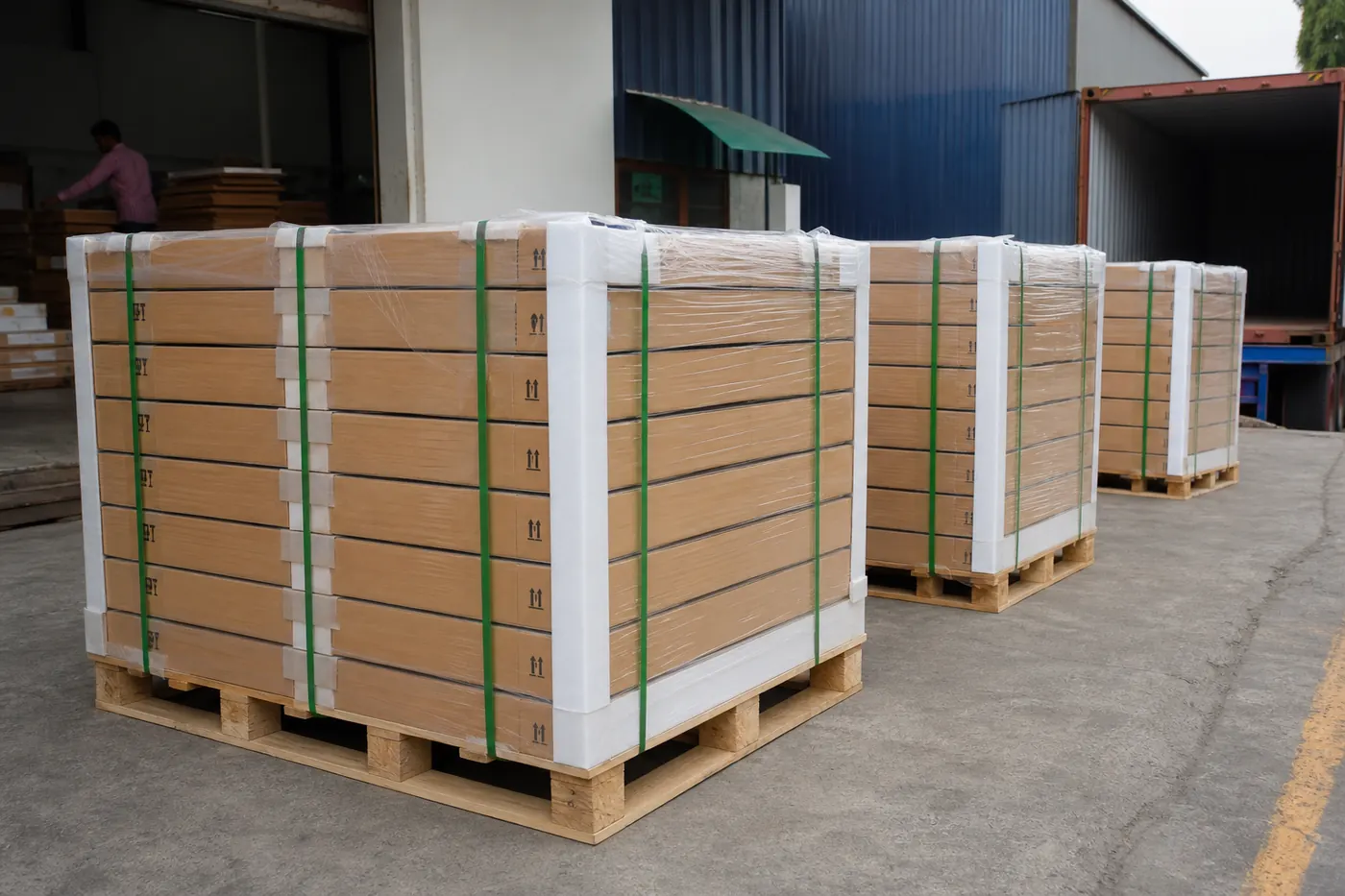
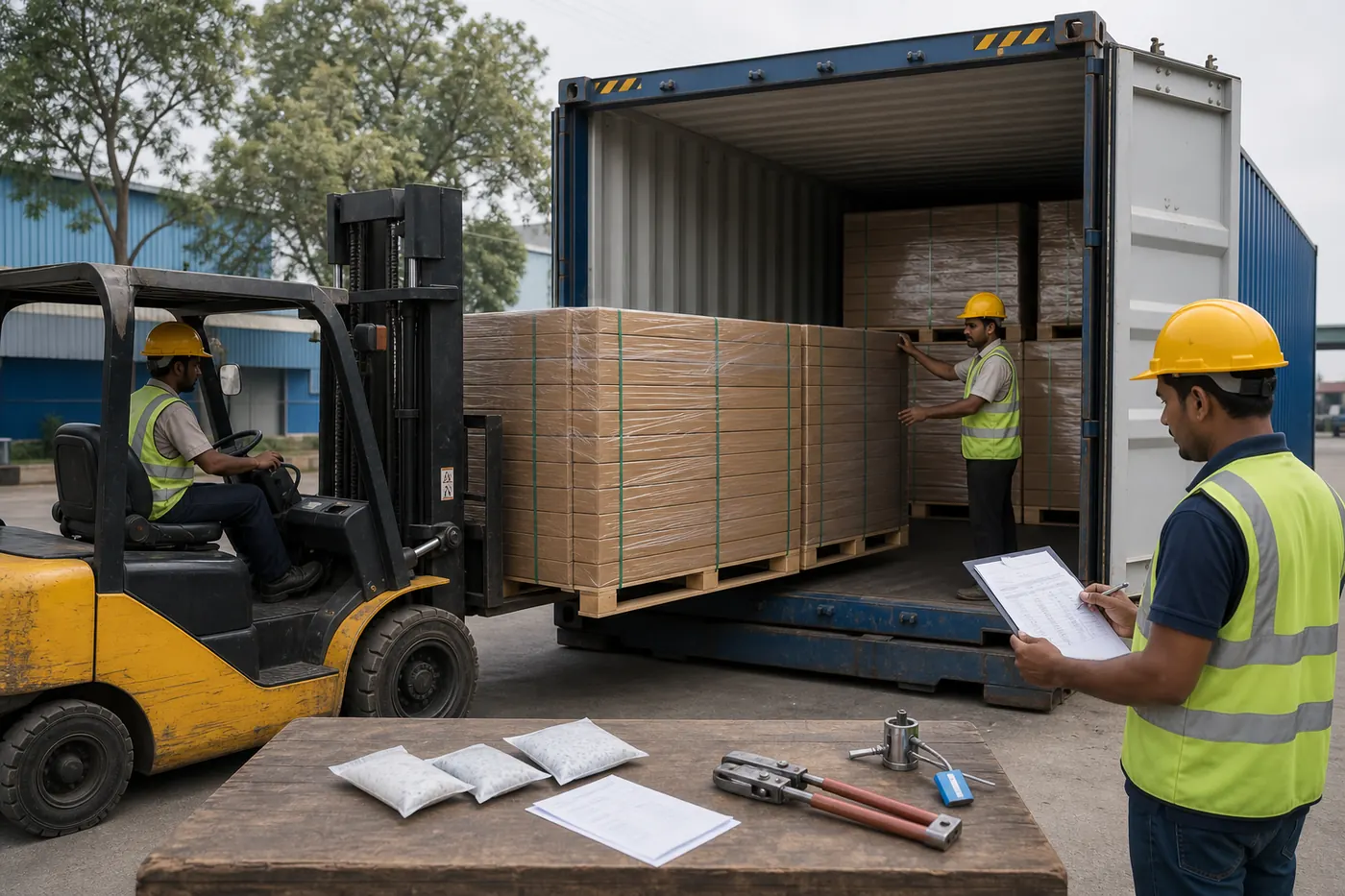
Knocked-down boxes are cube-limited. Measure the approved bundle's length, width, height and gross mass after compression recovery, then model pallet and floor loading. Verify 20-foot, 40-foot and 40-foot-high-cube internal limits with the carrier; nominal internet dimensions do not account for door clearance, pallets, stowage loss, route payload or moisture strategy.
Track boxes per bundle, bundles per pallet, pallets or bundles per container, cubic utilization and delivered damage. Compare direct shipment with local converting or shipping corrugated sheets only when technical and economic feasibility is real. Load dry cargo into a clean container, document condition and seal, and assess condensation controls without making unsupported “moisture-free” claims.
Measured inputs for corrugated-box container planning
Swipe →
Data table — swipe horizontally on small screens
| Loading input | Source | Sustainability use |
|---|---|---|
| Approved bundle cube | Physical measurement | Container utilization |
| Gross weight | Calibrated scale | Payload and emissions allocation |
| Pallet pattern | Load trial | Damage and handling |
| Route and equipment | Forwarder/carrier | Current transport model |
| Damage at receipt | Importer records | Continuous improvement |
Shipping Methods
Export Tip
Courier or air is appropriate mainly for samples because volumetric weight is costly. LCL supports pilots but adds handling and consolidation exposure. FCL can improve control and cube utilization for scale. Road or rail may suit regional lanes. Choose with current quotes, shipment size, damage risk, timing and measured emissions boundary—not a generic claim that one mode is always greenest.
State Incoterms® 2020 and the exact named place or port. FCA is usually a better fit than FOB when containerized cargo is handed to a carrier or terminal before loading aboard the vessel. FOB, CFR and CIF are sea/inland-waterway rules; under CIF the seller pays carriage and specified insurance to the named destination port, but risk transfers when the goods are on board at shipment, not at destination. Incoterms allocate specified tasks, costs and risk; they do not determine title or payment terms. DDP creates substantial import, tax and EPR questions and should be used only where legally operational.
Certifications
Compliance Notes
Sustainability evidence may include FSC or PEFC chain of custody, ISO 14001 environmental-management certification, recycled-content verification or a buyer audit. None is universally mandatory for corrugated boxes, and each has a limited scope. ISO 14001 addresses a management system, not a product footprint. Verify official status, site, scope, dates, issuer and transaction relevance.
Avoid badge collection. Build an evidence matrix around the destination, buyer and claim. The separate quality and certification article explains testing and supplier-certificate checks; this guide keeps focus on fiber, circularity, EPR and environmental communications.
Buyer Requirements
Buyer Requirements
Buyers should provide market role, annual box count and mass, material categories, product contact, artwork, claims, target recycled content, accepted chain claim, restricted components, EPR reporting fields and record-retention period. The importer should have counsel or its compliance provider approve destination obligations before artwork and shipment.
Buyer and supplier data responsibilities
Swipe →
Data table — swipe horizontally on small screens
| Requirement | Buyer input | Supplier output |
|---|---|---|
| Functional | Product, route, damage limit | Drawing and validated box |
| Material | Fiber and component policy | Bill of materials and records |
| Circularity | Collection/recycling market | Design rationale and evidence |
| EPR | Country data schema | Mass by material and shipment |
| Claims | Approved wording | Substantiation file |
EPR, PPWR and Country Compliance
Extended producer responsibility usually places registration, reporting and financing duties on defined producers or obligated businesses placing packaging on a market. Responsibility can depend on brand ownership, importation, distance selling, turnover and country thresholds. A factory's statement cannot determine the importer's legal role.
The EU Packaging and Packaging Waste Regulation, Regulation (EU) 2025/40, entered into force on 11 February 2025 and generally applies from 12 August 2026, with later provision-specific dates and implementing measures. It introduces requirements across packaging minimization, recyclability, labeling, reuse and EPR. Its mandatory recycled-content percentages concern relevant plastic packaging; it does not impose a blanket minimum recycled-fibre percentage on corrugated boxes. EPR registration and administration remain organized through Member States, so there is no single EU-wide producer registration. Buyers must map the current text and each national scheme to their role; do not reduce PPWR to a single “certificate.”
India's waste-paper and packaging framework, destination EPR regimes, the UK packaging rules, U.S. state EPR laws and Canadian provincial programs differ. Confirm effective dates and thresholds from government authorities. Customs duties likewise depend on the national extension of HS 481910, origin and entry date. As of July 17, 2026, the U.S. Section 122 measure adds a temporary 10% ad valorem surcharge to covered imports through 12:01 a.m. EDT on July 24, 2026, subject to exclusions or change; it is not a permanent HS 481910 rate. Ask the importer's broker for written classification, ordinary duty and any Chapter 99 treatment.
Country-wise Opportunities
Market Snapshot
Country opportunities and compliance checks
Swipe →
Data table — swipe horizontally on small screens
| Market | Opportunity hypothesis | Priority check |
|---|---|---|
| European Union | Right-sized, data-rich fiber boxes | PPWR timeline, EPR and claims |
| United Kingdom | Retail and e-commerce optimization | UK EPR data and Green Claims Code |
| United States | State-specific circular packaging | State EPR and FTC/state claims |
| Canada | Retail and provincial recovery programs | Province-specific producer role |
| Gulf markets | Food, appliance and export cases | Local recovery reality and heat |
| Regional South Asia | Shorter lanes and industrial supply | Origin, duty and local collection |

Sourcing Checklist
Checklist
- Define functional unit: one product safely delivered through the named route.
- Measure current dimensions, board mass, void fill, damage and loadability.
- Issue a corrugated-box drawing and performance floor.
- Specify recycled-content methodology and chain claim separately.
- Map every converter, printer and subcontractor.
- Request material, yield, waste and energy evidence with boundaries.
- Prototype, pack, palletize and test the actual configuration.
- Calculate landed cost and emissions on comparable assumptions.
- Approve EPR data fields and claims before printing.
- Retain shipment, transaction and substantiation records.
Buyer Checklist
Checklist
- [ ] Destination producer role assessed
- [ ] HS and duty confirmed by broker
- [ ] EPR registrations and data owners assigned
- [ ] Drawing and packed-product baseline approved
- [ ] Recycled and chain claims defined
- [ ] Recyclability assessed in target market
- [ ] Carbon boundary and functional unit disclosed
- [ ] Artwork and qualifications legally reviewed
- [ ] Receiving damage and cube measured
Exporter Checklist
Checklist
- [ ] Indian legal entity and IEC current
- [ ] Production and subcontract sites disclosed
- [ ] Paper invoices and chain claims reconciled
- [ ] Bill of materials and box mass recorded
- [ ] Approved sample and inspection complete
- [ ] Invoice, packing list and shipping bill aligned
- [ ] Origin and transaction evidence prepared
- [ ] Bundle, load and seal records retained
Compliance Checklist
Checklist
Compliance Notes
- [ ] PPWR or destination rules mapped by effective date
- [ ] National EPR thresholds and market role checked
- [ ] Food-contact use assessed where relevant
- [ ] Recycled-content calculation documented
- [ ] FSC/PEFC wording and trademark use authorized
- [ ] Recyclability claim qualified to available systems
- [ ] Comparative and carbon claims use like-for-like methods
- [ ] Records retained for regulator and customer review
Common Buyer Mistakes
Common Mistakes Box
- Selecting the lowest box weight without measuring damage.
- Equating recycled content with recyclability.
- Treating an FSC or PEFC logo as a carbon claim.
- Using a mill average as a guaranteed SKU percentage.
- Comparing footprints with different boundaries.
- Ignoring inks, labels, tape, coatings and adhesives.
- Shipping excess cube to achieve a low factory price.
- Assuming the Indian exporter owns destination EPR duties.
- Printing “100% recyclable” without local-system evidence.
- Buying excess MOQ that becomes obsolete.
Challenges & Solutions
Sustainable corrugated-box challenges and controls
Swipe →
Data table — swipe horizontally on small screens
| Challenge | Commercial consequence | Solution |
|---|---|---|
| Variable recovered paper | Strength and appearance shifts | Performance floor and incoming control |
| Weak claim evidence | Regulatory and reputation risk | Claim register and approval gate |
| Over-lightweighting | Damage and returns | Packed-system trials |
| Incomparable carbon data | False supplier ranking | Common boundary and functional unit |
| Fragmented EPR data | Late or inaccurate reports | Shipment-level mass schema |
Expert Insights from Saurabh Mittal
Expert Insight Box
Future Market Trends
Key Statistics
Expect more packaging minimization, structured recyclability assessment, digital material data, audited claim governance and buyer requests for product-level carbon information. EU PPWR implementation will influence multinational specifications beyond Europe, but requirements and dates must be read from official texts rather than copied from summaries.
Commercially, design libraries, variable-depth boxes, better packing data and damage analytics may reduce material and freight simultaneously. Fiber competition and recovered-paper quality will keep performance engineering important. Claims will become more specific: buyers should prepare to state what is measured, where it applies and what remains uncertain.
Conclusion
Sustainable corrugated packaging is not a material slogan. It is a controlled balance of protection, fiber, dimensions, manufacturing yield, shipping cube, recovery infrastructure, legal duties and truthful communication. Start with measured current performance, change one defensible variable at a time and retain the evidence.
Connect sustainability decisions to the corrugated specifications guide, quality and certification guide, wholesale pricing analysis and container-loading guide. These links help procurement teams test whether a lighter, certified or more recyclable design still protects the product, fits the budget and travels efficiently.
To source corrugated boxes from India, contact Altus Exports with destination, product and packed weight, dimensions, annual volume, distribution route, current damage rate, fiber policy, EPR fields and delivery window. Review our global sourcing service, merchant exporter model and import-from-India support.
References
- EUR-Lex, Regulation (EU) 2025/40 (PPWR): https://eur-lex.europa.eu/eli/reg/2025/40/oj
- European Commission, packaging waste: https://environment.ec.europa.eu/topics/waste-and-recycling/packaging-waste_en
- ISO, ISO 14021 environmental claims: https://www.iso.org/standard/66652.html
- ISO, life-cycle assessment standards: https://www.iso.org/standard/37456.html
- FSC certificate search: https://search.fsc.org/
- PEFC Find Certified: https://www.pefc.org/find-certified
- UK Competition and Markets Authority, Green Claims Code: https://greenclaims.campaign.gov.uk/
- U.S. FTC Green Guides: https://www.ftc.gov/business-guidance/resources/green-guides
- UN Comtrade, HS 481910: https://comtradeplus.un.org/
- World Bank WITS: https://wits.worldbank.org/
- India Central Pollution Control Board, EPR portals and guidance: https://cpcb.nic.in/
- ICC Incoterms rules: https://iccwbo.org/business-solutions/incoterms-rules/
- IPPC, ISPM 15 regulated wood packaging material: https://www.ippc.int/en/publications/640/
- White House, temporary Section 122 import surcharge proclamation: https://www.whitehouse.gov/presidential-actions/2026/02/imposing-a-temporary-import-surcharge-to-address-fundamental-international-payments-problems/
Authorities and scheme pages accessed July 17, 2026. Check current consolidated law, guidance and scheme rules before contracting or making claims.