
Corrugated Box Import Markets: HS 481910 Country Opportunity Guide
By Saurabh Mittal, Founder, Altus Exports
A data-led market-screening guide for importers and corrugated-box exporters comparing HS 481910 demand, access, compliance, competition, and landed economics.

## Introduction The best corrugated box import markets are not automatically the countries with the highest customs value. Corrugated cartons are lightweight, bulky, widely produced locally, and often bought on short replenishment cycles. An attractive market therefore combines addressable import demand with a suitable product niche, manageable freight cube, credible buyer channels, acceptable duty and compliance, and an Indian supply proposition that local converters or nearer exporters do not already satisfy.
This guide helps international buyers, importers, distributors, wholesalers, retail chains, packaging companies, and export teams screen countries using HS 481910. It separates official trade observations from commercial hypotheses, explains top-importer data, proposes a transparent scoring method, and covers opportunities, duties, packaging rules, MOQ, pricing, shipping, lead times, Incoterms, and buyer requirements. It does not present customs statistics as forecasts or supplier quotations.
Introduction
This market-research guide uses HS 481910 reporter data as a starting point, then adds product, route, competition, duty, compliance, channel, and execution filters. It is designed to move procurement and export teams from a country ranking to an evidence-based corrugated-box market-entry decision.
Executive Summary
Summary Box
WITS, using UN Comtrade reporter data, lists 2024 HS 481910 imports of US$856.101 million for the Netherlands, US$788.089 million for Mexico, US$747.204 million for the United States, US$601.675 million for the European Union aggregate, US$597.954 million for Canada, US$578.183 million for France, US$568.272 million for Germany, US$331.145 million for the United Kingdom, and US$91.782 million for Australia. The EU aggregate overlaps member states and must never be added to them.
India's exact 2024 HS 481910 exports were US$55,789,994.973 and 38,399,014.872 kilograms; WITS marks the world net weight as estimated. Destinations included the United States at US$11.2871 million, UAE at US$6.8296 million, United Kingdom at US$3.3456 million, Nepal at US$2.6661 million, Netherlands at US$2.2474 million, and Australia at US$1.9146 million. These figures demonstrate active lanes, not supplier share, demand forecasts, prices, or profitability.
Market Size & Industry Overview
Key Statistics
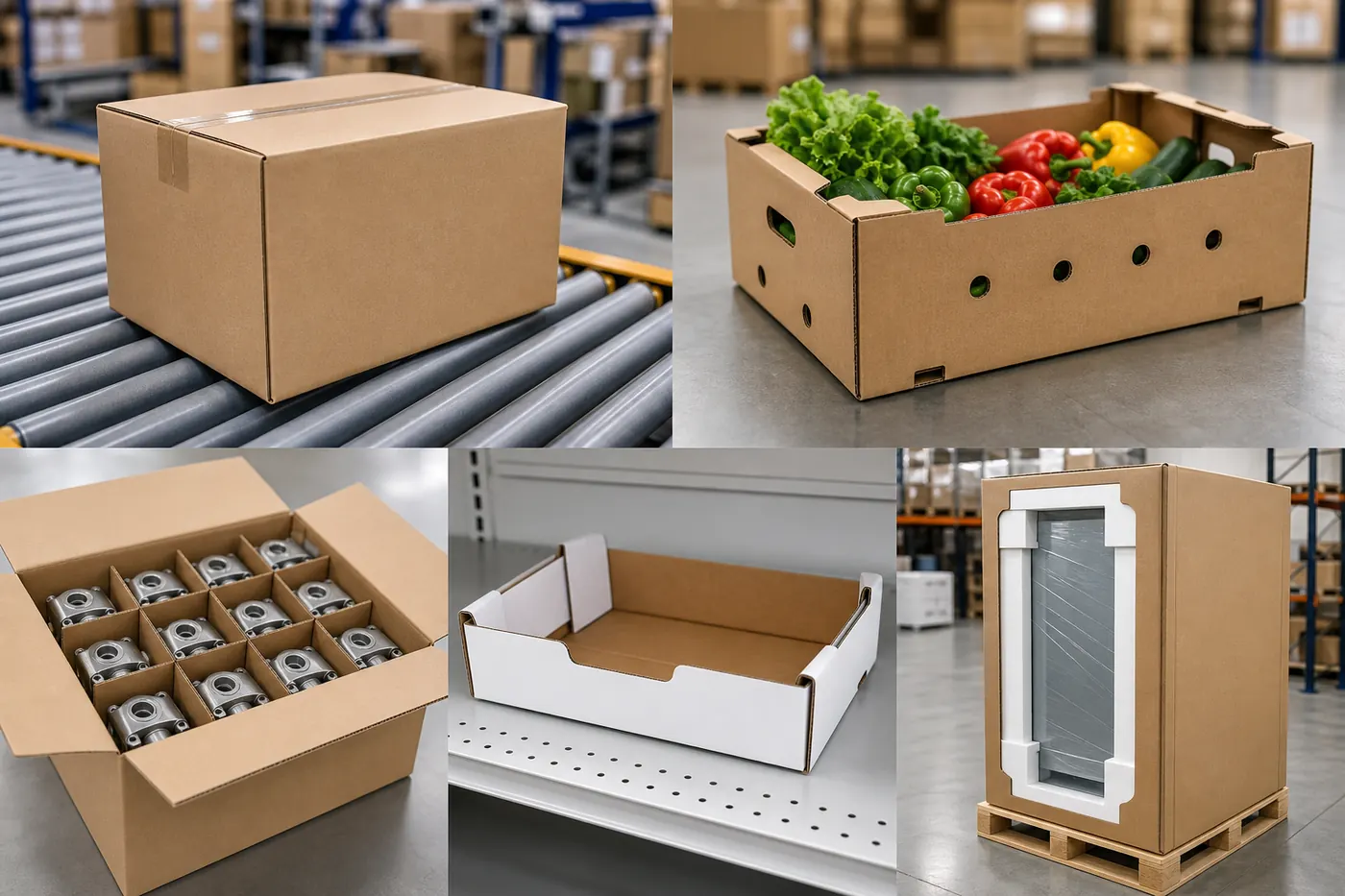
HS 481910 covers cartons, boxes, and cases of corrugated paper or paperboard at six digits. It does not distinguish RSCs from die-cut mailers, shelf-ready trays, printed retail boxes, produce cases, heavy-duty double-wall cases, or a specific flute. It also does not reveal whether boxes were shipped flat, sold with another service, imported temporarily, or moved between affiliated plants. Consequently, HS value is a broad cross-border market indicator—not the size of all domestic corrugated consumption.
Corrugated supply remains regional because converting plants can source paper, run short lead times, and deliver erected or flat boxes by road. Cross-border movements are especially visible between neighboring economies and within integrated manufacturing regions. The Netherlands' ranking may reflect its logistics and distribution role; Mexico, Canada, and the United States exchange packaging inside North American supply chains; and European members trade heavily with each other. Long-haul Indian supply needs a differentiated reason to win.
International opportunities can arise in custom print, labor-intensive hand assembly, specialty die cuts, certified-fiber programs, coordinated packaging for goods already sourced in India, disaster or peak-capacity supply, and markets with limited local converting depth. Buyers should read Corrugated Box Types and Specifications before comparing market offers, because data does not normalize flute, wall construction, ECT, BCT, Cobb, burst, printing, or tolerances.
Market-screening signals and cautions when interpreting corrugated-box import demand.
Swipe →
Data table — swipe horizontally on small screens
| Market characteristic | Positive signal | Caution |
|---|---|---|
| Large reported imports | Established cross-border procurement | May be dominated by neighbors or intra-company trade |
| India already supplies | Lane and product precedent | Value may be concentrated in few buyers |
| High unit-value indicator | Possible specialty mix | Quantity and valuation can be inconsistent |
| Low local converting depth | Supply gap may exist | Freight, FX, credit, and port risks may rise |
| Strong retail/e-commerce | Printed and right-sized formats | Domestic converters often respond quickly |
Trade Data Method and HS 481910 Scope
How to use HS 481910 data fields without overstating what customs records prove.
Swipe →
Data table — swipe horizontally on small screens
| Data field | Use | Do not infer |
|---|---|---|
| Reporter import value | Scale of declared inbound trade | Domestic market size or buyer margin |
| Quantity in kilograms | Broad physical-flow context | Number of boxes or converted area |
| Partner share | Supply concentration and route precedent | Supplier capability or origin preference |
| Growth over years | Direction requiring investigation | Forecast without checking breaks/revisions |
| Value/kg | Mix and anomaly screening | FOB quote or manufacturing cost |
Reporter years and units
The analysis uses WITS pages sourced from UN Comtrade for calendar 2024: global importer rows, India-reported exports by destination, and United States reporter imports as a country example. Access date is July 17, 2026. Values displayed in millions are rounded from source values; India's exact world value and estimated net weight are retained where material.
Rules for displaying the data
- Keep reporter, flow, partner, year, and HS scope visible.
- Round display values without inventing missing quantities.
- Do not add the EU aggregate to overlapping member-state rows.
Valuation and mirror-data cautions
Gross imports and exports are not net consumption. Import values may include cost, insurance, and freight under national conventions, while export values are commonly closer to free-on-board valuation. Re-exports, partner attribution, exchange rates, timing, classification, confidentiality, and revisions create asymmetry. Value per kilogram is only an arithmetic customs indicator; it is not a corrugated-box price because product mix, print, board weight, and valuation differ.
Export Statistics
Key Statistics
India reported US$55,789,994.973 and 38,399,014.872 kilograms of HS 481910 exports to the world in 2024; WITS identifies the world net weight as estimated. The United States led by value at US$11.2871 million, followed by the UAE at US$6.8296 million, United Kingdom at US$3.3456 million, Nepal at US$2.6661 million, Netherlands at US$2.2474 million, and Australia at US$1.9146 million. These customs observations are not forecasts.
Exporter and importer records differ. For example, the United States reported US$13.143 million and 5.222 million kilograms imported from India in 2024, while India reported US$11.287 million and 5.454 million kilograms exported to the United States. Differences of this kind are normal and can reflect valuation, timing, partner assignment, and revisions. Analysts should preserve the reporter perspective instead of silently merging the two.
India-reported HS 481910 exports, calendar 2024; WITS/UN Comtrade.
Swipe →
Data table — swipe horizontally on small screens
| Destination | Value, USD million | Quantity, million kg | Commercial reading |
|---|---|---|---|
| World | 55.790 | 38.399 | Overall Indian export base |
| United States | 11.287 | 5.454 | Largest Indian destination by reported value |
| United Arab Emirates | 6.830 | 6.681 | Strong regional lane and volume |
| United Kingdom | 3.346 | 1.869 | Established but compliance-intensive lane |
| Nepal | 2.666 | 0.844 | Neighboring-market logistics advantage |
| Netherlands | 2.247 | 1.077 | EU entry/distribution relevance |
| Australia | 1.915 | 1.304 | Long-haul specialty potential |
Trade Statistics
Key Statistics
Trade statistics in this article use 2024 global-importer, India-exporter, and United States-importer reporter views. Exporter and importer perspectives remain separate. HS 481910 values and kilograms describe a broad corrugated-carton, box, and case category; they do not identify box count, converted area, flute, print, strength, buyer, supplier, price, or margin.
Import Statistics
Key Statistics
The 2024 WITS global importer table reports the Netherlands at US$856.101 million, Mexico at US$788.089 million, United States at US$747.204 million, EU aggregate at US$601.675 million, Canada at US$597.954 million, France at US$578.183 million, Germany at US$568.272 million, United Kingdom at US$331.145 million, and Australia at US$91.782 million.
Quantity reporting and revisions can vary, so this table does not invent or carry forward uncertain quantities. The EU aggregate overlaps national rows and must never be added to member reporters. Use a multi-year download and inspect metadata before investment decisions; gross imports are not consumption or addressable demand.
Leading reporter rows for HS 481910 imports, calendar 2024; EU overlaps member states.
Swipe →
Data table — swipe horizontally on small screens
| Reporter | Value, USD million | Quantity, million kg | Interpretation caution |
|---|---|---|---|
| Netherlands | 856.101 | Not reproduced | Logistics hub and intra-European trade may matter |
| Mexico | 788.089 | Not reproduced | North American regional supply chains |
| United States | 747.204 | 344.218 | Large market with strong domestic and neighboring supply |
| European Union aggregate | 601.675 | Not reproduced | Overlaps member reporters; never add to members |
| Canada | 597.954 | Not reproduced | North American cross-border flows |
| France | 578.183 | Not reproduced | EU member; do not add EU aggregate |
| Germany | 568.272 | Not reproduced | EU member; do not add EU aggregate |
| United Kingdom | 331.145 | Not reproduced | Separate post-Brexit regime |
| Australia | 91.782 | Not reproduced | Long-haul lane and strong local competition |
Import Data Analysis
The United States illustrates concentration. Its 2024 HS 481910 imports were US$747.204 million, led by Canada at US$224.762 million, China at US$166.976 million, Mexico at US$156.389 million, Türkiye at US$57.906 million, and Vietnam at US$39.173 million. India ranked behind those suppliers at US$13.143 million. The opportunity is real, but Indian suppliers compete against adjacent countries, established Asian sources, and extensive US converting capacity.
The Netherlands' large 2024 import value should trigger partner, quantity-quality, hub, and product-mix investigation, not a claim about Dutch box prices or consumption. Mexico's high imports coexist with strong manufacturing and proximity to US supply, suggesting integrated industrial flows. Germany, France, Belgium, and other European reporters similarly reflect dense regional trade. Market selection must inspect partners, products, and buyers beneath the headline.
United States-reported HS 481910 imports, calendar 2024.
Swipe →
Data table — swipe horizontally on small screens
| Origin | Value, USD million | Quantity, million kg | Competitive implication |
|---|---|---|---|
| World | 747.204 | 344.218 | Large addressable import flow |
| Canada | 224.762 | 111.699 | Proximity and integrated supply |
| China | 166.976 | 65.940 | Established long-haul competitor |
| Mexico | 156.389 | 76.901 | Nearshore scale and road logistics |
| Türkiye | 57.906 | 35.702 | Meaningful overseas position |
| Vietnam | 39.173 | 25.062 | Asian competition |
| India | 13.143 | 5.222 | Existing foothold requiring differentiated growth |
Market Scoring Framework
A transparent score prevents procurement teams from chasing value rankings alone. Score each criterion from one to five using documented evidence, multiply by the stated weight, and retain notes. The sample weights below are a planning template, not a statistically validated model. Buyers may raise compliance weight for food or regulated goods, while exporters may raise payment and route reliability for new distributor markets.
A high score authorizes deeper diligence, not entry. Stage two should identify importer names, channels, specifications, local price architecture, supplier shares, duty, packaging EPR, port and inland costs, and payment practices. Stage three requires buyer interviews and a landed quotation. Stage four is a sample and pilot. A country that fails margin or compliance review should not advance merely because customs imports are large.
Illustrative weighted scorecard for prioritizing corrugated-box import markets.
Swipe →
Data table — swipe horizontally on small screens
| Criterion | Weight | Score 1 | Score 5 |
|---|---|---|---|
| Addressable import demand | 20% | Small/volatile after adjustment | Large, stable, relevant niche |
| India traction | 15% | No verified lane | Material, diversified Indian supply |
| Freight and route fit | 15% | Cube-costly/unreliable | Competitive and predictable |
| Competition gap | 15% | Commodity market locked by local supply | Differentiated unmet need |
| Duty and compliance | 15% | High burden/uncertain | Clear, manageable access |
| Buyer/channel fit | 10% | No identified targets | Qualified repeat-volume pipeline |
| Commercial risk | 10% | FX/payment/political risk high | Bankable and stable |
Product Categories / Variants
Summary Box
Market analysis becomes actionable only when linked to corrugated-box variants. Commodity RSCs tend to reward proximity and rapid replenishment. Printed die-cut retail boxes, shelf-ready trays, mailers, telescopic formats, and coordinated inserts may support longer-distance sourcing because design, print, tooling, or labor contribute more value. Heavy-duty double- or triple-wall cases can serve industrial needs but consume container cube and require rigorous performance validation.
Define the actual HS scope with the customs broker. Corrugated sheets, non-corrugated folding cartons, molded pulp, paper sacks, wooden cases, plastic totes, and packaging services are not interchangeable with HS 481910. A display with permanent fittings or a composite pack may require separate analysis. Product selection guidance belongs in Corrugated Box Types and Specifications.
Corrugated-box variants, cross-border sourcing rationales, and evidence needed before market entry.
Swipe →
Data table — swipe horizontally on small screens
| Variant | Cross-border rationale | Main market evidence |
|---|---|---|
| Plain RSC | Scale, emergency capacity, consolidation | Landed cost and replenishment advantage |
| Printed RSC | Brand consistency and volume | Color, rub, barcode, print economics |
| Die-cut mailer | Design and consumer experience | E-commerce buyer pipeline and DIM weight |
| Shelf-ready tray | Retail labor and presentation | Retailer manual and shelf dimensions |
| Produce/food case | Ventilation and wet performance | Food-contact and cold-chain protocol |
| Heavy-duty case | Industrial protection | BCT, route test and unit-load engineering |
Product Overview
Summary Box
The product in this market analysis is a corrugated carton, box, or case potentially classified under HS 481910—not corrugated sheet, folding carton, molded pulp, paper sack, plastic tote, or wooden case. Relevant variants include plain and printed RSCs, die-cut mailers, retail-ready trays, produce cases, telescopic boxes, and heavy-duty cases. Classification and opportunity must be confirmed from actual construction and use.
Manufacturing Overview
Export Tip
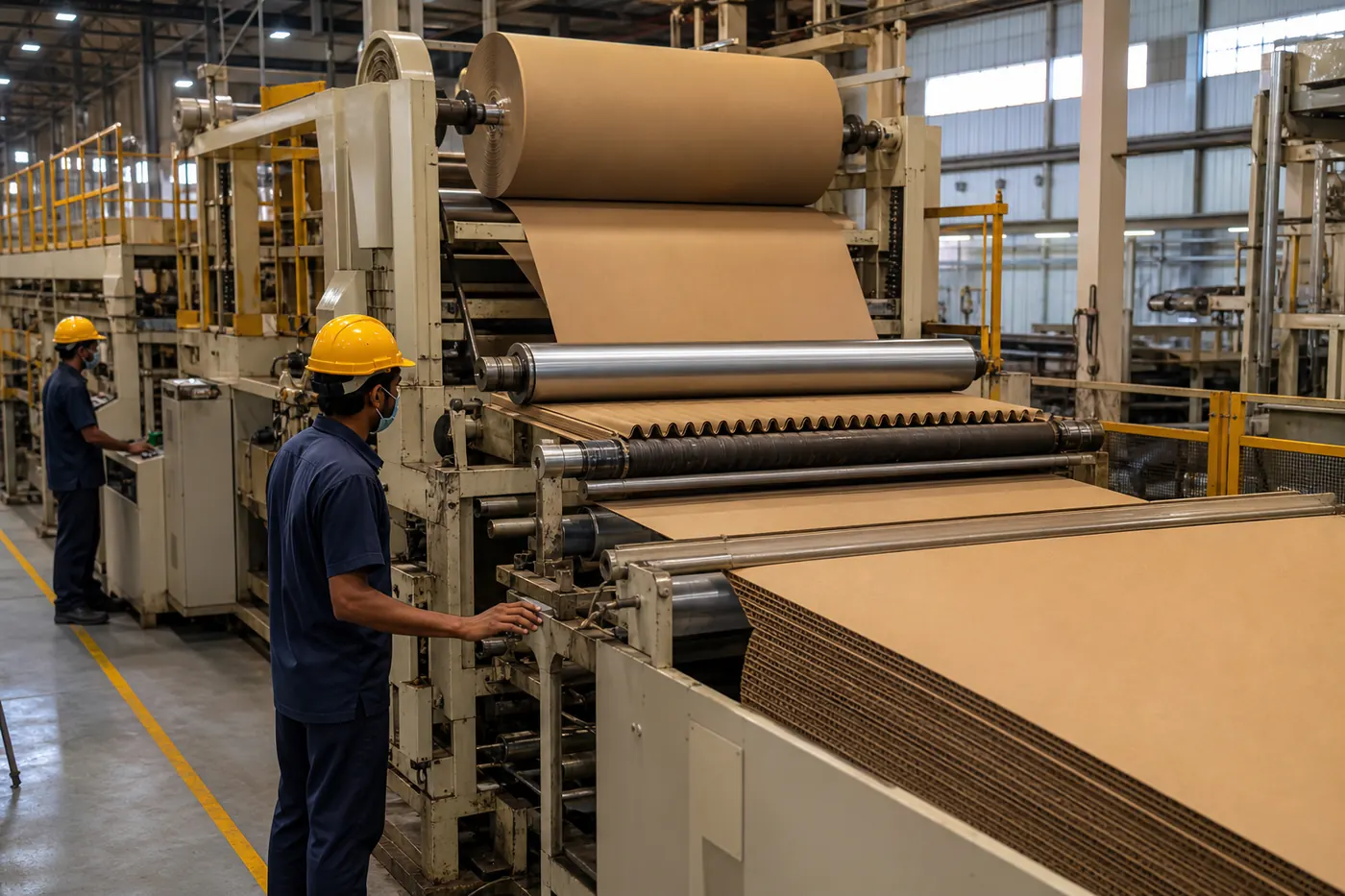
Indian production normally begins with liner and corrugating medium, which are conditioned, corrugated with heat and steam, bonded with starch adhesive, dried, scored, and slit. Board then moves through flexographic printing, slotting, rotary or flatbed die cutting, folding, gluing or stitching, inspection, counting, and bundling. Litho-laminated work adds printed sheets and lamination; digital print may support development or shorter runs depending on equipment and economics.
Market fit depends on plant capability: corrugator width and flute sets, board combination, print colors, registration, die-cut bed, gluing, laboratory, paper traceability, food-packaging controls where needed, and capacity available in the required window. Ask where every process occurs and whether paper, printing, coating, or die cutting is subcontracted. Use Corrugated Box Manufacturers in India for factory evaluation.
Export Process
Export Tip
The export process begins with country and buyer qualification, followed by a signed corrugated-box specification, supplier due diligence, comparable quotations, CAD fit samples, production-equivalent print and board approval, and a pilot order. Bulk controls cover paper traceability, flute and bond, dimensions, print, joints, performance tests, bundle counts, inspection, and change approval.
Shipment release should reconcile commercial invoice, packing list, shipping bill, certificate of origin where required, bill of lading or air waybill, test and inspection evidence, preference documents when valid, and buyer declarations. Loading records should show container condition, measured packs, tally, orientation, seal, and handoff. See Corrugated Box Export Documentation for the detailed document workflow.
Pricing Analysis
Buyer Tip
Price per box cannot be compared across markets without inside dimensions, board construction, paper grammages, flute, converted area, print, joint, strength, tolerances, packing, and Incoterm. Paper, recovered fiber, energy, starch, labor, tooling, waste, finance, inland haulage, ocean freight, destination fees, duty, taxes, inventory, and damage all affect landed cost. An arithmetic customs value per kilogram is not a current supplier price.
For a market study, collect dated EXW, FCA or FOB India, CIF named port, and buyer-landed scenarios against one specification. Use current forwarder and broker quotes. Indicative sensitivity ranges—not predicted prices—might test freight at ±20%, exchange rate at ±5%, paper cost at ±10%, and volume at three quote tiers. These are analyst-selected stress cases and must not be described as observed volatility. See Corrugated Box Wholesale Pricing in India.
Landed-cost layers and frequent comparison errors in corrugated-box market studies.
Swipe →
Data table — swipe horizontally on small screens
| Landed-cost layer | Required input | Common error |
|---|---|---|
| Box conversion | Approved drawing and quantity | Comparing unequal board/print |
| Tooling/setup | Plate, die, proof, amortization | Hiding one-time charges in units |
| Export packing | Bundle/pallet dimensions | Ignoring protective packing cube |
| Freight | Current route/equipment quote | Using freight per kilogram for cube cargo |
| Import | Tariff, origin, broker, tax | Assuming one duty worldwide |
| Inventory/risk | Lead time, damage, working capital | Ignoring local-response advantage |
MOQ Analysis
Buyer Tip
MOQ follows paper and converting economics rather than a country average. A plant's standard plain RSC may permit a lower test quantity than a custom six-color litho-laminated die-cut box. Printing plates, die tools, paper minimums, corrugator setups, glue, sorting, and separate SKU bundles create fixed cost. Buyers should request total-order, design, board, print, size, and delivery minimums and ask whether quantities can be consolidated.
For market validation, request tiered quotations—illustratively 1,000, 5,000, and 25,000 units per SKU—without calling those levels normal or guaranteed. A pilot should be large enough to use production equipment and validate packing, transit, customs, receiving, and customer response. Negotiate tooling ownership, repeat MOQ, forecast releases, call-off storage, excess material, and obsolete-artwork responsibility in writing.
Packaging Standards
Export Tip
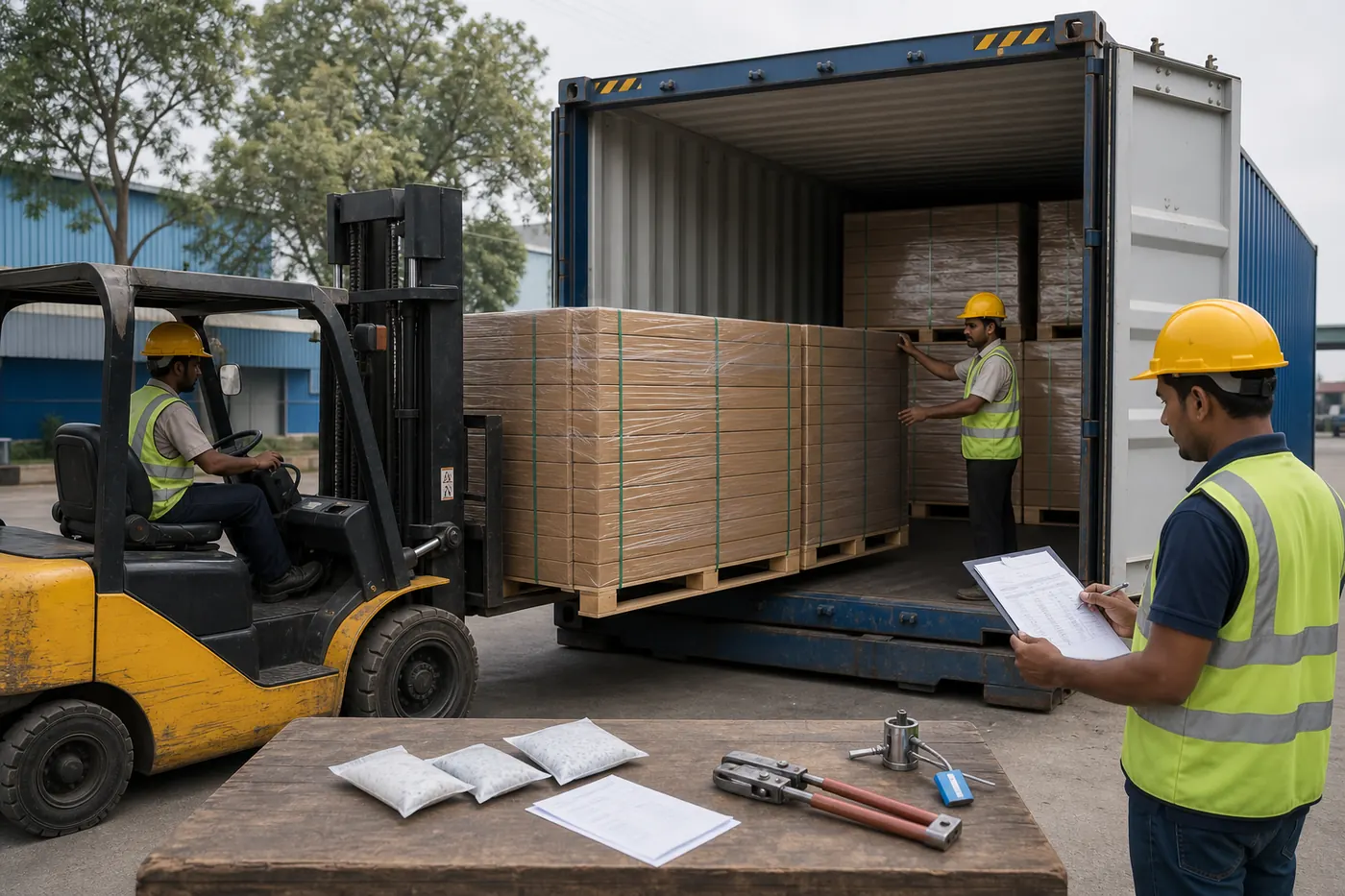
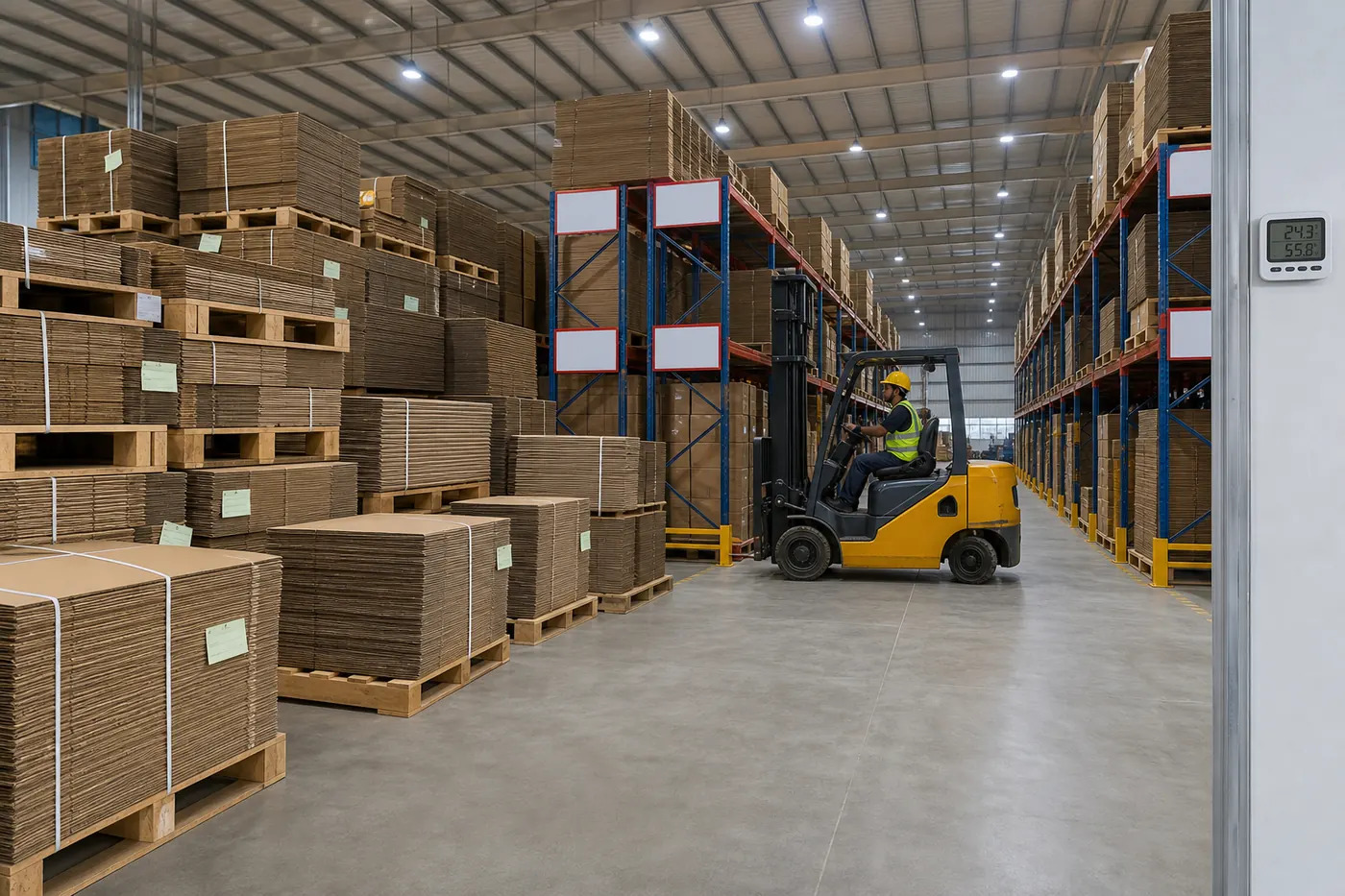
Corrugated boxes for export are themselves cargo. They are generally shipped flat in counted bundles, restrained without crushed edges, protected from dust and rain, and marked by SKU, dimensions, count, batch, and handling information. Floor loading maximizes cube but increases manual handling; palletization can improve handling and receiving while consuming cube and requiring a destination-compatible pallet. Final measured bundles—not CAD dimensions—drive freight.
Destination packaging rules still apply to the export pack. Regulated solid-wood pallets and dunnage generally require ISPM 15 compliance. Plastic wrap, straps, pallets, and protective components may create packaging EPR reporting or fees. Claims such as recyclable, recycled content, FSC, compostable, or food-safe need applicable evidence. Packaging standards and claims should be approved before printing and dispatch.
Container Loading Details
Export Tip
Corrugated blanks are usually constrained by cubic volume before payload. Model a 20-foot, 40-foot, or 40-foot high-cube container from measured bundle length, width, height, compressibility, stack limit, loading clearance, pallet footprint, door opening, and the booked carrier's equipment sheet. Carrier examples commonly publish nominal internal volumes around 33, 67, and 76 cubic metres respectively, but dimensions, payload and usable cube vary by fleet, container, stowage, route, and pack geometry; no capacity is guaranteed.
A pre-shipment load plan should state bundle orientation, tiers, void control, aisle needs, palletization, desiccant strategy where justified, and unloading method. Inspect the container for holes, odor, contamination, wet floor, protrusions, and door function; photograph loading and seal. Moisture risk depends on paper moisture, ambient conditions, temperature change, voyage, and ventilation. Corrugated Box Container Loading and Shipping provides the full workflow.
Floor-loaded and palletized corrugated-box container plans compared for cube, handling, and compliance.
Swipe →
Data table — swipe horizontally on small screens
| Load decision | Floor-loaded | Palletized |
|---|---|---|
| Cube use | Usually higher | Usually lower |
| Handling | More manual touches | Forklift-friendly where compatible |
| Edge protection | Depends on tier discipline | Depends on pallet fit and wrap |
| Receiving speed | Potentially slower | Potentially faster |
| Wood compliance | No wood if no dunnage | ISPM 15 review for solid wood |
| Decision evidence | Labor, damage and count trial | Pallet, stack and warehouse trial |
Shipping Methods
Export Tip
FCL ocean freight usually fits recurring volume because it reduces co-loading touches and allows a controlled load plan. LCL can support pilots but adds handling, consolidation, deconsolidation, and moisture exposure. Air or courier generally belongs to samples, urgent tooling references, or very small high-value packs because empty boxes have poor value-to-volume economics. Road and short-sea options may dominate neighboring markets such as Nepal or nearby regional routes.
State Incoterms® 2020 and the named place. EXW can place origin clearance and loading complexity on an overseas buyer; FCA may provide a clearer handoff for containerized cargo; FOB is commonly discussed for port shipments but must be applied correctly; CIF adds seller-arranged freight and minimum insurance to the named port while leaving destination costs; DDP requires the seller to manage import, tax, and regulatory obligations and is not always lawful or practical.
Indicative workflow planning might allow one to two weeks for commercial and sample development, two to six weeks for approved bulk production, and route-specific transit and clearance. These are broad scenarios, not promised lead times. Artwork, dies, paper, test failure, port capacity, sailing frequency, transshipment, customs examination, and buyer approvals alter timing. Record separate design, approval, cargo-ready, departure, arrival, and delivery milestones.
Certifications
Compliance Notes
FSC or PEFC chain of custody can support certified-fiber procurement when certificate holders, product groups, invoice claims, and logo approvals align. ISO 9001 concerns quality-management systems. BRCGS Packaging Materials may be relevant to buyers in food, consumer, and regulated supply chains. Accredited laboratories can test ECT, BCT, burst, Cobb, adhesion, dimensions, print, and transit performance under named methods. A certificate never substitutes for lot-level conformity.
Food-contact declarations require product-specific review of paper furnish, recycled content, functional barriers, inks, coatings, adhesives, migration, and destination law. Social audits may satisfy a retailer protocol but do not certify box performance. Environmental marketing must be substantiated against the destination's rules. Learn the technical evidence structure in Corrugated Box Quality Standards and Certifications and claim controls in Sustainable Corrugated Packaging from India.
Buyer Requirements
Buyer Requirements
A buyer brief should identify destination, importer of record, end use, channel, annual and release volume, inside dimensions, board and flute, ECT/BCT/burst/Cobb, gross product mass, pallet pattern, stack, climate, print, barcode, tolerances, closure, box style, bundle, certifications, test methods, inspection, Incoterm, delivery window, and documents. If the supplier may optimize construction, specify non-negotiable performance and approval gates.
Duty is country-specific. HS 481910 is only the six-digit starting point; national extensions are not universal. As checked on 17 July 2026, published base rates are generally Free for U.S. HTSUS 4819.10.00, EU CN 48191000, UK 4819100000, Canada 4819.10.00, and Australia 4819.10.00, with VAT/GST separate. Qualifying U.S. entries nevertheless face a temporary additional 10% Section 122 surcharge through 12:01 a.m. EDT on 24 July 2026 unless excluded. The UAE's commonly cited 5% standard customs rate is not a verified HS 481910 line ruling and must not be used without official line-specific confirmation. Check all measures on the entry date.
Buyer requirements and evidence gates from corrugated-box ordering through shipment release.
Swipe →
Data table — swipe horizontally on small screens
| Requirement | Evidence before order | Evidence before shipment |
|---|---|---|
| Classification/duty | Broker opinion and tariff line | Matching invoice/origin documents |
| Technical | Signed drawing, methods, golden sample | Inspection and laboratory reports |
| Claims | Certificate scope and artwork approval | Valid transaction/invoice claim |
| Packing | Bundle and pallet instruction | Measured pack list and load photos |
| Commercial | Normalized quote and Incoterm | Invoice, payment and quantity reconciliation |
| Compliance | Market responsibility matrix | Final declarations and retained records |
Country-wise Opportunities
Market Snapshot
The country profiles below are screening hypotheses anchored in trade observations, not sales forecasts. The United States has large imports and an established Indian lane, but neighboring Canada and Mexico and domestic converters are formidable. The Netherlands is a major importer and logistics gateway, while EU sustainability, EPR, and claim rules require strong data. The UAE is India's second-largest 2024 destination and can serve food, retail, and regional distribution, with humidity and local requirements requiring validation.
The United Kingdom is an existing Indian lane with separate tariff and packaging obligations. Nepal benefits from proximity and ranked fourth among India's 2024 destinations. Australia is a long-haul market where differentiated products and supply diversification may justify freight. African and Indian Ocean markets appear across India's destination list, but smaller customs values, route reliability, importer credit, country duties, and local demand should be investigated individually rather than grouped into a generic opportunity.
Country opportunity signals, hypotheses, and validation gates for Indian corrugated-box supply.
Swipe →
Data table — swipe horizontally on small screens
| Market | Verified signal | Best hypothesis to test | Gate |
|---|---|---|---|
| United States | $747.204m imports in 2024; India $13.143m | Printed/specialty and India-linked programs | Landed cost, HTS, buyer protocol |
| Netherlands | $856.101m imports in 2024; India export lane | EU distribution and specialized packs | Partner analysis, PPWR/EPR |
| UAE | India exported $6.830m in 2024 | Food, retail, logistics, re-export | Duty, food-contact, humidity |
| United Kingdom | India exported $3.346m in 2024 | Retail, e-commerce, industrial | UK tariff/EPR and buyer manual |
| Nepal | India exported $2.666m in 2024 | Regional consumer/industrial supply | Road route, duty, payment |
| Australia | India exported $1.915m in 2024 | Differentiated and certified packs | Cube, biosecurity, local competition |
| Selected Africa | Multiple smaller India lanes | Markets with limited converting depth | Country-level credit, route, duty |
Expert Insights — Saurabh Mittal: Reading Market Size
Expert Insight Box
Challenges & Solutions
The first challenge is false market size: country imports include products and regional flows irrelevant to the offer. Solve it by drilling into partners, years, shipment records where lawful, and buyer interviews. The second is freight cube. Solve it through flat packing, right-sizing, efficient bundles, pallet decisions, container trials, and focus on differentiated value. The third is short local lead time. Solve it with forecasts, call-off arrangements, inventory policy, and realistic safety stock.
Compliance fragmentation is managed through an importer-led matrix covering tariff, origin, packaging EPR, materials, claims, marks, food contact, tests, and records. Quality variation is managed with one drawing, approved board, change control, production-equivalent sample, named test methods, inspection, and remedies. Credit and currency risk require counterparty verification, banking controls, staged payment, insurance where available, and limits appropriate to the relationship.
Sourcing Checklist
Checklist
- Define the exact corrugated-box variant and confirm HS 481910 scope with a customs broker.
- Download at least three complete years of reporter imports and partner shares.
- Separate EU aggregate rows from member states to avoid double-counting.
- Identify buyer channels, incumbent origins, local converters, and price architecture.
- Build the weighted market score and retain evidence for every rating.
- Issue one technical RFQ and normalize all supplier quotations.
- Verify manufacturing site, subcontractors, certificates, capacity, and paper route.
- Approve fit, production-equivalent print, barcode, board, and packed-product tests.
- Model bundle cube, load plan, freight, duty, tax, inventory, and damage.
- Run a pilot and review customs, receiving, defects, buyer response, and margin.
Buyer Checklist
Checklist
- [ ] Importer registration, tariff classification, and customs broker confirmed
- [ ] Destination packaging, EPR, claims, and food-contact rules mapped
- [ ] Signed box drawing, board construction, performance, and tolerances complete
- [ ] MOQ, tooling ownership, quote validity, and payment terms agreed
- [ ] Incoterms® 2020 rule and named place written into the order
- [ ] Final bundle, pallet, container, and receiving plans approved
- [ ] Testing, inspection, remedies, and claims window contracted
- [ ] Landed cost includes duty, taxes, fees, inventory, and delivery
Exporter Checklist
Checklist
- [ ] IEC and applicable Indian tax, banking, and export registrations active
- [ ] Factory and every subcontracted process identified and approved
- [ ] Paper, board, artwork, tooling, golden sample, and change control locked
- [ ] Commercial invoice, packing list, shipping bill, and transport data reconcile
- [ ] Origin or preference claim supported by the applicable rule and evidence
- [ ] Bundle count, measurements, weights, container condition, tally, and seal recorded
- [ ] Test, inspection, certificate, and corrective-action evidence compiled
- [ ] Buyer updates and document handoff assigned to named owners
Compliance Checklist
Checklist
Compliance Notes
- [ ] Six-digit HS 481910 suitability and national tariff digits confirmed
- [ ] Duty, trade remedies, taxes, origin, and preference checked on shipment date
- [ ] Packaging EPR, material reporting, and marking obligations assigned
- [ ] FSC/PEFC, recycled-content, recyclability, and environmental claims substantiated
- [ ] Food-contact review completed when the corrugated box touches or protects food
- [ ] Inks, coatings, adhesives, restricted substances, and buyer RSL approved
- [ ] ISPM 15 evidence available for regulated solid-wood pallets or dunnage
- [ ] Record retention, complaint, recall, and responsible-party contacts documented
Common Buyer Mistakes
Common Mistakes Box
- Selecting countries by one year's value without partner, product, or quantity analysis.
- Adding the EU aggregate to member-state imports and overstating demand.
- Treating customs value per kilogram as a corrugated-box quotation.
- Assuming a large market will import commodity boxes profitably from India.
- Ignoring final bundle cube, pallets, destination charges, and inventory cost.
- Using HS 481910 without confirming the national tariff line and product facts.
- Quoting before destination EPR, food-contact, claims, and buyer protocols are known.
- Comparing factories on price without one signed drawing and test plan.
- Scaling before a production-equivalent pilot survives transit and receiving.
- Calling a certification valid without checking holder, site, scope, and transaction claim.
Expert Insights — Saurabh Mittal: Converting Data into Orders
Expert Insight Box
Altus Exports is an Indian merchant exporter and global sourcing partner, not the owner of every factory referenced in a sourcing program and not a customs authority. It can structure buyer briefs, identify suitable production routes, normalize offers, coordinate samples and inspection, organize documentation, and manage export communication. Market entry, technical approval, destination compliance, and importer obligations remain program-specific.
Future Market Trends
Key Statistics
Right-sizing, e-commerce returns, shelf-ready retail, automation compatibility, lower material intensity, certified fiber, recycled-content traceability, and packaging-data reporting are likely to shape buyer briefs. EU PPWR Regulation 2025/40 entered into force on 11 February 2025 and generally applies from 12 August 2026, with provision-specific dates. Trends do not eliminate functional performance: reducing board without validating compression and transit can increase product waste.
Digital printing and connected artwork workflows may improve shorter-run customization, while better pallet and container optimization can reduce cube. Regionalization may favor nearby converting, so Indian exporters should focus on design, specialized capability, coordinated supply, and reliability rather than price alone. These are strategic hypotheses, not quantified forecasts. Validate them with current laws, retailer manuals, tenders, customer interviews, and pilot orders.
Conclusion
HS 481910 data identifies active corrugated-box trade, but successful market selection requires a second layer: product relevance, partner structure, local competition, freight cube, duty, compliance, buyer channel, and execution risk. The Netherlands, Mexico, United States, Germany, France, Canada, and United Kingdom merit research because of reported import scale; existing Indian lanes such as the United States, UAE, United Kingdom, Nepal, Netherlands, and Australia deserve focused validation.
To turn a market hypothesis into an executable plan, contact Altus Exports with target countries, box drawing, board and performance requirements, annual volume, print, certifications, pallet plan, and delivery window. Review How to Import Corrugated Boxes from India, Custom-Printed Corrugated Boxes from India, and Corrugated Box Export Documentation or explore Altus Exports services.
References
- WITS/UN Comtrade — global HS 481910 importers, 2024
- WITS/UN Comtrade — India HS 481910 exports by destination, 2024
- WITS/UN Comtrade — United States HS 481910 imports, 2024
- UN Comtrade — official global merchandise trade database
- World Customs Organization — Harmonized System
- US International Trade Commission — Harmonized Tariff Schedule
- European Commission — Access2Markets
- UK Government — Trade Tariff
- EUR-Lex — Regulation (EU) 2025/40
- White House — temporary Section 122 import surcharge
- Canada 2026 Customs Tariff — chapter 48
- Australian Border Force — chapter 48 tariff
- IPPC — ISPM 15 wood-packaging standard
- FEFCO — European corrugated industry and technical resources
- Fibre Box Association — corrugated packaging resources
All trade sources were accessed 2026-07-17. WITS values were rounded from thousand-dollar source rows to displayed millions; no missing quantity was imputed. Standards, tariff schedules, and laws can change. Readers should open the current official publication and obtain professional advice before contracting or filing customs entries.