
Corrugated Box Export Documentation: India-to-World Compliance Guide
By Saurabh Mittal, Founder, Altus Exports
An operational guide to registrations, shipment records, HS classification, FSC and test evidence, document reconciliation, and importer-broker handoff.
International buyers rarely lose time because a corrugated box is difficult to describe. They lose it because the physical shipment, commercial agreement, customs declaration, origin evidence, sustainability claim, and transport record describe that box differently. Corrugated box export documentation is therefore a production-control system, not a clerical task performed after the converting line stops. The purchase order, approved specification, commercial invoice, packing list, shipping bill, certificate of origin, bill of lading, insurance evidence, test reports, and receiving record should tell one consistent story.
This guide is written for buyers importing flat-packed corrugated cartons, cases, trays, dividers, or custom-printed shipping boxes from India. It explains the exporter registrations that sit behind a shipment, the conditional documents that depend on the destination and commercial claim, and the reconciliation gates that should occur before customs filing and document release. It also separates broad HS 481910 market statistics from product-specific classification. The importer of record and its licensed customs broker must confirm the destination tariff line, duty, admissibility, and documentary requirements.
Executive Summary
Summary Box
A compliant corrugated-box shipment from India requires two connected controls: exporter readiness and transaction accuracy. IEC, the applicable GST export route and LUT, banking/customs setup, and RCMC where relevant establish the exporter framework. The commercial invoice, packing list, shipping bill, origin record, transport document, insurance evidence, tests, and certified-fiber claim then establish what actually moved. Neither layer can cure errors in the other.
The buyer should approve classification, destination duties, importer data, claim wording, and broker instructions before production. The exporter should freeze physical quantities and weights after packing, reconcile every document line, and send a complete pre-alert before clearance deadlines. Use this article as an operating framework, then obtain current legal, tax, customs, and certification advice for the exact shipment.
Introduction
A documentation pack has three audiences. Indian Customs needs a legally supportable export declaration. The carrier, forwarder, bank, and insurer need accurate transport and commercial instructions. The importer and destination broker need enough information to classify, value, clear, receive, and substantiate any preferential-origin or certified-fiber claim. A document that satisfies one audience can still fail another: a short invoice description may pass an origin system but leave the destination broker unable to distinguish corrugated cartons from non-corrugated folding cartons.
The practical objective is a controlled data set with named owners. Freeze the seller and buyer legal names, addresses, tax identifiers, purchase-order references, SKU descriptions, quantities, unit and total values, currency, Incoterms® 2020 rule and named place, gross and net weights, package count, country of origin, HS classification rationale, marks, and certification claim before final documents are generated. Changes after filing should follow a documented correction workflow rather than silent PDF editing.

Market Size & Industry Overview
Key Statistics
Corrugated boxes are internationally traded, but most supply remains regional because empty packaging is bulky relative to value. Cross-border procurement becomes more attractive when the box is flat-packed, technically differentiated, custom printed, certified, labor-intensive to convert, or bundled with another sourcing program. This freight reality makes documentation and cube control commercially connected: a packing-list error can change the booked volume, while an incorrect Incoterm can hide destination charges that erase the conversion-cost advantage.
World Bank WITS, using UN Comtrade, reports 2024 gross exports under HS 481910 led by China at about US$1.553 billion, the United States at US$1.384 billion, and Germany at US$1.218 billion. India reported about US$55.790 million and 38.399 million kg. These figures cover cartons, boxes, and cases of corrugated paper or paperboard, not every corrugated component and not every packaging service. They demonstrate an established traded category, not a forecast, a supplier capability rating, or a quotation.
For an India sourcing program, the commercial question is not whether a global market exists. It is whether the buyer's board grade, flute, wall construction, box style, print, coating, test performance, fiber claim, dimensions, pack-out, and route produce acceptable delivered economics. Begin with corrugated box types and specifications and evaluate corrugated box manufacturers in India before relying on any registration or certificate.
Leading 2024 HS 481910 exporters and the sourcing meaning of reported trade.
Swipe →
Data table — swipe horizontally on small screens
| 2024 HS 481910 exporter | Reported value | Reported quantity | Interpretation |
|---|---|---|---|
| China | US$1.553 billion | 689.417 million kg | Large and diverse reporting base |
| United States | US$1.384 billion | Quantity not shown in cited WITS summary | Substantial regional cross-border trade |
| Germany | US$1.218 billion | 807.331 million kg | Major European production and trade base |
| India | US$55.790 million | 38.399 million kg | Smaller traded base with targeted export opportunity |
Market Overview
For documentation planning, the market signal is an active but freight-sensitive traded product. Buyers should use customs statistics to identify lanes, then verify converter capability, delivered economics, destination obligations, and the exact evidence required by the importer rather than treating national trade value as supplier qualification.
Product Categories / Variants
Summary Box
HS 481910 describes cartons, boxes, and cases of corrugated paper or paperboard at the six-digit level. It does not automatically cover corrugated sheets, rolls, partitions, paperboard displays, non-corrugated folding cartons, molded-fiber items, or composite packs. Nor does the printed graphic change always leave classification untouched. The product's objective characteristics, condition at import, constituent materials, and national tariff wording govern. A flat-packed regular slotted container that is identifiable as a box may be treated differently from unfinished sheets; obtain a broker ruling or written classification position where facts are borderline.
A usable invoice description should go beyond “packing material.” A stronger line might identify “flat-packed corrugated paperboard shipping boxes, regular slotted container style, double-wall, printed, supplied knocked down,” followed by SKU, dimensions, quantity, and buyer item number. Do not overload the customs description with unverifiable marketing language. Keep detailed flute, ECT/BCT, Cobb, print, and tolerance data in the specification or annex while ensuring the customs description remains accurate.
Certification and testing are separate from tariff identity. FSC or PEFC chain-of-custody evidence supports specified responsible-fiber claims; it does not prove box compression performance. An ISTA report supports a defined distribution test on a particular packed-product configuration; it does not certify every later box. Mill test certificates, board-combination records, ECT, BCT, burst, Cobb, grammage, moisture, print-rub, food-contact, heavy-metal, or restricted-substance evidence should be requested only when relevant to the product, buyer standard, destination law, or downstream customer's protocol.
The record that controls each important corrugated-box product fact.
Swipe →
Data table — swipe horizontally on small screens
| Product fact | Primary record | Documentation risk |
|---|---|---|
| Box style and supplied condition | Approved drawing and invoice description | Calling sheets, blanks, and finished boxes the same product |
| Board/flute/wall construction | Signed specification and production record | Generic description masks a material substitution |
| Dimensions and tolerance | Drawing, inspection, packing list | Internal versus external dimensions are confused |
| Performance | Named test report and lot link | Old or non-representative report is presented as shipment proof |
| Fiber claim | Certificate scope plus transaction claim | Logo or certificate copy without claim continuity |
| Print/artwork | Approved proof and SKU record | Artwork revision differs from invoice SKU |
Product Overview
Regular slotted containers, die-cut mailers, trays, telescope boxes, heavy-duty double- or triple-wall cases, and retail-ready corrugated packs can share broad material technology while differing in form, value, and evidentiary needs. Corrugated sheets or rolls, loose partitions, and composite packaging require separate review. Maintain an H4-level classification note for each materially distinct SKU rather than assigning a code at the purchase-order header.
What the classification file should preserve
- Dieline, photographs, material composition, supplied condition, end use, and national tariff decision.
- The broker's decision date, tariff edition, ruling reference where available, and assumptions requiring revalidation.
Manufacturing Overview
Export Tip
Documentation should follow the actual corrugated conversion route. Paper reels are corrugated and laminated into single-face or combined board; board is slit, scored, printed, die-cut or slot-cut, folded, glued or stitched, inspected, bundled, and dispatched. A merchant exporter or converter should identify outsourced corrugation, printing, coating, die-cutting, testing, and packing because site identity affects origin evidence, quality traceability, and certification scope.
Create lot links from paper and board inputs through work order, machine route, inspection, bundle label, and invoice SKU. This is particularly important when the shipment carries an FSC or PEFC claim, a food-contact statement, a controlled recycled-content claim, or lot-specific performance evidence. A certificate held by one facility does not silently extend to an unlisted subcontractor or different selling entity.
Traceability records from corrugated-board input through packed export bundles.
Swipe →
Data table — swipe horizontally on small screens
| Manufacturing stage | Record to retain | Document consequence |
|---|---|---|
| Paper/board input | Supplier lot, grade, grammage, claim | Origin and certified-fiber evidence |
| Corrugation/lamination | Work order, flute, adhesive, site | Specification and site traceability |
| Printing/conversion | Artwork revision, dieline, machine route | Accurate SKU and product description |
| Testing/inspection | Sample identity, method, results, disposition | Shipment evidence and release status |
| Bundling/dispatch | Final tally, measurements, marks, lot map | Packing list and shipment master |

Export Process
Export Tip
The export process begins before the order. The Indian exporter should hold an active Importer Exporter Code issued by the Directorate General of Foreign Trade and maintain the required IEC particulars. GST registration applies according to the entity's circumstances and law. Exports are zero-rated supplies under India's GST framework; an eligible exporter may export under a Letter of Undertaking without payment of integrated tax, or use the applicable tax-payment/refund route. The LUT is not a buyer certificate and should not be listed as proof that the product is tax-free at destination.
Banking and customs setup matters as well. The exporter's authorized-dealer bank relationship and customs/port registration should be ready before filing. A Registration-cum-Membership Certificate is conditional: it may be relevant for benefits, authorizations, or engagement with the appropriate registering authority, but it is not a universal product license for corrugated boxes. The DGFT Handbook of Procedures 2023 identifies notified registering authorities and the RCMC framework. Confirm the current authority and scheme conditions instead of selecting a council merely because its name sounds related to paper.
At order launch, create a document-responsibility matrix. The buyer supplies the legal consignee/importer data, broker contact, destination tariff decision, purchase-order references, marks, preference request, claim wording, document deadlines, and any letter-of-credit terms. The exporter owns accurate origin records, invoice, packing list, Indian customs data, certificate applications, test dossier, shipping instructions, and timely draft review. The forwarder or carrier issues the transport record but relies on exporter instructions. Each party should have a deadline and escalation path.
When production is complete, perform final inspection and physical packing before freezing final quantities and weights. Generate the invoice and packing list from measured results. File the shipping bill through the customs process with a supportable HS code, description, quantity, value, currency, scheme details, port, and tax treatment. The “Let Export Order” is a customs milestone, not evidence that destination import requirements have been met. After loading, reconcile container number, seal, package count, and carrier instructions, then approve the draft bill of lading.
Send a pre-alert early enough for the importer and broker to object before arrival. It should contain the final invoice, packing list, transport document or draft/final status, certificate of origin where required, insurance evidence according to the sale, test and inspection records, claim documentation, and contacts for discrepancies. The buyer should acknowledge receipt and the broker should confirm that the data are usable, not merely that attachments opened.
Six release gates for an India-to-world corrugated-box export.
Swipe →
Data table — swipe horizontally on small screens
| Gate | Required output | Release rule |
|---|---|---|
| Exporter readiness | IEC, GST route, bank/customs setup, conditional RCMC | Registrations valid for legal entity and shipment plan |
| Order readiness | PO, specification, Incoterm, broker matrix, claim plan | No unresolved identity, classification, origin, or claim issue |
| Cargo readiness | Inspection, final count, measured weights and package data | Physical cargo agrees with shipment master |
| Customs readiness | Invoice, packing list, shipping-bill dataset | Line-level values, quantities, code, and tax route reconciled |
| Transport readiness | Shipping instructions, container/seal/tally, insurance plan | Carrier draft agrees with exporter and buyer requirements |
| Import readiness | Complete pre-alert and broker acceptance | Destination team has filing data before cutoff |
Core and Conditional Document Set
The commercial invoice establishes the transaction. It should identify seller, buyer, consignee where different, invoice number and date, PO, accurate goods description, HS reference if agreed, quantity and unit, unit price, total value, currency, Incoterms 2020 rule and named place, origin, payment terms, and required declarations. The packing list explains the physical consignment: package or bundle count, SKU distribution, dimensions, gross and net weights, marks, pallet details, and container allocation. Do not use estimated preproduction weights on a final packing list.
The shipping bill is the Indian customs export declaration. Its data must match the commercial records while following customs requirements for declared values, schemes, and units. The bill of lading is the carrier's transport record and may also function as a document of title depending on form. Carefully approve shipper, consignee, notify party, vessel/voyage, ports, freight status, package count, description, gross weight, container and seal numbers. “Said to contain” does not excuse conflicting shipper instructions.
A certificate of origin can be non-preferential or preferential. A preferential certificate is not simply an exporter letter: the goods must satisfy the relevant agreement's origin rule, documentary process, direct-transport or consignment conditions where applicable, and retention requirements. Corrugated boxes made in India from imported kraft liner do not automatically qualify—or fail—without applying the specific rule. The importer should confirm whether preference creates a real duty benefit before the exporter incurs administrative effort.
Insurance depends on the agreed sale and risk plan. CIF and CIP impose seller insurance obligations under Incoterms 2020, with different minimum cover expectations; FOB does not automatically mean uninsured cargo. The evidence should identify assured party, voyage, insured value, risks, exclusions, and claims contact as appropriate. Test reports and inspection certificates should state sample identity, method, date, laboratory or inspector, results, and linkage to the shipped lot. A buyer-created checklist should distinguish mandatory customs records from contractual quality records.
Core and conditional shipment records, owners, triggers, and reconciliation points.
Swipe →
Data table — swipe horizontally on small screens
| Record | Typical issuer/owner | When needed | Key reconciliation |
|---|---|---|---|
| Commercial invoice | Exporter/seller | Every commercial shipment | PO, value, currency, description, origin, Incoterm |
| Packing list | Exporter/packer | Every shipment | Actual package count, SKU, dimensions, net/gross weight |
| Shipping bill | Exporter via customs representative/system | Indian goods export | Invoice lines, HS, quantity, value, scheme/tax route |
| Bill of lading/air waybill | Carrier | Transport | Parties, ports, packages, weight, container/seal, freight status |
| Certificate of origin | Authorized issuer/process as applicable | Buyer, customs, or preference requirement | Origin rule, exporter, invoice, description, quantity |
| Insurance certificate/policy | Insurer/broker | Contract or risk requirement | Route, value, assured party, cover, claims process |
| Test/inspection report | Lab or inspection body | Law, contract, or risk plan | SKU, revision, lot, method, result, date |
| FSC/PEFC transaction evidence | Certified selling entity | Only for a certified claim | Certificate holder, scope, code, claim, product and quantity |
HS Classification, Duties, and Destination Compliance
Compliance Notes
Start with the World Customs Organization Harmonized System and the likely six-digit heading, then move to the importing country's current tariff schedule. HS 481910 is a strong starting point for cartons, boxes, and cases of corrugated paper or paperboard. It should not be copied onto every paper-packaging item in a mixed shipment. Create a classification worksheet recording product composition, form at import, function, drawings, photographs, chapter and heading analysis, national suffix, broker decision, and date.
Duties are destination-specific and can change through tariff updates, trade remedies, preference programs, or classification decisions. As of July 17, 2026, the United States' Section 122 measure adds a temporary 10% ad valorem surcharge to covered imports entered from February 24 through 12:01 a.m. EDT on July 24, 2026, subject to exclusions and any later change; it is additional to the ordinary HTSUS rate where applicable, not a permanent HS 481910 rate. The U.S. broker must check the entry date, origin, exclusion and Chapter 99 treatment. Customs value may also require additions or adjustments under local law. GST zero-rating in India does not determine foreign duty or import VAT/GST. Obtain a dated landed-cost worksheet separating duty, temporary/additional measures, import tax, brokerage, port charges, examination, demurrage, delivery and packaging obligations.
Corrugated boxes can also interact with rules beyond customs. Printed consumer-facing packaging may need chemical, heavy-metal, food-contact, labeling, recycling, extended-producer-responsibility, or packaging-waste review depending on intended use and country. ISPM 15 concerns regulated solid-wood packaging such as pallets, blocking and dunnage, subject to the standard's exemptions; it does not apply to corrugated boxes or paper pallets merely because they cross a border. Destination compliance should be assessed using the end use, not assumed from the box's status as “only packaging.”
Certifications
Compliance Notes
A certificate PDF is not the same as a certified sale. Under FSC chain-of-custody controls, the certified selling entity, product scope, valid certificate status, product description, quantity, and applicable claim on sales or delivery documentation matter. Match the legal entity issuing the invoice to the certificate holder, verify status in the official FSC database, and distinguish the chain-of-custody certificate code from the trademark license code. If certified and non-certified SKUs share an invoice, identify claims at line level.
The buyer's PO should specify the permitted claim and evidence before production. “FSC paper” is too vague. Depending on the certified system and product, defined claims can include FSC 100%, FSC Mix, or FSC Recycled variants. Artwork using an FSC trademark needs approval through the authorized process. A converter cannot preserve a certified output claim merely by purchasing some certified paper if its own chain-of-custody scope, material accounting, outsourcing controls, or sales documentation do not support that output.
Testing needs similar discipline. The report title, laboratory accreditation where required, sample source, box drawing revision, board combination, conditioning, test method, acceptance criterion, date, and production-lot relationship should be visible. ISO 535 addresses Cobb water absorptiveness for paper and board; box performance may use ECT, BCT, burst, grammage, moisture, print adhesion/rub, or distribution protocols selected for the program. Never convert an old development report into a shipment certificate by renaming the file.
Expert Insight — Saurabh Mittal

Export Statistics
Key Statistics
WITS/UN Comtrade 2024 gross-trade data place India at approximately US$55.790 million and 38.399 million kg of HS 481910 exports. Dividing those figures produces an implied customs value near US$1.45 per kg. That arithmetic is a category-level trade indicator, not an Indian factory price. Values can reflect printed and plain boxes, varying board combinations, sales terms, routes, and reporting practices. Do not use the implied value to negotiate a SKU.
The same data show a global category dominated by large regional manufacturing systems. China's, the United States', and Germany's export values each exceeded US$1.2 billion in 2024. Corrugated trade often crosses nearby borders within integrated manufacturing and retail networks. India's opportunity is therefore more selective: technically controlled custom programs, export packs supporting Indian-made products, regional lanes, or buyers whose conversion and print economics can absorb freight.
Trade Statistics
Trade statistics support category and lane research, while exporter shipment records support customs filing. Keep those uses separate: national averages cannot establish a SKU's price, weight, origin, classification, test result, or documentary requirement.
Import Statistics
Key Statistics
WITS reports the Netherlands as the leading 2024 HS 481910 importer at about US$856.101 million, followed by Mexico at US$788.089 million and the United States at US$747.204 million. The European Union aggregate was US$601.675 million, Canada reported US$597.954 million, and France separately reported US$578.183 million. EU member rows overlap the EU aggregate and must not be added to it when estimating a total. High gross imports can include re-export, cross-border supply chains, and short-haul movements; they do not prove equal opportunity for long-distance Indian supply.
The quantities also show why mix matters. The Netherlands reported 1.013 billion kg, Mexico 402.923 million kg, and the United States 344.218 million kg. Implied customs value per kg differs sharply, but it should not be read as a market price because product mix, freight inclusion, printed value, units, and declarations vary. Use importer statistics to prioritize research, then validate actual channels, buyer concentration, local converter competition, duties, freight, lead time, and sustainability requirements.
Top reported 2024 import markets and the question each buyer should investigate.
Swipe →
Data table — swipe horizontally on small screens
| 2024 reporter | Import value | Quantity | Buyer-screening implication |
|---|---|---|---|
| Netherlands | US$856.101 million | 1,012.570 million kg | Large trade and distribution signal; test long-haul economics |
| Mexico | US$788.089 million | 402.923 million kg | Strong cross-border manufacturing networks and regional competition |
| United States | US$747.204 million | 344.218 million kg | Large demand but substantial domestic/regional conversion |
| European Union aggregate | US$601.675 million | 281.048 million kg | Do not add member-state rows to this aggregate |
| Canada | US$597.954 million | Not reproduced here | Large regional trade signal; validate India-lane economics |
| France | US$578.183 million | 349.690 million kg | Member-state row; assess EU and French packaging requirements |
Import Data Analysis
A useful import analysis filters gross values through product fit, local converter competition, tariff and valuation rules, preference eligibility, buyer channels, and document complexity. It should end in a broker-validated lane hypothesis, not a claim that high imports guarantee demand for Indian corrugated boxes.
MOQ Analysis
Buyer Tip
Documentation does not create a universal corrugated-box MOQ. Commercial minimums arise from paper grade procurement, corrugator width and setup, print plates or dies, ink changes, certified-material segregation, packing, and order complexity. For documentation planning, ask for total order, per-dieline, per-print-version, per-board-combination, and certified-claim minimums. A supplier may accept a small physical run while charging development and testing separately.
For pilots, define whether samples are hand-cut, plotter-cut, or production-made because their reports have different representativeness. If multiple buyer SKUs share a board combination, consolidate only where traceability remains clear. Record allowed production overrun or underrun and how final invoicing, packing, customs quantity, and payment will be adjusted; an undocumented tolerance is a common source of mismatches.
Corrugated-box MOQ drivers and the document control needed for each.
Swipe →
Data table — swipe horizontally on small screens
| MOQ driver | Supplier input to request | Documentation control |
|---|---|---|
| Board run | Minimum area/weight by grade and flute | Link shared board lot to each SKU |
| Print/die setup | Minimum and setup cost by artwork/dieline | Freeze revision before production |
| Certified claim | Eligible input and product-group minimum | Separate claimed and non-claimed lines |
| Pilot order | Sample method and production representativeness | Label reports as prototype or production evidence |
| Overrun/underrun | Contract percentage and billing rule | Use actual accepted quantity in final documents |
Packaging Standards
Export Tip
These corrugated boxes are themselves the purchased product, yet they still need export packing. Flat blanks or folded knocked-down boxes are commonly counted into strapped bundles, protected at edges, wrapped or shrouded as agreed, and placed on pallets or prepared for floor loading. The packing specification should define bundle quantity, orientation, strap material and pressure, edge protection, pallet footprint, maximum stack height, wrapping, marks, and moisture protection without deforming flutes or crushing scores.
If regulated solid-wood pallets, blocking, or dunnage are used, confirm ISPM 15 applicability, exemptions and valid marks; the standard does not regulate the corrugated product itself. Claims such as recyclable, recycled-content, FSC, PEFC, plastic-free, “eco-friendly,” or food-safe require product- and market-specific substantiation. FSC/PEFC claims require eligible chain-of-custody scope and transaction continuity and do not prove broad environmental superiority. Packaging records feed the packing list: measure finished bundle or pallet dimensions and gross weight rather than relying on the preliminary quotation.
Export-pack controls that feed the final corrugated-box packing list.
Swipe →
Data table — swipe horizontally on small screens
| Export-pack element | Specification field | Evidence |
|---|---|---|
| Bundle | Count, orientation, strap points, edge protection | Approved pack sample and tally |
| Pallet | Material, footprint, load pattern, height, gross weight | Pallet record and photographs |
| Moisture barrier | Wrap/shroud type and ventilation strategy | Material specification and loading check |
| Marks | PO, SKU, bundle/pallet number, destination | Approved mark artwork and final photographs |
| Wood material | ISPM 15 status where applicable | Legible treatment mark and supplier record |
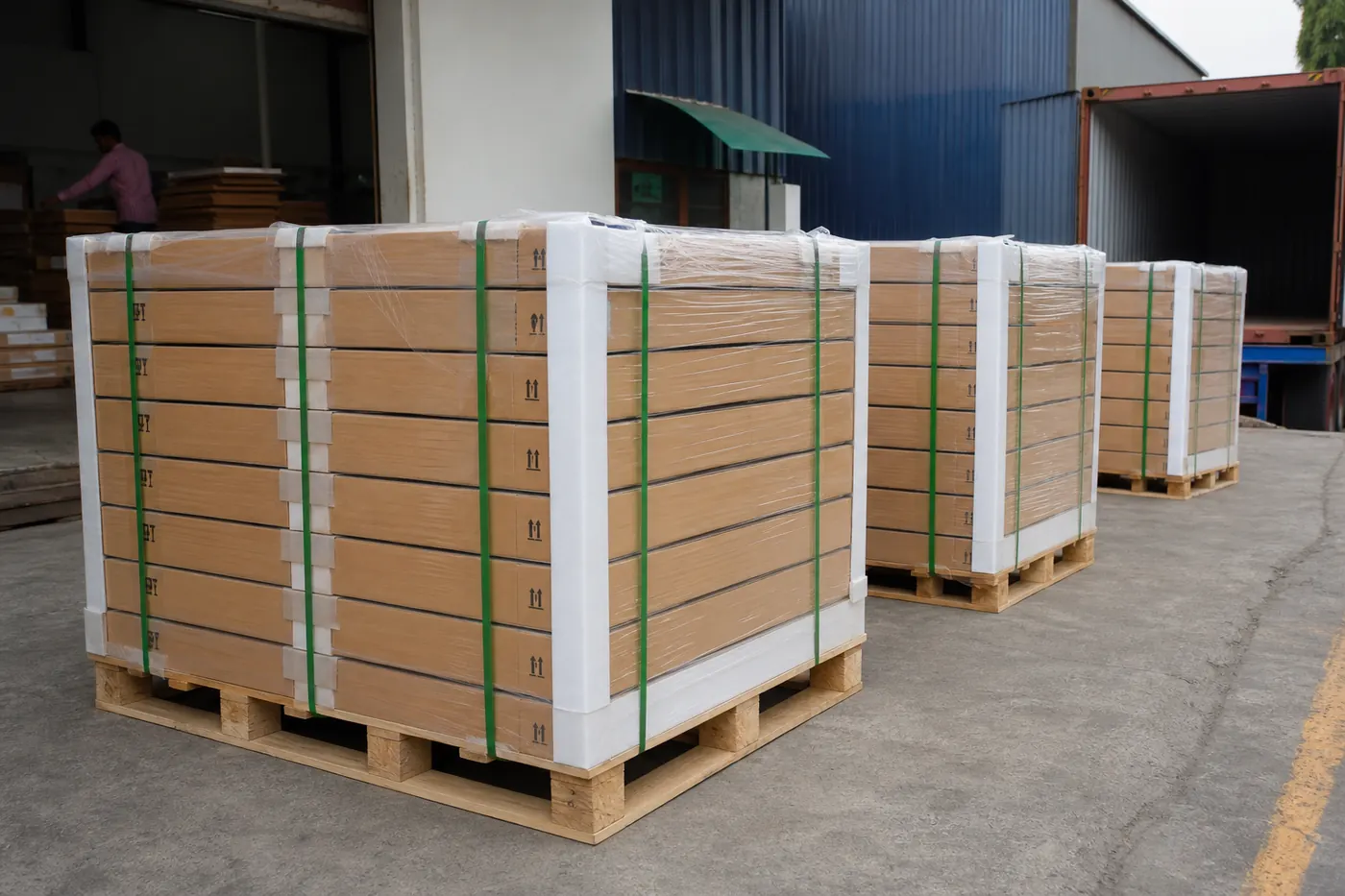
Container Loading Details
Export Tip
This documentation guide does not prescribe container counts. Corrugated boxes vary in blank size, fold, bundle count, pallet pattern, compression allowance, and moisture strategy, so fixed internet quantities are misleading. The final packing list should report measured length × width × height and gross weight for every package type. The shipment master should total cubic meters as quantity × package dimensions in meters and preserve pallet-level detail.
Loading photos and records should show empty-container condition, dry and odor-free status, floor/wall condition, bundle or pallet arrangement, void control, container and seal numbers, and final tally. The specialized corrugated box container loading and shipping guide owns CBM utilization, 20GP/40GP/40HC planning, crush and humidity controls, LCL/FCL economics, transit planning, and receiving.

Shipping Methods
Export Tip
Use FCL, LCL, air, or courier according to measured cargo, urgency, handling tolerance, and dated quotations. This article's documentation focus is to name the mode, ports or airports, transport reference, freight status, and Incoterms 2020 rule consistently. LCL can introduce additional handling and consolidation records; FCL requires container and seal reconciliation. Air or courier samples still need accurate export and import descriptions.
FCA is usually the better fit when containerized cargo is delivered to a carrier or terminal before vessel loading. FOB, CFR and CIF are sea/inland-waterway rules; CFR/CIF seller-paid carriage to the destination port does not move risk transfer there—risk transfers when goods are on board at shipment. CPT and CIP can apply across modes. Incoterms allocate specified tasks, costs and risk but do not set title or payment terms. State the rule and exact named place or port. Use DDP only where the seller can legally and operationally handle destination import, tax and compliance responsibilities.
Buyer Requirements
Buyer Requirements
The buyer should issue a destination-document schedule with the RFQ, not after cargo readiness. It should name the importer of record, broker, legal party data, tariff decision owner, preferred invoice description, valuation inputs, origin requirement, certificate/test requirements, transport-document form, original-versus-electronic needs, language, legalization, pre-alert timing, and record-retention period.
Letter-of-credit or documentary-collection terms require independent scrutiny before acceptance. Corrugated-box descriptions, quantities, shipment dates, ports, and presentation periods must be feasible. A bank examines documents rather than physical cargo; a bank-compliant presentation can still contain a customs or quality problem, so banking review does not replace broker reconciliation or receiving inspection.
Buyer inputs that must arrive before each export-document milestone.
Swipe →
Data table — swipe horizontally on small screens
| Buyer input | Deadline | Failure if late |
|---|---|---|
| Importer/broker legal data | Before PO | Incorrect parties and clearance setup |
| Classification and duty decision | Before landed-cost approval | Budget or entry error |
| Origin/preference request | Before material commitment | Ineligible claim or missed evidence |
| Claim/test protocol | Before production | Unsupported label or non-representative report |
| Transport/bank instructions | Before booking | Bill-of-lading or presentation discrepancy |
| Pre-alert checklist | Before cargo-ready date | Late broker questions and storage risk |
Country-wise Opportunities
Market Snapshot
Country selection should combine trade data with a delivered-value test. A destination can import heavily while remaining unattractive for bulky standard boxes because neighboring converters deliver faster. India's strongest proposition may involve custom graphics, specialized constructions, audited/certified supply, coordinated packaging for products already exported from India, or replenishment planned far enough ahead to use ocean freight.
Destination opportunities and the documentation emphasis to validate.
Swipe →
Data table — swipe horizontally on small screens
| Market | Opportunity hypothesis | Documentation emphasis |
|---|---|---|
| United States | Custom and specialized B2B packs; India-linked supply programs | HTS line, customs value, Lacey/EUDR questions where relevant, state packaging rules, broker pre-clearance |
| EU/Netherlands | Distribution, private label, certified and traceable fiber programs | EU tariff, packaging and waste obligations, PPWR transition planning, claim traceability |
| United Kingdom | Retail and e-commerce packaging niches | UK tariff, origin, packaging obligations, importer data |
| UAE and Gulf | Regional distribution, food, retail, and industrial packaging | Current conformity/end-use rules, preferential-origin analysis, Arabic/customer requirements |
| Africa | Selected industrial, consumer-goods, and agricultural packing programs | Country-specific duties, COO, inspection/conformity programs, documentary payment terms |
| Australia | Specialized printed and export-linked packaging | Current tariff, biosecurity for wood packing, claims, long-route moisture controls |
Pricing Analysis
Buyer Tip
Documentation has a price even when it is not shown as a line item. Classification research, origin certification, chamber or issuer fees, laboratory tests, inspection, FSC-compliant production and transaction records, bank handling, customs representation, couriering originals, amendments, and demurrage risk all affect landed cost. Ask suppliers to separate recurring unit economics from one-time development and per-shipment compliance costs.
Use scenarios rather than invented universal fees. Scenario A is a plain, non-preferential shipment with invoice, packing list, shipping bill, and sea waybill. Scenario B adds a preferential COO, original negotiable bill of lading, insurance certificate, and bank presentation. Scenario C adds certified-fiber claims, line-level traceability, buyer tests, third-party inspection, and legalized documents. Obtain dated third-party quotes for each selected scenario; do not assume a documentation charge covers testing or destination brokerage.
Amendment risk deserves a reserve. A wrong consignee, package count, or freight status on a bill of lading can lead to carrier amendment fees and clearance delay. A late origin certificate may eliminate a preference claim or require post-entry procedures. A mismatch in FSC claim wording can make downstream certified sales impossible. The cheapest prevention is a four-party draft review—exporter, buyer, forwarder, and broker—against a signed checklist.
Documentation-related cost layers for a landed-price scenario.
Swipe →
Data table — swipe horizontally on small screens
| Cost layer | Planning basis | Control |
|---|---|---|
| Exporter registrations | Entity-level compliance, not allocated blindly per shipment | Verify current status and renewal/update duties |
| Customs/forwarder documentation | Dated service quote by port and shipment | Define included filings and amendment fees |
| Origin evidence | Preferential or non-preferential route | Confirm actual duty benefit and rule before ordering |
| Testing/inspection | Per method, SKU, lot, site, or inspection day | Approve protocol and sample identity |
| Certification claim | Certified inputs, conversion controls, transaction evidence | Verify scope and invoice wording |
| Delay exposure | Port, detention, demurrage, storage, production interruption | Pre-alert deadlines and discrepancy escalation |
Document Reconciliation and Importer-Broker Handoff
- [ ] Seller, buyer, importer, consignee, and notify-party legal data match instructions
- [ ] PO, invoice, SKU, artwork, and specification revisions are connected
- [ ] HS classification rationale and destination tariff line are approved
- [ ] Invoice and shipping-bill values, currency, units, and tax route reconcile
- [ ] Packing-list bundles/pallets convert exactly to invoice sales units
- [ ] Net/gross weights, package count, container, seal, and marks are verified
- [ ] Origin certificate and FSC/PEFC claims match eligible line items
- [ ] Insurance and Incoterm responsibilities are consistent
- [ ] Broker has acknowledged the pre-alert and named unresolved issues
Reconciliation should be line based, not visual. Export the shipment master into a matrix and compare invoice, packing list, shipping bill, COO, insurance, inspection/test records, and bill of lading. Check legal names character by character; PO and invoice references; currency; Incoterm and named place; SKU and customs descriptions; HS line; origin; package count; sales quantity and customs unit; net and gross weight; value; container and seal; ports; freight status; and claim wording.
Weights do not need to be identical everywhere if the records describe different concepts, but the difference must be explainable. Invoice quantity can be pieces, packing list quantity can be bundles, and bill of lading package count can be pallets; a conversion map should connect them. Net weight should exclude packing as defined, while gross includes it. The verified gross mass process for a packed container is a separate maritime safety requirement and should not be confused with a commercial estimate.
Use version numbers and a discrepancy log. Mark drafts clearly, prevent uncontrolled copies, record who approved each version, and retain correction evidence. If the shipping bill says 12,000 boxes while the final invoice says 11,800, stop release and determine whether the physical cargo, short shipment, invoice, or customs filing is wrong. Do not compensate by changing an unrelated weight or description.
The broker handoff should occur before cargo arrival and preferably before origin filing cutoff. Provide a cover sheet summarizing parties, arrival estimate, entry port, transport reference, entry lines, value, Incoterm, origin/preference position, anticipated duties/taxes, PGA or other agency considerations, and document inventory. Ask the broker for an explicit response: classification accepted or queried, valuation additions identified, preference usable or not, missing documents, filing deadline, and delivery-release requirements.

Challenges & Solutions
Frequent corrugated-box documentation failures and practical corrective controls.
Swipe →
Data table — swipe horizontally on small screens
| Challenge | Why it happens | Operational solution |
|---|---|---|
| Vague product description | Templates reuse “paper boxes” | Use objective corrugated form, style, supplied condition, SKU, and dimensions |
| Wrong HS code copied across lines | Mixed paper packaging treated as one family | Classify each distinct product and retain rationale |
| Quantity mismatch | Pieces, bundles, pallets, and customs units are mixed | Maintain a unit-conversion map and line reconciliation |
| Origin claim fails | Country of shipment mistaken for preferential origin | Test the agreement rule using actual inputs and process |
| FSC claim unsupported | Certificate copy mistaken for transaction evidence | Verify holder, scope, status, product, claim, and sales record |
| Stale test report | Development evidence reused without lot linkage | Define validity and representative-sampling rules in the PO |
| Late broker questions | Documents sent only after sailing | Pre-clear drafts and send a timed pre-alert |
| Letter-of-credit discrepancy | Sales, logistics, and banking teams use different templates | Create the document set from LC terms and run independent review |
Expert Insights from Saurabh Mittal
Expert Insight Box
The operational principle associated with Saurabh Mittal's sourcing approach is that documentation should mirror the commercial and physical truth of the order. Altus Exports should not promise that a certificate, code, or template guarantees clearance. Its value is to coordinate the converter, testing partner, customs representative, forwarder, buyer, and destination broker around one approved data set and to surface exceptions before shipment.
A practical expert review asks four questions. Can the product be identified without looking at a marketing brochure? Can every number be traced to a purchase order, inspection, packing result, or approved calculation? Can every sustainability or performance claim be traced to evidence that covers this legal entity, site, product, and transaction? Can the importer and broker use the pack without requesting a second explanation? If any answer is no, document release is premature.
Sourcing Checklist
Checklist
- [ ] Define each corrugated-box SKU by style, supplied condition, board, flute, wall, dimensions, print, performance, and pack-out.
- [ ] Verify converter, exporter, subcontractor, IEC, GST route, banking/customs readiness, and conditional RCMC need.
- [ ] Obtain importer-broker classification, duty, valuation, origin, and destination-compliance decisions.
- [ ] Contract invoice description, quantity units, Incoterm, named place, claim wording, tests, and document deadlines.
- [ ] Approve production-equivalent sample, artwork, dieline, test plan, and certified-fiber evidence route.
- [ ] Freeze final quantities, package measurements, weights, marks, and shipment allocation after packing.
- [ ] Reconcile invoice, packing list, shipping bill, COO, bill of lading, insurance, tests, and claims.
- [ ] Send a version-controlled pre-alert and obtain written broker acceptance before arrival.
Buyer Checklist
Checklist
- [ ] Importer of record and customs broker appointed
- [ ] National tariff line, duty, import tax, and valuation additions confirmed
- [ ] PO and approved specification identify every corrugated-box SKU
- [ ] Destination packaging, chemical, food-contact, recycling, and claim rules assessed
- [ ] Preferential-origin benefit and rule verified where requested
- [ ] FSC/PEFC claim and trademark evidence approved where applicable
- [ ] Draft and final document review owners named
- [ ] Receiving discrepancy and claims process documented
Exporter Checklist
Checklist
- [ ] IEC and applicable GST/LUT, bank, customs, and RCMC arrangements current
- [ ] Manufacturing and outsourced-site route documented
- [ ] Invoice and packing list generated from final accepted cargo
- [ ] Shipping-bill data reconciled before filing
- [ ] Origin evidence supports any certificate application
- [ ] Carrier instructions, container, seal, packages, weight, and freight status verified
- [ ] Test reports and transaction claims linked to shipped SKUs and quantities
- [ ] Final pre-alert sent with version status and discrepancy contact
Compliance Checklist
Checklist
Compliance Notes
- [ ] HS 481910 scope tested against actual corrugated product and supplied condition
- [ ] Destination tariff suffix, duty, trade remedies, and customs value confirmed
- [ ] Indian zero-rated GST route supported without implying destination exemption
- [ ] Origin and preference statements match the applicable rule
- [ ] Certified-fiber claim matches holder, scope, product group, quantity, and sales record
- [ ] Tests identify method, sample, revision, lot, date, result, and issuing body
- [ ] Printed packaging and end-use compliance reviewed for the destination
- [ ] Wood packaging meets ISPM 15 where applicable
Common Buyer Mistakes
Common Mistakes Box
- Accepting “HS 481910” from a supplier without destination-broker confirmation.
- Treating India's GST/LUT position as evidence of zero duty or tax abroad.
- Assuming RCMC is mandatory for every corrugated box export or proves product quality.
- Requesting a preferential COO without testing the actual origin rule and duty benefit.
- Allowing invoice, packing list, and bill of lading teams to maintain separate quantities.
- Using estimated dimensions and weights after final packing has changed.
- Accepting an FSC logo or certificate PDF without transaction claim continuity.
- Receiving test reports that do not identify the SKU, revision, method, sample, or lot.
- Sending documents to the customs broker only when the vessel is about to arrive.
- Comparing quotations without including certification, testing, amendment, banking, and destination-document costs.
Future Market Trends
Key Statistics
Corrugated-box documentation is moving toward structured product and transaction data rather than isolated PDFs. Buyers increasingly need traceable material claims, packaging-composition data, supplier and site identity, test history, artwork revision, and line-level links between purchase order, invoice, and receiving record. Regulation (EU) 2025/40 generally applies from August 12, 2026 with later phased provisions; it has no blanket recycled-fibre minimum for corrugated boxes, while recycled-content percentages address relevant plastics. EPR remains administered through national systems rather than one EU registration, so obligations depend on role, market and date.
Digital certificates, customs single windows, electronic bills of lading, and product-level traceability can reduce rekeying, but only if source data are governed. Artificial intelligence can compare documents and flag mismatches; it cannot make an unsupported origin or FSC claim true. Procurement teams should preserve authoritative sources, approval history, and human accountability while automating repeatable checks.
FAQs
The most frequent operational questions are answered below. Because tariff, tax, origin, shipping, and product rules change, use these answers to structure a discussion with qualified professionals rather than as legal advice.
Conclusion
Reliable corrugated box export documentation begins with exporter readiness—IEC, applicable GST/LUT route, bank/customs setup, and RCMC where relevant—but it succeeds at shipment level. The invoice, packing list, shipping bill, certificate of origin, bill of lading, insurance, tests, and certified-fiber evidence must describe the same goods and claims. A clean handoff gives the destination broker time to validate classification, value, duty, preference, and admissibility before deadlines.
Build the broader program with our guides to import corrugated boxes from India, compare wholesale pricing, verify quality standards and certifications, and plan corrugated box container loading and shipping. Explore Altus Exports' India import coordination service and global sourcing partner support, or contact Altus Exports with destination, box drawings, quantities, end use, claims, Incoterm, and target delivery date.
References
- World Bank WITS / UN Comtrade, HS 481910 exporters, calendar year 2024
- World Bank WITS / UN Comtrade, HS 481910 importers, calendar year 2024
- Directorate General of Foreign Trade, Foreign Trade Policy 2023 and Handbook of Procedures
- Central Board of Indirect Taxes and Customs, GST and customs guidance
- ICEGATE, Indian Customs electronic filing and trade guidance
- International Chamber of Commerce, Incoterms® 2020 rules
- Forest Stewardship Council, FSC-STD-40-004 Chain of Custody Certification
- World Customs Organization, Harmonized System overview
- International Plant Protection Convention, ISPM 15 wood-packaging standard
- ISO 535, Paper and board — Cobb water absorptiveness
- White House, temporary Section 122 import surcharge proclamation, February 20, 2026
- EUR-Lex, Regulation (EU) 2025/40 on packaging and packaging waste
Sources were accessed July 17, 2026. Trade figures are reported gross trade and have been converted from thousands of U.S. dollars where stated. Rules and operational guidance must be checked in their current official versions for the shipment date.