
Corrugated Box Types and Specifications: International Buyer Guide
By Saurabh Mittal, Founder, Altus Exports
A specification-led guide for international buyers selecting corrugated board, box styles, performance tests, tolerances, packing, and end-use fit.
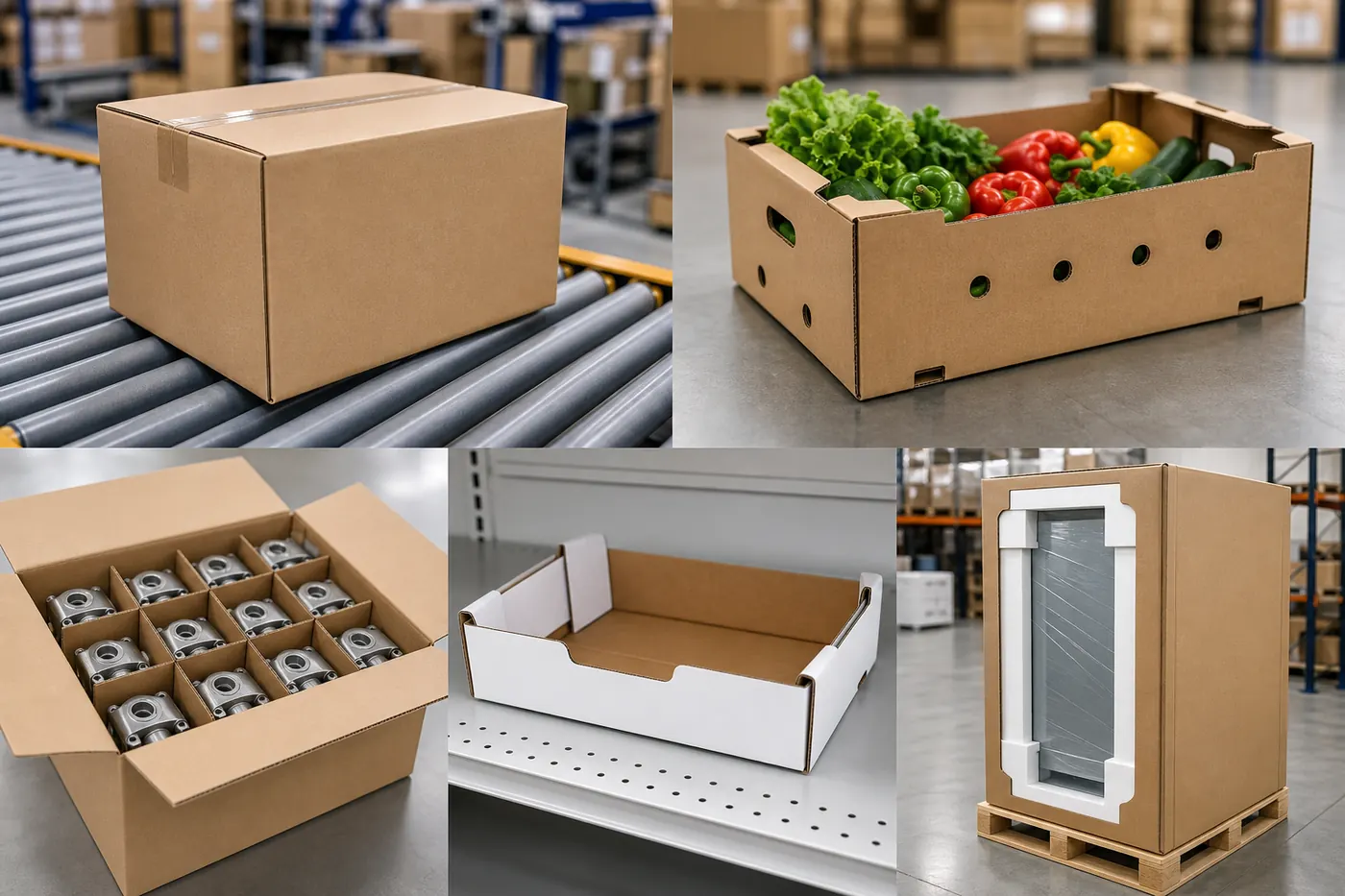
## Introduction International buyers comparing corrugated box types and specifications should begin with the packed product and distribution hazard, not a supplier's familiar grade name. A carton is a system: liners, fluted medium, adhesive, joints, scores, slots, print, dimensions, closures, unit load, climate, storage time, and handling all influence whether it performs. Two boxes described as “5-ply” can have materially different edge strength, compression, moisture resistance, converting accuracy, and delivered cost.
This guide is for importers, distributors, wholesalers, retail chains, packaging buyers, and procurement teams that need a measurable request for quotation. It explains flute profiles, board grades, wall construction, RSC, die-cut and telescopic styles, ECT, BCT, Cobb, burst strength, dimensions and tolerances. It also addresses MOQ, export packing, container planning, lead time, Incoterms, certifications, compliance, indicative commercial ranges, and common mistakes. All ranges are planning examples rather than offers or universal industry norms.
Introduction
This technical guide converts corrugated-box terminology into an inspectable buyer specification. It focuses on box construction and performance while linking each decision to commercial, compliance, and logistics controls required by international procurement teams.
Executive Summary
Summary Box
A corrugated-box specification must connect the packed product, distribution route, climate, storage, pallet, handling, and opening experience to measurable board and converted-case requirements. Flute profile, wall construction, paper grade, dimensions, ECT, BCT, burst, Cobb, print, joint, tolerances, and closures work as one system. Buyers should approve production-equivalent samples and test the complete packed product rather than purchase by ply count or grammage alone.
Market Size & Industry Overview
Key Statistics
Corrugated packaging serves food and beverage, consumer goods, e-commerce, appliances, automotive parts, pharmaceuticals, agriculture, and industrial distribution. Demand is local in many countries because empty boxes are bulky relative to value, but international sourcing can make sense for printed retail packs, labor-intensive die-cut designs, coordinated multi-component programs, specialized board, or buyers consolidating boxes with other Indian products. The commercial question is therefore not whether India can make a box; it is whether the complete landed program improves cost, service, quality, or sourcing resilience.
Fiber costs, recovered-paper availability, energy, starch, freight, print coverage, tooling, and order mix influence quotations. Buyers should avoid treating an old price per kilogram or per box as a current benchmark. A useful market comparison normalizes board construction, inside dimensions, converted area, printing, joint, tolerances, testing, packing, delivery term, and payment conditions. The broader sourcing workflow is covered in How to Import Corrugated Boxes from India, while supplier capability should be assessed with How to Evaluate Corrugated Box Manufacturers in India.
Named technical sources provide a common language. FEFCO's International Fibreboard Case Code identifies standard case designs, and FEFCO methods can provide test references; FEFCO is not a product certification. The Fibre Box Association publishes corrugated packaging references; TAPPI and ISO publish test methods; ASTM D4169 addresses performance testing of shipping containers and systems; and ISTA maintains packaged-product test procedures. Use the edition and method written into the contract rather than asking for “international standard quality.”
Product Categories / Variants
Summary Box
Corrugated fiberboard normally combines flat linerboard with a shaped corrugating medium. Single-face board has one liner and one fluted medium; single-wall board adds a second liner; double-wall combines three liners and two fluted media; triple-wall combines four liners and three media. Commercial shorthand such as 3-ply, 5-ply, and 7-ply generally maps to these constructions, but “ply” alone does not reveal paper grammage, fiber furnish, strength, flute combination, adhesive performance, or box compression.
Paper can be described by furnish and performance: kraftliner commonly contains a high share of virgin kraft fiber, testliner commonly contains recycled fiber, and fluting medium can be virgin or recovered-fiber based. Those labels vary by market and mill. A buyer should specify measurable properties for each component or for the combined board, plus acceptable substitutions. Appearance requirements—shade, smoothness, mottle, rub resistance, and print holdout—also matter for retail-facing liners but may add little value to an unseen transport carton.
Common flute directions; actual caliper and take-up depend on the producer and must be declared.
Swipe →
Data table — swipe horizontally on small screens
| Flute | Indicative pitch/caliper direction | Typical strengths | Buyer watchpoint |
|---|---|---|---|
| A flute | Coarse; roughly 4.5–5.0 mm board caliper | Cushioning and stacking potential | More cube and less fine-print detail |
| B flute | Fine; roughly 2.5–3.2 mm | Puncture resistance, die-cutting, print surface | Less cushioning than coarse flute |
| C flute | Medium; roughly 3.5–4.2 mm | Balanced shipping-case performance | Confirm actual plant profile |
| E flute | Microflute; roughly 1.2–1.8 mm | Retail graphics, compactness, die-cut packs | Lower cushioning; score design is critical |
| F flute | Very fine; often below 1 mm | Folding-carton-like presentation | Limited supplier/tooling availability |
| BC/EB double wall | Combined profiles | Compression, puncture, heavier loads | Higher weight, cube, price, and fold memory |
Product Overview
Summary Box
Corrugated boxes combine linerboard, fluted medium, adhesive, scores, joints, and closures into a converted package. Product identity should therefore include board architecture, box style, inside dimensions, flute direction, print, joint, performance tests, and intended use. Generic descriptions such as brown box, export grade, or five-ply are not complete specifications.
Flute, Board Grade, and Ply Selection
Flute profile decisions
Flute geometry influences cushioning, flat-crush resistance, bending stiffness, printability, and board caliper. Coarser flutes can provide cushioning and column strength; finer flutes can improve print surface and compactness. Double-wall combinations aim to combine attributes, but more material is not automatically better. Excess board increases cost, shipment cube, waste, and packing-line difficulty.
Production validation gate
- Pack the actual product with approved dividers and void fill.
- Use the intended closure, pallet pattern, stack, and handling method.
- Condition and test the package against the documented distribution route.
Paper grade and wall construction
Specify paper in grams per square meter where that is the contracting convention, but do not infer performance from grammage alone. Fiber quality and papermaking can allow a lighter sheet to outperform a heavier sheet. State liner and medium grammages, flute, combined-board caliper range, performance targets, moisture condition, and Cobb limit where relevant. Require written data and a production trial for an alternate construction.
Single-wall is often evaluated for ordinary consumer goods and moderate distribution; double-wall may suit heavier, fragile, long-storage, or demanding export loads; triple-wall may be considered for very heavy industrial contents. These are screening directions, not design rules. Product weight, load contribution, case perimeter, humidity, stacking duration, pallet support, vibration, and manual handling still govern selection.
Manufacturing Overview
Export Tip
Corrugated manufacturing begins when liner and corrugating medium are conditioned and the medium passes heated corrugating rolls to form flutes. Starch adhesive bonds the first liner into single-face web and a second liner creates single-wall board; additional flute and liner layers create double- or triple-wall board. Heat, steam, adhesive solids, speed, tension, and paper moisture influence bond, warp, caliper, crush, and downstream converting.
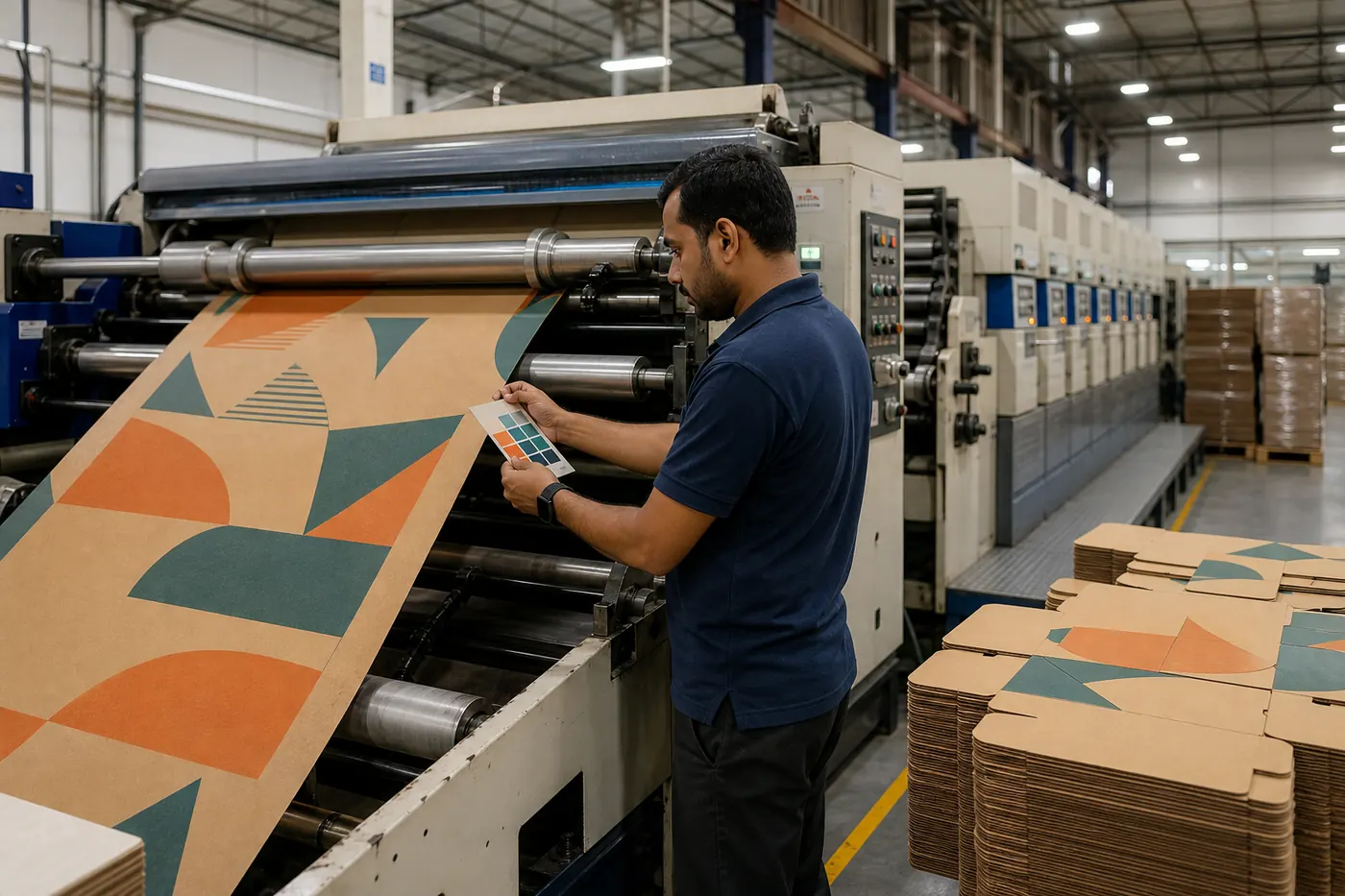
Board is slit, scored, cut, flexographically printed, slotted, rotary- or flatbed-die-cut, folded, glued or stitched, counted, and bundled. Litho-lamination adds a separately printed sheet; coatings add process and compliance questions. Production control should trace paper reels, adhesive batches, first-off settings, tools, artwork version, measurements, test results, defects, bundle counts, and corrective actions to the shipment lot.
Manufacturing controls and evidence expected at each corrugated-box production stage.
Swipe →
Data table — swipe horizontally on small screens
| Manufacturing stage | Critical variable | Buyer evidence |
|---|---|---|
| Paper receipt | Grade, grammage, moisture, fiber claim | Mill/reel records and approved substitution |
| Corrugating | Flute, heat, steam, speed, adhesive | Caliper, bond, warp and process checks |
| Printing | Artwork, color, registration, cure | First-off, rub and barcode checks |
| Converting | Scores, slots, die position, joint | Dimension and feature sampling |
| Finishing | Glue/stitch, folding and count | Joint, squareness and bundle audit |
| Release | Lot conformity and quantity | Inspection, tests and traceability |

Box Styles: RSC, Die-Cut, and Telescopic
The regular slotted container, commonly associated with FEFCO 0201, has outer flaps that meet and inner flaps that normally do not. It is efficient to manufacture, ships flat, and suits many transport applications. Variants include half-slotted cases, full-overlap cases, center-special slotted containers, and trays. State the FEFCO code where appropriate, but attach a drawing because features, manufacturer's joints, hand holes, perforations, and closures can alter the intended result.
Die-cut boxes use tooling to create shapes, locks, windows, handles, ventilation, tear strips, or retail display features. Rotary die cutting can suit longer runs; flatbed die cutting can suit precise or complex work depending on plant capability. Tool ownership, storage, revision control, expected life, and replacement responsibility belong in the purchase terms. A CAD sample proves geometry, while a production-equivalent sample is needed to validate board, print, scores, folding, glue, and packing-line behavior.
Telescopic designs use a lid and body, or overlapping members, to provide adjustable depth, improved stacking, or access. They can be useful for apparel, produce, long goods, furniture components, and products needing extra corner coverage. Their material usage and manual assembly may exceed an RSC. Buyers should test fit at minimum and maximum product dimensions and determine whether the lid can lift during vibration or warehouse handling.
Comparison of common corrugated-box styles, applications, benefits, and control points.
Swipe →
Data table — swipe horizontally on small screens
| Style | Good fit | Advantages | Controls |
|---|---|---|---|
| RSC/0201 direction | General shipping case | Efficient converting and assembly | Flap gap, joint, squareness, closure |
| Full-overlap slotted | Narrow/heavy contents | More top/bottom overlap | Material use and closure |
| Die-cut mailer | E-commerce and presentation | Integrated locking and opening | Score cracking, lock retention, dimensional fit |
| Tray/display | Shelf-ready retail | Fast replenishment and visibility | Tear performance, graphics, shelf dimensions |
| Telescopic | Variable depth or added coverage | Fit flexibility and stacking | Lid retention, overlap, labor |
ECT, BCT, Burst, Cobb, and Other Tests
Edge Crush Test measures the compressive resistance of a board specimen loaded on its edge under a named method and conditioning regime. ECT is useful because vertical board edges contribute to case stacking. Results may be expressed in kN/m or lb/in. A buyer must state the method, units, specimen orientation, conditioning, sampling, and acceptance rule. Converting damage, score placement, slots, hand holes, box perimeter, and humidity mean that board ECT cannot by itself guarantee finished-case compression.
Box Compression Test evaluates a finished case under compression. BCT is closer to stacking behavior but still requires a defined setup: empty or filled, closure, platen speed, preconditioning, loading orientation, and pass criterion. Warehouse stacks experience duration, humidity, pallet gaps, misalignment, vibration, and dynamic loads that a short laboratory test may not reproduce. Safety factors should be developed from distribution evidence, not copied blindly from an online formula.
Burst strength measures resistance to rupture under hydraulic pressure and remains common in board specifications and carrier rules in some markets. It can be useful for toughness comparisons but does not directly predict stacking. Cobb testing measures water absorptiveness over a specified time; lower uptake can support humid or cold-chain applications, yet waxes, coatings, sizing, and recycled-fiber content affect recyclability, repulpability, food-contact status, print, glue, and cost. Define the exact surface tested.
Additional checks may include basis weight, caliper, moisture, flat crush, pin adhesion, ply separation, puncture, coefficient of friction, glue bond, score bend, print rub, color, barcode verification, drop, vibration, and climatic conditioning. Current ISO catalogue editions checked on 17 July 2026 are ISO 3037:2022 for ECT, ISO 535:2023 for Cobb water absorptiveness, ISO 2759:2014 for corrugated-board burst, ISO 187:2022 for conditioning, and ISO 12048:1994 for compression/stacking; ISO records show ISO 12048:1994 was last confirmed in 2022. TAPPI T 811 and T 810 are alternative association methods. Contract one named method, edition, conditioning regime, and acceptance rule rather than mixing results.
Corrugated-board and finished-box tests, their limits, and essential contract details.
Swipe →
Data table — swipe horizontally on small screens
| Test | What it indicates | What it does not prove | Contract detail |
|---|---|---|---|
| ECT | Board edge compression | Complete case survival | Method, units, conditioning, sampling |
| BCT | Finished-case compression under test setup | Long-duration real-world stack performance | Case state, closure, speed, minimum |
| Burst | Rupture resistance | Stacking strength | Method, units, board side |
| Cobb | Water uptake over time | Waterproofness or recyclability | Time, surface, conditioning, maximum |
| Transit test | Packaged-product response to hazards | Every possible route | ISTA/ASTM schedule and acceptance criteria |

Dimensions, Tolerances, and Drawings
State whether dimensions are inside or outside and use the conventional sequence length × width × depth. Inside dimensions govern product fit; outside dimensions govern pallet and container utilization. A useful drawing identifies panel orientation, flute direction, scores, slots, joint, glue area, hand holes, perforations, print registration, barcode quiet zones, closure, and bundle orientation. Units must be explicit; a millimeter/inch conversion error can invalidate tooling and pallet plans.
Do not copy a generic ±3 mm tolerance across every dimension. Feasible tolerance depends on case size, board caliper, flute, converting equipment, moisture, score geometry, and test method. Agree separate limits for slot depth, slot position, score-to-score dimensions, flap gap, squareness, joint alignment, print registration, die-cut features, and bundle count. Define measurement after conditioning and whether a folded blank or erected case is measured.
Fit validation should include the largest and smallest acceptable product, liners or bags, dividers, corner pads, and packing-line clearances. For automated erectors and sealers, tolerance capability can be stricter than for manual packing. Palletization software is useful only after actual outside dimensions and compression behavior are known. A small dimension change multiplied across a pallet may create overhang, underfill, unstable columns, or lost container cube.
End-Use Selection Matrix
Selection starts with hazards and value at risk. An e-commerce mailer may prioritize closure integrity, opening experience, returnability, and dimensional weight. A chilled produce case may prioritize ventilation, wet strength, rapid cooling, stacking, and food-chain controls. An appliance case may rely on foam, corner posts, and pallet restraint as much as the corrugated shell. Retail-ready packaging must balance transport strength with clean tearing and shelf presentation.
Use a cross-functional design review involving product engineering, warehouse, packing operations, logistics, merchandising, compliance, and the supplier. Record assumptions: maximum gross mass, unsupported span, stack height, storage days, relative humidity, pallet pattern, route, number of handlings, and consumer-facing claims. Then test a pilot lot. A lower-cost board that raises product damage, labor, dimensional freight, or returns is not a lower landed-cost solution.
End-use selection matrix linking corrugated-box applications to design priorities and approval evidence.
Swipe →
Data table — swipe horizontally on small screens
| End use | Likely design focus | Evidence before approval |
|---|---|---|
| E-commerce | Right-size, closure, tamper evidence, returns | Packed drop/vibration and opening trial |
| FMCG/retail | Pallet compression, print, shelf-ready features | BCT, barcode, tear/display trial |
| Fresh produce | Ventilation, moisture, stacking | Climatic and supply-chain trial |
| Industrial parts | Puncture, blocking/bracing, corrosion protection | Packed-product route simulation |
| Appliances | Compression system, corner protection, handling | Full unit-load and clamp/fork review |
| Pharma/cosmetics | Cleanliness, traceability, print accuracy | Approved supplier and artwork controls |
Export Process
Export Tip
A controlled export process has gates. First, the buyer supplies product, route, annual demand, target pallet, regulatory, print, and testing requirements. Second, candidate plants confirm paper sourcing, corrugator width, flute availability, printing colors, slotting or die-cut capability, gluing or stitching, laboratory equipment, and subcontractors. Third, comparable quotations are issued against one drawing and test plan. Fourth, plain CAD samples establish fit; printed and production-equivalent samples establish execution.
Before bulk production, sign the specification, artwork, color reference, barcode, golden sample, defect catalogue, test plan, packing instruction, and inspection level. During production, verify incoming paper records, corrugator conditions, board warp, adhesive bond, print, slots, dimensions, and bundle counts. Final inspection should sample finished lots and reconcile quantity, variants, marks, documents, and loading. For documentary detail, use Corrugated Box Export Documentation.
Core Indian export documents commonly include commercial invoice, packing list, shipping bill, bill of lading or air waybill, and certificate of origin when required. Insurance, fumigation or ISPM 15 evidence for wood packaging, test reports, preference documents, and buyer declarations may also apply. Classification, invoice description, quantity unit, gross/net weights, country of origin, and Incoterm should agree across documents. The importer's broker must confirm destination requirements.
MOQ Analysis
Buyer Tip
MOQ depends on paper combination, corrugator setup, printing plates, ink, die tooling, gluing, bundle configuration, and SKU count. Plain RSCs using a plant's regular board may allow a smaller trial than custom litho-laminated die-cut packs. As purely indicative RFQ scenarios, buyers might ask suppliers to price 1,000, 5,000, and 25,000 units per design, but these are not represented as typical Indian minimums. Obtain a dated, SKU-specific MOQ and identify plate, die, sampling, and storage charges separately.
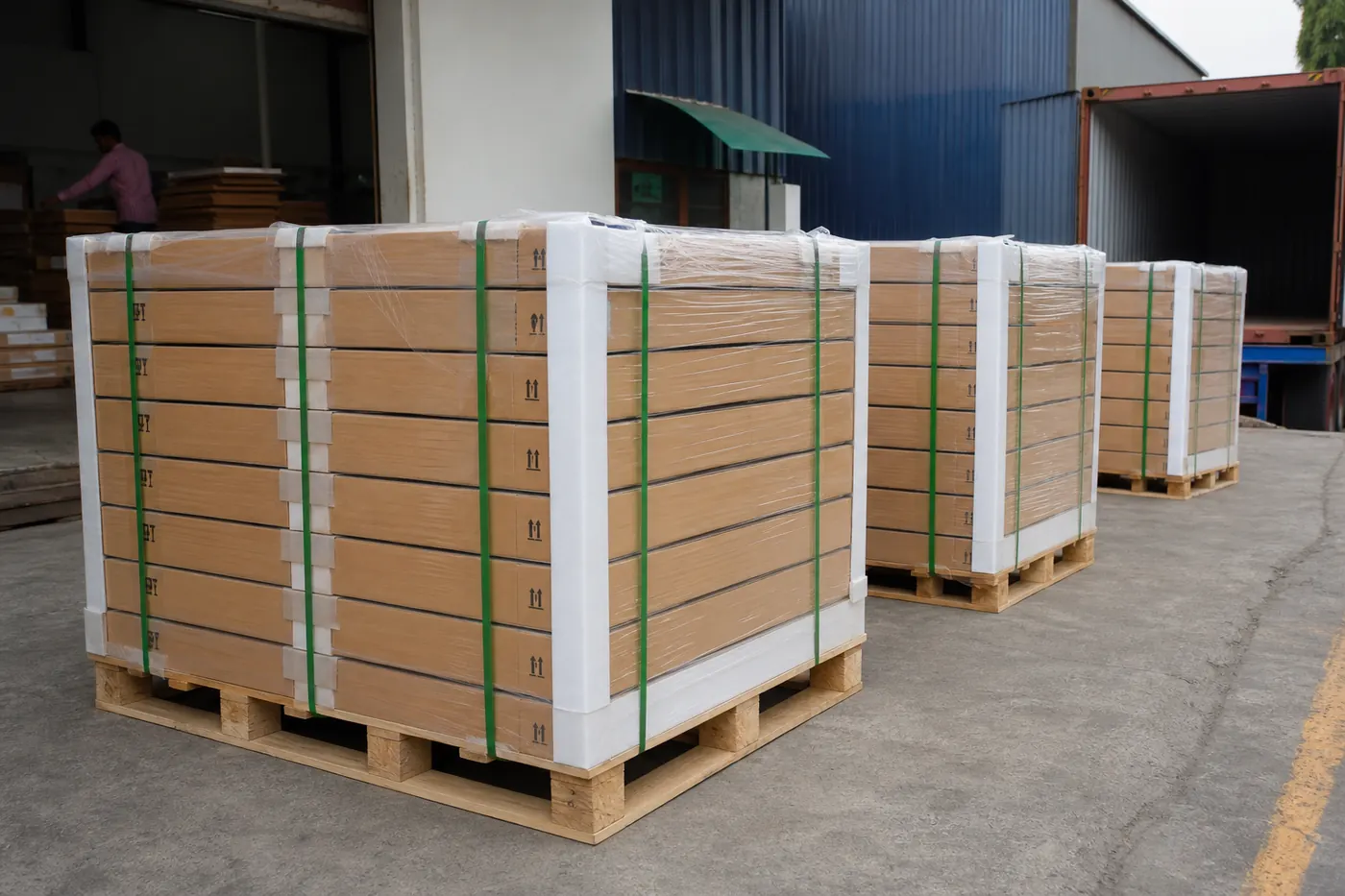
Flat boxes are normally counted, compressed into bundles, strapped or wrapped, then floor-loaded or palletized. Protection must control edge crush, strap damage, dust, rain, and container moisture without creating avoidable plastic. Export marks should show SKU, dimensions, quantity, batch, gross/net mass where needed, and handling direction. Wooden pallets or dunnage entering regulated markets generally require compliant ISPM 15 treatment and marks. Confirm packaging-waste and labeling obligations with the importer.
An indicative planning schedule might allow one to two weeks for drawing, costing, and samples; two to six weeks for tooling, paper, production, testing, and packing after final approvals; and route-specific time for booking and transport. These are broad workflow ranges, not promises. Specialty paper, complex print, many SKUs, peak demand, failed tests, or artwork revisions can extend them. Contract milestones and a cargo-ready date rather than one undifferentiated “lead time.”
Empty boxes are cube-sensitive. A 20-foot, 40-foot, or 40-foot high-cube load must be calculated from the final bundle dimensions, pallet plan, equipment limits, payload, door opening, and stowage allowance. LCL can expose bundles to more handling and moisture; FCL can reduce handling but requires sufficient volume. See Corrugated Box Container Loading and Shipping for detailed load planning.
Indicative MOQ and lead-time planning inputs that require supplier- and order-specific confirmation.
Swipe →
Data table — swipe horizontally on small screens
| Commercial item | Indicative planning direction | Required confirmation |
|---|---|---|
| MOQ | Request tiered scenarios; no universal minimum | Per SKU/design/board/print dated quote |
| Development | About 1–2 weeks may be modeled | Approved critical path |
| Bulk production | About 2–6 weeks may be modeled after approval | Capacity and paper availability |
| Packing | Bundles, palletized or floor-loaded | Measured bundle and load plan |
| Shipment | FCL, LCL, air for samples | Forwarder quote and route schedule |
Packaging Standards
Export Tip
Flat corrugated boxes are normally counted, compressed into bundles, restrained with straps or wrap, and floor-loaded or palletized. Protection must control edge crush, strap damage, dust, rain, and container moisture without adding unnecessary material. Export marks should show SKU, inside dimensions, count, batch, and handling direction; mass should align with the packing list. Approve the physical bundle as a golden export pack.
Solid-wood pallets and dunnage entering regulated markets generally require ISPM 15 treatment and legible marks. Plastic film, straps, edge protectors, and pallets can create destination packaging-reporting or EPR obligations. Confirm stack limit, pallet overhang, forklift entry, receiving count, and waste separation. The pack should preserve converted boxes without invalidating environmental or certified-fiber claims.
Container Loading Details
Export Tip
Empty corrugated boxes are cube-sensitive. A 20-foot, 40-foot, or 40-foot high-cube load must be calculated from measured bundle dimensions, pallet pattern, compression behavior, equipment limits, door opening, handling clearance, and stowage allowance. Rough usable-cube assumptions are suitable only for sensitivity analysis. Carrier equipment and the approved physical pack control the actual count.
Inspect the container for holes, water, odor, contamination, protrusions, and door operation. Record orientation, tiers, void control, tally, seal, photographs, and unloading plan. LCL adds consolidation touches and may increase moisture or crush exposure; FCL gives more control but needs sufficient volume. See Corrugated Box Container Loading and Shipping.
Container-loading inputs and release evidence for flat-packed corrugated-box bundles.
Swipe →
Data table — swipe horizontally on small screens
| Loading input | Why it matters | Release evidence |
|---|---|---|
| Measured bundle L × W × H | Determines geometric fit | Production measurement |
| Boxes per bundle | Controls invoice quantity | Tally and packing list |
| Pallet footprint/height | Changes cube and handling | Approved pallet plan |
| Stack limit | Prevents lower-bundle crush | Trial and instruction |
| Container condition | Controls contamination | Checklist and photographs |
| Seal and handoff | Supports chain of custody | Seal and transport record |

Shipping Methods
Export Tip
FCL ocean freight usually suits recurring corrugated-box volume because it reduces co-loading touches and supports a controlled load plan. LCL can support a pilot but adds handling, consolidation, deconsolidation, and moisture exposure. Air or courier generally belongs to samples because empty boxes have poor value-to-volume economics. Compare service, risk, and delivered cost using current route-specific forwarder quotations.
State Incoterms® 2020 and the named place. FCA may provide a clear handoff for containerized cargo; FOB must be applied correctly; CIF adds seller-arranged freight and minimum insurance to the named port but not all destination costs; DDP requires the seller to manage import and tax obligations and may be impractical. Define loading, documents, insurance, charges, and risk transfer.
Pricing Analysis
Buyer Tip
Corrugated pricing may be quoted per box, per thousand, per square meter, or by weight. Normalize to the approved unit and converted area. Cost drivers include liner and medium grades, grammage, flute take-up, trim waste, print colors and coverage, ink or coating, plate and die charges, slotting, gluing or stitching, inspection, bundles, pallets, inland freight, finance, and order cadence. Review Corrugated Box Wholesale Pricing in India for a dedicated cost model.
For budgeting only, a buyer could request an EXW, FOB named Indian port, and CIF named destination comparison, then add destination terminal charges, broker fees, duty, tax, local delivery, inventory, and damage allowance. No responsible article can provide a universal box-price range without dimensions, board, print, volume, and delivery term. Paper and freight move over time, so require validity dates and adjustment rules. Tooling should be amortized transparently rather than hidden in an incomparable unit price.
Certifications
Compliance Notes
HS 4819 covers certain cartons, boxes, cases, bags, and other packing containers of paper or paperboard. Corrugated cartons, boxes, and cases are generally considered under six-digit HS 481910, but fitted packaging, retail displays, paperboard articles, composite packs, and other forms may classify differently. National tariff lines add digits and are not universal. The importer should obtain a written classification decision from its customs broker; this guide is not customs advice.
As checked on 17 July 2026, the published base rate is generally Free for U.S. HTSUS 4819.10.00, EU CN 48191000, UK 4819100000, Canada 4819.10.00, and Australia 4819.10.00; import VAT/GST and other charges remain separate. For qualifying U.S. entries, however, a temporary additional 10% Section 122 surcharge applies from 24 February 2026 through 12:01 a.m. EDT on 24 July 2026 unless excluded. The importer must check the entry date, national suffix, chapter 99 measures, origin, and current official schedule.
FSC or PEFC chain-of-custody evidence can support certified-fiber claims when the supplying entities, product group, invoice claim, and certificate are valid. ISO 9001 addresses a quality-management system, not automatic product conformity. BRCGS Packaging Materials may be requested in food, consumer, or regulated supply chains. Food-contact suitability depends on intended contact, functional barrier, inks, coatings, adhesives, recycled content, migration risk, and destination law; a generic mill certificate is not enough.
EU Regulation 2025/40 on packaging and packaging waste entered into force on 11 February 2025 and generally applies from 12 August 2026, while individual marking, substances, recyclability, and other provisions have their own dates. National EPR rules still require market-specific review. The United States combines federal customs and product rules with retailer, carrier, food-contact, and state packaging requirements. Other markets have their own EPR, heavy-metal, labeling, phytosanitary, and recycling regimes. Verify current law as of placement on the market and shipment.
Quality evidence should be explored in Corrugated Box Quality Standards and Certifications, fiber and environmental claims in Sustainable Corrugated Packaging from India, and artwork controls in Custom-Printed Corrugated Boxes from India. Certification logos must not be printed until claim authorization and license-code rules have been approved.
Export Statistics
Key Statistics
Trade statistics should be interpreted cautiously because HS 481910 combines corrugated cartons, boxes, and cases rather than one flute, grade, or end use. UN Comtrade is the underlying official database; the World Bank's WITS interface republishes reporter data; and ITC Trade Map also supports trade screening. Values may be FOB for exports and CIF-type for imports depending on reporting practice, and partner-reported figures can differ because of timing, valuation, re-exports, confidentiality, or classification.
For specification work, trade data demonstrates that cross-border supply exists but cannot select a board grade or validate a factory. Use the most recently complete calendar year, record access date, and avoid mixing reporter imports with mirror exports as though they were identical. The separate Corrugated Box Import Markets guide owns HS 481910 country analysis and market scoring.
Trade Statistics
Key Statistics
HS 481910 trade records can establish that corrugated cartons, boxes, and cases move internationally, but they do not separate flute, wall construction, board strength, print, dimensions, or end use. Treat value and quantity as market context only. Name the reporter, partner, flow, year, valuation basis, and access date whenever statistics inform a procurement decision.
Import Statistics
Key Statistics
An importer should read HS 481910 data as a demand and lane signal, then test whether imported product economics make sense. High import value may reflect neighboring cross-border trade, regional converting networks, premium printed packaging, or temporary shortages. It does not prove an attractive margin for flat commodity RSCs from India. Compare value, quantity where reliably reported, supplier concentration, distance, tariffs, freight cube, local competition, and the buyer channel.
The best specification is market-aware: US retail programs may prioritize ISTA or retailer protocols and barcode execution; European programs may add packaging EPR data and substantiated recyclability claims; Gulf food chains may require food-safety documentation and humidity performance. Country data informs the compliance brief, while physical hazards determine the board and box design.
Import Data Analysis
Import data is most useful after product definition. A buyer can compare source-country concentration, route precedent, value, quantity, and year-to-year direction, then test whether the required corrugated-box format survives freight economics and destination compliance. Never translate an aggregate customs value per kilogram into a supplier quotation or assume a high-import country needs the exact proposed box.
Country-wise Opportunities
Market Snapshot
Country opportunities are product-specific hypotheses. The United States can offer scale for retail, e-commerce, food, and industrial channels but has strong domestic capacity and demanding buyer manuals. EU markets can value certified fiber, printing, and packaging data but impose evolving producer-responsibility and sustainability obligations. The United Kingdom has separate customs and packaging rules. Gulf markets can create demand around food, logistics, and retail, with heat and humidity requiring attention. Australia, Africa, and island markets may value supply diversification but freight cube can dominate.
Country screening matrix for corrugated-box opportunities and destination-specific procurement priorities.
Swipe →
Data table — swipe horizontally on small screens
| Market | Potential fit | Specification/compliance priority |
|---|---|---|
| United States | Printed, retail, specialty and coordinated programs | Broker classification, retailer/ISTA tests, state rules |
| European Union | Certified-fiber and optimized retail packaging | PPWR/EPR review, claims, languages |
| United Kingdom | Retail, e-commerce, food distribution | UK tariff, packaging EPR, buyer protocol |
| UAE/Gulf | Foodservice, retail, logistics | Humidity, food-contact and local conformity |
| Australia/New Zealand | Specialty and supply diversification | Biosecurity for wood packing, freight cube |
| Africa/Indian Ocean | Consumer and industrial distribution | Country duty, route reliability, importer standards |
Buyer Requirements
Buyer Requirements
A buyer requirement package should identify destination, importer, end use, annual and release quantity, inside dimensions, box style, flute direction, liners and medium, ECT/BCT/burst/Cobb, product gross mass, pallet pattern, stack, climate, print, barcode, joint, closure, tolerances, bundle, certifications, tests, inspection, Incoterm, and delivery window. Assign a document owner and acceptance rule to every critical field.
If suppliers may optimize the board, distinguish fixed requirements from performance outcomes and require change approval. The buyer should also provide retailer manuals, packing-line constraints, food-contact status, restricted-substance lists, environmental-claim wording, destination EPR data needs, and receiving equipment. Missing inputs should be recorded as assumptions, priced separately where relevant, and resolved before tooling or bulk paper is committed.
Challenges & Solutions
The most frequent challenge is specification substitution: a supplier changes paper or flute to manage availability while preserving only nominal ply. Solve it with approved bills of material, performance limits, change control, lot traceability, and incoming-paper records. Warp and poor bonding require process controls for moisture, heat, starch, and storage. Compression failures require review of board, converting damage, case geometry, pallet pattern, climate, and storage duration rather than simply adding paper.
Print and die-cut variation is controlled through approved artwork, color standards, barcodes, first-off approval, tooling maintenance, camera or gauge checks, and production sampling. Transit moisture is controlled through dry loading, container inspection, protected staging, verified moisture strategy, and prompt unloading—not an unqualified promise that desiccants solve every condensation risk. Late delivery is reduced through paper reservation, locked approvals, realistic tooling dates, milestone reporting, and alternate plans.
Common corrugated-box sourcing challenges, likely causes, and practical controls.
Swipe →
Data table — swipe horizontally on small screens
| Challenge | Likely cause | Control |
|---|---|---|
| Box collapses | Wrong safety assumptions, humidity, overhang, weak board | Distribution data, BCT, pallet and climate trial |
| Board warps | Moisture imbalance or storage | Process records, conditioned measurement, flat storage |
| Glue failure | Adhesive/process mismatch or contamination | Bond test and production monitoring |
| Print shifts/rubs | Registration, ink, surface or cure | Approved standard and rub/barcode tests |
| Poor fit | Inside/outside confusion or loose tolerances | Signed drawing and extreme-product fit test |
| High landed cost | Cube, over-specification, low run efficiency | Right-size, consolidate, normalize total cost |
Common Buyer Mistakes
Common Mistakes Box
- Buying on ply count or paper grammage without ECT, BCT, moisture, and distribution evidence.
- Using an unqualified “export quality” description instead of a signed drawing and test methods.
- Confusing inside and outside dimensions or omitting dimension order and units.
- Approving a white sample but not a production-equivalent printed sample and golden pack.
- Assuming ECT mathematically guarantees warehouse stacking performance.
- Ignoring pallet gaps, overhang, humidity, long storage, and bottom-case load.
- Comparing EXW, FOB, CIF, and delivered quotations without a landed-cost bridge.
- Booking freight from nominal case dimensions rather than measured bundles and pallets.
- Printing FSC, recycling, food-safe, or environmental claims without scope evidence.
- Changing product weight or pallet pattern after packaging validation without retesting.
Sourcing Checklist
Checklist
- Define packed product dimensions, gross mass, fragility, value, closure, and orientation.
- Map transport, handling, climate, stack height, storage days, and pallet support.
- Issue a drawing with dimensions, flute direction, style, joint, print, and tolerances.
- Specify board construction and named ECT, BCT, burst, Cobb, or transit tests.
- Qualify corrugating, printing, die-cutting, gluing, and packing locations.
- Approve CAD fit, production-equivalent box, artwork, barcode, and golden bundle.
- Normalize quotations, tooling, MOQ, Incoterm, payment, validity, and landed cost.
- Reconcile inspection, tests, quantity, documents, loading, and seal.
Buyer Checklist
Checklist
- [ ] End use, distribution hazards, stack, climate, and unit load documented
- [ ] Drawing, dimensions, tolerances, board, and performance methods approved
- [ ] Artwork, barcode, claims, and certification scope approved
- [ ] MOQ, tooling, lead-time milestones, and remedies contracted
- [ ] Golden box, packed-product test, and export bundle approved
- [ ] Incoterms® 2020, insurance, and payment responsibilities clear
- [ ] Tariff, duty, EPR, food-contact, and destination rules confirmed
- [ ] Receiving inspection and claims window prepared
Exporter Checklist
Checklist
- [ ] IEC and applicable Indian registrations active
- [ ] Paper route, plant, subcontractors, tools, and artwork verified
- [ ] Corrugator, print, die-cut, joint, dimensions, and tests recorded
- [ ] Lot quantities, bundle counts, dimensions, and weights reconciled
- [ ] Invoice, packing list, shipping bill, origin, and transport data aligned
- [ ] Container condition, load pattern, tally, photographs, and seal recorded
- [ ] Inspection, certificates, tests, and deviations handed to buyer
- [ ] Post-shipment document and corrective-action owners assigned
Compliance Checklist
Checklist
Compliance Notes
- [ ] HS 481910 suitability and destination tariff digits confirmed
- [ ] Duty, taxes, preference, measures, and origin rules checked
- [ ] Packaging EPR, material reporting, marks, and parties assigned
- [ ] Fiber, recycled-content, recyclability, and claims substantiated
- [ ] FSC/PEFC scope, invoice claim, and logo approval verified
- [ ] Food-contact, inks, coatings, adhesives, and substances reviewed
- [ ] ISPM 15 evidence retained for regulated solid wood
- [ ] Records, complaints, recall contacts, and legal review completed
Expert Insights — Saurabh Mittal
Expert Insight Box
Altus Exports is positioned as an Indian merchant exporter and global sourcing partner. It can help international buyers translate use cases into RFQs, identify suitable manufacturing routes, coordinate samples and inspections, normalize quotations, organize export records, and manage communication. It does not own every referenced factory, issue customs rulings, or replace the buyer's accredited laboratory, customs broker, packaging engineer, or legal adviser.
Future Market Trends
Key Statistics
Corrugated-box programs are likely to place greater weight on right-sizing, verified recycled content, certified fiber, lower material intensity, automation compatibility, e-commerce returnability, and machine-readable packaging data. EU PPWR Regulation 2025/40 generally applies from 12 August 2026 and phases individual obligations on different dates. Trend language does not replace current legal analysis or product testing.
Digital print may improve shorter-run customization, while design software can connect product protection, pallet utilization, and container cube. Lightweighting can reduce material and freight, but it becomes counterproductive if compression failure increases damaged goods. Procurement teams should validate future concepts through trials, retailer manuals, customer research, lifecycle boundaries, and current destination rules rather than generic sustainability claims.
Conclusion
A reliable corrugated specification joins material, geometry, conversion, performance, packing, and logistics. Define the product and distribution system; select flute, wall, and style as engineering responses; state ECT, BCT, burst, Cobb, dimensions, tolerances, print, and tests; approve production-equivalent samples; then control bulk and shipment evidence. Ply count alone is never a complete purchase specification.
For an RFQ, send Altus Exports the destination, end use, product dimensions and mass, annual demand, current drawing, pallet pattern, print files, test requirements, certifications, and delivery window. Contact Altus Exports or review Altus Exports sourcing services to structure a supplier comparison and export plan.
References
- FEFCO — International Fibreboard Case Code
- Fibre Box Association — corrugated packaging resources
- TAPPI — standards including T 811 and T 810
- ISO 3037:2022 — edgewise crush resistance
- ISO 535:2023 — Cobb water absorptiveness
- ISO 12048:1994 — compression and stacking tests
- ISO 2759:2014 — bursting strength
- ISO 187:2022 — conditioning and testing atmosphere
- ASTM International — ASTM D4169
- International Safe Transit Association — procedures
- World Customs Organization — Harmonized System
- UN Comtrade — official trade database
- EUR-Lex — Regulation (EU) 2025/40
- USITC — Harmonized Tariff Schedule
- White House — temporary Section 122 import surcharge
- UK Integrated Online Tariff — heading 4819
- Canada 2026 Customs Tariff — chapter 48
- Australian Border Force — chapter 48 tariff
- IPPC — ISPM 15
Sources consulted as named technical and trade references; access date 2026-07-17. Standards can be revised and are generally copyrighted, so procure the current edition from the publisher. Indicative dimensions, schedules, MOQ scenarios, and commercial directions in this article are not quotations, guarantees, legal advice, customs advice, or universal norms.