
Handicraft Export Documentation Checklist: IEC, GST, Shipping & Compliance
By Saurabh Mittal, Founder, Altus Exports
A complete handicraft export documentation checklist for Indian manufacturers, MSMEs, merchant exporters, and home décor or gift exporters. Cover IEC, GST, commercial invoice, packing list, shipping bill, bill of lading, airway bill, certificate of origin, insurance, and inspection paperwork. Learn how documentation errors cause customs delays, how to align HS codes and SKU descriptions, and which documents are mandatory versus buyer-driven. Includes country notes for the USA, UK, EU, UAE, Australia, and Canada, a printable pre-shipment checklist, common mistakes with fixes, and compliance guidance aligned with DGFT, CBIC, EPCH, and FIEO practice — from Altus Exports.

Export documentation is where many handicraft shipments succeed or stall. A carved tray set can be packed perfectly and still sit at destination because the commercial invoice description does not match the packing list, or the HS code on the shipping bill does not reflect the goods. In international trade, paperwork is not admin afterthought — it is part of the product the buyer receives.
Documentation errors cause demurrage, storage charges, payment holds, and buyer distrust. Compliance with DGFT, CBIC customs processes, GST zero-rating rules, and destination import expectations protects margin as much as craftsmanship does. This handicraft export documentation checklist walks manufacturers, MSMEs, merchant exporters, and home décor/gift exporters through registrations, core documents, shipping papers, country considerations, and error-proofing habits.
What you will learn: which registrations come first, which documents are mandatory versus situational, how shipping documents work, common mistakes, and a printable-style checklist you can use before every sailing. Pair this guide with how to export handicrafts from India, EPCH registration, and the broader export documentation checklist for India. Always confirm live portal steps with DGFT, CBIC, and your CHA — procedures evolve.
Key Takeaways
Summary Box
- A handicraft export documentation checklist should be completed before cargo cutoff — not after the container is gated in.
- IEC and GST foundations are mandatory; EPCH/RCMC strengthen handicraft market access and buyer diligence.
- Invoice, packing list, and shipping bill must use identical SKU descriptions, quantities, and weights.
- Bill of Lading (sea) and Airway Bill (air) are transport contracts — errors here delay delivery and payment.
- Most delays are mismatch errors, not missing exotic certificates.
- Altus Exports helps handicrafts & lifestyle programmes align documentation with shipment execution.
Why Export Documentation Matters
Customs clearance depends on aligned declarations. Payment processing under LC or document-against-payment structures depends on clean negotiable sets. Compliance reduces seizure and penalty risk. Risk management includes insurance claims that fail when packing lists and photos do not match. Buyer confidence rises when draft packs arrive before sailing.
Practical example: a Moradabad metal exporter invoiced "assorted handicrafts" while the packing list listed lantern SKUs by code. Destination customs examined the cargo, delaying delivery by nine days and triggering storage fees that erased the trial margin. Another example: a Saharanpur wood shipment used two different piece counts on invoice and B/L — the bank refused LC negotiation until amendments issued after vessel departure.
Ministry of Commerce and DGFT frameworks set the Indian export architecture; CBIC customs systems enforce declaration accuracy at the border. EPCH and FIEO help exporters operate inside organised trade networks, but none of those institutions can rescue a mismatched commercial set once cargo is gated in. Documentation quality is therefore a competitive advantage, not only a compliance chore.
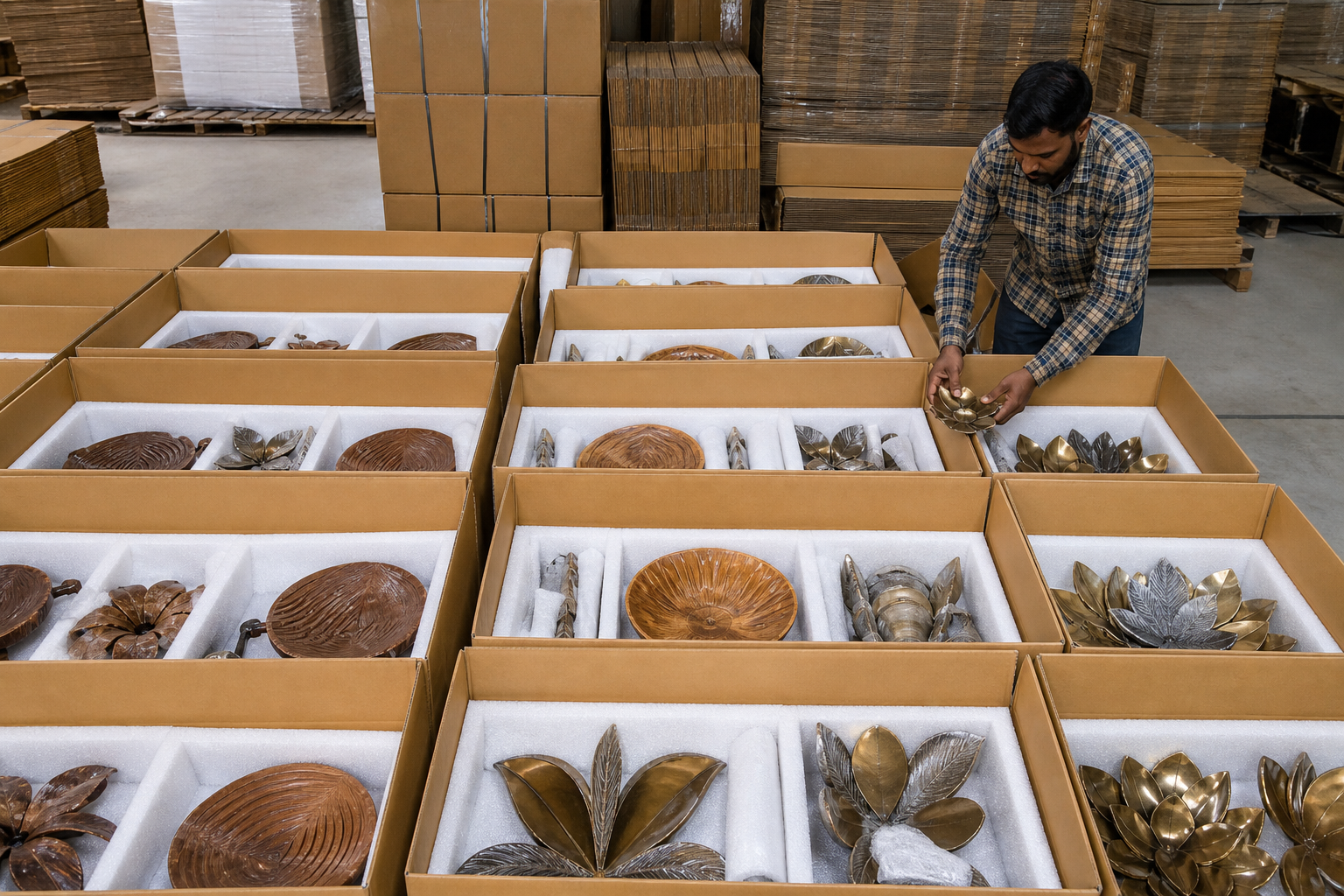
Overview of the Handicraft Export Process
Export Tip
Use this flowchart-style sequence to see where each document sits. Handicraft programmes often fail between stages 3 and 5 — after production is finished but before transport documents are clean — because sales, warehouse, and CHA work from different spreadsheets.
Comparison table
Swipe →
Data table — swipe horizontally on small screens
| Stage | What happens | Key documents |
|---|---|---|
| 1. Order confirmation | PO accepted; specs locked | PO, proforma invoice, sales contract |
| 2. Production | Bulk made to approved sample | Spec sheet, QC records (internal) |
| 3. Documentation prep | Draft commercial set | Commercial invoice, packing list, COO application, inspection cert if required |
| 4. Shipping / customs filing | Shipping bill filed; cargo handed over | Shipping bill/export declaration, freight invoice |
| 5. Transport document | Carrier issues B/L or AWB | Bill of Lading or Airway Bill |
| 6. Insurance (if CIF/CIP) | Cover arranged | Insurance certificate/policy |
| 7. Destination clearance | Buyer/broker clears | Full document pack + local import filings |
| 8. Payment collection | Documents presented/settled | Negotiable set per payment terms |
Essential Registrations Required Before Exporting
Import Export Code (IEC)
Purpose: The Import Export Code is the DGFT identifier required for commercial exports from India. Without it, shipping bills for commercial consignments generally cannot be filed. Benefits: Establishes organised trade identity, enables ICEGATE workflows, and signals seriousness to banks and buyers. Application process: Apply on dgft.gov.in with PAN, bank details, and address proofs that match your GST and company records. Common mistakes: Legal-name mismatches with GST; outdated address after a factory move; sharing IEC portal credentials casually across freelancers; assuming IEC alone proves product-category readiness.
GST registration
Purpose: GST registration is the tax identity for zero-rated export supplies under LUT/bond where eligible. Benefits: Clean commercial invoicing, refund/LUT workflows, and alignment between tax and customs data. Application process: Register on the GST portal; map HSN codes to your handicraft SKUs before the first export invoice. Common mistakes: Wrong HSN on metal versus textile lines; issuing zero-rated invoices before LUT is in place; invoice format gaps that banks or buyers reject; GSTIN details that do not match IEC particulars.
PAN, current account, RCMC, EPCH membership
PAN underpins IEC and tax filings — treat name consistency as non-negotiable. Current account supports trade remittances and AD code linkage with your authorised dealer bank; delays here stall shipping bill AD mapping. RCMC (Registration Cum Membership Certificate) via the relevant export promotion council supports scheme and council workflows — for handicrafts typically through EPCH pathways. EPCH membership builds handicraft credibility, fair access, and buyer diligence comfort.
Common mistakes: treating EPCH as optional until a fair deadline; confusing IEC with RCMC; letting membership lapse mid-season; and assuming council membership replaces shipping documents. See EPCH registration guide and IEC vs RCMC vs EPCH below.
Handicraft Export Documentation Checklist: Complete Document Table
Checklist
Compliance Notes
Use this master table as your pre-shipment gate. Confirm with your CHA for shipment-specific needs.
Comparison table
Swipe →
Data table — swipe horizontally on small screens
| Document | Purpose | Issued/Prepared by | When required | Status | Common errors |
|---|---|---|---|---|---|
| Proforma Invoice | Quote/terms before PO | Exporter | Pre-order | Commercial | Vague specs; missing Incoterms |
| Purchase Order | Buyer commitment | Buyer | Order stage | Commercial | Specs differ from proforma |
| Commercial Invoice | Value & description for customs/payment | Exporter | Every shipment | Mandatory | "Assorted handicrafts"; value mismatches |
| Packing List | Cartons, weights, dimensions | Exporter | Every shipment | Mandatory | Qty ≠ invoice; missing net/gross |
| Shipping Bill / Export Declaration | Indian customs export filing | Exporter via ICEGATE/CHA | Pre-export | Mandatory | HS errors; IEC/GST mismatches |
| Bill of Lading | Sea transport contract/receipt | Carrier/forwarder | Sea freight | Mandatory (sea) | Wrong consignee; quantity typos |
| Airway Bill | Air transport document | Airline/forwarder | Air freight | Mandatory (air) | Shipper/consignee errors |
| Certificate of Origin | Origin proof / preference claims | Chamber/authorised agency | Buyer/duty needs | Often required | Product desc ≠ invoice |
| Insurance Certificate | Cargo cover | Insurer/exporter | CIF/CIP or buyer request | Situational | Under-declared value |
| Inspection Certificate | Pre-shipment QC evidence | Agency/exporter QC | Buyer mandate | Situational | Checklist not agreed pre-production |
| Letter of Credit docs | LC compliance set | Exporter/bank chain | If LC used | Situational | Late presentation; data inconsistency |
| Packing declaration / wood packing docs | Packing compliance (e.g., ISPM-15 where applicable) | Exporter/treatment provider | When wood packing used | Situational | Untreated wood packing |
| EPCH/RCMC proofs | Council identity | EPCH/council | Onboarding/schemes | Recommended | Expired membership |
Which Export Documents Are Mandatory and Which Are Optional?
Typically mandatory for commercial handicraft exports from India: IEC-backed shipping bill/export declaration, commercial invoice, packing list, and transport document (B/L or AWB). GST-compliant invoicing and LUT/bond handling where claiming zero-rating are foundational compliance, not optional extras.
Often required by buyer or destination: Certificate of origin, insurance under CIF/CIP, inspection certificates, preferential origin forms, and wood-packaging compliance evidence. Optional/situational: Marketing catalogues, detailed process SOPs, social audit reports — valuable for retail onboarding but not always customs-mandatory. Never confuse "buyer mandatory" with "customs optional" — if the buyer needs it to pay or clear, it is mandatory for that programme.
IEC vs RCMC vs EPCH: Understanding the Difference
Compliance Notes
Think of IEC as the legal key to export, EPCH membership as handicraft-sector credibility and fair access, and RCMC as the council registration certificate linked to membership rules. You generally need IEC first; EPCH/RCMC strengthen organised handicraft trade identity. None of them fix a mismatched invoice.
Comparison table
Swipe →
Data table — swipe horizontally on small screens
| Instrument | What it is | Who needs it | What it does not do |
|---|---|---|---|
| IEC | DGFT import-export code | Every commercial exporter/importer | Does not prove handicraft category expertise |
| RCMC | Registration Cum Membership Certificate via council | Exporters seeking council registration/schemes | Does not replace IEC or GST |
| EPCH membership | Handicraft council membership | Handicraft exporters seeking category market access | Does not replace shipping documents or QC |
Understanding Shipping Documents
Bill of Lading (B/L): Evidence of sea carriage contract and receipt of goods; often needed for payment negotiation under LC or document-against-payment terms. Example error: consignee name misspelled versus invoice — amendment fees and destination release delays follow. For handicraft LCL consolidations, piece counts and carton totals on the B/L must match the packing list exactly.
Airway Bill (AWB): The air freight equivalent issued by the airline or agent. It is usually non-negotiable in the same way as an ocean B/L, but shipper, consignee, notify party, and cargo particulars must still match the commercial set. Air samples and urgent gift assortments fail when AWB descriptions say "gifts" while the invoice lists SKU-level décor items.
Shipping Bill / export declaration: The Indian customs export filing via ICEGATE — the backbone of Indian export compliance. HS codes, values, IEC, and GST particulars must align with the commercial invoice. Freight invoice: Carrier or forwarder charges evidence for cost allocation and buyer reimbursement under certain Incoterms. Insurance documents: Prove cover under CIF/CIP or buyer-requested policies; under-declared values weaken claims after breakage of ceramic or glass handicrafts.
Delivery order: Destination release document in some port workflows after freight and local charges are settled. Customs documentation at destination includes local import filings your buyer or broker handles using your pack. Practical habit: share draft invoice, packing list, and proposed HS codes with CHA and buyer broker before cutoff. Most painful amendments happen after the vessel sails. For mixed-SKU consolidations, carton marks on the packing list must match physical stencil marks so warehouses can locate goods during examinations.
Export Compliance Requirements for Handicraft Exporters
DGFT: Valid IEC; scheme rules if claiming benefits; restricted/prohibited list awareness. GST: Correct invoicing, HSN, LUT/bond where applicable. Customs (CBIC/ICEGATE): Accurate shipping bill data, valuation, and examination readiness. Product-specific: Wood packaging rules, labelling for textiles, chemical/safety expectations for painted children's items where relevant. Country-specific: Destination labelling, preferential origin, and broker requirements.
Handicrafts are generally less certificate-heavy than food, but destination retail compliance can still be strict. Restricted product considerations are uncommon for standard décor, yet exporters must still screen controlled materials in finishes or packaging. Ask your CHA before production — not after packing. World Customs Organization-aligned systems increasingly validate data consistency across declarations, which is why identical nomenclature matters more every year.
Common Documentation Mistakes Exporters Make
- Vague descriptions ("assorted handicrafts") — Use SKU-level descriptions.
- Invoice vs packing list quantity mismatch — Reconcile before filing.
- HS code errors — Confirm with CHA; keep a SKU–HS master.
- Missing signatures/stamps where required — Follow instrument rules.
- Incomplete declarations on shipping bill — Review draft with CHA.
- Wrong buyer/consignee details — Copy-paste from confirmed PO only.
- Weight/dimension inconsistencies — Weigh cartons; update packing list.
- Incoterm not stated or misunderstood — Lock on proforma and invoice.
- Currency/value typos — Dual-check before ICEGATE filing.
- COO description ≠ invoice — Harmonise nomenclature.
- Late certificate applications — Start COO/inspection early.
- Ignoring wood packing rules — Use compliant packing materials.
- LC document discrepancies — Checklist against LC clauses line by line.
- No draft pack shared with buyer broker — Pre-alert every trial.
- Poor version control — One master file; retire old drafts.
- Expired EPCH/membership proofs in onboarding packs — Renew on time.
- Different catalogue names vs customs names — Map marketing titles to export descriptions in the SKU master.
- Skipping broker pre-alert on trials — Every first shipment to a new destination needs a draft pack review.
Solutions share one pattern: single source of truth, dual review, and cutoff discipline. When an error recurs twice, add it as a permanent checklist line. Most documentation failures in handicraft exports are preventable process gaps — not exotic regulatory surprises.

How to Prepare Export Documents Without Errors
Build a SKU master with commercial description, HS code, net weight, and carton configuration. Generate the commercial invoice and packing list from the same master — never from separate sales and warehouse spreadsheets. Run a three-way match: PO ↔ invoice ↔ packing list. Have a second person review consignee, notify party, and Incoterm fields before CHA filing.
Freeze documents after CHA confirmation and mark the file FINAL. Photograph packed cartons and store images with the shipment folder for claims and examination queries. Use the printable checklist at cutoff minus 48 hours. Error-free preparation is process design, not last-minute heroics. When a mismatch appears after gating in, treat it as a root-cause event: update the master, retrain the owner, and add a checklist line so the same error cannot recur on the next sailing.
Country-Specific Documentation Considerations
USA
US importers expect clear commercial descriptions, accurate values, and timely data for ISF/importer security filings on their side. Retail programmes often need barcodes, carton labels, and detailed packing lists for mixed home-décor assortments. Wood packaging compliance matters when wooden packing materials are used. Share draft invoice and packing list with the US broker before sailing so entry data can be prepared without emergency amendments.
UK and European Union
Preferential origin documentation may matter for duty under applicable trade arrangements — confirm rules of origin before promising preferential rates. Labelling (especially textiles and fibre content) and claim substantiation for eco or handmade lines affect both clearance and retail acceptance. Precise product descriptions reduce examination risk at EU/UK borders. Work with destination brokers on EORI and import declarations; keep nomenclature identical across invoice, packing list, and COO.
UAE
Certificate of origin and clean commercial sets are commonly expected for UAE clearance and buyer onboarding. Hospitality and wholesale buyers still need accurate packing lists for mixed containers of lanterns, trays, and gift assortments. Speed-to-market does not excuse mismatched documents — Dubai and other Gulf hubs move fast when paperwork is clean and stall when it is not.
Australia and Canada
Biosecurity and packaging rules can be sensitive — especially wood packing and untreated materials. Accurate descriptions and compliant packing materials reduce holds at destination. Longer transit times make cargo insurance and carton photo evidence valuable if breakage or moisture damage occurs. Pre-alert brokers with drafts; do not wait for vessel arrival to discover a description mismatch.
Export Documentation Checklist PDF — Printable Pre-Shipment List
Checklist
Compliance Notes
- □ IEC valid; GSTIN and LUT status confirmed
- □ EPCH/RCMC proofs current (if used in onboarding)
- □ PO specs match approved sample
- □ Commercial invoice: SKU descriptions, qty, value, Incoterm, payment terms
- □ Packing list: cartons, net/gross, dimensions; qty matches invoice
- □ HS codes agreed with CHA
- □ Shipping bill data matches invoice/packing list
- □ B/L or AWB draft checked (shipper, consignee, notify, qty)
- □ COO applied/issued if required; wording matches invoice
- □ Insurance arranged if CIF/CIP
- □ Inspection certificate attached if buyer mandated
- □ Wood packing compliance confirmed if applicable
- □ Draft pack emailed to buyer broker
- □ Carton photos saved in shipment folder
- □ Payment instrument (advance/LC) conditions reviewed
Use this section as your printable handicraft export documentation checklist before every shipment. Copy it into your SOP binder or shared drive as a one-page gate. (Save/print this page section as your working PDF checklist.)
How Technology Is Simplifying Export Documentation
Digital documentation, ICEGATE filings, electronic Bills of Lading in some trades, trade management software, and AI-assisted compliance checks are reducing manual retyping — when master data is clean. Dirty SKU masters produce digital errors faster than paper ever did. Digital customs systems increasingly cross-check fields; inconsistency is easier for systems to flag than for a busy officer to miss.
AI-powered tools can highlight invoice–packing list mismatches and suggest HS candidates for CHA review, but they cannot own valuation, origin, or restricted-goods judgement. Future developments point to deeper customs digitisation, broader e-B/L adoption, and automated discrepancy detection before cargo cutoff. Technology amplifies discipline; it does not replace a named document owner or a cutoff checklist.
Case Study: Fixing Documentation Delays for a Handicraft Exporter
Background: A Jaipur home décor exporter shipping brass and textile gift assortments faced repeated destination delays on US and UAE LCL trials despite on-time production.
Challenges: Sales prepared invoices from catalogue names; warehouse prepared packing lists from internal SKU codes; descriptions drifted every shipment. No single owner owned the final commercial set.
Documentation issues: Quantity mismatches between invoice and packing list; HS inconsistencies across shipping bills; COO wording differed from the commercial invoice; broker drafts were emailed only after the vessel sailed.
Corrective actions: Created a SKU master with export descriptions and HS codes; appointed one document controller; enforced a cutoff−48h checklist; made buyer-broker pre-alert mandatory; added CHA draft review before ICEGATE filing.
Results: The next four shipments cleared without amendment; LC presentation was cleaner; storage and amendment costs dropped; buyer trust recovered with two repeat orders in the following quarter.
Lessons learned: Documentation is an operations system. Spreadsheet tools and WhatsApp threads failed until ownership and master data were fixed. The printable handicraft export documentation checklist became the gate that production could not bypass.
Export Documentation Best Practices
- Central document management folder per shipment
- Dual verification on consignee and quantities
- Version control — mark FINAL after CHA sign-off
- Compliance review against destination notes
- Written communication trail with forwarder/CHA
- Retain records per statutory and buyer requirements
- Quarterly internal audit of random shipment files
- Train sales not to invent descriptions under pressure
Future of Export Compliance and Documentation Through 2030
Through 2030 expect more automation, AI-powered document verification, broader electronic transport documents, blockchain pilots for trusted document chains, trade digitisation, and customs modernisation aligned with World Customs Organization directions. Indian exporters will interact with denser digital customs environments where mismatched fields are rejected earlier in the filing cycle.
Exporters with clean master data and checklist culture will move faster and win buyer preference. Those relying on last-minute manual fixes will face more automated rejections and higher amendment costs. Opportunity favours MSMEs and merchant exporters that professionalise paperwork early — treating the handicraft export documentation checklist as a permanent operating system, not a one-time blog download.

Conclusion
- Do next: Run the printable checklist on your current open order.
- Read export documentation checklist for India and export certifications.
- Continue with how to export handicrafts from India, find international buyers, trade shows for handicraft exporters, top handicraft products, best countries, source from India, most demanded by country, and sustainable handicraft exports.
- Explore merchant exporter support for end-to-end coordination.
A reliable handicraft export documentation checklist covers registrations (IEC, GST, EPCH/RCMC as applicable), commercial documents, shipping bill, transport documents, and destination-driven certificates — all with identical nomenclature. Compliance recommendations: build a SKU master, reconcile before filing, pre-alert brokers, and treat amendments as process failures to investigate.
Best practices are ownership, version control, and cutoff discipline. Actionable next steps: adopt the printable checklist above on your next shipment, align invoice/packing list templates, confirm EPCH/IEC status, and brief your CHA on hero SKU HS codes. Altus Exports supports handicraft exporters and buyers who need documentation discipline paired with real shipment execution.