
How to Export Handicrafts from India: Complete Guide for Beginners
By Saurabh Mittal, Founder, Altus Exports
A complete beginner's guide on how to export handicrafts from India — covering why Indian handmade products are in global demand, regional craft clusters, EPCH and IEC registrations, GST, export documentation, pricing, packaging, and shipping. Learn how MSMEs and artisan manufacturers find international buyers in the USA, UK, Europe, UAE, and Australia, avoid common first-order mistakes, and build repeat export programmes with consistent quality and compliance. Includes a step-by-step export process, documentation checklist, buyer-finding tactics, a wooden décor case study, and expert insights from Altus Exports.
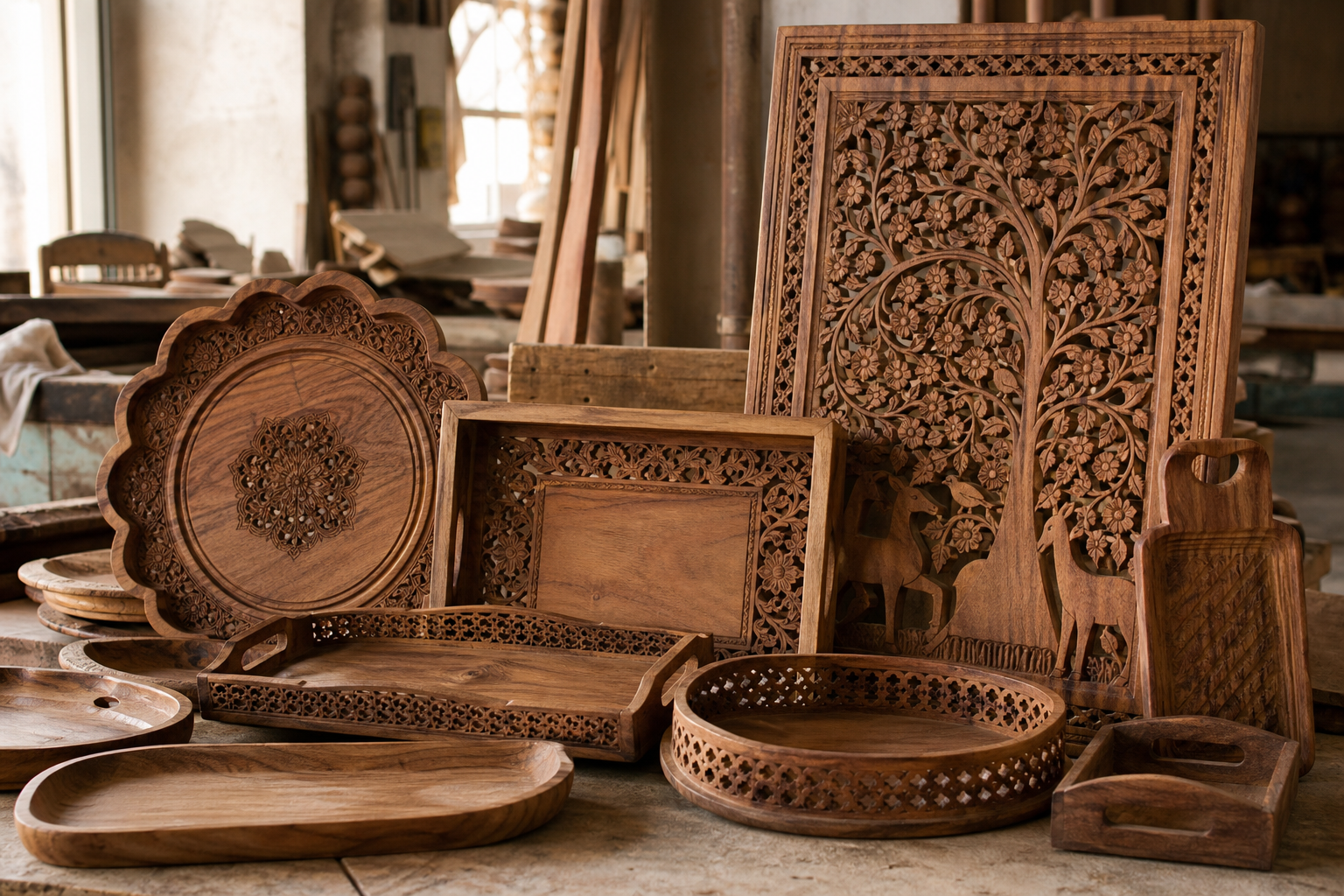
Global demand for handmade products has shifted from seasonal gift buying to year-round retail, hospitality, and e-commerce programmes. Buyers in the USA, UK, Europe, UAE, and Australia increasingly search for authentic artisan goods with traceable origin, consistent quality, and export-ready packaging — and India remains one of the strongest sources for that mix. If you are learning how to export handicrafts from India, the opportunity is real: wooden décor, metal crafts, textiles, ceramics, jewellery, and lifestyle accessories already move through major ports every week.
Indian handicrafts are popular worldwide because they combine regional craftsmanship with competitive landed cost. Jaipur brassware, Saharanpur wood carving, Moradabad metalware, Kutch embroidery, and Kashmir papier-mâché each carry distinct buyer recognition. Export Promotion Council for Handicrafts (EPCH) data and Ministry of Commerce trade reports consistently show handicrafts among India's resilient lifestyle export categories — even when commodity cycles soften — because design differentiation protects margin better than pure price competition.
For beginners, the barrier is rarely craftsmanship. It is process: IEC registration, EPCH membership, GST zero-rating, buyer discovery, export pricing, fragile-goods packaging, and documentation that clears destination customs without amendment. This guide walks through that full path — from product selection to first shipment — so Indian manufacturers, MSMEs, and aspiring exporters can build a handicraft export business with fewer costly first-order mistakes. International buyers and procurement managers will also see how verified Indian handicraft exporters structure quality, compliance, and logistics.
Key Takeaways
Summary Box
- How to export handicrafts from India starts with product-market fit, IEC, EPCH registration, and GST — not with cold emails to buyers.
- India's handicraft clusters (Moradabad, Saharanpur, Jaipur, Jodhpur, Kutch, and others) give beginners credible origin stories and supplier depth.
- Top import markets for Indian handicrafts include the USA, UAE, UK, Germany, France, Netherlands, and Australia — each with different labelling and compliance expectations.
- Export documentation for handicrafts typically includes commercial invoice, packing list, bill of lading/AWB, certificate of origin, and inspection certificates where buyers require them.
- Fragile wooden, metal, ceramic, and textile handicrafts need category-specific packaging — damage claims destroy first-order relationships faster than price disputes.
- Most MSMEs reach international handicraft buyers faster through trade data, EPCH exhibitions, B2B portals, and a merchant exporter in India than by building an overseas sales team.
What Makes India a Global Handicraft Export Hub?
India's position in the global handicraft trade rests on four structural advantages: deep artisan communities, specialised regional clusters, government export promotion through EPCH and related schemes, and a product range that spans home décor, gifts, furniture accessories, textiles, and lifestyle goods. Unlike single-factory industrial categories, handicraft export from India often combines workshop production with organised finishing, packing, and merchant-export coordination — which is why many international buyers prefer working with Indian handicraft exporters who can consolidate mixed SKUs into one compliant shipment.
Traditional craftsmanship is not a marketing slogan here; it is the production system. Wood carving in Saharanpur, brass and metal casting in Moradabad, blue pottery and block printing around Jaipur, stone and marble crafts in Agra and Kishangarh, and textile handicrafts across Gujarat and Rajasthan create natural specialisation. Buyers who understand these clusters source faster and negotiate more accurately because they know where capacity, finishing quality, and design fluency actually sit.
Government support matters for beginners. DGFT issues the Import Export Code (IEC). EPCH provides Registration Cum Membership Certificate (RCMC) pathways, market intelligence, and exhibitions such as IHGF Delhi Fair. FIEO and Ministry of Commerce programmes help MSMEs access trade fairs and export awareness. None of these replace quality systems — but they lower the administrative friction of entering international markets.
Comparison table
Swipe →
Data table — swipe horizontally on small screens
| Product Category | Major Production Region | Key Export Markets |
|---|---|---|
| Wooden décor & carved furniture accessories | Saharanpur (UP), Jodhpur (Rajasthan) | USA, UK, Europe, Australia |
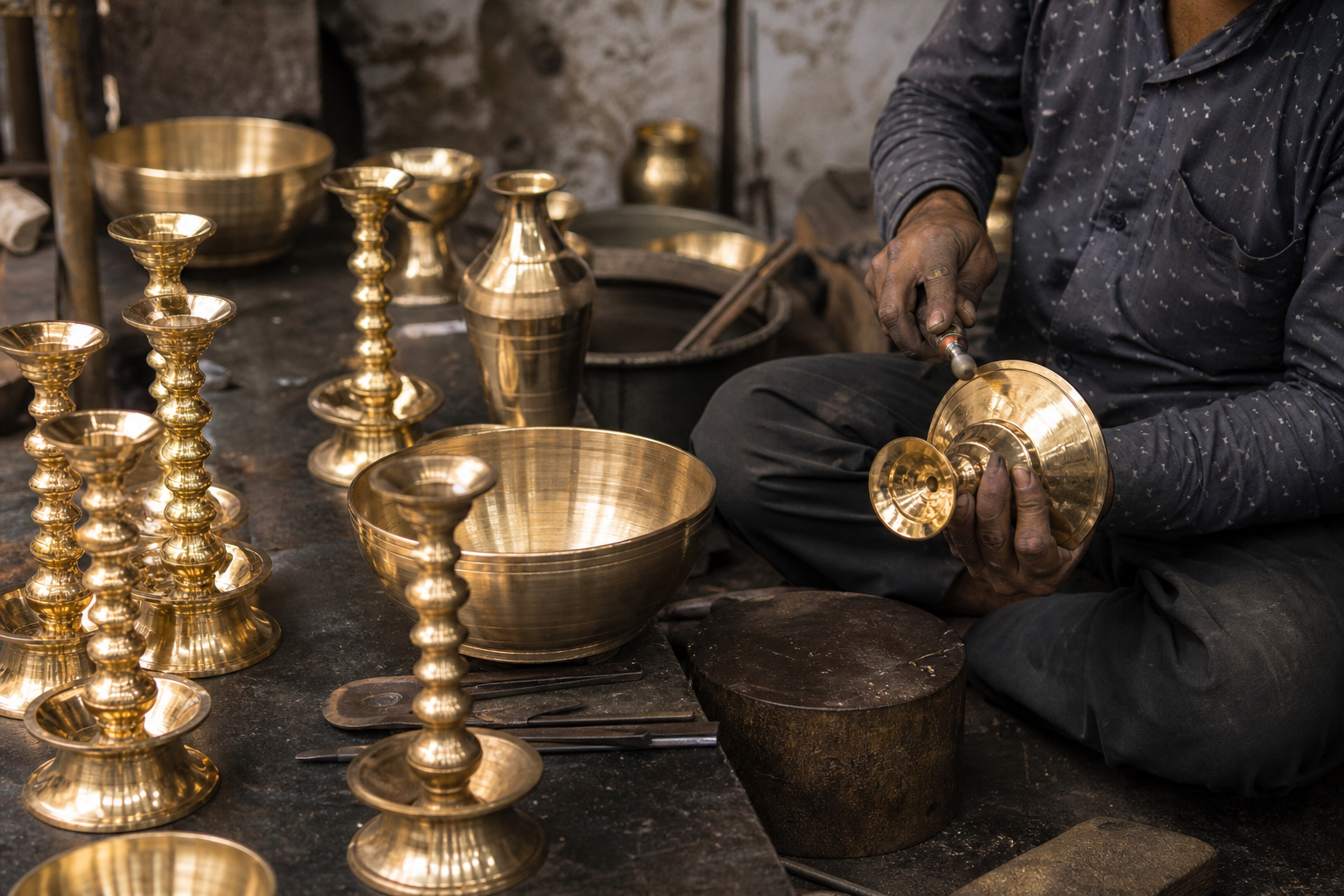
| Metal handicrafts & brassware | Moradabad (UP), Jaipur (Rajasthan) | USA, UAE, UK, Germany |
| Textile handicrafts & embroidery | Kutch (Gujarat), Jaipur, Lucknow | USA, UK, Europe, UAE |
| Ceramics, pottery & terracotta | Jaipur, Khurja (UP), Pondicherry | Europe, USA, Australia |
| Jewellery & fashion accessories | Jaipur, Delhi NCR, Hyderabad | USA, UAE, UK |
| Stone, marble & inlay crafts | Agra, Kishangarh, Makrana | Middle East, USA, Europe |
| Cane, bamboo & natural fibre | Assam, Tripura, West Bengal, Kerala | Europe, USA, Australia |
Understanding the Global Market for Indian Handicrafts
The Indian handicrafts export market is demand-led by home décor retail, hospitality fit-outs, gift wholesalers, and online lifestyle brands. ITC Trade Map and DGFT shipment patterns typically place the United States among the largest destinations for Indian handicrafts, followed by strong Gulf demand (especially UAE) and steady European offtake through Germany, UK, France, and the Netherlands. Australia remains a high-value, design-sensitive market for wooden décor, textiles, and eco-positioned handmade products.
Demand trends favour products that look handmade but ship like commercial goods: consistent dimensions, colour-fast finishes, retail-ready labelling, and packaging that survives ocean transit. Buyers still want artisan character — but they reject lot-to-lot variation that breaks planogram or online listing consistency. That is why organised exporters who standardise QC checkpoints outperform pure workshop aggregators on repeat orders.
Popular categories in 2025–26 include wooden wall art and trays, metal candle stands and planters, hand-block printed home textiles, ceramic tableware accents, festive décor, and sustainable natural-fibre products. Emerging opportunities include private-label lifestyle collections for US and UK e-commerce brands, hospitality décor programmes for UAE hotels, and eco-certified cane/bamboo lines for European retailers under tightening sustainability expectations.
Comparison table
Swipe →
Data table — swipe horizontally on small screens
| Market | Demand Profile | Popular Categories | Beginner Opportunity |
|---|---|---|---|
| USA | Highest volume; retail + e-commerce + wholesale | Wood décor, metalware, textiles, gifts | Strong if QC and packaging are retail-grade |
| UAE | Fast-moving wholesale and hospitality | Metal décor, festive gifts, furniture accents | Good first market for many MSMEs |
| UK | Design-led; compliance-aware | Textiles, ceramics, wooden accents | Higher margin with tighter specs |
| Germany / EU | Quality and sustainability focus | Natural fibre, ceramics, textiles | Requires REACH/labelling discipline |
| Australia | Premium niche; longer transit | Wood, textiles, lifestyle gifts | Plan packaging and lead times carefully |
| Netherlands / France | Design wholesale hubs | Mixed décor assortments | Useful for EU distribution partners |
How to Export Handicrafts from India: Step-by-Step Guide
Export Tip
The following ten steps are the practical operating sequence used by successful Indian handicraft exporters. Complete them in order. Skipping registrations or packaging validation to "save time" usually costs more at the first customs hold or damage claim.
Step 1: Choose the Right Product
- Select 2–5 core SKUs with repeatable production capacity
- Confirm raw material availability across seasons (wood moisture, metal alloys, dyes)
- Photograph products for catalogue and sample kits under consistent lighting
- Reject SKUs that cannot hold dimensional or colour consistency across lots
Start with products you can reproduce consistently — not one-off showpieces. Map each SKU to an HS code, define dimensions, materials, finish, colour tolerance, and packing configuration. Beginners should prefer categories with established export history from their cluster (for example, Moradabad metalware or Saharanpur wooden décor) rather than inventing a brand-new craft category with no buyer reference points.
Step 2: Identify Export Markets
Choose one primary market and one backup. Use import demand, freight economics from your nearest port (Nhava Sheva, Mundra, Chennai, or ICD-linked routes), payment norms, and compliance complexity. A Saharanpur wooden décor unit may start with UAE wholesale before tackling US retail programmes that demand stricter barcode, labelling, and carton testing.
Step 3: Obtain IEC Registration
Apply for an Import Export Code on the DGFT portal (dgft.gov.in). IEC is mandatory for shipping bill filing and most export benefit claims. Keep PAN, bank details, and address proof consistent with GST records. Most clean applications process within a few working days.
Step 4: Register with EPCH
EPCH registration (and RCMC where applicable) signals seriousness to buyers and unlocks council exhibitions, directories, and market support. For handicraft export from India, EPCH membership is one of the strongest credibility markers for MSMEs and artisan manufacturers entering organised trade channels.
Step 5: Complete GST Requirements
Ensure GST registration supports export of goods, including LUT/bond for zero-rated supplies where eligible. Align invoice formats, HSN codes, and place-of-supply fields with your CHA before the first shipping bill. GST mismatches are a common beginner delay even when product quality is excellent.
Step 6: Find International Buyers
Combine EPCH fairs, B2B portals, LinkedIn outreach, trade data prospecting, and referrals. For a structured non-fair approach, see How to Find International Buyers Without Attending Trade Shows and how trade data helps find export buyers.
Step 7: Product Pricing Strategy
Export price is not domestic price plus freight. Build FOB from ex-works cost + finishing + packaging + inspection + documentation + exporter margin + inland haul. Then model CIF/DDP landed cost for the buyer's market. Underpricing to win the first PO often creates quality shortcuts that kill the second PO.
Step 8: Packaging Requirements
Design packaging for ocean vibration, stacking, humidity, and last-mile handling. Wooden and ceramic items need corner protection and void fill; metalware needs anti-tarnish and scratch barriers; textiles need moisture control and clean folding standards. Test drop and compression on sample cartons before bulk packing.
Step 9: Shipping and Logistics
Select LCL for trial orders and FCL when volume and carton density justify it. Air freight suits urgent samples and high-value compact goods. Appoint a freight forwarder and CHA familiar with handicraft consolidations. Agree Incoterms (usually FOB or CIF for beginners) in writing before production starts.
Step 10: Export Documentation
Prepare commercial invoice, packing list, shipping bill, bill of lading or airway bill, certificate of origin, and any buyer-required inspection certificates with identical product descriptions across every document. Align this workflow with our export documentation checklist for India.
Export Documentation Checklist
Checklist
Compliance Notes
Documentation is where many first-time handicraft exporters lose days — and sometimes the buyer. Destination customs compare invoice, packing list, and transport documents line by line. A quantity mismatch, vague description ("assorted handicrafts"), or HS code that does not match the physical goods invites examination, storage charges, and trust damage.
Use the checklist below as a pre-shipment gate. Do not book cargo cutoff until drafts are reviewed by your CHA and, where possible, shared with the buyer's import broker.
Comparison table
Swipe →
Data table — swipe horizontally on small screens
| Document | Purpose | Who Issues / Coordinates | Beginner Tip |
|---|---|---|---|
| IEC | Legal authority to export/import | DGFT | Keep PDF and DGFT login credentials secure |
| GST + LUT (if applicable) | Zero-rated export compliance | GST portal / accountant | Match HSN on invoice and shipping bill |
| Commercial Invoice | Value, description, buyer/seller terms | Exporter | Use precise SKU descriptions, not "mixed décor" |
| Packing List | Carton count, net/gross weight, dimensions | Exporter | Must reconcile exactly with invoice quantities |
| Certificate of Origin | Preferential or non-preferential origin proof | Chamber / authorised agency | Confirm if buyer needs preferential COO |
| Bill of Lading / AWB | Evidence of shipment contract | Carrier / forwarder | Check consignee and notify party spelling |
| Insurance Documents | Cargo risk cover under CIF/CIP | Insurer / exporter | Photograph packing before sealing for claims |
| Inspection Certificates | Pre-shipment quality confirmation | Buyer-nominated agency / exporter QC | Agree AQL and checklist before production |
| EPCH / RCMC proofs | Council membership evidence | EPCH | Useful for buyer onboarding and fair access |
| Phyto / timber docs (if applicable) | Plant-product or wood compliance | Relevant authority | Required for some wooden/natural fibre goods |
How to Find International Buyers for Handicrafts
Buyer discovery for handmade products export works best as a portfolio of channels, not a single marketplace listing. Trade fairs create face-to-face trust; digital channels create weekly pipeline; referrals create the highest close rates.
Trade fairs and EPCH exhibitions
IHGF Delhi Fair and other EPCH-linked exhibitions remain high-intent venues for international handicraft buyers. Prepare a focused booth assortment, price list with MOQs, sample policy, and lead capture process. Follow up within 72 hours — most fair leads die from slow response, not weak products.
B2B portals, trade data, and LinkedIn
Use B2B portals for discovery, not as your only sales engine. Pair them with import shipment data to identify active importers of your HS codes into USA, UK, UAE, and Australia. On LinkedIn, target category buyers, assortment managers, and wholesale owners with SKU-specific messages — not generic "we are exporters" pitches.
Associations, referrals, and export partners
- Shortlist 50 target importers per primary market using trade data filters
- Send a one-page capability sheet: cluster, SKUs, MOQ, lead time, certifications
- Offer paid sample kits with clear credit terms against first order
- Track every lead in a simple CRM with next-action dates
- Prioritise buyers who already import Indian handicrafts — switching cost is lower
Trade associations, existing domestic retail clients with overseas sister companies, and merchant exporters can open doors faster than cold outreach alone. Altus Exports supports buyer matching and export coordination for handicrafts and lifestyle products when manufacturers need market access without building an international sales team — see how MSMEs export without a sales team.
Packaging and Shipping Best Practices
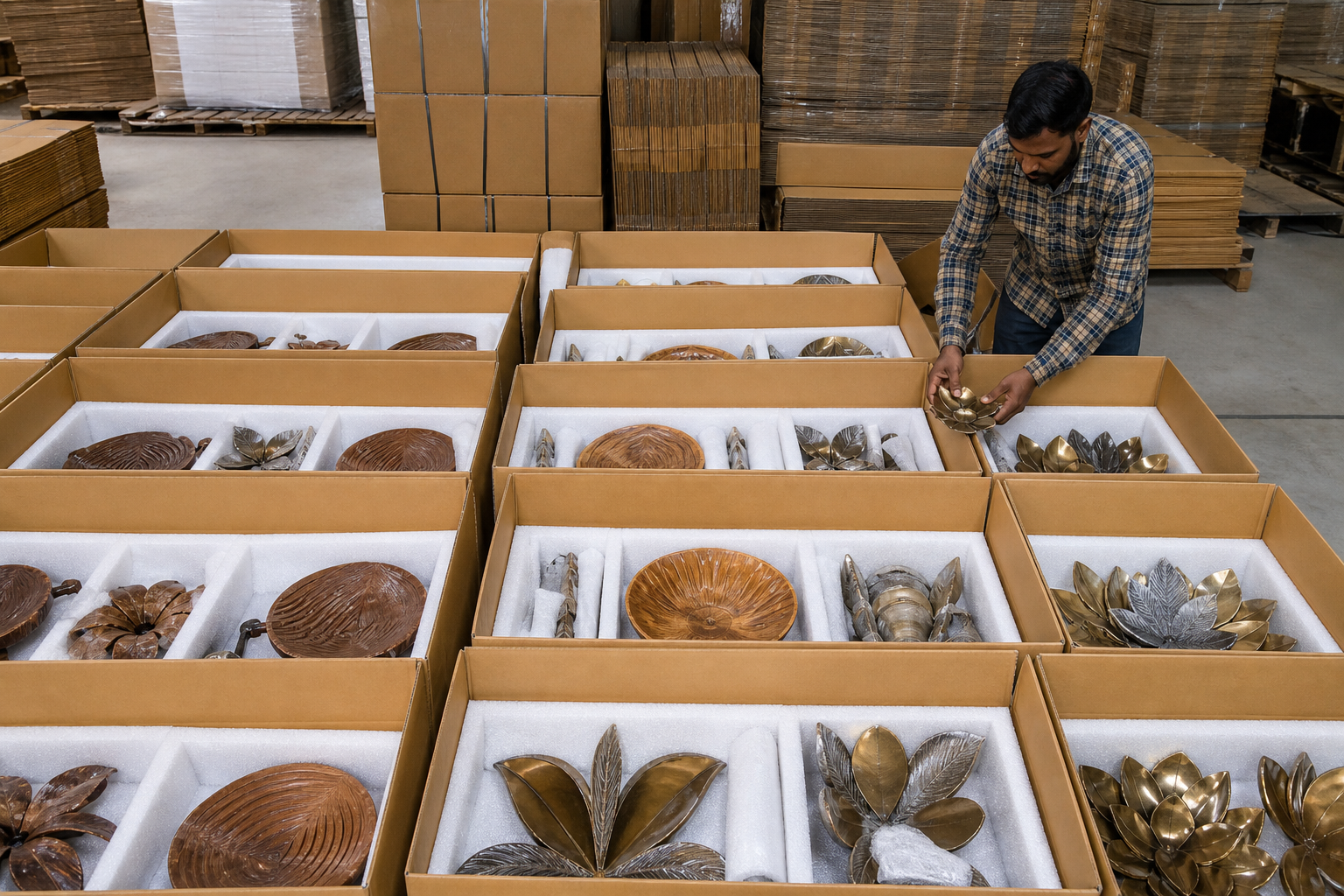
Packaging is part of the product for international handicraft shipments. A beautifully carved tray that arrives scratched is a failed export, regardless of FOB price.
Fragile, wooden, metal, and textile goods
- Fragile ceramics/glass accents: Double-wall cartons, individual wraps, dividers, orientation arrows, and "fragile" handling marks that match carrier rules
- Wooden handicrafts: Moisture content control before packing; corner protectors; avoid raw-wood rub against finishes; consider ISPM-15 for wood packaging materials
- Metal handicrafts: Soft wraps, anti-tarnish materials where needed, scratch barriers between nested pieces, and secure blocking to prevent transit abrasion
- Textile handicrafts: Clean polybags or kraft wraps, silica where humidity risk is high, colour-lot segregation, and retail fold standards agreed with buyer
Compliance, freight options, and cost control
Confirm destination labelling (fibre content, country of origin, care instructions, warnings). Choose LCL for trials, FCL for dense programmes, and air for samples or urgent replenishment. Cost optimisation comes from carton engineering (better cube utilisation), mixed-SKU consolidation, and accurate weight declarations — not from under-insuring cargo.
Common Mistakes New Handicraft Exporters Make
Common Mistakes Box
- Selling unique pieces that cannot be reproduced — Solution: commercialise only SKUs with documented production recipes and capacity.
- Quoting without full packaging cost — Solution: engineer export cartons before final FOB.
- Skipping EPCH / weak buyer credentials — Solution: complete IEC + EPCH before serious outreach.
- Vague invoice descriptions — Solution: SKU-level descriptions matching packing list and COO.
- No sample approval record — Solution: written sign-off with photos and measurements.
- Ignoring wood/moisture and finish curing time — Solution: build curing into lead time; measure moisture.
- Over-promising lead times before artisan capacity check — Solution: capacity calendar per workshop.
- Choosing markets only by high price, not compliance fit — Solution: score markets on regulatory readiness.
- Under-insuring or skipping pre-shipment photos — Solution: insure appropriately; document packing.
- Chasing one-time orders instead of programme buyers — Solution: target repeat wholesale and retail programmes.
- No QC checkpoints mid-production — Solution: in-line inspection for finish, dimensions, and packing.
- Working with unverified subcontractors — Solution: map every finishing vendor; audit critical steps.
Most first-order failures in handicraft export are process failures. Avoid these ten patterns:
Case Study: Exporting Handmade Wooden Décor to the USA
Challenge: A Saharanpur-based manufacturer of handmade wooden wall décor and trays sold strongly in Indian wholesale markets but had never exported. A US home décor importer requested a mixed 20-SKU assortment, retail packaging, and a first trial of one LCL shipment to Los Angeles — with strict colour and dimension tolerances.
Approach: The manufacturer partnered with an export coordinator to complete IEC verification, EPCH registration, GST/LUT alignment, and a written specification pack for each SKU. Two hero SKUs were engineered first for packaging drop tests; the remaining assortment followed only after sample approval.
Buyer search and negotiation: The US lead came through a combination of EPCH fair follow-up and LinkedIn outreach to assortment managers already importing Indian wood décor. Payment terms settled at 40% advance and 60% against scan copy of B/L for the trial.
Documentation and shipping: Commercial invoice and packing list used identical SKU codes. Certificate of origin and shipping bill descriptions matched. Cartons were photographed before sealing. The LCL moved via Nhava Sheva with cargo insurance and a pre-alert to the buyer's broker.
Results: The trial cleared without document amendment. In-transit damage was limited to one carton (credited). The buyer placed a repeat FCL within 90 days for a narrowed 12-SKU core range — higher volume, fewer variants, better margin.
Lessons learned: Narrow the assortment early, treat packaging as a production step, and price for repeat programme economics rather than one-shot fair pricing. For readiness sequencing beyond handicrafts, use The First 10 Steps Every Indian Manufacturer Should Take Before Starting Exports.
Future Outlook for Indian Handicraft Exports
Through 2030, Indian handicraft exports will be shaped less by "handmade vs machine" debates and more by digital discovery, sustainability proof, and supply reliability. AI-driven sourcing tools already help international buyers shortlist suppliers by category, certification, and shipment history — which means exporters with clean digital catalogues, FAQ-rich websites, and verifiable credentials will win more inbound RFQs.
Sustainability is moving from brochure language to purchase criteria: responsible wood sourcing, reduced plastic in packaging, natural dyes, and transparent artisan payment practices. Eco-friendly handicrafts and natural-fibre lines are especially relevant for European and Australian buyers. Digital trade platforms and direct-to-consumer export models will grow, but B2B wholesale and merchant-export consolidation will remain the volume backbone for MSMEs.
Exporters who invest now in EPCH visibility, consistent QC systems, and destination-compliant labelling will be better positioned as global lifestyle brands diversify away from single-country décor sourcing. India's craft depth is a durable advantage — process maturity is what converts that depth into long-term export revenue.

Conclusion
- Next step for manufacturers: Share your product category, target markets, and current registrations with Altus Exports for an export readiness review.
- Next step for buyers: Send your assortment brief, MOQ, and destination requirements — we match verified Indian handicraft exporters and coordinate documentation and shipment.
- Explore export products from India and merchant exporter services to choose the right partnership model.
- Review Top 15 Handicraft Products Exported from India for category demand, clusters, and buyer-market fit.
- Compare destinations in Best Countries to Export Indian Handicrafts in 2026 before locking your first market.
- Complete council readiness with A Guide to EPCH Registration and Benefits for Handicraft Exporters.
- Use the Handicraft Export Documentation Checklist before every shipment.
- Build pipeline with How to Find Genuine International Buyers for Indian Handicrafts and Trade Shows and B2B Marketplaces for Handicraft Exporters.
- Match demand with Most Demanded Indian Handicrafts by Country and Sustainable Handicraft Export Opportunities.
- Buyers sourcing into India should read How International Buyers Can Source Handicrafts Directly from India.
- Continue with India to Global: A Manufacturer's Roadmap to Export Growth for the full scaling framework.
Learning how to export handicrafts from India is less about finding a single "secret buyer list" and more about building an export operating system: the right SKUs, IEC and EPCH credentials, GST-ready invoicing, honest pricing, engineered packaging, and documentation that clears customs the first time. The global market for Indian handicrafts remains open to beginners who treat quality consistency and buyer communication as seriously as craftsmanship.
Key requirements are clear — registrations, market selection, packaging discipline, and document control. Best practices favour narrow assortments, sample sign-offs, and programme buyers over one-off deals. If you are an Indian manufacturer or MSME ready to move, complete your registrations, prepare a tight sample kit, and start structured buyer outreach this quarter. International buyers seeking verified partners can work with Altus Exports for handicraft and lifestyle sourcing under one accountable export relationship.