How to Compare Quotations When Buying from India
By Saurabh Mittal, Founder, Altus Exports
Compare Indian quotations only when every supplier prices the same specification, quantity, packing, and Incoterm. Rank the full quote, not the bold unit price.

A quotation is a commercial offer, not a brochure. When buyers procure products from India, the most common pricing mistake is comparing numbers that describe different goods: one quote on EXW works, another on FOB Nhava Sheva, a third that forgets export cartons.
Issue one RFQ to the shortlist from supplier discovery. This is gate three of how to procure products from India.
Put the same ask in every RFQ
Export Tip
- Specification and drawing or grade revision
- Quantity and acceptable MOQ
- Inner pack and export carton
- Incoterm and named place
- Payment proposal you are willing to discuss, not a blank cheque
- Tests or certificates the price must include or clearly exclude
- Quote currency and validity
Attach the product brief. State quantity, packing, destination if it changes labelling, the Incoterm you want, the load port if you know it, and the validity you need. Ask for lead time after sample approval, not from “the day we talk.” Ask the supplier to list exclusions.
Give a reply date. Late quotes can join the next round. Changing the specification for one factory because they suggested a cheaper material is allowed only if you send that change to every factory still in the running.
Normalize Incoterms before you rank prices
EXW is the factory gate. You pay and arrange everything after that, including loading in many practical cases, inland freight, and export clearance. FOB includes delivery on board the vessel at the named port, with export clearance typically on the seller. CIF adds ocean freight and insurance to a destination port and is still not your landed cost, because duty and destination handling sit outside it.
If one supplier will only quote EXW, add a realistic origin-logistics allowance before you compare it with FOB. Do not invent precision you do not have. Do not pretend the raw EXW number won. The Incoterm map is in FOB vs CIF vs EXW when buying from India.
Read what the price leaves out
Ask explicitly about export-worthy cartons, pallets, labels, third-party tests, fumigation, and certificates. A spice quote that excludes steam treatment or a textile quote that excludes a needle check can look cheap and fail your customer. Tooling and print cylinders should be separate lines so they do not hide inside the unit price.
Check quote validity against raw-material volatility. A three-day quote on a commodity and a thirty-day quote on a stable component are both reasonable. An expired quote that is “still okay” on a phone call is not a price you can put on a purchase order.
Comparison table
Swipe →
Data table — swipe horizontally on small screens
| Line | Why it changes the ranking |
|---|---|
| Unit price and currency | The number everyone sees first |
| Incoterm and named place | Makes the number a different product if it differs |
| MOQ and tier prices | A low price at an unusable quantity is not available |
| Lead time after sample approval | Ignores sampling and is comparable |
| Packing included or not | Often the largest hidden origin cost |
| Tests and certificates | Can exceed the unit-price gap |
| Validity and payment ask | A low price with 100 percent advance is a different risk |
Score the quotation, then choose who proceeds to samples
Give each complete quote a simple score: price after Incoterm normalization, ability to meet quantity, lead time, completeness, and how clearly they stated limits. Drop incomplete quotes or send them back once. Do not negotiate five factories down to the same fuzzy middle.
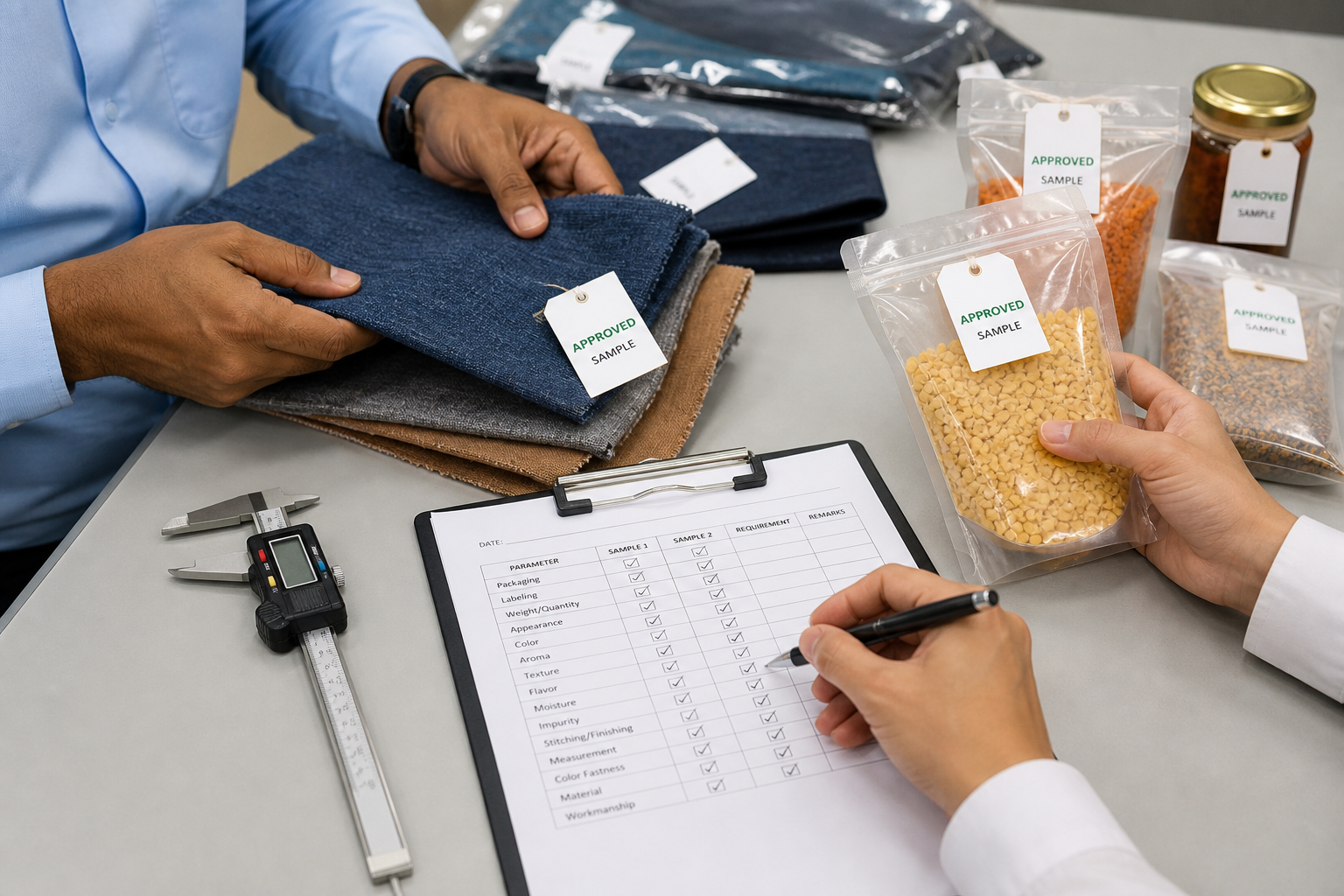
The winner of the quotation round earns the sample round, not the bulk order. Sampling is where the quote meets the product. Continue in how to approve samples when sourcing from India. Keep the second-ranked factory warm until the sample passes. A single-source decision before a sample is how buyers lose time.
Write the purchase order from the quote, not from memory
When you are ready to order, the purchase order should copy the agreed specification, quantity, price, Incoterm, packing, sample reference, inspection standard, and payment gates. A proforma that quietly changes the packing or the port is a new offer. Accept it in writing or reject it.
Payment structure belongs in that order. The quotation can propose terms. You accept terms that match payment terms when buying products from India, not whatever percentage the first email requested.