
How to Monitor Production in Indian Factories From Overseas
By Saurabh Mittal, Founder, Altus Exports
To monitor production in Indian factories from overseas, use a structured Overseas Production Monitoring Cadence (OPMC) with a milestone plan, WIP dashboard, photo and video evidence rules, first-piece approval, in-process checks at critical control points, and delayed-signal…

Once a purchase order is released and material is on the floor, the buyer’s risk shifts. Supplier verification and sample approval answer whether you chose a credible partner and defined the product correctly. They do not tell you whether this lot is using the approved inputs, whether the factory started bulk run before first-piece sign-off, or whether a delayed subcontract step will miss your vessel cut-off.
International buyers sourcing from India often manage production from the United States, Europe, the Middle East, or other regions with a large time-zone gap. Travel for every order is rarely practical. Messaging apps alone are worse than no system—they create the illusion of control while critical signals arrive too late, without context, or without evidence you can act on.
This article presents OPMC, the Overseas Production Monitoring Cadence: a repeatable method for tracking work-in-progress, confirming critical milestones, and escalating delays before they become shipment failure. OPMC is designed for live orders during production, not for initial supplier screening.
Ongoing production monitoring is not a remote supplier audit
Use it alongside how to conduct quality control when sourcing from India, pre-shipment inspection in India, and how to verify product quality before shipping from India. If you have not yet evaluated the supplier or product baseline, start with supplier due diligence and pre-order quality verification—not with production monitoring alone.
Altus Exports supports international buyers with milestone tracking, local factory communication, evidence collection, and escalation when production deviates from the agreed plan. The framework below is practical whether you work with Altus Exports, an inspection company, or your own procurement and quality team.
Buyers sometimes treat a factory video call as “monitoring.” A structured supplier audit in India without visiting the factory can be valuable, but it answers a different question at a different time.
A remote audit may include a walkthrough of quality stations and packing areas. It does not replace weekly—or daily, for high-risk orders—confirmation that your lot cleared material receipt, first-piece approval, in-process checks, and critical-path milestones on schedule.
Monitoring is also not endless chat. Without a milestone plan, photo rules, and escalation thresholds, overseas teams either over-message the factory or under-react until the supplier announces a delay one week before dispatch. OPMC gives both sides a shared operating rhythm.
Comparison table
Swipe →
Data table — swipe horizontally on small screens
| Activity | Purpose | Typical timing | Main output |
|---|---|---|---|
| Remote supplier audit | Assess identity, capability, process, and baseline risk | Before PO or before scaling with a new supplier | Audit report with go/hold decision |
| Production monitoring (OPMC) | Track WIP, milestones, and deviations on a live order | After PO release through packing readiness | Milestone log, evidence file, escalation actions |
| Pre-shipment inspection | Accept or reject a finished lot against agreed criteria | When production is complete and goods are packed | PSI report and release/hold decision |

OPMC: the Overseas Production Monitoring Cadence
OPMC is not software. It is a cadence made of owners, checkpoints, evidence standards, and response rules. Each live order should have an OPMC file before production starts.
The cadence should match product risk. A repeat order of a stable commodity may use weekly updates and fewer photos. A new private-label product, tight launch date, or order with subcontract steps may need daily WIP confirmation and same-day escalation.
Comparison table
Swipe →
Data table — swipe horizontally on small screens
| OPMC element | What it controls | Minimum evidence |
|---|---|---|
| Milestone plan | Sequence and dates for material, production, packing | Dated milestone sheet acknowledged by factory |
| WIP dashboard | Status by order line, quantity, and stage | Single shared status view updated on a fixed schedule |
| Evidence rules | What photos/videos prove and what they do not | Labeled files tied to milestone IDs |
| Critical path | Steps that directly affect ship date | Named bottleneck with owner and backup plan |
| Material gate | No bulk run until inputs are verified | GRN, batch IDs, photos, COA where required |
| First-piece gate | No mass production until approved units | Signed first-piece record with photos/measurements |
| In-process checks | Control points during production | Check sheets or inspector notes at defined steps |
| Delayed-signal escalation | Response when a milestone slips | Written alert, cause, recovery plan, and decision |
| Communication window | Predictable contact across time zones | Standing call slot and async update deadline |
| Micromanagement limits | What the buyer should not control remotely | Documented “factory-owned” decisions |
Build a milestone plan before production starts
- PO number, SKU list, order quantity, and specification or golden-sample revision;
- material procurement and expected arrival dates for critical inputs;
- tooling or setup completion, if applicable;
- first-piece or first-article submission date and approval deadline;
- in-process checkpoints for high-risk operations;
- subcontract send-out and return dates, if any;
- packing and labeling start;
- finished-goods quantity available for pre-shipment inspection;
- document readiness for export;
- cargo readiness date aligned with freight booking.
Monitoring fails when milestones are vague. “Production going well” is not a milestone. “Cutting complete for PO 4821, 12,000 units, ready for stitching start Monday” is.
Before the factory schedules the line, agree a milestone plan tied to your purchase order, specification revision, and ship window. At minimum, include:
Assign an owner on each side. The factory planner or merchandiser should name who updates status. On the buyer side, one person—not an entire email thread—should receive updates and approve escalations.
Build slack into the critical path, not into every task. If embroidery, printing, or heat treatment is outsourced, the milestone plan should show send-out and return as separate gates with buffer only at the true bottleneck.
Altus Exports can translate a buyer ship plan into a factory-facing milestone sheet that uses the supplier’s internal production stages. That reduces mismatches where your team tracks “Week 3” while the factory tracks “Lot B pending dye approval.”
Milestone plan template (core fields)
Comparison table
Swipe →
Data table — swipe horizontally on small screens
| Milestone ID | Stage | Planned date | Quantity scope | Evidence required | Buyer decision |
|---|---|---|---|---|---|
| M1 | Critical material received | Date | All PO lines | GRN, batch photo, COA if spec requires | Hold/release bulk |
| M2 | Setup / tooling ready | Date | SKU group | Setup photo, calibration record if relevant | Proceed to first piece |
| M3 | First piece submitted | Date | 1–5 units | Photos, measurements, function check | Approve / rework |
| M4 | In-process checkpoint | Date | Defined lot | Check sheet, sample photos | Continue / stop line |
| M5 | Subcontract return | Date | WIP lot ID | Return note, quantity, visual check | Release to next step |
| M6 | Packing complete | Date | Full PO qty | Carton count, label photos | Book PSI |
| M7 | PSI-ready | Date | Finished lot | Staging photos, lot code list | Release for inspection |
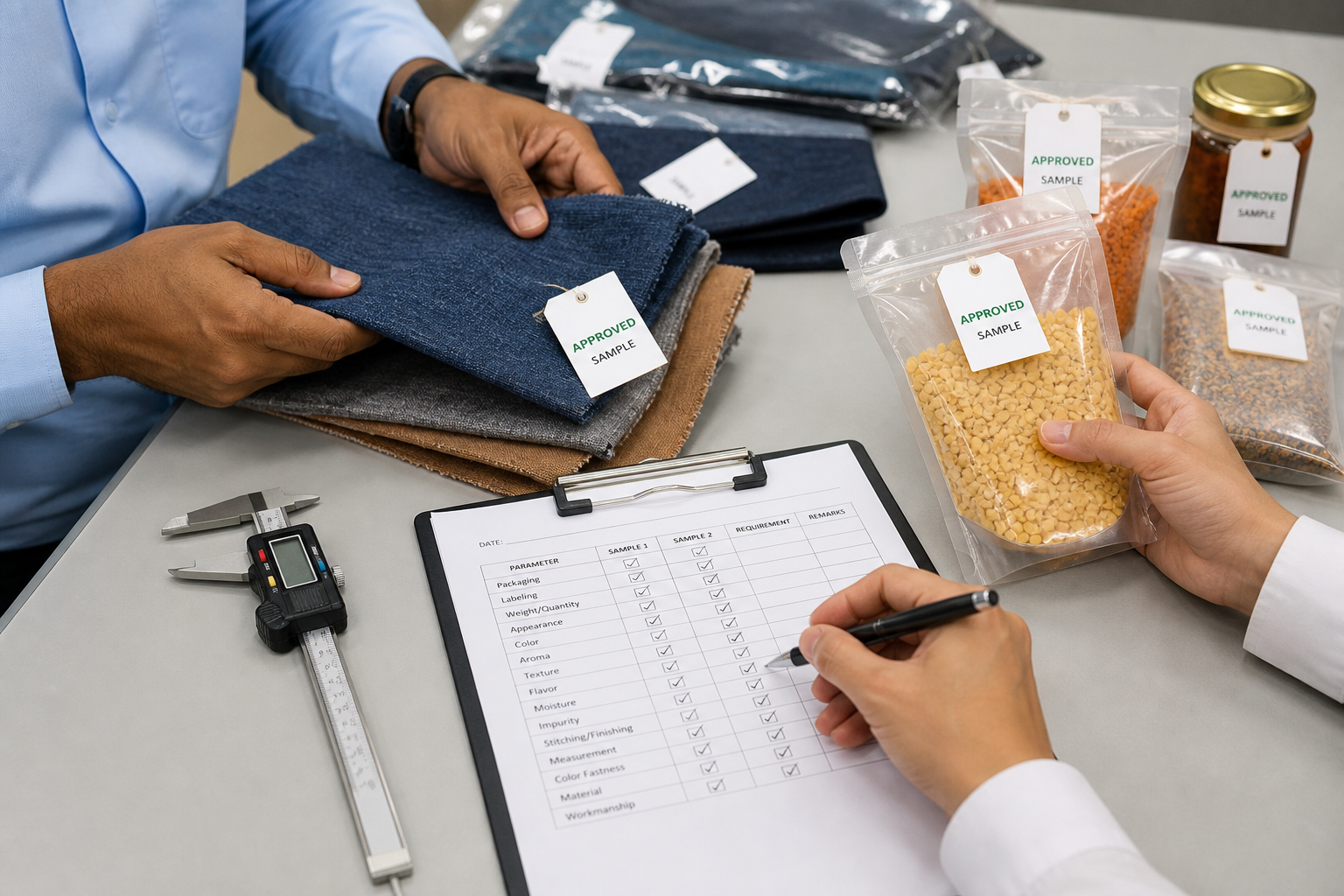
Photo and video evidence rules that actually work
- every file name or caption includes PO number, milestone ID, date, and brief description;
- use one controlled channel or folder—not scattered chats—for milestone evidence;
- require wide shots that show context (line, batch label, cartons) plus close-ups of the critical detail;
- include a scale reference for dimensions, color comparison, or defect size when relevant;
- timestamp visibility should be shown where the factory can do so without exposing unrelated orders;
- live video is reserved for escalation or first-piece review; routine updates use labeled photos;
- edited or cropped-only images do not replace raw files for dispute resolution;
- confidential customer areas may be restricted; record the restriction and use alternative evidence.
Photos and short videos are the main sensory evidence available to an overseas buyer. They are useful only when captured to a standard. Random WhatsApp images without date, lot reference, or scale create noise.
Set evidence rules in writing before production starts:
Define what photos cannot prove. A glossy finished unit on a desk does not prove bulk material. A packed carton photo without a visible label revision does not prove export marking. State these limits in the OPMC file so your team does not over-interpret evidence.
For high-risk categories, require the factory to hold rejected units and show separation from good stock in the same photo set. That supports later root-cause work if pre-shipment inspection finds a systemic issue.
Set up a WIP dashboard your team can use
- What stage is each PO line in right now?
- What quantity is complete, in process, rejected, or packed?
- Which milestone is late or at risk?
- What evidence was received since the last update?
A WIP dashboard is a single status view—not a ERP export nobody reads. It should answer four questions in under one minute:
The dashboard can live in a shared spreadsheet, a project board, or a sourcing platform. Format matters less than discipline. Update it on a fixed cadence: weekly for stable repeat orders, twice weekly for new products, daily when the ship date is inside two weeks or a critical path step is active.
Red does not mean panic on every amber item. Define amber as “slip ≤ X days but recovery plan received” and red as “no credible recovery plan” or “critical path breached.”
If the supplier cannot provide structured updates, that is a monitoring risk by itself. A factory that refuses basic WIP visibility may still produce acceptable goods, but you are flying blind until inspection—often too late to recover a launch date.
Comparison table
Swipe →
Data table — swipe horizontally on small screens
| Dashboard field | Why it matters |
|---|---|
| PO / SKU | Prevents mixed-status confusion across lines |
| Spec / sample revision | Ties WIP to the approved baseline |
| Stage (material, WIP, packed, held) | Shows true progress, not factory optimism |
| Completed qty / order qty | Surfaces under-production early |
| Reject qty and reason code | Flags quality drift before PSI |
| Next milestone and owner | Drives accountability |
| Evidence link | Connects status to proof |
| Risk flag (green/amber/red) | Triggers escalation without debate |

Track the critical path, not every task
- arrival of a single-source component;
- curing, drying, or aging time that cannot be compressed;
- outsourced printing with fixed batch queue;
- customs or testing hold on export-bound finished goods;
- booking cut-off for a specific vessel or air slot.
Overseas buyers often micromanage low-value updates while missing the step that actually controls dispatch. The critical path is the shortest sequence of dependent tasks that determines whether the order ships on time.
Identify critical-path steps during milestone planning. Examples include:
Monitor critical-path milestones at higher frequency and with tighter escalation rules than non-critical tasks. If inner-carton stuffing is one day late but embroidery—the true bottleneck—is on schedule, do not consume factory attention on the wrong problem.
Conversely, if a non-critical delay will consume buffer on the critical path, upgrade it immediately. OPMC treats schedule risk as cumulative.
Cross-link production monitoring with broader process design in India quality control from selection to shipment and the factory inspection in India complete guide when you need to align on-site and remote controls.
Confirm material arrival before approving downstream work
- goods receipt note or internal receiving record with date and quantity;
- supplier batch or lot identification visible on labels;
- photographs of labels and representative material;
- certificate of analysis or mill certificate where the spec requires it;
- comparison to the approved golden sample or color standard when appearance-critical;
- hold tag on material pending buyer or QC release, if your process uses it.
Many overseas quality failures begin before the first production minute: wrong material grade, wrong color lot, substituted component, or expired coating. Monitoring must include a material gate.
Before bulk run, require evidence that incoming material matches the approved specification:
If material fails the gate, downstream work should not start—or should stop if failure is discovered late. Continuing production on unapproved inputs turns a material problem into a full-lot problem.
For multi-component products, track material readiness by BOM line. A factory may report “material ready” when 9 of 10 components arrived; the missing buckle becomes the silent delay two weeks later.
Altus Exports can verify material arrival and label consistency locally when the buyer cannot review photos with enough context. That is especially useful for first orders or when the factory history of substitutions is unknown.

Lock first-piece approval before bulk run
- how many units constitute the first submission;
- which attributes are measured versus visually checked;
- who on the buyer side approves and within what time window;
- whether approval is written, with photos and revision reference;
- whether partial approval is allowed (e.g., product approved, packaging pending);
- what happens if the factory starts bulk before approval.
First-piece approval—sometimes called first-article inspection at the production stage—is the highest-leverage monitoring gate. Once hundreds or thousands of units are cut, molded, assembled, or printed, correction cost rises sharply.
Define first-piece rules before production:
The first piece should use production-intent material, tooling, and process—not a hand-made sample from the development room. Require photos of the unit, critical dimensions, labels, and packing mock-up if applicable.
If you are overseas, schedule a standing video window for first-piece review when the product is new or complex. Record observations in the OPMC file even if approval is ultimately by photo and measurement.
Do not allow “we started bulk because the line was idle” without a documented buyer decision. That is one of the most common sources of avoidable lot rejection.
Run in-process checks at the right control points
- after cutting or molding, before assembly;
- after printing, dyeing, or coating, before next handling;
- at torque, leak, electrical, or functional test stations;
- before packing when cosmetic damage is easily introduced;
- at label application when mislabeling creates regulatory risk.
- check method (visual, gauge, test fixture);
- sample size or frequency;
- pass/fail criteria linked to the specification;
- who performed the check;
- what happens to failed WIP.
Pre-shipment inspection evaluates finished goods. In-process checks catch drift while correction is still economical. Monitoring should confirm that those checks happened—not assume the factory’s quality poster on the wall means they occurred.
Define control points based on where defects are likely and irreversible:
For each control point, document:
Overseas monitoring does not mean performing every check remotely. It means requiring evidence that checks occurred on schedule: check sheets, photos of gauge readings, or inspector sign-off. If a checkpoint is missed, treat it as a delayed signal—hold further work until the gap is explained.
See how to prevent quality problems when sourcing from India for defect-prevention patterns that align in-process controls with supplier capability.

Escalate delayed signals before they become shipment risk
- milestone slip beyond agreed buffer;
- missing WIP update after two scheduled cycles;
- evidence that does not match the claimed stage (e.g., “packing complete” photos show unfinished goods);
- rising reject quantity without root cause;
- subcontract return date passed with no receipt record;
- unauthorized material or process change;
- request to skip first-piece or PSI timing;
- sudden change in export documentation or shipper instructions.
- what signal triggered review;
- factory explanation and supporting evidence;
- revised milestone plan with named owner;
- buyer decision: continue, hold line, partial ship, cancel, or independent inspection.
A delay is not only a late date. It is any signal that the milestone plan, material gate, first-piece rule, or in-process control may fail. OPMC requires delayed-signal escalation before the factory announces force majeure.
Define signals that trigger escalation:
Each escalation should produce a short written record:
Escalation is not blame. It is how overseas teams convert async messages into decisions. Without it, buyers discover problems at pre-shipment inspection when options are limited to rework, discount, or missed season.
Third-party monitors or sourcing partners can execute escalation on the ground while the buyer retains release authority. That split works well when the buyer’s office is asleep during the factory’s production day.
Manage timezone communication without losing control
- one standing sync slot per week for status review, plus an extra slot during critical path weeks;
- async update deadline: factory posts WIP and evidence by a fixed IST time; buyer responds within a fixed window;
- single-thread owner on each side to prevent conflicting instructions;
- urgent escalation channel for hold decisions only—not routine photos;
- meeting agenda tied to milestone IDs and dashboard reds;
- minutes with decisions, open actions, and due dates stored in the order file.
India operates on IST. US East Coast buyers face a 9.5- to 10.5-hour gap; US West Coast and European buyers face similar asymmetry. Monitoring fails when every question becomes an overnight ping-pong.
Set a communication protocol as part of OPMC:
Prepare questions before the call. “Any update?” wastes the only overlapping hour. “Confirm M4 checkpoint for PO 4821: send check sheet and two unit photos before 6 p.m. IST” produces evidence.
Respect that floor supervisors cannot join every call. Require the factory’s planning or quality contact to attend with data, not only sales.
Altus Exports often acts as the in-time-zone production contact, consolidating factory updates into a buyer-facing dashboard and flagging delays before they breach the ship plan.

What not to micromanage from overseas
- hourly line staffing decisions within agreed capacity;
- minor internal batch sequencing when the critical path is intact;
- cosmetic preferences not defined in the specification;
- rework method details when outcome meets spec;
- freight forwarder operational tasks outside agreed Incoterms;
- repeated photo requests that do not map to milestones;
- parallel instructions from sales, engineering, and finance without one owner.
Remote monitoring works when the buyer controls gates and evidence, not every operator motion. Micromanagement slows the factory, erodes trust, and still does not guarantee quality.
Avoid overseas control of:
Focus overseas attention on material approval, first-piece release, in-process checkpoints on the critical path, packing and label conformity, inspection booking, and document accuracy. Those are the decisions that determine whether the lot is shippable.
When a factory pushes back on excessive requests, review whether your OPMC plan is disciplined or chaotic. Often the fix is clearer milestones, not more messages.
Common remote production monitoring mistakes
Treating messaging activity as control. High chat volume without milestone evidence creates false confidence.
Starting monitoring after problems appear. OPMC begins at PO release, not when the buyer hears “might be late.”
No link between WIP status and specification revision. Production continues on an old artwork version while the buyer thinks Version 3 is live.
Skipping material and first-piece gates to save time. The time saved is borrowed at interest at pre-shipment inspection.
Ignoring subcontract visibility. The main factory’s dashboard shows green while an embroiderer has not started.
Deferring all quality to PSI. Inspection confirms lot acceptance; it does not recover a lost season if failure was predictable at M3.
Unclear hold authority. The factory needs to know who can stop the line and that hold decisions will be answered within the agreed window.

Conclusion
Monitoring production in Indian factories from overseas requires a cadence, not constant contact. OPMC—the Overseas Production Monitoring Cadence—combines a milestone plan, WIP dashboard, photo and video evidence rules, critical-path focus, material and first-piece gates, in-process check confirmation, delayed-signal escalation, and timezone-aware communication. Used consistently, it gives international buyers visibility while live orders move from raw material to packed goods.
This is ongoing work-in-progress tracking during production. It complements—but does not replace—a one-time remote supplier audit, independent factory inspection where needed, and pre-shipment inspection before release.
If you need help monitoring live production in India across time zones, contact Altus Exports with your PO details, milestone plan, specification revision, ship date, and current risk flags. A practical monitoring scope can be aligned to product risk and your internal approval process.