
India Quality Control Process: From Supplier Selection to Final Shipment
By Saurabh Mittal, Founder, Altus Exports
The India quality control process runs from supplier selection through factory inspection, golden sample approval, PO quality clauses, production monitoring, in-process checks, pre-shipment inspection, shipping release, and a post-shipment feedback loop. Each stage should…

International buyers sourcing from India often manage quality as a set of disconnected tasks: visit a factory, approve a sample, book an inspection, chase documents before shipment. Each step may be done well in isolation while the overall process still fails—because selection criteria ignored quality discipline, the sample did not represent production, the PO never attached the spec, or no one monitored the line until the container was already packed.
The India QC Process Map (Selection → Shipment) is the process spine for this cluster. It connects every quality stage from shortlisting suppliers to releasing the final shipment and feeding results back into the next order. Use it as a master checklist, a training document for your procurement team, and a scope guide when working with a sourcing partner or inspection firm.
The map has nine connected stages:
Why end-to-end QC process mapping matters
- what must be verified at each stage;
- who owns the output;
- which document proves the stage is complete;
- what blocks progression to the next stage.
> Select → Inspect → Approve → Contract → Monitor → Check → Inspect lot → Release → Learn
Select suppliers using QC-aware criteria, not price alone.
Inspect factories before commitment where risk requires it.
Approve golden samples and test evidence against the specification.
Contract quality requirements in the purchase order.
Monitor production from overseas at a defined cadence.
Check in-process quality at critical checkpoints during production.
Inspect lot with pre-shipment inspection against AQL and spec.
Release shipment only when quality and document gates pass.
Learn through CAPA, scorecards, and updated controls for repeat orders.
This article is pillar-support content: it links the full India quality control and factory inspection cluster into one lifecycle. For broader supplier due diligence—including entity verification, commercial terms, and fraud prevention—see the Indian supplier due diligence complete guide. That guide covers more than QC; this map owns the quality process slice from selection through shipment.
Altus Exports supports international buyers across this lifecycle: supplier comparison, factory coordination, sample and specification management, production follow-up, inspection booking, and export readiness. The process below applies whether you execute it internally, through Altus Exports, or with third-party inspectors in India.
Without a process map, teams optimize locally. Sourcing selects on price. Product approves a sample. Operations books PSI late. Finance pays against shipment date. Quality issues appear at destination—and no one can trace which gate failed.
An end-to-end map assigns:
QC is not a single department task. It is a cross-functional sequence. The map below shows how cluster articles fit at each stage.
Comparison table
Swipe →
Data table — swipe horizontally on small screens
| Problem without a process map | Stage that should have stopped it |
|---|---|
| Factory cannot hold tolerance | Selection + factory inspection |
| Bulk color differs from sample | Golden sample + material lock |
| Wrong barcode on cartons | Spec + PO clauses + in-process check |
| Mixed specification in one lot | Change control at monitor stage |
| Shipment left before PSI finished | Release gate |
| Same defect on every repeat order | Learn stage (CAPA + scorecard) |

India QC Process Map overview
No stage is optional for every order—but the depth at each stage should match product risk. A low-risk repeat SKU may compress factory inspection and use reduced monitoring. A new regulated product may require full audit depth, first-article inspection, lab tests, and independent PSI.
Comparison table
Swipe →
Data table — swipe horizontally on small screens
| Stage | Name | Primary objective | Key output | Typical owner | Cluster deep-dive |
|---|---|---|---|---|---|
| 1 | Selection QC | Choose suppliers capable of measurable quality | Shortlist with QC criteria scored | Buyer / sourcing | Conduct QC when sourcing |
| 2 | Factory inspection | Verify site, process, and quality discipline | Factory inspection / audit report | Buyer / auditor | Factory inspection guide |
| 3 | Sample & golden approval | Establish reproducible baseline | Signed golden sample + test pack | Buyer + factory | Verify before shipping |
| 4 | PO quality clauses | Contract acceptance requirements | PO with QC attachments | Buyer | Prevent quality problems |
| 5 | Production monitoring | Detect drift during manufacturing | Monitoring log / photos | Factory + buyer | Monitor production overseas |
| 6 | In-process checks | Control critical steps before pack-out | Checkpoint records | Factory QC | Conduct QC when sourcing |
| 7 | Pre-shipment inspection | Verify lot against spec before dispatch | PSI report | Inspector | Pre-shipment inspection India |
| 8 | Shipping release | Authorize dispatch and documents | Release note + export pack | Buyer / Altus | Verify before shipping |
| 9 | Feedback loop | Improve next order | CAPA + supplier scorecard | Buyer | Prevent quality problems |
Stage 1: Supplier selection with QC criteria
Selection is the first quality gate. A factory that lacks specification discipline, sample control, or inspection records will not become reliable because you added PSI at the end.
QC criteria to score during selection
- ability to produce a detailed specification response, not only a price;
- sample process: who makes samples, with what materials, and how approvals are recorded;
- quality contact: named person, not only sales;
- incoming material control and BOM management;
- in-process inspection routines and records;
- final inspection and AQL familiarity;
- packing and labeling capability for your destination;
- corrective action history and willingness to share records;
- subcontractor control if critical processes are outsourced;
- capacity realism for your lead time (rush is a quality risk).
Evaluate shortlisted suppliers against:
Use selection scoring alongside commercial comparison. A slightly higher unit cost from a factory with documented QC discipline often costs less in total than repeated rework, delays, and retailer chargebacks.
For the operating system that frames the full order lifecycle, see how to conduct quality control when sourcing from India. For pre-PO factory evaluation, continue to Stage 2.
Altus Exports helps buyers compare suppliers on quality evidence—not only quoted price—when building a shortlist for export programs.
Stage 2: Factory inspection before order commitment
Factory inspection answers whether the actual production site can make your product under controlled conditions. It is distinct from verifying that a company registration exists or that a salesperson sent a catalog.
When to inspect before placing an order
- the product is new to the factory or highly customized;
- order value, tooling investment, or launch consequence is high;
- the supplier is new or production location changed;
- critical processes are subcontracted;
- prior quality history is weak or unknown;
- destination or retailer requirements demand audit evidence.
Inspect before PO release when:
Use how to inspect an Indian factory before placing an order for pre-order inspection gates and factory inspection in India: complete guide for the full pillar methodology.
Factory inspection outputs
- site identity confirmed (address, entity, production role);
- processes observed for your product category;
- equipment and maintenance relevant to critical dimensions;
- quality area: incoming, in-process, final inspection;
- sample retention and revision control;
- packing and labeling area;
- workforce skill and supervision for critical operations;
- subcontractor map and control method;
- findings classified by severity with evidence photos;
- recommendation: approve, approve with conditions, or do not approve for this SKU.
A useful inspection or audit record includes:
For checklist depth, use the Indian factory audit checklist for international buyers. For remote or hybrid review before travel, cross-reference your internal audit protocol; this cluster focuses on on-site factory inspection depth for QC decisions.
Third-party auditors may support Stage 2 when independence matters; see third-party quality inspection in India for when to hire external QC support versus using internal staff.
Gate rule: Do not release a PO for high-risk SKUs until factory inspection findings are reviewed and any conditions are accepted in writing.
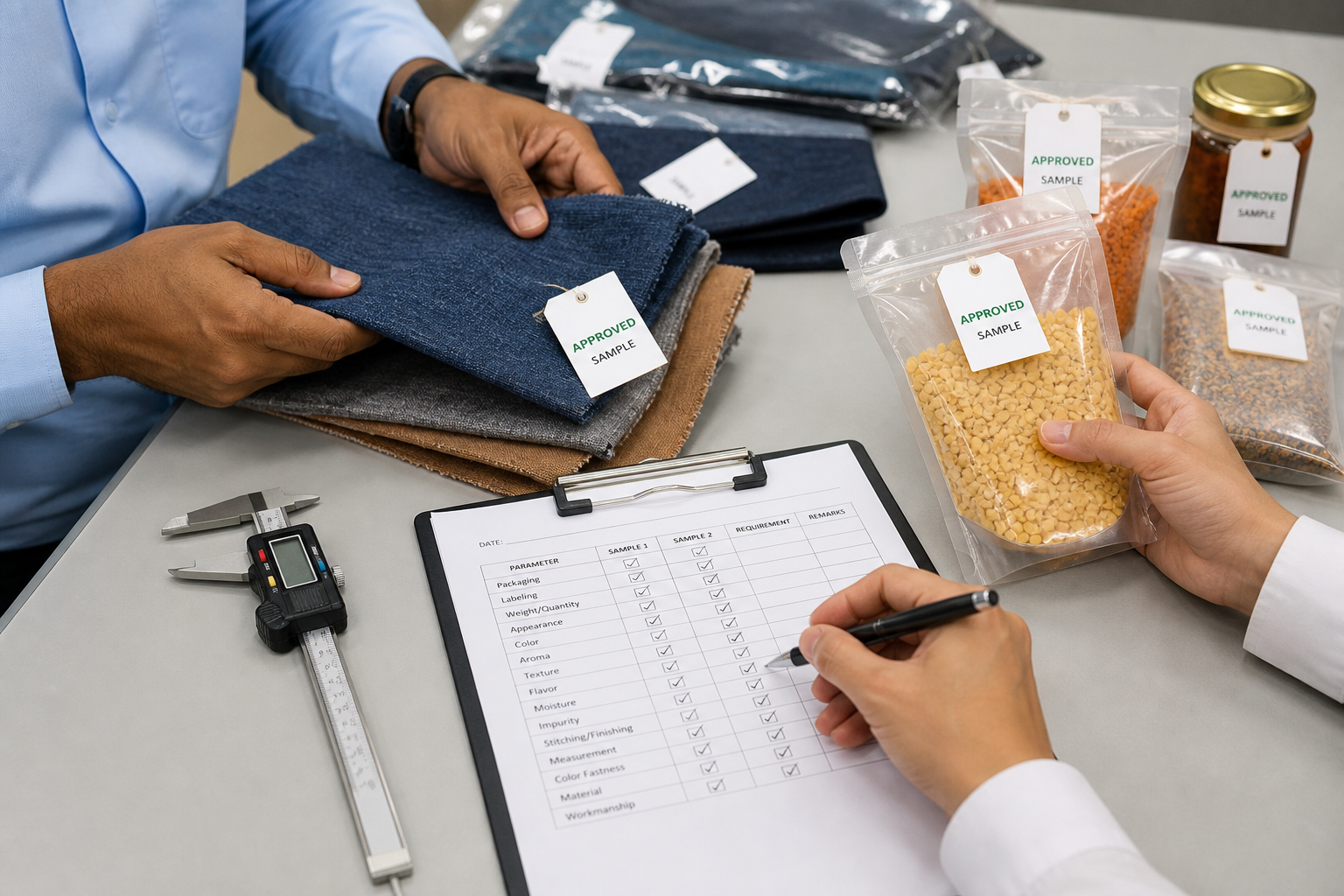
Stage 3: Specification, sample, and golden approval
Selection and factory inspection establish capability. Sample approval establishes baseline—what the buyer agrees to accept as the reference for bulk production.
Build the specification first
The specification is the contract for quality measurement. It must exist in version-controlled form before sample approval is meaningful. Include dimensions, materials, tolerances, tests, packing, labels, defect definitions, and inspection rules.
Without it, sample approval becomes subjective: “We like it” rather than “It meets revision B of spec 2026-08.”
Golden sample approval process
- Factory produces sample using production-intent materials and process where possible.
- Buyer checks sample against current specification and artwork revision.
- Tests ordered where required (safety, performance, compliance).
- Deviations documented and explicitly accepted or rejected.
- Buyer issues written golden sample approval with ID and revision.
- Factory and buyer retain labeled reference samples.
- Photographs and measurements stored in the approval file.
Distinguish development samples from golden samples. A hand-made prototype proves design direction; it does not prove bulk repeatability.
For first orders at controlled volume, combine golden approval with a small trial order before scaling to launch quantity.
The pre-shipping verification ladder in how to verify product quality before shipping from India aligns with this stage for test and document evidence that must still be true at dispatch.
Gate rule: Bulk production must not start until golden sample approval (and any required test reports) match the PO specification revision.
Stage 4: Purchase order quality clauses
The PO converts agreed quality requirements into contractual obligations. Email threads are not sufficient for repeat-order enforcement.
Minimum PO quality attachments
Comparison table
Swipe →
Data table — swipe horizontally on small screens
| PO element | Purpose |
|---|---|
| Specification revision | Defines measurable acceptance |
| Artwork and label revision | Prevents wrong mark/version |
| Golden sample ID and date | Links bulk to approved baseline |
| Approved BOM / material list | Controls substitution |
| Required certificates and tests | Supports compliance and traceability |
| In-process checkpoint plan | Defines monitor/check stages |
| PSI scope, AQL, defect classes | Sets lot release standard |
| Hold-shipment clause | Blocks dispatch on fail |
| Change-control procedure | Requires approval before alterations |
| CAPA timeline | Sets response if nonconformance occurs |
| Document retention period | Preserves evidence for claims |
Attach or incorporate by reference:
State Incoterm, inspection location, who pays for rework, and whether replacement or short-ship is allowed if inspection fails. Define who authorizes shipment release—buyer quality contact, sourcing manager, or delegated partner such as Altus Exports when within scope.
Prevention-focused PO design is covered in how to prevent quality problems when sourcing from India. The PO is where prevention and inspection meet: upstream controls are mandatory; PSI is the release gate.
Gate rule: Production start date confirmed only after PO quality pack is acknowledged by factory quality or management contact.
Stage 5: Production monitoring from overseas
Once production begins, the process moves from planning to execution control. Overseas buyers cannot rely on factory assurances alone during a six- to ten-week lead time.
Production monitoring cadence
Comparison table
Swipe →
Data table — swipe horizontally on small screens
| Risk level | Monitoring cadence | Typical evidence |
|---|---|---|
| Low (repeat SKU, proven factory) | Weekly or milestone updates | Quantity progress, completion date |
| Medium (new SKU, known factory) | Twice weekly + pre-pack photo set | Line photos, component labels, pack sample |
| High (launch, regulated, new factory) | Weekly detailed + checkpoint sign-offs | First-article, inline dimensions, label check |
- effective specification revision on the production floor;
- material batches match approved BOM;
- quantity reconciliation (no hidden partial runs);
- timeline credibility versus peak-season constraints;
- early warning of subcontractor or rush issues.
Match touchpoints to risk:
Monitoring confirms:
Full cadence guidance is in how to monitor production in Indian factories from overseas. Monitoring feeds Stage 6 checkpoints; it does not replace them.
Altus Exports provides production follow-up for buyers who need local coordination without maintaining an India office.
Gate rule: If monitoring reveals unapproved change or material swap, pause production until buyer review—document in the PO change-control clause.
Stage 6: In-process quality checks
In-process checks are during-production controls at critical points before final pack-out. They prevent discovering systematic errors only at PSI when rework capacity is limited.
Typical in-process checkpoints
- First-article / first-off approval at start of run;
- Material verification at line setup;
- Dimensional or functional check at defined intervals;
- Color or finish comparison against golden sample;
- Label and artwork verification before application;
- Assembly torque, weld, stitch, or bond checks where critical;
- Pre-pack inspection of finished unit against spec;
- Carton packing trial before full pack-out.
Define checkpoints by product type:
Record pass/fail, quantity checked, who signed, and date. Photos with revision label add traceability for overseas buyers.
In-process discipline separates factories with repeatable QC from those that only polish units for final inspection. Stage 6 outputs should flow into Stage 7 so the PSI inspector knows which checkpoints were already passed—and which deviations were approved.
Gate rule: For high-risk orders, define mandatory checkpoints in the PO; final pack-out should not begin until first-article or equivalent is approved.

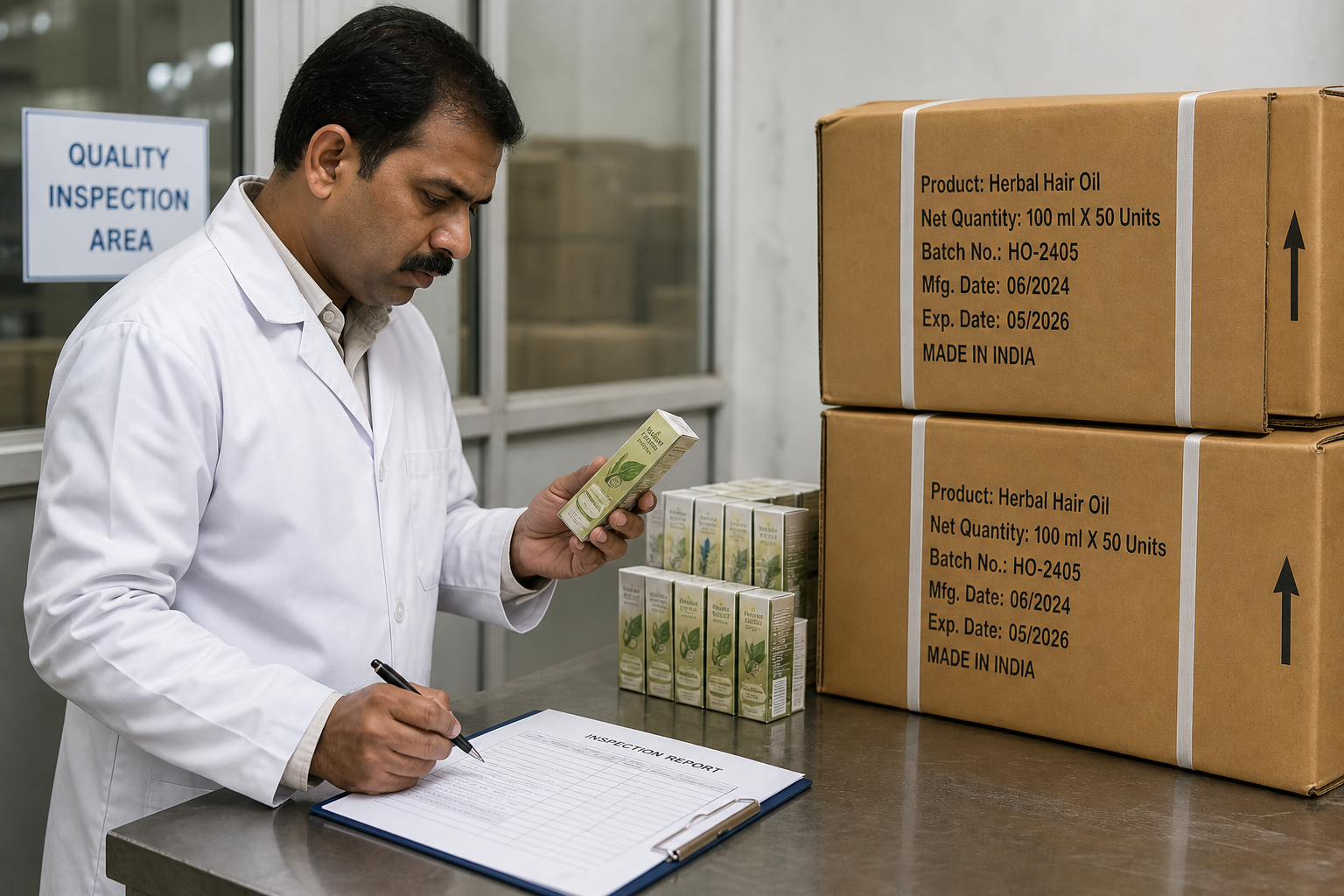
Stage 7: Pre-shipment inspection (PSI)
Pre-shipment inspection is the lot-level release gate. It verifies that the finished quantity ready for dispatch meets the agreed specification, AQL plan, packing standard, and labeling requirements.
PSI scope checklist
- confirm lot quantity and completion;
- confirm effective spec, artwork, and golden sample revision;
- provide defect definitions and AQL table;
- include packing, marking, barcode, and carton tests in scope;
- define cartons available for sampling and opening method;
- confirm hold-shipment rule if result is fail or conditional.
Before the inspector visits:
PSI is sampling-based acceptance—not 100% sorting unless agreed separately. Understand AQL as an acceptance-sampling parameter tied to defect classes, not as permission to ship a fixed percentage of bad goods.
Detailed PSI protocol: pre-shipment inspection in India. Independent inspection decision guide: third-party quality inspection in India.
Gate rule: Shipment release requires PSI pass (or documented buyer waiver with risk acceptance) for orders where PSI is contractually required.
Stage 8: Shipping release and export quality pack
Shipping release is the formal decision that quality and documentation gates are satisfied for dispatch. PSI pass alone is not always sufficient.
Release checklist before container or AWB
- PSI report reviewed and accepted;
- any conditional findings closed or waived in writing;
- packing list matches inspected lot;
- labels, marks, and barcodes match destination requirement;
- certificates, test reports, and compliance documents current for this lot;
- invoice and spec references consistent;
- photos archived if retailer or internal audit requires;
- CAPA open items from in-process issues resolved or accepted.
Confirm:
See how to verify product quality before shipping from India for the pre-dispatch verification ladder focused on this gate.
Altus Exports coordinates export documentation and shipment readiness so quality release aligns with customs and logistics execution.
Gate rule: No forwarder booking or bill of lading release until buyer-authorized quality release is recorded.

Stage 9: Feedback loop—CAPA, scorecards, and requalification
The process does not end at shipment. Stage 9 converts shipment results into next-order improvement.
Post-shipment inputs
- PSI result and defect Pareto;
- receiving inspection at destination if performed;
- customer returns, retailer rejections, or marketplace claims;
- transit damage linked to packing failure;
- supplier responsiveness during the order;
- adherence to monitoring and change-control rules.
Collect:
CAPA and supplier quality scorecard
- repeated major defects → increase in-process checks or third-party presence;
- strong stable performance → streamlined monitoring with maintained spec lock;
- unauthorized changes → stricter PO clauses or supplier replacement.
Run CAPA for significant nonconformances: containment, root cause, corrective action, preventive action, verification on next lot. Update the supplier quality scorecard with trends—not only the last order memory.
Use scorecard trends to adjust Stage 1 selection and Stage 2 inspection depth:
Prevention framework detail: how to prevent quality problems when sourcing from India.
Gate rule: Repeat orders use updated specification revision and scorecard notes; do not clone an old PO without reviewing last lot quality data.
Process roles and RACI summary
A = accountable, R = responsible, C = consulted, I = informed.
Adjust roles to your organization. The critical point is that accountability for release and specification approval stays with the buyer; factories and inspectors provide evidence.
Comparison table
Swipe →
Data table — swipe horizontally on small screens
| Stage | Buyer sourcing | Buyer quality | Factory QC | Third-party inspector | Sourcing partner (e.g., Altus) |
|---|---|---|---|---|---|
| 1 Selection | A/R | C | I | — | C |
| 2 Factory inspection | A | R | C | R (if hired) | C |
| 3 Golden approval | A | R | R | — | C |
| 4 PO clauses | A/R | R | C | — | C |
| 5 Monitoring | A | C | R | — | R |
| 6 In-process checks | I | C | A/R | C (if hired) | C |
| 7 PSI | A | R | C | R | C |
| 8 Release | A/R | R | C | — | R |
| 9 Feedback | A/R | R | C | — | C |
How cluster articles connect to the map
Use this map as navigation:
Comparison table
Swipe →
Data table — swipe horizontally on small screens
| If you need depth on… | Read |
|---|---|
| QC operating system across orders | How to conduct quality control when sourcing from India |
| Full factory inspection lifecycle | Factory inspection in India: complete guide |
| Pre-PO factory visit gates | How to inspect an Indian factory before placing an order |
| Operational audit checklist | Indian factory audit checklist for international buyers |
| Remote production monitoring | How to monitor production in Indian factories from overseas |
| PSI and AQL release | Pre-shipment inspection in India |
| Pre-dispatch verification | How to verify product quality before shipping from India |
| Third-party inspection decision | Third-party quality inspection in India |
| Defect prevention upstream | How to prevent quality problems when sourcing from India |
| Broader due diligence beyond QC | Indian supplier due diligence complete guide |

First order vs. repeat order: process differences
Even repeat orders require change control. “Same as last time” fails when artwork, material market, or factory staffing changed without documentation.
Comparison table
Swipe →
Data table — swipe horizontally on small screens
| Stage | First order / new SKU | Repeat order (stable performance) |
|---|---|---|
| Selection | Full QC scoring | Review scorecard; confirm no site change |
| Factory inspection | On-site or detailed audit | Periodic re-audit or skip per risk policy |
| Golden sample | Full approval + tests | Confirm revision unchanged or re-approve |
| PO | Full quality pack | Update revision; reference prior CAPA |
| Monitoring | Higher cadence | Reduced cadence with triggers for escalation |
| In-process | First-article mandatory | Sample checkpoints at interval |
| PSI | Required | Per risk matrix; may reduce frequency |
| Release | Full document review | Streamlined with exception triggers |
| Feedback | Establish baseline metrics | Trend review; requalify if drift |
Implement the map on your next India order
- Add QC criteria to supplier selection scorecard (Stage 1).
- Schedule factory inspection or audit for new/high-risk SKUs (Stage 2).
- Issue specification; approve golden sample with ID (Stage 3).
- Release PO with quality attachments and hold-shipment clause (Stage 4).
- Activate monitoring cadence when production starts (Stage 5).
- Confirm in-process checkpoints completed and recorded (Stage 6).
- Book PSI with scope tied to current revision (Stage 7).
- Issue written shipping release after PSI and documents (Stage 8).
- Update CAPA and scorecard within agreed days of receipt (Stage 9).
Copy this implementation sequence:
If your team can point to the output document for each stage, you are running a process—not hoping for quality.

Conclusion
The India QC Process Map (Selection → Shipment) connects supplier selection, factory inspection, golden sample approval, PO quality clauses, production monitoring, in-process checks, pre-shipment inspection, shipping release, and the feedback loop into one lifecycle. Each stage produces a documented output owned by a defined role; each gate blocks progression when evidence is missing.
Inspection at shipment remains essential, but it works best when earlier stages already locked the specification, sample, materials, and production discipline. Use cluster deep-dives for stage-specific checklists, and use the Indian supplier due diligence complete guide when quality selection sits inside a broader supplier approval program.
Altus Exports helps international buyers execute this process on the ground in India—from factory evaluation and sample coordination through production monitoring, inspection support, and export release. Share your product program, risk profile, and target timeline to align QC scope with the stage that needs support most.