
Factory Inspection in India: A Complete Guide for International Buyers
By Saurabh Mittal, Founder, Altus Exports
Factory inspection in India is an on-site or independently coordinated review of a manufacturing facility against defined scope—capability, quality system, process, and capacity—before or during a sourcing relationship. International buyers should prepare a written agenda,…

A factory in India may present well in a video call, a trade-show booth, or a polished PDF profile and still be the wrong place to make your product. The gap is often not fraud alone. The site may be genuine but oriented to domestic retail rather than export packing standards. It may subcontract your critical process without adequate control. It may have equipment for a similar category but not the tolerance, testing, or traceability your specification requires.
For an international buyer, factory inspection in India is the structured process of verifying what actually exists at a manufacturing site: equipment, process flow, quality checkpoints, material handling, capacity signals, documentation habits, and the people who will execute your order. It is evidence collection with a decision purpose—not tourism, not a substitute for product inspection, and not the same as checking a company’s registration online.
This pillar guide presents the India Factory Inspection Roadmap, a lifecycle framework from inspection planning through on-site or coordinated remote execution, scoring, report delivery, and follow-up linked to your purchase order and pre-shipment inspection program. It is written for buyers in the United States, United Kingdom, European Union, UAE, and other markets who source directly, through a trader, or with local coordination support.
Altus Exports conducts and coordinates factory inspections for international buyers across Indian production clusters, combining on-ground observation with documentation that supports sourcing and quality decisions. The roadmap below can also structure your visit with an independent auditor or your own engineering team.
Factory inspection, supplier verification, and PSI are different tools
Buyers often use these terms interchangeably. Each answers a different question at a different time.
Factory inspection sits in the middle of the sourcing decision. It reduces uncertainty about where and how goods are made. It does not prove that lot 2026-0412 will pass AQL—that is PSI. It also does not replace legal-entity checks—that is supplier verification.
For entity and due-diligence depth, see Indian supplier due diligence: a complete guide. For remote verification protocols when you cannot travel, see supplier audit in India without visiting the factory—that article owns the remote-plus-independent protocol; this guide owns full inspection scope, agenda, and scoring depth. For the post-PO quality rhythm, see how to conduct quality control when sourcing from India.
Comparison table
Swipe →
Data table — swipe horizontally on small screens
| Activity | Primary question | Typical timing | What it validates |
|---|---|---|---|
| Supplier verification | Who is this party and are they credible to contract? | Before PO | Entity, role, documents, basic capability claims |
| Factory inspection | What does the manufacturing site and system look like? | Pre-order, requalification, or after major change | Site, process, equipment, QMS signals, capacity indicators |
| Product / sample verification | Can this product meet the spec? | Before and during first orders | Samples, tests, pilot results |
| Pre-shipment inspection (PSI) | Does this finished lot conform before dispatch? | Before shipment and balance payment | Lot sampling, AQL, packing, labels on finished goods |
| Production monitoring | Is this order deviating during manufacturing? | Between PO release and PSI | Checkpoints, first-article, in-process evidence |

When to conduct a factory inspection in India
- you are placing a first order with a new manufacturer or a new production site;
- the product is custom, technical, regulated, branded, or safety-critical;
- the order value, tooling investment, or deposit exposure is significant;
- the supplier’s role is unclear—manufacturer, trader, or multi-factory group;
- prior orders showed unexplained quality variation or capacity failures;
- a major change occurred: relocation, new line, ownership change, key subcontractor, or product category shift;
- your customer, retailer, insurer, or lender requires factory assessment evidence;
- video or document review raised contradictions that only site observation can resolve.
Inspection should be proportionate to risk, but certain situations justify on-site or independently coordinated review more strongly than others.
Schedule or escalate factory inspection when:
You may defer a full inspection for a low-risk repeat SKU with a supplier that has repeated PSI pass history and stable specifications—but requalify if performance drops.
Comparison table
Swipe →
Data table — swipe horizontally on small screens
| Scenario | Recommended inspection depth |
|---|---|
| New supplier, standard commodity | Focused capability and process walk-through; quality system light review |
| New supplier, custom or regulated product | Full scope: capability, process, QMS, capacity, critical subprocesses |
| Repeat supplier, new SKU in same factory | Process and equipment fit review; update inspection record |
| Repeat supplier, new factory address | Treat as new site—full inspection |
| Post-failure requalification | Targeted re-inspection on prior red flags plus CAPA evidence |
Inspection scope types: what to include
The India Factory Inspection Roadmap uses modular scope blocks. Select blocks based on risk; do not treat every visit as identical.
Capability inspection
- product category fit versus your specification;
- relevant machinery, tooling, fixtures, and maintenance condition;
- technical staff availability and sample-development process;
- material sourcing and incoming inspection for key inputs;
- comparable work evidence (without breaching other customers’ confidentiality);
- subcontracted operations and control over them.
Capability inspection answers: Can this site make your product with the required process, equipment, and technical understanding?
Review:
Request that the supplier restate critical requirements from your RFQ before the visit. A factory that cannot explain your tolerance, material, test, or packing needs is unlikely to control them in production.
Quality system inspection
- documented work instructions, specifications, and revision control;
- incoming material inspection and supplier approval for critical inputs;
- first-article / first-piece approval practice;
- in-process inspection points and defect segregation;
- final inspection and pre-dispatch hold procedures;
- calibration of measuring equipment where relevant;
- corrective action records and nonconformance handling;
- traceability: batch codes, material records, rework identification;
- training and role clarity for quality responsibility.
Quality system inspection answers: Does the factory have repeatable controls—not merely a certificate on the wall?
Review:
A formal ISO or similar certificate may support the review but is not proof your order will follow the same process. Inspectors should observe practice, ask for records from recent production, and note gaps between policy and floor behavior.
Process inspection
- material receipt and storage;
- preparation (cutting, molding, mixing, printing, etc.);
- core manufacturing and assembly;
- finishing, coating, testing;
- packing, labeling, and palletization;
- finished-goods storage and dispatch discipline.
Process inspection answers: Is the actual production route sound for your product?
Walk the process flow from incoming material to packed export cartons:
At each step, note control points, contamination or damage risk, mixing of approved and rejected goods, and whether the route matches what the supplier described in quotation.
Capacity inspection
- current order load and visible WIP;
- shift pattern, equipment utilization, and bottleneck processes;
- raw-material inventory versus stated lead times;
- seasonality, labor availability, and power or utility constraints;
- ability to reserve production slot for your PO;
- contingency if an outsourced step delays.
Capacity inspection answers: Can the factory absorb your order without unacceptable risk to quality or timing?
Review:
Capacity claims without observable WIP, planning boards, or credible scheduling discussion should be scored cautiously. See also how to evaluate manufacturing capacity of an Indian supplier.
Social and compliance touchpoints (light scope only as needed)
Some buyers require light-touch review of labor and safety conditions, environmental handling, or prohibited-substance management where relevant to the product. This guide does not replace specialized social-compliance audits (SMETA, SA8000, etc.) or legal compliance programs. Include only what your customer, category, or policy requires—child-labor and forced-labor awareness, basic fire and egress observation, chemical storage for relevant processes, documented restricted-substance controls for textiles or coatings.
If your program demands full ethical audit protocol, engage a qualified audit firm with a defined standard. Factory inspection for sourcing QC should not pretend to be a complete social audit unless scoped that way.
Phase 1: Prepare the inspection
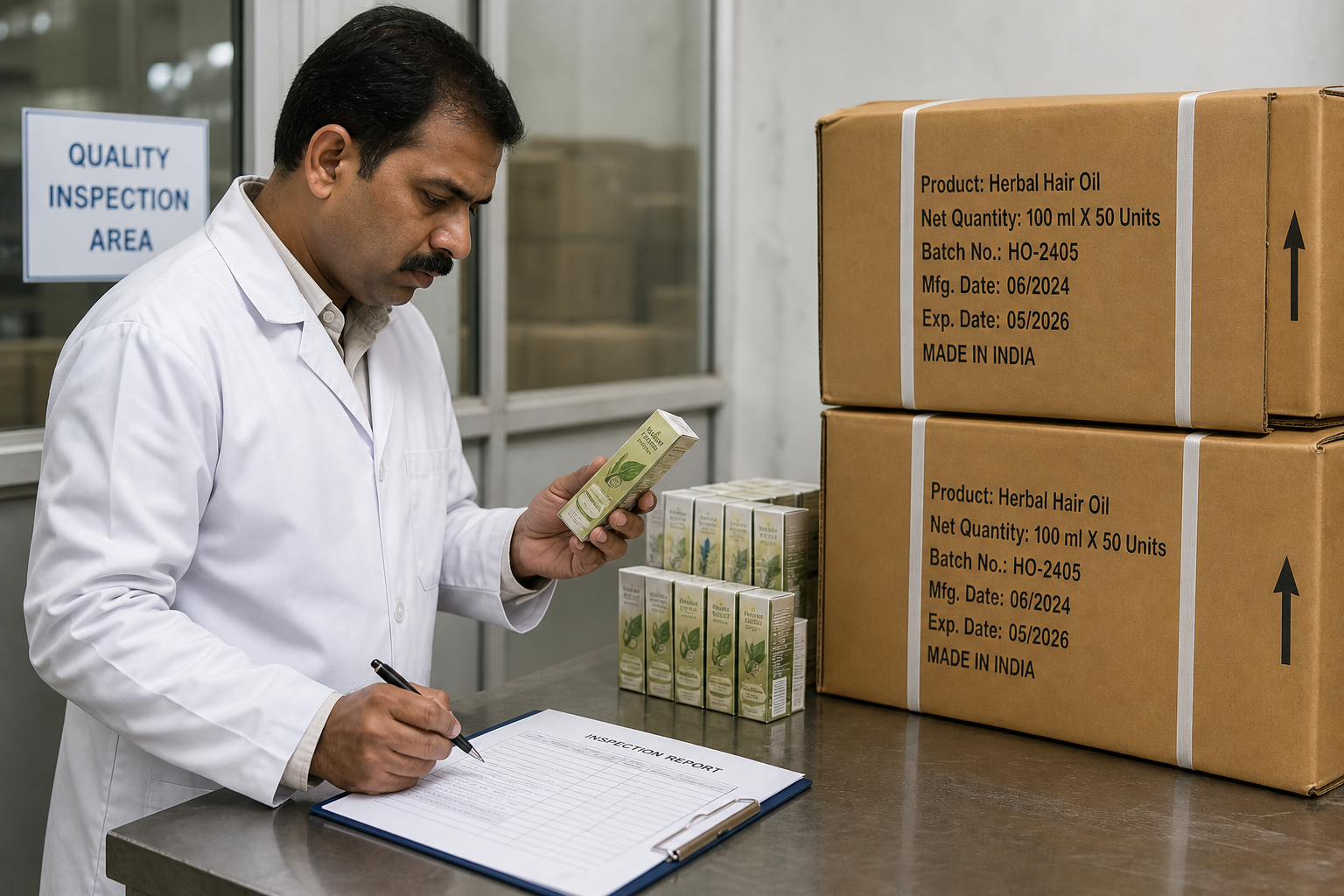
Preparation determines whether the visit produces a decision-ready report or a folder of unstructured photos.
Define objectives and scope in writing
- inspection date, site address, and supplier contact;
- scope modules selected (capability, QMS, process, capacity, compliance touchpoints);
- products and processes of interest;
- documents requested in advance;
- attendees required (owner, production head, quality manager);
- language and translation needs;
- photography rules and confidentiality boundaries;
- scoring method and pass/fail thresholds for recommendation.
Issue an inspection brief that states:
Share the brief with the supplier at least several business days before the visit. Last-minute scope expansion reduces cooperation and data quality.
Documents to request before arrival
Comparison table
Swipe →
Data table — swipe horizontally on small screens
| Document type | Why it matters |
|---|---|
| Organization chart and key contacts | Confirms who owns quality and production |
| Equipment list with age and capacity notes | Supports capability scoring |
| Process flow diagram for your product type | Baseline for walk-through comparison |
| Sample specification and quality records (sanitized) | Shows documentation discipline |
| Subcontractor list for critical operations | Reveals hidden dependencies |
| Recent internal rejection or CAPA records | Indicates honesty and learning culture |
| Export packing standard or carton test records | Links factory to your logistics needs |
Missing documents are a data point. Some factories operate with informal habits; the inspection should record that gap rather than accept verbal assurance alone.
Prepare your RFQ and specification pack
Bring the same controlled specification you would use for production: drawings, materials, tolerances, packing, labeling, test requirements, and defect definitions. Factory inspection is more valuable when the team can discuss your product, not only a generic category tour.
For pre-order inspection focused on first engagement, align with how to inspect an Indian factory before placing an order. Use Indian factory audit checklist for international buyers as a field reference during the visit.

Phase 2: Execute the on-site inspection agenda
A consistent agenda improves comparability across suppliers and regions—from Tiruppur textiles to Rajkot brass, Moradabad metalware, or Pune engineering.
Recommended half-day to full-day agenda
Comparison table
Swipe →
Data table — swipe horizontally on small screens
| Block | Duration | Activities |
|---|---|---|
| Opening meeting | 30–45 min | Confirm scope, attendees, safety rules, photography policy |
| Document review | 45–60 min | Spec control, records, subcontractor list, calibration |
| Site walk: material and stores | 30 min | Incoming inspection, storage, identification, FIFO discipline |
| Site walk: production | 90–120 min | Process flow, equipment, in-process checks, WIP segregation |
| Site walk: quality and packing | 45–60 min | Inspection area, defect hold, packing line, labeling |
| Capacity and planning discussion | 30–45 min | Order slot, lead time, dependencies, peak load |
| Closing meeting | 30 min | Preliminary findings, supplier response, evidence requests |
Adjust duration for facility size and scope. A trader’s showroom office is not a substitute for the production site address on your PO.
What to observe on the floor
- Is the production area active and relevant to your product category?
- Are measuring tools and gauges present and apparently in use?
- Are rejected goods segregated from good WIP and finished stock?
- Do operators follow visible work instructions or rely entirely on tribal knowledge?
- Is material labeled with grade, batch, or supplier identification?
- Are critical subprocesses on-site or visibly coordinated with named partners?
- Does packing match export requirements—carton strength, moisture protection, pallet pattern?
- Can quality staff explain what happens when a dimension fails mid-run?
Experienced inspectors prioritize evidence over presentation:
Take timestamped photos with context: machine nameplate, gauge reading, defect example, line layout. Avoid photographing unrelated customers’ branded goods without permission.
Altus Exports inspection reports combine floor observation with buyer-oriented scoring so international teams can compare sites without traveling to every cluster.
Remote and hybrid inspection
When travel is impractical, a hybrid model may combine live video walk-through, document review, and independent on-ground inspection by a local partner. Remote viewing cannot match physical presence for smell, sound, tactile checks, and unscripted floor behavior—but it is superior to no observation.
For protocol detail, use supplier audit in India without visiting the factory. This pillar guide’s scoring and report sections still apply; only the evidence capture method changes.
Phase 3: Score findings and classify the recommendation
Unstructured visit notes are hard to defend in a sourcing committee. Use a scored framework aligned to your scope modules.
Example scoring model (100 points)
Comparison table
Swipe →
Data table — swipe horizontally on small screens
| Module | Weight | High score indicators | Low score indicators |
|---|---|---|---|
| Capability fit | 25 | Correct equipment, technical comprehension, relevant experience | Wrong process route, unable to explain spec |
| Quality system | 25 | Documented controls, records, segregation, CAPA habit | No records, informal only, rejects mixed with good |
| Process control | 20 | Clear flow, in-process checks, stable subcontractor control | Bottleneck chaos, uncontrolled outsourcing |
| Capacity and planning | 15 | Credible slot, visible WIP management, realistic lead time | Overpromise, empty floor vs claimed load |
| Export readiness | 15 | Packing discipline, labeling area, dispatch documentation | Domestic-only packing, no export trace |
- Approve for defined trial order: Score meets minimum and no unresolved critical red flags.
- Approve with conditions: Medium gaps addressable via PO terms, first-article hold, or PSI enhancement.
- Do not approve without re-inspection: Critical gaps or contradictory evidence.
- Reject for this product: Fundamental misfit regardless of commercial attractiveness.
Define thresholds in advance:
Scores support decisions; they do not replace judgment on critical red flags.

Red flags during factory inspection in India
- Visit address does not match registration, quotation, or stated manufacturer name.
- Supplier refuses access to production areas while claiming to be the factory.
- Signage, utilities, and workforce suggest a trading office, not manufacturing.
- No incoming inspection for critical materials.
- No segregated reject area; rework blends into good stock without traceability.
- Quality records unavailable or clearly fabricated for the visit day.
- Operators cannot identify the current approved specification version.
- Measuring equipment missing, damaged, or clearly unused.
- Committed capacity far exceeds visible equipment and staffing.
- Factory denies existing export orders while WIP suggests extreme overload.
- Subcontractors for critical steps unnamed until pressed.
- Obviously unsafe electrical or fire egress conditions in audited areas.
- Uncontrolled chemical storage in relevant processes.
- No restricted-substance documentation where the product category requires it.
Red flags warrant documented escalation—not silent acceptance because the price is attractive.
Identity and site integrity
Quality and process
Capacity and commercial honesty
Compliance and safety (where in scope)
One red flag may be explainable. Clusters of unresolved red flags should block approval or restrict the relationship to a heavily controlled trial.
For fraud-oriented signals beyond normal immaturity, cross-check with supplier verification guides and how to identify fake Indian suppliers and export scams where relevant.
Phase 4: Structure the inspection report
A decision-ready report lets a buyer who did not attend the visit act confidently.
Recommended report sections
- Executive summary: Recommendation, score, key strengths, key risks, conditions for trial.
- Inspection details: Date, address, attendees, scope, products discussed, limitations.
- Capability findings: Equipment, technical fit, subcontractor map.
- Quality system findings: Documentation, inspection practice, CAPA evidence.
- Process walk-through: Step-by-step notes with photos referenced.
- Capacity assessment: Observed load, planning credibility, lead-time comment.
- Export and packing observations: Carton area, labeling control, dispatch discipline.
- Red flags and open items: Unresolved questions requiring document or re-visit.
- Photographic appendix: Labeled images tied to findings.
- Suggested PO and QC controls: First-article, monitoring, PSI scope, payment milestones.
Reports should distinguish observed fact, supplier statement, and assessor inference. Inference belongs in a labeled opinion section, not presented as verified truth.
Share the draft with the supplier only if your process requires comment; otherwise, supplier “corrections” after the visit should be evaluated as new evidence, not automatic report revision.

Phase 5: Link inspection results to the PO and PSI program
Factory inspection earns its cost when it changes how the order is controlled—not when it sits in a drawer labeled “done.”
Translate findings into PO and QC terms
Comparison table
Swipe →
Data table — swipe horizontally on small screens
| Inspection outcome | Typical PO / QC linkage |
|---|---|
| Strong capability, weak documentation | Require first-article approval and enhanced PSI; milestone reporting |
| Critical subprocess outsourced | Name subcontractor in file; right to inspect or require supplier QA evidence |
| Capacity tight vs your date | Phased shipment, penalty terms, or alternate slot in writing |
| Packing area immature | Approve carton spec and drop-test evidence before bulk pack |
| Quality manager credible but understaffed | Mid-production checkpoint for first order |
Reference inspection conditions in the purchase order or annex: inspection rights, hold points, sample retention, and re-inspection after rework.
Connect to the broader QC operating system
- specification and golden-sample control;
- production monitoring during the order;
- pre-shipment inspection in India;
- third-party quality inspection in India where independence is required;
- India quality control process from selection to shipment as the end-to-end map.
Factory inspection informs but does not replace:
A factory that scored well on visit day can still fail PSI if your specification was weak or production monitoring was skipped. Treat inspection as baseline qualification, not perpetual guarantee.
Altus Exports links factory inspection findings to live order coordination—sample approval, checkpoint scheduling, and PSI booking—so recommendations become operational controls rather than static PDFs.

Follow-up, requalification, and supplier file maintenance
- the supplier moves production to a new address;
- your order volume step-change exceeds what the capacity review supported;
- PSI or customer returns indicate defects traceable to process gaps seen—or missed—at inspection;
- new subcontractor or material source is introduced for a critical attribute;
- ownership or key quality personnel change;
- more than 12–24 months passed without repeat performance evidence (interval depends on category risk).
Factory inspection is not permanently valid.
Reinspect or conduct targeted follow-up when:
Maintain a supplier file: inspection report, score, photos, conditions, trial PO outcome, PSI history, and CAPA records. Use it for how to prevent quality problems when sourcing from India and supplier comparison on repeat sourcing rounds.
Factory inspection checklist summary
Checklist
Use this summary before, during, and after the visit. Expand with Indian factory audit checklist for international buyers.
Comparison table
Swipe →
Data table — swipe horizontally on small screens
| Stage | Key actions |
|---|---|
| Before | Issue scope brief, request documents, confirm site address, pack spec |
| During | Walk process flow, verify QMS practice, score modules, photograph evidence |
| After | Deliver structured report, set recommendation, define PO conditions |
| Order linkage | First-article, monitoring plan, PSI scope, payment milestones |
| Requalification | Revisit on site change, failure trend, or material process change |

Conclusion
Factory inspection in India gives international buyers evidence about the manufacturing site, process, quality habits, and capacity signals that documents and video calls alone cannot fully provide. The India Factory Inspection Roadmap moves from scoped preparation through on-site or coordinated execution, scored findings, structured reporting, and follow-up tied to purchase order terms and pre-shipment inspection.
Keep factory inspection distinct from supplier verification and lot-level PSI. Use it to qualify the environment and system; use the QC operating system and PSI to control each order. When travel is limited, combine defined remote protocol with independent on-ground observation rather than skipping inspection entirely.
For support planning or executing factory inspection on a live sourcing project, contact Altus Exports with your product category, target site, and order timeline—or explore global sourcing partner services in India.