
How to Import Products From India: A Complete Guide for International Buyers
By Saurabh Mittal, Founder, Altus Exports
To import products from India, define your product brief, shortlist and verify suppliers, approve samples, agree commercial terms and Incoterms, structure payment milestones, monitor production and QC, collect export documents, book freight, clear destination customs, and…

Importing products from India is not a single transaction. It is a sequence of commercial, quality, documentation, and logistics decisions that must align before goods arrive at your warehouse. International buyers in the USA, UK, Europe, UAE, Australia, Canada, and other markets often start with a product idea or a supplier contact, then discover that import success depends on how well each stage is controlled—not on finding the lowest unit price alone.
India offers deep manufacturing clusters, competitive production costs, and export experience across textiles, spices, engineering components, handicrafts, chemicals, and consumer goods. It also presents real execution risk: specification drift between approved samples and production, payment timing that does not match manufacturing milestones, export documents that do not match customs declarations, and freight handoffs where no one party owns the full chain. Buyers who treat import as a checklist of isolated tasks often learn these gaps at the port, when rework, storage charges, or clearance delays are already costly.
The most practical way to import from India is to use a structured stage-gate process. Each stage has defined inputs, decision criteria, and a clear go/no-go point before you commit more capital or time. That is the logic behind the India Import Stage-Gate Model in this guide: ten stages from product brief through warehouse receiving, with explicit buyer responsibilities at each gate. Deep dives on documents, landed cost, Incoterms, payments, shipping, customs, and duties are covered in linked cluster articles so this pillar stays focused on the actionable how-to.
Altus Exports operates as a merchant exporter and India sourcing and export partner for international buyers who need on-ground coordination—supplier verification, QC follow-up, document collection, and export execution—without building a full India procurement team. Whether you manage the process internally or work with a partner, the stage-gate framework applies. For category strategy, market selection, and longer narrative context, see the legacy complete guide to importing products from India; this article owns the modern buyer import playbook.
The India Import Stage-Gate Model
The India Import Stage-Gate Model breaks the import lifecycle into ten stages. Each stage ends with a gate: a documented decision that confirms readiness before the next commitment. Skipping gates—especially around samples, commercial terms, and documents—is one of the most common reasons imports fail or cost more than planned.
This model is deliberately buyer-centric. Indian suppliers, freight forwarders, customs brokers, and sourcing partners each play roles—but the buyer (or buyer's team) owns the decision to proceed at every gate. A partner can execute tasks; it cannot replace your product, compliance, and commercial approvals.
For a parallel end-to-end timeline view, see India import process: from supplier selection to delivery at your warehouse.
Comparison table
Swipe →
Data table — swipe horizontally on small screens
| Stage | Name | Primary buyer decision | Gate question |
|---|---|---|---|
| 0 | Import readiness | Confirm internal capability and compliance baseline | Are we ready to import this product category into our destination market? |
| 1 | Product brief | Define specifications, packaging, compliance, and target cost | Is the brief complete enough for suppliers to quote accurately? |
| 2 | Supplier shortlist | Identify and screen candidate suppliers or export partners | Have we verified enough to request formal quotations? |
| 3 | Samples and specification lock | Approve physical samples and documented specs | Does the approved sample match what production must deliver? |
| 4 | Commercial terms and Incoterms | Agree price, MOQ, lead time, delivery basis, and responsibilities | Do terms reflect true cost, risk, and who handles freight and insurance? |
| 5 | Payment structure | Align payment method and milestones with production risk | Does payment timing protect the buyer without blocking production? |
| 6 | Production and QC | Monitor manufacturing against approved specifications | Is production on spec, on schedule, and ready for pre-shipment checks? |
| 7 | Export documents | Collect and review the document pack before shipment | Do documents match the order, shipment, and destination requirements? |
| 8 | Shipping and transit | Confirm booking, routing, and handoff to destination logistics | Is cargo moving under correct terms with visible tracking? |
| 9 | Customs clearance | File entry, pay duties/taxes, and release cargo | Can customs clear the shipment without document or classification disputes? |
| 10 | Warehouse receiving | Inspect, accept, and reconcile against purchase and shipping records | Do received goods match what was ordered, documented, and paid for? |
Stage 0: Confirm import readiness before you source
Before contacting suppliers, confirm that importing the product into your destination market is feasible. Readiness covers regulatory requirements, labeling rules, restricted or licensed goods, your internal receiving capability, and whether you can support the cash flow of international procurement.
Buyer readiness checklist
Comparison table
Swipe →
Data table — swipe horizontally on small screens
| Readiness area | What to confirm | Why it matters |
|---|---|---|
| Product classification | Preliminary HS code and any import restrictions | Misclassification affects duties, admissibility, and clearance |
| Market compliance | Labeling, safety, food, textile, or electronics rules in destination country | Non-compliant goods may be held, rejected, or destroyed |
| Import entity | EIN/importer of record, VAT registration, or local entity if required | Customs entry requires a valid importing party |
| Logistics capability | Warehouse, 3PL, or fulfillment partner ready to receive | Delays at destination add storage and handling cost |
| Working capital | Budget for deposit, balance payment, freight, duties, and buffer | Underfunded imports stall at payment or clearance |
| Quality standard | Defined acceptance criteria and inspection approach | Without this, "good enough" becomes disputed at arrival |
| Document ownership | Who will review invoices, packing lists, and certificates | Document gaps block clearance and payment reconciliation |
| Internal approvals | Who signs off on specs, samples, terms, and shipment release | Unclear ownership slows decisions across time zones |
If you are importing for the first time, read what buyers need to know before importing from India alongside this checklist. For supplier discovery and verification depth, link out to the sourcing cluster rather than duplicating it here—see how to find reliable suppliers in India and how to verify Indian suppliers before placing orders.
Stage 1: Build a product brief suppliers can quote against
- Product description, dimensions, materials, and finish requirements
- Packaging type, labeling language, barcodes, and retail-ready needs
- Quality standards, tolerances, and reference samples or drawings
- Target quantity, MOQ flexibility, and order frequency
- Destination market and intended use (retail, industrial, food service, etc.)
- Required certifications or test reports for your market
- Target price range or landed-cost ceiling (internal use)
- Required lead time and any seasonal constraints
- Preferred Incoterm or openness to alternatives
- Confidentiality boundaries for designs or brand information
A weak brief produces incompatible quotations. Suppliers quote different materials, pack sizes, certifications, and Incoterms assumptions. You then compare prices that are not comparable.
Your product brief should include:
Illustrative examples: A US apparel buyer sourcing from Tiruppur must specify GSM, color standards, size grading, and FTC-compliant care labels—or quotes will compare unlike fabrics. A European spice importer must define mesh size, moisture limits, treatment status, and EU residue expectations—or quotes will be unusable for clearance.
Send the same brief to every shortlisted supplier. Ask them to confirm assumptions in writing before you treat any quotation as final.

Stage 2: Shortlist suppliers and verify before RFQ comparison
Export Tip
- Legal entity confirmation and export experience
- Product category fit and production capability
- Communication responsiveness and English proficiency for your workflow
- Export documentation experience to your destination
- Willingness to provide references or sample history where appropriate
- Alignment with your order scale (MOQ and capacity)
Stage 2 is not about collecting the longest supplier list. It is about identifying candidates worth formal quotation and verification. Sources include trade referrals, export-focused manufacturers, merchant exporters, India sourcing partners, trade directories, and industry clusters—but list size is less important than screening discipline.
Minimum screening before a full RFQ should cover:
Compare three to five qualified candidates where possible. A single quote removes your ability to detect outliers in specification, lead time, or export terms.
Do not treat B2B platform badges or a polished website as verification. For structured verification methods, use the supplier verification cluster. If you need a coordinating layer rather than direct factory relationships, evaluate an India sourcing partner vs. direct manufacturer before committing.
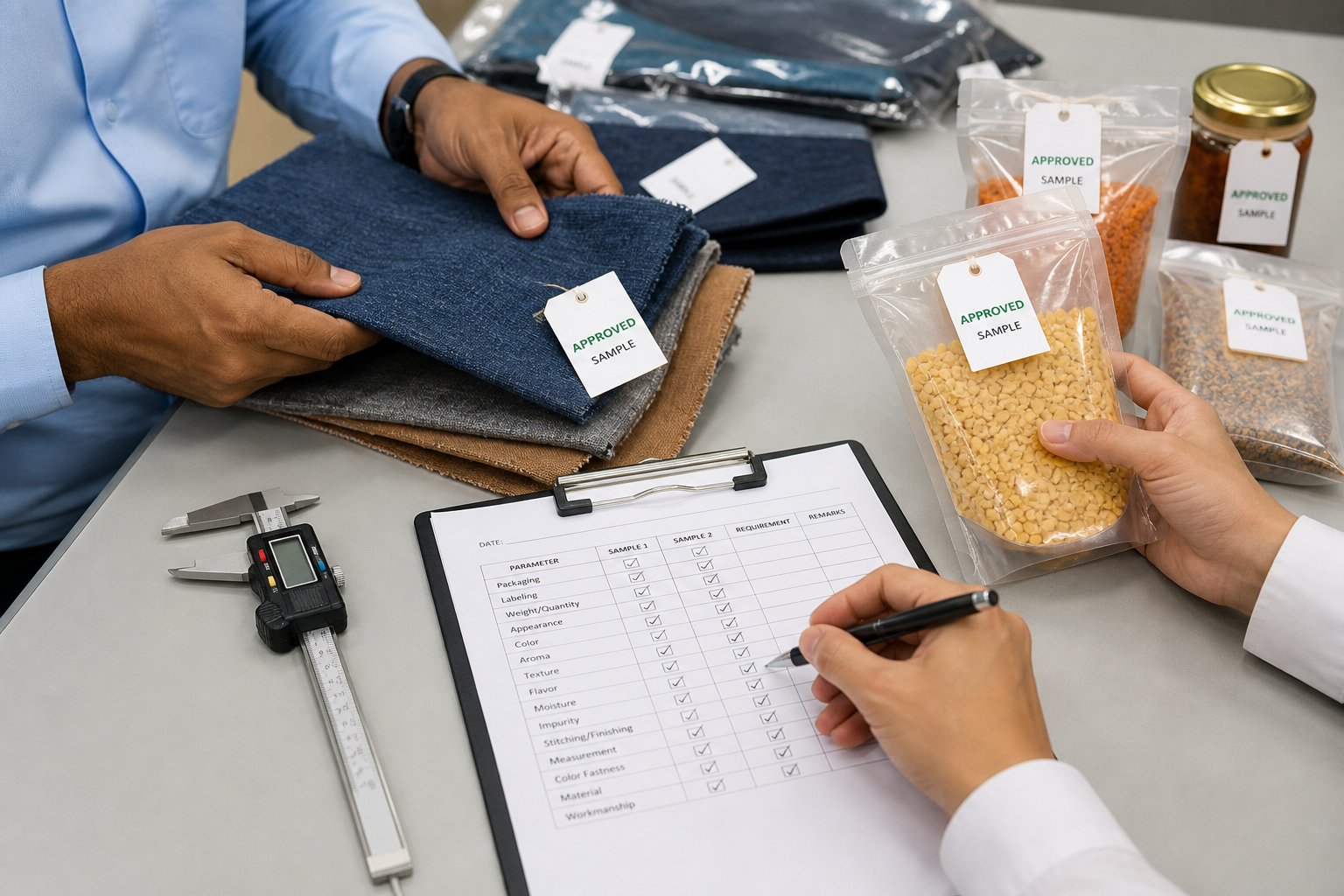
Stage 3: Samples, approvals, and specification lock
- Initial sample — confirms concept, material, and workmanship direction
- Pre-production sample (PP sample) — confirms the factory will use approved materials, colors, and construction before bulk run
- Golden sample — retained reference for QC comparison during production and pre-shipment inspection
Samples are your primary defense against production mismatch. The gate at Stage 3 is binary: either the sample and documented specification are approved, or they are not. "Close enough" approvals create expensive disputes later.
Run samples in a defined sequence:
Document approvals in writing: date, sample version, photos, lab dip references, measurement tables, and any accepted deviations. Link the approval to the purchase order or proforma invoice.
Illustrative example—engineering components: A Canadian distributor importing brass fittings needs approved drawings with tolerances, thread standard, and plating spec stored as the golden sample reference—not verbal sales descriptions.
If samples fail, reset Stage 3 before production deposits. Fixing a bad bulk run costs far more than resetting at sample stage.
For production-stage quality controls, see how to reduce India sourcing risk for international buyers and the QC cluster articles on pre-shipment inspection.
Stage 4: Agree commercial terms and Incoterms
- Unit price and price basis (per piece, per kg, per meter, etc.)
- MOQ and order quantity
- Lead time from deposit or LC opening to ready-to-ship date
- Incoterm (EXW, FOB, CIF, DAP, etc.) and named place
- Packaging and marking responsibilities
- Warranty, defect handling, and claim window
- Governing law and dispute mechanism (where practical)
- Validity period of the quotation
Commercial terms translate your approved specification into a binding economic and logistics framework. At minimum, your agreement should state:
Incoterms define who pays for transport, insurance, and export/import formalities—not who physically performs them. Many India import disputes trace back to Incoterm misunderstanding: a buyer assumes "CIF Los Angeles" includes destination terminal handling; a supplier assumes their obligation ends at port arrival.
For a full comparison and selection framework, read FOB vs CIF vs EXW: which Incoterm to use when buying from India. Align Incoterm choice with your ability to book freight, manage export documents, and clear customs—or with your partner's scope if you use one.
Comparison table
Swipe →
Data table — swipe horizontally on small screens
| Incoterm (common in India exports) | Supplier typically handles | Buyer typically handles |
|---|---|---|
| EXW | Make goods available at factory | All transport, export clearance, insurance, import clearance |
| FOB (named Indian port) | Delivery on board vessel at port; export clearance | Ocean freight, insurance, import clearance, inland delivery |
| CIF (named destination port) | Freight and insurance to destination port | Import clearance, duties, taxes, inland delivery |
| DAP/DDP (less common from India) | Delivery to named place; DDP includes import duties | DAP: buyer clears import; DDP: supplier clears import (requires local capability) |
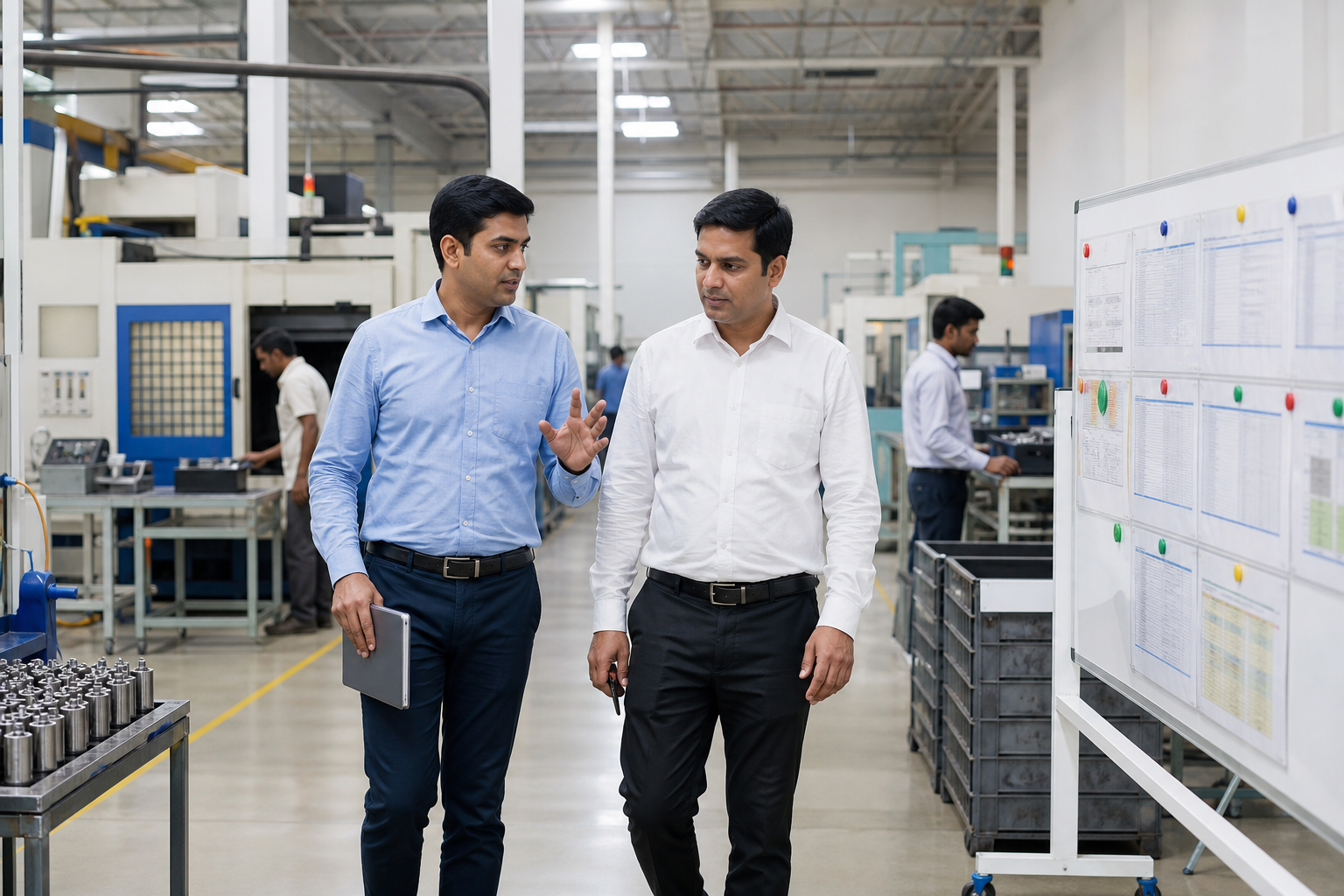
Stage 5: Structure payments to match production risk
Payment terms should follow manufacturing milestones, not convenience. Common structures include advance deposit plus balance before shipment, letter of credit (LC), documentary collection, and open account for established relationships. Each carries different risk for buyer and supplier.
Avoid paying the full balance before pre-shipment verification when product quality risk is material. Tie final payment release to agreed inspection results, document completeness, or shipment under LC terms.
For instrument details, milestone design, and currency considerations, see how to pay Indian suppliers: payment terms for international buyers.
Comparison table
Swipe →
Data table — swipe horizontally on small screens
| Payment approach | Typical use | Buyer risk | Supplier risk |
|---|---|---|---|
| Advance + balance before shipment | Small to mid orders, new relationships | High if deposit is large and production is unverified | Low once production is funded |
| Advance + balance against copy documents | Established suppliers, moderate trust | Medium; depends on document review discipline | Medium |
| Letter of credit (LC) | Larger orders, first-time or high-value deals | Lower if LC terms match spec and shipment docs | Document compliance burden |
| Open account (net 30/60) | Mature, proven relationships | Higher until trust is established | Higher receivables exposure |
Stage 6: Production monitoring and quality control
- Production start confirmation and expected completion date
- In-process checkpoints for high-risk products (color batches, dimensions, food batches)
- Pre-shipment inspection (PSI) scope: quantity, workmanship, packaging, labeling, barcode scan
- Who conducts inspection: factory QC, buyer-appointed inspector, or partner-coordinated third party
- Defect classification and rework/reject thresholds
- Hold-shipment authority when results fail agreed criteria
Once production starts, the buyer's job is visibility—not passive waiting. At minimum, define:
PSI after packing is usually more useful than mid-line checks alone for finished goods. Do not assume ISO certification replaces product-specific inspection against your approved sample.
Stage 7: Export documents—collect and review before shipment releases
- Commercial invoice
- Packing list
- Bill of lading (ocean) or air waybill (air)
- Certificate of origin (where required for preferential duty or compliance)
- Inspection or test certificates (category-dependent)
- Phytosanitary, fumigation, or health certificates (agricultural and food products)
- Insurance certificate (when applicable under Incoterm)
Export documents are the operational language of international trade. Customs authorities, banks, freight carriers, and your receiving team all depend on consistent data across the document pack. Stage 7 gate: no shipment release until required documents are reviewed against the purchase order and destination checklist.
Core documents typically include:
The buyer-side document pack, ownership matrix, and mismatch risks are covered in depth in documents required to import products from India. For exporter-side preparation detail, see export documentation checklist for India.
Common Stage 7 failures include invoice quantities that do not match the packing list, HS codes that differ between invoice and bill of lading, missing certificate of origin when duty preference is claimed, and shipper/consignee details that do not match your import entity. Review documents before cargo departs when possible; correcting errors after sailing is slower and more expensive.
Stage 8: Shipping, booking, and transit management
- Ocean vs. air vs. multimodal (cost, urgency, product value, shelf-life)
- Full container load (FCL) vs. less than container load (LCL)
- Port of loading in India (Nhava Sheva/Mumbai, Mundra, Chennai, Kolkata, etc.)
- Routing, transshipment points, and total transit time
- Insurance coverage gaps under chosen Incoterm
- Delivery instructions to destination agent or customs broker
Shipping connects Indian origin to your destination port or airport. Your Incoterm determines who books freight, but the buyer always has interest in transit visibility and arrival planning.
Key decisions at Stage 8:
Book freight early when capacity is tight—peak seasons around major holidays and post-monsoon export surges affect both rates and space. Confirm cut-off dates for documentation and cargo delivery to port or CFS (container freight station).
For mode selection, booking steps, and transit timelines, read shipping from India: a complete guide for international importers.
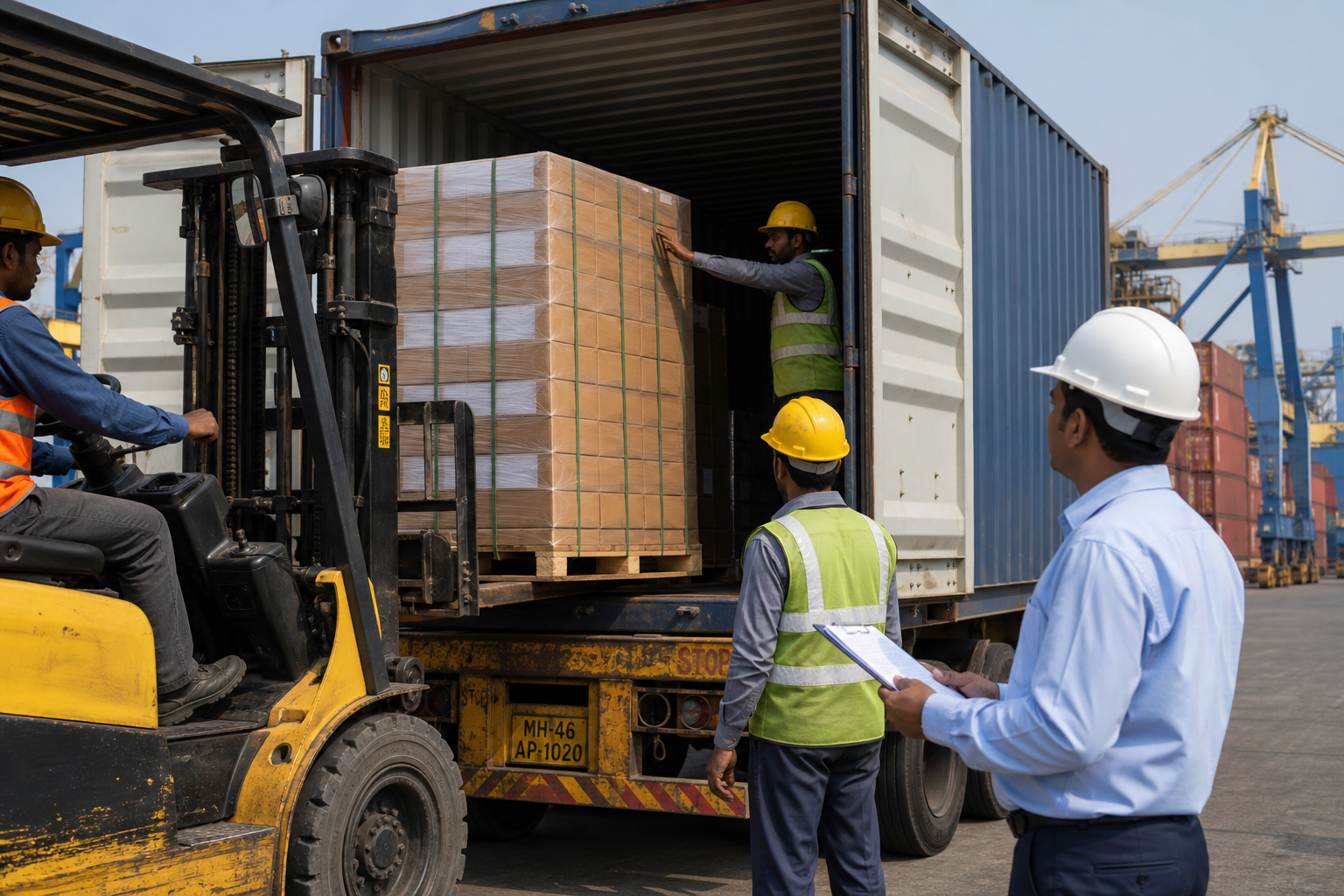
Stage 9: Customs clearance at destination
- Providing importer-of-record details and bond if required
- Confirming HS classification and duty rate expectations before arrival
- Supplying broker with complete document pack in advance of vessel arrival
- Paying duties, taxes, and broker fees
- Responding to customs queries or examination requests promptly
Customs clearance is where product classification, document accuracy, and duty payment converge. Your customs broker (or internal trade compliance team) files entry based on commercial invoice, packing list, transport document, and certificates. Errors here delay release and trigger storage charges.
Buyer responsibilities at Stage 9 typically include:
Do not assume preferential duty treatment; verify rules of origin and certificate format before shipment. See customs clearance when importing from India and how import duties and taxes work when buying from India.
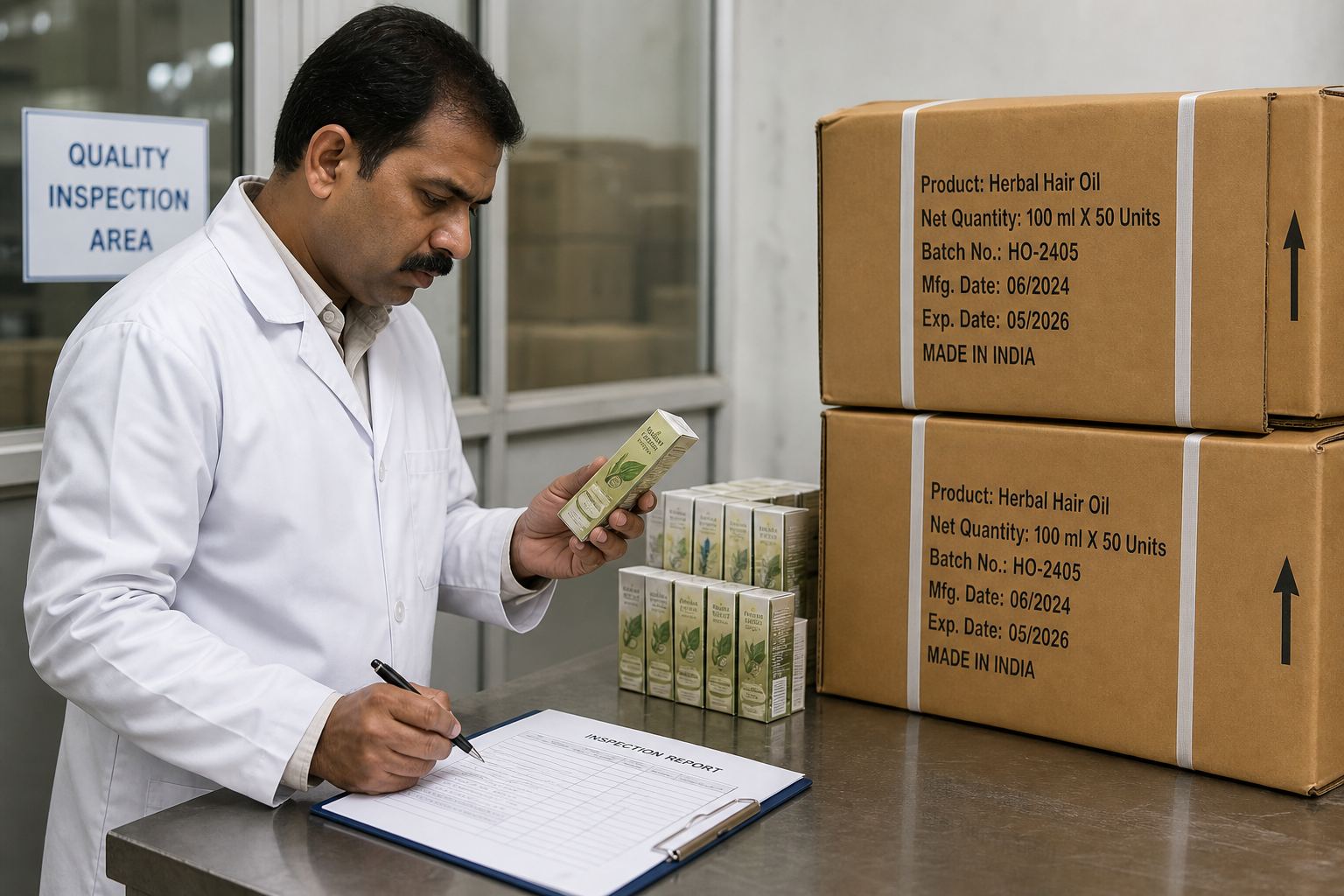
Stage 10: Warehouse receiving and import reconciliation
- Compare carton count and weights to packing list
- Inspect outer cartons for damage; note exceptions on delivery receipt
- Sample or full inspection against approved specification
- Verify labels, barcodes, and batch codes for market compliance
- Reconcile commercial invoice, freight invoice, duty payment, and purchase order
- Enter inventory and close the import file with documented variances
The import is not complete when customs releases cargo. Stage 10 confirms that what you receive matches what you ordered, paid for, and planned to sell or use.
Receiving checklist:
Document and resolve shortages, damage, or quality failures within agreed claim windows. Photos, inspection reports, and sealed-sample comparison strengthen claims with suppliers and insurers.
Calculate cost before you commit: landed cost and total cost
Import decisions made on FOB price alone underestimate true cost. Landed cost adds freight, insurance, duties, taxes, brokerage, and inland delivery. Total cost of ownership adds sampling, inspection, partner fees, and rework. Use landed cost during Stage 4 and total cost for broader TCO.

When to manage import yourself vs. use an India partner
Not every buyer needs the same operating model. Direct import suits buyers with trade compliance expertise and proven suppliers; partners add value when coordination gaps cause repeated failures.
Altus Exports, led by Saurabh Mittal, supports buyers as a merchant exporter and India sourcing and export partner. See import products from India and merchant exporter in India.
Comparison table
Swipe →
Data table — swipe horizontally on small screens
| Factor | DIY direct import may fit | Partner-supported import is often useful |
|---|---|---|
| Supplier relationship | Proven factory, repeat orders | New suppliers or multiple factories |
| Category complexity | Simple, standardized SKU | Regulated, multi-spec, or multi-SKU programs |
| Internal trade team | Experienced importer of record staff | No dedicated import or compliance resource |
| Quality risk | Low consequence of variation | Brand, safety, or food-grade sensitivity |
| Document discipline | Strong internal document review | Past document mismatch or clearance delays |
| Logistics scope | Buyer books freight and clears customs routinely | Buyer needs single coordinator across export chain |
| Geographic coverage | Single cluster, single port pattern | Multi-region sourcing with consolidated export |
Common failure modes and how stage gates prevent them
Treat failures as process signals—reinforce gates rather than abandoning India sourcing. Most recurring problems trace to compressed decisions or documentation treated as an afterthought.
Comparison table
Swipe →
Data table — swipe horizontally on small screens
| Failure mode | Typical cause | Stage gate that prevents it |
|---|---|---|
| Production does not match sample | Verbal approval, no golden sample | Stage 3 specification lock |
| Landed cost exceeds budget | FOB-only comparison, ignored duties and freight | Stage 4 + landed-cost worksheet |
| Supplier stops production mid-run | Unclear payment milestones | Stage 5 payment structure |
| Shipment held at customs | HS mismatch, missing certificate | Stages 0, 7, 9 readiness and document review |
| Wrong Incoterm assumptions | Buyer thought CIF included all destination costs | Stage 4 Incoterm alignment |
| Quality dispute at arrival | No PSI or vague acceptance criteria | Stage 6 QC plan |
| Cash flow surprise | Duties and freight invoiced after arrival | Stages 0 and 4 cost modeling |
| Supplier not export-ready | No verification before PO | Stage 2 supplier screening |

Conclusion
Importing products from India successfully requires more than finding a supplier and transferring payment. The India Import Stage-Gate Model gives international buyers a practical sequence: confirm readiness, define the brief, verify suppliers, lock specifications through samples, agree commercial terms and Incoterms, structure payments, monitor production and QC, review export documents, manage shipping, clear customs, and reconcile at the warehouse. Each gate protects the next commitment.
Use linked cluster articles for depth on documents, landed cost, Incoterms, payments, shipping, customs, and duties. Use the legacy complete guide to importing products from India for category strategy. Use sourcing and verification clusters for supplier discovery—not this import playbook.
If you want on-ground India support for verification, QC coordination, documents, and export execution, contact Altus Exports with your product brief, destination market, and target timeline to discuss whether a structured import approach fits your program.