
China + India Sourcing Strategy: How International Companies Can Source From Both Countries
By Saurabh Mittal, Founder, Altus Exports
A China + India strategy works as one operating system: allocate SKUs with primary/backup roles, sync QC and commercials, name China and India owners, and scale pilot → parallel → portfolio. Keep China where scale wins; add India where diversification or category fit justifies parallel capacity.

Most international companies do not face a single question—India or China? They face a portfolio question: which SKUs belong where, who governs the combined program, and how do we scale without doubling chaos? Buyers who add India to an established China base—or maintain China while building India-first categories—often stumble not because dual origin is wrong, but because they run two countries with two incompatible playbooks. Different QC checklists, different payment habits, different document naming, and no named owner for cross-origin decisions turn diversification into firefighting.
China India sourcing strategy is therefore an operating discipline. It connects strategic rationale (why two origins) with tactical execution (how volume moves, how quality is judged consistently, how commercial terms align, and how teams coordinate across time zones). This article is the strategic close of the India vs China sourcing cluster: it assumes you already understand origin comparison at pillar level and diversification rationale—it links those resources rather than re-arguing them. For the buyer decision framework on whether India, China, or both fit your categories, see India vs China for sourcing: international buyers. For why companies add India and how to structure a diversification decision, see India vs China supply chain diversification and India China plus one strategy for global buyers. This guide owns how to run both countries day to day.
Altus Exports operates as an India-side sourcing and merchant-export coordination partner. We do not replace your China relationships or act as a China agent. In dual-origin programs, Altus can serve as the India coordination node—supplier search, sample flow, production follow-up, QC coordination, consolidation support, and export execution—while your team and China counterpart maintain the parallel lane. Whether you use a partner or internal staff, the frameworks below apply.
Dual origin is an operating system, not a spreadsheet column
Adding India alongside China fails when treated as a side project: three SKUs in India, eighty in China, no shared standards, and procurement discovers at pre-shipment that Indian cartons use different defect definitions than the Chinese audit firm. Dual country sourcing succeeds when built as one system with two execution lanes.
The rest of this article supplies named frameworks to prevent those failures.
Comparison table
Swipe →
Data table — swipe horizontally on small screens
| Failure pattern | What it looks like | System fix |
|---|---|---|
| Orphan India lane | India orders lack QC, finance, and logistics owners | Assign India lane owner; mirror China gate structure |
| Duplicate but divergent QC | Two inspection firms, two AQL interpretations | Single QC standard pack per SKU family |
| Document babel | Invoices and packing lists formatted differently by origin | One document template and naming convention |
| Allocation drift | Volume silently shifts origin without scorecard review | Quarterly allocation review against rules |
| Partner overlap | China agent and India partner both "coordinate" same SKU | China+India Governance RACI with single accountable party per decision |

The Dual-Country Allocation Playbook
The Dual-Country Allocation Playbook assigns every SKU (or SKU-destination variant) to one of four roles. Document the role in your sourcing master data before production deposits.
Comparison table
Swipe →
Data table — swipe horizontally on small screens
| Role | Definition | Typical volume | Trigger to revisit |
|---|---|---|---|
| China primary | Default production in China; India not qualified | Majority of program | Tariff shock, quality failure, capacity loss, diversification mandate |
| India primary | Default production in India; China not required | Majority of program | Capacity ceiling, new category expansion from China base |
| Dual primary (split) | Stable volume share across qualified origins | Defined % split (e.g., 70/30) | Scorecard drift, lane cost change, customer origin preference |
| Backup / hedge | Qualified alternate not taking routine volume | 0% until trigger; trial orders to keep warm | Geopolitical, tariff, or supplier concentration triggers |
Allocation decision inputs
Comparison table
Swipe →
Data table — swipe horizontally on small screens
| Input | Cluster resource |
|---|---|
| Category and manufacturing fit | India vs China manufacturing: cost, quality, MOQ, lead times |
| Landed cost and tariff treatment | India vs China sourcing costs: landed cost comparison |
| Supplier discovery difficulty | India vs China supplier networks |
| QC and audit load | India vs China quality control, factory audits, supplier risk |
| Destination-market fit | India vs China exporting to USA, Europe, Middle East |
| SME / MOQ constraints | India vs China for SME buyers |
| Private label development path | India vs China for private label products |
Use inputs from across the cluster—without re-deriving their full depth here:
SKU allocation workshop (90-minute format)
- List SKUs with annual volume, margin band, and destination markets.
- Score category fit per origin (Green/Amber/Red) using pillar scorecard logic from Article 1.
- Assign playbook role (China primary, India primary, dual split, backup).
- Name owners for each lane and for cross-origin exceptions.
- Set review triggers—tariff change, two consecutive QC failures, lead-time slip beyond X days.
- Publish allocation register accessible to procurement, product, finance, and logistics.
Run quarterly or when launching a new category:
Illustrative allocation: A housewares importer keeps plastic storage and small appliances as China primary, assigns brass décor and spice gift sets as India primary, runs organic cotton towels as dual primary 60/40 China/India, and maintains a backup Indian textile mill for China port disruption on basic towel SKUs.
China+India Governance RACI
The China+India Governance RACI defines who is Responsible, Accountable, Consulted, and Informed for decisions that span both origins. Without it, email threads decide allocation ad hoc.
China counterpart may be internal China sourcing staff, a Hong Kong or mainland agent, or a long-standing trading partner—provided accountability is explicit. India coordinator may be internal hire, India sourcing partner, or Altus Exports for on-ground execution. The buyer program lead remains Accountable for product, commercial, and release decisions in both lanes.
Comparison table
Swipe →
Data table — swipe horizontally on small screens
| Workstream | Buyer program lead (Accountable) | China counterpart (R/C) | India coordinator / Altus node (R/C) | QC / inspection | Finance | Logistics |
|---|---|---|---|---|---|---|
| SKU allocation register | A | C | C | I | I | C |
| Product spec & revision control | A | C | C | C | I | I |
| Supplier appointment | A | R (China SKUs) | R (India SKUs) | C | C | I |
| Sample approval | A/R | R (China) | R (India) | C | I | I |
| Commercial terms template | A | C | C | I | R | C |
| QC standard issuance | A | C | C | R | I | I |
| Pre-shipment release | A/R | C | C | R | C | C |
| Payment authorization | A/R | I | I | I | R | I |
| Document standard enforcement | A | R | R | I | R | C |
| Cross-origin substitution | A | C | C | C | C | C |
| Allocation review (quarterly) | A/R | C | C | C | C | C |
| Crisis reallocation | A | R | R | C | C | C |
Escalation path
- Tier 1 — Lane issue: Single-origin delay, document correction, sample rework; resolved within lane owner + 48 hours.
- Tier 2 — Cross-origin impact: Substitution affects allocation register, customer commitment, or shared launch; program lead decides within 72 hours.
- Tier 3 — Strategic: Tariff regime change, forced origin shift, major quality systemic failure; leadership + quarterly allocation review triggered early.
Define three tiers:

Primary and backup roles in practice
Primary suppliers earn default volume against documented qualification. Backup suppliers stay qualified through periodic trial orders or audit refresh—not through verbal assurances.
When backup activates, log reason code (tariff, quality, capacity, logistics, geopolitical) for the next allocation review. Patterns in reason codes tell you whether allocation rules need updating.
Comparison table
Swipe →
Data table — swipe horizontally on small screens
| Element | Primary supplier (either origin) | Backup supplier |
|---|---|---|
| Qualification depth | Full audit, approved samples, production history | Audit + approved samples; trial order within 12 months |
| Volume | Planned forecast share | Surge or switch volume only |
| Tooling | Owned per agreement | Compatible or duplicate tooling plan documented |
| QC | Routine PSI at agreed AQL | Same QC pack; may increase inspection frequency on activation |
| Commercial terms | Negotiated baseline | Frame agreement or quick-quote mechanism pre-agreed |
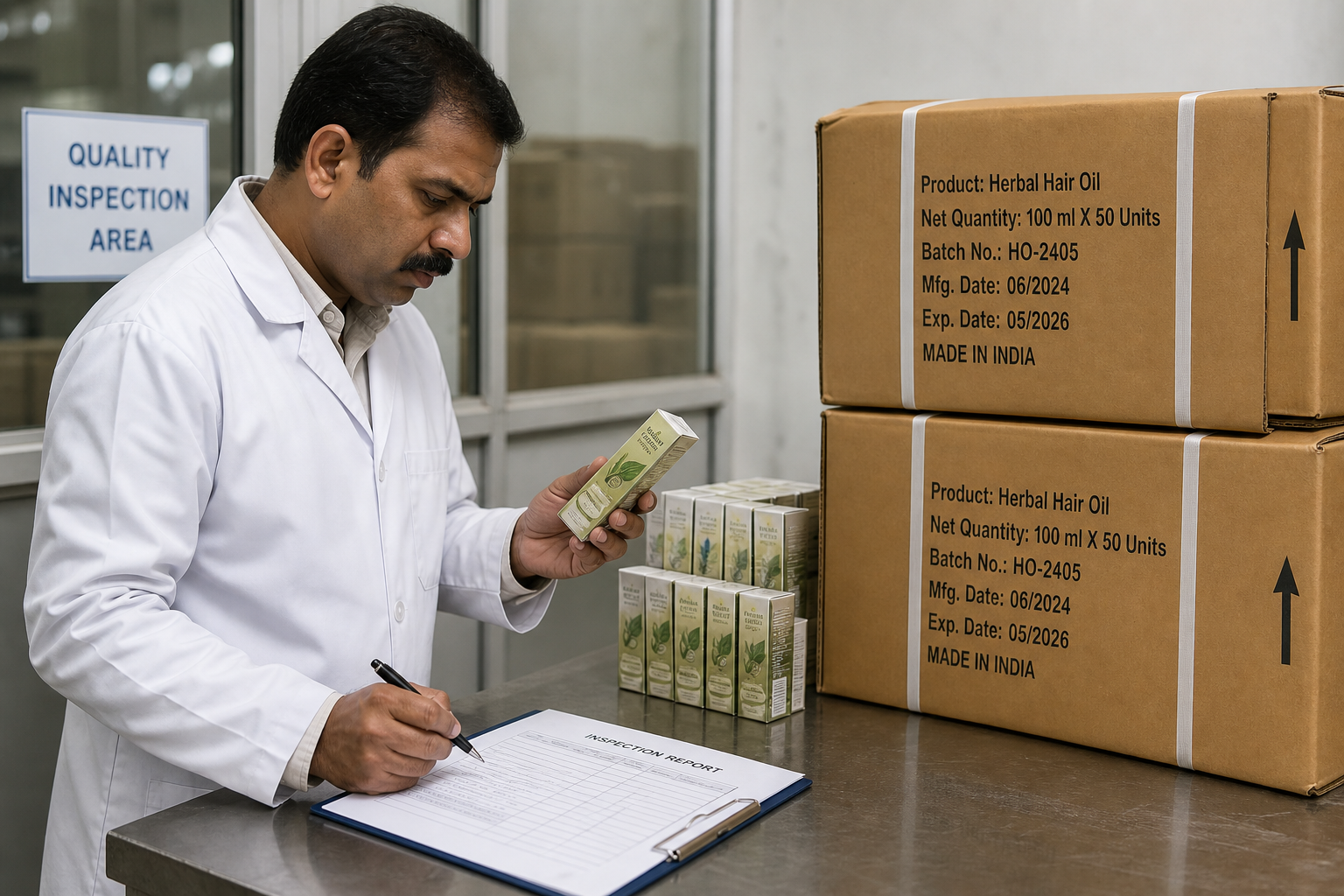
Synchronizing QC standards across China and India
Inconsistent QC destroys dual-origin value. Customers and regulators judge your brand, not the origin port.
The Unified QC Pack (per SKU or SKU family)
- Approved specification — dimensions, materials, colors, performance tests.
- Golden sample reference — photos, revision ID, storage location.
- Defect dictionary — named defects with photo examples and severity (critical/major/minor).
- Acceptance method — AQL table or 100% check rules for critical safety points.
- Packaging and labeling standard — carton marks, language, barcode placement.
- Inspection trigger — when PSI is mandatory vs skip-lot (if ever).
- CAPA template — corrective action format both origins must complete.
Publish one controlled document set:
China and India factories receive the same pack revision. Inspectors—whether one firm globally or two firms briefed identically—apply the same criteria. See India vs China quality control, factory audits, and supplier risk for risk-tiering detail.
QC sync cadence
Comparison table
Swipe →
Data table — swipe horizontally on small screens
| Cadence | Activity |
|---|---|
| At SKU launch | Issue QC pack v1.0; both origins acknowledge |
| Each production lot | PSI against same revision unless documented deviation |
| Quarterly | Compare defect Pareto China vs India; update defect dictionary |
| After customer complaint | Root cause by origin; revise pack if systemic |
For multi-supplier India complexity, layer how to manage multiple Indian suppliers through one partner and coordinate quality control across multiple Indian suppliers without diluting the unified standard.
Aligning commercial terms across origins
China plus India procurement breaks when payment terms, Incoterms, and liability language diverge without reason. Standardize where possible; document intentional differences.
Finance should reconcile landed cost on the same template for both origins. Use how to calculate landed cost for products imported from India as the India model and mirror line items for China.
Comparison table
Swipe →
Data table — swipe horizontally on small screens
| Term area | Standardization recommendation | When origins may differ |
|---|---|---|
| Incoterms | One preferred term (often FOB port) for both lanes | India EXW vs China FOB only if freight model requires |
| Payment milestones | Sample / deposit / pre-shipment / balance pattern mirrored | China LC history vs India TT-only supplier |
| Currency | USD quotes for comparability | Local currency only with FX policy |
| MOQ and lead time | Record in allocation register | Naturally differs by factory |
| Warranty and liability | Same commercial policy | Jurisdiction clauses per contract law |
| Tooling ownership | Identical clause structure | — |
| IP and NDA | One NDA template | — |

The India coordinator + China counterpart model
Dual-origin programs scale when each geography has a named execution owner reporting to one buyer program lead.
Role split
Comparison table
Swipe →
Data table — swipe horizontally on small screens
| Function | China counterpart | India coordinator (internal or Altus) |
|---|---|---|
| Supplier search & RFQ | Lead for China SKUs | Lead for India SKUs |
| Factory follow-up & milestones | R | R |
| Sample logistics | R | R |
| Local inspection coordination | R | R |
| Export document collection | R | R |
| Issue escalation to buyer | R | R |
| Allocation & substitution decisions | C | C |
| Final sample & shipment release | I — buyer A | I — buyer A |
This is not duplication—it is parallel lanes with shared standards. The buyer program lead holds product truth, QC pack revisions, allocation register, and release authority.
Altus as India-side node
- Monday: Lane status dashboard (milestones, amber/red flags).
- Wednesday: Exception review (only items needing buyer decision).
- Friday: Document completeness check for shipments in next 14 days.
Altus Exports fits the India coordinator role when buyers lack India staff: global sourcing partner in India, product sourcing company in India, find manufacturers in India, import products from India, and merchant exporter in India services scoped to agreed deliverables. China relationships remain yours—agent, factory direct, or trading company. Clear RACI prevents the India partner from overriding China instructions or vice versa.
Weekly rhythm for dual-origin programs:
Import execution depth for India lane: how to import products from India, shipping from India, customs clearance.
Scale phases: pilot, parallel, portfolio
Do not jump from zero India volume to full dual-primary on every SKU.
Phase 1 — Pilot (1–3 SKUs, 2–4 cycles)
- Select SKUs where India fit is strong and China concentration risk is meaningful.
- Run full qualification, Unified QC Pack, and landed cost comparison.
- Keep volume small; measure defects, lead time, document friction, and coordination hours.
- Outcome: Go/no-go per SKU for Phase 2.
Phase 2 — Parallel (expanded SKU list, defined split rules)
- Add SKUs with documented primary/backup or dual-primary percentages.
- Activate China+India Governance RACI and weekly rhythm.
- Finance tracks margin by origin lane.
- Outcome: Stable operating cost per order known; training materials for new team members.
Phase 3 — Portfolio (category strategies embedded)
- Category managers default to allocation playbook roles when launching new SKUs.
- Quarterly allocation review is calendarized.
- Crisis reallocation tested (tabletop: China port delay → India backup activation).
- Outcome: Dual origin is BAU, not a special project.
Diversification why and executive narrative live in India vs China supply chain diversification and India China plus one strategy—this article owns scale mechanics.

Technology and documentation standards
You do not need expensive software on day one. You need one source of truth.
Align document naming: {SKU}-{origin}-{PO#}-invoice.pdf reduces warehouse confusion when containers from Nhava Sheva and Shenzhen arrive the same week.
Comparison table
Swipe →
Data table — swipe horizontally on small screens
| Artifact | Minimum viable control |
|---|---|
| Allocation register | Spreadsheet or ERP field: SKU, role, % split, primary factories, backup factories |
| Spec and QC pack | Versioned folder; revision ID on PO |
| Decision log | Date, decision, approver, linked SKU |
| Shipment release register | Inspection status, docs complete, buyer authorization |
| Landed cost model | Same template; updated duty assumptions |
Common dual-origin failure modes and fixes
Comparison table
Swipe →
Data table — swipe horizontally on small screens
| Symptom | Likely cause | Fix |
|---|---|---|
| India quality "feels different" | Different defect definitions | Unified QC Pack + inspector briefing |
| Finance cannot compare margins | Different Incoterms in quotes | Re-quote on standard FOB basis |
| Backup never ready | No trial orders | Annual backup warm-up order |
| Teams blame origin bias | No scorecard data | Track defects and landed cost by origin |
| Duplicate tooling disputes | Unclear ownership | Tooling schedule in both contracts |
| Launch misses despite dual source | Both lanes slipped | Independent milestone owners; no shared fantasy dates |
Category scenarios: how allocation looks in the field
Apparel basics vs fashion capsules: China primary on basic tees at high MOQ; India primary on embroidered or cotton-rich capsules with shorter runs—Unified QC Pack covers stitch and color standards for both.
Housewares mix: China primary on molded plastics; India primary on brass and spice accessories; dual-primary on neutral ceramic lines where both origins quoted competitively.
Industrial MRO: Drawing-level qualification; China primary where tier depth wins; India backup for concentration hedge after successful trial run.
Private label food-adjacent: India primary on spices and ingredients where cluster and export registration align; China primary on packaging machinery or non-food display—see India vs China for private label products.
Destination-specific splits are detailed in India vs China exporting to USA, Europe, Middle East.
Conclusion
Source from China and India successfully is a governance and standards problem as much as a geography problem. The Dual-Country Allocation Playbook tells you which SKUs belong where. The China+India Governance RACI tells you who decides. The Unified QC Pack and commercial templates tell you how both lanes produce comparable outcomes. The India coordinator + China counterpart model tells you how work gets done without duplicating chaos—whether the India node is internal staff or Altus Exports.
If you already know diversification makes sense, stop re-debating why and start building the operating system. Link back to India vs China for sourcing when onboarding new stakeholders; link forward to import and QC cluster articles when lanes go live. Dual origin compounds value when allocation is intentional, measurable, and owned.