
How to Source Private Label Products From India: Complete Guide for International Buyers
By Saurabh Mittal, Founder, Altus Exports
To source private label products from India, define a clear product brief, shortlist OEM-capable manufacturers, develop and freeze specs and packaging, agree MOQ and commercial terms, run quality gates through production, then complete export documents and logistics. Treat…

Sourcing private label products from India is a full commercial program, not a single factory search. International buyers—importers, distributors, retailers, e-commerce brands, and private-label owners—need a repeatable path from product idea to branded goods that can clear quality checks and leave India with usable export paperwork. That path typically covers a written brief, manufacturer discovery, product development and sampling, packaging and labeling, commercial agreement, production follow-up, quality control, and shipment coordination.
India is a practical private-label base across many categories: textiles and apparel accessories, home and lifestyle goods, personal care and cosmetics formats, food ingredients and packed food concepts (where the buyer owns market compliance), gift and stationery lines, and selected engineering-adjacent consumer products. The advantage is not “cheap everything.” It is the combination of manufacturing depth, customization flexibility, packaging options, and export-oriented suppliers—if the buyer runs a controlled process.
This guide is the pillar overview for private label sourcing India. It explains the end-to-end playbook and points to deeper cluster articles for manufacturer discovery, selection scorecards, development, packaging, MOQ economics, brand protection, and the integrated supplier–QC–pack–export map. Altus Exports supports international buyers as an on-ground India sourcing and merchant-export coordination partner for private-label manufacturing programs—without making the buyer’s product, compliance, or commercial decisions for them.
Private label, OEM, and white label: use the right terms
Buyers often use these labels interchangeably. For RFQs and contracts, precise language reduces mismatch.
Private label import from India can sit anywhere on that spectrum. A white-label route may shorten development; a full OEM route may require more sampling, tooling, and documentation. State which model you want in the first brief so factories quote comparable work.
Comparison table
Swipe →
Data table — swipe horizontally on small screens
| Term | What it usually means in practice | Buyer control | Typical factory expectation |
|---|---|---|---|
| Private label | Product made for the buyer’s brand; may be custom or adapted from a base design | High on brand, pack, and often formula/spec | Clear brand assets, specs, and approval trail |
| OEM sourcing India | Factory manufactures to the buyer’s technical design or adapted OEM specification | High on technical design and tolerances | Engineering/process fit; tooling or setup may apply |
| White label products India | Near-ready product the buyer rebrands with limited customization | Moderate—mainly branding and pack | Faster path when base SKU already exists |
The Private Label Sourcing Brief
Most private-label failures start with an incomplete brief. Factories then invent assumptions about materials, pack formats, MOQ, testing, and branding. You compare apples to oranges and discover the gap after samples or first production.
Use a Private Label Sourcing Brief before you contact manufacturers. One to three pages is enough if it is specific.
What the brief should include
- Product category, intended use, and destination markets
- Private label vs OEM vs white label preference
- Reference sample, photo board, drawing, or competitor SKU (if shareable)
- Materials, dimensions, performance, fragrance/flavor constraints, or finish requirements as applicable
- Branding scope: logo placement, colorways, hangtags, inserts, barcodes, multilingual labels
- Packaging concept: primary pack, secondary carton, pallet or master-case notes
- Target volumes for trial and steady-state reorder (ranges are fine)
- Indicative price context if you choose to share it
- Compliance themes the buyer already knows apply (for example, textile labeling, cosmetics claims limits, food labeling rules)—without asking the factory to act as your legal counsel
- Timeline for samples, freeze, and first shipment window
- Confidentiality needs: artwork, formulas, customer names, launch dates
You do not need to disclose every commercial secret in the first outreach. You do need enough detail that a serious manufacturer or sourcing partner can say yes, no, or “possible with these conditions.”
Brief quality table
Comparison table
Swipe →
Data table — swipe horizontally on small screens
| Brief quality | What factories receive | Likely outcome |
|---|---|---|
| Vague | “Private label home product, good quality, competitive price” | Scattered quotes; mismatched packs and MOQs |
| Partial | Photos + approximate size; no pack or branding detail | Samples that look right but ship wrong |
| Controlled | Specs, pack concept, volumes, markets, approval method | Comparable RFQs and a usable development plan |
For category fit before you invest in a full program, see best private label products to source from India. For MOQ ranges and negotiation once the brief is clear, use private label MOQ in India.
End-to-end playbook: the 8-stage Private Label India Route Map
Treat private-label sourcing as eight connected stages. Skipping a stage does not remove the work; it only moves risk later—usually into production or customs.
Stage 1 — Define product, brand, and commercial boundaries
Confirm what “done” means: retail-ready branded goods, warehouse-ready master cartons, or semi-finished OEM components for packing in your market. Decide who owns artwork files, who pays for tooling or molds, who arranges testing, and which Incoterm you intend to use for first shipment.
Stage 2 — Find OEM-capable manufacturers
Search for factories that can actually run your process and branding model—not only trading companies that can “source anything.” Discovery channels and shortlisting methods are covered in how to find private label manufacturers in India. Keep this stage focused on a longlist and a shortlist, not a final award.
Stage 3 — Verify and choose the manufacturer
Entity checks, capability fit, sample history, capacity, and commercial clarity belong here. Use a structured scorecard rather than gut feel after a good video call. The selection framework lives in how to choose a private label manufacturer in India. For deeper entity and document verification, also use how to verify an Indian supplier before order.
Stage 4 — Develop the product and freeze the specification
Move from idea to approved pre-production sample with a revision log. Formulation, construction, color, fragrance, hardware, and packing trials belong in development—not in silent factory improvisation after PO. See private label product development in India.
Stage 5 — Finalize packaging and labeling
Artwork, dielines, barcodes, claims language, and destination labeling rules often delay launches more than the product itself. Coordinate packaging early enough that production is not waiting on unapproved files. Detail sits in private label packaging and labeling in India.
Stage 6 — Lock commercial terms, MOQ, and production plan
Agree unit price basis, tooling, sample costs, payment milestones, lead times, packing standards, and what happens if materials change. MOQ should be discussed with cost drivers visible, not as a single mysterious number. Link out for depth: private label MOQ in India.
Stage 7 — Produce with quality gates
Inline checks, pre-shipment inspection criteria, AQL or equivalent acceptance rules (as agreed), and nonconformity handling protect the brand. Overview controls appear later in this article; the fuller operational map is in India private label sourcing: supplier, quality control, packaging and export guide.
Stage 8 — Export documents and logistics handoff
Commercial invoice, packing list, transport documents, certificates of origin where applicable, and any product-specific certificates need owners and timelines. Private label import from India fails operationally when goods are ready but documents are not.
Process depth by manufacturing stage is also covered in private label manufacturing in India: how the process works.
Who should run the program: direct factory vs India coordination partner
You can source private label directly from a factory when you already have a proven manufacturer, an experienced buying team, and capacity to manage samples, revisions, QC, and export follow-up yourself. A coordination partner becomes more useful when you are new to India, working across several SKUs or factories, or need local presence for verification, production follow-up, and document chase.
Altus Exports can operate in the partner and merchant-export coordination role for private-label programs—manufacturer search support, verification coordination, sampling follow-up, QC arrangements, and export handoffs—while you retain product, pricing, and compliance decisions. Whether that model fits depends on your category, volume, and internal bandwidth. Related operating-model context: global sourcing partner in India and private label manufacturing in India.
Comparison table
Swipe →
Data table — swipe horizontally on small screens
| Situation | Direct OEM manufacturer may fit | India sourcing / PL coordination partner often helps |
|---|---|---|
| Product scope | One known SKU and factory | New private-label line or multi-SKU program |
| Local presence | Frequent visits or resident team | Limited travel; need on-ground follow-up |
| Brand risk | Established process with that factory | New branding, pack, or formula; higher IP sensitivity |
| Coordination load | Buyer can manage daily factory chat | Buyer needs one accountable local coordinator |
| Export | Factory’s export desk is proven | Multiple suppliers or unclear document ownership |
Finding and shortlisting manufacturers without freezing selection too early
- legal entity name and role (manufacturer, merchant exporter, trading company);
- process capability that matches your product;
- evidence of private-label or OEM experience (without requiring confidential client names);
- indicative MOQ and lead-time posture;
- sample policy and revision process;
- export experience to your region;
- open questions for verification.
Discovery and selection are different jobs. Discovery builds options; selection awards a partner. Mixing them creates two common errors: awarding the first polite factory, or collecting twenty contacts with no comparable data.
Practical discovery inputs include referrals from comparable buyers, trade shows, export councils and industry clusters, professional networks, carefully filtered B2B platforms, and specialist search with category keywords such as “OEM manufacturer India” plus your process (knitting, injection molding, soap noodle conversion, wooden housewares, and so on).
When you shortlist, record:
Do not treat a glossy catalog as proof of OEM capability. Ask how branding, packaging, and change control are handled. Full channel detail: how to find private label manufacturers in India. Manufacturer search support: find manufacturers in India.
Product development and sampling: freeze before you scale
Private-label development turns a concept into a production-ready specification. The freeze is the commercial line between “still exploring” and “this is what you will manufacture.”
Development sequence that keeps control
- Concept alignment — confirm category, price band, and differentiation vs white-label base options.
- Technical translation — materials, BOM, tolerances, fragrance/active levels, stitch or weld standards, or other process specs.
- Prototype or lab sample — prove form and function, not necessarily final pack.
- Branded sample — apply near-final labels, colorways, and pack structure.
- Pre-production sample (PPS) — made with intended materials and process; becomes the reference.
- Specification freeze — signed or written approval of product, artwork, packing, and test plan.
- Pilot or first production — limited run with defined QC gates before larger replenishment.
Keep a revision log. Note who requested each change, what cost or lead-time impact was disclosed, and which sample version is approved. Factories that “improve” a product without approval create expensive surprises.
Brand-sensitive formulas, molds, and artwork should move under confidentiality controls early. Overview of brand protection belongs in how to protect your brand when working with Indian private label manufacturers; do not wait until mass production to discuss NDA practice, artwork ownership, and restricted sharing.
Packaging and labeling: treat them as part of the product
- primary pack structure and barrier needs;
- label size, language, claims, and regulatory fields for destination markets;
- barcode and SKU encoding;
- shipper marks, carton strength, and inner packing that survives your logistics path;
- artwork file ownership and print proof approval;
- who buys packaging materials and who controls print quality.
For private label, the pack is part of the SKU. A correct product in wrong packaging is still a failed launch.
Coordinate early:
Buyer teams sometimes finalize product samples weeks before artwork is ready. That compresses the packaging timeline and increases error risk. Build pack milestones into the same Gantt as sampling. Deep guide: private label packaging and labeling in India.
Commercial terms: price, MOQ, payment, and Incoterms
A private-label unit price is only meaningful when the quote states material grade, pack format, branding method, quantity break, payment terms, and delivery basis. Two factories quoting “$X per unit” without those fields are not comparable.
Commercial clarity checklist
- Quantity tiers and what changes at each tier
- Tooling, plate, mold, or die costs and ownership after payment
- Sample charges and whether they credit against order
- Payment milestones tied to approvals and shipment events
- Incoterms (for example FOB named port vs EXW) and what is excluded
- Lead time from deposit / artwork approval / material arrival—whichever is the real start
- Validity of the quote and raw-material fluctuation language, if any
- What happens on rejected goods or delayed materials
MOQ deserves its own analysis because private-label MOQ often includes packaging print minimums, fragrance or color batch sizes, and labor setup—not only machine capacity. Use private label MOQ in India for economics and trial strategies rather than treating MOQ as a single negotiation slogan.

Quality control across the private-label lifecycle
QC is not only a final inspection photo set. For private label, quality gates should match the brand risk.
Practical QC timeline
Comparison table
Swipe →
Data table — swipe horizontally on small screens
| Gate | When | Purpose |
|---|---|---|
| Incoming / material check | Before or at production start | Confirm agreed materials and components |
| Inline / process check | During production | Catch construction, fill weight, color, or assembly drift early |
| Pre-production sample confirmation | Before mass run | Align factory floor to approved PPS |
| Pre-shipment inspection (PSI) | When goods are ~80–100% packed, as agreed | Decide ship / rework / reject against written criteria |
| Post-arrival spot check | At destination | Feedback loop for next PO |
Define acceptance criteria in writing: dimensions, appearance, functional tests, packaging integrity, labeling accuracy, and any lab tests the buyer requires. A factory saying “export quality” without a measurable standard is not a QC plan.
If you need a broader QC operating approach beyond this pillar overview, use the comprehensive map in India private label sourcing: supplier, QC, packaging and export guide and Altus’s quality-related coordination under product sourcing company in India.
Brand protection and confidentiality as operating controls
- share only what is needed at each stage;
- mark confidential materials;
- confirm who may subcontract printing or components;
- keep approved artwork under version control;
- separate public catalog SKUs from your exclusive adaptations where exclusivity is commercially agreed;
- avoid oversharing launch calendars and retail customer names.
Private label creates brand assets: logos, artwork, formulas, customer packaging, and sometimes molds. Protection is an operating discipline, not a single signed PDF.
At program level:
Legal form should match risk and jurisdiction advice from your counsel. The cluster article on brand protection covers practical controls in depth: how to protect your brand when working with Indian private label manufacturers. This pillar only requires that brand protection is scheduled as a stage, not left to chance.
Export and logistics: private label import from India
- shipper and consignee details on documents;
- product descriptions that match packing lists and invoices;
- HS classification approach your broker will use (buyer/broker owned);
- certificates or declarations your market or customer requires;
- carton marks and packing that match booking;
- inspection release before vessel or air cut-off;
- who books freight under the chosen Incoterm.
Export readiness is part of sourcing, not a courier afterthought. Before production finishes, confirm:
Merchant-export structures can simplify multi-supplier consolidation when that commercial model is agreed. Factory-direct export can work when one manufacturer handles the full document set reliably. Choose consciously; do not discover the model during customs queries.
The Private Label India Readiness Checklist
Checklist
- Brief complete — product, brand model, markets, volumes, pack concept recorded.
- Manufacturer shortlist — at least two to three credible options compared on equivalent terms.
- Verification done — entity, capability, and export role understood at agreed depth.
- PPS approved — pre-production sample and revision log closed.
- Artwork approved — print proofs signed; file ownership clear.
- Commercial terms written — price basis, MOQ, payment, Incoterms, lead time, tooling.
- QC plan agreed — gates, criteria, who inspects, who decides.
- Brand controls in place — confidentiality and sharing limits understood.
- Export checklist assigned — document owners and timeline before cargo ready date.
- Reorder path defined — what stays frozen vs what can change on PO2.
Use this checklist before you place a first significant private-label PO.
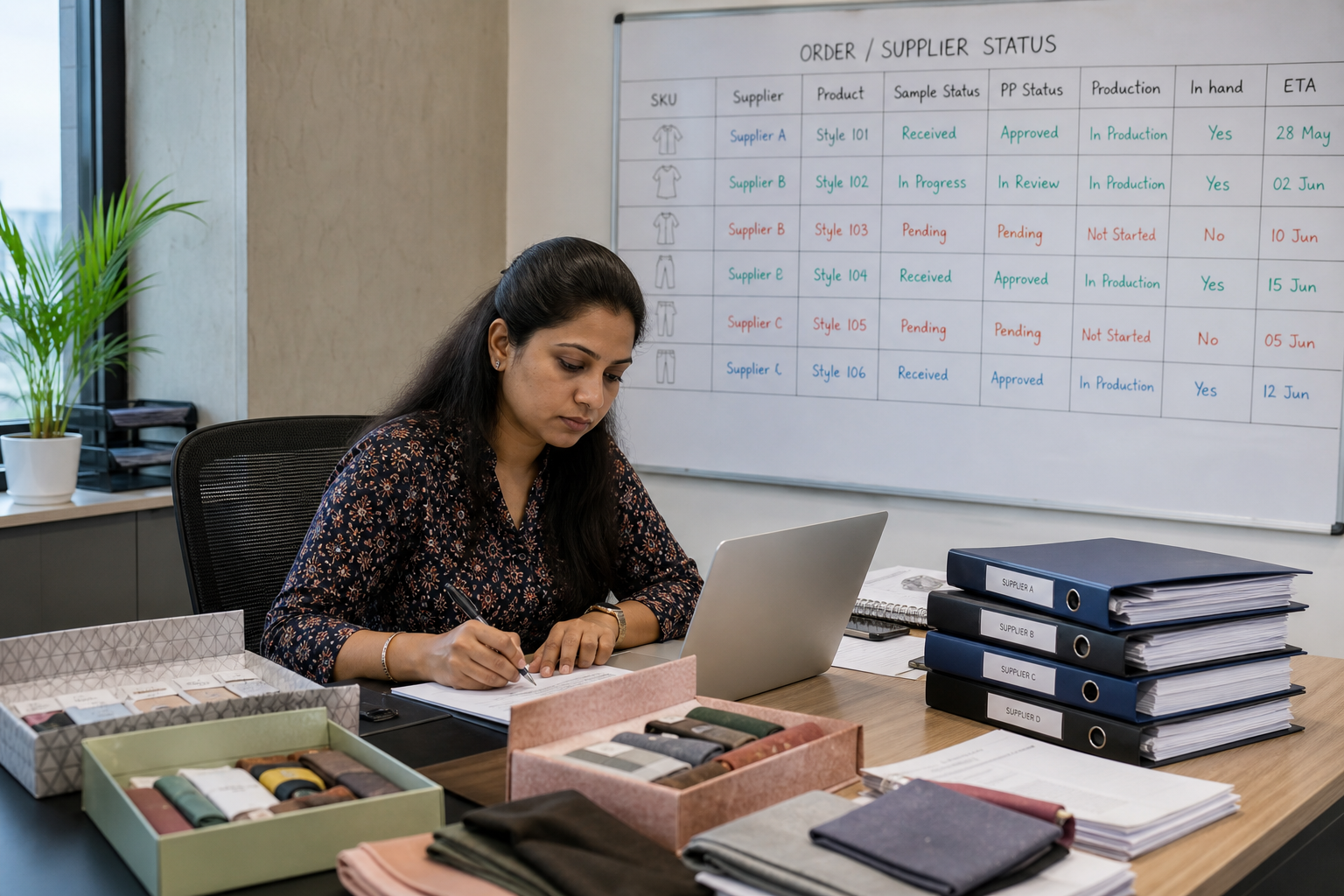
Common mistakes in private label sourcing India
Common Mistakes Box
Mistake 1: Treating white label and OEM as the same RFQ
Factories quote different work. State the model or you will compare incompatible offers.
Mistake 2: Selecting on unit price alone
The cheapest quote often assumes simpler pack, lighter material, or higher MOQ. Normalize the RFQ fields first.
Mistake 3: Freezing the factory before freezing the product
Awarding a manufacturer before PPS approval encourages pressure to “start production” on unfinished specs.
Mistake 4: Leaving packaging to the end
Late artwork is a leading cause of missed ship dates for branded goods.
Mistake 5: Skipping a pilot or first controlled run
A large first order can hide process issues that a smaller controlled run would reveal.
Mistake 6: Confusing a sourcing partner with a manufacturer
A partner coordinates; a manufacturer produces. You may need both roles, but assess them differently. For partner discovery patterns outside pure PL mechanics, see how to find a reliable sourcing partner in India.
Mistake 7: Ignoring brand-asset control
Uncontrolled file sharing and informal “small changes” erode brand consistency and IP posture.
How Altus Exports fits in a private-label program
- Private label manufacturing in India
- Global sourcing partner in India
- Find manufacturers in India
- Product sourcing company in India
Altus Exports can support private-label buyers who need India-based coordination across manufacturer identification, verification support, sampling follow-up, packaging and production checkpoints, quality arrangements, and export documentation handoffs. Engagements vary by category and scope; the useful starting point is a clear Private Label Sourcing Brief, target markets, and the stages you want locally managed.
Service entry points:
This article does not claim exclusive factory access, guaranteed savings, or certifications beyond what a specific project documents. Reliability comes from process clarity and evidence—not slogans.

Conclusion
To source private label products from India successfully, run a controlled program: define the brief, distinguish private label / OEM / white label, shortlist capable manufacturers, develop and freeze product and packaging, lock commercial terms, apply quality gates, and finish with export-ready documents. Use this pillar for the overview; use the cluster guides for discovery, selection, process stages, development, packaging, MOQ, brand protection, and the integrated supplier–QC–pack–export checklist.
If you want on-ground coordination for a private-label program, contact Altus Exports with your product brief, target markets, volume ranges, and the stages you need supported. A clear first discussion can determine whether a structured sourcing and manufacturing-coordination plan is the right next step.