Private Label Packaging and Labeling in India: A Guide for International Buyers
By Saurabh Mittal, Founder, Altus Exports
Private-label packaging and labeling in India succeed when the buyer owns destination-market regulatory decisions and supplies approved artwork and pack specs, while the India manufacturer and sourcing partner execute against locked files: packaging materials, print method,…

For international buyers, private-label packaging is not decoration. It is the commercial surface customers see, the compliance vehicle regulators inspect, and often the first place a shipment fails. A well-made product with incorrect claims, missing lot codes, wrong barcode data, or export cartons that crush in transit can still become an expensive problem.
India supports private-label and OEM packaging across many categories—personal care, food and ingredients, home textiles, housewares, lifestyle goods, and industrial consumables. That capability helps only when the buyer runs a clear packaging operating system: who decides destination rules, who owns artwork approval, which revision is live on the line, and how packing is checked before cargo leaves India.
This article owns packaging materials, artwork workflow, labeling principles for destination markets, barcode and lot coding, export packing, and the failures buyers see most often. It does not replace category-specific legal advice, a full quality-control operating system, or a brand-IP deep dive. For end-to-end private-label sourcing context, start with how to source private label products from India. For product freeze and handoff into packaging, use private label product development in India. For integrated supplier, QC, pack, and export mapping, see India private label sourcing: supplier, QC, packaging and export guide.
Altus Exports supports international buyers as an India-based private-label sourcing and procurement partner. In packaging work, that usually means coordinating manufacturer and converter capability, locking artwork and pack specs, chasing print proofs, checking coding and carton marks against buyer instructions, and escalating mismatches before shipment—not deciding destination regulatory compliance on the buyer’s behalf.
Executive answer: lock ownership, then execute against approved files
The buyer retains authority for destination-market labeling rules, claims, allergen or ingredient presentation where applicable, barcode ownership, and artwork approval. The India manufacturer and packaging vendors execute print, application, coding, and export packing against the approved revision. A sourcing partner helps keep the correct files, materials, and packing instructions visible on the production side and surfaces exceptions early.
Do not treat packaging as something that can be “sorted at the end.” Material lead times, print minimums, proof cycles, and coding setup often sit on the critical path. A packaging delay can hold finished goods that are otherwise ready.

Why packaging and labeling deserve their own workstream
- Material engineering: film, board, bottle resin, closures, adhesives, and barrier performance.
- Print production: color matching, registration, varnish, die-cut, and finishing.
- Regulatory presentation: mandatory statements, language, claim boundaries, and layout rules for the destination market.
- Data integrity: barcodes, SKUs, net contents, batch/lot, and best-before or expiry fields where required.
- Logistics packing: inner packs, master cartons, palletization, moisture protection, and marks for export.
Private-label buyers often discover packaging risk late: after the formula or product sample is approved, after the purchase order is issued, or after goods are already packed. By then, reprinting labels, remaking cartons, or reworking units can destroy the commercial case for the order.
Packaging deserves a dedicated workstream because it combines several different skill sets:
A factory that manufactures the product may or may not control every packaging component. Labels, bottles, and cartons often come from specialist converters. OEM packaging in India frequently means a network, not a single machine. The buyer’s packaging brief must be clear enough that every node works from the same revision.
The Packaging Control Framework
The Packaging Control Framework has five stages: brief → specify → prove → apply → ship. It keeps packaging decisions sequenced so production does not outrun approval.
Stage 1: Brief the commercial and market context
- destination country or countries for the first shipment;
- retail, e-commerce, wholesale, or industrial channel;
- brand hierarchy and SKU architecture;
- whether the first order uses interim packaging or final branded packs;
- languages required on pack;
- whether inserts, QR codes, or digital assets are part of the offer; and
- any retailer or marketplace packaging rules the buyer must meet.
Start with the decisions packaging must support:
State who owns regulatory interpretation. For most international programmes, that owner is the buyer, advised by counsel or a qualified regulatory specialist for the destination market. The India side should not be asked to invent claims language or decide whether a statement is lawful in the buyer’s market.
Stage 2: Specify materials, structure, and labeling fields
- primary pack type and material (bottle, jar, pouch, tin, carton, polybag, hangtag set);
- secondary and tertiary packaging;
- dimensions, fill volume or count, and tolerance notes;
- barrier, seal, or closure requirements;
- label stock, adhesive, varnish, and application method;
- print process and color references;
- mandatory label fields and claim copy supplied by the buyer;
- barcode symbology and number ownership;
- lot/batch coding method and location;
- carton construction, board grade, and stacking expectation;
- ship marks, pallet pattern, and moisture or dust protection; and
- approved artwork file names and revision identifiers.
Convert the brief into a packaging specification pack. Depending on the category, it may include:
Ask the manufacturer to confirm feasibility, tooling needs, print MOQ, and lead time for each component. Packaging MOQ often differs from product MOQ; that commercial detail belongs in the same discussion as order quantity. See private label MOQ in India for how print runs and packaging minimums affect order size.
Stage 3: Prove artwork and physical packs before mass application
- Digital or PDF proof for layout, spelling, mandatory field placement, and barcode presence.
- Color or press proof where brand color is commercially important.
- Physical mock-up or pre-production pack to check fit, wrap, seal, readability, and application on the actual container.
- Coding test for lot, date, or variable data on the intended substrate.
Proofing is where many private-label programmes either protect themselves or create avoidable reprints. Use a proof ladder appropriate to risk:
Do not approve a low-resolution screenshot as a final print file. Ask for the production file format the printer will use, confirm fonts and linked images are embedded or supplied, and record the approved revision in writing. If the manufacturer proposes a layout change to fit a smaller label or a different bottle, treat it as a controlled change—not a casual adjustment in chat.
Stage 4: Apply packaging under controlled production conditions
Once materials arrive, confirm that the line is using the approved revision, correct label roll or carton lot, and agreed coding format. Application defects—skewed labels, poor adhesion, wrong SKU mix, missing inserts—are common when packing is rushed or when multiple SKUs share a shift.
A proportionate packing check belongs in the inspection plan. It should verify that the pack matches the approved baseline, not invent a new packaging science project at the dock. For broader inspection method and release discipline, use how to conduct quality control when sourcing from India and pre-shipment inspection in India. This article stays with packaging-specific controls; those guides own the wider QC operating system.
Stage 5: Ship with export packing that protects the approved presentation
Export packing is the last packaging decision and often the least specified. Carton strength, void fill, pallet wrap, humidity protection, and mark accuracy determine whether the retail-ready presentation survives the journey. A beautiful primary pack crushed by a soft carton is still a packaging failure.
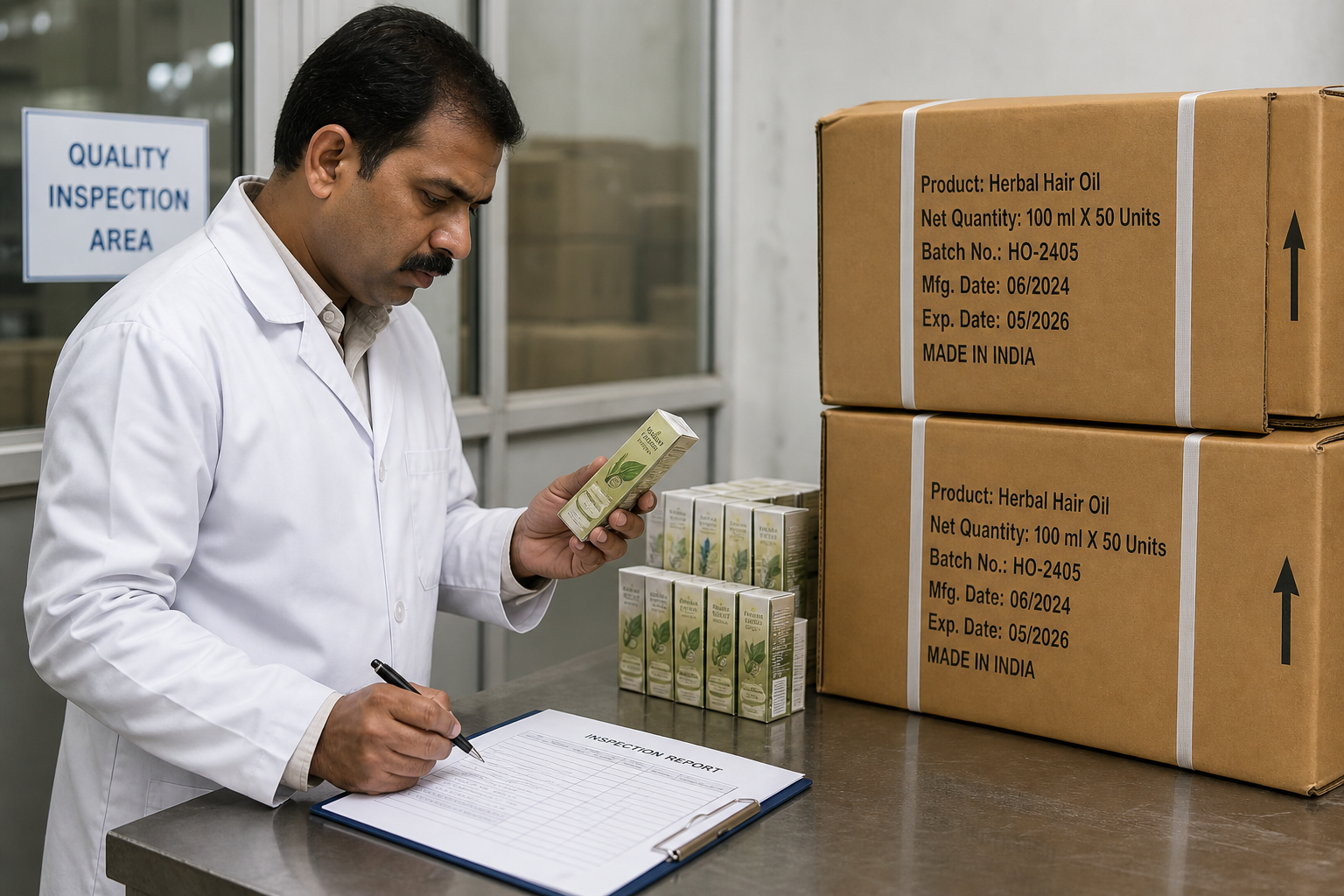
Packaging materials and OEM packaging options in India
India’s packaging ecosystem can support many OEM packaging routes. The right choice depends on category, volume, brand positioning, and destination requirements.
Comparison table
Swipe →
Data table — swipe horizontally on small screens
| Packaging layer | Common India options | Buyer decisions to lock early |
|---|---|---|
| Primary pack | PET/HDPE bottles, glass jars, laminated pouches, tins, folding cartons, polybags, blister or clamshell where available | Material contact suitability, barrier needs, fill method, closure integrity |
| Labels and decoration | Pressure-sensitive labels, shrink sleeves, direct print, hot stamp, screen print, woven or printed hangtags | Substrate, adhesive, finish, color standard, application method |
| Secondary pack | Retail cartons, sleeves, multipacks, display trays | Shelf presentation, unit count, barcode location, language panels |
| Tertiary / export | Corrugated master cartons, inner partitions, stretch wrap, desiccants, pallets | Board grade, stacking, marks, moisture control, handling marks |
| Information pack | Inserts, IFUs, care labels, authenticity stickers | Content ownership, language, revision control, placement |
Material selection principles that travel across categories
- Match material to product risk. Food-contact, cosmetic-contact, and textile care information create different evidence needs than a non-food housewares item.
- Prefer proven local constructions when a novel pack structure would add untested tooling and delay.
- Separate “nice to have” finishes from launch-critical requirements. Soft-touch varnish and specialty foils can wait if they extend lead time beyond the commercial window.
- Confirm who buys each component. If the buyer nominates a bottle and the factory fills it, ownership of rejects, residuals, and timing must be explicit.
- Record substitution rules. A change from one film laminate to another, or from glass to PET, can affect claims, shipping weight, breakage, and customer perception even when the product inside is unchanged.
Cross-category private label still benefits from a few stable principles:
OEM packaging India capability is broad, but not every factory is a packaging specialist. When evaluating manufacturers, ask whether packaging is in-house, outsourced, or mixed, and who manages printer quality. Manufacturer selection depth belongs in how to choose a private label manufacturer in India; packaging questions should still appear on that scorecard.
Artwork workflow for private label artwork compliance India
Artwork is where brand intent meets production reality. A disciplined workflow reduces the chance that the wrong claim set, outdated logo, or unapproved translation reaches the printer.
The Artwork Revision Gate
- Content lock: buyer-approved legal copy, claims, ingredients or composition text where required, and language set.
- Design lock: layout on the actual dieline or label template.
- Technical lock: print-ready file, barcodes, quiet zones, minimum text size, and color references.
- Proof lock: approved digital and, where needed, physical proof.
- Production release: only the locked revision may be printed or applied.
- Change control: any later edit creates a new revision identifier and restarts the affected gates.
Use the Artwork Revision Gate as a named checkpoint sequence:
Name files with SKU, market, and revision. “Final_v2_reallyfinal.pdf” is not a control system. The purchase order, packing list, and inspection checklist should reference the same revision string the printer used.
Roles and responsibilities
Comparison table
Swipe →
Data table — swipe horizontally on small screens
| Role | Owns | Does not own by default |
|---|---|---|
| Buyer / brand | Destination rules, claims decisions, barcode ownership, artwork approval, market languages | Day-to-day printer chase in India unless self-managing |
| Regulatory adviser (buyer-side) | Interpretation of destination labeling law and claim boundaries | Factory production scheduling |
| Manufacturer / filler | Feasibility, application process, coding execution, pack integrity | Inventing destination-compliant claim language |
| Packaging converter / printer | Print quality against approved file and material specs | Product formula or finished-goods QC policy |
| India sourcing partner | Coordination, revision control on the ground, exception escalation, packing evidence | Final regulatory sign-off for the destination market |
This division matters for private label artwork compliance India programmes. Factories can tell you what fits on a label and what their printer can hold. They should not be treated as the buyer’s counsel for US, UK, EU, GCC, Australian, or Canadian labeling law.

Labeling requirements for India export: principles by category family
Private label labeling requirements India export programmes vary by product family and destination. The following is principle-level guidance for planning—not legal advice and not a substitute for market-specific counsel or qualified regulatory review.
Food and edible ingredients
Food labeling commonly turns on identity of the food, ingredient list rules, allergen declaration practices, net quantity, origin or importer identity where required, nutrition presentation formats, date marking, and claim restrictions. A buyer exporting private-label spices, blends, oils, or packaged foods from India should supply the exact panel content and layout rules for each destination. Do not assume an India-domestic label layout will satisfy the import market. Storage statements and lot coding are often operationally critical even when the brand focuses on front-of-pack design.
Cosmetics and personal care
Cosmetic labeling often emphasizes product identity, responsible person or importer details depending on the market, ingredient listing conventions, net content, function or usage directions, batch identification, and cautionary statements. Claims about performance, natural positioning, or therapeutic effect can trigger different evidence expectations. The buyer should decide claim boundaries before artwork starts. The India manufacturer can usually execute INCI-style lists or buyer-supplied ingredient text when those texts are provided and freeze-controlled; the manufacturer should not invent marketing claims to fill empty panel space.
Textiles and soft goods
Textile labeling frequently centers on fiber content, care instructions, size designation, country of origin, and brand or manufacturer identification rules that vary by market. Hangtags and sewn-in labels both need revision control. Color, shrinkage, and finishing can interact with care-claim accuracy; packaging copy should not promise care performance the product specification does not support.
General merchandise and housewares
Even when a category is less claim-sensitive than food or cosmetics, packaging may still need accurate product description, quantity, safety warnings, age grading where relevant, material disclosures, and barcode integrity. Marketplace sellers often face additional channel rules that are commercial rather than statutory; those still need to be written into the packaging brief.
Across all families, keep one rule visible: the buyer decides compliance content; India executes the approved content. If the destination market is not yet chosen, do not print final market-specific claims “for later.” Use interim packaging intentionally, or delay branded print until the market set is known.
Barcodes, lot coding, and variable data
Barcode and coding errors are disproportionately expensive because they affect receiving, retail scan-out, traceability, and recall readiness.
Barcodes
- who owns the GS1 company prefix or equivalent numbering system the buyer will use;
- which SKU maps to which GTIN or barcode number;
- symbology required by the channel;
- size, quiet zone, and placement on pack; and
- whether inner packs and master cartons need different codes.
Confirm early:
Ask for a scan test on the actual printed substrate, not only on a laser printout. Low contrast varnish, textured film, or curved bottles can break a code that looked fine on screen.
Lot, batch, and date coding
- what data appears (lot, batch, manufacture date, best before, expiry, or plant code);
- character format and language or numeral conventions;
- location on primary and secondary packs;
- method (inkjet, laser, thermal transfer, emboss); and
- who generates the lot logic and how it links to production records.
Agree the coding format before production:
A coding trial on scrap or setup material is inexpensive insurance. Illegible dates, missing codes, or codes placed under a label fold are common packing failures and are usually preventable.

Export packing that protects private-label presentation
- units per inner and inners per master carton;
- carton internal dimensions and board grade or burst/edge-crush expectations appropriate to the route;
- maximum stacking height assumption;
- use of partitions, corner boards, or void fill for fragile items;
- pallet type, footprint, and wrap method where palletization is used;
- protection against moisture, dust, or odor transfer where the category needs it;
- shipping marks: PO, SKU, description, quantity, destination, handling marks, and cartons of total; and
- whether cartons are retail-ready or will be reworked in the destination warehouse.
Export packing should be specified with the same seriousness as the retail label.
Define:
Ask the factory to photograph a packed carton sample against the packing standard before mass packing when the pack is new. A sourcing partner can compare marks and pack configuration to the buyer’s instructions and flag mismatches while correction is still possible.
For merchant-export or consolidated handoff models, clarify who applies final marks and who is responsible if carton data does not match documents. Service options are outlined under merchant exporter India and private label manufacturing India.

Common packaging and labeling failures—and how to prevent them
Comparison table
Swipe →
Data table — swipe horizontally on small screens
| Failure | Typical cause | Prevention |
|---|---|---|
| Wrong revision printed | Multiple “final” files in email threads | Single revision register; PO cites revision ID |
| Noncompliant claims on pack | Factory or designer filled gaps without buyer legal review | Content lock before design lock; buyer owns claims |
| Barcode will not scan | Size, contrast, curve, or quiet-zone issues | Scan test on real substrate; channel size rules |
| Missing or unreadable lot code | Coding not trialled; poor placement | Coding trial; define location and format in pack spec |
| Label lift or wrinkling | Wrong adhesive or application on cold/dirty packs | Material qualification; process checks at application |
| Mixed SKUs in cartons | Shared packing line without segregation | SKU segregation plan; carton audits |
| Crushed or damp goods | Weak cartons or poor moisture control | Board grade and route-appropriate packing standard |
| Document vs pack mismatch | Marks or quantities differ from invoice/packing list | Pre-shipment document and mark reconciliation |
What not to do
- Do not approve artwork from memory after a video call.
- Do not assume the factory’s “export standard carton” meets your retailer drop-test or stacking needs.
- Do not let marketing rewrite claims after the printer has plates or cylinders in process without a formal revision and cost/time impact.
- Do not treat packaging QC as optional because product QC looked acceptable. Pack presentation is part of the deliverable.
- Do not outsource destination legal interpretation to the lowest-cost quote.
Brand misuse, artwork leakage, and unauthorized reprinting sit adjacent to this topic but belong primarily to brand-protection controls. For NDAs, artwork access, and IP operating practice, see how to protect your brand when working with Indian private label manufacturers.
Building packaging into the private-label timeline
- Freeze product essentials enough to size the pack.
- Issue the packaging brief and destination assumptions.
- Select pack structure and component suppliers.
- Lock content and design through the Artwork Revision Gate.
- Place packaging component orders with realistic print lead times.
- Run proofs and coding trials.
- Release production packaging only against the locked revision.
- Verify application and export packing before shipment.
- Capture photos and retained samples of packed goods for the shipment file.
A practical sequence for many programmes:
If packaging is on the critical path, say so in the project plan. Buyers sometimes negotiate product MOQ carefully and ignore that a custom carton print run or specialty bottle may set a higher practical minimum. Align packaging economics with the order strategy in the main sourcing plan and the MOQ article linked above.

How an India sourcing partner helps without taking regulatory ownership
- translate the buyer’s pack brief into manufacturer- and printer-ready questions;
- confirm which components are local, bought-out, or buyer-supplied;
- maintain the live revision on the ground;
- chase proofs and report deviations with photos;
- check that coding format and carton marks match instructions;
- coordinate packing checks as part of agreed inspection; and
- escalate when the factory proposes an unapproved substitute material or layout.
A capable partner can:
A partner should not silently rewrite claims to “make the label fit,” approve a destination-compliance question without buyer authority, or imply that a clean packing photo equals legal market clearance. Those boundaries keep accountability clear.
Altus Exports works with buyers through private label manufacturing in India and global sourcing partner India service models when packaging coordination, manufacturer alignment, and export readiness need local follow-through.
Conclusion: treat packaging as controlled production, not an afterthought
Private label packaging and labeling in India work when ownership is explicit and files are locked. The buyer decides destination compliance content and approves artwork. Indian manufacturers and converters execute materials, print, coding, and export packing against that baseline. Proofs, revision control, barcode and lot checks, and carton standards prevent the failures that most often turn a good product into a rejected shipment.
Build packaging into the same timeline as product development and manufacturer selection. Use the Packaging Control Framework—brief, specify, prove, apply, ship—and keep the Artwork Revision Gate visible to everyone who touches a file. When local coordination is needed, a sourcing partner can help the India side execute cleanly without taking over the buyer’s regulatory accountability.