
Private Label Manufacturing in India: How the Process Works
By Saurabh Mittal, Founder, Altus Exports
Private label manufacturing in India typically follows a controlled sequence: product brief and commercial assumptions, supplier alignment, sampling and revisions, buyer approval and specification freeze, production planning, manufacturing and packing, inspection against…
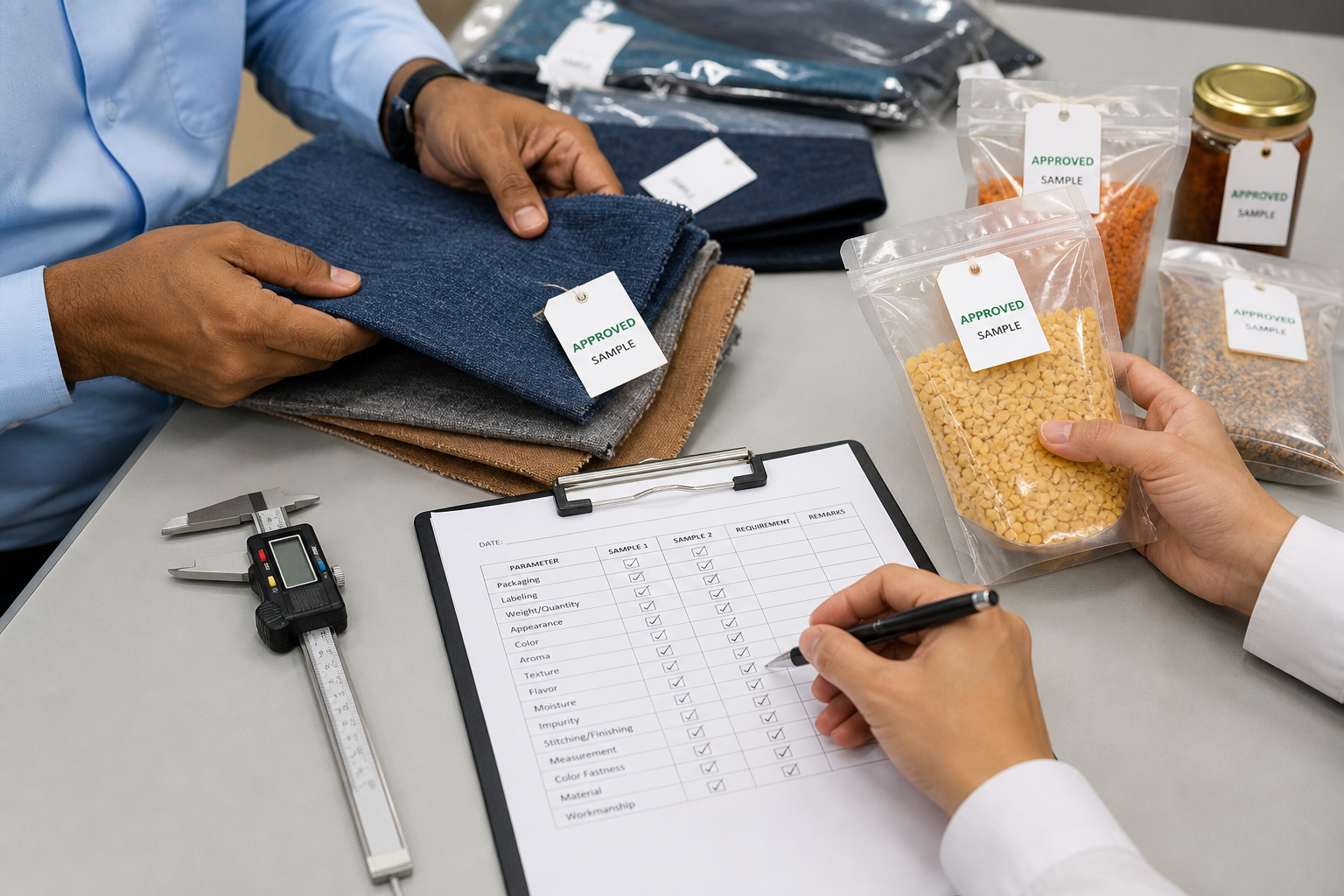
Private label manufacturing in India is not a single factory task. It is a staged workflow that turns a buyer’s brand brief into approved samples, a frozen production specification, manufactured and packed goods, inspected lots, and an export-ready handoff. International buyers who treat the process as “find a factory and place an order” often discover late that packaging, artwork, tolerances, materials, or inspection criteria were never locked.
A clear process protects both sides. The manufacturer knows what to produce. The buyer knows what to approve, when to pay, and what evidence to require before goods leave India. The same sequence applies whether you are building OEM private label from a custom specification or adapting a white-label base product with your brand and pack presentation. The depth of development differs; the control points remain similar.
Altus Exports supports international buyers as an India-based private-label and sourcing partner, helping coordinate manufacturing stages, sampling records, production follow-up, quality checks, and export handoffs within an agreed scope. This article maps the private label manufacturing India process stage by stage so you can run OEM or white-label production with visible gates—not informal messaging and hope.
For the full sourcing playbook around this workflow, see how to source private label products from India. For creative NPD, formulation depth, and idea-to-freeze development, see private label product development in India. Packaging compliance detail belongs in private label packaging and labeling in India.
The short answer: private label manufacturing is a gated production system
- brief and commercial assumptions;
- manufacturer capability alignment;
- sampling and revision control;
- buyer approval and specification freeze;
- purchase order and production planning;
- manufacturing, packing, and batch records;
- inspection and release decisions;
- export document assembly and logistics handoff.
In practical terms, private label production steps in India usually include:
OEM manufacturing process India work adds more technical definition before production. White label manufacturing workflow India work often starts closer to an existing base product, then adds branding, pack, and destination requirements. Both models fail for the same reasons: vague briefs, informal sample approvals, late artwork, and inspection criteria invented after packing is finished.
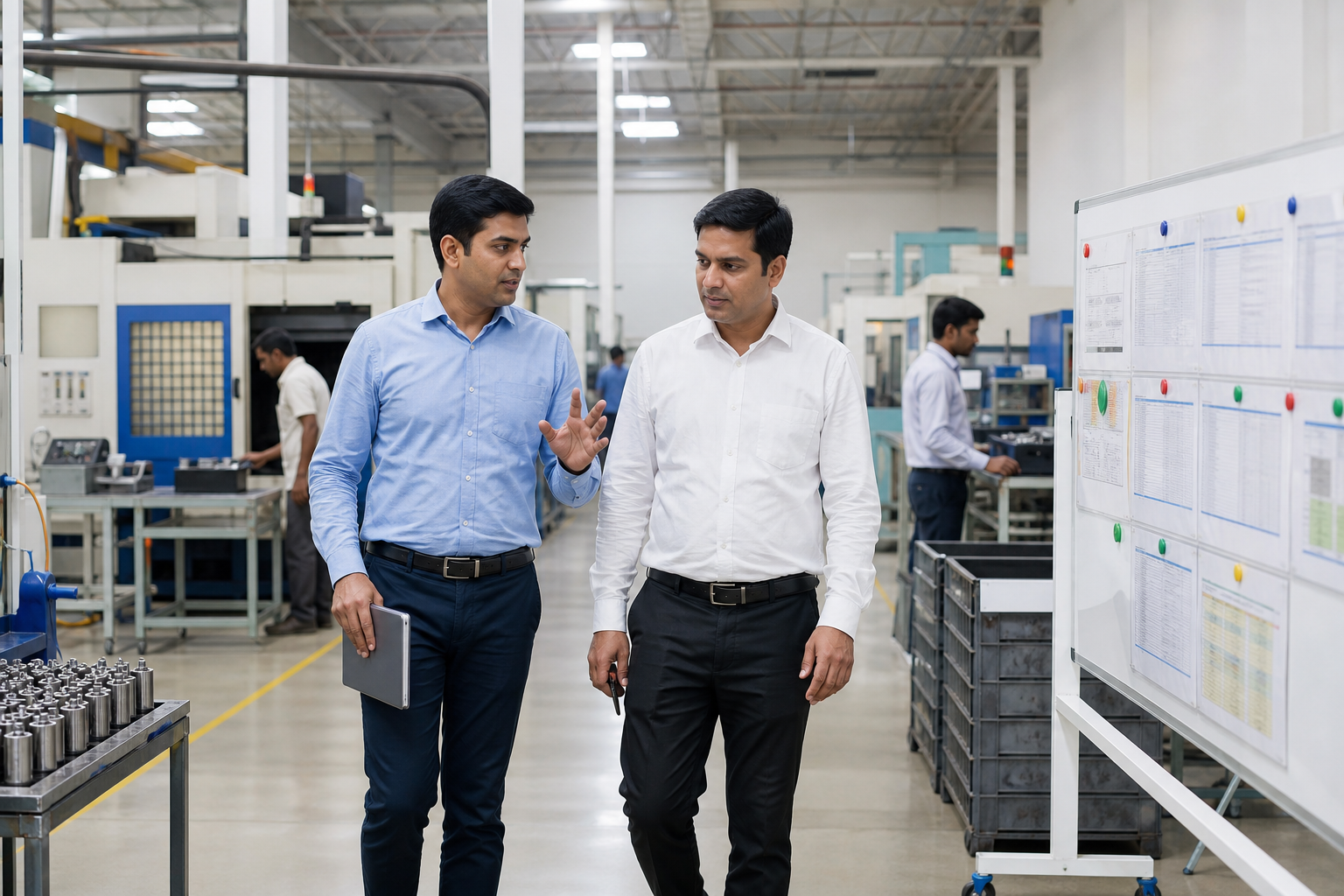
Private Label Manufacturing Control Chain
The Private Label Manufacturing Control Chain is a named operating framework for buyers who need visibility from brief to shipment. Each link has a purpose, a primary owner, and a minimum record. If a link is skipped, risk usually appears later as cost, delay, or quality dispute.
Use this chain when scoping private label manufacturing in India or when comparing manufacturers. A factory that can produce well but cannot maintain approval records is still a process risk.
Comparison table
Swipe →
Data table — swipe horizontally on small screens
| Stage | Purpose | Primary owner | Minimum record | Buyer gate |
|---|---|---|---|---|
| 1. Brief | Define product, brand, volume, and constraints | Buyer (+ coordinator) | Written brief; open questions list | Confirm priorities and assumptions |
| 2. Capability alignment | Confirm factory can make the product at intended scale | Manufacturer / sourcing partner | Capability notes; risk flags | Approve factory for sampling |
| 3. Sampling | Prove the physical product against the brief | Manufacturer | Sample tracker; revision log | Approve, revise, or stop |
| 4. Spec freeze | Lock the production basis | Buyer + manufacturer | Approved sample ID; frozen spec pack | Sign off production version |
| 5. Production planning | Convert approval into schedule, materials, and packing plan | Manufacturer | Production plan; material readiness | Approve critical changes |
| 6. Make and pack | Produce and pack to frozen specification | Manufacturer | Batch / process records as agreed | Escalate deviations only |
| 7. Inspection | Verify lot against acceptance criteria | Buyer / inspector / partner | Inspection report; NCR log | Accept, rework, hold, or reject |
| 8. Export handoff | Transfer goods and documents for shipment | Exporter + logistics parties | Document checklist; cargo readiness | Approve shipping instructions |
Stage 1: Build a manufacturing brief, not a wish list
- product category, intended use, and target market;
- reference sample, photos, drawing, bill of materials, or technical sheet;
- dimensions, materials, colors, finishes, tolerances, and performance expectations;
- brand presentation: logo placement, labels, inserts, barcodes, and inner/outer packing intent;
- estimated trial quantity, first order, and reorder cadence;
- target price context if the buyer chooses to share it;
- required certifications, test reports, or market rules identified by the buyer;
- Incoterm preference, destination, and timing window;
- sample approval method and quality-acceptance approach.
The private label manufacturing India process starts with a brief that manufacturers can quote and produce against. A brand mood board alone is not enough. Factories need measurable inputs, commercial boundaries, and destination constraints that affect materials, packing, labeling, and testing.
A usable manufacturing brief typically covers:
The coordinator or sourcing partner should flag missing items that will distort quotes. They should not invent compliance claims for an overseas market. For regulated categories, buyers should obtain appropriate legal, testing, and market-compliance advice; manufacturing partners can coordinate supplier evidence within scope.
Illustrative example: A US retailer requests “premium cotton throw blankets under private label.” Without GSM, size tolerance, stitching standard, label content, polybag type, carton marks, and trial quantity, three factories will quote three different products. The Control Chain fails at Stage 1 before sampling even begins.
Stage 2: Align the manufacturer to the production model
- process fit (weaving, filling, blending, molding, assembly, finishing, and so on);
- branding and packing capability for your presentation level;
- realistic capacity versus your launch and reorder windows;
- experience with export packing and documentation discipline;
- willingness to work from frozen specifications and revision control;
- ability to support OEM customization versus white-label adaptation.
Before sampling, confirm that the shortlisted factory fits the manufacturing model you intend to run. Capability alignment is not the same as deep manufacturer selection scoring; that belongs in how to choose a private label manufacturer in India. At this stage, the question is narrower: can this plant execute this process path?
Check for:
If you are still discovering factories, use how to find private label manufacturers in India and find manufacturers in India for search and shortlisting, then return to this process map for execution.
Stage 3: Run sampling as a controlled experiment
- sample type requested (development, pre-production, size set, color, pack mock-up);
- cost, freight responsibility, and expected timeline;
- version ID for every physical sample;
- structured buyer feedback, not scattered chat comments;
- revision instructions tied to the previous version;
- photographs and measurement notes where relevant;
- clear decision: approve, revise, or reject.
Sampling is where the written brief becomes a physical product. In OEM manufacturing process India programs, sampling may include material swatches, proto samples, engineering samples, color standards, and packaging mock-ups. In white label manufacturing workflow India programs, sampling may start with a base SKU and then prove brand, pack, and minor specification changes.
A controlled sample process should include:
Do not treat an attractive photograph as an approved production standard. The sample that will govern production must be identified, retained or photographically archived, and referenced in the purchase order or manufacturing agreement.
Sample decision matrix
Comparison table
Swipe →
Data table — swipe horizontally on small screens
| Sample outcome | What it means | Next process step | Risk if ignored |
|---|---|---|---|
| Approve as-is | Product matches brief for production | Proceed to specification freeze | Low if records are complete |
| Approve with notes | Minor changes required before production | Issue revision and confirm updated sample or written delta | Medium—notes can be forgotten |
| Revise | Material product gap remains | New sample version required | High if production starts early |
| Reject | Factory or concept is not viable | Stop or change manufacturer / brief | High if buyer forces a “fix later” |
Stage 4: Freeze the specification before production money moves
- approved sample version ID and date;
- final product specification or technical sheet;
- materials and components list with acceptable equivalents if any;
- color, finish, and tolerance standards;
- branding placement and artwork file versions (without turning this article into a packaging encyclopedia);
- packing configuration: unit, inner, master carton, marks;
- inspection criteria and critical defects;
- labeling and destination statements confirmed by the buyer;
- commercial terms: MOQ, price basis, Incoterm, payment milestones.
Specification freeze is the central control in private label production steps India. Until freeze, the product is still under development. After freeze, changes are commercial events with cost, lead-time, and quality consequences.
A practical freeze pack often includes:
Creative formulation work, sensory development, and extended NPD loops belong in the product-development article. Here, the manufacturing process only needs one rule: production should not begin on an unfrozen brief.
Altus Exports can help buyers keep sample versions, approval notes, and freeze records organized across manufacturers, but the buyer normally retains final approval authority unless that authority is explicitly delegated in writing.

Stage 5: Convert approval into a production plan
- material and component procurement timing;
- pre-production confirmation or pilot if required;
- production start and expected completion;
- packing start and cartonization plan;
- inspection window;
- cargo-readiness target;
- dependencies such as buyer artwork, labels, barcodes, or accessories.
After freeze and commercial confirmation, the manufacturer builds a production plan. This is where private label manufacturing stops being a design conversation and becomes an operations schedule.
A usable production plan should show:
Buyers should ask what can delay the plan. Common blockers include delayed artwork approval, imported components, seasonal material shortages, festival calendars, and last-minute brand changes. MOQ economics and trial-order strategy are covered separately in private label MOQ in India; in the manufacturing workflow, the practical question is whether the ordered quantity and material plan match the frozen specification.
Production readiness checklist
- purchase order or manufacturing contract references the frozen version;
- payment or deposit terms are clear;
- materials are available or ordered;
- packaging components and labels are ready or scheduled;
- inspection standard is agreed;
- shipping window and Incoterm are understood by the parties who will execute them.
Before the factory starts bulk production, confirm:
Stage 6: Manufacture and pack to the frozen standard
- planned versus actual milestone dates;
- quantity completed versus quantity ordered;
- material substitutions requested or made;
- process or packing deviations;
- in-process quality observations;
- decisions required from the buyer and deadlines.
During manufacturing, the factory owns process control. The buyer’s role is not to micromanage every machine setting. It is to receive milestone visibility and to decide quickly when a deviation affects brand, safety, or commercial acceptance.
Useful production follow-up reports cover:
Packing is part of manufacturing, not an afterthought. Damaged cartons, wrong assortment, missing labels, or incorrect shipping marks create destination problems even when the product itself is acceptable. Keep packing tied to the freeze pack. Detailed artwork compliance and destination labeling rules are owned by the packaging article; in this process map, packing means executing the approved configuration.
For multi-SKU private label programs, maintain separate freeze packs and packing instructions. A home-textile set, a spice assortment, and a lifestyle gift SKU should never share one ambiguous “same as last time” instruction.

Stage 7: Inspect against criteria you already agreed
- pre-production confirmation against the approved sample;
- in-process checks during critical operations;
- pre-shipment inspection of finished, packed goods;
- measurement, function, sensory, or appearance checks as relevant;
- carton drop, assortment, barcode, or label verification;
- coordination of laboratory testing where the buyer requires it.
- what was inspected;
- sampling method or lot coverage;
- defects found and severity;
- manufacturer response and corrective action;
- buyer decision: accept, conditional accept, rework, hold, or reject.
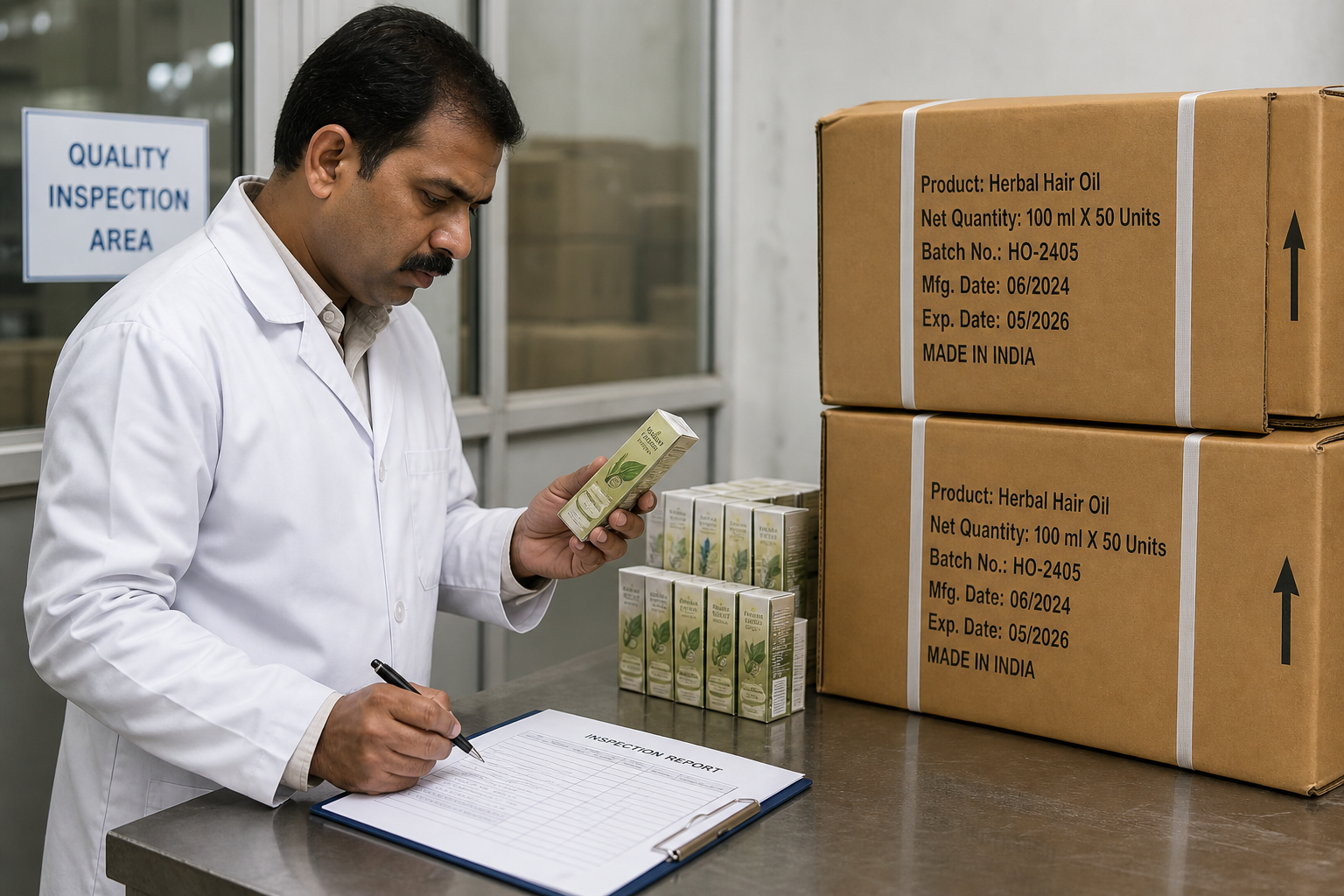
Inspection converts manufacturing output into a release decision. “Looks fine” is not a private-label quality system. Define what will be checked, when, by whom, and what happens if findings fail.
Depending on product risk and order value, inspection may include:
A responsible process distinguishes:
No coordinator should claim that inspection guarantees every unit is perfect. Inspection creates evidence at a point in time against an agreed standard. Broader QC operating systems can be linked from the comprehensive guide: India private label sourcing: supplier, quality control, packaging and export guide.
Stage 8: Complete the export handoff without last-minute chaos
- commercial invoice and packing-list information aligned to the order;
- carton counts, weights, dimensions, and packing configuration;
- shipping marks and buyer references;
- origin, inspection, test, or other documents supplied by relevant parties;
- cargo readiness confirmation;
- forwarder or logistics handoff instructions;
- Incoterm-consistent responsibility boundaries.
When goods pass inspection—or when the buyer accepts a documented disposition—the process moves to export handoff. This stage fails when documents, marks, weights, and shipping instructions are assembled after the truck is waiting.
Export handoff coordination may include:
Confirm who is seller, who is exporter of record, who issues documents, and who owns customs and destination compliance. Do not assume a manufacturer or sourcing partner provides legal, tax, customs classification, or freight advice unless that service is explicitly agreed. A global sourcing partner in India can coordinate the information flow; the commercial structure still needs to be written down.

OEM vs white label: same chain, different starting depth
Buyers often ask whether OEM and white label follow different manufacturing processes. The Control Chain is the same. The starting depth differs.
White label is not “no process.” It still needs brief clarity, sample approval, packing confirmation, inspection, and export handoff. OEM is not “infinite creativity during production.” Creativity belongs before freeze; production belongs after freeze.
Comparison table
Swipe →
Data table — swipe horizontally on small screens
| Dimension | OEM private label | White label / private brand adaptation |
|---|---|---|
| Starting point | Buyer-defined or co-developed specification | Existing base product with brand/pack overlay |
| Sampling load | Usually higher; more revision cycles | Often lower if base product is stable |
| Freeze complexity | Higher technical and packaging freeze | Brand, pack, and limited variant freeze |
| MOQ sensitivity | Often higher due to customization | May be lower if base line already runs |
| Process risk | Spec ambiguity and late changes | Assuming “base product” equals brand-ready export product |
| Best use | Differentiation and controlled brand standards | Faster launch with controlled branding |
Private Label Stage Gate Calendar
The Private Label Stage Gate Calendar helps buyers schedule decisions instead of discovering them late. Exact durations vary by category, material lead time, customization, season, and factory load. Use the calendar as a planning tool, not a promise of fixed timelines.
Category changes the calendar length. Home textiles may wait on yarn or finishing. Spices and natural products may wait on crop, moisture, or lab results. Handicrafts may wait on artisan capacity. The process structure should still be recognizable.
Comparison table
Swipe →
Data table — swipe horizontally on small screens
| Gate | Typical focus period | Buyer decision required | Common delay source |
|---|---|---|---|
| G1 Brief complete | Project week 0–1 | Priorities and constraints confirmed | Incomplete destination or pack requirements |
| G2 Factory aligned | After shortlist | Approve sampling supplier(s) | Capability mismatch found late |
| G3 Sample approved | After 1–n sample rounds | Approve version for freeze | Informal feedback; unclear revisions |
| G4 Spec frozen | Immediately after approval | Sign freeze pack | Artwork or label content still open |
| G5 Production released | After PO / deposit | Authorize bulk start | Material or packing component lag |
| G6 Inspection complete | Near cargo readiness | Accept / rework / reject | Criteria undefined before packing |
| G7 Shipment handed off | After release | Shipping instructions approved | Document mismatch; mark errors |
Who owns what in a private label manufacturing engagement
- brand standards and final product acceptance;
- destination-market compliance decisions and qualified advisers;
- supplier selection and commercial approvals;
- sample and freeze sign-off;
- payment authorizations;
- shipping instruction approvals.
- process capability and manufacturing execution;
- material procurement for agreed specifications;
- in-plant process controls;
- packing to the approved configuration;
- factory documents and production evidence agreed in scope.
- brief structuring and open-question tracking;
- factory coordination and milestone reporting;
- sample logistics and revision records;
- inspection coordination;
- document collection and logistics handoff support;
- multi-supplier critical-path visibility.
Clear ownership prevents polite confusion.
Buyer usually owns:
Manufacturer usually owns:
Sourcing / private-label partner may own (when scoped):
Altus Exports can operate in that coordination layer for cross-category private label programs. It should not be expected to replace destination legal counsel, independent certification bodies, or the manufacturer’s production obligations unless a specific commercial role is agreed.

Common process failures—and how the Control Chain prevents them
Failure 1: Production starts on a verbal sample approval
Use version IDs and a written freeze. Chat compliments are not purchase authorizations.
Failure 2: Artwork arrives after materials are cut or filled
Treat brand and pack components as production inputs with their own readiness date inside the Stage Gate Calendar.
Failure 3: Inspection criteria appear at the dock
Agree acceptance criteria at freeze. Late criteria create disputes, not quality.
Failure 4: Substitutions happen quietly to protect a ship date
Require written deviation requests. A silent material change can become a brand or compliance event.
Failure 5: Multi-SKU orders share one vague packing note
Separate freeze packs and packing instructions by SKU or assortment.
Failure 6: Export documents are treated as clerical leftover
Build the document checklist into Stage 8 before cargo readiness, not after.
Failure 7: OEM creativity continues during bulk production
Move unfinished development back to sampling. Protect production from open experiments.
How to use this process when you engage a partner
- Which stages are included?
- What records will you receive?
- Which decisions remain yours?
- What is excluded?
- How are deviations escalated?
- Who coordinates inspection and export handoff?
If you work with a manufacturer directly, use the Private Label Manufacturing Control Chain as your internal checklist. If you work with a partner, ask them to map their deliverables to each stage:
A proposal that only says “full private label support” is incomplete. A proposal that lists brief support, sample tracker, freeze pack, production milestones, inspection report, and document checklist is operable.
For buyers still designing the overall programme—not only the factory process—return to the pillar guide on sourcing private label products from India. For integrated supplier, QC, packaging, and export mapping, use the comprehensive private label sourcing guide.

Conclusion
Private label manufacturing in India works when it is run as a gated system: brief, capability alignment, controlled sampling, specification freeze, production planning, make-and-pack execution, inspection, and export handoff. OEM and white label differ in development depth, not in the need for written approvals and release criteria.
Use the Private Label Manufacturing Control Chain and Stage Gate Calendar to define ownership, records, and decisions before money and materials move. Whether you engage factories directly or through Altus Exports for coordination support, process clarity is what turns a brand idea into exportable private-label goods without unmanaged surprises.